

Gastritis is inflammation Inflammation Inflammation is a complex set of responses to infection and injury involving leukocytes as the principal cellular mediators in the body's defense against pathogenic organisms. Inflammation is also seen as a response to tissue injury in the process of wound healing. The 5 cardinal signs of inflammation are pain, heat, redness, swelling, and loss of function. Inflammation of the gastric mucosa Gastric mucosa Lining of the stomach, consisting of an inner epithelium, a middle lamina propria, and an outer muscularis mucosae. The surface cells produce mucus that protects the stomach from attack by digestive acid and enzymes. When the epithelium invaginates into the lamina propria at various region of the stomach (cardia; gastric fundus; and pylorus), different tubular gastric glands are formed. These glands consist of cells that secrete mucus, enzymes, hydrochloric acid, or hormones. Stomach: Anatomy and can be classified by time course (acute or chronic), histologic features, and etiology. The predominant causes are Helicobacter pylori Helicobacter pylori A spiral bacterium active as a human gastric pathogen. It is a gram-negative, urease-positive, curved or slightly spiral organism initially isolated in 1982 from patients with lesions of gastritis or peptic ulcers in Western Australia. Helicobacter pylori was originally classified in the genus campylobacter, but RNA sequencing, cellular fatty acid profiles, growth patterns, and other taxonomic characteristics indicate that the micro-organism should be included in the genus Helicobacter. It has been officially transferred to Helicobacter gen. Helicobacter infection and aspirin Aspirin The prototypical analgesic used in the treatment of mild to moderate pain. It has anti-inflammatory and antipyretic properties and acts as an inhibitor of cyclooxygenase which results in the inhibition of the biosynthesis of prostaglandins. Aspirin also inhibits platelet aggregation and is used in the prevention of arterial and venous thrombosis. Nonsteroidal Antiinflammatory Drugs (NSAIDs)/ NSAID NSAID Nonsteroidal antiinflammatory drugs (NSAIDs) are a class of medications consisting of aspirin, reversible NSAIDs, and selective NSAIDs. NSAIDs are used as antiplatelet, analgesic, antipyretic, and antiinflammatory agents. Nonsteroidal Antiinflammatory Drugs (NSAIDs) use. Chronic (metaplastic) gastritis may be due to autoimmune or environmental causes and is a risk factor for gastric cancer Gastric cancer Gastric cancer is the 3rd-most common cause of cancer-related deaths worldwide. The majority of cases are from adenocarcinoma. The modifiable risk factors include Helicobacter pylori infection, smoking, and nitrate-rich diets. Gastric Cancer. Individuals with gastritis may be asymptomatic or may have abdominal pain Abdominal Pain Acute Abdomen, dyspepsia Dyspepsia Impaired digestion, especially after eating. Lactose Intolerance, and nausea Nausea An unpleasant sensation in the stomach usually accompanied by the urge to vomit. Common causes are early pregnancy, sea and motion sickness, emotional stress, intense pain, food poisoning, and various enteroviruses. Antiemetics. Treatment of acute and chronic gastritis due to H. pylori H. pylori A spiral bacterium active as a human gastric pathogen. It is a gram-negative, urease-positive, curved or slightly spiral organism initially isolated in 1982 from patients with lesions of gastritis or peptic ulcers in Western Australia. Helicobacter pylori was originally classified in the genus campylobacter, but RNA sequencing, cellular fatty acid profiles, growth patterns, and other taxonomic characteristics indicate that the micro-organism should be included in the genus Helicobacter. It has been officially transferred to Helicobacter gen. Helicobacter infection involves acid suppression Suppression Defense Mechanisms and antibiotics. Other causes are managed by avoiding offending agents and replacing associated deficiencies.
Last updated: Dec 1, 2025
Gastritis is the inflammation Inflammation Inflammation is a complex set of responses to infection and injury involving leukocytes as the principal cellular mediators in the body’s defense against pathogenic organisms. Inflammation is also seen as a response to tissue injury in the process of wound healing. The 5 cardinal signs of inflammation are pain, heat, redness, swelling, and loss of function. Inflammation of gastric mucosa Gastric mucosa Lining of the stomach, consisting of an inner epithelium, a middle lamina propria, and an outer muscularis mucosae. The surface cells produce mucus that protects the stomach from attack by digestive acid and enzymes. When the epithelium invaginates into the lamina propria at various region of the stomach (cardia; gastric fundus; and pylorus), different tubular gastric glands are formed. These glands consist of cells that secrete mucus, enzymes, hydrochloric acid, or hormones. Stomach: Anatomy associated with mucosal injury.
Gastritis is usually due to an infection or an immune-mediated process.
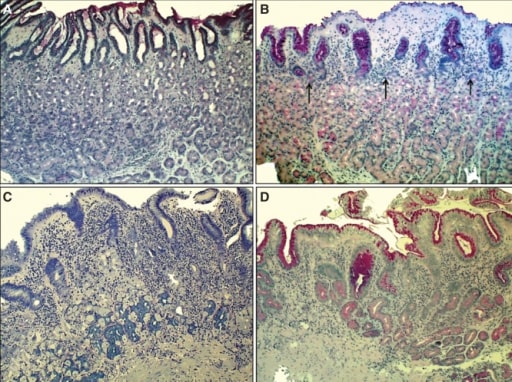
Chronic H. pylori gastritis:
A: Normal mucosa of the corpus
B: Non-atrophic gastritis: mild mononuclear inflammation seen in upper layer of the mucosa (superficial gastritis as indicated by arrows). Gland layer is still intact.
C: Moderate atrophic gastritis: intense chronic mononuclear inflammation occurs in the lower layers, accompanied by atrophy of the oxyntic glands (indicating stomach with hypochlorhydria). Acid secretion is impaired due to loss of parietal cells (in the oxyntic glands).
D: Severe atrophic gastritis, showing mild inflammation but there is loss of oxyntic glands.
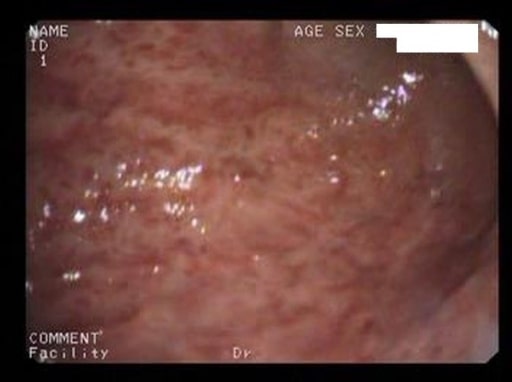
Acute erosive gastritis changes (endoscopic view) in a patient who has had prolonged COX-2 NSAID therapy
Image: “Acute erosive gastritis” by Department of Medical Sciences II, Medical Rehabilitation, University of Medicine and Pharmacy of Craiova, Romania. License: CC BY 2.0
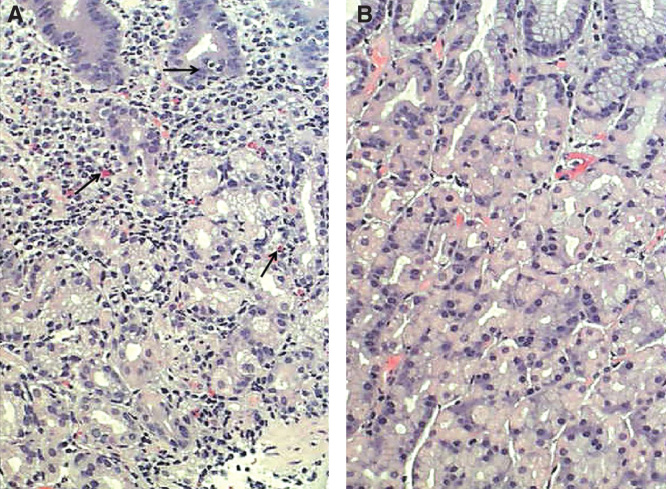
Chronic gastritis. A: mucosal inflammation with many mononuclear cells (arrows); B: normal mucosa.
Image: “Corpus mucosa” by Informa Healthcare. License: CC BY 4.0
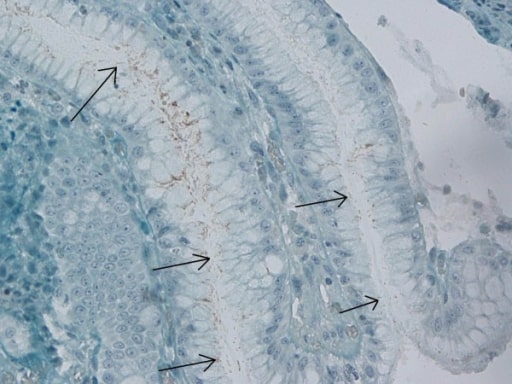
Immunohistochemical stain for H. pylori in the gastric antrum
Image: “Immunohistochemical H. pylori” by Department of Gastroenterology, Bakirkoy Dr Sadi Konuk Training and Research Hospital, Istanbul, Turkey. License: CC BY 2.0