Domina Conceptos Médicos

Estudia para la escuela de medicina y tus examenes con Lecturio.

Cáncer de Pulmón

El cáncer de pulmón es la principal causa de muerte relacionada con el cáncer y se define como la transformación maligna del tejido pulmonar. La mayoría de los LOS Neisseria casos están relacionados con el consumo de tabaco a largo plazo. La enfermedad suele clasificarse histológicamente como cáncer de pulmón de células pequeñas o cáncer de pulmón de células no pequeñas. El perfil molecular del cáncer ofrece una mejor distinción del comportamiento biológico del tumor Tumor Inflammation, el pronóstico y las opciones de tratamiento. Los LOS Neisseria síntomas incluyen tos TOS Thoracic outlet syndrome (TOS) is a broad term used for a spectrum of syndromes related to the general region of the thoracic outlet, which involves the compression or irritation of elements of the brachial plexus, subclavian artery, or subclavian vein. Thoracic Outlet Syndrome, disnea, pérdida de peso y molestias torácicas. La propagación regional y las metástasis provocan síntomas y complicaciones adicionales en EN Erythema nodosum is an immune-mediated panniculitis (inflammation of the subcutaneous fat) caused by a type IV (delayed-type) hypersensitivity reaction. It commonly manifests in young women as tender, erythematous nodules on the shins. Erythema Nodosum función de la localización y él ( los LOS Neisseria) órgano(s) afectado(s). Los LOS Neisseria síndromes paraneoplásicos relacionados incluyen la hipercalcemia, la hiponatremia, el síndrome de Lambert-Eaton, el síndrome de Cushing, la polidermatomiositis y la dermatomiositis. El diagnóstico definitivo y la estadificación se realizan mediante una biopsia, el estudio con pruebas de biomarcadores para determinar la presencia de mutaciones genéticas y la imagenología. El tratamiento depende del estadio del cáncer y el perfil molecular asociado. El cáncer de pulmón posee en EN Erythema nodosum is an immune-mediated panniculitis (inflammation of the subcutaneous fat) caused by a type IV (delayed-type) hypersensitivity reaction. It commonly manifests in young women as tender, erythematous nodules on the shins. Erythema Nodosum líneas generales un mal pronóstico.

Last updated: Dec 15, 2025

Editorial responsibility: Stanley Oiseth, Lindsay Jones, Evelin Maza

Descripción General

Epidemiología

  • El cáncer de pulmón es la principal causa de muerte relacionada con el cáncer en EN Erythema nodosum is an immune-mediated panniculitis (inflammation of the subcutaneous fat) caused by a type IV (delayed-type) hypersensitivity reaction. It commonly manifests in young women as tender, erythematous nodules on the shins. Erythema Nodosum Estados Unidos:
    • El 90% de los LOS Neisseria casos son mortales.
    • La supervivencia es de 5 años en EN Erythema nodosum is an immune-mediated panniculitis (inflammation of the subcutaneous fat) caused by a type IV (delayed-type) hypersensitivity reaction. It commonly manifests in young women as tender, erythematous nodules on the shins. Erythema Nodosum aproximadamente el 18% de los LOS Neisseria casos (incluso con los LOS Neisseria avances en EN Erythema nodosum is an immune-mediated panniculitis (inflammation of the subcutaneous fat) caused by a type IV (delayed-type) hypersensitivity reaction. It commonly manifests in young women as tender, erythematous nodules on the shins. Erythema Nodosum el tratamiento)
    • Muertes anuales:
      • 160 000 en EN Erythema nodosum is an immune-mediated panniculitis (inflammation of the subcutaneous fat) caused by a type IV (delayed-type) hypersensitivity reaction. It commonly manifests in young women as tender, erythematous nodules on the shins. Erythema Nodosum Estados Unidos
      • 1,6 millones a nivel mundial
  • Cada año se registran 230 000 nuevos casos en EN Erythema nodosum is an immune-mediated panniculitis (inflammation of the subcutaneous fat) caused by a type IV (delayed-type) hypersensitivity reaction. It commonly manifests in young women as tender, erythematous nodules on the shins. Erythema Nodosum los LOS Neisseria Estados Unidos (lo que representa el 13% de todos los LOS Neisseria casos de cáncer).
  • La incidencia aumenta con la edad:
    • Infrecuente antes de los LOS Neisseria 50 años de edad
    • La incidencia alcanza su punto máximo a los LOS Neisseria 75–79 años.
  • El 85%–90% de los LOS Neisseria casos de cáncer de pulmón se atribuyen al AL Amyloidosis tabaquismo.

Factores de riesgo

  • Fumar (el más común):
    • Existe un mayor riesgo relacionado con el número de cigarrillos fumados por paquete-año (paquete-año = número de paquetes de cigarrillos fumados al AL Amyloidosis día multiplicado por los LOS Neisseria años que la persona ha HA Hemolytic anemia (HA) is the term given to a large group of anemias that are caused by the premature destruction/hemolysis of circulating red blood cells (RBCs). Hemolysis can occur within (intravascular hemolysis) or outside the blood vessels (extravascular hemolysis). Hemolytic Anemia fumado, suponiendo que hay 20 cigarrillos en EN Erythema nodosum is an immune-mediated panniculitis (inflammation of the subcutaneous fat) caused by a type IV (delayed-type) hypersensitivity reaction. It commonly manifests in young women as tender, erythematous nodules on the shins. Erythema Nodosum 1 paquete)
    • Es más probable que el cáncer de pulmón se desarrolle fumando a una menor intensidad durante un tiempo prolongado que fumando a una mayor intensidad durante corto tiempo.
    • La asociación con los LOS Neisseria cigarrillos electrónicos aún no está clara.
  • Exposiciones ambientales:
    • Humo de segunda mano o humo ajeno (fumadores pasivos)
    • Contaminación del aire
    • Asbesto
    • Radón
    • Cromo
    • Níquel
    • Arsénico
    • Hidrocarburos aromáticos policíclicos
  • Radioterapia
  • Enfermedad pulmonar:
    • Fibrosis Fibrosis Any pathological condition where fibrous connective tissue invades any organ, usually as a consequence of inflammation or other injury. Bronchiolitis Obliterans pulmonar idiopática
    • Deficiencia de alfa-1 antitripsina
    • Enfermedad pulmonar obstructiva crónica (EPOC)
  • Infección por VIH
  • Antecedentes familiares
  • Consumo de alcohol

Fisiopatología y Clasificación

Fisiopatología

  • No se comprende del todo
  • El consumo de cigarrillos expone a los LOS Neisseria pacientes a agentes carcinógenos:
    • Los LOS Neisseria hidrocarburos aromáticos policíclicos ocasionan mutaciones en EN Erythema nodosum is an immune-mediated panniculitis (inflammation of the subcutaneous fat) caused by a type IV (delayed-type) hypersensitivity reaction. It commonly manifests in young women as tender, erythematous nodules on the shins. Erythema Nodosum el p53 → la supresión tumoral se compromete
    • Se cree que es un factor de acumulación de mutaciones tipo “driver” (inductoras de proliferación celular) adquiridas (alteraciones que inician el desarrollo de la malignidad en EN Erythema nodosum is an immune-mediated panniculitis (inflammation of the subcutaneous fat) caused by a type IV (delayed-type) hypersensitivity reaction. It commonly manifests in young women as tender, erythematous nodules on the shins. Erythema Nodosum una célula no cancerosa)
  • No fumadores:
    • Aproximadamente entre 10% y 20% de los LOS Neisseria cánceres de pulmón (más a menudo en EN Erythema nodosum is an immune-mediated panniculitis (inflammation of the subcutaneous fat) caused by a type IV (delayed-type) hypersensitivity reaction. It commonly manifests in young women as tender, erythematous nodules on the shins. Erythema Nodosum mujeres)
    • En EN Erythema nodosum is an immune-mediated panniculitis (inflammation of the subcutaneous fat) caused by a type IV (delayed-type) hypersensitivity reaction. It commonly manifests in young women as tender, erythematous nodules on the shins. Erythema Nodosum los LOS Neisseria Estados Unidos, aproximadamente el 20% de las mujeres con cáncer de pulmón nunca han fumado, contra el ~10 % de los LOS Neisseria hombres con cáncer de pulmón.
    • El 50 % al AL Amyloidosis 60 % de los LOS Neisseria casos de cáncer de pulmón en EN Erythema nodosum is an immune-mediated panniculitis (inflammation of the subcutaneous fat) caused by a type IV (delayed-type) hypersensitivity reaction. It commonly manifests in young women as tender, erythematous nodules on the shins. Erythema Nodosum no fumadores son adenocarcinomas.
    • El 10 % al AL Amyloidosis 20 % de los LOS Neisseria casos de cáncer de pulmón en EN Erythema nodosum is an immune-mediated panniculitis (inflammation of the subcutaneous fat) caused by a type IV (delayed-type) hypersensitivity reaction. It commonly manifests in young women as tender, erythematous nodules on the shins. Erythema Nodosum no fumadores son carcinomas de células escamosas.
    • Se encuentran mutaciones asociadas y abordables (probablemente mutaciones del receptor Receptor Receptors are proteins located either on the surface of or within a cell that can bind to signaling molecules known as ligands (e.g., hormones) and cause some type of response within the cell. Receptors del factor de crecimiento epidérmico (EGF, por sus siglas en EN Erythema nodosum is an immune-mediated panniculitis (inflammation of the subcutaneous fat) caused by a type IV (delayed-type) hypersensitivity reaction. It commonly manifests in young women as tender, erythematous nodules on the shins. Erythema Nodosum inglés)).
  • Lesiones precursoras:
    • Hiperplasia adenomatosa atípica
    • Adenocarcinoma in situ
    • Displasia escamosa y carcinoma in situ
    • Hiperplasia pulmonar idiopática difusa de células neuroendocrinas

Esquema de clasificación

  • Principales tipos histológicos de cáncer de pulmón:
    • El carcinoma de pulmón de células no pequeñas (NSCLC, por sus siglas en EN Erythema nodosum is an immune-mediated panniculitis (inflammation of the subcutaneous fat) caused by a type IV (delayed-type) hypersensitivity reaction. It commonly manifests in young women as tender, erythematous nodules on the shins. Erythema Nodosum inglés) constituye el 85% de todos los LOS Neisseria cánceres de pulmón y generalmente se subcategoriza en EN Erythema nodosum is an immune-mediated panniculitis (inflammation of the subcutaneous fat) caused by a type IV (delayed-type) hypersensitivity reaction. It commonly manifests in young women as tender, erythematous nodules on the shins. Erythema Nodosum:
      • Adenocarcinoma
      • Carcinoma de células escamosas (CCE)
      • Carcinoma de células grandes
    • El carcinoma de pulmón de células pequeñas (SCLC, por sus siglas en EN Erythema nodosum is an immune-mediated panniculitis (inflammation of the subcutaneous fat) caused by a type IV (delayed-type) hypersensitivity reaction. It commonly manifests in young women as tender, erythematous nodules on the shins. Erythema Nodosum inglés) constituye el 15% de todos los LOS Neisseria cánceres de pulmón.
  • La clasificación del 2015 de la Organización Mundial de la Salud:
    • Reconoce los LOS Neisseria perfiles histológicos y moleculares heterogéneos de los LOS Neisseria cánceres de pulmón
    • La clasificación utiliza la inmunohistoquímica y los LOS Neisseria hallazgos histológicos para caracterizar los LOS Neisseria tumores.
    • Orienta el enfoque terapéutico para personalizar las estrategias de tratamiento (terapias moleculares dirigidas)

Clasificación de 2015

  • Enumera los LOS Neisseria NSCLC más comunes y agrupa los LOS Neisseria SCLC con otros tumores que presentan una diferenciación neuroendocrina
  • Tumores epiteliales:
    • Adenocarcinoma
    • CCE
    • Carcinoma de células grandes
    • Carcinoma neuroendocrino:
      • Carcinoma de células pequeñas
      • Carcinoma neuroendocrino de células grandes
      • Carcinoide (típico o atípico)
    • Otros tumores epiteliales raros:
      • Carcinoma adenoescamoso
      • Carcinoma pleomórfico
      • Carcinoma de células fusiformes
      • Carcinoma de células gigantes
      • Carcinosarcoma
      • Blastoma pulmonar
      • Otros carcinomas y carcinomas no clasificados
      • Carcinomas de tipo glándula salival
  • Tumores mesenquimales
  • Tumores linfohistiocíticos
  • Tumores de origen ectópico
  • Tumores metastásicos

Patología

Adenocarcinoma

  • El más común (alrededor 40%–50% de los LOS Neisseria cánceres de pulmón)
  • Ubicación: periférica
  • Mutaciones asociadas:
    • Receptor Receptor Receptors are proteins located either on the surface of or within a cell that can bind to signaling molecules known as ligands (e.g., hormones) and cause some type of response within the cell. Receptors de EGF
    • Quinasa de linfoma anaplásico (ALK, por sus siglas en EN Erythema nodosum is an immune-mediated panniculitis (inflammation of the subcutaneous fat) caused by a type IV (delayed-type) hypersensitivity reaction. It commonly manifests in young women as tender, erythematous nodules on the shins. Erythema Nodosum inglés)
    • KRAS
    • BRAF
    • RET
    • ROS1
    • MET MET Preoperative Care
  • Patología:
    • Formación de glándulas neoplásicas
    • Mucina intracitoplasmática
    • Marcadores neumocitarios/inmunohistoquímicos:
      • Factor de transcripción tiroidea 1 (TTF-1, por sus siglas en EN Erythema nodosum is an immune-mediated panniculitis (inflammation of the subcutaneous fat) caused by a type IV (delayed-type) hypersensitivity reaction. It commonly manifests in young women as tender, erythematous nodules on the shins. Erythema Nodosum inglés)
      • Napsina A

Subtipos:

  • Preinvasivo:
    • Hiperplasia adenomatosa atípica (crecimiento ≤ 5 mm)
    • Adenocarcinoma in situ (≤ 3 cm, crecimiento lepídico o crecimiento no invasivo a lo largo de las estructuras alveolares)
  • Invasivo (basado en EN Erythema nodosum is an immune-mediated panniculitis (inflammation of the subcutaneous fat) caused by a type IV (delayed-type) hypersensitivity reaction. It commonly manifests in young women as tender, erythematous nodules on the shins. Erythema Nodosum el patrón predominante):
    • Mínimamente invasivo: ≤ 3 cm de crecimiento lepídico, ≤ 5 mm de invasión
    • Lepídico: El patrón de crecimiento es lepídico con una invasión de > 5 mm.
    • Papilar: Las células tumorales recubren las papilas (con un núcleo central fibrovascular).
    • Micropapilar: Las células tumorales recubren las papilas (sin núcleo fibrovascular central).
    • Acinar: Las células tumorales forman espacios similares a las glándulas.
    • Sólido: carece de características glandulares
    • Mucinoso invasivo: antiguo carcinoma bronquioloalveolar mucinoso
    • Coloide: abundante mucina extracelular
    • Fetal: similar al AL Amyloidosis adenocarcinoma endometrioide
    • Entérico: se asemeja al AL Amyloidosis adenocarcinoma que surge en EN Erythema nodosum is an immune-mediated panniculitis (inflammation of the subcutaneous fat) caused by a type IV (delayed-type) hypersensitivity reaction. It commonly manifests in young women as tender, erythematous nodules on the shins. Erythema Nodosum colon Colon The large intestines constitute the last portion of the digestive system. The large intestine consists of the cecum, appendix, colon (with ascending, transverse, descending, and sigmoid segments), rectum, and anal canal. The primary function of the colon is to remove water and compact the stool prior to expulsion from the body via the rectum and anal canal. Colon, Cecum, and Appendix: Anatomy y recto

Carcinoma de células escamosas

  • Aproximadamente el 20% de los LOS Neisseria cánceres de pulmón
  • Localización:
    • Central
    • Surgen principalmente en EN Erythema nodosum is an immune-mediated panniculitis (inflammation of the subcutaneous fat) caused by a type IV (delayed-type) hypersensitivity reaction. It commonly manifests in young women as tender, erythematous nodules on the shins. Erythema Nodosum el árbol traqueobronquial proximal
  • Mutaciones/deleciones cromosómicas asociadas en EN Erythema nodosum is an immune-mediated panniculitis (inflammation of the subcutaneous fat) caused by a type IV (delayed-type) hypersensitivity reaction. It commonly manifests in young women as tender, erythematous nodules on the shins. Erythema Nodosum:
    • 3p
    • 9p ( locus Locus Specific regions that are mapped within a genome. Genetic loci are usually identified with a shorthand notation that indicates the chromosome number and the position of a specific band along the P or Q arm of the chromosome where they are found. For example the locus 6p21 is found within band 21 of the P-arm of chromosome 6. Many well known genetic loci are also known by common names that are associated with a genetic function or hereditary disease. Basic Terms of Genetics del gen CDKN2A )
    • 17p ( locus Locus Specific regions that are mapped within a genome. Genetic loci are usually identified with a shorthand notation that indicates the chromosome number and the position of a specific band along the P or Q arm of the chromosome where they are found. For example the locus 6p21 is found within band 21 of the P-arm of chromosome 6. Many well known genetic loci are also known by common names that are associated with a genetic function or hereditary disease. Basic Terms of Genetics del gen TP53 )
  • Patología:
    • Puentes intercelulares/desmosomas
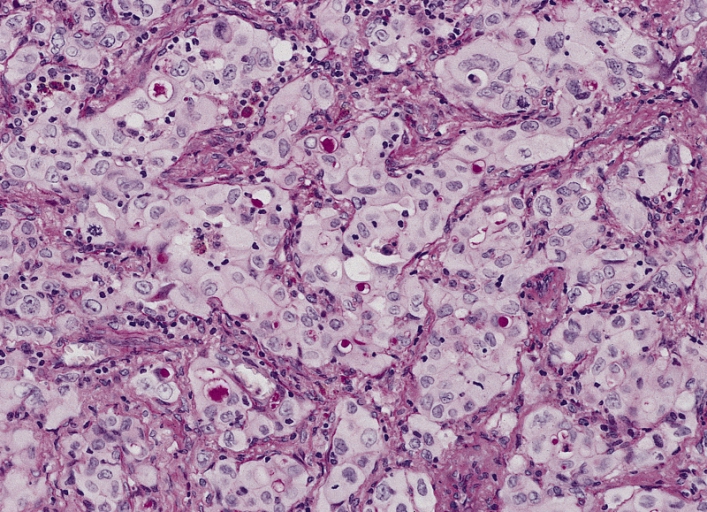
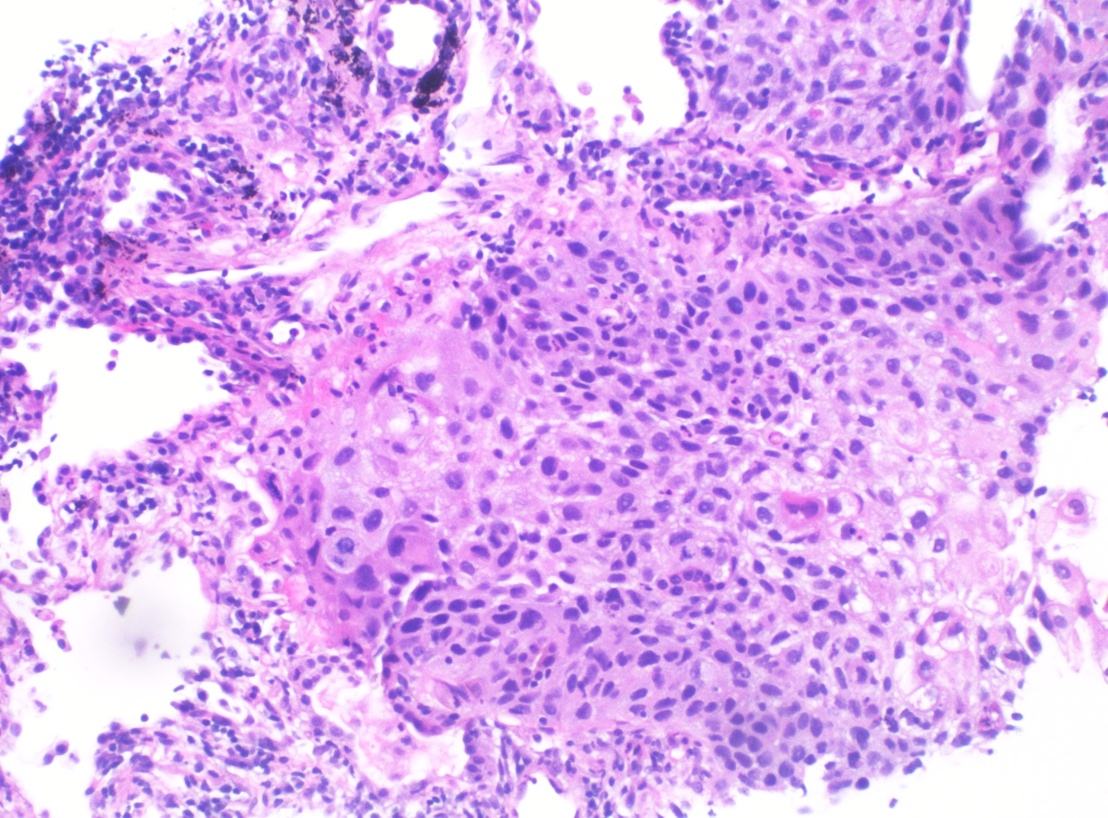
    • Queratinización: perlas escamosas o células con citoplasma eosinófilo
    • El nido de células tumorales infiltrantes muestra una necrosis Necrosis The death of cells in an organ or tissue due to disease, injury or failure of the blood supply. Ischemic Cell Damage central que da lugar a una cavitación.
    • Marcadores inmunohistoquímicos:
      • p40
      • Citoqueratina 5/6
      • p63
  • Asociado a la secreción de péptidos relacionados con la hormona paratiroidea

Subtipos:

  • Queratinizante
  • No queratinizante
  • Basaloide

Carcinoma de células grandes

  • 2% de los LOS Neisseria cánceres de pulmón
  • Ubicación: periférica
  • Patología:
    • Indiferenciada
    • Células tumorales grandes (núcleos grandes, nucleolos prominentes, citoplasma moderado); posiblemente dispuestas en EN Erythema nodosum is an immune-mediated panniculitis (inflammation of the subcutaneous fat) caused by a type IV (delayed-type) hypersensitivity reaction. It commonly manifests in young women as tender, erythematous nodules on the shins. Erythema Nodosum láminas
    • No expresa ningún marcador inmunohistoquímico de adenocarcinoma o carcinoma de células escamosas
  • Puede secretar gonadotropina coriónica humana beta y causar ginecomastia

Carcinoma de pulmón de células pequeñas

  • Alrededor del 15% de todos los LOS Neisseria cánceres de pulmón
  • Muy agresivo: presentación rápida y > 60% con enfermedad metastásica en EN Erythema nodosum is an immune-mediated panniculitis (inflammation of the subcutaneous fat) caused by a type IV (delayed-type) hypersensitivity reaction. It commonly manifests in young women as tender, erythematous nodules on the shins. Erythema Nodosum el momento del diagnóstico
  • Casi siempre se observa en EN Erythema nodosum is an immune-mediated panniculitis (inflammation of the subcutaneous fat) caused by a type IV (delayed-type) hypersensitivity reaction. It commonly manifests in young women as tender, erythematous nodules on the shins. Erythema Nodosum fumadores
  • Ubicación: central
  • Mutaciones genéticas asociadas:
    • TP53
    • MYC
    • RB1
    • BLC2
    • Deleción en EN Erythema nodosum is an immune-mediated panniculitis (inflammation of the subcutaneous fat) caused by a type IV (delayed-type) hypersensitivity reaction. It commonly manifests in young women as tender, erythematous nodules on the shins. Erythema Nodosum 3p
  • Patología:
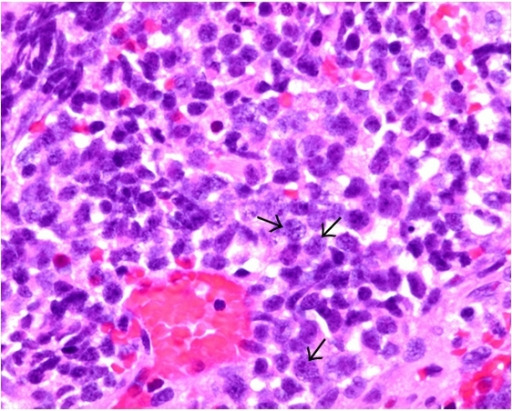
    • Hojas de pequeñas células azules, formación de rosetas, necrosis Necrosis The death of cells in an organ or tissue due to disease, injury or failure of the blood supply. Ischemic Cell Damage
    • Alta tasa mitótica (> 11 mitosis Mitosis A type of cell nucleus division by means of which the two daughter nuclei normally receive identical complements of the number of chromosomes of the somatic cells of the species. Cell Cycle/2 mm²)
    • Células neuroendocrinas de Kulchitsky:
      • Células pequeñas con escaso citoplasma
      • Núcleos hipercromáticos con cromatina finamente granular (patrón de sal y pimienta)
    • Marcadores neuroendocrinos:
      • CD56 (detectado en EN Erythema nodosum is an immune-mediated panniculitis (inflammation of the subcutaneous fat) caused by a type IV (delayed-type) hypersensitivity reaction. It commonly manifests in young women as tender, erythematous nodules on the shins. Erythema Nodosum 90%–100% de los LOS Neisseria casos)
      • Cromogranina A
      • Sinaptofisina
      • Enolasa neuroespecífica
    • Puede ser positiva para TTF-1
  • Puede producir hormonas peptídicas:
    • Hormona adrenocorticotrópica (ACTH, por sus siglas en EN Erythema nodosum is an immune-mediated panniculitis (inflammation of the subcutaneous fat) caused by a type IV (delayed-type) hypersensitivity reaction. It commonly manifests in young women as tender, erythematous nodules on the shins. Erythema Nodosum inglés)
    • Arginina vasopresina u hormona antidiurética (ADH, por sus siglas en EN Erythema nodosum is an immune-mediated panniculitis (inflammation of the subcutaneous fat) caused by a type IV (delayed-type) hypersensitivity reaction. It commonly manifests in young women as tender, erythematous nodules on the shins. Erythema Nodosum inglés)
    • Péptido natriurético auricular (ANP, por sus siglas en EN Erythema nodosum is an immune-mediated panniculitis (inflammation of the subcutaneous fat) caused by a type IV (delayed-type) hypersensitivity reaction. It commonly manifests in young women as tender, erythematous nodules on the shins. Erythema Nodosum inglés)
    • Péptido liberador de gastrina

Carcinoma neuroendocrino de células grandes

  • Cáncer de pulmón raro pero agresivo
  • Asociado al AL Amyloidosis tabaquismo
  • Ubicación: periférica
  • Patología:
    • Disposición celular: nidos, formación de rosetas, necrosis Necrosis The death of cells in an organ or tissue due to disease, injury or failure of the blood supply. Ischemic Cell Damage
    • Las células son grandes con abundante citoplasma eosinófilo.
    • Alta tasa mitótica (> 10 mitosis Mitosis A type of cell nucleus division by means of which the two daughter nuclei normally receive identical complements of the number of chromosomes of the somatic cells of the species. Cell Cycle/2 mm²)
    • Marcadores neuroendocrinos:
      • Cromogranina
      • Sinaptofisina
      • CD56

Carcinoides

  • 1%–2% de todos los LOS Neisseria cánceres de pulmón
  • Tumores neuroendocrinos bien diferenciados (generalmente de crecimiento lento)
  • Pacientes más jóvenes y no fumadores
  • Ubicación: central > periférica
  • Patología:
    • Carcinoide típico: ausencia o leve atipia nuclear con < 2 mitosis Mitosis A type of cell nucleus division by means of which the two daughter nuclei normally receive identical complements of the number of chromosomes of the somatic cells of the species. Cell Cycle/2 mm².
    • Carcinoide atípico: atipia nuclear moderada con 2–10 mitosis Mitosis A type of cell nucleus division by means of which the two daughter nuclei normally receive identical complements of the number of chromosomes of the somatic cells of the species. Cell Cycle/2 mm².

Presentación Clínica

Síntomas generales

  • Asintomático en EN Erythema nodosum is an immune-mediated panniculitis (inflammation of the subcutaneous fat) caused by a type IV (delayed-type) hypersensitivity reaction. It commonly manifests in young women as tender, erythematous nodules on the shins. Erythema Nodosum aproximadamente el 25% de los LOS Neisseria pacientes
  • Tos TOS Thoracic outlet syndrome (TOS) is a broad term used for a spectrum of syndromes related to the general region of the thoracic outlet, which involves the compression or irritation of elements of the brachial plexus, subclavian artery, or subclavian vein. Thoracic Outlet Syndrome (más común):
    • Tos TOS Thoracic outlet syndrome (TOS) is a broad term used for a spectrum of syndromes related to the general region of the thoracic outlet, which involves the compression or irritation of elements of the brachial plexus, subclavian artery, or subclavian vein. Thoracic Outlet Syndrome de nueva aparición en EN Erythema nodosum is an immune-mediated panniculitis (inflammation of the subcutaneous fat) caused by a type IV (delayed-type) hypersensitivity reaction. It commonly manifests in young women as tender, erythematous nodules on the shins. Erythema Nodosum un fumador o exfumador
    • Síntoma frecuente en EN Erythema nodosum is an immune-mediated panniculitis (inflammation of the subcutaneous fat) caused by a type IV (delayed-type) hypersensitivity reaction. It commonly manifests in young women as tender, erythematous nodules on the shins. Erythema Nodosum los LOS Neisseria cánceres escamosos y de células pequeñas debido a su localización central
    • Puede presentar hemoptisis
  • Disnea relacionada con la malignidad:
    • Obstrucción de la vía aérea
    • Atelectasias
    • Derrame pleural
    • Neumotórax
    • Anemia Anemia Anemia is a condition in which individuals have low Hb levels, which can arise from various causes. Anemia is accompanied by a reduced number of RBCs and may manifest with fatigue, shortness of breath, pallor, and weakness. Subtypes are classified by the size of RBCs, chronicity, and etiology. Anemia: Overview and Types
  • Dolor Dolor Inflammation torácico:
    • Vago
    • Localizado
    • Pleurítico
  • Fatiga
  • Caquexia por cáncer:
    • Pérdida de masa muscular y grasa, pérdida de peso, anorexia Anorexia The lack or loss of appetite accompanied by an aversion to food and the inability to eat. It is the defining characteristic of the disorder anorexia nervosa. Anorexia Nervosa
    • Los LOS Neisseria mediadores inflamatorios desempeñan un papel (conducen a la degradación del músculo esquelético)

Diseminación regional

  • Invasión del nervio laríngeo recurrente: disfonía
  • Invasión del nervio frénico:
    • Parálisis diafragmática (elevación del diafragma)
    • Disnea
    • Hipoxia
  • Síndrome de la vena cava superior (VCS):
    • SCLC > NSCLC
    • Compresión o invasión de la VCS que resulta en EN Erythema nodosum is an immune-mediated panniculitis (inflammation of the subcutaneous fat) caused by a type IV (delayed-type) hypersensitivity reaction. It commonly manifests in young women as tender, erythematous nodules on the shins. Erythema Nodosum:
      • Cefalea
      • Sensación de opresión y pesadez en EN Erythema nodosum is an immune-mediated panniculitis (inflammation of the subcutaneous fat) caused by a type IV (delayed-type) hypersensitivity reaction. It commonly manifests in young women as tender, erythematous nodules on the shins. Erythema Nodosum la cabeza
      • Edema Edema Edema is a condition in which excess serous fluid accumulates in the body cavity or interstitial space of connective tissues. Edema is a symptom observed in several medical conditions. It can be categorized into 2 types, namely, peripheral (in the extremities) and internal (in an organ or body cavity). Edema facial
      • Edema Edema Edema is a condition in which excess serous fluid accumulates in the body cavity or interstitial space of connective tissues. Edema is a symptom observed in several medical conditions. It can be categorized into 2 types, namely, peripheral (in the extremities) and internal (in an organ or body cavity). Edema de extremidades superiores
      • Ortopnea
      • Venas dilatadas en EN Erythema nodosum is an immune-mediated panniculitis (inflammation of the subcutaneous fat) caused by a type IV (delayed-type) hypersensitivity reaction. It commonly manifests in young women as tender, erythematous nodules on the shins. Erythema Nodosum el cuello, la cara y el tronco
      • Plétora facial (enrojecimiento)
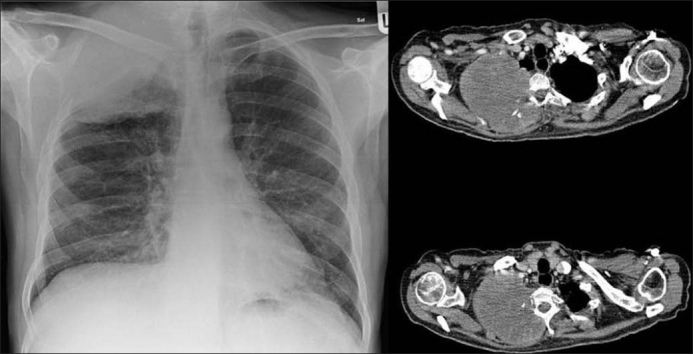
  • Síndrome de Pancoast:
    • Principalmente debido al AL Amyloidosis NSCLC
    • Los LOS Neisseria tumores apicales invaden el plexo braquial, la pleura Pleura The pleura is a serous membrane that lines the walls of the thoracic cavity and the surface of the lungs. This structure of mesodermal origin covers both lungs, the mediastinum, the thoracic surface of the diaphragm, and the inner part of the thoracic cage. The pleura is divided into a visceral pleura and parietal pleura. Pleura: Anatomy o las costillas dando lugar a:
      • Dolor Dolor Inflammation en EN Erythema nodosum is an immune-mediated panniculitis (inflammation of the subcutaneous fat) caused by a type IV (delayed-type) hypersensitivity reaction. It commonly manifests in young women as tender, erythematous nodules on the shins. Erythema Nodosum el hombro y en EN Erythema nodosum is an immune-mediated panniculitis (inflammation of the subcutaneous fat) caused by a type IV (delayed-type) hypersensitivity reaction. It commonly manifests in young women as tender, erythematous nodules on the shins. Erythema Nodosum las extremidades superiores
      • Debilidad de las extremidades superiores
      • Atrofia de la mano ipsilateral
      • Síndrome de Horner: ptosis Ptosis Cranial Nerve Palsies, miosis Miosis Pupil: Physiology and Abnormalities, anhidrosis
  • Diseminación pericárdica:
    • Pericarditis Pericarditis Pericarditis is an inflammation of the pericardium, often with fluid accumulation. It can be caused by infection (often viral), myocardial infarction, drugs, malignancies, metabolic disorders, autoimmune disorders, or trauma. Acute, subacute, and chronic forms exist. Pericarditis dolor Dolor Inflammation torácico
    • Derrame pericárdico (puede condicionar un taponamiento cardíaco) → disnea
  • Compresión esofágica: disfagia

Metástasis

  • Hígado:
  • Cerebro:
    • Cambios del comportamiento y confusión
    • Afasia
    • Déficits neurológicos focales
    • Náusea y vómito
    • Convulsiones
  • Hueso:
  • Glándulas suprarrenales:
    • Generalmente asintomático
    • Insuficiencia suprarrenal (si ambas glándulas están afectadas por un cáncer metastásico):
      • Debilidad
      • Náuseas
      • Anorexia Anorexia The lack or loss of appetite accompanied by an aversion to food and the inability to eat. It is the defining characteristic of the disorder anorexia nervosa. Anorexia Nervosa
      • Desequilibrios electrolíticos

Síndrome paraneoplásico

  • Osteoartropatía pulmonar hipertrófica:
    • Observado en EN Erythema nodosum is an immune-mediated panniculitis (inflammation of the subcutaneous fat) caused by a type IV (delayed-type) hypersensitivity reaction. It commonly manifests in young women as tender, erythematous nodules on the shins. Erythema Nodosum adenocarcinomas y carcinomas de células grandes
    • Dedos hipocráticos o en EN Erythema nodosum is an immune-mediated panniculitis (inflammation of the subcutaneous fat) caused by a type IV (delayed-type) hypersensitivity reaction. It commonly manifests in young women as tender, erythematous nodules on the shins. Erythema Nodosum palillo de tambor
    • Proliferación perióstica de los LOS Neisseria huesos tubulares:
      • Artropatía simétrica y dolorosa
      • Afecta a tobillos, rodillas, muñecas y codos
  • Hipercalcemia:
    • Fuentes:
      • El carcinoma de células escamosas produce la proteína relacionada con la PTH (por sus siglas en EN Erythema nodosum is an immune-mediated panniculitis (inflammation of the subcutaneous fat) caused by a type IV (delayed-type) hypersensitivity reaction. It commonly manifests in young women as tender, erythematous nodules on the shins. Erythema Nodosum inglés).
      • Metástasis óseas extensas
    • Signos y síntomas:
      • Anorexia Anorexia The lack or loss of appetite accompanied by an aversion to food and the inability to eat. It is the defining characteristic of the disorder anorexia nervosa. Anorexia Nervosa
      • Náuseas
      • Estreñimiento
      • Letargo
      • Poliuria y polidipsia
      • Confusión
      • Coma Coma Coma is defined as a deep state of unarousable unresponsiveness, characterized by a score of 3 points on the GCS. A comatose state can be caused by a multitude of conditions, making the precise epidemiology and prognosis of coma difficult to determine. Coma
  • Síndrome de secreción inadecuada de hormona antidiurética ( SIADH SIADH Syndrome of inappropriate antidiuretic hormone secretion (SIADH) is a disorder of impaired water excretion due to the inability to suppress the secretion of antidiuretic hormone (ADH). SIADH is characterized by impaired water excretion leading to dilutional hyponatremia, which is mainly asymptomatic but may cause neurologic symptoms. S Syndrome of Inappropriate Antidiuretic Hormone Secretion (SIADH), por sus siglas en EN Erythema nodosum is an immune-mediated panniculitis (inflammation of the subcutaneous fat) caused by a type IV (delayed-type) hypersensitivity reaction. It commonly manifests in young women as tender, erythematous nodules on the shins. Erythema Nodosum inglés)/ síndrome de Schwartz-Bartter:
    • Asociado al AL Amyloidosis SCLC
    • Signos y síntomas:
      • Anorexia Anorexia The lack or loss of appetite accompanied by an aversion to food and the inability to eat. It is the defining characteristic of the disorder anorexia nervosa. Anorexia Nervosa
      • Náuseas, vómitos
      • Confusión, coma Coma Coma is defined as a deep state of unarousable unresponsiveness, characterized by a score of 3 points on the GCS. A comatose state can be caused by a multitude of conditions, making the precise epidemiology and prognosis of coma difficult to determine. Coma
      • Convulsiones
      • Hiponatremia
  • Síndrome de Lambert-Eaton:
    • Típicamente visto en EN Erythema nodosum is an immune-mediated panniculitis (inflammation of the subcutaneous fat) caused by a type IV (delayed-type) hypersensitivity reaction. It commonly manifests in young women as tender, erythematous nodules on the shins. Erythema Nodosum el SCLC
    • Cuando se asocia a la malignidad, se observa un curso más rápido.
    • Debilidad muscular proximal progresiva o miastenia en EN Erythema nodosum is an immune-mediated panniculitis (inflammation of the subcutaneous fat) caused by a type IV (delayed-type) hypersensitivity reaction. It commonly manifests in young women as tender, erythematous nodules on the shins. Erythema Nodosum la cintura pélvica
  • Síndrome de Cushing:
    • El SCLC puede producir hormona adrenocorticotrópica (ACTH).
    • También se observa en EN Erythema nodosum is an immune-mediated panniculitis (inflammation of the subcutaneous fat) caused by a type IV (delayed-type) hypersensitivity reaction. It commonly manifests in young women as tender, erythematous nodules on the shins. Erythema Nodosum los LOS Neisseria tumores carcinoides
    • Signos y síntomas:
      • Debilidad muscular
      • Pérdida de peso
      • Hipertensión
      • Hirsutismo
      • Osteoporosis Osteoporosis Osteoporosis refers to a decrease in bone mass and density leading to an increased number of fractures. There are 2 forms of osteoporosis: primary, which is commonly postmenopausal or senile; and secondary, which is a manifestation of immobilization, underlying medical disorders, or long-term use of certain medications. Osteoporosis
  • Hipercoagulabilidad:
    • Tromboflebitis superficial migratoria (síndrome de Trousseau)
    • Trombosis venosa profunda y tromboembolismo
    • Coagulopatía intravascular diseminada
  • Dermatomiositis y polimiositis:
    • Se asocia con el cáncer de pulmón, así como con los LOS Neisseria tumores malignos de ovario, páncreas, vejiga y estómago
    • Signos y síntomas:
      • Debilidad muscular proximal
      • Pápulas de Gottron
      • Erupción/eritema heliotropo
      • Signo de Shawl

Diagnóstico

Radiografía de tórax

  • No es diagnóstica, pero suele realizarse en EN Erythema nodosum is an immune-mediated panniculitis (inflammation of the subcutaneous fat) caused by a type IV (delayed-type) hypersensitivity reaction. It commonly manifests in young women as tender, erythematous nodules on the shins. Erythema Nodosum pacientes con síntomas respiratorios
  • Hallazgos que deben crear la sospecha de malignidad:
    • Lesión focal nueva o en EN Erythema nodosum is an immune-mediated panniculitis (inflammation of the subcutaneous fat) caused by a type IV (delayed-type) hypersensitivity reaction. It commonly manifests in young women as tender, erythematous nodules on the shins. Erythema Nodosum aumento
    • Derrame pleural
    • Nodularidad pleural
    • Agrandamiento de los LOS Neisseria ganglios linfáticos hiliares y paratraqueales
    • Lesión endobronquial
    • Neumonía postobstructiva
    • Atelectasia segmentaria o lobar

Tomografía computarizada

  • Se utiliza como herramienta de tamizaje (dosis bajas)
  • La TC de dosis baja produce imagenología de alta resolución con menos radiación:
    • Hallazgos preocupantes en EN Erythema nodosum is an immune-mediated panniculitis (inflammation of the subcutaneous fat) caused by a type IV (delayed-type) hypersensitivity reaction. It commonly manifests in young women as tender, erythematous nodules on the shins. Erythema Nodosum un paciente con un nódulo pulmonar solitario:
      • Tamaño > 15 mm
      • Bordes irregulares o espiculados
      • Ubicación en EN Erythema nodosum is an immune-mediated panniculitis (inflammation of the subcutaneous fat) caused by a type IV (delayed-type) hypersensitivity reaction. It commonly manifests in young women as tender, erythematous nodules on the shins. Erythema Nodosum un lóbulo superior
      • Cavitación
      • Un componente sólido dentro de una lesión de vidrio esmerilado
      • El crecimiento se observa en EN Erythema nodosum is an immune-mediated panniculitis (inflammation of the subcutaneous fat) caused by a type IV (delayed-type) hypersensitivity reaction. It commonly manifests in young women as tender, erythematous nodules on the shins. Erythema Nodosum la imagenología de seguimiento.
    • Los LOS Neisseria nódulos múltiples deben ser preocupantes por las metástasis pulmonares.
  • Los LOS Neisseria hallazgos anormales deben ser seguidos con una TC diagnóstica.
  • Se realiza en EN Erythema nodosum is an immune-mediated panniculitis (inflammation of the subcutaneous fat) caused by a type IV (delayed-type) hypersensitivity reaction. It commonly manifests in young women as tender, erythematous nodules on the shins. Erythema Nodosum todos los LOS Neisseria pacientes con sospecha de cáncer de pulmón para evaluar la localización de:
  • Contribuye a la planificación de la biopsia

Imagenología de seguimiento

Además de la TC, se utilizan las siguientes modalidades para determinar la extensión de la enfermedad con fines de estadificación:
  • PET PET An imaging technique that combines a positron-emission tomography (PET) scanner and a ct X ray scanner. This establishes a precise anatomic localization in the same session. Nuclear Imaging:
    • Evalúa la presencia de metástasis a distancia
    • Estudio más preciso para la evaluación de la enfermedad en EN Erythema nodosum is an immune-mediated panniculitis (inflammation of the subcutaneous fat) caused by a type IV (delayed-type) hypersensitivity reaction. It commonly manifests in young women as tender, erythematous nodules on the shins. Erythema Nodosum mediastino que la TC
    • Evalúa la actividad metabólica del tumor Tumor Inflammation primario
  • RM:
    • Imagenología de preferencia para las metástasis cerebrales y de la columna vertebral
    • Se utiliza para evaluar la afectación de los LOS Neisseria nervios (e.g., el plexo braquial)

Biopsia

  • Se requiere una descripción patológica definitiva para el diagnóstico (se prefiere la biopsia de tejido sobre la muestra citológica).
  • Las muestras de tejido pueden obtenerse por medio de:
    • Broncoscopia con ecografía endobronquial (más común)
    • Mediastinoscopia
    • Biopsia transtorácica con aguja
    • Biopsia endoscópica transesofágica
    • Biopsia pulmonar a cielo abierto
  • Las muestras citológicas pueden obtenerse de esputo, lavados bronquiales y aspirados con aguja.
  • Histopatología: diferencia el NSCLC del SCLC y clasifica los LOS Neisseria cánceres de pulmón
  • Pruebas moleculares adicionales (mutaciones y dianas inmunológicas):
    • Técnicas utilizadas para la determinación de mutaciones (permite realizar terapias dirigidas en EN Erythema nodosum is an immune-mediated panniculitis (inflammation of the subcutaneous fat) caused by a type IV (delayed-type) hypersensitivity reaction. It commonly manifests in young women as tender, erythematous nodules on the shins. Erythema Nodosum el NSCLC):
      • Secuenciación del ADN
      • Técnica de hibridación fluorescente in situ ( FISH FISH A type of in situ hybridization in which target sequences are stained with fluorescent dye so their location and size can be determined using fluorescence microscopy. This staining is sufficiently distinct that the hybridization signal can be seen both in metaphase spreads and in interphase nuclei. Chromosome Testing, por sus siglas en EN Erythema nodosum is an immune-mediated panniculitis (inflammation of the subcutaneous fat) caused by a type IV (delayed-type) hypersensitivity reaction. It commonly manifests in young women as tender, erythematous nodules on the shins. Erythema Nodosum inglés)
      • Inmunohistoquímica
    • Mutaciones inductoras clave detectadas:
      • Mutación del receptor Receptor Receptors are proteins located either on the surface of or within a cell that can bind to signaling molecules known as ligands (e.g., hormones) and cause some type of response within the cell. Receptors de EGF
      • Reordenamientos de ALK
      • Reordenamientos de ROS1
      • Fusión RET
      • BRAF
      • Mutación MET MET Preoperative Care
    • La expresión del ligando de muerte celular programada 1 (PD-L1, por sus siglas en EN Erythema nodosum is an immune-mediated panniculitis (inflammation of the subcutaneous fat) caused by a type IV (delayed-type) hypersensitivity reaction. It commonly manifests in young women as tender, erythematous nodules on the shins. Erythema Nodosum inglés) en EN Erythema nodosum is an immune-mediated panniculitis (inflammation of the subcutaneous fat) caused by a type IV (delayed-type) hypersensitivity reaction. It commonly manifests in young women as tender, erythematous nodules on the shins. Erythema Nodosum la inmunohistoquímica ayuda a determinar el uso de los LOS Neisseria inhibidores de puntos de control en EN Erythema nodosum is an immune-mediated panniculitis (inflammation of the subcutaneous fat) caused by a type IV (delayed-type) hypersensitivity reaction. It commonly manifests in young women as tender, erythematous nodules on the shins. Erythema Nodosum las terapias contra el cáncer.
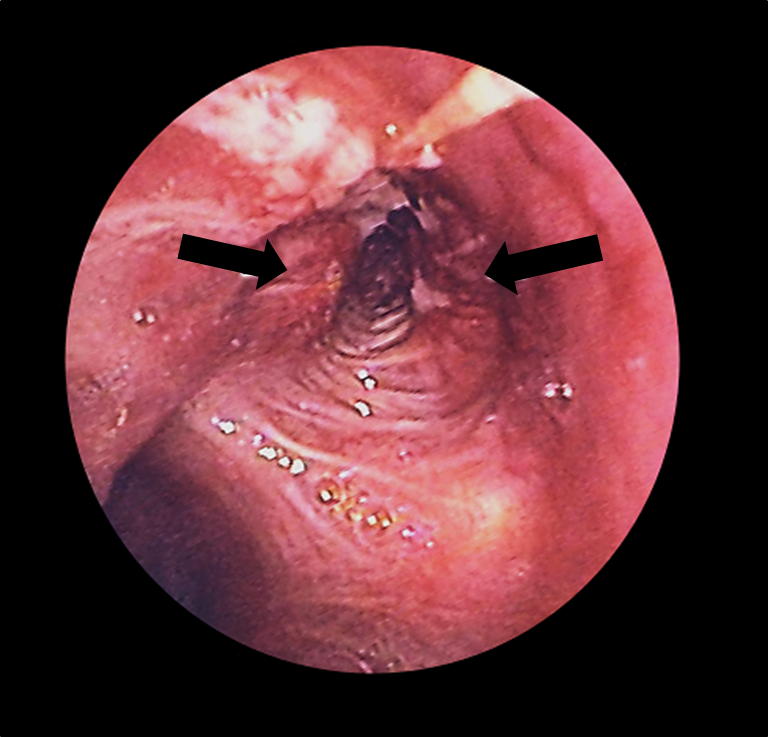
Broncoscopia cáncer de pulmón

Broncoscopia:
Cáncer de pulmón (flechas) en el bronquio izquierdo visto con un broncoscopio

Imagen: “Lung cancer in L. Bronchus – bronchoscopic view” por JHeuser. Licencia: CC BY 2.5

Pruebas de laboratorio

Las siguientes pruebas son posibles hallazgos para el cáncer de pulmón:

  • Hemograma
    • ↓ Hemoglobina
    • ↓ Plaquetas
  • Electrolitos:
    • ↓ Sodio → SIADH SIADH Syndrome of inappropriate antidiuretic hormone secretion (SIADH) is a disorder of impaired water excretion due to the inability to suppress the secretion of antidiuretic hormone (ADH). SIADH is characterized by impaired water excretion leading to dilutional hyponatremia, which is mainly asymptomatic but may cause neurologic symptoms. S Syndrome of Inappropriate Antidiuretic Hormone Secretion (SIADH)
    • ↑ Calcio → manifestación paraneoplásica, metástasis ósea.
  • ↑ Pruebas de función hepática → metástasis hepática:
    • ↑ De la fosfatasa alcalina también puede deberse a una metástasis ósea.

Estadificación

Estadificación tumor-ganglios-metástasis (TNM, por sus siglas en EN Erythema nodosum is an immune-mediated panniculitis (inflammation of the subcutaneous fat) caused by a type IV (delayed-type) hypersensitivity reaction. It commonly manifests in young women as tender, erythematous nodules on the shins. Erythema Nodosum inglés)

A continuación se presentan las directrices de estadificación de la 8va edición de la International Association for the Study of Lung Cancer Lung cancer Lung cancer is the malignant transformation of lung tissue and the leading cause of cancer-related deaths. The majority of cases are associated with long-term smoking. The disease is generally classified histologically as either small cell lung cancer or non-small cell lung cancer. Symptoms include cough, dyspnea, weight loss, and chest discomfort. Lung Cancer:

Tabla: El tumor Tumor Inflammation primario (categoría T)
Estadio Descripción
Tx El tumor Tumor Inflammation primario no puede ser evaluado.
T0 No hay evidencia de un tumor Tumor Inflammation primario
Tis Carcinoma in situ
T1 Tumor Tumor Inflammation ≤ 3 cm, rodeado de pulmón o pleura Pleura The pleura is a serous membrane that lines the walls of the thoracic cavity and the surface of the lungs. This structure of mesodermal origin covers both lungs, the mediastinum, the thoracic surface of the diaphragm, and the inner part of the thoracic cage. The pleura is divided into a visceral pleura and parietal pleura. Pleura: Anatomy visceral, sin invasión del bronquio principal:
  • T1a: ≤ 1 cm
  • T1b: > 1 cm pero ≤ 2 cm
  • T1c: > 2 cm pero ≤ 3 cm
T2 Tumor Tumor Inflammation > 3 cm pero ≤ 5 cm, o:
  • Afecta al AL Amyloidosis bronquio principal (sin afectar a la carina)
  • Invade la pleura Pleura The pleura is a serous membrane that lines the walls of the thoracic cavity and the surface of the lungs. This structure of mesodermal origin covers both lungs, the mediastinum, the thoracic surface of the diaphragm, and the inner part of the thoracic cage. The pleura is divided into a visceral pleura and parietal pleura. Pleura: Anatomy visceral
  • Asociado con atelectasia o neumonitis obstructiva que se extiende a la región hiliar:
    • T2a: > 3 cm pero ≤ 4 cm
    • T2b: > 4 cm pero ≤ 5 cm
T3 T3 A T3 thyroid hormone normally synthesized and secreted by the thyroid gland in much smaller quantities than thyroxine (T4). Most T3 is derived from peripheral monodeiodination of T4 at the 5′ position of the outer ring of the iodothyronine nucleus. The hormone finally delivered and used by the tissues is mainly t3. Thyroid Hormones Tumor Tumor Inflammation > 5 cm pero ≤ 7 cm, o nódulos tumorales asociados en EN Erythema nodosum is an immune-mediated panniculitis (inflammation of the subcutaneous fat) caused by a type IV (delayed-type) hypersensitivity reaction. It commonly manifests in young women as tender, erythematous nodules on the shins. Erythema Nodosum el mismo lóbulo que el tumor Tumor Inflammation primario o invasión directa de la pared torácica, del nervio frénico o del pericardio parietal Parietal One of a pair of irregularly shaped quadrilateral bones situated between the frontal bone and occipital bone, which together form the sides of the cranium. Skull: Anatomy
T4 T4 The major hormone derived from the thyroid gland. Thyroxine is synthesized via the iodination of tyrosines (monoiodotyrosine) and the coupling of iodotyrosines (diiodotyrosine) in the thyroglobulin. Thyroxine is released from thyroglobulin by proteolysis and secreted into the blood. Thyroxine is peripherally deiodinated to form triiodothyronine which exerts a broad spectrum of stimulatory effects on cell metabolism. Thyroid Hormones Tumor Tumor Inflammation > 7 cm, o nódulos tumorales asociados en EN Erythema nodosum is an immune-mediated panniculitis (inflammation of the subcutaneous fat) caused by a type IV (delayed-type) hypersensitivity reaction. It commonly manifests in young women as tender, erythematous nodules on the shins. Erythema Nodosum un lóbulo ipsilateral diferente al AL Amyloidosis tumor Tumor Inflammation primario, o invasión de diafragma, mediastino, corazón, grandes vasos, tráquea, esófago, nervio laríngeo recurrente, cuerpo vertebral o carina
Tabla: Los LOS Neisseria ganglios linfáticos (categoría N)
Estadio Descripción
Nx No es posible evaluar los LOS Neisseria ganglios linfáticos regionales
N0 No hay metástasis en EN Erythema nodosum is an immune-mediated panniculitis (inflammation of the subcutaneous fat) caused by a type IV (delayed-type) hypersensitivity reaction. It commonly manifests in young women as tender, erythematous nodules on the shins. Erythema Nodosum los LOS Neisseria ganglios linfáticos regionales
N1 Ganglios linfáticos peribronquiales y/o hiliares ipsilaterales y afectación de los LOS Neisseria ganglios intrapulmonares
N2 Afectación de los LOS Neisseria ganglios linfáticos mediastínicos y/o subcarinales ipsilaterales
N3 Afectación de ganglio linfático mediastínico contralateral, hiliar contralateral, escaleno ipsilateral o contralateral, o del supraclavicular
Tabla: Metástasis (categoría M)
Estadio Descripción
M0 No hay metástasis a distancia
M1 Metástasis a distancia:
  • M1a: nódulos tumorales separados en EN Erythema nodosum is an immune-mediated panniculitis (inflammation of the subcutaneous fat) caused by a type IV (delayed-type) hypersensitivity reaction. It commonly manifests in young women as tender, erythematous nodules on the shins. Erythema Nodosum el lóbulo contralateral, nódulos pleurales o pericárdicos, o derrame pleural o pericárdico maligno
  • M1b: metástasis extratorácica única
  • M1c: metástasis extratorácicas múltiples

Estadificación del cáncer de pulmón de células no pequeñas

Agrupación de estadios Estadio TNM
Oculto
  • TXN0M0
0
  • TisN0M0
I
  • IA1: T1aN0M0
  • IA2: T1bN0M0
  • IA3: T1cN0M0
  • IB: T2aN0M0
II
  • IIA: T2bN0M0
  • IIB:
    • T1a-cN1M0
    • T2a-bN1M0
    • T3N0M0
III
  • IIIA:
    • T1a-cN2M0
    • T2a-bN2M0
    • T3N1M0
    • T4N0-1M0
  • IIIB:
    • T1a-cN3M0
    • T2a-bN3M0
    • T3N2M0
    • T4N2M0
  • IIIC:
    • T3N3M0
    • T4N3M0
IV
  • IVA: cualquier T y N más M1a o M1b
  • IVB: cualquier T y N más M1c

Estadificación del cáncer de pulmón de células pequeñas

  • La estadificación se divide en EN Erythema nodosum is an immune-mediated panniculitis (inflammation of the subcutaneous fat) caused by a type IV (delayed-type) hypersensitivity reaction. It commonly manifests in young women as tender, erythematous nodules on the shins. Erythema Nodosum enfermedad limitada y extensa (difiere del NSCLC).
  • Se utiliza un sistema simplificado, ya que la mayoría de los LOS Neisseria SCLC se presentan con enfermedad localmente avanzada o metastásica (> 60%).
Estadio (SCLC) Descripción
Enfermedad limitada
Enfermedad extensa
  • Tumor Tumor Inflammation más allá del hemitórax ipsilateral
  • Afectación de los LOS Neisseria ganglios supraclaviculares e hiliares contralaterales
  • Metástasis a distancia
  • Derrames pericárdicos o pleurales
  • Corresponde al AL Amyloidosis estadio TNM IV
NSCLC: cáncer de pulmón de células no pequeñas
SCLC: cáncer de pulmón de células pequeñas
TNM: tumor-ganglios-metástasis

Tratamiento

Opciones de tratamiento disponibles

Cirugía:

  • Evaluar el estado funcional (status performance) (comorbilidades y función pulmonar) para determinar si el paciente es un candidato quirúrgico adecuado.
  • Lobectomía quirúrgica para aquellos con excelente reserva pulmonar (preferido)
  • Resección sublobar o en EN Erythema nodosum is an immune-mediated panniculitis (inflammation of the subcutaneous fat) caused by a type IV (delayed-type) hypersensitivity reaction. It commonly manifests in young women as tender, erythematous nodules on the shins. Erythema Nodosum cuña para aquellos pacientes que no tolerarían una lobectomía completa

Quimioterapia:

  • Terapia combinada: regímenes que contienen cisplatino (cisplatino más vinorelbina, docetaxel Docetaxel A semisynthetic analog of paclitaxel used in the treatment of locally advanced or metastatic breast neoplasms and non-small cell lung cancer. Microtubule and Topoisomerase Inhibitors o paclitaxel Paclitaxel A cyclodecane isolated from the bark of the pacific yew tree, taxus brevifolia. It stabilizes microtubules in their polymerized form leading to cell death. Microtubule and Topoisomerase Inhibitors)
  • Carboplatino: alternativa al AL Amyloidosis cisplatino

Radioterapia:

  • Radioterapia corporal estereotáxica:
    • Radiación a una diana pequeña y bien definida
    • Se prefiere para tumores < 5 cm
  • Radioterapia definitiva con fraccionamiento convencional para lesiones grandes

Terapias dirigidas:

Inmunoterapia:

  • Utilizado en EN Erythema nodosum is an immune-mediated panniculitis (inflammation of the subcutaneous fat) caused by a type IV (delayed-type) hypersensitivity reaction. It commonly manifests in young women as tender, erythematous nodules on the shins. Erythema Nodosum tumores con expresión de PD-L1 (≥ 50%)
  • El receptor Receptor Receptors are proteins located either on the surface of or within a cell that can bind to signaling molecules known as ligands (e.g., hormones) and cause some type of response within the cell. Receptors de muerte celular programada 1 ( PD-1 PD-1 An inhibitory t-lymphocyte receptor that has specificity for CD274 antigen and programmed cell death 1 ligand 2 protein. Signaling by the receptor limits T cell proliferation and interferon gamma synthesis. The receptor also may play an essential role in the regulatory pathway that induces peripheral tolerance. T cells: Types and Functions) y la unión del PD-L1 son dianas porque:
    • La interacción PD-1 PD-1 An inhibitory t-lymphocyte receptor that has specificity for CD274 antigen and programmed cell death 1 ligand 2 protein. Signaling by the receptor limits T cell proliferation and interferon gamma synthesis. The receptor also may play an essential role in the regulatory pathway that induces peripheral tolerance. T cells: Types and Functions:PD-L1 inhibe la apoptosis Apoptosis A regulated cell death mechanism characterized by distinctive morphologic changes in the nucleus and cytoplasm, including the endonucleolytic cleavage of genomic DNA, at regularly spaced, internucleosomal sites, I.e., DNA fragmentation. It is genetically-programmed and serves as a balance to mitosis in regulating the size of animal tissues and in mediating pathologic processes associated with tumor growth. Ischemic Cell Damage de las células tumorales.
    • La elevación de PD-L1 permite a las células cancerosas eludir el sistema inmunitario (las células T están inactivadas).
  • Se utiliza si hay progresión del tumor Tumor Inflammation a pesar de la quimioterapia
  • Medicamentos disponibles:
    • Pembrolizumab Pembrolizumab Squamous Cell Carcinoma (SCC)
    • Atezolizumab
    • Nivolumab Nivolumab A genetically engineered, fully humanized immunoglobulin g4 monoclonal antibody that binds to the pd-1 receptor, activating an immune response to tumor cells. It is used as monotherapy or in combination with ipilimumab for the treatment of advanced malignant melanoma. It is also used in the treatment of advanced or recurring non-small cell lung cancer; renal cell carcinoma; and Hodgkin’s lymphoma. Melanoma

Cáncer de pulmón de células no pequeñas

Estadio (NSCLC) Abordaje terapéutico
Estadio I-II
  • Lobectomía quirúrgica: tratamiento de elección si la lesión es resecable
  • Radioterapia:
    • Alternativa para candidatos a cirugía con pronóstico reservado
    • Recomendado después de la cirugía si los LOS Neisseria márgenes de resección quirúrgica son positivos
  • Quimioterapia adyuvante:
    • No para el estadio IA
    • Para el estadio II y algunos casos del estadio IB
  • Quimiorradioterapia seguida de resección quirúrgica (para el tumor Tumor Inflammation de Pancoast)
Estadio III
  • Resección quirúrgica, si es factible, seguida de quimioterapia adyuvante
  • Si la resección no es factible:
    • Quimioterapia con radioterapia
    • Seguido de inmunoterapia (anticuerpo PD-L1) si no hay progresión de la enfermedad
Estadio IV*
  • La terapia se guía por las mutaciones tumorales detectadas.
  • Con mutaciones tratables, terapias disponibles:
    • Mutaciones del receptor Receptor Receptors are proteins located either on the surface of or within a cell that can bind to signaling molecules known as ligands (e.g., hormones) and cause some type of response within the cell. Receptors EGF: osimertinib, tratamiento de 1era línea ( en EN Erythema nodosum is an immune-mediated panniculitis (inflammation of the subcutaneous fat) caused by a type IV (delayed-type) hypersensitivity reaction. It commonly manifests in young women as tender, erythematous nodules on the shins. Erythema Nodosum lugar de quimioterapia)
    • Mutaciones ALK: alectinib Alectinib Targeted and Other Nontraditional Antineoplastic Therapy
    • Cánceres ROS1 positivos: crizotinib Crizotinib A piperidine and aminopyridine derivative that acts as an inhibitor of receptor protein-tyrosine kinases, including anaplastic lymphoma kinase (alk) and hepatocyte growth factor receptor (hgfr; c-met). It is used in the treatment of non-small cell lung cancer. Targeted and Other Nontraditional Antineoplastic Therapy
    • Otras mutaciones: Los LOS Neisseria inhibidores disponibles se integran en EN Erythema nodosum is an immune-mediated panniculitis (inflammation of the subcutaneous fat) caused by a type IV (delayed-type) hypersensitivity reaction. It commonly manifests in young women as tender, erythematous nodules on the shins. Erythema Nodosum los LOS Neisseria tratamientos.
  • Sin mutaciones tratables:
  • Para metástasis aisladas (e.g., en EN Erythema nodosum is an immune-mediated panniculitis (inflammation of the subcutaneous fat) caused by a type IV (delayed-type) hypersensitivity reaction. It commonly manifests in young women as tender, erythematous nodules on the shins. Erythema Nodosum el cerebro): radioterapia
*Estadio IV: cuidados paliativos centrados en aliviar los síntomas y prolongar la supervivencia
NSCLC: cáncer de pulmón de células no pequeñas
PD-L1: ligando de muerte celular programada 1
EGF: factor de crecimiento epidérmico
ALK: quinasa del linfoma anaplásico

Cáncer de pulmón de células pequeñas

Estadio (SCLC) Descripción
Enfermedad limitada
  • Quimioterapia más radioterapia:
    • La combinación es mejor que la quimioterapia sola ( en EN Erythema nodosum is an immune-mediated panniculitis (inflammation of the subcutaneous fat) caused by a type IV (delayed-type) hypersensitivity reaction. It commonly manifests in young women as tender, erythematous nodules on the shins. Erythema Nodosum caso de afectación de los LOS Neisseria ganglios linfáticos mediastínicos o hiliares).
    • Agentes quimioterapéuticos: cisplatino o carboplatino más etopósido
    • La radiación limita el riesgo de recidiva.
    • La quimioterapia es la opción preferida en EN Erythema nodosum is an immune-mediated panniculitis (inflammation of the subcutaneous fat) caused by a type IV (delayed-type) hypersensitivity reaction. It commonly manifests in young women as tender, erythematous nodules on the shins. Erythema Nodosum el síndrome de VCS.
  • Lobectomía quirúrgica:
    • Para aquellos con un tumor Tumor Inflammation pequeño y focal (sin ganglios linfáticos, sin metástasis)
    • Si se identifica la afectación de los LOS Neisseria ganglios linfáticos en EN Erythema nodosum is an immune-mediated panniculitis (inflammation of the subcutaneous fat) caused by a type IV (delayed-type) hypersensitivity reaction. It commonly manifests in young women as tender, erythematous nodules on the shins. Erythema Nodosum la cirugía, se procede a la quimioterapia más radiación.
  • Radiación profiláctica de todo el cerebro:
    • Para los LOS Neisseria que responden al AL Amyloidosis tratamiento inicial
    • Reduce las metástasis cerebrales
    • Aumenta la supervivencia
Enfermedad extensa*
  • Combinación de:
    • Inmunoterapia (anticuerpos monoclonales humanizados contra el ligando de muerte programada 1)
    • Quimioterapia
  • Radioterapia para aquellos con respuesta al AL Amyloidosis tratamiento sistémico y con enfermedad residual
  • Radiación profiláctica o terapéutica de todo el cerebro
*Enfermedad extensa: cuidados paliativos centrados en aliviar los síntomas y prolongar la supervivencia
SCLC: cáncer de pulmón de células pequeñas
VCS: vena cava superior

Medidas paliativas

  • Derrames pleurales malignos recurrentes:
    • Repetir la toracocentesis
    • Pleurodesis
    • Catéter pleural permanente
  • Metástasis ósea:
    • Bifosfonatos
    • Denosumab Denosumab A humanized monoclonal antibody and an inhibitor of the rank ligand, which regulates osteoclast differentiation and bone remodeling. It is used as a bone density conservation agent in the treatment of osteoporosis. Other Antiresorptive Drugs (agente modificador del hueso)
  • Tumores de la tráquea o de los LOS Neisseria bronquios principales:
    • Fulguración broncoscópica
    • Colocación de stent
  • Cuidados del final de la vida:
    • Oxígeno suplementario
    • Broncodilatadores
    • Opiáceos
    • Antieméticos
    • Programa de cuidados paliativos

Prevención

La modificación de los LOS Neisseria factores de riesgo es más eficaz que el tamizaje para reducir la mortalidad por cáncer de pulmón.

  • Dejar de fumar:
    • Factor más importante
    • El mayor beneficio se observa en EN Erythema nodosum is an immune-mediated panniculitis (inflammation of the subcutaneous fat) caused by a type IV (delayed-type) hypersensitivity reaction. It commonly manifests in young women as tender, erythematous nodules on the shins. Erythema Nodosum quienes dejan de fumar a los LOS Neisseria 30 años.
    • Con un promedio de 21 paquetes-año, el riesgo se reduce en EN Erythema nodosum is an immune-mediated panniculitis (inflammation of the subcutaneous fat) caused by a type IV (delayed-type) hypersensitivity reaction. It commonly manifests in young women as tender, erythematous nodules on the shins. Erythema Nodosum un 39% tras dejar de fumar durante 5 años.
  • Radón:
    • Se puede realizar pruebas y rehabilitación en EN Erythema nodosum is an immune-mediated panniculitis (inflammation of the subcutaneous fat) caused by a type IV (delayed-type) hypersensitivity reaction. It commonly manifests in young women as tender, erythematous nodules on the shins. Erythema Nodosum residencias privadas.
    • Se desconoce el efecto sobre la incidencia del cáncer de pulmón.

Diagnóstico Diferencial

  • Tromboembolismo pulmonar: obstrucción de las arterias pulmonares, a menudo debido a la migración del trombo desde el sistema venoso profundo. Los LOS Neisseria signos y síntomas incluyen dolor Dolor Inflammation torácico pleurítico, disnea, taquipnea y taquicardia. Los LOS Neisseria casos severos pueden dar como resultado inestabilidad hemodinámica o paro cardiopulmonar. Una TC de tórax con angiografía es el método principal de diagnóstico. El tratamiento incluye oxigenación, anticoagulación y terapia trombolítica para pacientes inestables.
  • Tuberculosis Tuberculosis Tuberculosis (TB) is an infectious disease caused by Mycobacterium tuberculosis complex bacteria. The bacteria usually attack the lungs but can also damage other parts of the body. Approximately 30% of people around the world are infected with this pathogen, with the majority harboring a latent infection. Tuberculosis spreads through the air when a person with active pulmonary infection coughs or sneezes. Tuberculosis: la bacteria Bacteria Bacteria are prokaryotic single-celled microorganisms that are metabolically active and divide by binary fission. Some of these organisms play a significant role in the pathogenesis of diseases. Bacteriology Mycobacterium tuberculosis Mycobacterium tuberculosis Tuberculosis (TB) is an infectious disease caused by Mycobacterium tuberculosis complex bacteria. The bacteria usually attack the lungs but can also damage other parts of the body. Approximately 30% of people around the world are infected with this pathogen, with the majority harboring a latent infection. Tuberculosis spreads through the air when a person with active pulmonary infection coughs or sneezes. Tuberculosis ataca los LOS Neisseria pulmones y otras partes del cuerpo. Los LOS Neisseria síntomas incluyen; fiebre, tos TOS Thoracic outlet syndrome (TOS) is a broad term used for a spectrum of syndromes related to the general region of the thoracic outlet, which involves the compression or irritation of elements of the brachial plexus, subclavian artery, or subclavian vein. Thoracic Outlet Syndrome productiva, sudores nocturnos y pérdida de peso. El diagnóstico se realiza con la identificación de bacilos ácido-alcohol resistentes en EN Erythema nodosum is an immune-mediated panniculitis (inflammation of the subcutaneous fat) caused by a type IV (delayed-type) hypersensitivity reaction. It commonly manifests in young women as tender, erythematous nodules on the shins. Erythema Nodosum el cultivo de esputo. Se requieren múltiples medicamentos antimicrobianos para su tratamiento (isoniazida, rifampicina, pirazinamida y etambutol).
  • Neumonía: infección del parénquima pulmonar causada generalmente por una bacteria Bacteria Bacteria are prokaryotic single-celled microorganisms that are metabolically active and divide by binary fission. Some of these organisms play a significant role in the pathogenesis of diseases. Bacteriology o un virus Virus Viruses are infectious, obligate intracellular parasites composed of a nucleic acid core surrounded by a protein capsid. Viruses can be either naked (non-enveloped) or enveloped. The classification of viruses is complex and based on many factors, including type and structure of the nucleoid and capsid, the presence of an envelope, the replication cycle, and the host range. Virology. La presentación suele incluir; fiebre, tos TOS Thoracic outlet syndrome (TOS) is a broad term used for a spectrum of syndromes related to the general region of the thoracic outlet, which involves the compression or irritation of elements of the brachial plexus, subclavian artery, or subclavian vein. Thoracic Outlet Syndrome productiva y disnea, y la radiografía de tórax evidencia consolidación. Por lo general, se inicia un tratamiento antibiótico empírico que puede adaptarse si se dispone de datos de cultivo.
  • Histoplasmosis Histoplasmosis Histoplasmosis is an infection caused by Histoplasma capsulatum, a dimorphic fungus. Transmission is through inhalation, and exposure to soils containing bird or bat droppings increases the risk of infection. Most infections are asymptomatic; however, immunocompromised individuals generally develop acute pulmonary infection, chronic infection, or even disseminated disease. Histoplasma/Histoplasmosis: enfermedad pulmonar ocasionada por Histoplasma capsulatum Histoplasma capsulatum Histoplasma/Histoplasmosis. Los LOS Neisseria pacientes pueden tener fiebre, tos TOS Thoracic outlet syndrome (TOS) is a broad term used for a spectrum of syndromes related to the general region of the thoracic outlet, which involves the compression or irritation of elements of the brachial plexus, subclavian artery, or subclavian vein. Thoracic Outlet Syndrome, mialgias, disnea y dolor Dolor Inflammation torácico. La imagenología puede mostrar infiltrados difusos y nodulares o una lesión cavitaria. El diagnóstico se confirma con pruebas de antígenos o con la presencia de Histoplasma Histoplasma Histoplasmosis is an infection caused by Histoplasma capsulatum, a dimorphic fungus. The fungus exists as a mold at low temperatures and as yeast at high temperatures. H. capsulatum is the most common endemic fungal infection in the US and is most prevalent in the midwestern and central states along the Ohio and Mississippi River valleys. Histoplasma/Histoplasmosis en EN Erythema nodosum is an immune-mediated panniculitis (inflammation of the subcutaneous fat) caused by a type IV (delayed-type) hypersensitivity reaction. It commonly manifests in young women as tender, erythematous nodules on the shins. Erythema Nodosum el esputo. El tratamiento se basa en EN Erythema nodosum is an immune-mediated panniculitis (inflammation of the subcutaneous fat) caused by a type IV (delayed-type) hypersensitivity reaction. It commonly manifests in young women as tender, erythematous nodules on the shins. Erythema Nodosum la presentación e incluye itraconazol, fluconazol o anfotericina B.
  • Sarcoidosis Sarcoidosis Sarcoidosis is a multisystem inflammatory disease that causes noncaseating granulomas. The exact etiology is unknown. Sarcoidosis usually affects the lungs and thoracic lymph nodes, but it can also affect almost every system in the body, including the skin, heart, and eyes, most commonly. Sarcoidosis: enfermedad inflamatoria que provoca granulomas Granulomas A relatively small nodular inflammatory lesion containing grouped mononuclear phagocytes, caused by infectious and noninfectious agents. Sarcoidosis no caseificantes en EN Erythema nodosum is an immune-mediated panniculitis (inflammation of the subcutaneous fat) caused by a type IV (delayed-type) hypersensitivity reaction. It commonly manifests in young women as tender, erythematous nodules on the shins. Erythema Nodosum los LOS Neisseria órganos, incluidos los LOS Neisseria pulmones. La presentación incluye; tos TOS Thoracic outlet syndrome (TOS) is a broad term used for a spectrum of syndromes related to the general region of the thoracic outlet, which involves the compression or irritation of elements of the brachial plexus, subclavian artery, or subclavian vein. Thoracic Outlet Syndrome, disnea, fiebre y pérdida de peso. El diagnóstico por imagenología puede mostrar linfadenopatía hiliar y mediastínica y anomalías del parénquima. El diagnóstico se confirma mediante una biopsia y el tratamiento incluye corticosteroides y medicamentos inmunosupresores.
  • Enfermedad pulmonar obstructiva crónica (EPOC): un espectro de condiciones caracterizadas por la limitación irreversible del flujo de aire. La enfermedad pulmonar obstructiva crónica es el resultado de la inflamación obstructiva de las vías respiratorias pequeñas y de los LOS Neisseria cambios en EN Erythema nodosum is an immune-mediated panniculitis (inflammation of the subcutaneous fat) caused by a type IV (delayed-type) hypersensitivity reaction. It commonly manifests in young women as tender, erythematous nodules on the shins. Erythema Nodosum el parénquima pulmonar. La mayoría de los LOS Neisseria casos son debidos al AL Amyloidosis tabaquismo. Los LOS Neisseria pacientes presentan síntomas progresivos con exacerbaciones de disnea y tos TOS Thoracic outlet syndrome (TOS) is a broad term used for a spectrum of syndromes related to the general region of the thoracic outlet, which involves the compression or irritation of elements of the brachial plexus, subclavian artery, or subclavian vein. Thoracic Outlet Syndrome crónica. El diagnóstico se basa en EN Erythema nodosum is an immune-mediated panniculitis (inflammation of the subcutaneous fat) caused by a type IV (delayed-type) hypersensitivity reaction. It commonly manifests in young women as tender, erythematous nodules on the shins. Erythema Nodosum los LOS Neisseria antecedentes y en EN Erythema nodosum is an immune-mediated panniculitis (inflammation of the subcutaneous fat) caused by a type IV (delayed-type) hypersensitivity reaction. It commonly manifests in young women as tender, erythematous nodules on the shins. Erythema Nodosum las pruebas de función pulmonar. El tratamiento incluye dejar de fumar, rehabilitación pulmonar y terapia con medicamentos.
  • Mesotelioma: crecimiento maligno de las células mesoteliales que suele afectar a la pleura Pleura The pleura is a serous membrane that lines the walls of the thoracic cavity and the surface of the lungs. This structure of mesodermal origin covers both lungs, the mediastinum, the thoracic surface of the diaphragm, and the inner part of the thoracic cage. The pleura is divided into a visceral pleura and parietal pleura. Pleura: Anatomy. La mayoría de los LOS Neisseria casos están asociados a la exposición ocupacional al AL Amyloidosis asbesto. Los LOS Neisseria síntomas incluyen; disnea, dolor Dolor Inflammation torácico, tos TOS Thoracic outlet syndrome (TOS) is a broad term used for a spectrum of syndromes related to the general region of the thoracic outlet, which involves the compression or irritation of elements of the brachial plexus, subclavian artery, or subclavian vein. Thoracic Outlet Syndrome, fatiga y pérdida de peso. La TC de tórax muestra un engrosamiento pleural multifocal Multifocal Retinoblastoma y un derrame pleural. La biopsia pleural es necesaria para confirmar y descartar metástasis de cáncer de pulmón o de mama. El tratamiento es raramente efectivo y la supervivencia media es de < 1 año.

Referencias

  1. Diniz Gomes D, & Gold K.A., & Gibbons D.L., & Eapen C.A. (2016). Non–small cell lung cancer. Kantarjian H.M., & Wolff R.A.(Eds.), The MD Anderson Manual of Medical Oncology, 3rd ed. McGraw-Hill.
  2. Fisseler-Eckhoff, A., & Demes, M. (2012). Neuroendocrine tumors of the lung. Cancers, 4(3), 777–798. https://doi.org/10.3390/cancers4030777
  3. Inamura, K. (2017). Lung Cancer: Understanding Its Molecular Pathology and the 2015 WHO Classification. Frontiers in Oncology 7: 193.
  4. Keith, R.L. (2020). Lung carcinoma. [online] MSD Manual Professional Version. https://www.merckmanuals.com/professional/pulmonary-disorders/tumors-of-the-lungs/lung-carcinoma
  5. Mannino, D.M. (2020). Cigarette smoking and other possible risk factors for lung cancer. UpToDate. Retrieved January 15, 2021, from https://www.uptodate.com/contents/cigarette-smoking-and-other-possible-risk-factors-for-lung-cancer
  6. Midthun, D.E. (2020). Clinical manifestations of lung cancer. UpToDate. Retrieved January 14, 2021, from https://www.uptodate.com/contents/clinical-manifestations-of-lung-cancer
  7. Thomas, K.W., and Gould, M.K. (2020). Overview of the initial evaluation, diagnosis, and staging of patients with suspected lung cancer. UpToDate. Retrieved January 14, 2021, from https://www.uptodate.com/contents/overview-of-the-initial-evaluation-diagnosis-and-staging-of-patients-with-suspected-lung-cancer
  8. Midthun, D.E. (2020). Overview of the initial treatment and prognosis of lung cancer. UpToDate. Retrieved January 14, 2021, from https://www.uptodate.com/contents/overview-of-the-initial-treatment-and-prognosis-of-lung-cancer
  9. Thomas, K.W., and Gould, M.K. (2019). Tumor, node, metastasis (TNM) staging system for lung cancer. UpToDate. Retrieved January 14, 2021, from https://www.uptodate.com/contents/tumor-node-metastasis-tnm-staging-system-for-lung-cancer
  10. Keith, R.L. (2020). Lung carcinoma. [online] MSD Manual Professional Version. https://www.merckmanuals.com/professional/pulmonary-disorders/tumors-of-the-lungs/lung-carcinoma
  11. Siddiqui, F., and Siddiqui, A.H. (2020). Lung cancer. [online] StatPearls. https://www.ncbi.nlm.nih.gov/books/NBK482357/
  12. Travis WD, Brambila E, Burke AP, et al. (2015). WHO classification of tumours of the lung, pleura, thymus and heart. 4th ed.
  13. Wang S (2021). Bronchogenic carcinoma. Papadakis M.A., & McPhee S.J., & Rabow M.W.(Eds.), Current Medical Diagnosis & Treatment 2021. McGraw-Hill.
  14. Shum, E. (2024) Lung cancer in never smokers. UpToDate. Retrieved November 27, 2024, from https://www.uptodate.com/contents/lung-cancer-in-never-smokers

¡Crea tu cuenta gratis o inicia una sesión para seguir leyendo!

Regístrate ahora y obtén acceso gratuito a Lecturio con páginas de concepto, videos médicos y cuestionarios para tu educación médica.

User Reviews

Que tengas una sesión de estudio alegre y navideña 🎁 Ahorra 50% en todos los planes >>

Details