Domina Conceptos Médicos

Estudia para la escuela de medicina y tus examenes con Lecturio.

Enfermedad de Kawasaki

La enfermedad de Kawasaki, también conocida como síndrome ganglionar mucocutáneo o poliarteritis infantil, es una vasculitis Vasculitis Inflammation of any one of the blood vessels, including the arteries; veins; and rest of the vasculature system in the body. Systemic Lupus Erythematosus necrotizante de vasos de mediano calibre que afecta predominantemente a los LOS Neisseria niños < 5 años de edad. La etiología es desconocida actualmente, pero se postula que involucra a una combinación de factores ambientales y genéticos. Los LOS Neisseria sistemas implicados son múltiples, pero la enfermedad muestra una predilección por las arterias coronarias, lo que puede llevar a serias complicaciones. El diagnóstico puede realizarse basándose en EN Erythema nodosum is an immune-mediated panniculitis (inflammation of the subcutaneous fat) caused by a type IV (delayed-type) hypersensitivity reaction. It commonly manifests in young women as tender, erythematous nodules on the shins. Erythema Nodosum criterios clínicos. En EN Erythema nodosum is an immune-mediated panniculitis (inflammation of the subcutaneous fat) caused by a type IV (delayed-type) hypersensitivity reaction. It commonly manifests in young women as tender, erythematous nodules on the shins. Erythema Nodosum los LOS Neisseria casos en EN Erythema nodosum is an immune-mediated panniculitis (inflammation of the subcutaneous fat) caused by a type IV (delayed-type) hypersensitivity reaction. It commonly manifests in young women as tender, erythematous nodules on the shins. Erythema Nodosum los LOS Neisseria que se puede sospechar una enfermedad de Kawasaki incompleta, el diagnóstico puede apoyarse en EN Erythema nodosum is an immune-mediated panniculitis (inflammation of the subcutaneous fat) caused by a type IV (delayed-type) hypersensitivity reaction. It commonly manifests in young women as tender, erythematous nodules on the shins. Erythema Nodosum estudios de laboratorio y ecocardiografía. El tratamiento incluye inmunoglobulina intravenosa y dosis altas de aspirina. El seguimiento requiere ecocardiogramas seriados para controlar la presencia de aneurismas en EN Erythema nodosum is an immune-mediated panniculitis (inflammation of the subcutaneous fat) caused by a type IV (delayed-type) hypersensitivity reaction. It commonly manifests in young women as tender, erythematous nodules on the shins. Erythema Nodosum las arterias coronarias.

Last updated: May 14, 2025

Editorial responsibility: Stanley Oiseth, Lindsay Jones, Evelin Maza

Datos importantes

  • Vasculitis Vasculitis Inflammation of any one of the blood vessels, including the arteries; veins; and rest of the vasculature system in the body. Systemic Lupus Erythematosus de arterias de mediano calibre con una etiología poco clara, que suele afectar a las arterias coronarias
  • Afecta a niños pequeños (normalmente < 5 años de edad), especialmente a los LOS Neisseria de ascendencia asiática
  • Presentación (mnemotecnia en EN Erythema nodosum is an immune-mediated panniculitis (inflammation of the subcutaneous fat) caused by a type IV (delayed-type) hypersensitivity reaction. It commonly manifests in young women as tender, erythematous nodules on the shins. Erythema Nodosum inglés CRASH and Burn):
    • Conjunctivitis (conjuntivitis)
    • Rash (erupción cutánea)
    • Adenopathy (adenopatía)
    • Strawberry tongue Tongue The tongue, on the other hand, is a complex muscular structure that permits tasting and facilitates the process of mastication and communication. The blood supply of the tongue originates from the external carotid artery, and the innervation is through cranial nerves. Lips and Tongue: Anatomy (lengua en EN Erythema nodosum is an immune-mediated panniculitis (inflammation of the subcutaneous fat) caused by a type IV (delayed-type) hypersensitivity reaction. It commonly manifests in young women as tender, erythematous nodules on the shins. Erythema Nodosum fresa)
    • Hands and feet (manos y pies) hinchazón, eritema, descamación periungueal
    • Burn (quemadura): fiebre durante ≥ 5 días
  • Se debe realizar una ecocardiografía para evaluar: Aneurisma de la arteria coronaria
  • Tratamiento:
    • Autolimitado
    • Dosis altas de aspirina e IGIV
  • Complicaciones:
    • Miocarditis y/o pericarditis Pericarditis Pericarditis is an inflammation of the pericardium, often with fluid accumulation. It can be caused by infection (often viral), myocardial infarction, drugs, malignancies, metabolic disorders, autoimmune disorders, or trauma. Acute, subacute, and chronic forms exist. Pericarditis
    • Disfunción valvular
    • Infarto de miocardio

Epidemiología y Etiología

Epidemiología

  • Una de las vasculitis Vasculitis Inflammation of any one of the blood vessels, including the arteries; veins; and rest of the vasculature system in the body. Systemic Lupus Erythematosus más comunes durante la infancia
  • Afecta más comúnmente a niños que a niñas.
  • 80%–90% de los LOS Neisseria casos son en EN Erythema nodosum is an immune-mediated panniculitis (inflammation of the subcutaneous fat) caused by a type IV (delayed-type) hypersensitivity reaction. It commonly manifests in young women as tender, erythematous nodules on the shins. Erythema Nodosum niños menores de 5 años.
  • Variación geográfica:
    • Incidencia más alta en EN Erythema nodosum is an immune-mediated panniculitis (inflammation of the subcutaneous fat) caused by a type IV (delayed-type) hypersensitivity reaction. It commonly manifests in young women as tender, erythematous nodules on the shins. Erythema Nodosum niños que viven en EN Erythema nodosum is an immune-mediated panniculitis (inflammation of the subcutaneous fat) caused by a type IV (delayed-type) hypersensitivity reaction. It commonly manifests in young women as tender, erythematous nodules on the shins. Erythema Nodosum Asia ASIA Spinal Cord Injuries Oriental o de ascendencia asiática que viven en EN Erythema nodosum is an immune-mediated panniculitis (inflammation of the subcutaneous fat) caused by a type IV (delayed-type) hypersensitivity reaction. It commonly manifests in young women as tender, erythematous nodules on the shins. Erythema Nodosum otras partes del mundo
    • Incidencia anual de 20 por cada 100 000 niños menores de 5 años en EN Erythema nodosum is an immune-mediated panniculitis (inflammation of the subcutaneous fat) caused by a type IV (delayed-type) hypersensitivity reaction. It commonly manifests in young women as tender, erythematous nodules on the shins. Erythema Nodosum Estados Unidos
  • ¼ de los LOS Neisseria casos en EN Erythema nodosum is an immune-mediated panniculitis (inflammation of the subcutaneous fat) caused by a type IV (delayed-type) hypersensitivity reaction. It commonly manifests in young women as tender, erythematous nodules on the shins. Erythema Nodosum adultos se dan en EN Erythema nodosum is an immune-mediated panniculitis (inflammation of the subcutaneous fat) caused by a type IV (delayed-type) hypersensitivity reaction. It commonly manifests in young women as tender, erythematous nodules on the shins. Erythema Nodosum pacientes con VIH.

Etiología

La etiología de la enfermedad de Kawasaki es desconocida. Hay varias teorías:

Teoría de la respuesta inmunológica

  • Las células inflamatorias se encuentran infiltradas en EN Erythema nodosum is an immune-mediated panniculitis (inflammation of the subcutaneous fat) caused by a type IV (delayed-type) hypersensitivity reaction. It commonly manifests in young women as tender, erythematous nodules on the shins. Erythema Nodosum las arterias de mediano calibre:
    • Neutrófilos
    • Células T CD8+
    • Eosinófilos
    • Células plasmáticas IgA IgA Represents 15-20% of the human serum immunoglobulins, mostly as the 4-chain polymer in humans or dimer in other mammals. Secretory iga is the main immunoglobulin in secretions. Immunoglobulins: Types and Functions
    • Macrófagos (único entre las vasculitis Vasculitis Inflammation of any one of the blood vessels, including the arteries; veins; and rest of the vasculature system in the body. Systemic Lupus Erythematosus)
  • Se ha HA Hemolytic anemia (HA) is the term given to a large group of anemias that are caused by the premature destruction/hemolysis of circulating red blood cells (RBCs). Hemolysis can occur within (intravascular hemolysis) or outside the blood vessels (extravascular hemolysis). Hemolytic Anemia observado una alta expresión de genes Genes A category of nucleic acid sequences that function as units of heredity and which code for the basic instructions for the development, reproduction, and maintenance of organisms. DNA Types and Structure inflamatorios durante la fase aguda de la enfermedad, incluidos los LOS Neisseria de:
    • Adrenomedulina
    • Gancalcina
    • Granulina
  • Se desconoce el estímulo de esta expresión génica y de la infiltración inflamatoria.

Teoría de la predisposición genética

  • Se sospecha debido a la mayor frecuencia en EN Erythema nodosum is an immune-mediated panniculitis (inflammation of the subcutaneous fat) caused by a type IV (delayed-type) hypersensitivity reaction. It commonly manifests in young women as tender, erythematous nodules on the shins. Erythema Nodosum:
    • Poblaciones asiáticas
    • Miembros de la familia ( los LOS Neisseria hermanos de los LOS Neisseria afectados por la enfermedad de Kawasaki tienen una mayor probabilidad de desarrollar también la enfermedad de Kawasaki que la población general)
  • Las variaciones y polimorfismos de los LOS Neisseria genes Genes A category of nucleic acid sequences that function as units of heredity and which code for the basic instructions for the development, reproduction, and maintenance of organisms. DNA Types and Structure relacionados con la regulación inmunitaria y la homeostasis Homeostasis The processes whereby the internal environment of an organism tends to remain balanced and stable. Cell Injury and Death vascular se han asociado a la enfermedad de Kawasaki.

Teoría de los LOS Neisseria factores ambientales

  • Los LOS Neisseria desencadenantes hipotéticos son:
    • Mercurio
    • Ácaros del polvo
    • Champú para alfombras
    • Polen
  • Carece de evidencia que las soporte

Teoría de la infección

  • Similitudes con otras afecciones infecciosas pediátricas:
    • Exantema febril con linfadenitis y mucositis Mucositis Stomatitis is a general term referring to inflammation of the mucous membranes of the mouth, which may include sores. Stomatitis can be caused by infections, autoimmune disorders, allergic reactions, or exposure to irritants. The typical presentation may be either solitary or a group of painful oral lesions. Stomatitis
    • ↑ Incidencia durante el invierno y el verano
    • Ocurre en EN Erythema nodosum is an immune-mediated panniculitis (inflammation of the subcutaneous fat) caused by a type IV (delayed-type) hypersensitivity reaction. It commonly manifests in young women as tender, erythematous nodules on the shins. Erythema Nodosum epidemias
    • Niños > niñas
    • ↑ Incidencia en EN Erythema nodosum is an immune-mediated panniculitis (inflammation of the subcutaneous fat) caused by a type IV (delayed-type) hypersensitivity reaction. It commonly manifests in young women as tender, erythematous nodules on the shins. Erythema Nodosum niños pequeños
  • Ejemplos de patógenos potenciales:
    • Virales:
      • Adenovirus Adenovirus Adenovirus (member of the family Adenoviridae) is a nonenveloped, double-stranded DNA virus. Adenovirus is transmitted in a variety of ways, and it can have various presentations based on the site of entry. Presentation can include febrile pharyngitis, conjunctivitis, acute respiratory disease, atypical pneumonia, and gastroenteritis. Adenovirus
      • Citomegalovirus
      • Rotavirus Rotavirus A genus of Reoviridae, causing acute gastroenteritis in birds and mammals, including humans. Transmission is horizontal and by environmental contamination. Seven species (rotaviruses A through G) are recognized. Rotavirus
    • Bacteriana: Mycoplasma Mycoplasma Mycoplasma is a species of pleomorphic bacteria that lack a cell wall, which makes them difficult to target with conventional antibiotics and causes them to not gram stain well. Mycoplasma bacteria commonly target the respiratory and urogenital epithelium. Mycoplasma pneumoniae (M. pneumoniae), the causative agent of atypical or “walking” pneumonia. Mycoplasma

COVID-19 COVID-19 Coronavirus disease 2019 (COVID-19) is an infectious disease caused by the severe acute respiratory syndrome coronavirus 2 (SARS-CoV-2) that mainly affects the respiratory system but can also cause damage to other body systems (cardiovascular, gastrointestinal, renal, and central nervous systems). y Síndrome inflamatorio multisistémico infantil

Durante la pandemia de COVID-19 COVID-19 Coronavirus disease 2019 (COVID-19) is an infectious disease caused by the severe acute respiratory syndrome coronavirus 2 (SARS-CoV-2) that mainly affects the respiratory system but can also cause damage to other body systems (cardiovascular, gastrointestinal, renal, and central nervous systems). , se identificó una nueva afección hiperinflamatoria denominada Síndrome Inflamatorio Multisistémico Infantil (MIS-C, por sus siglas en EN Erythema nodosum is an immune-mediated panniculitis (inflammation of the subcutaneous fat) caused by a type IV (delayed-type) hypersensitivity reaction. It commonly manifests in young women as tender, erythematous nodules on the shins. Erythema Nodosum inglés) asociada a la infección por SARS-CoV-2.

  • Características del MIS-C que se superponen con la enfermedad de Kawasaki:
    • Fiebre
    • Manifestaciones mucocutáneas
    • Afectación cardiovascular
  • Diferencias clave:
    • El MIS-C suele afectar a niños mayores y adolescentes.
    • Síntomas gastrointestinales y neurológicos más prominentes
    • Tasas más altas de disfunción cardíaca
    • Anomalías de laboratorio más graves (linfopenia, elevación de marcadores inflamatorios)
    • Asociación temporal con la infección por SARS-CoV-2 (2-6 semanas después de la infección)
  • Tratamiento similar: principalmente inmunoglobulina intravenosa ( IVIG IVIG Dermatomyositis) y corticosteroides, aunque podrían necesitarse inmunomoduladores adicionales en EN Erythema nodosum is an immune-mediated panniculitis (inflammation of the subcutaneous fat) caused by a type IV (delayed-type) hypersensitivity reaction. It commonly manifests in young women as tender, erythematous nodules on the shins. Erythema Nodosum casos refractarios.

La aparición del MIS-C ha HA Hemolytic anemia (HA) is the term given to a large group of anemias that are caused by the premature destruction/hemolysis of circulating red blood cells (RBCs). Hemolysis can occur within (intravascular hemolysis) or outside the blood vessels (extravascular hemolysis). Hemolytic Anemia reforzado las teorías de que la EK también puede ser desencadenada por agentes infecciosos.

Fisiopatología

La enfermedad de Kawasaki es una enfermedad sistémica e inflamatoria que afecta a las arterias de mediano calibre, especialmente a las coronarias.
  • Están implicados múltiples órganos y tejidos, pero las secuelas a largo plazo solo se producen en EN Erythema nodosum is an immune-mediated panniculitis (inflammation of the subcutaneous fat) caused by a type IV (delayed-type) hypersensitivity reaction. It commonly manifests in young women as tender, erythematous nodules on the shins. Erythema Nodosum las arterias.
  • El daño a los LOS Neisseria vasos sanguíneos es consecuencia de la infiltración de células inflamatorias en EN Erythema nodosum is an immune-mediated panniculitis (inflammation of the subcutaneous fat) caused by a type IV (delayed-type) hypersensitivity reaction. It commonly manifests in young women as tender, erythematous nodules on the shins. Erythema Nodosum los LOS Neisseria tejidos vasculares.
    • Fase inicial: la media vascular y el endotelio se vuelven edematosos
    • Fase tardía: afluencia de neutrófilos seguida de la proliferación de células plasmáticas IgA IgA Represents 15-20% of the human serum immunoglobulins, mostly as the 4-chain polymer in humans or dimer in other mammals. Secretory iga is the main immunoglobulin in secretions. Immunoglobulins: Types and Functions y células T CD8+.
      • Los LOS Neisseria eosinófilos y los LOS Neisseria macrófagos también pueden ser importantes
      • Las células inflamatorias secretan múltiples citoquinas y metaloproteinasas de matriz que provocan daños vasculares.
      • El tejido conectivo fibroso dentro de la pared vascular puede desarrollarse y causar un engrosamiento de la íntima, el estrechamiento de la luz del vaso y la formación de un trombo.
      • La destrucción de las fibras de elastina y colágeno puede causar una pérdida de la integridad estructural de la pared arterial que conduce a la dilatación y a la formación de aneurismas.

Presentación Clínica

Síntomas que se presentan comúnmente

  • Fiebre
    • > 38.5° C
    • Responde mínimamente a los LOS Neisseria antipiréticos
  • Erupción:
    • Presentación muy variable Variable Variables represent information about something that can change. The design of the measurement scales, or of the methods for obtaining information, will determine the data gathered and the characteristics of that data. As a result, a variable can be qualitative or quantitative, and may be further classified into subgroups. Types of Variables (polimorfa)
    • Usualmente NO vesicular
    • Se presenta en EN Erythema nodosum is an immune-mediated panniculitis (inflammation of the subcutaneous fat) caused by a type IV (delayed-type) hypersensitivity reaction. It commonly manifests in young women as tender, erythematous nodules on the shins. Erythema Nodosum tronco, extremidades y región perianal
  • Malestar
    • Se describe a menudo como “inconsolable”
    • Disminución de la actividad y del apetito son comunes
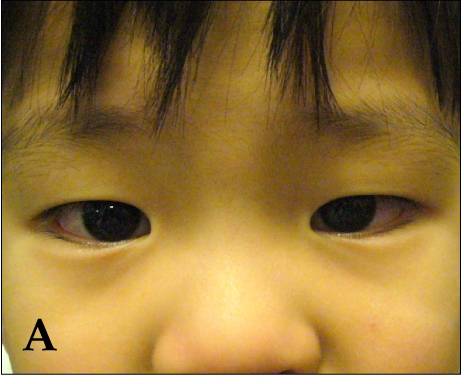
  • Conjuntivitis
    • Bilateral
    • No exudativa
    • Bulbar
    • Respeta el limbo
    • Inicia a los LOS Neisseria pocos días de la fiebre
    • A veces se observa con fotofofobia
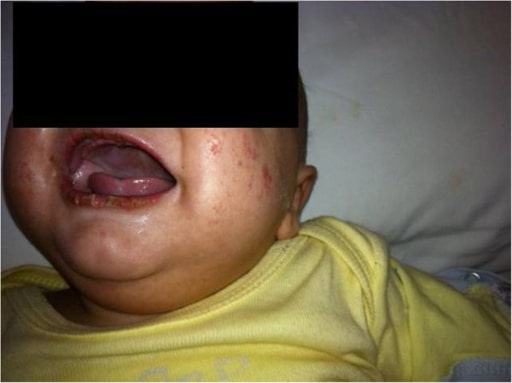
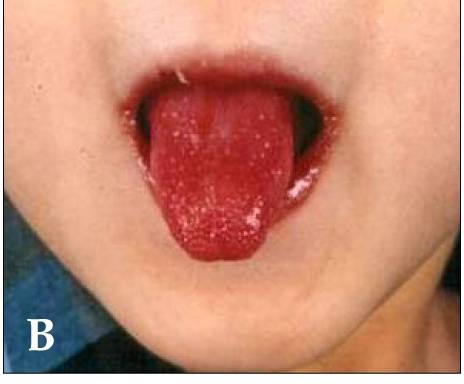
  • Mucositis Mucositis Stomatitis is a general term referring to inflammation of the mucous membranes of the mouth, which may include sores. Stomatitis can be caused by infections, autoimmune disorders, allergic reactions, or exposure to irritants. The typical presentation may be either solitary or a group of painful oral lesions. Stomatitis:
    • Eritema de labios y mucosa oral
    • “Lengua en EN Erythema nodosum is an immune-mediated panniculitis (inflammation of the subcutaneous fat) caused by a type IV (delayed-type) hypersensitivity reaction. It commonly manifests in young women as tender, erythematous nodules on the shins. Erythema Nodosum fresa”
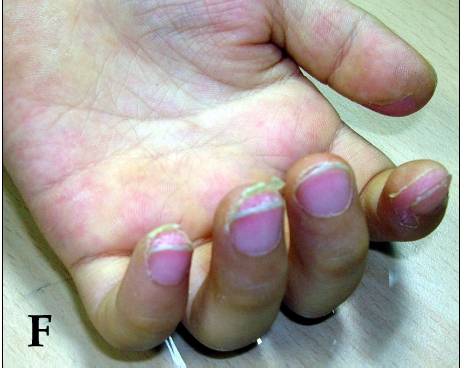
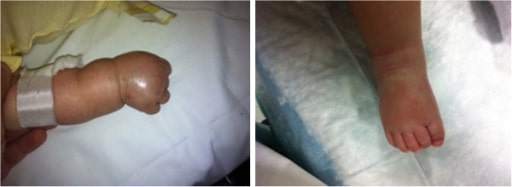
  • Cambios en EN Erythema nodosum is an immune-mediated panniculitis (inflammation of the subcutaneous fat) caused by a type IV (delayed-type) hypersensitivity reaction. It commonly manifests in young women as tender, erythematous nodules on the shins. Erythema Nodosum las extremidades:
    • Inflamación y/o eritema en EN Erythema nodosum is an immune-mediated panniculitis (inflammation of the subcutaneous fat) caused by a type IV (delayed-type) hypersensitivity reaction. It commonly manifests in young women as tender, erythematous nodules on the shins. Erythema Nodosum palmas y plantas
    • Descamación periungueal
    • Generalmente, se observa de forma tardía en EN Erythema nodosum is an immune-mediated panniculitis (inflammation of the subcutaneous fat) caused by a type IV (delayed-type) hypersensitivity reaction. It commonly manifests in young women as tender, erythematous nodules on the shins. Erythema Nodosum el curso de la enfermedad
  • Linfadenopatía cervical:
    • Manifestación menos constante de la enfermedad de Kawasaki
    • Tiende a involucrar la cadena de ganglios cervicales anteriores
  • Pródromo inespecífico de síntomas respiratorios o gastrointestinales

Manifestaciones menos comunes

Sistema Manifestaciones
Gastrointestinal Diarrea, dolor Dolor Inflammation abdominal, vómitos, disfunción hepática, pancreatitis Pancreatitis Inflammation of the pancreas. Pancreatitis is classified as acute unless there are computed tomographic or endoscopic retrograde cholangiopancreatographic findings of chronic pancreatitis. The two most common forms of acute pancreatitis are alcoholic pancreatitis and gallstone pancreatitis. Acute Pancreatitis, hidrops biliar, ascitis, infarto esplénico
Musculoesquelético Poliartritis, artralgia
Sistema cardiovascular Miocarditis, pericarditis Pericarditis Pericarditis is an inflammation of the pericardium, often with fluid accumulation. It can be caused by infection (often viral), myocardial infarction, drugs, malignancies, metabolic disorders, autoimmune disorders, or trauma. Acute, subacute, and chronic forms exist. Pericarditis, taquicardia, valvulopatía
Genitourinario Uretritis, prostatitis Prostatitis Prostatitis is inflammation or an irritative condition of the prostate that presents as different syndromes: acute bacterial, chronic bacterial, chronic prostatitis/chronic pelvic pain, and asymptomatic. Bacterial prostatitis is easier to identify clinically and the management (antibiotics) is better established. Prostatitis, cistitis, nefritis intersticial, síndrome nefrótico
Sistema nervioso central Letargo, aumento de la irritabilidad, meningitis Meningitis Meningitis is inflammation of the meninges, the protective membranes of the brain, and spinal cord. The causes of meningitis are varied, with the most common being bacterial or viral infection. The classic presentation of meningitis is a triad of fever, altered mental status, and nuchal rigidity. Meningitis aséptica, sordera neurosensorial
Respiratorio Falta de aire, síntomas gripales, derrame pleural, tos TOS Thoracic outlet syndrome (TOS) is a broad term used for a spectrum of syndromes related to the general region of the thoracic outlet, which involves the compression or irritation of elements of the brachial plexus, subclavian artery, or subclavian vein. Thoracic Outlet Syndrome, rinorrea
Piel Eritema e induración en EN Erythema nodosum is an immune-mediated panniculitis (inflammation of the subcutaneous fat) caused by a type IV (delayed-type) hypersensitivity reaction. It commonly manifests in young women as tender, erythematous nodules on the shins. Erythema Nodosum el lugar de vacunación con BCG BCG An active immunizing agent and a viable avirulent attenuated strain of Mycobacterium bovis, which confers immunity to mycobacterial infections. It is used also in immunotherapy of neoplasms due to its stimulation of antibodies and non-specific immunity. Cancer Immunotherapy (bacilo de Calmette-Guérin), líneas de Beau, gangrena de dedos
General Irritabilidad, disminución de la ingesta, letargo

Diagnóstico

Criterios diagnósticos

  • Fiebre de duración ≥ 5 días Y al AL Amyloidosis menos 4 de los LOS Neisseria siguientes:
    • Inyección conjuntival bilateral no exudativa
    • Cambios en EN Erythema nodosum is an immune-mediated panniculitis (inflammation of the subcutaneous fat) caused by a type IV (delayed-type) hypersensitivity reaction. It commonly manifests in young women as tender, erythematous nodules on the shins. Erythema Nodosum la mucosa oral:
      • Labios fisurados
      • Lengua en EN Erythema nodosum is an immune-mediated panniculitis (inflammation of the subcutaneous fat) caused by a type IV (delayed-type) hypersensitivity reaction. It commonly manifests in young women as tender, erythematous nodules on the shins. Erythema Nodosum fresa
      • Inyección faringea
    • Cambios en EN Erythema nodosum is an immune-mediated panniculitis (inflammation of the subcutaneous fat) caused by a type IV (delayed-type) hypersensitivity reaction. It commonly manifests in young women as tender, erythematous nodules on the shins. Erythema Nodosum las extremidades periféricas:
      • Eritema de las palmas/plantas
      • Edema Edema Edema is a condition in which excess serous fluid accumulates in the body cavity or interstitial space of connective tissues. Edema is a symptom observed in several medical conditions. It can be categorized into 2 types, namely, peripheral (in the extremities) and internal (in an organ or body cavity). Edema de las manos/pies
      • Descamación periungueal
    • Erupción polimorfa eritematosa
    • Linfadenopatía cervical: al AL Amyloidosis menos 1 ganglio > 1,5 cm de diámetro
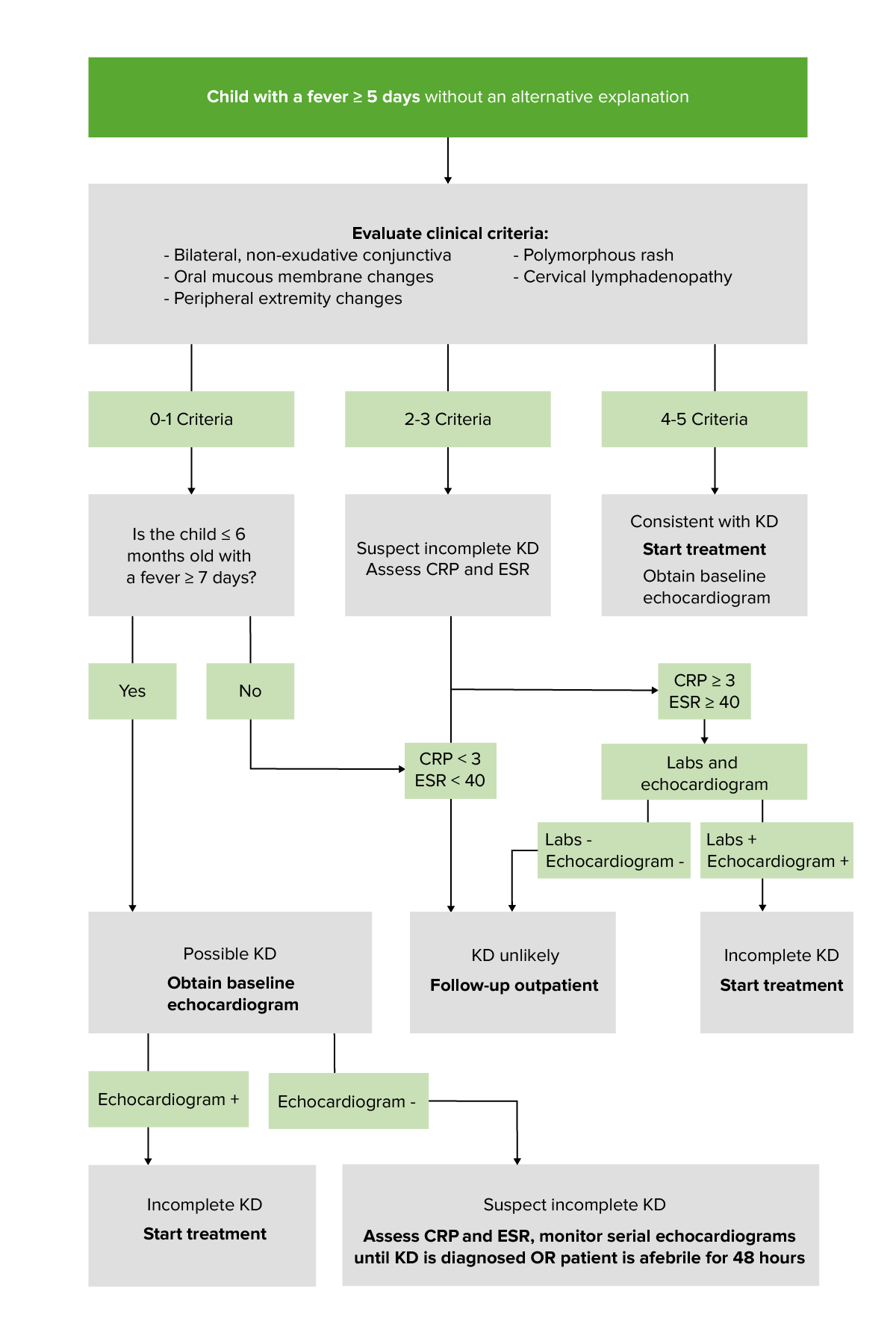
  • Si <4 criterios → Kawasaki incompleto, complementar con las pruebas de laboratorio de abajo
Diagnostic algorithm for children with fever_diagnosis of Kawasaki disease
Algoritmo diagnóstico para niños con fiebre/ diagnóstico de la enfermedad de Kawasaki

Unidades: PCR en mg/dL; velocidad de eritrosedimentación (ESR) en mm/h.
Hallazgos de laboratorio positivos (≥ 3 hallazgos de laboratorio suplementarios) incluyen:
Anemia (para la edad)
↑ Recuento de plaquetas
↑ Leucocitos
↓ Albúmina
↑ ALT
Piuria
Imagen por Lecturio.

Estudios de laboratorio e imagenología

  • Hemograma con diferencial:
    • ↑ Leucocitos
    • ↑ Plaquetas
    • Anemia Anemia Anemia is a condition in which individuals have low Hb levels, which can arise from various causes. Anemia is accompanied by a reduced number of RBCs and may manifest with fatigue, shortness of breath, pallor, and weakness. Subtypes are classified by the size of RBCs, chronicity, and etiology. Anemia: Overview and Types
  • Pruebas de función hepática:
    • ↑ Aspartato aminotransferasa ( AST AST Enzymes of the transferase class that catalyze the conversion of l-aspartate and 2-ketoglutarate to oxaloacetate and l-glutamate. Liver Function Tests) y alanina aminotransferasa ( ALT ALT An enzyme that catalyzes the conversion of l-alanine and 2-oxoglutarate to pyruvate and l-glutamate. Liver Function Tests)
    • ↓ Albúmina
  • Reactantes de fase aguda:
    • ↑Proteína c reactiva ( PCR PCR Polymerase chain reaction (PCR) is a technique that amplifies DNA fragments exponentially for analysis. The process is highly specific, allowing for the targeting of specific genomic sequences, even with minuscule sample amounts. The PCR cycles multiple times through 3 phases: denaturation of the template DNA, annealing of a specific primer to the individual DNA strands, and synthesis/elongation of new DNA molecules. Polymerase Chain Reaction (PCR))
    • ↑Velocidad de eritrosedimentación (VES)
  • Análisis de orina: piuria estéril
  • Electrocardiograma:
    • Puede demostrar cambios relacionados con miocarditis, pericarditis Pericarditis Pericarditis is an inflammation of the pericardium, often with fluid accumulation. It can be caused by infection (often viral), myocardial infarction, drugs, malignancies, metabolic disorders, autoimmune disorders, or trauma. Acute, subacute, and chronic forms exist. Pericarditis o isquemia/infarto de miocardio
    • Ejemplos de posibles hallazgos:
      • ↑ Intervalo PR
      • Ondas Q
      • Cambios en EN Erythema nodosum is an immune-mediated panniculitis (inflammation of the subcutaneous fat) caused by a type IV (delayed-type) hypersensitivity reaction. It commonly manifests in young women as tender, erythematous nodules on the shins. Erythema Nodosum el ST
      • Bajo voltaje
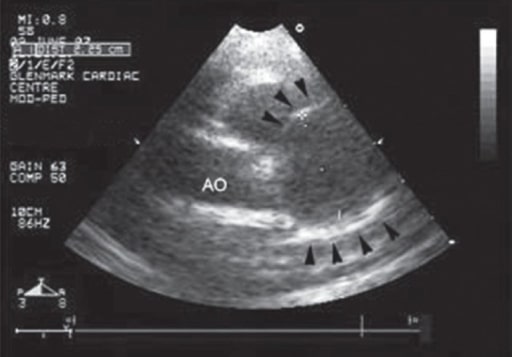
  • Ecocardiograma:
    • Posibles hallazgos:
      • ↑ Tamaño de la arteria descendente anterior izquierda o de la arteria coronaria derecha
      • Se observa un aneurisma de la arteria coronaria
      • ↓ Función del ventrículo izquierdo
      • Disfunción valvular (por ejemplo, regurgitación)
      • Derrame pericárdico
    • Debe realizarse en EN Erythema nodosum is an immune-mediated panniculitis (inflammation of the subcutaneous fat) caused by a type IV (delayed-type) hypersensitivity reaction. It commonly manifests in young women as tender, erythematous nodules on the shins. Erythema Nodosum todos los LOS Neisseria pacientes con enfermeda de Kawasaki
    • Establece un punto de referencia para el seguimiento longitudinal
    • Determina la eficacia del tratamiento
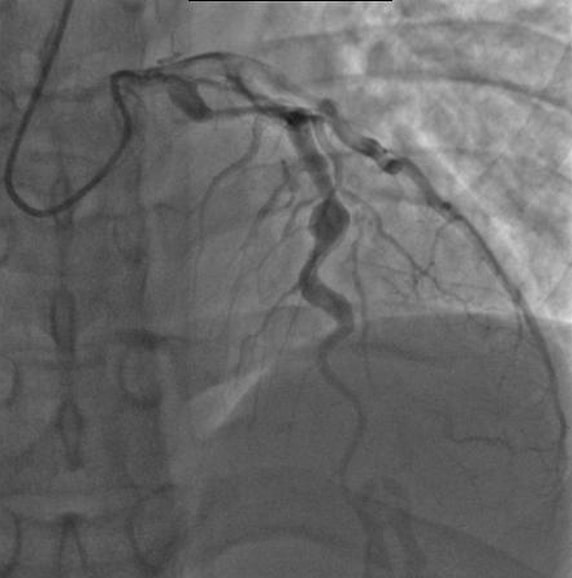
  • Angiografía:
    • Se utiliza para observar aneurismas ya detectados mediante ecocardiograma
    • No se utiliza para la detección o el diagnóstico inicial

Mnemotecnia

CRASH y Burn ( en EN Erythema nodosum is an immune-mediated panniculitis (inflammation of the subcutaneous fat) caused by a type IV (delayed-type) hypersensitivity reaction. It commonly manifests in young women as tender, erythematous nodules on the shins. Erythema Nodosum inglés):

C Conjunctivitis Conjunctivitis Conjunctivitis is a common inflammation of the bulbar and/or palpebral conjunctiva. It can be classified into infectious (mostly viral) and noninfectious conjunctivitis, which includes allergic causes. Patients commonly present with red eyes, increased tearing, burning, foreign body sensation, and photophobia. Conjunctivitis (conjuntivitis)
R Rash Rash Rocky Mountain Spotted Fever (erupción)
A – Adenopathy (adenopatía)
S Strawberry tongue Strawberry tongue Kawasaki Disease (lengua de fresa)
H – Hands and feet (manos y pies)
Burn – (quemadura): fiebre

Tratamiento

  • La enfermedad de Kawasaki es autolimitada.
  • El tratamiento tiene como objetivo prevenir las complicaciones y reducir los LOS Neisseria síntomas.
  • Pilar del tratamiento:
    • Inmunoglobulina intravenosa:
      • 2 g/kg administrados en EN Erythema nodosum is an immune-mediated panniculitis (inflammation of the subcutaneous fat) caused by a type IV (delayed-type) hypersensitivity reaction. It commonly manifests in young women as tender, erythematous nodules on the shins. Erythema Nodosum infusión única durante 8–12 horas
      • Si se inicia en EN Erythema nodosum is an immune-mediated panniculitis (inflammation of the subcutaneous fat) caused by a type IV (delayed-type) hypersensitivity reaction. It commonly manifests in young women as tender, erythematous nodules on the shins. Erythema Nodosum los LOS Neisseria 10 días siguientes a la aparición de la fiebre, reduce el riesgo de aneurismas de las arterias coronarias.
      • Observar durante 24 horas tras la finalización de la infusión de Inmunoglobulina intravenosa para confirmar la resolución de la fiebre.
      • Los LOS Neisseria pacientes con alto riesgo de resistencia a la inmunoglobulina intravenosa son tratados adicionalmente con glucocorticoides sistémicos.
    • Aspirina:
      • 30–50 mg/kg diarios divididos en EN Erythema nodosum is an immune-mediated panniculitis (inflammation of the subcutaneous fat) caused by a type IV (delayed-type) hypersensitivity reaction. It commonly manifests in young women as tender, erythematous nodules on the shins. Erythema Nodosum 4 dosis
      • Efectos antiinflamatorios y antiplaquetarios
      • Previene trombosis en EN Erythema nodosum is an immune-mediated panniculitis (inflammation of the subcutaneous fat) caused by a type IV (delayed-type) hypersensitivity reaction. It commonly manifests in young women as tender, erythematous nodules on the shins. Erythema Nodosum las arterias coronarias
  • Seguimiento con ecocardiogramas seriados a las 2 y 6 semanas
Tabla: Otros medicamentos que pueden utilizarse
Medicamento Indicación
Clopidogrel Clopidogrel A ticlopidine analog and platelet purinergic p2y receptor antagonist that inhibits adenosine diphosphate-mediated platelet aggregation. It is used to prevent thromboembolism in patients with arterial occlusive diseases; myocardial infarction; stroke; or atrial fibrillation. Antiplatelet Drugs, dipiridamol y otros medicamentos antiplaquetarios Para aneurismas de pequeño a mediano tamaño de las arterias coronarias y con un alto riesgo para la formación de trombos
Heparina de bajo peso molecular, warfarina y otros anticoagulantes Para aneurismas grandes de las arterias coronarias y un alto riesgo de formación de trombos
Infliximab Infliximab A chimeric monoclonal antibody to tnf-alpha that is used in the treatment of rheumatoid arthritis; ankylosing spondylitis; psoriatic arthritis and Crohn’s disease. Disease-Modifying Antirheumatic Drugs (DMARDs), ciclofosfamida y ciclosporina Casos refractarios con aneurisma coronario
Corticosteroides Pacientes que no responden a los LOS Neisseria tratamientos y terapias estándar o que corren el riesgo de presentar resistencia a la inmunoglobulina intravenosa

Complicaciones

  • Shock Shock Shock is a life-threatening condition associated with impaired circulation that results in tissue hypoxia. The different types of shock are based on the underlying cause: distributive (↑ cardiac output (CO), ↓ systemic vascular resistance (SVR)), cardiogenic (↓ CO, ↑ SVR), hypovolemic (↓ CO, ↑ SVR), obstructive (↓ CO), and mixed. Types of Shock:
    • Síndrome de shock Shock Shock is a life-threatening condition associated with impaired circulation that results in tissue hypoxia. The different types of shock are based on the underlying cause: distributive (↑ cardiac output (CO), ↓ systemic vascular resistance (SVR)), cardiogenic (↓ CO, ↑ SVR), hypovolemic (↓ CO, ↑ SVR), obstructive (↓ CO), and mixed. Types of Shock de la enfermedad de Kawasaki está dado por hipotensión sistólica sostenida o signos clínicos de mala perfusión.
    • Características altamente sugestivas de síndrome de shock Shock Shock is a life-threatening condition associated with impaired circulation that results in tissue hypoxia. The different types of shock are based on the underlying cause: distributive (↑ cardiac output (CO), ↓ systemic vascular resistance (SVR)), cardiogenic (↓ CO, ↑ SVR), hypovolemic (↓ CO, ↑ SVR), obstructive (↓ CO), and mixed. Types of Shock de la enfermedad de Kawasaki:
      • Trombocitosis
      • Edad temprana
      • Anomalías de las arterias coronarias
  • Complicaciones cardíacas:
    • Incluyen:
      • Dilatación, aneurisma y/o estenosis de las arterias coronarias
      • Disfunción ventricular
      • Insuficiencia valvular
      • Derrames pericárdicos
    • Monitorizar con ecocardiogramas seriados.
  • Síndrome de activación de macrófagos:
    • Activación y proliferación de macrófagos y células T.
    • Coagulopatía intravascular diseminada
    • Citopenias
    • Trombosis.
  • Isquemia, gangrena:
    • Causada por la obstrucción arterial periférica
    • Puede afectar las vísceras o las extremidades
  • Anomalías urinarias:
    • Piuria estéril (común)
    • Nefritis intersticial aguda
    • Proteinuria Proteinuria The presence of proteins in the urine, an indicator of kidney diseases. Nephrotic Syndrome in Children leve
    • Lesión renal aguda
  • Anomalías gastrointestinales:
    • Hidropesía de la vesícula biliar es un hallazgo común durante la fase aguda de la enfermedad de Kawasaki
    • Resuelve rápidamente con la administración de inmunoglobulina intravenosa
  • Sistema nervioso central:
    • La irritabilidad es una característica común de la fase aguda de la enfermedad de Kawasak
    • Se cree que está relacionada con la pleocitosis del líquido cefalorraquídeo
  • Pérdida de audición neurosensorial: Puede ocurrir en EN Erythema nodosum is an immune-mediated panniculitis (inflammation of the subcutaneous fat) caused by a type IV (delayed-type) hypersensitivity reaction. It commonly manifests in young women as tender, erythematous nodules on the shins. Erythema Nodosum la fase aguda de la enfermedad de Kawasaki, pero rara vez persiste.

Diagnóstico Diferencial

  • Escarlatina: enfermedad que se produce como consecuencia de una infección por el estreptococo del grupo A, también conocido como Streptococcus Streptococcus Streptococcus is one of the two medically important genera of gram-positive cocci, the other being Staphylococcus. Streptococci are identified as different species on blood agar on the basis of their hemolytic pattern and sensitivity to optochin and bacitracin. There are many pathogenic species of streptococci, including S. pyogenes, S. agalactiae, S. pneumoniae, and the viridans streptococci. Streptococcus pyogenes. Los LOS Neisseria signos y síntomas incluyen dolor Dolor Inflammation de garganta, fiebre, cefaleas, inflamación de los LOS Neisseria ganglios linfáticos, una erupción característica (roja y parecida al AL Amyloidosis papel de lija) y lengua roja/con bultos. La faringitis exudativa en EN Erythema nodosum is an immune-mediated panniculitis (inflammation of the subcutaneous fat) caused by a type IV (delayed-type) hypersensitivity reaction. It commonly manifests in young women as tender, erythematous nodules on the shins. Erythema Nodosum la enfermedad de Kawasaki puede confundirse con la faringitis estreptocócica. El diagnóstico de la escarlatina suele confirmarse con la detección rápida de antígenos o el cultivo de garganta. El tratamiento es con penicilina o amoxicilina.
  • Sarampión: infección por el paramixovirus que se presenta con fiebre, conjuntivitis y una erupción polimorfa muy contagiosa. Las lesiones intraorales discretas de la enfermedad de Kawasaki pueden confundirse con las manchas de Koplik del sarampión. El diagnóstico se realiza mediante la reacción en EN Erythema nodosum is an immune-mediated panniculitis (inflammation of the subcutaneous fat) caused by a type IV (delayed-type) hypersensitivity reaction. It commonly manifests in young women as tender, erythematous nodules on the shins. Erythema Nodosum cadena de la polimerasa ( PCR PCR Polymerase chain reaction (PCR) is a technique that amplifies DNA fragments exponentially for analysis. The process is highly specific, allowing for the targeting of specific genomic sequences, even with minuscule sample amounts. The PCR cycles multiple times through 3 phases: denaturation of the template DNA, annealing of a specific primer to the individual DNA strands, and synthesis/elongation of new DNA molecules. Polymerase Chain Reaction (PCR)) viral, y el manejo implica el aislamiento y el tratamiento de soporte.
  • Enfermedad de Lyme: una enfermedad infecciosa causada por la Borrelia burgdorferi Borrelia burgdorferi A specific species of bacteria, part of the borrelia burgdorferi group, whose common name is lyme disease spirochete. Borrelia, que se transmite a través de las garrapatas. El signo más común es el eritema migratorio que aparece en EN Erythema nodosum is an immune-mediated panniculitis (inflammation of the subcutaneous fat) caused by a type IV (delayed-type) hypersensitivity reaction. It commonly manifests in young women as tender, erythematous nodules on the shins. Erythema Nodosum el lugar de la picadura de la garrapata aproximadamente una semana después de producirse. Otros síntomas son dolor Dolor Inflammation en EN Erythema nodosum is an immune-mediated panniculitis (inflammation of the subcutaneous fat) caused by a type IV (delayed-type) hypersensitivity reaction. It commonly manifests in young women as tender, erythematous nodules on the shins. Erythema Nodosum las articulaciones, cefalea intensa, rigidez nucal o palpitaciones. El diagnóstico se basa en EN Erythema nodosum is an immune-mediated panniculitis (inflammation of the subcutaneous fat) caused by a type IV (delayed-type) hypersensitivity reaction. It commonly manifests in young women as tender, erythematous nodules on the shins. Erythema Nodosum los LOS Neisseria hallazgos clínicos y la exposición a las garrapatas, y se apoya en EN Erythema nodosum is an immune-mediated panniculitis (inflammation of the subcutaneous fat) caused by a type IV (delayed-type) hypersensitivity reaction. It commonly manifests in young women as tender, erythematous nodules on the shins. Erythema Nodosum pruebas serológicas. Para el tratamiento se utilizan antibióticos, como la doxiciclina.
  • Fiebre de las Montañas Rocosas: Infección bacteriana que se transmite por la picadura de una garrapata infectada. Los LOS Neisseria síntomas incluyen vómitos, fiebre alta y repentina, cefalea, dolor Dolor Inflammation abdominal, sarpullido y dolores musculares. El diagnóstico se basa en EN Erythema nodosum is an immune-mediated panniculitis (inflammation of the subcutaneous fat) caused by a type IV (delayed-type) hypersensitivity reaction. It commonly manifests in young women as tender, erythematous nodules on the shins. Erythema Nodosum las características clínicas, la biopsia de la erupción y las pruebas serológicas. El tratamiento consiste en EN Erythema nodosum is an immune-mediated panniculitis (inflammation of the subcutaneous fat) caused by a type IV (delayed-type) hypersensitivity reaction. It commonly manifests in young women as tender, erythematous nodules on the shins. Erythema Nodosum la administración de antibióticos, como la doxiciclina.
  • Rotavirus Rotavirus A genus of Reoviridae, causing acute gastroenteritis in birds and mammals, including humans. Transmission is horizontal and by environmental contamination. Seven species (rotaviruses A through G) are recognized. Rotavirus: El rotavirus Rotavirus A genus of Reoviridae, causing acute gastroenteritis in birds and mammals, including humans. Transmission is horizontal and by environmental contamination. Seven species (rotaviruses A through G) are recognized. Rotavirus es una causa frecuente de gastroenteritis Gastroenteritis Gastroenteritis is inflammation of the stomach and intestines, commonly caused by infections from bacteria, viruses, or parasites. Transmission may be foodborne, fecal-oral, or through animal contact. Common clinical features include abdominal pain, diarrhea, vomiting, fever, and dehydration. Gastroenteritis grave. El pródromo inespecífico de síntomas gastrointestinales, como diarrea, dolor Dolor Inflammation abdominal y vómitos, que puede observarse en EN Erythema nodosum is an immune-mediated panniculitis (inflammation of the subcutaneous fat) caused by a type IV (delayed-type) hypersensitivity reaction. It commonly manifests in young women as tender, erythematous nodules on the shins. Erythema Nodosum la enfermedad de Kawasaki puede confundirse con una infección por rotavirus Rotavirus A genus of Reoviridae, causing acute gastroenteritis in birds and mammals, including humans. Transmission is horizontal and by environmental contamination. Seven species (rotaviruses A through G) are recognized. Rotavirus. Por lo general, no es necesario realizar pruebas de diagnóstico del rotavirus Rotavirus A genus of Reoviridae, causing acute gastroenteritis in birds and mammals, including humans. Transmission is horizontal and by environmental contamination. Seven species (rotaviruses A through G) are recognized. Rotavirus. La terapia de rehidratación oral es el pilar del tratamiento.
  • Neumonía: inflamación aguda o crónica del tejido pulmonar causada por una infección por bacterias, virus Virus Viruses are infectious, obligate intracellular parasites composed of a nucleic acid core surrounded by a protein capsid. Viruses can be either naked (non-enveloped) or enveloped. The classification of viruses is complex and based on many factors, including type and structure of the nucleoid and capsid, the presence of an envelope, the replication cycle, and the host range. Virology u hongos que se considera una enfermedad común de la infancia. El pródromo inespecífico de síntomas respiratorios y gastrointestinales de la enfermedad de Kawasaki puede confundirse con una neumonía. El diagnóstico de la neumonía se basa en EN Erythema nodosum is an immune-mediated panniculitis (inflammation of the subcutaneous fat) caused by a type IV (delayed-type) hypersensitivity reaction. It commonly manifests in young women as tender, erythematous nodules on the shins. Erythema Nodosum la historia clínica y la exploración, y se apoya en EN Erythema nodosum is an immune-mediated panniculitis (inflammation of the subcutaneous fat) caused by a type IV (delayed-type) hypersensitivity reaction. It commonly manifests in young women as tender, erythematous nodules on the shins. Erythema Nodosum imágenes (como una radiografía de tórax). El tratamiento incluye cuidados de apoyo y agentes antimicrobianos en EN Erythema nodosum is an immune-mediated panniculitis (inflammation of the subcutaneous fat) caused by a type IV (delayed-type) hypersensitivity reaction. It commonly manifests in young women as tender, erythematous nodules on the shins. Erythema Nodosum función de la etiología.
  • Adenovirus Adenovirus Adenovirus (member of the family Adenoviridae) is a nonenveloped, double-stranded DNA virus. Adenovirus is transmitted in a variety of ways, and it can have various presentations based on the site of entry. Presentation can include febrile pharyngitis, conjunctivitis, acute respiratory disease, atypical pneumonia, and gastroenteritis. Adenovirus: causa infecciones leves de las vías respiratorias superiores en EN Erythema nodosum is an immune-mediated panniculitis (inflammation of the subcutaneous fat) caused by a type IV (delayed-type) hypersensitivity reaction. It commonly manifests in young women as tender, erythematous nodules on the shins. Erythema Nodosum los LOS Neisseria niños pequeños. El pródromo de síntomas respiratorios inespecíficos y la conjuntivitis no exudativa que los LOS Neisseria acompaña en EN Erythema nodosum is an immune-mediated panniculitis (inflammation of the subcutaneous fat) caused by a type IV (delayed-type) hypersensitivity reaction. It commonly manifests in young women as tender, erythematous nodules on the shins. Erythema Nodosum la enfermedad de Kawasaki pueden confundirse con una infección respiratoria superior común causada por adenovirus Adenovirus Adenovirus (member of the family Adenoviridae) is a nonenveloped, double-stranded DNA virus. Adenovirus is transmitted in a variety of ways, and it can have various presentations based on the site of entry. Presentation can include febrile pharyngitis, conjunctivitis, acute respiratory disease, atypical pneumonia, and gastroenteritis. Adenovirus. El diagnóstico de adenovirus Adenovirus Adenovirus (member of the family Adenoviridae) is a nonenveloped, double-stranded DNA virus. Adenovirus is transmitted in a variety of ways, and it can have various presentations based on the site of entry. Presentation can include febrile pharyngitis, conjunctivitis, acute respiratory disease, atypical pneumonia, and gastroenteritis. Adenovirus se confirma mediante PCR PCR Polymerase chain reaction (PCR) is a technique that amplifies DNA fragments exponentially for analysis. The process is highly specific, allowing for the targeting of specific genomic sequences, even with minuscule sample amounts. The PCR cycles multiple times through 3 phases: denaturation of the template DNA, annealing of a specific primer to the individual DNA strands, and synthesis/elongation of new DNA molecules. Polymerase Chain Reaction (PCR) y las pruebas de antígenos. La mayoría de las infecciones son autolimitadas, por lo que el tratamiento suele ser de apoyo.
  • Meningitis Meningitis Meningitis is inflammation of the meninges, the protective membranes of the brain, and spinal cord. The causes of meningitis are varied, with the most common being bacterial or viral infection. The classic presentation of meningitis is a triad of fever, altered mental status, and nuchal rigidity. Meningitis: inflamación de las meninges Meninges The brain and the spinal cord are enveloped by 3 overlapping layers of connective tissue called the meninges. The layers are, from the most external layer to the most internal layer, the dura mater, arachnoid mater, and pia mater. Between these layers are 3 potential spaces called the epidural, subdural, and subarachnoid spaces. Meninges: Anatomy causada generalmente por bacterias y virus Virus Viruses are infectious, obligate intracellular parasites composed of a nucleic acid core surrounded by a protein capsid. Viruses can be either naked (non-enveloped) or enveloped. The classification of viruses is complex and based on many factors, including type and structure of the nucleoid and capsid, the presence of an envelope, the replication cycle, and the host range. Virology. La irritabilidad es una manifestación frecuente de la enfermedad de Kawasaki y la meningitis Meningitis Meningitis is inflammation of the meninges, the protective membranes of the brain, and spinal cord. The causes of meningitis are varied, with the most common being bacterial or viral infection. The classic presentation of meningitis is a triad of fever, altered mental status, and nuchal rigidity. Meningitis. Otros signos y síntomas que se presentan son fiebre, alteración del estado mental y rigidez nucal. El diagnóstico se confirma con el análisis del LCR. El tratamiento incluye una terapia antimicrobiana inmediata de amplio espectro, que puede adaptarse una vez que se identifique el patógeno causante.
  • Síndrome de Stevens-Johnson: reacción de hipersensibilidad mediada por el complejo inmunitario que puede ser desencadenada por etiologías infecciosas o por el uso de anticonvulsivos, antibióticos u otros medicamentos. El síndrome se caracteriza por la necrólisis epidérmica, la separación de la epidermis Epidermis The external, nonvascular layer of the skin. It is made up, from within outward, of five layers of epithelium: (1) basal layer (stratum basale epidermidis); (2) spinous layer (stratum spinosum epidermidis); (3) granular layer (stratum granulosum epidermidis); (4) clear layer (stratum lucidum epidermidis); and (5) horny layer (stratum corneum epidermidis). Skin: Structure and Functions de la dermis Dermis A layer of vascularized connective tissue underneath the epidermis. The surface of the dermis contains innervated papillae. Embedded in or beneath the dermis are sweat glands; hair follicles; and sebaceous glands. Skin: Structure and Functions y la formación de ampollas cutáneas y bullas en EN Erythema nodosum is an immune-mediated panniculitis (inflammation of the subcutaneous fat) caused by a type IV (delayed-type) hypersensitivity reaction. It commonly manifests in young women as tender, erythematous nodules on the shins. Erythema Nodosum la cara, los LOS Neisseria labios, la garganta y las extremidades. La erupción bullosa o vesicular en EN Erythema nodosum is an immune-mediated panniculitis (inflammation of the subcutaneous fat) caused by a type IV (delayed-type) hypersensitivity reaction. It commonly manifests in young women as tender, erythematous nodules on the shins. Erythema Nodosum la enfermedad de Kawasaki puede confundirse con el Síndrome de Stevens-Johnson. El diagnóstico del síndrome de Stevens Johnson suele ser clínico, y el tratamiento es principalmente de apoyo. Se requiere la retirada de cualquier agente causante.
  • Virus Virus Viruses are infectious, obligate intracellular parasites composed of a nucleic acid core surrounded by a protein capsid. Viruses can be either naked (non-enveloped) or enveloped. The classification of viruses is complex and based on many factors, including type and structure of the nucleoid and capsid, the presence of an envelope, the replication cycle, and the host range. Virology de Epstein-Barr: causa la mononucleosis Mononucleosis Infectious mononucleosis (IM), also known as “the kissing disease,” is a highly contagious viral infection caused by the Epstein-Barr virus. Its common name is derived from its main method of transmission: the spread of infected saliva via kissing. Clinical manifestations of IM include fever, tonsillar pharyngitis, and lymphadenopathy. Mononucleosis infecciosa y se asocia con el linfoma de Burkitt, la linfohistiocitosis hemofagocítica y el linfoma de Hodgkin. La linfadenopatía generalizada observada en EN Erythema nodosum is an immune-mediated panniculitis (inflammation of the subcutaneous fat) caused by a type IV (delayed-type) hypersensitivity reaction. It commonly manifests in young women as tender, erythematous nodules on the shins. Erythema Nodosum la enfermedad de Kawasaki puede confundirse con la linfadenopatía generalizada de la mononucleosis Mononucleosis Infectious mononucleosis (IM), also known as “the kissing disease,” is a highly contagious viral infection caused by the Epstein-Barr virus. Its common name is derived from its main method of transmission: the spread of infected saliva via kissing. Clinical manifestations of IM include fever, tonsillar pharyngitis, and lymphadenopathy. Mononucleosis infecciosa. El diagnóstico es clínico y se confirma mediante pruebas de anticuerpos heterófilos o serología. El tratamiento es de apoyo.

References:

  1. Jone, Pei-Ni, et al AL Amyloidosis. “Update on Diagnosis and Management of Kawasaki Disease Kawasaki disease An acute, febrile, mucocutaneous condition accompanied by swelling of cervical lymph nodes in infants and young children. The principal symptoms are fever, congestion of the ocular conjunctivae, reddening of the lips and oral cavity, protuberance of tongue papillae, and edema or erythema of the extremities. Kawasaki Disease: A Scientific Statement From the American Heart Association American Heart Association A voluntary organization concerned with the prevention and treatment of heart and vascular diseases. Heart Failure. Circulation Circulation The movement of the blood as it is pumped through the cardiovascular system. ABCDE Assessment, vol. 150, no. 23, Dec. 2024, pp. e481–500. https://www.ahajournals.org/doi/10.1161/CIR.0000000000001295
  2. Lee, Heirim. “Cardiac Outcomes of Multisystem Inflammatory Syndrome in Children. Kawasaki Disease Kawasaki disease An acute, febrile, mucocutaneous condition accompanied by swelling of cervical lymph nodes in infants and young children. The principal symptoms are fever, congestion of the ocular conjunctivae, reddening of the lips and oral cavity, protuberance of tongue papillae, and edema or erythema of the extremities. Kawasaki Disease, vol. 1, no. 2, 2023. www.e-kd.org, https://doi.org/10.59492/kd.2023.1.2.e13.
  3. Cherry, J. D., Harrison, G. J., Kaplan, S. L., Hotez, P. J., Steinbach, W. J., & Prober, C. G. (Eds.). (2024). Feigin and Cherry’s textbook of pediatric infectious diseases (9th ed.). Elsevier.
  4. Noval Rivas, M., & Arditi, M. (2023). Kawasaki Disease Kawasaki disease An acute, febrile, mucocutaneous condition accompanied by swelling of cervical lymph nodes in infants and young children. The principal symptoms are fever, congestion of the ocular conjunctivae, reddening of the lips and oral cavity, protuberance of tongue papillae, and edema or erythema of the extremities. Kawasaki Disease and Multisystem Inflammatory Syndrome in Children: Common Inflammatory Pathways of Two Distinct Diseases. Rheumatic diseases clinics of North America49(3), 647–659. https://doi.org/10.1016/j.rdc.2023.03.002
  5. Lee, S., Kim, D., Kim, B. J., Rhim, J. W., Lee, S. Y., & Jeong, D. C. (2023). Comparison of COVID-19-associated multisystem inflammatory syndrome in children (MIS-C) and Kawasaki disease Kawasaki disease An acute, febrile, mucocutaneous condition accompanied by swelling of cervical lymph nodes in infants and young children. The principal symptoms are fever, congestion of the ocular conjunctivae, reddening of the lips and oral cavity, protuberance of tongue papillae, and edema or erythema of the extremities. Kawasaki Disease shock Shock Shock is a life-threatening condition associated with impaired circulation that results in tissue hypoxia. The different types of shock are based on the underlying cause: distributive (↑ cardiac output (CO), ↓ systemic vascular resistance (SVR)), cardiogenic (↓ CO, ↑ SVR), hypovolemic (↓ CO, ↑ SVR), obstructive (↓ CO), and mixed. Types of Shock syndrome: case reports and literature review. Journal of rheumatic diseases30(4), 272–277. https://doi.org/10.4078/jrd.2023.0022
  6. Son, M. B., & Newburger, J. W. (2012). Management of Kawasaki disease Kawasaki disease An acute, febrile, mucocutaneous condition accompanied by swelling of cervical lymph nodes in infants and young children. The principal symptoms are fever, congestion of the ocular conjunctivae, reddening of the lips and oral cavity, protuberance of tongue papillae, and edema or erythema of the extremities. Kawasaki Disease: corticosteroids Corticosteroids Chorioretinitis revisited. Lancet (London, England)379(9826), 1571–1572. https://doi.org/10.1016/S0140-6736(12)60196-2

¡Crea tu cuenta gratis o inicia una sesión para seguir leyendo!

Regístrate ahora y obtén acceso gratuito a Lecturio con páginas de concepto, videos médicos y cuestionarios para tu educación médica.

User Reviews

Que tengas una sesión de estudio alegre y navideña 🎁 Ahorra 50% en todos los planes >>

Details