Domina Conceptos Médicos

Estudia para la escuela de medicina y tus examenes con Lecturio.

Insuficiencia Cardíaca

La insuficiencia cardíaca es un síndrome clínico que se caracteriza por síntomas típicos (p. ej., disnea, hinchazón de tobillos y fatiga) que pueden ir acompañados de signos (p. ej., presión venosa yugular elevada, crepitaciones pulmonares y edema Edema Edema is a condition in which excess serous fluid accumulates in the body cavity or interstitial space of connective tissues. Edema is a symptom observed in several medical conditions. It can be categorized into 2 types, namely, peripheral (in the extremities) and internal (in an organ or body cavity). Edema periférico) causados por una anomalía cardíaca estructural o funcional, lo que resulta en EN Erythema nodosum is an immune-mediated panniculitis (inflammation of the subcutaneous fat) caused by a type IV (delayed-type) hypersensitivity reaction. It commonly manifests in young women as tender, erythematous nodules on the shins. Erythema Nodosum una reducción del gasto cardíaco o en EN Erythema nodosum is an immune-mediated panniculitis (inflammation of the subcutaneous fat) caused by a type IV (delayed-type) hypersensitivity reaction. It commonly manifests in young women as tender, erythematous nodules on the shins. Erythema Nodosum presiones intracardíacas elevadas en EN Erythema nodosum is an immune-mediated panniculitis (inflammation of the subcutaneous fat) caused by a type IV (delayed-type) hypersensitivity reaction. It commonly manifests in young women as tender, erythematous nodules on the shins. Erythema Nodosum reposo o durante el esfuerzo. En EN Erythema nodosum is an immune-mediated panniculitis (inflammation of the subcutaneous fat) caused by a type IV (delayed-type) hypersensitivity reaction. It commonly manifests in young women as tender, erythematous nodules on the shins. Erythema Nodosum la insuficiencia cardíaca, la alteración del llenado ventricular o de la eyección de sangre provoca fatiga, disnea y retención de líquidos o edema Edema Edema is a condition in which excess serous fluid accumulates in the body cavity or interstitial space of connective tissues. Edema is a symptom observed in several medical conditions. It can be categorized into 2 types, namely, peripheral (in the extremities) and internal (in an organ or body cavity). Edema. La ecocardiografía puede confirmar el diagnóstico y dar información sobre la fracción de eyección. El tratamiento está dirigido a la eliminación del exceso de líquido y a la disminución de la demanda de oxígeno del corazón. El pronóstico depende de la causa subyacente, del cumplimiento del tratamiento médico y de la presencia de comorbilidades.

Last updated: Sep 6, 2024

Editorial responsibility: Stanley Oiseth, Lindsay Jones, Evelin Maza

Epidemiología

  • Prevalencia en EN Erythema nodosum is an immune-mediated panniculitis (inflammation of the subcutaneous fat) caused by a type IV (delayed-type) hypersensitivity reaction. It commonly manifests in young women as tender, erythematous nodules on the shins. Erythema Nodosum Estados Unidos: 1%–2%
  • Es más común en EN Erythema nodosum is an immune-mediated panniculitis (inflammation of the subcutaneous fat) caused by a type IV (delayed-type) hypersensitivity reaction. It commonly manifests in young women as tender, erythematous nodules on the shins. Erythema Nodosum los LOS Neisseria hombres.
  • La prevalencia en EN Erythema nodosum is an immune-mediated panniculitis (inflammation of the subcutaneous fat) caused by a type IV (delayed-type) hypersensitivity reaction. It commonly manifests in young women as tender, erythematous nodules on the shins. Erythema Nodosum los LOS Neisseria afroamericanos es un 25% mayor que en EN Erythema nodosum is an immune-mediated panniculitis (inflammation of the subcutaneous fat) caused by a type IV (delayed-type) hypersensitivity reaction. It commonly manifests in young women as tender, erythematous nodules on the shins. Erythema Nodosum los LOS Neisseria blancos.
  • La incidencia y la prevalencia aumentan considerablemente con la edad.
  • Causa más común de hospitalización en EN Erythema nodosum is an immune-mediated panniculitis (inflammation of the subcutaneous fat) caused by a type IV (delayed-type) hypersensitivity reaction. It commonly manifests in young women as tender, erythematous nodules on the shins. Erythema Nodosum pacientes > 60 años de edad

Etiología

Las afecciones subyacentes incluyen:

  • Hipertensión
  • Enfermedad arterial coronaria
  • Diabetes Diabetes Diabetes mellitus (DM) is a metabolic disease characterized by hyperglycemia and dysfunction of the regulation of glucose metabolism by insulin. Type 1 DM is diagnosed mostly in children and young adults as the result of autoimmune destruction of β cells in the pancreas and the resulting lack of insulin. Type 2 DM has a significant association with obesity and is characterized by insulin resistance. Diabetes Mellitus mellitus
  • Infarto de miocardio (IM)
  • Cardiomiopatía (incluye los LOS Neisseria tipos postparto y relacionados con el estrés)
  • Hipertrofia ventricular izquierda
  • Hipertensión pulmonar
  • Cor pulmonale Cor Pulmonale Cor pulmonale is right ventricular (RV) dysfunction caused by lung disease that results in pulmonary artery hypertension. The most common cause of cor pulmonale is chronic obstructive pulmonary disease. Dyspnea is the usual presenting symptom. Cor Pulmonale (e.g., enfermedad pulmonar obstructiva crónica)
  • Cardiopatías valvulares (e.g., estenosis aórtica)
  • Insuficiencia renal
  • Enfermedades del pericardio (e.g., pericarditis Pericarditis Pericarditis is an inflammation of the pericardium, often with fluid accumulation. It can be caused by infection (often viral), myocardial infarction, drugs, malignancies, metabolic disorders, autoimmune disorders, or trauma. Acute, subacute, and chronic forms exist. Pericarditis constrictiva)
  • Miocarditis
  • Hemocromatosis
  • Amiloidosis
  • Arritmias (e.g., bradiarritmias, taquiarritmias)
  • Abuso de sustancias
  • Quimioterapia o medicamentos cardiotóxicos

Los LOS Neisseria factores de riesgo son:

  • Abuso de sustancias (e.g., etanol, cocaína)
  • Tabaquismo
  • Obesidad
  • Estilo de vida sedentario

Fisiopatología

  • La insuficiencia cardíaca puede deberse a una disfunción sistólica o diastólica.
    • Insuficiencia cardíaca con fracción de eyección reducida o falla cardíaca sistólica:
      • Deterioro de la contractilidad de los LOS Neisseria miocitos y dilatación del corazón → reducción del volumen sistólico y de la fracción de eyección
      • Fracción de eyección del ventriculo izquierdo ≤ 40%
    • Insuficiencia cardíaca con fracción de eyección preservada o insuficiencia cardíaca diastólica:
      • Relajación y llenado inadecuados del corazón hipertrofiado, pero contractilidad normal de los LOS Neisseria miocitos → fracción de eyección preservada a pesar de un volumen sistólico bajo.
      • Fracción de eyección del ventriculo izquierdo ≥ 50%
    • Insuficiencia cardíaca con fracción de eyección levemente reducida:
      • Fracción de eyección del ventriculo izquierd entre 41% y 49%
    • Insuficiencia cardíaca con fracción de eyección mejorada: fracción de eyección del ventriculo izquierdo previa ≤ 40% que ha HA Hemolytic anemia (HA) is the term given to a large group of anemias that are caused by the premature destruction/hemolysis of circulating red blood cells (RBCs). Hemolysis can occur within (intravascular hemolysis) or outside the blood vessels (extravascular hemolysis). Hemolytic Anemia mejorado a > 40% en EN Erythema nodosum is an immune-mediated panniculitis (inflammation of the subcutaneous fat) caused by a type IV (delayed-type) hypersensitivity reaction. It commonly manifests in young women as tender, erythematous nodules on the shins. Erythema Nodosum la medición de seguimiento
  • La insuficiencia cardíaca también puede clasificarse de acuerdo con el área afectada:
    • Insuficiencia cardíaca izquierda: resulta de anomalías en EN Erythema nodosum is an immune-mediated panniculitis (inflammation of the subcutaneous fat) caused by a type IV (delayed-type) hypersensitivity reaction. It commonly manifests in young women as tender, erythematous nodules on the shins. Erythema Nodosum el lado izquierdo del corazón (ventrículo izquierdo, válvula aórtica, válvula mitral)
    • Insuficiencia cardíaca derecha: resulta de anomalías en EN Erythema nodosum is an immune-mediated panniculitis (inflammation of the subcutaneous fat) caused by a type IV (delayed-type) hypersensitivity reaction. It commonly manifests in young women as tender, erythematous nodules on the shins. Erythema Nodosum el lado derecho del corazón (ventrículo derecho, válvula tricúspide, válvula pulmonar)
    • La insuficiencia cardíaca izquierda y derecha puede producirse al AL Amyloidosis mismo tiempo.
  • Mecanismos compensatorios inducidos por la disminución del gasto cardíaco:
    • Activación del sistema nervioso simpático
    • Activación del sistema renina-angiotensina-aldosterona
    • Liberación de hormona antidiurética
    • Liberación de péptido natriurético auricular/péptido natriurético cerebral ( BNP BNP A peptide that is secreted by the brain and the heart atria, stored mainly in cardiac ventricular myocardium. It can cause natriuresis; diuresis; vasodilation; and inhibits secretion of renin and aldosterone. It improves heart function. It contains 32 amino acids. Renal Sodium and Water Regulation)
    • Remodelación cardíaca/hipertrofia
    • Efectos:
      • ↑ Presiones ventricular y auricular izquierda → ↑ presión capilar pulmonar → edema Edema Edema is a condition in which excess serous fluid accumulates in the body cavity or interstitial space of connective tissues. Edema is a symptom observed in several medical conditions. It can be categorized into 2 types, namely, peripheral (in the extremities) and internal (in an organ or body cavity). Edema pulmonar (disnea).
      • Deterioro del llenado del ventrículo izquierdo → favorece la retención de sodio y agua → ↑ volumen → edema Edema Edema is a condition in which excess serous fluid accumulates in the body cavity or interstitial space of connective tissues. Edema is a symptom observed in several medical conditions. It can be categorized into 2 types, namely, peripheral (in the extremities) and internal (in an organ or body cavity). Edema de extremidades/periférico
      • Congestión hepática pasiva crónica → lesión hepática (hepatopatía congestiva)
      • Presión arterial inadecuada y ↓ perfusión renal → lesión renal aguda a enfermedad crónica progresiva (síndrome cardiorrenal)
      • Incapacidad de irrigar suficiente sangre a otras zonas → confusión, fatiga, diaforesis
  • Inicialmente, estas adaptaciones pueden aumentar el gasto cardíaco y evitar el desarrollo de síntomas (Insuficiencia cardíaca compensada).
  • Con el tiempo, la hipertrofia disminuye el tamaño del lumen y no logra aumentar la contractilidad → exacerbación de la insuficiencia debido al AL Amyloidosis aumento de la demanda de oxígeno y la disminución de la contractilidad → Insuficiencia cardíaca descompensada
  • La insuficiencia cardíaca aguda descompensada suele deberse a una isquemia miocárdica (e.g., un infarto de miocardio).

Presentación Clínica

Síntomas de la insuficiencia cardíaca

  • Dolor Dolor Inflammation precordial
  • Disnea (de esfuerzo en EN Erythema nodosum is an immune-mediated panniculitis (inflammation of the subcutaneous fat) caused by a type IV (delayed-type) hypersensitivity reaction. It commonly manifests in young women as tender, erythematous nodules on the shins. Erythema Nodosum insuficiencia cardiaca temprana)
  • Ortopnea
  • Disnea paroxística nocturna
  • Hipotensión
  • Síncope
  • Fatiga
  • Confusión
  • Palpitaciones
  • Mareo
  • Tos TOS Thoracic outlet syndrome (TOS) is a broad term used for a spectrum of syndromes related to the general region of the thoracic outlet, which involves the compression or irritation of elements of the brachial plexus, subclavian artery, or subclavian vein. Thoracic Outlet Syndrome
  • Intolerancia al AL Amyloidosis ejercicio
  • Pérdida de peso involuntaria (caquexia cardíaca)

Signos de insuficiencia cardíaca

  • Hallazgos en EN Erythema nodosum is an immune-mediated panniculitis (inflammation of the subcutaneous fat) caused by a type IV (delayed-type) hypersensitivity reaction. It commonly manifests in young women as tender, erythematous nodules on the shins. Erythema Nodosum los LOS Neisseria signos vitales incluyen:
    • Taquicardia
    • Presión de pulso estrecha
    • Hipotensión observada en EN Erythema nodosum is an immune-mediated panniculitis (inflammation of the subcutaneous fat) caused by a type IV (delayed-type) hypersensitivity reaction. It commonly manifests in young women as tender, erythematous nodules on the shins. Erythema Nodosum la insuficiencia cardíaca grave
    • Pulsus alternans (alternancia de pulsos fuertes y débiles): recuperación incompleta de la contracción ventricular cada dos ciclos cardíacos → alternancia del volumen sistólico
  • Aspecto:
    • Cianosis (por mala perfusión)
    • Diaforesis
  • Examen torácico y cardiovascular:
    • Crepitaciones o estertores en EN Erythema nodosum is an immune-mediated panniculitis (inflammation of the subcutaneous fat) caused by a type IV (delayed-type) hypersensitivity reaction. It commonly manifests in young women as tender, erythematous nodules on the shins. Erythema Nodosum la exploración pulmonar
    • Ingurgitación yugular
    • Latido apical desplazado
    • Ruido cardíaco S3 S3 Heart Sounds (sonido grave en EN Erythema nodosum is an immune-mediated panniculitis (inflammation of the subcutaneous fat) caused by a type IV (delayed-type) hypersensitivity reaction. It commonly manifests in young women as tender, erythematous nodules on the shins. Erythema Nodosum la diástole temprana)
  • Otros hallazgos físicos:
    • Hepatoesplenomegalia (que puede causar sensibilidad)
    • Reflujo hepatoyugular (↑ presión venosa yugular con compresión del cuadrante superior derecho)
    • Ascitis
  • Edema Edema Edema is a condition in which excess serous fluid accumulates in the body cavity or interstitial space of connective tissues. Edema is a symptom observed in several medical conditions. It can be categorized into 2 types, namely, peripheral (in the extremities) and internal (in an organ or body cavity). Edema simétrico y/o con fóvea en EN Erythema nodosum is an immune-mediated panniculitis (inflammation of the subcutaneous fat) caused by a type IV (delayed-type) hypersensitivity reaction. It commonly manifests in young women as tender, erythematous nodules on the shins. Erythema Nodosum las extremidades inferiores:
    • Consistente con sobrecarga de volumen
    • Durante mucho tiempo, se produce induración de la piel.

Mnemotecnia

Los síntomas de insuficiencia cardíaca avanzada se pueden identificar con la frase I NEED HELP (“yo necesito ayuda” en EN Erythema nodosum is an immune-mediated panniculitis (inflammation of the subcutaneous fat) caused by a type IV (delayed-type) hypersensitivity reaction. It commonly manifests in young women as tender, erythematous nodules on the shins. Erythema Nodosum Ingles):
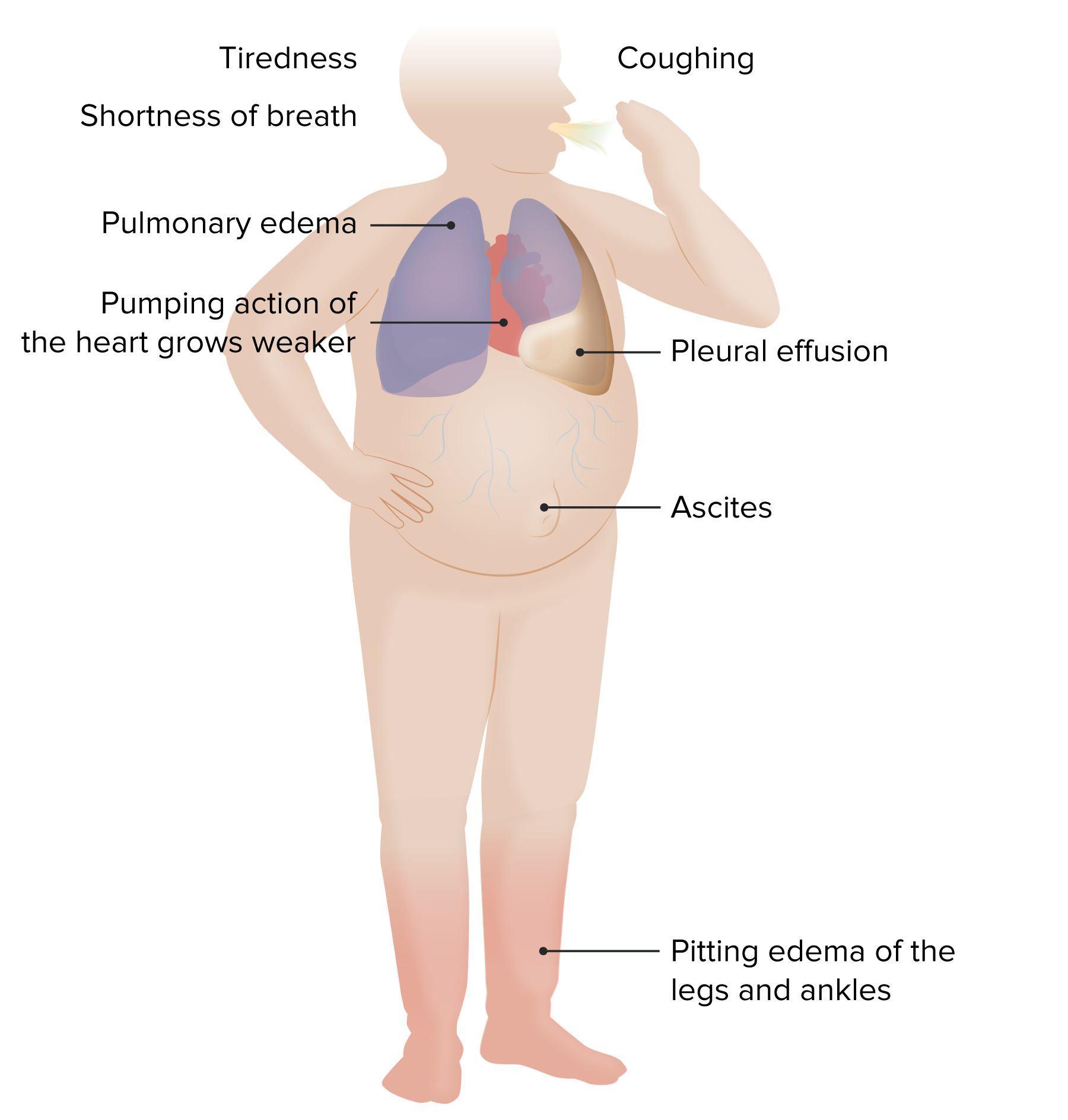
  • I Inotrope use (inotrópicos)
  • NNYHA class III-IV symptoms or elevated natriuretic peptides Natriuretic peptides Peptides that regulate the water-electrolyte balance in the body, also known as natriuretic peptide hormones. Several have been sequenced (atrial natriuretic factor; brain natriuretic peptide; c-type natriuretic peptide). Arterial Pressure Regulation (síntomas de clase III-IV de la NYHA o péptidos Natriuréticos elevados)
  • EEnd-organ dysfunction (disfunción orgánica)
  • EEjection fraction <20% (fracción de eyección <20%)
  • DDefibrillator shocks (descargas del desfibrilador)
  • HHospitalization >1 in the past year (hospitalización >1 en EN Erythema nodosum is an immune-mediated panniculitis (inflammation of the subcutaneous fat) caused by a type IV (delayed-type) hypersensitivity reaction. It commonly manifests in young women as tender, erythematous nodules on the shins. Erythema Nodosum el último año)
  • EEdema or escalating diuretics Diuretics Agents that promote the excretion of urine through their effects on kidney function. Heart Failure and Chronic Coronary Syndrome Medication ( edema Edema Edema is a condition in which excess serous fluid accumulates in the body cavity or interstitial space of connective tissues. Edema is a symptom observed in several medical conditions. It can be categorized into 2 types, namely, peripheral (in the extremities) and internal (in an organ or body cavity). Edema o aumento progresivo de diuréticos)
  • LLow blood pressure <100mmHg (presión arterial <100 mmHg)
  • PPrognostic medication intolerance (intolerancia a medicamentos pronósticos)

Clasificación funcional de la New York Heart Association (NYHA, por sus siglas en EN Erythema nodosum is an immune-mediated panniculitis (inflammation of the subcutaneous fat) caused by a type IV (delayed-type) hypersensitivity reaction. It commonly manifests in young women as tender, erythematous nodules on the shins. Erythema Nodosum inglés)

  • Clase I: sin limitaciones de actividad física
  • Clase II: cómodo en EN Erythema nodosum is an immune-mediated panniculitis (inflammation of the subcutaneous fat) caused by a type IV (delayed-type) hypersensitivity reaction. It commonly manifests in young women as tender, erythematous nodules on the shins. Erythema Nodosum reposo pero con ligera limitación durante la actividad física moderada/ prolongada
  • Clase III: cómodo sólo en EN Erythema nodosum is an immune-mediated panniculitis (inflammation of the subcutaneous fat) caused by a type IV (delayed-type) hypersensitivity reaction. It commonly manifests in young women as tender, erythematous nodules on the shins. Erythema Nodosum reposo. Las actividades cotidianas, como vestirse, suponen una marcada limitación de la actividad física.
  • Clase IV: sintomático incluso en EN Erythema nodosum is an immune-mediated panniculitis (inflammation of the subcutaneous fat) caused by a type IV (delayed-type) hypersensitivity reaction. It commonly manifests in young women as tender, erythematous nodules on the shins. Erythema Nodosum reposo

Clasificación de la Asociación Americana del Corazón

  • Estadio A ( en EN Erythema nodosum is an immune-mediated panniculitis (inflammation of the subcutaneous fat) caused by a type IV (delayed-type) hypersensitivity reaction. It commonly manifests in young women as tender, erythematous nodules on the shins. Erythema Nodosum riesgo de insuficiencia cardíaca): alto riesgo de insuficiencia cardíaca pero sin cardiopatía estructural, evidencia objetiva de enfermedad cardiovascular o síntomas de insuficiencia cardíaca, ahora incluye a pacientes con predisposición genética basada en EN Erythema nodosum is an immune-mediated panniculitis (inflammation of the subcutaneous fat) caused by a type IV (delayed-type) hypersensitivity reaction. It commonly manifests in young women as tender, erythematous nodules on the shins. Erythema Nodosum puntuaciones de riesgo genómico
  • Estadio B (pre- insuficiencia cardíaca): cardiopatía estructural/evidencia objetiva de enfermedad cardiovascular mínima pero sin signos o síntomas de insuficiencia cardíaca
  • Estadio C (insuficiencia cardíaca sintomática): cardiopatía estructural/evidencia objetiva de enfermedad cardiovascular de moderada a grave con síntomas previos o actuales de insuficiencia cardíaca
  • Estadio D (insuficiencia cardíaca avanzada): insuficiencia cardíaca refractaria/evidencia objetiva de enfermedad cardiovascular grave que requiere intervenciones especializadas

Diagnóstico

Abordaje inicial

  • El diagnóstico suele realizarse en EN Erythema nodosum is an immune-mediated panniculitis (inflammation of the subcutaneous fat) caused by a type IV (delayed-type) hypersensitivity reaction. It commonly manifests in young women as tender, erythematous nodules on the shins. Erythema Nodosum base a:
    • Evaluación clínica:
      • Signos y síntomas de congestión
      • Evidencia de retención de líquidos y/o hipoperfusión
      • Deterioro de la capacidad funcional
      • Los LOS Neisseria factores precipitantes provocan la exacerbación debido a ↑ la carga de trabajo cardíaco.
      • Otros factores: antecedentes familiares de enfermedad cardíaca
    • Evidencia de disfunción cardíaca en EN Erythema nodosum is an immune-mediated panniculitis (inflammation of the subcutaneous fat) caused by a type IV (delayed-type) hypersensitivity reaction. It commonly manifests in young women as tender, erythematous nodules on the shins. Erythema Nodosum la ecocardiografía (o cateterismo cardíaco)
  • La evaluación inicial de la sospecha de insuficiencia cardíaca incluye pruebas de laboratorio y estudios de imagen.
  • Las pruebas de laboratorio evalúan los LOS Neisseria factores de riesgo, las enfermedades preexistentes y las causas reversibles de la disfunción cardíaca.
    • Hemograma:
      • La anemia Anemia Anemia is a condition in which individuals have low Hb levels, which can arise from various causes. Anemia is accompanied by a reduced number of RBCs and may manifest with fatigue, shortness of breath, pallor, and weakness. Subtypes are classified by the size of RBCs, chronicity, and etiology. Anemia: Overview and Types puede causar insuficiencia cardíaca de alto gasto.
      • La hemoglobina < 8 mg/dL se asocia a una alteración del suministro de oxígeno.
    • Glucosa en EN Erythema nodosum is an immune-mediated panniculitis (inflammation of the subcutaneous fat) caused by a type IV (delayed-type) hypersensitivity reaction. It commonly manifests in young women as tender, erythematous nodules on the shins. Erythema Nodosum ayunas y hemoglobina A1c: La diabetes Diabetes Diabetes mellitus (DM) is a metabolic disease characterized by hyperglycemia and dysfunction of the regulation of glucose metabolism by insulin. Type 1 DM is diagnosed mostly in children and young adults as the result of autoimmune destruction of β cells in the pancreas and the resulting lack of insulin. Type 2 DM has a significant association with obesity and is characterized by insulin resistance. Diabetes Mellitus mellitus es una comorbilidad frecuente.
    • BUN y creatinina:
      • BUN/creatinina: > 20 = insuficiencia prerrenal → peor pronóstico.
      • Aumento del BUN → aumento de la mortalidad.
      • Aumento de ≥ 0,3 mg/dL de creatinina → aumento de la mortalidad.
    • Electrolitos:
      • Hiponatremia → peor pronóstico
      • Sodio < 137 mEq/L → disminución de la supervivencia
    • Albúmina: hipoalbuminemia → peor pronóstico
    • Bilirrubina:
      • Bilirrubina total elevada → peor pronóstico
      • Resultados de la hepatopatía congestiva
    • Niveles de aminotransferasas séricas: reflejan la función hepática
    • Pruebas de función tiroidea: El hipertiroidismo y el hipotiroidismo pueden conducir a una insuficiencia cardíaca grave o contribuir a la gravedad de la insuficiencia cardíaca existente.
    • Panel de lípidos: ↑ Lípidos → ↑ riesgo de enfermedad cardiovascular aterosclerótica
    • Niveles de BNP BNP A peptide that is secreted by the brain and the heart atria, stored mainly in cardiac ventricular myocardium. It can cause natriuresis; diuresis; vasodilation; and inhibits secretion of renin and aldosterone. It improves heart function. It contains 32 amino acids. Renal Sodium and Water Regulation/ProBNP terminal (NT-proBNP): alta sensibilidad y valor predictivo.
    • Troponina: Se obtiene en EN Erythema nodosum is an immune-mediated panniculitis (inflammation of the subcutaneous fat) caused by a type IV (delayed-type) hypersensitivity reaction. It commonly manifests in young women as tender, erythematous nodules on the shins. Erythema Nodosum el contexto de la emergencia durante la insuficiencia cardíaca aguda descompensada para determinar la presencia de un síndrome coronario agudo
  • Pruebas cardiopulmonares:
    • ECG ECG An electrocardiogram (ECG) is a graphic representation of the electrical activity of the heart plotted against time. Adhesive electrodes are affixed to the skin surface allowing measurement of cardiac impulses from many angles. The ECG provides 3-dimensional information about the conduction system of the heart, the myocardium, and other cardiac structures. Electrocardiogram (ECG):
      • Detecta anomalías en EN Erythema nodosum is an immune-mediated panniculitis (inflammation of the subcutaneous fat) caused by a type IV (delayed-type) hypersensitivity reaction. It commonly manifests in young women as tender, erythematous nodules on the shins. Erythema Nodosum el ritmo y la conducción cardíacos
      • Puede mostrar un aumento del voltaje del QRS en EN Erythema nodosum is an immune-mediated panniculitis (inflammation of the subcutaneous fat) caused by a type IV (delayed-type) hypersensitivity reaction. It commonly manifests in young women as tender, erythematous nodules on the shins. Erythema Nodosum las derivaciones I y aVL, ondas Q y anomalías de las ondas ST y T en EN Erythema nodosum is an immune-mediated panniculitis (inflammation of the subcutaneous fat) caused by a type IV (delayed-type) hypersensitivity reaction. It commonly manifests in young women as tender, erythematous nodules on the shins. Erythema Nodosum pacientes con un IM previo o con una miocardiopatía
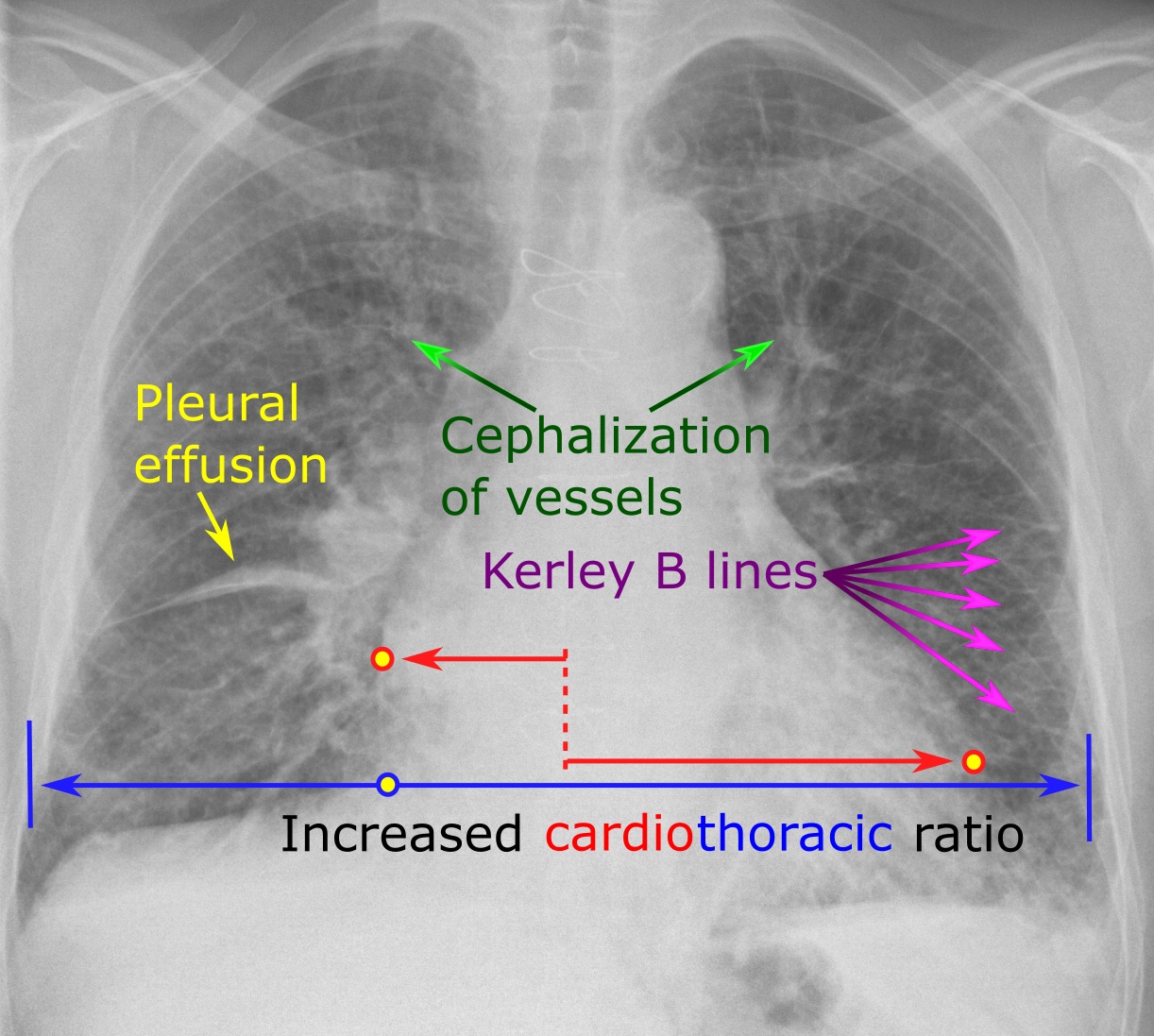
    • Radiografía de tórax: Puede mostrar cardiomegalia (relación entre el tamaño cardíaco y el tamaño torácico > 0,5), edema Edema Edema is a condition in which excess serous fluid accumulates in the body cavity or interstitial space of connective tissues. Edema is a symptom observed in several medical conditions. It can be categorized into 2 types, namely, peripheral (in the extremities) and internal (in an organ or body cavity). Edema pulmonar, derrame pleural, congestión vascular pulmonar, líneas B de Kerley
    • Ecocardiograma transtorácico (ETT) con imágenes Doppler Doppler Ultrasonography applying the doppler effect, with frequency-shifted ultrasound reflections produced by moving targets (usually red blood cells) in the bloodstream along the ultrasound axis in direct proportion to the velocity of movement of the targets, to determine both direction and velocity of blood flow. Ultrasound (Sonography):
      • Mide la fracción de eyección y evalúa la anatomía cardíaca
      • Detecta anomalías en EN Erythema nodosum is an immune-mediated panniculitis (inflammation of the subcutaneous fat) caused by a type IV (delayed-type) hypersensitivity reaction. It commonly manifests in young women as tender, erythematous nodules on the shins. Erythema Nodosum las válvulas, el miocardio y el pericardio
    • Resonancia magnética cardíaca:
      • Caracteriza el miocardio
      • Detecta el miocardio dañado, la fibrosis Fibrosis Any pathological condition where fibrous connective tissue invades any organ, usually as a consequence of inflammation or other injury. Bronchiolitis Obliterans y el IM (agudo y crónico)
    • Gammagrafía de adquisición multidireccional (ventriculografía con radionúclidos):
      • La forma más precisa de evaluar la fracción de eyección, pero rara vez se realiza
      • Indicación habitual: para obtener una evaluación basal de la función ventricular y para controlar la cardiotoxicidad de las antraciclinas (quimioterapia)
    • Prueba de esfuerzo cardiopulmonar:
      • Puede detectar la cardiopatía isquémica
      • Proporciona información sobre la capacidad de ejercicio, lo que ayuda a determinar el pronóstico
      • También ayuda a evaluar la idoneidad de un tratamiento avanzado, como el trasplante
Tabla: Hallazgos diagnósticos comunes en EN Erythema nodosum is an immune-mediated panniculitis (inflammation of the subcutaneous fat) caused by a type IV (delayed-type) hypersensitivity reaction. It commonly manifests in young women as tender, erythematous nodules on the shins. Erythema Nodosum insuficiencia cardíaca
Prueba Hallazgos
BNP BNP A peptide that is secreted by the brain and the heart atria, stored mainly in cardiac ventricular myocardium. It can cause natriuresis; diuresis; vasodilation; and inhibits secretion of renin and aldosterone. It improves heart function. It contains 32 amino acids. Renal Sodium and Water Regulation/pro-BNP
  • Diagnóstico de insuficiencia cardíaca aguda:
    • BNP BNP A peptide that is secreted by the brain and the heart atria, stored mainly in cardiac ventricular myocardium. It can cause natriuresis; diuresis; vasodilation; and inhibits secretion of renin and aldosterone. It improves heart function. It contains 32 amino acids. Renal Sodium and Water Regulation > 100 pg/ml o
    • NT-proBNP > 300 pg/ml
  • Determinación de insuficiencia cardíaca aguda:
    • BNP BNP A peptide that is secreted by the brain and the heart atria, stored mainly in cardiac ventricular myocardium. It can cause natriuresis; diuresis; vasodilation; and inhibits secretion of renin and aldosterone. It improves heart function. It contains 32 amino acids. Renal Sodium and Water Regulation > 400 pg/ml
    • NT-proBNP > 450 pg/ml (< 50 años)
    • NT-proBNP > 900 pg/ml (50-75 años)
    • NT-proBNP > 1800 pg/ml (> 75 años)
  • Umbrales inferiores para la insuficiencia cardíaca crónica
Radiografía de tórax
  • Edema Edema Edema is a condition in which excess serous fluid accumulates in the body cavity or interstitial space of connective tissues. Edema is a symptom observed in several medical conditions. It can be categorized into 2 types, namely, peripheral (in the extremities) and internal (in an organ or body cavity). Edema pulmonar
  • índice cardio/torácico > 0.5
ECG ECG An electrocardiogram (ECG) is a graphic representation of the electrical activity of the heart plotted against time. Adhesive electrodes are affixed to the skin surface allowing measurement of cardiac impulses from many angles. The ECG provides 3-dimensional information about the conduction system of the heart, the myocardium, and other cardiac structures. Electrocardiogram (ECG)
  • Desviación del eje a la izquierda
  • Aumento de la duración del QRS
Ecocardiograma
  • Fracción de eyección reducida/preservada(normal > 55%)
  • El tamaño del ventrículo y las anomalías del movimiento de la pared dependen de la etiología
Radiografía de insuficiencia cardíaca congestiva

Radiografía de tórax que muestra los hallazgos característicos de la insuficiencia cardíaca

Imagen: “Chest radiograph with signs of congestive heart failure – annotated” por Mikael Häggström – Own work. Licencia: CC0 1.0

Mnemotecnia

Una buena mnemotecnia para recordar estos hallazgos en EN Erythema nodosum is an immune-mediated panniculitis (inflammation of the subcutaneous fat) caused by a type IV (delayed-type) hypersensitivity reaction. It commonly manifests in young women as tender, erythematous nodules on the shins. Erythema Nodosum la radiografia de tórax es ABCDE ( en EN Erythema nodosum is an immune-mediated panniculitis (inflammation of the subcutaneous fat) caused by a type IV (delayed-type) hypersensitivity reaction. It commonly manifests in young women as tender, erythematous nodules on the shins. Erythema Nodosum inglés):

  • A – Alveolar edema Edema Edema is a condition in which excess serous fluid accumulates in the body cavity or interstitial space of connective tissues. Edema is a symptom observed in several medical conditions. It can be categorized into 2 types, namely, peripheral (in the extremities) and internal (in an organ or body cavity). Edema (batwing) ( edema Edema Edema is a condition in which excess serous fluid accumulates in the body cavity or interstitial space of connective tissues. Edema is a symptom observed in several medical conditions. It can be categorized into 2 types, namely, peripheral (in the extremities) and internal (in an organ or body cavity). Edema alveolar)
  • B – Kerley B lines (líneas B de Kerley)
  • C Cardiomegaly Cardiomegaly Enlargement of the heart, usually indicated by a cardiothoracic ratio above 0. 50. Heart enlargement may involve the right, the left, or both heart ventricles or heart atria. Cardiomegaly is a nonspecific symptom seen in patients with chronic systolic heart failure (heart failure) or several forms of cardiomyopathies. Ebstein’s Anomaly (cardiomegalia)
  • D – Dilated upper lobe vessels (vasos de los LOS Neisseria lóbulos superiores dilatados)
  • E – Pleural Effusion (derrame pleural)

Pruebas adicionales

  • Cuando la evaluación clínica y las pruebas iniciales confirman la

    insuficiencia cardíaca, se realizan pruebas adicionales para determinar la etiología y la estratificación del riesgo mediante la clasificación del estadio de la insuficiencia cardíaca.

  • Estudio de la enfermedad arterial coronaria (especialmente en EN Erythema nodosum is an immune-mediated panniculitis (inflammation of the subcutaneous fat) caused by a type IV (delayed-type) hypersensitivity reaction. It commonly manifests in young women as tender, erythematous nodules on the shins. Erythema Nodosum el caso de

    insuficiencia cardíaca inexplicada):

    • Prueba de esfuerzo cardíaco: puede evaluar el deterioro funcional debido a la enfermedad coronaria
      • Prueba de ECG ECG An electrocardiogram (ECG) is a graphic representation of the electrical activity of the heart plotted against time. Adhesive electrodes are affixed to the skin surface allowing measurement of cardiac impulses from many angles. The ECG provides 3-dimensional information about the conduction system of the heart, the myocardium, and other cardiac structures. Electrocardiogram (ECG) de ejercicio
      • Imagen de perfusión miocárdica con radionúclidos (rMPI)
      • Ecocardiografía de estrés
    • Angiografía coronaria:
      • Estándar de oro para diagnosticar la estenosis de las arterias coronarias
      • Mide el gasto cardíaco, el grado de disfunción del ventrículo izquierdo y la presión diastólica final del ventrículo izquierdo
  • Biopsia endomiocárdica:
    • No es una prueba de rutina
    • Es un procedimiento invasivo cuyos riesgos incluyen el taponamiento cardíaco, la perforación y la formación de trombos
    • Se realiza cuando se espera que un diagnóstico (e.g., amiloidosis) influya en EN Erythema nodosum is an immune-mediated panniculitis (inflammation of the subcutaneous fat) caused by a type IV (delayed-type) hypersensitivity reaction. It commonly manifests in young women as tender, erythematous nodules on the shins. Erythema Nodosum el tratamiento y la información que proporciona la prueba supera sus riesgos
  • Cateterismo cardíaco derecho (arteria pulmonar):
    • Mide las presiones intracardíacas
    • La información ayuda a dirigir la elegibilidad para las terapias avanzadas
  • Si está clínicamente indicado, se realizan pruebas específicas para las enfermedades no isquémicas.
  • Se realizan pruebas adicionales si hay complicaciones como la hepatopatía congestiva.
    • En EN Erythema nodosum is an immune-mediated panniculitis (inflammation of the subcutaneous fat) caused by a type IV (delayed-type) hypersensitivity reaction. It commonly manifests in young women as tender, erythematous nodules on the shins. Erythema Nodosum raras ocasiones, se necesitan pruebas invasivas.
    • En EN Erythema nodosum is an immune-mediated panniculitis (inflammation of the subcutaneous fat) caused by a type IV (delayed-type) hypersensitivity reaction. It commonly manifests in young women as tender, erythematous nodules on the shins. Erythema Nodosum individuos con casos equívocos (especialmente en EN Erythema nodosum is an immune-mediated panniculitis (inflammation of the subcutaneous fat) caused by a type IV (delayed-type) hypersensitivity reaction. It commonly manifests in young women as tender, erythematous nodules on the shins. Erythema Nodosum aquellos con enfermedad hepática subyacente), se realiza una biopsia hepática percutánea.
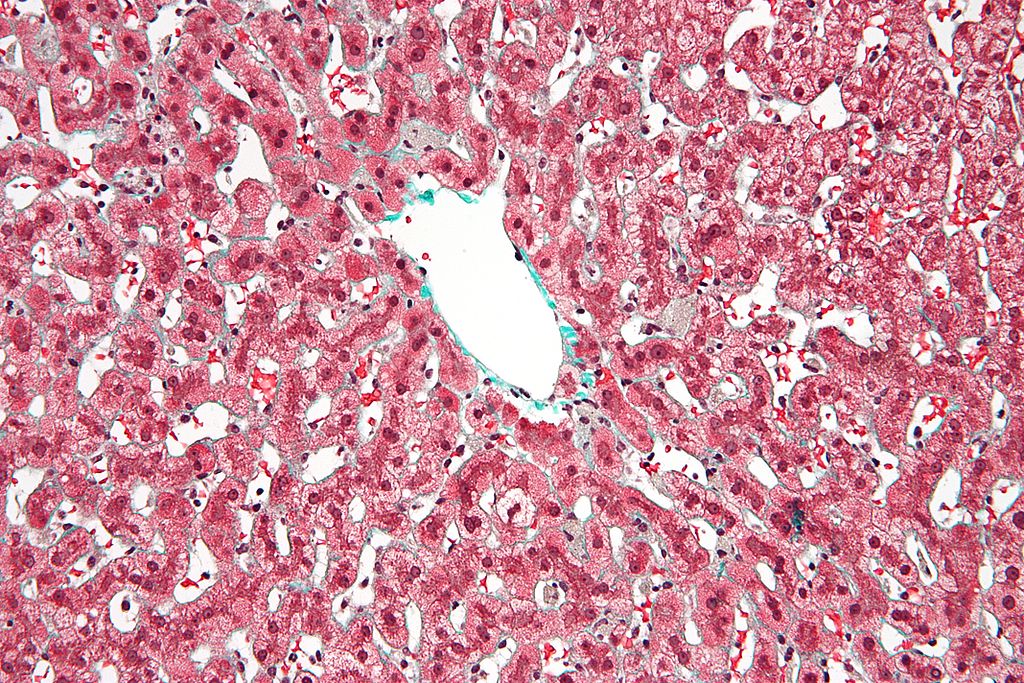
    • “Hígado en nuez moscada”: El aspecto macroscópico de áreas centrales rojas (que representan la congestión sinusoidal) se alterna con áreas amarillas (tejido hepático normal o graso).
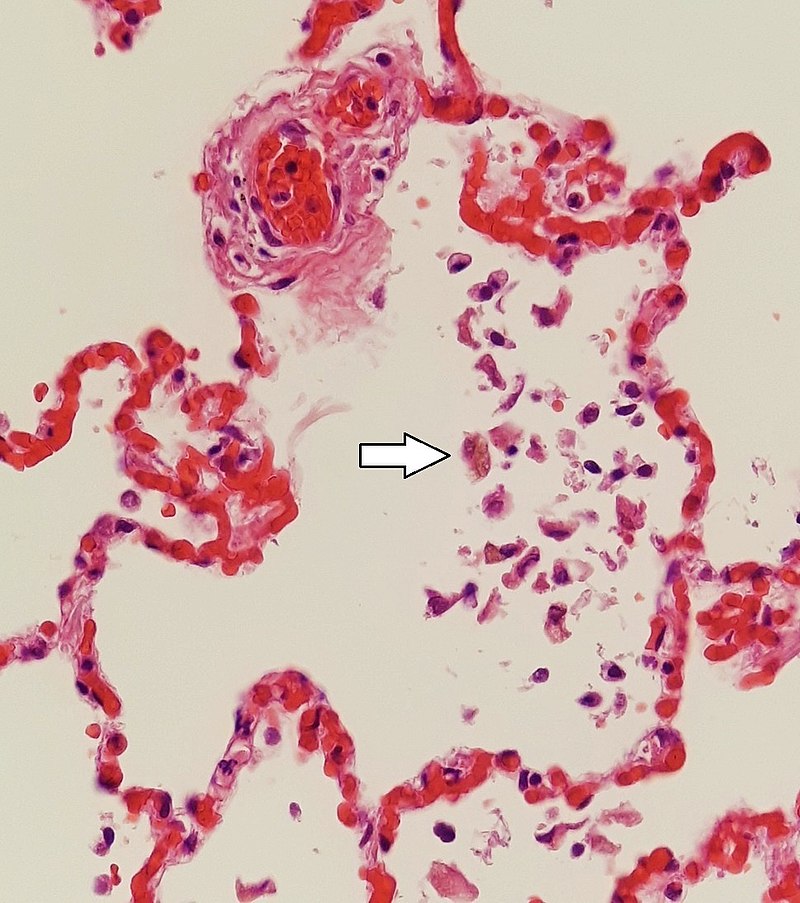
    • Histológicamente, se observan cambios hepáticos con macrófagos cargados de hemosiderina.

Tratamiento

Tratamiento de la insuficiencia cardíaca aguda descompensada

La descompensación aguda de la insuficiencia cardíaca provoca dificultad respiratoria, generalmente debido a la acumulación de líquido en EN Erythema nodosum is an immune-mediated panniculitis (inflammation of the subcutaneous fat) caused by a type IV (delayed-type) hypersensitivity reaction. It commonly manifests in young women as tender, erythematous nodules on the shins. Erythema Nodosum los LOS Neisseria pulmones ( edema Edema Edema is a condition in which excess serous fluid accumulates in the body cavity or interstitial space of connective tissues. Edema is a symptom observed in several medical conditions. It can be categorized into 2 types, namely, peripheral (in the extremities) and internal (in an organ or body cavity). Edema pulmonar).

Medidas iniciales de tratamiento

  • Evaluar las vías respiratorias y la oxigenación:
    • Pulsioximetría continua
    • Proporcionar suplemento de oxígeno según sea necesario (hipoxemia) con el objetivo de mantener la SpO2 > 90%
  • Telemetría cardíaca continua
  • Signos vitales: comprobar si hay hipertensión o hipotensión
  • Postura sentada o erguida
  • Tratamiento diurético intravenoso:
    • Alivia el edema Edema Edema is a condition in which excess serous fluid accumulates in the body cavity or interstitial space of connective tissues. Edema is a symptom observed in several medical conditions. It can be categorized into 2 types, namely, peripheral (in the extremities) and internal (in an organ or body cavity). Edema pulmonar/la sobrecarga de volumen aguda
    • Opciones:
      • Furosemida
      • Bumetanida
      • Torsemida
  • En EN Erythema nodosum is an immune-mediated panniculitis (inflammation of the subcutaneous fat) caused by a type IV (delayed-type) hypersensitivity reaction. It commonly manifests in young women as tender, erythematous nodules on the shins. Erythema Nodosum caso de hipertensión grave, administrar un tratamiento vasodilatador.
    • Nitroprusiato:
      • Reduce la poscarga del ventrículo izquierdo
      • Se utiliza en EN Erythema nodosum is an immune-mediated panniculitis (inflammation of the subcutaneous fat) caused by a type IV (delayed-type) hypersensitivity reaction. It commonly manifests in young women as tender, erythematous nodules on the shins. Erythema Nodosum la hipertensión severa y en EN Erythema nodosum is an immune-mediated panniculitis (inflammation of the subcutaneous fat) caused by a type IV (delayed-type) hypersensitivity reaction. It commonly manifests in young women as tender, erythematous nodules on the shins. Erythema Nodosum la regurgitación aórtica o mitral aguda
    • Nitroglicerina:
      • Reduce el tono venoso
      • Puede administrarse a quienes no han respondido plenamente al AL Amyloidosis tratamiento con diuréticos
  • Para la hipotensión/ shock Shock Shock is a life-threatening condition associated with impaired circulation that results in tissue hypoxia. The different types of shock are based on the underlying cause: distributive (↑ cardiac output (CO), ↓ systemic vascular resistance (SVR)), cardiogenic (↓ CO, ↑ SVR), hypovolemic (↓ CO, ↑ SVR), obstructive (↓ CO), and mixed. Types of Shock cardiogénico:
    • Agentes inotrópicos: se administran en EN Erythema nodosum is an immune-mediated panniculitis (inflammation of the subcutaneous fat) caused by a type IV (delayed-type) hypersensitivity reaction. It commonly manifests in young women as tender, erythematous nodules on the shins. Erythema Nodosum la insuficiencia cardíaca con fracción de eyección reducida (disfunción sistólica del ventrículo izquierdo)
      • Dobutamina
      • Milrinona
      • Dosis bajas de dopamina
    • Vasopresores: opción en EN Erythema nodosum is an immune-mediated panniculitis (inflammation of the subcutaneous fat) caused by a type IV (delayed-type) hypersensitivity reaction. It commonly manifests in young women as tender, erythematous nodules on the shins. Erythema Nodosum la insuficiencia cardíaca con fracción de eyección preservada y en EN Erythema nodosum is an immune-mediated panniculitis (inflammation of the subcutaneous fat) caused by a type IV (delayed-type) hypersensitivity reaction. It commonly manifests in young women as tender, erythematous nodules on the shins. Erythema Nodosum la obstrucción del tracto de salida del ventrículo izquierdo
      • Norepinefrina
      • Dosis altas de dopamina
      • Vasopresina

Mnemotecnia

Para recordar el tratamiento de la insuficiencia cardíaca aguda o la exacerbación de la insuficiencia cardíaca, recuerde la LMNOP” ( en EN Erythema nodosum is an immune-mediated panniculitis (inflammation of the subcutaneous fat) caused by a type IV (delayed-type) hypersensitivity reaction. It commonly manifests in young women as tender, erythematous nodules on the shins. Erythema Nodosum inglés):

  • L Lasix Lasix A benzoic-sulfonamide-furan. It is a diuretic with fast onset and short duration that is used for edema and chronic renal insufficiency. Loop Diuretics/Loop diuretic (diurético de asa ASA Anterior Cord Syndrome)
  • M Morphine Morphine The principal alkaloid in opium and the prototype opiate analgesic and narcotic. Morphine has widespread effects in the central nervous system and on smooth muscle. Opioid Analgesics (morfina) (para síndrome coronario agudo)
  • N Nitroglycerin Nitroglycerin A volatile vasodilator which relieves angina pectoris by stimulating guanylate cyclase and lowering cytosolic calcium. It is also sometimes used for tocolysis and explosives. Nitrates (nitroglicerina)
  • O – Oxygen (oxígeno)
  • P – Position or Prop up the patient (posición del paciente)

Tratamiento a largo plazo de la insuficiencia cardíaca

Las modificaciones del estilo de vida disminuyen la morbilidad y la mortalidad en EN Erythema nodosum is an immune-mediated panniculitis (inflammation of the subcutaneous fat) caused by a type IV (delayed-type) hypersensitivity reaction. It commonly manifests in young women as tender, erythematous nodules on the shins. Erythema Nodosum la insuficiencia cardíaca.

  • Pérdida de peso
  • Ejercicio (contraindicado si hay descompensación)
  • Restricción de sodio a 3 g/día
  • Restricción de líquidos a 1,5-2 L/día en EN Erythema nodosum is an immune-mediated panniculitis (inflammation of the subcutaneous fat) caused by a type IV (delayed-type) hypersensitivity reaction. It commonly manifests in young women as tender, erythematous nodules on the shins. Erythema Nodosum caso de sobrecarga de volumen/ edema Edema Edema is a condition in which excess serous fluid accumulates in the body cavity or interstitial space of connective tissues. Edema is a symptom observed in several medical conditions. It can be categorized into 2 types, namely, peripheral (in the extremities) and internal (in an organ or body cavity). Edema
  • Vigilancia del peso (si aumenta más de 1,5 kg, consultar al AL Amyloidosis médico)
  • Dejar de fumar y de consumir alcohol
  • Evitar el consumo de drogas ilícitas
  • Evitar medicamentos que empeoren la insuficiencia cardíaca o desencadenen exacerbaciones, como:
    • AINEs
    • Tiazolidinedionas
    • Antagonistas del calcio no dihidropiridínicos
    • Trimetoprima-sulfametoxazol (↑ potasio cuando se toma con medicamentos para la IC IC Inhaled Anesthetics)
    • Inhibidores de la fosfodiesterasa 3
    • Antidepresivos, especialmente los LOS Neisseria tricíclicos
    • Antiarrítmicos como la clase 1C y la dronedarona (efecto inotrópico negativo)
    • Inhibidores de la dipeptidil peptidasa-4 (alogliptina, saxagliptina)
    • Quimioterapia cardiotóxica
    • Inhibidores del factor de necrosis Necrosis The death of cells in an organ or tissue due to disease, injury or failure of the blood supply. Ischemic Cell Damage tumoral alfa
  • Vacuna neumocócica polisacárida (PPSV23) ( los LOS Neisseria individuos con insuficiencia cardíaca son más susceptibles a la neumonía neumocócica)
  • Vacuna anual contra la influenza Influenza Influenza viruses are members of the Orthomyxoviridae family and the causative organisms of influenza, a highly contagious febrile respiratory disease. There are 3 primary influenza viruses (A, B, and C) and various subtypes, which are classified based on their virulent surface antigens, hemagglutinin (HA) and neuraminidase (NA). Influenza typically presents with a fever, myalgia, headache, and symptoms of an upper respiratory infection. Influenza Viruses/Influenza

Tratamiento farmacológico

Resumen:

  • Terapia médica dirigida según las guías (5 clases de fármacos principales para la insuficiencia con fracción de eyección reducida según las actualizaciones de las guías de 2024, con combinaciones específicas también recomendadas para la insuficiencia con fracción de eyección preservada):
    • Inhibidor del sistema renina-angiotensina:
      • Inhibidor del receptor Receptor Receptors are proteins located either on the surface of or within a cell that can bind to signaling molecules known as ligands (e.g., hormones) and cause some type of response within the cell. Receptors de angiotensina-neprilisina, O
      • Inhibidor de la enzima convertidora de angiotensina (IECA), O
      • Antagonista de los LOS Neisseria receptores de angiotensina (ARA)
    • Betabloqueadores
    • Antagonista del receptor Receptor Receptors are proteins located either on the surface of or within a cell that can bind to signaling molecules known as ligands (e.g., hormones) and cause some type of response within the cell. Receptors de mineralocorticoides ( ARM Arm The arm, or “upper arm” in common usage, is the region of the upper limb that extends from the shoulder to the elbow joint and connects inferiorly to the forearm through the cubital fossa. It is divided into 2 fascial compartments (anterior and posterior). Arm: Anatomy)
    • Inhibidor del cotransportador de sodio-glucosa 2 (SGLT2i)
    • Diuréticos de asa ASA Anterior Cord Syndrome o terapia diurética de apoyo
  • En EN Erythema nodosum is an immune-mediated panniculitis (inflammation of the subcutaneous fat) caused by a type IV (delayed-type) hypersensitivity reaction. It commonly manifests in young women as tender, erythematous nodules on the shins. Erythema Nodosum la insuficiencia cardíaca con fracción de eyección reducida:
    • Dependiendo del estadio de la insuficiencia cardíaca con fracción de eyección reducida, el tratamiento inicial general a largo plazo incluye:
      • Inhibidor del sistema renina-angiotensina
      • Betabloqueador
      • Diurético según sea necesario para la sobrecarga de volumen
    • Agentes secundarios a largo plazo (añadidos a la terapia inicial para criterios específicos):
      • Antagonista del receptor Receptor Receptors are proteins located either on the surface of or within a cell that can bind to signaling molecules known as ligands (e.g., hormones) and cause some type of response within the cell. Receptors de mineralocorticoides
      • SGLT2i
      • Ivabradina
      • Hidralazina más nitrato
      • Digoxina
      • Vericiguat
  • En EN Erythema nodosum is an immune-mediated panniculitis (inflammation of the subcutaneous fat) caused by a type IV (delayed-type) hypersensitivity reaction. It commonly manifests in young women as tender, erythematous nodules on the shins. Erythema Nodosum la insuficiencia cardíaca con fracción de eyección preservada:
    • En EN Erythema nodosum is an immune-mediated panniculitis (inflammation of the subcutaneous fat) caused by a type IV (delayed-type) hypersensitivity reaction. It commonly manifests in young women as tender, erythematous nodules on the shins. Erythema Nodosum comparación con la insuficiencia cardíaca con fracción de eyección reducida, el tratamiento farmacológico no ha HA Hemolytic anemia (HA) is the term given to a large group of anemias that are caused by the premature destruction/hemolysis of circulating red blood cells (RBCs). Hemolysis can occur within (intravascular hemolysis) or outside the blood vessels (extravascular hemolysis). Hemolytic Anemia mostrado evidencias claras de reducción de la mortalidad.
    • La adición del tratamiento farmacológico tiene como objetivo reducir los LOS Neisseria síntomas de la IC IC Inhaled Anesthetics, mejorar el estado funcional y disminuir las hospitalizaciones.
    • En EN Erythema nodosum is an immune-mediated panniculitis (inflammation of the subcutaneous fat) caused by a type IV (delayed-type) hypersensitivity reaction. It commonly manifests in young women as tender, erythematous nodules on the shins. Erythema Nodosum los LOS Neisseria pacientes con insuficiencia cardíaca con fracción de eyección preservada sintomática (clase II-III de la NYHA) y BNP BNP A peptide that is secreted by the brain and the heart atria, stored mainly in cardiac ventricular myocardium. It can cause natriuresis; diuresis; vasodilation; and inhibits secretion of renin and aldosterone. It improves heart function. It contains 32 amino acids. Renal Sodium and Water Regulation elevado:
      • Inhibidores de SGLT2 como terapia de base
      • Agonistas del receptor Receptor Receptors are proteins located either on the surface of or within a cell that can bind to signaling molecules known as ligands (e.g., hormones) and cause some type of response within the cell. Receptors de GLP-1 GLP-1 A peptide of 36 or 37 amino acids that is derived from proglucagon and mainly produced by the intestinal l cells. Glp-1(1-37 or 1-36) is further n-terminally truncated resulting in glp-1(7-37) or glp-1-(7-36) which can be amidated. These glp-1 peptides are known to enhance glucose-dependent insulin release, suppress glucagon release and gastric emptying, lower blood glucose, and reduce food intake. Insulinomas para pacientes con obesidad (IMC ≥30)
      • Adición de ARM Arm The arm, or “upper arm” in common usage, is the region of the upper limb that extends from the shoulder to the elbow joint and connects inferiorly to the forearm through the cubital fossa. It is divided into 2 fascial compartments (anterior and posterior). Arm: Anatomy si los LOS Neisseria síntomas persisten a pesar de la terapia óptima

Clases de medicamentos en EN Erythema nodosum is an immune-mediated panniculitis (inflammation of the subcutaneous fat) caused by a type IV (delayed-type) hypersensitivity reaction. It commonly manifests in young women as tender, erythematous nodules on the shins. Erythema Nodosum detalle:

  • Inhibidor del receptor Receptor Receptors are proteins located either on the surface of or within a cell that can bind to signaling molecules known as ligands (e.g., hormones) and cause some type of response within the cell. Receptors de angiotensina-neprilisina (sacubitril-valsartán):
    • Papel de la neprilisina:
      • Degrada el BNP BNP A peptide that is secreted by the brain and the heart atria, stored mainly in cardiac ventricular myocardium. It can cause natriuresis; diuresis; vasodilation; and inhibits secretion of renin and aldosterone. It improves heart function. It contains 32 amino acids. Renal Sodium and Water Regulation; por tanto, si se inhibe la neprilisina, el BNP BNP A peptide that is secreted by the brain and the heart atria, stored mainly in cardiac ventricular myocardium. It can cause natriuresis; diuresis; vasodilation; and inhibits secretion of renin and aldosterone. It improves heart function. It contains 32 amino acids. Renal Sodium and Water Regulation aumenta.
      • El NT-proBNP, sin embargo, no es degradado por la neprilisina; por lo que el NT-proBNP puede utilizarse para la monitorización de la insuficiencia cardíaca mientras se está en EN Erythema nodosum is an immune-mediated panniculitis (inflammation of the subcutaneous fat) caused by a type IV (delayed-type) hypersensitivity reaction. It commonly manifests in young women as tender, erythematous nodules on the shins. Erythema Nodosum tratamiento con inhibidor del receptor Receptor Receptors are proteins located either on the surface of or within a cell that can bind to signaling molecules known as ligands (e.g., hormones) and cause some type of response within the cell. Receptors de angiotensina-neprilisina.
    • Componentes del medicamento y mecanismo:
      • Sacubitril: inhibe la neprilisina → ↑ los LOS Neisseria niveles de péptidos (incluidos los LOS Neisseria péptidos natriuréticos, la bradiquinina y la adrenomedulina); provoca vasodilatación y natriuresis.
      • Valsartán: un ARA
    • Beneficios: mejores resultados (↓ mortalidad y rehospitalización) en EN Erythema nodosum is an immune-mediated panniculitis (inflammation of the subcutaneous fat) caused by a type IV (delayed-type) hypersensitivity reaction. It commonly manifests in young women as tender, erythematous nodules on the shins. Erythema Nodosum la insuficiencia cardíaca de clase II-III de la NYHA en EN Erythema nodosum is an immune-mediated panniculitis (inflammation of the subcutaneous fat) caused by a type IV (delayed-type) hypersensitivity reaction. It commonly manifests in young women as tender, erythematous nodules on the shins. Erythema Nodosum comparación con el enalapril Enalapril An angiotensin-converting enzyme inhibitor that is used to treat hypertension and heart failure. Hypertension Drugs
  • Otros inhibidores del sistema renina-angiotensina (se administran cuando el inhibidor del receptor Receptor Receptors are proteins located either on the surface of or within a cell that can bind to signaling molecules known as ligands (e.g., hormones) and cause some type of response within the cell. Receptors de angiotensina-neprilisina no es factible):
    • IECA:
      • Mecanismo: impide la formación de angiotensina II (un vasoconstrictor) a partir de la angiotensina I
      • Efectos: ↓ remodelación cardíaca y ↓ efectos adversos de la angiotensina sobre el corazón, los LOS Neisseria riñones y los LOS Neisseria vasos sanguíneos → ↓ poscarga del ventrículo izquierdo con mejora del tono vascular y la función endotelial
      • Beneficios: disminución de la mortalidad y la rehospitalización en EN Erythema nodosum is an immune-mediated panniculitis (inflammation of the subcutaneous fat) caused by a type IV (delayed-type) hypersensitivity reaction. It commonly manifests in young women as tender, erythematous nodules on the shins. Erythema Nodosum la insuficiencia cardíaca congestiva con fracción de eyección reducida
      • No puede utilizarse con inhibidores del receptor Receptor Receptors are proteins located either on the surface of or within a cell that can bind to signaling molecules known as ligands (e.g., hormones) and cause some type of response within the cell. Receptors de angiotensina-neprilisina
      • Contraindicado en EN Erythema nodosum is an immune-mediated panniculitis (inflammation of the subcutaneous fat) caused by a type IV (delayed-type) hypersensitivity reaction. It commonly manifests in young women as tender, erythematous nodules on the shins. Erythema Nodosum el embarazo y en EN Erythema nodosum is an immune-mediated panniculitis (inflammation of the subcutaneous fat) caused by a type IV (delayed-type) hypersensitivity reaction. It commonly manifests in young women as tender, erythematous nodules on the shins. Erythema Nodosum individuos con antecedentes de angioedema Angioedema Angioedema is a localized, self-limited (but potentially life-threatening), nonpitting, asymmetrical edema occurring in the deep layers of the skin and mucosal tissue. The common underlying pathophysiology involves inflammatory mediators triggering significant vasodilation and increased capillary permeability. Angioedema
      • Monotirizar los LOS Neisseria electrolitos (especialmente el potasio) y la función renal
      • Ejemplos: enalapril Enalapril An angiotensin-converting enzyme inhibitor that is used to treat hypertension and heart failure. Hypertension Drugs, lisinopril Lisinopril One of the angiotensin-converting enzyme inhibitors (ACE inhibitors), orally active, that has been used in the treatment of hypertension and congestive heart failure. Renin-Angiotensin-Aldosterone System Inhibitors, ramipril Ramipril A long-acting angiotensin-converting enzyme inhibitor. It is a prodrug that is transformed in the liver to its active metabolite ramiprilat. Hypertension Drugs
    • ARA:
      • Mecanismo: bloquea los LOS Neisseria receptores de angiotensina II (desplaza la angiotensina II del receptor Receptor Receptors are proteins located either on the surface of or within a cell that can bind to signaling molecules known as ligands (e.g., hormones) and cause some type of response within the cell. Receptors)
      • Efectos: ↓ efectos adversos de la angiotensina II
      • Beneficios: disminución de la mortalidad y la rehospitalización en EN Erythema nodosum is an immune-mediated panniculitis (inflammation of the subcutaneous fat) caused by a type IV (delayed-type) hypersensitivity reaction. It commonly manifests in young women as tender, erythematous nodules on the shins. Erythema Nodosum la insuficiencia cardíaca congestiva con fracción de eyección reducida
      • Para individuos con contraindicación o intolerancia a los LOS Neisseria IECA (e.g., tos TOS Thoracic outlet syndrome (TOS) is a broad term used for a spectrum of syndromes related to the general region of the thoracic outlet, which involves the compression or irritation of elements of the brachial plexus, subclavian artery, or subclavian vein. Thoracic Outlet Syndrome que se debe a la acumulación de cinina por la inhibición de la ECA)
      • Evitar la combinación con IECAs.
      • Monitorizar los LOS Neisseria electrolitos (especialmente el potasio) y la función renal
      • Ejemplos: valsartán, losartán, candesartán
  • Betabloqueadores:
    • Mecanismo: ↓ efectos de las catecolaminas en EN Erythema nodosum is an immune-mediated panniculitis (inflammation of the subcutaneous fat) caused by a type IV (delayed-type) hypersensitivity reaction. It commonly manifests in young women as tender, erythematous nodules on the shins. Erythema Nodosum el miocardio, ↓ vasoconstrictores
    • Efectos: ↓ frecuencia cardíaca, ↓ demanda miocárdica, ↓ latidos ventriculares prematuros
    • Beneficios: asociados a la disminución de la mortalidad y la incidencia de la muerte súbita cardíaca
    • Utilizar después de estabilizar con inhibidors del receptor Receptor Receptors are proteins located either on the surface of or within a cell that can bind to signaling molecules known as ligands (e.g., hormones) and cause some type of response within the cell. Receptors de angiotensina-neprilisina/IECA/ARA
    • Contraindicado en EN Erythema nodosum is an immune-mediated panniculitis (inflammation of the subcutaneous fat) caused by a type IV (delayed-type) hypersensitivity reaction. It commonly manifests in young women as tender, erythematous nodules on the shins. Erythema Nodosum insuficiencia cardíaca aguda descompensada debido a los LOS Neisseria efectos inotrópicos/cronotrópicos negativos
    • Betabloqueadores establecidos con beneficios en EN Erythema nodosum is an immune-mediated panniculitis (inflammation of the subcutaneous fat) caused by a type IV (delayed-type) hypersensitivity reaction. It commonly manifests in young women as tender, erythematous nodules on the shins. Erythema Nodosum la IC IC Inhaled Anesthetics:
      • Carvedilol Carvedilol A carbazole and propanol derivative that acts as a non-cardioselective beta blocker and vasodilator. It has blocking activity for alpha 1 adrenergic receptors and, at higher doses, may function as a blocker of calcium channels; it also has antioxidant properties. Carvedilol is used in the treatment of hypertension; angina pectoris; and heart failure. It can also reduce the risk of death following myocardial infarction. Class 2 Antiarrhythmic Drugs (Beta Blockers) (formulaciones de liberación inmediata y de liberación prolongada)
      • Succinato de metoprolol Metoprolol A selective adrenergic beta-1 blocking agent that is commonly used to treat angina pectoris; hypertension; and cardiac arrhythmias. Antiadrenergic Drugs de liberación prolongada
      • Bisoprolol Bisoprolol A cardioselective beta-1 adrenergic blocker. It is effective in the management of hypertension and angina pectoris. Class 2 Antiarrhythmic Drugs (Beta Blockers)
      • Bucindolol (para pacientes con respuesta genética, polimorfismos del receptor Receptor Receptors are proteins located either on the surface of or within a cell that can bind to signaling molecules known as ligands (e.g., hormones) and cause some type of response within the cell. Receptors β1-adrenérgico)
  • Diuréticos:
    • Mecanismo:
      • Diurético de asa ASA Anterior Cord Syndrome: ↓ reabsorción de sodio en EN Erythema nodosum is an immune-mediated panniculitis (inflammation of the subcutaneous fat) caused by a type IV (delayed-type) hypersensitivity reaction. It commonly manifests in young women as tender, erythematous nodules on the shins. Erythema Nodosum la rama ascendente gruesa del asa ASA Anterior Cord Syndrome de Henle.
      • Tiazida: inhibe la reabsorción de sodio en EN Erythema nodosum is an immune-mediated panniculitis (inflammation of the subcutaneous fat) caused by a type IV (delayed-type) hypersensitivity reaction. It commonly manifests in young women as tender, erythematous nodules on the shins. Erythema Nodosum los LOS Neisseria túbulos distales
    • Efectos: ↑ excreción de sodio y agua → alivio sintomático de la sobrecarga de volumen
    • No mejora el pronóstico/no disminuye la mortalidad
    • Ejemplos:
      • Diuréticos del asa ASA Anterior Cord Syndrome: furosemida, torsemida, bumetanida.
      • Tiazidas: metolazona, clorotiazida, indapamida, clortalidona, hidroclorotiazida
  • Antagonista del receptor Receptor Receptors are proteins located either on the surface of or within a cell that can bind to signaling molecules known as ligands (e.g., hormones) and cause some type of response within the cell. Receptors de mineralocorticoides:
    • Mecanismo: bloquea los LOS Neisseria efectos adversos de la aldosterona en EN Erythema nodosum is an immune-mediated panniculitis (inflammation of the subcutaneous fat) caused by a type IV (delayed-type) hypersensitivity reaction. It commonly manifests in young women as tender, erythematous nodules on the shins. Erythema Nodosum el corazón, los LOS Neisseria riñones y los LOS Neisseria vasos sanguíneos
    • Efectos: efectos diuréticos y reductores de la presión arterial
    • Beneficios: disminuye la mortalidad y las hospitalizaciones
    • Se administra en EN Erythema nodosum is an immune-mediated panniculitis (inflammation of the subcutaneous fat) caused by a type IV (delayed-type) hypersensitivity reaction. It commonly manifests in young women as tender, erythematous nodules on the shins. Erythema Nodosum síntomas de insuficiencia cardíaca congestiva con fracción de eyección reducida y clase II-IV de la NYHA y después de un IAM con una fracción de eyección ≤ 40%.
    • Se asocia a un aumento del potasio (es necesario controlar los LOS Neisseria electrolitos y la función renal)
    • Ejemplos: espironolactona, eplerenona
  • SGLT2i:
    • Mecanismo: ↑ diuresis osmótica y natriuresis, ↑ excreción urinaria de glucosa.
    • Efectos:
      • Con natriuresis → reducción de la precarga
      • Con la mejora de la función endotelial y la vasodilatación → reducción de la poscarga
    • Beneficios: disminución de la mortalidad y las hospitalizaciones en EN Erythema nodosum is an immune-mediated panniculitis (inflammation of the subcutaneous fat) caused by a type IV (delayed-type) hypersensitivity reaction. It commonly manifests in young women as tender, erythematous nodules on the shins. Erythema Nodosum los LOS Neisseria enfermos de insuficiencia cardíaca con o sin diabetes Diabetes Diabetes mellitus (DM) is a metabolic disease characterized by hyperglycemia and dysfunction of the regulation of glucose metabolism by insulin. Type 1 DM is diagnosed mostly in children and young adults as the result of autoimmune destruction of β cells in the pancreas and the resulting lack of insulin. Type 2 DM has a significant association with obesity and is characterized by insulin resistance. Diabetes Mellitus
    • Ejemplos:
      • Empagliflozina
      • Dapagliflozina
      • Sotagliflozina (aprobada en EN Erythema nodosum is an immune-mediated panniculitis (inflammation of the subcutaneous fat) caused by a type IV (delayed-type) hypersensitivity reaction. It commonly manifests in young women as tender, erythematous nodules on the shins. Erythema Nodosum 2024)
      • Canagliflozina
  • Ivabradina:
    • Mecanismo y efecto: inhibe selectiva y específicamente la corriente del marcapasos cardíaco (If) → disminución de la frecuencia cardíaca
    • Beneficios: disminuye la mortalidad y las hospitalizaciones
    • Se administra en EN Erythema nodosum is an immune-mediated panniculitis (inflammation of the subcutaneous fat) caused by a type IV (delayed-type) hypersensitivity reaction. It commonly manifests in young women as tender, erythematous nodules on the shins. Erythema Nodosum insuficiencia cardíaca congestiva con fracción de eyección reducida en EN Erythema nodosum is an immune-mediated panniculitis (inflammation of the subcutaneous fat) caused by a type IV (delayed-type) hypersensitivity reaction. It commonly manifests in young women as tender, erythematous nodules on the shins. Erythema Nodosum ritmo sinusal y frecuencia cardiaca en EN Erythema nodosum is an immune-mediated panniculitis (inflammation of the subcutaneous fat) caused by a type IV (delayed-type) hypersensitivity reaction. It commonly manifests in young women as tender, erythematous nodules on the shins. Erythema Nodosum reposo ≥ 70/min incluso con dosis máxima tolerada de betabloqueante
  • Hidralazina + nitratos (dinitrato de isosorbida):
    • Mecanismo: hidralazina (vasodilatador arterial → ↓ poscarga) + nitrato (venodilatador → ↓ precarga).
    • Efectos: aumenta el gasto cardíaco y el volumen sistólico, disminuye la resistencia vascular
    • Beneficios: ha HA Hemolytic anemia (HA) is the term given to a large group of anemias that are caused by the premature destruction/hemolysis of circulating red blood cells (RBCs). Hemolysis can occur within (intravascular hemolysis) or outside the blood vessels (extravascular hemolysis). Hemolytic Anemia demostrado ser una terapia eficaz (mejora de la supervivencia y reducción de las hospitalizaciones) en EN Erythema nodosum is an immune-mediated panniculitis (inflammation of the subcutaneous fat) caused by a type IV (delayed-type) hypersensitivity reaction. It commonly manifests in young women as tender, erythematous nodules on the shins. Erythema Nodosum afroamericanos
    • También se administra a personas intolerantes a los LOS Neisseria IECA/ARA y con síntomas de clase III-IV
  • Digoxina:
    • Mecanismo y efectos: inhibe el ciclo sodio-potasio-adenosina trifosfatasa (Na+/K+-ATPasa) en EN Erythema nodosum is an immune-mediated panniculitis (inflammation of the subcutaneous fat) caused by a type IV (delayed-type) hypersensitivity reaction. It commonly manifests in young women as tender, erythematous nodules on the shins. Erythema Nodosum el miocardio → ↑ afluencia de calcio → ↑ contractilidad
    • Beneficios: ↓ síntomas de insuficiencia cardíaca y puede ayudar a reducir las hospitalizaciones
    • Se administra en EN Erythema nodosum is an immune-mediated panniculitis (inflammation of the subcutaneous fat) caused by a type IV (delayed-type) hypersensitivity reaction. It commonly manifests in young women as tender, erythematous nodules on the shins. Erythema Nodosum aquellos con síntomas persistentes de clase III-IV a pesar de la optimización del tratamiento inicial
  • Vericiguat:
    • Mecanismo: estimulador de la guanilato ciclasa (que conduce a la producción de GMPc)
    • Efecto: relajación del músculo liso y vasodilatación
    • Administrado en EN Erythema nodosum is an immune-mediated panniculitis (inflammation of the subcutaneous fat) caused by a type IV (delayed-type) hypersensitivity reaction. It commonly manifests in young women as tender, erythematous nodules on the shins. Erythema Nodosum aquellos con síntomas persistentes a pesar de la optimización de la terapia
    • Contraindicado en EN Erythema nodosum is an immune-mediated panniculitis (inflammation of the subcutaneous fat) caused by a type IV (delayed-type) hypersensitivity reaction. It commonly manifests in young women as tender, erythematous nodules on the shins. Erythema Nodosum:
      • Embarazo
      • Quienes toman nitratos de acción prolongada o un inhibidor de la fosfodiesterasa 5 (provocará una PA ↓↓)
  • Nuevas terapias:
    • Activadores de la miosina cardíaca (omecamtiv mecarbil) aprobados en EN Erythema nodosum is an immune-mediated panniculitis (inflammation of the subcutaneous fat) caused by a type IV (delayed-type) hypersensitivity reaction. It commonly manifests in young women as tender, erythematous nodules on the shins. Erythema Nodosum 2024 para pacientes con la fracción de eyección severamente reducida como tratamiento complementario para reducir las hospitalizaciones
    • En EN Erythema nodosum is an immune-mediated panniculitis (inflammation of the subcutaneous fat) caused by a type IV (delayed-type) hypersensitivity reaction. It commonly manifests in young women as tender, erythematous nodules on the shins. Erythema Nodosum pacientes con la fracción de eyección preservada y obesidad (IMC ≥30 kg/m²), los LOS Neisseria agonistas del receptor Receptor Receptors are proteins located either on the surface of or within a cell that can bind to signaling molecules known as ligands (e.g., hormones) and cause some type of response within the cell. Receptors de GLP-1 GLP-1 A peptide of 36 or 37 amino acids that is derived from proglucagon and mainly produced by the intestinal l cells. Glp-1(1-37 or 1-36) is further n-terminally truncated resulting in glp-1(7-37) or glp-1-(7-36) which can be amidated. These glp-1 peptides are known to enhance glucose-dependent insulin release, suppress glucagon release and gastric emptying, lower blood glucose, and reduce food intake. Insulinomas (tirzepatida, semaglutida) muestran reducciones significativas en EN Erythema nodosum is an immune-mediated panniculitis (inflammation of the subcutaneous fat) caused by a type IV (delayed-type) hypersensitivity reaction. It commonly manifests in young women as tender, erythematous nodules on the shins. Erythema Nodosum las hospitalizaciones por insuficiencia cardíaca, una mejor calidad de vida y una mayor capacidad de ejercicio (estudios de 2024-2025)

Procedimientos invasivos

  • Desfibrilador cardioversor implantable:
    • Dispositivo que detecta y termina la taquicardia ventricular y la fibrilación ventricular (una causa común de muerte súbita cardíaca)
    • Se asocia a una disminución de la mortalidad
    • Individuos considerados para el desfibrilador cardioversor implantable:
      • 1 año de supervivencia
      • 40 días desde el IM
    • Prevención primaria de arritmias:
      • Aquellos con fracción de eyección ≤ 35% y síntomas de clase II-III a pesar de la terapia médica optimizada dirigida por las guías
      • Aquellos con una fracción de eyección ≤ 30% y un IM previo o cardiopatía isquémica
    • Prevención secundaria de arritmias: individuos con antecedentes de arritmias ventriculares o parada cardiaca súbita
  • Terapia de resincronización cardíaca:
    • Dispositivo de estimulación biventricular utilizado para la función sistólica del VI y la activación ventricular disincrónica
    • Derivaciones:
      • Derivación endocárdica del ventrículo derecho (con o sin cable auricular derecho) para la estimulación del VD
      • Cable del seno coronario para la estimulación del VI
    • Tipos:
      • Terapia de resincronización cardíaca (TRC) con marcapasos
      • TRC-D: con desfibrilador, con tecnología de algoritmo adaptativo a partir de 2024 que optimiza automáticamente los LOS Neisseria parámetros de estimulación cardíaca según los LOS Neisseria niveles de actividad del paciente y las respuestas hemodinámicas
    • Beneficios:
      • ↑ Función sistólica del ventrículo izquierdo
      • ↑ Remodelación inversa del ventrículo izquierdo (el tamaño del ventrículo izquierdo disminuye)
      • ↑ Contractilidad miocárdica (sin ↑ en EN Erythema nodosum is an immune-mediated panniculitis (inflammation of the subcutaneous fat) caused by a type IV (delayed-type) hypersensitivity reaction. It commonly manifests in young women as tender, erythematous nodules on the shins. Erythema Nodosum la demanda de oxígeno del miocardio)
    • Para ser considerado para la terapia de resincronización cardíaca:
      • > 1 año de supervivencia
      • > 40 días después de un IM
    • Recomendado en EN Erythema nodosum is an immune-mediated panniculitis (inflammation of the subcutaneous fat) caused by a type IV (delayed-type) hypersensitivity reaction. It commonly manifests in young women as tender, erythematous nodules on the shins. Erythema Nodosum aquellos con:
      • FEVI ≤ 35%, sintomáticos (clase II-III o clase IV ambulatoria a pesar de la terapia médica optimizada dirigida por las guías), ritmo sinusal, QRS ≥ 150 mseg con bloqueo de rama izquierda
      • FEVI ≤ 35% con bloqueo AV de alto grado (que requiere un marcapasos)
  • Monitores hemodinámicos implantables:
    • Ahora recomendado (Clase IIa) para el tratamiento de pacientes con insuficiencia cardíaca Clase III de la NYHA con antecedentes de hospitalización
    • Demostrar una reducción del 39 % en EN Erythema nodosum is an immune-mediated panniculitis (inflammation of the subcutaneous fat) caused by a type IV (delayed-type) hypersensitivity reaction. It commonly manifests in young women as tender, erythematous nodules on the shins. Erythema Nodosum las hospitalizaciones por insuficiencia cardíaca
  • Revascularización coronaria (angioplastia coronaria transluminal percutánea o cirugía de bypass coronario):
    • Se considera en EN Erythema nodosum is an immune-mediated panniculitis (inflammation of the subcutaneous fat) caused by a type IV (delayed-type) hypersensitivity reaction. It commonly manifests in young women as tender, erythematous nodules on the shins. Erythema Nodosum casos de miocardiopatía isquémica
    • La elección de revascularización o no revascularización depende de:
      • La extensión y la localización de la enfermedad arterial coronaria
      • El riesgo quirúrgico individual
      • Otros factores (riesgos, beneficios de la revascularización y otras terapias disponibles, como el trasplante)
  • Soporte circulatorio mecánico:
    • Indicado en EN Erythema nodosum is an immune-mediated panniculitis (inflammation of the subcutaneous fat) caused by a type IV (delayed-type) hypersensitivity reaction. It commonly manifests in young women as tender, erythematous nodules on the shins. Erythema Nodosum el estadio D (síntomas de clase IV a pesar de la terapia optimizada) o en EN Erythema nodosum is an immune-mediated panniculitis (inflammation of the subcutaneous fat) caused by a type IV (delayed-type) hypersensitivity reaction. It commonly manifests in young women as tender, erythematous nodules on the shins. Erythema Nodosum individuos dependientes de la terapia inotrópica continua:
      • A corto plazo (actuando como puente al AL Amyloidosis trasplante)
      • Terapia a largo plazo o de destino (especialmente si no es candidato a cirugía o trasplante): prolonga la supervivencia y mejora el estado funcional
    • Soporte circulatorio mecánico a corto plazo:
      • Balón de contrapulsación intraaórtico
      • Dispositivos de asistencia circulatoria mecánica percutánea tipo no balón intraaórtico
      • Oxigenación por membrana extracorpórea (ECMO, por sus siglas en EN Erythema nodosum is an immune-mediated panniculitis (inflammation of the subcutaneous fat) caused by a type IV (delayed-type) hypersensitivity reaction. It commonly manifests in young women as tender, erythematous nodules on the shins. Erythema Nodosum inglés)
    • Soporte circulatorio mecánico duradero para la terapia a largo plazo:
      • Dispositivo de asistencia ventricular izquierda
      • Corazón artificial total
  • Trasplante cardíaco:
    • Indicado en EN Erythema nodosum is an immune-mediated panniculitis (inflammation of the subcutaneous fat) caused by a type IV (delayed-type) hypersensitivity reaction. It commonly manifests in young women as tender, erythematous nodules on the shins. Erythema Nodosum el estadio D (refractario al AL Amyloidosis tratamiento farmacológico y a la optimización quirúrgica)
    • Se asocia a una mayor supervivencia y a una mejora del estado funcional
Tabla: Terapia de acuerdo al AL Amyloidosis estadio de insuficiencia cardíaca (insuficiencia cardíaca con fracción de eyección reducida)
Estadio A Estadio B Estadio C Estadio D
En EN Erythema nodosum is an immune-mediated panniculitis (inflammation of the subcutaneous fat) caused by a type IV (delayed-type) hypersensitivity reaction. It commonly manifests in young women as tender, erythematous nodules on the shins. Erythema Nodosum riesgo de insuficiencia cardíaca Enfermedad cardíaca estructura, sin síntomas Enfermedad cardíaca estructura con síntomas IC IC Inhaled Anesthetics avanzada
N/A NYHA clase I NYHA clase I–IV NYHA IV
Medidas generales
  • Tratar la hipertensión (meta < 130/80 mm Hg)
  • Tratar trastornos de los LOS Neisseria lípidos
  • Cesación tabáquica
  • Desaconsejar el consumo de alcohol
  • Evitar el uso de drogas ilícitas
  • Ejercicio regular Regular Insulin (a tolerancia)
Terapia farmacológica inicial Según indicado por otros factores de riesgo
  • IECA/ARA en EN Erythema nodosum is an immune-mediated panniculitis (inflammation of the subcutaneous fat) caused by a type IV (delayed-type) hypersensitivity reaction. It commonly manifests in young women as tender, erythematous nodules on the shins. Erythema Nodosum insuficiencia cardíaca con fracción de eyección reducida
  • Betaqueadores
  • Diurético según sea necesario
  • ARNi ARNi Renin-Angiotensin-Aldosterone System Inhibitors se prefieren en EN Erythema nodosum is an immune-mediated panniculitis (inflammation of the subcutaneous fat) caused by a type IV (delayed-type) hypersensitivity reaction. It commonly manifests in young women as tender, erythematous nodules on the shins. Erythema Nodosum clases II–III, o IECA/ARA
  • Betabloqueador
  • Diurético según necesario
  • IECA/ARA
  • Betabloqueador
  • Diurético según necesario
Terapia farmacológica secundaria(adicionales) N/A N/A En EN Erythema nodosum is an immune-mediated panniculitis (inflammation of the subcutaneous fat) caused by a type IV (delayed-type) hypersensitivity reaction. It commonly manifests in young women as tender, erythematous nodules on the shins. Erythema Nodosum clase II-IV, añadir:
IECA: Inhibodor de la enzima convertidora de angiotensina
ARA: Antagonista del receptor de angiotensina
ARNi: Inhibidor del receptor de angiotensina-neprilisina
FE: fracción de eyección
MRA: Antagonista del receptor de mineralocorticoide
N/A: no aplica
SGLT2i: inhibidor del cotransportador de sodio glucosa tipo 2

Complicaciones


Aparte de las complicaciones cardiovasculares, como las arritmias y la disfunción valvular, las complicaciones a largo plazo pueden ser:

  • Síndrome cardiorrenal:
    • Interacción bidireccional entre el corazón y los LOS Neisseria riñones que conduce a un deterioro de la función renal y/o cardíaca.
    • En EN Erythema nodosum is an immune-mediated panniculitis (inflammation of the subcutaneous fat) caused by a type IV (delayed-type) hypersensitivity reaction. It commonly manifests in young women as tender, erythematous nodules on the shins. Erythema Nodosum los LOS Neisseria esfuerzos por preservar la función del corazón o de los LOS Neisseria riñones con la terapia, el otro órgano se ve VE Ventilation: Mechanics of Breathing comprometido.
  • Hepatopatía congestiva: lesión hepática resultante de la insuficiencia cardíaca derecha
  • Efectos pulmonares (incluyendo congestión, derrame pleural): conduce a la pérdida de la función pulmonar y a un pobre intercambio de aire
  • Predisposición al AL Amyloidosis tromboembolismo
    • ↑ Incidencia de accidentes cerebrovasculares/eventos tromboembólicos
    • Riesgo más elevado en EN Erythema nodosum is an immune-mediated panniculitis (inflammation of the subcutaneous fat) caused by a type IV (delayed-type) hypersensitivity reaction. It commonly manifests in young women as tender, erythematous nodules on the shins. Erythema Nodosum la insuficiencia cardíaca con fracción de eyección reducida que en EN Erythema nodosum is an immune-mediated panniculitis (inflammation of the subcutaneous fat) caused by a type IV (delayed-type) hypersensitivity reaction. It commonly manifests in young women as tender, erythematous nodules on the shins. Erythema Nodosum la de fracción de eyección preservada

Pronóstico

  • Hospitalización por IC IC Inhaled Anesthetics:
    • Un marcador de mal pronóstico
    • Hasta un 22% de mortalidad en EN Erythema nodosum is an immune-mediated panniculitis (inflammation of the subcutaneous fat) caused by a type IV (delayed-type) hypersensitivity reaction. It commonly manifests in young women as tender, erythematous nodules on the shins. Erythema Nodosum el plazo de un año
  • Factores demográficos:
    • La supervivencia empeora con ↑ la edad.
    • Las mujeres, en EN Erythema nodosum is an immune-mediated panniculitis (inflammation of the subcutaneous fat) caused by a type IV (delayed-type) hypersensitivity reaction. It commonly manifests in young women as tender, erythematous nodules on the shins. Erythema Nodosum general, tienen mejor pronóstico.
    • Los LOS Neisseria afroamericanos no hispanos tienen las tasas de mortalidad más altas.
    • Los LOS Neisseria individuos con un nivel socioeconómico más bajo tienen una tasa de supervivencia reducida.
  • Estadio de la enfermedad (tasa de mortalidad):
    • Clase II-III de la NYHA: 25% en EN Erythema nodosum is an immune-mediated panniculitis (inflammation of the subcutaneous fat) caused by a type IV (delayed-type) hypersensitivity reaction. It commonly manifests in young women as tender, erythematous nodules on the shins. Erythema Nodosum 2 años
    • Estadio D/NYHA clase IV: hasta el 75 % de mortalidad en EN Erythema nodosum is an immune-mediated panniculitis (inflammation of the subcutaneous fat) caused by a type IV (delayed-type) hypersensitivity reaction. It commonly manifests in young women as tender, erythematous nodules on the shins. Erythema Nodosum 1 año sin terapias avanzadas (reducida al AL Amyloidosis 25 % con la implementación de la vía integral de insuficiencia cardíaca avanzada del 2024)
  • Tasa de mortalidad y etiología de la IC IC Inhaled Anesthetics:
    • La tasa de mortalidad hospitalaria se acerca al AL Amyloidosis 40% en EN Erythema nodosum is an immune-mediated panniculitis (inflammation of the subcutaneous fat) caused by a type IV (delayed-type) hypersensitivity reaction. It commonly manifests in young women as tender, erythematous nodules on the shins. Erythema Nodosum la insuficiencia cardíaca con IM agudo.
    • ↓ Supervivencia observada con insuficiencia cardíaca asociada a amiloidosis, hemocromatosis, toxicidad por doxorrubicina. e infección por VIH.
  • Otros factores asociados a un mal pronóstico:
    • Comorbilidades ( DM DM Diabetes mellitus (DM) is a metabolic disease characterized by hyperglycemia and dysfunction of the regulation of glucose metabolism by insulin. Type 1 DM is diagnosed mostly in children and young adults as the result of autoimmune destruction of β cells in the pancreas and the resulting lack of insulin. Type 2 DM has a significant association with obesity and is characterized by insulin resistance. Diabetes Mellitus, hipertensión, anemia Anemia Anemia is a condition in which individuals have low Hb levels, which can arise from various causes. Anemia is accompanied by a reduced number of RBCs and may manifest with fatigue, shortness of breath, pallor, and weakness. Subtypes are classified by the size of RBCs, chronicity, and etiology. Anemia: Overview and Types).
    • ↑ Frecuencia de hospitalizaciones y duración de la estancia hospitalaria
    • BNP BNP A peptide that is secreted by the brain and the heart atria, stored mainly in cardiac ventricular myocardium. It can cause natriuresis; diuresis; vasodilation; and inhibits secretion of renin and aldosterone. It improves heart function. It contains 32 amino acids. Renal Sodium and Water Regulation elevado
    • Hiponatremia
  • Principales causas de muerte:
    • Cardiovascular (60%)
    • Arritmia y disminución progresiva del bombeo cardíaco: causas más frecuentes

Relevancia Clínica

Las siguientes afecciones son factores de riesgo y/o causas de la insuficiencia cardíaca congestiva:

  • Hipertensión: presión arterial superior a > 130 mm Hg en EN Erythema nodosum is an immune-mediated panniculitis (inflammation of the subcutaneous fat) caused by a type IV (delayed-type) hypersensitivity reaction. It commonly manifests in young women as tender, erythematous nodules on the shins. Erythema Nodosum sístole y > 80 mm Hg en EN Erythema nodosum is an immune-mediated panniculitis (inflammation of the subcutaneous fat) caused by a type IV (delayed-type) hypersensitivity reaction. It commonly manifests in young women as tender, erythematous nodules on the shins. Erythema Nodosum diástole. Es un factor de riesgo de enfermedades secundarias como el ictus y la insuficiencia cardíaca
  • Diabetes Diabetes Diabetes mellitus (DM) is a metabolic disease characterized by hyperglycemia and dysfunction of the regulation of glucose metabolism by insulin. Type 1 DM is diagnosed mostly in children and young adults as the result of autoimmune destruction of β cells in the pancreas and the resulting lack of insulin. Type 2 DM has a significant association with obesity and is characterized by insulin resistance. Diabetes Mellitus mellitus: un grupo heterogéneo de enfermedades metabólicas cuya característica básica es la hiperglucemia crónica con posterior contenido elevado de azúcar en EN Erythema nodosum is an immune-mediated panniculitis (inflammation of the subcutaneous fat) caused by a type IV (delayed-type) hypersensitivity reaction. It commonly manifests in young women as tender, erythematous nodules on the shins. Erythema Nodosum la orina
  • La enfermedad coronaria: la principal causa de muerte en EN Erythema nodosum is an immune-mediated panniculitis (inflammation of the subcutaneous fat) caused by a type IV (delayed-type) hypersensitivity reaction. It commonly manifests in young women as tender, erythematous nodules on the shins. Erythema Nodosum el mundo. Es una afección que se produce como resultado de cambios ateroscleróticos de las arterias coronarias con el consiguiente estrechamiento de los LOS Neisseria vasos, impidiendo su dilatación.
  • Infarto de miocardio: isquemia del tejido miocárdico debida a una obstrucción completa o a una constricción drástica de la arteria coronaria. Suele ir acompañado de un aumento de las enzimas cardíacas, cambios típicos en EN Erythema nodosum is an immune-mediated panniculitis (inflammation of the subcutaneous fat) caused by a type IV (delayed-type) hypersensitivity reaction. It commonly manifests in young women as tender, erythematous nodules on the shins. Erythema Nodosum el ECG ECG An electrocardiogram (ECG) is a graphic representation of the electrical activity of the heart plotted against time. Adhesive electrodes are affixed to the skin surface allowing measurement of cardiac impulses from many angles. The ECG provides 3-dimensional information about the conduction system of the heart, the myocardium, and other cardiac structures. Electrocardiogram (ECG) (elevaciones del ST) y dolor Dolor Inflammation torácico.
  • Fibrilación ventricular: tipo de taquiarritmia ventricular que suele ir precedida de una taquicardia ventricular. En EN Erythema nodosum is an immune-mediated panniculitis (inflammation of the subcutaneous fat) caused by a type IV (delayed-type) hypersensitivity reaction. It commonly manifests in young women as tender, erythematous nodules on the shins. Erythema Nodosum esta arritmia, el ventrículo late rápida y esporádicamente. Los LOS Neisseria latidos del corazón no están coordinados, lo que provoca una disminución del gasto cardíaco y un colapso hemodinámico inmediato.
  • Miocardiopatía: grupo de enfermedades miocárdicas asociadas a un deterioro de la función sistólica y diastólica. La Organización Mundial de la Salud clasifica 5 tipos en EN Erythema nodosum is an immune-mediated panniculitis (inflammation of the subcutaneous fat) caused by a type IV (delayed-type) hypersensitivity reaction. It commonly manifests in young women as tender, erythematous nodules on the shins. Erythema Nodosum función de las alteraciones cardíacas: miocardiopatías dilatadas, hipertróficas no obstructivas u obstructivas, restrictivas, arritmogénicas del ventrículo derecho y no clasificadas.
  • Miocarditis: enfermedad inflamatoria del músculo cardíaco que surge sobre todo por infecciones con virus Virus Viruses are infectious, obligate intracellular parasites composed of a nucleic acid core surrounded by a protein capsid. Viruses can be either naked (non-enveloped) or enveloped. The classification of viruses is complex and based on many factors, including type and structure of the nucleoid and capsid, the presence of an envelope, the replication cycle, and the host range. Virology cardiotrópicos, especialmente infecciones con el virus Virus Viruses are infectious, obligate intracellular parasites composed of a nucleic acid core surrounded by a protein capsid. Viruses can be either naked (non-enveloped) or enveloped. The classification of viruses is complex and based on many factors, including type and structure of the nucleoid and capsid, the presence of an envelope, the replication cycle, and the host range. Virology Coxsackie.
  • Fibrilación auricular: la forma más común de arritmia supraventricular. La fibrilación auricular crónica aumenta el riesgo de eventos tromboembólicos, especialmente en EN Erythema nodosum is an immune-mediated panniculitis (inflammation of the subcutaneous fat) caused by a type IV (delayed-type) hypersensitivity reaction. It commonly manifests in young women as tender, erythematous nodules on the shins. Erythema Nodosum individuos de edad avanzada. La fibrilación auricular reduce la calidad de vida y aumenta la mortalidad de las personas afectadas.
  • Amiloidosis: trastorno causado por el depósito extracelular de fibrillas amiloides anormales insolubles que alteran la función de los LOS Neisseria tejidos. El amiloide es una proteína que se produce en EN Erythema nodosum is an immune-mediated panniculitis (inflammation of the subcutaneous fat) caused by a type IV (delayed-type) hypersensitivity reaction. It commonly manifests in young women as tender, erythematous nodules on the shins. Erythema Nodosum la médula ósea y puede depositarse en EN Erythema nodosum is an immune-mediated panniculitis (inflammation of the subcutaneous fat) caused by a type IV (delayed-type) hypersensitivity reaction. It commonly manifests in young women as tender, erythematous nodules on the shins. Erythema Nodosum cualquier órgano.
  • Hemocromatosis: trastorno genético autosómico recesivo que se produce como resultado de mutaciones genéticas de ciertos genes Genes A category of nucleic acid sequences that function as units of heredity and which code for the basic instructions for the development, reproduction, and maintenance of organisms. DNA Types and Structure (e.g., gen HFE) implicados en EN Erythema nodosum is an immune-mediated panniculitis (inflammation of the subcutaneous fat) caused by a type IV (delayed-type) hypersensitivity reaction. It commonly manifests in young women as tender, erythematous nodules on the shins. Erythema Nodosum el metabolismo del hierro, lo que provoca un aumento de la absorción intestinal de hierro.
  • Cor pulmonale Cor Pulmonale Cor pulmonale is right ventricular (RV) dysfunction caused by lung disease that results in pulmonary artery hypertension. The most common cause of cor pulmonale is chronic obstructive pulmonary disease. Dyspnea is the usual presenting symptom. Cor Pulmonale: agrandamiento anormal del ventrículo derecho como consecuencia de una enfermedad primaria de los LOS Neisseria pulmones o de los LOS Neisseria vasos sanguíneos pulmonares
  • Obesidad: trastorno que implica una excesiva deposición de grasa corporal y que aumenta el riesgo de sufrir problemas de salud como enfermedades cardiovasculares, apnea del sueño y diabetes Diabetes Diabetes mellitus (DM) is a metabolic disease characterized by hyperglycemia and dysfunction of the regulation of glucose metabolism by insulin. Type 1 DM is diagnosed mostly in children and young adults as the result of autoimmune destruction of β cells in the pancreas and the resulting lack of insulin. Type 2 DM has a significant association with obesity and is characterized by insulin resistance. Diabetes Mellitus de tipo II. Se mide mediante el índice de masa corporal.
  • Estenosis aórtica: enfermedad caracterizada por el estrechamiento de la válvula aórtica, en EN Erythema nodosum is an immune-mediated panniculitis (inflammation of the subcutaneous fat) caused by a type IV (delayed-type) hypersensitivity reaction. It commonly manifests in young women as tender, erythematous nodules on the shins. Erythema Nodosum la que el ventrículo izquierdo tiene que emplear más fuerza para mantener el gasto cardíaco contra el gradiente de presión patológicamente aumentado de la válvula. Esto da lugar a una hipertrofia concéntrica del ventrículo izquierdo. A largo plazo, esto crea una disfunción diastólica.
  • Hipertiroidismo: el hipertiroidismo está causado por un exceso de hormonas tiroideas T3 T3 A T3 thyroid hormone normally synthesized and secreted by the thyroid gland in much smaller quantities than thyroxine (T4). Most T3 is derived from peripheral monodeiodination of T4 at the 5′ position of the outer ring of the iodothyronine nucleus. The hormone finally delivered and used by the tissues is mainly t3. Thyroid Hormones y T4 T4 The major hormone derived from the thyroid gland. Thyroxine is synthesized via the iodination of tyrosines (monoiodotyrosine) and the coupling of iodotyrosines (diiodotyrosine) in the thyroglobulin. Thyroxine is released from thyroglobulin by proteolysis and secreted into the blood. Thyroxine is peripherally deiodinated to form triiodothyronine which exerts a broad spectrum of stimulatory effects on cell metabolism. Thyroid Hormones. Las características clínicas se deben principalmente al AL Amyloidosis aumento de la tasa metabólica del cuerpo. El hipertiroidismo puede provocar una insuficiencia cardiaca grave o contribuir a la gravedad de la insuficiencia cardiaca debido a otras causas comunes. Por lo tanto, la función tiroidea debe ser evaluada y corregida antes de clasificar la insuficiencia cardiaca como avanzada.
  • Hipotiroidismo: el hipotiroidismo es causado por la deficiencia de las hormonas T3 T3 A T3 thyroid hormone normally synthesized and secreted by the thyroid gland in much smaller quantities than thyroxine (T4). Most T3 is derived from peripheral monodeiodination of T4 at the 5′ position of the outer ring of the iodothyronine nucleus. The hormone finally delivered and used by the tissues is mainly t3. Thyroid Hormones y T4 T4 The major hormone derived from the thyroid gland. Thyroxine is synthesized via the iodination of tyrosines (monoiodotyrosine) and the coupling of iodotyrosines (diiodotyrosine) in the thyroglobulin. Thyroxine is released from thyroglobulin by proteolysis and secreted into the blood. Thyroxine is peripherally deiodinated to form triiodothyronine which exerts a broad spectrum of stimulatory effects on cell metabolism. Thyroid Hormones. Las características clínicas se deben principalmente a la acumulación de sustancias matrices y a la disminución de la tasa metabólica. El hipotiroidismo puede provocar una insuficiencia cardiaca grave o contribuir a la gravedad de la insuficiencia cardiaca debido a otras causas comunes. Por lo tanto, la función tiroidea debe ser evaluada y corregida antes de clasificar la insuficiencia cardiaca como avanzada.
  • Apnea obstructiva del sueño: la apnea obstructiva del sueño es un trastorno caracterizado por la obstrucción recurrente de las vías respiratorias superiores durante el sueño, lo que provoca hipoxia y sueño fragmentado. Los LOS Neisseria trastornos respiratorios del sueño son frecuentes en EN Erythema nodosum is an immune-mediated panniculitis (inflammation of the subcutaneous fat) caused by a type IV (delayed-type) hypersensitivity reaction. It commonly manifests in young women as tender, erythematous nodules on the shins. Erythema Nodosum los LOS Neisseria pacientes con insuficiencia cardiaca y pueden perjudicar la función cardíaca sistólica y diastólica. La presencia de apnea obstructiva del sueño en EN Erythema nodosum is an immune-mediated panniculitis (inflammation of the subcutaneous fat) caused by a type IV (delayed-type) hypersensitivity reaction. It commonly manifests in young women as tender, erythematous nodules on the shins. Erythema Nodosum pacientes con insuficiencia cardiaca se asocia a un peor pronóstico.
  • Anemia Anemia Anemia is a condition in which individuals have low Hb levels, which can arise from various causes. Anemia is accompanied by a reduced number of RBCs and may manifest with fatigue, shortness of breath, pallor, and weakness. Subtypes are classified by the size of RBCs, chronicity, and etiology. Anemia: Overview and Types: la anemia Anemia Anemia is a condition in which individuals have low Hb levels, which can arise from various causes. Anemia is accompanied by a reduced number of RBCs and may manifest with fatigue, shortness of breath, pallor, and weakness. Subtypes are classified by the size of RBCs, chronicity, and etiology. Anemia: Overview and Types severa se define como hemoglobina < 8 mg/dL y puede dar lugar a una alteración del suministro de oxígeno a los LOS Neisseria tejidos. Esto puede contribuir a síntomas como la disnea y la fatiga en EN Erythema nodosum is an immune-mediated panniculitis (inflammation of the subcutaneous fat) caused by a type IV (delayed-type) hypersensitivity reaction. It commonly manifests in young women as tender, erythematous nodules on the shins. Erythema Nodosum pacientes con sospecha de insuficiencia cardiaca avanzada. El tratamiento de la anemia Anemia Anemia is a condition in which individuals have low Hb levels, which can arise from various causes. Anemia is accompanied by a reduced number of RBCs and may manifest with fatigue, shortness of breath, pallor, and weakness. Subtypes are classified by the size of RBCs, chronicity, and etiology. Anemia: Overview and Types puede mejorar los LOS Neisseria síntomas de la insuficiencia cardiaca.

Referencias

  1. Givertz M.M., & Mehra M.R. (2022). Heart failure: pathophysiology and diagnosis. Loscalzo J, & Fauci A, & Kasper D, & Hauser S, & Longo D, & Jameson J(Eds.), Harrison’s Principles of Internal Medicine 21e. McGraw Hill. https://accessmedicine.mhmedical.com/content.aspx?bookid=3095&sectionid=265451573
  2. Heidenreich, P. A., Bozkurt, B., Aguilar, D., Allen, L. A., Byun, J. J., Colvin, M. M., Deswal, A., Drazner, M. H., Dunlay, S. M., Evers, L. R., Fang, J. C., Fedson, S. E., Fonarow, G. C., Hayek, S. S., Hernandez, A. F., Khazanie, P., Kittleson, M. M., Lee, C. S., Link, M. S., Milano, C. A., … Yancy, C. W. (2022). 2022 AHA/ACC/HFSA Guideline for the Management of Heart Failure: A Report of the American College of Cardiology/American Heart Association Joint Committee on Clinical Practice Guidelines. Circulation, 145(18), e895–e1032. https://doi.org/10.1161/CIR.0000000000001063
  3. Colucci, W.S. (2025). Prognosis of heart failure. UpToDate. Retrieved August 25, 2025, from https://www.uptodate.com/contents/prognosis-of-heart-failure
  4. Colucci, W.S., Chen, H.H. (2024). Natriuretic peptide measurement in heart failure. UpToDate. Retrieved August 16, 2025, from https://www.uptodate.com/contents/natriuretic-peptide-measurement-in-heart-failure
  5. Colvin, M. (2022). 2022 AHA/ACC/HFSA Heart Failure Guideline: Key Perspectives. American College of Cardiology. Retrieved August 16, 2025, from https://www.acc.org/Latest-in-Cardiology/ten-points-to-remember/2022/03/29/19/53/2022-AHA-ACC-HFSA-Heart-Failure-Guideline-gl-hf
  6. Colucci, W.S. (2025). Determining the etiology and severity of heart failure or cardiomyopathy. UpToDate. Retrieved August 16, 2025, from https://www.uptodate.com/contents/determining-the-etiology-and-severity-of-heart-failure-or-cardiomyopathy
  7. Sterns, R.H., Gottlieb, S.S. (2025). Hyponatremia in heart failure. UpToDate. Retrieved August 16, 2025, from https://www.uptodate.com/contents/hyponatremia-in-patients-with-heart-failure
  8. Chow, S. L., Maisel, A. S., Anand, I., Bozkurt, B., de Boer, R. A., Felker, G. M., Fonarow, G. C., Greenberg, B., Januzzi, J. L., Jr, Kiernan, M. S., Liu, P. P., Wang, T. J., Yancy, C. W., Zile, M. R., & American Heart Association Clinical Pharmacology Committee of the Council on Clinical Cardiology; Council on Basic Cardiovascular Sciences; Council on Cardiovascular Disease in the Young; Council on Cardiovascular and Stroke Nursing; Council on Cardiopulmonary, Critical Care, Perioperative and Resuscitation; Council on Epidemiology and Prevention; Council on Functional Genomics and Translational Biology; and Council on Quality of Care and Outcomes Research (2017). Role of Biomarkers for the Prevention, Assessment, and Management of Heart Failure: A Scientific Statement From the American Heart Association. Circulation, 135(22), e1054–e1091. https://doi.org/10.1161/CIR.0000000000000490
  9. Colucci, W.S. (2024). Treatment of acute decompensated heart failure: Specific therapies. UpToDate. Retrieved August 16, 2025, from https://www.uptodate.com/contents/treatment-of-acute-decompensated-heart-failure-specific-therapies
  10. Colucci, W.S. (2025). Treatment of acute decompensated heart failure: Specific therapies. UpToDate. Retrieved August 16, 2025, from https://www.uptodate.com/contents/treatment-of-acute-decompensated-heart-failure-specific-therapies
  11. Borlaug, B.A., Colucci, W.S. (2025). Treatment and prognosis of heart failure with preserved ejection fraction. UpToDate. Retrieved August 16, 2025, from https://www.uptodate.com/contents/treatment-and-prognosis-of-heart-failure-with-preserved-ejection-fraction
  12. Colucci, W. S. (2024). Overview of the management of heart failure with reduced ejection fraction in adults. UpToDate. Retrieved August 17, 2025, from https://www.uptodate.com/contents/overview-of-the-management-of-heart-failure-with-reduced-ejection-fraction-in-adults
  13. Givertz, M.M., Colucci, W.S. (2024). Pharmacologic therapy of heart failure with reduced ejection fraction: Mechanisms of action. UpToDate. Retrieved August 17, 2025, from https://www.uptodate.com/contents/pharmacologic-therapy-of-heart-failure-with-reduced-ejection-fraction-mechanisms-of-action
  14. McDonagh, T. A., Metra, M., Adamo, M., Gardner, R. S., Baumbach, A., Böhm, M., Burri, H., Butler, J., Čelutkienė, J., Chioncel, O., Cleland, J., Coats, A., Crespo-Leiro, M. G., Farmakis, D., Gilard, M., Heymans, S., Hoes, A. W., Jaarsma, T., Jankowska, E. A., Lainscak, M., … ESC Scientific Document Group (2021). 2021 ESC Guidelines for the diagnosis and treatment of acute and chronic heart failure. European heart journal, 42(36), 3599–3726. https://doi.org/10.1093/eurheartj/ehab368
  15. National Institute for Health and Care Excellence (2018). Chronic Heart Failure in Adults: diagnosis and management. NICE. Retrieved August 17, 2025, from https://www.nice.org.uk/guidance/ng106
  16. Pellegrini, C. (2024). Implantable cardioverter-defibrillators: overview of indications, components and functions. UpToDate. Retrieved August 17, 2025, from https://www.uptodate.com/contents/implantable-cardioverter-defibrillators-overview-of-indications-components-and-functions
  17. Marine, J.E., Russo, A.M. (2025). Prevention of sudden cardiac death in patients with heart failure with reduced LVEF. UpToDate. Retrieved August 17, 2025, from https://www.uptodate.com/contents/primary-prevention-of-sudden-cardiac-death-in-patients-with-cardiomyopathy-and-heart-failure-with-reduced-lvef
  18. Knight, B.P. (2023). Cardiac resynchronization therapy and conduction system pacing in heart failure: System implantation and programming. UpToDate. Retrieved August 17, 2025, from https://www.uptodate.com/contents/cardiac-resynchronization-therapy-in-heart-failure-implantation-and-other-considerations
  19. Fang, J.C., Aranki, S., Anyanwu, A. (2025) Treatment of ischemic cardiomyopathy. UpToDate. Retrieved August 17, 2025, from https://www.uptodate.com/contents/treatment-of-ischemic-cardiomyopathy
  20. Fitzsimons, M.G., Nicoara, A., Maisonave, Y. (2024). Short-term left ventricular mechanical circulatory support: Use of echocardiography during initiation and management. UpToDate. Retrieved August 17, 2025, from https://www.uptodate.com/contents/short-term-mechanical-circulatory-support-initiation-and-management-considerations
  21. Birks, E.J., Mancini, D. (2023). Treatment of advanced heart failure with a durable mechanical circulatory support device. UpToDate. Retrieved August 17, 2025, from https://www.uptodate.com/contents/treatment-of-advanced-heart-failure-with-a-durable-mechanical-circulatory-support-device
  22. Colucci, W.S., Dunlay, S.M. (2024). Clinical manifestations and diagnosis of heart failure. UpToDate. Retrieved August 17, 2025, from https://www.uptodate.com/contents/clinical-manifestations-and-diagnosis-of-advanced-heart-failure
  23. Desai A.S., & Mehra M.R. (2022). Heart failure: management. Loscalzo J, & Fauci A, & Kasper D, & Hauser S, & Longo D, & Jameson J(Eds.), Harrison’s Principles of Internal Medicine 21e. McGraw Hill. https://accessmedicine.mhmedical.com/content.aspx?bookid=3095&sectionid=265451702
  24. Dumitru, I. (2025). Heart Failure. Medscape. Retrieved August 17, 2025, from https://emedicine.medscape.com/article/163062-overview#a6
  25. Apostolo, A., Giusti, G., Gargiulo, P., Bussotti, M., Agostoni, P. (2012) Lungs in Heart Failure. Pulmonary Medicine, Article ID 952741, 9 pages. https://doi.org/10.1155/2012/952741
  26. Anker, S. D., Butler, J., Filippatos, G., et al. (2021). Empagliflozin in Heart Failure with a Preserved Ejection Fraction. New England Journal of Medicine, 385(16), 1451-1461. https://doi.org/10.1056/NEJMoa2107038
  27. Borlaug, B. A., Sharma, K., Shah, S. J., & Ho, J. E. (2023). Heart Failure With Preserved Ejection Fraction: JACC Scientific Statement. Journal of the American College of Cardiology, 81(18), 1810-1834. https://doi.org/10.1016/j.jacc.2023.01.049
  28. Bozkurt, B., Heidenreich, P. A., Butler, J., Fonarow, G. C., & Khazanie, P. (2024). 2024 Update to the 2022 AHA/ACC/HFSA guideline for the management of heart failure. Circulation, 149(18), e1234-e1250. https://doi.org/10.1161/CIR.0000000000001273
  29. Brugts, J. J., Radhoe, S. P., Clephas, P. R., et al. (2023). Remote haemodynamic monitoring of pulmonary artery pressures in patients with chronic heart failure (MONITOR-HF): a randomised clinical trial. Lancet, 401(10394), 2113-2123. https://doi.org/10.1016/S0140-6736(23)00923-6
  30. Butler, J., Shah, S. J., Petrie, M. C., et al. (2024). Semaglutide versus placebo in people with obesity-related heart failure with preserved ejection fraction: a pooled analysis of the STEP-HFpEF and STEP-HFpEF DM randomised trials. Lancet, 403(10437), 1635-1648. https://doi.org/10.1016/S0140-6736(24)00469-0
  31. Felker, G. M., Solomon, S. D., Claggett, B., et al. (2022). Assessment of Omecamtiv Mecarbil for the Treatment of Patients With Severe Heart Failure: A Post Hoc Analysis of Data From the GALACTIC-HF Randomized Clinical Trial. JAMA Cardiology, 7(1), 26-34. https://doi.org/10.1001/jamacardio.2021.4027
  32. Greene, S. J., Butler, J., Albert, N. M., DeVore, A. D., Sharma, P. P., Duffy, C. I., Hill, C. L., McCague, K., Mi, X., Patterson, J. H., Spertus, J. A., Thomas, L., Williams, F. B., Hernandez, A. F., & Fonarow, G. C. (2018). Medical Therapy for Heart Failure With Reduced Ejection Fraction: The CHAMP-HF Registry. Journal of the American College of Cardiology72(4), 351–366. https://doi.org/10.1016/j.jacc.2018.04.070
  33. Kosiborod, M. N., Abildstrøm, S. Z., Borlaug, B. A., et al. (2023). Semaglutide in Patients with Heart Failure with Preserved Ejection Fraction and Obesity. New England Journal of Medicine, 389(12), 1069-1081. https://doi.org/10.1056/NEJMoa2306963
  34. McDonagh, T. A., Metra, M., & Bauersachs, J. (2023). The 2023 ESC Guidelines for the management of heart failure. European Heart Journal, 44(32), 3028-3114. https://doi.org/10.1093/eurheartj/ehad195
  35. Ostrominski, J. W., & Vaduganathan, M. (2024). Clinical and Mechanistic Potential of Sodium-Glucose Co-Transporter 2 (SGLT2) Inhibitors in Heart Failure with Preserved Ejection Fraction. The American Journal of Medicine, 137, S9-S24. https://doi.org/10.1016/j.amjmed.2023.07.016
  36. Solomon, S. D., McMurray, J. J. V., Claggett, B., et al. (2022). Dapagliflozin in Heart Failure with Mildly Reduced or Preserved Ejection Fraction. New England Journal of Medicine, 387(12), 1089-1098. https://doi.org/10.1056/NEJMoa2206286

¡Crea tu cuenta gratis o inicia una sesión para seguir leyendo!

Regístrate ahora y obtén acceso gratuito a Lecturio con páginas de concepto, videos médicos y cuestionarios para tu educación médica.

User Reviews

Que tengas una sesión de estudio alegre y navideña 🎁 Ahorra 50% en todos los planes >>

Details