Domina Conceptos Médicos

Estudia para la escuela de medicina y tus examenes con Lecturio.

Infección por VIH y SIDA

El virus Virus Viruses are infectious, obligate intracellular parasites composed of a nucleic acid core surrounded by a protein capsid. Viruses can be either naked (non-enveloped) or enveloped. The classification of viruses is complex and based on many factors, including type and structure of the nucleoid and capsid, the presence of an envelope, the replication cycle, and the host range. Virology de la inmunodeficiencia humana (VIH), un virus Virus Viruses are infectious, obligate intracellular parasites composed of a nucleic acid core surrounded by a protein capsid. Viruses can be either naked (non-enveloped) or enveloped. The classification of viruses is complex and based on many factors, including type and structure of the nucleoid and capsid, the presence of an envelope, the replication cycle, and the host range. Virology de ARN monocatenario perteneciente a la familia Retroviridae Retroviridae The human immunodeficiency virus (HIV) is a species of Lentivirus, a genus of the family Retroviridae, which causes HIV infections and acquired immunodeficiency syndrome (AIDS). The virus has high genetic variability and is divided into 2 major types, HIV type 1 (HIV-1) and HIV type 2 (HIV-2). The human immunodeficiency virus is a single-stranded, positive-sense, enveloped RNA virus, which targets and destroys WBCs, leading to frequent opportunistic infections and, eventually, death. Human Immunodeficiency Virus (HIV) , es el agente etiológico del síndrome de inmunodeficiencia adquirida (SIDA). El virus Virus Viruses are infectious, obligate intracellular parasites composed of a nucleic acid core surrounded by a protein capsid. Viruses can be either naked (non-enveloped) or enveloped. The classification of viruses is complex and based on many factors, including type and structure of the nucleoid and capsid, the presence of an envelope, the replication cycle, and the host range. Virology de la inmunodeficiencia humana es una infección de transmisión sexual o transmitida por la sangre que ataca a los LOS Neisseria linfocitos T CD4+, los LOS Neisseria macrófagos y las células dendríticas, lo que conduce a una posible inmunodeficiencia. La presentación está marcada por síntomas constitucionales como linfadenopatía y fiebre. Una mayor progresión predispone a infecciones oportunistas y neoplasias malignas. El diagnóstico se realiza mediante inmunoensayo enzimático para VIH-1 y -2. Las pruebas adicionales incluyen la carga viral del VIH, el genotipado y el recuento de linfocitos T CD4+ para determinar la terapia y evaluar la respuesta al AL Amyloidosis tratamiento y la progresión de la enfermedad. Se recomienda el tratamiento inmediato con terapia antirretroviral combinada.

Last updated: Jun 24, 2025
Editorial responsibility: Stanley Oiseth, Lindsay Jones, Evelin Maza

Epidemiología

A nivel mundial

  • A finales de 2023, ~39,9 millones de personas vivían con VIH en EN Erythema nodosum is an immune-mediated panniculitis (inflammation of the subcutaneous fat) caused by a type IV (delayed-type) hypersensitivity reaction. It commonly manifests in young women as tender, erythematous nodules on the shins. Erythema Nodosum todo el mundo.
  • Africa Subsahariana:
    • La zona más afectada del mundo
    • Aproximadamente > 10% de los LOS Neisseria adultos de 15–49 años se ven afectados.
    • Representa > 50% del total mundial de infecciones por el virus Virus Viruses are infectious, obligate intracellular parasites composed of a nucleic acid core surrounded by a protein capsid. Viruses can be either naked (non-enveloped) or enveloped. The classification of viruses is complex and based on many factors, including type and structure of the nucleoid and capsid, the presence of an envelope, the replication cycle, and the host range. Virology de la inmunodeficiencia humana (VIH).
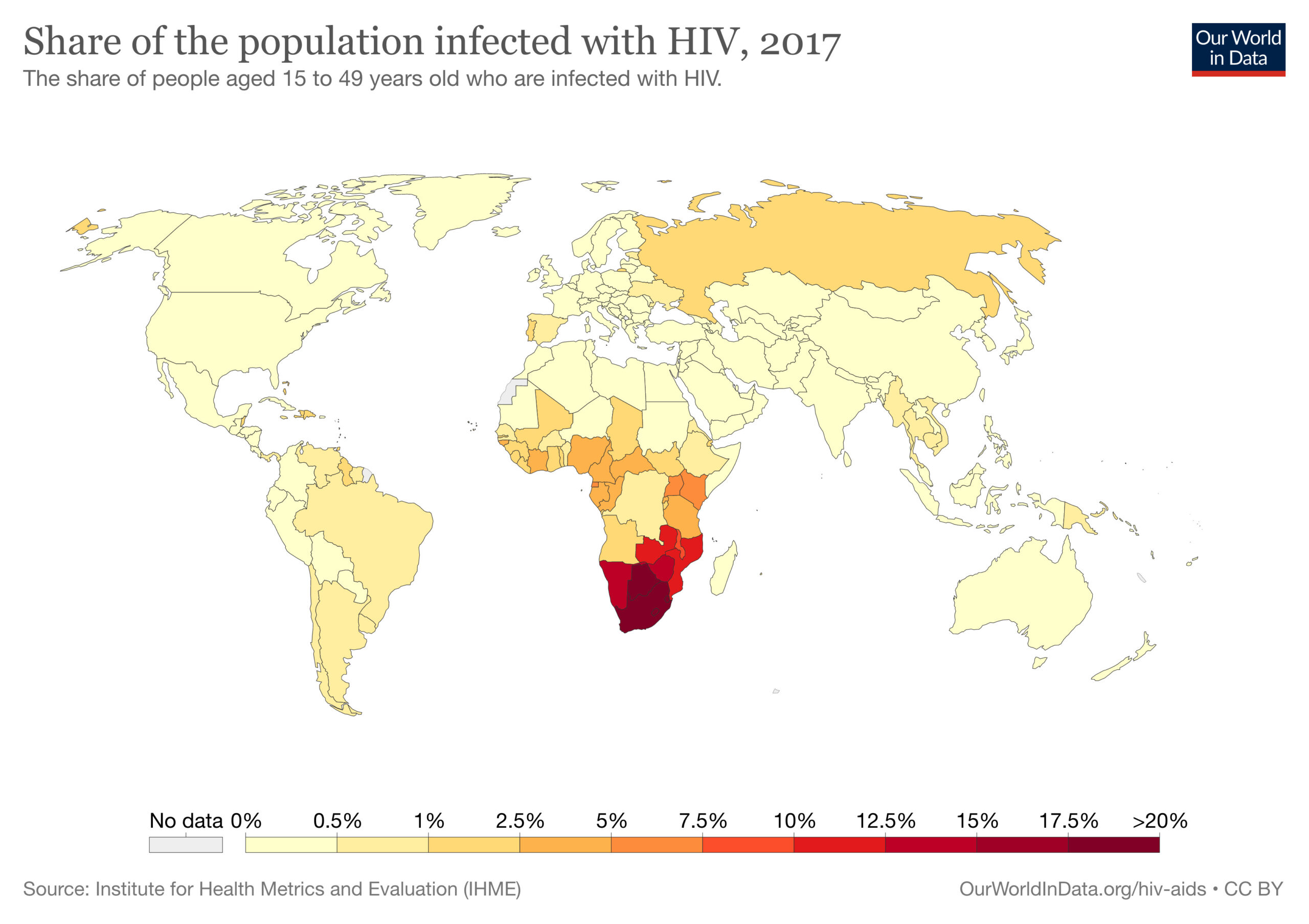
Población infectada por el VIH en 2017

Mapa mundial de infecciones por VIH en 2017 (en personas de 15 a 49 años):
Los colores indican el porcentaje de población con infección por el virus de la inmunodeficiencia humana (VIH) en cada país. La información sobre el porcentaje de población correspondiente (color designado) se encuentra debajo del mapa mundial.
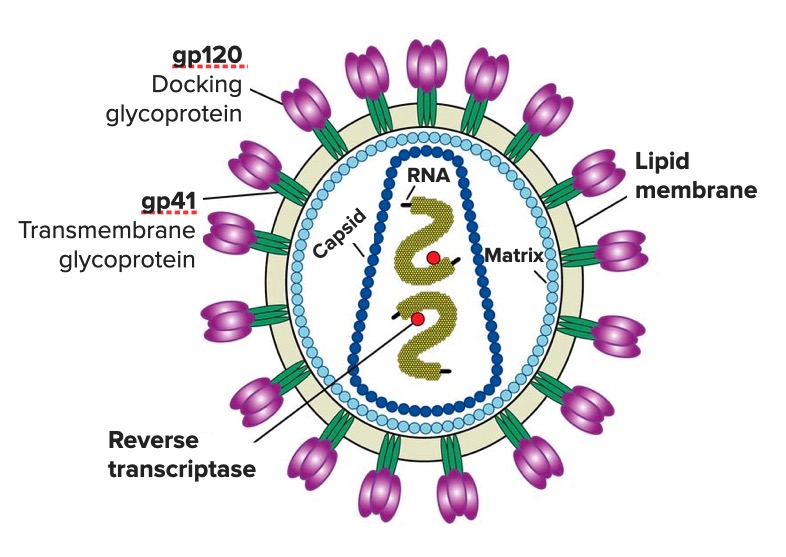
Imagen: “Proporción de la población infectada con el VIH, 2017” por Our World in Data. Licencia: CC BY 4.0

Estados Unidos

  • Aproximadamente 31.800 casos nuevos diagnosticados anualmente en EN Erythema nodosum is an immune-mediated panniculitis (inflammation of the subcutaneous fat) caused by a type IV (delayed-type) hypersensitivity reaction. It commonly manifests in young women as tender, erythematous nodules on the shins. Erythema Nodosum Estados Unidos (datos de 2022)
  • Aproximadamente 1,2 millones de personas que actualmente viven con el VIH
  • Infección por VIH más alta entre hispanos y afroamericanos (probablemente debido a factores socioeconómicos)
  • Los LOS Neisseria hombres homosexuales y bisexuales representan la mayoría de los LOS Neisseria casos recién diagnosticados.
  • Los LOS Neisseria niños generalmente adquieren la infección de su madre en EN Erythema nodosum is an immune-mediated panniculitis (inflammation of the subcutaneous fat) caused by a type IV (delayed-type) hypersensitivity reaction. It commonly manifests in young women as tender, erythematous nodules on the shins. Erythema Nodosum el útero o mediante la lactancia posterior.

Etiología y Transmisión

VIH

  • Género, Lentivirus Lentivirus A genus of the family retroviridae consisting of non-oncogenic retroviruses that produce multi-organ diseases characterized by long incubation periods and persistent infection. Lentiviruses are unique in that they contain open reading frames (orfs) between the pol and env genes and in the 3′ env region. Five serogroups are recognized, reflecting the mammalian hosts with which they are associated. HIV-1 is the type species. Human Immunodeficiency Virus (HIV); familia, Retroviridae Retroviridae The human immunodeficiency virus (HIV) is a species of Lentivirus, a genus of the family Retroviridae, which causes HIV infections and acquired immunodeficiency syndrome (AIDS). The virus has high genetic variability and is divided into 2 major types, HIV type 1 (HIV-1) and HIV type 2 (HIV-2). The human immunodeficiency virus is a single-stranded, positive-sense, enveloped RNA virus, which targets and destroys WBCs, leading to frequent opportunistic infections and, eventually, death. Human Immunodeficiency Virus (HIV)
  • Estructura:
    • La envoltura de virión contiene 2 glicoproteínas de membrana:
      • Gp41 Gp41 Transmembrane envelope protein of the human immunodeficiency virus which is encoded by the HIV env gene. It has a molecular weight of 41, 000 and is glycosylated. The n-terminal part of gp41 is thought to be involved in cell fusion with the CD4 antigens of T4 lymphocytes, leading to syncytial formation. Gp41 is one of the most common HIV antigens detected by immunoblotting. HIV Infection and AIDS (transmembrana)
      • Gp120 Gp120 External envelope protein of the human immunodeficiency virus which is encoded by the HIV env gene. It has a molecular weight of 120 kda and contains numerous glycosylation sites. Gp120 binds to cells expressing CD4 cell-surface antigens, most notably t4-lymphocytes and monocytes/macrophages. Gp120 has been shown to interfere with the normal function of CD4 and is at least partly responsible for the cytopathic effect of HIV. HIV Infection and AIDS (proteína de superficie/acoplamiento)
    • Proteína de matriz p17: rodea el núcleo del virus Virus Viruses are infectious, obligate intracellular parasites composed of a nucleic acid core surrounded by a protein capsid. Viruses can be either naked (non-enveloped) or enveloped. The classification of viruses is complex and based on many factors, including type and structure of the nucleoid and capsid, the presence of an envelope, the replication cycle, and the host range. Virology
    • Núcleo del virus Virus Viruses are infectious, obligate intracellular parasites composed of a nucleic acid core surrounded by a protein capsid. Viruses can be either naked (non-enveloped) or enveloped. The classification of viruses is complex and based on many factors, including type and structure of the nucleoid and capsid, the presence of an envelope, the replication cycle, and the host range. Virology:
      • Proteína de la cápside p24
      • 2 moléculas de ácido ribonucleico (ARN) monocatenario, de sentido positivo, recubiertas con proteína de nucleocápside
      • Enzimas (transcriptasa inversa, integrasa, proteasa)
  • Subtipos de VIH:
    • VIH-1:
      • Especie más común en EN Erythema nodosum is an immune-mediated panniculitis (inflammation of the subcutaneous fat) caused by a type IV (delayed-type) hypersensitivity reaction. It commonly manifests in young women as tender, erythematous nodules on the shins. Erythema Nodosum todo el mundo
      • Similar al AL Amyloidosis virus Virus Viruses are infectious, obligate intracellular parasites composed of a nucleic acid core surrounded by a protein capsid. Viruses can be either naked (non-enveloped) or enveloped. The classification of viruses is complex and based on many factors, including type and structure of the nucleoid and capsid, the presence of an envelope, the replication cycle, and the host range. Virology de la inmunodeficiencia simia en EN Erythema nodosum is an immune-mediated panniculitis (inflammation of the subcutaneous fat) caused by a type IV (delayed-type) hypersensitivity reaction. It commonly manifests in young women as tender, erythematous nodules on the shins. Erythema Nodosum chimpancés
      • 4 subgrupos distintos (M, N, O y P)
      • Subgrupo M: 90% de VIH/SIDA (síndrome de inmunodeficiencia adquirida) en EN Erythema nodosum is an immune-mediated panniculitis (inflammation of the subcutaneous fat) caused by a type IV (delayed-type) hypersensitivity reaction. It commonly manifests in young women as tender, erythematous nodules on the shins. Erythema Nodosum todo el mundo
    • VIH-2:
      • Infecciosidad más baja, menos virulenta, confinada en EN Erythema nodosum is an immune-mediated panniculitis (inflammation of the subcutaneous fat) caused by a type IV (delayed-type) hypersensitivity reaction. It commonly manifests in young women as tender, erythematous nodules on the shins. Erythema Nodosum gran parte a África occidental
      • Similar al AL Amyloidosis virus Virus Viruses are infectious, obligate intracellular parasites composed of a nucleic acid core surrounded by a protein capsid. Viruses can be either naked (non-enveloped) or enveloped. The classification of viruses is complex and based on many factors, including type and structure of the nucleoid and capsid, the presence of an envelope, the replication cycle, and the host range. Virology de la inmunodeficiencia simia de los LOS Neisseria monos mangabey tiznados
      • 8 subgrupos conocidos (A a H)
  • Transmisión a través de fluidos corporales (es decir, sangre, semen, secreciones vaginales y leche materna)
Virión del VIH

Diagrama del virión del VIH con la estructura de su genoma y sus principales enzimas y glicoproteínas (gp120 y gp41)

Imagen: “Diagram of the HIV virus” por el US National Institute of Health. Licencia: Dominio Público

Modos de transmisión del VIH

Sexual:

  • Sexo sin protección:
    • Responsable del 80% de las infecciones
    • Relaciones sexuales anales receptivas sin protección en EN Erythema nodosum is an immune-mediated panniculitis (inflammation of the subcutaneous fat) caused by a type IV (delayed-type) hypersensitivity reaction. It commonly manifests in young women as tender, erythematous nodules on the shins. Erythema Nodosum hombres y mujeres > relaciones sexuales vaginales receptivas sin protección
  • En EN Erythema nodosum is an immune-mediated panniculitis (inflammation of the subcutaneous fat) caused by a type IV (delayed-type) hypersensitivity reaction. It commonly manifests in young women as tender, erythematous nodules on the shins. Erythema Nodosum el coito anal, la infección ocurre:
    • Con inoculación directa en EN Erythema nodosum is an immune-mediated panniculitis (inflammation of the subcutaneous fat) caused by a type IV (delayed-type) hypersensitivity reaction. It commonly manifests in young women as tender, erythematous nodules on the shins. Erythema Nodosum la sangre en EN Erythema nodosum is an immune-mediated panniculitis (inflammation of the subcutaneous fat) caused by a type IV (delayed-type) hypersensitivity reaction. It commonly manifests in young women as tender, erythematous nodules on the shins. Erythema Nodosum presencia de desgarros traumáticos
    • Con fácil acceso a las células diana debajo de la frágil membrana mucosa rectal
  • En EN Erythema nodosum is an immune-mediated panniculitis (inflammation of the subcutaneous fat) caused by a type IV (delayed-type) hypersensitivity reaction. It commonly manifests in young women as tender, erythematous nodules on the shins. Erythema Nodosum los LOS Neisseria Estados Unidos, se notó riesgo en EN Erythema nodosum is an immune-mediated panniculitis (inflammation of the subcutaneous fat) caused by a type IV (delayed-type) hypersensitivity reaction. It commonly manifests in young women as tender, erythematous nodules on the shins. Erythema Nodosum:
    • Hombres que tienen sexo con hombres (más alto)
    • Individuos heterosexuales
  • En EN Erythema nodosum is an immune-mediated panniculitis (inflammation of the subcutaneous fat) caused by a type IV (delayed-type) hypersensitivity reaction. It commonly manifests in young women as tender, erythematous nodules on the shins. Erythema Nodosum África, las infecciones notificadas son predominantemente por transmisión heterosexual (datos limitados sobre las tasas de transmisión homosexual).

Parenteral:

  • Consumo de drogas por vía intravenosa (IV por sus siglas en EN Erythema nodosum is an immune-mediated panniculitis (inflammation of the subcutaneous fat) caused by a type IV (delayed-type) hypersensitivity reaction. It commonly manifests in young women as tender, erythematous nodules on the shins. Erythema Nodosum inglés) y uso compartido de agujas
  • Pinchazos accidentales con agujas en EN Erythema nodosum is an immune-mediated panniculitis (inflammation of the subcutaneous fat) caused by a type IV (delayed-type) hypersensitivity reaction. It commonly manifests in young women as tender, erythematous nodules on the shins. Erythema Nodosum profesionales médicos

Vertical:

  • De madre a hijo durante el embarazo, el parto o la lactancia
  • La mayoría de los LOS Neisseria casos ocurren durante el parto.
  • Factores de riesgo para la transmisión vertical:
    • Sin terapia antirretroviral o profilaxis
    • Carga viral materna elevada
    • Rotura de membranas > 4 horas

Factores que afectan la transmisión

  • Carga viral:
    • La cantidad de VIH es el principal factor que determina la transmisión.
    • La transmisión es improbable si la carga viral está suprimida (definida como tener una carga viral de < 400 copias de ARN del VIH/mL).
  • Tipo de contacto sexual:
    • El sexo anal receptivo es el de mayor riesgo.
    • La circuncisión reduce el riesgo de transmisión.
  • Daño a la mucosa: La inflamación, los LOS Neisseria desgarros, las infecciones de transmisión sexual y la irritación de las membranas mucosas genitales aumentan el riesgo de transmisión.
  • Infección reciente por el VIH: riesgo elevado de transmisión debido a la alta carga viral

Fisiopatología

Ciclo de replicación del VIH

  • Células diana: linfocitos T CD4 +, macrófagos y células dendríticas
  • Entrada del VIH a las células:
    • El virión entra primero a través de una ruptura en EN Erythema nodosum is an immune-mediated panniculitis (inflammation of the subcutaneous fat) caused by a type IV (delayed-type) hypersensitivity reaction. It commonly manifests in young women as tender, erythematous nodules on the shins. Erythema Nodosum una membrana mucosa.
    • El virión luego cruza la barrera mucosa y busca células diana.
  • Replicación del VIH:
    1. Fusión de membranas y unión de receptores (entrada): el virión (que transporta ARN viral, transcriptasa inversa, integrasa y otras proteínas) inicia la entrada en EN Erythema nodosum is an immune-mediated panniculitis (inflammation of the subcutaneous fat) caused by a type IV (delayed-type) hypersensitivity reaction. It commonly manifests in young women as tender, erythematous nodules on the shins. Erythema Nodosum la célula huésped.
      • El virión se une al AL Amyloidosis receptor Receptor Receptors are proteins located either on the surface of or within a cell that can bind to signaling molecules known as ligands (e.g., hormones) and cause some type of response within the cell. Receptors CD4 y a un receptor Receptor Receptors are proteins located either on the surface of or within a cell that can bind to signaling molecules known as ligands (e.g., hormones) and cause some type of response within the cell. Receptors de quimioquinas ( CCR5 CCR5 Ccr receptors with specificity for chemokine ccl3; chemokine ccl4; and chemokine ccl5. They are expressed at high levels in T-lymphocytes; B-lymphocytes; macrophages; mast cells; and nk cells. The ccr5 receptor is used by the human immunodeficiency virus to infect cells. HIV Infection and AIDS en EN Erythema nodosum is an immune-mediated panniculitis (inflammation of the subcutaneous fat) caused by a type IV (delayed-type) hypersensitivity reaction. It commonly manifests in young women as tender, erythematous nodules on the shins. Erythema Nodosum los LOS Neisseria macrófagos, CXCR4 CXCR4 Cxcr receptors with specificity for cxcl12 chemokine. The receptors may play a role in hematopoiesis regulation and can also function as coreceptors for the human immunodeficiency virus. HIV Infection and AIDS en EN Erythema nodosum is an immune-mediated panniculitis (inflammation of the subcutaneous fat) caused by a type IV (delayed-type) hypersensitivity reaction. It commonly manifests in young women as tender, erythematous nodules on the shins. Erythema Nodosum los LOS Neisseria linfocitos T).
        • Virus Virus Viruses are infectious, obligate intracellular parasites composed of a nucleic acid core surrounded by a protein capsid. Viruses can be either naked (non-enveloped) or enveloped. The classification of viruses is complex and based on many factors, including type and structure of the nucleoid and capsid, the presence of an envelope, the replication cycle, and the host range. Virology con tropismo por macrófagos: cepas R5
        • Virus Virus Viruses are infectious, obligate intracellular parasites composed of a nucleic acid core surrounded by a protein capsid. Viruses can be either naked (non-enveloped) or enveloped. The classification of viruses is complex and based on many factors, including type and structure of the nucleoid and capsid, the presence of an envelope, the replication cycle, and the host range. Virology con tropismo por linfocitos T: cepas X4
      • La unión de gp120 Gp120 External envelope protein of the human immunodeficiency virus which is encoded by the HIV env gene. It has a molecular weight of 120 kda and contains numerous glycosylation sites. Gp120 binds to cells expressing CD4 cell-surface antigens, most notably t4-lymphocytes and monocytes/macrophages. Gp120 has been shown to interfere with the normal function of CD4 and is at least partly responsible for the cytopathic effect of HIV. HIV Infection and AIDS con CD4 y los LOS Neisseria receptores de quimioquinas conduce a un cambio conformacional, exponiendo el dominio de fusión en EN Erythema nodosum is an immune-mediated panniculitis (inflammation of the subcutaneous fat) caused by a type IV (delayed-type) hypersensitivity reaction. It commonly manifests in young women as tender, erythematous nodules on the shins. Erythema Nodosum gp41 Gp41 Transmembrane envelope protein of the human immunodeficiency virus which is encoded by the HIV env gene. It has a molecular weight of 41, 000 and is glycosylated. The n-terminal part of gp41 is thought to be involved in cell fusion with the CD4 antigens of T4 lymphocytes, leading to syncytial formation. Gp41 is one of the most common HIV antigens detected by immunoblotting. HIV Infection and AIDS.
      • Este proceso une las membranas virales y celulares, fusionándolas.
    2. La capa de proteína de la cápside (que rodea el ARN viral y las proteínas) no está cubierta cuando el virión atraviesa el citoplasma.
    3. Transcripción inversa: Se produce la síntesis mediada por transcriptasa inversa de ácido desoxirribonucleico (ADN) proviral (a partir del ARN viral).
    4. Integración: El ADN viral se transporta a través del núcleo y se integra en EN Erythema nodosum is an immune-mediated panniculitis (inflammation of the subcutaneous fat) caused by a type IV (delayed-type) hypersensitivity reaction. It commonly manifests in young women as tender, erythematous nodules on the shins. Erythema Nodosum el ADN del huésped, facilitado por la integrasa.
    5. Replicación: El ADN viral se transcribe y se forman múltiples copias del nuevo ARN del VIH y se transportan al AL Amyloidosis citoplasma.
      • El nuevo ARN del VIH se convierte en EN Erythema nodosum is an immune-mediated panniculitis (inflammation of the subcutaneous fat) caused by a type IV (delayed-type) hypersensitivity reaction. It commonly manifests in young women as tender, erythematous nodules on the shins. Erythema Nodosum el genoma de un nuevo virus Virus Viruses are infectious, obligate intracellular parasites composed of a nucleic acid core surrounded by a protein capsid. Viruses can be either naked (non-enveloped) or enveloped. The classification of viruses is complex and based on many factors, including type and structure of the nucleoid and capsid, the presence of an envelope, the replication cycle, and the host range. Virology.
      • Otras copias del ARN se utilizan para producir nuevas proteínas del VIH.
    6. Ensamblaje: Nuevo ARN viral + proteínas + enzimas se mueven a la superficie celular y forman una partícula no infecciosa.
    7. Brotación y maduración:
      • La partícula (ARN viral + proteínas) finalmente brota de la célula huésped con el VIH inmaduro.
      • La proteína proteasa viral luego escinde las poliproteínas recién sintetizadas, produciendo un VIH maduro.
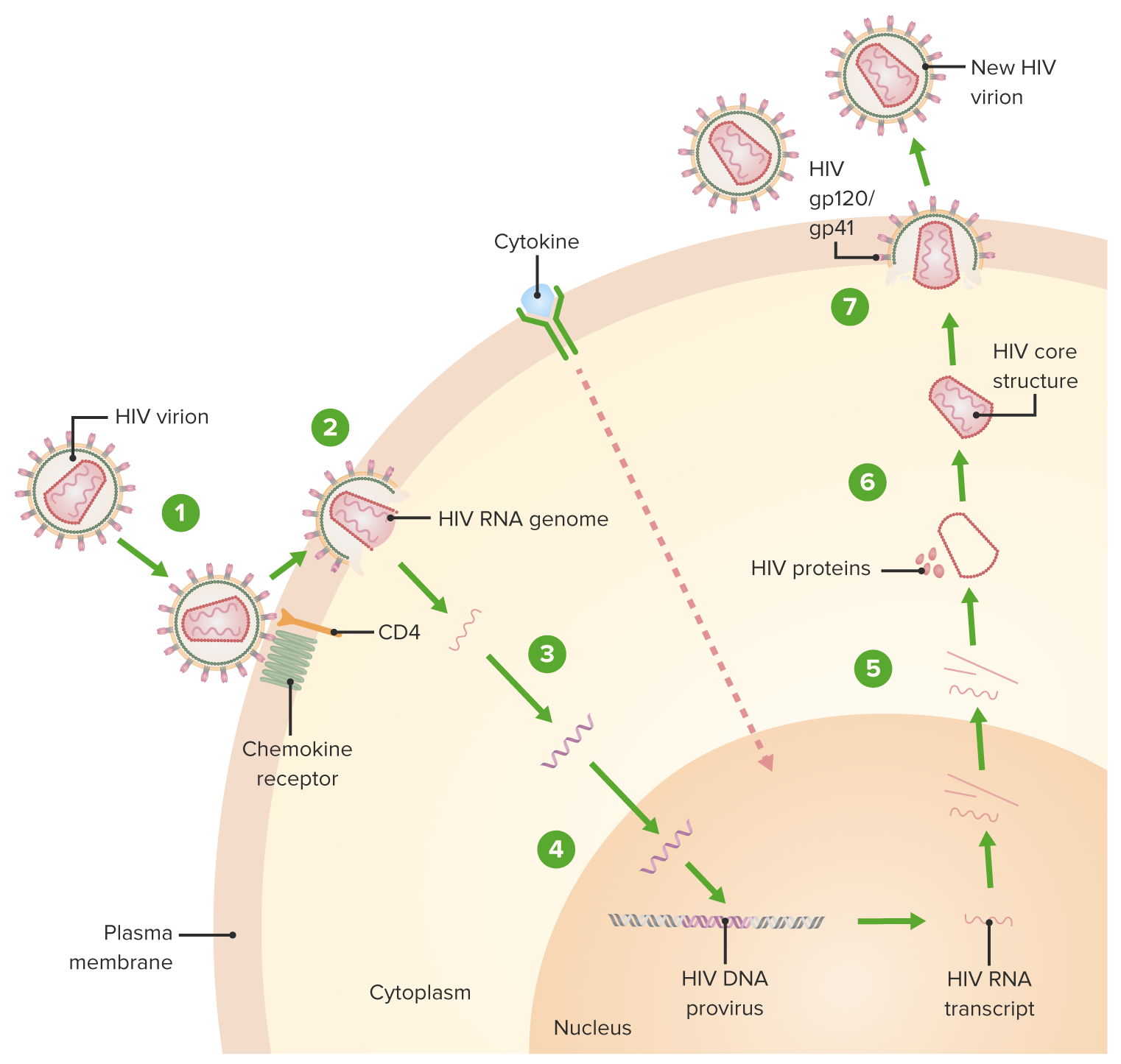
Ciclo de replicación del VIH

Ciclo de replicación del VIH:
1. El virión se une al receptor CD4 y un receptor de quimioquinas, seguido de un cambio conformacional que facilita la fusión del virión y la célula huésped.
2. Una capa de proteína de la cápside (que rodea el ARN y las proteínas virales) queda sin recubrimiento a medida que el virión atraviesa el citoplasma.
3. Se produce la síntesis de ADN proviral mediada por transcriptasa inversa.
4. El ADN viral se transporta a través del núcleo y se integra en el ADN del huésped, facilitado por la integrasa.
5. Se transcribe el ADN viral y se forman y transportan múltiples copias del nuevo ARN del VIH al citoplasma. El nuevo ARN del VIH se convierte en el genoma de un nuevo virus. También se produce la activación de citocinas de la célula.
6. El nuevo ARN viral + proteínas + enzimas se mueven a la superficie celular y forman una partícula no infecciosa.
7. Las partículas (ARN viral + proteínas) eventualmente brotan de la célula huésped con el VIH inmaduro. La proteína viral proteasa (enzima) luego escinde poliproteínas recién sintetizadas produciendo un VIH maduro.
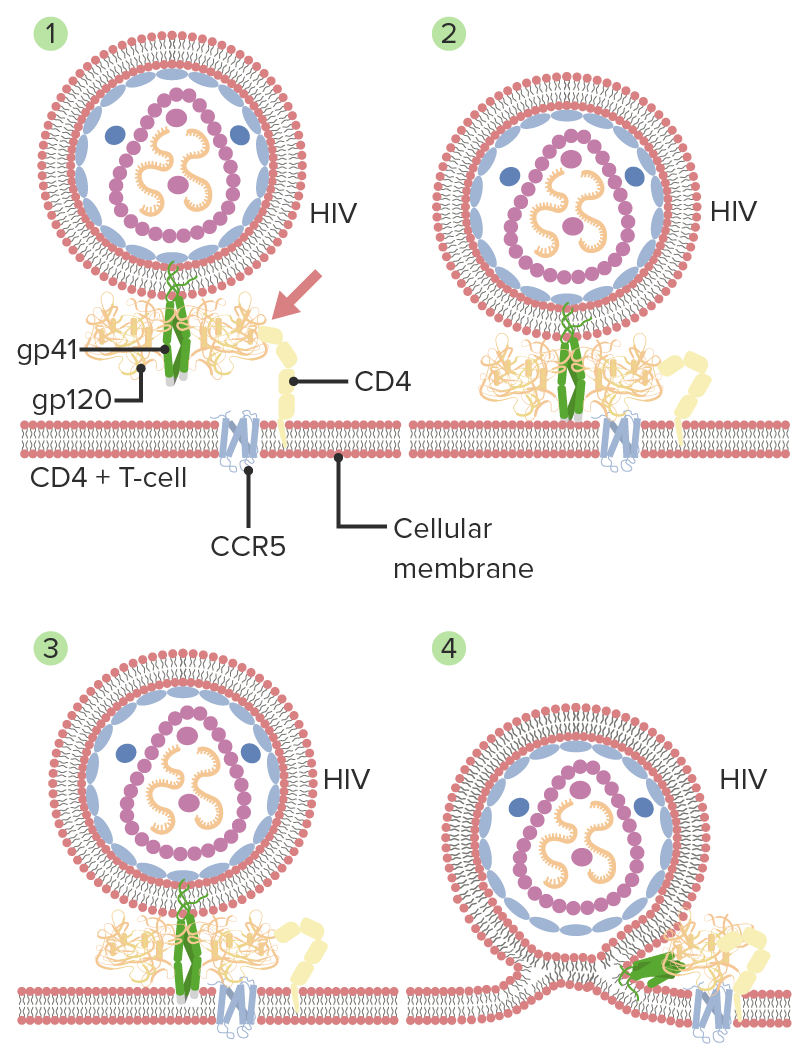
Imagen por Lecturio.
Mecanismo de entrada del VIH y fusión de membranas

Mecanismo de entrada del VIH y fusión de membranas:
1. Gp120 del VIH interactúa con CD4 (célula huésped).
2. Sigue una interacción secundaria con otro receptor CCR5, con un cambio conformacional en gp120.
3. Las puntas de gp41 se insertan en la membrana celular.
4. Gp41 se pliega por la mitad y forma bobinas enrolladas. Las membranas virales y celulares se unen, lo que lleva a la fusión.

Imagen por Lecturio.

Historia natural

Fase aguda (infección, diseminación, síndrome retroviral):

  • El VIH infecta y destruye los LOS Neisseria linfocitos T CD4+, los LOS Neisseria macrófagos y las células dendríticas en EN Erythema nodosum is an immune-mediated panniculitis (inflammation of the subcutaneous fat) caused by a type IV (delayed-type) hypersensitivity reaction. It commonly manifests in young women as tender, erythematous nodules on the shins. Erythema Nodosum los LOS Neisseria tejidos de las mucosas.
  • Se produce la diseminación y la replicación en EN Erythema nodosum is an immune-mediated panniculitis (inflammation of the subcutaneous fat) caused by a type IV (delayed-type) hypersensitivity reaction. It commonly manifests in young women as tender, erythematous nodules on the shins. Erythema Nodosum los LOS Neisseria ganglios linfáticos, luego se procede a otros compartimentos linfoides (más células diana CD4+) → viremia Viremia The presence of viruses in the blood. Erythema Infectiosum.
  • Sigue una mayor propagación al AL Amyloidosis plasma Plasma The residual portion of blood that is left after removal of blood cells by centrifugation without prior blood coagulation. Transfusion Products y otros órganos.
  • La respuesta inmune antiviral Antiviral Antivirals for Hepatitis B conduce a la seroconversión (alrededor de 3–7 semanas).
  • Los LOS Neisseria linfocitos T citolíticos (CTL) CD8+ se activan y esta respuesta inmune produce un control parcial de la replicación viral.
  • Síndrome retroviral agudo:
    • Presentación clínica de la enfermedad viral aguda autolimitada
    • Asociado con millones de copias de ARN del VIH/mL de plasma Plasma The residual portion of blood that is left after removal of blood cells by centrifugation without prior blood coagulation. Transfusion Products
    • Alta probabilidad de transmisión durante este período

Fase crónica/latencia clínica:

  • Replicación de bajo nivel del virus Virus Viruses are infectious, obligate intracellular parasites composed of a nucleic acid core surrounded by a protein capsid. Viruses can be either naked (non-enveloped) or enveloped. The classification of viruses is complex and based on many factors, including type and structure of the nucleoid and capsid, the presence of an envelope, the replication cycle, and the host range. Virology en EN Erythema nodosum is an immune-mediated panniculitis (inflammation of the subcutaneous fat) caused by a type IV (delayed-type) hypersensitivity reaction. It commonly manifests in young women as tender, erythematous nodules on the shins. Erythema Nodosum tejidos linfoides y agotamiento progresivo lento de linfocitos T
  • La replicación sostenida genera mutación, lo que contribuye al AL Amyloidosis escape viral del control de los LOS Neisseria linfocitos citolíticos CD8+.
  • El virus Virus Viruses are infectious, obligate intracellular parasites composed of a nucleic acid core surrounded by a protein capsid. Viruses can be either naked (non-enveloped) or enveloped. The classification of viruses is complex and based on many factors, including type and structure of the nucleoid and capsid, the presence of an envelope, the replication cycle, and the host range. Virology puede evolucionar y sufrir un cambio de correceptor ( en EN Erythema nodosum is an immune-mediated panniculitis (inflammation of the subcutaneous fat) caused by a type IV (delayed-type) hypersensitivity reaction. It commonly manifests in young women as tender, erythematous nodules on the shins. Erythema Nodosum lugar de 1 correceptor, el virus Virus Viruses are infectious, obligate intracellular parasites composed of a nucleic acid core surrounded by a protein capsid. Viruses can be either naked (non-enveloped) or enveloped. The classification of viruses is complex and based on many factors, including type and structure of the nucleoid and capsid, the presence of an envelope, the replication cycle, and the host range. Virology puede depender de CCR5 CCR5 Ccr receptors with specificity for chemokine ccl3; chemokine ccl4; and chemokine ccl5. They are expressed at high levels in T-lymphocytes; B-lymphocytes; macrophages; mast cells; and nk cells. The ccr5 receptor is used by the human immunodeficiency virus to infect cells. HIV Infection and AIDS o CXCR4 CXCR4 Cxcr receptors with specificity for cxcl12 chemokine. The receptors may play a role in hematopoiesis regulation and can also function as coreceptors for the human immunodeficiency virus. HIV Infection and AIDS).

SIDA:

  • La activación continua de los LOS Neisseria linfocitos T da como resultado una muerte extensa de los LOS Neisseria linfocitos T CD4+.
  • La inmunodeficiencia profunda conduce a infecciones oportunistas (causa habitual de muerte).
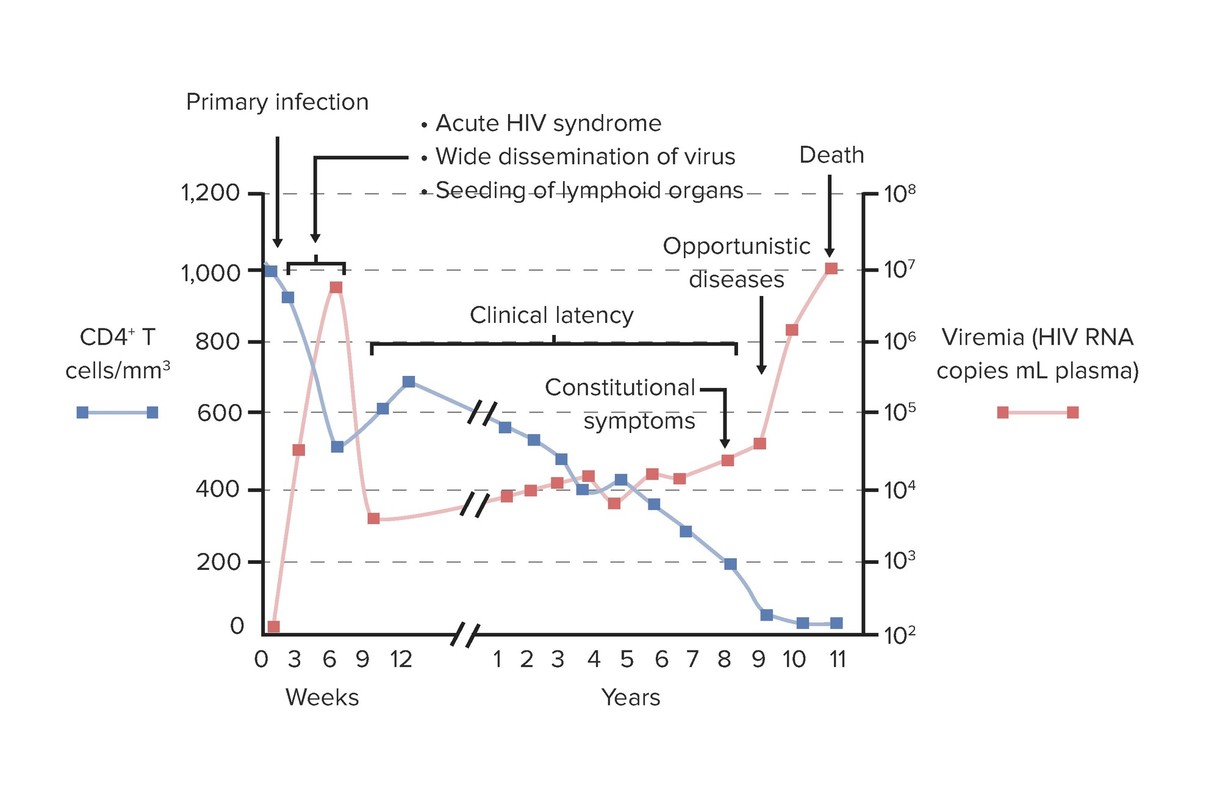
Relación entre el recuento de células T CD4+ y la carga viral

Gráfico de la relación entre el recuento de linfocitos T CD4+ y la carga viral durante el curso clínico de la infección por VIH y SIDA:
En la infección primaria/aguda (infección inicial, diseminación y síndrome retroviral agudo), se observa un aumento de la carga viral (viremia) con disminución de los linfocitos T CD4+. Este período dura semanas. En el período de latencia clínica, se produce una replicación viral de bajo nivel, pero sostenida, y se observa una disminución gradual de los linfocitos CD4+. La progresión al SIDA es el resultado de la descomposición de las defensas del huésped, con linfocitos T CD4+ agotados y carga viral en aumento. Este proceso predispone a infecciones oportunistas.

Imagen por Lecturio.

Presentación Clínica

Categorías de infección por VIH

La clasificación de los LOS Neisseria Centros para el Control y la Prevención de Enfermedades (CDC por sus siglas en EN Erythema nodosum is an immune-mediated panniculitis (inflammation of the subcutaneous fat) caused by a type IV (delayed-type) hypersensitivity reaction. It commonly manifests in young women as tender, erythematous nodules on the shins. Erythema Nodosum inglés) señala que el recuento de linfocitos T CD4+ es:

  • Un indicador fiable de la progresión de la enfermedad
  • Una guía para el manejo clínico y terapéutico de la infección por VIH
Cuadro: Sistema de clasificación revisado de 1993 para la infección por VIH
Categorías/etapa de linfocitos T CD 4+ 1 2 3
Categorías clínicas CD4+ ≥ 500 células/µL CD4+ 200–499 células/µL CD4+ <200 células/µL*
A: asintomático, VIH agudo, linfadenopatía persistente A1 A2 A3
B: sintomático, no A o C B1 B2 B3
C: SIDA, incluidas infecciones oportunistas, enfermedades neurológicas y tumores C1 C2 C3
* El recuento de CD4 por debajo de 200/μL se considera definitorio de SIDA.

Curso clínico y síntomas

Síndrome retroviral agudo (fase aguda):
  • 3–6 semanas después de la infección
  • Presentación similar a la mononucleosis Mononucleosis Infectious mononucleosis (IM), also known as “the kissing disease,” is a highly contagious viral infection caused by the Epstein-Barr virus. Its common name is derived from its main method of transmission: the spread of infected saliva via kissing. Clinical manifestations of IM include fever, tonsillar pharyngitis, and lymphadenopathy. Mononucleosis infecciosa:
    • Fiebre, fatiga, mialgias (más comunes)
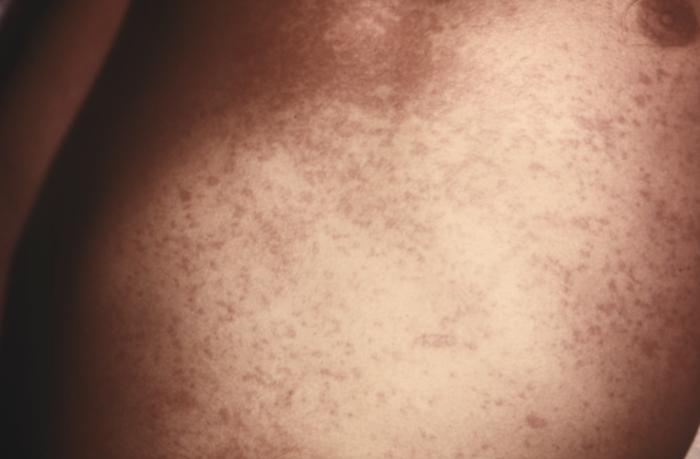
    • Cefalea retroorbitaria (puede haber meningitis Meningitis Meningitis is inflammation of the meninges, the protective membranes of the brain, and spinal cord. The causes of meningitis are varied, with the most common being bacterial or viral infection. The classic presentation of meningitis is a triad of fever, altered mental status, and nuchal rigidity. Meningitis aséptica), artralgias y erupción cutánea
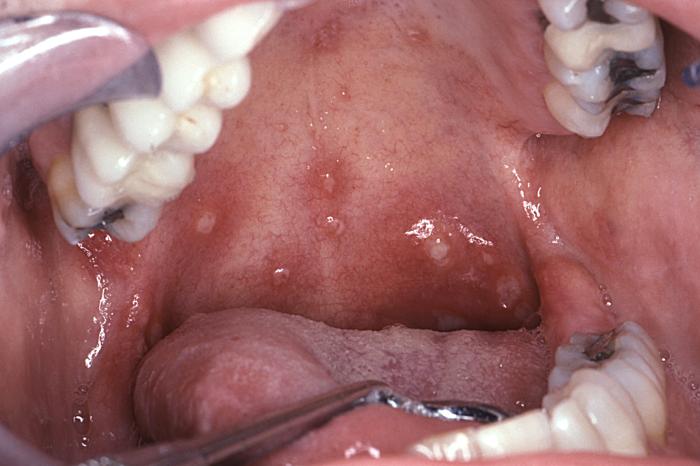
    • Dolor Dolor Inflammation de garganta y llagas dolorosas en EN Erythema nodosum is an immune-mediated panniculitis (inflammation of the subcutaneous fat) caused by a type IV (delayed-type) hypersensitivity reaction. It commonly manifests in young women as tender, erythematous nodules on the shins. Erythema Nodosum la boca (úlceras aftosas)
    • Hepatoesplenomegalia
    • Ganglios linfáticos inflamados (principalmente cervicales, axilares y occipitales)
    • Náuseas, vómitos, diarrea y pérdida de peso

Infección crónica (latencia clínica):

  • Pocas o ninguna manifestación clínica de infección
  • Infecciones oportunistas menores:
    • Muguet
    • Candidiasis Candidiasis Candida is a genus of dimorphic, opportunistic fungi. Candida albicans is part of the normal human flora and is the most common cause of candidiasis. The clinical presentation varies and can include localized mucocutaneous infections (e.g., oropharyngeal, esophageal, intertriginous, and vulvovaginal candidiasis) and invasive disease (e.g., candidemia, intraabdominal abscess, pericarditis, and meningitis). Candida/Candidiasis vaginal
    • Herpes zóster
    • Tuberculosis Tuberculosis Tuberculosis (TB) is an infectious disease caused by Mycobacterium tuberculosis complex bacteria. The bacteria usually attack the lungs but can also damage other parts of the body. Approximately 30% of people around the world are infected with this pathogen, with the majority harboring a latent infection. Tuberculosis spreads through the air when a person with active pulmonary infection coughs or sneezes. Tuberculosis

SIDA:

  • Sin tratamiento, la progresión al AL Amyloidosis SIDA tiene lugar después de una fase crónica de 7–10 años.
  • Enfermedades definitorias de SIDA y neoplasias malignas
  • Infecciones oportunistas
  • Síndrome de emaciación
  • Encefalopatía asociada al AL Amyloidosis VIH

SIDA

  • Definido como:
    • Recuento de linfocitos T CD4+ de < 200 células/μL o un porcentaje total de linfocitos T CD4+ < 14 %
    • Y/o al AL Amyloidosis menos 1 condición definitoria de SIDA (infecciones oportunistas o enfermedades asociadas con inmunosupresión)
  • Condiciones que definen el SIDA:
    • Infecciones fúngicas y parasitarias:
      • Candidiasis Candidiasis Candida is a genus of dimorphic, opportunistic fungi. Candida albicans is part of the normal human flora and is the most common cause of candidiasis. The clinical presentation varies and can include localized mucocutaneous infections (e.g., oropharyngeal, esophageal, intertriginous, and vulvovaginal candidiasis) and invasive disease (e.g., candidemia, intraabdominal abscess, pericarditis, and meningitis). Candida/Candidiasis
      • Meningitis Meningitis Meningitis is inflammation of the meninges, the protective membranes of the brain, and spinal cord. The causes of meningitis are varied, with the most common being bacterial or viral infection. The classic presentation of meningitis is a triad of fever, altered mental status, and nuchal rigidity. Meningitis criptocócica
      • Cryptosporidium Cryptosporidium A genus of coccidian parasites of the family cryptosporidiidae, found in the intestinal epithelium of many vertebrates including humans. Hyper-IgM Syndrome o Cystoisospora Cystoisospora Cystoisospora is a genus within the Coccidia subclass of protozoans. They are single-celled, obligate intracellular parasites that cause intestinal infections in humans. Humans are the only host for these species, and they are both transmitted through the fecal-oral route. The symptoms of cystoisosporiasis are watery diarrhea, abdominal pain, and fever. Cystoisospora/Cystoisosporiasis and Cyclospora/Cyclosporiasis ( enteritis Enteritis Inflammation of any segment of the small intestine. Lactose Intolerance/diarrea)
      • Coccidioidomicosis
      • Neumonía por Pneumocystis jirovecii
      • Toxoplasmosis Toxoplasmosis Toxoplasmosis is an infectious disease caused by Toxoplasma gondii, an obligate intracellular protozoan parasite. Felines are the definitive host, but transmission to humans can occur through contact with cat feces or the consumption of contaminated foods. The clinical presentation and complications depend on the host’s immune status. Toxoplasma/Toxoplasmosis cerebral
      • Histoplasmosis Histoplasmosis Histoplasmosis is an infection caused by Histoplasma capsulatum, a dimorphic fungus. Transmission is through inhalation, and exposure to soils containing bird or bat droppings increases the risk of infection. Most infections are asymptomatic; however, immunocompromised individuals generally develop acute pulmonary infection, chronic infection, or even disseminated disease. Histoplasma/Histoplasmosis
    • Infecciones bacterianas:
      • Mycobacterium avium Mycobacterium avium A bacterium causing tuberculosis in domestic fowl and other birds. In pigs, it may cause localized and sometimes disseminated disease. The organism occurs occasionally in sheep and cattle. It should be distinguished from the m. avium complex, which infects primarily humans. Mycobacterium intracelular
      • Tuberculosis Tuberculosis Tuberculosis (TB) is an infectious disease caused by Mycobacterium tuberculosis complex bacteria. The bacteria usually attack the lungs but can also damage other parts of the body. Approximately 30% of people around the world are infected with this pathogen, with the majority harboring a latent infection. Tuberculosis spreads through the air when a person with active pulmonary infection coughs or sneezes. Tuberculosis M.
      • Septicemia por Salmonella Salmonella Salmonellae are gram-negative bacilli of the family Enterobacteriaceae. Salmonellae are flagellated, non-lactose-fermenting, and hydrogen sulfide-producing microbes. Salmonella enterica, the most common disease-causing species in humans, is further classified based on serotype as typhoidal (S. typhi and paratyphi) and nontyphoidal (S. enteritidis and typhimurium). Salmonella
      • Nocardia Nocardia Nocardia is a branching, filamentous, gram-positive bacilli. It is partially acid fast due to the presence of mycolic acids in the cell wall. Nocardia is a ubiquitous soil organism that most commonly affects immunocompromised patients. Nocardia is transmitted via inhalation of aerosolized bacteria or less commonly, via direct contact with wounds. Nocardia/Nocardiosis
    • Infecciones virales:
      • Herpes zóster
      • Infecciones por citomegalovirus (CMV)
      • Encefalitis por el virus Virus Viruses are infectious, obligate intracellular parasites composed of a nucleic acid core surrounded by a protein capsid. Viruses can be either naked (non-enveloped) or enveloped. The classification of viruses is complex and based on many factors, including type and structure of the nucleoid and capsid, the presence of an envelope, the replication cycle, and the host range. Virology del herpes simple ( HSV HSV Herpes simplex virus (HSV) is a double-stranded DNA virus belonging to the family Herpesviridae. Herpes simplex virus commonly causes recurrent infections involving the skin and mucosal surfaces, including the mouth, lips, eyes, and genitals. Herpes Simplex Virus 1 and 2 por sus siglas en EN Erythema nodosum is an immune-mediated panniculitis (inflammation of the subcutaneous fat) caused by a type IV (delayed-type) hypersensitivity reaction. It commonly manifests in young women as tender, erythematous nodules on the shins. Erythema Nodosum inglés)
      • Leucoencefalopatía multifocal Multifocal Retinoblastoma progresiva
    • Neoplasias malignas:
      • Linfoma (de Burkitt, inmunoblástico)
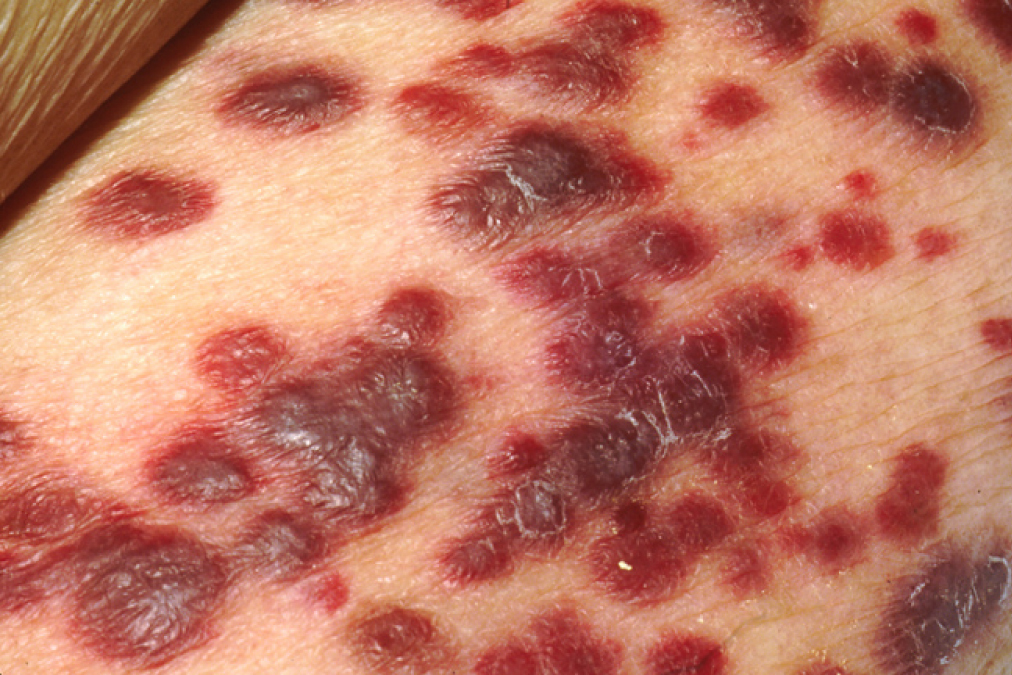
      • Sarcoma de Kaposi Kaposi A multicentric, malignant neoplastic vascular proliferation characterized by the development of bluish-red cutaneous nodules, usually on the lower extremities, most often on the toes or feet, and slowly increasing in size and number and spreading to more proximal areas. The tumors have endothelium-lined channels and vascular spaces admixed with variably sized aggregates of spindle-shaped cells, and often remain confined to the skin and subcutaneous tissue, but widespread visceral involvement may occur. Hhv-8 is the suspected cause. There is also a high incidence in AIDS patients. AIDS-defining Conditions
      • Carcinomas cervicales y anales invasivos
    • Misceláneas:
sarcoma de Kaposi

Lesiones cutáneas del sarcoma de Kaposi

Imagen: “Kaposi‘s sarcoma” por OpenStax College. Licencia: CC BY 3.0
Infecciones y condiciones seleccionadas

  • Neumonía por P. jiroveci:
    • Factores de riesgo:
      • Recuento de CD4 < 200/µL
      • Muguet
      • Neumonía previa por Pneumocystis
      • Pérdida de peso
    • Los LOS Neisseria síntomas incluyen disnea, fiebre y tos TOS Thoracic outlet syndrome (TOS) is a broad term used for a spectrum of syndromes related to the general region of the thoracic outlet, which involves the compression or irritation of elements of the brachial plexus, subclavian artery, or subclavian vein. Thoracic Outlet Syndrome no productiva.
    • Hallazgos del examen físico:
      • Taquipnea
      • Taquicardia
      • Crepitantes y roncus; auscultación normal en EN Erythema nodosum is an immune-mediated panniculitis (inflammation of the subcutaneous fat) caused by a type IV (delayed-type) hypersensitivity reaction. It commonly manifests in young women as tender, erythematous nodules on the shins. Erythema Nodosum el 50% de los LOS Neisseria casos
    • La radiografía de tórax muestra infiltrados intersticiales bilaterales.
    • Diagnóstico: tinción especial con plata de secreciones respiratorias que muestra quistes clásicos
    • Tratamiento:
      • Trimetoprim-sulfametoxazol
      • Alternativa: clindamicina + primaquina
      • Hipoxemia moderada o severa: se agregan dosis decrecientes de prednisona.
  • Meningitis Meningitis Meningitis is inflammation of the meninges, the protective membranes of the brain, and spinal cord. The causes of meningitis are varied, with the most common being bacterial or viral infection. The classic presentation of meningitis is a triad of fever, altered mental status, and nuchal rigidity. Meningitis criptocócica:
    • Mayor riesgo si el recuento de CD4 < 100/µL
    • Los LOS Neisseria síntomas incluyen cefalea, fiebre, estado mental alterado y déficits neurológicos.
    • El examen muestra meningismo en EN Erythema nodosum is an immune-mediated panniculitis (inflammation of the subcutaneous fat) caused by a type IV (delayed-type) hypersensitivity reaction. It commonly manifests in young women as tender, erythematous nodules on the shins. Erythema Nodosum < 40% de los LOS Neisseria pacientes.
    • Diagnóstico:
      • Punción lumbar, incluida la medición de la presión de apertura
      • Líquido cefalorraquídeo (LCR): ↓ recuento de leucocitos, ↑ proteínas ↓ o glucosa normal
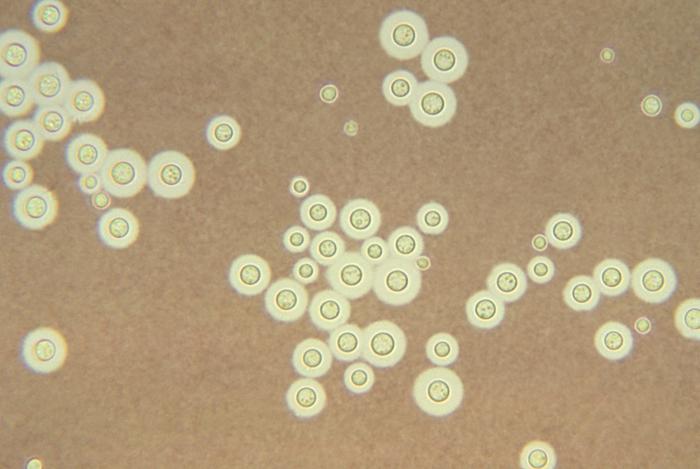
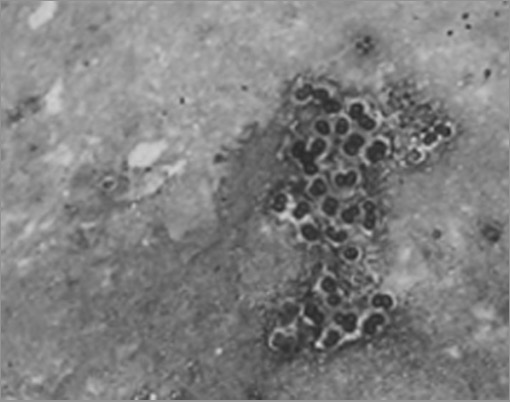
      • Tinción con tinta china (organismos levaduriformes encapsulados), cultivo de LCR
      • Prueba de antígeno criptocócico en EN Erythema nodosum is an immune-mediated panniculitis (inflammation of the subcutaneous fat) caused by a type IV (delayed-type) hypersensitivity reaction. It commonly manifests in young women as tender, erythematous nodules on the shins. Erythema Nodosum LCR
      • Prueba de antígeno criptocócico sérico
    • Tratamiento:
      • Anfotericina B y flucitosina durante 2 semanas
      • Luego, fluconazol oral durante 8 semanas o hasta que el cultivo del paciente sea negativo.
  • Encefalitis por toxoplasma Toxoplasma Toxoplasmosis is an infectious disease caused by Toxoplasma gondii, an obligate intracellular protozoan parasite. Felines are the definitive host, but transmission to humans can occur through contact with cat feces or the consumption of contaminated foods. The clinical presentation and complications depend on the host’s immune status. Toxoplasma/Toxoplasmosis:
    • Mayor riesgo si el recuento de CD4 < 100/µL
    • Los LOS Neisseria síntomas incluyen cefalea, confusión, fiebre, convulsiones y letargo.
    • El examen físico muestra ataxia Ataxia Impairment of the ability to perform smoothly coordinated voluntary movements. This condition may affect the limbs, trunk, eyes, pharynx, larynx, and other structures. Ataxia may result from impaired sensory or motor function. Sensory ataxia may result from posterior column injury or peripheral nerve diseases. Motor ataxia may be associated with cerebellar diseases; cerebral cortex diseases; thalamic diseases; basal ganglia diseases; injury to the red nucleus; and other conditions. Ataxia-telangiectasia, déficits neurológicos y sensoriales focales.
    • Diagnóstico:
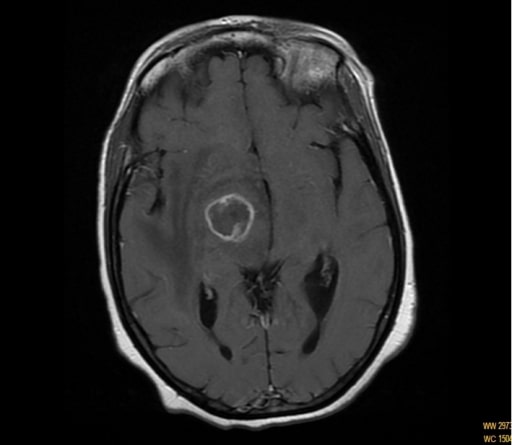
      • Imágenes cerebrales: múltiples lesiones con realce en EN Erythema nodosum is an immune-mediated panniculitis (inflammation of the subcutaneous fat) caused by a type IV (delayed-type) hypersensitivity reaction. It commonly manifests in young women as tender, erythematous nodules on the shins. Erythema Nodosum anillo
      • + Anticuerpo IgG IgG The major immunoglobulin isotype class in normal human serum. There are several isotype subclasses of igg, for example, igg1, igg2a, and igg2b. Hypersensitivity Pneumonitis contra Toxoplasma Toxoplasma Toxoplasmosis is an infectious disease caused by Toxoplasma gondii, an obligate intracellular protozoan parasite. Felines are the definitive host, but transmission to humans can occur through contact with cat feces or the consumption of contaminated foods. The clinical presentation and complications depend on the host’s immune status. Toxoplasma/Toxoplasmosis gondii
      • Síndrome clínico típico
    • Tratamiento: pirimetamina, sulfadiazina y ácido folínico durante 6 semanas
  • Infección diseminada por el complejo M. avium (MAC, por sus siglas en EN Erythema nodosum is an immune-mediated panniculitis (inflammation of the subcutaneous fat) caused by a type IV (delayed-type) hypersensitivity reaction. It commonly manifests in young women as tender, erythematous nodules on the shins. Erythema Nodosum inglés):
    • Mayor riesgo si el recuento de CD4 < 50/µL
    • Los LOS Neisseria síntomas incluyen fiebre, pérdida de peso, sudores nocturnos, dolor Dolor Inflammation abdominal y diarrea.
    • El examen físico muestra linfadenopatía y hepatoesplenomegalia.
    • Estudios de laboratorio: anemia Anemia Anemia is a condition in which individuals have low Hb levels, which can arise from various causes. Anemia is accompanied by a reduced number of RBCs and may manifest with fatigue, shortness of breath, pallor, and weakness. Subtypes are classified by the size of RBCs, chronicity, and etiology. Anemia: Overview and Types severa (por afectación de la médula ósea), ↑ fosfatasa alcalina, ↑ lactato deshidrogenasa
    • Diagnóstico: hemocultivos
    • Tratamiento:
      • Macrólido (e.g., claritromicina, azitromicina) + etambutol
      • +/- Rifabutina (si hay ↑ carga micobacteriana)
  • Manifestaciones del SIDA en EN Erythema nodosum is an immune-mediated panniculitis (inflammation of the subcutaneous fat) caused by a type IV (delayed-type) hypersensitivity reaction. It commonly manifests in young women as tender, erythematous nodules on the shins. Erythema Nodosum el sistema nervioso:
    • El 90% de los LOS Neisseria pacientes presentan afectación neurológica en EN Erythema nodosum is an immune-mediated panniculitis (inflammation of the subcutaneous fat) caused by a type IV (delayed-type) hypersensitivity reaction. It commonly manifests in young women as tender, erythematous nodules on the shins. Erythema Nodosum la autopsia.
    • Algunos hallazgos:
      • Mielopatía vacuolar: microscópicamente se asemeja a la degeneración combinada subaguda (deficiencia de vitamina B12)
      • Neuropatías periféricas asociadas al AL Amyloidosis SIDA (más común: polineuropatía sensorial distal)
      • Meningoencefalitis por VIH: demencia, ataxia Ataxia Impairment of the ability to perform smoothly coordinated voluntary movements. This condition may affect the limbs, trunk, eyes, pharynx, larynx, and other structures. Ataxia may result from impaired sensory or motor function. Sensory ataxia may result from posterior column injury or peripheral nerve diseases. Motor ataxia may be associated with cerebellar diseases; cerebral cortex diseases; thalamic diseases; basal ganglia diseases; injury to the red nucleus; and other conditions. Ataxia-telangiectasia, incontinencia intestinal y vesical
      • Complejo de demencia por SIDA o encefalopatía por VIH

Diagnóstico

Enfoque diagnóstico

  • Asesoramiento previo a la prueba:
    • Discutir la indicación para la prueba del VIH
    • Evaluación de riesgos (conductas de riesgo del paciente)
    • Implicaciones de los LOS Neisseria resultados positivos de la prueba
    • Discuta la confidencialidad y el seguimiento.
  • Indicaciones para la prueba:
    • Tamizaje: Examinar a todos los LOS Neisseria adolescentes y adultos en EN Erythema nodosum is an immune-mediated panniculitis (inflammation of the subcutaneous fat) caused by a type IV (delayed-type) hypersensitivity reaction. It commonly manifests in young women as tender, erythematous nodules on the shins. Erythema Nodosum riesgo incrementado de infección por VIH y a todas las mujeres embarazadas
    • Cualquier paciente con características de infección aguda o crónica por VIH
  • Pruebas de laboratorio:
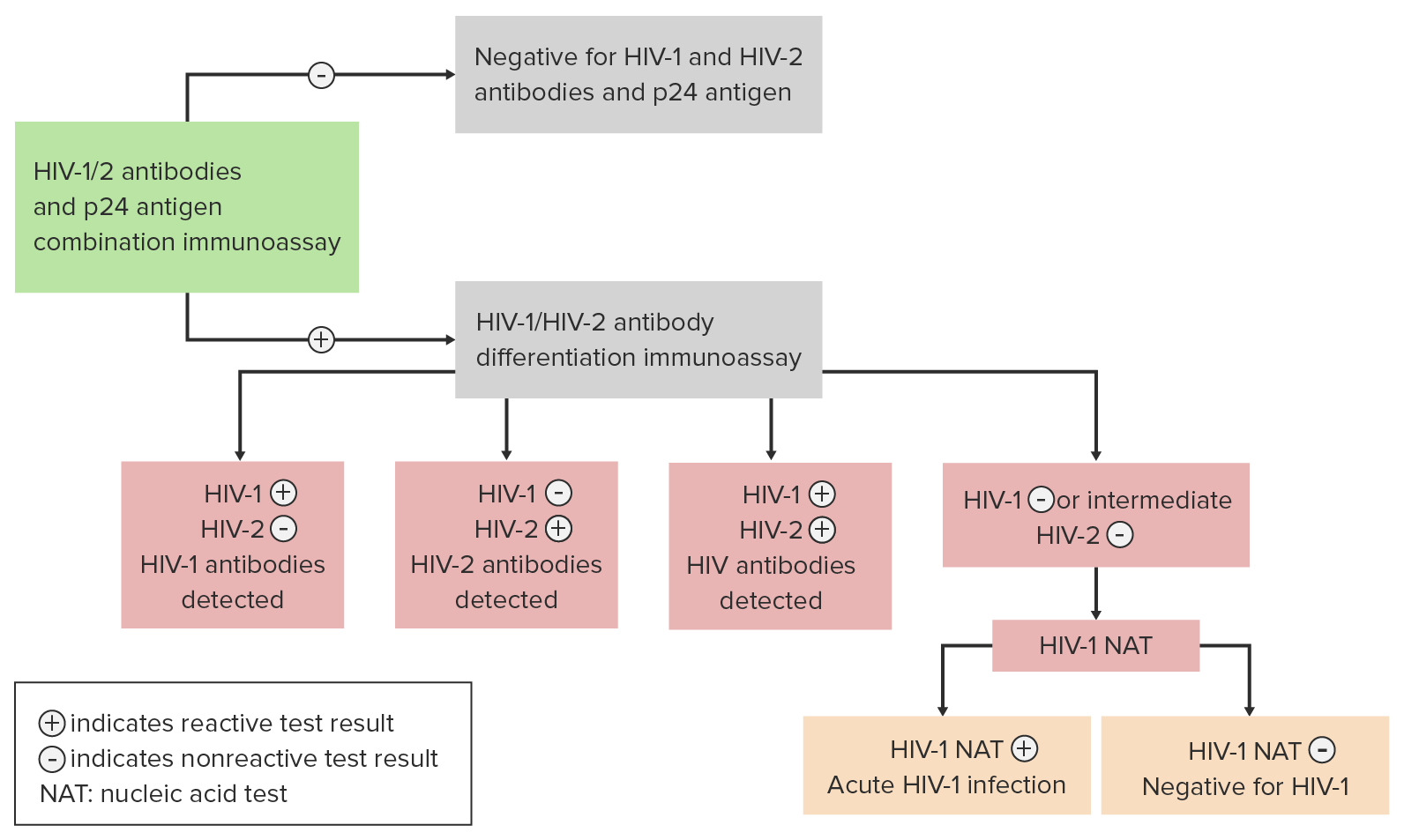
    • Inmunoensayo enzimático ( EIA EIA HIV Infection and AIDS, por sus siglas en EN Erythema nodosum is an immune-mediated panniculitis (inflammation of the subcutaneous fat) caused by a type IV (delayed-type) hypersensitivity reaction. It commonly manifests in young women as tender, erythematous nodules on the shins. Erythema Nodosum inglés) de 4. ta TA Thyrotoxicosis and Hyperthyroidism generación para VIH-1 y -2
      • Detecta anticuerpos (generalmente aparecen 3–12 semanas después de la infección) y antígeno p24 del VIH.
      • Resultado negativo: No es necesario realizar más pruebas.
      • Resultado positivo: prueba de inmunoensayo de diferenciación de anticuerpos VIH-1 y -2
      • Resultado indeterminado: probar con la prueba de ácido nucleico del VIH-1 aprobada por la FDA
    • Otras pruebas para el VIH:
      • Western blot: separación de proteínas virales por peso molecular en EN Erythema nodosum is an immune-mediated panniculitis (inflammation of the subcutaneous fat) caused by a type IV (delayed-type) hypersensitivity reaction. It commonly manifests in young women as tender, erythematous nodules on the shins. Erythema Nodosum gel de poliacrilamida (2 bandas presentes = positivo)
      • Prueba de reacción en EN Erythema nodosum is an immune-mediated panniculitis (inflammation of the subcutaneous fat) caused by a type IV (delayed-type) hypersensitivity reaction. It commonly manifests in young women as tender, erythematous nodules on the shins. Erythema Nodosum cadena de la polimerasa con transcriptasa inversa ( RT-PCR RT-PCR A variation of the pcr technique in which cDNA is made from RNA via reverse transcription. The resultant cDNA is then amplified using standard pcr protocols. Polymerase Chain Reaction (PCR)): cuantificación del virus Virus Viruses are infectious, obligate intracellular parasites composed of a nucleic acid core surrounded by a protein capsid. Viruses can be either naked (non-enveloped) or enveloped. The classification of viruses is complex and based on many factors, including type and structure of the nucleoid and capsid, the presence of an envelope, the replication cycle, and the host range. Virology o ARN del VIH para el seguimiento
Diagrama de flujo de virus de ARN envueltos

Algoritmo para el diagnóstico y diferenciación entre una infección por VIH producida por el subtipo VIH-1 y el subtipo VIH-2

Imagen por Lecturio.

Pruebas adicionales y seguimiento

  • Relacionado con el VIH:
    • Recuento de linfocitos T CD4+ (evaluar la función inmunológica)
    • Carga de ARN viral (valorar viremia Viremia The presence of viruses in the blood. Erythema Infectiosum)
    • Pruebas de resistencia del VIH o genotipificación (tasa de resistencia del VIH a la terapia actual: 4%–10%)
    • HLA-B HLA-B Class I human histocompatibility (HLA) surface antigens encoded by more than 30 detectable alleles on locus B of the HLA complex, the most polymorphic of all the HLA specificities. Several of these antigens (e.g., hla-b27, -b7, -b8) are strongly associated with predisposition to rheumatoid and other autoimmune disorders. Like other class I HLA determinants, they are involved in the cellular immune reactivity of cytolytic T lymphocytes. Organ Transplantation*5701:
      • Obtener antes de iniciar un régimen con abacavir Abacavir Anti-HIV Drugs (ABC) en EN Erythema nodosum is an immune-mediated panniculitis (inflammation of the subcutaneous fat) caused by a type IV (delayed-type) hypersensitivity reaction. It commonly manifests in young women as tender, erythematous nodules on the shins. Erythema Nodosum los LOS Neisseria pacientes
      • Si es positivo, al AL Amyloidosis paciente no se debe indicar ABC debido a una reacción de hipersensibilidad
  • Serología de HBV HBV Hepatitis B virus (HBV) is a partially double-stranded DNA virus, which belongs to the Orthohepadnavirus genus and the Hepadnaviridae family. Hepatitis B virus is transmitted by exposure to infectious blood or body fluids. Examples of types of exposure include sexual intercourse, IV drug use, and childbirth. Hepatitis B Virus y HCV HCV Hepatitis C is an infection of the liver caused by the hepatitis C virus (HCV). Hepatitis C virus is an RNA virus and a member of the genus Hepacivirus and the family Flaviviridae. The infection can be transmitted through infectious blood or body fluids and may be transmitted during childbirth or through IV drug use or sexual intercourse. Hepatitis C Virus (el estado de hepatitis viral afecta la elección de la terapia)
  • Otras enfermedades de transmisión sexual
  • Otras pruebas necesarias para el seguimiento y determinación de comorbilidades:
    • Panel metabólico básico
    • Pruebas de función hepática (algunos de los LOS Neisseria antirretrovirales provocan alteraciones en EN Erythema nodosum is an immune-mediated panniculitis (inflammation of the subcutaneous fat) caused by a type IV (delayed-type) hypersensitivity reaction. It commonly manifests in young women as tender, erythematous nodules on the shins. Erythema Nodosum la función hepática)
    • Hemograma con diferencial
    • Perfil de lípidos en EN Erythema nodosum is an immune-mediated panniculitis (inflammation of the subcutaneous fat) caused by a type IV (delayed-type) hypersensitivity reaction. It commonly manifests in young women as tender, erythematous nodules on the shins. Erythema Nodosum ayunas (algunos antirretrovirales causan problemas de lípidos)
    • Glucosa en EN Erythema nodosum is an immune-mediated panniculitis (inflammation of the subcutaneous fat) caused by a type IV (delayed-type) hypersensitivity reaction. It commonly manifests in young women as tender, erythematous nodules on the shins. Erythema Nodosum ayunas o hemoglobina A1c ( los LOS Neisseria antirretrovirales causan problemas con la tolerancia a la glucosa)
    • Análisis de orina (debido a la prevalencia de nefropatía por VIH)
    • Prueba de embarazo (tratamiento necesario en EN Erythema nodosum is an immune-mediated panniculitis (inflammation of the subcutaneous fat) caused by a type IV (delayed-type) hypersensitivity reaction. It commonly manifests in young women as tender, erythematous nodules on the shins. Erythema Nodosum mujeres embarazadas)
  • Seguimiento:
    • Carga de ARN viral (indicador de respuesta a la terapia antirretroviral):
      • Cargas virales ↓ indican un tratamiento efectivo
      • Un marcador pronóstico en EN Erythema nodosum is an immune-mediated panniculitis (inflammation of the subcutaneous fat) caused by a type IV (delayed-type) hypersensitivity reaction. It commonly manifests in young women as tender, erythematous nodules on the shins. Erythema Nodosum el tratamiento a largo plazo
    • Recuento de linfocitos T CD4+: aumenta con la terapia antirretroviral (TAR)

Tratamiento

Medicamentos antirretrovirales

  • Los LOS Neisseria inhibidores de la transcriptasa inversa interfieren con la traducción del ARN viral en EN Erythema nodosum is an immune-mediated panniculitis (inflammation of the subcutaneous fat) caused by a type IV (delayed-type) hypersensitivity reaction. It commonly manifests in young women as tender, erythematous nodules on the shins. Erythema Nodosum ADN:
    • Inhibidores de la transcriptasa inversa nucleósidos (NRTI, por sus siglas en EN Erythema nodosum is an immune-mediated panniculitis (inflammation of the subcutaneous fat) caused by a type IV (delayed-type) hypersensitivity reaction. It commonly manifests in young women as tender, erythematous nodules on the shins. Erythema Nodosum inglés) (e.g., zidovudina, emtricitabina, tenofovir Tenofovir An adenine analog reverse transcriptase inhibitor with antiviral activity against HIV-1 and hepatitis b. It is used to treat HIV infections and chronic hepatitis b, in combination with other antiviral agents, due to the emergence of antiviral drug resistance when it is used alone. Anti-HIV Drugs)
    • Inhibidores de la transcriptasa inversa no nucleósidos (NNRTI, por sus siglas en EN Erythema nodosum is an immune-mediated panniculitis (inflammation of the subcutaneous fat) caused by a type IV (delayed-type) hypersensitivity reaction. It commonly manifests in young women as tender, erythematous nodules on the shins. Erythema Nodosum inglés) (e.g., efavirenz Efavirenz Anti-HIV Drugs, doravirina, etravirina)
  • Inhibidores de la proteasa:
    • Bloquean la escisión de los LOS Neisseria precursores de proteínas necesarios para la producción de partículas virales infecciosas.
    • Ejemplos: atazanavir Atazanavir Anti-HIV Drugs, darunavir, lopinavir Lopinavir An HIV protease inhibitor used in a fixed-dose combination with ritonavir. It is also an inhibitor of cytochrome p-450 cyp3a. Anti-HIV Drugs
  • Inhibidores de la transferencia de cadenas de integrasa
    • Impiden la inserción del genoma viral en EN Erythema nodosum is an immune-mediated panniculitis (inflammation of the subcutaneous fat) caused by a type IV (delayed-type) hypersensitivity reaction. It commonly manifests in young women as tender, erythematous nodules on the shins. Erythema Nodosum el ADN del huésped.
    • Ejemplos: dolutegravir Dolutegravir Anti-HIV Drugs, elvitegravir Elvitegravir Anti-HIV Drugs
  • Inhibidores de entrada:
    • Antagonista de CCR5 CCR5 Ccr receptors with specificity for chemokine ccl3; chemokine ccl4; and chemokine ccl5. They are expressed at high levels in T-lymphocytes; B-lymphocytes; macrophages; mast cells; and nk cells. The ccr5 receptor is used by the human immunodeficiency virus to infect cells. HIV Infection and AIDS:
      • Inhibe la unión del virus Virus Viruses are infectious, obligate intracellular parasites composed of a nucleic acid core surrounded by a protein capsid. Viruses can be either naked (non-enveloped) or enveloped. The classification of viruses is complex and based on many factors, including type and structure of the nucleoid and capsid, the presence of an envelope, the replication cycle, and the host range. Virology al AL Amyloidosis linfocito CD4 bloqueando la unión de gp120 Gp120 External envelope protein of the human immunodeficiency virus which is encoded by the HIV env gene. It has a molecular weight of 120 kda and contains numerous glycosylation sites. Gp120 binds to cells expressing CD4 cell-surface antigens, most notably t4-lymphocytes and monocytes/macrophages. Gp120 has been shown to interfere with the normal function of CD4 and is at least partly responsible for the cytopathic effect of HIV. HIV Infection and AIDS.
      • Maraviroc Maraviroc A cyclohexane and triazole derivative that acts as an antagonist of the ccr5 receptor. It prevents infection by HIV-1 virus strains which use ccr5 as a co-receptor for membrane fusion and cellular entry. Anti-HIV Drugs
    • Inhibidor de fusión:
      • Interfiere con la fusión de las membranas celulares del VIH y el linfocito CD4.
      • Enfuvirtida
    • Inhibidor de adhesión:
      • Se une a gp120 Gp120 External envelope protein of the human immunodeficiency virus which is encoded by the HIV env gene. It has a molecular weight of 120 kda and contains numerous glycosylation sites. Gp120 binds to cells expressing CD4 cell-surface antigens, most notably t4-lymphocytes and monocytes/macrophages. Gp120 has been shown to interfere with the normal function of CD4 and is at least partly responsible for the cytopathic effect of HIV. HIV Infection and AIDS, evitando la adhesión viral.
      • Fostemsavir Fostemsavir Anti-HIV Drugs
    • Inhibidor posterior a la adhesión:

Enfoque de tratamiento

  • ¡Iniciar la terapia antirretroviral (TAR) de inmediato!
  • Objetivos:
    • Suprimir el ARN del VIH en EN Erythema nodosum is an immune-mediated panniculitis (inflammation of the subcutaneous fat) caused by a type IV (delayed-type) hypersensitivity reaction. It commonly manifests in young women as tender, erythematous nodules on the shins. Erythema Nodosum plasma Plasma The residual portion of blood that is left after removal of blood cells by centrifugation without prior blood coagulation. Transfusion Products
    • Mejorar la función inmunológica
    • Reducir las complicaciones asociadas al AL Amyloidosis VIH y prolongar la supervivencia
    • Prevenir la transmisión del VIH
  • Evitar la resistencia: la terapia de tres medicamentos dada la resistencia del VIH se desarrolla rápidamente a los LOS Neisseria regímenes de 1 o 2 medicamentos
  • Combinación de TAR para pacientes sin tratamiento previo (IAS-USA, 2024):
    • BIC/TAF/FTC
    • Dolutegravir Dolutegravir Anti-HIV Drugs más TXF/XTC; mDTG/3TC (solo si el nivel de ARN del VIH es <500.000 copias/ml, no hay resistencia a la lamivudina ni coinfección por el VHB)
    • Dolutegravir Dolutegravir Anti-HIV Drugs + abacavir Abacavir Anti-HIV Drugs + lamivudina: solo para personas HLA-B HLA-B Class I human histocompatibility (HLA) surface antigens encoded by more than 30 detectable alleles on locus B of the HLA complex, the most polymorphic of all the HLA specificities. Several of these antigens (e.g., hla-b27, -b7, -b8) are strongly associated with predisposition to rheumatoid and other autoimmune disorders. Like other class I HLA determinants, they are involved in the cellular immune reactivity of cytolytic T lymphocytes. Organ Transplantation*5701 negativas y sin HBV HBV Hepatitis B virus (HBV) is a partially double-stranded DNA virus, which belongs to the Orthohepadnavirus genus and the Hepadnaviridae family. Hepatitis B virus is transmitted by exposure to infectious blood or body fluids. Examples of types of exposure include sexual intercourse, IV drug use, and childbirth. Hepatitis B Virus crónico
    • Dolutegravir Dolutegravir Anti-HIV Drugs + lamivudina, excepto:
      • Individuos con ARN de VIH > 500.000 copias/mL
      • Individuos con coinfección por HBV HBV Hepatitis B virus (HBV) is a partially double-stranded DNA virus, which belongs to the Orthohepadnavirus genus and the Hepadnaviridae family. Hepatitis B virus is transmitted by exposure to infectious blood or body fluids. Examples of types of exposure include sexual intercourse, IV drug use, and childbirth. Hepatitis B Virus
      • Individuos que necesitan iniciar TAR antes de que estén disponibles los LOS Neisseria resultados de las pruebas de resistencia genotípica del VIH
  • Una vez iniciado, el tratamiento es indefinido.

Síndrome inflamatorio de reconstitución inmune (SIRI)

  • Empeoramiento de infecciones oportunistas preexistentes o no tratadas cuando se inicia la terapia antirretroviral combinada (TARc):
    • SIRI paradójico: empeoramiento de una condición conocida o preexistente
    • SIRI desenmascarador: síntomas asociados con una condición no diagnosticada previamente
  • Frecuentemente visto en EN Erythema nodosum is an immune-mediated panniculitis (inflammation of the subcutaneous fat) caused by a type IV (delayed-type) hypersensitivity reaction. It commonly manifests in young women as tender, erythematous nodules on the shins. Erythema Nodosum la tuberculosis Tuberculosis Tuberculosis (TB) is an infectious disease caused by Mycobacterium tuberculosis complex bacteria. The bacteria usually attack the lungs but can also damage other parts of the body. Approximately 30% of people around the world are infected with this pathogen, with the majority harboring a latent infection. Tuberculosis spreads through the air when a person with active pulmonary infection coughs or sneezes. Tuberculosis
  • Comienzo: 1 semana a unos pocos meses de iniciación TARc
  • Patogenia: respuesta inflamatoria similar a la reacción de hipersensibilidad tipo IV
  • Tratamiento:
    • Tratar la infección oportunista
    • Puede retrasar la terapia antirretroviral (e.g., meningitis Meningitis Meningitis is inflammation of the meninges, the protective membranes of the brain, and spinal cord. The causes of meningitis are varied, with the most common being bacterial or viral infection. The classic presentation of meningitis is a triad of fever, altered mental status, and nuchal rigidity. Meningitis criptocócica y tuberculosa)
    • Glucocorticoides según sea necesario con una posterior disminución de dosis

Prevención de enfermedades cardiovasculares en EN Erythema nodosum is an immune-mediated panniculitis (inflammation of the subcutaneous fat) caused by a type IV (delayed-type) hypersensitivity reaction. It commonly manifests in young women as tender, erythematous nodules on the shins. Erythema Nodosum personas con VIH

  • 20 % de riesgo de ECVA a 10 años o colesterol LDL ≥190 mg/dl: estatinas de alta intensidad
  • Diabetes Diabetes Diabetes mellitus (DM) is a metabolic disease characterized by hyperglycemia and dysfunction of the regulation of glucose metabolism by insulin. Type 1 DM is diagnosed mostly in children and young adults as the result of autoimmune destruction of β cells in the pancreas and the resulting lack of insulin. Type 2 DM has a significant association with obesity and is characterized by insulin resistance. Diabetes Mellitus: al AL Amyloidosis menos una estatina de intensidad moderada
  • 5-20 % de riesgo de ECVA a 10 años en EN Erythema nodosum is an immune-mediated panniculitis (inflammation of the subcutaneous fat) caused by a type IV (delayed-type) hypersensitivity reaction. It commonly manifests in young women as tender, erythematous nodules on the shins. Erythema Nodosum personas de 40 a 75 años: al AL Amyloidosis menos una estatina de intensidad moderada
  • <5 % de riesgo de ECVA a 10 años: estatinas de intensidad moderada
  • Fármaco de elección: 4 mg diarios de pitavastatina según los LOS Neisseria resultados del ensayo REPRIEVE

Prevención y Profilaxis

Prevención general

  • Prácticas de sexo seguro (uso de condones)
  • Tratamiento de enfermedades de transmisión sexual
  • Circuncisión masculina
  • Uso de instrumentos estériles
  • Equipo de protección personal adecuado para profesionales médicos.
  • Terapia de sustitución de opioides (↓ uso de drogas ilícitas e inyecciones)
  • Atención pre y perinatal adecuada (para reducir la transmisión a los LOS Neisseria lactantes)
  • Profilaxis pre- y post- exposición
  • TAR adecuada para personas infectadas

Profilaxis

  • Profilaxis posterior a la exposición :
    • Dentro de las 72 horas posteriores a la exposición después del contacto con las membranas mucosas o el contacto parenteral con materiales infectados por el VIH
    • Tomada durante 28 días
    • Combinación de 3 medicamentos antirretrovirales
    • Opciones:
  • Profilaxis pre-exposición (PrEP):
    • Opciones de PrEP oral:
      • TDF/FTC oral diario para todas las poblaciones
      • TAF/FTC oral diario limitado a hombres cisgénero y otras personas cuyas exposiciones no incluyan sexo vaginal receptivo ni consumo de drogas inyectables
      • Dosis oral a demanda (2-1-1) de TDF/FTC para hombres cisgénero que tengan sexo anal receptivo planificado
    • Opciones de PrEP inyectable:
      • Inyecciones de cabotegravir de acción prolongada cada 8 semanas después de las inyecciones mensuales iniciales para personas con probabilidad de exposición sexual al AL Amyloidosis VIH
  • Profilaxis perinatal:
    • El mayor riesgo de transmisión del VIH es durante el parto.
    • El objetivo es bloquear la transmisión (de madre a bebé):
      • Trate a los LOS Neisseria pacientes con VIH de inmediato y no espere a que se genotipifique.
      • El régimen se puede cambiar más tarde.
    • Zidovudina o régimen de 3 medicamentos (dependiendo de la carga viral materna/riesgo de transmisión) administrado al AL Amyloidosis lactante como profilaxis

VIH en Poblaciones Especiales

Embarazo

  • Pruebas:
    • La prueba del VIH como parte de la atención prenatal
    • Repetir la prueba en EN Erythema nodosum is an immune-mediated panniculitis (inflammation of the subcutaneous fat) caused by a type IV (delayed-type) hypersensitivity reaction. It commonly manifests in young women as tender, erythematous nodules on the shins. Erythema Nodosum el 3.er trimestre en EN Erythema nodosum is an immune-mediated panniculitis (inflammation of the subcutaneous fat) caused by a type IV (delayed-type) hypersensitivity reaction. It commonly manifests in young women as tender, erythematous nodules on the shins. Erythema Nodosum pacientes con alto riesgo de infección por VIH
    • Repita la prueba en EN Erythema nodosum is an immune-mediated panniculitis (inflammation of the subcutaneous fat) caused by a type IV (delayed-type) hypersensitivity reaction. It commonly manifests in young women as tender, erythematous nodules on the shins. Erythema Nodosum pacientes con enfermedades de transmisión sexual
  • Transmisión:
    • Durante el embarazo
    • Parto (mayor riesgo)
    • Lactancia materna
  • El riesgo depende de la carga viral materna.
  • Manejo materno:
    • TAF/XTC más dolutegravir Dolutegravir Anti-HIV Drugs, con TDF/XTC + dolutegravir Dolutegravir Anti-HIV Drugs como alternativa adecuada si no se dispone de tenofovir Tenofovir An adenine analog reverse transcriptase inhibitor with antiviral activity against HIV-1 and hepatitis b. It is used to treat HIV infections and chronic hepatitis b, in combination with other antiviral agents, due to the emergence of antiviral drug resistance when it is used alone. Anti-HIV Drugs alafenamida.
    • Se pueden usar los LOS Neisseria siguientes medicamentos si dolutegravir Dolutegravir Anti-HIV Drugs no es una opción:
      • Darunavir (600 mg) más ritonavir Ritonavir An HIV protease inhibitor that works by interfering with the reproductive cycle of HIV. It also inhibits cytochrome p-450 cyp3a. Anti-HIV Drugs (100 mg), ambos administrados dos veces al AL Amyloidosis día con TAF/XTC o TDF/XTC
      • BIC/TAF/FTC

Recién nacidos

  • Pruebas de diagnóstico del VIH para todos los LOS Neisseria bebés con exposición perinatal al AL Amyloidosis VIH:
    • Utilizar PCR PCR Polymerase chain reaction (PCR) is a technique that amplifies DNA fragments exponentially for analysis. The process is highly specific, allowing for the targeting of specific genomic sequences, even with minuscule sample amounts. The PCR cycles multiple times through 3 phases: denaturation of the template DNA, annealing of a specific primer to the individual DNA strands, and synthesis/elongation of new DNA molecules. Polymerase Chain Reaction (PCR) (pruebas de ácido nucleico de ADN o ARN del VIH):
      • No inmunoensayo de anticuerpos contra el VIH
      • Falsos positivos en EN Erythema nodosum is an immune-mediated panniculitis (inflammation of the subcutaneous fat) caused by a type IV (delayed-type) hypersensitivity reaction. It commonly manifests in young women as tender, erythematous nodules on the shins. Erythema Nodosum pruebas de anticuerpos en EN Erythema nodosum is an immune-mediated panniculitis (inflammation of the subcutaneous fat) caused by a type IV (delayed-type) hypersensitivity reaction. It commonly manifests in young women as tender, erythematous nodules on the shins. Erythema Nodosum niños < 18 meses de edad (anticuerpos maternos circulantes todavía presentes)
    • Momento de realización:
      • 14–21 días
      • 1–2 meses
      • 4–6 meses
  • Bajo riesgo de transmisión perinatal del VIH:
    • Considerado en EN Erythema nodosum is an immune-mediated panniculitis (inflammation of the subcutaneous fat) caused by a type IV (delayed-type) hypersensitivity reaction. It commonly manifests in young women as tender, erythematous nodules on the shins. Erythema Nodosum:
      • Madres en EN Erythema nodosum is an immune-mediated panniculitis (inflammation of the subcutaneous fat) caused by a type IV (delayed-type) hypersensitivity reaction. It commonly manifests in young women as tender, erythematous nodules on the shins. Erythema Nodosum TAR durante el embarazo con adherencia al AL Amyloidosis tratamiento
      • Nivel confirmado de ARN de VIH < 50 copias/mL (supresión viral) cerca al AL Amyloidosis parto
    • Medicación neonatal: zidovudina durante 4 semanas
  • Alto riesgo de transmisión perinatal del VIH:
    • Considerado en EN Erythema nodosum is an immune-mediated panniculitis (inflammation of the subcutaneous fat) caused by a type IV (delayed-type) hypersensitivity reaction. It commonly manifests in young women as tender, erythematous nodules on the shins. Erythema Nodosum:
      • Madres sin TAR anteparto/intraparto o solo TAR intraparto
      • Madres sin supresión viral
      • Madres con VIH agudo durante el embarazo o la lactancia
    • Intraparto: zidovudina IV en EN Erythema nodosum is an immune-mediated panniculitis (inflammation of the subcutaneous fat) caused by a type IV (delayed-type) hypersensitivity reaction. It commonly manifests in young women as tender, erythematous nodules on the shins. Erythema Nodosum caso de ARN de VIH >1000 copias/mL
    • Desde el nacimiento hasta las 6 semanas (terapia presuntiva del VIH para recién nacidos):
  • Presunta exposición del recién nacido:
    • Considerada en EN Erythema nodosum is an immune-mediated panniculitis (inflammation of the subcutaneous fat) caused by a type IV (delayed-type) hypersensitivity reaction. It commonly manifests in young women as tender, erythematous nodules on the shins. Erythema Nodosum:
      • Madres que tienen al AL Amyloidosis menos 1 prueba de VIH positiva en EN Erythema nodosum is an immune-mediated panniculitis (inflammation of the subcutaneous fat) caused by a type IV (delayed-type) hypersensitivity reaction. It commonly manifests in young women as tender, erythematous nodules on the shins. Erythema Nodosum el parto o posparto
      • Madres cuyos recién nacidos tienen una prueba de anticuerpos contra el VIH positiva
    • Mismos medicamentos que la terapia presuntiva del VIH para recién nacidos
  • Recién nacido con VIH (prueba virológica de VIH confirmada): Usar TAR de 3 medicamentos (usando las dosis adecuadas)

Niños

  • Transmisión:
    • Transmisión vertical (vía de transmisión más común)
    • Otros: transfusión de sangre, abuso sexual, uso de drogas inyectables
    • Mayor riesgo de infección por el VIH entre quienes tienen relaciones sexuales sin protección y los LOS Neisseria adolescentes varones que tienen relaciones sexuales con parejas del mismo sexo
  • Presentación:
    • Niños:
      • Progresores rápidos infantiles: desarrollan signos severos de SIDA precozmente en EN Erythema nodosum is an immune-mediated panniculitis (inflammation of the subcutaneous fat) caused by a type IV (delayed-type) hypersensitivity reaction. It commonly manifests in young women as tender, erythematous nodules on the shins. Erythema Nodosum la vida que contribuyen a la muerte (a la edad de 2–4 años)
      • Características únicas: baja estatura, retraso en EN Erythema nodosum is an immune-mediated panniculitis (inflammation of the subcutaneous fat) caused by a type IV (delayed-type) hypersensitivity reaction. It commonly manifests in young women as tender, erythematous nodules on the shins. Erythema Nodosum el desarrollo, problemas de aspiración y deglución, infecciones de oído recurrentes y pubertad retrasada
    • Adolescentes: a menudo asintomáticos hasta que cae el recuento de CD4
    • Otros hallazgos:
      • Infecciones oportunistas
      • Enfermedad de sistemas de órganos (e.g., nefropatía, encefalopatía, hepatitis)
      • Neoplasia maligna (e.g., linfoma no Hodgkin)
  • Diagnóstico:
    • < 18 meses: PCR PCR Polymerase chain reaction (PCR) is a technique that amplifies DNA fragments exponentially for analysis. The process is highly specific, allowing for the targeting of specific genomic sequences, even with minuscule sample amounts. The PCR cycles multiple times through 3 phases: denaturation of the template DNA, annealing of a specific primer to the individual DNA strands, and synthesis/elongation of new DNA molecules. Polymerase Chain Reaction (PCR) (pruebas de ácido nucleico de ADN o ARN de VIH), no inmunoensayo de anticuerpos contra el VIH
    • > 18 meses: inmunoensayo de anticuerpos contra el VIH
  • Tratamiento:
    • Terapia antirretroviral combinada (régimen de 3 medicamentos)
    • Tratar infecciones oportunistas
  • Prevención:
    • Pruebas “opcionales” de rutina (la prueba del VIH se incluye en EN Erythema nodosum is an immune-mediated panniculitis (inflammation of the subcutaneous fat) caused by a type IV (delayed-type) hypersensitivity reaction. It commonly manifests in young women as tender, erythematous nodules on the shins. Erythema Nodosum las pruebas preventivas estándar y el paciente tiene la oportunidad de rechazar)
    • Tratar a las mujeres embarazadas para reducir la carga viral (↓ transmisión)
    • Profilaxis infantil
    • En EN Erythema nodosum is an immune-mediated panniculitis (inflammation of the subcutaneous fat) caused by a type IV (delayed-type) hypersensitivity reaction. It commonly manifests in young women as tender, erythematous nodules on the shins. Erythema Nodosum Estados Unidos: no dar lactancia materna
    • Tamizaje de rutina ofrecido al AL Amyloidosis menos a la edad de 16 años en EN Erythema nodosum is an immune-mediated panniculitis (inflammation of the subcutaneous fat) caused by a type IV (delayed-type) hypersensitivity reaction. It commonly manifests in young women as tender, erythematous nodules on the shins. Erythema Nodosum áreas de alta prevalencia
  • Categorías inmunológicas:
    • Las etapas del VIH en EN Erythema nodosum is an immune-mediated panniculitis (inflammation of the subcutaneous fat) caused by a type IV (delayed-type) hypersensitivity reaction. It commonly manifests in young women as tender, erythematous nodules on the shins. Erythema Nodosum los LOS Neisseria niños dependen de la edad y del recuento de linfocitos T CD4.
    • Si se detecta una infección oportunista en EN Erythema nodosum is an immune-mediated panniculitis (inflammation of the subcutaneous fat) caused by a type IV (delayed-type) hypersensitivity reaction. It commonly manifests in young women as tender, erythematous nodules on the shins. Erythema Nodosum etapa 3, el paciente tiene SIDA independientemente del nivel de recuento de linfocitos T CD4.
Tabla: Etapa de infección por VIH y SIDA de los LOS Neisseria Centros para el Control y la Prevención de Enfermedades (CDC) según el recuento de linfocitos T CD4+ específicos de la edad
Etapa < 1 año 1–5 años ≥ 6 años
0 N / A N / A N / A
1 ≥ 1500 células/µL ≥ 1000 células/µL ≥ 500 células/µL
2 750–1499 células/µL 500–999 células/µL 200–499 células/µL
3 (SIDA) < 750 células/µL < 500 células/µL < 200 células/µL

Ancianos

  • En EN Erythema nodosum is an immune-mediated panniculitis (inflammation of the subcutaneous fat) caused by a type IV (delayed-type) hypersensitivity reaction. It commonly manifests in young women as tender, erythematous nodules on the shins. Erythema Nodosum 2018, > 50% de los LOS Neisseria estadounidenses infectados por el VIH tenían > 50 años de edad.
  • Desafíos:
    • La disminución de la función hepática/renal relacionada con la edad puede aumentar los LOS Neisseria efectos secundarios del TAR o la toxicidad de los LOS Neisseria medicamentos.
    • Mayor riesgo de interacciones medicamentosas
    • La edad y el VIH aumentan el riesgo de enfermedades cardiovasculares, pérdida ósea y cáncer.

Diagnóstico Diferencial

  • Mononucleosis Mononucleosis Infectious mononucleosis (IM), also known as “the kissing disease,” is a highly contagious viral infection caused by the Epstein-Barr virus. Its common name is derived from its main method of transmission: the spread of infected saliva via kissing. Clinical manifestations of IM include fever, tonsillar pharyngitis, and lymphadenopathy. Mononucleosis infecciosa:Una infección viral contagiosa causada por el virus Virus Viruses are infectious, obligate intracellular parasites composed of a nucleic acid core surrounded by a protein capsid. Viruses can be either naked (non-enveloped) or enveloped. The classification of viruses is complex and based on many factors, including type and structure of the nucleoid and capsid, the presence of an envelope, the replication cycle, and the host range. Virology de Epstein-Barr. La transmisión es a través de la propagación de saliva Saliva The clear, viscous fluid secreted by the salivary glands and mucous glands of the mouth. It contains mucins, water, organic salts, and ptyalin. Salivary Glands: Anatomy infectada. Las manifestaciones clínicas incluyen fiebre, faringitis amigdalina y linfadenopatía. La infección puede ser similar al AL Amyloidosis síndrome retroviral agudo. El diagnóstico es clínico y se confirma mediante pruebaus de anticuerpos heterófilos.
  • Toxoplasmosis Toxoplasmosis Toxoplasmosis is an infectious disease caused by Toxoplasma gondii, an obligate intracellular protozoan parasite. Felines are the definitive host, but transmission to humans can occur through contact with cat feces or the consumption of contaminated foods. The clinical presentation and complications depend on the host’s immune status. Toxoplasma/Toxoplasmosis: Una enfermedad causada por T. gondii, un parásito que vive en EN Erythema nodosum is an immune-mediated panniculitis (inflammation of the subcutaneous fat) caused by a type IV (delayed-type) hypersensitivity reaction. It commonly manifests in young women as tender, erythematous nodules on the shins. Erythema Nodosum el intestino felino (huésped definitivo). La transmisión es por consumo de carne cruda o alimentos contaminados con heces de gato. La presentación depende de la inmunidad del huésped. Los LOS Neisseria pacientes inmunocompetentes generalmente no tienen síntomas virales o estos son leves. Los LOS Neisseria pacientes inmunocomprometidos desarrollan toxoplasmosis Toxoplasmosis Toxoplasmosis is an infectious disease caused by Toxoplasma gondii, an obligate intracellular protozoan parasite. Felines are the definitive host, but transmission to humans can occur through contact with cat feces or the consumption of contaminated foods. The clinical presentation and complications depend on the host’s immune status. Toxoplasma/Toxoplasmosis cerebral u ocular.
  • Criptococosis: Una infección fúngica que afecta con mayor frecuencia a pacientes inmunocomprometidos (e.g., SIDA, cáncer, receptores de trasplantes, uso crónico de corticosteroides). Los LOS Neisseria pacientes presentan cefaleas y un estado mental anormal. El antígeno capsular criptocócico en EN Erythema nodosum is an immune-mediated panniculitis (inflammation of the subcutaneous fat) caused by a type IV (delayed-type) hypersensitivity reaction. It commonly manifests in young women as tender, erythematous nodules on the shins. Erythema Nodosum el LCR y el cultivo establecen el diagnóstico.
  • Linfoma de Hodgkin: Una neoplasia maligna de los LOS Neisseria linfocitos B dentro de los LOS Neisseria ganglios linfáticos. La presentación de la enfermedad es con linfadenopatía no dolorosa palpable, principalmente en EN Erythema nodosum is an immune-mediated panniculitis (inflammation of the subcutaneous fat) caused by a type IV (delayed-type) hypersensitivity reaction. It commonly manifests in young women as tender, erythematous nodules on the shins. Erythema Nodosum el cuello, el área supraclavicular y la axila. También se observan los LOS Neisseria “síntomas B” constitucionales (fiebre, sudores nocturnos y pérdida de peso). El hallazgo histológico patognomónico es una célula de Reed-Sternberg (linfocitos B gigantes con inclusiones eosinofílicas).

Referencias

  1. Cohen MS. HIV infection: Risk factors and prevention strategies. UpToDate. May 6, 2025. Accessed June 24, 2025. https://www.uptodate.com/contents/hiv-infection-risk-factors-and-prevention-strategies.
  2. Costa da Rosa M, Lobato RC, Goncalves CV, et al. Evaluation of factors associated with vertical HIV-1 transmission. Jornal de Pediatria. June 28, 2015. Accessed June 24, 2025. https://www.sciencedirect.com/science/article/pii/S0021755715000959?via%3Dihub.
  3. Fauci A.S., & Folkers G.K., & Lane H (2018). Human immunodeficiency virus disease: aids and related disorders. Jameson J, & Fauci A.S., & Kasper D.L., & Hauser S.L., & Longo D.L., & Loscalzo J(Eds.), Harrison’s Principles of Internal Medicine, 20e. McGraw-Hill.
  4. Gillespie SL, Mirani G. Pediatric HIV infection: Epidemiology, clinical manifestations, and outcome. UpToDate. November 11, 2024. Accessed June 24, 2025. https://www.uptodate.com/contents/pediatric-hiv-infection-epidemiology-clinical-manifestations-and-outcome.
  5. Gilroy SA, Faragon JJ. HIV infection and AIDS. Practice Essentials, Background, Pathophysiology. February 24, 2025. Accessed June 24, 2025. https://emedicine.medscape.com/article/211316-overview.
  6. Cu-Uvin, S. Intrapartum and postpartum management of pregnant women with HIV in resource-abundant settings. UpToDate. April 16, 2025. Accessed June 24, 2025. https://www.uptodate.com/contents/intrapartum-and-postpartum-management-of-pregnant-women-with-hiv-in-resource-abundant-settings.
  7. Katz M.H. (2021). Overview: HIV infection & AIDS. Papadakis M.A., & McPhee S.J., & Rabow M.W.(Eds.), Current Medical Diagnosis & Treatment 2021. McGraw-Hill.
  8. HHS Panel on Antiretroviral Guidelines for Adults and Adolescents—A Working Group of the Office of AIDS Research Advisory Council (OARAC). Guidelines for the Use of Antiretroviral Agents in Adults and Adolescents with HIVS. [Updated 2024 Sep 12]. In: ClinicalInfo.HIV.gov [Internet]. Rockville (MD): US Department of Health and Human Services; 2002-. Available from: https://www.ncbi.nlm.nih.gov/books/NBK586306/
  9. Centers for Disease Control and Prevention; HIV Medicine Association of the Infectious Diseases Society of America; Pediatric Infectious Diseases Society; HHS Panel on Treatment of HIV During Pregnancy and Prevention of Perinatal Transmission— A Working Group of the Office of AIDS Research Advisory Council (OARAC). Recommendations for the Use of Antiretroviral Drugs During Pregnancy and Interventions to Reduce Perinatal HIV Transmission in the United States. [Updated 2024 Dec 19]. In: ClinicalInfo.HIV.gov [Internet]. Rockville (MD): US Department of Health and Human Services; 2002-. Available from: https://www.ncbi.nlm.nih.gov/books/NBK586310/
  10. Rivera D.M., Frye R.E. Pediatric HIV Infection. Practice Essentials, Background, Pathophysiology. February 24, 2025. Accessed June 24, 2025. https://emedicine.medscape.com/article/965086-overview
  11. Ropper A.H., & Samuels M.A., & Klein J.P., & Prasad S (Eds.), (2019). Viral infections of the nervous system and prion diseases. Adams and Victor’s Principles of Neurology, 11e. McGraw-Hill.
  12. Wood B.R., Sax P.E., Mitty J. The natural history and clinical features of HIV infection in adults and adolescents. UpToDate. Feb 15, 2023. Retrieved June 24, 2025, from https://www.uptodate.com/contents/the-natural-history-and-clinical-features-of-hiv-infection-in-adults-and-adolescents
  13. Byonanebye, D. M., Polizzotto, M. N., Maltez, F., Petrovic, M., Čulig, J., Brandt, R. S., Woolley, I., Castagna, A., Gompels, M., Zangerle, R., Hessamfar, M., Braun, D. L., Castelli, F., Stella-Ascariz, N., Mussini, C., Menozzi, M., Beniowski, M., Chkhartishvili, N., Vannappagari, V., & Llibre, J. M. (2024). Associations between change in BMI and the risk of hypertension and dyslipidaemia in people receiving integrase strand-transfer inhibitors, tenofovir alafenamide, or both compared with other contemporary antiretroviral regimens: A multicentre, prospective observational study from the RESPOND consortium cohorts. Lancet HIV, 11(5), e321-e332. https://doi.org/10.1016/S2352-3018(23)00328-4
  14. CDC. “CDC Publishes New HIV Surveillance Reports.” National Center for HIV, Viral Hepatitis, STD, and Tuberculosis Prevention, 21 May 2024, https://www.cdc.gov/nchhstp/director-letters/cdc-publishes-new-hiv-surveillance-reports.html
  15. Centers for Disease Control and Prevention. (2025). Antiretroviral postexposure prophylaxis after sexual, injection drug use, or other nonoccupational exposure to HIV—CDC recommendations, United States, 2025. MMWR Recommendations and Reports, 74(1), 1-28. https://www.cdc.gov/mmwr/volumes/74/rr/rr7401a1.htm
  16. Chen, G. J., Cheng, C. Y., Yang, C. J., Lee, N. Y., Tang, H. J., Huang, S. H., Huang, M. H., Liou, B. H., Lee, Y. C., Lin, C. Y., Hung, T. C., Lin, S. P., Sun, H. Y., Chang, S. Y., Hung, C. C., & Taiwan HIV Study Group. (2024). Trends of pre-treatment drug resistance in antiretroviral-naïve people with HIV-1 in the era of second-generation integrase strand-transfer inhibitors in Taiwan. Journal of Antimicrobial Chemotherapy, 79(5), 1157-1163. https://doi.org/10.1093/jac/dkae086
  17. Gandhi, R. T., Landovitz, R. J., Sax, P. E., Smith, D. M., Springer, S. A., Günthard, H. F., Thompson, M. A., Bedimo, R. J., Benson, C. A., Buchbinder, S. P., Crabtree-Ramirez, B. E., del Rio, C., Eron, J. J., Hoy, J. F., Lehmann, C., Molina, J. M., & Saag, M. S. (2024). Antiretroviral drugs for treatment and prevention of HIV infection in adults: 2024 recommendations of the International Antiviral Society-USA Panel. JAMA, 331(24), 2125-2144. https://doi.org/10.1001/jama.2024.24543
  18. Grinspoon, S. K., Fitch, K. V., Zanni, M. V., Fichtenbaum, C. J., Umbleja, T., Aberg, J. A., Overton, E. T., Malvestutto, C. D., Bloomfield, G. S., Currier, J. S., Geisler, J., Guaraldi, G., Hanna, D. B., Hatano, H., Hsue, P. Y., Hwang, W. T., Lake, J. E., Longenecker, C. T., Luetkemeyer, A. F., & McComsey, G. A. (2023). Pitavastatin to prevent cardiovascular disease in HIV infection. New England Journal of Medicine, 389(8), 687-699. https://doi.org/10.1056/NEJMoa2304146
  19. Horberg, M., Thompson, M., Agwu, A., Colasanti, J. A., Jain, M. K., Short, W. R., Singh, T., & Aberg, J. A. (2024). Primary care guidance for providers of care for persons with human immunodeficiency virus: 2024 update by the HIV Medicine Association of the Infectious Diseases Society of America. Clinical Infectious Diseases, 79(4), 968-1010. https://doi.org/10.1093/cid/ciae479
  20. Joint United Nations Programme on HIV/AIDS. (2024). 2024 Global AIDS update: The urgency of now—AIDS at a crossroads. UNAIDS. https://www.unaids.org/en/resources/documents/2024/global-aids-update-2024
  21. Joint United Nations Programme on HIV/AIDS. (2024). Global HIV & AIDS statistics—Fact sheet 2024. UNAIDS. https://www.unaids.org/en/resources/fact-sheet
  22. Landovitz, R. J., Delany-Moretlwe, S., Fogel, J. M., Cotton, M. F., Farrior, J. N., Bennie, T., Jahan, F., Lewin, S. R., Flexner, C., McCallister, S., Mgodi, N., Hanscom, B., Auma, E., Kimetto, S. M., Mendoza, R., & Brown, E. R. (2024). Features of HIV infection in the context of long-acting cabotegravir preexposure prophylaxis. New England Journal of Medicine, 391(5), 409-418. https://doi.org/10.1056/NEJMc2402088
  23. Lockman, S., Brummel, S. S., Ziemba, L., Stranix-Chibanda, L., McCarthy, K., Coletti, A., Theron, G., Chipato, T., Fairlie, L., Patel, K., Oyugi, J., Cohn, S. E., Yotebieng, M., Santos, B., Bnevins, M., Supparatpinyo, K., Mohapi, L., Puleng, L., Phanwichien, T., & Violari, A. (2024). Efficacy and safety of dolutegravir with emtricitabine and tenofovir alafenamide fumarate or tenofovir disoproxil fumarate, and efavirenz, emtricitabine, and tenofovir disoproxil fumarate HIV antiretroviral therapy regimens started in pregnancy (IMPAACT 2010/VESTED): A multicentre, open-label, randomised, controlled, phase 3 trial. Lancet, 397(10281), 1276-1292. https://doi.org/10.1016/S0140-6736(21)00314-7
  24. Panel on Antiretroviral Guidelines for Adults and Adolescents. (2024). Guidelines for the use of antiretroviral agents in adults and adolescents with HIV (Version 6.11.24). U.S. Department of Health and Human Services. https://clinicalinfo.hiv.gov/en/guidelines/hiv-clinical-guidelines-adult-and-adolescent-arv
  25. Women with HIV Infection and Prevention of Perinatal Transmission. (2024). Recommendations for use of antiretroviral drugs during pregnancy and interventions to reduce perinatal HIV transmission in the United States (Version 12.19.24). U.S. Department of Health and Human Services. https://clinicalinfo.hiv.gov/en/guidelines/perinatal
  26. Patel, K., Huo, Y., Jao, J., Kacanek, D., Smith, R., Khadse, S., Williams, P. L., Van Dyke, R. B., Chadwick, E. G., & Seage, G. R., III. (2023). Dolutegravir in pregnancy as compared with current HIV regimens in the United States. New England Journal of Medicine, 389(9), 799-809. https://doi.org/10.1056/NEJMoa2200600
  27. Trickey, A., McGinnis, K., Gill, M. J., Abgrall, S., Bonnet, F., Sabin, C., Justice, A. C., d’Arminio Monforte, A., Guest, J. L., Jarrin, I., Kirk, O., Reiss, P., Shepherd, L., Sterling, T. R., Vandenhende, M. A., Wasmuth, J. C., Wittkop, L., May, M. T., & Sterne, J. A. (2024). Longitudinal trends in causes of death among adults with HIV on antiretroviral therapy in Europe and North America from 1996 to 2020: A collaboration of cohort studies. Lancet HIV, 11(3), e176-e185. https://doi.org/10.1016/S2352-3018(23)00272-2
  28. World Health Organization. (2023). Consolidated guidelines on HIV prevention, testing, treatment, service delivery and monitoring: Recommendations for a public health approach (2023 update). WHO Press. https://www.who.int/publications/i/item/9789240031593

¡Crea tu cuenta gratis o inicia una sesión para seguir leyendo!

Regístrate ahora y obtén acceso gratuito a Lecturio con páginas de concepto, videos médicos y cuestionarios para tu educación médica.

User Reviews

Que tengas una sesión de estudio alegre y navideña 🎁 Ahorra 50% en todos los planes >>

Details