Domina Conceptos Médicos

Estudia para la escuela de medicina y tus examenes con Lecturio.

Parálisis De Los Nervios Craneales

La parálisis de nervios craneales es una disfunción congénita o adquirida de uno o más nervios craneales que, a su vez, dará lugar a anomalías neurológicas focales en EN Erythema nodosum is an immune-mediated panniculitis (inflammation of the subcutaneous fat) caused by a type IV (delayed-type) hypersensitivity reaction. It commonly manifests in young women as tender, erythematous nodules on the shins. Erythema Nodosum el movimiento o disfunción autonómica de su territorio. El trauma de cabeza/cuello, el efecto de masa, los LOS Neisseria procesos infecciosos y la isquemia/infarto se encuentran entre las muchas etiologías de estas disfunciones. El diagnóstico es inicialmente clínico y se apoya en EN Erythema nodosum is an immune-mediated panniculitis (inflammation of the subcutaneous fat) caused by a type IV (delayed-type) hypersensitivity reaction. It commonly manifests in young women as tender, erythematous nodules on the shins. Erythema Nodosum ayudas diagnósticas. El tratamiento incluye tanto medidas sintomáticas como intervenciones dirigidas a corregir la causa subyacente.

Last updated: Dec 15, 2025

Editorial responsibility: Stanley Oiseth, Lindsay Jones, Evelin Maza

Descripción General

Definiciones

  • Parálisis: entumecimiento de un área del cuerpo, incapacitándola para el movimiento voluntario
  • Parálisis de nervio craneal: disfunción de un nervio craneal ( en EN Erythema nodosum is an immune-mediated panniculitis (inflammation of the subcutaneous fat) caused by a type IV (delayed-type) hypersensitivity reaction. It commonly manifests in young women as tender, erythematous nodules on the shins. Erythema Nodosum individuos con función motora, puede causar debilidad o parálisis del territorio que inerva)

Descripción general de los LOS Neisseria nervios craneales

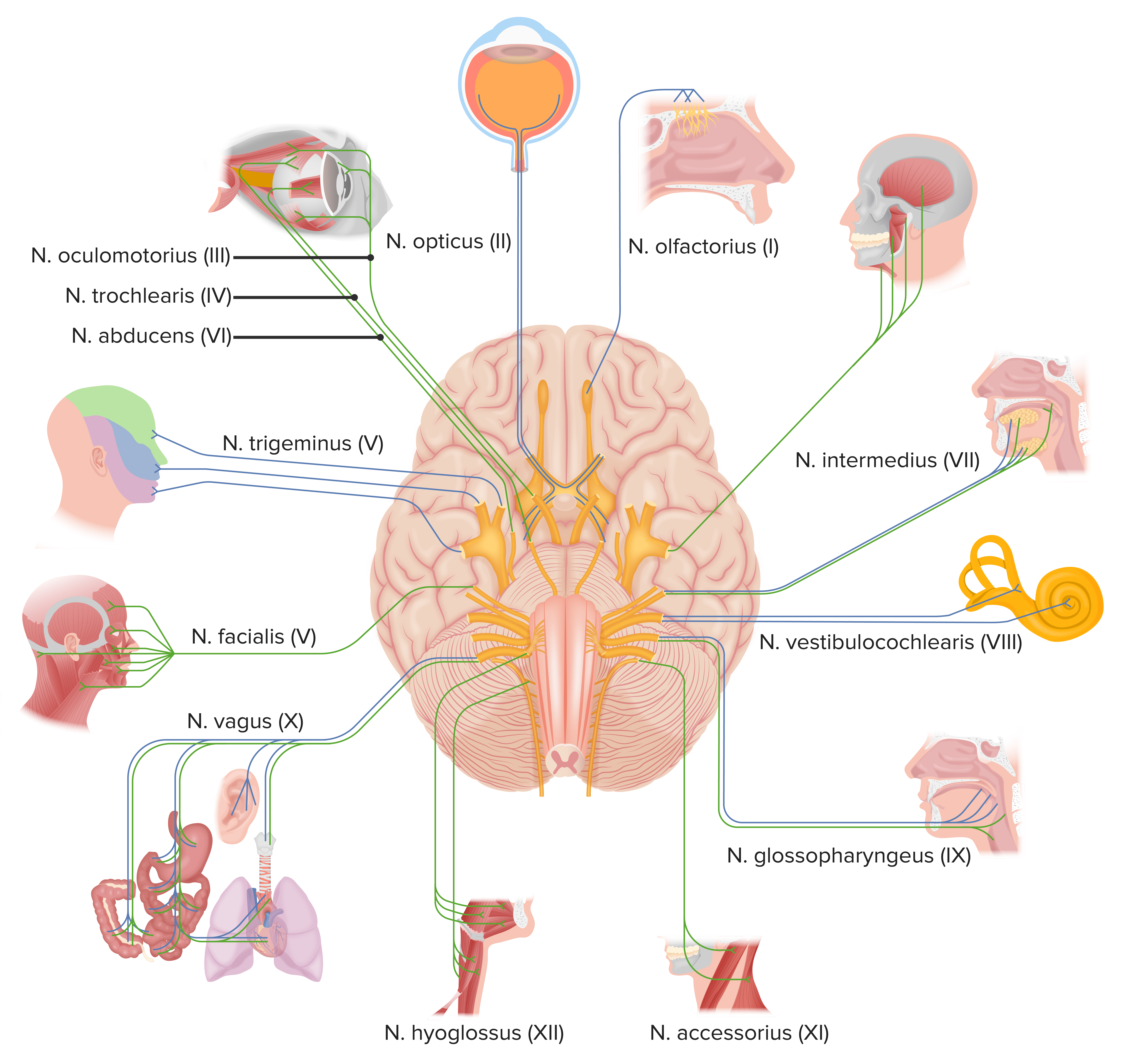
La siguiente tabla resume las funciones de los LOS Neisseria 12 nervios craneales.

Tabla: Funciones de los LOS Neisseria 12 nervios craneales
Nervio craneal Nombre Función Tipo
I Olfatorio Olfato Sensorial
II Óptico Visión Sensorial
III Oculomotor
  • Movimiento del ojo
  • Constricción pupilar
  • Acomodación
  • Apertura de párpados
Motor Motor Neurons which send impulses peripherally to activate muscles or secretory cells. Nervous System: Histology
IV Troclear Movimiento ocular (músculo oblicuo superior) Motor Motor Neurons which send impulses peripherally to activate muscles or secretory cells. Nervous System: Histology
V Trigémino
  • Sensación facial
  • Masticación
Motor Motor Neurons which send impulses peripherally to activate muscles or secretory cells. Nervous System: Histology/Sensorial
VI Abducens Movimiento ocular (músculo recto lateral) Motor Motor Neurons which send impulses peripherally to activate muscles or secretory cells. Nervous System: Histology
VII Facial
  • Movimientos faciales
  • Gusto de ⅔ anterior de la lengua (cuerda del tímpano)
  • Lagrimeo
  • Salivación
  • Cierre de párpados
  • Reflejo auditivo
Motor Motor Neurons which send impulses peripherally to activate muscles or secretory cells. Nervous System: Histology/Sensorial
VIII Vestibulococlear
  • Audición
  • Equilibrio
Sensorial
IX Glosofaríngeo
  • Gusto y sensación del ⅓ posterior de la lengua
  • Monitorización de los LOS Neisseria quimiorreceptores y barorreceptores del cuerpo carotídeo y de los LOS Neisseria senos paranasales
  • Elevación de faringe/laringe
Motor Motor Neurons which send impulses peripherally to activate muscles or secretory cells. Nervous System: Histology/Sensorial
X Vago
  • Sabor de la región supraglótica
  • Deglución
  • Elevación del paladar blando
  • Habla
  • Reflejo de la tos TOS Thoracic outlet syndrome (TOS) is a broad term used for a spectrum of syndromes related to the general region of the thoracic outlet, which involves the compression or irritation of elements of the brachial plexus, subclavian artery, or subclavian vein. Thoracic Outlet Syndrome
  • Inervación parasimpática de las vísceras toracoabdominales
  • Monitorización de quimiorreceptores y barorreceptores del arco aórtico
Motor Motor Neurons which send impulses peripherally to activate muscles or secretory cells. Nervous System: Histology/Sensorial
XI Accesorio
  • Girar la cabeza
  • Encogimiento de hombros
Motor Motor Neurons which send impulses peripherally to activate muscles or secretory cells. Nervous System: Histology
XII Hipogloso Movimientos de la lengua Motor Motor Neurons which send impulses peripherally to activate muscles or secretory cells. Nervous System: Histology
Los nervios craneales

Nervios craneales

Imagen por Lecturio.
Parálisis del Nervio Craneal I (Olfatorio)

Epidemiología

  • Los LOS Neisseria trastornos del olfato afectan a 10%‒12% de las personas > 40 años de edad.
  • La prevalencia aumenta con la edad hasta aproximadamente un 40% a los LOS Neisseria 80 años.
  • Afecta a más hombres que mujeres.
  • Afecta a más no blancos que blancos

Etiología

  • Sinusitis Sinusitis Sinusitis refers to inflammation of the mucosal lining of the paranasal sinuses. The condition usually occurs concurrently with inflammation of the nasal mucosa (rhinitis), a condition known as rhinosinusitis. Acute sinusitis is due to an upper respiratory infection caused by a viral, bacterial, or fungal agent. Sinusitis
  • Rinitis alérgica
  • Infecciones virales:
    • COVID-19 COVID-19 Coronavirus disease 2019 (COVID-19) is an infectious disease caused by the severe acute respiratory syndrome coronavirus 2 (SARS-CoV-2) that mainly affects the respiratory system but can also cause damage to other body systems (cardiovascular, gastrointestinal, renal, and central nervous systems).
    • Influenza Influenza Influenza viruses are members of the Orthomyxoviridae family and the causative organisms of influenza, a highly contagious febrile respiratory disease. There are 3 primary influenza viruses (A, B, and C) and various subtypes, which are classified based on their virulent surface antigens, hemagglutinin (HA) and neuraminidase (NA). Influenza typically presents with a fever, myalgia, headache, and symptoms of an upper respiratory infection. Influenza Viruses/Influenza
    • Resfriado comun
  • Obstrucción de las fosas nasales
  • Migraña ( aura Aura Reversible neurological phenomena that often precede or coincide with headache onset. Migraine Headache olfativa)
  • Toxicidad por inhalación:
    • Humo de cigarro
    • Herbicidas
    • Plaguicidas
    • Disolventes
  • Medicamentos (lista no completa):
    • Antibióticos
    • Anticonvulsivantes
    • Antidepresivos
  • Deficiencias nutricionales:
    • Vitamina A
    • Vitaminas B6, B12
    • Zinc Zinc A metallic element of atomic number 30 and atomic weight 65. 38. It is a necessary trace element in the diet, forming an essential part of many enzymes, and playing an important role in protein synthesis and in cell division. Zinc deficiency is associated with anemia, short stature, hypogonadism, impaired wound healing, and geophagia. It is known by the symbol zn. Trace Elements, cobre
  • Tumor Tumor Inflammation/efecto de masa
  • Accidente cerebrovascular/trauma del sistema límbico
  • Enfermedad por depósito de amiloide
  • Traumatismo craneoencefálico/traumatismo de la lámina cribosa
  • Trastornos neurodegenerativos:
    • Enfermedad de Huntington
    • Enfermedad de Parkinson
    • Enfermedad de Alzheimer
  • Deterioro relacionado con la edad en EN Erythema nodosum is an immune-mediated panniculitis (inflammation of the subcutaneous fat) caused by a type IV (delayed-type) hypersensitivity reaction. It commonly manifests in young women as tender, erythematous nodules on the shins. Erythema Nodosum la agudeza olfativa

Fisiopatología

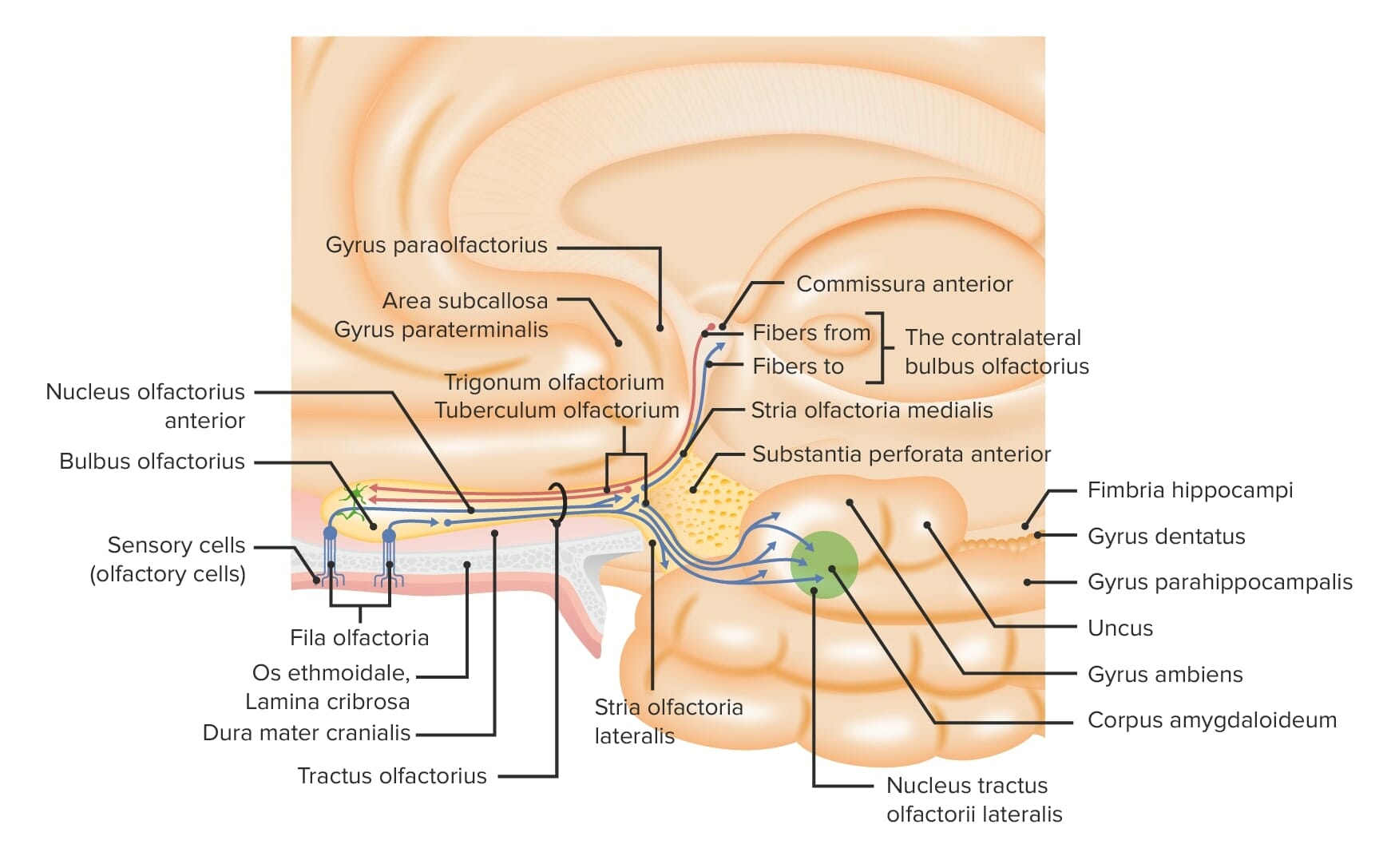
  • El nervio craneal I contiene fibras aferentes “especiales” que transportan el sentido del olfato.
  • Las células sensoriales olfatorias especializadas se encuentran en EN Erythema nodosum is an immune-mediated panniculitis (inflammation of the subcutaneous fat) caused by a type IV (delayed-type) hypersensitivity reaction. It commonly manifests in young women as tender, erythematous nodules on the shins. Erythema Nodosum la mucosa olfatoria que se encuentra debajo de la placa cribosa:
    • Neuronas quimiosensoriales que tienen receptores para moléculas de olor en EN Erythema nodosum is an immune-mediated panniculitis (inflammation of the subcutaneous fat) caused by a type IV (delayed-type) hypersensitivity reaction. It commonly manifests in young women as tender, erythematous nodules on the shins. Erythema Nodosum el aire
    • La mucosa nasal también produce moco para “atrapar” las moléculas de olor, lo que facilita la unión del receptor Receptor Receptors are proteins located either on the surface of or within a cell that can bind to signaling molecules known as ligands (e.g., hormones) and cause some type of response within the cell. Receptors.
  • Las células olfatorias hacen sinapsis con neuronas secundarias en EN Erythema nodosum is an immune-mediated panniculitis (inflammation of the subcutaneous fat) caused by a type IV (delayed-type) hypersensitivity reaction. It commonly manifests in young women as tender, erythematous nodules on the shins. Erythema Nodosum los LOS Neisseria bulbos olfatorios, que luego transmiten fibras al AL Amyloidosis sistema límbico (corteza olfatoria y amígdala):
    • La corteza olfatoria funciona para procesar e interpretar los LOS Neisseria estímulos olfatorios.
    • La amígdala puede producir respuestas emocionales y/o recuerdos en EN Erythema nodosum is an immune-mediated panniculitis (inflammation of the subcutaneous fat) caused by a type IV (delayed-type) hypersensitivity reaction. It commonly manifests in young women as tender, erythematous nodules on the shins. Erythema Nodosum respuesta a estímulos olfatorios.
  • Cualquier interrupción de las neuronas o de la vía olfatoria podría provocar una disfunción en EN Erythema nodosum is an immune-mediated panniculitis (inflammation of the subcutaneous fat) caused by a type IV (delayed-type) hypersensitivity reaction. It commonly manifests in young women as tender, erythematous nodules on the shins. Erythema Nodosum la detección o el procesamiento del olfato.
Descripción general de los componentes periféricos y centrales del sistema olfativo

Resumen de los componentes periféricos y centrales del sistema olfatorio

Imagen por Lecturio.
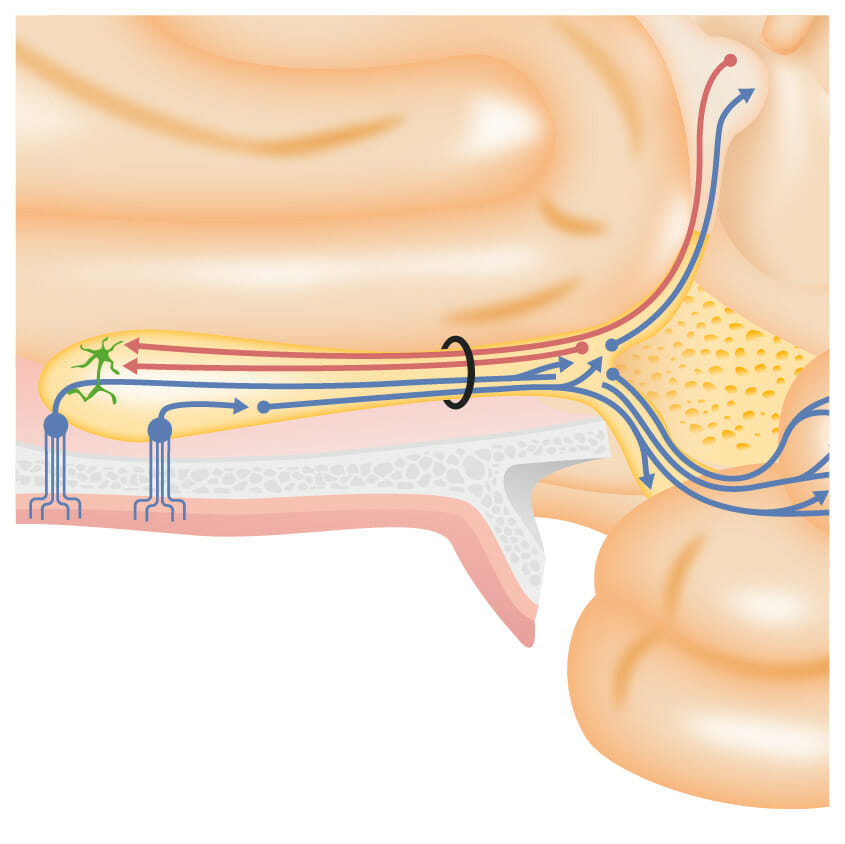
Una mirada más cercana a las células sensoriales olfativas

Una mirada más cercana a las células sensoriales olfatorias en la mucosa olfatoria, pasando a través de la lámina cribosa y haciendo sinapsis con el tracto olfatorio en los bulbos olfatorios

Imagen por Lecturio.
Presentación clínica

  • Hiposmia: capacidad reducida para oler
  • Hiperosmia: sentido del olfato anormalmente mejorado
  • Disosmia: percepción anormal del olfato ante estímulos familiares
  • Anosmia Anosmia Complete or severe loss of the subjective sense of smell. Loss of smell may be caused by many factors such as a cold, allergy, olfactory nerve diseases, viral respiratory tract infections (e.g., COVID-19), aging and various neurological disorders (e.g., Alzheimer disease). Cranial Nerve Palsies:
    • Incapacidad total para oler
    • Puede ser unilateral o bilateral
  • Alucinaciones olfativas:
    • Percepción de olores para los LOS Neisseria que no hay estímulo presente
    • A menudo por irritación del uncus Uncus Cerebral Cortex: Anatomy
    • Se denomina cacosmia si la alucinación olfativa es desagradable
  • Puede estar relacionado con trastornos de la sensación del gusto

Diagnóstico

  • Basado en EN Erythema nodosum is an immune-mediated panniculitis (inflammation of the subcutaneous fat) caused by a type IV (delayed-type) hypersensitivity reaction. It commonly manifests in young women as tender, erythematous nodules on the shins. Erythema Nodosum los LOS Neisseria antecedentes y el examen físico (descartar sinusitis Sinusitis Sinusitis refers to inflammation of the mucosal lining of the paranasal sinuses. The condition usually occurs concurrently with inflammation of the nasal mucosa (rhinitis), a condition known as rhinosinusitis. Acute sinusitis is due to an upper respiratory infection caused by a viral, bacterial, or fungal agent. Sinusitis, rinitis alérgica, infección viral de las vías respiratorias superiores, medicamentos)
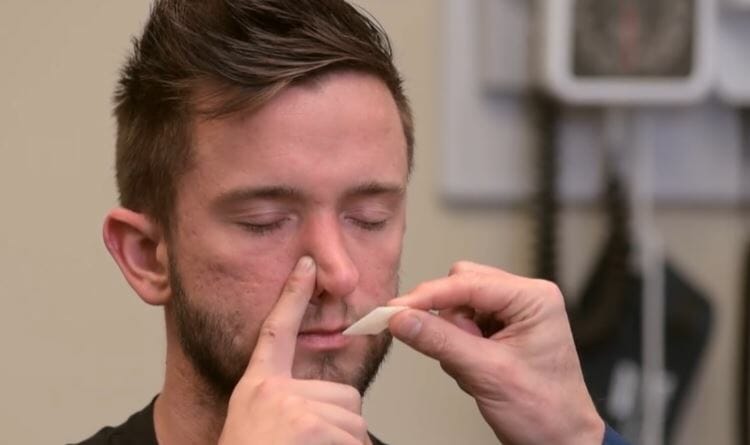
  • Estimule a la persona afectada con olores familiares mientras sus ojos están cerrados.
  • Laboratorios:
    • Hemograma
    • Panel metabólico básico
    • Panel de vitaminas/minerales
    • Velocidad de eritrosedimentación (VES)
  • Neuroimagenologia (descartar efecto de masa):
    • TC para evaluación de estructuras óseas y/o senos paranasales
    • RM para la evaluación de las estructuras de los LOS Neisseria tejidos blandos
Examen de CN I

Examen del nervio craneal I: estimular al sujeto con un estímulo olfativo familiar

Imagen por Lecturio.
Tratamiento

  • Tratar las causas subyacentes:
    • Rinitis alérgica
    • Sinusitis Sinusitis Sinusitis refers to inflammation of the mucosal lining of the paranasal sinuses. The condition usually occurs concurrently with inflammation of the nasal mucosa (rhinitis), a condition known as rhinosinusitis. Acute sinusitis is due to an upper respiratory infection caused by a viral, bacterial, or fungal agent. Sinusitis
    • Retire las obstrucciones.
  • Cesación de tabaquismo
  • Suspender los LOS Neisseria probables medicamentos causantes.
  • Remitir a otorrinolaringología/evaluación quirúrgica de masas/tumores.
  • Altas dosis de esteroides, con su respectiva disminución progresiva, pueden tener alguna utilidad para las condiciones inflamatorias.

Diagnósticos diferenciales

  • Abuso de sustancias intranasales
  • Psicosis
  • Migraña
  • Trastorno convulsivo

Parálisis del Nervio Craneal II (Óptico)

Epidemiología

  • La neuritis óptica es la causa más común de disfunción del nervio óptico.
  • Incidencia: aproximadamente 6 por 100 000
  • Afecta a más mujeres que hombres, 3:1
  • Afecta a más caucásicos que afroamericanos

Etiología

  • Neuritis óptica:
    • Infecciones
    • Esclerosis múltiple
  • Accidente cerebrovascular
  • Tumor Tumor Inflammation
  • Glaucoma Glaucoma Glaucoma is an optic neuropathy characterized by typical visual field defects and optic nerve atrophy seen as optic disc cupping on examination. The acute form of glaucoma is a medical emergency. Glaucoma is often, but not always, caused by increased intraocular pressure (IOP). Glaucoma (aumento de la presión sobre el nervio óptico)
  • Isquemia
  • Trauma

Fisiopatología

  • El nervio craneal II contiene fibras aferentes “especiales” que transportan el sentido de la vista.
  • Las células sensoriales fotorreceptoras especializadas (conos y bastones) se encuentran en EN Erythema nodosum is an immune-mediated panniculitis (inflammation of the subcutaneous fat) caused by a type IV (delayed-type) hypersensitivity reaction. It commonly manifests in young women as tender, erythematous nodules on the shins. Erythema Nodosum la retina Retina The ten-layered nervous tissue membrane of the eye. It is continuous with the optic nerve and receives images of external objects and transmits visual impulses to the brain. Its outer surface is in contact with the choroid and the inner surface with the vitreous body. The outermost layer is pigmented, whereas the inner nine layers are transparent. Eye: Anatomy en EN Erythema nodosum is an immune-mediated panniculitis (inflammation of the subcutaneous fat) caused by a type IV (delayed-type) hypersensitivity reaction. It commonly manifests in young women as tender, erythematous nodules on the shins. Erythema Nodosum la parte posterior del ojo:
    • Estos fotorreceptores hacen sinapsis con células bipolares, que a su vez hacen sinapsis con células ganglionares de la retina Retina The ten-layered nervous tissue membrane of the eye. It is continuous with the optic nerve and receives images of external objects and transmits visual impulses to the brain. Its outer surface is in contact with the choroid and the inner surface with the vitreous body. The outermost layer is pigmented, whereas the inner nine layers are transparent. Eye: Anatomy.
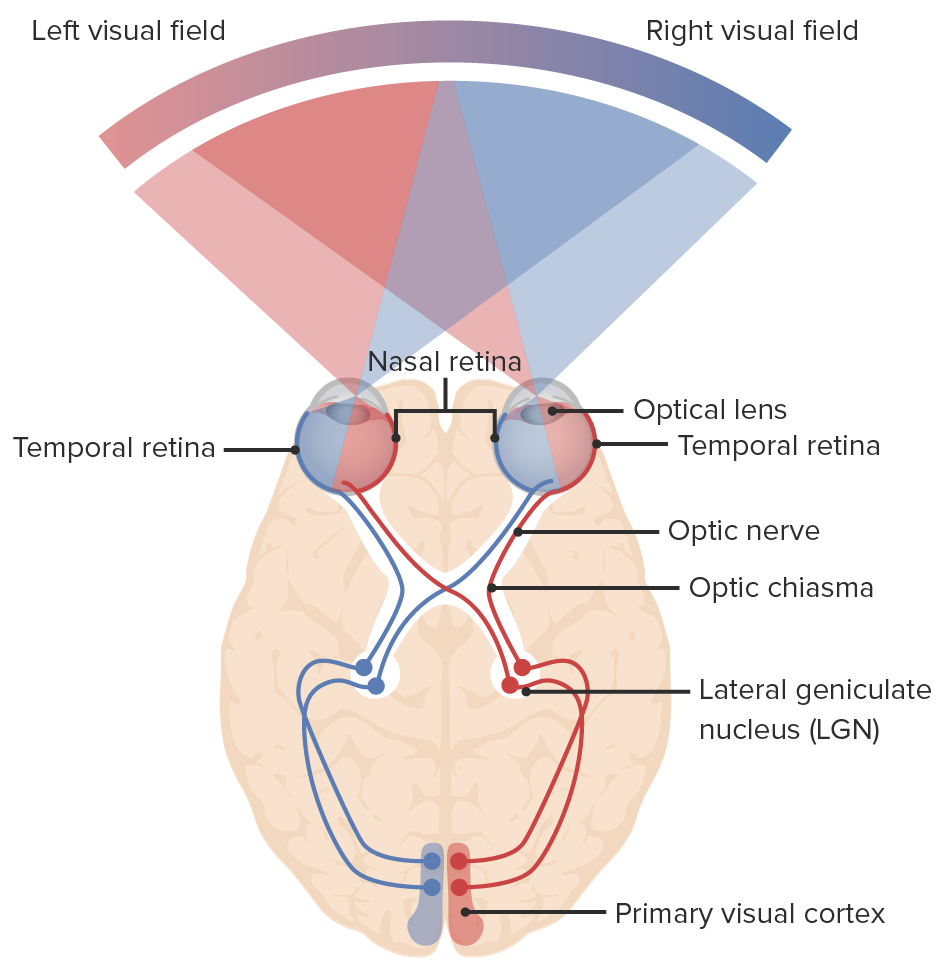
    • Los LOS Neisseria axones de células ganglionares de la retina Retina The ten-layered nervous tissue membrane of the eye. It is continuous with the optic nerve and receives images of external objects and transmits visual impulses to the brain. Its outer surface is in contact with the choroid and the inner surface with the vitreous body. The outermost layer is pigmented, whereas the inner nine layers are transparent. Eye: Anatomy convergen para formar los LOS Neisseria nervios ópticos, el quiasma óptico y las vías ópticas.
    • La mayoría de las células ganglionares de la retina Retina The ten-layered nervous tissue membrane of the eye. It is continuous with the optic nerve and receives images of external objects and transmits visual impulses to the brain. Its outer surface is in contact with the choroid and the inner surface with the vitreous body. The outermost layer is pigmented, whereas the inner nine layers are transparent. Eye: Anatomy participan en EN Erythema nodosum is an immune-mediated panniculitis (inflammation of the subcutaneous fat) caused by a type IV (delayed-type) hypersensitivity reaction. It commonly manifests in young women as tender, erythematous nodules on the shins. Erythema Nodosum la generación de imágenes, mientras que una minoría participa en EN Erythema nodosum is an immune-mediated panniculitis (inflammation of the subcutaneous fat) caused by a type IV (delayed-type) hypersensitivity reaction. It commonly manifests in young women as tender, erythematous nodules on the shins. Erythema Nodosum los LOS Neisseria arcos reflejos y en EN Erythema nodosum is an immune-mediated panniculitis (inflammation of the subcutaneous fat) caused by a type IV (delayed-type) hypersensitivity reaction. It commonly manifests in young women as tender, erythematous nodules on the shins. Erythema Nodosum el mantenimiento del ritmo circadiano.
  • Las células ganglionares de la retina Retina The ten-layered nervous tissue membrane of the eye. It is continuous with the optic nerve and receives images of external objects and transmits visual impulses to the brain. Its outer surface is in contact with the choroid and the inner surface with the vitreous body. The outermost layer is pigmented, whereas the inner nine layers are transparent. Eye: Anatomy hacen sinapsis con neuronas secundarias en EN Erythema nodosum is an immune-mediated panniculitis (inflammation of the subcutaneous fat) caused by a type IV (delayed-type) hypersensitivity reaction. It commonly manifests in young women as tender, erythematous nodules on the shins. Erythema Nodosum varias estructuras diana:
    • Núcleo supraquiasmático ( en EN Erythema nodosum is an immune-mediated panniculitis (inflammation of the subcutaneous fat) caused by a type IV (delayed-type) hypersensitivity reaction. It commonly manifests in young women as tender, erythematous nodules on the shins. Erythema Nodosum el hipotálamo, implicado en EN Erythema nodosum is an immune-mediated panniculitis (inflammation of the subcutaneous fat) caused by a type IV (delayed-type) hypersensitivity reaction. It commonly manifests in young women as tender, erythematous nodules on the shins. Erythema Nodosum los LOS Neisseria ritmos circadianos)
    • Núcleo geniculado lateral ( en EN Erythema nodosum is an immune-mediated panniculitis (inflammation of the subcutaneous fat) caused by a type IV (delayed-type) hypersensitivity reaction. It commonly manifests in young women as tender, erythematous nodules on the shins. Erythema Nodosum el tálamo, proyecta fibras superiores e inferiores a la corteza visual primaria del lóbulo occipital Occipital Part of the back and base of the cranium that encloses the foramen magnum. Skull: Anatomy)
    • Núcleo pretectal (reflejo pupilar a la luz)
    • Colículo superior (influye en EN Erythema nodosum is an immune-mediated panniculitis (inflammation of the subcutaneous fat) caused by a type IV (delayed-type) hypersensitivity reaction. It commonly manifests in young women as tender, erythematous nodules on the shins. Erythema Nodosum los LOS Neisseria movimientos oculares en EN Erythema nodosum is an immune-mediated panniculitis (inflammation of the subcutaneous fat) caused by a type IV (delayed-type) hypersensitivity reaction. It commonly manifests in young women as tender, erythematous nodules on the shins. Erythema Nodosum respuesta a estímulos ambientales)
    • Corteza visual primaria (funciones para procesar e interpretar estímulos visuales)
  • El nervio óptico también transporta el estímulo aferente para el reflejo de luz pupilar y el reflejo de acomodación:
    • Reflejo de luz pupilar: las fibras del nervio óptico hacen sinapsis en EN Erythema nodosum is an immune-mediated panniculitis (inflammation of the subcutaneous fat) caused by a type IV (delayed-type) hypersensitivity reaction. It commonly manifests in young women as tender, erythematous nodules on the shins. Erythema Nodosum el núcleo de Edinger-Westphal, donde se estimulan las fibras eferentes del nervio craneal III para contraer la pupila.
    • Reflejo de acomodación:
      • Las fibras del nervio óptico hacen sinapsis en EN Erythema nodosum is an immune-mediated panniculitis (inflammation of the subcutaneous fat) caused by a type IV (delayed-type) hypersensitivity reaction. It commonly manifests in young women as tender, erythematous nodules on the shins. Erythema Nodosum la corteza visual primaria, donde las señales eferentes hacen sinapsis en EN Erythema nodosum is an immune-mediated panniculitis (inflammation of the subcutaneous fat) caused by a type IV (delayed-type) hypersensitivity reaction. It commonly manifests in young women as tender, erythematous nodules on the shins. Erythema Nodosum el núcleo de Edinger-Westphal y el núcleo oculomotor.
      • Las fibras eferentes del nervio craneal III se estimulan para contraer la pupila y relajar los LOS Neisseria músculos ciliares, de modo que se manipula la refracción del cristalino.
  • Mecanismos patológicos mejor descritos de la disfunción del nervio craneal II en EN Erythema nodosum is an immune-mediated panniculitis (inflammation of the subcutaneous fat) caused by a type IV (delayed-type) hypersensitivity reaction. It commonly manifests in young women as tender, erythematous nodules on the shins. Erythema Nodosum la neuritis óptica:
    • La desmielinización inflamatoria del nervio óptico se manifiesta como:
      • Inflamación del endotelio vascular de la retina Retina The ten-layered nervous tissue membrane of the eye. It is continuous with the optic nerve and receives images of external objects and transmits visual impulses to the brain. Its outer surface is in contact with the choroid and the inner surface with the vitreous body. The outermost layer is pigmented, whereas the inner nine layers are transparent. Eye: Anatomy
      • Manguito perivascular
      • Edema Edema Edema is a condition in which excess serous fluid accumulates in the body cavity or interstitial space of connective tissues. Edema is a symptom observed in several medical conditions. It can be categorized into 2 types, namely, peripheral (in the extremities) and internal (in an organ or body cavity). Edema de las vainas nerviosas mielinizadas
    • Se cree que es una condición mediada por el sistema inmune
    • Es probable que exista una susceptibilidad genética relacionada con los LOS Neisseria subtipos del antígeno leucocitario humano (HLA, por sus siglas en EN Erythema nodosum is an immune-mediated panniculitis (inflammation of the subcutaneous fat) caused by a type IV (delayed-type) hypersensitivity reaction. It commonly manifests in young women as tender, erythematous nodules on the shins. Erythema Nodosum inglés).

Presentación clínica

  • Deterioro del campo visual/pérdida visual:
    • Lesión del nervio óptico anterior al AL Amyloidosis quiasma óptico → pérdida de visión monocular ipsilateral
    • La lesión del quiasma óptico interrumpe las fibras retinianas mediales (nasales) de ambos ojos → pérdida de ambos campos visuales laterales (temporales) (hemianopsia bitemporal)
    • La lesión del tracto óptico produce hemianopsia homónima contralateral.
  • Pérdida de la visión del color desproporcionada con respecto a la agudeza visual (observada en EN Erythema nodosum is an immune-mediated panniculitis (inflammation of the subcutaneous fat) caused by a type IV (delayed-type) hypersensitivity reaction. It commonly manifests in young women as tender, erythematous nodules on the shins. Erythema Nodosum la neuritis óptica)
  • Diplopía
  • Escotoma
  • Ceguera
  • Disfunción pupilar:
    • Pérdida de constricción
    • Pérdida de la acomodación
  • Dolor Dolor Inflammation de ojo
  • Dolor Dolor Inflammation con el movimiento de los LOS Neisseria ojos
Sistema visual

Diagrama de la vía visual y los campos visuales: la luz entra en el ojo y envía señales a la retina y a través del nervio óptico. Las fibras nasales de cada ojo se decusan en el quiasma óptico y continúan hasta el tracto óptico con las fibras temporales. Las fibras nasales derechas se unen a las fibras temporales izquierdas (líneas azules) y las fibras nasales izquierdas se unen a las fibras temporales derechas (líneas rojas). Las neuronas hacen sinapsis en el núcleo geniculado lateral. Las radiaciones ópticas conectan el núcleo geniculado lateral a la corteza visual primaria del lóbulo occipital donde se procesa la información visual.

Imagen por Lecturio.
Diagnóstico

  • Pruebas de campo visual
  • Prueba de agudeza visual (gráfico de Snellen)
  • Prueba de visión de color (gráfico de Ishihara)
  • Examen de fondo de ojo
  • Monitoreo de la presión intraocular
  • Laboratorios:
    • Hemograma
    • Glucosa sérica y HbA1c HbA1c Products of non-enzymatic reactions between glucose and hemoglobin a, occurring as a minor fraction of the hemoglobin components of human erythrocytes. Hemoglobin a1c is hemoglobin a with glucose covalently bound to the terminal valine of the beta chain. Glycated hemoglobin a is used as an index of the average blood sugar level over a lifetime of erythrocytes. Diabetes Mellitus
    • Velocidad de eritrosedimentación (VES)
  • Punción lumbar con estudios de LCR:
    • Evaluación típica de meningitis Meningitis Meningitis is inflammation of the meninges, the protective membranes of the brain, and spinal cord. The causes of meningitis are varied, with the most common being bacterial or viral infection. The classic presentation of meningitis is a triad of fever, altered mental status, and nuchal rigidity. Meningitis/encefalitis (incluye estudios para la enfermedad de Lyme, infecciones por virus Virus Viruses are infectious, obligate intracellular parasites composed of a nucleic acid core surrounded by a protein capsid. Viruses can be either naked (non-enveloped) or enveloped. The classification of viruses is complex and based on many factors, including type and structure of the nucleoid and capsid, the presence of an envelope, the replication cycle, and the host range. Virology herpes simple ( HSV HSV Herpes simplex virus (HSV) is a double-stranded DNA virus belonging to the family Herpesviridae. Herpes simplex virus commonly causes recurrent infections involving the skin and mucosal surfaces, including the mouth, lips, eyes, and genitals. Herpes Simplex Virus 1 and 2, por sus siglas en EN Erythema nodosum is an immune-mediated panniculitis (inflammation of the subcutaneous fat) caused by a type IV (delayed-type) hypersensitivity reaction. It commonly manifests in young women as tender, erythematous nodules on the shins. Erythema Nodosum inglés)
    • Niveles de IgG IgG The major immunoglobulin isotype class in normal human serum. There are several isotype subclasses of igg, for example, igg1, igg2a, and igg2b. Hypersensitivity Pneumonitis, bandas oligoclonales, proteína básica de mielina
  • Neuroimagenologia (del cerebro y las órbitas):
    • TC para evaluación de estructuras óseas
    • RM (con contraste) para la evaluación de estructuras de tejidos blandos

Tratamiento

  • La pérdida aguda de la visión debe ser referida a oftalmología de emergencia.
  • Las altas dosis de esteroides, y su consecuente disminución progresiva, puede tener alguna utilidad para las condiciones inflamatorias.
  • Terapias específicas de la enfermedad para causas subyacentes identificables/tratables
  • Terapias de inmunomodulación para trastornos autoinmunes

Diagnósticos diferenciales

  • Esclerosis múltiple
  • Enfermedad autoinmune
  • Enfermedad de depósito
  • Meningitis Meningitis Meningitis is inflammation of the meninges, the protective membranes of the brain, and spinal cord. The causes of meningitis are varied, with the most common being bacterial or viral infection. The classic presentation of meningitis is a triad of fever, altered mental status, and nuchal rigidity. Meningitis/encefalitis
  • Enfermedad cerebrovascular
  • Migraña
  • Trastorno convulsivo

Parálisis del Nervio Craneal III (Oculomotor)

Epidemiología

  • Incidencia de parálisis del nervio craneal III adquirida: 4,0 por 100 000 personas
  • Afecta a hombres y mujeres por igual

Etiología

  • Causas inherentes al AL Amyloidosis nervio craneal III:
    • Isquemia del nervio
    • Trauma
    • Neoplasia intracraneal
    • Hemorragia
    • Migraña
    • Congénita
    • Idiopática
  • Causas sistémicas:
    • Diabetes Diabetes Diabetes mellitus (DM) is a metabolic disease characterized by hyperglycemia and dysfunction of the regulation of glucose metabolism by insulin. Type 1 DM is diagnosed mostly in children and young adults as the result of autoimmune destruction of β cells in the pancreas and the resulting lack of insulin. Type 2 DM has a significant association with obesity and is characterized by insulin resistance. Diabetes Mellitus mellitus
    • Hipertensión

Fisiopatología

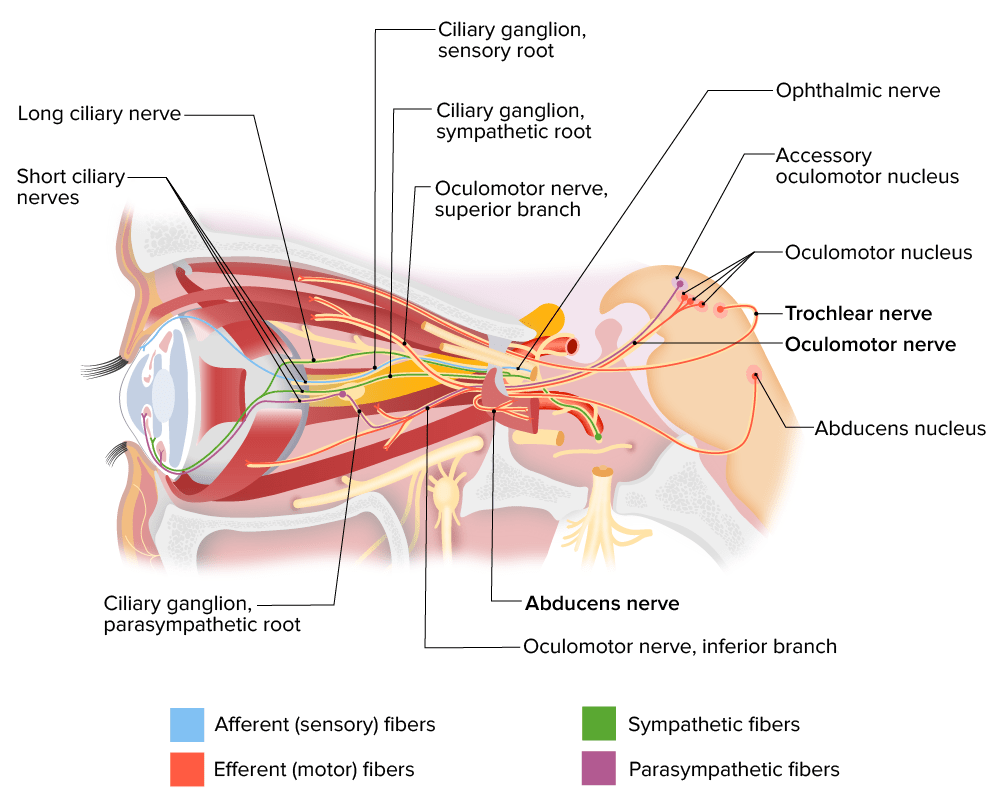
  • El nervio oculomotor tiene fibras parasimpáticas en EN Erythema nodosum is an immune-mediated panniculitis (inflammation of the subcutaneous fat) caused by a type IV (delayed-type) hypersensitivity reaction. It commonly manifests in young women as tender, erythematous nodules on the shins. Erythema Nodosum la capa externa (superficial) y las fibras motoras en EN Erythema nodosum is an immune-mediated panniculitis (inflammation of the subcutaneous fat) caused by a type IV (delayed-type) hypersensitivity reaction. It commonly manifests in young women as tender, erythematous nodules on the shins. Erythema Nodosum el centro.
  • La irrigación difiere entre las porciones externa (a través de los LOS Neisseria vasos sanguíneos que irrigan la piamadre) e interna (a través de los LOS Neisseria vasa vasorum Vasa vasorum Nutrient blood vessels which supply the walls of large arteries or veins. Arteries: Histology) del nervio:
    • Es más probable que la isquemia 1ro cause daño a las capas internas (fibras motoras).
    • Las lesiones que resultan en EN Erythema nodosum is an immune-mediated panniculitis (inflammation of the subcutaneous fat) caused by a type IV (delayed-type) hypersensitivity reaction. It commonly manifests in young women as tender, erythematous nodules on the shins. Erythema Nodosum isquemia causan síntomas motores más prominentes.
    • Es probable que las lesiones compresivas de los LOS Neisseria nervios (e.g., aneurismas, masas, hernias) se presenten con compromiso de la inervación parasimpática (pupila dilatada).
Inervación de los músculos oculares por los nervios craneales III, IV y VI

Inervación de los músculos oculares por los nervios craneales III, IV y VI

Imagen por Lecturio.

Presentación clínica

  • Lesión de las fibras motoras (síntomas/hallazgos homolaterales):
    • Diplopía (horizontal)
    • Ptosis Ptosis Cranial Nerve Palsies
    • Debilidad en EN Erythema nodosum is an immune-mediated panniculitis (inflammation of the subcutaneous fat) caused by a type IV (delayed-type) hypersensitivity reaction. It commonly manifests in young women as tender, erythematous nodules on the shins. Erythema Nodosum la aducción
    • Mirada hacia abajo y hacia afuera (lateral y hacia abajo)
  • Lesión de las fibras autonómicas (parasimpáticas) (síntomas/hallazgos homolaterales):
    • Dificultad para la acomodación entre luces brillantes y tenues (parálisis del músculo ciliar)
    • Pupila fija y midriática
Mirada hacia abajo y hacia afuera

Pupila fija y midriática en posición de mirada lateral y hacia abajo (down-and-out)

Imagen: “Oculomotor nerve palsy” por Hakim W, Sherman R, Rezk T, Pannu K. Licencia: CC BY 3.0

Diagnóstico

  • Basado en EN Erythema nodosum is an immune-mediated panniculitis (inflammation of the subcutaneous fat) caused by a type IV (delayed-type) hypersensitivity reaction. It commonly manifests in young women as tender, erythematous nodules on the shins. Erythema Nodosum los LOS Neisseria antecedentes y el examen físico (pruebas de movimientos pupilares y oculares)
  • Laboratorios:
    • Hemograma
    • Glucosa sérica y HbA1c HbA1c Products of non-enzymatic reactions between glucose and hemoglobin a, occurring as a minor fraction of the hemoglobin components of human erythrocytes. Hemoglobin a1c is hemoglobin a with glucose covalently bound to the terminal valine of the beta chain. Glycated hemoglobin a is used as an index of the average blood sugar level over a lifetime of erythrocytes. Diabetes Mellitus
    • VES
  • Neuroimagenologia (modalidad de 1ra línea para pupilas midriáticas para identificar lesiones compresivas):
    • TC
    • RM

Tratamiento

De urgencia:

  • La parálisis del nervio craneal III es un signo importante que indica aneurismas potencialmente mortales.
  • Todas las pupilas dilatadas deben examinarse mediante imagenologia para diagnosticar herniación.
  • Colocación urgente de clipajes en EN Erythema nodosum is an immune-mediated panniculitis (inflammation of the subcutaneous fat) caused by a type IV (delayed-type) hypersensitivity reaction. It commonly manifests in young women as tender, erythematous nodules on the shins. Erythema Nodosum aneurismas

No urgente:

  • Conservador:
    • Tratamiento médico
    • Vigilar y controlar la diabetes Diabetes Diabetes mellitus (DM) is a metabolic disease characterized by hyperglycemia and dysfunction of the regulation of glucose metabolism by insulin. Type 1 DM is diagnosed mostly in children and young adults as the result of autoimmune destruction of β cells in the pancreas and the resulting lack of insulin. Type 2 DM has a significant association with obesity and is characterized by insulin resistance. Diabetes Mellitus o causas desmielinizantes.
    • Seguimiento cada 3 meses para detectar signos de mejora.
  • Indicaciones quirúrgicas:
    • Casos que no mejoran con tratamiento conservador
    • Objetivo: restauración de la visión binocular
    • Eliminación de masas intracraneales

Diagnósticos diferenciales

  • Ptosis Ptosis Cranial Nerve Palsies congénita
  • Anisocoria Anisocoria Unequal pupil size, which may represent a benign physiologic variant or a manifestation of disease. Pathologic anisocoria reflects an abnormality in the musculature of the iris (iris diseases) or in the parasympathetic or sympathetic pathways that innervate the pupil. Physiologic anisocoria refers to an asymmetry of pupil diameter, usually less than 2mm, that is not associated with disease. Pupil: Physiology and Abnormalities
  • Migraña oftalmopléjica
  • Miastenia gravis

Parálisis del Nervio Craneal IV (Troclear)

Epidemiología

  • Incidencia: 5,73 por 100 000 personas al AL Amyloidosis año
  • Los LOS Neisseria hombres se ven más comúnmente afectados en EN Erythema nodosum is an immune-mediated panniculitis (inflammation of the subcutaneous fat) caused by a type IV (delayed-type) hypersensitivity reaction. It commonly manifests in young women as tender, erythematous nodules on the shins. Erythema Nodosum la 3ra década de la vida.

Etiología

  • Congénita
  • Hipertensión
  • Trauma
  • Diabetes Diabetes Diabetes mellitus (DM) is a metabolic disease characterized by hyperglycemia and dysfunction of the regulation of glucose metabolism by insulin. Type 1 DM is diagnosed mostly in children and young adults as the result of autoimmune destruction of β cells in the pancreas and the resulting lack of insulin. Type 2 DM has a significant association with obesity and is characterized by insulin resistance. Diabetes Mellitus
  • Secundaria a neurocirugía
  • Neoplasias intracraneales
  • Secundaria a herpes zoster Herpes Zoster Varicella-zoster virus (VZV) is a linear, double-stranded DNA virus in the Herpesviridae family. Shingles (also known as herpes zoster) is more common in adults and occurs due to the reactivation of VZV. Varicella-Zoster Virus/Chickenpox oftálmico
  • Trombosis del seno cavernoso

Presentación clínica

  • Los LOS Neisseria individuos afectados suelen quejarse de diplopía mientras leen o bajan las escaleras.
  • Diplopía binocular vertical: exacerbada cuando la mirada se dirige hacia abajo y hacia adentro
  • Examen de la vista:
    • Extorsión del ojo: cuando se le pide al AL Amyloidosis sujeto que abduzca el ojo mientras mira hacia abajo, el ojo se dispara hacia arriba en EN Erythema nodosum is an immune-mediated panniculitis (inflammation of the subcutaneous fat) caused by a type IV (delayed-type) hypersensitivity reaction. It commonly manifests in young women as tender, erythematous nodules on the shins. Erythema Nodosum la aducción.
    • Deterioro de la torsión, depresión y abducción del ojo (compromiso del músculo oblicuo superior) → induce hiperactividad del músculo oblicuo inferior
    • Compensatorio:
      • Estrabismo
      • Tortícolis
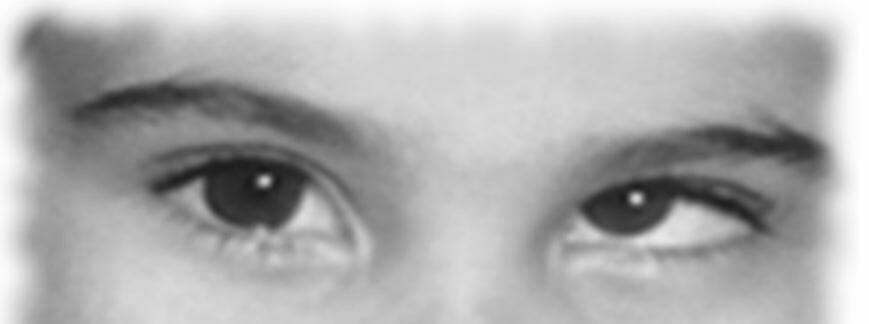
Parálisis del nervio troclear izquierdo

Parálisis del nervio troclear izquierdo:
Se le pidió al sujeto que mirara a la derecha después de mirar a la izquierda. El ojo izquierdo muestra extorsión.

Imagen: “Trochlear nerve palsy” por S. Bhimji. Licencia: CC BY 4.0

Diagnóstico

  • Basado en EN Erythema nodosum is an immune-mediated panniculitis (inflammation of the subcutaneous fat) caused by a type IV (delayed-type) hypersensitivity reaction. It commonly manifests in young women as tender, erythematous nodules on the shins. Erythema Nodosum los LOS Neisseria antecedentes y el examen físico
  • No se requieren estudios adicionales excepto para descartar diagnósticos diferenciales.

Tratamiento

  • Conservador (esperando recuperación espontánea):
    • Gafas de prisma (diplopía)
    • Inyección de toxina botulínica en EN Erythema nodosum is an immune-mediated panniculitis (inflammation of the subcutaneous fat) caused by a type IV (delayed-type) hypersensitivity reaction. It commonly manifests in young women as tender, erythematous nodules on the shins. Erythema Nodosum músculos oblicuos inferiores hiperactivos
  • Quirúrgico:
    • Casos que no mejoran con manejo conservador
    • Objetivo: restauración de la visión binocular
    • Debilitamiento del oblicuo inferior + intervención de los LOS Neisseria rectos verticales y horizontales

Diagnósticos diferenciales

  • Miastenia gravis
  • Lesión vestibulococlear y desviación oblicua
  • Fracturas orbitales
  • Tortícolis congénita
  • Oftalmopatía asociada a la tiroides

Parálisis del Nervio Craneal V (Trigémino)

Etiología

  • Trastornos estructurales:
  • Trastornos hereditarios y degenerativos:
    • Neurofibromatosis
    • ELA
  • Desórdenes metabólicos:
    • Diabetes Diabetes Diabetes mellitus (DM) is a metabolic disease characterized by hyperglycemia and dysfunction of the regulation of glucose metabolism by insulin. Type 1 DM is diagnosed mostly in children and young adults as the result of autoimmune destruction of β cells in the pancreas and the resulting lack of insulin. Type 2 DM has a significant association with obesity and is characterized by insulin resistance. Diabetes Mellitus mellitus
    • Tiamina, folato, vitamina B12, piridoxina, ácido pantoténico, deficiencias de vitamina A
  • Infecciones:
    • Herpes zoster Herpes Zoster Varicella-zoster virus (VZV) is a linear, double-stranded DNA virus in the Herpesviridae family. Shingles (also known as herpes zoster) is more common in adults and occurs due to the reactivation of VZV. Varicella-Zoster Virus/Chickenpox
    • SIDA (infecciones oportunistas)
  • Tumores:
    • SNC (e.g., tumores gliales, meningioma Meningioma Meningiomas are slow-growing tumors that arise from the meninges of the brain and spinal cord. The vast majority are benign. These tumors commonly occur in individuals with a history of high doses of skull radiation, head trauma, and neurofibromatosis 2. Meningioma, schwannoma Schwannoma Schwannomas (also known as neurilemmomas) are benign nerve sheath tumors in the peripheral nervous system (PNS), arising from Schwann cells that encase the peripheral nerves. Schwannomas are the most common tumors in the PNS. Schwannoma)
    • Metástasis (e.g., cáncer de pulmón, cáncer de mama)
  • Trastornos desmielinizantes:
    • Esclerosis múltiple
    • Encefalomielitis desmielinizante aguda
    • Síndrome de Guillain-Barré
    • Síndrome de Tolosa-Hunt
    • Sarcoidosis Sarcoidosis Sarcoidosis is a multisystem inflammatory disease that causes noncaseating granulomas. The exact etiology is unknown. Sarcoidosis usually affects the lungs and thoracic lymph nodes, but it can also affect almost every system in the body, including the skin, heart, and eyes, most commonly. Sarcoidosis
    • Lupus eritematoso sistémico (LES)
  • Epilepsia: convulsiones focales

Presentación clínica

Tabla: Correlación clínico-anatómica en EN Erythema nodosum is an immune-mediated panniculitis (inflammation of the subcutaneous fat) caused by a type IV (delayed-type) hypersensitivity reaction. It commonly manifests in young women as tender, erythematous nodules on the shins. Erythema Nodosum parálisis del nervio craneal V (trigémino): supranuclear
Sitio de la lesión Hallazgos clínicos Otros hallazgos: Causas comunes
Corteza sensorial
  • Entumecimiento facial
  • Parestesias
  • Negligencia
  • Apraxia Apraxia A group of cognitive disorders characterized by the inability to perform previously learned skills that cannot be attributed to deficits of motor or sensory function. The two major subtypes of this condition are ideomotor and ideational apraxia, which refers to loss of the ability to mentally formulate the processes involved with performing an action. For example, dressing apraxia may result from an inability to mentally formulate the act of placing clothes on the body. Apraxias are generally associated with lesions of the dominant parietal lobe and supramarginal gyrus. Cranial Nerve Palsies
  • Afasia
Cápsula interna Pérdida sensorial hemifacial Hemiparesia del brazo
Corona radiada Paresia central del 7mo nervio craneal
Núcleo posteromedial ventral del tálamo
  • Anosmia Anosmia Complete or severe loss of the subjective sense of smell. Loss of smell may be caused by many factors such as a cold, allergy, olfactory nerve diseases, viral respiratory tract infections (e.g., COVID-19), aging and various neurological disorders (e.g., Alzheimer disease). Cranial Nerve Palsies
  • Déficit hemisensorial
Mesencéfalo Oftalmoparesia
Tabla: Correlación clínico-anatómica en EN Erythema nodosum is an immune-mediated panniculitis (inflammation of the subcutaneous fat) caused by a type IV (delayed-type) hypersensitivity reaction. It commonly manifests in young women as tender, erythematous nodules on the shins. Erythema Nodosum parálisis del nervio craneal V (trigémino): nuclear
Sitio de la lesión Hallazgos clínicos Otros hallazgos: Causas comunes
Puente
  • Entumecimiento facial y debilidad
  • Parestesias
  • Dolor Dolor Inflammation
  • Neuralgia trigeminal
  • Oftalmoparesia
  • Parálisis del nervio craneal VI, VII, VIII
  • Síndrome de Horner
  • Accidente cerebrovascular
  • Tumor Tumor Inflammation
  • Hemorragia
  • Esclerosis multiple
  • Siringobulbia
  • Absceso
  • Trauma
Médula
  • Ataxia Ataxia Impairment of the ability to perform smoothly coordinated voluntary movements. This condition may affect the limbs, trunk, eyes, pharynx, larynx, and other structures. Ataxia may result from impaired sensory or motor function. Sensory ataxia may result from posterior column injury or peripheral nerve diseases. Motor ataxia may be associated with cerebellar diseases; cerebral cortex diseases; thalamic diseases; basal ganglia diseases; injury to the red nucleus; and other conditions. Ataxia-telangiectasia
  • Parálisis del nervio craneal X
  • Oftalmoparesia
  • Nistagmo
  • Síndrome de Horner
  • Síndrome de Wallenberg
  • Accidente cerebrovascular
  • Esclerosis multiple
  • Tumor Tumor Inflammation
  • Aneurisma
  • Absceso
  • Vasculopatía
Tabla: Correlación clínico-anatómica en EN Erythema nodosum is an immune-mediated panniculitis (inflammation of the subcutaneous fat) caused by a type IV (delayed-type) hypersensitivity reaction. It commonly manifests in young women as tender, erythematous nodules on the shins. Erythema Nodosum parálisis del nervio craneal V (trigémino): preganglionar
Sitio de la lesión Hallazgos clínicos Otros hallazgos: Causas comunes
Ángulo pontocerebeloso Entumecimiento facial
  • Parálisis del nervio craneal VII, VIII
  • Cefalea
  • Disergia cerebelosa
  • Neuroma
  • Meningioma Meningioma Meningiomas are slow-growing tumors that arise from the meninges of the brain and spinal cord. The vast majority are benign. These tumors commonly occur in individuals with a history of high doses of skull radiation, head trauma, and neurofibromatosis 2. Meningioma
  • Meningitis Meningitis Meningitis is inflammation of the meninges, the protective membranes of the brain, and spinal cord. The causes of meningitis are varied, with the most common being bacterial or viral infection. The classic presentation of meningitis is a triad of fever, altered mental status, and nuchal rigidity. Meningitis (bacteriana, tuberculosis Tuberculosis Tuberculosis (TB) is an infectious disease caused by Mycobacterium tuberculosis complex bacteria. The bacteria usually attack the lungs but can also damage other parts of the body. Approximately 30% of people around the world are infected with this pathogen, with the majority harboring a latent infection. Tuberculosis spreads through the air when a person with active pulmonary infection coughs or sneezes. Tuberculosis ( TB TB Tuberculosis (TB) is an infectious disease caused by Mycobacterium tuberculosis complex bacteria. The bacteria usually attack the lungs but can also damage other parts of the body. Approximately 30% of people around the world are infected with this pathogen, with the majority harboring a latent infection. Tuberculosis spreads through the air when a person with active pulmonary infection coughs or sneezes. Tuberculosis), cáncer)
  • Aneurisma
  • Trauma
Ganglio de Gasser Entumecimiento facial y debilidad
  • Síndrome de Gradenigo
  • Parálisis del nervio craneal VI, VII
Base del cráneo Entumecimiento facial y debilidad
  • Cefalea
  • Meningismo
Meningitis Meningitis Meningitis is inflammation of the meninges, the protective membranes of the brain, and spinal cord. The causes of meningitis are varied, with the most common being bacterial or viral infection. The classic presentation of meningitis is a triad of fever, altered mental status, and nuchal rigidity. Meningitis (bacteriana, TB TB Tuberculosis (TB) is an infectious disease caused by Mycobacterium tuberculosis complex bacteria. The bacteria usually attack the lungs but can also damage other parts of the body. Approximately 30% of people around the world are infected with this pathogen, with the majority harboring a latent infection. Tuberculosis spreads through the air when a person with active pulmonary infection coughs or sneezes. Tuberculosis, cáncer, sarcoidosis Sarcoidosis Sarcoidosis is a multisystem inflammatory disease that causes noncaseating granulomas. The exact etiology is unknown. Sarcoidosis usually affects the lungs and thoracic lymph nodes, but it can also affect almost every system in the body, including the skin, heart, and eyes, most commonly. Sarcoidosis)
Tabla: Correlación clínico-anatómica en EN Erythema nodosum is an immune-mediated panniculitis (inflammation of the subcutaneous fat) caused by a type IV (delayed-type) hypersensitivity reaction. It commonly manifests in young women as tender, erythematous nodules on the shins. Erythema Nodosum la parálisis del nervio craneal V (trigémino): ramas del nervio trigémino
Sitio de la lesión Hallazgos clínicos Otros hallazgos: Causas comunes
V1: seno cavernoso
  • Cefalea
  • Oftalmoparesia
  • Síndrome de Horner
V1: fístula carótido-cavernosa Entumecimiento facial Trauma
V2: región maxilar
  • Entumecimiento facial
  • Síndrome de la mejilla entumecida
V3: región mandibular
  • Debilidad de la masticación
  • Síndrome de la barbilla entumecida
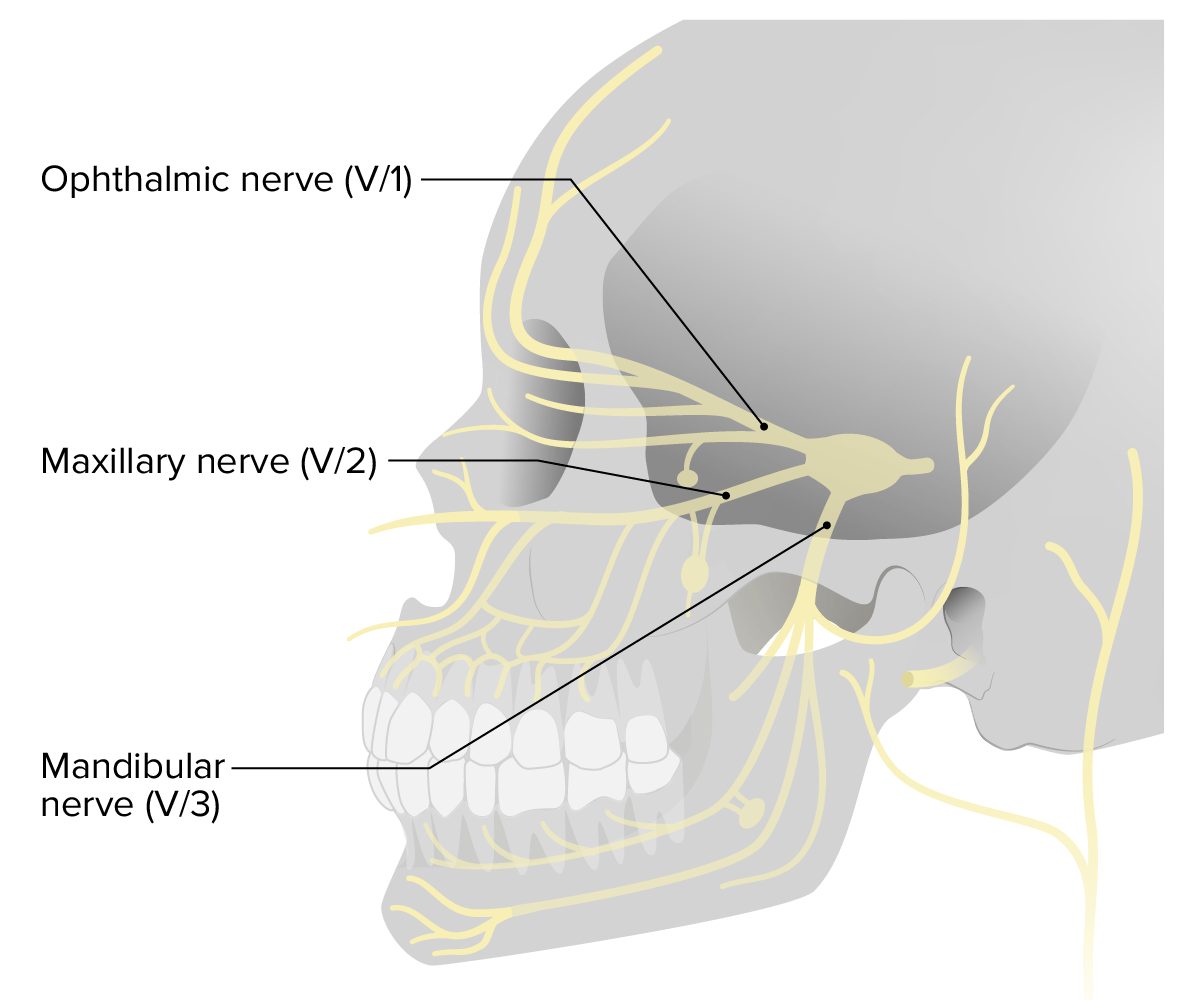
Distribución del nervio craneal V

Distribución del nervio craneal V (trigémino), con sus ramas etiquetadas

Imagen por Lecturio.
Diagnóstico

  • Basado en EN Erythema nodosum is an immune-mediated panniculitis (inflammation of the subcutaneous fat) caused by a type IV (delayed-type) hypersensitivity reaction. It commonly manifests in young women as tender, erythematous nodules on the shins. Erythema Nodosum los LOS Neisseria antecedentes y el examen físico
  • Imagenologia: TC/RM para determinar la presencia de eventos cerebrovasculares o tumores

Tratamiento

  • Terapia médica:
    • 1ra línea: carbamazepina u oxcarbazepina
    • 2da línea: lamotrigina, baclofeno, gabapentina
  • Terapia quirúrgica: indicada cuando la terapia médica es ineficaz o no se tolera

Diagnósticos diferenciales

  • Cefalea en EN Erythema nodosum is an immune-mediated panniculitis (inflammation of the subcutaneous fat) caused by a type IV (delayed-type) hypersensitivity reaction. It commonly manifests in young women as tender, erythematous nodules on the shins. Erythema Nodosum racimos
  • Sinusitis Sinusitis Sinusitis refers to inflammation of the mucosal lining of the paranasal sinuses. The condition usually occurs concurrently with inflammation of the nasal mucosa (rhinitis), a condition known as rhinosinusitis. Acute sinusitis is due to an upper respiratory infection caused by a viral, bacterial, or fungal agent. Sinusitis esfenoidal
  • Arteritis temporal (arteritis de células gigantes)
  • Neuralgia postherpética
  • Neuralgia del glosofaríngeo

Parálisis del Nervio Craneal VI (Abducens)

Epidemiología

  • Nervio ocular más comúnmente afectado en EN Erythema nodosum is an immune-mediated panniculitis (inflammation of the subcutaneous fat) caused by a type IV (delayed-type) hypersensitivity reaction. It commonly manifests in young women as tender, erythematous nodules on the shins. Erythema Nodosum adultos
  • 2da parálisis más común en EN Erythema nodosum is an immune-mediated panniculitis (inflammation of the subcutaneous fat) caused by a type IV (delayed-type) hypersensitivity reaction. It commonly manifests in young women as tender, erythematous nodules on the shins. Erythema Nodosum niños
  • Incidencia: 2,5 casos por cada 100 000 habitantes
  • La diabetes Diabetes Diabetes mellitus (DM) is a metabolic disease characterized by hyperglycemia and dysfunction of the regulation of glucose metabolism by insulin. Type 1 DM is diagnosed mostly in children and young adults as the result of autoimmune destruction of β cells in the pancreas and the resulting lack of insulin. Type 2 DM has a significant association with obesity and is characterized by insulin resistance. Diabetes Mellitus mellitus tipo 2 no controlada es un importante factor de riesgo.

Etiología

  • Neoplasia orbitaria
  • Trauma
  • Accidente cerebrovascular isquémica en EN Erythema nodosum is an immune-mediated panniculitis (inflammation of the subcutaneous fat) caused by a type IV (delayed-type) hypersensitivity reaction. It commonly manifests in young women as tender, erythematous nodules on the shins. Erythema Nodosum el puente
  • Enfermedad de Wernicke
  • LES
  • Aneurisma que comprometa su trayecto
  • Arteritis de células gigantes (arteritis temporal)
  • Infecciones:
    • Enfermedad de Lyme
    • Sífilis
    • TB TB Tuberculosis (TB) is an infectious disease caused by Mycobacterium tuberculosis complex bacteria. The bacteria usually attack the lungs but can also damage other parts of the body. Approximately 30% of people around the world are infected with this pathogen, with the majority harboring a latent infection. Tuberculosis spreads through the air when a person with active pulmonary infection coughs or sneezes. Tuberculosis
    • Criptococosis
  • Complicación de:
    • Otitis media
    • Mastoiditis Mastoiditis Inflammation of the honeycomb-like mastoid bone in the skull just behind the ear. It is usually a complication of otitis media. Mumps Virus/Mumps
    • Fractura de la base del cráneo
  • Iatrogénico (e.g., post-punción lumbar)

Fisiopatología

  • Nervio craneal con el trayecto intracraneal más largo
  • Control ipsilateral al AL Amyloidosis recto lateral (única inervación de este músculo)
  • Permite que ocurra la abducción
  • La lesión del nervio provoca debilidad o parálisis del recto lateral ipsilateral → incapacidad para abducir correctamente el ojo e incapacidad para la desviación hacia adentro

Presentación clínica

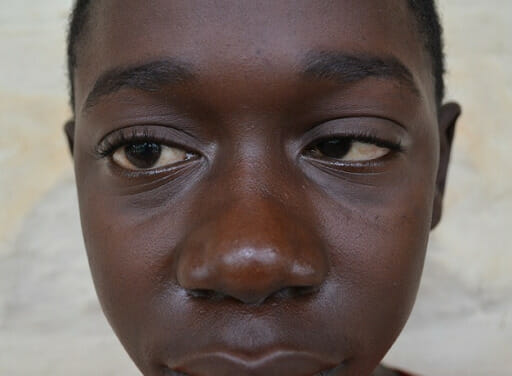
  • Diplopía binocular horizontal que resulta en EN Erythema nodosum is an immune-mediated panniculitis (inflammation of the subcutaneous fat) caused by a type IV (delayed-type) hypersensitivity reaction. It commonly manifests in young women as tender, erythematous nodules on the shins. Erythema Nodosum un giro compensatorio de la cabeza
  • Abducción débil del ojo afectado
Cerebral venous thrombosis with nephrotic syndrome

Un niño con síndrome nefrótico que muestra la típica hinchazón facial nefrótica y la parálisis del VI par craneal derecho: El paciente es incapaz de abducir el ojo derecho.

Imagen: “F0001” por Shalinee Bhoobun et al. Licencia: CC BY 2.0
Diagnóstico

  • Basado en EN Erythema nodosum is an immune-mediated panniculitis (inflammation of the subcutaneous fat) caused by a type IV (delayed-type) hypersensitivity reaction. It commonly manifests in young women as tender, erythematous nodules on the shins. Erythema Nodosum los LOS Neisseria antecedentes y el examen físico
  • Los LOS Neisseria estudios adicionales dependen de la etiología sospechada:
    • Laboratorios:
      • Diabetes Diabetes Diabetes mellitus (DM) is a metabolic disease characterized by hyperglycemia and dysfunction of the regulation of glucose metabolism by insulin. Type 1 DM is diagnosed mostly in children and young adults as the result of autoimmune destruction of β cells in the pancreas and the resulting lack of insulin. Type 2 DM has a significant association with obesity and is characterized by insulin resistance. Diabetes Mellitus mellitus: glucosa sérica, HbA1c HbA1c Products of non-enzymatic reactions between glucose and hemoglobin a, occurring as a minor fraction of the hemoglobin components of human erythrocytes. Hemoglobin a1c is hemoglobin a with glucose covalently bound to the terminal valine of the beta chain. Glycated hemoglobin a is used as an index of the average blood sugar level over a lifetime of erythrocytes. Diabetes Mellitus
      • Sífilis: prueba rápida de reagina plasmática y VDRL VDRL Treponema
    • Neuroimagenologia (TC/RM): trauma, isquemia, aneurisma, neoplasia
    • Punción lumbar diagnóstica: aumento de la presión intracraneal (PIC)

Tratamiento

  • En EN Erythema nodosum is an immune-mediated panniculitis (inflammation of the subcutaneous fat) caused by a type IV (delayed-type) hypersensitivity reaction. It commonly manifests in young women as tender, erythematous nodules on the shins. Erythema Nodosum pediatría:
    • Uso alternante de parches oculares
    • Terapia de prisma
    • Cirugía de estrabismo en EN Erythema nodosum is an immune-mediated panniculitis (inflammation of the subcutaneous fat) caused by a type IV (delayed-type) hypersensitivity reaction. It commonly manifests in young women as tender, erythematous nodules on the shins. Erythema Nodosum casos que no responden
  • Conservador:
    • Observación: La mayoría de los LOS Neisseria casos son autolimitados.
    • Esteroides para tratar la arteritis de células gigantes
    • Inyección de toxina botulínica en EN Erythema nodosum is an immune-mediated panniculitis (inflammation of the subcutaneous fat) caused by a type IV (delayed-type) hypersensitivity reaction. It commonly manifests in young women as tender, erythematous nodules on the shins. Erythema Nodosum el músculo recto medial hiperactivo
  • Quirúrgico:
    • En EN Erythema nodosum is an immune-mediated panniculitis (inflammation of the subcutaneous fat) caused by a type IV (delayed-type) hypersensitivity reaction. It commonly manifests in young women as tender, erythematous nodules on the shins. Erythema Nodosum casos de aumento de la PIC, aneurisma o neoplasia
    • Los LOS Neisseria procedimientos pueden incluir:
      • Craniectomía/craneotomía descompresiva
      • Punción lumbar terapéutica

Diagnósticos diferenciales

  • Miastenia gravis
  • Oftalmopatía asociada a la tiroides
  • Hipertensión intracraneal idiopática (pseudotumor cerebral)

Parálisis del Nervio Craneal VII (Facial)

Etiología

  • Idiopática (la parálisis de Bell representa el 70% de los LOS Neisseria casos de parálisis facial (neurona motora inferior))
  • Infecciones:
    • HSV HSV Herpes simplex virus (HSV) is a double-stranded DNA virus belonging to the family Herpesviridae. Herpes simplex virus commonly causes recurrent infections involving the skin and mucosal surfaces, including the mouth, lips, eyes, and genitals. Herpes Simplex Virus 1 and 2 (síndrome de Ramsay-Hunt)
    • Virus Virus Viruses are infectious, obligate intracellular parasites composed of a nucleic acid core surrounded by a protein capsid. Viruses can be either naked (non-enveloped) or enveloped. The classification of viruses is complex and based on many factors, including type and structure of the nucleoid and capsid, the presence of an envelope, the replication cycle, and the host range. Virology de Epstein-Barr ( EBV EBV Epstein-barr virus (EBV) is a linear, double-stranded DNA virus belonging to the herpesviridae family. This highly prevalent virus is mostly transmitted through contact with oropharyngeal secretions from an infected individual. The virus can infect epithelial cells and B lymphocytes, where it can undergo lytic replication or latency. Epstein-Barr Virus, por sus siglas en EN Erythema nodosum is an immune-mediated panniculitis (inflammation of the subcutaneous fat) caused by a type IV (delayed-type) hypersensitivity reaction. It commonly manifests in young women as tender, erythematous nodules on the shins. Erythema Nodosum inglés)
    • Citomegalovirus
    • Adenovirus Adenovirus Adenovirus (member of the family Adenoviridae) is a nonenveloped, double-stranded DNA virus. Adenovirus is transmitted in a variety of ways, and it can have various presentations based on the site of entry. Presentation can include febrile pharyngitis, conjunctivitis, acute respiratory disease, atypical pneumonia, and gastroenteritis. Adenovirus
    • Virus Virus Viruses are infectious, obligate intracellular parasites composed of a nucleic acid core surrounded by a protein capsid. Viruses can be either naked (non-enveloped) or enveloped. The classification of viruses is complex and based on many factors, including type and structure of the nucleoid and capsid, the presence of an envelope, the replication cycle, and the host range. Virology de la rubéola
    • Influenza Influenza Influenza viruses are members of the Orthomyxoviridae family and the causative organisms of influenza, a highly contagious febrile respiratory disease. There are 3 primary influenza viruses (A, B, and C) and various subtypes, which are classified based on their virulent surface antigens, hemagglutinin (HA) and neuraminidase (NA). Influenza typically presents with a fever, myalgia, headache, and symptoms of an upper respiratory infection. Influenza Viruses/Influenza tipo B
    • Virus Virus Viruses are infectious, obligate intracellular parasites composed of a nucleic acid core surrounded by a protein capsid. Viruses can be either naked (non-enveloped) or enveloped. The classification of viruses is complex and based on many factors, including type and structure of the nucleoid and capsid, the presence of an envelope, the replication cycle, and the host range. Virology coxsackie
    • VIH
    • Enfermedad de Lyme
  • Trauma
  • Accidente cerebrovascular
  • Diabetes Diabetes Diabetes mellitus (DM) is a metabolic disease characterized by hyperglycemia and dysfunction of the regulation of glucose metabolism by insulin. Type 1 DM is diagnosed mostly in children and young adults as the result of autoimmune destruction of β cells in the pancreas and the resulting lack of insulin. Type 2 DM has a significant association with obesity and is characterized by insulin resistance. Diabetes Mellitus mellitus
  • Patología de la glándula parótida ( tumor Tumor Inflammation, inflamación, sarcoidosis Sarcoidosis Sarcoidosis is a multisystem inflammatory disease that causes noncaseating granulomas. The exact etiology is unknown. Sarcoidosis usually affects the lungs and thoracic lymph nodes, but it can also affect almost every system in the body, including the skin, heart, and eyes, most commonly. Sarcoidosis)
  • Embarazo
  • Síndrome de Guillain-Barré

Fisiopatología

  • La parálisis del nervio facial es la incapacidad de utilizar los LOS Neisseria músculos de la expresión facial.
  • Dividido en EN Erythema nodosum is an immune-mediated panniculitis (inflammation of the subcutaneous fat) caused by a type IV (delayed-type) hypersensitivity reaction. It commonly manifests in young women as tender, erythematous nodules on the shins. Erythema Nodosum deficiencias motoras superiores e inferiores:
    • Deficiencia de neurona motora superior (parálisis central):
      • Se origina desde la corteza hasta la protuberancia (tronco cerebral)
      • Inerva los LOS Neisseria músculos faciales contralaterales
      • Inerva los LOS Neisseria músculos faciales superiores (ojos y frente) BILATERALMENTE; por lo tanto, las lesiones de un solo lado aún respetan los LOS Neisseria músculos de la frente y los LOS Neisseria ojos
    • Deficiencia de neurona motora inferior (parálisis periférica):
      • Se origina en EN Erythema nodosum is an immune-mediated panniculitis (inflammation of the subcutaneous fat) caused by a type IV (delayed-type) hypersensitivity reaction. It commonly manifests in young women as tender, erythematous nodules on the shins. Erythema Nodosum el núcleo de la protuberancia y se ramifica en EN Erythema nodosum is an immune-mediated panniculitis (inflammation of the subcutaneous fat) caused by a type IV (delayed-type) hypersensitivity reaction. It commonly manifests in young women as tender, erythematous nodules on the shins. Erythema Nodosum varios nervios hacia los LOS Neisseria músculos de la cara.
      • Inerva los LOS Neisseria músculos faciales ipsilaterales.
  • Otras funciones del nervio incluyen:
    • Gusto de los LOS Neisseria ⅔ anteriores de la lengua (cuerda del tímpano)
    • Lagrimeo
    • Salivación
    • Reflejo auditivo
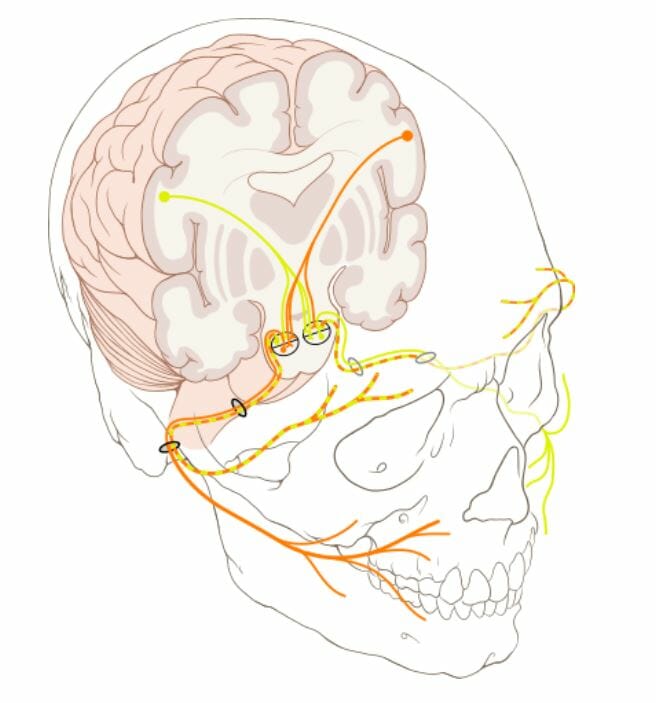
Núcleos del nervio facial en el tronco encefálico

Los núcleos del nervio facial están en el tronco encefálico.
Naranja: nervios provenientes del hemisferio izquierdo del cerebro
Amarillo: nervios provenientes del hemisferio derecho del cerebro
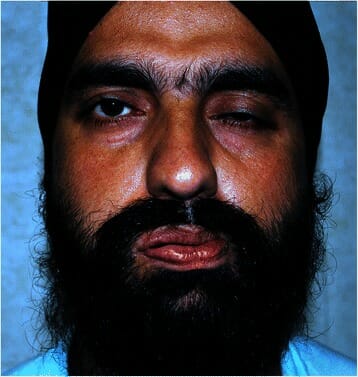
Imagen: “Cranial nerve VII” por Patrick J. Lynch. Licencia: CC BY 2.5

Presentación clínica

  • Lesión motora superior:
    • La boca está caída (sugiere lesión contralateral).
    • El ojo se puede cerrar, fruncimiento el ceño intacto
  • Lesión motora inferior:
    • Parálisis facial completa en EN Erythema nodosum is an immune-mediated panniculitis (inflammation of the subcutaneous fat) caused by a type IV (delayed-type) hypersensitivity reaction. It commonly manifests in young women as tender, erythematous nodules on the shins. Erythema Nodosum 1 lado (mismo lado de la lesión)
    • Los LOS Neisseria ojos no se pueden cerrar.
    • No se logra fruncir el ceño
    • Boca caída y babeo excesivo
  • Daño a los LOS Neisseria nervios periféricos:
    • Hiperacusia (sensibilidad a los LOS Neisseria ruidos fuertes)
    • Pérdida del gusto en EN Erythema nodosum is an immune-mediated panniculitis (inflammation of the subcutaneous fat) caused by a type IV (delayed-type) hypersensitivity reaction. It commonly manifests in young women as tender, erythematous nodules on the shins. Erythema Nodosum los LOS Neisseria ⅔ anteriores de la lengua
    • Disminución del lagrimeo → ulceración ocular/queratitis
    • Salivación desigual
parálisis de Bell

Individuo con parálisis de Bell (lesión motora inferior):
Se observan boca caída e incapacidad para cerrar el ojo izquierdo.

Imagen: “Clinical photograph showing the Bell’s palsy” por Kumar KV, Shijith KP, Ahmad FM. Licencia: CC BY 4.0

Diagnóstico

  • Basado en EN Erythema nodosum is an immune-mediated panniculitis (inflammation of the subcutaneous fat) caused by a type IV (delayed-type) hypersensitivity reaction. It commonly manifests in young women as tender, erythematous nodules on the shins. Erythema Nodosum los LOS Neisseria antecedentes y el examen físico
  • Evaluación de la parálisis facial utilizando el sistema de gratificación House-Brackman
  • Evocar reflejos:
    • Corneal
    • Estapedio
  • El examen del oído puede mostrar vesículas cutáneas si el síndrome de Ramsay-Hunt está presente.
  • Lagrimeo: prueba de Schirmer
  • Audiograma
Tabla: Sistema de clasificación de House-Brackman para la parálisis del nervio facial
Grado Definición
I Función simétrica normal en EN Erythema nodosum is an immune-mediated panniculitis (inflammation of the subcutaneous fat) caused by a type IV (delayed-type) hypersensitivity reaction. It commonly manifests in young women as tender, erythematous nodules on the shins. Erythema Nodosum todo
II
  • Ligera debilidad notable en EN Erythema nodosum is an immune-mediated panniculitis (inflammation of the subcutaneous fat) caused by a type IV (delayed-type) hypersensitivity reaction. It commonly manifests in young women as tender, erythematous nodules on the shins. Erythema Nodosum una inspección detallada
  • Ligera sincinesia
  • Simetría y tono normales en EN Erythema nodosum is an immune-mediated panniculitis (inflammation of the subcutaneous fat) caused by a type IV (delayed-type) hypersensitivity reaction. It commonly manifests in young women as tender, erythematous nodules on the shins. Erythema Nodosum reposo.
  • Frente: movimiento de moderado a bueno
  • Ojo: cierre completo con el mínimo esfuerzo
  • Boca: ligera asimetría
III
  • Diferencia obvia (pero no desfigurante) entre los LOS Neisseria lados
  • Sincinesia, contractura o espasmo hemifacial notable (no grave)
  • En EN Erythema nodosum is an immune-mediated panniculitis (inflammation of the subcutaneous fat) caused by a type IV (delayed-type) hypersensitivity reaction. It commonly manifests in young women as tender, erythematous nodules on the shins. Erythema Nodosum reposo, simetría y tono normales.
  • Frente: movimiento leve a moderado
  • Ojo: cierre completo con esfuerzo
  • Boca: ligeramente débil con el máximo esfuerzo
IV
  • Debilidad evidente y/o asimetría desfigurante
  • En EN Erythema nodosum is an immune-mediated panniculitis (inflammation of the subcutaneous fat) caused by a type IV (delayed-type) hypersensitivity reaction. It commonly manifests in young women as tender, erythematous nodules on the shins. Erythema Nodosum reposo, simetría y tono normales.
  • Frente: sin movimiento
  • Ojo: cierre incompleto
  • Boca: asimétrico con máximo esfuerzo
V
  • Solo movimiento apenas perceptible
  • En EN Erythema nodosum is an immune-mediated panniculitis (inflammation of the subcutaneous fat) caused by a type IV (delayed-type) hypersensitivity reaction. It commonly manifests in young women as tender, erythematous nodules on the shins. Erythema Nodosum reposo asimetría
  • Frente: sin movimiento
  • Ojo: cierre incompleto
  • Boca: ligero movimiento
VI
  • Sin movimiento
  • Atónico
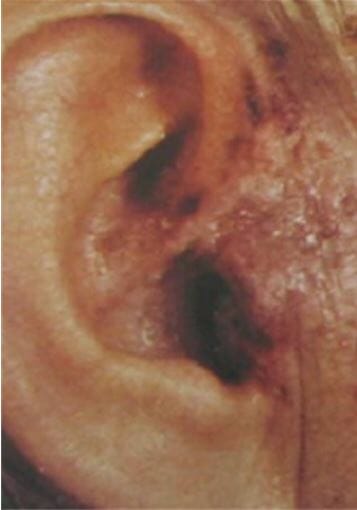
Vesículas del oído vistas en el síndrome de Ramsay-Hunt.

Vesículas del oído vistas en el síndrome de Ramsay-Hunt

Imagen: “Erythème et vésicules cutanées de la zone de Ramsay Hunt droite” por Mahfoudhi M, Lahiani R. Licencia: CC BY 2.0

Tratamiento

  • Objetivo terapéutico: restauración de la motilidad facial
  • Médico:
    • Prednisolona
    • Síndrome de Ramsay-Hunt: aciclovir y analgesia Analgesia Methods of pain relief that may be used with or in place of analgesics. Anesthesiology: History and Basic Concepts ( paracetamol paracetamol Acetaminophen is an over-the-counter nonopioid analgesic and antipyretic medication and the most commonly used analgesic worldwide. Despite the widespread use of acetaminophen, its mechanism of action is not entirely understood. Acetaminophen o ibuprofeno)
  • Fisioterapia: ejercicios faciales
  • Quirúrgico: descompresión del nervio facial
  • Cierre incompleto del ojo: consulta oftalmológica urgente y protección ocular para evitar daño corneal

Diagnósticos diferenciales

  • Enfermedad cerebrovascular isquémica y hemorrágica
  • Otitis media aguda

Parálisis del Nervio Craneal VIII (Vestibulococlear)

Epidemiología

  • La disminución de la agudeza auditiva tiene una prevalencia de por vida en EN Erythema nodosum is an immune-mediated panniculitis (inflammation of the subcutaneous fat) caused by a type IV (delayed-type) hypersensitivity reaction. It commonly manifests in young women as tender, erythematous nodules on the shins. Erythema Nodosum aproximadamente el 10% de la población general.
  • El tinnitus Tinnitus A nonspecific symptom of hearing disorder characterized by the sensation of buzzing, ringing, clicking, pulsations, and other noises in the ear. Objective tinnitus refers to noises generated from within the ear or adjacent structures that can be heard by other individuals. The term subjective tinnitus is used when the sound is audible only to the affected individual. Tinnitus may occur as a manifestation of cochlear diseases; vestibulocochlear nerve diseases; intracranial hypertension; craniocerebral trauma; and other conditions. Cranial Nerve Palsies tiene una prevalencia de por vida en EN Erythema nodosum is an immune-mediated panniculitis (inflammation of the subcutaneous fat) caused by a type IV (delayed-type) hypersensitivity reaction. It commonly manifests in young women as tender, erythematous nodules on the shins. Erythema Nodosum aproximadamente el 30% de la población general.
  • El mareo/vértigo tiene una prevalencia de por vida en EN Erythema nodosum is an immune-mediated panniculitis (inflammation of the subcutaneous fat) caused by a type IV (delayed-type) hypersensitivity reaction. It commonly manifests in young women as tender, erythematous nodules on the shins. Erythema Nodosum aproximadamente el 20% de la población general.

Etiología

  • Anomalías congénitas:
  • Tumor Tumor Inflammation:
    • Schwannoma Schwannoma Schwannomas (also known as neurilemmomas) are benign nerve sheath tumors in the peripheral nervous system (PNS), arising from Schwann cells that encase the peripheral nerves. Schwannomas are the most common tumors in the PNS. Schwannoma vestibular (neurinoma del acústico)
    • Neurofibromatosis tipo 2
  • Trauma en EN Erythema nodosum is an immune-mediated panniculitis (inflammation of the subcutaneous fat) caused by a type IV (delayed-type) hypersensitivity reaction. It commonly manifests in young women as tender, erythematous nodules on the shins. Erythema Nodosum el hueso temporal o laberinto óseo
  • Infección
  • Isquemia/infarto
  • Desmielinización (esclerosis múltiple)
  • Inflamación (neuritis vestibular)
  • Medicamentos

Fisiopatología

Fisiología general:

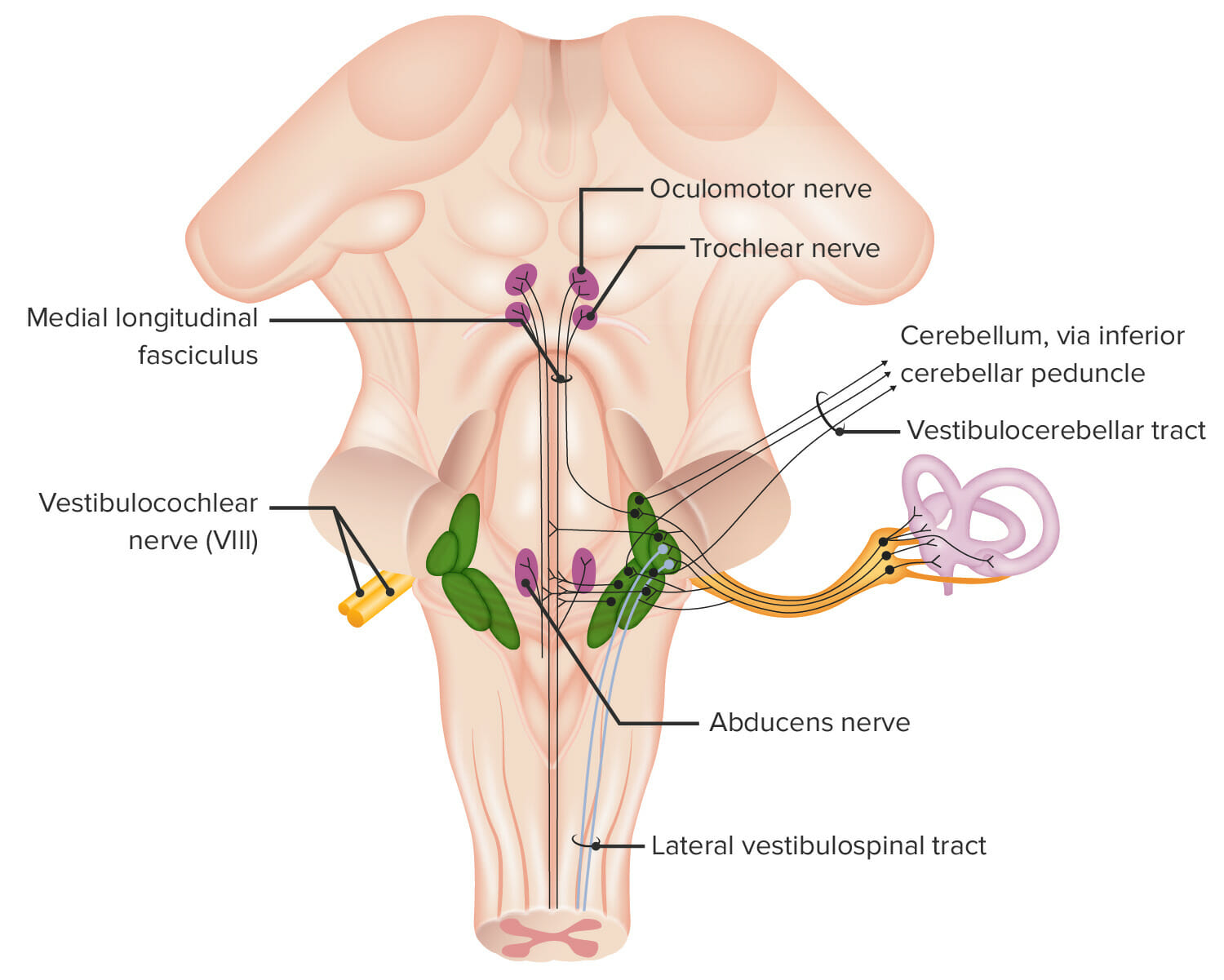
  • El nervio craneal VIII contiene fibras aferentes “especiales” que transmiten los LOS Neisseria sentidos del oído y el equilibrio.
  • Consta de los LOS Neisseria nervios vestibular y coclear:
    • 2 núcleos distintos en EN Erythema nodosum is an immune-mediated panniculitis (inflammation of the subcutaneous fat) caused by a type IV (delayed-type) hypersensitivity reaction. It commonly manifests in young women as tender, erythematous nodules on the shins. Erythema Nodosum el tronco encefálico
    • El nervio coclear juega un papel en EN Erythema nodosum is an immune-mediated panniculitis (inflammation of the subcutaneous fat) caused by a type IV (delayed-type) hypersensitivity reaction. It commonly manifests in young women as tender, erythematous nodules on the shins. Erythema Nodosum la audición.
    • El nervio vestibular desempeña un papel en EN Erythema nodosum is an immune-mediated panniculitis (inflammation of the subcutaneous fat) caused by a type IV (delayed-type) hypersensitivity reaction. It commonly manifests in young women as tender, erythematous nodules on the shins. Erythema Nodosum el mantenimiento del equilibrio y los LOS Neisseria movimientos extraoculares.
Structures associated with cranial nerve VIII (vestibulocochlear)

Estructuras asociadas con el nervio craneal VIII (vestibulococlear)

Imagen por Lecturio.

Nervio coclear:

El nervio coclear transmite estímulos de sonido desde el oído interno (cóclea llena de líquido) al AL Amyloidosis núcleo coclear (tronco encefálico) y luego a la corteza auditiva primaria (lóbulo temporal).

  • Las neuronas que perciben los LOS Neisseria sonidos periféricos (células ciliadas) están contenidas en EN Erythema nodosum is an immune-mediated panniculitis (inflammation of the subcutaneous fat) caused by a type IV (delayed-type) hypersensitivity reaction. It commonly manifests in young women as tender, erythematous nodules on the shins. Erythema Nodosum la cóclea llena de líquido del oído interno.
  • Estas neuronas envían proyecciones centralmente para convertirse en EN Erythema nodosum is an immune-mediated panniculitis (inflammation of the subcutaneous fat) caused by a type IV (delayed-type) hypersensitivity reaction. It commonly manifests in young women as tender, erythematous nodules on the shins. Erythema Nodosum el nervio coclear, que viaja a través del canal auditivo interno para unirse al AL Amyloidosis nervio vestibular (formando el nervio craneal VIII) en EN Erythema nodosum is an immune-mediated panniculitis (inflammation of the subcutaneous fat) caused by a type IV (delayed-type) hypersensitivity reaction. It commonly manifests in young women as tender, erythematous nodules on the shins. Erythema Nodosum su camino hacia el tronco encefálico.
  • Al AL Amyloidosis entrar en EN Erythema nodosum is an immune-mediated panniculitis (inflammation of the subcutaneous fat) caused by a type IV (delayed-type) hypersensitivity reaction. It commonly manifests in young women as tender, erythematous nodules on the shins. Erythema Nodosum el tronco encefálico en EN Erythema nodosum is an immune-mediated panniculitis (inflammation of the subcutaneous fat) caused by a type IV (delayed-type) hypersensitivity reaction. It commonly manifests in young women as tender, erythematous nodules on the shins. Erythema Nodosum el ángulo pontocerebeloso, los LOS Neisseria nervios se separan de nuevo y las fibras del nervio coclear hacen sinapsis en EN Erythema nodosum is an immune-mediated panniculitis (inflammation of the subcutaneous fat) caused by a type IV (delayed-type) hypersensitivity reaction. It commonly manifests in young women as tender, erythematous nodules on the shins. Erythema Nodosum los LOS Neisseria núcleos cocleares anteroventral, dorsal y posteroventral.
  • Después de hacer sinapsis en EN Erythema nodosum is an immune-mediated panniculitis (inflammation of the subcutaneous fat) caused by a type IV (delayed-type) hypersensitivity reaction. It commonly manifests in young women as tender, erythematous nodules on the shins. Erythema Nodosum los LOS Neisseria núcleos cocleares, las neuronas se cruzan para unirse al AL Amyloidosis lemnisco lateral contralateral hacia el colículo inferior del mesencéfalo y luego se proyectan al AL Amyloidosis tálamo (núcleo geniculado medial) antes de llegar a la corteza auditiva primaria.

Nervio vestibular:

  • El nervio vestibular transmite información sensorial sobre el movimiento y la posición del cuerpo mediante la coordinación de señales del aparato vestibular (canales semicirculares, sáculo y utrículo), músculos extraoculares, músculos posturales, tronco encefálico y corteza cerebral.
  • Componentes del aparato vestibular (todos revestidos de epitelio sensorial que contiene células ciliadas):
    • Utrículo: detecta el movimiento horizontal de la cabeza
    • Sáculo: detecta el movimiento vertical de la cabeza
    • 3 conductos semicirculares (dentro de los LOS Neisseria canales semicirculares): detectan movimientos angulares y rotatorios de la cabeza
  • Las fibras nerviosas se proyectan desde el epitelio sensorial hasta el ganglio vestibular en EN Erythema nodosum is an immune-mediated panniculitis (inflammation of the subcutaneous fat) caused by a type IV (delayed-type) hypersensitivity reaction. It commonly manifests in young women as tender, erythematous nodules on the shins. Erythema Nodosum el canal auditivo interno, que luego se une al AL Amyloidosis nervio coclear (para formar el nervio craneal VIII) en EN Erythema nodosum is an immune-mediated panniculitis (inflammation of the subcutaneous fat) caused by a type IV (delayed-type) hypersensitivity reaction. It commonly manifests in young women as tender, erythematous nodules on the shins. Erythema Nodosum su camino hacia el tronco encefálico.
  • Al AL Amyloidosis entrar en EN Erythema nodosum is an immune-mediated panniculitis (inflammation of the subcutaneous fat) caused by a type IV (delayed-type) hypersensitivity reaction. It commonly manifests in young women as tender, erythematous nodules on the shins. Erythema Nodosum el tronco encefálico en EN Erythema nodosum is an immune-mediated panniculitis (inflammation of the subcutaneous fat) caused by a type IV (delayed-type) hypersensitivity reaction. It commonly manifests in young women as tender, erythematous nodules on the shins. Erythema Nodosum el ángulo pontocerebeloso, los LOS Neisseria nervios se separan de nuevo y las fibras nerviosas vestibulares hacen sinapsis en EN Erythema nodosum is an immune-mediated panniculitis (inflammation of the subcutaneous fat) caused by a type IV (delayed-type) hypersensitivity reaction. It commonly manifests in young women as tender, erythematous nodules on the shins. Erythema Nodosum los LOS Neisseria núcleos vestibulares medial, lateral, superior e inferior:
    • El núcleo medial ayuda a mediar los LOS Neisseria reflejos vestibulo-ocular y vestibuloespinal al AL Amyloidosis contribuir al AL Amyloidosis control de los LOS Neisseria movimientos de la cabeza y el cuello.
    • El núcleo superior ayuda a mediar el reflejo vestíbulo-ocular.
    • El núcleo lateral se une a las fibras del cerebelo para convertirse en EN Erythema nodosum is an immune-mediated panniculitis (inflammation of the subcutaneous fat) caused by a type IV (delayed-type) hypersensitivity reaction. It commonly manifests in young women as tender, erythematous nodules on the shins. Erythema Nodosum el tracto vestibular lateral dentro de la médula espinal ipsolateral para mediar en EN Erythema nodosum is an immune-mediated panniculitis (inflammation of the subcutaneous fat) caused by a type IV (delayed-type) hypersensitivity reaction. It commonly manifests in young women as tender, erythematous nodules on the shins. Erythema Nodosum el reflejo vestibuloespinal y ayudar a mantener la postura y el equilibrio.
    • El núcleo inferior coordina la comunicación entre los LOS Neisseria otros 3 núcleos vestibulares y el cerebelo.

Lesiones del nervio vestibulococlear:

Las lesiones del nervio coclear a menudo ocurren en EN Erythema nodosum is an immune-mediated panniculitis (inflammation of the subcutaneous fat) caused by a type IV (delayed-type) hypersensitivity reaction. It commonly manifests in young women as tender, erythematous nodules on the shins. Erythema Nodosum:
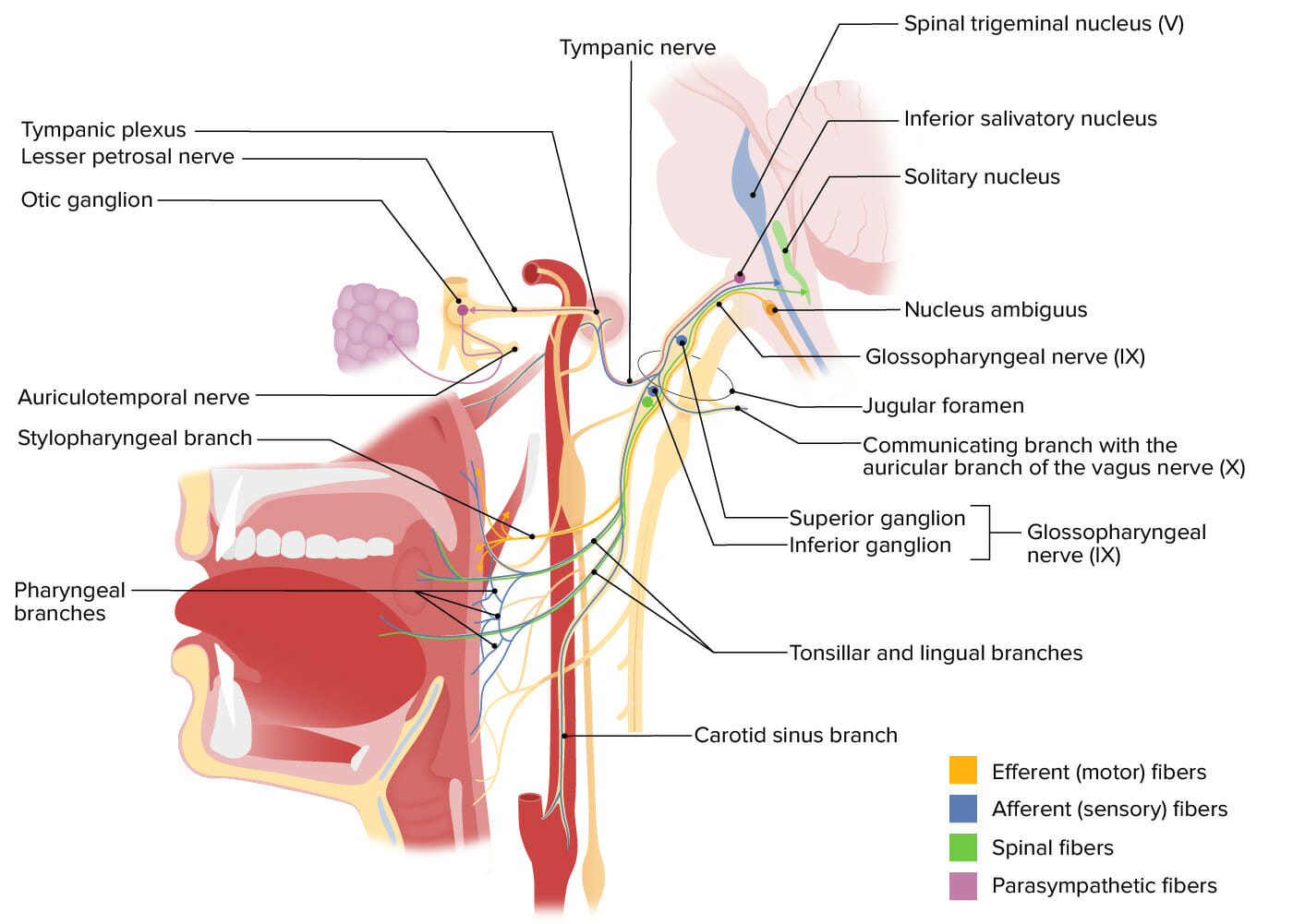
  • Conducto acústico interno o
  • En EN Erythema nodosum is an immune-mediated panniculitis (inflammation of the subcutaneous fat) caused by a type IV (delayed-type) hypersensitivity reaction. It commonly manifests in young women as tender, erythematous nodules on the shins. Erythema Nodosum el ángulo pontocerebeloso

Presentación clínica

  • Tinnitus Tinnitus A nonspecific symptom of hearing disorder characterized by the sensation of buzzing, ringing, clicking, pulsations, and other noises in the ear. Objective tinnitus refers to noises generated from within the ear or adjacent structures that can be heard by other individuals. The term subjective tinnitus is used when the sound is audible only to the affected individual. Tinnitus may occur as a manifestation of cochlear diseases; vestibulocochlear nerve diseases; intracranial hypertension; craniocerebral trauma; and other conditions. Cranial Nerve Palsies
  • Pérdida auditiva neurosensorial
  • Deterioro del equilibrio/equilibrio
  • Vértigo
  • Nistagmo

Diagnóstico

  • Evaluación clinica:
    • Prueba de Weber
    • Prueba de Rinne
    • Prueba de Romberg
  • Pruebas audiológicas
  • Prueba de Dix-Hallpike
  • Laboratorios:
    • Hemograma
    • VES
  • Neuroimagenologia (del cerebro y del oído interno):
    • TC para evaluación de estructuras óseas
    • RM (con contraste) para la evaluación de estructuras de tejidos blandos

Tratamiento

  • Consulta a otorrinolaringología, audiología y neurología, según corresponda
  • Consulta de neurocirugía por tumores
  • Audífonos para aquellos con agudeza auditiva disminuida
  • Antieméticos, meclizina para el vértigo
  • Altas dosis de esteroides, con su correspondiente disminución progresiva, pueden ser útiles en EN Erythema nodosum is an immune-mediated panniculitis (inflammation of the subcutaneous fat) caused by a type IV (delayed-type) hypersensitivity reaction. It commonly manifests in young women as tender, erythematous nodules on the shins. Erythema Nodosum condiciones inflamatorias.

Diagnósticos diferenciales

  • Psicosis
  • Isquemia/infarto

Parálisis del Nervio Craneal IX (Glosofaríngeo)

Etiología

  • Traumatismos de cabeza, cuello y boca
  • Neuralgia del glosofaríngeo (muy rara)
  • Tumor Tumor Inflammation de fosa posterior (junto con parálisis del nervio craneal X y XI)
  • Lesión iatrogénica (e.g., colocación de máscara laríngea, cirugía)
  • Complicación de amigdalectomía
  • Síndrome de Vernet
  • Síndrome de Collet-Sicard
  • Síndrome de Villaret
  • Fractura del estiloides

Fisiopatología

  • La lesión del nervio produce déficit motores y sensitivos en EN Erythema nodosum is an immune-mediated panniculitis (inflammation of the subcutaneous fat) caused by a type IV (delayed-type) hypersensitivity reaction. It commonly manifests in young women as tender, erythematous nodules on the shins. Erythema Nodosum su territorio y discontinuidad de los LOS Neisseria arcos reflejos.
  • El déficit motor Motor Neurons which send impulses peripherally to activate muscles or secretory cells. Nervous System: Histology se expresa como disfagia.
  • El déficit sensorial se expresa como una disminución del sentido del gusto en EN Erythema nodosum is an immune-mediated panniculitis (inflammation of the subcutaneous fat) caused by a type IV (delayed-type) hypersensitivity reaction. It commonly manifests in young women as tender, erythematous nodules on the shins. Erythema Nodosum el tercio posterior de la lengua, paladar y faringe.
  • Los LOS Neisseria reflejos nauseoso y del seno carotídeo están abolidos, lo que se manifiesta como la incapacidad de provocar emesis y proteger las vías respiratorias (aumento del riesgo de aspiración) y regular Regular Insulin la presión arterial (síncope), respectivamente.
Structures associated with cranial nerve VIII (vestibulocochlear)

Estructuras inervadas por el nervio craneal IX (glosofaríngeo)

Imagen por Lecturio.
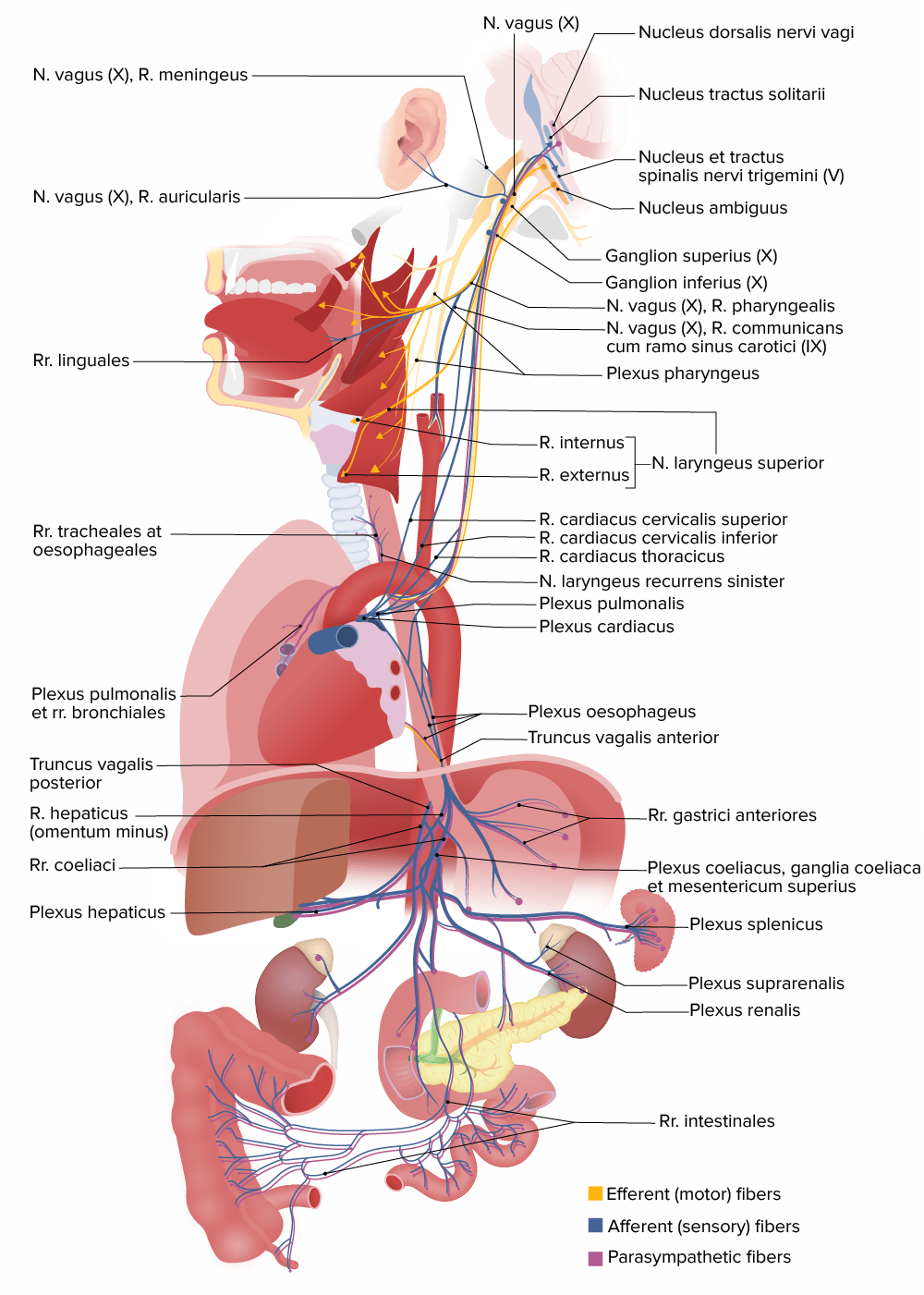
Presentación clínica

  • Disfagia
  • Reflejo nauseoso ausente
  • Sensación reducida sobre el tercio posterior de la lengua, el paladar y la faringe
  • Pérdida del reflejo del seno carotídeo → ortostasis/síncope
  • Disfunción de la secreción de la glándula parótida
  • En EN Erythema nodosum is an immune-mediated panniculitis (inflammation of the subcutaneous fat) caused by a type IV (delayed-type) hypersensitivity reaction. It commonly manifests in young women as tender, erythematous nodules on the shins. Erythema Nodosum casos de neuralgia:
  • Comúnmente acompañado por síntomas de parálisis del nervio craneal X y XI

Diagnóstico

  • Basado en EN Erythema nodosum is an immune-mediated panniculitis (inflammation of the subcutaneous fat) caused by a type IV (delayed-type) hypersensitivity reaction. It commonly manifests in young women as tender, erythematous nodules on the shins. Erythema Nodosum los LOS Neisseria antecedentes y el examen físico
  • Neuroimagenologia: TC para determinar la presencia de accidentes cerebrovasculares o tumores

Tratamiento

  • Similar a la de la neuralgia del trigémino:
    • Opciones de terapia de 1ra línea:
      • Carbamazepina
      • Oxcarbazepina
    • Agentes alternativos:
      • Baclofeno
      • lamotrigina
      • Gabapentina
  • Ingreso y consulta de neurología si varios nervios están comprometidos

Diagnósticos diferenciales

  • Parálisis del nervio craneal X
  • Parálisis del nervio craneal V

Parálisis del Nervio Craneal X (Vago)

Etiología

  • Cirugía reciente de carótida o tiroides
  • Tumor Tumor Inflammation de fosa posterior (junto con parálisis del nervio craneal IX y XI)

Presentación clínica

  • Disfonía
  • Disfagia
  • Regurgitación en EN Erythema nodosum is an immune-mediated panniculitis (inflammation of the subcutaneous fat) caused by a type IV (delayed-type) hypersensitivity reaction. It commonly manifests in young women as tender, erythematous nodules on the shins. Erythema Nodosum la nariz
  • Examen oral:
    • Caída del arco del paladar blando
    • Desviación de la úvula lejos del lado afectado

Diagnóstico

  • Basado en EN Erythema nodosum is an immune-mediated panniculitis (inflammation of the subcutaneous fat) caused by a type IV (delayed-type) hypersensitivity reaction. It commonly manifests in young women as tender, erythematous nodules on the shins. Erythema Nodosum los LOS Neisseria antecedentes y el examen físico
  • Neuroimagenologia: TC/RM para determinar la presencia de acidentes cerebrovasculares o tumores

Tratamiento

  • Depende de la causa subyacente
  • Terapia del habla y de la deglución

Diagnósticos diferenciales

  • Parálisis del nervio craneal IX
  • Parálisis del nervio craneal XII

Parálisis del Nervio Craneal XI (Accesorio Espinal)

Etiología

  • Lesión iatrogénica (más común):
    • Eliminación de masas en EN Erythema nodosum is an immune-mediated panniculitis (inflammation of the subcutaneous fat) caused by a type IV (delayed-type) hypersensitivity reaction. It commonly manifests in young women as tender, erythematous nodules on the shins. Erythema Nodosum el cuello
    • Cirugía estética (e.g., estiramiento facial)
  • Tumores del agujero yugular:
    • Síndrome de Collet-Sicard
    • Síndrome de Vernet
  • Traumatismo penetrante (triángulo posterior del cuello)
  • Tumor Tumor Inflammation de fosa posterior (junto con parálisis del nervio craneal XI y X)
  • Neuritis braquial
  • Poliomielitis

Presentación clínica

  • Dolor Dolor Inflammation y debilidad en EN Erythema nodosum is an immune-mediated panniculitis (inflammation of the subcutaneous fat) caused by a type IV (delayed-type) hypersensitivity reaction. It commonly manifests in young women as tender, erythematous nodules on the shins. Erythema Nodosum el hombro
  • Hombro caído
  • Disminución de la capacidad para mantener el hombro en EN Erythema nodosum is an immune-mediated panniculitis (inflammation of the subcutaneous fat) caused by a type IV (delayed-type) hypersensitivity reaction. It commonly manifests in young women as tender, erythematous nodules on the shins. Erythema Nodosum abducción.
  • Signo de giro escapular positivo:
    • Ala escapular lateral
    • Daño del nervio ipsilateral (neurona motora inferior)
  • Tracción compensatoria y esfuerzo del elevador de la escápula y los LOS Neisseria músculos romboides
  • Atrofia del trapecio
Inervación de los músculos esternocleidomastoideo y trapecio por CN XI

Inervación de los músculos esternocleidomastoideo y trapecio por el nervio craneal XI (nervio espinal accesorio)

Imagen por Lecturio.
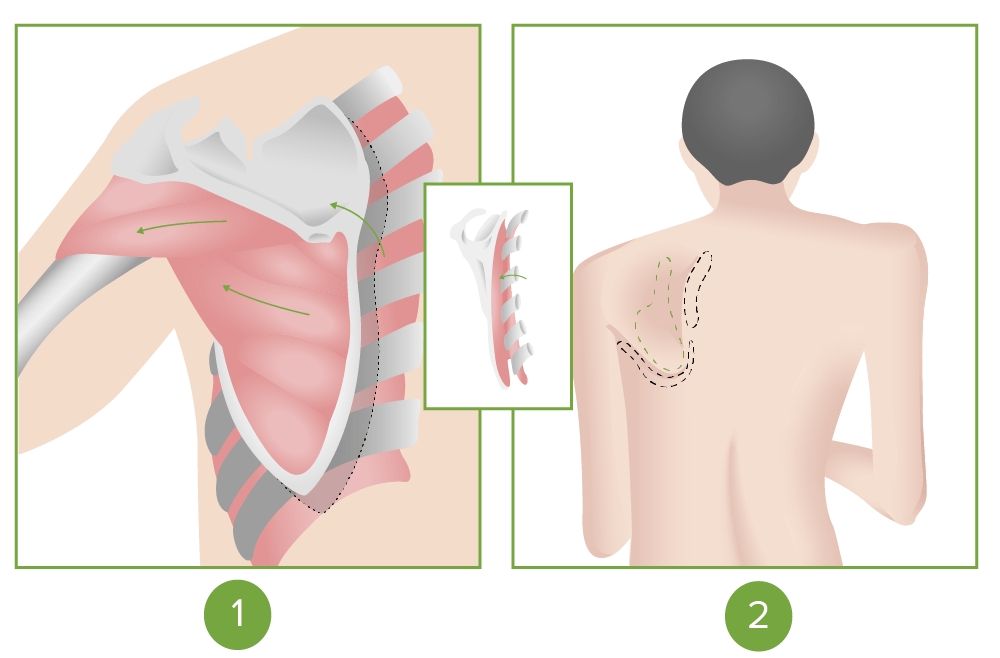
Signo de giro escapular positivo

Signo de giro escapular positivo observado en la parálisis del nervio craneal XI (accesorio)

Imagen por Lecturio.
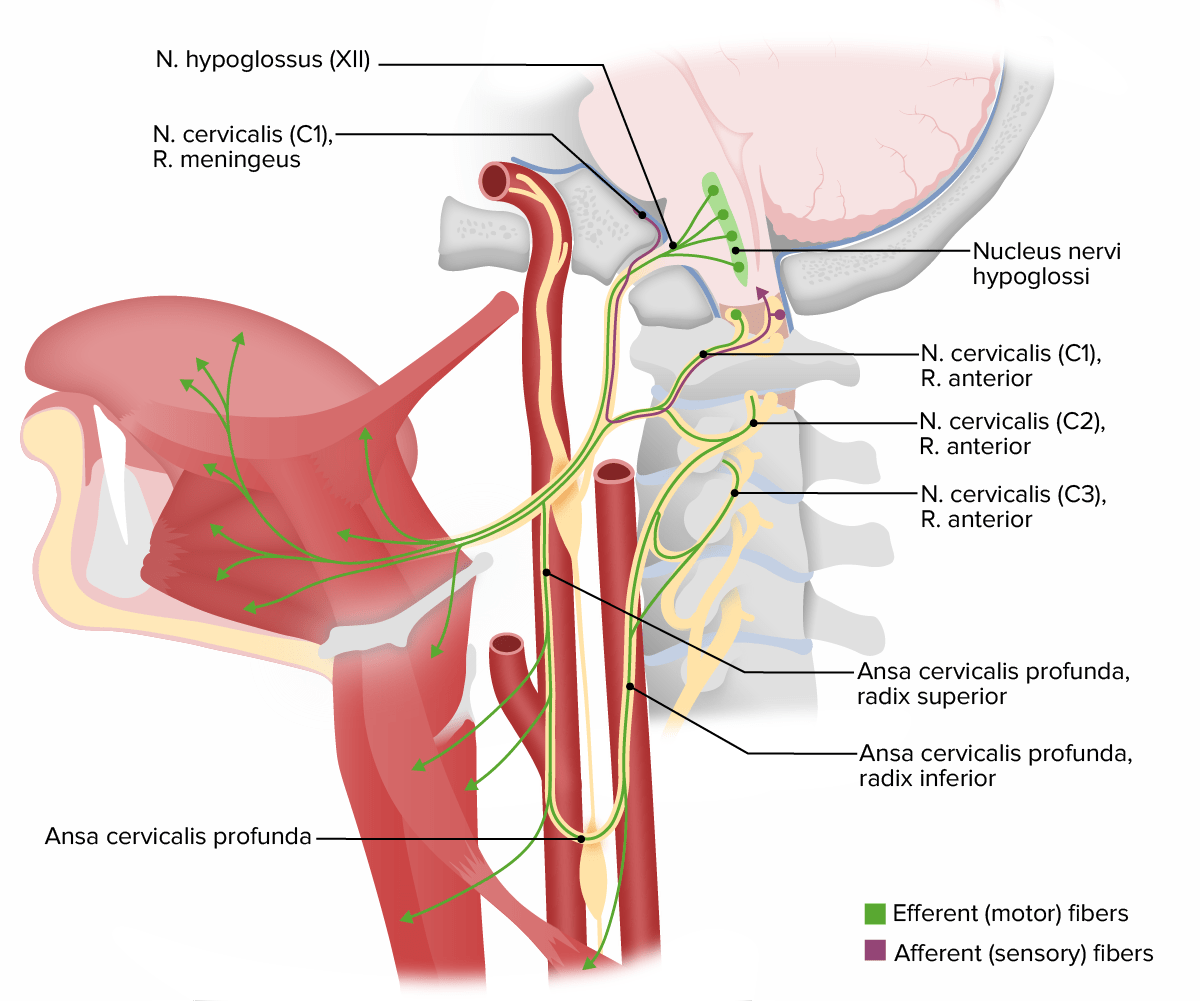
Diagnóstico

  • Basado en EN Erythema nodosum is an immune-mediated panniculitis (inflammation of the subcutaneous fat) caused by a type IV (delayed-type) hypersensitivity reaction. It commonly manifests in young women as tender, erythematous nodules on the shins. Erythema Nodosum los LOS Neisseria antecedentes y el examen físico
  • La electromiografía se puede utilizar para determinar la extensión de la parálisis.
  • El ultrasonido de alta resolución permite la visualización de la anatomía normal del nervio craneal XI y puede revelar cambios anatómicos después de la lesión (i.e., pérdida de continuidad, terminaciones nerviosas libres).

Tratamiento

  • Las opciones terapéuticas específicas dependen de la etiología.
  • Médico:
    • AINE
    • Estimulación nerviosa
    • Bloqueo nervioso regional
    • Fisioterapia y rehabilitación
  • Quirúrgico:
    • Reanastomosis nerviosa
    • Injerto de nervio

Diagnósticos diferenciales

  • Parálisis del nervio torácico largo
  • Lesión del manguito rotador

Parálisis del Nervio Craneal XII (Hipogloso)

Etiología

  • Tumores intracraneales/de la base del cráneo
  • Trauma vertebral
  • Disección o aneurisma de la arteria carótida interna
  • Tumores del espacio faríngeo
  • Complicación rara del manejo de la vía aérea durante la anestesia general

Fisiopatología

  • Compresión/estiramiento del nervio → lesión
  • La lesión produce déficit motores en EN Erythema nodosum is an immune-mediated panniculitis (inflammation of the subcutaneous fat) caused by a type IV (delayed-type) hypersensitivity reaction. It commonly manifests in young women as tender, erythematous nodules on the shins. Erythema Nodosum su territorio.
Estructuras inervadas por el nervio craneal XII (hipogloso)

Estructuras inervadas por el nervio craneal XII (hipogloso)
N = nervio
R. = rama
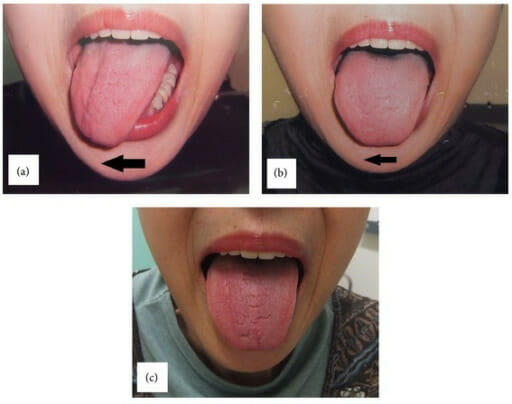
Imagen por Lecturio.

Presentación clínica

  • Debilidad unilateral de la lengua en EN Erythema nodosum is an immune-mediated panniculitis (inflammation of the subcutaneous fat) caused by a type IV (delayed-type) hypersensitivity reaction. It commonly manifests in young women as tender, erythematous nodules on the shins. Erythema Nodosum el lado afectado
  • Disfagia
  • Dificultad con el habla
Unilateral hypoglossal nerve palsy

Parálisis unilateral del nervio hipogloso tras el uso de máscara laríngea:
(a): En el día postoperatorio 1, la lengua se desvía hacia el lado derecho en la protrusión, demostrando una parálisis del nervio hipogloso derecho.
(b): La desviación mejoró ligeramente 3 meses después.
(c): La desviación desapareció 5 meses más tarde para la recuperación completa de la función del nervio hipogloso.

Imagen: “fig1” por Kenichi Takahoko et al. Licencia: CC BY 3.0

Diagnóstico

  • Basado en EN Erythema nodosum is an immune-mediated panniculitis (inflammation of the subcutaneous fat) caused by a type IV (delayed-type) hypersensitivity reaction. It commonly manifests in young women as tender, erythematous nodules on the shins. Erythema Nodosum los LOS Neisseria antecedentes y el examen físico
  • Neuroimagenologia: TC/RM para determinar la presencia de accidentes cerebrovasculares o tumores

Tratamiento

  • Depende de la causa subyacente
  • Terapia del habla y de la deglución

Referencias

  1. LaFreniere, D. (2025). Taste and olfactory disorders in adults: Anatomy and etiology. UpToDate. Retrieved September 11, 2025, from https://www.uptodate.com/contents/taste-and-olfactory-disorders-in-adults-anatomy-and-etiology
  2. LaFreniere, D. (2025). Taste and olfactory disorders in adults: Evaluation and management. UpToDate. Retrieved September 11, 2025, from https://www.uptodate.com/contents/taste-and-olfactory-disorders-in-adults-evaluation-and-management
  3. Shaikh, S., Bin Yaacob, H., & Bin Abd Rahman, R. (2011). Lamotrigine for trigeminal neuralgia: Efficacy and safety in comparison with carbamazepine. Journal of the Chinese Medical Association, 74(6), 243–249. https://doi.org/10.1016/j.jcma.2011.04.002
  4. Golnik, K. C. (2025). Congenital and acquired abnormalities of the optic nerve. UpToDate. Retrieved September 11, 2025, from https://www.uptodate.com/contents/congenital-and-acquired-abnormalities-of-the-optic-nerve
  5. Ropper, A.H., Samuels, M.A., Klein, J.P., Prasad, S. (2019). Diseases of the cranial nerves. In Adams and Victor’s Principles of Neurology, 11e. McGraw-Hill Education.
  6. Ropper, A.H., Samuels, M.A., Klein, J.P., Prasad, S. (2019). Disturbances of vision. In Adams and Victor’s Principles of Neurology, 11e. McGraw-Hill Education.
  7. Ropper, A.H., Samuels, M.A., Klein, J.P., Prasad, S. (2019). Disorders of ocular movement and pupillary function. In Adams and Victor’s Principles of Neurology, 11e. McGraw-Hill Education.
  8. Kahloun, R., et al. (2015). Infectious optic neuropathies: a clinical update. Eye and brain. 2015(7), 59–81. https://doi.org/10.2147/EB.S69173
  9. Modi, P., Arsiwalla, T. (2023). Cranial nerve III palsy. StatPearls. Treasure Island (FL): StatPearls Publishing. Retrieved September 11, 2025, from http://www.ncbi.nlm.nih.gov/books/NBK526112/ 
  10. Khanam, S., Sood, G. (2024). Trochlear nerve palsy. StatPearls. Treasure Island (FL): StatPearls Publishing. Retrieved September 11, 2025, from http://www.ncbi.nlm.nih.gov/books/NBK565850/ 
  11. Graham, C., Mohseni, M. (2023). Abducens nerve palsy. StatPearls. Treasure Island (FL): StatPearls Publishing. Retrieved September 11, 2025, from http://www.ncbi.nlm.nih.gov/books/NBK482177/ 
  12. Walker, N.R., Mistry, R.K., Mazzoni, T. (2023). Facial nerve palsy. StatPearls. Treasure Island (FL): StatPearls Publishing. Retrieved September 11, 2025, from http://www.ncbi.nlm.nih.gov/books/NBK549815/ 
  13. Crouch, A.E., Andaloro, C. (2023). Ramsay Hunt syndrome. StatPearls. Treasure Island (FL): StatPearls Publishing. Retrieved August 9, 2025, from http://www.ncbi.nlm.nih.gov/books/NBK557409/
  14. Pontillo, M., Kelley, M.J., Zgonis, M. (2021). Clinical examination of the shoulder. In Skirven, T.M., et al. (Eds.), Rehabilitation of the hand and upper extremity (pp. 87–116). Elsevier.
  15. AlShareef, S., Newton, B.W. (2022). Accessory nerve injury. StatPearls. Treasure Island (FL): StatPearls Publishing. Retrieved September 11, 2025, from http://www.ncbi.nlm.nih.gov/books/NBK532245/
  16. Ropper, A.H., Samuels, M.A., Klein, J.P., Prasad, S. (2019). Diseases of the cranial nerves. In Adams and Victor’s Principles of Neurology, 11e. McGraw-Hill Education. https://accessmedicine.mhmedical.com/content.aspx?aid=1162600318
  17. Thomas, K., Minutello, K., Das, J.M. (2022). Neuroanatomy, cranial nerve 9 (glossopharyngeal). StatPearls. Retrieved September 11, 2025, from https://www.statpearls.com/ArticleLibrary/viewarticle/22295
  18. Wang, E.E. (2013). Cranial nerve disorders. In Adams, J.G. (Ed.), Emergency Medicine (pp. 818–829.e1). McGraw Hill.

¡Crea tu cuenta gratis o inicia una sesión para seguir leyendo!

Regístrate ahora y obtén acceso gratuito a Lecturio con páginas de concepto, videos médicos y cuestionarios para tu educación médica.

User Reviews

Que tengas una sesión de estudio alegre y navideña 🎁 Ahorra 50% en todos los planes >>

Details