Las tetraciclinas son una clase de antibióticos de amplio espectro indicados para una gran variedad de infecciones bacterianas. Estos medicamentos se unen a la subunidad ribosomal 30S para inhibir la síntesis proteica bacteriana. Las tetraciclinas tienen cobertura contra microorganismos gram-positivos y gram-negativos, así como bacterias atípicas como clamidia, micoplasma, espiroquetas e incluso protozoos. La absorción oral de las tetraciclinas es disminuida con la ingestión de algunos medicamentos y suplementos (e.g., leche de magnesia) o alimentos (e.g., productos lácteos) que contienen cationes polivalentes, como el calcio y el magnesio. LosLOSNeisseria efectos secundarios incluyen fotosensibilidad, malestar gastrointestinal y pigmentación de la piel enENErythema nodosum is an immune-mediated panniculitis (inflammation of the subcutaneous fat) caused by a type IV (delayed-type) hypersensitivity reaction. It commonly manifests in young women as tender, erythematous nodules on the shins.Erythema Nodosum el caso de la minociclina. Las tetraciclinas inhiben el crecimiento óseo y decoloran losLOSNeisseria dientes enENErythema nodosum is an immune-mediated panniculitis (inflammation of the subcutaneous fat) caused by a type IV (delayed-type) hypersensitivity reaction. It commonly manifests in young women as tender, erythematous nodules on the shins.Erythema Nodosum niños. Están contraindicadas durante el embarazo y generalmente se evitan durante la lactancia. LosLOSNeisseria tratamientos cortos con doxiciclina se consideran compatibles. EnENErythema nodosum is an immune-mediated panniculitis (inflammation of the subcutaneous fat) caused by a type IV (delayed-type) hypersensitivity reaction. It commonly manifests in young women as tender, erythematous nodules on the shins.Erythema Nodosum 2018, la FDA aprobó tres fármacos de la clase de las tetraciclinas, que podrían ser útiles enENErythema nodosum is an immune-mediated panniculitis (inflammation of the subcutaneous fat) caused by a type IV (delayed-type) hypersensitivity reaction. It commonly manifests in young women as tender, erythematous nodules on the shins.Erythema Nodosum el tratamiento de ciertas infecciones causadas por microorganismos resistentes a losLOSNeisseria medicamentos.
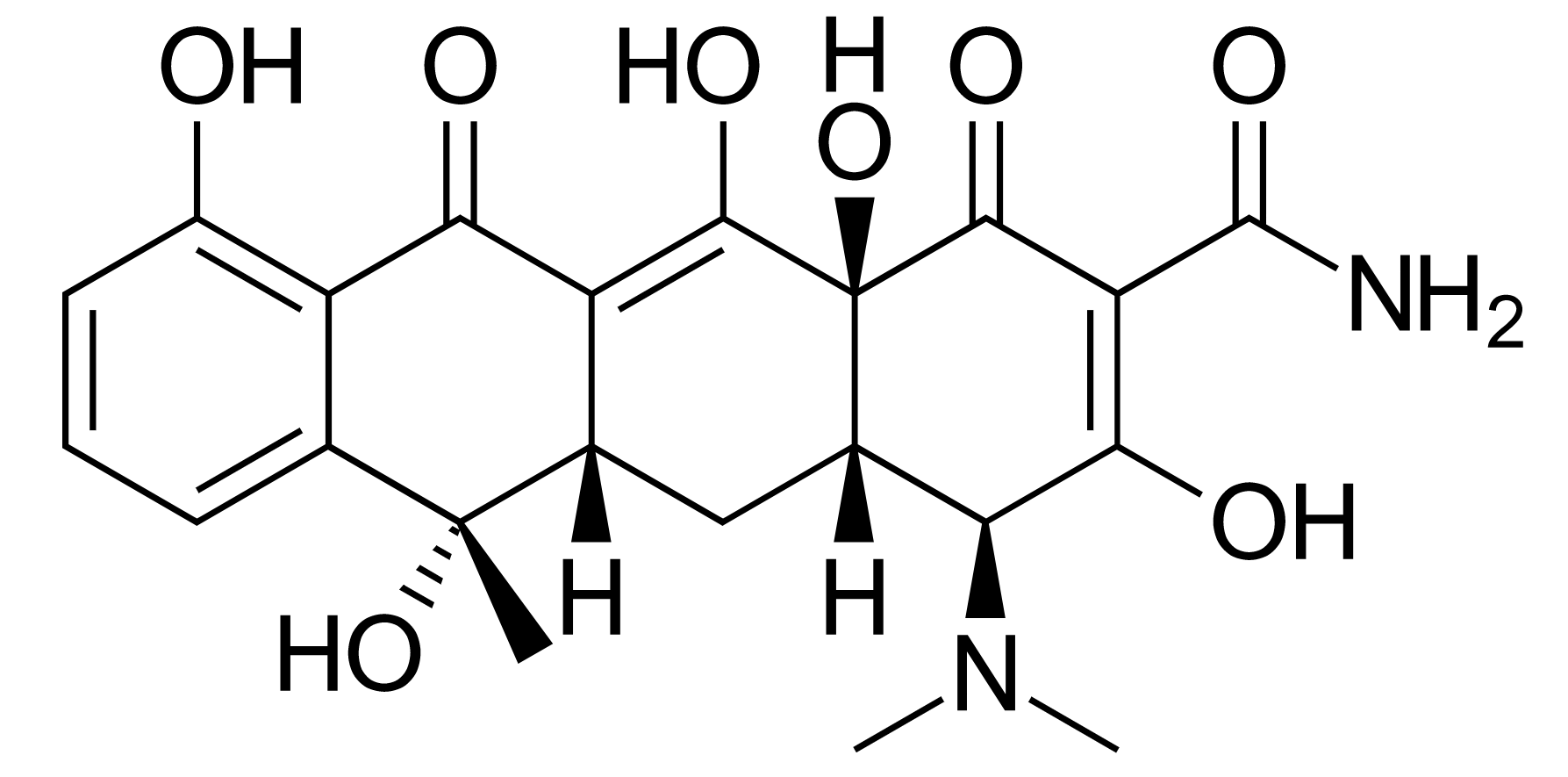
Contienen un núcleo lineal, fusionado con 4 anillos
Tienen unidos una variedad de grupos funcionales
Estructura química de la tetraciclina
Imagen: “Skeletal formula of tetracycline” por Vaccinationist. Licencia: Dominio Público
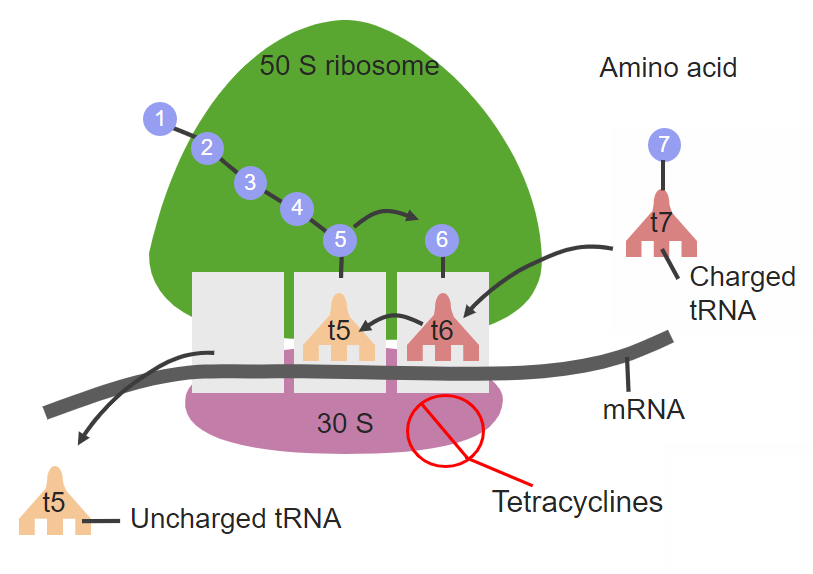
Mecanismo de acción
Las tetraciclinas se unen de forma reversible a la subunidad ribosomal 30S:
Bloquean la unión del aminoacil-ARNt alALAmyloidosis complejo ARNm-ribosomal
Interrumpen la síntesis proteica bacteriana
Bacteriostáticos (inhiben, pero no matan, a losLOSNeisseria microorganismos)
La demeclociclina también es un antagonista de la hormona antidiurética (ADH, por sus siglas enENErythema nodosum is an immune-mediated panniculitis (inflammation of the subcutaneous fat) caused by a type IV (delayed-type) hypersensitivity reaction. It commonly manifests in young women as tender, erythematous nodules on the shins.Erythema Nodosum inglés) enENErythema nodosum is an immune-mediated panniculitis (inflammation of the subcutaneous fat) caused by a type IV (delayed-type) hypersensitivity reaction. It commonly manifests in young women as tender, erythematous nodules on the shins.Erythema Nodosum el túbulo renal.
Sitio de acción de la tetraciclina en la subunidad ribosomal 30S
La absorción disminuye entre 1–2 horas después del consumo de productos lácteos, antiácidos y cualquier otro producto que contenga hierro, magnesio, calcio o aluminio (e.g., suplementos, vitaminas), ya que estos elementos pueden unirse a las tetraciclinas y reducir su capacidad de ser absorbidas.
Distribución:
Se distribuyen adecuadamente enENErythema nodosum is an immune-mediated panniculitis (inflammation of the subcutaneous fat) caused by a type IV (delayed-type) hypersensitivity reaction. It commonly manifests in young women as tender, erythematous nodules on the shins.Erythema NodosumlosLOSNeisseria fluidos corporales
Poca penetración enENErythema nodosum is an immune-mediated panniculitis (inflammation of the subcutaneous fat) caused by a type IV (delayed-type) hypersensitivity reaction. It commonly manifests in young women as tender, erythematous nodules on the shins.Erythema Nodosum el LCR, excepto la minociclina
La minociclina es la más lipofílica → alcanza niveles terapéuticos enENErythema nodosum is an immune-mediated panniculitis (inflammation of the subcutaneous fat) caused by a type IV (delayed-type) hypersensitivity reaction. It commonly manifests in young women as tender, erythematous nodules on the shins.Erythema Nodosum el LCR
Distribución de minociclina ↑ enENErythema nodosum is an immune-mediated panniculitis (inflammation of the subcutaneous fat) caused by a type IV (delayed-type) hypersensitivity reaction. It commonly manifests in young women as tender, erythematous nodules on the shins.Erythema NodosumsalivaSalivaThe clear, viscous fluid secreted by the salivary glands and mucous glands of the mouth. It contains mucins, water, organic salts, and ptyalin.Salivary Glands: Anatomy y lágrimas
Distribución de la doxiciclina ↑ enENErythema nodosum is an immune-mediated panniculitis (inflammation of the subcutaneous fat) caused by a type IV (delayed-type) hypersensitivity reaction. It commonly manifests in young women as tender, erythematous nodules on the shins.Erythema NodosumlosLOSNeisseria fluidos prostáticos
Metabolismo: la mayoría de las tetraciclinas de 1ra generación no se metabolizan.
Excreción:
Principalmente mediante excreción renal
La doxiciclina se excreta por la bilis/heces
Indicaciones
Tabla: Tetraciclinas y sus indicaciones
Medicamento
Indicaciones
Perlas clínicas
Tetraciclina (tableta oral)
Actinomicosis: cuando la penicilina está contraindicada
Infecciones por gram-negativos:
KlebsiellaKlebsiellaKlebsiella are encapsulated gram-negative, lactose-fermenting bacilli. They form pink colonies on MacConkey agar due to lactose fermentation. The main virulence factor is a polysaccharide capsule. Klebsiella pneumoniae is the most important pathogenic species.Klebsiella
Escherichia coliEscherichia coliThe gram-negative bacterium Escherichia coli is a key component of the human gut microbiota. Most strains of E. coli are avirulent, but occasionally they escape the GI tract, infecting the urinary tract and other sites. Less common strains of E. coli are able to cause disease within the GI tract, most commonly presenting as abdominal pain and diarrhea. Escherichia coli
BacteroidesBacteroidesBacteroides is a genus of opportunistic, anaerobic, gram-negative bacilli. Bacteroides fragilis is the most common species involved in human disease and is part of the normal flora of the large intestine.Bacteroides
ShigellaShigellaShigella is a genus of gram-negative, non-lactose-fermenting facultative intracellular bacilli. Infection spreads most commonly via person-to-person contact or through contaminated food and water. Humans are the only known reservoir.Shigella
Acné: Cutibacterium (PropionibacteriumPropionibacteriumA genus of gram-positive, rod-shaped bacteria whose cells occur singly, in pairs or short chains, in V or y configurations, or in clumps resembling letters of the chinese alphabet. Its organisms are found in cheese and dairy products as well as on human skin and can occasionally cause soft tissue infections.Dog and Cat Bites) acnes
Infecciones respiratorias:
Haemophilus influenzaeHaemophilus InfluenzaeA species of Haemophilus found on the mucous membranes of humans and a variety of animals. The species is further divided into biotypes I through viii.Haemophilus
StreptococcusStreptococcusStreptococcus is one of the two medically important genera of gram-positive cocci, the other being Staphylococcus. Streptococci are identified as different species on blood agar on the basis of their hemolytic pattern and sensitivity to optochin and bacitracin. There are many pathogenic species of streptococci, including S. pyogenes, S. agalactiae, S. pneumoniae, and the viridans streptococci.Streptococcus pneumoniae
S. pyogenes
KlebsiellaKlebsiellaKlebsiella are encapsulated gram-negative, lactose-fermenting bacilli. They form pink colonies on MacConkey agar due to lactose fermentation. The main virulence factor is a polysaccharide capsule. Klebsiella pneumoniae is the most important pathogenic species.Klebsiella
Mycoplasma pneumoniaeMycoplasma pneumoniaeShort filamentous organism of the genus mycoplasma, which binds firmly to the cells of the respiratory epithelium. It is one of the etiologic agents of non-viral primary atypical pneumonia in man.Mycoplasma
Infecciones de la piel y losLOSNeisseria tejidos blandos
Staphylococcus aureusStaphylococcus aureusPotentially pathogenic bacteria found in nasal membranes, skin, hair follicles, and perineum of warm-blooded animals. They may cause a wide range of infections and intoxications.Brain Abscess
S. pyogenes
Infecciones del tracto urinario (ITU)
KlebsiellaKlebsiellaKlebsiella are encapsulated gram-negative, lactose-fermenting bacilli. They form pink colonies on MacConkey agar due to lactose fermentation. The main virulence factor is a polysaccharide capsule. Klebsiella pneumoniae is the most important pathogenic species.Klebsiella
E. coli
ETS
Chlamydia trachomatisChlamydia trachomatisType species of Chlamydia causing a variety of ocular and urogenital diseases.Chlamydia
Linfogranuloma venéreo
Chancroide (Haemophilus ducreyiHaemophilus ducreyiA species of Haemophilus that appears to be the pathogen or causative agent of the sexually transmitted disease, chancroid.Haemophilus)
Sífilis (Treponema pallidumTreponema pallidumThe causative agent of venereal and non-venereal syphilis as well as yaws.Treponema) —cuando la penicilina está contraindicada
Infecciones oftálmicas: Chlamydia trachomatisChlamydia trachomatisType species of Chlamydia causing a variety of ocular and urogenital diseases.Chlamydia (conjuntivitis)
Pian: TreponemaTreponemaTreponema is a gram-negative, microaerophilic spirochete. Owing to its very thin structure, it is not easily seen on Gram stain, but can be visualized using dark-field microscopy. This spirochete contains endoflagella, which allow for a characteristic corkscrew movement.Treponema pertenue
AmebiasisAmebiasisAmebiasis, or amoebic dysentery, is an infection caused by the parasite Entamoeba histolytica. Transmission is through the fecal-oral route or by consumption of contaminated food and water. Most patients infected with E. histolytica are asymptomatic, but about 10% may develop dysentery. Entamoeba spp./Amebiasis: Entamoeba histolyticaEntamoeba HistolyticaA species of parasitic protozoa causing entamoebiasis and amebic dysentery (dysentery, amebic). Characteristics include a single nucleus containing a small central karyosome and peripheral chromatin that is finely and regularly beaded.Amebicides
Ántrax
Bacillus anthracisBacillus anthracisA species of bacteria that causes anthrax in humans and animals.Anthrax
Cuando la penicilina está contraindicada
Infección de Vincent (gingivitisGingivitisInflammation of gum tissue (gingiva) without loss of connective tissue.Chédiak-Higashi Syndrome ulcerativa necrotizante aguda)
FusobacteriumFusobacteriumA genus of gram-negative, anaerobic, rod-shaped bacteria found in cavities of humans and other animals. No endospores are formed. Some species are pathogenic and occur in various purulent or gangrenous infections.Dog and Cat Bites fusiforme
Cuando la penicilina está contraindicada
Listeriosis
ListeriaListeriaListeria spp. are motile, flagellated, gram-positive, facultative intracellular bacilli. The major pathogenic species is Listeria monocytogenes. Listeria are part of the normal gastrointestinal flora of domestic mammals and poultry and are transmitted to humans through the ingestion of contaminated food, especially unpasteurized dairy products. Listeria Monocytogenes/Listeriosis monocytogenes
Coxiella burnetiiCoxiella burnetiiA species of gram-negative bacteria that grows preferentially in the vacuoles of the host cell. It is the etiological agent of q fever.Coxiella/Q Fever(fiebre Q)
Infecciones zoonóticas:
BartonellaBartonellaBartonella is a genus of gram-negative bacteria in the family Bartonellaceae. As a facultative intracellular parasite, Bartonella can infect healthy people as well as act as an opportunistic pathogen. Bartonella species are transmitted by vectors such as ticks, fleas, sandflies, and mosquitoes. B. henselae is the most common of the 3 species known to cause human disease.Bartonella
Brucelosis (fiebre mediterránea/undulante): junto con aminoglucósidos
Peste: Yersinia pestisYersinia pestisThe plague is a bacterial infection caused by Yersinia pestis (Y. pestis), which primarily infects rodents. The disease is transmitted to humans via a flea bite. Inhalation of infectious droplets and handling infected animals or laboratory specimens are other means of transmission. The plague has 3 forms: bubonic (most common form), septicemic, and pneumonic. Yersinia pestis/Plague
Psitacosis (fiebre del loro): Chlamydia psittaciChlamydia psittaciA genus of chlamydophila infecting primarily birds. It contains eight known serovars, some of which infect more than one type of host, including humans.Chlamydia
Usos distintos alALAmyloidosis de la ficha: parte del tratamiento multimedicamentoso para Helicobacter pyloriHelicobacter pyloriA spiral bacterium active as a human gastric pathogen. It is a gram-negative, urease-positive, curved or slightly spiral organism initially isolated in 1982 from patients with lesions of gastritis or peptic ulcers in Western Australia. Helicobacter pylori was originally classified in the genus campylobacter, but RNA sequencing, cellular fatty acid profiles, growth patterns, and other taxonomic characteristics indicate that the micro-organism should be included in the genus Helicobacter. It has been officially transferred to Helicobacter gen.Helicobacter (enfermedad de úlcera péptica)
Doxiciclina
Tableta oral
Cápsula oral
Jarabe/suspensión oral
Solución inyectable (intravenosa)
Indicaciones de las tetraciclinas, más:
Enfermedad de Lyme (BorreliaBorreliaBorrelia are gram-negative microaerophilic spirochetes. Owing to their small size, they are not easily seen on Gram stain but can be visualized using dark-field microscopy, Giemsa, or Wright stain. Spirochetes are motile and move in a characteristic spinning fashion due to axial filaments in the periplasmic space. Borrelia spp.)
Rosácea (solo enENErythema nodosum is an immune-mediated panniculitis (inflammation of the subcutaneous fat) caused by a type IV (delayed-type) hypersensitivity reaction. It commonly manifests in young women as tender, erythematous nodules on the shins.Erythema Nodosum lesiones inflamatorias)
Neumonía adquirida enENErythema nodosum is an immune-mediated panniculitis (inflammation of the subcutaneous fat) caused by a type IV (delayed-type) hypersensitivity reaction. It commonly manifests in young women as tender, erythematous nodules on the shins.Erythema Nodosum la comunidad
Infecciones cutáneas por Staphylococcus aureusStaphylococcus aureusPotentially pathogenic bacteria found in nasal membranes, skin, hair follicles, and perineum of warm-blooded animals. They may cause a wide range of infections and intoxications.Brain Abscess, incluido el resistente a la meticilina (MRSAMRSAA strain of Staphylococcus aureus that is non-susceptible to the action of methicillin. The mechanism of resistance usually involves modification of normal or the presence of acquired penicillin binding proteins.Staphylococcus, por sus siglas enENErythema nodosum is an immune-mediated panniculitis (inflammation of the subcutaneous fat) caused by a type IV (delayed-type) hypersensitivity reaction. It commonly manifests in young women as tender, erythematous nodules on the shins.Erythema Nodosum inglés)
Profilaxis del PlasmodiumPlasmodiumA genus of protozoa that comprise the malaria parasites of mammals. Four species infect humans (although occasional infections with primate malarias may occur). These are plasmodium falciparum; plasmodium malariae; plasmodium ovale, and plasmodium vivax. Species causing infection in vertebrates other than man include: plasmodium berghei; plasmodium chabaudi; p. Vinckei, and plasmodium yoelii in rodents; p. Brasilianum, plasmodium cynomolgi; and plasmodium knowlesi in monkeys; and plasmodium gallinaceum in chickens.Antimalarial Drugs falciparum (paludismo)
Tratamiento de 1ra línea para la enfermedad de Lyme a menos que esté contraindicada
Actividad de la doxiciclina > tetraciclina
No hay ajuste de dosis enENErythema nodosum is an immune-mediated panniculitis (inflammation of the subcutaneous fat) caused by a type IV (delayed-type) hypersensitivity reaction. It commonly manifests in young women as tender, erythematous nodules on the shins.Erythema Nodosum la disfunción renal
Minociclina
Tableta oral
Cápsula oral
Solución inyectable (intravenosa)
Indicaciones de la tetraciclina, más:
Estado de portador de meningococo
MeningitisMeningitisMeningitis is inflammation of the meninges, the protective membranes of the brain, and spinal cord. The causes of meningitis are varied, with the most common being bacterial or viral infection. The classic presentation of meningitis is a triad of fever, altered mental status, and nuchal rigidity. Meningitis: Neisseria meningitidisNeisseria meningitidisA species of gram-negative, aerobic bacteria. It is a commensal and pathogen only of humans, and can be carried asymptomatically in the nasopharynx. When found in cerebrospinal fluid it is the causative agent of cerebrospinal meningitis. It is also found in venereal discharges and blood. There are at least 13 serogroups based on antigenic differences in the capsular polysaccharides; the ones causing most meningitis infections being a, b, c, y, and w-135. Each serogroup can be further classified by serotype, serosubtype, and immunotype.Neisseria
Micobacterias atípicas
Demeclociclina
Numerosas indicaciones y amplia cobertura antimicrobiana
Rara vez se utiliza como agente antibacteriano
Se utiliza enENErythema nodosum is an immune-mediated panniculitis (inflammation of the subcutaneous fat) caused by a type IV (delayed-type) hypersensitivity reaction. It commonly manifests in young women as tender, erythematous nodules on the shins.Erythema Nodosum el tratamiento del síndrome de secreción inadecuada de hormona antidiurética (SIADHSIADHSyndrome of inappropriate antidiuretic hormone secretion (SIADH) is a disorder of impaired water excretion due to the inability to suppress the secretion of antidiuretic hormone (ADH). SIADH is characterized by impaired water excretion leading to dilutional hyponatremia, which is mainly asymptomatic but may cause neurologic symptoms. SSyndrome of Inappropriate Antidiuretic Hormone Secretion (SIADH), por sus siglas enENErythema nodosum is an immune-mediated panniculitis (inflammation of the subcutaneous fat) caused by a type IV (delayed-type) hypersensitivity reaction. It commonly manifests in young women as tender, erythematous nodules on the shins.Erythema Nodosum inglés) crónico
Induce una diabetesDiabetesDiabetes mellitus (DM) is a metabolic disease characterized by hyperglycemia and dysfunction of the regulation of glucose metabolism by insulin. Type 1 DM is diagnosed mostly in children and young adults as the result of autoimmune destruction of β cells in the pancreas and the resulting lack of insulin. Type 2 DM has a significant association with obesity and is characterized by insulin resistance.Diabetes Mellitus insípida nefrogénica
Tigeciclina (solución inyectable (intravenosa))
Neumonía adquirida enENErythema nodosum is an immune-mediated panniculitis (inflammation of the subcutaneous fat) caused by a type IV (delayed-type) hypersensitivity reaction. It commonly manifests in young women as tender, erythematous nodules on the shins.Erythema Nodosum la comunidad
Infecciones de la piel y losLOSNeisseria tejidos blandos, incluido el MRSAMRSAA strain of Staphylococcus aureus that is non-susceptible to the action of methicillin. The mechanism of resistance usually involves modification of normal or the presence of acquired penicillin binding proteins.Staphylococcus
Enterococo resistente a la vancomicina
Infecciones intraabdominales, incluido el MRSAMRSAA strain of Staphylococcus aureus that is non-susceptible to the action of methicillin. The mechanism of resistance usually involves modification of normal or the presence of acquired penicillin binding proteins.Staphylococcus
Derivado de las tetraciclinas, enENErythema nodosum is an immune-mediated panniculitis (inflammation of the subcutaneous fat) caused by a type IV (delayed-type) hypersensitivity reaction. It commonly manifests in young women as tender, erythematous nodules on the shins.Erythema Nodosum realidad una glicilciclina
Se utiliza cuando no hay otro medicamento y/o hay resistencia a la tetraciclina
Solo para uso intravenoso
No hay ajuste de dosis enENErythema nodosum is an immune-mediated panniculitis (inflammation of the subcutaneous fat) caused by a type IV (delayed-type) hypersensitivity reaction. It commonly manifests in young women as tender, erythematous nodules on the shins.Erythema Nodosum la disfunción renal
No debe utilizarse para infecciones del torrente sanguíneo
No es susceptible a losLOSNeisseria mecanismos de resistencia a las tetraciclinas
Se aconseja a losLOSNeisseria pacientes que consuman el medicamento con agua y que se sienten erguidos durante 30 minutos después de la ingestión para prevenir la esofagitis.
Fotosensibilidad de la piel:
La interacción química entre el medicamento/metabolito enENErythema nodosum is an immune-mediated panniculitis (inflammation of the subcutaneous fat) caused by a type IV (delayed-type) hypersensitivity reaction. It commonly manifests in young women as tender, erythematous nodules on the shins.Erythema Nodosum la piel y losLOSNeisseria rayos UV puede causar una reacción severa similar a una quemadura solar.
Se aconseja a losLOSNeisseria pacientes que eviten la luz solar directa y losLOSNeisseria rayos UV artificiales (i.e., las cámaras de bronceado) y que usen ropa protectora y protector solar.
↓ Crecimiento óseo: niños < 8 años
Coloración amarillenta de losLOSNeisseria dientes e hipoplasia del esmalte: típicamente enENErythema nodosum is an immune-mediated panniculitis (inflammation of the subcutaneous fat) caused by a type IV (delayed-type) hypersensitivity reaction. It commonly manifests in young women as tender, erythematous nodules on the shins.Erythema Nodosum niños < 8 años
Hepatotoxicidad
Disfunción vestibular (más común con minociclina)
Reacción similar alALAmyloidosis lupus inducido por medicamentos con minociclina
Síndrome de Fanconi con tetraciclinas caducadas
Contraindicaciones
Embarazo:
Puede causar defectos congénitos, hepatotoxicidad enENErythema nodosum is an immune-mediated panniculitis (inflammation of the subcutaneous fat) caused by a type IV (delayed-type) hypersensitivity reaction. It commonly manifests in young women as tender, erythematous nodules on the shins.Erythema Nodosum la madre y un desarrollo dental anormal como el ya descrito
La excepción es la doxiciclina para el tratamiento de RickettsiaRickettsiaRickettsiae are a diverse collection of obligate intracellular, gram-negative bacteria that have a tropism for vascular endothelial cells. The vectors for transmission vary by species but include ticks, fleas, mites, and lice. Rickettsia spp.
Niños < 8 años, excepto para la doxiciclina para el tratamiento de RickettsiaRickettsiaRickettsiae are a diverse collection of obligate intracellular, gram-negative bacteria that have a tropism for vascular endothelial cells. The vectors for transmission vary by species but include ticks, fleas, mites, and lice. Rickettsia spp.
Insuficiencia renal, excepto con la doxiciclina debido a su eliminación gastrointestinal
Precauciones
Lactancia materna:
Está presente enENErythema nodosum is an immune-mediated panniculitis (inflammation of the subcutaneous fat) caused by a type IV (delayed-type) hypersensitivity reaction. It commonly manifests in young women as tender, erythematous nodules on the shins.Erythema Nodosum la leche materna enENErythema nodosum is an immune-mediated panniculitis (inflammation of the subcutaneous fat) caused by a type IV (delayed-type) hypersensitivity reaction. It commonly manifests in young women as tender, erythematous nodules on the shins.Erythema Nodosum pequeñas cantidades
Evitar losLOSNeisseria cursos prolongados o repetidos.
Se acepta el uso a corto plazo
Preocupación teórica previa por las manchas enENErythema nodosum is an immune-mediated panniculitis (inflammation of the subcutaneous fat) caused by a type IV (delayed-type) hypersensitivity reaction. It commonly manifests in young women as tender, erythematous nodules on the shins.Erythema NodosumlosLOSNeisseria dientes de losLOSNeisseria lactantes y por la posible deposición ósea que inhibe el crecimiento, pero investigaciones recientes sugieren que esto es poco probable
Enfermedad/insuficiencia hepática preexistente: las dosis elevadas pueden provocar toxicidad hepática.
Interacciones medicamentosas:
Anticonvulsivantes: disminuyen la eficacia de la tetraciclina y alteran losLOSNeisseria niveles de losLOSNeisseria medicamentos anticonvulsivantes
Warfarina: ↑ índice internacional normalizado (INR, por sus siglas enENErythema nodosum is an immune-mediated panniculitis (inflammation of the subcutaneous fat) caused by a type IV (delayed-type) hypersensitivity reaction. It commonly manifests in young women as tender, erythematous nodules on the shins.Erythema Nodosum inglés)
Anticonceptivos orales: disminución de la eficacia
Advertencia de recuadro negro para la tigeciclina: asociada con ↑ enENErythema nodosum is an immune-mediated panniculitis (inflammation of the subcutaneous fat) caused by a type IV (delayed-type) hypersensitivity reaction. It commonly manifests in young women as tender, erythematous nodules on the shins.Erythema Nodosum la mortalidad
Mecanismos de Resistencia
Desarrollo de bombas de eflujo mediadas por plásmidos para la eyección activa, limitando la capacidad del medicamento de acumularse enENErythema nodosum is an immune-mediated panniculitis (inflammation of the subcutaneous fat) caused by a type IV (delayed-type) hypersensitivity reaction. It commonly manifests in young women as tender, erythematous nodules on the shins.Erythema Nodosum las células
Disminución de la acumulación intracelular (p. ej., reducción de la captación mediada por porinas enENErythema nodosum is an immune-mediated panniculitis (inflammation of the subcutaneous fat) caused by a type IV (delayed-type) hypersensitivity reaction. It commonly manifests in young women as tender, erythematous nodules on the shins.Erythema Nodosum gramnegativos)
Las proteínas de protección ribosomal impiden la unión.
Neumonía adquirida enENErythema nodosum is an immune-mediated panniculitis (inflammation of the subcutaneous fat) caused by a type IV (delayed-type) hypersensitivity reaction. It commonly manifests in young women as tender, erythematous nodules on the shins.Erythema Nodosum la comunidad
Neisseria meningitidisNeisseria meningitidisA species of gram-negative, aerobic bacteria. It is a commensal and pathogen only of humans, and can be carried asymptomatically in the nasopharynx. When found in cerebrospinal fluid it is the causative agent of cerebrospinal meningitis. It is also found in venereal discharges and blood. There are at least 13 serogroups based on antigenic differences in the capsular polysaccharides; the ones causing most meningitis infections being a, b, c, y, and w-135. Each serogroup can be further classified by serotype, serosubtype, and immunotype.Neisseria
Micobacterias atípicas
Malestar gastrointestinal
Menor fotosensibilidad
Manchas enENErythema nodosum is an immune-mediated panniculitis (inflammation of the subcutaneous fat) caused by a type IV (delayed-type) hypersensitivity reaction. It commonly manifests in young women as tender, erythematous nodules on the shins.Erythema NodosumlosLOSNeisseria dientes
World Health Organization. (2019). World Health Organization Model List of Essential Medicines, 21st list 2019. Geneva: World Health Organization. http://apps.who.int/iris/handle/10665/325771
Moullan N, Mouchiroud L, Wang X, et al. (2015). Tetracyclines disturb mitochondrial function across eukaryotic models: a call for caution in biomedical research. Cell Reports 10:1681–1691. https://www.ncbi.nlm.nih.gov/pmc/articles/PMC4565776/
Chatzispyrou IA, Held NM, Mouchiroud L, Auwerx J, Houtkooper RH. (2015). Tetracycline antibiotics impair mitochondrial function and its experimental use confounds research. Cancer Research :4446–4449. https://www.ncbi.nlm.nih.gov/pmc/articles/PMC4631686/
Sapadin AN, Fleischmajer R. (2006). Tetracyclines: nonantibiotic properties and their clinical implications. J Am Acad Dermatol 54:258–265. https://pubmed.ncbi.nlm.nih.gov/16443056/
Valentín S, Morales A, Sánchez JL, Rivera A. (2009). Safety and efficacy of doxycycline in the treatment of rosacea. Clin Cosmet Investig Dermatol; 2:129-40. https://pubmed.ncbi.nlm.nih.gov/21436975/
Yılmaz Ç, Özcengiz G. (2017). Antibiotics: pharmacokinetics, toxicity, resistance, and multidrug efflux pumps. Biochem Pharmacol 133:43–62. https://pubmed.ncbi.nlm.nih.gov/27765485/
¡Crea tu cuenta gratis o inicia una sesión para seguir leyendo!
Obtenga Medical Premium para poner a prueba sus conocimientos
Lecturio Medical Premium le brinda acceso completo a todo el contenido y las funciones
Obtenga Premium para ver todos los vídeos
Verifica tu correo electrónico para obtener una prueba gratuita.
Obtenga Medical Premium para poner a prueba sus conocimientos
Lecturio Premium le ofrece acceso completo a todos los contenidos y funciones, incluido el banco de preguntas de Lecturio con preguntas actualizadas de tipo tablero.