Domina Conceptos Médicos

Estudia para la escuela de medicina y tus examenes con Lecturio.

Mordeduras de Perros y Gatos

Las mordeduras de perros y gatos pueden provocar la destrucción de tejidos superficiales y profundos, así como graves infecciones en EN Erythema nodosum is an immune-mediated panniculitis (inflammation of the subcutaneous fat) caused by a type IV (delayed-type) hypersensitivity reaction. It commonly manifests in young women as tender, erythematous nodules on the shins. Erythema Nodosum las heridas. Las mordeduras de perro se producen con mayor frecuencia en EN Erythema nodosum is an immune-mediated panniculitis (inflammation of the subcutaneous fat) caused by a type IV (delayed-type) hypersensitivity reaction. It commonly manifests in young women as tender, erythematous nodules on the shins. Erythema Nodosum hombres y niños y suelen causar traumatismos por aplastamiento o desgarro. Las mordeduras de gato son más frecuentes en EN Erythema nodosum is an immune-mediated panniculitis (inflammation of the subcutaneous fat) caused by a type IV (delayed-type) hypersensitivity reaction. It commonly manifests in young women as tender, erythematous nodules on the shins. Erythema Nodosum las mujeres adultas y provocan heridas punzantes. Dado que las heridas punzantes permiten la inoculación de bacterias en EN Erythema nodosum is an immune-mediated panniculitis (inflammation of the subcutaneous fat) caused by a type IV (delayed-type) hypersensitivity reaction. It commonly manifests in young women as tender, erythematous nodules on the shins. Erythema Nodosum los LOS Neisseria tejidos profundos, las mordeduras de gato se asocian con mayor frecuencia a la infección. El diagnóstico es clínico, y deben obtenerse cultivos si la herida parece infectada. El tratamiento requiere un cuidado estricto de las heridas y antibióticos para las heridas de alto riesgo o infectadas.

Last updated: Dec 15, 2025

Editorial responsibility: Stanley Oiseth, Lindsay Jones, Evelin Maza

Descripción General

Epidemiología

Se carece de datos internacionales, pero las estadísticas en EN Erythema nodosum is an immune-mediated panniculitis (inflammation of the subcutaneous fat) caused by a type IV (delayed-type) hypersensitivity reaction. It commonly manifests in young women as tender, erythematous nodules on the shins. Erythema Nodosum Estados Unidos incluyen:

  • De 3–6 millones de mordeduras de animales al AL Amyloidosis año
  • La mayoría causan solo heridas leves, pero 1 de cada 5 casos requiere atención médica
  • El 2,5% requiere hospitalización
  • Aumento de la frecuencia en EN Erythema nodosum is an immune-mediated panniculitis (inflammation of the subcutaneous fat) caused by a type IV (delayed-type) hypersensitivity reaction. It commonly manifests in young women as tender, erythematous nodules on the shins. Erythema Nodosum las zonas rurales
Tabla: Datos demográficos por animal
Mordeduras de perro Mordeduras de gato
Aproximadamente el 90% de las mordeduras de animales Aproximadamente el 10% de las mordeduras de animales
Hombres > mujeres Mujeres > hombres
Niños > adultos Adultos > niños
Con menos frecuencia son el resultado de una provocación Con mayor frecuencia es el resultado de una provocación

Microbiología

Además del riesgo de contraer el virus Virus Viruses are infectious, obligate intracellular parasites composed of a nucleic acid core surrounded by a protein capsid. Viruses can be either naked (non-enveloped) or enveloped. The classification of viruses is complex and based on many factors, including type and structure of the nucleoid and capsid, the presence of an envelope, the replication cycle, and the host range. Virology de la rabia por la mordedura de un animal, las infecciones de las heridas pueden ser causadas por los LOS Neisseria siguientes organismos:

Tabla: Bacterias comunes implicadas en EN Erythema nodosum is an immune-mediated panniculitis (inflammation of the subcutaneous fat) caused by a type IV (delayed-type) hypersensitivity reaction. It commonly manifests in young women as tender, erythematous nodules on the shins. Erythema Nodosum las heridas por mordedura
Mordeduras de perro Mordeduras de gato Ambos
  • Capnocytophaga canimorsus Capnocytophaga Canimorsus Dog and Cat Bites
  • Eikenella Eikenella A genus of gram-negative, facultatively anaerobic, rod-shaped bacteria that occurs in the human mouth and intestine. Organisms of this genus can be opportunistic pathogens. Dog and Cat Bites
  • Proteus Proteus Proteus spp. are gram-negative, facultatively anaerobic bacilli. Different types of infection result from Proteus, but the urinary tract is the most common site. The majority of cases are caused by Proteus mirabilis (P. mirabilis). The bacteria are part of the normal intestinal flora and are also found in the environment. Proteus
  • Klebsiella Klebsiella Klebsiella are encapsulated gram-negative, lactose-fermenting bacilli. They form pink colonies on MacConkey agar due to lactose fermentation. The main virulence factor is a polysaccharide capsule. Klebsiella pneumoniae is the most important pathogenic species. Klebsiella
  • Haemophilus Haemophilus Haemophilus is a genus of Gram-negative coccobacilli, all of whose strains require at least 1 of 2 factors for growth (factor V [NAD] and factor X [heme]); therefore, it is most often isolated on chocolate agar, which can supply both factors. The pathogenic species are H. influenzae and H. ducreyi. Haemophilus
  • Enterobacter Enterobacter Multidrug-resistant Organisms and Nosocomial Infections
  • Moraxella Moraxella Moraxella is a genus of gram-negative diplococci, with M. catarrhalis being the most clinically relevant species. M. catarrhalis is part of the normal flora of the upper respiratory tract, but it can cause infection in susceptible individuals. The infection is transmitted through respiratory droplets and can lead to chronic obstructive pulmonary disease (COPD) exacerbations in adults and otitis media in children. Moraxella
  • Corynebacterium Corynebacterium Corynebacteria are gram-positive, club-shaped bacilli. Corynebacteria are commonly isolated on tellurite or Loeffler’s media and have characteristic metachromatic granules. The major pathogenic species is Corynebacterium diphtheriae, which causes a severe respiratory infection called diphtheria. Corynebacterium
  • Neisseria Neisseria Neisseria is a genus of bacteria commonly present on mucosal surfaces. Several species exist, but only 2 are pathogenic to humans: N. gonorrhoeae and N. meningitidis. Neisseria species are non-motile, gram-negative diplococci most commonly isolated on modified Thayer-Martin (MTM) agar. Neisseria
  • Prevotella Prevotella A genus of gram-negative, anaerobic, nonsporeforming, nonmotile rods. Organisms of this genus had originally been classified as members of the bacteroides genus but overwhelming biochemical and chemical findings in 1990 indicated the need to separate them from other bacteroides species, and hence, this new genus was established. Dog and Cat Bites
  • Porphyromonas Porphyromonas A genus of gram-negative, anaerobic, nonsporeforming, nonmotile rods or coccobacilli. Organisms in this genus had originally been classified as members of the bacteroides genus but overwhelming biochemical and chemical findings indicated the need to separate them from other bacteroides species, and hence, this new genus was created. Dog and Cat Bites
  • Bartonella henselae Bartonella henselae A species of gram-negative bacteria that is the etiologic agent of bacillary angiomatosis. This organism can also be a cause of cat-scratch disease in immunocompetent patients. Bartonella
  • Actinomyces Actinomyces Actinomyces is an anaerobic, gram-positive, branching, filamentous rod. Actinomyces israelii is the most common species involved in human disease. The organism is commonly found as part of the normal flora in the oral cavity, gastrointestinal tract, and reproductive tract. Actinomyces/Actinomycosis
  • Propionibacterium Propionibacterium A genus of gram-positive, rod-shaped bacteria whose cells occur singly, in pairs or short chains, in V or y configurations, or in clumps resembling letters of the chinese alphabet. Its organisms are found in cheese and dairy products as well as on human skin and can occasionally cause soft tissue infections. Dog and Cat Bites
  • Clostridium
  • Wolinella Wolinella A genus of gram-negative, anaerobic, rod-shaped bacteria isolated from the bovine rumen, the human gingival sulcus, and dental pulpitis infections. Dog and Cat Bites
  • Peptostreptococcus Peptostreptococcus A genus of gram-positive, anaerobic, coccoid bacteria that is part of the normal flora of humans. Its organisms are opportunistic pathogens causing bacteremias and soft tissue infections. Perianal and Perirectal Abscess
  • Staphylococcus Staphylococcus Staphylococcus is a medically important genera of Gram-positive, aerobic cocci. These bacteria form clusters resembling grapes on culture plates. Staphylococci are ubiquitous for humans, and many strains compose the normal skin flora. Staphylococcus
  • Streptococcus Streptococcus Streptococcus is one of the two medically important genera of gram-positive cocci, the other being Staphylococcus. Streptococci are identified as different species on blood agar on the basis of their hemolytic pattern and sensitivity to optochin and bacitracin. There are many pathogenic species of streptococci, including S. pyogenes, S. agalactiae, S. pneumoniae, and the viridans streptococci. Streptococcus
  • Pasteurella multocida Pasteurella Multocida A species of gram-negative, facultatively anaerobic, rod-shaped bacteria normally found in the flora of the mouth and respiratory tract of animals and birds. It causes shipping fever; hemorrhagic bacteremia; and intestinal disease in animals. In humans, disease usually arises from a wound infection following a bite or scratch from domesticated animals. Dog and Cat Bites
  • Bacteroides Bacteroides Bacteroides is a genus of opportunistic, anaerobic, gram-negative bacilli. Bacteroides fragilis is the most common species involved in human disease and is part of the normal flora of the large intestine. Bacteroides
  • Fusobacterium Fusobacterium A genus of gram-negative, anaerobic, rod-shaped bacteria found in cavities of humans and other animals. No endospores are formed. Some species are pathogenic and occur in various purulent or gangrenous infections. Dog and Cat Bites

Factores de riesgo de infección por mordedura

Factores relacionados con el paciente:

  • Presentación tardía
  • Inmunosupresión:
    • Diabetes Diabetes Diabetes mellitus (DM) is a metabolic disease characterized by hyperglycemia and dysfunction of the regulation of glucose metabolism by insulin. Type 1 DM is diagnosed mostly in children and young adults as the result of autoimmune destruction of β cells in the pancreas and the resulting lack of insulin. Type 2 DM has a significant association with obesity and is characterized by insulin resistance. Diabetes Mellitus mellitus
    • Quimioterapia
    • VIH
    • Enfermedad de células falciformes
    • Asplenia Asplenia Asplenia is the absence of splenic tissue or function and can stem from several factors ranging from congenital to iatrogenic. There is a distinction between anatomic asplenia, which is due to the surgical removal of the spleen, and functional asplenia, which is due to a condition that leads to splenic atrophy, infarct, congestion, or infiltrative disease. Asplenia
  • Estasis venosa o enfermedad vascular

Factores relacionados con las mordeduras:

  • Mordedura de gato (provoca una inoculación bacteriana más profunda)
  • Destrucción significativa del tejido (lesión por aplastamiento)
  • Afectación de la mano o del pie
  • Ubicación cerca de una articulación o prótesis

Presentación Clínica

Características generales

Tabla: Diferencias en EN Erythema nodosum is an immune-mediated panniculitis (inflammation of the subcutaneous fat) caused by a type IV (delayed-type) hypersensitivity reaction. It commonly manifests in young women as tender, erythematous nodules on the shins. Erythema Nodosum la presentación de las mordeduras de perro y gato
Mordeduras de perro Mordeduras de gato
Localización Niños: cabeza, cara, cuello
Adultos: manos, brazos
Extremidades
Tipo de herida Aplastamiento y desgarro Punzante
Consecuencias Las estructuras profundas se ven lesionadas con frecuencia (tendones, huesos y vasos sanguíneos). Inoculación de bacterias en EN Erythema nodosum is an immune-mediated panniculitis (inflammation of the subcutaneous fat) caused by a type IV (delayed-type) hypersensitivity reaction. It commonly manifests in young women as tender, erythematous nodules on the shins. Erythema Nodosum los LOS Neisseria tejidos profundos
Riesgo de infección profunda Menos probable Más probable (y requiere menor tiempo para manifestarse)
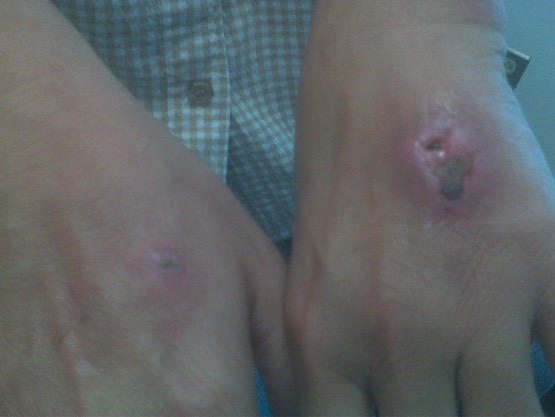
Mordedura de perro

Heridas bilaterales, ulcerosas y nodulares en el dorso de las manos de un paciente tras sufrir mordeduras de perro

Imagen: “Ulcerative, nodular wounds” por Warren Alpert Brown University School of Medicine, 1125 North Main Street, Providence, RI 02906, USA. Licencia: CC BY 4.0

Importante obtener los LOS Neisseria siguientes antecedentes:

  • Tiempo de ocurrencia ( hace HACE Altitude Sickness cuánto tiempo se produjo la mordedura)
  • Circunstancias
  • Tipo de animal
  • Estado del animal (riesgo de rabia)
  • Fiebre
  • Factores de riesgo del paciente para la infección de la herida

Hallazgos importantes al AL Amyloidosis examen físico

  • Exploración de la herida:
    • Cuerpos extraños (dientes, ropa)
    • Destrucción local del tejido
    • Lesiones de estructuras profundas
  • Signos de celulitis o infección de los LOS Neisseria tejidos profundos (más frecuentes en EN Erythema nodosum is an immune-mediated panniculitis (inflammation of the subcutaneous fat) caused by a type IV (delayed-type) hypersensitivity reaction. It commonly manifests in young women as tender, erythematous nodules on the shins. Erythema Nodosum las mordeduras de gato):
  • Evaluación local y distal:
    • Lesión vascular
    • Daño neurológico
    • Ruptura de tendón
    • Lesiones óseas (fracturas de cráneo y columna cervical en EN Erythema nodosum is an immune-mediated panniculitis (inflammation of the subcutaneous fat) caused by a type IV (delayed-type) hypersensitivity reaction. It commonly manifests in young women as tender, erythematous nodules on the shins. Erythema Nodosum bebés y niños pequeños)
    • Violación del espacio articular

Diagnóstico y Tratamiento

Diagnóstico

El diagnóstico de una mordedura de gato o de perro es clínico, pero se puede utilizar lo siguiente en EN Erythema nodosum is an immune-mediated panniculitis (inflammation of the subcutaneous fat) caused by a type IV (delayed-type) hypersensitivity reaction. It commonly manifests in young women as tender, erythematous nodules on the shins. Erythema Nodosum casos seleccionados:

  • Cultivos de heridas:
    • Puede hacerse si la herida está infectada para guiar la terapia antibiótica
    • Las muestras de las heridas frescas no son valiosas.
  • Deben realizarse hemocultivos en EN Erythema nodosum is an immune-mediated panniculitis (inflammation of the subcutaneous fat) caused by a type IV (delayed-type) hypersensitivity reaction. It commonly manifests in young women as tender, erythematous nodules on the shins. Erythema Nodosum pacientes con sepsis Sepsis Systemic inflammatory response syndrome with a proven or suspected infectious etiology. When sepsis is associated with organ dysfunction distant from the site of infection, it is called severe sepsis. When sepsis is accompanied by hypotension despite adequate fluid infusion, it is called septic shock. Sepsis and Septic Shock.

Consideraciones generales

  • Se debe instar a los LOS Neisseria pacientes a que busquen una atención rápida.
  • En EN Erythema nodosum is an immune-mediated panniculitis (inflammation of the subcutaneous fat) caused by a type IV (delayed-type) hypersensitivity reaction. It commonly manifests in young women as tender, erythematous nodules on the shins. Erythema Nodosum Estados Unidos, los LOS Neisseria médicos están obligados por ley a reportar las mordeduras de animales.
  • Profilaxis:
    • Inmunización antitetánica (si no está actualizada o se desconoce)
    • Inmunización antirrábica (si se desconoce la situación del animal)

Tratamiento de las heridas

  • Presión directa para controlar la hemorragia
  • Irrigación exhaustiva de la herida
  • Explorar los LOS Neisseria tejidos profundos en EN Erythema nodosum is an immune-mediated panniculitis (inflammation of the subcutaneous fat) caused by a type IV (delayed-type) hypersensitivity reaction. It commonly manifests in young women as tender, erythematous nodules on the shins. Erythema Nodosum busca de daños en EN Erythema nodosum is an immune-mediated panniculitis (inflammation of the subcutaneous fat) caused by a type IV (delayed-type) hypersensitivity reaction. It commonly manifests in young women as tender, erythematous nodules on the shins. Erythema Nodosum los LOS Neisseria tendones y los LOS Neisseria huesos.
  • Buscar y retirar cuerpos extraños.
  • Desbridar el tejido desvitalizado.
  • Cierre de la herida:
    • Por primera intención, está indicado para:
      • Daños mínimos
      • Se limpia fácilmente
      • Bajo riesgo de infección
    • Por segunda intención, es adecuado para:
      • Presentación tardía
      • Heridas en EN Erythema nodosum is an immune-mediated panniculitis (inflammation of the subcutaneous fat) caused by a type IV (delayed-type) hypersensitivity reaction. It commonly manifests in young women as tender, erythematous nodules on the shins. Erythema Nodosum manos y pies
      • Heridas contaminadas
      • Evidencia de inflamación
      • Afección de estructuras profundas

Tratamiento de las heridas infectadas

  • Generalmente, las infecciones son polimicrobianas.
  • Terapia con antibióticos:
    • Amoxicilina-clavulanato (primera línea)
    • Agentes alternativos más cobertura anaeróbica (metronizadol o clindamicina):
      • Doxiciclina
      • Trimetoprim-sulfametoxazol (TMP-SMX)
      • Cefuroxima
      • Ciprofloxacina o levofloxacina
    • Alternativa en EN Erythema nodosum is an immune-mediated panniculitis (inflammation of the subcutaneous fat) caused by a type IV (delayed-type) hypersensitivity reaction. It commonly manifests in young women as tender, erythematous nodules on the shins. Erythema Nodosum monoterapia: Moxifloxacina
    • Terapia intravenosa de amplio espectro para infecciones graves
  • Hospitalizar al AL Amyloidosis paciente por:
    • Empeoramiento de la celulitis
    • Sospecha de sepsis Sepsis Systemic inflammatory response syndrome with a proven or suspected infectious etiology. When sepsis is associated with organ dysfunction distant from the site of infection, it is called severe sepsis. When sepsis is accompanied by hypotension despite adequate fluid infusion, it is called septic shock. Sepsis and Septic Shock
  • Consulte a un especialista:
    • La consulta quirúrgica está justificada en EN Erythema nodosum is an immune-mediated panniculitis (inflammation of the subcutaneous fat) caused by a type IV (delayed-type) hypersensitivity reaction. It commonly manifests in young women as tender, erythematous nodules on the shins. Erythema Nodosum caso de heridas extensas, avulsión parcial en EN Erythema nodosum is an immune-mediated panniculitis (inflammation of the subcutaneous fat) caused by a type IV (delayed-type) hypersensitivity reaction. It commonly manifests in young women as tender, erythematous nodules on the shins. Erythema Nodosum colgajo o pérdida completa de tejido.
    • Consultar a enfermedades infecciosas para ayudar en EN Erythema nodosum is an immune-mediated panniculitis (inflammation of the subcutaneous fat) caused by a type IV (delayed-type) hypersensitivity reaction. It commonly manifests in young women as tender, erythematous nodules on the shins. Erythema Nodosum el régimen antibiótico definitivo

Profilaxis

Las heridas con bajo riesgo de infección no requieren profilaxis antibiótica. La profilaxis antibiótica está indicada en EN Erythema nodosum is an immune-mediated panniculitis (inflammation of the subcutaneous fat) caused by a type IV (delayed-type) hypersensitivity reaction. It commonly manifests in young women as tender, erythematous nodules on the shins. Erythema Nodosum:

  • Cualquier mordedura de gato que penetre la piel

Heridas de alto riesgo:

  • Heridas punzantes profundas
  • Lesiones por aplastamiento
  • Heridas que requieren reparación quirúrgica o después de un cierre primario
  • Heridas cerca de un hueso o articulación
  • Mordeduras en EN Erythema nodosum is an immune-mediated panniculitis (inflammation of the subcutaneous fat) caused by a type IV (delayed-type) hypersensitivity reaction. It commonly manifests in young women as tender, erythematous nodules on the shins. Erythema Nodosum la mano, la cara o la zona genital

Condiciones de alto riesgo:

  • Presentación tardía
  • Pacientes inmunocomprometidos
  • Diabetes Diabetes Diabetes mellitus (DM) is a metabolic disease characterized by hyperglycemia and dysfunction of the regulation of glucose metabolism by insulin. Type 1 DM is diagnosed mostly in children and young adults as the result of autoimmune destruction of β cells in the pancreas and the resulting lack of insulin. Type 2 DM has a significant association with obesity and is characterized by insulin resistance. Diabetes Mellitus mellitus
  • Esplenectomía
  • Hepatopatía avanzada
  • Postmastectomía
  • Prótesis articulares

Mordeduras de Humanos

Al AL Amyloidosis igual que las mordeduras de perro y gato, las mordeduras de humanos pueden conllevar un riesgo importante de infección.

Clasificación

  • Lesión por puño cerrado (cuando el puño golpea los LOS Neisseria dientes de otro individuo): más común
  • Mordedura oclusiva (cuando alguien muerde con suficiente fuerza para romper la piel)

Microbiología

La infección tras una mordedura de humano suele ser polimicrobiana. Los LOS Neisseria microorganismos más comunes son:

  • Streptococcus Streptococcus Streptococcus is one of the two medically important genera of gram-positive cocci, the other being Staphylococcus. Streptococci are identified as different species on blood agar on the basis of their hemolytic pattern and sensitivity to optochin and bacitracin. There are many pathogenic species of streptococci, including S. pyogenes, S. agalactiae, S. pneumoniae, and the viridans streptococci. Streptococcus
  • Staphylococcus Staphylococcus Staphylococcus is a medically important genera of Gram-positive, aerobic cocci. These bacteria form clusters resembling grapes on culture plates. Staphylococci are ubiquitous for humans, and many strains compose the normal skin flora. Staphylococcus
  • Eikenella Eikenella A genus of gram-negative, facultatively anaerobic, rod-shaped bacteria that occurs in the human mouth and intestine. Organisms of this genus can be opportunistic pathogens. Dog and Cat Bites corrodens
  • Corynebacterium Corynebacterium Corynebacteria are gram-positive, club-shaped bacilli. Corynebacteria are commonly isolated on tellurite or Loeffler’s media and have characteristic metachromatic granules. The major pathogenic species is Corynebacterium diphtheriae, which causes a severe respiratory infection called diphtheria. Corynebacterium
  • Bacteroides Bacteroides Bacteroides is a genus of opportunistic, anaerobic, gram-negative bacilli. Bacteroides fragilis is the most common species involved in human disease and is part of the normal flora of the large intestine. Bacteroides

Consideraciones generales y evaluación

  • Los LOS Neisseria individuos con estas lesiones suelen presentar una infección establecida (e.g., heridas con secreción purulenta y/o hinchazón)
  • En EN Erythema nodosum is an immune-mediated panniculitis (inflammation of the subcutaneous fat) caused by a type IV (delayed-type) hypersensitivity reaction. It commonly manifests in young women as tender, erythematous nodules on the shins. Erythema Nodosum las lesiones por mordedura en EN Erythema nodosum is an immune-mediated panniculitis (inflammation of the subcutaneous fat) caused by a type IV (delayed-type) hypersensitivity reaction. It commonly manifests in young women as tender, erythematous nodules on the shins. Erythema Nodosum la mano, es necesario evaluar cuidadosamente los LOS Neisseria daños en EN Erythema nodosum is an immune-mediated panniculitis (inflammation of the subcutaneous fat) caused by a type IV (delayed-type) hypersensitivity reaction. It commonly manifests in young women as tender, erythematous nodules on the shins. Erythema Nodosum la vaina del tendón, la fascia Fascia Layers of connective tissue of variable thickness. The superficial fascia is found immediately below the skin; the deep fascia invests muscles, nerves, and other organs. Cellulitis y la cabeza del metacarpiano:
    • Examinar la mano con los LOS Neisseria dedos extendidos y en EN Erythema nodosum is an immune-mediated panniculitis (inflammation of the subcutaneous fat) caused by a type IV (delayed-type) hypersensitivity reaction. It commonly manifests in young women as tender, erythematous nodules on the shins. Erythema Nodosum posición de puño cerrado.
    • Compruebe si hay material extraño, infección y estado neurovascular.
    • La infección profunda se manifiesta como:
  • Evaluación:
    • Marcadores inflamatorios (e.g., PCR PCR Polymerase chain reaction (PCR) is a technique that amplifies DNA fragments exponentially for analysis. The process is highly specific, allowing for the targeting of specific genomic sequences, even with minuscule sample amounts. The PCR cycles multiple times through 3 phases: denaturation of the template DNA, annealing of a specific primer to the individual DNA strands, and synthesis/elongation of new DNA molecules. Polymerase Chain Reaction (PCR)) para detectar una infección clínicamente evidente
    • Cultivo de la herida
    • Hemocultivos por sospecha de bacteriemia
    • Prueba de posible exposición al AL Amyloidosis VIH, hepatitis B Hepatitis B Hepatitis B virus (HBV) is a partially double-stranded DNA virus, which belongs to the Orthohepadnavirus genus and the Hepadnaviridae family. Most individuals with acute HBV infection are asymptomatic or have mild, self-limiting symptoms. Chronic infection can be asymptomatic or create hepatic inflammation, leading to liver cirrhosis and hepatocellular carcinoma (HCC). Hepatitis B Virus y hepatitis C Hepatitis C Hepatitis C is an infection of the liver caused by the hepatitis C virus (HCV). The infection can be transmitted through infectious blood or body fluids and may be transmitted during childbirth or through IV drug use or sexual intercourse. Hepatitis C virus can cause both acute and chronic hepatitis, ranging from a mild to a serious, lifelong illness including liver cirrhosis and hepatocellular carcinoma (HCC). Hepatitis C Virus
    • Imágenes radiológicas

Tratamiento

  • Irrigación extensa de la herida
  • Inmunización antitetánica
  • Profilaxis postexposición (VIH y hepatitis B Hepatitis B Hepatitis B virus (HBV) is a partially double-stranded DNA virus, which belongs to the Orthohepadnavirus genus and the Hepadnaviridae family. Most individuals with acute HBV infection are asymptomatic or have mild, self-limiting symptoms. Chronic infection can be asymptomatic or create hepatic inflammation, leading to liver cirrhosis and hepatocellular carcinoma (HCC). Hepatitis B Virus) como indicado
  • Se debe administrar profilaxis con amoxicilina-clavulanato si la piel ha HA Hemolytic anemia (HA) is the term given to a large group of anemias that are caused by the premature destruction/hemolysis of circulating red blood cells (RBCs). Hemolysis can occur within (intravascular hemolysis) or outside the blood vessels (extravascular hemolysis). Hemolytic Anemia sido perforada.
  • Regimen antibiótico alternativo es similar a mordeduras de perros y gatos.
  • Interconsulta a cirugía:
    • Lesiones por puño cerrado
    • Heridas complejas en EN Erythema nodosum is an immune-mediated panniculitis (inflammation of the subcutaneous fat) caused by a type IV (delayed-type) hypersensitivity reaction. It commonly manifests in young women as tender, erythematous nodules on the shins. Erythema Nodosum la cara
    • Heridas profundas
    • Evidencia de compromiso neurovascular
    • Infección en EN Erythema nodosum is an immune-mediated panniculitis (inflammation of the subcutaneous fat) caused by a type IV (delayed-type) hypersensitivity reaction. It commonly manifests in young women as tender, erythematous nodules on the shins. Erythema Nodosum un individuo inmunocomprometido
  • Desbridamiento cuando esté indicado

Complicaciones

  • Transmisión de:
    • Hepatitis B Hepatitis B Hepatitis B virus (HBV) is a partially double-stranded DNA virus, which belongs to the Orthohepadnavirus genus and the Hepadnaviridae family. Most individuals with acute HBV infection are asymptomatic or have mild, self-limiting symptoms. Chronic infection can be asymptomatic or create hepatic inflammation, leading to liver cirrhosis and hepatocellular carcinoma (HCC). Hepatitis B Virus
    • Hepatitis C Hepatitis C Hepatitis C is an infection of the liver caused by the hepatitis C virus (HCV). The infection can be transmitted through infectious blood or body fluids and may be transmitted during childbirth or through IV drug use or sexual intercourse. Hepatitis C virus can cause both acute and chronic hepatitis, ranging from a mild to a serious, lifelong illness including liver cirrhosis and hepatocellular carcinoma (HCC). Hepatitis C Virus
    • VIH
    • Virus Virus Viruses are infectious, obligate intracellular parasites composed of a nucleic acid core surrounded by a protein capsid. Viruses can be either naked (non-enveloped) or enveloped. The classification of viruses is complex and based on many factors, including type and structure of the nucleoid and capsid, the presence of an envelope, the replication cycle, and the host range. Virology del herpes simple
  • Laceración de tendones
  • Infecciones ( en EN Erythema nodosum is an immune-mediated panniculitis (inflammation of the subcutaneous fat) caused by a type IV (delayed-type) hypersensitivity reaction. It commonly manifests in young women as tender, erythematous nodules on the shins. Erythema Nodosum particular, lesiones por puño cerrado):
    • Tenosinovitis
    • Artritis séptica
    • Osteomielitis
  • Deformidades cosméticas

Diagnóstico Diferencial

  • Mordedura de ofidio: El envenenamiento en EN Erythema nodosum is an immune-mediated panniculitis (inflammation of the subcutaneous fat) caused by a type IV (delayed-type) hypersensitivity reaction. It commonly manifests in young women as tender, erythematous nodules on the shins. Erythema Nodosum el lugar de la mordedura puede causar edema Edema Edema is a condition in which excess serous fluid accumulates in the body cavity or interstitial space of connective tissues. Edema is a symptom observed in several medical conditions. It can be categorized into 2 types, namely, peripheral (in the extremities) and internal (in an organ or body cavity). Edema, eritema, calor Calor Inflammation, bullas y necrosis Necrosis The death of cells in an organ or tissue due to disease, injury or failure of the blood supply. Ischemic Cell Damage. Pueden presentarse síntomas sistémicos como náuseas, diaforesis, parestesias y alteración del sensorio, que no son comunes en EN Erythema nodosum is an immune-mediated panniculitis (inflammation of the subcutaneous fat) caused by a type IV (delayed-type) hypersensitivity reaction. It commonly manifests in young women as tender, erythematous nodules on the shins. Erythema Nodosum las mordeduras de perro o gato. El diagnóstico es clínico. El tratamiento incluye cuidados de soporte, control del dolor Dolor Inflammation, hidratación y antiveneno. Los LOS Neisseria pacientes son monitoreados estrechamente para detectar shock Shock Shock is a life-threatening condition associated with impaired circulation that results in tissue hypoxia. The different types of shock are based on the underlying cause: distributive (↑ cardiac output (CO), ↓ systemic vascular resistance (SVR)), cardiogenic (↓ CO, ↑ SVR), hypovolemic (↓ CO, ↑ SVR), obstructive (↓ CO), and mixed. Types of Shock, coagulopatía, insuficiencia respiratoria e insuficiencia renal.
  • Picadura de insecto: Las picaduras de abejas, avispas y hormigas pueden causar envenenamiento con edema Edema Edema is a condition in which excess serous fluid accumulates in the body cavity or interstitial space of connective tissues. Edema is a symptom observed in several medical conditions. It can be categorized into 2 types, namely, peripheral (in the extremities) and internal (in an organ or body cavity). Edema localizado. Algunos pacientes desarrollarán una reacción alérgica grave, incluida la anafilaxia. Esto no ocurre con las mordeduras de perro o gato. El diagnóstico es clínico. El tratamiento incluye la extracción del aguijón (si está presente), antihistamínicos, control del dolor Dolor Inflammation y atención de emergencia para la anafilaxia.
  • Picadura de escorpión: La mayoría de las picaduras de escorpión son inofensivas. Sin embargo, el escorpión de corteza es venenoso. Los LOS Neisseria pacientes tendrán dolor Dolor Inflammation y edema Edema Edema is a condition in which excess serous fluid accumulates in the body cavity or interstitial space of connective tissues. Edema is a symptom observed in several medical conditions. It can be categorized into 2 types, namely, peripheral (in the extremities) and internal (in an organ or body cavity). Edema en EN Erythema nodosum is an immune-mediated panniculitis (inflammation of the subcutaneous fat) caused by a type IV (delayed-type) hypersensitivity reaction. It commonly manifests in young women as tender, erythematous nodules on the shins. Erythema Nodosum el lugar de la picadura. Las manifestaciones sistémicas pueden incluir espasmos musculares, diaforesis, movimientos anormales del cuello y la cabeza, taquicardia, hipertensión y dificultad respiratoria. El diagnóstico es clínico. El tratamiento incluye cuidados de soporte, control del dolor Dolor Inflammation, benzodiazepinas para los LOS Neisseria espasmos musculares y antiveneno.
  • Picaduras de araña: La araña reclusa parda contiene un veneno necrosante, que puede provocar una herida dolorosa, ampollosa y necrótica, fiebres, mialgias, hemólisis, convulsiones e insuficiencia renal. El veneno neurotóxico de la araña viuda negra puede provocar calambres y rigidez muscular, inestabilidad de los LOS Neisseria signos vitales, lagrimeo, salivación, ptosis Ptosis Cranial Nerve Palsies y dificultad respiratoria. El diagnóstico es clínico. El tratamiento incluye el cuidado de las heridas, el tratamiento del dolor Dolor Inflammation, el antiveneno para las picaduras de viuda negra y el desbridamiento tardío del tejido necrótico para las picaduras de reclusa parda.

Referencias

  1. Holmquist L, Elixhauser A. (2010). Emergency department visits and inpatient stays involving dog bites. Healthcare Cost and Utilization Project Statistical Briefs. https://www.ncbi.nlm.nih.gov/books/NBK52650/
  2. Oehler RL, Velez AP, Mizrachi M, Lamarche J, Gompf S. (2009). Bite-related and septic syndromes caused by cats and dogs. Lancet Infect Dis. Medline. Retrieved April 24, 2025, from https://reference.medscape.com/medline/abstract/19555903
  3. Garth AP, Harris NS, Spanlerman CS, Salas RN. (2021). Animal bites in emergency medicine. In Alcock J. (Ed.). Medscape. Retrieved April 24, 2025, from https://emedicine.medscape.com/article/768875-overview
  4. Maniscalco K, Edens MA. (2022). Animal bites. StatPearls. https://www.ncbi.nlm.nih.gov/books/NBK430852/
  5. Barish RA, Arnold T. (2025). Human and mammal bites. MSD Manual Professional Version. Retrieved April 24, 2025, from https://www.msdmanuals.com/professional/injuries-poisoning/bites-and-stings/human-and-mammal-bites

¡Crea tu cuenta gratis o inicia una sesión para seguir leyendo!

Regístrate ahora y obtén acceso gratuito a Lecturio con páginas de concepto, videos médicos y cuestionarios para tu educación médica.

User Reviews

Que tengas una sesión de estudio alegre y navideña 🎁 Ahorra 50% en todos los planes >>

Details