
Domina Conceptos Médicos

Estudia para la escuela de medicina y tus examenes con Lecturio.

Fiebre Recurrente

La fiebre recurrente es una enfermedad transmitida por vectores y causada por múltiples especies de la espiroqueta Borrelia Borrelia Borrelia are gram-negative microaerophilic spirochetes. Owing to their small size, they are not easily seen on Gram stain but can be visualized using dark-field microscopy, Giemsa, or Wright stain. Spirochetes are motile and move in a characteristic spinning fashion due to axial filaments in the periplasmic space. Borrelia. Existen dos formas principales de fiebre recurrente: la fiebre recurrente transmitida por garrapatas (causada por múltiples especies, como B. hermsii B. hermsii Borrelia, B. miyamotoi B. miyamotoi Borrelia y B. turicatae B. turicatae Borrelia) y la fiebre recurrente transmitida por piojos (causada por B. recurrentis B. recurrentis Borrelia). Los LOS Neisseria pacientes pasan por etapas recurrentes de fiebre, fase de crisis y períodos afebriles. Las manifestaciones graves pueden incluir miocarditis, síndrome de dificultad respiratoria aguda y meningitis Meningitis Meningitis is inflammation of the meninges, the protective membranes of the brain, and spinal cord. The causes of meningitis are varied, with the most common being bacterial or viral infection. The classic presentation of meningitis is a triad of fever, altered mental status, and nuchal rigidity. Meningitis. El diagnóstico se basa en EN Erythema nodosum is an immune-mediated panniculitis (inflammation of the subcutaneous fat) caused by a type IV (delayed-type) hypersensitivity reaction. It commonly manifests in young women as tender, erythematous nodules on the shins. Erythema Nodosum los LOS Neisseria antecedentes clínicos y en EN Erythema nodosum is an immune-mediated panniculitis (inflammation of the subcutaneous fat) caused by a type IV (delayed-type) hypersensitivity reaction. It commonly manifests in young women as tender, erythematous nodules on the shins. Erythema Nodosum la visualización de espiroquetas en EN Erythema nodosum is an immune-mediated panniculitis (inflammation of the subcutaneous fat) caused by a type IV (delayed-type) hypersensitivity reaction. It commonly manifests in young women as tender, erythematous nodules on the shins. Erythema Nodosum un frotis de sangre grueso y fino obtenido durante un episodio febril. El tratamiento de la fiebre recurrente es con antibióticos, como la doxiciclina, la penicilina o la ceftriaxona. Los LOS Neisseria pacientes deben ser vigilados de cerca para detectar la reacción de Jarisch-Herxheimer.

Last updated: Dec 15, 2025
Editorial responsibility: Stanley Oiseth, Lindsay Jones, Evelin Maza

Descripción General

Organismo causante

  • Borrelia Borrelia Borrelia are gram-negative microaerophilic spirochetes. Owing to their small size, they are not easily seen on Gram stain but can be visualized using dark-field microscopy, Giemsa, or Wright stain. Spirochetes are motile and move in a characteristic spinning fashion due to axial filaments in the periplasmic space. Borrelia spp.:
    • Espiroquetas (morfología espiral)
    • Gram negativo (débil)
    • Puede visualizarse mediante microscopía de campo oscuro, tinción de Wright o tinción de Giemsa
    • Posee filamentos axiales para la motilidad
    • Microaerófilo
    • Difícil de cultivar
  • Enfermedades asociadas:
    • La fiebre recurrente transmitida por garrapatas es causada por múltiples especies de Borrelia Borrelia Borrelia are gram-negative microaerophilic spirochetes. Owing to their small size, they are not easily seen on Gram stain but can be visualized using dark-field microscopy, Giemsa, or Wright stain. Spirochetes are motile and move in a characteristic spinning fashion due to axial filaments in the periplasmic space. Borrelia, incluyendo:
    • La fiebre recurrente transmitida por piojos es causada por B. recurrentis B. recurrentis Borrelia.
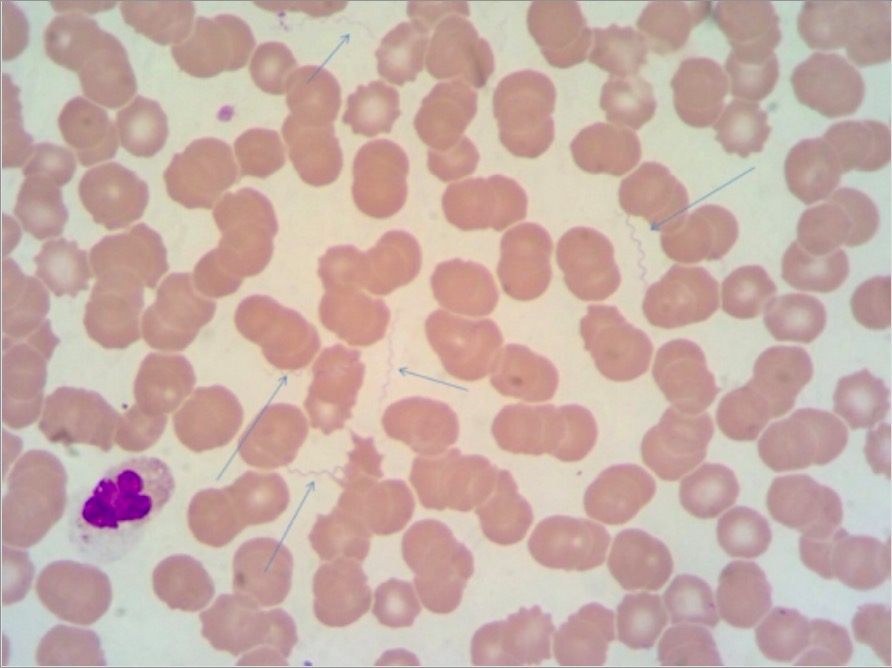
May-Gruenwald-Giemsa mostrando Borrellia recurrentis

Frotis de sangre fina teñido con May-Grünwald-Giemsa (MGG, por sus siglas en inglés) que muestra numerosas espiroquetas (flechas) identificadas como Borrelia recurrentis

Imagen: “Tinción MGG” por Department of Clinical and Biomedical Sciences Luigi Sacco, University of Milano, Milano, Italy. Licencia: CC BY 4.0

Epidemiología

Fiebre recurrente transmitida por garrapatas:

  • Ubicación:
  • Se ve VE Ventilation: Mechanics of Breathing con frecuencia en EN Erythema nodosum is an immune-mediated panniculitis (inflammation of the subcutaneous fat) caused by a type IV (delayed-type) hypersensitivity reaction. It commonly manifests in young women as tender, erythematous nodules on the shins. Erythema Nodosum los LOS Neisseria meses de verano ( los LOS Neisseria picos son en EN Erythema nodosum is an immune-mediated panniculitis (inflammation of the subcutaneous fat) caused by a type IV (delayed-type) hypersensitivity reaction. It commonly manifests in young women as tender, erythematous nodules on the shins. Erythema Nodosum agosto)
  • Mortalidad:
    • < 2% en EN Erythema nodosum is an immune-mediated panniculitis (inflammation of the subcutaneous fat) caused by a type IV (delayed-type) hypersensitivity reaction. It commonly manifests in young women as tender, erythematous nodules on the shins. Erythema Nodosum pacientes tratados
    • 4%–10% en EN Erythema nodosum is an immune-mediated panniculitis (inflammation of the subcutaneous fat) caused by a type IV (delayed-type) hypersensitivity reaction. It commonly manifests in young women as tender, erythematous nodules on the shins. Erythema Nodosum pacientes no tratados (el más alto en EN Erythema nodosum is an immune-mediated panniculitis (inflammation of the subcutaneous fat) caused by a type IV (delayed-type) hypersensitivity reaction. It commonly manifests in young women as tender, erythematous nodules on the shins. Erythema Nodosum infecciones por B. duttoni B. duttoni Borrelia)

Fiebre recurrente transmitida por piojos:
  • Endémica en EN Erythema nodosum is an immune-mediated panniculitis (inflammation of the subcutaneous fat) caused by a type IV (delayed-type) hypersensitivity reaction. It commonly manifests in young women as tender, erythematous nodules on the shins. Erythema Nodosum países en EN Erythema nodosum is an immune-mediated panniculitis (inflammation of the subcutaneous fat) caused by a type IV (delayed-type) hypersensitivity reaction. It commonly manifests in young women as tender, erythematous nodules on the shins. Erythema Nodosum desarrollo de África, como Etiopía, Sudán y Somalia
  • Suele ocurrir en EN Erythema nodosum is an immune-mediated panniculitis (inflammation of the subcutaneous fat) caused by a type IV (delayed-type) hypersensitivity reaction. It commonly manifests in young women as tender, erythematous nodules on the shins. Erythema Nodosum zonas de guerra, hambruna, hacinamiento (personas sin hogar) y migración masiva (refugiados)
  • Los LOS Neisseria casos alcanzan su punto máximo durante la temporada de lluvias.
  • Mortalidad:
    • 4% en EN Erythema nodosum is an immune-mediated panniculitis (inflammation of the subcutaneous fat) caused by a type IV (delayed-type) hypersensitivity reaction. It commonly manifests in young women as tender, erythematous nodules on the shins. Erythema Nodosum pacientes tratados
    • 10%–70% en EN Erythema nodosum is an immune-mediated panniculitis (inflammation of the subcutaneous fat) caused by a type IV (delayed-type) hypersensitivity reaction. It commonly manifests in young women as tender, erythematous nodules on the shins. Erythema Nodosum pacientes no tratados

Patogénesis

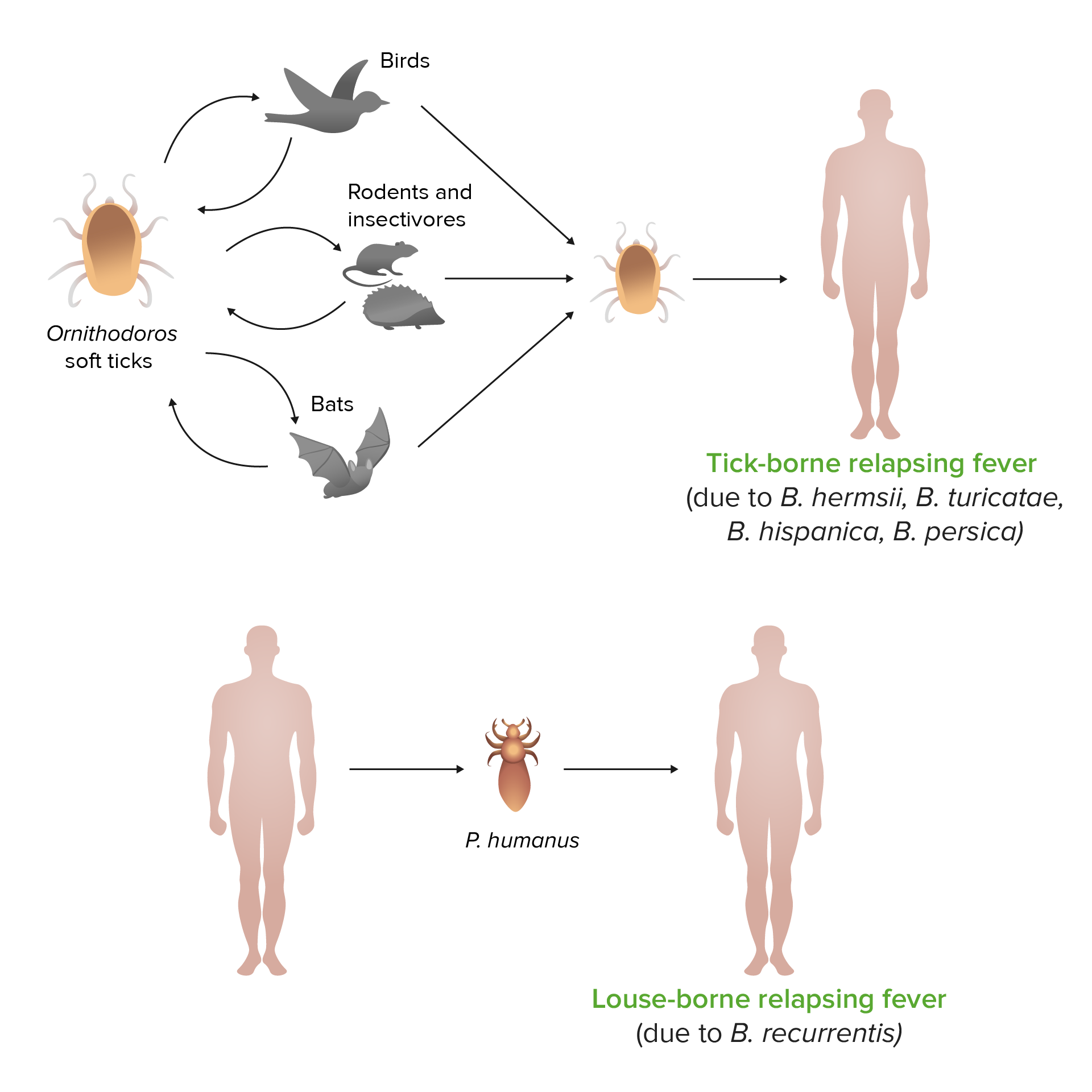
Ciclo de vectores de la fiebre recurrente

Los vectores y reservorios de Borrelia en la fiebre recurrente

Imagen por Lecturio.

Transmisión de la fiebre recurrente transmitida por garrapatas

Transmisión de la fiebre recurrente transmitida por piojos

Fisiopatología

  • Borrelia Borrelia Borrelia are gram-negative microaerophilic spirochetes. Owing to their small size, they are not easily seen on Gram stain but can be visualized using dark-field microscopy, Giemsa, or Wright stain. Spirochetes are motile and move in a characteristic spinning fashion due to axial filaments in the periplasmic space. Borrelia entra en EN Erythema nodosum is an immune-mediated panniculitis (inflammation of the subcutaneous fat) caused by a type IV (delayed-type) hypersensitivity reaction. It commonly manifests in young women as tender, erythematous nodules on the shins. Erythema Nodosum el cuerpo a través de:
    • Picadura de garrapata a través de la saliva Saliva The clear, viscous fluid secreted by the salivary glands and mucous glands of the mouth. It contains mucins, water, organic salts, and ptyalin. Salivary Glands: Anatomy de la garrapata en EN Erythema nodosum is an immune-mediated panniculitis (inflammation of the subcutaneous fat) caused by a type IV (delayed-type) hypersensitivity reaction. It commonly manifests in young women as tender, erythematous nodules on the shins. Erythema Nodosum fiebre recurrente trasmitida por garrapatas
    • Piel o mucosas en EN Erythema nodosum is an immune-mediated panniculitis (inflammation of the subcutaneous fat) caused by a type IV (delayed-type) hypersensitivity reaction. It commonly manifests in young women as tender, erythematous nodules on the shins. Erythema Nodosum fiebre recurrente transmitida por piojos
      • Se produce cuando el piojo es aplastado por los LOS Neisseria humanos
      • B. recurrentis B. recurrentis Borrelia crece en EN Erythema nodosum is an immune-mediated panniculitis (inflammation of the subcutaneous fat) caused by a type IV (delayed-type) hypersensitivity reaction. It commonly manifests in young women as tender, erythematous nodules on the shins. Erythema Nodosum la cavidad corporal del piojo, pero no aparece en EN Erythema nodosum is an immune-mediated panniculitis (inflammation of the subcutaneous fat) caused by a type IV (delayed-type) hypersensitivity reaction. It commonly manifests in young women as tender, erythematous nodules on the shins. Erythema Nodosum la saliva Saliva The clear, viscous fluid secreted by the salivary glands and mucous glands of the mouth. It contains mucins, water, organic salts, and ptyalin. Salivary Glands: Anatomy ni en EN Erythema nodosum is an immune-mediated panniculitis (inflammation of the subcutaneous fat) caused by a type IV (delayed-type) hypersensitivity reaction. It commonly manifests in young women as tender, erythematous nodules on the shins. Erythema Nodosum las heces del piojo.
  • Las espiroquetas entran en EN Erythema nodosum is an immune-mediated panniculitis (inflammation of the subcutaneous fat) caused by a type IV (delayed-type) hypersensitivity reaction. It commonly manifests in young women as tender, erythematous nodules on the shins. Erythema Nodosum la irrigacion.
    • La replicación se produce cada 6–12 horas.
    • Los LOS Neisseria síntomas se producen junto con la espiroquetemia (espiroquetas en EN Erythema nodosum is an immune-mediated panniculitis (inflammation of the subcutaneous fat) caused by a type IV (delayed-type) hypersensitivity reaction. It commonly manifests in young women as tender, erythematous nodules on the shins. Erythema Nodosum la sangre).
      • Síntomas generalizados (e.g., fiebre, mialgia)
      • Síntomas no focales del SNC
      • Adherencia de las espiroquetas a las células sanguíneas → microagregados → oclusión de pequeños vasos y secuestro de células sanguíneas en EN Erythema nodosum is an immune-mediated panniculitis (inflammation of the subcutaneous fat) caused by a type IV (delayed-type) hypersensitivity reaction. It commonly manifests in young women as tender, erythematous nodules on the shins. Erythema Nodosum el bazo y el hígado → disfunción de órganos
    • Permite la diseminación a órganos de todo el cuerpo → invasión de tejidos:
      • Hepatoesplenomegalia
      • Deterioro de la función de los LOS Neisseria órganos
      • Anomalías focales del SNC
      • Puede atravesar la barrera materno-fetal → inflamación y alteración de la placenta Placenta A highly vascularized mammalian fetal-maternal organ and major site of transport of oxygen, nutrients, and fetal waste products. It includes a fetal portion (chorionic villi) derived from trophoblasts and a maternal portion (decidua) derived from the uterine endometrium. The placenta produces an array of steroid, protein and peptide hormones (placental hormones). Placenta, Umbilical Cord, and Amniotic Cavity → retraso del crecimiento intrauterino e infección congénita
  • El sistema inmunitario intenta eliminar la enfermedad.
    • Creación de anticuerpos dirigidos a las lipoproteínas de superficie de las espiroquetas
    • Opsonización y fijación del complemento → lisis de las espiroquetas
    • Productos de lisis (lipoproteínas y productos bacterianos) → causan un empeoramiento de los LOS Neisseria síntomas con fiebre, hipotensión y fase de shock Shock Shock is a life-threatening condition associated with impaired circulation that results in tissue hypoxia. The different types of shock are based on the underlying cause: distributive (↑ cardiac output (CO), ↓ systemic vascular resistance (SVR)), cardiogenic (↓ CO, ↑ SVR), hypovolemic (↓ CO, ↑ SVR), obstructive (↓ CO), and mixed. Types of Shock/crisis
    • Fase de crisis: síntomas similares a la reacción de Jarisch-Herxheimer
  • Los LOS Neisseria períodos afebriles se producen cuando las espiroquetas se eliminan de la sangre.
  • La variación antigénica permite a algunas espiroquetas evadir el sistema inmunitario y reaparecer más tarde → crea ciclos de la enfermedad → recaídas de fiebre y síntomas

Presentación Clínica

Cronología de la fiebre recurrente

  • Periodo de incubación: 3–12 días
  • Curso recurrente: periodos febriles con periodos afebriles de algunos días
  • Fase/periodo febril:
    • Episodio febril caracterizado por la aparición súbita de fiebre que dura:
      • 1–3 días en EN Erythema nodosum is an immune-mediated panniculitis (inflammation of the subcutaneous fat) caused by a type IV (delayed-type) hypersensitivity reaction. It commonly manifests in young women as tender, erythematous nodules on the shins. Erythema Nodosum fiebre recurrente trasmitida por garrapatas
      • 3–6 días en EN Erythema nodosum is an immune-mediated panniculitis (inflammation of the subcutaneous fat) caused by a type IV (delayed-type) hypersensitivity reaction. It commonly manifests in young women as tender, erythematous nodules on the shins. Erythema Nodosum fiebre recurrente transmitida por piojos
    • El 1er episodio suele ser el más grave.
    • El episodio febril termina en EN Erythema nodosum is an immune-mediated panniculitis (inflammation of the subcutaneous fat) caused by a type IV (delayed-type) hypersensitivity reaction. It commonly manifests in young women as tender, erythematous nodules on the shins. Erythema Nodosum una fase de crisis que dura entre 15–30 minutos.
  • Fase de crisis:
    • La mortalidad es la más comúnmente asociada a esta fase.
    • Se caracteriza por el rigor y el aumento de la temperatura, la frecuencia cardíaca y la presión arterial
    • Seguido de varias horas de diaforesis, temperatura ↓ e hipotensión
  • Período afebril: sigue al AL Amyloidosis período febril y puede durar de 4–14 días
  • Recaída:
    • La fiebre tiende a ser más leve con cada recaída.
    • Fiebre recurrente transmitida por garrapatas: Se experimentan múltiples recaídas.
    • Fiebre recurrente transmitida por piojos: generalmente una sola recaída más leve

Síntomas y manifestaciones asociadas

  • General:
    • Cefalea
    • Mialgia
    • Artralgia
    • Escalofríos
    • Náuseas
    • Dolor Dolor Inflammation abdominal
    • Diarrea
  • Hepáticas:
    • Ictericia
    • Hepatoesplenomegalia
  • Cardiopulmonar:
    • Miocarditis (tanto fiebre recurrente trasmitida por garrapatas como fiebre recurrente trasmitida por piojos)
    • Tos TOS Thoracic outlet syndrome (TOS) is a broad term used for a spectrum of syndromes related to the general region of the thoracic outlet, which involves the compression or irritation of elements of the brachial plexus, subclavian artery, or subclavian vein. Thoracic Outlet Syndrome no productiva (fiebre recurrente trasmitida por piojos)
    • Síndrome de dificultad respiratoria aguda (se produce durante la fase de crisis de la fiebre recurrente trasmitida por garrapatas)
  • Neurológico:
    • Delirio
    • Estupor
    • Mareos
    • Coma Coma Coma is defined as a deep state of unarousable unresponsiveness, characterized by a score of 3 points on the GCS. A comatose state can be caused by a multitude of conditions, making the precise epidemiology and prognosis of coma difficult to determine. Coma
    • Signos localizados (debido a la espiroquetemia) asociados a la fiebre recurrente trasmitida por garrapatas:
      • Hemiplejia
      • Neuritis craneal (que provoca parálisis de Bell y/o sordera)
      • Mielitis
      • Meningitis Meningitis Meningitis is inflammation of the meninges, the protective membranes of the brain, and spinal cord. The causes of meningitis are varied, with the most common being bacterial or viral infection. The classic presentation of meningitis is a triad of fever, altered mental status, and nuchal rigidity. Meningitis o meningoencefalitis
      • Radiculopatía
  • Oftalmológico (más común en EN Erythema nodosum is an immune-mediated panniculitis (inflammation of the subcutaneous fat) caused by a type IV (delayed-type) hypersensitivity reaction. It commonly manifests in young women as tender, erythematous nodules on the shins. Erythema Nodosum fiebre recurrente trasmitida por garrapatas):
    • Iridociclitis
    • Panoftalmitis
    • La afectación bilateral puede provocar la pérdida de visión.
  • Dermatológico (más común en EN Erythema nodosum is an immune-mediated panniculitis (inflammation of the subcutaneous fat) caused by a type IV (delayed-type) hypersensitivity reaction. It commonly manifests in young women as tender, erythematous nodules on the shins. Erythema Nodosum fiebre recurrente trasmitida por garrapatas):
    • Puede aparecer una erupción macular o purpúrica.
    • Eritema multiforme
  • Hallazgos hematológicos debidos a ↓ plaquetas, factores de coagulación (más frecuentes en EN Erythema nodosum is an immune-mediated panniculitis (inflammation of the subcutaneous fat) caused by a type IV (delayed-type) hypersensitivity reaction. It commonly manifests in young women as tender, erythematous nodules on the shins. Erythema Nodosum fiebre recurrente trasmitida por piojos):

Pronóstico

Hallazgos indicativos de un mal pronóstico:
  • Estupor o coma Coma Coma is defined as a deep state of unarousable unresponsiveness, characterized by a score of 3 points on the GCS. A comatose state can be caused by a multitude of conditions, making the precise epidemiology and prognosis of coma difficult to determine. Coma
  • Neumonía
  • Miocarditis
  • Hemorragia difusa
  • Enfermedad hepática grave
  • Desnutrición
  • Coinfección con tifus, malaria Malaria Malaria is an infectious parasitic disease affecting humans and other animals. Most commonly transmitted via the bite of a female Anopheles mosquito infected with microorganisms of the Plasmodium genus. Patients present with fever, chills, myalgia, headache, and diaphoresis. Plasmodium/Malaria, tifoidea

Diagnóstico

  • El frotis de sangre gruesa y fina es el 1er paso:
    • Intenta visualizar los LOS Neisseria microorganismos utilizando:
      • Tinción de Giemsa o Wright
      • Microscopía de campo oscuro
      • Inmunofluorescencia
    • Óptimo entre el inicio y el pico de fiebre
    • Menor rendimiento, una vez que la temperatura disminuye
  • Para muestras de tejido: tinción de plata o inmunofluorescencia
  • Si el frotis sanguíneo no es indicativo, pero hay una alta sospecha clínica:
    • La PCR PCR Polymerase chain reaction (PCR) is a technique that amplifies DNA fragments exponentially for analysis. The process is highly specific, allowing for the targeting of specific genomic sequences, even with minuscule sample amounts. The PCR cycles multiple times through 3 phases: denaturation of the template DNA, annealing of a specific primer to the individual DNA strands, and synthesis/elongation of new DNA molecules. Polymerase Chain Reaction (PCR) puede realizarse con muestras de sangre, LCR o tejidos.
    • Cultivo:
      • Requiere medios de cultivo especiales
      • Solo unos pocos laboratorios tienen esta capacidad.
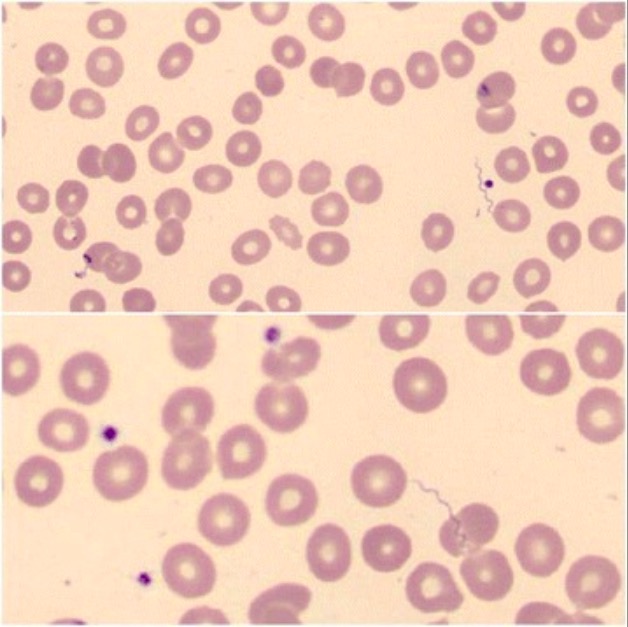
Frotis de sangre para diagnosticar la infección por Borrellia

Frotis de sangre que muestra Borrelia:
Frotis sanguíneo de un paciente con fiebre recurrente transmitida por garrapatas secundaria a Borrelia hispanica. Se observan espirales irregulares de espiroquetas.

Imagen: “Frotis sanguíneo” por Irmin Leen et al. Licencia: CC BY 4.0

Otras pruebas y resultados de apoyo:

  • Hemograma
    • Anemia Anemia Anemia is a condition in which individuals have low Hb levels, which can arise from various causes. Anemia is accompanied by a reduced number of RBCs and may manifest with fatigue, shortness of breath, pallor, and weakness. Subtypes are classified by the size of RBCs, chronicity, and etiology. Anemia: Overview and Types normocítica o hemolítica
    • Leucopenia durante una crisis
    • Trombocitopenia
  • ↑ Velocidad de sedimentación globular
  • ↑ Aminotransferasas y bilirrubina no conjugada
  • ↑ Protrombina y tromboplastina parcial
  • Análisis del LCR:
    • ↑ Monocitos
    • ↑ Proteína
    • Glucosa normal
  • ECG ECG An electrocardiogram (ECG) is a graphic representation of the electrical activity of the heart plotted against time. Adhesive electrodes are affixed to the skin surface allowing measurement of cardiac impulses from many angles. The ECG provides 3-dimensional information about the conduction system of the heart, the myocardium, and other cardiac structures. Electrocardiogram (ECG): en EN Erythema nodosum is an immune-mediated panniculitis (inflammation of the subcutaneous fat) caused by a type IV (delayed-type) hypersensitivity reaction. It commonly manifests in young women as tender, erythematous nodules on the shins. Erythema Nodosum la miocarditis, intervalo QTc prolongado
  • Radiografía de tórax: puede mostrar un edema Edema Edema is a condition in which excess serous fluid accumulates in the body cavity or interstitial space of connective tissues. Edema is a symptom observed in several medical conditions. It can be categorized into 2 types, namely, peripheral (in the extremities) and internal (in an organ or body cavity). Edema pulmonar

Tratamiento

Fiebre recurrente transmitida por garrapatas

  • La mayoría de los LOS Neisseria pacientes requerirán hospitalización debido a los LOS Neisseria síntomas graves.
  • Terapia con antibióticos:
    • Primera línea para la mayoría de los LOS Neisseria pacientes: doxiciclina oral.
    • Utilizar penicilina G o ceftriaxona IV en EN Erythema nodosum is an immune-mediated panniculitis (inflammation of the subcutaneous fat) caused by a type IV (delayed-type) hypersensitivity reaction. It commonly manifests in young women as tender, erythematous nodules on the shins. Erythema Nodosum caso de enfermedad grave o afectación neurológica; se prefiere la ceftriaxona para enfermedades del SNC.
    • La azitromicina es una alternativa cuando las tetraciclinas están contraindicadas (p. ej., embarazo).

Fiebre recurrente transmitida por piojos

  • Muchos pacientes pueden tratarse con una dosis única de doxiciclina (o tetraciclina).
  • Las alternativas incluyen eritromicina o penicilina G parenteral según los LOS Neisseria regímenes recomendados.

Reacción Jarisch-Herxheimer

  • Causada por una respuesta inmunitaria a los LOS Neisseria antígenos liberados por las espiroquetas que están siendo eliminadas
  • Síntomas:
    • Rigores
    • Mialgias
    • Aumento de la temperatura
    • Aumento de la frecuencia respiratoria
    • Hipotensión
  • Todos los LOS Neisseria pacientes deben ser controlados tras el inicio de la terapia.
    • Suele ocurrir en EN Erythema nodosum is an immune-mediated panniculitis (inflammation of the subcutaneous fat) caused by a type IV (delayed-type) hypersensitivity reaction. It commonly manifests in young women as tender, erythematous nodules on the shins. Erythema Nodosum 4–6 horas
    • Puede durar hasta 24 horas
    • Visto en EN Erythema nodosum is an immune-mediated panniculitis (inflammation of the subcutaneous fat) caused by a type IV (delayed-type) hypersensitivity reaction. It commonly manifests in young women as tender, erythematous nodules on the shins. Erythema Nodosum:
      • Aproximadamente el 80% de los LOS Neisseria pacientes con fiebre recurrente transmitida por piojos
      • Aproximadamente el 50% de los LOS Neisseria pacientes con fiebre recurrente transmitida por garrapatas
  • Se pueden dar cuidados de soporte:
    • Antipiréticos (e.g., paracetamol paracetamol Acetaminophen is an over-the-counter nonopioid analgesic and antipyretic medication and the most commonly used analgesic worldwide. Despite the widespread use of acetaminophen, its mechanism of action is not entirely understood. Acetaminophen, aspirina, ibuprofeno)
    • Fluidos intravenosos

Prevención y Profilaxis

Prevención de la fiebre recurrente transmitida por garrapatas

  • Evitar la infestación de roedores.
  • Sellar los LOS Neisseria suelos y las paredes de las casas.
  • Utilizar repelentes de garrapatas.

Prevención de la fiebre recurrente transmitida por piojos

  • Mejorar la higiene.
  • Lavar la ropa.
  • Evitar aglomeraciones.

Profilaxis posterior a la exposición

  • Proporcionado a individuos:
    • Con alto riesgo de infección
    • Con sospecha de exposición
    • En EN Erythema nodosum is an immune-mediated panniculitis (inflammation of the subcutaneous fat) caused by a type IV (delayed-type) hypersensitivity reaction. It commonly manifests in young women as tender, erythematous nodules on the shins. Erythema Nodosum las zonas endémicas
    • Tras una inoculación accidental (sangre infectada o cultivo en EN Erythema nodosum is an immune-mediated panniculitis (inflammation of the subcutaneous fat) caused by a type IV (delayed-type) hypersensitivity reaction. It commonly manifests in young women as tender, erythematous nodules on the shins. Erythema Nodosum un laboratorio)
  • Opciones de antibióticos:
    • Doxiciclina
    • Tetraciclina

Diagnóstico Diferencial

  • Enfermedad de Lyme: infección causada por B. burgdorferi, que se transmite por la garrapata Ixodes. La presentación depende de la fase de la enfermedad y puede incluir una erupción eritematosa característica. Las manifestaciones neurológicas, cardíacas, oculares y articulares también son comunes en EN Erythema nodosum is an immune-mediated panniculitis (inflammation of the subcutaneous fat) caused by a type IV (delayed-type) hypersensitivity reaction. It commonly manifests in young women as tender, erythematous nodules on the shins. Erythema Nodosum las etapas posteriores. El diagnóstico se basa en EN Erythema nodosum is an immune-mediated panniculitis (inflammation of the subcutaneous fat) caused by a type IV (delayed-type) hypersensitivity reaction. It commonly manifests in young women as tender, erythematous nodules on the shins. Erythema Nodosum los LOS Neisseria hallazgos clínicos y en EN Erythema nodosum is an immune-mediated panniculitis (inflammation of the subcutaneous fat) caused by a type IV (delayed-type) hypersensitivity reaction. It commonly manifests in young women as tender, erythematous nodules on the shins. Erythema Nodosum la exposición a las garrapatas y se apoya en EN Erythema nodosum is an immune-mediated panniculitis (inflammation of the subcutaneous fat) caused by a type IV (delayed-type) hypersensitivity reaction. It commonly manifests in young women as tender, erythematous nodules on the shins. Erythema Nodosum pruebas serológicas. Se utilizan antibióticos para el tratamiento.
  • Leptospirosis Leptospirosis Leptospira is a spiral or question mark-shaped, gram-negative spirochete with hook-shaped ends. The major clinical species is Leptospira interrogans, which causes a mild flu-like illness in a majority of cases. The manifestations are biphasic, with Leptospira found in the blood initially. Leptospira/Leptospirosis: enfermedad causada por Leptospira interrogans Leptospira interrogans A genus of question mark-shaped bacteria spirochetes which is found in freshwater that is contaminated by animal urine. It causes leptospirosis. Leptospira/Leptospirosis. La leptospirosis Leptospirosis Leptospira is a spiral or question mark-shaped, gram-negative spirochete with hook-shaped ends. The major clinical species is Leptospira interrogans, which causes a mild flu-like illness in a majority of cases. The manifestations are biphasic, with Leptospira found in the blood initially. Leptospira/Leptospirosis provoca una enfermedad leve de tipo gripal en EN Erythema nodosum is an immune-mediated panniculitis (inflammation of the subcutaneous fat) caused by a type IV (delayed-type) hypersensitivity reaction. It commonly manifests in young women as tender, erythematous nodules on the shins. Erythema Nodosum la mayoría de los LOS Neisseria casos y las manifestaciones son bifásicas. En EN Erythema nodosum is an immune-mediated panniculitis (inflammation of the subcutaneous fat) caused by a type IV (delayed-type) hypersensitivity reaction. It commonly manifests in young women as tender, erythematous nodules on the shins. Erythema Nodosum aproximadamente el 10% de las infecciones, se desarrolla una leptospirosis Leptospirosis Leptospira is a spiral or question mark-shaped, gram-negative spirochete with hook-shaped ends. The major clinical species is Leptospira interrogans, which causes a mild flu-like illness in a majority of cases. The manifestations are biphasic, with Leptospira found in the blood initially. Leptospira/Leptospirosis icterohemorrágica que se manifiesta con hemorragia, insuficiencia renal e ictericia. El cultivo bacteriano tarda semanas, por lo que se utilizan otras pruebas de diagnóstico como la serología y la microscopía de campo oscuro. El tratamiento es principalmente con penicilina.
  • Babesiosis Babesiosis Babesiosis is an infection caused by a protozoa belonging to the genus, Babesia. The most common Babesia seen in the United States is B. microti, which is transmitted by the Ixodes tick. The protozoa thrive and replicate within host erythrocytes. Lysis of erythrocytes and the body’s immune response result in clinical symptoms. Babesia/Babesiosis: infección transmitida por garrapatas y causada por Babesia Babesia Babesiosis is an infection caused by a protozoa belonging to the genus, Babesia. The most common Babesia seen in the United States is B. microti, which is transmitted by the Ixodes tick. The protozoa thrive and replicate within host erythrocytes. Lysis of erythrocytes and the body’s immune response result in clinical symptoms. Babesia/Babesiosis. Los LOS Neisseria pacientes pueden ser asintomáticos o desarrollar fiebre, fatiga, malestar y artralgias. Los LOS Neisseria pacientes asplénicos, inmunodeprimidos y de edad avanzada corren el riesgo de padecer una enfermedad grave, que puede provocar anemia Anemia Anemia is a condition in which individuals have low Hb levels, which can arise from various causes. Anemia is accompanied by a reduced number of RBCs and may manifest with fatigue, shortness of breath, pallor, and weakness. Subtypes are classified by the size of RBCs, chronicity, and etiology. Anemia: Overview and Types hemolítica, trombocitopenia, hepatoesplenomegalia, insuficiencia renal y muerte. El diagnóstico se basa en EN Erythema nodosum is an immune-mediated panniculitis (inflammation of the subcutaneous fat) caused by a type IV (delayed-type) hypersensitivity reaction. It commonly manifests in young women as tender, erythematous nodules on the shins. Erythema Nodosum un frotis de sangre periférica, pruebas serológicas y PCR PCR Polymerase chain reaction (PCR) is a technique that amplifies DNA fragments exponentially for analysis. The process is highly specific, allowing for the targeting of specific genomic sequences, even with minuscule sample amounts. The PCR cycles multiple times through 3 phases: denaturation of the template DNA, annealing of a specific primer to the individual DNA strands, and synthesis/elongation of new DNA molecules. Polymerase Chain Reaction (PCR). El tratamiento es con antibióticos, como la atovaquona más azitromicina.
  • Erliquiosis y anaplasmosis Anaplasmosis Anaplasmosis is a tick-borne bacterial infection. The most common causative species include Anaplasma phagocytophilum, which infect and multiply within granulocytes. The clinical presentation can vary widely, but often includes fever, malaise, headache, myalgia, and arthralgias. Ehrlichiosis and Anaplasmosis: infecciones transmitidas por garrapatas causadas por Ehrlichia chaffeensis Ehrlichia chaffeensis A species of gram-negative bacteria that is the causative agent of human ehrlichiosis. This organism was first discovered at fort chaffee, arkansas, when blood samples from suspected human ehrlichiosis patients were studied. Ehrlichiosis and Anaplasmosis y Anaplasmosis Anaplasmosis Anaplasmosis is a tick-borne bacterial infection. The most common causative species include Anaplasma phagocytophilum, which infect and multiply within granulocytes. The clinical presentation can vary widely, but often includes fever, malaise, headache, myalgia, and arthralgias. Ehrlichiosis and Anaplasmosis phagocytophilum, respectivamente. Los LOS Neisseria síntomas incluyen fiebre, dolor Dolor Inflammation de cabeza y malestar general. La erupción es poco frecuente, pero puede ser petequial o maculopapular Maculopapular Dermatologic Examination. El diagnóstico se basa en EN Erythema nodosum is an immune-mediated panniculitis (inflammation of the subcutaneous fat) caused by a type IV (delayed-type) hypersensitivity reaction. It commonly manifests in young women as tender, erythematous nodules on the shins. Erythema Nodosum la serología o la PCR PCR Polymerase chain reaction (PCR) is a technique that amplifies DNA fragments exponentially for analysis. The process is highly specific, allowing for the targeting of specific genomic sequences, even with minuscule sample amounts. The PCR cycles multiple times through 3 phases: denaturation of the template DNA, annealing of a specific primer to the individual DNA strands, and synthesis/elongation of new DNA molecules. Polymerase Chain Reaction (PCR). El tratamiento de ambas enfermedades es con doxiciclina.
  • Fiebre de las Montañas Rocosas: enfermedad causada por Rickettsia rickettsii Rickettsia rickettsii A species of gram-negative, aerobic bacteria that is the etiologic agent of rocky mountain spotted fever. Its cells are slightly smaller and more uniform in size than those of rickettsia prowazekii. Rickettsia que se presenta con fiebre, fatiga, dolor Dolor Inflammation de cabeza y una erupción tras la picadura de una garrapata (garrapata Dermacentor Dermacentor A widely distributed genus of ticks, in the family ixodidae, including a number that infest humans and other mammals. Several are vectors of diseases such as tularemia; rocky mountain spotted fever; colorado tick fever; and anaplasmosis. Rickettsia). El diagnóstico se basa en EN Erythema nodosum is an immune-mediated panniculitis (inflammation of the subcutaneous fat) caused by a type IV (delayed-type) hypersensitivity reaction. It commonly manifests in young women as tender, erythematous nodules on the shins. Erythema Nodosum las características clínicas, la biopsia de la erupción y las pruebas serológicas. El tratamiento es con antibióticos, incluyendo la doxiciclina.
  • Tifus epidémico: enfermedad transmitida por piojos y causada por Rickettsia prowazekii Rickettsia prowazekii A species of gram-negative, aerobic bacteria that is the etiologic agent of epidemic typhus fever acquired through contact with lice as well as brill’s disease. Rickettsia que se presenta con mialgias, artralgias, erupciones y encefalitis. La erupción comienza en EN Erythema nodosum is an immune-mediated panniculitis (inflammation of the subcutaneous fat) caused by a type IV (delayed-type) hypersensitivity reaction. It commonly manifests in young women as tender, erythematous nodules on the shins. Erythema Nodosum el tronco y se extiende hacia las extremidades. El diagnóstico se basa en EN Erythema nodosum is an immune-mediated panniculitis (inflammation of the subcutaneous fat) caused by a type IV (delayed-type) hypersensitivity reaction. It commonly manifests in young women as tender, erythematous nodules on the shins. Erythema Nodosum el cuadro clínico y en EN Erythema nodosum is an immune-mediated panniculitis (inflammation of the subcutaneous fat) caused by a type IV (delayed-type) hypersensitivity reaction. It commonly manifests in young women as tender, erythematous nodules on the shins. Erythema Nodosum las pruebas serológicas. El tratamiento es con antibióticos, incluyendo la doxiciclina.
  • Mononucleosis Mononucleosis Infectious mononucleosis (IM), also known as “the kissing disease,” is a highly contagious viral infection caused by the Epstein-Barr virus. Its common name is derived from its main method of transmission: the spread of infected saliva via kissing. Clinical manifestations of IM include fever, tonsillar pharyngitis, and lymphadenopathy. Mononucleosis infecciosa: enfermedad causada por el virus Virus Viruses are infectious, obligate intracellular parasites composed of a nucleic acid core surrounded by a protein capsid. Viruses can be either naked (non-enveloped) or enveloped. The classification of viruses is complex and based on many factors, including type and structure of the nucleoid and capsid, the presence of an envelope, the replication cycle, and the host range. Virology de Epstein-Barr que se caracteriza por fiebre, fatiga, linfadenopatía y faringitis. El diagnóstico se basa en EN Erythema nodosum is an immune-mediated panniculitis (inflammation of the subcutaneous fat) caused by a type IV (delayed-type) hypersensitivity reaction. It commonly manifests in young women as tender, erythematous nodules on the shins. Erythema Nodosum las características clínicas y en EN Erythema nodosum is an immune-mediated panniculitis (inflammation of the subcutaneous fat) caused by a type IV (delayed-type) hypersensitivity reaction. It commonly manifests in young women as tender, erythematous nodules on the shins. Erythema Nodosum las pruebas, utilizando una prueba de anticuerpos heterófilos o la serología. El tratamiento es con cuidados de soporte.
  • Malaria Malaria Malaria is an infectious parasitic disease affecting humans and other animals. Most commonly transmitted via the bite of a female Anopheles mosquito infected with microorganisms of the Plasmodium genus. Patients present with fever, chills, myalgia, headache, and diaphoresis. Plasmodium/Malaria: infección causada por Plasmodium Plasmodium A genus of protozoa that comprise the malaria parasites of mammals. Four species infect humans (although occasional infections with primate malarias may occur). These are plasmodium falciparum; plasmodium malariae; plasmodium ovale, and plasmodium vivax. Species causing infection in vertebrates other than man include: plasmodium berghei; plasmodium chabaudi; p. Vinckei, and plasmodium yoelii in rodents; p. Brasilianum, plasmodium cynomolgi; and plasmodium knowlesi in monkeys; and plasmodium gallinaceum in chickens. Antimalarial Drugs. Los LOS Neisseria pacientes también pueden presentar fiebre periódica. Otros síntomas son rigores, sudores nocturnos, diarrea, dolor Dolor Inflammation abdominal, convulsiones, anemia Anemia Anemia is a condition in which individuals have low Hb levels, which can arise from various causes. Anemia is accompanied by a reduced number of RBCs and may manifest with fatigue, shortness of breath, pallor, and weakness. Subtypes are classified by the size of RBCs, chronicity, and etiology. Anemia: Overview and Types hemolítica y esplenomegalia. El diagnóstico se confirma mediante la visualización de Plasmodium Plasmodium A genus of protozoa that comprise the malaria parasites of mammals. Four species infect humans (although occasional infections with primate malarias may occur). These are plasmodium falciparum; plasmodium malariae; plasmodium ovale, and plasmodium vivax. Species causing infection in vertebrates other than man include: plasmodium berghei; plasmodium chabaudi; p. Vinckei, and plasmodium yoelii in rodents; p. Brasilianum, plasmodium cynomolgi; and plasmodium knowlesi in monkeys; and plasmodium gallinaceum in chickens. Antimalarial Drugs en EN Erythema nodosum is an immune-mediated panniculitis (inflammation of the subcutaneous fat) caused by a type IV (delayed-type) hypersensitivity reaction. It commonly manifests in young women as tender, erythematous nodules on the shins. Erythema Nodosum un frotis periférico y se basa en EN Erythema nodosum is an immune-mediated panniculitis (inflammation of the subcutaneous fat) caused by a type IV (delayed-type) hypersensitivity reaction. It commonly manifests in young women as tender, erythematous nodules on the shins. Erythema Nodosum una prueba rápida de detección de antígenos de Plasmodium Plasmodium A genus of protozoa that comprise the malaria parasites of mammals. Four species infect humans (although occasional infections with primate malarias may occur). These are plasmodium falciparum; plasmodium malariae; plasmodium ovale, and plasmodium vivax. Species causing infection in vertebrates other than man include: plasmodium berghei; plasmodium chabaudi; p. Vinckei, and plasmodium yoelii in rodents; p. Brasilianum, plasmodium cynomolgi; and plasmodium knowlesi in monkeys; and plasmodium gallinaceum in chickens. Antimalarial Drugs. El tratamiento con antimaláricos depende de la especie.
  • Fiebre tifoidea: una enfermedad sistémica causada por Salmonella enterica Salmonella enterica A subgenus of Salmonella containing several medically important serotypes. The habitat for the majority of strains is warm-blooded animals. Salmonella serotipo typhi. Los LOS Neisseria pacientes pueden tener fiebre alta, dolor Dolor Inflammation abdominal y manchas rosas (erupciones) en EN Erythema nodosum is an immune-mediated panniculitis (inflammation of the subcutaneous fat) caused by a type IV (delayed-type) hypersensitivity reaction. It commonly manifests in young women as tender, erythematous nodules on the shins. Erythema Nodosum el cuerpo. A diferencia de la fiebre recurrente, la fiebre tifoidea se manifiesta predominantemente con síntomas gastrointestinales. El diagnóstico se basa en EN Erythema nodosum is an immune-mediated panniculitis (inflammation of the subcutaneous fat) caused by a type IV (delayed-type) hypersensitivity reaction. It commonly manifests in young women as tender, erythematous nodules on the shins. Erythema Nodosum la presentación clínica y se confirma mediante estudios de cultivo. El tratamiento es con antibióticos, incluyendo ceftriaxona, fluoroquinolonas y azitromicina.
  • Brucelosis: infección causada por Brucella Brucella Brucellosis (also known as undulant fever, Mediterranean fever, or Malta fever) is a zoonotic infection that spreads predominantly through ingestion of unpasteurized dairy products or direct contact with infected animal products. Clinical manifestations include fever, arthralgias, malaise, lymphadenopathy, and hepatosplenomegaly. Brucella/Brucellosis, que se propaga principalmente tras la ingestión de productos lácteos no pasteurizados o el contacto directo con productos animales infectados. Las manifestaciones clínicas incluyen fiebre, artralgias, malestar, linfadenopatía y hepatoesplenomegalia. El diagnóstico se basa en EN Erythema nodosum is an immune-mediated panniculitis (inflammation of the subcutaneous fat) caused by a type IV (delayed-type) hypersensitivity reaction. It commonly manifests in young women as tender, erythematous nodules on the shins. Erythema Nodosum las manifestaciones clínicas, los LOS Neisseria antecedentes de exposición, la serología y los LOS Neisseria estudios de cultivo. El tratamiento de la brucelosis implica una combinación de antibióticos, como la doxiciclina, la rifampicina y los LOS Neisseria aminoglucósidos.

Referencias

  1. Barbour, A.G. (2024). Clinical features, diagnosis, and management of relapsing fever. In Mitty, J. (Ed.), UpToDate. Retrieved October 28, 2025, from https://www.uptodate.com/contents/clinical-features-diagnosis-and-management-of-relapsing-fever
  2. Barbour, A.G. (2024). Microbiology, pathogenesis, and epidemiology of relapsing fever. In Mitty, J. (Ed.), UpToDate. Retrieved October 28, 2025, from https://www.uptodate.com/contents/microbiology-pathogenesis-and-epidemiology-of-relapsing-fever
  3. Bush, L.M., and Vazquez-Pertejo, M.T. (2025). Relapsing fever. [online] MSD Manual Professional Version. Retrieved October 28, 2025, from https://www.merckmanuals.com/professional/infectious-diseases/spirochetes/relapsing-fever
  4. Bobkova, E., and Kauser, A. (2024). Relapsing fever. In Bronze, M.S. (Ed.), Medscape. Retrieved October 28, 2025, from https://emedicine.medscape.com/article/227272-overview
  5. Snowden, J., Yarrarapu, S.N.S., and Oliver, T.I. (2025). Relapsing fever. [online] StatPearls. Retrieved October 28, 2025, from https://www.ncbi.nlm.nih.gov/books/NBK441913/

¡Crea tu cuenta gratis o inicia una sesión para seguir leyendo!

Regístrate ahora y obtén acceso gratuito a Lecturio con páginas de concepto, videos médicos y cuestionarios para tu educación médica.

User Reviews

Que tengas una sesión de estudio alegre y navideña 🎁 Ahorra 50% en todos los planes >>

Details