



Sépsis nas Crianças

A sépsis é definida como uma síndrome de resposta sistémica ameaçadora de vida causada por vírus, bactérias, fungos, parasitas ou toxinas libertadas por um destes microrganismos. Dado terem um sistema imune imaturo, os recém-nascidos e as crianças são particularmente propensos à ocorrência de sépsis. Os indivíduos afetados podem apresentar sintomas específicos localizadores da fonte de infeção, mas, muitas vezes, a apresentação é com sintomas sistémicos inespecíficos. O diagnóstico baseia-se na história clínica, exame objetivo, avaliação laboratorial e exames de imagem. Para a obtenção de resultados favoráveis, é obrigatório haver um alto índice de suspeição, um diagnóstico rápido e uma intervenção clínica com tratamento adequado.

Last updated: Dec 15, 2025

Editorial responsibility: Stanley Oiseth, Lindsay Jones, Evelin Maza

Descrição Geral

Definição

  • Síndrome de resposta inflamatória sistémica (SIRS, pela sigla em inglês): resposta inflamatória disseminada, definida por uma combinação de critérios clínicos (e.g., febre, taquicardia, taquipneia) e laboratoriais (e.g., leucograma).
  • Sépsis: SIRS associada à identificação de um agente patogénico causador da infeção (e.g., critérios de SIRS com uma urocultura positiva).

Critérios da síndrome de resposta inflamatória sistémica

Sépsis:

  • 2 dos critérios de SIRS (nota: os valores de cutoff dependem da idade):
    • Taquicardia ou bradicardia (em crianças < 1 ano de idade)
    • Taquipneia
    • Febre ou hipotermia: temperatura > 38°C ou < 36°C (> 100,4°F ou < 95,0°F)
    • Leucocitose, leucopenia ou células em banda ≥ 10%
  • Associados à suspeita ou confirmação de uma fonte de infeção

Sépsis grave:

  • Deve preencher os critérios de sépsis
  • Mais MAIS Androgen Insensitivity Syndrome 1 dos seguintes:
    • Hipotensão (pressão arterial sistólica < 90 mmHg)
    • Disfunção orgânica:
      • Disfunção cardiovascular
      • ARDS
      • Falência renal
      • Alteração do estado mental
    • Ácido lático > 4 mmol

O choque séptico corresponde a uma sépsis grave não responsiva à ressuscitação com fluidos.
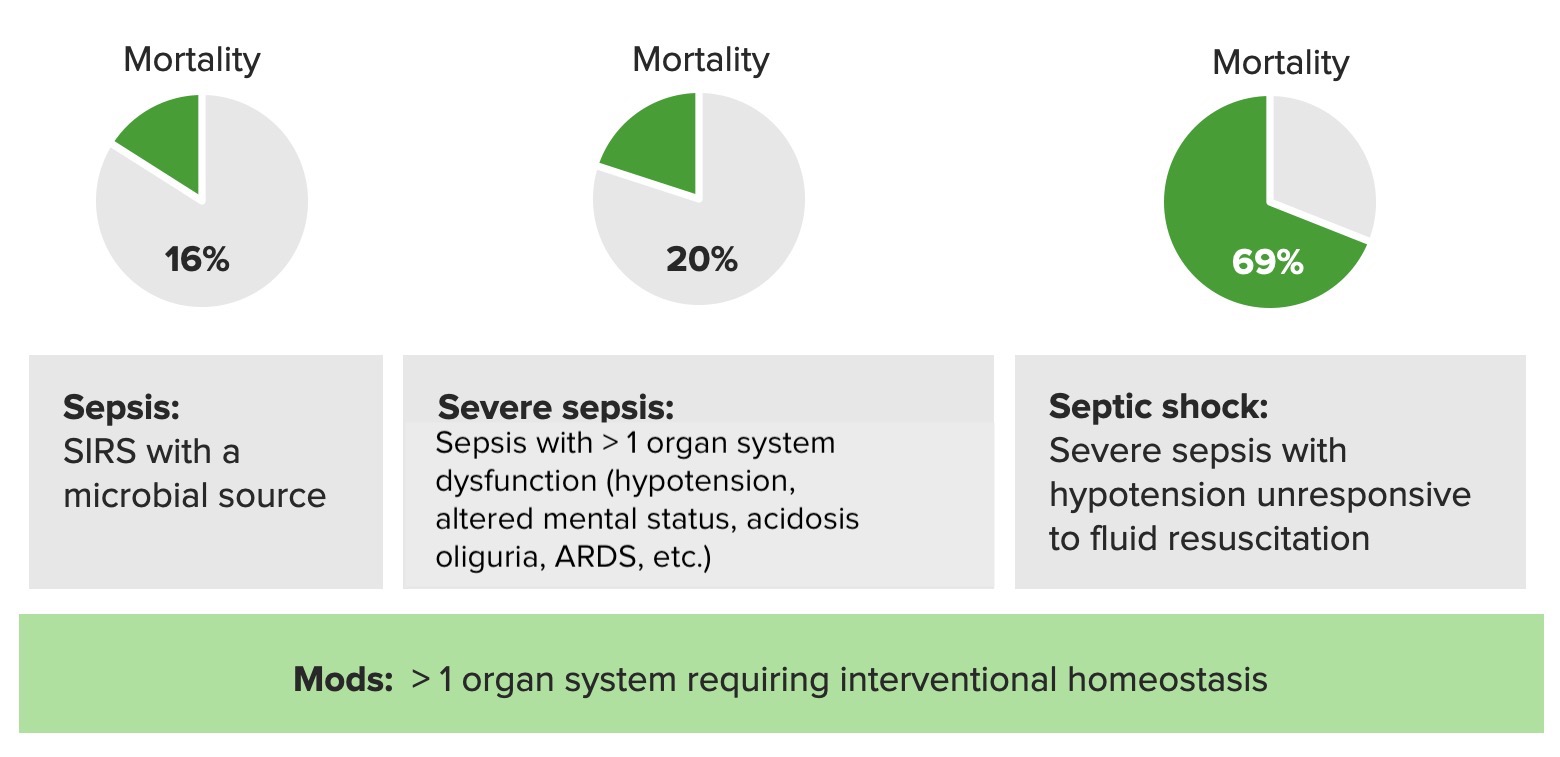
Taxas de mortalidade em choque

Taxas de mortalidade da sépsis, sépsis grave e choque séptico:
SIRS: síndrome de resposta inflamatória sistémica
ARDS: síndrome de dificuldade respiratória aguda

Imagem por Lecturio.

Epidemiologia e Etiologia

Epidemiologia

  • A incidência de sépsis está inversamente relacionada com a idade das crianças.
  • Neonatal:
    • Até 10% dos recém-nascidos têm uma infeção no primeiro mês de vida.
    • Mais MAIS Androgen Insensitivity Syndrome comum em crianças com um peso ao nascimento < 1.500 gramas
    • A transmissão de patogénios ocorre, mais MAIS Androgen Insensitivity Syndrome frequentemente, intraparto ou durante a passagem num canal de parto infetado.
    • A transmissão vertical tem ↓ devido à deteção e tratamento precoces do estreptococo do grupo B durante a gravidez
  • Lactentes e crianças:
    • Nos EUA, são hospitalizadas anualmente 75.000 crianças por sépsis grave.
    • 65% dos casos estão associados a infeções respiratórias ou da corrente sanguínea.
    • A incidência está a diminuir graças à imunização contra Streptococcus Streptococcus Streptococcus is one of the two medically important genera of gram-positive cocci, the other being Staphylococcus. Streptococci are identified as different species on blood agar on the basis of their hemolytic pattern and sensitivity to optochin and bacitracin. There are many pathogenic species of streptococci, including S. pyogenes, S. agalactiae, S. pneumoniae, and the viridans streptococci. Streptococcus pneumoniae e Haemophilus influenzae Haemophilus Influenzae A species of Haemophilus found on the mucous membranes of humans and a variety of animals. The species is further divided into biotypes I through viii. Haemophilus.

Fatores de risco

  • Neonatais:
    • Imaturidade imunológica
    • Exposição a patogénios do trato genital materno
    • Traumatismo do couro cabeludo durante o parto
    • Procedimentos invasivos (por exemplo, intubação endotraqueal prolongada, alimentação parentérica)
    • Poucas defesas mecânicas (por exemplo, pele facilmente erodível)
    • Microrganismos resistentes
  • Lactentes e crianças:
    • Idade < 1 mês
    • Lesão grave (por exemplo, traumatismo penetrante)
    • Patologias crónicas e debilitantes
    • Imunossupressão (por exemplo, infeção pelo VIH)
    • Grandes incisões cirúrgicas
    • Colocação de dispositivos invasivos (por exemplo, dreno torácico)
    • Infeções do trato urinário recorrentes

Etiologia

  • Recém-nascidos:
    • Bactérias mais MAIS Androgen Insensitivity Syndrome comuns:
      • Streptococcus Streptococcus Streptococcus is one of the two medically important genera of gram-positive cocci, the other being Staphylococcus. Streptococci are identified as different species on blood agar on the basis of their hemolytic pattern and sensitivity to optochin and bacitracin. There are many pathogenic species of streptococci, including S. pyogenes, S. agalactiae, S. pneumoniae, and the viridans streptococci. Streptococcus grupo B (em recém-nascidos)
      • S. agalactiae
      • MRSA MRSA A strain of Staphylococcus aureus that is non-susceptible to the action of methicillin. The mechanism of resistance usually involves modification of normal or the presence of acquired penicillin binding proteins. Staphylococcus
      • Escherichia coli Escherichia coli The gram-negative bacterium Escherichia coli is a key component of the human gut microbiota. Most strains of E. coli are avirulent, but occasionally they escape the GI tract, infecting the urinary tract and other sites. Less common strains of E. coli are able to cause disease within the GI tract, most commonly presenting as abdominal pain and diarrhea. Escherichia coli
      • Enterococcus Enterococcus Enterococcus is a genus of oval-shaped gram-positive cocci that are arranged in pairs or short chains. Distinguishing factors include optochin resistance and the presence of pyrrolidonyl arylamidase (PYR) and Lancefield D antigen. Enterococcus is part of the normal flora of the human GI tract. Enterococcus faecalis
    • Bactérias menos comuns:
      • S. pneumoniae
      • Pseudomonas aeruginosa Pseudomonas aeruginosa A species of gram-negative, aerobic, rod-shaped bacteria commonly isolated from clinical specimens (wound, burn, and urinary tract infections). It is also found widely distributed in soil and water. P. Aeruginosa is a major agent of nosocomial infection. Pseudomonas
      • Listeria Listeria Listeria spp. are motile, flagellated, gram-positive, facultative intracellular bacilli. The major pathogenic species is Listeria monocytogenes. Listeria are part of the normal gastrointestinal flora of domestic mammals and poultry and are transmitted to humans through the ingestion of contaminated food, especially unpasteurized dairy products. Listeria Monocytogenes/Listeriosis monocytogenes
      • Klebsiella Klebsiella Klebsiella are encapsulated gram-negative, lactose-fermenting bacilli. They form pink colonies on MacConkey agar due to lactose fermentation. The main virulence factor is a polysaccharide capsule. Klebsiella pneumoniae is the most important pathogenic species. Klebsiella
      • H. influenzae H. influenzae A species of Haemophilus found on the mucous membranes of humans and a variety of animals. The species is further divided into biotypes I through VIII. Haemophilus
      • Mycoplasma hominis Mycoplasma hominis A common inhabitant of the vagina and cervix and a potential human pathogen, causing infections of the male and female reproductive tracts. It has also been associated with respiratory disease and pharyngitis. Mycoplasma
    • Vírus:
      • Adenovírus
      • CMV
      • Enterovírus
      • Parechovírus
      • Vírus da hepatite B e C
      • HSV HSV Herpes simplex virus (HSV) is a double-stranded DNA virus belonging to the family Herpesviridae. Herpes simplex virus commonly causes recurrent infections involving the skin and mucosal surfaces, including the mouth, lips, eyes, and genitals. Herpes Simplex Virus 1 and 2
      • Vírus da imunodeficiência humana (VIH)
      • Parvovírus
      • Vírus da rubéola
      • Vírus da varicela zoster (VZV, pela sigla em inglês)
      • EBV EBV Epstein-barr virus (EBV) is a linear, double-stranded DNA virus belonging to the herpesviridae family. This highly prevalent virus is mostly transmitted through contact with oropharyngeal secretions from an infected individual. The virus can infect epithelial cells and B lymphocytes, where it can undergo lytic replication or latency. Epstein-Barr Virus (em indivíduos imunocomprometidos)
    • Fungos:
      • Candida Candida Candida is a genus of dimorphic, opportunistic fungi. Candida albicans is part of the normal human flora and is the most common cause of candidiasis. The clinical presentation varies and can include localized mucocutaneous infections (e.g., oropharyngeal, esophageal, intertriginous, and vulvovaginal candidiasis) and invasive disease (e.g., candidemia, intraabdominal abscess, pericarditis, and meningitis). Candida/Candidiasis spp.
      • Malassezia Malassezia Malassezia is a lipophilic yeast commonly found on the skin surfaces of many animals, including humans. In the presence of certain environments or triggers, this fungus can cause pathologic diseases ranging from superficial skin conditions (tinea versicolor and dermatitis) to invasive disease (e.g., Malassezia folliculitis, catheter-associated fungemia, meningitis, and urinary tract infections). Malassezia Fungi spp.
    • Protozoários:
      • Espécies de Plasmodium Plasmodium A genus of protozoa that comprise the malaria parasites of mammals. Four species infect humans (although occasional infections with primate malarias may occur). These are plasmodium falciparum; plasmodium malariae; plasmodium ovale, and plasmodium vivax. Species causing infection in vertebrates other than man include: plasmodium berghei; plasmodium chabaudi; p. Vinckei, and plasmodium yoelii in rodents; p. Brasilianum, plasmodium cynomolgi; and plasmodium knowlesi in monkeys; and plasmodium gallinaceum in chickens. Antimalarial Drugs
      • Toxoplasma Toxoplasma Toxoplasmosis is an infectious disease caused by Toxoplasma gondii, an obligate intracellular protozoan parasite. Felines are the definitive host, but transmission to humans can occur through contact with cat feces or the consumption of contaminated foods. The clinical presentation and complications depend on the host’s immune status. Toxoplasma/Toxoplasmosis gondii
      • Trypanosoma cruzi Trypanosoma cruzi Chagas disease is an infection caused by the American trypanosome Trypanosoma cruzi. This parasitic protozoan is transmitted in the feces of reduviid bugs in South and Central America. Acute infection may present with inflammation at the inoculation site (chagoma), fever, and lymphadenopathy. Untreated, chronic infection can progress to severe complications. Trypanosoma cruzi/Chagas disease
  • Lactentes e crianças:
    • E. coli
    • S. aureus S. aureus Potentially pathogenic bacteria found in nasal membranes, skin, hair follicles, and perineum of warm-blooded animals. They may cause a wide range of infections and intoxications. Staphylococcus
    • S. pneumoniae
    • H. Influenza Influenza Influenza viruses are members of the Orthomyxoviridae family and the causative organisms of influenza, a highly contagious febrile respiratory disease. There are 3 primary influenza viruses (A, B, and C) and various subtypes, which are classified based on their virulent surface antigens, hemagglutinin (HA) and neuraminidase (NA). Influenza typically presents with a fever, myalgia, headache, and symptoms of an upper respiratory infection. Influenza Viruses/Influenza tipo b
    • Neisseria meningitidis Neisseria meningitidis A species of gram-negative, aerobic bacteria. It is a commensal and pathogen only of humans, and can be carried asymptomatically in the nasopharynx. When found in cerebrospinal fluid it is the causative agent of cerebrospinal meningitis. It is also found in venereal discharges and blood. There are at least 13 serogroups based on antigenic differences in the capsular polysaccharides; the ones causing most meningitis infections being a, b, c, y, and w-135. Each serogroup can be further classified by serotype, serosubtype, and immunotype. Neisseria
    • Salmonela spp.
    • Vírus

Fisiopatologia

A capacidade do hospedeiro de resistir ao dano direto causado pelo patogénio e a resposta do sistema imune, determinam a evolução para o controlo da infeção ou para sépsis.

  • Reconhecimento antigénico → início da resposta imune inata → secreção de citocinas → ativação do complemento, do fator de ativação plaquetária, do ácido araquidónico e das vias inflamatórias, bem como libertação de NO
  • Ativação dos fatores da coagulação e fibrinólise → CID (coagulação intravascular disseminada)
  • Inflamação sistémica → vasodilatação generalizada com má perfusão orgânica metabolismo anaeróbio → acidose lática
  • ↓ Perfusão → síndrome de disfunção multiorgânica
  • Vasodilatação generalizada → hipovolemia relativa e, eventualmente, choque distributivo

Apresentação Clínica

Inespecífica

  • Dificuldade na alimentação
  • Alteração do comportamento
  • Letargia
  • Alteração do estado mental
  • ↑/↓ FC Fc Crystallizable fragments composed of the carboxy-terminal halves of both immunoglobulin heavy chains linked to each other by disulfide bonds. Fc fragments contain the carboxy-terminal parts of the heavy chain constant regions that are responsible for the effector functions of an immunoglobulin (complement fixation, binding to the cell membrane via fc receptors, and placental transport). This fragment can be obtained by digestion of immunoglobulins with the proteolytic enzyme papain. Immunoglobulins: Types and Functions
  • Hipotensão
  • Instabilidade térmica

Específica de um sistema orgânico

  • Circulatório
    • Má perfusão:
      • Palidez e cianose
      • ↑ Preenchimento capilar
      • Edema Edema Edema is a condition in which excess serous fluid accumulates in the body cavity or interstitial space of connective tissues. Edema is a symptom observed in several medical conditions. It can be categorized into 2 types, namely, peripheral (in the extremities) and internal (in an organ or body cavity). Edema
      • Desidratação
    • Choque séptico:
      • Choque “quente”:
        • Preenchimento capilar instantâneo
        • Pulsos palpáveis e aumentados (pressão de pulso ampla)
        • Extremidades quentes
      • Choque “frio”:
  • Digestivo:
    • Vómitos/diarreia
    • Distensão abdominal
    • Hepatomegalia
  • Respiratório:
    • ↑/↓ FR
    • Tiragem
    • Gemido
    • Adejo nasal
    • Dispneia
    • Cianose
    • Hipóxia (saturação < 90%)
  • Urológico:
    • Oligúria
    • Anúria
  • Neurológico:
    • Crises epiléticas ou tremores
    • Apatia
    • Irritabilidade
    • Letargia
    • Hipo/hipertonia
    • Hiperreflexia
    • Fontanela abaulada
    • Reflexo de Moro anormal
    • Respiração irregular
    • Choro agudo
  • Hematológico:
    • Icterícia
    • Hepatoesplenomegalia
    • Hemorragia
  • Dermatológico:
    • Manchas
    • Petéquias
    • Púrpura

Evolução clínica da sépsis neonatal

Tabela: Evolução clínica da sépsis neonatal
Fase inicial Fase séptica Fase tardia
  • Mau estado geral.
  • Dificuldade na alimentação
  • Letargia
  • Taquicardia inexplicável
  • Sintomas gastrointestinais
  • Sintomas respiratórios
  • Sinais neurológicos
  • Sintomas urológicos
  • Colapso circulatório
  • Sinais hematológicos

Diagnóstico

Avaliação laboratorial

  • Hemograma:
    • ↑/↓ Contagem de leucócitos
    • ↓ Contagem de plaquetas
    • ↑ Blastos
  • Eletrólitos:
    • ↓ Na
    • ↓/↑ K
    • ↓ Fósforo
    • ↓ Glicose por ↑ das necessidades metabólicas e ↓ da ingestão calórica
    • Creatinina sérica e BUN: azotemia Azotemia A biochemical abnormality referring to an elevation of blood urea nitrogen and creatinine. Azotemia can be produced by kidney diseases or other extrarenal disorders. When azotemia becomes associated with a constellation of clinical signs, it is termed uremia. Acute Kidney Injury pré-renal por LRA
  • Gases sanguíneos:
    • Acidose metabólica
    • ↑ Ácido lático: forte preditor da mortalidade
    • Hipoxemia
  • Bilirrubina total:
    • ↑ (> 4 mg/dL) ALT ALT An enzyme that catalyzes the conversion of l-alanine and 2-oxoglutarate to pyruvate and l-glutamate. Liver Function Tests
    • O ↑ das transaminases Transaminases A subclass of enzymes of the transferase class that catalyze the transfer of an amino group from a donor (generally an amino acid) to an acceptor (generally a 2-keto acid). Most of these enzymes are pyridoxyl phosphate proteins. Autoimmune Hepatitis pode ser indicativo da presença de disfunção hepática, ou de infeção pelo HSV HSV Herpes simplex virus (HSV) is a double-stranded DNA virus belonging to the family Herpesviridae. Herpes simplex virus commonly causes recurrent infections involving the skin and mucosal surfaces, including the mouth, lips, eyes, and genitals. Herpes Simplex Virus 1 and 2 ou enterovírus
  • Hemoculturas x 2 para a identificação do agente causador
  • PT, PTT e INR por distúrbios na coagulação
  • ↓ Fibrinogénio
  • ↑ D-dímero: CID
  • Urinálise e cultura

Imagiologia diagnóstica

  • Radiografia de tórax: na suspeita de pneumonia Pneumonia Pneumonia or pulmonary inflammation is an acute or chronic inflammation of lung tissue. Causes include infection with bacteria, viruses, or fungi. In more rare cases, pneumonia can also be caused through toxic triggers through inhalation of toxic substances, immunological processes, or in the course of radiotherapy. Pneumonia ou sobrecarga de fluidos
  • Ecografia ou tomografia computadorizada do abdómen: +/- se a etiologia for desconhecida
  • TC de crânio: em indivíduos com coagulopatia e alteração do estado mental

Tratamento e Prevenção

Tratamento

  • Inicia-se com a estabilização do indivíduo
  • Objetivos do tratamento dirigido:
    • Acesso IV em 5 minutos
    • Ressuscitação volémica em 30 minutos
    • Antibioterapia de largo espectro em 60 minutos
    • Infusão inotrópica dentro de 60 minutos (no choque refratário a fluidos)
    • Reavaliação periódica de:
      • Pulsos centrais e periféricos
      • Perfusão cutânea (preenchimento capilar e temperatura da pele)
      • Estado volémico
      • Débito urinário (> 1 mL/kg/hora)
      • Pressão arterial sistólica
      • Estado mental
      • Níveis séricos de lactato
      • Saturação venosa central de oxigénio (ScvO₂)
  • Objetivos da ressuscitação:
    • Pressão arterial média > 65 mmHg
    • Débito urinário > 0,5 mL/kg/hora
    • Pressão venosa central (PVC) 8–10 mmHg
    • ScvO₂ > 70% ou SvO₂ > 65%
  • Opções terapêuticas:
    • Soluções IV isotónicas: bólus inicial de 20 cc/kg em crianças mais MAIS Androgen Insensitivity Syndrome velhas, na ausência de patologia renal ou cardíaca
    • Vasopressores (por exemplo, noradrenalina, adrenalina)
    • Tratamento inotrópico (por exemplo, adrenalina, dopamina)
    • Cálculo da taxa de infusão: dose/volume de diluição/peso da criança/tempo de infusão

Antibioterapia

  • Deve ser iniciada o quanto antes.
    • Na 1ª hora de apresentação (golden hour)
    • Depois da obtenção de amostras para cultura
  • Inicialmente com antibióticos empíricos de largo espectro; com ajuste após a obtenção dos resultados das culturas e antibiogramas
  • Fatores a considerar:
    • Idade
    • História clínica
    • Comorbilidades
    • Situação clínica
    • Tipo de infeção
    • Resultados da coloração de Gram
  • Opções de antibioterapia:
    • <28 semanas: ampicilina (50 mg/kg) ou vancomicina (15 mg/kg) + cefotaxima (100 mg/kg) + gentamicina (2,5 mg/kg) e aciclovir (20 mg/kg) na suspeita de infeção por HSV HSV Herpes simplex virus (HSV) is a double-stranded DNA virus belonging to the family Herpesviridae. Herpes simplex virus commonly causes recurrent infections involving the skin and mucosal surfaces, including the mouth, lips, eyes, and genitals. Herpes Simplex Virus 1 and 2
    • > 28 semanas:
      • Vancomicina (15 mg/kg) + ceftriaxona (75 mg/kg) ou cefotaxima (100 mg/kg)
      • Na imunossupressão: vancomicina (15 mg/kg) + cefepima (75 mg/kg) ou meropenem Meropenem A thienamycin derivative antibacterial agent that is more stable to renal dehydropeptidase I than imipenem, but does not need to be given with an enzyme inhibitor such as cilastatin. It is used in the treatment of bacterial infections, including infections in immunocompromised patients. Carbapenems and Aztreonam (20 mg/kg)
    • Nas crianças que não podem realizar penicilina: vancomicina (15 mg/kg) + meropenem Meropenem A thienamycin derivative antibacterial agent that is more stable to renal dehydropeptidase I than imipenem, but does not need to be given with an enzyme inhibitor such as cilastatin. It is used in the treatment of bacterial infections, including infections in immunocompromised patients. Carbapenems and Aztreonam (20 mg/kg) ou aztreonam Aztreonam The carbapenems and aztreonam are both members of the bactericidal beta-lactam family of antibiotics (similar to penicillins). They work by preventing bacteria from producing their cell wall, ultimately leading to bacterial cell death. Carbapenems and Aztreonam (90–120 mg/kg/dia) + clindamicina (40 mg/kg)
    • Nas crianças com infeções fúngicas: anfotericina B + caspofungina

Prevenção

  • Cumprir o calendário vacinal para prevenir infeções.
  • Limitar a utilização de cateteres invasivos.
  • Rastreio dos potenciais patogénios durante a gravidez e tratamento antes do nascimento.
  • Pesquisar a presença de colonização por Streptococcus Streptococcus Streptococcus is one of the two medically important genera of gram-positive cocci, the other being Staphylococcus. Streptococci are identified as different species on blood agar on the basis of their hemolytic pattern and sensitivity to optochin and bacitracin. There are many pathogenic species of streptococci, including S. pyogenes, S. agalactiae, S. pneumoniae, and the viridans streptococci. Streptococcus grupo B às 35-37 semanas de gestação, através de uma zaragatoa retovaginal, bem como realizar uma avaliação serológica para:
    • VIH
    • Sífilis
    • Antigénio de superfície da hepatite B
    • C. trachomatis
    • N.  gonorrhea Gonorrhea Gonorrhea is a sexually transmitted infection (STI) caused by the gram-negative bacteria Neisseria gonorrhoeae (N. gonorrhoeae). Gonorrhea may be asymptomatic but commonly manifests as cervicitis or urethritis with less common presentations such as proctitis, conjunctivitis, or pharyngitis. Gonorrhea
    • Nas mulheres de alto risco, rastreio de anticorpos contra a hepatite C

Related videos

Diagnóstico Diferencial

  • Meningite pediátrica: inflamação das meninges Meninges The brain and the spinal cord are enveloped by 3 overlapping layers of connective tissue called the meninges. The layers are, from the most external layer to the most internal layer, the dura mater, arachnoid mater, and pia mater. Between these layers are 3 potential spaces called the epidural, subdural, and subarachnoid spaces. Meninges: Anatomy, que pode ser fatal. Múltiplos microrganismos são responsáveis pela meningite. Os sintomas variam de acordo com a idade, desde fontanelas abauladas em lactentes a rigidez da nuca em crianças mais MAIS Androgen Insensitivity Syndrome velhas. Também podem estar presentes febre, cefaleia, letargia e vómitos. O diagnóstico é realizado através de uma punção lombar. O tratamento é com antibióticos.
  • Insuficiência da suprarrenal pediátrica: caracterizada como primária (o problema está na suprarrenal) e central (disfunção hipotálamo-hipofisária), podendo ser congénita ou adquirida. Os indivíduos afetados apresentam hipovolemia, hipoglicemia, hiponatremia e hipercalemia. O diagnóstico é confirmado através de exames laboratoriais. O tratamento é com solução salina e dextrose Dextrose Intravenous Fluids para regular Regular Insulin os eletrólitos.
  • Enterocolite necrotisante: uma doença GI caracterizada pela necrose de uma parte do intestino. Comum em prematuros e recém-nascidos com mau estado geral. Os lactentes apresentam-se com dificuldade na alimentação, distensão abdominal e sinais de sépsis. Esta patologia é diagnosticada através de uma radiografia abdominal. A realização precoce do diagnóstico e da administração de antibióticos pode melhorar os resultados. Pode ser necessária uma intervenção cirúrgica.
  • Choque cardiogénico: patologia que ocorre quando há um colapso da circulação secundário ao insulto cardíaco. Os indivíduos afetados apresentam-se com taquicardia, hepatomegalia, galopes, sopros, palpação de impulsos precordiais e distensão venosa jugular. A avaliação laboratorial auxilia o diagnóstico. A radiografia de tórax e a monitorização do débito cardíaco são úteis. O tratamento envolve a manutenção da via aérea, oxigenação, ventilação e circulação.
  • Pericardite infecciosa pediátrica: infeção do pericárdio por bactérias, vírus ou fungos. Os indivíduos afetados apresentam febre e toracalgia que agrava com a palpação do esterno e podem ter uma síndrome prodrómica. A pericardite infecciosa pediátrica pode provocar um derrame pericárdico ou tamponamento cardíaco e morte. A avaliação laboratorial e imagiológica cardíacas auxiliam no diagnóstico. O tratamento envolve o controlo da dor e antibioterapia ou pericardiocentese.
  • Acidose metabólica pediátrica: distúrbio ácido-base que resulta das concentrações séricas baixas de HCO3 ou elevadas de hidrogénio. Várias etiologias podem dar origem a esta patologia, incluindo hipovolemia, ingestão de tóxicos, erros inatos do metabolismo, insuficiência cardíaca, cetoacidose diabética, insuficiência renal crónica e sépsis. A identificação e tratamento da etiologia subjacente é importante para a resolução desta patologia.

Referências

  1. Butt, W. (2001). Septic shock. Pediatric Clinics of North America, 48(3), 601.
  2. Haslam, D.B. (2020). Epidemiology of infections. In R.M. Kliegman MD, J.W. St Geme MD, N.J. Blum MD, Shah, Samir S., MD, MSCE, Tasker, Robert C., MBBS, MD, Wilson, Karen M., MD, MPH (Eds.), Nelson Textbook of Pediatrics (pp. 99–1005.e1)
  3. Mathias, B., Mira, J.C., Larson, S.D. (2016). Pediatric sepsis. Current Opinion in Pediatrics, 28(3), 380–387.
  4. Pasman, E.A. (2021). Shock in Pediatrics Treatment & Management: Approach Considerations, Initial Resuscitation, Glucose and Calcium Stabilization. Medscape. Retrieved August 8, 2021, from https://emedicine.medscape.com/article/1833578-treatment
  5. Rhodes, A., Evans, L.E., Alhazzani, W., Levy, M.M., Antonelli, M., Ferrer, R., Dellinger, R.P. (2017). Surviving sepsis campaign: international guidelines for the management of sepsis and septic shock. Intensive Care Medicine, 43(3), 304–377.
  6. Santhanam, S. (2021). Pediatric Sepsis: Practice Essentials, Background, Pathophysiology. Medscape. Retrieved August 8, 2021, from https://emedicine.medscape.com/article/972559-overview
  7. Sarmin, M., Afroze, F., Sharifuzzaman, Alam, T., Shaly, N.J., Ahmed, T., Chisti, M.J. (2019). Predictor of death in diarrheal children under 5 years of age having severe sepsis in an urban critical care ward in Bangladesh. Global Pediatric Health, 6, 2333794X19862716.
  8. Mathias, B., Mira, J.C., Larson, S.D. (2016). Pediatric sepsis. Current Opinion in Pediatrics, 28(3), 380–387.
  9. Wood, B.P. (2020). Necrotizing Enterocolitis Imaging: Practice Essentials, Radiography, Ultrasonography. Medscape. Retrieved August 8, 2021, from https://emedicine.medscape.com/article/411616-overview

Crie sua conta gratuita ou faça login para continuar lendo!

Cadastre-se agora e tenha acesso grátis ao Lecturio, com páginas de conceitos, vídeos de medicina e questões para sua educação médica.

Aprende mais com a Lecturio:

Multiple devices displaying human anatomy and health education content.

Complementa o teu estudo da faculdade com o companheiro de estudo tudo-em-um da Lecturio, através de métodos de ensino baseados em evidência.

Estuda onde quiseres

Two iPhones display medical education apps, one showing anatomy, the other Bookmatcher.

A Lecturio Medical complementa o teu estudo através de métodos de ensino baseados em evidência, vídeos de palestras, perguntas e muito mais – tudo combinado num só lugar e fácil de usar.

User Reviews

Have a holly, jolly study session 🎁 Save 50% on all plans now >>

Que tengas una sesión de estudio alegre y navideña 🎁 Ahorra 50% en todos los planes >>

Details