La endocarditisEndocarditisEndocarditis is an inflammatory disease involving the inner lining (endometrium) of the heart, most commonly affecting the cardiac valves. Both infectious and noninfectious etiologies lead to vegetations on the valve leaflets. Patients may present with nonspecific symptoms such as fever and fatigue. Endocarditis es una enfermedad inflamatoria que afecta alALAmyloidosis revestimiento interno (endocardio) del corazón y que suele afectar a las válvulas cardíacas. Tanto las etiologías infecciosas como las no infecciosas dan lugar a vegetaciones enENErythema nodosum is an immune-mediated panniculitis (inflammation of the subcutaneous fat) caused by a type IV (delayed-type) hypersensitivity reaction. It commonly manifests in young women as tender, erythematous nodules on the shins.Erythema Nodosum las valvas de la válvula. LosLOSNeisseria pacientes pueden presentar síntomas inespecíficos como fiebre y fatiga. LosLOSNeisseria hallazgos importantes del examen clínico incluyen un soplo cardíaco nuevo o modificado y signos extracardíacos comunes, como losLOSNeisseria nódulos de Osler, las lesiones de Janeway, las hemorragias enENErythema nodosum is an immune-mediated panniculitis (inflammation of the subcutaneous fat) caused by a type IV (delayed-type) hypersensitivity reaction. It commonly manifests in young women as tender, erythematous nodules on the shins.Erythema Nodosum astilla y las manchas de Roth. El diagnóstico se basa enENErythema nodosum is an immune-mediated panniculitis (inflammation of the subcutaneous fat) caused by a type IV (delayed-type) hypersensitivity reaction. It commonly manifests in young women as tender, erythematous nodules on the shins.Erythema NodosumlosLOSNeisseria hallazgos clínicos, losLOSNeisseria hemocultivos y la ecocardiografía que muestra las vegetaciones valvulares. El tratamiento incluye antibióticos intravenosos para losLOSNeisseria casos infecciosos, el tratamiento de la etiología subyacente para losLOSNeisseria casos no infecciosos y la reparación quirúrgica cuando sea necesaria.
La endocarditisEndocarditisEndocarditis is an inflammatory disease involving the inner lining (endometrium) of the heart, most commonly affecting the cardiac valves. Both infectious and noninfectious etiologies lead to vegetations on the valve leaflets. Patients may present with nonspecific symptoms such as fever and fatigue. Endocarditis infecciosa es causada por la infección o la inflamación del revestimiento interno del corazón (endocardio), que suele afectar a las válvulas cardíacas.
La endocarditisEndocarditisEndocarditis is an inflammatory disease involving the inner lining (endometrium) of the heart, most commonly affecting the cardiac valves. Both infectious and noninfectious etiologies lead to vegetations on the valve leaflets. Patients may present with nonspecific symptoms such as fever and fatigue. Endocarditis no infecciosa es el resultado de la formación de trombos de plaquetas y fibrina estériles enENErythema nodosum is an immune-mediated panniculitis (inflammation of the subcutaneous fat) caused by a type IV (delayed-type) hypersensitivity reaction. It commonly manifests in young women as tender, erythematous nodules on the shins.Erythema Nodosum las válvulas cardíacas y el endocardio.
Epidemiología
EndocarditisEndocarditisEndocarditis is an inflammatory disease involving the inner lining (endometrium) of the heart, most commonly affecting the cardiac valves. Both infectious and noninfectious etiologies lead to vegetations on the valve leaflets. Patients may present with nonspecific symptoms such as fever and fatigue. Endocarditis infecciosa:
La forma más común de endocarditisEndocarditisEndocarditis is an inflammatory disease involving the inner lining (endometrium) of the heart, most commonly affecting the cardiac valves. Both infectious and noninfectious etiologies lead to vegetations on the valve leaflets. Patients may present with nonspecific symptoms such as fever and fatigue. Endocarditis
Incidencia: 11–15 casos por cada 100 000 personas alALAmyloidosis año
Edad media: 60,8 años (> 50% tienen > 50 años)
3 veces más frecuente enENErythema nodosum is an immune-mediated panniculitis (inflammation of the subcutaneous fat) caused by a type IV (delayed-type) hypersensitivity reaction. It commonly manifests in young women as tender, erythematous nodules on the shins.Erythema NodosumlosLOSNeisseria hombres
EndocarditisEndocarditisEndocarditis is an inflammatory disease involving the inner lining (endometrium) of the heart, most commonly affecting the cardiac valves. Both infectious and noninfectious etiologies lead to vegetations on the valve leaflets. Patients may present with nonspecific symptoms such as fever and fatigue. Endocarditis no infecciosa:
Rara
A menudo se encuentra enENErythema nodosum is an immune-mediated panniculitis (inflammation of the subcutaneous fat) caused by a type IV (delayed-type) hypersensitivity reaction. It commonly manifests in young women as tender, erythematous nodules on the shins.Erythema Nodosum la autopsia
Incidencia: 0,9%–1,6%
Grupo de edad común: 30–70 años
No hay predilección por el sexo
Etiologías de la endocarditisEndocarditisEndocarditis is an inflammatory disease involving the inner lining (endometrium) of the heart, most commonly affecting the cardiac valves. Both infectious and noninfectious etiologies lead to vegetations on the valve leaflets. Patients may present with nonspecific symptoms such as fever and fatigue. Endocarditis infecciosa
La endocarditisEndocarditisEndocarditis is an inflammatory disease involving the inner lining (endometrium) of the heart, most commonly affecting the cardiac valves. Both infectious and noninfectious etiologies lead to vegetations on the valve leaflets. Patients may present with nonspecific symptoms such as fever and fatigue. Endocarditis infecciosa puede estar causada por numerosos organismos; la lista que figura a continuación no es exhaustiva.
Estafilococos:
Staphylococcus aureusStaphylococcus aureusPotentially pathogenic bacteria found in nasal membranes, skin, hair follicles, and perineum of warm-blooded animals. They may cause a wide range of infections and intoxications.Brain Abscess (más común)
S. epidermidisS. epidermidisA species of staphylococcus that is a spherical, non-motile, gram-positive, chemoorganotrophic, facultative anaerobe. Mainly found on the skin and mucous membrane of warm-blooded animals, it can be primary pathogen or secondary invader.Staphylococcus
Estreptococos:
Streptococcus viridansStreptococcus viridansA large heterogeneous group of mostly alpha-hemolytic streptococci. They colonize the respiratory tract at birth and generally have a low degree of pathogenicity. This group of species includes Streptococcus mitis; Streptococcus mutans; Streptococcus oralis; Streptococcus sanguis; Streptococcus sobrinus; and the Streptococcus milleri group. The latter are often beta-hemolytic and commonly produce invasive pyogenic infections including brain and abdominal abscesses.Brain Abscess (comúnmente después de procedimientos dentales)
S. pneumoniae
StreptococcusStreptococcusStreptococcus is one of the two medically important genera of gram-positive cocci, the other being Staphylococcus. Streptococci are identified as different species on blood agar on the basis of their hemolytic pattern and sensitivity to optochin and bacitracin. There are many pathogenic species of streptococci, including S. pyogenes, S. agalactiae, S. pneumoniae, and the viridans streptococci.Streptococcus gallolyticus (anteriormente S. bovis; asociado con el cáncer colorrectal)
Grupo HACEK:
Haemophilus
Actinobacillus (ahora conocido como Aggregatibacter)
Cardiobacterium
Eikenella
Kingella
Otras causas bacterianas:
EnterococcusEnterococcusEnterococcus is a genus of oval-shaped gram-positive cocci that are arranged in pairs or short chains. Distinguishing factors include optochin resistance and the presence of pyrrolidonyl arylamidase (PYR) and Lancefield D antigen. Enterococcus is part of the normal flora of the human GI tract.Enterococcus
Coxellia burnetii
BrucellaBrucellaBrucellosis (also known as undulant fever, Mediterranean fever, or Malta fever) is a zoonotic infection that spreads predominantly through ingestion of unpasteurized dairy products or direct contact with infected animal products. Clinical manifestations include fever, arthralgias, malaise, lymphadenopathy, and hepatosplenomegaly. Brucella/Brucellosis
BartonellaBartonellaBartonella is a genus of gram-negative bacteria in the family Bartonellaceae. As a facultative intracellular parasite, Bartonella can infect healthy people as well as act as an opportunistic pathogen. Bartonella species are transmitted by vectors such as ticks, fleas, sandflies, and mosquitoes. B. henselae is the most common of the 3 species known to cause human disease.Bartonella
Hongos:
Candida albicansCandida albicansA unicellular budding fungus which is the principal pathogenic species causing candidiasis (moniliasis).Candida/Candidiasis
AspergillusAspergillusA genus of mitosporic fungi containing about 100 species and eleven different teleomorphs in the family trichocomaceae.Echinocandins
Etiologías de endocarditisEndocarditisEndocarditis is an inflammatory disease involving the inner lining (endometrium) of the heart, most commonly affecting the cardiac valves. Both infectious and noninfectious etiologies lead to vegetations on the valve leaflets. Patients may present with nonspecific symptoms such as fever and fatigue. Endocarditis no infecciosas
EndocarditisEndocarditisEndocarditis is an inflammatory disease involving the inner lining (endometrium) of the heart, most commonly affecting the cardiac valves. Both infectious and noninfectious etiologies lead to vegetations on the valve leaflets. Patients may present with nonspecific symptoms such as fever and fatigue. Endocarditis de Libman-Sacks:
Debido a losLOSNeisseria complejos inmunes circulantes
Asociado con:
Lupus eritematoso sistémico
Síndrome antifosfolípido
Afecta a la válvula mitral > aórtica
EndocarditisEndocarditisEndocarditis is an inflammatory disease involving the inner lining (endometrium) of the heart, most commonly affecting the cardiac valves. Both infectious and noninfectious etiologies lead to vegetations on the valve leaflets. Patients may present with nonspecific symptoms such as fever and fatigue. Endocarditis trombótica (marántica):
Malignidad (debido a metástasis que penetran enENErythema nodosum is an immune-mediated panniculitis (inflammation of the subcutaneous fat) caused by a type IV (delayed-type) hypersensitivity reaction. It commonly manifests in young women as tender, erythematous nodules on the shins.Erythema Nodosum las válvulas del corazón)
Estados hipercoagulables
Enfermedad de desgaste crónico
Infecciones crónicas (e.g., tuberculosisTuberculosisTuberculosis (TB) is an infectious disease caused by Mycobacterium tuberculosis complex bacteria. The bacteria usually attack the lungs but can also damage other parts of the body. Approximately 30% of people around the world are infected with this pathogen, with the majority harboring a latent infection. Tuberculosis spreads through the air when a person with active pulmonary infection coughs or sneezes. Tuberculosis)
EndocarditisEndocarditisEndocarditis is an inflammatory disease involving the inner lining (endometrium) of the heart, most commonly affecting the cardiac valves. Both infectious and noninfectious etiologies lead to vegetations on the valve leaflets. Patients may present with nonspecific symptoms such as fever and fatigue. Endocarditis reumática:
Por reacción antígeno-anticuerpo tras una faringitis por estreptococo del grupo A
Afecta a la válvula mitral > aórtica
EndocarditisEndocarditisEndocarditis is an inflammatory disease involving the inner lining (endometrium) of the heart, most commonly affecting the cardiac valves. Both infectious and noninfectious etiologies lead to vegetations on the valve leaflets. Patients may present with nonspecific symptoms such as fever and fatigue. Endocarditis de Löffler:
Debida a la infiltración eosinofílica y alALAmyloidosis daño tisular
Traumatismos iatrogénicos enENErythema nodosum is an immune-mediated panniculitis (inflammation of the subcutaneous fat) caused by a type IV (delayed-type) hypersensitivity reaction. It commonly manifests in young women as tender, erythematous nodules on the shins.Erythema Nodosum las válvulas cardíacas
Otras afecciones autoinmunes (poco frecuentes):
Enfermedad de Behcet
Artritis reumatoide
Esclerodermia sistémica
VasculitisVasculitisInflammation of any one of the blood vessels, including the arteries; veins; and rest of the vasculature system in the body.Systemic Lupus Erythematosus
LosLOSNeisseria siguientes son factores de riesgo para la endocarditisEndocarditisEndocarditis is an inflammatory disease involving the inner lining (endometrium) of the heart, most commonly affecting the cardiac valves. Both infectious and noninfectious etiologies lead to vegetations on the valve leaflets. Patients may present with nonspecific symptoms such as fever and fatigue. Endocarditis infecciosa:
Enfermedades cardíacas:
Cardiopatía reumática
Anomalías valvulares
Defectos congénitos
Presencia de una válvula protésica
Edad > 60 años
Uso de drogas por vía intravenosa (afecta más comúnmente a la válvula tricúspide)
Dentición deficiente
Dispositivos o catéteres implantados
Inmunosupresión
Antecedentes de endocarditisEndocarditisEndocarditis is an inflammatory disease involving the inner lining (endometrium) of the heart, most commonly affecting the cardiac valves. Both infectious and noninfectious etiologies lead to vegetations on the valve leaflets. Patients may present with nonspecific symptoms such as fever and fatigue. Endocarditis
EndocarditisEndocarditisEndocarditis is an inflammatory disease involving the inner lining (endometrium) of the heart, most commonly affecting the cardiac valves. Both infectious and noninfectious etiologies lead to vegetations on the valve leaflets. Patients may present with nonspecific symptoms such as fever and fatigue. Endocarditis infecciosa
Factores predisponentes:
Anomalía o lesión del endocardio
Bacteriemia
Endotelio dañado → depósito de plaquetas y fibrina → adhesión de microorganismos
Proliferación e invasión de organismos → inflamación → desarrollo de la vegetación → destrucción de la válvula
Liberación de émbolos sépticos → complicaciones embólicas y/o infección metastásica
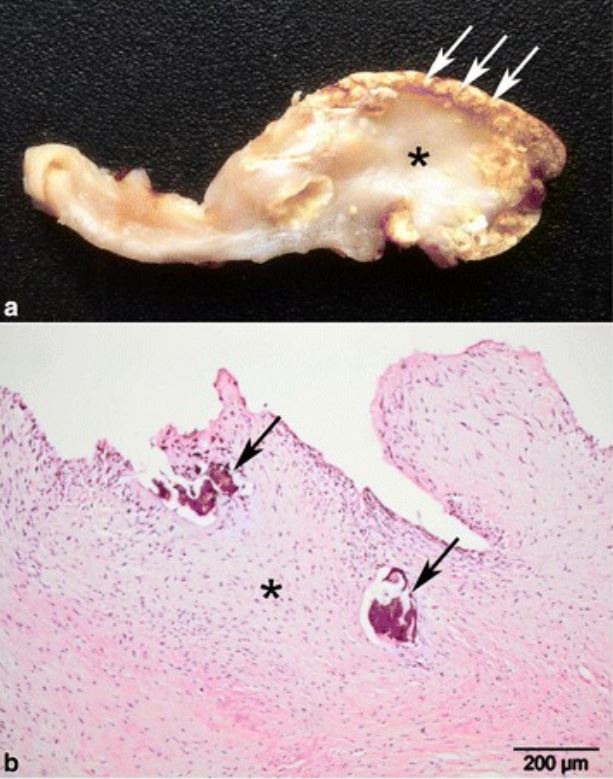
Especímenes de patología de un paciente con endocarditis crónica fibrosa calcificada bovina: a: patología macroscópica que muestra una extensa fibrosis y engrosamiento del estroma (*) y una calcificación superficial generalizada (flechas) b: histopatología de la lesión, mostrando fibrosis extensa (*) y áreas de calcificación (flechas)
EndocarditisEndocarditisEndocarditis is an inflammatory disease involving the inner lining (endometrium) of the heart, most commonly affecting the cardiac valves. Both infectious and noninfectious etiologies lead to vegetations on the valve leaflets. Patients may present with nonspecific symptoms such as fever and fatigue. Endocarditis no infecciosa
Lesión endotelial enENErythema nodosum is an immune-mediated panniculitis (inflammation of the subcutaneous fat) caused by a type IV (delayed-type) hypersensitivity reaction. It commonly manifests in young women as tender, erythematous nodules on the shins.Erythema Nodosum las valvas de la válvula debido a:
Trauma
Complejos inmunes circulantes
Citoquinas
Reacciones antígeno-anticuerpo
Se produce la activación y el depósito de plaquetas (a menudo durante un estado de hipercoagulabilidad).
El trombo está entrelazado con:
Fibrina
Complejos inmunitarios
Células mononucleares
Las vegetaciones se desprenden fácilmente → complicaciones embólicas
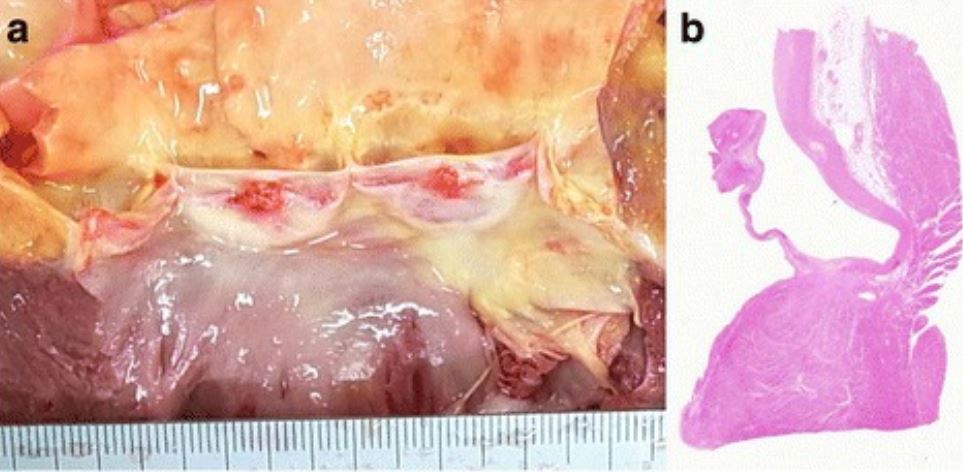
Vegetaciones de la válvula aórtica en la autopsia: a: El aspecto macroscópico de la válvula aórtica demuestra 2 vegetaciones de 4 mm y 5 mm de diámetro. b: La evaluación histológica muestra que las vegetaciones consisten en fibrina sin colonias bacterianas, lo que es consistente con una endocarditis no infecciosa.
Imagen: “Newly recognized cerebral infarctions on postmortem imaging: a report of three cases with systemic infectious disease” por BMC Medical Imaging. Licencia: CC BY 4.0
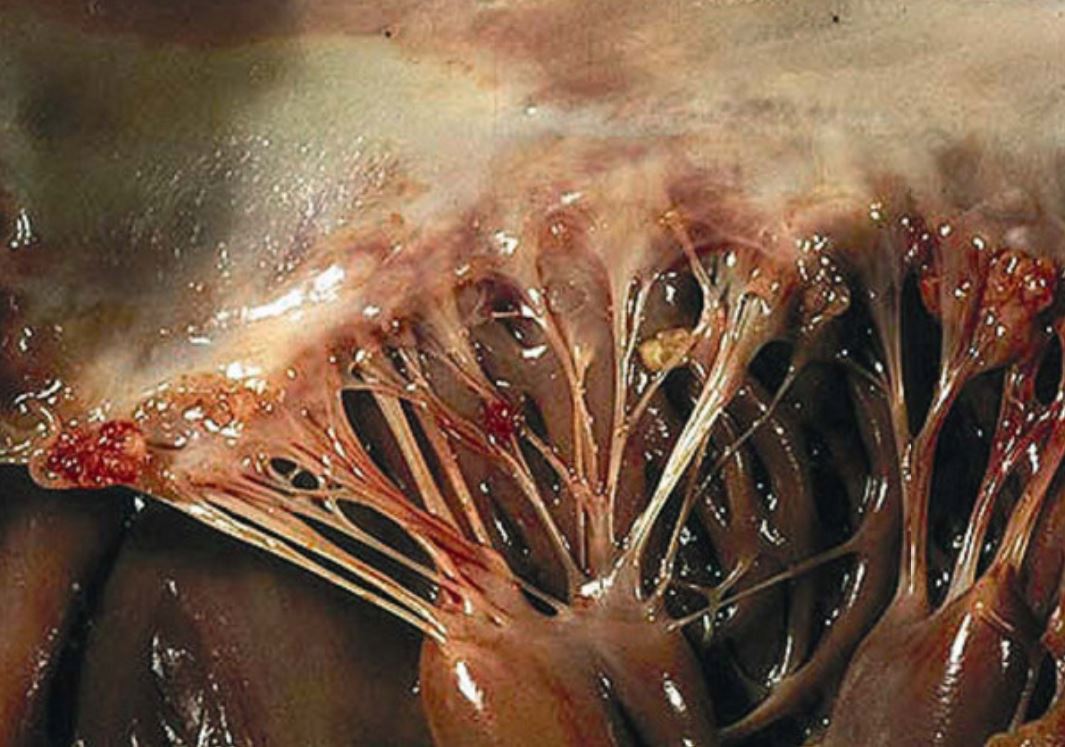
Vegetaciones verrugosas observadas en la endocarditis de Libman-Sacks de la válvula mitral: Las vegetaciones estériles suelen tener una morfología verrugosa. Las vegetaciones pueden encontrarse cerca del borde de las valvas a lo largo de la línea de cierre, tanto en el lado auricular como en el ventricular de las valvas, e incluso pueden encontrarse en las cuerdas y el endocardio. En este caso, hay varios microtrombos en el borde libre de la valva y en las cuerdas.
Imagen: “Mitral valve surgery for mitral regurgitation caused by Libman-Sacks endocarditis: a report of four cases and a systematic review of the literature” por Bouma, W., et al. Licencia: CC BY 2.0
La endocarditisEndocarditisEndocarditis is an inflammatory disease involving the inner lining (endometrium) of the heart, most commonly affecting the cardiac valves. Both infectious and noninfectious etiologies lead to vegetations on the valve leaflets. Patients may present with nonspecific symptoms such as fever and fatigue. Endocarditis infecciosa puede clasificarse además enENErythema nodosum is an immune-mediated panniculitis (inflammation of the subcutaneous fat) caused by a type IV (delayed-type) hypersensitivity reaction. It commonly manifests in young women as tender, erythematous nodules on the shins.Erythema Nodosum función de la evolución clínica, el tipo de válvula y la localización.
Según su curso clínico
EndocarditisEndocarditisEndocarditis is an inflammatory disease involving the inner lining (endometrium) of the heart, most commonly affecting the cardiac valves. Both infectious and noninfectious etiologies lead to vegetations on the valve leaflets. Patients may present with nonspecific symptoms such as fever and fatigue. Endocarditis infecciosa aguda:
Aparición más repentina de losLOSNeisseria síntomas
Progresa más rápidamente
Vegetación de mayor tamaño
Afecta más comúnmente a las válvulas normales
Fatal si no se trata a tiempo
La causa más común es el S. aureusS. aureusPotentially pathogenic bacteria found in nasal membranes, skin, hair follicles, and perineum of warm-blooded animals. They may cause a wide range of infections and intoxications.Staphylococcus.
EndocarditisEndocarditisEndocarditis is an inflammatory disease involving the inner lining (endometrium) of the heart, most commonly affecting the cardiac valves. Both infectious and noninfectious etiologies lead to vegetations on the valve leaflets. Patients may present with nonspecific symptoms such as fever and fatigue. Endocarditis infecciosa subaguda (endocarditisEndocarditisEndocarditis is an inflammatory disease involving the inner lining (endometrium) of the heart, most commonly affecting the cardiac valves. Both infectious and noninfectious etiologies lead to vegetations on the valve leaflets. Patients may present with nonspecific symptoms such as fever and fatigue. Endocarditis lenta):
Afecta más comúnmente a las válvulas congénitamente anormales o enfermas
LosLOSNeisseria pacientes pueden sobrevivir durante meses sin tratamiento.
La causa más común es S. viridans.
Según el tipo de válvula
EndocarditisEndocarditisEndocarditis is an inflammatory disease involving the inner lining (endometrium) of the heart, most commonly affecting the cardiac valves. Both infectious and noninfectious etiologies lead to vegetations on the valve leaflets. Patients may present with nonspecific symptoms such as fever and fatigue. Endocarditis de válvula nativa:
Además, se subdivide enENErythema nodosum is an immune-mediated panniculitis (inflammation of the subcutaneous fat) caused by a type IV (delayed-type) hypersensitivity reaction. It commonly manifests in young women as tender, erythematous nodules on the shins.Erythema Nodosum:
Adquirida enENErythema nodosum is an immune-mediated panniculitis (inflammation of the subcutaneous fat) caused by a type IV (delayed-type) hypersensitivity reaction. It commonly manifests in young women as tender, erythematous nodules on the shins.Erythema Nodosum la comunidad (la más común)
Asociada a losLOSNeisseria cuidados enENErythema nodosum is an immune-mediated panniculitis (inflammation of the subcutaneous fat) caused by a type IV (delayed-type) hypersensitivity reaction. It commonly manifests in young women as tender, erythematous nodules on the shins.Erythema Nodosum salud
Consumo de drogas por vía intravenosa
Se asocia más a menudo con:
StaphylococcusStaphylococcusStaphylococcus is a medically important genera of Gram-positive, aerobic cocci. These bacteria form clusters resembling grapes on culture plates. Staphylococci are ubiquitous for humans, and many strains compose the normal skin flora.Staphylococcus
StreptococcusStreptococcusStreptococcus is one of the two medically important genera of gram-positive cocci, the other being Staphylococcus. Streptococci are identified as different species on blood agar on the basis of their hemolytic pattern and sensitivity to optochin and bacitracin. There are many pathogenic species of streptococci, including S. pyogenes, S. agalactiae, S. pneumoniae, and the viridans streptococci.Streptococcus
Organismos HACEK
EndocarditisEndocarditisEndocarditis is an inflammatory disease involving the inner lining (endometrium) of the heart, most commonly affecting the cardiac valves. Both infectious and noninfectious etiologies lead to vegetations on the valve leaflets. Patients may present with nonspecific symptoms such as fever and fatigue. Endocarditis de válvula protésica:
Además, se subdivide enENErythema nodosum is an immune-mediated panniculitis (inflammation of the subcutaneous fat) caused by a type IV (delayed-type) hypersensitivity reaction. It commonly manifests in young women as tender, erythematous nodules on the shins.Erythema Nodosum:
Intermedia: 60–365 días después de la colocación de la válvula
Tardía:
> 1 año después de la colocación de la válvula
Suele implicar a organismos similares a la endocarditisEndocarditisEndocarditis is an inflammatory disease involving the inner lining (endometrium) of the heart, most commonly affecting the cardiac valves. Both infectious and noninfectious etiologies lead to vegetations on the valve leaflets. Patients may present with nonspecific symptoms such as fever and fatigue. Endocarditis de la válvula nativa
Se asocia a un mayor riesgo de complicaciones y mortalidad
Según su ubicación
EndocarditisEndocarditisEndocarditis is an inflammatory disease involving the inner lining (endometrium) of the heart, most commonly affecting the cardiac valves. Both infectious and noninfectious etiologies lead to vegetations on the valve leaflets. Patients may present with nonspecific symptoms such as fever and fatigue. Endocarditis del lado izquierdo:
Válvula mitral
Válvula aórtica
EndocarditisEndocarditisEndocarditis is an inflammatory disease involving the inner lining (endometrium) of the heart, most commonly affecting the cardiac valves. Both infectious and noninfectious etiologies lead to vegetations on the valve leaflets. Patients may present with nonspecific symptoms such as fever and fatigue. Endocarditis del lado derecho (más común enENErythema nodosum is an immune-mediated panniculitis (inflammation of the subcutaneous fat) caused by a type IV (delayed-type) hypersensitivity reaction. It commonly manifests in young women as tender, erythematous nodules on the shins.Erythema Nodosum el uso de drogas intravenosas):
La presentación y el curso dependen de la etiología, la localización de las vegetaciones y la gravedad.
Signos y síntomas generales
LosLOSNeisseria siguientes son más frecuentes enENErythema nodosum is an immune-mediated panniculitis (inflammation of the subcutaneous fat) caused by a type IV (delayed-type) hypersensitivity reaction. It commonly manifests in young women as tender, erythematous nodules on the shins.Erythema NodosumendocarditisEndocarditisEndocarditis is an inflammatory disease involving the inner lining (endometrium) of the heart, most commonly affecting the cardiac valves. Both infectious and noninfectious etiologies lead to vegetations on the valve leaflets. Patients may present with nonspecific symptoms such as fever and fatigue. Endocarditis infecciosa que enENErythema nodosum is an immune-mediated panniculitis (inflammation of the subcutaneous fat) caused by a type IV (delayed-type) hypersensitivity reaction. It commonly manifests in young women as tender, erythematous nodules on the shins.Erythema Nodosum la no infecciosa:
Fiebre (debe sospecharse una endocarditisEndocarditisEndocarditis is an inflammatory disease involving the inner lining (endometrium) of the heart, most commonly affecting the cardiac valves. Both infectious and noninfectious etiologies lead to vegetations on the valve leaflets. Patients may present with nonspecific symptoms such as fever and fatigue. EndocarditisenENErythema nodosum is an immune-mediated panniculitis (inflammation of the subcutaneous fat) caused by a type IV (delayed-type) hypersensitivity reaction. It commonly manifests in young women as tender, erythematous nodules on the shins.Erythema Nodosum un paciente con fiebre de origen desconocido)
Sudores nocturnos
Fatiga
Pérdida de apetito
Pérdida de peso
Mialgias y artralgias
Hallazgos cardíacos
Soplo cardíaco nuevo o modificado:
Insuficiencia mitral
Insuficiencia tricuspídea
Insuficiencia aórtica
Taquicardia
Arritmia:
Potencialmente debido a la propagación de la infección y a la formación de un absceso miocárdico
Produce una alteración del sistema de conducción auriculoventricular → retraso enENErythema nodosum is an immune-mediated panniculitis (inflammation of the subcutaneous fat) caused by a type IV (delayed-type) hypersensitivity reaction. It commonly manifests in young women as tender, erythematous nodules on the shins.Erythema Nodosum la conducción o bloqueo cardíaco
Hallazgos extracardíacos
LosLOSNeisseria siguientes son losLOSNeisseria posibles hallazgos enENErythema nodosum is an immune-mediated panniculitis (inflammation of the subcutaneous fat) caused by a type IV (delayed-type) hypersensitivity reaction. It commonly manifests in young women as tender, erythematous nodules on the shins.Erythema NodosumendocarditisEndocarditisEndocarditis is an inflammatory disease involving the inner lining (endometrium) of the heart, most commonly affecting the cardiac valves. Both infectious and noninfectious etiologies lead to vegetations on the valve leaflets. Patients may present with nonspecific symptoms such as fever and fatigue. Endocarditis infecciosa
Hemorragias enENErythema nodosum is an immune-mediated panniculitis (inflammation of the subcutaneous fat) caused by a type IV (delayed-type) hypersensitivity reaction. It commonly manifests in young women as tender, erythematous nodules on the shins.Erythema Nodosum astilla:
Pequeñas áreas de coloración eritematosa bajo las uñas
Debido a microémbolos enENErythema nodosum is an immune-mediated panniculitis (inflammation of the subcutaneous fat) caused by a type IV (delayed-type) hypersensitivity reaction. It commonly manifests in young women as tender, erythematous nodules on the shins.Erythema NodosumlosLOSNeisseria capilares
Nodos de Osler:
Nódulos dolorosos eritematosos enENErythema nodosum is an immune-mediated panniculitis (inflammation of the subcutaneous fat) caused by a type IV (delayed-type) hypersensitivity reaction. It commonly manifests in young women as tender, erythematous nodules on the shins.Erythema NodosumlosLOSNeisseria pulpejos de losLOSNeisseria dedos de las manos y de losLOSNeisseria pies
Debido a la deposición de inmunocomplejos y a la inflamación
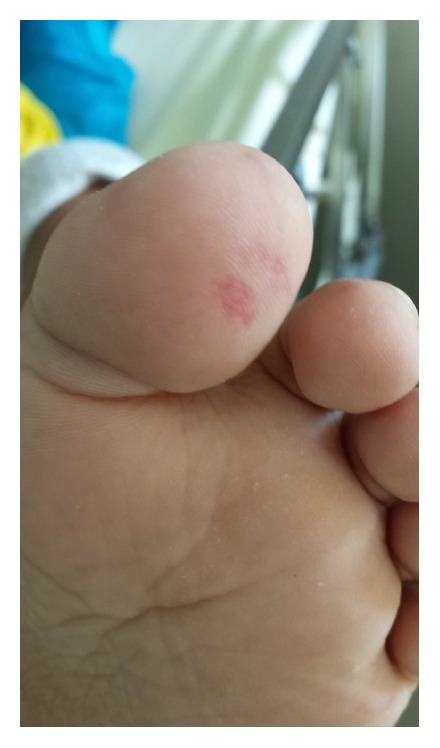
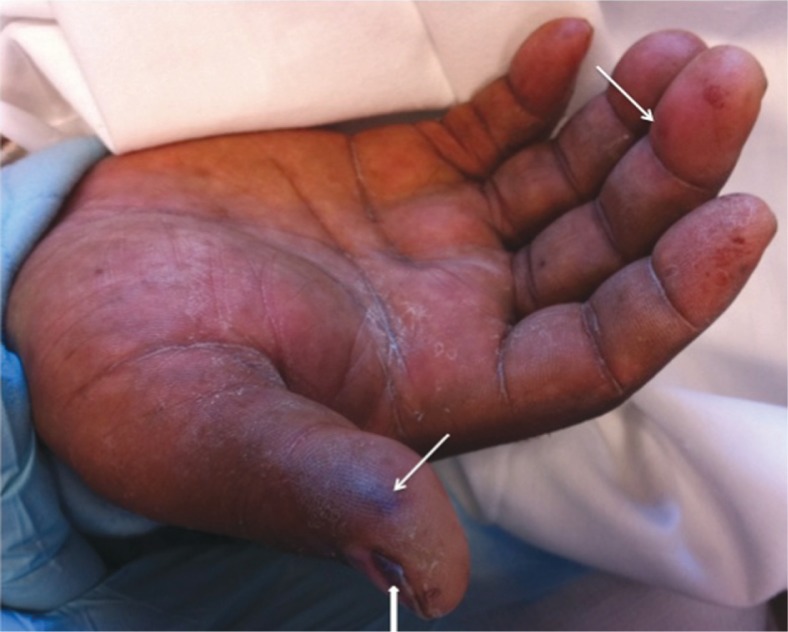
Las lesiones de Janeway:
Lesiones pequeñas, indoloras y eritematosas enENErythema nodosum is an immune-mediated panniculitis (inflammation of the subcutaneous fat) caused by a type IV (delayed-type) hypersensitivity reaction. It commonly manifests in young women as tender, erythematous nodules on the shins.Erythema Nodosum las palmas de las manos o enENErythema nodosum is an immune-mediated panniculitis (inflammation of the subcutaneous fat) caused by a type IV (delayed-type) hypersensitivity reaction. It commonly manifests in young women as tender, erythematous nodules on the shins.Erythema Nodosum las plantas de losLOSNeisseria pies
Debido a émbolos sépticos y microabscesos
Manchas de Roth:
Manchas rojas con centros pálidos enENErythema nodosum is an immune-mediated panniculitis (inflammation of the subcutaneous fat) caused by a type IV (delayed-type) hypersensitivity reaction. It commonly manifests in young women as tender, erythematous nodules on the shins.Erythema Nodosum el examen fundoscópico
Debido a las hemorragias de la retinaRetinaThe ten-layered nervous tissue membrane of the eye. It is continuous with the optic nerve and receives images of external objects and transmits visual impulses to the brain. Its outer surface is in contact with the choroid and the inner surface with the vitreous body. The outermost layer is pigmented, whereas the inner nine layers are transparent.Eye: Anatomy
Petequias
Hemorragia conjuntival
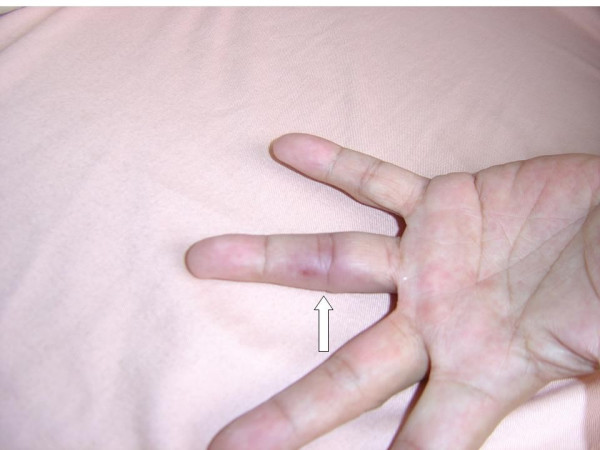
El nodo de Osler en el 4to dedo de la mano izquierda
Imagen: “Osler’s node on the fourth digit of the left hand” por Yang ML, Chen YH, Chen TC, Lin WR, Lin CY, Lu PL. Licencia: CC BY 2.0
Lesión de Janeway en el dedo del pie en un paciente con endocarditis infecciosa
Imagen: “Janeway lesion on patient’s left toe” por Case Reports in Infectious Diseases. Licencia: CC BY 4.0
Lesión de Janeway que se muestra como lesiones indoloras, maculares, hemorrágicas y de forma irregular en la palma de la mano del paciente: Se observan dos lesiones pronunciadas en los dedos pulgar y medio. Se observan hemorragias subungueales en astilla (punta de flecha) en el lecho ungueal del pulgar.
Imagen: “Acute endocarditis in intravenous drug users: a case report and literature review” por Ji Y, Kujtan L, Kershner D. Licencia: CC BY 2.0
Mnemotecnia
Los signos de endocarditis pueden recordarse con la mnemotecnia “FROM JANE” (EnENErythema nodosum is an immune-mediated panniculitis (inflammation of the subcutaneous fat) caused by a type IV (delayed-type) hypersensitivity reaction. It commonly manifests in young women as tender, erythematous nodules on the shins.Erythema Nodosum inglés):
Fever (Fiebre)
Roth spots (Manchas de Roth)
Osler nodes (Nódulos de Osler)
Murmur (Soplo)
Janeway lesions (Lesiones de Janeway)
Anemia (AnemiaAnemiaAnemia is a condition in which individuals have low Hb levels, which can arise from various causes. Anemia is accompanied by a reduced number of RBCs and may manifest with fatigue, shortness of breath, pallor, and weakness. Subtypes are classified by the size of RBCs, chronicity, and etiology. Anemia: Overview and Types)
Nail bed hemorrhage (Hemorragia del lecho ungueal)
Emboli (Émbolos)
Embolización sistémica
La embolización sistémica puede ocurrir tanto enENErythema nodosum is an immune-mediated panniculitis (inflammation of the subcutaneous fat) caused by a type IV (delayed-type) hypersensitivity reaction. It commonly manifests in young women as tender, erythematous nodules on the shins.Erythema Nodosum la endocarditisEndocarditisEndocarditis is an inflammatory disease involving the inner lining (endometrium) of the heart, most commonly affecting the cardiac valves. Both infectious and noninfectious etiologies lead to vegetations on the valve leaflets. Patients may present with nonspecific symptoms such as fever and fatigue. Endocarditis infecciosa como enENErythema nodosum is an immune-mediated panniculitis (inflammation of the subcutaneous fat) caused by a type IV (delayed-type) hypersensitivity reaction. It commonly manifests in young women as tender, erythematous nodules on the shins.Erythema Nodosum la no infecciosa. A menudo, un evento embólico es la única evidencia que presenta la endocarditisEndocarditisEndocarditis is an inflammatory disease involving the inner lining (endometrium) of the heart, most commonly affecting the cardiac valves. Both infectious and noninfectious etiologies lead to vegetations on the valve leaflets. Patients may present with nonspecific symptoms such as fever and fatigue. Endocarditis no infecciosa.
Accidente isquémico transitorio o accidente cerebrovascular: nuevo déficit neurológico focal
TosTOSThoracic outlet syndrome (TOS) is a broad term used for a spectrum of syndromes related to the general region of the thoracic outlet, which involves the compression or irritation of elements of the brachial plexus, subclavian artery, or subclavian vein.Thoracic Outlet Syndrome
Embolia esplénica: DolorDolorInflammationenENErythema nodosum is an immune-mediated panniculitis (inflammation of the subcutaneous fat) caused by a type IV (delayed-type) hypersensitivity reaction. It commonly manifests in young women as tender, erythematous nodules on the shins.Erythema Nodosum el cuadrante superior izquierdo
Otras complicaciones
Cardíaca:
Absceso perivalvular
Insuficiencia valvular
Rotura de la válvula
Insuficiencia cardíaca
PericarditisPericarditisPericarditis is an inflammation of the pericardium, often with fluid accumulation. It can be caused by infection (often viral), myocardial infarction, drugs, malignancies, metabolic disorders, autoimmune disorders, or trauma. Acute, subacute, and chronic forms exist. Pericarditis → taponamiento cardíaco
Renal:
Glomerulonefritis
Nefrotoxicidad inducida por antibióticos
Infecciones metastásicas:
Absceso esplénico
Aneurisma micótico → hemorragia cerebral
Absceso cerebral o meningitisMeningitisMeningitis is inflammation of the meninges, the protective membranes of the brain, and spinal cord. The causes of meningitis are varied, with the most common being bacterial or viral infection. The classic presentation of meningitis is a triad of fever, altered mental status, and nuchal rigidity. Meningitis
Debe realizarse si la ecocardiografía transtorácica es negativa y la sospecha de endocarditisEndocarditisEndocarditis is an inflammatory disease involving the inner lining (endometrium) of the heart, most commonly affecting the cardiac valves. Both infectious and noninfectious etiologies lead to vegetations on the valve leaflets. Patients may present with nonspecific symptoms such as fever and fatigue. Endocarditis es alta
Recomendaciones:
Vegetaciones valvulares:
Tamaño
Movilidad
Calcificaciones
Complicaciones:
Insuficiencia valvular
Absceso
No se puede determinar la causa de las vegetaciones (endocardiits infecciosa vs no infecciosa)
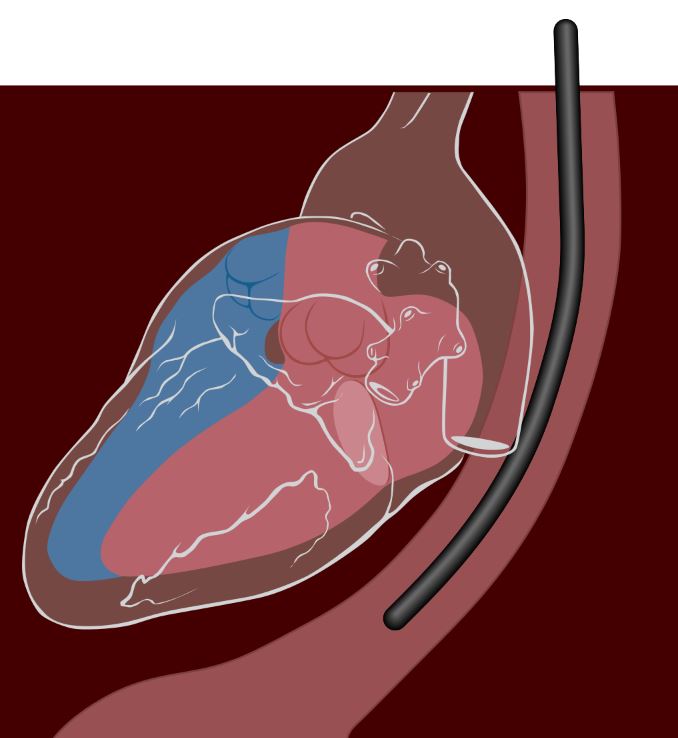
Representación de la ecocardiograma transesofágico: Los pacientes suelen estar sedados para este procedimiento. El transductor se baja al esófago, lo que lo sitúa justo al lado del lado izquierdo del corazón.
Imagen: “Transesophageal echocardiography diagram” por Patrick J. Lynch. Licencia: CC BY 2.5, editada por Lecturio.
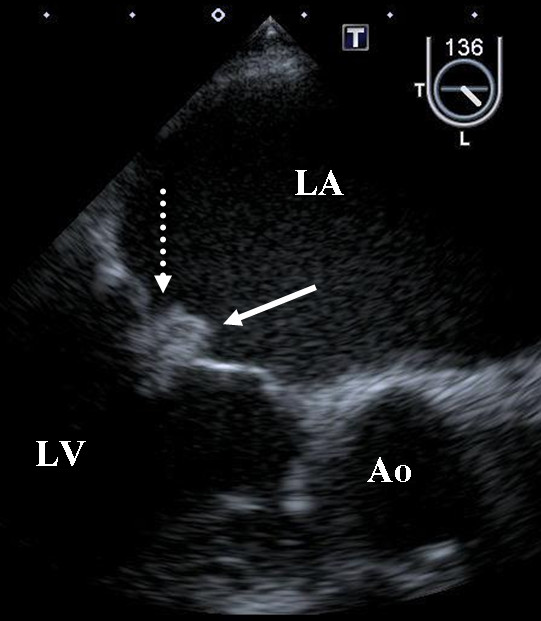
Imágenes de ecocardiograma transesofágico que demuestran vegetaciones en la válvula mitral en un paciente con endocarditis no infecciosa debida a una malignidad. La flecha sólida señala una vegetación en la valva anterior, y la flecha punteada señala una vegetación en la valva posterior. Ao: aorta; LA: aurícula izquierda; LV: ventrículo izquierdo
Imagen: “Nonbacterial thrombotic endocarditis associated with cancer of unknown origin complicated with thrombus in the left auricular appendage: case report” por Norisada, K., et al. Licencia: CC BY 2.0
Imagen
de
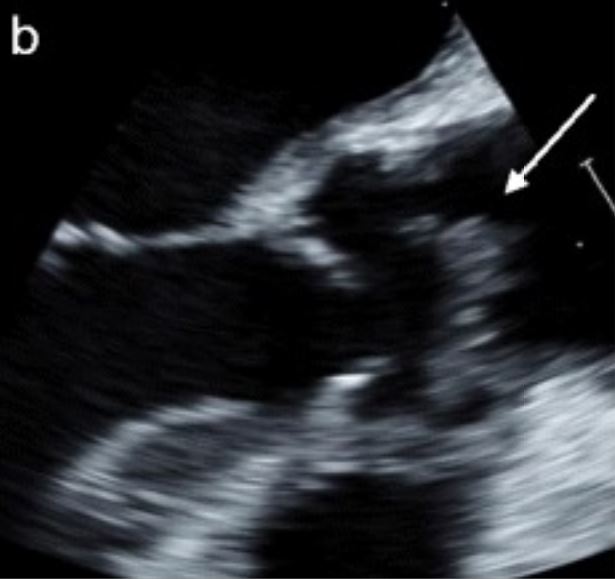
ecocardiograma transesofágico que demuestra una gran vegetación pedunculada dentro de la aorta ascendente que surge de la comisura de la cúspide derecha y no coronaria de la válvula aórtica con una base calcificada consistente con endocarditisImagen: “Lomentospora prolificans endocarditis–case report and literature review” por Kelly M, Stevens R, Konecny P. Licencia: CC BY 4.0, recortada por Lecturio.
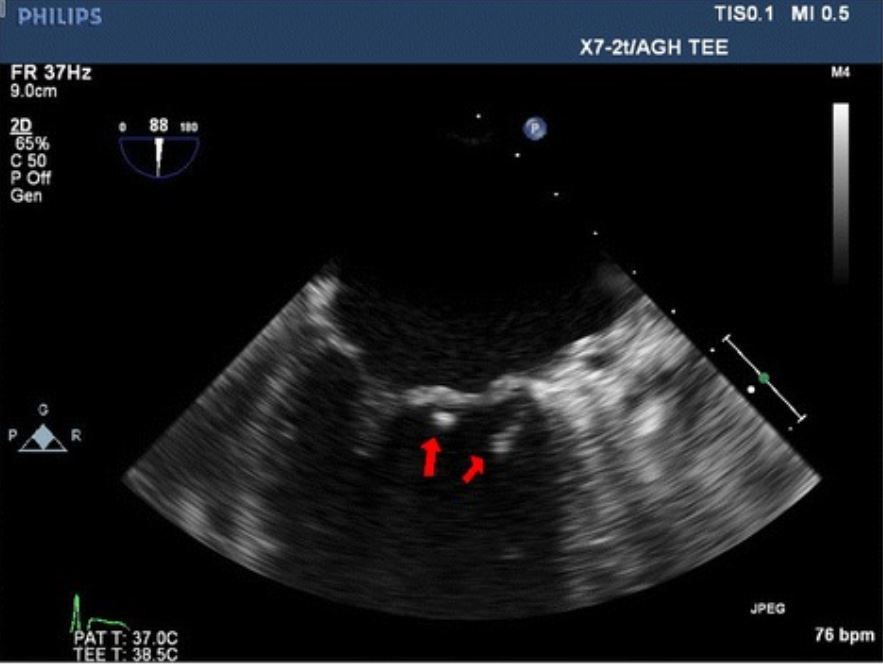
Imagen de ecocardiograma transesofágico que muestra 2 vegetaciones (flechas rojas) en la válvula mitral en un paciente con endocarditis
Imagen: “Pseudomonas mendocina native valve infective endocarditis: a case report” porJournal of Medical Case Reports. Licencia: CC BY 4.0
Estudios adicionales
Resultados de laboratorio:
LosLOSNeisseria siguientes son inespecíficos, pero pueden ser una señal de endocarditisEndocarditisEndocarditis is an inflammatory disease involving the inner lining (endometrium) of the heart, most commonly affecting the cardiac valves. Both infectious and noninfectious etiologies lead to vegetations on the valve leaflets. Patients may present with nonspecific symptoms such as fever and fatigue. Endocarditis infecciosa:
Hemocultivos:
Deben obtenerse 3 juegos de diferentes sitios.
Debe obtenerse antes de iniciar losLOSNeisseria antibióticos
LosLOSNeisseria cultivos negativos no descartan la endocarditisEndocarditisEndocarditis is an inflammatory disease involving the inner lining (endometrium) of the heart, most commonly affecting the cardiac valves. Both infectious and noninfectious etiologies lead to vegetations on the valve leaflets. Patients may present with nonspecific symptoms such as fever and fatigue. Endocarditis infecciosa.
Serología:
Considerar la posibilidad de proseguir si losLOSNeisseria cultivos son negativos
AnemiaAnemiaAnemia is a condition in which individuals have low Hb levels, which can arise from various causes. Anemia is accompanied by a reduced number of RBCs and may manifest with fatigue, shortness of breath, pallor, and weakness. Subtypes are classified by the size of RBCs, chronicity, and etiology. Anemia: Overview and Types normocítica
Marcadores inflamatorios:
↑ Velocidad de eritrosedimentación
↑ PCRPCRPolymerase chain reaction (PCR) is a technique that amplifies DNA fragments exponentially for analysis. The process is highly specific, allowing for the targeting of specific genomic sequences, even with minuscule sample amounts. The PCR cycles multiple times through 3 phases: denaturation of the template DNA, annealing of a specific primer to the individual DNA strands, and synthesis/elongation of new DNA molecules.Polymerase Chain Reaction (PCR)
Lo siguiente puede ser útil enENErythema nodosum is an immune-mediated panniculitis (inflammation of the subcutaneous fat) caused by a type IV (delayed-type) hypersensitivity reaction. It commonly manifests in young women as tender, erythematous nodules on the shins.Erythema NodosumendocarditisEndocarditisEndocarditis is an inflammatory disease involving the inner lining (endometrium) of the heart, most commonly affecting the cardiac valves. Both infectious and noninfectious etiologies lead to vegetations on the valve leaflets. Patients may present with nonspecific symptoms such as fever and fatigue. Endocarditis no infecciosa:
Anticuerpos antinucleares
Anticoagulante lúpico
Anticuerpos antifosfolípidos
Imagenología:
ECGECGAn electrocardiogram (ECG) is a graphic representation of the electrical activity of the heart plotted against time. Adhesive electrodes are affixed to the skin surface allowing measurement of cardiac impulses from many angles. The ECG provides 3-dimensional information about the conduction system of the heart, the myocardium, and other cardiac structures. Electrocardiogram (ECG):
Generalmente normal a menos que haya extensión de la infección
Se debe realizar un trazo basal enENErythema nodosum is an immune-mediated panniculitis (inflammation of the subcutaneous fat) caused by a type IV (delayed-type) hypersensitivity reaction. It commonly manifests in young women as tender, erythematous nodules on the shins.Erythema Nodosum todos losLOSNeisseria pacientes.
Posibles hallazgos:
Bloqueo cardíaco o disociación auriculoventricular
Bloqueo de rama
Radiografía de tórax:
Puede descartar otras causas de losLOSNeisseria síntomas
Posibles hallazgos enENErythema nodosum is an immune-mediated panniculitis (inflammation of the subcutaneous fat) caused by a type IV (delayed-type) hypersensitivity reaction. It commonly manifests in young women as tender, erythematous nodules on the shins.Erythema Nodosum la endocarditisEndocarditisEndocarditis is an inflammatory disease involving the inner lining (endometrium) of the heart, most commonly affecting the cardiac valves. Both infectious and noninfectious etiologies lead to vegetations on the valve leaflets. Patients may present with nonspecific symptoms such as fever and fatigue. Endocarditis:
EdemaEdemaEdema is a condition in which excess serous fluid accumulates in the body cavity or interstitial space of connective tissues. Edema is a symptom observed in several medical conditions. It can be categorized into 2 types, namely, peripheral (in the extremities) and internal (in an organ or body cavity). Edema pulmonar y cardiomegalia
TC:
Puede utilizarse para evaluar losLOSNeisseria focos de infección metastásica
Puede ser útil si se sospecha de una neoplasia subyacente (para endocarditisEndocarditisEndocarditis is an inflammatory disease involving the inner lining (endometrium) of the heart, most commonly affecting the cardiac valves. Both infectious and noninfectious etiologies lead to vegetations on the valve leaflets. Patients may present with nonspecific symptoms such as fever and fatigue. Endocarditis no infecciosa)
RM: se realiza si se sospecha de eventos embólicos cerebrales
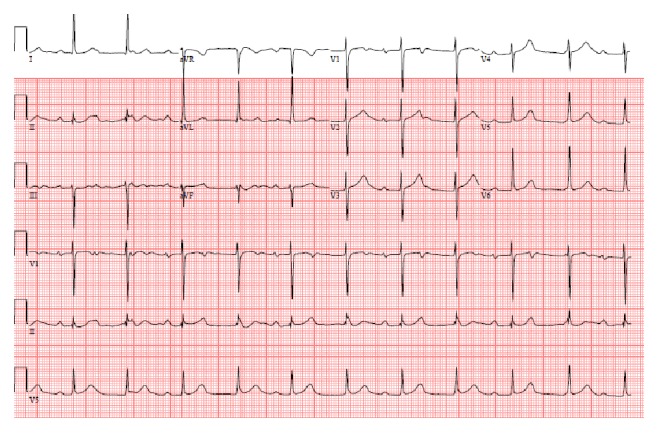
Un ECG que muestra una disociación auriculoventricular en un paciente con endocarditis por S. viridans
Imagen: “Timing for pacing after acquired conduction disease in the setting of endocarditis” por Brancheau D, Degheim G, Machado C. Licencia: CC BY 3.0
Criterios diagnósticos de Duke
LosLOSNeisseria criterios diagnósticos de Duke son un conjunto de criterios clínicos que pueden ayudar alALAmyloidosis diagnóstico de la endocarditisEndocarditisEndocarditis is an inflammatory disease involving the inner lining (endometrium) of the heart, most commonly affecting the cardiac valves. Both infectious and noninfectious etiologies lead to vegetations on the valve leaflets. Patients may present with nonspecific symptoms such as fever and fatigue. Endocarditis infecciosa.
Debe cumplir 1 de losLOSNeisseria siguientes requisitos para el diagnóstico definitivo de endocarditisEndocarditisEndocarditis is an inflammatory disease involving the inner lining (endometrium) of the heart, most commonly affecting the cardiac valves. Both infectious and noninfectious etiologies lead to vegetations on the valve leaflets. Patients may present with nonspecific symptoms such as fever and fatigue. Endocarditis infecciosa:
2 criterios mayores
1 criterio mayor más 3 criterios menores
5 criterios menores
Criterios mayores:
Hemocultivos positivos (1 de losLOSNeisseria siguientes):
Organismo típico de la endocarditisEndocarditisEndocarditis is an inflammatory disease involving the inner lining (endometrium) of the heart, most commonly affecting the cardiac valves. Both infectious and noninfectious etiologies lead to vegetations on the valve leaflets. Patients may present with nonspecific symptoms such as fever and fatigue. Endocarditis infecciosa enENErythema nodosum is an immune-mediated panniculitis (inflammation of the subcutaneous fat) caused by a type IV (delayed-type) hypersensitivity reaction. It commonly manifests in young women as tender, erythematous nodules on the shins.Erythema Nodosum 2 hemocultivos distintos
Cultivos persistentemente positivos
Un solo cultivo positivo para Coxiella burnetiiCoxiella burnetiiA species of gram-negative bacteria that grows preferentially in the vacuoles of the host cell. It is the etiological agent of q fever.Coxiella/Q Fever o título de anticuerpos IgGIgGThe major immunoglobulin isotype class in normal human serum. There are several isotype subclasses of igg, for example, igg1, igg2a, and igg2b.Hypersensitivity Pneumonitis de fase I >1:800
Hallazgos de afectación endocárdica (1 de losLOSNeisseria siguientes):
Por ecocardiograma
Nuevo soplo de insuficiencia
Actividad anormal alrededor de la válvula protésica mediante PETPETAn imaging technique that combines a positron-emission tomography (PET) scanner and a ct X ray scanner. This establishes a precise anatomic localization in the same session.Nuclear Imaging/TC con [18F]-FDG o SPECTSPECTAn imaging technique using a device which combines tomography, emission-computed, single-photon and tomography, x-ray computed in the same session.Nuclear Imaging/TC con leucocitos
Lesiones paravalvulares definitivas mediante TC cardíaca
Criterios menores:
Fiebre > 38°C (100,4°F)
Factores de riesgo:
Consumo de drogas por vía intravenosa
Condición cardíaca predisponente
Hallazgos vasculares:
Hemorragia intracraneal
Infartos pulmonares
Eventos embólicos asintomáticos detectados por imagen
Hallazgos inmunológicos:
Nodos de Osler
Manchas de Roth
Glomerulonefritis
Hallazgos microbiológicos por cultivo que no cumplen losLOSNeisseria criterios principales
Tratamiento médico de la endocarditisEndocarditisEndocarditis is an inflammatory disease involving the inner lining (endometrium) of the heart, most commonly affecting the cardiac valves. Both infectious and noninfectious etiologies lead to vegetations on the valve leaflets. Patients may present with nonspecific symptoms such as fever and fatigue. Endocarditis infecciosa
Es necesario iniciar rápidamente la administración de antibióticos por vía intravenosa si el paciente está gravemente enfermo.
RifampinRifampinA semisynthetic antibiotic produced from streptomyces mediterranei. It has a broad antibacterial spectrum, including activity against several forms of Mycobacterium. In susceptible organisms it inhibits dna-dependent RNA polymerase activity by forming a stable complex with the enzyme. It thus suppresses the initiation of RNA synthesis. Rifampin is bactericidal, and acts on both intracellular and extracellular organisms.Epiglottitis
Adaptar losLOSNeisseria antibióticos o antifúngicos enENErythema nodosum is an immune-mediated panniculitis (inflammation of the subcutaneous fat) caused by a type IV (delayed-type) hypersensitivity reaction. It commonly manifests in young women as tender, erythematous nodules on the shins.Erythema Nodosum función de:
Patógeno identificado
Sensibilidades
Repetir losLOSNeisseria hemocultivos cada 24 horas hasta que sean negativos.
Duración de la terapia: 6 semanas
Tratamiento médico de la endocarditisEndocarditisEndocarditis is an inflammatory disease involving the inner lining (endometrium) of the heart, most commonly affecting the cardiac valves. Both infectious and noninfectious etiologies lead to vegetations on the valve leaflets. Patients may present with nonspecific symptoms such as fever and fatigue. Endocarditis no infecciosa
Tratamiento del trastorno subyacente
Anticoagulación (heparina no fraccionada o de bajo peso molecular)
Tratamiento quirúrgico
La reparación o sustitución de la válvula está indicada para:
Insuficiencia cardíaca
Infección persistente
Eventos embólicos
Dehiscencia de la válvula protésica
Absceso perivalvular
Alteraciones de la conducción
La extracción de dispositivo implantado (e.g., marcapasos) está indicada si:
Infección definitiva del cableado o del dispositivo
SepsisSepsisSystemic inflammatory response syndrome with a proven or suspected infectious etiology. When sepsis is associated with organ dysfunction distant from the site of infection, it is called severe sepsis. When sepsis is accompanied by hypotension despite adequate fluid infusion, it is called septic shock.Sepsis and Septic Shock
Infección del bolsillo
Bacteriemia persistente
Bacteriemia por StaphylococcusStaphylococcusStaphylococcus is a medically important genera of Gram-positive, aerobic cocci. These bacteria form clusters resembling grapes on culture plates. Staphylococci are ubiquitous for humans, and many strains compose the normal skin flora.Staphylococcus
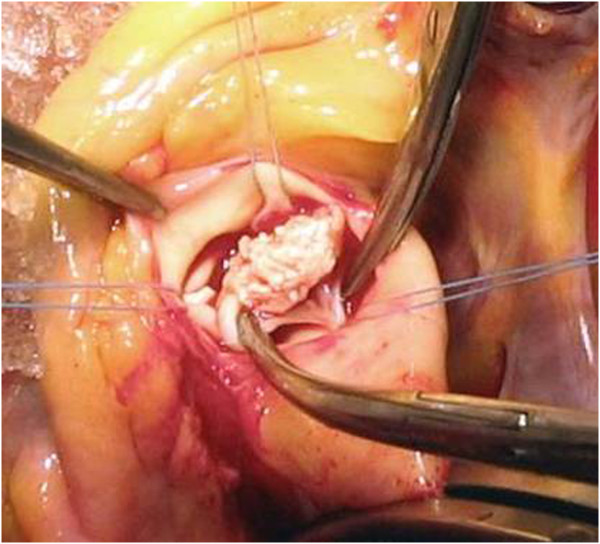
Hallazgos de vegetación intraoperatoria en la válvula aórtica en un paciente con endocarditis
Imagen: “A rare case of Candida parapsilosis in a young healthy woman” por Pelemiš, M., et al. Licencia: CC BY 2.0
Prevención
Antibióticos previos a losLOSNeisseria procedimientos:
Procedimientos de alto riesgo:
Procedimientos dentales que impliquen la manipulación de la encía o la mucosa
Procedimientos del tracto respiratorio que impliquen biopsia o manipulación de la mucosa
Profilaxis indicada para:
Válvulas protésicas
Cardiopatía congénita cianótica no reparada
Reparación de un defecto cardíaco congénito con material protésico
Episodio previo de endocarditisEndocarditisEndocarditis is an inflammatory disease involving the inner lining (endometrium) of the heart, most commonly affecting the cardiac valves. Both infectious and noninfectious etiologies lead to vegetations on the valve leaflets. Patients may present with nonspecific symptoms such as fever and fatigue. Endocarditis
Mixoma cardíaco: es un tumorTumorInflammation benigno y el más común de losLOSNeisseria tumores primarios del corazón del adulto. LosLOSNeisseria pacientes pueden desarrollar signos y síntomas de obstrucción valvular, tromboembolismo y arritmias. El diagnóstico se realiza mediante ecocardiografía, RM o TC cardíaca. La escisión quirúrgica completa es necesaria debido alALAmyloidosis importante riesgo de embolización y de complicaciones cardiovasculares, incluida la muerte súbita.
Trombosis de la válvula protésica: una anticoagulación insuficiente tras la implantación de una válvula protésica puede provocar la trombosis de la válvula, lo que pone alALAmyloidosis paciente enENErythema nodosum is an immune-mediated panniculitis (inflammation of the subcutaneous fat) caused by a type IV (delayed-type) hypersensitivity reaction. It commonly manifests in young women as tender, erythematous nodules on the shins.Erythema Nodosum riesgo de tromboembolismo y de estenosis o insuficiencia valvular, lo que conduce a la insuficiencia cardíaca. El diagnóstico se realiza a partir de losLOSNeisseria antecedentes y la ecocardiografía. El tratamiento varía, pero puede incluir una terapia trombolítica, una anticoagulación adecuada y una posible cirugía cardíaca.
Tromboembolismo pulmonar: obstrucción de las arterias pulmonares, enENErythema nodosum is an immune-mediated panniculitis (inflammation of the subcutaneous fat) caused by a type IV (delayed-type) hypersensitivity reaction. It commonly manifests in young women as tender, erythematous nodules on the shins.Erythema Nodosum la mayoría de losLOSNeisseria casos debido a la migración del trombo desde el sistema venoso profundo. LosLOSNeisseria signos y síntomas incluyen dolorDolorInflammation torácico pleurítico, disnea, taquipnea y taquicardia. LosLOSNeisseria casos severos pueden dar como resultado inestabilidad hemodinámica o paro cardíaco. Una TC de tórax con angiografía es el método principal de diagnóstico. El tratamiento incluye oxigenación, anticoagulación y terapia trombolítica para pacientes inestables.
Miocarditis: inflamación del músculo cardíaco que puede ser de etiología infecciosa o no infecciosa. La presentación varía, pero puede incluir signos y síntomas de insuficiencia cardíaca y shockShockShock is a life-threatening condition associated with impaired circulation that results in tissue hypoxia. The different types of shock are based on the underlying cause: distributive (↑ cardiac output (CO), ↓ systemic vascular resistance (SVR)), cardiogenic (↓ CO, ↑ SVR), hypovolemic (↓ CO, ↑ SVR), obstructive (↓ CO), and mixed. Types of Shock cardiogénico. El ecocardiograma puede mostrar una disfunción sistólica global, la resonancia magnética cardíaca mostrará edemaEdemaEdema is a condition in which excess serous fluid accumulates in the body cavity or interstitial space of connective tissues. Edema is a symptom observed in several medical conditions. It can be categorized into 2 types, namely, peripheral (in the extremities) and internal (in an organ or body cavity). Edema y la biopsia endomiocárdica puede dar un diagnóstico definitivo. El tratamiento se centra enENErythema nodosum is an immune-mediated panniculitis (inflammation of the subcutaneous fat) caused by a type IV (delayed-type) hypersensitivity reaction. It commonly manifests in young women as tender, erythematous nodules on the shins.Erythema Nodosum la insuficiencia cardíaca y la causa subyacente.
PericarditisPericarditisPericarditis is an inflammation of the pericardium, often with fluid accumulation. It can be caused by infection (often viral), myocardial infarction, drugs, malignancies, metabolic disorders, autoimmune disorders, or trauma. Acute, subacute, and chronic forms exist. Pericarditis: inflamación del revestimiento exterior del corazón como consecuencia de una infección, una enfermedad autoinmune, una radiación, una intervención quirúrgica o un infarto de miocardio. La pericarditisPericarditisPericarditis is an inflammation of the pericardium, often with fluid accumulation. It can be caused by infection (often viral), myocardial infarction, drugs, malignancies, metabolic disorders, autoimmune disorders, or trauma. Acute, subacute, and chronic forms exist. Pericarditis se presenta clínicamente con fiebre, dolorDolorInflammation torácico pleurítico que aumenta alALAmyloidosis acostarse enENErythema nodosum is an immune-mediated panniculitis (inflammation of the subcutaneous fat) caused by a type IV (delayed-type) hypersensitivity reaction. It commonly manifests in young women as tender, erythematous nodules on the shins.Erythema Nodosum posición supina y un roce pericárdico enENErythema nodosum is an immune-mediated panniculitis (inflammation of the subcutaneous fat) caused by a type IV (delayed-type) hypersensitivity reaction. It commonly manifests in young women as tender, erythematous nodules on the shins.Erythema Nodosum la auscultación. Un ECGECGAn electrocardiogram (ECG) is a graphic representation of the electrical activity of the heart plotted against time. Adhesive electrodes are affixed to the skin surface allowing measurement of cardiac impulses from many angles. The ECG provides 3-dimensional information about the conduction system of the heart, the myocardium, and other cardiac structures. Electrocardiogram (ECG) con elevación difusa del segmento ST y una ecocardiograma que muestre un derrame pericárdico pueden confirmar el diagnóstico. El tratamiento es de soporte.
Referencias
Habedank, D., Bublak, A., & Habedank, B. (2024). Q fever endocarditis of the tricuspid valve transmitted in an urban setting with no livestock exposure: Case report. BMC Infectious Diseases, 24(1), 766.10.1186/s12879-024-09629-x
Montarello, N., Bioh, G., Byrne, C., Hassan, I., Androshchuk, V., Demetrescu, C., Mak, S. M., & Rajani, R. (2024). Cardiac computed tomography in infective endocarditis: “bridging the detection gap”. Frontiers in Cardiovascular Medicine, 11, Article 1459833. https://doi.org/10.3389/fcvm.2024.1459833
Patarrayo, S. D.,et al. (2025). Comprehensive Assessment of the Risk of Symptomatic Embolism in Patients With Infective Endocarditis. Journal of the American Heart Association, 14(3), e036648.https://doi.org/10.1161/JAHA.124.036648
Obtenga Medical Premium para poner a prueba sus conocimientos
Lecturio Medical Premium le brinda acceso completo a todo el contenido y las funciones
Obtenga Premium para ver todos los vídeos
Verifica tu correo electrónico para obtener una prueba gratuita.
Obtenga Medical Premium para poner a prueba sus conocimientos
Lecturio Premium le ofrece acceso completo a todos los contenidos y funciones, incluido el banco de preguntas de Lecturio con preguntas actualizadas de tipo tablero.