



Terapia Direcionada e Outros Agentes Antineoplásicos Não Tradicionais

A terapia direcionada exerce atividade antineoplástica contra células cancerígenas ao interferir com propriedades únicas encontradas em tumores ou neoplasias malignas. Os tipos de fármacos podem ser moléculas pequenas, capazes de entrar nas células, ou anticorpos monoclonais, que têm alvos fora ou na superfície das células. Entre as áreas das células malignas que são bloqueadas ou inibidas por terapia direcionada estão as vias de sinalização (como visto nos inibidores da proteína cinase), que levam a uma diminuição da proliferação e subsequente apoptose das células tumorais. Outra forma de reduzir as células cancerígenas é ao eliminar a capacidade de reparação do DNA DNA A deoxyribonucleotide polymer that is the primary genetic material of all cells. Eukaryotic and prokaryotic organisms normally contain DNA in a double-stranded state, yet several important biological processes transiently involve single-stranded regions. DNA, which consists of a polysugar-phosphate backbone possessing projections of purines (adenine and guanine) and pyrimidines (thymine and cytosine), forms a double helix that is held together by hydrogen bonds between these purines and pyrimidines (adenine to thymine and guanine to cytosine). DNA Types and Structure (visto nos inibidores da poli(ADP-ribose) polimerase), bloquear a ligação ligando-recetor (inibidores de fatores de crescimento) e aumentar a atividade imune contra a neoplasia (imunoterapias). Estes agentes são utilizados em vários tipos de cancro e em combinação com agentes quimioterápicos tradicionais.

Last updated: Dec 15, 2025
Editorial responsibility: Stanley Oiseth, Lindsay Jones, Evelin Maza

Descrição Geral

Desenvolvimento de terapia do cancro

  • A quimioterapia tradicional afecta tanto as células cancerígenas como as células normais.
  • Um número crescente de novos agentes anticancerígenos (terapia direcionada) é agora usado além dos fármacos antineoplásicos tradicionais.
    • O desenvolvimento é baseado em descobertas de que mudanças moleculares nas células impulsionam a progressão para a malignidade.
    • Os fármacos conseguem bloquear a(s) via(s) oncogénica(s) com menos efeitos citotóxicos nas células normais.

Terapia do cancro direcionada

  • Interfere com moléculas específicas que têm como alvo vias particulares, afetando o crescimento e a proliferação de células cancerígenas
  • Existem várias maneiras de perturbar as vias; estas incluem a prevenção da ligação dos recetores e a ligação intracelular e inibição de cinases.
  • A maioria das terapias disponíveis são:
    • Moléculas pequenas:
      • Compostos (que conseguem entrar nas células) com alvos intracelulares (por exemplo, cinases)
      • A inibição de cinases previne a ativação de diferentes vias (como visto nos inibidores de proteína cinase)
      • A maioria dos nomes de fármacos inibidores de proteína cinase terminam com a sílaba “-ib”.
    • Anticorpos monoclonais:
      • Usados para alvos que estão fora ou na superfície das células (por exemplo, recetores de fatores de crescimento ou ligandos de recetores)
      • Os nomes de anticorpos monoclonais (“monoclonal antibody” terminam com a sílaba “-mab”.
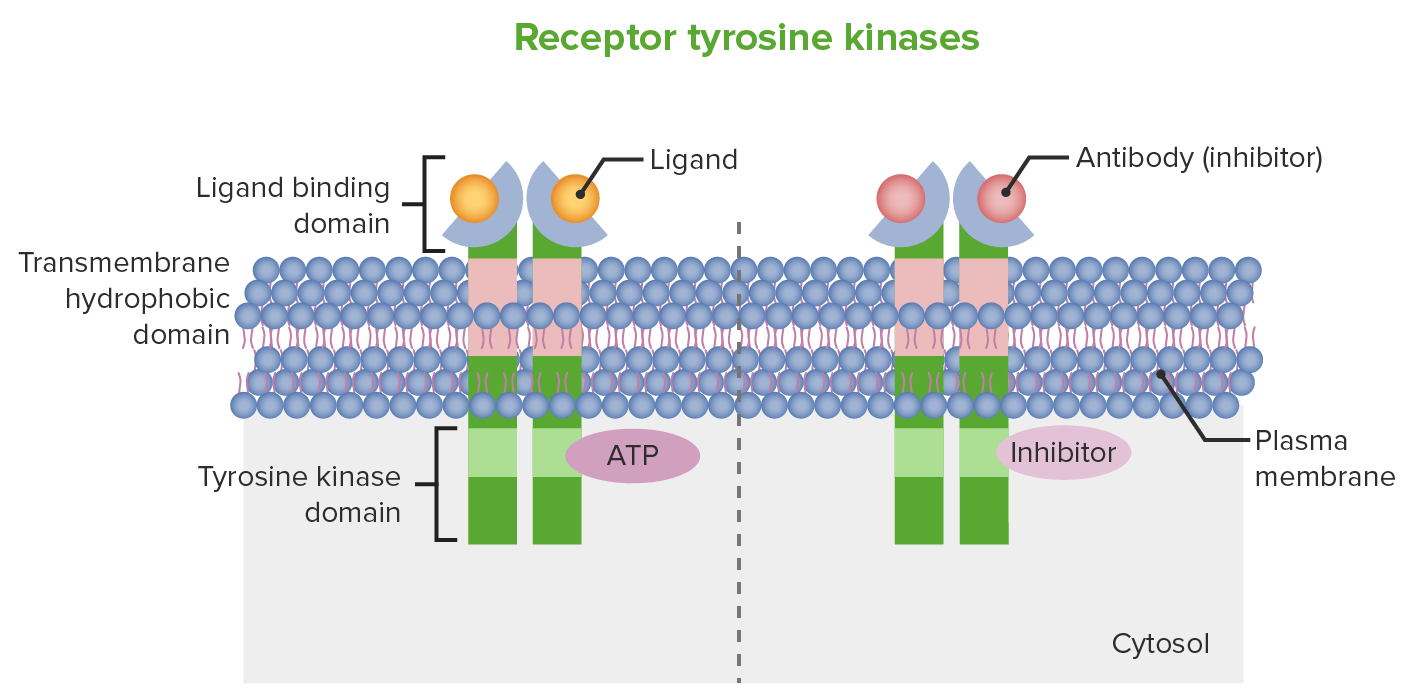
Schematic mechanism for receptor tyrosine kinase inhibition

Mecanismo esquemático para inibição do recetor de tirosina cinase: À esquerda, a imagem mostra a estrutura do recetor da célula. Na superfície da célula encontra-se o domínio ligante e o domínio cinase (nesta imagem, tirosina cinase) está presente intracelularmente. À direita, a imagem mostra como um anticorpo monoclonal pode produzir atividade antineoplásica, que é através da inibição mediada por anticorpos do domínio de ligação ao ligando. Pequenas moléculas, que conseguem entrar nas células, são capazes de produzir inibição do domínio de ligação à ATP (tirosina cinase).

Imagem por Lecturio.

Inibidores de Proteína Cinase

Proteínas cinases

  • Existem > 500 proteína cinases diferentes no genoma humano:
    • As proteína cinases funcionam ao adicionar um grupo fosfato aos substratos proteicos: serina, treonina ou tirosina.
    • Após a fosforilação, a proteína sofre uma mudança conformacional (“ativa a proteína”).
    • As fosfatases (que removem o fosfato) revertem a ação das cinases.
  • Seguem-se cascatas de transdução de sinal particulares (por exemplo, BCR-ABL com tirosina como substrato proteico, RAF com serina/treonina); as atividades moduladoras incluem:
    • Proliferação celular
    • Expressão génica
    • Metabolismo
    • Transporte membranar
    • Apoptose
  • No entanto, quando as cinases são expressas constitutivamente → oncogénese, como a que se vê na via RAS-RAF-MEK-ERK:
    • Via de sinalização envolvida na proliferação e diferenciação celular
    • Ativada em muitos cancros
    • A sinalização reguladora afeta o crescimento do cancro.
  • Inibidores de proteína cinase:
    • Bloqueiam a ação das enzimas proteína cinases, que são muitas vezes sobre-expressas no cancro.
    • A inibição das proteína cinases é um mecanismo que é também usado em fármacos para tratar patologias inflamatórias.

Inibidores de BCR-ABL cinase

  • Translocação do cromossoma Philadelphia t(9;22) → gene Gene A category of nucleic acid sequences that function as units of heredity and which code for the basic instructions for the development, reproduction, and maintenance of organisms. Basic Terms of Genetics de fusão BCR-ABL1
    • A fusão leva à ativação constitutiva de BCR-ABL → divisão celular descontrolada → ↑ produção granulocítica
    • Visto em leucemia mieloide crónica (LMC)
  • Agentes relacionados:
Tabela: Inibidores de BCR-ABL cinase
Imatinib Imatinib A tyrosine kinase inhibitor and antineoplastic agent that inhibits the bcr-abl kinase created by chromosome rearrangements in chronic myeloid leukemia and acute lymphoblastic leukemia, as well as pdg-derived tyrosine kinases that are overexpressed in gastrointestinal stromal tumors. Targeted and Other Nontraditional Antineoplastic Therapy Dasatinib Dasatinib A pyrimidine and thiazole derived antineoplastic agent and protein kinase inhibitor of bcr-abl kinase. It is used in the treatment of patients with chronic myeloid leukemia who are resistant or intolerant to imatinib. Targeted and Other Nontraditional Antineoplastic Therapy Nilotinib Nilotinib Targeted and Other Nontraditional Antineoplastic Therapy
Farmacodinâmica
  • Inibem a BCR-ABL tirosina cinase (o que causa apoptose das linhas celulares BCR-ABL positivas)
  • Inibição de c-KIT, PDGFR
  • Imatinib Imatinib A tyrosine kinase inhibitor and antineoplastic agent that inhibits the bcr-abl kinase created by chromosome rearrangements in chronic myeloid leukemia and acute lymphoblastic leukemia, as well as pdg-derived tyrosine kinases that are overexpressed in gastrointestinal stromal tumors. Targeted and Other Nontraditional Antineoplastic Therapy: também inibe fatores de células estaminais
Farmacocinética
  • Oral
  • Metabolismo hepático
  • Excreção: principalmente nas fezes
Indicações
  • LMC
  • Imatinib Imatinib A tyrosine kinase inhibitor and antineoplastic agent that inhibits the bcr-abl kinase created by chromosome rearrangements in chronic myeloid leukemia and acute lymphoblastic leukemia, as well as pdg-derived tyrosine kinases that are overexpressed in gastrointestinal stromal tumors. Targeted and Other Nontraditional Antineoplastic Therapy, dasatinib Dasatinib A pyrimidine and thiazole derived antineoplastic agent and protein kinase inhibitor of bcr-abl kinase. It is used in the treatment of patients with chronic myeloid leukemia who are resistant or intolerant to imatinib. Targeted and Other Nontraditional Antineoplastic Therapy: LLA ( Ph pH The quantitative measurement of the acidity or basicity of a solution. Acid-Base Balance+)
  • Imatinib Imatinib A tyrosine kinase inhibitor and antineoplastic agent that inhibits the bcr-abl kinase created by chromosome rearrangements in chronic myeloid leukemia and acute lymphoblastic leukemia, as well as pdg-derived tyrosine kinases that are overexpressed in gastrointestinal stromal tumors. Targeted and Other Nontraditional Antineoplastic Therapy:
    • Mastocitose sistémica
    • LMC
    • GIST GIST All tumors in the gastrointestinal tract arising from mesenchymal cells (mesoderm) except those of smooth muscle cells (leiomyoma) or schwann cells (schwannoma). Gastric Cancer
    • Dermatofibrossarcoma protuberante
    • LEC
    • MDS MDS Myelodysplastic syndromes (MDS) are a group of clonal neoplasms with maturation defects characterized by dysplasia, cytopenia, and immature bone marrow precursors. Myelodysplastic syndromes can be idiopathic, or secondary to various injurious exposures such as cytotoxic chemotherapy, ionizing radiation, or environmental toxins. Myelodysplastic Syndromes/MPD
Efeitos adversos
  • Mielossupressão
  • SLT
  • Hemorragia
  • Eventos cardiovasculares (insuficiência cardíaca)
  • Edema Edema Edema is a condition in which excess serous fluid accumulates in the body cavity or interstitial space of connective tissues. Edema is a symptom observed in several medical conditions. It can be categorized into 2 types, namely, peripheral (in the extremities) and internal (in an organ or body cavity). Edema
  • Reações dermatológicas (por exemplo, SSD SSD Somatic symptom disorder (SSD) is a condition characterized by the presence of 1 or more physical symptoms associated with excessive thoughts and feelings about symptom severity. Symptoms are usually not dangerous, but the patient devotes excessive time and energy to figuring out their underlying cause and how to treat them. Somatic Symptom Disorder, EM)
  • Irritação GI
  • Nefrotoxicidade
  • Hepatotoxicidade
  • Mielossupressão
  • SLT
  • Hemorragia
  • Eventos cardiovasculares
  • Edema Edema Edema is a condition in which excess serous fluid accumulates in the body cavity or interstitial space of connective tissues. Edema is a symptom observed in several medical conditions. It can be categorized into 2 types, namely, peripheral (in the extremities) and internal (in an organ or body cavity). Edema
  • Reações dermatológicas
  • Intervalo QT prolongado
  • Hipertensão pulmonar
  • Mielossupressão
  • SLT
  • Hemorragia
  • Eventos cardiovasculares
  • Edema Edema Edema is a condition in which excess serous fluid accumulates in the body cavity or interstitial space of connective tissues. Edema is a symptom observed in several medical conditions. It can be categorized into 2 types, namely, peripheral (in the extremities) and internal (in an organ or body cavity). Edema
  • Intervalo QT prolongado
  • Desequilíbrio eletrolítico
  • Hepatotoxicidade
Contraindicações
LEC: leucemia eosinofílica crónica
EM: eritema multiforme
GIST: Tumores do estroma GI
MDS/MPD: doenças mielodisplásicas/mieloproliferativas
PDGF: fator de crescimento derivado de plaquetas
Ph+: Cromossoma Philadelphia positivo
SSJ: Síndrome de Stevens-Johnson
SLT: síndrome de lise tumoral

Inibidores de BRAF cinase

  • BRAF:
    • Proteína da família RAF de serina/treonina cinases
    • Tem um papel importante na mediação de sinais do RAS RAS Renal artery stenosis (RAS) is the narrowing of one or both renal arteries, usually caused by atherosclerotic disease or by fibromuscular dysplasia. If the stenosis is severe enough, the stenosis causes decreased renal blood flow, which activates the renin-angiotensin-aldosterone system (RAAS) and leads to renovascular hypertension (RVH). Renal Artery Stenosis para MEK, levando à proliferação
    • Mutações → sinalização intracelular persistente → malignidade
      • Visto em 60% dos melanomas e em 15% dos cancros colorrectais
      • Levam ao aumento da sobrevivência e mobilidade do tumor Tumor Inflammation
  • Agentes relacionados (bloqueam a atividade de BRAF mutante):
Tabela: Inibidores da BRAF cinase
Vemurafenib Vemurafenib An indole sulfonamide compound and inhibitor of BRAF kinases that is used for the treatment of unresectable or metastatic melanoma. Targeted and Other Nontraditional Antineoplastic Therapy Dabrafenib DaBRAFenib Targeted and Other Nontraditional Antineoplastic Therapy*
Farmacodinâmica Inibem a atividade de BRAF cinase mutada (incluindo a mutação V600)
Farmacocinética
Indicações
  • Melanoma Melanoma Melanoma is a malignant tumor arising from melanocytes, the melanin-producing cells of the epidermis. These tumors are most common in fair-skinned individuals with a history of excessive sun exposure and sunburns. Melanoma
  • Doença de Erdheim-Chester
  • Melanoma Melanoma Melanoma is a malignant tumor arising from melanocytes, the melanin-producing cells of the epidermis. These tumors are most common in fair-skinned individuals with a history of excessive sun exposure and sunburns. Melanoma
  • CPNPC
  • Cancro da tiróide
Efeitos adversos
  • Cardiovasculares: intervalo QT prolongado, hipertensão
  • Malignidade cutânea
  • Uveíte
  • Reações dermatológicas
  • Hepatotoxicidade
  • Nefrotoxicidade
  • Pancreatite
  • Perturbações fibroproliferativas
  • Sensibilização a radiação
  • Cardiovasculares: cardiomiopatia, intervalo QT prolongado
  • Malignidade cutânea
  • Uveíte
  • Reações dermatológicas
  • Reações febris
  • Hemorragia
  • Glucose Glucose A primary source of energy for living organisms. It is naturally occurring and is found in fruits and other parts of plants in its free state. It is used therapeutically in fluid and nutrient replacement. Lactose Intolerance
  • TEV
Contraindicações Hipersensibilidade ao fármaco
*Combinação com trametinib produz maior atividade inibitória.
CPNPC: cancro do pulmão de não pequenas células
TEV: tromboembolismo venoso

Inibidores de MEK

Tabela: Inibidores de MEK
Trametinib Trametinib Targeted and Other Nontraditional Antineoplastic Therapy Cobimetinib Cobimetinib Targeted and Other Nontraditional Antineoplastic Therapy
Farmacodinâmica Inibe a ativação de MEK e a atividade cinase
Farmacocinética
  • Oral
  • Principalmente desacetilação
  • Não é um substrato de enzimas do CYP
  • Meia-vida: 4–5 dias
  • Excreção: fezes
  • Oral
  • Metabolismo hepático
  • Meia-vida: 44 horas
  • Excreção: fezes
Indicações
  • Melanoma Melanoma Melanoma is a malignant tumor arising from melanocytes, the melanin-producing cells of the epidermis. These tumors are most common in fair-skinned individuals with a history of excessive sun exposure and sunburns. Melanoma
  • CPNPC
  • Carcinma anaplásico da tiroide
Melanoma Melanoma Melanoma is a malignant tumor arising from melanocytes, the melanin-producing cells of the epidermis. These tumors are most common in fair-skinned individuals with a history of excessive sun exposure and sunburns. Melanoma
Efeitos adversos
  • Mielossupressão
  • Hepatotoxicidade
  • Eventos cardiovasculares (insuficiência cardíaca, ↓ FEVE)
  • Reações dermatológicas
  • Hemorragia
  • Cancros cutâneos
  • Reações febris
  • Glucose Glucose A primary source of energy for living organisms. It is naturally occurring and is found in fruits and other parts of plants in its free state. It is used therapeutically in fluid and nutrient replacement. Lactose Intolerance
  • Colite, perfuração GI
  • Oculares: descolamento da retina Retina The ten-layered nervous tissue membrane of the eye. It is continuous with the optic nerve and receives images of external objects and transmits visual impulses to the brain. Its outer surface is in contact with the choroid and the inner surface with the vitreous body. The outermost layer is pigmented, whereas the inner nine layers are transparent. Eye: Anatomy
  • TEV
  • Mielossupressão
  • Hepatotoxicidade
  • Eventos cardiovasculares (insuficiência cardíaca, ↓ FEVE)
  • Reações dermatológicas
  • Hemorragia
  • Cancros cutâneos
  • Oculares: descolamento da retina Retina The ten-layered nervous tissue membrane of the eye. It is continuous with the optic nerve and receives images of external objects and transmits visual impulses to the brain. Its outer surface is in contact with the choroid and the inner surface with the vitreous body. The outermost layer is pigmented, whereas the inner nine layers are transparent. Eye: Anatomy, retinopatia
Contraindicações Hipersensibilidade ao fármaco
FEVE: fração de ejeção ventricular esquerda
CPNPC: cancro do pulmão de não pequenas
TEV: tromboembolismo venoso

Inibidores da JAK

  • As cinases associadas à janus (JAK, pela sigla em inglês) são mediadores de sinais entre células, citocinas e fatores de crescimento na hematopoiese e na resposta imune.
    • O recetor interage com uma citocina ou com um fator de crescimento → ativa JAK → fosforilação da tirosina → ativa o transdutor de sinal e os ativadores de transcrição (STAT, pela sigla em inglês)
    • As STAT translocam-se para o núcleo → transcrição dos genes Genes A category of nucleic acid sequences that function as units of heredity and which code for the basic instructions for the development, reproduction, and maintenance of organisms. DNA Types and Structure efetores → efeitos incluem proliferação, diferenciação, migração, apoptose e sobrevivência celular
  • Agentes relacionados:
Tabela: Inibidores de JAK
Ruxolitinib Ruxolitinib Targeted and Other Nontraditional Antineoplastic Therapy Barcitinib
Farmacodinâmica Inibem JAK
Farmacocinética
Indicações
  • Policitémia vera
  • Mielofibrose
  • Doença do enxerto contra o hospedeiro (aguda)
  • Artrite reumatoide
  • “Off-label”: Internamento por COVID-19 COVID-19 Coronavirus disease 2019 (COVID-19) is an infectious disease caused by the severe acute respiratory syndrome coronavirus 2 (SARS-CoV-2) that mainly affects the respiratory system but can also cause damage to other body systems (cardiovascular, gastrointestinal, renal, and central nervous systems). (com necessidade de oxigénio)
Efeitos adversos
  • Mielossupressão
  • Infeções graves
  • ↑ Enzimas hepáticas
  • Cancros cutâneos
  • ↑ Lípidos
  • Mielossupressão
  • Infeções graves (incluindo tuberculose)
  • ↑ Enzimas hepáticas
  • Cancros cutâneos
  • ↑ Lípidos
  • Trombose
  • Perfuração GI
Contraindicações Hipersensibilidade ao fármaco
JAK: cinases associadas à Janus
COVID-19: doença por coronavírus 2019

Inibidores da cinase dependente de ciclina (CDK)

  • As CDK são cinases de proteínas de serina/treonina que medeiam a sinalização na progressão do ciclo celular (da fase G0 G0 Cell Cycle/G1 à S) e, portanto, afetam a proliferação celular.
  • O complexo de ciclina D e CDK → fosforilam a proteína do gene Gene A category of nucleic acid sequences that function as units of heredity and which code for the basic instructions for the development, reproduction, and maintenance of organisms. Basic Terms of Genetics retinoblastoma Retinoblastoma Retinoblastoma is a rare tumor but the most common primary intraocular malignancy of childhood. It is believed that the condition arises from a neuronal progenitor cell. Retinoblastoma can be heritable or non-heritable. Retinoblastoma (RB1) → os processos levam à indução de genes Genes A category of nucleic acid sequences that function as units of heredity and which code for the basic instructions for the development, reproduction, and maintenance of organisms. DNA Types and Structure da fase S.
  • Progressão inapropriada do ciclo celular → tumorigénese
  • Classe de fármacos identificada pela sílaba “-ciclib”.
  • Agentes relacionados:
Tabela: Inibidores de CDK
Palbociclib Palbociclib Targeted and Other Nontraditional Antineoplastic Therapy Abemaciclib
Farmacodinâmica Inibidor da CDK; impede a progressão pelo ciclo celular, levando a uma paragem na fase G1
Farmacocinética
Indicações Cancro da mama avançado
Efeitos adversos
  • Mielossupressão
  • Toxicidade pulmonar
  • ↑ Enzimas hepáticas
  • Mielossupressão
  • Toxicidade pulmonar
  • ↑ Enzimas hepáticas
  • Tromboembolismo
  • Diarreia
Contraindicações Hipersensibilidade ao fármaco

Inibidores da tirosina cinase de Bruton (BTK)

Tabela: Inibidores de BTK
Ibrutinib Ibrutinib Targeted and Other Nontraditional Antineoplastic Therapy Acalabrutinib Acalabrutinib Targeted and Other Nontraditional Antineoplastic Therapy
Farmacodinâmica Inibição de BTK, o que leva à redução da proliferação de células B e do crescimento tumoral
Farmacocinética
Indicações
  • Doença do enxerto contra o hospedeiro (crónica)
  • Leucemia linfoblástica crónica/LLPC
  • Linfoma de células do manto
  • Linfoma da zona marginal
  • Macroglobulinemia de Waldenström
  • Leucemia linfoblástica crónica/LLPC
  • Linfoma de células do manto
Efeitos adversos
  • Mielossupressão
  • Efeitos cardiovasculares (arritmias, hipertensão arterial)
  • Hemorragia
  • Infeções graves
  • Malignidades secundárias
  • Toxicidade renal
  • SLT
  • Mielossupressão
  • Efeitos cardiovasculares (arritmias)
  • Hemorragia
  • Infeções graves
  • Malignidades secundárias
  • ↑ Enzimas hepáticas
Contraindicações Hipersensibilidade ao fármaco
LLPC: linfoma linfocítico de pequenas células
SLT: síndrome de lise tumoral

Inibidores da cinase do linfoma anaplásico (ALK)

  • A cinase do linfoma anaplásico é uma tirosina cinase que é observada a ser expressa de forma anormal em certos tumores, como no cancro de pulmão de não pequenas células (CPNPC).
  • O gene Gene A category of nucleic acid sequences that function as units of heredity and which code for the basic instructions for the development, reproduction, and maintenance of organisms. Basic Terms of Genetics ALK é capaz de formar genes Genes A category of nucleic acid sequences that function as units of heredity and which code for the basic instructions for the development, reproduction, and maintenance of organisms. DNA Types and Structure de fusão que se tornam impulsionadores oncogénicos.
    • Gene Gene A category of nucleic acid sequences that function as units of heredity and which code for the basic instructions for the development, reproduction, and maintenance of organisms. Basic Terms of Genetics de fusão ALK-NPM → linfoma anaplásico de grandes células (LAGC)
    • Gene Gene A category of nucleic acid sequences that function as units of heredity and which code for the basic instructions for the development, reproduction, and maintenance of organisms. Basic Terms of Genetics de fusão EML4-ALK → encontrado em alguns CPNPC
  • Agentes relacionados:
Tabela: Inibidores de ALK
Crizotinib Crizotinib A piperidine and aminopyridine derivative that acts as an inhibitor of receptor protein-tyrosine kinases, including anaplastic lymphoma kinase (alk) and hepatocyte growth factor receptor (hgfr; c-met). It is used in the treatment of non-small cell lung cancer. Targeted and Other Nontraditional Antineoplastic Therapy Alectinib Alectinib Targeted and Other Nontraditional Antineoplastic Therapy Ceritinib Ceritinib Targeted and Other Nontraditional Antineoplastic Therapy
Farmacodinâmica Inibe a ALK, prevenindo a proliferação e sobrevivência de tumores ALK-positivos
Farmacocinética
  • Oral
  • Meia-vida: 42 horas
  • Metabolismo hepático
  • Excreção: fezes
  • Oral
  • Meia-vida: cerca de 33 horas
  • Metabolismo hepático
  • Excreção: fezes
  • Oral
  • Meia-vida: 41 horas
  • Metabolismo hepático
  • Excreção: fezes
Indicações
  • CPNPC (ALK-positivo), metastático
  • Linfoma anaplásico de grandes células (ALK-positivo)
Efeitos adversos
  • Toxicidade cardiovascular (bradicardia, intervalo QT prolongado)
  • Diarreia, náuseas e vómitos
  • Hepatotoxicidade
  • Toxicidade pulmonar
Contraindicações Hipersensibilidade ao fármaco

Inibidores de Recetores de Fatores de Crescimento

Agentes do recetor de fatores de crescimento epidérmico (EGFR)

  • EGFR:
    • Parte da família de recetores de fatores de crestimento ErbB, com um papel importante no crescimento e diferenciação das células epiteliais
    • Sobre-expresso em alguns cancros
    • O ligando liga-se ao domínio extracelular do EGFR → sinalização intracelular (domínio intracelular com tirosina cinase) por meio da fosforilação cruzada que leva a:
      • Crescimento celular
      • Angiogénese
      • Invasão e metástase
  • Anticorpos monoclonais inibidores de EGFR:
    • Reconhecem o domínio extracelular de EGFR, levando a:
      • Bloqueio da ligação de ligandos
      • Recrutamento de células imunes, produzindo uma resposta imune
    • Incluem:
  • Inibidores da proteina tirosina cinase (TKI, pela sigla em inglês) de EGFR:
    • Entram nas células tumorais, inibindo a tirosina quinase do EGFR
    • Incluem:
Tabela: Anticorpos monoclonais que ligam a EGFR
Cetuximab Cetuximab A chimeric monoclonal antibody that functions as an antineoplastic agent through its binding to the epidermal growth factor receptor, where it prevents the binding and signaling action of cell growth and survival factors. Targeted and Other Nontraditional Antineoplastic Therapy Panitumumab Panitumumab Recombinant human monoclonal antibody that binds to and inhibits the function of the epidermal growth factor receptor. It is used in the treatment of egfr-expressing metastatic colorectal cancer that expresses wild-type RAS gene. Targeted and Other Nontraditional Antineoplastic Therapy
Farmacodinâmica
  • Anticorpos monoclonais que ligam ao domínio extracelular de EGFR
  • Bloqueiam posteriormente a ativação das cinases dos recetores dependentes de ligandos
  • Mutações no KRAS (parte da cascata de sinalização de EGFR): ↓ efeito do cetuximab Cetuximab A chimeric monoclonal antibody that functions as an antineoplastic agent through its binding to the epidermal growth factor receptor, where it prevents the binding and signaling action of cell growth and survival factors. Targeted and Other Nontraditional Antineoplastic Therapy
Farmacocinética
  • IV
  • Meia-vida: 5 dias
  • IV
  • Meia-vida: 7,5 dias
Indicações
  • Cancro colorretal metastático (KRAS tipo selvagem ou sem mutação)
  • Cetuximab Cetuximab A chimeric monoclonal antibody that functions as an antineoplastic agent through its binding to the epidermal growth factor receptor, where it prevents the binding and signaling action of cell growth and survival factors. Targeted and Other Nontraditional Antineoplastic Therapy: cabeça e pescoço, carcinoma de células escamosas
Efeitos adversos
  • Erupção cutânea (acneiforme)
  • Prurido
  • Cefaleias
  • Diarreia
  • ↓ Mg
  • Doença pulmonar intersticial
  • Paragem cardiopulmonar
Contraindicações Hipersensibilidade ao fármaco ou aos seus componentes
Tabela: Inibidores da proteina tirosina cinase do EGFR
Afatinib Afatinib A quinazoline and butenamide derivative that acts as a tyrosine kinase inhibitor of epidermal growth factor receptors (ErbB receptors) and is used in the treatment of metastatic non-small cell lung cancer. Targeted and Other Nontraditional Antineoplastic Therapy Erlotinib Erlotinib A quinazoline derivative and antineoplastic agent that functions as a protein kinase inhibitor for egfr associated tyrosine kinase. It is used in the treatment of non-small cell lung cancer. Targeted and Other Nontraditional Antineoplastic Therapy Gefitinib Gefitinib A selective tyrosine kinase inhibitor for the epidermal growth factor receptor (egfr) that is used for the treatment of locally advanced or metastatic non-small cell lung cancer. Targeted and Other Nontraditional Antineoplastic Therapy
Farmacodinâmica Inibidor da tirosina quinase de EGFR
Farmacocinética
  • Oral (↓ absorção com refeições gordurosas)
  • Meia-vida: 37 horas
  • Metabolismo enzimático residual
  • Excreção: fezes
  • Oral (↑ absorção com alimentos)
  • Meia-vida: 36 horas
  • Metabolismo hepático
  • Excreção: fezes
  • Oral
  • Meia-vida: 48 horas
  • Metabolismo hepático
  • Excreção: fezes
Indicações CPNPC (com mutações)
  • CPNPC (com mutações)
  • Cancro do pâncreas (avançado)
CPNPC (com mutações no EGFR)
Efeitos adversos
  • Erupções cutâneas
  • Anorexia Anorexia The lack or loss of appetite accompanied by an aversion to food and the inability to eat. It is the defining characteristic of the disorder anorexia nervosa. Anorexia Nervosa, diarreia
  • Disfunção ventricular esquerda
  • Doença pulmonar intersticial
  • Hepatotoxicidade
  • Nefrotoxicidade
  • Erlotinib Erlotinib A quinazoline derivative and antineoplastic agent that functions as a protein kinase inhibitor for egfr associated tyrosine kinase. It is used in the treatment of non-small cell lung cancer. Targeted and Other Nontraditional Antineoplastic Therapy: ↑ atividade anticoagulante da varfarina
Contraindicações Hipersensibilidade ao fármaco ou aos seus componentes
EGFR: recetor de fatores de crescimento epidérmico
CPNPC: cancro do pulmão de não pequenas

Agentes de recetores do fator de crescimento endotelial vascular (VEGFR)

  • Fator de crescimento angiogénico
  • Importante para tumores, que precisam de estruturas vasculares intactas para o crescimento.
  • Formas e agentes diferentes para inibir a sinalização de VEGFR:
    • Inibidores diretos da tirosina quinase de VEGFR ou TKI de VEGF:
      • Sorafenib Sorafenib A niacinamide and phenylurea derivative that inhibits multiple intracellular and cell surface kinases thought to be involved in angiogenesis, including raf kinases and vegf receptors. It is used in the treatment of advanced renal cell carcinoma and hepatocellular carcinoma, and for treatment of thyroid carcinoma refractory to radioactive iodine therapy. Targeted and Other Nontraditional Antineoplastic Therapy (inibidor multicinase)
      • Pazopanib (inibidor multicinase)
      • Sunitinib
    • Anticorpos monoclonais que têm o ligando de VEGF como alvo:
    • Retenção do fator de crescimento endotelial vascular (VEGF, pela sigla em inglês) ou um recetor solúvel de domínios extracelulares do VEGFR (que se liga ao ligando de VEGF, assim ↓ sinalização): Ziv-aflibercept Ziv-Aflibercept Targeted and Other Nontraditional Antineoplastic Therapy
Tabela: Agentes que inibem o VEGFR por mecanismos diferentes
Bevacizumab Bevacizumab An anti-vegf humanized murine monoclonal antibody. It inhibits vegf receptors and helps to prevent pathologic angiogenesis. Targeted and Other Nontraditional Antineoplastic Therapy Ziv-aflibercept Ziv-Aflibercept Targeted and Other Nontraditional Antineoplastic Therapy Sorafenib Sorafenib A niacinamide and phenylurea derivative that inhibits multiple intracellular and cell surface kinases thought to be involved in angiogenesis, including raf kinases and vegf receptors. It is used in the treatment of advanced renal cell carcinoma and hepatocellular carcinoma, and for treatment of thyroid carcinoma refractory to radioactive iodine therapy. Targeted and Other Nontraditional Antineoplastic Therapy
Farmacodinâmica Anticorpo monoclonal para o ligando do VEGF Proteína de fusão recombinante que atua como um recetor falso Inibe as tirosina cinases de VEGFR (e também PDGF)
Farmacocinética
  • IV (para cancro)
  • Meia-vida: 20 dias em adultos
  • IV
  • Meia-vida: cerca de 6 dias
  • Oral
  • Meia-vida: 1–2 dias
  • Metabolismo hepático
Indicações
  • Cancro cervical avançado
  • CCR metastático
  • CHC metastático
  • GBM recorrente
  • CPNPC
  • Cancro do ovário, da trompa de Falópio, peritoneal
  • RCC RCC Renal cell carcinoma (RCC) is a tumor that arises from the lining of the renal tubular system within the renal cortex. Renal cell carcinoma is responsible for 80%-85% of all primary renal neoplasms. Most RCCs arise sporadically, but smoking, hypertension, and obesity are linked to its development. Renal Cell Carcinoma
CCR metastático
  • CHC avançado
  • RCC RCC Renal cell carcinoma (RCC) is a tumor that arises from the lining of the renal tubular system within the renal cortex. Renal cell carcinoma is responsible for 80%-85% of all primary renal neoplasms. Most RCCs arise sporadically, but smoking, hypertension, and obesity are linked to its development. Renal Cell Carcinoma avançado
Efeitos adversos
Contraindicações
  • Hipersensibilidade ao fármaco
  • Metástases do SNC não tratada
Nenhuma indicada
  • Hipersensibilidade ao fármaco
  • Evitar o uso com carboplatina e paclitaxel Paclitaxel A cyclodecane isolated from the bark of the pacific yew tree, taxus brevifolia. It stabilizes microtubules in their polymerized form leading to cell death. Microtubule and Topoisomerase Inhibitors (para cancro do pulmão), uma vez que o sorafenib Sorafenib A niacinamide and phenylurea derivative that inhibits multiple intracellular and cell surface kinases thought to be involved in angiogenesis, including raf kinases and vegf receptors. It is used in the treatment of advanced renal cell carcinoma and hepatocellular carcinoma, and for treatment of thyroid carcinoma refractory to radioactive iodine therapy. Targeted and Other Nontraditional Antineoplastic Therapy ↑ os seus efeitos tóxicos
CCR: cancro colorretal
GBM: glioblastoma
CHC: carcinoma hepatocelular
CPNPC: cancro do pulmão de não pequenas
PDGF: fator de crescimento derivado de plaquetas
RCC: carcinoma de células renais
AIT: acidente isquémico transitório
VEGFR: recetor de fator de crescimento endotelial vascular

Agentes do recetor do tipo 2 do fator de crescimento epidérmico humano ( HER2 HER2 A cell surface protein-tyrosine kinase receptor that is overexpressed in a variety of adenocarcinomas. It has extensive homology to and heterodimerizes with the EGF receptor, the ERBB-3 receptor, and the ERBB-4 receptor. Activation of the erbB-2 receptor occurs through heterodimer formation with a ligand-bound erbB receptor family member. Targeted and Other Nontraditional Antineoplastic Therapy)

  • HER2 HER2 A cell surface protein-tyrosine kinase receptor that is overexpressed in a variety of adenocarcinomas. It has extensive homology to and heterodimerizes with the EGF receptor, the ERBB-3 receptor, and the ERBB-4 receptor. Activation of the erbB-2 receptor occurs through heterodimer formation with a ligand-bound erbB receptor family member. Targeted and Other Nontraditional Antineoplastic Therapy: também denominado Neu Neu A cell surface protein-tyrosine kinase receptor that is overexpressed in a variety of adenocarcinomas. It has extensive homology to and heterodimerizes with the EGF receptor, the ERBB-3 receptor, and the ERBB-4 receptor. Activation of the erbB-2 receptor occurs through heterodimer formation with a ligand-bound erbB receptor family member. Targeted and Other Nontraditional Antineoplastic Therapy ou ErbB2 ErbB2 A cell surface protein-tyrosine kinase receptor that is overexpressed in a variety of adenocarcinomas. It has extensive homology to and heterodimerizes with the EGF receptor, the ERBB-3 receptor, and the ERBB-4 receptor. Activation of the erbB-2 receptor occurs through heterodimer formation with a ligand-bound erbB receptor family member. Targeted and Other Nontraditional Antineoplastic Therapy
  • Sobre-expressão → ativação intracelular da tirosina cinase → sinalização oncogénica
  • HER2 HER2 A cell surface protein-tyrosine kinase receptor that is overexpressed in a variety of adenocarcinomas. It has extensive homology to and heterodimerizes with the EGF receptor, the ERBB-3 receptor, and the ERBB-4 receptor. Activation of the erbB-2 receptor occurs through heterodimer formation with a ligand-bound erbB receptor family member. Targeted and Other Nontraditional Antineoplastic Therapy sobre-expresso: visto em até 30% dos cancros da mama
  • Anticorpos monoclonais contra o HER2 HER2 A cell surface protein-tyrosine kinase receptor that is overexpressed in a variety of adenocarcinomas. It has extensive homology to and heterodimerizes with the EGF receptor, the ERBB-3 receptor, and the ERBB-4 receptor. Activation of the erbB-2 receptor occurs through heterodimer formation with a ligand-bound erbB receptor family member. Targeted and Other Nontraditional Antineoplastic Therapy/ Neu Neu A cell surface protein-tyrosine kinase receptor that is overexpressed in a variety of adenocarcinomas. It has extensive homology to and heterodimerizes with the EGF receptor, the ERBB-3 receptor, and the ERBB-4 receptor. Activation of the erbB-2 receptor occurs through heterodimer formation with a ligand-bound erbB receptor family member. Targeted and Other Nontraditional Antineoplastic Therapy:
  • TKI: lapatinib Lapatinib A quinazoline derivative that inhibits epidermal growth factor receptor and HER2 tyrosine kinases. It is used for the treatment of advanced or metastatic breast cancer, where tumors overexpress HER2. Targeted and Other Nontraditional Antineoplastic Therapy
Tabela: Agentes inibidores do HER2 HER2 A cell surface protein-tyrosine kinase receptor that is overexpressed in a variety of adenocarcinomas. It has extensive homology to and heterodimerizes with the EGF receptor, the ERBB-3 receptor, and the ERBB-4 receptor. Activation of the erbB-2 receptor occurs through heterodimer formation with a ligand-bound erbB receptor family member. Targeted and Other Nontraditional Antineoplastic Therapy
Trastuzumab Trastuzumab A humanized monoclonal antibody against the ErbB-2 receptor (HER2). As an antineoplastic agent, it is used to treat breast cancer where HER2 is overexpressed. Targeted and Other Nontraditional Antineoplastic Therapy Pertuzumab Pertuzumab Targeted and Other Nontraditional Antineoplastic Therapy Lapatinib Lapatinib A quinazoline derivative that inhibits epidermal growth factor receptor and HER2 tyrosine kinases. It is used for the treatment of advanced or metastatic breast cancer, where tumors overexpress HER2. Targeted and Other Nontraditional Antineoplastic Therapy
Farmacodinâmica Anticorpo monoclonal que liga ao HER2 HER2 A cell surface protein-tyrosine kinase receptor that is overexpressed in a variety of adenocarcinomas. It has extensive homology to and heterodimerizes with the EGF receptor, the ERBB-3 receptor, and the ERBB-4 receptor. Activation of the erbB-2 receptor occurs through heterodimer formation with a ligand-bound erbB receptor family member. Targeted and Other Nontraditional Antineoplastic Therapy (domínio extracelular) Inibidor duplo de cinases (inibe o EGFR e o HER2 HER2 A cell surface protein-tyrosine kinase receptor that is overexpressed in a variety of adenocarcinomas. It has extensive homology to and heterodimerizes with the EGF receptor, the ERBB-3 receptor, and the ERBB-4 receptor. Activation of the erbB-2 receptor occurs through heterodimer formation with a ligand-bound erbB receptor family member. Targeted and Other Nontraditional Antineoplastic Therapy)
Farmacocinética
  • IV
  • Meia-vida: cerca de 5,8 dias
  • IV
  • Meia-vida: 18 dias
  • Oral
  • Metabolismo hepático
  • Meia-vida: cerca de 24 horas
  • Excreção: fezes
Indicações
  • Cancro da mama
  • Cancro do estômago
Cancro da mama Cancro da mama
Efeitos adversos
  • Cardiotoxicidade: cardiomiopatia
  • Toxicidade pulmonar
  • Toxicidade renal
  • Reações dermatológicas
  • Defeitos congénitos
  • Cardiotoxicidade
  • Diarreia
  • Defeitos congénitos
  • Cardiotoxicidade
  • Hepatotoxicidade
  • Toxicidade pulmonar
  • Mielossupressão (com capecitabina)
  • Diarreia
  • Reações dermatológicas
Contraindicações Hipersensibilidade ao fármaco

Agentes do recetor do fator de crescimento derivado de plaquetas (PDGFR)

  • Os fatores de crescimento derivados de plaquetas (PDGF, pela sigla em inglês) ligam-se ao recetor e ativam as proteína cinases dos recetores.
    • Importantes na sobrevivência e proliferação de células mesenquimais
    • Crescimento do cancro facilitado pela sinalização disfuncional e papel na angiogénese
  • TKI (agentes com atividade PDGFR):
  • Anticorpo monoclonal direcionado para PDGFR: olaratumab
    • Farmacodinâmica: liga-se ao PDGFRɑ, bloqueando a ativação do recetor e a sinalização
    • Farmacocinética: IV, com meia-vida de cerca de 11 dias
    • Indicação: sarcoma dos tecidos moles Moles Primary Skin Lesions
    • Efeitos adversos:
      • Neutropenia Neutropenia Neutrophils are an important component of the immune system and play a significant role in the eradication of infections. Low numbers of circulating neutrophils, referred to as neutropenia, predispose the body to recurrent infections or sepsis, though patients can also be asymptomatic. Neutropenia, trombocitopenia
      • Náuseas, vómitos, diarreia
      • Reações relacionadas com a infusão
      • Danos no embrião/feto
    • Contraindicação: hipersensibilidade ao fármaco

Inibidores da PARP

Poli(ADP-ribose) polimerase (PARP)

  • Um produto dos genes Genes A category of nucleic acid sequences that function as units of heredity and which code for the basic instructions for the development, reproduction, and maintenance of organisms. DNA Types and Structure de reparação de danos no DNA DNA A deoxyribonucleotide polymer that is the primary genetic material of all cells. Eukaryotic and prokaryotic organisms normally contain DNA in a double-stranded state, yet several important biological processes transiently involve single-stranded regions. DNA, which consists of a polysugar-phosphate backbone possessing projections of purines (adenine and guanine) and pyrimidines (thymine and cytosine), forms a double helix that is held together by hydrogen bonds between these purines and pyrimidines (adenine to thymine and guanine to cytosine). DNA Types and Structure
  • Catalisa a transferência de uma ADP-ribose para proteínas-alvo (processo chamado PARilação)
  • Funções:
    • Importante na reparação da excisão de bases Bases Usually a hydroxide of lithium, sodium, potassium, rubidium or cesium, but also the carbonates of these metals, ammonia, and the amines. Acid-Base Balance e na reparação da excisão de nucleótidos
    • Também envolvido na transcrição e regulação do ciclo celular
  • Inibindo a PARP → ↓ capacidade de reparação → apoptose de células tumorais e ↑ sensibilidade das células a outros agentes quimioterápicos (por exemplo, fármacos alquilantes)

Inibidores da PARP

  • Olaparib
  • Rucaparib
  • Niraparib
Tabela: Inibidores da PARP
Olaparib Rucaparib Niraparib
Farmacodinâmica Inibidor da enzima PARP
Farmacocinética
  • Oral
  • Metabolizado pelo CYP3A
  • Meia-vida: cerca de 15 horas
  • Excreção: urina e fezes
  • Oral
  • Metabolismo hepático (CYP2D6, CYP3A, CYP1A2)
  • Meia-vida: 26 horas
  • Excreção: urina e fezes
Indicações
  • Cancro do ovário avançado
  • Cancro da mama metastático
  • Cancro do pâncreas metastático
  • Cancro da próstata metastático
  • Cancro do ovário avançado
  • Cancro da próstata metastático resistente à castração
Cancro do ovário, da trompa de Falópio ou peritoneal primário
Efeitos adversos comuns
  • Mielossupressão
  • Vómitos
  • Malignidade secundária
Efeitos adversos
  • Toxicidade pulmonar
  • Eventos tromboembólicos
  • Edema Edema Edema is a condition in which excess serous fluid accumulates in the body cavity or interstitial space of connective tissues. Edema is a symptom observed in several medical conditions. It can be categorized into 2 types, namely, peripheral (in the extremities) and internal (in an organ or body cavity). Edema
  • ↑ Colesterol
  • Efeitos cardiovasculares (hipertensão)
  • Síndrome de encefalopatia posterior
Contraindicações Hipersensibilidade ao fármaco Nenhuma indicada Hipersensibilidade ao fármaco

Outras Terapias Direcionadas, Imunoterapia e Agentes Diversos

Inibidores de BCL2

  • A família da proteína BCL2 está envolvida na regulação da morte celular programada (apoptose).
    • As proteínas antiapoptóticas têm domínios BH1 e BH2.
    • As proteínas pró-apoptóticas têm um domínio BH3.
  • Quando as proteínas antiapoptóticas são promovidas, há um aumento da sobrevivência celular, como visto em cancros como a leucemia linfoblástica crónica, em que o BCL2 é sobre-expresso.
  • Agente relacionado: venetoclax Venetoclax Chronic Lymphocytic Leukemia
    • 1.º na classe
    • Mimético do BH3
    • Direcionado para interação com BCL2 → ↓ efeito inibitório sobre as proteínas pró-apoptóticas → apoptose de células cancerígenas
    • Indicações:
      • Leucemia linfocítica crónica
      • Leucemia mieloide aguda

Inibidores de CD20

  • O CD20 é um antigénio na superfície celular de células B, encontrado em 90% das neoplasias das células B.
  • Os anticorpos monoclonais ligam-se ao CD20 e iniciam a lise de células B através de citotoxicidade dependente do complemento (CDC) e da citotoxicidade mediada por células dependente de anticorpos ( ADCC ADCC The phenomenon of antibody-mediated target cell destruction by non-sensitized effector cells. The identity of the target cell varies, but it must possess surface immunoglobulin G whose Fc portion is intact. The effector cell is a ‘killer’ cell possessing Fc receptors. It may be a lymphocyte lacking conventional B- or T-cell markers, or a monocyte, macrophage, or polynuclear leukocyte, depending on the identity of the target cell. The reaction is complement-independent. Humoral Adaptive Immunity, pela sigla em inglês).
  • Agentes relacionados:
    • Rituximab Rituximab A murine-derived monoclonal antibody and antineoplastic agent that binds specifically to the cd20 antigen and is used in the treatment of leukemia; lymphoma and rheumatoid arthritis. Immunosuppressants
    • Ofatumumab
    • Obinutuzumab
  • Indicações:
    • Leucemia linfocítica crónica
    • Linfoma não Hodgkin

Inibidores da via de sinalização Hedgehog

  • A via de sinalização Hedgehog está envolvida no crescimento e na diferenciação celular.
  • As mutações nos componentes da via estão associadas ao carcinoma basocelular (proliferação descontrolada de células basais na pele).
  • Os agentes inibidores geralmente ligam-se um componente proteico e inibem a transdução de sinal da Hedgehog.
  • Agentes relacionados:
  • Indicação: carcinoma basocelular
  • Efeitos adversos: defeitos congénitos, toxicidade dermatológica

Inibidores de ponto de controlo imunes

  • Os pontos de controlo imunes estão normalmente presentes para evitar que o sistema imunitário (por exemplo, as células T) danifique as células normais.
  • Com os pontos de controlo presentes, as células tumorais escapam à imunovigilância.
  • Estes fármacos permitem a proliferação e a ativação das células T efetoras através da inibição dos pontos de controlo imunes:
    • Atividade de morte celular programada 1 ( PD-1 PD-1 An inhibitory t-lymphocyte receptor that has specificity for CD274 antigen and programmed cell death 1 ligand 2 protein. Signaling by the receptor limits T cell proliferation and interferon gamma synthesis. The receptor also may play an essential role in the regulatory pathway that induces peripheral tolerance. T cells: Types and Functions)
    • Antigénio 4 associado ao linfócito T citotóxico (CTLA4)
  • Agentes relacionados:
    • Anticorpo anti-CTLA4:
      • Ipilimumab
      • Tremelimumab
    • Anticorpo anti-PD-1: nivolumab Nivolumab A genetically engineered, fully humanized immunoglobulin g4 monoclonal antibody that binds to the pd-1 receptor, activating an immune response to tumor cells. It is used as monotherapy or in combination with ipilimumab for the treatment of advanced malignant melanoma. It is also used in the treatment of advanced or recurring non-small cell lung cancer; renal cell carcinoma; and Hodgkin’s lymphoma. Melanoma
  • Indicações:
    • Cancro colorretal
    • Carcinoma hepatocelular (CHC)
    • Mesotelioma pleural maligno
    • Melanoma Melanoma Melanoma is a malignant tumor arising from melanocytes, the melanin-producing cells of the epidermis. These tumors are most common in fair-skinned individuals with a history of excessive sun exposure and sunburns. Melanoma
    • CPNPC
    • Carcinoma de células renais
    • O nivolumab Nivolumab A genetically engineered, fully humanized immunoglobulin g4 monoclonal antibody that binds to the pd-1 receptor, activating an immune response to tumor cells. It is used as monotherapy or in combination with ipilimumab for the treatment of advanced malignant melanoma. It is also used in the treatment of advanced or recurring non-small cell lung cancer; renal cell carcinoma; and Hodgkin’s lymphoma. Melanoma também é usado para carcinoma urotelial, linfoma de Hodgkin e cancro do estômago.
  • Efeitos adversos: efeitos relacionados com a imunidade (por exemplo, nefrite, pneumonia Pneumonia Pneumonia or pulmonary inflammation is an acute or chronic inflammation of lung tissue. Causes include infection with bacteria, viruses, or fungi. In more rare cases, pneumonia can also be caused through toxic triggers through inhalation of toxic substances, immunological processes, or in the course of radiotherapy. Pneumonia)

Inibidores da mTOR mTOR Peutz-Jeghers Syndrome

  • A via de sinalização mTOR mTOR Peutz-Jeghers Syndrome está envolvida na regulação do crescimento celular, metabolismo e diferenciação das células imunes.
    • A via é anormalmente ativada em alguns tumores.
    • Os agentes inibem a atividade da serina/treonina cinase da mTOR mTOR Peutz-Jeghers Syndrome.
    • A inibição leva à interrupção do ciclo celular, diminuindo a proliferação.
    • Os agentes também têm efeitos antiangiogénicos.
  • Agentes relacionados (análogos da rapamicina (rapalogs)) e indicações:
    • Everolímus:
      • Carcinoma de células renais
      • Prevenção da rejeição de transplantes
      • Complexo da esclerose tuberosa associada a convulsões parciais, angiomiolipoma renal e astrocitoma subependimário de células gigantes
      • Tumores neuroendócrinos
      • Cancro da mama
    • Temsirolímus: carcinoma de células renais
    • Sirolímus:
      • Linfangioleiomiomatose
      • Prevenção da rejeição de transplantes
  • Efeitos adversos:
    • Infeções graves
    • Toxicidade pulmonar
    • Angioedema Angioedema Angioedema is a localized, self-limited (but potentially life-threatening), nonpitting, asymmetrical edema occurring in the deep layers of the skin and mucosal tissue. The common underlying pathophysiology involves inflammatory mediators triggering significant vasodilation and increased capillary permeability. Angioedema
    • ↑ Lípidos
    • Malignidade secundária

Inibidores de proteassomas

  • Os proteassomas são complexos que decompõem as proteínas em péptidos.
    • Geralmente afetam diferentes vias de sinalização
    • Um efeito importante que leva à atividade antineoplástica envolve o fator nuclear kappa B (NF-κB) (ligado a IκB).
    • Sob stress celular, o NF-κB entra no núcleo para ativar os genes Genes A category of nucleic acid sequences that function as units of heredity and which code for the basic instructions for the development, reproduction, and maintenance of organisms. DNA Types and Structure necessários para a sobrevivência celular
    • Os proteassomas degradam IκB para libertar NF-κB.
    • Com a inibição de proteasomas, há um aumento da apoptose e uma diminuição da sobrevivência das células cancerígenas.
  • Agentes relacionados:
  • Indicações:
    • Mieloma múltiplo
    • O bortezomib Bortezomib A pyrazine and boronic acid derivative that functions as a reversible proteasome inhibitor. It is used as an antineoplastic agent in the treatment of multiple myeloma and mantle cell lymphoma. Targeted and Other Nontraditional Antineoplastic Therapy é também usado para linfoma de células do manto.
  • Efeitos adversos:
    • Cardiotoxicidade
    • Mielossupressão
    • Hepatotoxicidade
    • Neuropatia
    • Microangiopatia trombótica
    • Síndrome de lise tumoral (SLT)

Talidomida e lenalidomida

  • A talidomida foi originalmente retirada devido a teratogenicidade e dismelia.
  • Verificou-se que tinha atividade imunomoduladora (↓ fator de necrose tumoral ɑ, ↑ células natural killer e interleucina-2) e efeitos antiangiogénicos
  • Agentes relacionados e indicações:
    • Talidomida:
      • Mieloma múltiplo
      • Eritema nodoso leproso
    • Lenalidomida:
      • Linfoma folicular
      • Linfoma de células do manto
      • Linfoma da zona marginal
      • Mieloma múltiplo
      • Síndrome mielodisplásica

L-asparaginase L-Asparaginase Targeted and Other Nontraditional Antineoplastic Therapy

  • As células leucémicas requerem asparagina exógena para o crescimento.
  • A L-asparaginase L-Asparaginase Targeted and Other Nontraditional Antineoplastic Therapy, uma enzima, esgota a asparagina sérica (desamidação da asparagina a ácido aspártico e amónia).
  • Indicação: leucemia linfoblástica aguda
  • Efeitos adversos:
    • Hepatotoxicidade
    • Hemorragia
    • ↑ Glicose
    • ↑ Lípidos

Comparação de Agentes Não Tradicionais

Tabela: Agentes antineoplásicos não tradicionais
Fármacos Atividade
Inibidores de proteína cinase:
  • Inibidores de BCR-ABL
  • Inibidores de BRAF
  • Inibidores de MEK
  • Inibidores de JAK
  • Inibidores de CDK
  • Inibidores de BTK
  • Inibidores de ALK
Inibem a ação das enzimas proteína cinases
Inibidores dos recetores de fatores de crescimento:
  • Agentes EGFR
  • Agentes VEGFR
  • Agentes HER2 HER2 A cell surface protein-tyrosine kinase receptor that is overexpressed in a variety of adenocarcinomas. It has extensive homology to and heterodimerizes with the EGF receptor, the ERBB-3 receptor, and the ERBB-4 receptor. Activation of the erbB-2 receptor occurs through heterodimer formation with a ligand-bound erbB receptor family member. Targeted and Other Nontraditional Antineoplastic Therapy/ Neu Neu A cell surface protein-tyrosine kinase receptor that is overexpressed in a variety of adenocarcinomas. It has extensive homology to and heterodimerizes with the EGF receptor, the ERBB-3 receptor, and the ERBB-4 receptor. Activation of the erbB-2 receptor occurs through heterodimer formation with a ligand-bound erbB receptor family member. Targeted and Other Nontraditional Antineoplastic Therapy
  • Agentes PDGFR
  • Os anticorpos monoclonais ligam-se ao domínio extracelular, bloqueando o ligando.
  • As moléculas pequenas inibem a atividade da cinase.
Inibidores de PARP ↓ Capacidade de reparação do DNA DNA A deoxyribonucleotide polymer that is the primary genetic material of all cells. Eukaryotic and prokaryotic organisms normally contain DNA in a double-stranded state, yet several important biological processes transiently involve single-stranded regions. DNA, which consists of a polysugar-phosphate backbone possessing projections of purines (adenine and guanine) and pyrimidines (thymine and cytosine), forms a double helix that is held together by hydrogen bonds between these purines and pyrimidines (adenine to thymine and guanine to cytosine). DNA Types and Structure
Inibidores de BCL2 Promovem a apoptose de células cancerígenas (que dependem desta via)
Inibidores de CD20 Ligam-se ao antigénio da superfície celular e iniciam a lise de células B
Inibidores da via Hedgehog Ligam-se à componente proteica e inibem a transdução de sinal da via Hedgehog, ↓ a proliferação das células (no carcinoma basocelular)
Inibidores de pontos de controlo imunes Inibem os pontos de controlo imunes (CTLA4, PD-1 PD-1 An inhibitory t-lymphocyte receptor that has specificity for CD274 antigen and programmed cell death 1 ligand 2 protein. Signaling by the receptor limits T cell proliferation and interferon gamma synthesis. The receptor also may play an essential role in the regulatory pathway that induces peripheral tolerance. T cells: Types and Functions), permitindo a ativação e proliferação de células T
Inibidores de mTOR mTOR Peutz-Jeghers Syndrome Inibem a atividade da mTOR mTOR Peutz-Jeghers Syndrome cinase, levando à redução da síntese de proteínas, proliferação celular e angiogénese
Inibidores do proteassoma Bloqueam a atividade proteassómica, interrompendo a sinalização e aumentando a apoptose celular
Asparaginase Asparaginase A hydrolase enzyme that converts l-asparagine and water to l-aspartate and NH3. Acute Lymphoblastic Leukemia Esgota a asparagina, reduzindo assim a fonte de células leucémicas
Talidomida
  • Imunomodulador
  • Antiangiogénese

Referências

  1. Bhullar, K. S., et al. (2018). Kinase-targeted cancer therapies: progress, challenges and future directions. Molecular Cancer 17:48. https://doi.org/10.1186/s12943-018-0804-2
  2. Chu, E. (2021). Cancer chemotherapy. Chapter 54 of Katzung, B.G., Vanderah, T.W. (Eds.), Basic & Clinical Pharmacology, 15th ed. McGraw-Hill. https://accessmedicine.mhmedical.com/content.aspx?bookid=2988&sectionid=250603422
  3. Cohen, S., & Reddy, V. (2025). Overview of the Janus kinase inhibitors for rheumatologic and other inflammatory disorders. UpToDate. Retrieved on August 4, 2025, from https://www.uptodate.com/contents/overview-of-the-janus-kinase-inhibitors-for-rheumatologic-and-other-inflammatory-disorders
  4. Katzung, B.G., et al. (Eds.). (2021). Cancer chemotherapy. Chapter 54 of Katzung & Trevor’s Pharmacology: Examination & Board Review, 13th ed. McGraw-Hill. https://accessmedicine.mhmedical.com/content.aspx?bookid=3058&sectionid=255307933
  5. Sausville, E.A., Longo, D.L. (2018). Principles of cancer treatment. Chapter 69 of Jameson, J, et al. (Eds.), Harrison’s Principles of Internal Medicine, 20th ed. McGraw-Hill. https://accessmedicine.mhmedical.com/content.aspx?bookid=2129&sectionid=192014984
  6. Thomson, R. J., Moshirfar, M., & Ronquillo, Y. (2023). Tyrosine kinase inhibitors. In StatPearls. StatPearls Publishing. Retrieved on August 4, 2025, from https://www.ncbi.nlm.nih.gov/books/NBK563322/
  7. Wellstein, A., Giaccone, G., Atkins, M.B., Sausville, E.A. (2017). Pathway-targeted therapies: monoclonal antibodies, protein kinase inhibitors, and various small molecules. Chapter 67 of Brunton, L.L., Hilal-Dandan, R., & Knollmann, B.C. (Eds.), Goodman & Gilman’s: The Pharmacological Basis of Therapeutics, 13th ed. McGraw-Hill. https://accessmedicine.mhmedical.com/content.aspx?bookid=2189&sectionid=172487438
  8. National Cancer Institute. (2022). Targeted cancer therapies. Retrieved on August 4, 2025, from https://www.cancer.gov/about-cancer/treatment/types/targeted-therapies/targeted-therapies-fact-sheet

Crie sua conta gratuita ou faça login para continuar lendo!

Cadastre-se agora e tenha acesso grátis ao Lecturio, com páginas de conceitos, vídeos de medicina e questões para sua educação médica.

Aprende mais com a Lecturio:

Multiple devices displaying human anatomy and health education content.

Complementa o teu estudo da faculdade com o companheiro de estudo tudo-em-um da Lecturio, através de métodos de ensino baseados em evidência.

Estuda onde quiseres

Two iPhones display medical education apps, one showing anatomy, the other Bookmatcher.

A Lecturio Medical complementa o teu estudo através de métodos de ensino baseados em evidência, vídeos de palestras, perguntas e muito mais – tudo combinado num só lugar e fácil de usar.

User Reviews

Details