Domina Conceptos Médicos

Estudia para la escuela de medicina y tus examenes con Lecturio.

Enfermedad de Úlcera Péptica

La enfermedad de úlcera péptica ( PUD PUD Peptic ulcer disease (PUD) refers to the full-thickness ulcerations of duodenal or gastric mucosa. The ulcerations form when exposure to acid and digestive enzymes overcomes mucosal defense mechanisms. The most common etiologies include Helicobacter pylori (H. pylori) infection and prolonged use of non-steroidal anti-inflammatory drugs (NSAIDs). Peptic Ulcer Disease, por sus siglas en EN Erythema nodosum is an immune-mediated panniculitis (inflammation of the subcutaneous fat) caused by a type IV (delayed-type) hypersensitivity reaction. It commonly manifests in young women as tender, erythematous nodules on the shins. Erythema Nodosum inglés) se refiere a las ulceraciones de espesor total de la mucosa duodenal o gástrica. Las ulceraciones se forman cuando la exposición al AL Amyloidosis ácido y a las enzimas digestivas supera los LOS Neisseria mecanismos de defensa de la mucosa. Las etiologías más comunes son la infección por Helicobacter pylori Helicobacter pylori A spiral bacterium active as a human gastric pathogen. It is a gram-negative, urease-positive, curved or slightly spiral organism initially isolated in 1982 from patients with lesions of gastritis or peptic ulcers in Western Australia. Helicobacter pylori was originally classified in the genus campylobacter, but RNA sequencing, cellular fatty acid profiles, growth patterns, and other taxonomic characteristics indicate that the micro-organism should be included in the genus Helicobacter. It has been officially transferred to Helicobacter gen. Helicobacter ( H. pylori H. pylori A spiral bacterium active as a human gastric pathogen. It is a gram-negative, urease-positive, curved or slightly spiral organism initially isolated in 1982 from patients with lesions of gastritis or peptic ulcers in Western Australia. Helicobacter pylori was originally classified in the genus campylobacter, but RNA sequencing, cellular fatty acid profiles, growth patterns, and other taxonomic characteristics indicate that the micro-organism should be included in the genus Helicobacter. It has been officially transferred to Helicobacter gen. Helicobacter) y el uso prolongado de antiinflamatorios no esteroideos (AINE). Los LOS Neisseria pacientes pueden ser asintomáticos o presentarse con dolor Dolor Inflammation abdominal, náuseas y saciedad temprana. La enfermedad de la úlcera péptica suele responder bien al AL Amyloidosis tratamiento médico, que consiste en EN Erythema nodosum is an immune-mediated panniculitis (inflammation of the subcutaneous fat) caused by a type IV (delayed-type) hypersensitivity reaction. It commonly manifests in young women as tender, erythematous nodules on the shins. Erythema Nodosum la erradicación del H. pylori H. pylori A spiral bacterium active as a human gastric pathogen. It is a gram-negative, urease-positive, curved or slightly spiral organism initially isolated in 1982 from patients with lesions of gastritis or peptic ulcers in Western Australia. Helicobacter pylori was originally classified in the genus campylobacter, but RNA sequencing, cellular fatty acid profiles, growth patterns, and other taxonomic characteristics indicate that the micro-organism should be included in the genus Helicobacter. It has been officially transferred to Helicobacter gen. Helicobacter, la eliminación de los LOS Neisseria factores de riesgo y la utilización de inhibidores de la bomba de protones (IBP). Si no se trata, puede provocar hemorragia, perforación, estenosis pilórica y cáncer gástrico.

Last updated: Dec 15, 2025

Editorial responsibility: Stanley Oiseth, Lindsay Jones, Evelin Maza

Descripción General

Definición

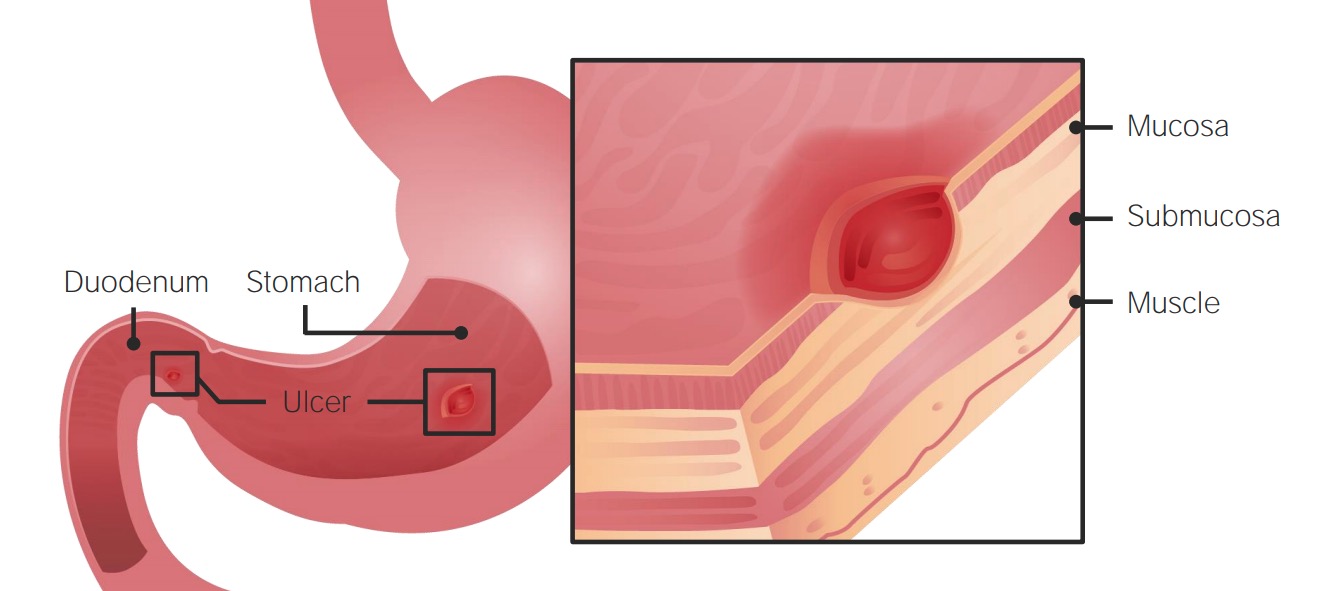
Una úlcera péptica es un defecto de la mucosa en EN Erythema nodosum is an immune-mediated panniculitis (inflammation of the subcutaneous fat) caused by a type IV (delayed-type) hypersensitivity reaction. It commonly manifests in young women as tender, erythematous nodules on the shins. Erythema Nodosum la pared del estómago o del duodeno que penetra en EN Erythema nodosum is an immune-mediated panniculitis (inflammation of the subcutaneous fat) caused by a type IV (delayed-type) hypersensitivity reaction. It commonly manifests in young women as tender, erythematous nodules on the shins. Erythema Nodosum la muscularis mucosae.

Epidemiología

  • Incidencia:
    • Enfermedad de úlcera péptica ( PUD PUD Peptic ulcer disease (PUD) refers to the full-thickness ulcerations of duodenal or gastric mucosa. The ulcerations form when exposure to acid and digestive enzymes overcomes mucosal defense mechanisms. The most common etiologies include Helicobacter pylori (H. pylori) infection and prolonged use of non-steroidal anti-inflammatory drugs (NSAIDs). Peptic Ulcer Disease, por sus siglas en EN Erythema nodosum is an immune-mediated panniculitis (inflammation of the subcutaneous fat) caused by a type IV (delayed-type) hypersensitivity reaction. It commonly manifests in young women as tender, erythematous nodules on the shins. Erythema Nodosum inglés) no complicada: 1 caso por cada 1000 personas-año en EN Erythema nodosum is an immune-mediated panniculitis (inflammation of the subcutaneous fat) caused by a type IV (delayed-type) hypersensitivity reaction. It commonly manifests in young women as tender, erythematous nodules on the shins. Erythema Nodosum la población general
    • Complicaciones de la PUD PUD Peptic ulcer disease (PUD) refers to the full-thickness ulcerations of duodenal or gastric mucosa. The ulcerations form when exposure to acid and digestive enzymes overcomes mucosal defense mechanisms. The most common etiologies include Helicobacter pylori (H. pylori) infection and prolonged use of non-steroidal anti-inflammatory drugs (NSAIDs). Peptic Ulcer Disease: 0.7 casos por cada 1000 personas-año en EN Erythema nodosum is an immune-mediated panniculitis (inflammation of the subcutaneous fat) caused by a type IV (delayed-type) hypersensitivity reaction. It commonly manifests in young women as tender, erythematous nodules on the shins. Erythema Nodosum la población general
  • Úlceras duodenales > úlceras gástricas (3:1)
  • Afecta a hombres y mujeres por igual
  • Las úlceras duodenales se producen, en EN Erythema nodosum is an immune-mediated panniculitis (inflammation of the subcutaneous fat) caused by a type IV (delayed-type) hypersensitivity reaction. It commonly manifests in young women as tender, erythematous nodules on the shins. Erythema Nodosum promedio, dos décadas antes que las gástricas.
  • Las tasas de incidencia han ido bajando en EN Erythema nodosum is an immune-mediated panniculitis (inflammation of the subcutaneous fat) caused by a type IV (delayed-type) hypersensitivity reaction. It commonly manifests in young women as tender, erythematous nodules on the shins. Erythema Nodosum las últimas décadas.

Etiología

  • Infecciosa:
    • Helicobacter pylori Helicobacter pylori A spiral bacterium active as a human gastric pathogen. It is a gram-negative, urease-positive, curved or slightly spiral organism initially isolated in 1982 from patients with lesions of gastritis or peptic ulcers in Western Australia. Helicobacter pylori was originally classified in the genus campylobacter, but RNA sequencing, cellular fatty acid profiles, growth patterns, and other taxonomic characteristics indicate that the micro-organism should be included in the genus Helicobacter. It has been officially transferred to Helicobacter gen. Helicobacter o H. pylori H. pylori A spiral bacterium active as a human gastric pathogen. It is a gram-negative, urease-positive, curved or slightly spiral organism initially isolated in 1982 from patients with lesions of gastritis or peptic ulcers in Western Australia. Helicobacter pylori was originally classified in the genus campylobacter, but RNA sequencing, cellular fatty acid profiles, growth patterns, and other taxonomic characteristics indicate that the micro-organism should be included in the genus Helicobacter. It has been officially transferred to Helicobacter gen. Helicobacter (la más común):
      • 80%–90% úlceras duodenales
      • 70%–80% úlceras gástricas
    • Virus Virus Viruses are infectious, obligate intracellular parasites composed of a nucleic acid core surrounded by a protein capsid. Viruses can be either naked (non-enveloped) or enveloped. The classification of viruses is complex and based on many factors, including type and structure of the nucleoid and capsid, the presence of an envelope, the replication cycle, and the host range. Virology:
      • Virus Virus Viruses are infectious, obligate intracellular parasites composed of a nucleic acid core surrounded by a protein capsid. Viruses can be either naked (non-enveloped) or enveloped. The classification of viruses is complex and based on many factors, including type and structure of the nucleoid and capsid, the presence of an envelope, the replication cycle, and the host range. Virology del herpes simple ( HSV HSV Herpes simplex virus (HSV) is a double-stranded DNA virus belonging to the family Herpesviridae. Herpes simplex virus commonly causes recurrent infections involving the skin and mucosal surfaces, including the mouth, lips, eyes, and genitals. Herpes Simplex Virus 1 and 2, por sus siglas en EN Erythema nodosum is an immune-mediated panniculitis (inflammation of the subcutaneous fat) caused by a type IV (delayed-type) hypersensitivity reaction. It commonly manifests in young women as tender, erythematous nodules on the shins. Erythema Nodosum inglés)
      • Citomegalovirus (CMV)
    • Infecciones raras:
      • Tuberculosis Tuberculosis Tuberculosis (TB) is an infectious disease caused by Mycobacterium tuberculosis complex bacteria. The bacteria usually attack the lungs but can also damage other parts of the body. Approximately 30% of people around the world are infected with this pathogen, with the majority harboring a latent infection. Tuberculosis spreads through the air when a person with active pulmonary infection coughs or sneezes. Tuberculosis ( TB TB Tuberculosis (TB) is an infectious disease caused by Mycobacterium tuberculosis complex bacteria. The bacteria usually attack the lungs but can also damage other parts of the body. Approximately 30% of people around the world are infected with this pathogen, with the majority harboring a latent infection. Tuberculosis spreads through the air when a person with active pulmonary infection coughs or sneezes. Tuberculosis)
      • Sífilis
      • Mucormicosis
  • Medicamentosa:
    • Antiinflamatorios no esteroideos (AINE; los LOS Neisseria más comunes)
    • Medicamentos relacionados con la PUD PUD Peptic ulcer disease (PUD) refers to the full-thickness ulcerations of duodenal or gastric mucosa. The ulcerations form when exposure to acid and digestive enzymes overcomes mucosal defense mechanisms. The most common etiologies include Helicobacter pylori (H. pylori) infection and prolonged use of non-steroidal anti-inflammatory drugs (NSAIDs). Peptic Ulcer Disease o riesgo exacerbado por la combinación con AINE:
      • Bifosfonatos
      • Clopidogrel Clopidogrel A ticlopidine analog and platelet purinergic p2y receptor antagonist that inhibits adenosine diphosphate-mediated platelet aggregation. It is used to prevent thromboembolism in patients with arterial occlusive diseases; myocardial infarction; stroke; or atrial fibrillation. Antiplatelet Drugs
      • Corticosteroides
      • Espironolactona
    • Quimioterapia
    • Sirolimus Sirolimus A macrolide compound obtained from streptomyces hygroscopicus that acts by selectively blocking the transcriptional activation of cytokines thereby inhibiting cytokine production. It is bioactive only when bound to immunophilins. Sirolimus is a potent immunosuppressant and possesses both antifungal and antineoplastic properties. Immunosuppressants
    • Micofenolato mofetilo
    • Cloruro de potasio
  • Hormonal:
    • Gastrinoma Gastrinoma A gastrinoma is a tumor that secretes excessive levels of the hormone gastrin and is responsible for Zollinger-Ellison syndrome (ZES). Gastrinomas are frequently associated with multiple endocrine neoplasia 1 (MEN 1) and can arise from the pancreas, stomach, duodenum, jejunum, and/or even from the lymph nodes. Gastrinoma (síndrome de Zollinger-Ellison)
    • Hiperplasia/hiperfunción de las células G antrales ( gastritis Gastritis Gastritis refers to inflammation of the gastric mucosa. Gastritis may occur suddenly (acute gastritis) or slowly over time (chronic gastritis). Gastritis may be asymptomatic or with symptoms, including burning abdominal pain (which either worsens or improves with eating), dyspepsia, nausea, and vomiting. Gastritis)
  • Postoperatoria:
    • Exclusión antral
    • Bypass gástrico
  • Isquémica: consumo de cocaína
  • Enfermedades crónicas descompensadas:
    • Cirrosis
    • Insuficiencia renal
    • Enfermedad pulmonar obstructiva crónica (EPOC)
    • Estancia prolongada en EN Erythema nodosum is an immune-mediated panniculitis (inflammation of the subcutaneous fat) caused by a type IV (delayed-type) hypersensitivity reaction. It commonly manifests in young women as tender, erythematous nodules on the shins. Erythema Nodosum una unidad de cuidados intensivos (UCI) por cualquier motivo
  • Idiopática
  • Otras causas raras:
    • Páncreas anular
    • Sarcoidosis Sarcoidosis Sarcoidosis is a multisystem inflammatory disease that causes noncaseating granulomas. The exact etiology is unknown. Sarcoidosis usually affects the lungs and thoracic lymph nodes, but it can also affect almost every system in the body, including the skin, heart, and eyes, most commonly. Sarcoidosis
    • Enfermedad de Crohn
    • Radiación

Factores de riesgo

En EN Erythema nodosum is an immune-mediated panniculitis (inflammation of the subcutaneous fat) caused by a type IV (delayed-type) hypersensitivity reaction. It commonly manifests in young women as tender, erythematous nodules on the shins. Erythema Nodosum muchos casos, las etiologías enumeradas no son suficientes para producir una PUD PUD Peptic ulcer disease (PUD) refers to the full-thickness ulcerations of duodenal or gastric mucosa. The ulcerations form when exposure to acid and digestive enzymes overcomes mucosal defense mechanisms. The most common etiologies include Helicobacter pylori (H. pylori) infection and prolonged use of non-steroidal anti-inflammatory drugs (NSAIDs). Peptic Ulcer Disease. Los LOS Neisseria siguientes factores de riesgo contribuyen al AL Amyloidosis desarrollo de la PUD PUD Peptic ulcer disease (PUD) refers to the full-thickness ulcerations of duodenal or gastric mucosa. The ulcerations form when exposure to acid and digestive enzymes overcomes mucosal defense mechanisms. The most common etiologies include Helicobacter pylori (H. pylori) infection and prolonged use of non-steroidal anti-inflammatory drugs (NSAIDs). Peptic Ulcer Disease:

  • Tabaquismo
  • Alcohol
  • Estrés (relacionado con una enfermedad grave, psicológico)
  • Dieta
  • Predisposición genética
  • Tipos de sangre A y O

Fisiopatología

Localización anatómica de las úlceras

  • Úlcera duodenal: es una úlcera localizada en EN Erythema nodosum is an immune-mediated panniculitis (inflammation of the subcutaneous fat) caused by a type IV (delayed-type) hypersensitivity reaction. It commonly manifests in young women as tender, erythematous nodules on the shins. Erythema Nodosum el duodeno, normalmente en EN Erythema nodosum is an immune-mediated panniculitis (inflammation of the subcutaneous fat) caused by a type IV (delayed-type) hypersensitivity reaction. It commonly manifests in young women as tender, erythematous nodules on the shins. Erythema Nodosum el bulbo duodenal (1ra porción)
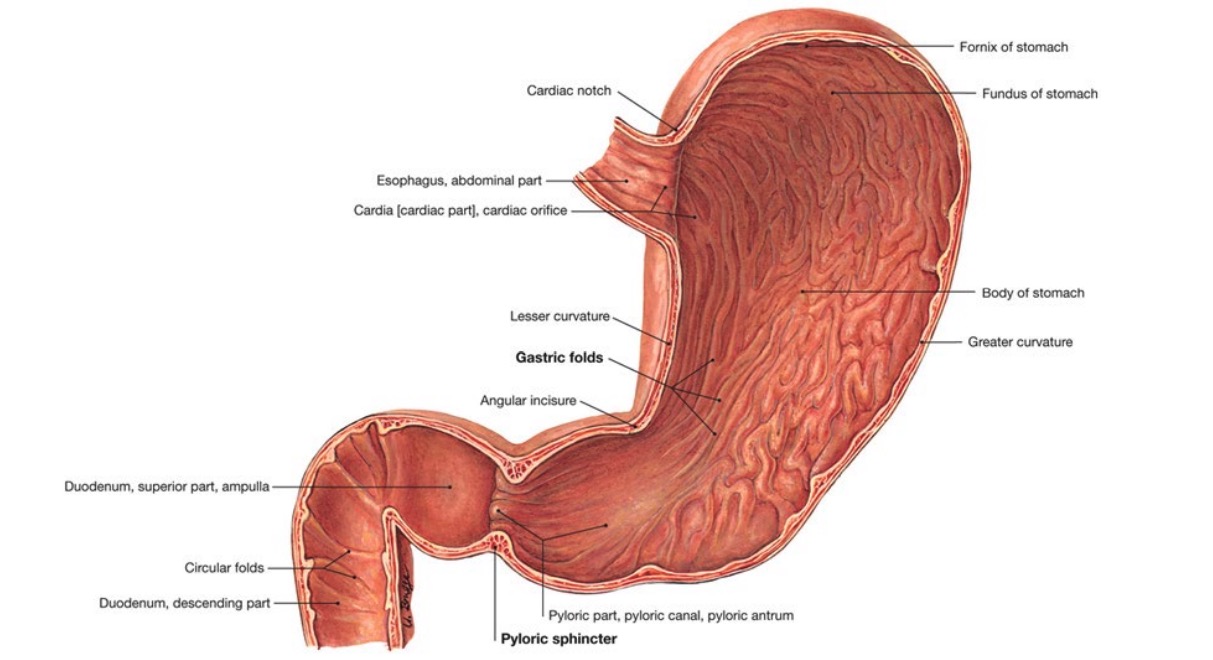
  • Úlcera gástrica: es una úlcera en EN Erythema nodosum is an immune-mediated panniculitis (inflammation of the subcutaneous fat) caused by a type IV (delayed-type) hypersensitivity reaction. It commonly manifests in young women as tender, erythematous nodules on the shins. Erythema Nodosum el revestimiento del estómago, comúnmente en EN Erythema nodosum is an immune-mediated panniculitis (inflammation of the subcutaneous fat) caused by a type IV (delayed-type) hypersensitivity reaction. It commonly manifests in young women as tender, erythematous nodules on the shins. Erythema Nodosum la curvatura menor del estómago cerca de la unión del fundus Fundus The superior portion of the body of the stomach above the level of the cardiac notch. Stomach: Anatomy y la mucosa antral (o tipo I)
Tabla: Clasificación de las úlceras gástricas según su localización (clasificación de Johnson modificada)
Tipo Localización Nivel de acidez
I Curvatura menor del estómago en EN Erythema nodosum is an immune-mediated panniculitis (inflammation of the subcutaneous fat) caused by a type IV (delayed-type) hypersensitivity reaction. It commonly manifests in young women as tender, erythematous nodules on the shins. Erythema Nodosum la incisura angular Bajo a normal
II Cuerpo gástrico; coexiste con la úlcera duodenal Aumentado
III En EN Erythema nodosum is an immune-mediated panniculitis (inflammation of the subcutaneous fat) caused by a type IV (delayed-type) hypersensitivity reaction. It commonly manifests in young women as tender, erythematous nodules on the shins. Erythema Nodosum el canal pilórico (a menos de 3 cm del píloro) Aumentado
IV Úlcera gastroesofágica proximal Normal
V En EN Erythema nodosum is an immune-mediated panniculitis (inflammation of the subcutaneous fat) caused by a type IV (delayed-type) hypersensitivity reaction. It commonly manifests in young women as tender, erythematous nodules on the shins. Erythema Nodosum cualquier parte del estómago (inducido por la aspirina/ los LOS Neisseria AINE) Normal
Componentes anatómicos del estómago

Imagen por Lecturio.

Fisiopatología

  • Estómago y duodeno:
    • Normalmente expuesto a un entorno tóxico (ácido + pepsina)
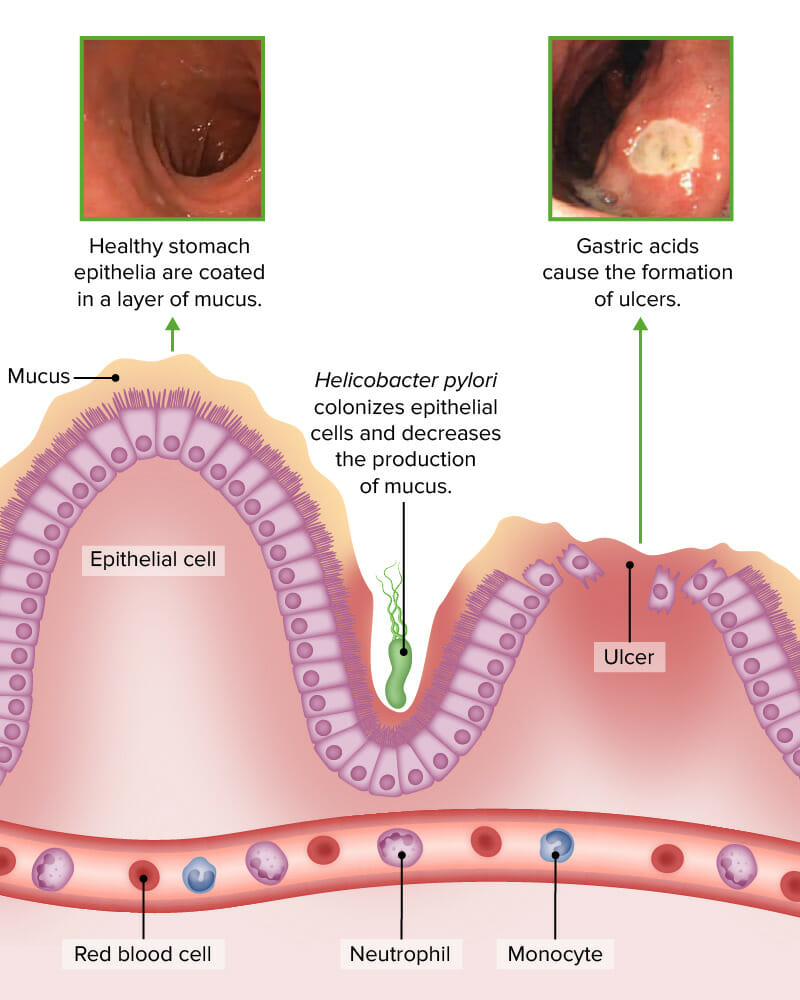
    • El desequilibrio entre los LOS Neisseria agentes ofensivos y los LOS Neisseria mecanismos de defensa conduce a la úlcera péptica.
  • Las defensas que previenen las lesiones de la mucosa:
    • Capa de moco-bicarbonato-fosfolípido
    • Capa epitelial (cuya reparación está regulada por las prostaglandinas)
    • Defensa subepitelial (flujo sanguíneo de la mucosa para el suministro de nutrientes y oxígeno, eliminación de agentes nocivos)
  • Mecanismos por agentes ofensivos:
    • Aumento de la secreción de ácido gástrico:
      • Gastritis Gastritis Gastritis refers to inflammation of the gastric mucosa. Gastritis may occur suddenly (acute gastritis) or slowly over time (chronic gastritis). Gastritis may be asymptomatic or with symptoms, including burning abdominal pain (which either worsens or improves with eating), dyspepsia, nausea, and vomiting. Gastritis o inflamación por H. pylori H. pylori A spiral bacterium active as a human gastric pathogen. It is a gram-negative, urease-positive, curved or slightly spiral organism initially isolated in 1982 from patients with lesions of gastritis or peptic ulcers in Western Australia. Helicobacter pylori was originally classified in the genus campylobacter, but RNA sequencing, cellular fatty acid profiles, growth patterns, and other taxonomic characteristics indicate that the micro-organism should be included in the genus Helicobacter. It has been officially transferred to Helicobacter gen. Helicobacter: ↑ ácido gástrico, inhibe la somatostatina, ↓ moco
      • La inhibición de la COX 1 COX 1 A constitutively-expressed subtype of prostaglandin-endoperoxide synthase. It plays an important role in many cellular processes. Antiplatelet Drugs por los LOS Neisseria AINE → ↓ prostaglandina (↓ moco, ↓ flujo sanguíneo de la mucosa, ↓ proliferación epitelial).
      • La inhibición de la COX 2 COX 2 An inducibly-expressed subtype of prostaglandin-endoperoxide synthase. It plays an important role in many cellular processes and inflammation. It is the target of cox 2 inhibitors. Antiplatelet Drugs por los LOS Neisseria AINE → retrasa la cicatrización
    • Deterioro de la secreción de bicarbonato duodenal ( en EN Erythema nodosum is an immune-mediated panniculitis (inflammation of the subcutaneous fat) caused by a type IV (delayed-type) hypersensitivity reaction. It commonly manifests in young women as tender, erythematous nodules on the shins. Erythema Nodosum pacientes con úlceras duodenales)
    • Efectos de otras etiologías o factores de riesgo:
      • Fumar → ↑ secreción de ácido, ↓ prostaglandina.
      • Síndrome de Zollinger-Ellison ( gastrinoma Gastrinoma A gastrinoma is a tumor that secretes excessive levels of the hormone gastrin and is responsible for Zollinger-Ellison syndrome (ZES). Gastrinomas are frequently associated with multiple endocrine neoplasia 1 (MEN 1) and can arise from the pancreas, stomach, duodenum, jejunum, and/or even from the lymph nodes. Gastrinoma) → ↑ gastrina
      • Las lesiones cerebrales aumentan la presión intracraneal, estimulando excesivamente el nervio vago → ↑ ácido gástrico (úlcera de Cushing)
      • Lesión por quemadura (estrés) → reducción de volumen, necrosis Necrosis The death of cells in an organ or tissue due to disease, injury or failure of the blood supply. Ischemic Cell Damage celular → descamación de la mucosa gástrica → deterioro de la barrera (úlcera de Curling).
Enfermedad de úlcera péptica
Desarrollo de la PUD en el estómago y el duodeno

Imagen por Lecturio.

Presentación Clínica

Asintomática

  • 70% de los LOS Neisseria pacientes con PUD PUD Peptic ulcer disease (PUD) refers to the full-thickness ulcerations of duodenal or gastric mucosa. The ulcerations form when exposure to acid and digestive enzymes overcomes mucosal defense mechanisms. The most common etiologies include Helicobacter pylori (H. pylori) infection and prolonged use of non-steroidal anti-inflammatory drugs (NSAIDs). Peptic Ulcer Disease
  • Adultos mayores
  • Pacientes que toman AINE
  • Las complicaciones (hemorragia o perforación) pueden ser la primera presentación clínica sin síntomas previos.

Sintomática

  • Dolor Dolor Inflammation abdominal:
    • Epigástrico con irradiación a los LOS Neisseria cuadrantes superiores izquierdo o derecho
    • A veces se irradia hacia la espalda
    • Dolor Dolor Inflammation clásico de la úlcera duodenal: 2–5 horas después de comer y por la noche (cuando se segrega ácido sin comida)
    • A veces se exacerba al AL Amyloidosis comer (úlceras del canal pilórico)
  • Otros síntomas:
    • Náuseas/vómitos
    • Saciedad temprana
    • Plenitud postprandial/distensión abdominal
    • Eructos
    • Melena Melena The black, tarry, foul-smelling feces that contain degraded blood. Gastrointestinal Bleeding
    • Hematemesis Hematemesis Vomiting of blood that is either fresh bright red, or older ‘coffee-ground’ in character. It generally indicates bleeding of the upper gastrointestinal tract. Mallory-Weiss Syndrome (Mallory-Weiss Tear)

Diagnóstico

Antecedentes

Revisión de los LOS Neisseria factores de riesgo comunes:
  • Uso de AINE/aspirina
  • Uso concomitante de medicamentos de alto riesgo
  • Enfermedad crónica subyacente
  • Cirugía gástrica previa o radiación

Estudios de laboratorio

  • Anemia Anemia Anemia is a condition in which individuals have low Hb levels, which can arise from various causes. Anemia is accompanied by a reduced number of RBCs and may manifest with fatigue, shortness of breath, pallor, and weakness. Subtypes are classified by the size of RBCs, chronicity, and etiology. Anemia: Overview and Types (hemorragia oculta y/o malabsorción de hierro)
  • Niveles elevados de gastrina en EN Erythema nodosum is an immune-mediated panniculitis (inflammation of the subcutaneous fat) caused by a type IV (delayed-type) hypersensitivity reaction. It commonly manifests in young women as tender, erythematous nodules on the shins. Erythema Nodosum ayunas (si se sospecha el síndrome de Zollinger-Ellison)

Esofagogastroduodenoscopia (EGD)

  • Prueba de diagnóstico más precisa
  • Hallazgos:
    • Úlcera gástrica:
      • Lesiones mucosas discretas generalmente solitarias, con base lisa perforada
      • Las lesiones benignas tienen bordes lisos y redondeados (a diferencia de los LOS Neisseria bordes irregulares que se observan en EN Erythema nodosum is an immune-mediated panniculitis (inflammation of the subcutaneous fat) caused by a type IV (delayed-type) hypersensitivity reaction. It commonly manifests in young women as tender, erythematous nodules on the shins. Erythema Nodosum las lesiones malignas).
      • Típicamente en EN Erythema nodosum is an immune-mediated panniculitis (inflammation of the subcutaneous fat) caused by a type IV (delayed-type) hypersensitivity reaction. It commonly manifests in young women as tender, erythematous nodules on the shins. Erythema Nodosum la curvatura menor
    • Úlcera duodenal:
      • Pequeñas roturas en EN Erythema nodosum is an immune-mediated panniculitis (inflammation of the subcutaneous fat) caused by a type IV (delayed-type) hypersensitivity reaction. It commonly manifests in young women as tender, erythematous nodules on the shins. Erythema Nodosum la mucosa, a menudo < 1 cm
      • Se observa generalmente en EN Erythema nodosum is an immune-mediated panniculitis (inflammation of the subcutaneous fat) caused by a type IV (delayed-type) hypersensitivity reaction. It commonly manifests in young women as tender, erythematous nodules on the shins. Erythema Nodosum la primera parte del duodeno
  • Indicaciones para la biopsia:
    • Sospecha de malignidad (masa ulcerada, márgenes irregulares, pliegues mucosos anormales)
    • Cualquier úlcera gástrica en EN Erythema nodosum is an immune-mediated panniculitis (inflammation of the subcutaneous fat) caused by a type IV (delayed-type) hypersensitivity reaction. It commonly manifests in young women as tender, erythematous nodules on the shins. Erythema Nodosum zonas con alta incidencia de cáncer gástrico
    • Si se sospecha una etiología inusual (e.g., sarcoidosis Sarcoidosis Sarcoidosis is a multisystem inflammatory disease that causes noncaseating granulomas. The exact etiology is unknown. Sarcoidosis usually affects the lungs and thoracic lymph nodes, but it can also affect almost every system in the body, including the skin, heart, and eyes, most commonly. Sarcoidosis)
    • Biopsia de la mucosa gástrica del antro y del cuerpo (además de la propia úlcera) para la detección de H. pylori H. pylori A spiral bacterium active as a human gastric pathogen. It is a gram-negative, urease-positive, curved or slightly spiral organism initially isolated in 1982 from patients with lesions of gastritis or peptic ulcers in Western Australia. Helicobacter pylori was originally classified in the genus campylobacter, but RNA sequencing, cellular fatty acid profiles, growth patterns, and other taxonomic characteristics indicate that the micro-organism should be included in the genus Helicobacter. It has been officially transferred to Helicobacter gen. Helicobacter
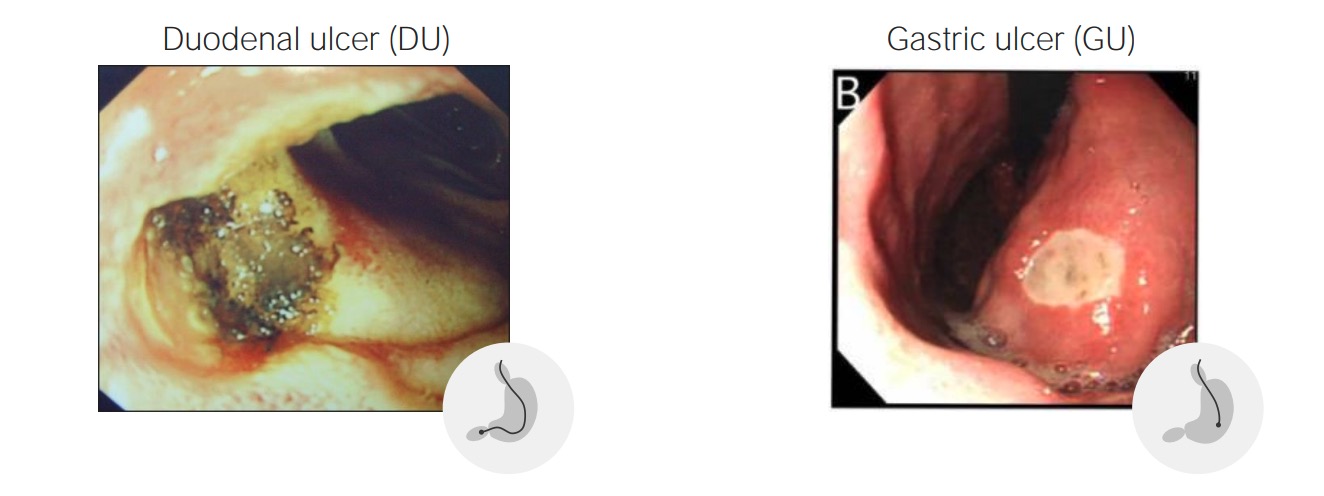
Endoscopia de lesiones ulcerosas
Vista endoscópica de lesiones ulcerosas a nivel duodenal (izquierda) y gástrico (derecha)

Imagen: “F0002” por Department of Surgery, King Fahad Specialist Hospital, Dammam, Saudi Arabia. Licencia: CC BY 2.0, e Imagen: “F1” por Department of Psychosomatic Internal Medicine, Health Sciences University of Hokkaido, Japan. Licencia: CC BY 2.0, editado por Lecturio.

Pruebas de H. pylori H. pylori A spiral bacterium active as a human gastric pathogen. It is a gram-negative, urease-positive, curved or slightly spiral organism initially isolated in 1982 from patients with lesions of gastritis or peptic ulcers in Western Australia. Helicobacter pylori was originally classified in the genus campylobacter, but RNA sequencing, cellular fatty acid profiles, growth patterns, and other taxonomic characteristics indicate that the micro-organism should be included in the genus Helicobacter. It has been officially transferred to Helicobacter gen. Helicobacter

  • No invasivas:
    • Prueba de antígeno en EN Erythema nodosum is an immune-mediated panniculitis (inflammation of the subcutaneous fat) caused by a type IV (delayed-type) hypersensitivity reaction. It commonly manifests in young women as tender, erythematous nodules on the shins. Erythema Nodosum heces:
      • Para el diagnóstico inicial
      • Para confirmar la erradicación
    • Prueba de aliento de urea Urea A compound formed in the liver from ammonia produced by the deamination of amino acids. It is the principal end product of protein catabolism and constitutes about one half of the total urinary solids. Urea Cycle:
      • El paciente recibe urea Urea A compound formed in the liver from ammonia produced by the deamination of amino acids. It is the principal end product of protein catabolism and constitutes about one half of the total urinary solids. Urea Cycle marcada radioactivamente por vía oral.
      • La ureasa producida por H. pylori H. pylori A spiral bacterium active as a human gastric pathogen. It is a gram-negative, urease-positive, curved or slightly spiral organism initially isolated in 1982 from patients with lesions of gastritis or peptic ulcers in Western Australia. Helicobacter pylori was originally classified in the genus campylobacter, but RNA sequencing, cellular fatty acid profiles, growth patterns, and other taxonomic characteristics indicate that the micro-organism should be included in the genus Helicobacter. It has been officially transferred to Helicobacter gen. Helicobacter divide la urea Urea A compound formed in the liver from ammonia produced by the deamination of amino acids. It is the principal end product of protein catabolism and constitutes about one half of the total urinary solids. Urea Cycle y libera CO2.
      • El CO2 radiactivo se detecta en EN Erythema nodosum is an immune-mediated panniculitis (inflammation of the subcutaneous fat) caused by a type IV (delayed-type) hypersensitivity reaction. It commonly manifests in young women as tender, erythematous nodules on the shins. Erythema Nodosum el aliento.
    • Serología:
      • Detección de IgG IgG The major immunoglobulin isotype class in normal human serum. There are several isotype subclasses of igg, for example, igg1, igg2a, and igg2b. Hypersensitivity Pneumonitis en EN Erythema nodosum is an immune-mediated panniculitis (inflammation of the subcutaneous fat) caused by a type IV (delayed-type) hypersensitivity reaction. It commonly manifests in young women as tender, erythematous nodules on the shins. Erythema Nodosum suero contra H. pylori H. pylori A spiral bacterium active as a human gastric pathogen. It is a gram-negative, urease-positive, curved or slightly spiral organism initially isolated in 1982 from patients with lesions of gastritis or peptic ulcers in Western Australia. Helicobacter pylori was originally classified in the genus campylobacter, but RNA sequencing, cellular fatty acid profiles, growth patterns, and other taxonomic characteristics indicate that the micro-organism should be included in the genus Helicobacter. It has been officially transferred to Helicobacter gen. Helicobacter
      • Baja precisión
      • La IgG IgG The major immunoglobulin isotype class in normal human serum. There are several isotype subclasses of igg, for example, igg1, igg2a, and igg2b. Hypersensitivity Pneumonitis sigue siendo positiva después de la erradicación.
  • Invasivas (requiere la toma de muestras de la mucosa gástrica):
    • Prueba de ureasa rápida:
      • La ureasa producida por H. pylori H. pylori A spiral bacterium active as a human gastric pathogen. It is a gram-negative, urease-positive, curved or slightly spiral organism initially isolated in 1982 from patients with lesions of gastritis or peptic ulcers in Western Australia. Helicobacter pylori was originally classified in the genus campylobacter, but RNA sequencing, cellular fatty acid profiles, growth patterns, and other taxonomic characteristics indicate that the micro-organism should be included in the genus Helicobacter. It has been officially transferred to Helicobacter gen. Helicobacter libera amoníaco a partir de la urea Urea A compound formed in the liver from ammonia produced by the deamination of amino acids. It is the principal end product of protein catabolism and constitutes about one half of the total urinary solids. Urea Cycle.
      • El pH pH The quantitative measurement of the acidity or basicity of a solution. Acid-Base Balance alcalino cambia el color de un reactivo de pH pH The quantitative measurement of the acidity or basicity of a solution. Acid-Base Balance.
    • Histología:
      • Precisión mejorada por las tinciones (inmunohistoquímica, tinciones de Giemsa)
      • Se observan bacilos gramnegativos curvos y flagelados.
    • Cultivo bacteriano y sensibilidad

Tratamiento

Modificación de los LOS Neisseria factores de riesgo

  • Suspender los LOS Neisseria AINE.
  • Dejar de fumar y suspender la ingesta de alcohol y drogas.
  • Dieta blanda

Medicamentos

  • Erradicación de H. pylori H. pylori A spiral bacterium active as a human gastric pathogen. It is a gram-negative, urease-positive, curved or slightly spiral organism initially isolated in 1982 from patients with lesions of gastritis or peptic ulcers in Western Australia. Helicobacter pylori was originally classified in the genus campylobacter, but RNA sequencing, cellular fatty acid profiles, growth patterns, and other taxonomic characteristics indicate that the micro-organism should be included in the genus Helicobacter. It has been officially transferred to Helicobacter gen. Helicobacter:
    • Una combinación de un régimen de antibióticos y de inhibidores de la bomba de protones (IBP):
      • Terapia triple: IBP + claritromicina + amoxicilina o metronidazol
      • Terapia cuádruple con bismuto (primera línea empírica preferida en EN Erythema nodosum is an immune-mediated panniculitis (inflammation of the subcutaneous fat) caused by a type IV (delayed-type) hypersensitivity reaction. It commonly manifests in young women as tender, erythematous nodules on the shins. Erythema Nodosum la mayoría de los LOS Neisseria casos): IBP + bismuto + tetraciclina + metronidazol
    • Confirmar la erradicación de H. pylori H. pylori A spiral bacterium active as a human gastric pathogen. It is a gram-negative, urease-positive, curved or slightly spiral organism initially isolated in 1982 from patients with lesions of gastritis or peptic ulcers in Western Australia. Helicobacter pylori was originally classified in the genus campylobacter, but RNA sequencing, cellular fatty acid profiles, growth patterns, and other taxonomic characteristics indicate that the micro-organism should be included in the genus Helicobacter. It has been officially transferred to Helicobacter gen. Helicobacter después del tratamiento.
  • IBP:
    • Úlceras no complicadas:
      • Administrar durante 2 semanas (más tratamiento antibiótico para H. pylori H. pylori A spiral bacterium active as a human gastric pathogen. It is a gram-negative, urease-positive, curved or slightly spiral organism initially isolated in 1982 from patients with lesions of gastritis or peptic ulcers in Western Australia. Helicobacter pylori was originally classified in the genus campylobacter, but RNA sequencing, cellular fatty acid profiles, growth patterns, and other taxonomic characteristics indicate that the micro-organism should be included in the genus Helicobacter. It has been officially transferred to Helicobacter gen. Helicobacter si es positivo)
      • Más tiempo si el paciente tiene indicaciones de terapia de mantenimiento
    • Úlceras complicadas (hemorragia, penetración, obstrucción o perforación):
      • Úlcera duodenal: 4–8 semanas
      • Úlcera gástrica: 8–12 semanas (es necesario confirmar la curación de la úlcera)
      • Más tiempo si el paciente tiene indicaciones de terapia de mantenimiento
    • Terapia de mantenimiento:
      • Si es necesario continuar con los LOS Neisseria AINE o la aspirina
      • Úlcera gigante (> 2 cm)
      • H. pylori H. pylori A spiral bacterium active as a human gastric pathogen. It is a gram-negative, urease-positive, curved or slightly spiral organism initially isolated in 1982 from patients with lesions of gastritis or peptic ulcers in Western Australia. Helicobacter pylori was originally classified in the genus campylobacter, but RNA sequencing, cellular fatty acid profiles, growth patterns, and other taxonomic characteristics indicate that the micro-organism should be included in the genus Helicobacter. It has been officially transferred to Helicobacter gen. Helicobacter negativo, úlceras negativas a los LOS Neisseria AINE
      • Úlcera péptica recurrente (> 2/año)

Repetir la endoscopia

  • Úlceras duodenales:
    • Normalmente no es necesario
    • Si los LOS Neisseria síntomas persisten con el tratamiento > 4 semanas
    • Si hay evidencia de una hemorragia continua
  • Úlceras gástricas:
    • Síntomas persistentes a pesar de 8–12 semanas de tratamiento médico
    • Etiología poco clara
    • Úlcera gigante (> 2 cm)
    • La úlcera era sospechosa de malignidad en EN Erythema nodosum is an immune-mediated panniculitis (inflammation of the subcutaneous fat) caused by a type IV (delayed-type) hypersensitivity reaction. It commonly manifests in young women as tender, erythematous nodules on the shins. Erythema Nodosum la primera endoscopia (incluso con biopsia negativa).
    • Evidencia de una hemorragia continua
    • Fracaso para erradicar la infección por H. pylori H. pylori A spiral bacterium active as a human gastric pathogen. It is a gram-negative, urease-positive, curved or slightly spiral organism initially isolated in 1982 from patients with lesions of gastritis or peptic ulcers in Western Australia. Helicobacter pylori was originally classified in the genus campylobacter, but RNA sequencing, cellular fatty acid profiles, growth patterns, and other taxonomic characteristics indicate that the micro-organism should be included in the genus Helicobacter. It has been officially transferred to Helicobacter gen. Helicobacter
    • Factores de riesgo del cáncer gástrico:
      • Edad > 50 años
      • H. pylori H. pylori A spiral bacterium active as a human gastric pathogen. It is a gram-negative, urease-positive, curved or slightly spiral organism initially isolated in 1982 from patients with lesions of gastritis or peptic ulcers in Western Australia. Helicobacter pylori was originally classified in the genus campylobacter, but RNA sequencing, cellular fatty acid profiles, growth patterns, and other taxonomic characteristics indicate that the micro-organism should be included in the genus Helicobacter. It has been officially transferred to Helicobacter gen. Helicobacter
      • Antecedentes familiares
      • Inmigrantes de zonas endémicas (Japón, Corea)
      • Atrofia gástrica, metaplasia Metaplasia A condition in which there is a change of one adult cell type to another similar adult cell type. Cellular Adaptation/displasia, adenoma

Tratamiento quirúrgico

  • Poco frecuente porque la terapia médica es muy eficaz
  • Indicaciones de la cirugía:
    • Manejo de las complicaciones:
      • Hemorragia
      • Perforación
      • Estenosis pilórica
    • PUD PUD Peptic ulcer disease (PUD) refers to the full-thickness ulcerations of duodenal or gastric mucosa. The ulcerations form when exposure to acid and digestive enzymes overcomes mucosal defense mechanisms. The most common etiologies include Helicobacter pylori (H. pylori) infection and prolonged use of non-steroidal anti-inflammatory drugs (NSAIDs). Peptic Ulcer Disease refractaria al AL Amyloidosis tratamiento médico
    • Incumplimiento o efectos secundarios intolerables de los LOS Neisseria medicamentos
  • Principios quirúrgicos:
    • Prevenir las complicaciones de la úlcera: resección de la úlcera
    • Reducir la secreción de ácido: vagotomía, antrectomía
    • Minimizar las alteraciones fisiológicas postoperatorias: piloroplastia para facilitar el vaciado gástrico tras la vagotomía
  • Procedimientos:
    • Vagotomía altamente selectiva: Solamente se seccionan las ramas vagales que estimulan la secreción de ácido.
    • Vagotomía y drenaje (piloroplastia o gastroyeyunostomía)
    • Procedimientos que involucran la resección parcial del estómago:
      • Vagotomía y antrectomía: elimina la parte del estómago que produce ácido
      • Gastrectomía parcial: extirpa la parte del estómago que contiene la úlcera gástrica
      • Reconstrucción necesaria para una gastrectomía parcial: por anastomosis gastroduodenal (Billroth I) o gastroyeyunal (Billroth II)

Complicaciones

Hemorragia gastrointestinal

  • Los LOS Neisseria pacientes presentan hematemesis Hematemesis Vomiting of blood that is either fresh bright red, or older ‘coffee-ground’ in character. It generally indicates bleeding of the upper gastrointestinal tract. Mallory-Weiss Syndrome (Mallory-Weiss Tear) y/o melena Melena The black, tarry, foul-smelling feces that contain degraded blood. Gastrointestinal Bleeding.
  • Puede ser crónica/de bajo grado y presentarse como anemia Anemia Anemia is a condition in which individuals have low Hb levels, which can arise from various causes. Anemia is accompanied by a reduced number of RBCs and may manifest with fatigue, shortness of breath, pallor, and weakness. Subtypes are classified by the size of RBCs, chronicity, and etiology. Anemia: Overview and Types
  • Las hemorragias agudas suelen abordarse con una intervención endoscópica.
  • Lesión de Dieulafoy: malformación vascular en EN Erythema nodosum is an immune-mediated panniculitis (inflammation of the subcutaneous fat) caused by a type IV (delayed-type) hypersensitivity reaction. It commonly manifests in young women as tender, erythematous nodules on the shins. Erythema Nodosum el estómago (submucosa) que se ulcera y provoca una hemorragia masiva
  • La cirugía puede ser necesaria si no se logra el control endoscópico.

Perforación

  • Defecto de espesor total de la pared del estómago que permite la salida del contenido a la cavidad peritoneal.
  • Aparición repentina de dolor Dolor Inflammation abdominal difuso grave, peritonitis Peritonitis Inflammation of the peritoneum lining the abdominal cavity as the result of infectious, autoimmune, or chemical processes. Primary peritonitis is due to infection of the peritoneal cavity via hematogenous or lymphatic spread and without intra-abdominal source. Secondary peritonitis arises from the abdominal cavity itself through rupture or abscess of intra-abdominal organs. Penetrating Abdominal Injury, taquicardia
  • Se requiere cirugía de emergencia.

Penetración

  • Una úlcera puede penetrar la pared para:
    • Involucrar órganos adyacentes (e.g., el páncreas).
    • Formar una perforación confinada (e.g., sin fuga del contenido a la cavidad peritoneal debido a adherencias).
  • Los LOS Neisseria síntomas no son tan pronunciados como en EN Erythema nodosum is an immune-mediated panniculitis (inflammation of the subcutaneous fat) caused by a type IV (delayed-type) hypersensitivity reaction. It commonly manifests in young women as tender, erythematous nodules on the shins. Erythema Nodosum el caso de una perforación libre; aparición subaguda
  • A menudo da lugar a la formación de abscesos o fístulas a los LOS Neisseria órganos circundantes ( colon Colon The large intestines constitute the last portion of the digestive system. The large intestine consists of the cecum, appendix, colon (with ascending, transverse, descending, and sigmoid segments), rectum, and anal canal. The primary function of the colon is to remove water and compact the stool prior to expulsion from the body via the rectum and anal canal. Colon, Cecum, and Appendix: Anatomy, árbol biliar, vasos sanguíneos)

Estenosis pilórica

  • Obstrucción mecánica por inflamación y cicatrización peri-pilórica
  • El tratamiento de primera línea es la erradicación del H. pylori H. pylori A spiral bacterium active as a human gastric pathogen. It is a gram-negative, urease-positive, curved or slightly spiral organism initially isolated in 1982 from patients with lesions of gastritis or peptic ulcers in Western Australia. Helicobacter pylori was originally classified in the genus campylobacter, but RNA sequencing, cellular fatty acid profiles, growth patterns, and other taxonomic characteristics indicate that the micro-organism should be included in the genus Helicobacter. It has been officially transferred to Helicobacter gen. Helicobacter y los LOS Neisseria IBP.
  • La dilatación endoscópica se emplea cuando fracasa el tratamiento médico
  • La cirugía se reserva como último recurso

Cáncer gástrico

  • Adenocarcinoma
  • Linfoma de tejido linfoide asociado a la mucosa ( MALToma MALToma Extranodal marginal zone lymphoma (EMZL) of mucosa-associated lymphoid tissue (also called MALToma, MALT lymphoma, and pseudolymphoma) is a group of non-Hodgkin’s lymphomas that have historically been grouped together because they appear to arise from postgerminal center marginal zone B cells and share a similar immunophenotype. MALT Lymphoma o linfoma MALT MALT Colon, Cecum, and Appendix: Anatomy, por sus siglas en EN Erythema nodosum is an immune-mediated panniculitis (inflammation of the subcutaneous fat) caused by a type IV (delayed-type) hypersensitivity reaction. It commonly manifests in young women as tender, erythematous nodules on the shins. Erythema Nodosum inglés)
  • Ambos asociados a la infección crónica por H. pylori H. pylori A spiral bacterium active as a human gastric pathogen. It is a gram-negative, urease-positive, curved or slightly spiral organism initially isolated in 1982 from patients with lesions of gastritis or peptic ulcers in Western Australia. Helicobacter pylori was originally classified in the genus campylobacter, but RNA sequencing, cellular fatty acid profiles, growth patterns, and other taxonomic characteristics indicate that the micro-organism should be included in the genus Helicobacter. It has been officially transferred to Helicobacter gen. Helicobacter y a la gastritis Gastritis Gastritis refers to inflammation of the gastric mucosa. Gastritis may occur suddenly (acute gastritis) or slowly over time (chronic gastritis). Gastritis may be asymptomatic or with symptoms, including burning abdominal pain (which either worsens or improves with eating), dyspepsia, nausea, and vomiting. Gastritis atrófica
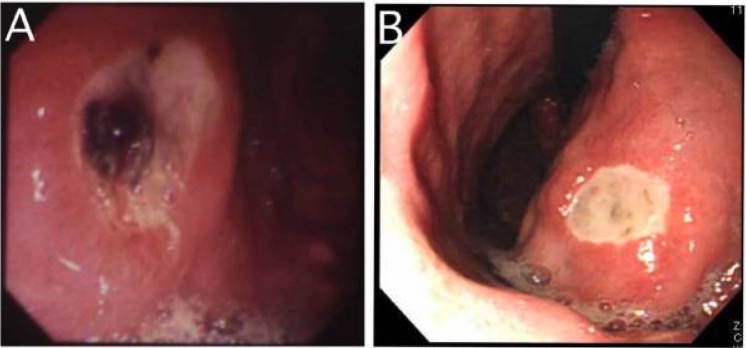
Hallazgos de EDA de una úlcera péptica
A: esofagogastroduodenoscopia de una úlcera gástrica abierta con vaso expuesto
B: úlcera gástrica sin hemorragia activa

Imagen: “F1” por Department of Psychosomatic Internal Medicine, Health Sciences University of Hokkaido, Japan. Licencia: CC BY 2.0.

Diagnóstico Diferencial

  • Enfermedad por reflujo gastroesofágico (ERGE): puede presentarse con regurgitación recurrente, ardor epigástrico/subesternal, indigestión, eructos. El proceso de la enfermedad implica una relajación inadecuada del esfínter esofágico inferior. La enfermedad por reflujo gastroesofágico puede provocar daños en EN Erythema nodosum is an immune-mediated panniculitis (inflammation of the subcutaneous fat) caused by a type IV (delayed-type) hypersensitivity reaction. It commonly manifests in young women as tender, erythematous nodules on the shins. Erythema Nodosum la mucosa de la parte inferior del esófago por la exposición al AL Amyloidosis ácido gástrico.
  • Cáncer gástrico: puede ser asintomático en EN Erythema nodosum is an immune-mediated panniculitis (inflammation of the subcutaneous fat) caused by a type IV (delayed-type) hypersensitivity reaction. It commonly manifests in young women as tender, erythematous nodules on the shins. Erythema Nodosum las primeras fases, pero suele presentarse con distensión abdominal, saciedad precoz, disfagia, pérdida de peso y fatiga relacionada con el cáncer. El diagnóstico se realiza mediante endoscopia con biopsia.
  • Gastritis Gastritis Gastritis refers to inflammation of the gastric mucosa. Gastritis may occur suddenly (acute gastritis) or slowly over time (chronic gastritis). Gastritis may be asymptomatic or with symptoms, including burning abdominal pain (which either worsens or improves with eating), dyspepsia, nausea, and vomiting. Gastritis: inflamación de la mucosa gástrica. La infección por H. pylori H. pylori A spiral bacterium active as a human gastric pathogen. It is a gram-negative, urease-positive, curved or slightly spiral organism initially isolated in 1982 from patients with lesions of gastritis or peptic ulcers in Western Australia. Helicobacter pylori was originally classified in the genus campylobacter, but RNA sequencing, cellular fatty acid profiles, growth patterns, and other taxonomic characteristics indicate that the micro-organism should be included in the genus Helicobacter. It has been officially transferred to Helicobacter gen. Helicobacter es también la culpable más común. La gastritis Gastritis Gastritis refers to inflammation of the gastric mucosa. Gastritis may occur suddenly (acute gastritis) or slowly over time (chronic gastritis). Gastritis may be asymptomatic or with symptoms, including burning abdominal pain (which either worsens or improves with eating), dyspepsia, nausea, and vomiting. Gastritis puede coexistir con la PUD PUD Peptic ulcer disease (PUD) refers to the full-thickness ulcerations of duodenal or gastric mucosa. The ulcerations form when exposure to acid and digestive enzymes overcomes mucosal defense mechanisms. The most common etiologies include Helicobacter pylori (H. pylori) infection and prolonged use of non-steroidal anti-inflammatory drugs (NSAIDs). Peptic Ulcer Disease y se presenta con dolor Dolor Inflammation epigástrico, náuseas y dispepsia. La endoscopia puede mostrar irritación/atrofia de la mucosa, pero no una ulceración de espesor total.
  • Colecistitis/colelitiasis: cálculos biliares que obstruyen el conducto cístico con o sin inflamación asociada de la vesícula biliar. La presentación típica es el dolor Dolor Inflammation en EN Erythema nodosum is an immune-mediated panniculitis (inflammation of the subcutaneous fat) caused by a type IV (delayed-type) hypersensitivity reaction. It commonly manifests in young women as tender, erythematous nodules on the shins. Erythema Nodosum el cuadrante superior derecho y el epigastrio, náuseas y vómitos. Frecuentemente, se asocia con sensibilidad en EN Erythema nodosum is an immune-mediated panniculitis (inflammation of the subcutaneous fat) caused by a type IV (delayed-type) hypersensitivity reaction. It commonly manifests in young women as tender, erythematous nodules on the shins. Erythema Nodosum el cuadrante superior derecho o en EN Erythema nodosum is an immune-mediated panniculitis (inflammation of the subcutaneous fat) caused by a type IV (delayed-type) hypersensitivity reaction. It commonly manifests in young women as tender, erythematous nodules on the shins. Erythema Nodosum la región subcostal. El diagnóstico se efectúa mediante ultrasonido.
  • Gastroenteritis Gastroenteritis Gastroenteritis is inflammation of the stomach and intestines, commonly caused by infections from bacteria, viruses, or parasites. Transmission may be foodborne, fecal-oral, or through animal contact. Common clinical features include abdominal pain, diarrhea, vomiting, fever, and dehydration. Gastroenteritis viral: enfermedad aguda autolimitada asociada a dolor Dolor Inflammation abdominal difuso, vómitos y diarrea. También puede estar asociada la fiebre. La diarrea acuosa es un rasgo característico.
  • Pancreatitis Pancreatitis Inflammation of the pancreas. Pancreatitis is classified as acute unless there are computed tomographic or endoscopic retrograde cholangiopancreatographic findings of chronic pancreatitis. The two most common forms of acute pancreatitis are alcoholic pancreatitis and gallstone pancreatitis. Acute Pancreatitis: inflamación del páncreas. La pancreatitis Pancreatitis Inflammation of the pancreas. Pancreatitis is classified as acute unless there are computed tomographic or endoscopic retrograde cholangiopancreatographic findings of chronic pancreatitis. The two most common forms of acute pancreatitis are alcoholic pancreatitis and gallstone pancreatitis. Acute Pancreatitis puede ser aguda o crónica, y suele presentarse con dolor Dolor Inflammation epigástrico que se irradia a la espalda, náuseas, vómitos y distensión abdominal. Los LOS Neisseria análisis de sangre mostrarán una amilasa y una lipasa elevadas.
  • Síndrome coronario agudo: se presenta con dolor Dolor Inflammation torácico, que suele describirse como una presión a través de la región precordial que puede irradiarse al AL Amyloidosis cuello, el hombro, la mandíbula, la espalda, la parte superior del abdomen o cualquiera de los LOS Neisseria brazos. El síndrome coronario agudo puede presentarse a veces como un dolor Dolor Inflammation principalmente subesternal/epigástrico, y es importante mantener un alto índice de sospecha. Un electrocardiograma mostrará cambios debidos a la isquemia/infarto de miocardio.

Referencias

  1. Vakil, N.B. (2025). Peptic ulcer disease: Clinical manifestations and diagnosis. Retrieved May 21, 2025, from https://www.uptodate.com/contents/peptic-ulcer-disease-clinical-manifestations-and-diagnosis
  2. Vakil, N. B. (2025). Peptic ulcer disease: Epidemiology, etiology, and pathogenesis. UpToDate. Retrieved May 21, 2025, from https://www.uptodate.com/contents/peptic-ulcer-disease-epidemiology-etiology-and-pathogenesis
  3. Vakil, N. B. (2024). Peptic ulcer disease: Treatment and secondary prevention. UpToDate. Retrieved May 21, 2025, from https://www.uptodate.com/contents/peptic-ulcer-disease-treatment-and-secondary-prevention
  4. Vakil, N. B. (2025). Overview of complications of peptic ulcer disease. UpToDate. Retrieved May 21, 2025, from https://www.uptodate.com/contents/overview-of-complications-of-peptic-ulcer-disease
  5. American College of Gastroenterology. (2024). ACG guideline on treatment of Helicobacter pylori: New recommendations… Will practice change? American Journal of Gastroenterology. https://gi.org/journals-publications/ebgi/schoenfeld_sep2024/

¡Crea tu cuenta gratis o inicia una sesión para seguir leyendo!

Regístrate ahora y obtén acceso gratuito a Lecturio con páginas de concepto, videos médicos y cuestionarios para tu educación médica.

User Reviews

Que tengas una sesión de estudio alegre y navideña 🎁 Ahorra 50% en todos los planes >>

Details