Domina Conceptos Médicos

Estudia para la escuela de medicina y tus examenes con Lecturio.

Diarrea Pediátrica

La diarrea se describe como la evacuación de grandes cantidades de heces que suelen ser sueltas, líquidas o acuosas, lo que provoca una pérdida excesiva de líquidos y electrolitos. La diarrea es una de las enfermedades más comunes en EN Erythema nodosum is an immune-mediated panniculitis (inflammation of the subcutaneous fat) caused by a type IV (delayed-type) hypersensitivity reaction. It commonly manifests in young women as tender, erythematous nodules on the shins. Erythema Nodosum los LOS Neisseria niños, representando los LOS Neisseria mayores porcentajes de morbilidad y mortalidad a nivel mundial en EN Erythema nodosum is an immune-mediated panniculitis (inflammation of the subcutaneous fat) caused by a type IV (delayed-type) hypersensitivity reaction. It commonly manifests in young women as tender, erythematous nodules on the shins. Erythema Nodosum el grupo de edad pediátrico. La mayoría de los LOS Neisseria casos son infecciosos, causados por el rotavirus Rotavirus A genus of Reoviridae, causing acute gastroenteritis in birds and mammals, including humans. Transmission is horizontal and by environmental contamination. Seven species (rotaviruses A through G) are recognized. Rotavirus, mientras que el resto son causados por bacterias ( Escherichia coli Escherichia coli The gram-negative bacterium Escherichia coli is a key component of the human gut microbiota. Most strains of E. coli are avirulent, but occasionally they escape the GI tract, infecting the urinary tract and other sites. Less common strains of E. coli are able to cause disease within the GI tract, most commonly presenting as abdominal pain and diarrhea. Escherichia coli, Salmonella Salmonella Salmonellae are gram-negative bacilli of the family Enterobacteriaceae. Salmonellae are flagellated, non-lactose-fermenting, and hydrogen sulfide-producing microbes. Salmonella enterica, the most common disease-causing species in humans, is further classified based on serotype as typhoidal (S. typhi and paratyphi) and nontyphoidal (S. enteritidis and typhimurium). Salmonella) y parásitos ( Entamoeba histolytica Entamoeba Histolytica A species of parasitic protozoa causing entamoebiasis and amebic dysentery (dysentery, amebic). Characteristics include a single nucleus containing a small central karyosome and peripheral chromatin that is finely and regularly beaded. Amebicides). El tratamiento se basa principalmente en EN Erythema nodosum is an immune-mediated panniculitis (inflammation of the subcutaneous fat) caused by a type IV (delayed-type) hypersensitivity reaction. It commonly manifests in young women as tender, erythematous nodules on the shins. Erythema Nodosum rehidratación; la terapia antibiótica se utiliza solo cuando está indicada. El pronóstico es excelente si la diarrea se trata con prontitud.

Last updated: Dec 15, 2025

Editorial responsibility: Stanley Oiseth, Lindsay Jones, Evelin Maza

Descripción General

Definición

La diarrea se define como una pérdida excesiva de heces que suelen ser sueltas o acuosas.

La cuantificación de la producción de heces varía:

  • > 10 mL/kg/día en EN Erythema nodosum is an immune-mediated panniculitis (inflammation of the subcutaneous fat) caused by a type IV (delayed-type) hypersensitivity reaction. It commonly manifests in young women as tender, erythematous nodules on the shins. Erythema Nodosum bebés y > 200 g/día en EN Erythema nodosum is an immune-mediated panniculitis (inflammation of the subcutaneous fat) caused by a type IV (delayed-type) hypersensitivity reaction. It commonly manifests in young women as tender, erythematous nodules on the shins. Erythema Nodosum niños mayores, lo que provoca una pérdida excesiva de líquidos y electrolitos
  • Hacer ≥ 3 deposiciones acuosas sueltas al AL Amyloidosis día (definición de la World Health Organization (WHO))

Clasificación

  • Por tiempo de inicio:
    • Aguda, si dura ≤ 2 semanas
    • Crónica, si dura > 2 semanas
  • Por etiología:
    • Osmótica
    • Secretora
    • Inflamatoria
    • Relacionada con la motilidad

Epidemiología

  • Principal causa de morbilidad y mortalidad a nivel mundial:
    • En EN Erythema nodosum is an immune-mediated panniculitis (inflammation of the subcutaneous fat) caused by a type IV (delayed-type) hypersensitivity reaction. It commonly manifests in young women as tender, erythematous nodules on the shins. Erythema Nodosum los LOS Neisseria países desarrollados, la diarrea más común es la aguda y se asocia con menores tasas de morbilidad y mortalidad.
    • En EN Erythema nodosum is an immune-mediated panniculitis (inflammation of the subcutaneous fat) caused by a type IV (delayed-type) hypersensitivity reaction. It commonly manifests in young women as tender, erythematous nodules on the shins. Erythema Nodosum los LOS Neisseria países en EN Erythema nodosum is an immune-mediated panniculitis (inflammation of the subcutaneous fat) caused by a type IV (delayed-type) hypersensitivity reaction. It commonly manifests in young women as tender, erythematous nodules on the shins. Erythema Nodosum desarrollo, la diarrea crónica es la más común y la más letal.
  • La enfermedad más común del niño sano:
    • A nivel mundial, los LOS Neisseria niños menores de 5 años tienen una media de 2–3 episodios cada año.
  • La forma más común es la diarrea viral:
    • El rotavirus Rotavirus A genus of Reoviridae, causing acute gastroenteritis in birds and mammals, including humans. Transmission is horizontal and by environmental contamination. Seven species (rotaviruses A through G) are recognized. Rotavirus es el agente causal más común.

Etiología

Aguda

Lactantes y niños pequeños:

  • Infecciosa:
    • Gastroenteritis Gastroenteritis Gastroenteritis is inflammation of the stomach and intestines, commonly caused by infections from bacteria, viruses, or parasites. Transmission may be foodborne, fecal-oral, or through animal contact. Common clinical features include abdominal pain, diarrhea, vomiting, fever, and dehydration. Gastroenteritis virales ( rotavirus Rotavirus A genus of Reoviridae, causing acute gastroenteritis in birds and mammals, including humans. Transmission is horizontal and by environmental contamination. Seven species (rotaviruses A through G) are recognized. Rotavirus (la más común), virus Virus Viruses are infectious, obligate intracellular parasites composed of a nucleic acid core surrounded by a protein capsid. Viruses can be either naked (non-enveloped) or enveloped. The classification of viruses is complex and based on many factors, including type and structure of the nucleoid and capsid, the presence of an envelope, the replication cycle, and the host range. Virology Norwalk (a menudo visto entre los LOS Neisseria pasajeros de cruceros))
    • Enteritis Enteritis Inflammation of any segment of the small intestine. Lactose Intolerance bacteriana ( Escherichia coli Escherichia coli The gram-negative bacterium Escherichia coli is a key component of the human gut microbiota. Most strains of E. coli are avirulent, but occasionally they escape the GI tract, infecting the urinary tract and other sites. Less common strains of E. coli are able to cause disease within the GI tract, most commonly presenting as abdominal pain and diarrhea. Escherichia coli (comúnmente vista en EN Erythema nodosum is an immune-mediated panniculitis (inflammation of the subcutaneous fat) caused by a type IV (delayed-type) hypersensitivity reaction. It commonly manifests in young women as tender, erythematous nodules on the shins. Erythema Nodosum guarderías y jardines de infancia), Salmonella Salmonella Salmonellae are gram-negative bacilli of the family Enterobacteriaceae. Salmonellae are flagellated, non-lactose-fermenting, and hydrogen sulfide-producing microbes. Salmonella enterica, the most common disease-causing species in humans, is further classified based on serotype as typhoidal (S. typhi and paratyphi) and nontyphoidal (S. enteritidis and typhimurium). Salmonella (huevos, leche, aves de corral, reptiles, animales domésticos), Shigella Shigella Shigella is a genus of gram-negative, non-lactose-fermenting facultative intracellular bacilli. Infection spreads most commonly via person-to-person contact or through contaminated food and water. Humans are the only known reservoir. Shigella (alimentos contaminados), Campylobacter Campylobacter Campylobacter (“curved bacteria”) is a genus of thermophilic, S-shaped, gram-negative bacilli. There are many species of Campylobacter, with C. jejuni and C. coli most commonly implicated in human disease. Campylobacter (alimentos contaminados), Yersinia Yersinia Yersinia is a genus of bacteria characterized as gram-negative bacilli that are facultative anaerobic with bipolar staining. There are 2 enteropathogenic species that cause yersiniosis, Y. enterocolitica and Y. pseudotuberculosis. Infections are manifested as pseudoappendicitis or mesenteric lymphadenitis, and enterocolitis. Yersinia spp./Yersiniosis (animales domésticos, alimentos contaminados), Clostridium difficile Clostridium difficile A common inhabitant of the colon flora in human infants and sometimes in adults. The type species clostridioides difficile is formerly known as Clostridium difficile. It is a causative agent for clostridioides infections and is associated with pseudomembranous enterocolitis in patients receiving antibiotic therapy. Clostridia (uso previo de antibióticos), Staphylococcus aureus Staphylococcus aureus Potentially pathogenic bacteria found in nasal membranes, skin, hair follicles, and perineum of warm-blooded animals. They may cause a wide range of infections and intoxications. Brain Abscess (productos de huevo))
    • Parasitarias ( Entamoeba histolytica Entamoeba Histolytica A species of parasitic protozoa causing entamoebiasis and amebic dysentery (dysentery, amebic). Characteristics include a single nucleus containing a small central karyosome and peripheral chromatin that is finely and regularly beaded. Amebicides, Giardia Giardia A genus of flagellate intestinal eukaryotes parasitic in various vertebrates, including humans. Characteristics include the presence of four pairs of flagella arising from a complicated system of axonemes and cysts that are ellipsoidal to ovoidal in shape. Nitroimidazoles (comúnmente vista entre los LOS Neisseria excursionistas), Cryptosporidium Cryptosporidium A genus of coccidian parasites of the family cryptosporidiidae, found in the intestinal epithelium of many vertebrates including humans. Hyper-IgM Syndrome)
    • Infecciones sistémicas
  • No infecciosa:
    • Asociada a los LOS Neisseria antibióticos
    • Colitis Colitis Inflammation of the colon section of the large intestine, usually with symptoms such as diarrhea (often with blood and mucus), abdominal pain, and fever. Pseudomembranous Colitis tóxica de Hirschsprung
    • Abstinencia neonatal de narcóticos
    • Hiperplasia suprarrenal congénita

Niños mayores:

  • Infecciosa:
    • Gastroenteritis Gastroenteritis Gastroenteritis is inflammation of the stomach and intestines, commonly caused by infections from bacteria, viruses, or parasites. Transmission may be foodborne, fecal-oral, or through animal contact. Common clinical features include abdominal pain, diarrhea, vomiting, fever, and dehydration. Gastroenteritis vírica
    • Enteritis Enteritis Inflammation of any segment of the small intestine. Lactose Intolerance bacteriana
    • Intoxicación alimentaria
  • No infecciosa:
    • Diarrea asociada a los LOS Neisseria antibióticos (e.g., amoxicilina-ácido clavulánico)
    • Apendicitis

Crónica

Lactantes y niños pequeños:

  • Infecciosa:
    • Parásitos
    • Absceso apendicular
  • Malabsortiva:
    • Deficiencia postinfecciosa de lactasa
    • Intolerancia a las proteínas alimentarias
    • Diarrea del niño
    • Fibrosis Fibrosis Any pathological condition where fibrous connective tissue invades any organ, usually as a consequence of inflammation or other injury. Bronchiolitis Obliterans quística
    • Enfermedad celíaca
  • Inflamatoria:
    • Eosinófilos
    • Gastroenteritis Gastroenteritis Gastroenteritis is inflammation of the stomach and intestines, commonly caused by infections from bacteria, viruses, or parasites. Transmission may be foodborne, fecal-oral, or through animal contact. Common clinical features include abdominal pain, diarrhea, vomiting, fever, and dehydration. Gastroenteritis
  • Inmunodeficiencia:
    • Inmunodeficiencia combinada grave
    • Enteropatía por VIH
  • Endocrinológica: insuficiencia suprarrenal
  • Otras:
    • Linfangiectasia
    • Toxinas
    • Trastornos intestinales congénitos poco frecuentes

Niños mayores:

  • Infecciosa:
    • Parásitos
    • Absceso apendicular
  • Malabsortiva:
    • Intolerancia a la lactosa
    • Abuso de laxantes
    • Enfermedad celíaca
    • Neoplasia secretora
  • Inflamatoria:
    • Gastroenteritis Gastroenteritis Gastroenteritis is inflammation of the stomach and intestines, commonly caused by infections from bacteria, viruses, or parasites. Transmission may be foodborne, fecal-oral, or through animal contact. Common clinical features include abdominal pain, diarrhea, vomiting, fever, and dehydration. Gastroenteritis eosinofílica
    • Síndrome del intestino irritable
  • Inmunodeficiencia: Enteropatía por VIH
  • Endocrinológica:
    • Insuficiencia suprarrenal
    • Hiperparatiroidismo e hipoparatiroidismo
  • Otras:
    • Estreñimiento ( encopresis Encopresis Encopresis is the involuntary or unintentional passage of feces in inappropriate situations in children older than 4 years of age in the absence of neuromuscular disease. Elimination Disorders)
    • Síndrome del intestino irritable
    • Toxinas

Clasificaciones

Secretora

  • Mecanismo:
    • ↓ Absorción gastrointestinal de fluidos/solutos
    • ↑ Secreción gastrointestinal de fluidos/solutos
    • Defectos de transporte de electrolitos
    • Puede ser causado por un secretagogo (e.g., la toxina del cólera)
  • Agentes causantes:
    • Cólera
    • E. coli
    • Carcinoide
    • Neuroblastoma Neuroblastoma Neuroblastoma is a malignancy that arises from the neural crest cell derivatives along the sympathetic chain (neuroblasts) and is most commonly located in the adrenal medulla. The tumor often presents in childhood with a flank mass that crosses the midline. Neuroblastoma
    • Diarrea congénita de cloruros (clorhidrorrea congénita)
    • Clostridium difficile Clostridium difficile A common inhabitant of the colon flora in human infants and sometimes in adults. The type species clostridioides difficile is formerly known as Clostridium difficile. It is a causative agent for clostridioides infections and is associated with pseudomembranous enterocolitis in patients receiving antibiotic therapy. Clostridia
    • Criptosporidiosis (SIDA)
  • Características clínicas:
    • Persiste durante el ayuno
    • La malabsorción de sales biliares también puede aumentar la secreción de agua intestinal
    • No hay leucocitos en EN Erythema nodosum is an immune-mediated panniculitis (inflammation of the subcutaneous fat) caused by a type IV (delayed-type) hypersensitivity reaction. It commonly manifests in young women as tender, erythematous nodules on the shins. Erythema Nodosum las heces
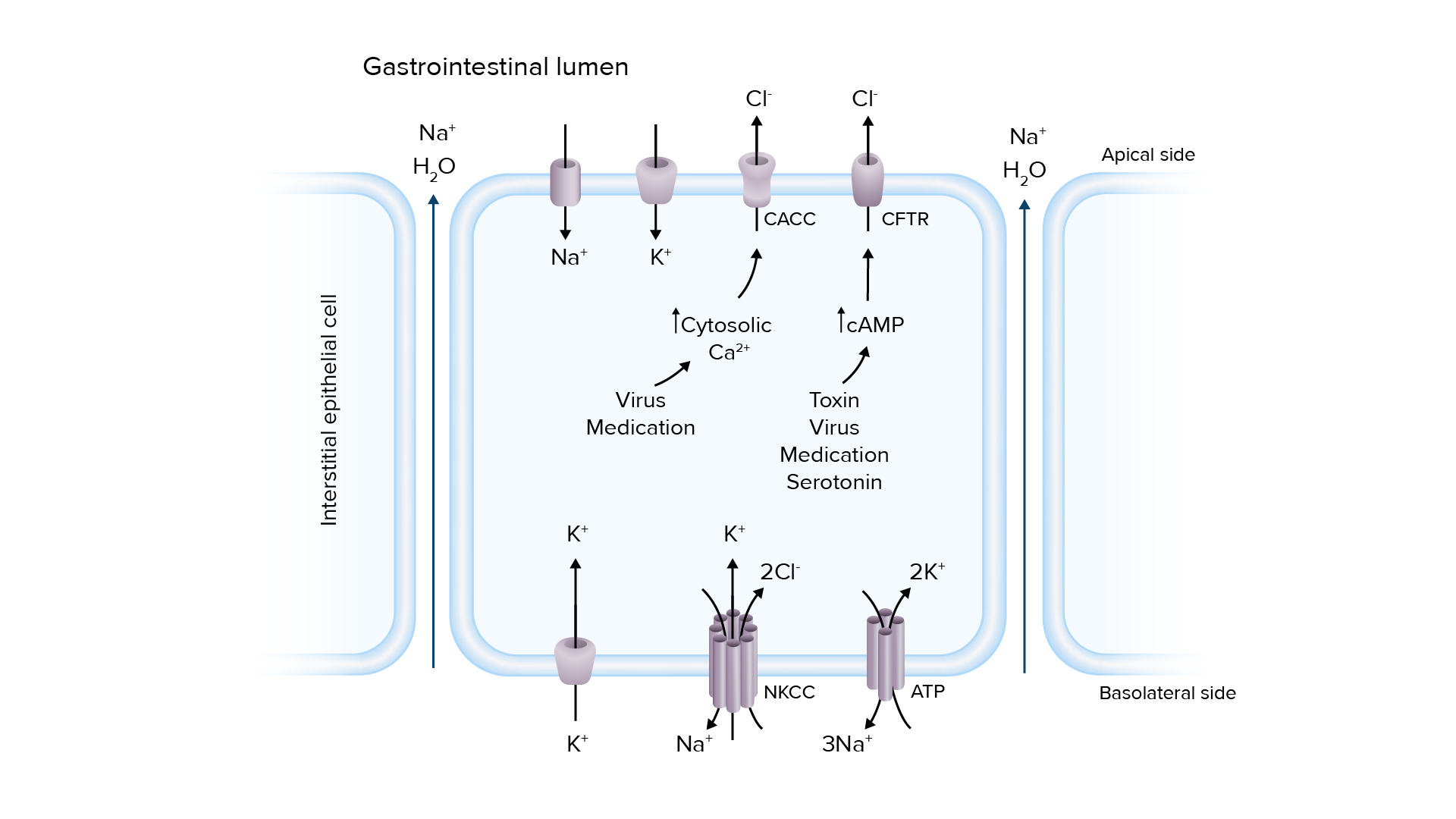
Diarrea secretora

Patogénesis de la diarrea secretora:
La sobreactivación de los canales de transporte de iones puede conducir a la secreción de electrolitos y agua en el lumen intestinal, lo que provoca diarrea.
Ca2+: calcio
CaCC: canales de cloruro activados por el calcio
AMPc: monofosfato de adenosina cíclico
CFTR: regulador de la conductancia transmembrana de la fibrosis quística
Cl: cloruro
K+: potasio
Na+: sodio
NKCC: cotransportador sodio-cloruro de potasio
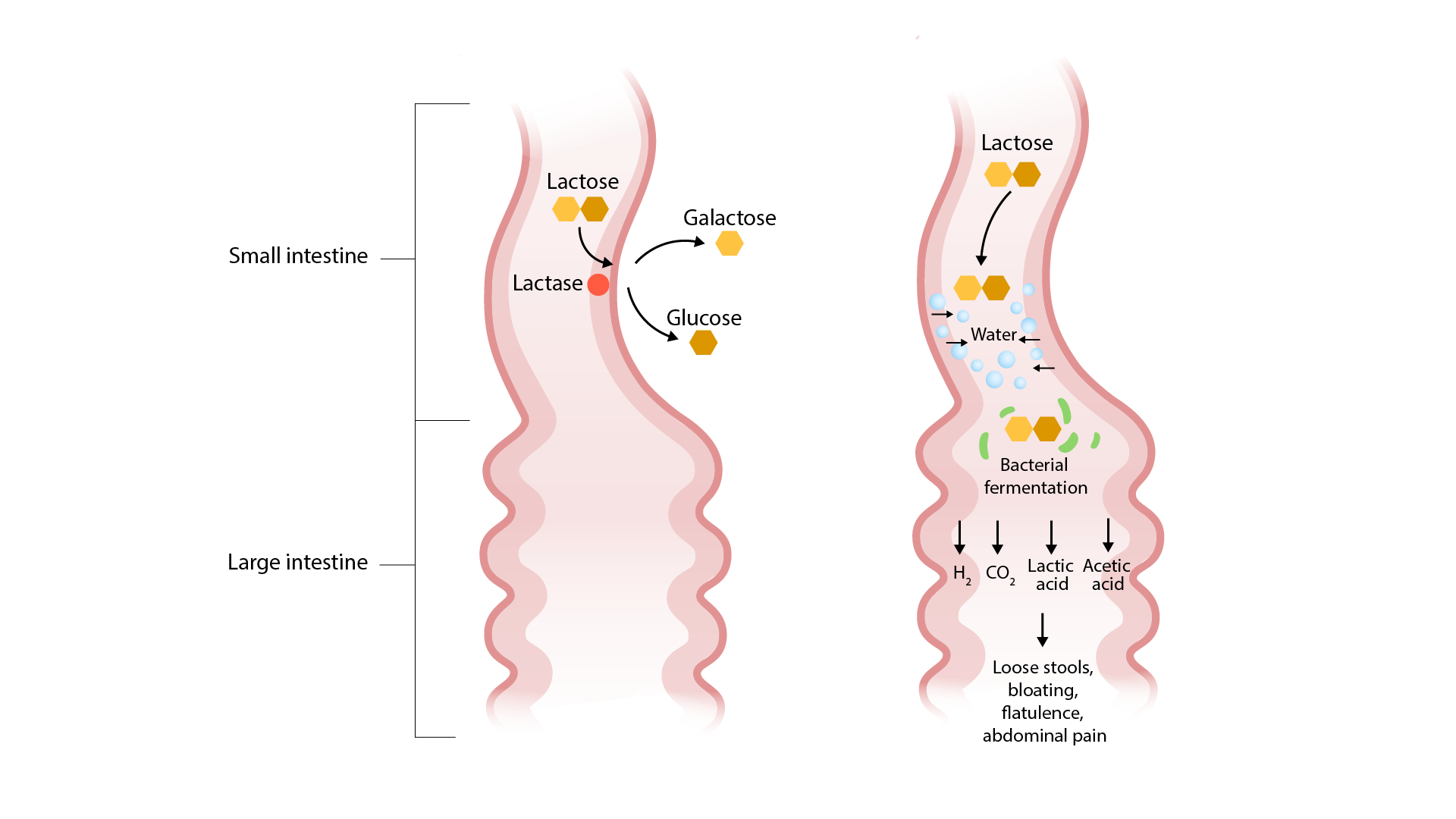
Imagen por Lecturio.

Osmótica

  • Mecanismo:
    • Las sustancias no digeribles cambian los LOS Neisseria gradientes osmóticos en EN Erythema nodosum is an immune-mediated panniculitis (inflammation of the subcutaneous fat) caused by a type IV (delayed-type) hypersensitivity reaction. It commonly manifests in young women as tender, erythematous nodules on the shins. Erythema Nodosum el tracto gastrointestinal.
    • El líquido es extraído del revestimiento gastrointestinal en EN Erythema nodosum is an immune-mediated panniculitis (inflammation of the subcutaneous fat) caused by a type IV (delayed-type) hypersensitivity reaction. It commonly manifests in young women as tender, erythematous nodules on the shins. Erythema Nodosum lugar de fluir hacia él.
  • Agentes causantes:
    • Deficiencia de lactasa
    • Malabsorción de glucosa-galactosa
    • Lactulosa
    • Abuso de laxantes
  • Características clínicas:
    • Se detiene con el ayuno
    • ↑ Hidrógeno en EN Erythema nodosum is an immune-mediated panniculitis (inflammation of the subcutaneous fat) caused by a type IV (delayed-type) hypersensitivity reaction. It commonly manifests in young women as tender, erythematous nodules on the shins. Erythema Nodosum el aliento con malabsorción de carbohidratos
    • No hay leucocitos en EN Erythema nodosum is an immune-mediated panniculitis (inflammation of the subcutaneous fat) caused by a type IV (delayed-type) hypersensitivity reaction. It commonly manifests in young women as tender, erythematous nodules on the shins. Erythema Nodosum las heces
Diarrea osmótica

Patogénesis de la deficiencia de lactasa (una etiología de la diarrea osmótica):
La lactosa no se descompone y permanece en la luz del intestino delgado, atrayendo agua y provocando una diarrea osmótica. La fermentación bacteriana de la lactosa provoca los síntomas de hinchazón, flatulencia y dolor abdominal.

Imagen por Lecturio.

Aumento de la motilidad

  • Mecanismo:
    • Intestinos patológicamente hiperactivos
    • ↓ Tiempo de tránsito gastrointestinal
    • Los LOS Neisseria alimentos no se digieren y se excretan rápidamente.
  • Agentes causantes:
    • Síndrome del intestino irritable
    • Tirotoxicosis
    • Síndrome de dumping (vaciado rápido) postvagotomía
  • Característica clínica: La infección puede contribuir a aumentar la motilidad.

Disminución de la motilidad

  • Mecanismo:
    • Defecto en EN Erythema nodosum is an immune-mediated panniculitis (inflammation of the subcutaneous fat) caused by a type IV (delayed-type) hypersensitivity reaction. It commonly manifests in young women as tender, erythematous nodules on the shins. Erythema Nodosum las unidades neuromusculares
    • Estancamiento que conduce a un crecimiento bacteriano excesivo
  • Agentes causantes:
  • Característica clínica: posible crecimiento bacteriano excesivo

Disminución de la superficie

  • Mecanismo: ↓ capacidad funcional
  • Agentes causantes:
    • Síndrome del intestino corto
    • Enfermedad celíaca
    • Enteritis Enteritis Inflammation of any segment of the small intestine. Lactose Intolerance por rotavirus Rotavirus A genus of Reoviridae, causing acute gastroenteritis in birds and mammals, including humans. Transmission is horizontal and by environmental contamination. Seven species (rotaviruses A through G) are recognized. Rotavirus
  • Característica clínica: podría requerir dieta elemental más alimentación parenteral

Invasión de la mucosa

  • Mecanismo:
    • Inflamación
    • Disminución de la reabsorción colónica
    • Aumento de la motilidad
  • Agentes causantes:
    • Salmonella Salmonella Salmonellae are gram-negative bacilli of the family Enterobacteriaceae. Salmonellae are flagellated, non-lactose-fermenting, and hydrogen sulfide-producing microbes. Salmonella enterica, the most common disease-causing species in humans, is further classified based on serotype as typhoidal (S. typhi and paratyphi) and nontyphoidal (S. enteritidis and typhimurium). Salmonella
    • Shigella Shigella Shigella is a genus of gram-negative, non-lactose-fermenting facultative intracellular bacilli. Infection spreads most commonly via person-to-person contact or through contaminated food and water. Humans are the only known reservoir. Shigella
    • Amebiasis Amebiasis Amebiasis, or amoebic dysentery, is an infection caused by the parasite Entamoeba histolytica. Transmission is through the fecal-oral route or by consumption of contaminated food and water. Most patients infected with E. histolytica are asymptomatic, but about 10% may develop dysentery. Entamoeba spp./Amebiasis
    • Yersinia Yersinia Yersinia is a genus of bacteria characterized as gram-negative bacilli that are facultative anaerobic with bipolar staining. There are 2 enteropathogenic species that cause yersiniosis, Y. enterocolitica and Y. pseudotuberculosis. Infections are manifested as pseudoappendicitis or mesenteric lymphadenitis, and enterocolitis. Yersinia spp./Yersiniosis
    • Campylobacter Campylobacter Campylobacter (“curved bacteria”) is a genus of thermophilic, S-shaped, gram-negative bacilli. There are many species of Campylobacter, with C. jejuni and C. coli most commonly implicated in human disease. Campylobacter
  • Característica clínica: disentería con evidencia de sangre, moco y leucocitos.

Presentación Clínica

Antecedentes

  • Signos y síntomas asociados importantes:
    • Fiebre
    • Sangre o moco en EN Erythema nodosum is an immune-mediated panniculitis (inflammation of the subcutaneous fat) caused by a type IV (delayed-type) hypersensitivity reaction. It commonly manifests in young women as tender, erythematous nodules on the shins. Erythema Nodosum las heces
    • Exposición a animales de granja y reptiles ( Salmonella Salmonella Salmonellae are gram-negative bacilli of the family Enterobacteriaceae. Salmonellae are flagellated, non-lactose-fermenting, and hydrogen sulfide-producing microbes. Salmonella enterica, the most common disease-causing species in humans, is further classified based on serotype as typhoidal (S. typhi and paratyphi) and nontyphoidal (S. enteritidis and typhimurium). Salmonella, E. coli) para el síndrome urémico hemolítico en EN Erythema nodosum is an immune-mediated panniculitis (inflammation of the subcutaneous fat) caused by a type IV (delayed-type) hypersensitivity reaction. It commonly manifests in young women as tender, erythematous nodules on the shins. Erythema Nodosum niños
    • Alimentos sospechosos
    • Viajes recientes
    • Uso reciente de antibióticos
  • Cuando es causada por un virus Virus Viruses are infectious, obligate intracellular parasites composed of a nucleic acid core surrounded by a protein capsid. Viruses can be either naked (non-enveloped) or enveloped. The classification of viruses is complex and based on many factors, including type and structure of the nucleoid and capsid, the presence of an envelope, the replication cycle, and the host range. Virology:
    • 7–10 días de diarrea acuosa
    • Vómitos
    • Algunos niños pueden presentar síntomas respiratorios superiores.
  • Cuando es causada por una bacteria Bacteria Bacteria are prokaryotic single-celled microorganisms that are metabolically active and divide by binary fission. Some of these organisms play a significant role in the pathogenesis of diseases. Bacteriology:
    • Fiebre alta
    • Heces con sangre
    • Dolor Dolor Inflammation abdominal
    • La infección por Shigella Shigella Shigella is a genus of gram-negative, non-lactose-fermenting facultative intracellular bacilli. Infection spreads most commonly via person-to-person contact or through contaminated food and water. Humans are the only known reservoir. Shigella puede ir acompañada de convulsiones.

Examen físico

  • Signos de deshidratación:
    • Sequedad de las mucosas orales
    • ↓ Turgencia de la piel
    • ↓ Llenado capilar
    • Taquicardia sostenida
    • La presión arterial permanece generalmente alta hasta que se produce una deshidratación extrema.
  • Signos de infección sistémica:
    • ↓ Nivel de conciencia
    • Fiebre
  • Examen abdominal: buscar signo de rebote y resistencia (defensa abdominal).
  • Retraso en EN Erythema nodosum is an immune-mediated panniculitis (inflammation of the subcutaneous fat) caused by a type IV (delayed-type) hypersensitivity reaction. It commonly manifests in young women as tender, erythematous nodules on the shins. Erythema Nodosum el crecimiento y en EN Erythema nodosum is an immune-mediated panniculitis (inflammation of the subcutaneous fat) caused by a type IV (delayed-type) hypersensitivity reaction. It commonly manifests in young women as tender, erythematous nodules on the shins. Erythema Nodosum el aumento de peso
  • La inspección perianal puede mostrar marcas o fisuras en EN Erythema nodosum is an immune-mediated panniculitis (inflammation of the subcutaneous fat) caused by a type IV (delayed-type) hypersensitivity reaction. It commonly manifests in young women as tender, erythematous nodules on the shins. Erythema Nodosum la enfermedad de Crohn.
  • Infección por Yersinia Yersinia Yersinia is a genus of bacteria characterized as gram-negative bacilli that are facultative anaerobic with bipolar staining. There are 2 enteropathogenic species that cause yersiniosis, Y. enterocolitica and Y. pseudotuberculosis. Infections are manifested as pseudoappendicitis or mesenteric lymphadenitis, and enterocolitis. Yersinia spp./Yersiniosis asociada a:
    • Artritis y erupción
    • Pseudoapendicitis
Tabla: Grado de deshidratación en EN Erythema nodosum is an immune-mediated panniculitis (inflammation of the subcutaneous fat) caused by a type IV (delayed-type) hypersensitivity reaction. It commonly manifests in young women as tender, erythematous nodules on the shins. Erythema Nodosum niños
Leve Moderada Severa
Pérdida de peso
  • < 5% en EN Erythema nodosum is an immune-mediated panniculitis (inflammation of the subcutaneous fat) caused by a type IV (delayed-type) hypersensitivity reaction. It commonly manifests in young women as tender, erythematous nodules on the shins. Erythema Nodosum lactantes
  • < 3% en EN Erythema nodosum is an immune-mediated panniculitis (inflammation of the subcutaneous fat) caused by a type IV (delayed-type) hypersensitivity reaction. It commonly manifests in young women as tender, erythematous nodules on the shins. Erythema Nodosum niños mayores
  • 5%–10% en EN Erythema nodosum is an immune-mediated panniculitis (inflammation of the subcutaneous fat) caused by a type IV (delayed-type) hypersensitivity reaction. It commonly manifests in young women as tender, erythematous nodules on the shins. Erythema Nodosum lactantes
  • 3%–9% en EN Erythema nodosum is an immune-mediated panniculitis (inflammation of the subcutaneous fat) caused by a type IV (delayed-type) hypersensitivity reaction. It commonly manifests in young women as tender, erythematous nodules on the shins. Erythema Nodosum niños mayores
  • > 10% en EN Erythema nodosum is an immune-mediated panniculitis (inflammation of the subcutaneous fat) caused by a type IV (delayed-type) hypersensitivity reaction. It commonly manifests in young women as tender, erythematous nodules on the shins. Erythema Nodosum lactantes
  • > 9% en EN Erythema nodosum is an immune-mediated panniculitis (inflammation of the subcutaneous fat) caused by a type IV (delayed-type) hypersensitivity reaction. It commonly manifests in young women as tender, erythematous nodules on the shins. Erythema Nodosum niños mayores
Mucosa seca (1er signo) +/-, parece seca +, parece muy seca
Turgencia de la piel (último signo) + +/– ++/+
Depresión de la fontanela anterior + ++/+
Estado mental Normal Fatiga/irritabilidad Apatía/letargo
Enoftalmos + +
Respiración Normal Profunda, puede ser taquipneica Profunda y taquipneica
Frecuencia cardíaca Normal Elevada Muy elevada
Hipotensión + +
Perfusión distal Normal
  • Se sienten frías
  • 3–4 segundos
  • Acrocianóticas
  • > 4 segundos
Diuresis Disminuida Oliguria Oliguria Decreased urine output that is below the normal range. Oliguria can be defined as urine output of less than or equal to 0. 5 or 1 ml/kg/hr depending on the age. Renal Potassium Regulation Oliguria Oliguria Decreased urine output that is below the normal range. Oliguria can be defined as urine output of less than or equal to 0. 5 or 1 ml/kg/hr depending on the age. Renal Potassium Regulation/ anuria Anuria Absence of urine formation. It is usually associated with complete bilateral ureteral (ureter) obstruction, complete lower urinary tract obstruction, or unilateral ureteral obstruction when a solitary kidney is present. Acute Kidney Injury

Diagnóstico

Por lo general, no es necesario realizar estudios y solo están indicados en EN Erythema nodosum is an immune-mediated panniculitis (inflammation of the subcutaneous fat) caused by a type IV (delayed-type) hypersensitivity reaction. It commonly manifests in young women as tender, erythematous nodules on the shins. Erythema Nodosum casos de deshidratación moderada o grave, inmunocompromiso y sepsis Sepsis Systemic inflammatory response syndrome with a proven or suspected infectious etiology. When sepsis is associated with organ dysfunction distant from the site of infection, it is called severe sepsis. When sepsis is accompanied by hypotension despite adequate fluid infusion, it is called septic shock. Sepsis and Septic Shock, así como en EN Erythema nodosum is an immune-mediated panniculitis (inflammation of the subcutaneous fat) caused by a type IV (delayed-type) hypersensitivity reaction. It commonly manifests in young women as tender, erythematous nodules on the shins. Erythema Nodosum casos crónicos.

  • Laboratorios:
    • Un corte basal en EN Erythema nodosum is an immune-mediated panniculitis (inflammation of the subcutaneous fat) caused by a type IV (delayed-type) hypersensitivity reaction. It commonly manifests in young women as tender, erythematous nodules on the shins. Erythema Nodosum casos de deshidratación severa puede mostrar:
      • ↓ Glucosa
      • ↑ Nitrógeno ureico en EN Erythema nodosum is an immune-mediated panniculitis (inflammation of the subcutaneous fat) caused by a type IV (delayed-type) hypersensitivity reaction. It commonly manifests in young women as tender, erythematous nodules on the shins. Erythema Nodosum sangre (BUN, por sus siglas en EN Erythema nodosum is an immune-mediated panniculitis (inflammation of the subcutaneous fat) caused by a type IV (delayed-type) hypersensitivity reaction. It commonly manifests in young women as tender, erythematous nodules on the shins. Erythema Nodosum inglés)
      • ↑ Sodio y cloro
      • ↓ Bicarbonato
      • ↑ Creatinina
    • Microscopía en EN Erythema nodosum is an immune-mediated panniculitis (inflammation of the subcutaneous fat) caused by a type IV (delayed-type) hypersensitivity reaction. It commonly manifests in young women as tender, erythematous nodules on the shins. Erythema Nodosum heces, en EN Erythema nodosum is an immune-mediated panniculitis (inflammation of the subcutaneous fat) caused by a type IV (delayed-type) hypersensitivity reaction. It commonly manifests in young women as tender, erythematous nodules on the shins. Erythema Nodosum busca de huevos y parásitos
    • Coprocultivo
    • Si se sospecha de síndrome urémico hemolítico: pruebas específicas para E. coli O157:H7
    • Si se sospecha de un retraso en EN Erythema nodosum is an immune-mediated panniculitis (inflammation of the subcutaneous fat) caused by a type IV (delayed-type) hypersensitivity reaction. It commonly manifests in young women as tender, erythematous nodules on the shins. Erythema Nodosum el crecimiento:
      • Fibrosis Fibrosis Any pathological condition where fibrous connective tissue invades any organ, usually as a consequence of inflammation or other injury. Bronchiolitis Obliterans quística: elastasa en EN Erythema nodosum is an immune-mediated panniculitis (inflammation of the subcutaneous fat) caused by a type IV (delayed-type) hypersensitivity reaction. It commonly manifests in young women as tender, erythematous nodules on the shins. Erythema Nodosum heces, prueba del sudor
      • Enfermedad del intestino irritable: ↑ marcadores inflamatorios, velocidad de eritrosedimentación (VES)/ PCR PCR Polymerase chain reaction (PCR) is a technique that amplifies DNA fragments exponentially for analysis. The process is highly specific, allowing for the targeting of specific genomic sequences, even with minuscule sample amounts. The PCR cycles multiple times through 3 phases: denaturation of the template DNA, annealing of a specific primer to the individual DNA strands, and synthesis/elongation of new DNA molecules. Polymerase Chain Reaction (PCR), calprotectina fecal
      • Malabsorción: sustancias reductoras de heces, grasa fecal
      • Inmunodeficiencia: VIH, enumeración de linfocitos, perfil de Ig Ig X-linked Agammaglobulinemia
  • Imagenología diagnóstica: endoscopia/colonoscopia en EN Erythema nodosum is an immune-mediated panniculitis (inflammation of the subcutaneous fat) caused by a type IV (delayed-type) hypersensitivity reaction. It commonly manifests in young women as tender, erythematous nodules on the shins. Erythema Nodosum casos especiales (e.g., niños con emesis no resuelta o sospecha de enfermedad del intestino irritable)

Tratamiento

  • Atención de apoyo sólo para la mayoría de los LOS Neisseria casos:
    • Terapia de reposición de líquidos en EN Erythema nodosum is an immune-mediated panniculitis (inflammation of the subcutaneous fat) caused by a type IV (delayed-type) hypersensitivity reaction. It commonly manifests in young women as tender, erythematous nodules on the shins. Erythema Nodosum niños
    • Recuperación nutricional adecuada: fomentar la alimentación durante y después de los LOS Neisseria episodios diarreicos.
  • Antibióticos para los LOS Neisseria niños que están:
    • Gravemente enfermo
    • Inmunocomprometidos
  • Prevención:
    • Lactancia materna exclusiva hasta los LOS Neisseria 6 meses de edad
    • Vacunación contra el rotavirus Rotavirus A genus of Reoviridae, causing acute gastroenteritis in birds and mammals, including humans. Transmission is horizontal and by environmental contamination. Seven species (rotaviruses A through G) are recognized. Rotavirus y el cólera en EN Erythema nodosum is an immune-mediated panniculitis (inflammation of the subcutaneous fat) caused by a type IV (delayed-type) hypersensitivity reaction. It commonly manifests in young women as tender, erythematous nodules on the shins. Erythema Nodosum zonas endémicas
    • Educación sobre:
      • Lavado y desinfección adecuados de los LOS Neisseria alimentos
      • Eliminación adecuada de los LOS Neisseria residuos de alimentos
      • Necesidad de hervir el agua
      • Lavado de manos, especialmente después de defecar, y otros hábitos de higiene
Fluid replacement treatment flowchart

Diagrama de flujo para la evaluación y el tratamiento de la deshidratación en función de la gravedad de los síntomas
ORT: terapia de sustitución oral
PO: per os (utilizado para indicar la ingesta/administración oral)
NG: nasogástrica

Imagen por Lecturio.

Relevancia Clínica

  • Colitis Colitis Inflammation of the colon section of the large intestine, usually with symptoms such as diarrhea (often with blood and mucus), abdominal pain, and fever. Pseudomembranous Colitis tóxica de Hirschsprung: dilatación congénita no obstructiva del colon Colon The large intestines constitute the last portion of the digestive system. The large intestine consists of the cecum, appendix, colon (with ascending, transverse, descending, and sigmoid segments), rectum, and anal canal. The primary function of the colon is to remove water and compact the stool prior to expulsion from the body via the rectum and anal canal. Colon, Cecum, and Appendix: Anatomy asociada a toxicidad sistémica. En EN Erythema nodosum is an immune-mediated panniculitis (inflammation of the subcutaneous fat) caused by a type IV (delayed-type) hypersensitivity reaction. It commonly manifests in young women as tender, erythematous nodules on the shins. Erythema Nodosum la colitis Colitis Inflammation of the colon section of the large intestine, usually with symptoms such as diarrhea (often with blood and mucus), abdominal pain, and fever. Pseudomembranous Colitis tóxica de Hirschsprung, la inflamación del revestimiento intestinal provoca distensión y diarrea y suele requerir una colectomía a una edad temprana.
  • Apendicitis: inflamación e infección del apéndice que provoca dolor Dolor Inflammation en EN Erythema nodosum is an immune-mediated panniculitis (inflammation of the subcutaneous fat) caused by a type IV (delayed-type) hypersensitivity reaction. It commonly manifests in young women as tender, erythematous nodules on the shins. Erythema Nodosum el cuadrante inferior derecho y fiebre y puede presentarse con vómitos y diarrea. En EN Erythema nodosum is an immune-mediated panniculitis (inflammation of the subcutaneous fat) caused by a type IV (delayed-type) hypersensitivity reaction. It commonly manifests in young women as tender, erythematous nodules on the shins. Erythema Nodosum pediatría, la imagenología de elección para la apendicitis es el ultrasonido y el tratamiento es quirúrgico.
  • Fibrosis Fibrosis Any pathological condition where fibrous connective tissue invades any organ, usually as a consequence of inflammation or other injury. Bronchiolitis Obliterans quística: trastorno autosómico recesivo causado por una mutación en EN Erythema nodosum is an immune-mediated panniculitis (inflammation of the subcutaneous fat) caused by a type IV (delayed-type) hypersensitivity reaction. It commonly manifests in young women as tender, erythematous nodules on the shins. Erythema Nodosum el gen CFTR asociado a infecciones pulmonares crónicas y a un mal funcionamiento del páncreas. Además de los LOS Neisseria síntomas pulmonares, los LOS Neisseria síntomas gastrointestinales pueden incluir diarrea crónica. Los LOS Neisseria niños se presentan a una edad temprana, y el tamizaje se realiza de forma rutinaria en EN Erythema nodosum is an immune-mediated panniculitis (inflammation of the subcutaneous fat) caused by a type IV (delayed-type) hypersensitivity reaction. It commonly manifests in young women as tender, erythematous nodules on the shins. Erythema Nodosum Estados Unidos.
  • Enfermedad celíaca: también llamada enteropatía por sensibilidad al AL Amyloidosis gluten Gluten Prolamins in the endosperm of seeds from the triticeae tribe which includes species of wheat; barley; and rye. Celiac Disease. La enfermedad celíaca se caracteriza por una intolerancia al AL Amyloidosis gluten Gluten Prolamins in the endosperm of seeds from the triticeae tribe which includes species of wheat; barley; and rye. Celiac Disease que produce diarrea recurrente. El diagnóstico por biopsia de colon Colon The large intestines constitute the last portion of the digestive system. The large intestine consists of the cecum, appendix, colon (with ascending, transverse, descending, and sigmoid segments), rectum, and anal canal. The primary function of the colon is to remove water and compact the stool prior to expulsion from the body via the rectum and anal canal. Colon, Cecum, and Appendix: Anatomy es la prueba estándar de oro, pero hay ensayos disponibles para el tamizaje en EN Erythema nodosum is an immune-mediated panniculitis (inflammation of the subcutaneous fat) caused by a type IV (delayed-type) hypersensitivity reaction. It commonly manifests in young women as tender, erythematous nodules on the shins. Erythema Nodosum heces. El tratamiento consiste en EN Erythema nodosum is an immune-mediated panniculitis (inflammation of the subcutaneous fat) caused by a type IV (delayed-type) hypersensitivity reaction. It commonly manifests in young women as tender, erythematous nodules on the shins. Erythema Nodosum evitar el consumo de gluten Gluten Prolamins in the endosperm of seeds from the triticeae tribe which includes species of wheat; barley; and rye. Celiac Disease.
  • Síndrome del intestino irritable: trastorno crónico de la motilidad gastrointestinal sin causa orgánica, caracterizado por hábitos intestinales irregulares, dolor Dolor Inflammation abdominal y síntomas gastrointestinales que incluyen flatulencia y diarrea. El tratamiento es de soporte.
  • Enfermedad de Crohn: enfermedad inflamatoria intestinal caracterizada por una inflamación colónica inmunomediada. Las personas que padecen enfermedades inflamatorias del intestino suelen tener diarrea. El tratamiento es con agentes inmunosupresores como los LOS Neisseria esteroides.

Referencias

  1. Maqbool, A., Liacouras, C.A. (2020). Major symptoms and signs of digestive tract disorders. In: R. M. Kliegman, R.M., J. W. St Geme, J.W., Blum N.J., Shah, S.S., Tasker, R.C., Wilson, K.M., (Eds.), Nelson Textbook of Pediatrics, pp. 190–1912.e1.
  2. Pariente, A. (2018). Diarrea aguda. Tratado de Medicina 22(2):1–4.
  3. Kotloff, K. L. (2020). Acute gastroenteritis in children. In: Kliegman, R.M., et al. (Eds.), Nelson Textbook of Pediatrics, pp. 201–2033.e2.
  4. Barrett K. E. (2000). New insights into the pathogenesis of intestinal dysfunction: secretory diarrhea and cystic fibrosis. World Journal of Gastroenterology 6:470–474. 
  5. Wanyiri, J. W. et al. (2013). Infectious diarrhea in antiretroviral therapy-naive HIV/AIDS patients in Kenya. Transactions of the Royal Society of Tropical Medicine and Hygiene 107:631–638.
  6. Maser, C., Toset, A., Roman, S. (2006). Gastrointestinal manifestations of endocrine disease. World Journal of Gastroenterology 12:3174–3179.
  7. Op den Winkel, M., Gülberg, V., Weiss, M., Ebeling, F., Gerbes, A. L., Samtleben, W. (2010). Acute postinfectious glomerulonephritis associated with Campylobacter jejuni enteritis—a case report and review of the literature on C. jejuni’s potential to trigger immunologically mediated renal disease. Clinical Nephrology 74:474–479.
  8. McAnearney, S., McCall, D. (2015). Salmonella osteomyelitis. Ulster Medical Journal 84:171–172.
  9. Guandalini, S. (2020). Diarrhea. Medscape. Retrieved April 7, 2021 from https://emedicine.medscape.com/article/928598-overview#a6
  10. Fleisher, G. (2020). Approach to diarrhea in children in resource-rich countries. UpToDate. Retrieved April 7, 2021, from: https://www.uptodate.com/contents/approach-to-diarrhea-in-children-in-resource-rich-countries
  11. Thiagarajah, J., Martin, M. (2019). UpToDate. Pathogenesis of acute diarrhea in children. Retrieved April 8, 2021, from: https://www.uptodate.com/contents/pathogenesis-of-acute-diarrhea-in-children?search=acute-diarrhea-in-children…&source=search_result&selectedTitle=3~150&usage_type=default&display_rank=3
  12. King, C.K., Glass, R., Bresee, J.S., Duggan, C.. Managing acute gastroenteritis among children: oral rehydration, maintenance, and nutritional therapy. MMWR Recomm Rep 2003;52(RR-16):1–16. https://pubmed.ncbi.nlm.nih.gov/14627948/

¡Crea tu cuenta gratis o inicia una sesión para seguir leyendo!

Regístrate ahora y obtén acceso gratuito a Lecturio con páginas de concepto, videos médicos y cuestionarios para tu educación médica.

User Reviews

Que tengas una sesión de estudio alegre y navideña 🎁 Ahorra 50% en todos los planes >>

Details