


Meningite

A meningite é a inflamação das meninges Meninges The brain and the spinal cord are enveloped by 3 overlapping layers of connective tissue called the meninges. The layers are, from the most external layer to the most internal layer, the dura mater, arachnoid mater, and pia mater. Between these layers are 3 potential spaces called the epidural, subdural, and subarachnoid spaces. Meninges: Anatomy, as membranas protetoras do cérebro, e da medula espinhal. As causas da meningite são variadas, sendo a infeção bacteriana ou viral a mais MAIS Androgen Insensitivity Syndrome comum. A apresentação clássica da meningite é uma tríade de febre, alteração do estado mental e rigidez da nuca. O diagnóstico de meningite é feito com base na clínica através de um exame neurológico completo. A análise do LCR é uma ferramenta diagnóstica importante, pois é difícil identificar clinicamente a causa exata. O tratamento da meningite inclui a administração imediata de antibióticos de largo espectro e terapêutica de suporte para prevenir complicações. O tratamento específico depende da etiologia da meningite. O atraso no tratamento pode levar a défices neurológicos permanentes e morte.

Last updated: Jun 28, 2022

Editorial responsibility: Stanley Oiseth, Lindsay Jones, Evelin Maza

Descrição Geral

Definição

A meningite é a inflamação das membranas protetoras do cérebro e da medula espinhal, chamadas coletivamente de meninges Meninges The brain and the spinal cord are enveloped by 3 overlapping layers of connective tissue called the meninges. The layers are, from the most external layer to the most internal layer, the dura mater, arachnoid mater, and pia mater. Between these layers are 3 potential spaces called the epidural, subdural, and subarachnoid spaces. Meninges: Anatomy, comummente causada por uma infeção aguda.

Epidemiologia

  • Ocorreu uma diminuição significativa na sua frequência após a introdução da vacinação infantil de rotina contra o Haemophilus influenzae Haemophilus Influenzae A species of Haemophilus found on the mucous membranes of humans and a variety of animals. The species is further divided into biotypes I through viii. Haemophilus e o Pneumococcus.
  • Desde 2010, o pico de incidência de meningite bacteriana passou de crianças <5 anos de idade para adultos.
  • A meningite meningocócica é observada em espaços lotados.
  • A incidência é maior nos países em desenvolvimento devido à falta de acesso a medidas preventivas.
  • A meningite viral atinge o seu pico no início do outono e no verão.
  • A meningite pode ocorrer em qualquer idade e afeta igualmente ambos os sexos.

Etiologia

A meningite pode ser de origem infeciosa ( mais MAIS Androgen Insensitivity Syndrome comum) ou não infeciosa. A meningite infeciosa pode ser adquirida na comunidade ou em hospitais.

Meningite infeciosa

Meningite bacteriana:

  • A causa mais MAIS Androgen Insensitivity Syndrome comum de meningite bacteriana é o Streptococcus Streptococcus Streptococcus is one of the two medically important genera of gram-positive cocci, the other being Staphylococcus. Streptococci are identified as different species on blood agar on the basis of their hemolytic pattern and sensitivity to optochin and bacitracin. There are many pathogenic species of streptococci, including S. pyogenes, S. agalactiae, S. pneumoniae, and the viridans streptococci. Streptococcus pneumoniae.
  • A frequência relativa de ocorrência varia de acordo com a faixa etária:
    • Recém-nascidos: Escherichia coli Escherichia coli The gram-negative bacterium Escherichia coli is a key component of the human gut microbiota. Most strains of E. coli are avirulent, but occasionally they escape the GI tract, infecting the urinary tract and other sites. Less common strains of E. coli are able to cause disease within the GI tract, most commonly presenting as abdominal pain and diarrhea. Escherichia coli, Listeria Listeria Listeria spp. are motile, flagellated, gram-positive, facultative intracellular bacilli. The major pathogenic species is Listeria monocytogenes. Listeria are part of the normal gastrointestinal flora of domestic mammals and poultry and are transmitted to humans through the ingestion of contaminated food, especially unpasteurized dairy products. Listeria Monocytogenes/Listeriosis monocytogenes, streptococcus Streptococcus Streptococcus is one of the two medically important genera of gram-positive cocci, the other being Staphylococcus. Streptococci are identified as different species on blood agar on the basis of their hemolytic pattern and sensitivity to optochin and bacitracin. There are many pathogenic species of streptococci, including S. pyogenes, S. agalactiae, S. pneumoniae, and the viridans streptococci. Streptococcus do grupo B
    • Bebés e crianças: Haemophilus influenzae Haemophilus Influenzae A species of Haemophilus found on the mucous membranes of humans and a variety of animals. The species is further divided into biotypes I through viii. Haemophilus, Neisseria meningitidis Neisseria meningitidis A species of gram-negative, aerobic bacteria. It is a commensal and pathogen only of humans, and can be carried asymptomatically in the nasopharynx. When found in cerebrospinal fluid it is the causative agent of cerebrospinal meningitis. It is also found in venereal discharges and blood. There are at least 13 serogroups based on antigenic differences in the capsular polysaccharides; the ones causing most meningitis infections being a, b, c, y, and w-135. Each serogroup can be further classified by serotype, serosubtype, and immunotype. Neisseria
    • Adultos: S. pneumoniae, N. meningitidis N. meningitidis A species of gram-negative, aerobic bacteria. It is a commensal and pathogen only of humans, and can be carried asymptomatically in the nasopharynx. When found in cerebrospinal fluid it is the causative agent of cerebrospinal meningitis. It is also found in venereal discharges and blood. There are at least 13 serogroups based on antigenic differences in the capsular polysaccharides; the ones causing most meningitis infections being a, b, c, y, and w-135. Each serogroup can be further classified by serotype, serosubtype, and immunotype. Neisseria ( Meningococcus ), L. monocytogenes L. monocytogenes A species of gram-positive, rod-shaped bacteria widely distributed in nature. It has been isolated from sewage, soil, silage, and from feces of healthy animals and man. Infection with this bacterium leads to encephalitis, meningitis, endocarditis, and abortion. Listeria Monocytogenes/Listeriosis
  • A meningite bacteriana adquirida na comunidade é causada principalmente por 5 organismos:
    • S. pneumoniae (50%)
    • N. meningitidis N. meningitidis A species of gram-negative, aerobic bacteria. It is a commensal and pathogen only of humans, and can be carried asymptomatically in the nasopharynx. When found in cerebrospinal fluid it is the causative agent of cerebrospinal meningitis. It is also found in venereal discharges and blood. There are at least 13 serogroups based on antigenic differences in the capsular polysaccharides; the ones causing most meningitis infections being a, b, c, y, and w-135. Each serogroup can be further classified by serotype, serosubtype, and immunotype. Neisseria (15%)
    • Streptococcus Streptococcus Streptococcus is one of the two medically important genera of gram-positive cocci, the other being Staphylococcus. Streptococci are identified as different species on blood agar on the basis of their hemolytic pattern and sensitivity to optochin and bacitracin. There are many pathogenic species of streptococci, including S. pyogenes, S. agalactiae, S. pneumoniae, and the viridans streptococci. Streptococcus do grupo B (15%)
    • L. monocytogenes L. monocytogenes A species of gram-positive, rod-shaped bacteria widely distributed in nature. It has been isolated from sewage, soil, silage, and from feces of healthy animals and man. Infection with this bacterium leads to encephalitis, meningitis, endocarditis, and abortion. Listeria Monocytogenes/Listeriosis (10%)
    • H. influenzae H. influenzae A species of Haemophilus found on the mucous membranes of humans and a variety of animals. The species is further divided into biotypes I through VIII. Haemophilus (10%)
  • Meningite tuberculosa:
    • Causada por Mycobacterium tuberculosis Mycobacterium tuberculosis Tuberculosis (TB) is an infectious disease caused by Mycobacterium tuberculosis complex bacteria. The bacteria usually attack the lungs but can also damage other parts of the body. Approximately 30% of people around the world are infected with this pathogen, with the majority harboring a latent infection. Tuberculosis spreads through the air when a person with active pulmonary infection coughs or sneezes. Tuberculosis
    • Prevalente em países em desenvolvimento
    • As condições predisponentes são:
      • História de exposição anterior à tuberculose
      • SIDA
      • Idade jovem (crianças)

Meningite viral:

  • Enterovírus:
    • Coxsackievírus
    • Ecovírus
    • Enterovírus humano
  • HSV-2
  • Vírus transmitidos por artrópodes
  • VIH
  • Parotidite epidémica

Meningite fúngica:

Meningite por parasitas:
  • Angiostrongylus cantonensis
  • Gnathostoma spinigerum
  • Acanthamoeba spp.
  • Naegleria Fowleri
  • Taenia Taenia Taenia belong to the Cestoda class of helminths. Humans are infected with these tapeworms by eating undercooked beef (T. saginata) or pork (T. solium and T. asiatica). Taeniasis is often asymptomatic, but the ingestion of larvae can cause abdominal discomfort, nausea, and constipation or diarrhea. Taenia/Taeniasis solium
  • Strongyloides stercoralis Strongyloides stercoralis A species of parasitic nematode widely distributed in tropical and subtropical countries. The females and their larvae inhabit the mucosa of the intestinal tract, where they cause ulceration and diarrhea. Strongyloidiasis

Meningite não infeciosa

  • Lúpus Eritematoso Sistémico (LES)
  • Doença maligna
  • Sarcoidose
  • AINEs
  • Imunoglobulinas IV
  • Doença de Behçet

Fatores de risco

  • Indivíduos não vacinados ou que saltaram vacinações
  • Crianças <5 anos
  • Indivíduos imunocomprometidos com doenças como SIDA, diabetes Diabetes Diabetes mellitus (DM) is a metabolic disease characterized by hyperglycemia and dysfunction of the regulation of glucose metabolism by insulin. Type 1 DM is diagnosed mostly in children and young adults as the result of autoimmune destruction of β cells in the pancreas and the resulting lack of insulin. Type 2 DM has a significant association with obesity and is characterized by insulin resistance. Diabetes Mellitus, ou LES
  • Fármacos imunossupressores
  • Gravidez
  • Os surtos geralmente ocorrem em ambientes de acomodações comunitárias.
  • Pneumococcus:
    • Outras infeções pneumocócicas: pneumonia Pneumonia Pneumonia or pulmonary inflammation is an acute or chronic inflammation of lung tissue. Causes include infection with bacteria, viruses, or fungi. In more rare cases, pneumonia can also be caused through toxic triggers through inhalation of toxic substances, immunological processes, or in the course of radiotherapy. Pneumonia, sinusite, otite média
    • Esplenectomia, asplenia Asplenia Asplenia is the absence of splenic tissue or function and can stem from several factors ranging from congenital to iatrogenic. There is a distinction between anatomic asplenia, which is due to the surgical removal of the spleen, and functional asplenia, which is due to a condition that leads to splenic atrophy, infarct, congestion, or infiltrative disease. Asplenia
    • Hipogamaglobulinemia
    • Deficiência do complemento
  • N. meningitidis N. meningitidis A species of gram-negative, aerobic bacteria. It is a commensal and pathogen only of humans, and can be carried asymptomatically in the nasopharynx. When found in cerebrospinal fluid it is the causative agent of cerebrospinal meningitis. It is also found in venereal discharges and blood. There are at least 13 serogroups based on antigenic differences in the capsular polysaccharides; the ones causing most meningitis infections being a, b, c, y, and w-135. Each serogroup can be further classified by serotype, serosubtype, and immunotype. Neisseria:
    • Deficiência do complemento
    • Serotipo B
  • L. monocytogenes L. monocytogenes A species of gram-positive, rod-shaped bacteria widely distributed in nature. It has been isolated from sewage, soil, silage, and from feces of healthy animals and man. Infection with this bacterium leads to encephalitis, meningitis, endocarditis, and abortion. Listeria Monocytogenes/Listeriosis:
    • Recém-nascidos <1 mês
    • Mulheres grávidas
    • Indivíduos >60 anos
    • Indivíduos imunocomprometidos
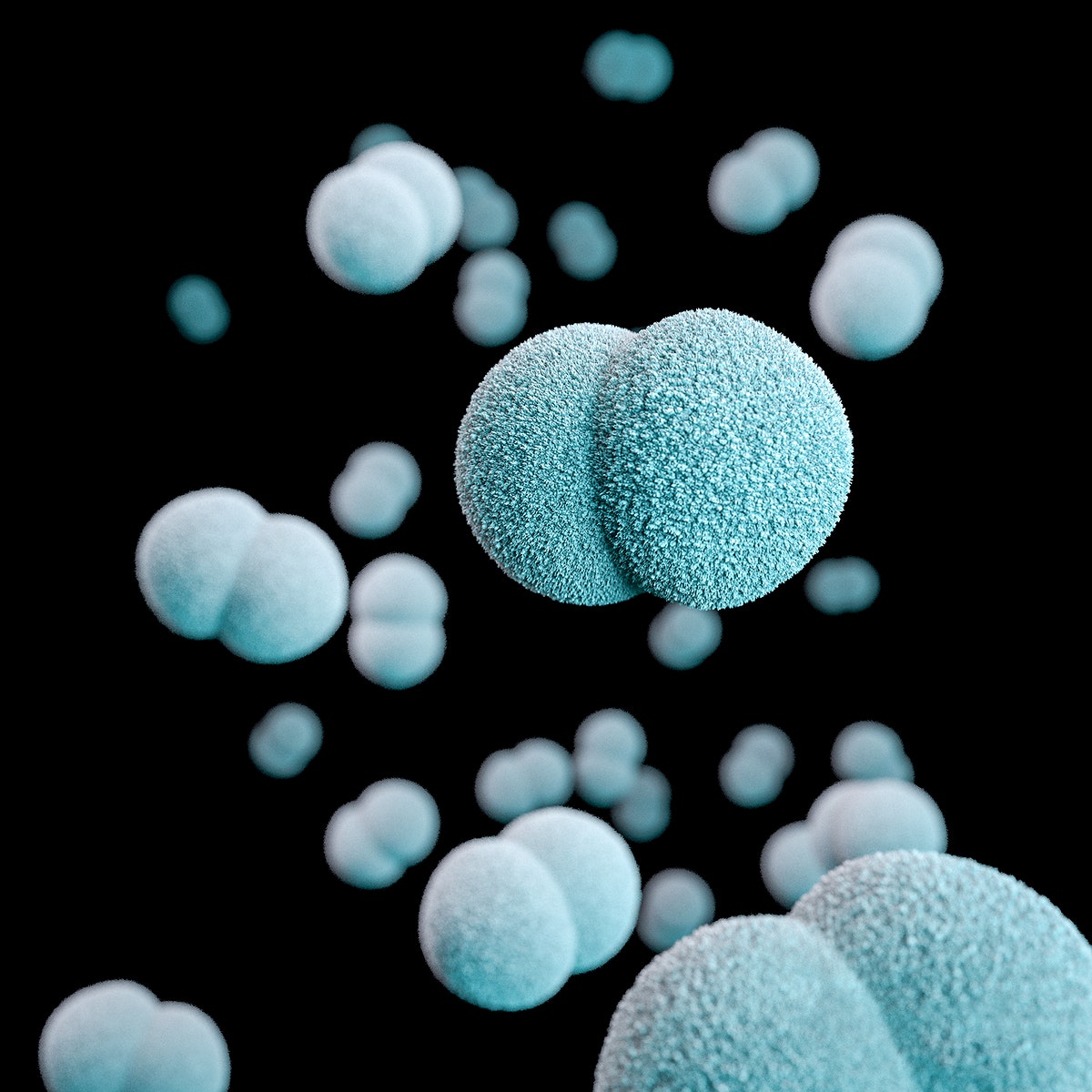
Imagem 3D de um grupo de diplococos gram-negativos de Neisseria meningitides

Imagem tridimensional (3D) de um grupo de diplococcus gram-negativos de Neisseria meningitidis


Imagem: “A 3D image of a group of diplococcal, Gram-negative, Neisseria meningitidis, bacteria” por Centers for Disease Control and Prevention. Licença: Public Domain

Fisiopatologia

A inoculação direta do agente infecioso nas meninges Meninges The brain and the spinal cord are enveloped by 3 overlapping layers of connective tissue called the meninges. The layers are, from the most external layer to the most internal layer, the dura mater, arachnoid mater, and pia mater. Between these layers are 3 potential spaces called the epidural, subdural, and subarachnoid spaces. Meninges: Anatomy é rara na meningite. Normalmente, a infeção num local adjacente ou remoto espalha-se para o cérebro.

Início

Meningite aguda:

  • Etiologia: predominantemente bacteriana ou viral
  • Os sintomas desenvolvem-se em poucas horas ou dentro de um dia.

Meningite crónica:

  • Etiologia: bacteriana, viral, parasitária, fúngica ou não infeciosa
  • Os sintomas persistem por >4 semanas
  • Ao fazer uma revisão da história clínica devem ser feitas perguntas sobre viagens recentes, estado imunológico e exposição a animais.

Patogénese da meningite infeciosa

  • A primeira etapa geralmente é a colonização da mucosa.
  • Locais de colonização:
    • Pele
    • Nasofaringe
    • Trato respiratório
    • Trato GI
    • Trato genitourinário
  • Os mecanismos de fixação na mucosa variam dependendo do organismo:
    • N. meningitidis N. meningitidis A species of gram-negative, aerobic bacteria. It is a commensal and pathogen only of humans, and can be carried asymptomatically in the nasopharynx. When found in cerebrospinal fluid it is the causative agent of cerebrospinal meningitis. It is also found in venereal discharges and blood. There are at least 13 serogroups based on antigenic differences in the capsular polysaccharides; the ones causing most meningitis infections being a, b, c, y, and w-135. Each serogroup can be further classified by serotype, serosubtype, and immunotype. Neisseria: pili Pili Filamentous or elongated proteinaceous structures which extend from the cell surface in gram-negative bacteria that contain certain types of conjugative plasmid. These pili are the organs associated with genetic transfer and have essential roles in conjugation. Normally, only one or a few pili occur on a given donor cell. This preferred use of ‘pili’ refers to the sexual appendage, to be distinguished from bacterial fimbriae, also known as common pili, which are usually concerned with adhesion. Salmonella tipo 4
    • S. pneumoniae: recetor do fator de ativação de plaquetas, laminina, recetores de imunoglobulina polimérica
  • A secreção de protease Protease Enzyme of the human immunodeficiency virus that is required for post-translational cleavage of gag and gag-pol precursor polyproteins into functional products needed for viral assembly. HIV protease is an aspartic protease encoded by the amino terminus of the pol gene. HIV Infection and AIDS IgA IgA Represents 15-20% of the human serum immunoglobulins, mostly as the 4-chain polymer in humans or dimer in other mammals. Secretory iga is the main immunoglobulin in secretions. Immunoglobulins: Types and Functions por agentes patogénicos inativa a IgA IgA Represents 15-20% of the human serum immunoglobulins, mostly as the 4-chain polymer in humans or dimer in other mammals. Secretory iga is the main immunoglobulin in secretions. Immunoglobulins: Types and Functions da mucosa e ajuda, também, na fixação epitelial.
  • O organismo invade a submucosa no local da colonização e altera as defesas do hospedeiro. A cápsula é um importante fator de virulência neste processo.
  • Os agentes patogénicos virais, geralmente, multiplicam-se nos gânglios regionais antes de invadirem a corrente sanguínea.
  • A invasão da corrente sanguínea e disseminação hematogénica para o SNC é a via mais MAIS Androgen Insensitivity Syndrome comum:
    • A cápsula de polissacarídeo dos principais agentes patogénicos inibe a fixação do complemento e a fagocitose.
    • A cápsula é o principal fator na sobrevivência intravascular.
  • Outras vias de acesso SNC:
    • Transmissão neuronal retrógrada através dos nervos olfativos ou periféricos
    • Propagação contígua direta (devido a otite, sinusite)
    • Inoculação direta (raro)
    • Transmissão vertical em recém-nascidos (a partir da mãe)
  • O organismo coloniza as meninges Meninges The brain and the spinal cord are enveloped by 3 overlapping layers of connective tissue called the meninges. The layers are, from the most external layer to the most internal layer, the dura mater, arachnoid mater, and pia mater. Between these layers are 3 potential spaces called the epidural, subdural, and subarachnoid spaces. Meninges: Anatomy.
  • As defesas do corpo atuam contra o agente patogénico induzindo inflamação e uma cascata de eventos, que inclui o edema Edema Edema is a condition in which excess serous fluid accumulates in the body cavity or interstitial space of connective tissues. Edema is a symptom observed in several medical conditions. It can be categorized into 2 types, namely, peripheral (in the extremities) and internal (in an organ or body cavity). Edema das meninges Meninges The brain and the spinal cord are enveloped by 3 overlapping layers of connective tissue called the meninges. The layers are, from the most external layer to the most internal layer, the dura mater, arachnoid mater, and pia mater. Between these layers are 3 potential spaces called the epidural, subdural, and subarachnoid spaces. Meninges: Anatomy e do parênquima cerebral.
  • O edema Edema Edema is a condition in which excess serous fluid accumulates in the body cavity or interstitial space of connective tissues. Edema is a symptom observed in several medical conditions. It can be categorized into 2 types, namely, peripheral (in the extremities) and internal (in an organ or body cavity). Edema parenquimatoso aumenta a pressão intracraniana, o que agrava os sintomas.

Apresentação Clínica

Adultos

  • A tríade clássica de sintomas:
    1. Alteração do estado mental (pontuação na escala de coma Coma Coma is defined as a deep state of unarousable unresponsiveness, characterized by a score of 3 points on the GCS. A comatose state can be caused by a multitude of conditions, making the precise epidemiology and prognosis of coma difficult to determine. Coma de Glasgow, <14)
    2. Febre >38℃
    3. Rigidez da nuca
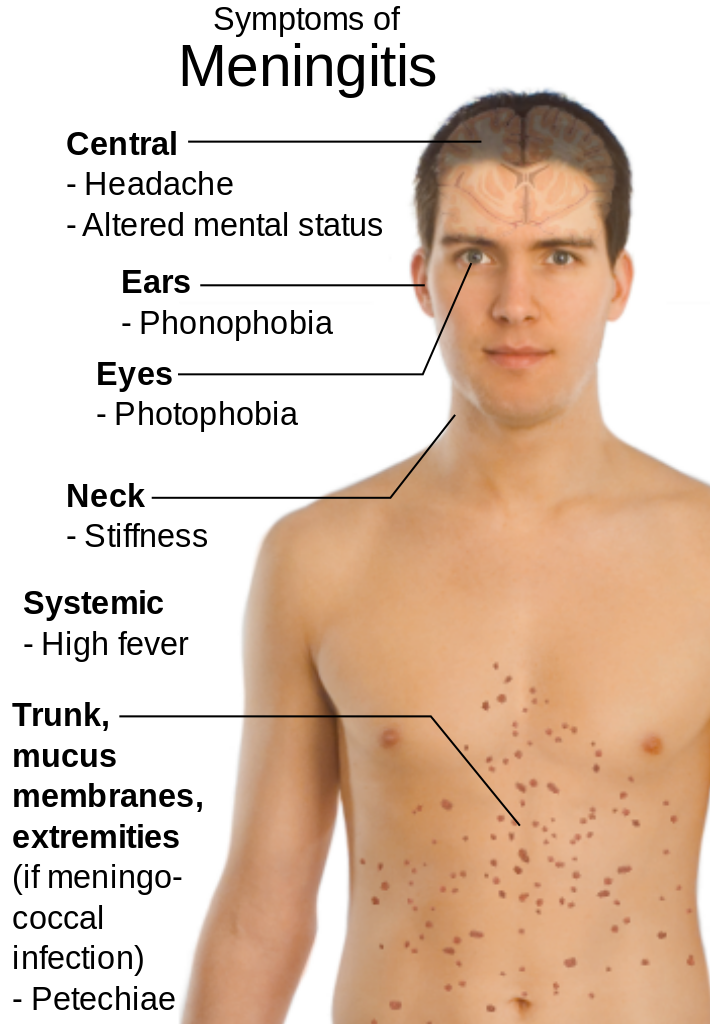
  • Cefaleia severa
  • Letargia e sonolência
  • Náuseas e vómitos
  • Fotofobia
  • Afasia
  • Hemiparesia ou monoparesia
  • Crises convulsivas
  • Ataxia Ataxia Impairment of the ability to perform smoothly coordinated voluntary movements. This condition may affect the limbs, trunk, eyes, pharynx, larynx, and other structures. Ataxia may result from impaired sensory or motor function. Sensory ataxia may result from posterior column injury or peripheral nerve diseases. Motor ataxia may be associated with cerebellar diseases; cerebral cortex diseases; thalamic diseases; basal ganglia diseases; injury to the red nucleus; and other conditions. Ataxia-telangiectasia
  • Paralisia de nervos cranianos
  • Nistagmo
  • Rash Rash Rocky Mountain Spotted Fever
  • Papiledema ( edema Edema Edema is a condition in which excess serous fluid accumulates in the body cavity or interstitial space of connective tissues. Edema is a symptom observed in several medical conditions. It can be categorized into 2 types, namely, peripheral (in the extremities) and internal (in an organ or body cavity). Edema do disco ótico)
  • Meningite devido a L. monocytogenes L. monocytogenes A species of gram-positive, rod-shaped bacteria widely distributed in nature. It has been isolated from sewage, soil, silage, and from feces of healthy animals and man. Infection with this bacterium leads to encephalitis, meningitis, endocarditis, and abortion. Listeria Monocytogenes/Listeriosis:
    • Aumento da tendência para ter convulsões
    • Defeitos neurológicos focais no início da infeção
  • Meningite devido a N. meningitidis N. meningitidis A species of gram-negative, aerobic bacteria. It is a commensal and pathogen only of humans, and can be carried asymptomatically in the nasopharynx. When found in cerebrospinal fluid it is the causative agent of cerebrospinal meningitis. It is also found in venereal discharges and blood. There are at least 13 serogroups based on antigenic differences in the capsular polysaccharides; the ones causing most meningitis infections being a, b, c, y, and w-135. Each serogroup can be further classified by serotype, serosubtype, and immunotype. Neisseria:
    • Manifestações cutâneas: petéquias, púrpura palpável
    • Artrite
Sintomas de meningite

Apresentação clínica da meningite

Imagem: “Main symptoms of Meningitis” por Mikael Häggström. Licença: Public Domain
Recém-nascidos

  • Febre alta
  • Irritabilidade (choro constante)
  • Sonolência excessiva
  • Dificuldade em acordar
  • Letargia
  • Diminuição da ingesta
  • Vómitos
  • Abaulamento da fontanela anterior
  • Rigidez do corpo e pescoço

Diagnóstico

História

  • Aguda:
    • Doença respiratória precedente
    • Otite/sinusite
    • Imunodeficiência/VIH
    • Início agudo com desenvolvimento rápido de sintomas (frequentemente em <24 horas)
  • Crónica:
    • Viagem recente
    • Residência em determinadas áreas endémicas (e.g., coccidioidomicose)
    • Exposição a animais
    • Tuberculose ou teste cutâneo da tuberculina positivo
    • Sarcoidose

Exame físico

  • Febre
  • Doentes com mau estado geral
  • Sinais de irritação meníngea (baixa sensibilidade para meningite aguda):
    • Sinal de Kernig:
      • O paciente é colocado em posição supina ou sentado numa cadeira.
      • O quadril e os joelhos são flexionados a 90 graus e é feita uma tentativa de estender o joelho.
      • A manobra causa dor no pescoço ou nas costas.
    • Rigidez da nuca:
      • O doente é colocado em posição supina.
      • O tórax do paciente é sustentado por uma mão enquanto a outra é mantida sob o occipital Occipital Part of the back and base of the cranium that encloses the foramen magnum. Skull: Anatomy.
      • O queixo é movido em direção ao esterno.
      • A contração reflexa dos músculos do pescoço impede que o queixo do doente toque o tórax.
    • Sinal de Brudzinski:
      • O doente é colocado em posição supina.
      • A flexão do pescoço causa flexão involuntária do quadril e joelhos.
  • Reflexo de Cushing:
    • Pressão de pulso aumentada, bradicardia e respiração irregular
    • Indicativo de aumento da pressão intracraniana
  • Papiledema
  • Paralisia do abducente (6º nervo)

Análises laboratoriais

  • Hemograma:
    • Contagem de leucócitos elevada
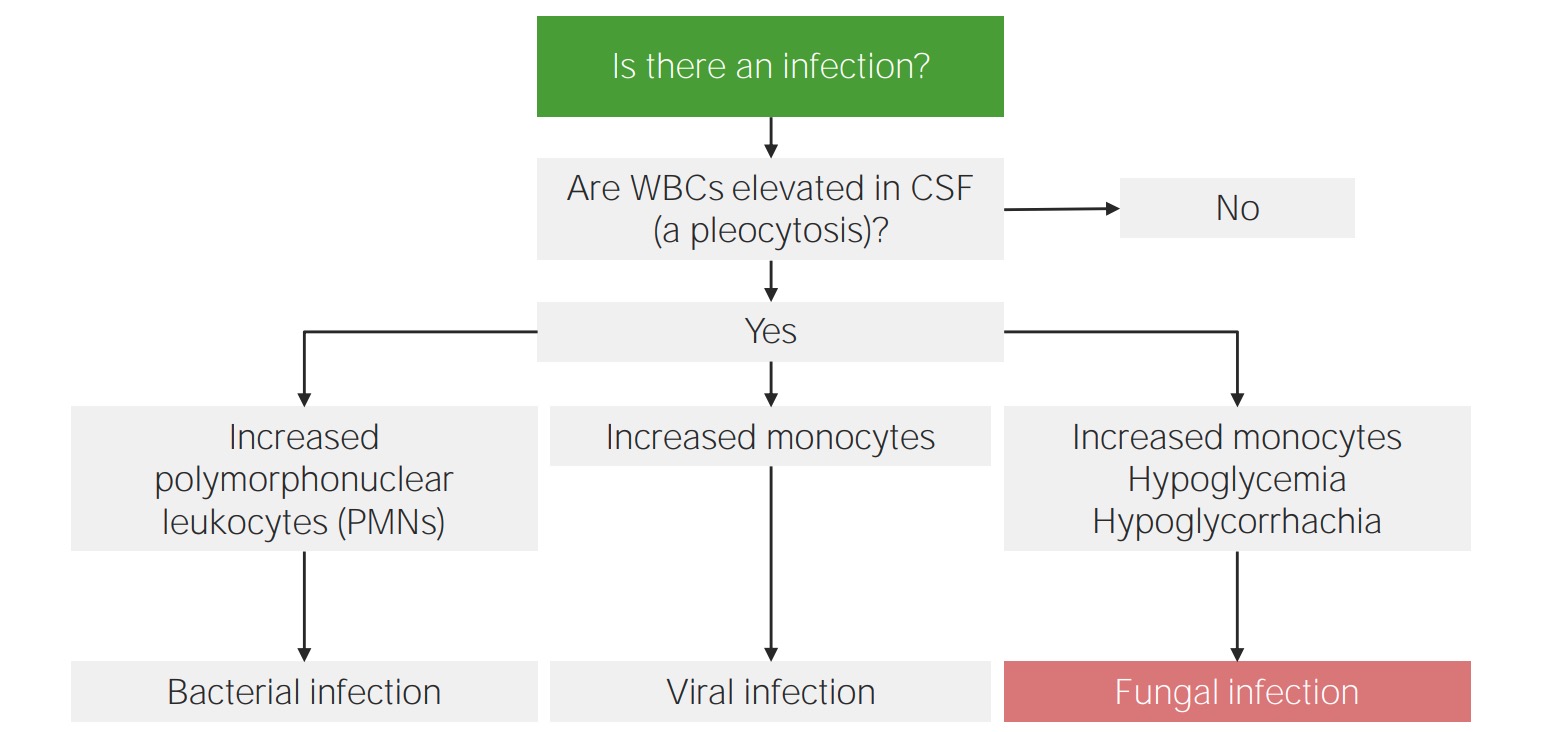
    • O diagnóstico diferencial pode ajudar a determinar a etiologia:
      • Proliferação de neutrófilos na meningite bacteriana
      • Aumento de linfócitos na meningite viral ou fúngica
  • Hemocultura: para identificar a causa da meningite e testar a sensibilidade aos antibióticos
  • Painel metabólico:
    • Comparar a glicose sérica com os níveis de glicose no LCR.
    • Avaliar se há distúrbios metabólicos.
    • Avaliar possíveis disfunções orgânicas.
  • Teste de VIH: testar o estado imunológico se não existir histórico de outras condições que cursem com imunossupressão.
  • Perfil de coagulação (PT e PTT, pela sigla em inglês) antes da punção lombar:
    • Uso crónico de álcool
    • Doença hepática crónica
    • Suspeita de CID

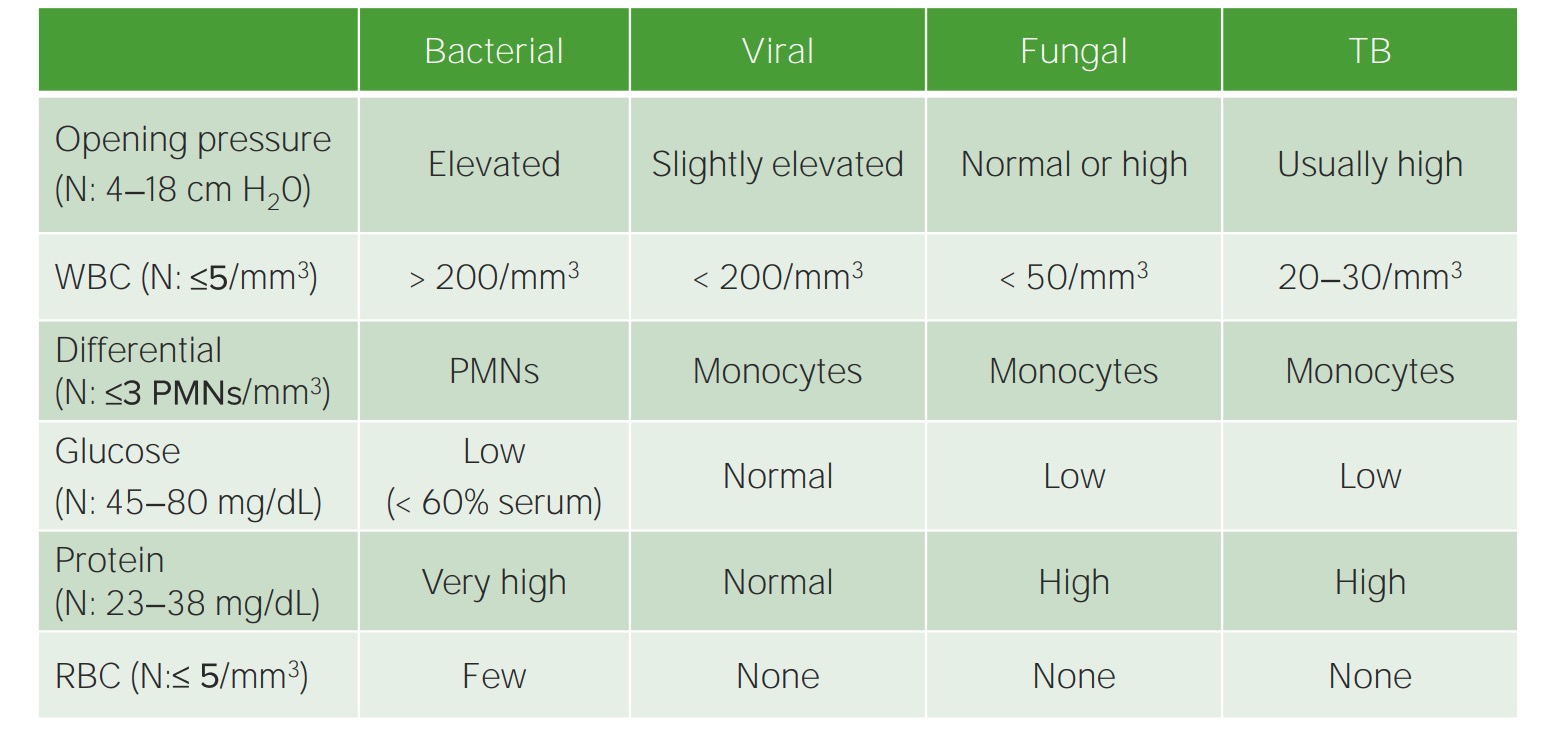
Análise do LCR

  • A punção lombar é realizada em todos os doentes com suspeita de meningite, a menos que haja contraindicação, como o aumento da pressão intracraniana ou suspeita de lesão ocupante de espaço.
  • A análise do LCR estabelece um diagnóstico definitivo e auxilia na determinação do tratamento adequado. LCR é testado para:
    • Pressão de abertura
    • Contagem de leucócitos
    • Contagem diferencial de leucócitos
    • Níveis de glicose
    • Proteínas
    • Eritrócitos
    • Cultura e sensibilidade

Imagiologia

Os exames de imagem não são necessários para o diagnóstico, mas geralmente estão indicados antes de realizar uma punção lombar se houver preocupação com o aumento da pressão intracraniana e para detetar complicações.
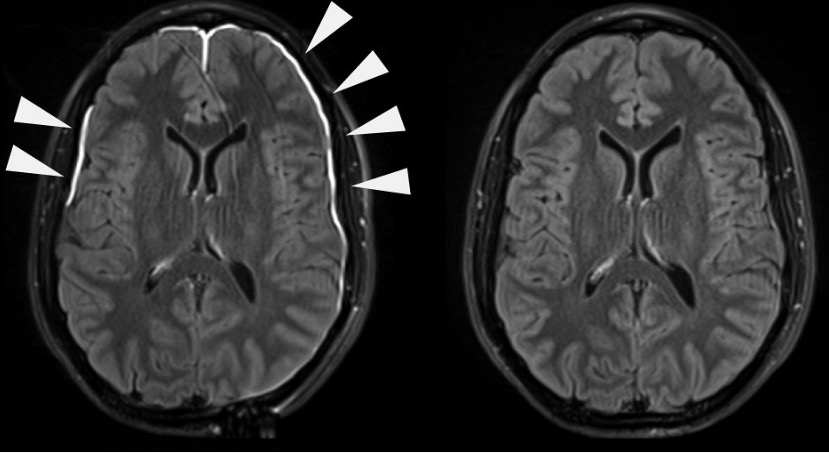
  • Pode ser realizado TAC ou RMN.
  • Normalmente indicado se:
    • Estado imunocomprometido
    • História de doença neurológica (lesão/acidente vascular cerebral/infeção focal)
    • Convulsão após 1 semana depois da apresentação
    • Papiledema
    • Alteração do estado de consciência
    • Défice neurológico focal: pupila dilatada não reativa/ paralisia do olhar/ paralisia do movimento do braço ou da perna
    • Para detetar complicações:
      • Hidrocefalia
      • Enfarte cerebral
      • Abcesso cerebral
      • Empiema subdural
      • Trombose do seio venoso
Irritação meníngea evidente na RMN com contraste

Irritação meníngea evidente na RMN com contraste


Imagem: “Damaged Meninges” por National Institutes of Health (NIH). Licença: Public Domain

Gestão e Prevenção

Tratamento

O tratamento é baseado no tipo de meningite. Os cuidados de suporte são comuns para a maioria dos doentes. Antibióticos de largo espectro são geralmente administrados como medida imediata, enquanto a causa está a ser determinada.

Meningite bacteriana:

  • Os antibióticos não devem ser atrasados enquanto se espera os resultados da tomografia computadorizada ou punção lombar.
  • Inicialmente, são administrados antibióticos de largo espectro.
  • Posteriormente, os antibióticos são ajustados com base na cultura e na sensibilidade:
    • S. pneumoniae: vancomicina + ceftriaxone Ceftriaxone A broad-spectrum cephalosporin antibiotic and cefotaxime derivative with a very long half-life and high penetrability to meninges, eyes and inner ears. Cephalosporins
    • N. meningitidis N. meningitidis A species of gram-negative, aerobic bacteria. It is a commensal and pathogen only of humans, and can be carried asymptomatically in the nasopharynx. When found in cerebrospinal fluid it is the causative agent of cerebrospinal meningitis. It is also found in venereal discharges and blood. There are at least 13 serogroups based on antigenic differences in the capsular polysaccharides; the ones causing most meningitis infections being a, b, c, y, and w-135. Each serogroup can be further classified by serotype, serosubtype, and immunotype. Neisseria: cefalosporina de 3ª geração; penicilina G ou ampicilina, se suscetível
    • H. influenzae H. influenzae A species of Haemophilus found on the mucous membranes of humans and a variety of animals. The species is further divided into biotypes I through VIII. Haemophilus: cefalosporina de 3ª geração; penicilina G ou ampicilina, se suscetível
    • L. monocytogenes L. monocytogenes A species of gram-positive, rod-shaped bacteria widely distributed in nature. It has been isolated from sewage, soil, silage, and from feces of healthy animals and man. Infection with this bacterium leads to encephalitis, meningitis, endocarditis, and abortion. Listeria Monocytogenes/Listeriosis: ampicilina ou penicilina G + gentamicina
    • Bacilos gram-negativos (geralmente nosocomiais): cefalosporina de 3ª geração
  • A administração IV é usada para eficácia máxima.
  • A penetração da barreira hematoencefálica é facilitada pela inflamação meníngea ativa.
  • A administração intratecal de antibióticos é considerada em doentes que não respondem a antibióticos intravenosos ou com meningite nosocomial.
  • A duração depende da resposta do doente e do agente patogénico.
  • Administração de esteróides:
    • Os corticosteroides, especialmente a dexametasona, são usados como tratamento adjuvante para a meningite bacteriana
    • Diminui a mortalidade
    • Diminui a taxa de complicações neurológicas (e.g., perda auditiva)
  • Tratamento de suporte:
    • Administração de fluidos IV
    • Repouso no leito
    • Analgésicos
    • Antipiréticos
    • Anticonvulsivantes no tratamento de convulsões
    • Administração de imunoglobulina em doentes imunocomprometivos

Meningite viral:

A meningite viral é, geralmente, autolimitada e requer apenas tratamento de suporte. A terapêutica antiviral Antiviral Antivirals for Hepatitis B é indicada apenas em casos selecionados e/ou graves.

  • Tratamento de suporte:
    • Administração de fluidos IV
    • Repouso no leito
    • Analgésicos
    • Antipiréticos
    • Anticonvulsivantes no tratamento de convulsões
    • Administração de imunoglobulina em doentes imunocomprometivos
  • Indicações para terapêutica antiviral Antiviral Antivirals for Hepatitis B:
    • Doentes com VIH
    • Meningite por herpes simplex Herpes Simplex A group of acute infections caused by herpes simplex virus type 1 or type 2 that is characterized by the development of one or more small fluid-filled vesicles with a raised erythematous base on the skin or mucous membrane. It occurs as a primary infection or recurs due to a reactivation of a latent infection. Congenital TORCH Infections: aciclovir
    • Meningite por citomegalovírus: ganciclovir Ganciclovir An acyclovir analog that is a potent inhibitor of the herpesvirus family including cytomegalovirus. Ganciclovir is used to treat complications from aids-associated cytomegalovirus infections. Antivirals for Herpes Virus, foscarnet Foscarnet An antiviral agent used in the treatment of cytomegalovirus retinitis. Foscarnet also shows activity against human herpesviruses and HIV. Antivirals for Herpes Virus
    • Casos associados a encefalite

Meningite fúngica:

  • O tipo mais MAIS Androgen Insensitivity Syndrome comum é a meningite criptocócica.
  • Os fármacos antifúngicos administrados são:
    • Anfotericina B
    • Fluconazol
    • Itraconazol
  • A pressão intracraniana elevada é uma complicação comum da meningite fúngica e é controlada com:
    • Punções lombares regulares para drenar o excesso de fluido
    • Colocação de um dreno lombar

Outros tipos de meningite:

  • A meningite tuberculosa é tratada com terapêutica antibacilar:
    • Isoniazida, rifampicina, pirazinamida, etambutol, estreptomicina
    • A duração recomendada do tratamento é de 9–12 meses.
  • Meningite parasitária:
    • Antimicrobianos: anfotericina B, miconazol, rifampicina, miltefosina
    • A meningite parasitária é fatal e o tratamento imediato é essencial.
    • Os fármacos são administrados em altas doses e alguns por via intratecal.
  • Meningite não infeciosa:
    • A meningite alérgica ou autoimune é tratada com corticosteroides.
    • A meningite por cancro é tratada com base no tratamento da doença subjacente.

Prognóstico

  • A mortalidade aumenta com a idade:
    • 18–34 anos: A letalidade é de 8,9%.
    • > 65 anos: A letalidade é de 22,7%.
  • As complicações neurológicas (perda auditiva, deficiência intelectual, défices focais) afetam até 28% dos doentes.

Prevenção

A vacinação pode proteger contra determinados tipos de meningite:
  • Vacina contra Haemophilus influenzae Haemophilus Influenzae A species of Haemophilus found on the mucous membranes of humans and a variety of animals. The species is further divided into biotypes I through viii. Haemophilus tipo B (Hib)
  • Vacina pneumocócica conjugada
  • Vacina meningocócica

Diagnóstico Diferencial

  • AVC: lesão cerebral por interrupção do suprimento sanguíneo: O AVC apresenta-se com defeitos neurológicos, visão turva, fala arrastada e parestesias. O AVC é diagnosticado pela história clínica, exame neurológico e imagem. O tratamento depende do tipo de AVC.
  • Abcesso cerebral: coleção de pus em resposta a uma infeção ou trauma: O abcesso cerebral apresenta-se com febre, dor de cabeça, convulsões, náuseas e vómitos. Diagnosticado por avaliação de sinais e sintomas, exames laboratoriais sanguíneos e imagens. O tratamento inclui antibioterapia e cirurgia para drenagem do abcesso.
  • Encefalite: inflamação do parênquima cerebral devido a infeção: A encefalite apresenta-se com febre, dor de cabeça, mialgias, dores nas articulações e fadiga. Diagnosticado por imagem, análise do LCR, exames laboratoriais e eletroencefalografia. A encefalite raramente se apresenta com rigidez da nuca e fotofobia. As convulsões são comuns. Tratamento de suporte e uso de fármacos anti-inflamatórios e antivirais para tratar a encefalite.
  • Empiema subdural: acumulação de pus entre a dura mater Dura mater The outermost of the three meninges, a fibrous membrane of connective tissue that covers the brain and the spinal cord. Meninges: Anatomy e a aracnoide: O empiema subdural apresenta-se com febre, cefaleia, letargia, défices neurológicos focais e convulsões. Esta condição é diagnosticada por imagem, mais MAIS Androgen Insensitivity Syndrome comummente com RMN com contraste. O empiema subdural é tratado cirurgicamente e com antibióticos.
  • Delirium Delirium Delirium is a medical condition characterized by acute disturbances in attention and awareness. Symptoms may fluctuate during the course of a day and involve memory deficits and disorientation. Delirium tremens: forma grave de abstinência do etanol que se apresenta clinicamente com confusão global, agitação, alucinações, febre e sudorese. O diagnóstico do delirium Delirium Delirium is a medical condition characterized by acute disturbances in attention and awareness. Symptoms may fluctuate during the course of a day and involve memory deficits and disorientation. Delirium tremens é feito pela história e pelos sinais e sintomas, e o tratamento envolve terapêutica de suporte e tiamina.
  • Hemorragia subaracnoideia: sangramento no espaço subaracnoide que ocorre espontaneamente ou após traumatismo cranioencefálico: A hemorragia subaracnoide apresenta-se com dor no pescoço e nos ombros, parestesias por todo o corpo, convulsões, confusão, irritabilidade, diplopia Diplopia A visual symptom in which a single object is perceived by the visual cortex as two objects rather than one. Disorders associated with this condition include refractive errors; strabismus; oculomotor nerve diseases; trochlear nerve diseases; abducens nerve diseases; and diseases of the brain stem and occipital lobe. Myasthenia Gravis e cefaleia súbita. O diagnóstico é feito com base na história clínica, sinais e sintomas, imagem e angiografia cerebral. A hemorragia subaracnoide é tratada cirurgicamente. São recomendados agentes anti-hipertensivos.

Referências

  1. Hasbun R. (2021). Pathogenesis and pathophysiology of bacterial meningitis. UpToDate. Retrieved April 26, 2021, from https://www.uptodate.com/contents/pathogenesis-and-pathophysiology-of-bacterial-meningitis
  2. Cassoobhoy A. (2020). Meningitis. WebMD. https://www.webmd.com/children/understanding-meningitis-basics#2-7
  3. Hasbun R. (2019). Meningitis. Medscape. https://emedicine.medscape.com/article/232915-overview#a3
  4. Mayo Clinic. (2020). Meningitis. https://www.mayoclinic.org/diseases-conditions/meningitis/symptoms-causes/syc-20350508
  5. Meningitis (2017). Healthline. https://www.healthline.com/health/meningitis#symptoms
  6. Armas-Tarrillo, A., Cieza-Cruz, E. J. ., Mancco-Taco, M. A. ., Orellana-Hidalgo, L. M. ., Vallejos-Estela, A. ., Álvarez-Manrique, V. ., Morales-García , M. ., Sairitupa-Sanchez, L. Z. ., & Morales-García, W. C. . (2025). Bacterial meningitis in adults: a narrative review. AG Salud3, 186. https://doi.org/10.62486/agsalud2025186
  7. Hasbun R. (2021). Clinical features and diagnosis of bacterial meningitis in adults. UpToDate. Retrieved April 26, 2021, from https://www.uptodate.com/contents/clinical-features-and-diagnosis-of-acute-bacterial-meningitis-in-adults

Crie sua conta gratuita ou faça login para continuar lendo!

Cadastre-se agora e tenha acesso grátis ao Lecturio, com páginas de conceitos, vídeos de medicina e questões para sua educação médica.

Aprende mais com a Lecturio:

Multiple devices displaying human anatomy and health education content.

Complementa o teu estudo da faculdade com o companheiro de estudo tudo-em-um da Lecturio, através de métodos de ensino baseados em evidência.

Estuda onde quiseres

Two iPhones display medical education apps, one showing anatomy, the other Bookmatcher.

A Lecturio Medical complementa o teu estudo através de métodos de ensino baseados em evidência, vídeos de palestras, perguntas e muito mais – tudo combinado num só lugar e fácil de usar.

User Reviews

Have a holly, jolly study session 🎁 Save 50% on all plans now >>

Que tengas una sesión de estudio alegre y navideña 🎁 Ahorra 50% en todos los planes >>

Details