Domina Conceptos Médicos

Estudia para la escuela de medicina y tus examenes con Lecturio.

Síndromes Paraneoplásicos

Los LOS Neisseria síndromes paraneoplásicos son un grupo heterogéneo de trastornos causados por una respuesta inmune anormal a una neoplasia. Las sustancias producidas no se deben al AL Amyloidosis efecto directo del tumor Tumor Inflammation, como metástasis, efecto de masa o invasión. Se generan anticuerpos, hormonas, citoquinas y otras sustancias que afectan múltiples sistemas de órganos. Alrededor del 10% de los LOS Neisseria casos de cáncer se ven afectados por síndromes paraneoplásicos. Los LOS Neisseria cánceres comunes que se presentan con síndromes paraneoplásicos incluyen cáncer de pulmón, seno, ovarios, riñón, hígado y estómago, y linfomas.

Last updated: Dec 15, 2025

Editorial responsibility: Stanley Oiseth, Lindsay Jones, Evelin Maza

Descripción General

Definición

Los LOS Neisseria síndromes paraneoplásicos son síndromes clínicos que surgen de una respuesta inmune a una neoplasia, produciendo sustancias que no son un efecto directo del tumor Tumor Inflammation, como metástasis, efecto de masa o invasión del tumor Tumor Inflammation.

Epidemiología

  • Ocurre en EN Erythema nodosum is an immune-mediated panniculitis (inflammation of the subcutaneous fat) caused by a type IV (delayed-type) hypersensitivity reaction. It commonly manifests in young women as tender, erythematous nodules on the shins. Erythema Nodosum alrededor del 10% de los LOS Neisseria pacientes con cáncer.
  • Los LOS Neisseria hombres y las mujeres son afectados por igual.
  • Puede ocurrir con cualquier malignidad.

Etiología

Hay 2 mecanismos principales:

  • Respuesta inmunológica a la presencia de una neoplasia en EN Erythema nodosum is an immune-mediated panniculitis (inflammation of the subcutaneous fat) caused by a type IV (delayed-type) hypersensitivity reaction. It commonly manifests in young women as tender, erythematous nodules on the shins. Erythema Nodosum el organismo que conduce a:
    • Células T citotóxicas que atacan antígenos tumorales y antígenos similares en EN Erythema nodosum is an immune-mediated panniculitis (inflammation of the subcutaneous fat) caused by a type IV (delayed-type) hypersensitivity reaction. It commonly manifests in young women as tender, erythematous nodules on the shins. Erythema Nodosum tejido no neoplásico
    • Producción de anticuerpos onconeurales o paraneoplásicos dirigidos a un antígeno (e.g., receptores de acetilcolina)
  • Hormonas, péptidos o citocinas producidas por el tumor Tumor Inflammation (e.g., síndrome de Cushing debido a la secreción ectópica de hormona adrenocorticotrópica (ACTH))

Clasificación

Tabla: Endocrinopatías paraneoplásicas
Síndrome clínico Neoplasia asociada Patogénesis
Síndrome de Cushing
  • Cáncer de pulmón de células pequeñas
  • Carcinoma de páncreas
  • Timoma
  • Carcinoma medular de tiroides
  • Tumor Tumor Inflammation carcinoide
  • Feocromocitoma
Producción de ACTH o sustancias similares a ACTH
Síndrome de secreción inadecuada de hormona antidiurética
  • Carcinoma de células pequeñas
  • Neoplasias intracraneales
Producción de hormona antidiurética (ADH) o vasopresina
Hipercalcemia
  • Carcinoma de pulmón de células escamosas
  • Carcinoma renal
  • Carcinoma de seno
  • Cánceres de cabeza y cuello
  • Mieloma múltiple
  • Carcinoma de ovario
Hormona relacionada con la hormona paratiroidea ( PTHrP PTHrP Hypercalcemia)
Hipoglucemia
  • Carcinoma de ovario
  • Fibrosarcoma
  • Carcinoma hepatocelular
  • Otros sarcomas mesenquimales
Insulina o sustancia similar a la insulina
Tabla: Síndromes paraneoplásicos neurológicos
Síndrome clínico Neoplasia asociada Patogénesis
Síndrome miasténico de Lambert-Eaton Cáncer de pulmón de células pequeñas Autoanticuerpos contra los LOS Neisseria canales presinápticos de Ca CA Condylomata acuminata are a clinical manifestation of genital HPV infection. Condylomata acuminata are described as raised, pearly, flesh-colored, papular, cauliflower-like lesions seen in the anogenital region that may cause itching, pain, or bleeding. Condylomata Acuminata (Genital Warts)2+ (canal de calcio dependiente de anti-voltaje)
Miastenia gravis
  • Miastenia gravis
  • Cáncer de pulmón de células no pequeñas
Anticuerpo anti-receptores de acetilcolina
Degeneración cerebelosa paraneoplásica
  • Cáncer de ovarios
  • Cáncer de pulmón
  • Cáncer de seno
  • Linfoma
Anticuerpos contra antígenos en EN Erythema nodosum is an immune-mediated panniculitis (inflammation of the subcutaneous fat) caused by a type IV (delayed-type) hypersensitivity reaction. It commonly manifests in young women as tender, erythematous nodules on the shins. Erythema Nodosum células de Purkinje del cerebelo (anticuerpo anticélulas de Purkinje)
Encefalitis/encefalomielitis paraneoplásica (e.g., encefalitis límbica)
  • Cáncer de pulmón de células pequeñas
  • Seminoma Seminoma A radiosensitive, malignant neoplasm of the testis, thought to be derived from primordial germ cells of the sexually undifferentiated embryonic gonad. There are three variants: classical (typical), the most common type; anaplastic; and spermatocytic. The classical seminoma is composed of fairly well differentiated sheets or cords of uniform polygonal or round cells (seminoma cells), each cell having abundant clear cytoplasm, distinct cell membranes, a centrally placed round nucleus, and one or more nucleoli. In the female, a grossly and histologically identical neoplasm, known as dysgerminoma, occurs. Testicular Cancer
  • Timoma
  • Cáncer de seno
Anti-Hu o anticuerpo nuclear antineuronal-1
Tabla: Síndromes paraneoplásicos hematológicos
Síndrome clínico Neoplasia asociada Patogénesis
Estado de hipercoagulabilidad o trombosis venosa (síndrome de Trousseau)
  • Cáncer de páncreas
  • Carcinoma broncogénico
  • Carcinoma gástrico
Liberación de mucina que activa los LOS Neisseria factores de coagulación.
Endocarditis Endocarditis Endocarditis is an inflammatory disease involving the inner lining (endometrium) of the heart, most commonly affecting the cardiac valves. Both infectious and noninfectious etiologies lead to vegetations on the valve leaflets. Patients may present with nonspecific symptoms such as fever and fatigue. Endocarditis trombótica no bacteriana (trombos estériles) Adenocarcinoma secretor de mucina Sustancia similar a la tromboplastina (estado hipercoagulable)
Policitemia
  • Carcinoma de células renales
  • Carcinoma hepatocelular
  • Hemangioma Hemangioma A vascular anomaly due to proliferation of blood vessels that forms a tumor-like mass. The common types involve capillaries and veins. It can occur anywhere in the body but is most frequently noticed in the skin and subcutaneous tissue. Imaging of the Liver and Biliary Tract cerebeloso
  • Hemangioblastoma Hemangioblastoma Hemangioblastomas are vascular neoplasms of the CNS. Hemangioblastomas are rare and are often associated with von Hippel-Lindau disease (VHL). The most common presentation is a headache and, depending on the size and location of the tumor, patients may present with sensory deficits and motor weakness. Hemangioblastoma
  • Feocromocitoma
Producción de eritropoyetina
CID
  • Leucemia promielocítica aguda
  • Carcinoma de próstata
  • Otro adenocarcinoma
Productos tumorales que activan la coagulación
Tabla: Síndromes paraneoplásicos mucocutáneos
Síndrome clínico Neoplasia asociada Patogénesis
Acantosis nigricans
  • Carcinoma gástrico
  • Adenocarcinomas en EN Erythema nodosum is an immune-mediated panniculitis (inflammation of the subcutaneous fat) caused by a type IV (delayed-type) hypersensitivity reaction. It commonly manifests in young women as tender, erythematous nodules on the shins. Erythema Nodosum otros sitios
  • Carcinoma hepatocelular
Secreción del factor de crecimiento epidérmico
Signo de Leser-Trélat Adenocarcinomas gastrointestinales Hipersensibilidad al AL Amyloidosis factor de crecimiento
Dermatomiositis
  • Cánceres de ovario, cuello uterino, útero
  • Cáncer de seno
  • Cáncer de pulmón
  • Cáncer gástrico, colorrectal y pancreático
Respuesta inmunológica a las proteínas expresadas por el tumor Tumor Inflammation; depósito de anticuerpos donde se encuentran los LOS Neisseria antígenos de la piel y del músculo
Eritema necrolítico migratorio Glucagonoma Glucagonoma A glucagonoma is a glucagon-secreting neuroendocrine tumor that originates from the β-cells in the pancreatic islets. Most glucagonomas are malignant, and many of them are part of the autosomal dominant condition known as multiple endocrine neoplasia syndrome type 1 (MEN 1). Elevated levels of glucagon lead to increased gluconeogenesis and glycogenolysis. Glucagonoma Desconocida
Síndrome de Sweet
  • Leucemia mieloide aguda
  • Síndrome mielodisplásico
Reacción inmunitaria a tumor Tumor Inflammation(es) y otros antígenos
Tabla: Otros síndromes paraneoplásicos
Síndrome clínico Neoplasia asociada Patogénesis
Síndrome nefrótico (nefropatía membranosa)
  • Cáncer de pulmón
  • Cáncer de colon Colon The large intestines constitute the last portion of the digestive system. The large intestine consists of the cecum, appendix, colon (with ascending, transverse, descending, and sigmoid segments), rectum, and anal canal. The primary function of the colon is to remove water and compact the stool prior to expulsion from the body via the rectum and anal canal. Colon, Cecum, and Appendix: Anatomy
  • Cáncer de próstata
  • Cáncer de seno
Antígeno tumoral, depósito de inmunocomplejos
Osteoartropatía hipertrófica y dedos en EN Erythema nodosum is an immune-mediated panniculitis (inflammation of the subcutaneous fat) caused by a type IV (delayed-type) hypersensitivity reaction. It commonly manifests in young women as tender, erythematous nodules on the shins. Erythema Nodosum palillo de tambor Cáncer de pulmón Proliferación fibrovascular

Endocrinopatías Paraneoplásicas

Síndrome de Cushing

  • Asociación con el cáncer:
    • Cáncer de pulmón de células pequeñas (el más común)
    • Carcinoma de páncreas
    • Timoma
    • Cáncer medular de tiroides
    • Feocromocitoma
    • Tumores carcinoides
  • ACTH ectópica: aproximadamente el 20% de los LOS Neisseria casos de síndrome de Cushing
  • ↑ ACTH ectópica → ↑ cortisol Cortisol Glucocorticoids (hipercortisolismo)
  • La presentación clínica puede incluir:
    • Retención de líquidos
    • Hipertensión
    • Hipopotasemia
    • Intolerante a la glucosa
    • Hiperpigmentación
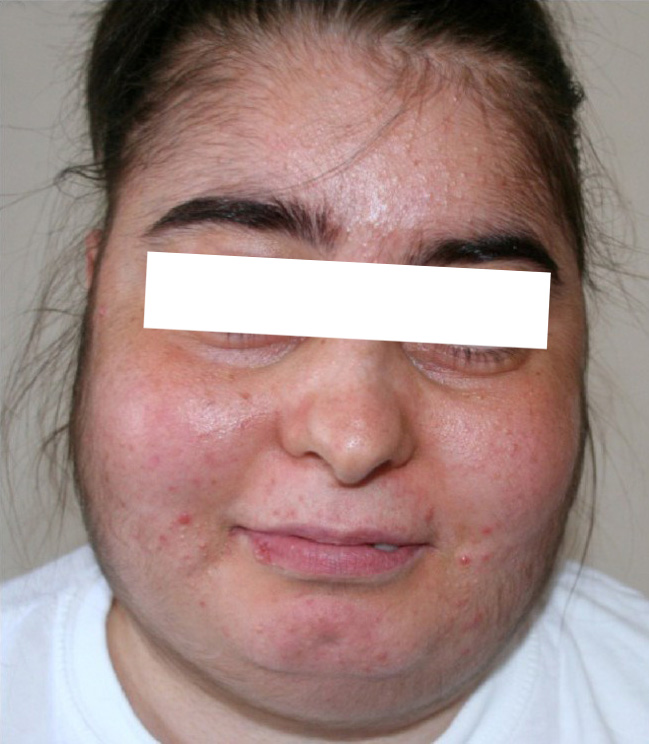
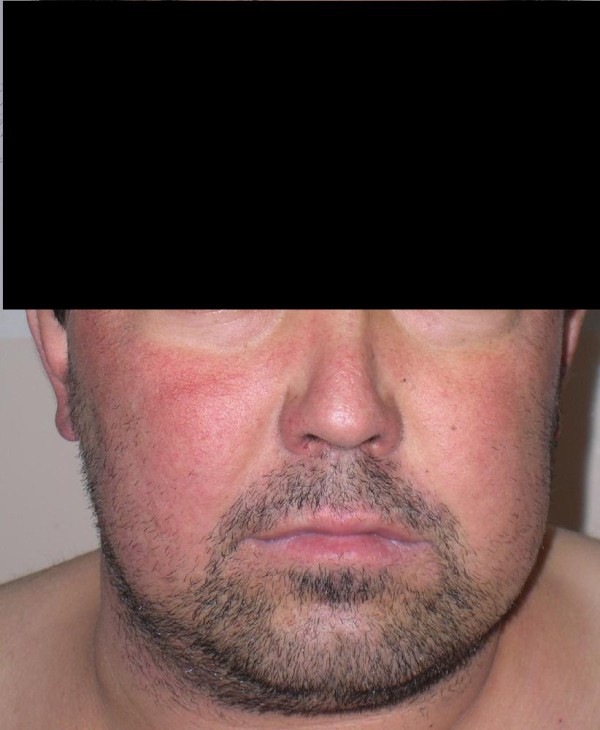
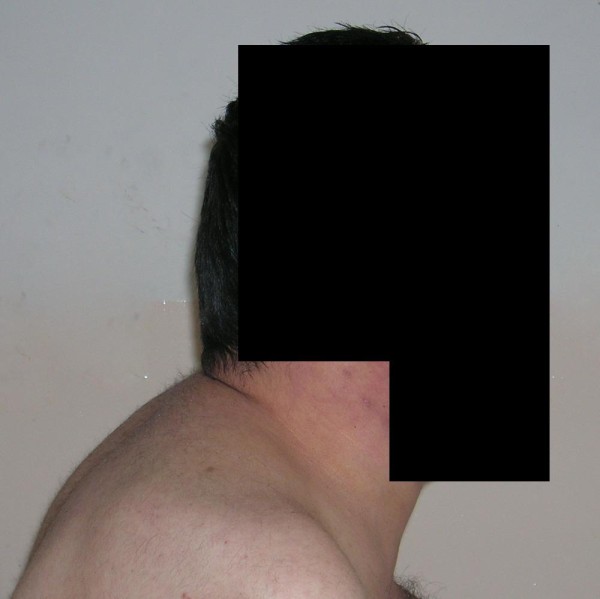
  • Los LOS Neisseria hallazgos del examen físico incluyen facies de luna, obesidad troncal y ginecomastia, entre otros.
  • Estudios:
    • ↑ ACTH
    • Dexametasona en EN Erythema nodosum is an immune-mediated panniculitis (inflammation of the subcutaneous fat) caused by a type IV (delayed-type) hypersensitivity reaction. It commonly manifests in young women as tender, erythematous nodules on the shins. Erythema Nodosum dosis altas:
  • Tratamiento:
    • Tratamiento médico:
      • Ketoconazol
      • Metirapona
      • Mitotano
    • Tratamiento de malignidad subyacente (por lo general, no es suficiente para reducir los LOS Neisseria niveles de cortisol Cortisol Glucocorticoids)

Hipercalcemia

  • Asociación con el cáncer:
    • Cáncer de pulmón
    • Cáncer de seno
    • Carcinoma renal
    • Cánceres de cabeza y cuello
    • Mieloma múltiple
    • Linfoma
  • El aumento de calcio se debe a tumores que producen PTHrP PTHrP Hypercalcemia → hipercalcemia humoral de malignidad
  • Otras fuentes del ↑ calcio en EN Erythema nodosum is an immune-mediated panniculitis (inflammation of the subcutaneous fat) caused by a type IV (delayed-type) hypersensitivity reaction. It commonly manifests in young women as tender, erythematous nodules on the shins. Erythema Nodosum malignidad:
    • De tumores con secreción ectópica de hormona paratiroidea (PTH) (e.g., cáncer de pulmón de células pequeñas)
    • Actividad osteolítica de las metástasis esqueléticas
  • Presentación:
    • Calcio elevado asintomático encontrado en EN Erythema nodosum is an immune-mediated panniculitis (inflammation of the subcutaneous fat) caused by a type IV (delayed-type) hypersensitivity reaction. It commonly manifests in young women as tender, erythematous nodules on the shins. Erythema Nodosum pruebas de laboratorio
    • La elevación marcada puede presentarse con:
      • Fatiga
      • Estreñimiento
      • Nefrolitiasis
      • Psicosis o cambios en EN Erythema nodosum is an immune-mediated panniculitis (inflammation of the subcutaneous fat) caused by a type IV (delayed-type) hypersensitivity reaction. It commonly manifests in young women as tender, erythematous nodules on the shins. Erythema Nodosum el estado mental
  • Estudios:
    • Hipercalcemia, hipercalciuria, hipofosfatemia
    • Hipercalcemia humoral de malignidad:
      • PTH suprimida
      • PTHrP PTHrP Hypercalcemia elevada
      • 1,25-dihidroxivitamina D normal a baja (la PTHrP PTHrP Hypercalcemia tiene menos tendencia a estimular la producción de 1,25-dihidroxivitamina D)
  • El tratamiento (depende de la gravedad) incluye:
    • Hidratación
    • Bifosfonatos
    • Calcitonina
    • Diálisis (último recurso)

Síndrome de secreción inadecuada de hormona antidiurética

  • Asociación con el cáncer:
    • Cánceres de pulmón
    • Tumores intracraneales
  • Presentación:
    • Hiponatremia notada en EN Erythema nodosum is an immune-mediated panniculitis (inflammation of the subcutaneous fat) caused by a type IV (delayed-type) hypersensitivity reaction. It commonly manifests in young women as tender, erythematous nodules on the shins. Erythema Nodosum las pruebas de laboratorio
    • Los LOS Neisseria signos y síntomas pueden incluir:
      • Letargo
      • Confusión
      • Convulsiones
      • Disminución del estado de conciencia
  • Pruebas de diagnóstico que muestran:
    • Hiponatremia
    • Osmolalidad sérica reducida
  • Tratamiento:
    • Restricción de líquidos
    • Demeclociclina
    • Antagonistas de la vasopresina (conivaptán, tolvaptán)
    • Hiponatremia severa: infusión de solución hipertónica

Hipoglucemia

  • Asociación con el cáncer:
    • Carcinoma de ovario
    • Fibrosarcoma
    • Carcinoma hepatocelular
    • Otros sarcomas mesenquimales
  • Múltiples mecanismos de hipoglucemia de tumores de células no islotes:
    • ↑ Utilización de la glucosa
    • ↓ Liberación hepática de glucosa debido al AL Amyloidosis factor de crecimiento similar a la insulina-2 (o en EN Erythema nodosum is an immune-mediated panniculitis (inflammation of the subcutaneous fat) caused by a type IV (delayed-type) hypersensitivity reaction. It commonly manifests in young women as tender, erythematous nodules on the shins. Erythema Nodosum casos raros, factor de crecimiento similar a la insulina-1)
  • Presentación:
    • Letargo
    • Somnolencia
    • Diaforesis
    • Confusión
    • Coma Coma Coma is defined as a deep state of unarousable unresponsiveness, characterized by a score of 3 points on the GCS. A comatose state can be caused by a multitude of conditions, making the precise epidemiology and prognosis of coma difficult to determine. Coma
  • Pruebas de diagnóstico:
    • ↓ Glucosa, insulina, proinsulina, péptido C, beta-hidroxibutirato
    • Detección de sulfonilureas/meglitinidas
    • Hipoglucemia confirmada, nivel de insulina, péptido C y beta-hidroxibutirato → estudios de imagen para buscar tumor Tumor Inflammation
  • Tratamiento:
    • Hipoglucemia de urgencia: glucagón subcutáneo o intramuscular
    • Tratamiento del cáncer subyacente
    • Glucocorticoides

Síndromes Paraneoplásicos Neurológicos

Síndrome miasténico de Lambert Eaton

  • Asociación con el cáncer: cáncer de pulmón de células pequeñas
  • Alrededor del 50% asociado con malignidad
  • Asociado con:
    • Liberación reducida de acetilcolina
    • Desarrollo de anticuerpos:
      • Dirigidos al AL Amyloidosis canal de calcio dependiente de voltaje tipo P/Q
      • Canal de calcio dependiente de voltaje tipo P/Q facilita el flujo de calcio normal, lo que permite la liberación de acetilcolina.
    • Los LOS Neisseria canales de calcio dependiente de voltaje tipo P/Q se expresan en EN Erythema nodosum is an immune-mediated panniculitis (inflammation of the subcutaneous fat) caused by a type IV (delayed-type) hypersensitivity reaction. It commonly manifests in young women as tender, erythematous nodules on the shins. Erythema Nodosum la membrana superficial de las células de cáncer de pulmón de células pequeñas.
  • Presentación:
    • Debilidad muscular proximal progresiva (sin atrofia muscular)
    • Reflejos tendinosos profundos reducidos o ausentes
    • Ptosis Ptosis Cranial Nerve Palsies (hallazgo más común del nervio craneal)
    • Los LOS Neisseria síntomas mejoran con el tiempo después de un movimiento repetitivo (que difiere de la miastenia grave)
  • Pruebas de diagnóstico:
    • Estudios de conducción nerviosa motora y sensorial
    • Estimulación nerviosa repetitiva
    • Electromiografía de aguja
    • Prueba de anticuerpos para canales de calcio dependiente de voltaje tipo P/Q anti-P/Q-tipo
  • Tratamiento:
    • Tratar la malignidad subyacente
    • Amifampridina
    • Guanidina en EN Erythema nodosum is an immune-mediated panniculitis (inflammation of the subcutaneous fat) caused by a type IV (delayed-type) hypersensitivity reaction. It commonly manifests in young women as tender, erythematous nodules on the shins. Erythema Nodosum dosis bajas
    • Piridostigmina (última opción, por efectos secundarios graves)
    • Debilidad refractaria:
      • Inmunoglobulina intravenosa
      • Prednisona

Miastenia gravis

  • Asociación con el cáncer:
    • Timomas
    • Cáncer de pulmón de células no pequeñas
  • Debido a la destrucción mediada por anticuerpos contra el receptor Receptor Receptors are proteins located either on the surface of or within a cell that can bind to signaling molecules known as ligands (e.g., hormones) and cause some type of response within the cell. Receptors de acetilcolina en EN Erythema nodosum is an immune-mediated panniculitis (inflammation of the subcutaneous fat) caused by a type IV (delayed-type) hypersensitivity reaction. It commonly manifests in young women as tender, erythematous nodules on the shins. Erythema Nodosum la unión neuromuscular
  • Presentación:
    • Fatiga, debilidad
    • Ptosis Ptosis Cranial Nerve Palsies, diplopía
    • Disfagia
    • Insuficiencia respiratoria
    • A diferencia del síndrome miasténico de Lambert Eaton, los LOS Neisseria síntomas no mejoran con el movimiento repetido
  • Diagnóstico:
    • Autoanticuerpos contra el receptor Receptor Receptors are proteins located either on the surface of or within a cell that can bind to signaling molecules known as ligands (e.g., hormones) and cause some type of response within the cell. Receptors de acetilcolina
    • Estudios de estimulación nerviosa repetitiva
    • Electromiografía de fibra única
  • Tratamiento:
    • Tratar la malignidad subyacente
    • Inhibidores de la acetilcolinesterasa
    • Agentes inmunosupresores (e.g., glucocorticoides)
    • Plasmaféresis
    • Inmunoglobulina intravenosa
    • Anticuerpos monoclonales

Degeneración cerebelosa paraneoplásica

  • Asociación con el cáncer:
    • Cáncer de pulmón
    • Cáncer de ovarios
    • Cáncer de seno
    • Linfoma
  • Múltiples autoanticuerpos asociados:
    • Anticuerpo anti-Yo o de células de Purkinje: más común
    • Anti-Ri (ANNA-2)
    • Anti-Tr ( receptor Receptor Receptors are proteins located either on the surface of or within a cell that can bind to signaling molecules known as ligands (e.g., hormones) and cause some type of response within the cell. Receptors relacionado con el factor de crecimiento epidérmico tipo Delta/Notch)
    • Anti-canales de calcio dependiente de voltaje tipo P/Q (también asociado con síndrome miasténico de Lambert Eaton)
  • Se presenta con características de oscilopsia, diplopía, disartria y ataxia Ataxia Impairment of the ability to perform smoothly coordinated voluntary movements. This condition may affect the limbs, trunk, eyes, pharynx, larynx, and other structures. Ataxia may result from impaired sensory or motor function. Sensory ataxia may result from posterior column injury or peripheral nerve diseases. Motor ataxia may be associated with cerebellar diseases; cerebral cortex diseases; thalamic diseases; basal ganglia diseases; injury to the red nucleus; and other conditions. Ataxia-telangiectasia.
  • Un diagnóstico de exclusión:
    • No todos los LOS Neisseria biomarcadores tienen pruebas (suero y LCR) disponibles
    • Si no se encuentra cáncer inicialmente, buscar malignidad oculta
  • Tratamiento:
    • Tratamiento para el cáncer
    • Inmunoterapia (aunque el pronóstico general es malo)

Encefalitis/encefalomielitis paraneoplásica

  • Asociación con el cáncer:
    • Cáncer de pulmón de células pequeñas
    • Seminoma Seminoma A radiosensitive, malignant neoplasm of the testis, thought to be derived from primordial germ cells of the sexually undifferentiated embryonic gonad. There are three variants: classical (typical), the most common type; anaplastic; and spermatocytic. The classical seminoma is composed of fairly well differentiated sheets or cords of uniform polygonal or round cells (seminoma cells), each cell having abundant clear cytoplasm, distinct cell membranes, a centrally placed round nucleus, and one or more nucleoli. In the female, a grossly and histologically identical neoplasm, known as dysgerminoma, occurs. Testicular Cancer
    • Timoma
    • Cáncer de seno
  • Algunos anticuerpos relacionados:
    • Anti-Hu (ANNA-1): encefalomielitis, encefalitis límbica y del tronco encefálico
    • Anti-Ri (ANNA-2): encefalitis del tronco encefálico
    • Receptor Receptor Receptors are proteins located either on the surface of or within a cell that can bind to signaling molecules known as ligands (e.g., hormones) and cause some type of response within the cell. Receptors anti-N-metil-D-aspartato (NMDA): encefalitis asociada a teratoma Teratoma A true neoplasm composed of a number of different types of tissue, none of which is native to the area in which it occurs. It is composed of tissues that are derived from three germinal layers, the endoderm, mesoderm, and ectoderm. They are classified histologically as mature (benign) or immature (malignant). Imaging of the Mediastinum ovárico
  • Se manifiesta como:
    • Encefalitis límbica, que incluye:
    • Encefalitis del tronco encefálico, que incluye:
      • Déficit de movimientos extraoculares
      • Disfagia
      • Nistagmo
      • Opsoclono
      • Vértigo
      • Pérdida de la audición
    • Encefalomielitis: Los LOS Neisseria síntomas varían según las diversas regiones del sistema nervioso involucradas
    • Encefalitis receptor Receptor Receptors are proteins located either on the surface of or within a cell that can bind to signaling molecules known as ligands (e.g., hormones) and cause some type of response within the cell. Receptors anti-NMDA:
      • Manifestaciones psiquiátricas (ansiedad, delirios, alucinaciones)
      • Déficits de memoria
      • Convulsiones
      • Discinesias
      • Disfunción del lenguaje
      • Inestabilidad autonómica
  • Enfoque diagnóstico:
    • Implica la revisión de las características clínicas, los LOS Neisseria factores de riesgo de cáncer y los LOS Neisseria hallazgos concomitantes de laboratorio e imagenología
    • No siempre se encuentran anticuerpos en EN Erythema nodosum is an immune-mediated panniculitis (inflammation of the subcutaneous fat) caused by a type IV (delayed-type) hypersensitivity reaction. It commonly manifests in young women as tender, erythematous nodules on the shins. Erythema Nodosum la encefalitis paraneoplásica
  • Tratamiento: tratamiento del tumor Tumor Inflammation e inmunoterapia

Síndromes Paraneoplásicos Hematológicos

Síndrome de Trousseau

  • Tromboflebitis migratoria
  • Asociación con el cáncer:
    • Carcinoma de páncreas
    • Carcinoma gástrico
    • Carcinoma broncogénico
  • Asociado con actividad procoagulante:
    • Factor tisular: forma un complejo con el factor VII Factor VII Heat- and storage-stable plasma protein that is activated by tissue thromboplastin to form factor viia in the extrinsic pathway of blood coagulation. The activated form then catalyzes the activation of factor X to factor Xa. Hemostasis → cascada de la coagulación
    • Procoagulante del cáncer: proteasa en EN Erythema nodosum is an immune-mediated panniculitis (inflammation of the subcutaneous fat) caused by a type IV (delayed-type) hypersensitivity reaction. It commonly manifests in young women as tender, erythematous nodules on the shins. Erythema Nodosum tejido maligno que activa el factor X Factor X Storage-stable glycoprotein blood coagulation factor that can be activated to factor Xa by both the intrinsic and extrinsic pathways. A deficiency of factor X, sometimes called stuart-prower factor deficiency, may lead to a systemic coagulation disorder. Hemostasis
    • Activadores en EN Erythema nodosum is an immune-mediated panniculitis (inflammation of the subcutaneous fat) caused by a type IV (delayed-type) hypersensitivity reaction. It commonly manifests in young women as tender, erythematous nodules on the shins. Erythema Nodosum células normales como la P-selectina (que se encuentra en EN Erythema nodosum is an immune-mediated panniculitis (inflammation of the subcutaneous fat) caused by a type IV (delayed-type) hypersensitivity reaction. It commonly manifests in young women as tender, erythematous nodules on the shins. Erythema Nodosum plaquetas y células endoteliales): ↑ expresión del factor tisular
  • Presentación: tromboflebitis superficial migratoria recurrente
  • Evaluación:
    • Descartar trombosis venosa profunda coexistente
    • Pruebas integrales de búsqueda de malignidad (imagenología, pruebas de laboratorio)
  • Tratamiento:
    • De soporte (controlar el dolor Dolor Inflammation, reducir la inflamación)
    • Anticoagulación
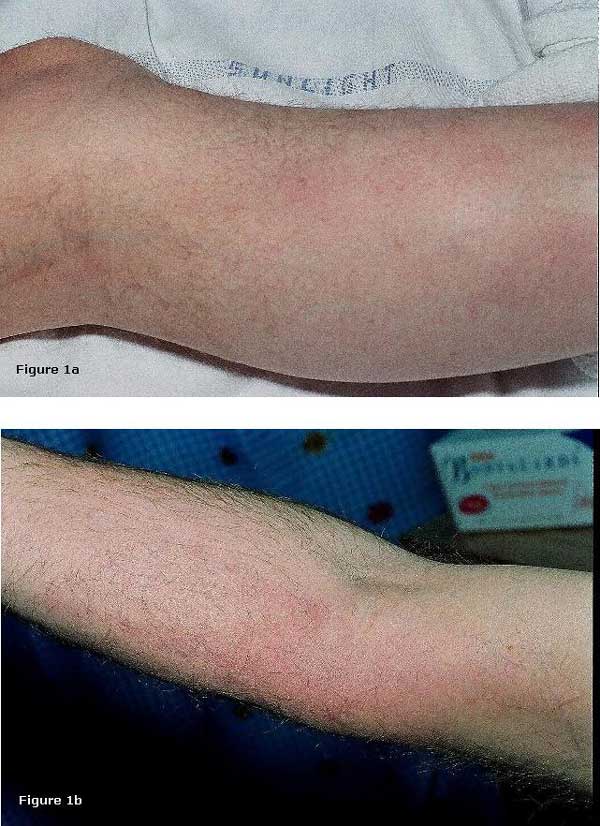
Síndrome de Trousseau

Síndrome de Trousseau:
Tromboflebitis migratoria en un hombre con adenocarcinoma de páncreas
Erupción eritematosa dolorosa en la cara medial del antebrazo derecho y miembro inferior izquierdo
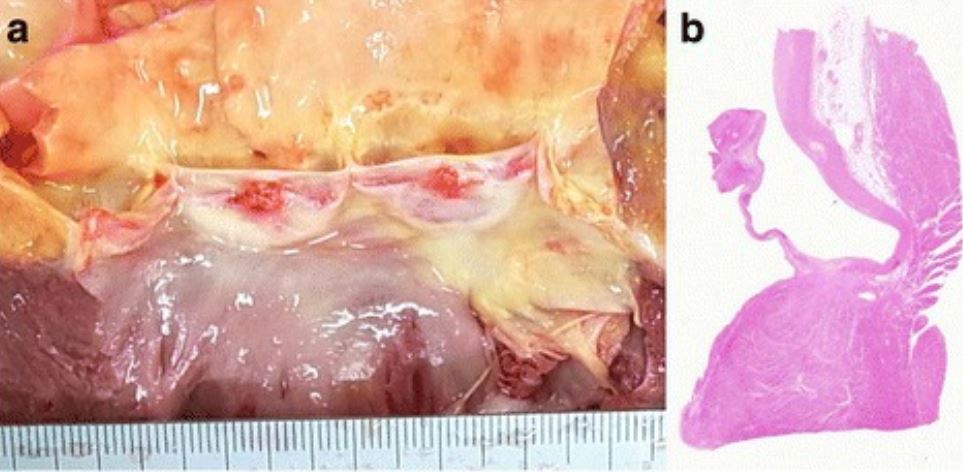
Imagen: “(A) and (B) Tender erythematous rash” por Thayalasekaran S, Liddicoat H, Wood E. Licencia: CC BY 3.0

Endocarditis Endocarditis Endocarditis is an inflammatory disease involving the inner lining (endometrium) of the heart, most commonly affecting the cardiac valves. Both infectious and noninfectious etiologies lead to vegetations on the valve leaflets. Patients may present with nonspecific symptoms such as fever and fatigue. Endocarditis trombótica no bacteriana

  • Endocarditis Endocarditis Endocarditis is an inflammatory disease involving the inner lining (endometrium) of the heart, most commonly affecting the cardiac valves. Both infectious and noninfectious etiologies lead to vegetations on the valve leaflets. Patients may present with nonspecific symptoms such as fever and fatigue. Endocarditis marántica, endocarditis Endocarditis Endocarditis is an inflammatory disease involving the inner lining (endometrium) of the heart, most commonly affecting the cardiac valves. Both infectious and noninfectious etiologies lead to vegetations on the valve leaflets. Patients may present with nonspecific symptoms such as fever and fatigue. Endocarditis verrugosa
  • Asociación con el cáncer: adenocarcinoma secretor de mucina (cáncer avanzado en EN Erythema nodosum is an immune-mediated panniculitis (inflammation of the subcutaneous fat) caused by a type IV (delayed-type) hypersensitivity reaction. It commonly manifests in young women as tender, erythematous nodules on the shins. Erythema Nodosum el 80% de los LOS Neisseria casos)
  • También se ve VE Ventilation: Mechanics of Breathing en EN Erythema nodosum is an immune-mediated panniculitis (inflammation of the subcutaneous fat) caused by a type IV (delayed-type) hypersensitivity reaction. It commonly manifests in young women as tender, erythematous nodules on the shins. Erythema Nodosum el lupus eritematoso sistémico (LES)
  • ↑ Del estado coagulable que conduce a vegetaciones compuestas de fibrina y plaquetas:
    • Los LOS Neisseria depósitos se desprenden fácilmente → émbolos
    • Puede provocar accidentes cerebrovasculares y estenosis/regurgitación valvular
  • Presentación:
    • La fiebre puede estar o no presente
    • A menudo se diagnostica cuando se ha HA Hemolytic anemia (HA) is the term given to a large group of anemias that are caused by the premature destruction/hemolysis of circulating red blood cells (RBCs). Hemolysis can occur within (intravascular hemolysis) or outside the blood vessels (extravascular hemolysis). Hemolytic Anemia producido un evento embólico:
  • Pruebas de diagnóstico:
    • Laboratorios completos, incluidos hemocultivos
    • Descartar LES, CID
    • Imagenología, incluido el ecocardiograma
  • Tratamiento:
    • Tratar la malignidad subyacente
    • Anticoagulación
    • Cirugía en EN Erythema nodosum is an immune-mediated panniculitis (inflammation of the subcutaneous fat) caused by a type IV (delayed-type) hypersensitivity reaction. It commonly manifests in young women as tender, erythematous nodules on the shins. Erythema Nodosum casos seleccionados
Vegetaciones de la válvula aórtica en la autopsia

Vegetaciones de la válvula aórtica en la autopsia:
a: El aspecto macroscópico de la válvula aórtica muestra 2 vegetaciones de 4 mm y 5 mm de diámetro.
b: La evaluación histológica muestra que las vegetaciones consisten en fibrina sin colonias bacterianas, compatibles con endocarditis no infecciosa.
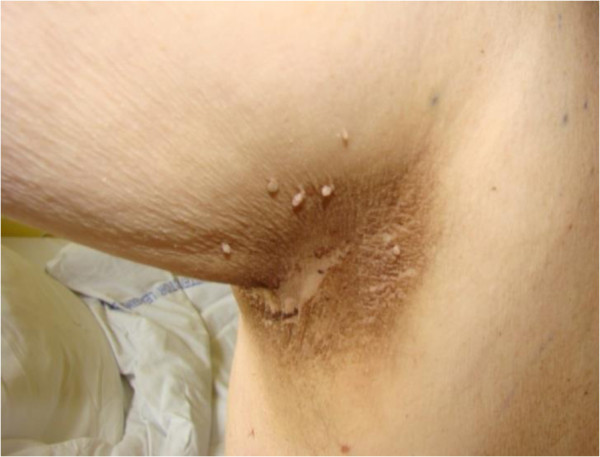
Imagen: “Newly recognized cerebral infarctions on postmortem imaging: a report of three cases with systemic infectious disease” por BMC Medical Imaging. Licencia: CC BY 4.0

Policitemia

  • Asociación con el cáncer:
    • Carcinoma de células renales
    • Carcinoma hepatocelular
    • Hemangioblastoma Hemangioblastoma Hemangioblastomas are vascular neoplasms of the CNS. Hemangioblastomas are rare and are often associated with von Hippel-Lindau disease (VHL). The most common presentation is a headache and, depending on the size and location of the tumor, patients may present with sensory deficits and motor weakness. Hemangioblastoma
    • Feocromocitoma
    • Hemangioma Hemangioma A vascular anomaly due to proliferation of blood vessels that forms a tumor-like mass. The common types involve capillaries and veins. It can occur anywhere in the body but is most frequently noticed in the skin and subcutaneous tissue. Imaging of the Liver and Biliary Tract cerebeloso
  • Secundario a la producción autónoma de eritropoyetina.
  • Presentación:
    • Síndrome de hiperviscosidad
    • Cefalea
    • Facies pletórica
    • Hipertensión
  • Pruebas de diagnóstico:
    • ↑ Hemoglobina, hematocrito
    • ↑ Eritropoyetina sin causas secundarias
  • Tratamiento:
    • Tratar la malignidad subyacente
    • Tratamiento basado en EN Erythema nodosum is an immune-mediated panniculitis (inflammation of the subcutaneous fat) caused by a type IV (delayed-type) hypersensitivity reaction. It commonly manifests in young women as tender, erythematous nodules on the shins. Erythema Nodosum el riesgo (depende en EN Erythema nodosum is an immune-mediated panniculitis (inflammation of the subcutaneous fat) caused by a type IV (delayed-type) hypersensitivity reaction. It commonly manifests in young women as tender, erythematous nodules on the shins. Erythema Nodosum parte del riesgo trombótico)

CID

  • Asociación con el cáncer:
    • Leucemia promielocítica aguda
    • Adenocarcinoma de próstata
    • Otros adenocarcinomas (e.g., colon Colon The large intestines constitute the last portion of the digestive system. The large intestine consists of the cecum, appendix, colon (with ascending, transverse, descending, and sigmoid segments), rectum, and anal canal. The primary function of the colon is to remove water and compact the stool prior to expulsion from the body via the rectum and anal canal. Colon, Cecum, and Appendix: Anatomy, estómago)
  • Las células tumorales producen factor tisular y otros procoagulantes.
  • La presentación puede variar:
    • Anemia Anemia Anemia is a condition in which individuals have low Hb levels, which can arise from various causes. Anemia is accompanied by a reduced number of RBCs and may manifest with fatigue, shortness of breath, pallor, and weakness. Subtypes are classified by the size of RBCs, chronicity, and etiology. Anemia: Overview and Types hemolítica microangiopática
    • Disnea, insuficiencia respiratoria
    • Convulsiones
    • Insuficiencia renal
    • Insuficiencia circulatoria
  • El diagnóstico se basa en EN Erythema nodosum is an immune-mediated panniculitis (inflammation of the subcutaneous fat) caused by a type IV (delayed-type) hypersensitivity reaction. It commonly manifests in young women as tender, erythematous nodules on the shins. Erythema Nodosum:
    • Características clínicas e historia.
    • Pruebas de laboratorio, incluyendo:
      • ↓ Fibrinógeno
      • Anemia Anemia Anemia is a condition in which individuals have low Hb levels, which can arise from various causes. Anemia is accompanied by a reduced number of RBCs and may manifest with fatigue, shortness of breath, pallor, and weakness. Subtypes are classified by the size of RBCs, chronicity, and etiology. Anemia: Overview and Types y trombocitopenia
      • ↑ Tiempo de protrombina y aTPT
      • ↑ Dímero D
      • Anemia Anemia Anemia is a condition in which individuals have low Hb levels, which can arise from various causes. Anemia is accompanied by a reduced number of RBCs and may manifest with fatigue, shortness of breath, pallor, and weakness. Subtypes are classified by the size of RBCs, chronicity, and etiology. Anemia: Overview and Types hemolítica en EN Erythema nodosum is an immune-mediated panniculitis (inflammation of the subcutaneous fat) caused by a type IV (delayed-type) hypersensitivity reaction. It commonly manifests in young women as tender, erythematous nodules on the shins. Erythema Nodosum el frotis periférico
  • Tratamiento:
    • Tratar la causa subyacente (malignidad)
    • Soporte hemodinámico
    • Reemplazo de componentes sanguíneos

Síndromes Mucocutáneos y Otros Síndromes Paraneoplásicos

Acantosis nigricans

  • Asociación con el cáncer:
    • Carcinoma gástrico (más común)
    • Otros:
      • Adenocarcinoma de pulmón, ovario, riñones, páncreas, mama
      • Carcinoma hepatocelular
  • La activación del receptor Receptor Receptors are proteins located either on the surface of or within a cell that can bind to signaling molecules known as ligands (e.g., hormones) and cause some type of response within the cell. Receptors del factor de crecimiento epidérmico contribuye a la acantosis nigricans asociada con malignidad.
  • Lesiones de la piel:
    • Placas hiperpigmentadas: pueden ser aterciopeladas o verrugosas
    • Puede ocurrir antes del diagnóstico de malignidad
    • Aparece incluso en EN Erythema nodosum is an immune-mediated panniculitis (inflammation of the subcutaneous fat) caused by a type IV (delayed-type) hypersensitivity reaction. It commonly manifests in young women as tender, erythematous nodules on the shins. Erythema Nodosum no obesos (a diferencia de la acantosis nigricans asociada con la resistencia a la insulina)
  • Puede ocurrir con callos de palma:
    • También llamada acantosis palmaris y paquidermatoglifia adquirida
    • Palma engrosada, con crestas palmares acentuadas, similar a la mucosa del estómago
  • El diagnóstico es clínico, ↑ sospecha en EN Erythema nodosum is an immune-mediated panniculitis (inflammation of the subcutaneous fat) caused by a type IV (delayed-type) hypersensitivity reaction. It commonly manifests in young women as tender, erythematous nodules on the shins. Erythema Nodosum casos de:
    • Progresión rápida
    • Afectación palma y planta del pie
    • Afectación de mucosas
  • Tratamiento: el tratamiento de la malignidad puede conducir a la resolución
Acantosis nigricans

Acantosis nigricans:
Decoloración oscura que generalmente se desarrolla en los pliegues o pliegues del cuerpo, afectando aquí la axila derecha. La piel se vuelve gruesa debido a la hiperqueratosis y puede parecer aterciopelada.
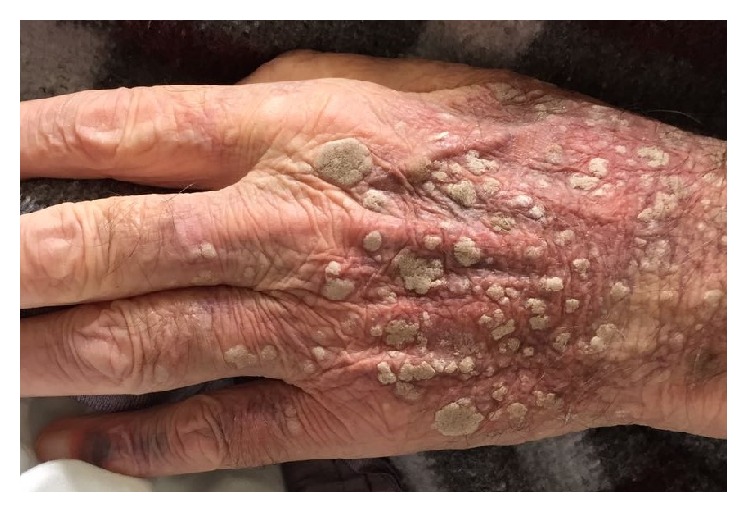
Imagen: “Acantosis nigricans before starting chemotherapy” por Kubicka-Wołkowska J, Dębska-Szmich S, Lisik-Habib M, Noweta M, Potemski P. Licencia: CC BY 4.0

Signo de Leser-Trélat

  • Asociación con el cáncer: adenocarcinomas gastrointestinales (e.g., de estómago, colorrectales).
  • Es probable que los LOS Neisseria factores de crecimiento y las citocinas del tumor Tumor Inflammation contribuyan a la rápida aparición de las lesiones.
  • Presentación: queratosis seborréica (múltiples)
    • Lesiones cutáneas elevadas con aspecto “pegado”
    • Bien delimitado con superficie verrugosa
    • Indoloro, pruriginoso
  • El diagnóstico es clínico.
  • Tratamiento: Tratar la neoplasia maligna subyacente
Signo de Leser-Trélat

Signo de Leser-Trélat:
Queratosis seborreicas en el dorso de la mano que aparecieron y aumentaron de tamaño en un período corto
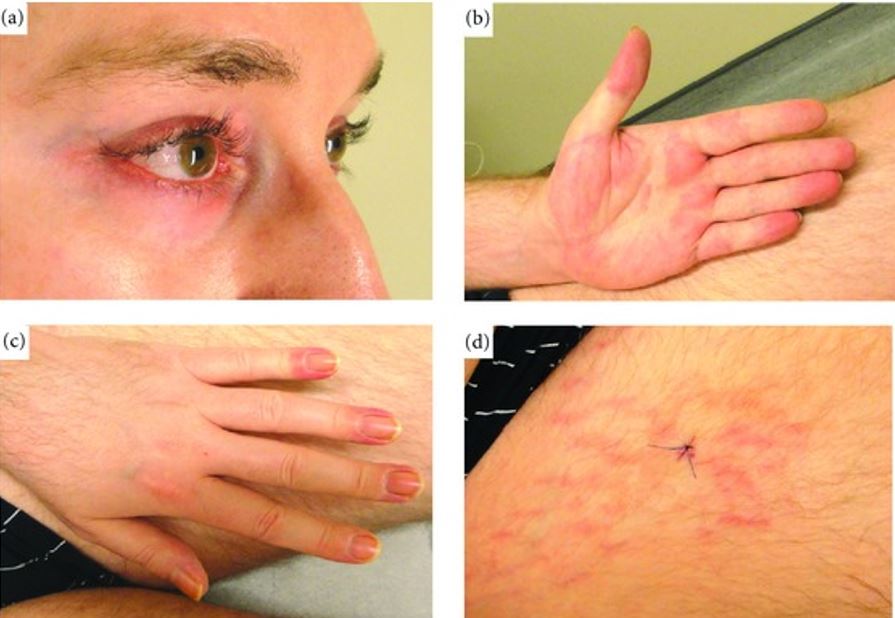
Imagen: “Seborrheic keratoses on the back of the hand” por Case Reports in Medicine. Licencia: CC BY 4.0

Dermatomiositis

  • Asociación con el cáncer:
    • Cánceres de ovario, cuello uterino, útero
    • Cáncer de seno
    • Cáncer de pulmón
    • Cáncer gástrico, colorrectal y pancreático
  • Oncoproteínas expresadas por tumores → respuesta inmune inflamatoria → depósito de autoanticuerpos en EN Erythema nodosum is an immune-mediated panniculitis (inflammation of the subcutaneous fat) caused by a type IV (delayed-type) hypersensitivity reaction. It commonly manifests in young women as tender, erythematous nodules on the shins. Erythema Nodosum sitios con antígenos de piel y músculo
  • Hallazgos clínicos:
    • Pápulas de Gottron: pápulas eritematosas o violáceas en EN Erythema nodosum is an immune-mediated panniculitis (inflammation of the subcutaneous fat) caused by a type IV (delayed-type) hypersensitivity reaction. It commonly manifests in young women as tender, erythematous nodules on the shins. Erythema Nodosum las prominencias óseas de las manos
    • Erupción en EN Erythema nodosum is an immune-mediated panniculitis (inflammation of the subcutaneous fat) caused by a type IV (delayed-type) hypersensitivity reaction. It commonly manifests in young women as tender, erythematous nodules on the shins. Erythema Nodosum heliotropo: manchas violáceas en EN Erythema nodosum is an immune-mediated panniculitis (inflammation of the subcutaneous fat) caused by a type IV (delayed-type) hypersensitivity reaction. It commonly manifests in young women as tender, erythematous nodules on the shins. Erythema Nodosum la piel periorbitaria, ocasionalmente con edema Edema Edema is a condition in which excess serous fluid accumulates in the body cavity or interstitial space of connective tissues. Edema is a symptom observed in several medical conditions. It can be categorized into 2 types, namely, peripheral (in the extremities) and internal (in an organ or body cavity). Edema palpebral
    • Eritema facial (involucra pliegues nasolabiales)
    • Poiquilodermia fotodistribuida: el signo del chal se presenta en EN Erythema nodosum is an immune-mediated panniculitis (inflammation of the subcutaneous fat) caused by a type IV (delayed-type) hypersensitivity reaction. It commonly manifests in young women as tender, erythematous nodules on the shins. Erythema Nodosum la parte superior de la espalda y el signo de V se presenta en EN Erythema nodosum is an immune-mediated panniculitis (inflammation of the subcutaneous fat) caused by a type IV (delayed-type) hypersensitivity reaction. It commonly manifests in young women as tender, erythematous nodules on the shins. Erythema Nodosum el cuello y la parte superior del pecho
    • Cutículas irregulares
    • Miopatía inflamatoria: simétrica, progresiva, debilidad proximal
  • Tratamiento:
    • Tratar la malignidad subyacente
    • Corticoesteroides
dermatomiositis

Dermatomiositis:
Las características clínicas de la dermatomiositis incluyen:
(a): eritema heliotropo
(b): eritema palmar
(c): eritema periungueal
(d): eritema flagelado

Imagen: “Cutaneous features of DM” por Norrenberg S, Gangji V, Del Marmol V, Soyfoo MS. Licencia: CC BY 3.0

Eritema necrolítico migratorio

  • Asociación con cáncer: glucagonoma Glucagonoma A glucagonoma is a glucagon-secreting neuroendocrine tumor that originates from the β-cells in the pancreatic islets. Most glucagonomas are malignant, and many of them are part of the autosomal dominant condition known as multiple endocrine neoplasia syndrome type 1 (MEN 1). Elevated levels of glucagon lead to increased gluconeogenesis and glycogenolysis. Glucagonoma
  • Hallazgos:
    • Erupción supurante o eritematosa
    • Se encuentra en EN Erythema nodosum is an immune-mediated panniculitis (inflammation of the subcutaneous fat) caused by a type IV (delayed-type) hypersensitivity reaction. It commonly manifests in young women as tender, erythematous nodules on the shins. Erythema Nodosum sitios acrales, pliegues de la piel u orificios corporales
  • Diagnóstico:
    • Hallazgos en EN Erythema nodosum is an immune-mediated panniculitis (inflammation of the subcutaneous fat) caused by a type IV (delayed-type) hypersensitivity reaction. It commonly manifests in young women as tender, erythematous nodules on the shins. Erythema Nodosum la piel
    • Evidencia de glucagón elevado y tumor Tumor Inflammation pancreático secretor de glucagón
  • Tratamiento:
    • Tratar la malignidad
    • Octreótido
Eritema necrolítico migratorio

Eritema necrolítico migratorio:
A: erupciones cutáneas extremadamente eritematosas en el área pretibial
B: biopsia que muestra una zona de necrólisis y queratinocitos vacuolados
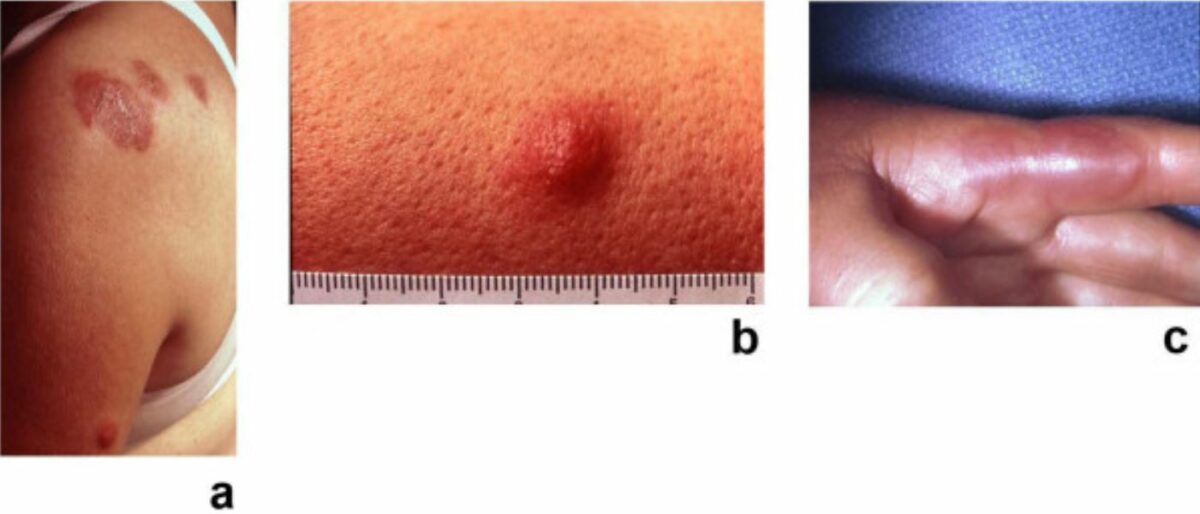
Imagen: “Necrolytic migratory erythema” por Castro, PG, et al. Licencia: CC BY 2.0

Síndrome de Sweet

  • Dermatosis neutrofílicas febriles agudas
  • Asociación con el cáncer:
    • Leucemia mieloide aguda
    • Síndrome mielodisplásico
  • Surge de una reacción de hipersensibilidad al AL Amyloidosis tumor Tumor Inflammation y antígenos → ↑ citocinas → activación e infiltración de neutrófilos
  • Se manifiesta como:
    • Pápulas o placas o nódulos sensibles e hinchados
    • Puede ser eritematoso o violáceo
  • Diagnóstico:
    • Apariencia típica
    • Histopatología que muestra infiltración neutrofílica sin vasculitis Vasculitis Inflammation of any one of the blood vessels, including the arteries; veins; and rest of the vasculature system in the body. Systemic Lupus Erythematosus leucocitoclástica
  • Tratamiento:
    • Tratamiento de malignidad
    • Prednisona
Síndrome de Sweet

Síndrome de Sweet: placas dolorosas, eritematosas, seudovasculares de dermatosis neutrofílica febril aguda
a: Placa eritematosa en el hombro izquierdo
b: Lesión nodular en el brazo
c: Placa eritematosa en un dedo
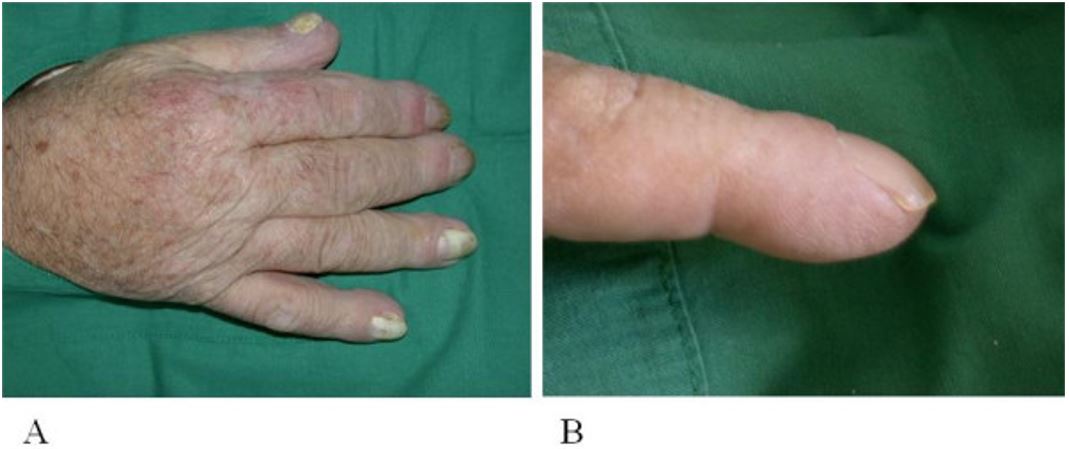
Imagen: “Sweet’s syndrome–a comprehensive review of an acute febrile neutrophilic dermatosis” por Cohen PR. Licencia: CC BY 2.0

Síndrome nefrótico

  • Nefropatía membranosa
  • Asociación con el cáncer:
    • Cáncer de pulmón
    • Cáncer de colon Colon The large intestines constitute the last portion of the digestive system. The large intestine consists of the cecum, appendix, colon (with ascending, transverse, descending, and sigmoid segments), rectum, and anal canal. The primary function of the colon is to remove water and compact the stool prior to expulsion from the body via the rectum and anal canal. Colon, Cecum, and Appendix: Anatomy
    • Cáncer de próstata
    • Cáncer de seno
  • Los LOS Neisseria antígenos, que pueden ser no renales, se identifican en EN Erythema nodosum is an immune-mediated panniculitis (inflammation of the subcutaneous fat) caused by a type IV (delayed-type) hypersensitivity reaction. It commonly manifests in young women as tender, erythematous nodules on the shins. Erythema Nodosum el depósito de inmunocomplejos.
  • Hallazgos clínicos y diagnósticos:
  • Tratamiento:
    • Tratar la malignidad subyacente
    • Deterioro progresivo de la función renal: inmunoterapia

Osteoartropatía hipertrófica

  • Asociación con el cáncer: cáncer de pulmón (comúnmente cáncer de pulmón de células no pequeñas)
  • Surge de la estimulación y liberación del factor de crecimiento endotelial vascular provocada por la vascularización anormal y la inflamación crónica:
    • ↑ Angiogénesis
    • ↑ Estimulación de osteoblastos y formación ósea
    • Edema Edema Edema is a condition in which excess serous fluid accumulates in the body cavity or interstitial space of connective tissues. Edema is a symptom observed in several medical conditions. It can be categorized into 2 types, namely, peripheral (in the extremities) and internal (in an organ or body cavity). Edema
  • Presentación:
    • Formación de hueso nuevo, particularmente en EN Erythema nodosum is an immune-mediated panniculitis (inflammation of the subcutaneous fat) caused by a type IV (delayed-type) hypersensitivity reaction. It commonly manifests in young women as tender, erythematous nodules on the shins. Erythema Nodosum los LOS Neisseria extremos distales de los LOS Neisseria huesos largos, metatarsianos, metacarpianos y falanges proximales ( dolor Dolor Inflammation a la palpación)
    • Artritis
    • Hinchazón de los LOS Neisseria dedos
  • Pruebas de diagnóstico:
    • Sin pruebas serológicas
    • Revisar radiografía de tórax para descartar cáncer de pulmón
  • Tratamiento: tratar la malignidad subyacente
Osteoartropatía hipertrófica

Osteoartropatía hipertrófica:
A: Mano derecha grande con hinchazón edematosa
B: Eritema periungueal y acropaquias

Imagen: “Hypertrophic osteoarthropathy” por Kanen BL, Loffeld RJ. Licencia: CC BY 2.0

Referencias

  1. Bauer, K. (2021). Pathogenesis of the hypercoagulable state associated with malignancy. UpToDate. Retrieved September 15, 2021, from https://www.uptodate.com/contents/pathogenesis-of-the-hypercoagulable-state-associated-with-malignancy
  2. Bauer, K. (2021). Nonbacterial thrombotic endocarditis. UpToDate. Retrieved September 16, 2021, from https://www.uptodate.com/contents/nonbacterial-thrombotic-endocarditis
  3. Dalmau, J., Rosenfeld, M.R. (2020). Overview of paraneoplastic syndromes of the nervous system. UpToDate. Retrieved September 15, 2021, from https://www.uptodate.com/contents/overview-of-paraneoplastic-syndromes-of-the-nervous-system
  4. Dalmau, J., Rosenfeld, M.R. (2021). Paraneoplastic syndromes affecting spinal cord, peripheral nerve, and muscle. UpToDate. Retrieved September 15, 2021, from https://www.uptodate.com/contents/paraneoplastic-syndromes-affecting-spinal-cord-peripheral-nerve-and-muscle 
  5. Jinna S, Khoury J. (2021). Migratory thrombophlebitis. StatPearls. https://www.ncbi.nlm.nih.gov/books/NBK547702/
  6. Krugh, M., Vaidya, P.N. (2021). Osteoarthropathy hypertrophic. StatPearls. https://www.ncbi.nlm.nih.gov/books/NBK540968/
  7. Merola, J. (2021). Sweet syndrome (acute febrile neutrophilic dermatoses): pathogenesis, clinical manifestations and diagnosis. UpToDate. Retrieved September 16, 2021, from https://www.uptodate.com/contents/sweet-syndrome-acute-febrile-neutrophilic-dermatosis-pathogenesis-clinical-manifestations-and-diagnosis
  8. Ofori, E., Ramai, D., Ona, M., Reddy, M. (2017). Paraneoplastic dermatomyositis syndrome presenting as dysphagia. Gastroenterology Research 10:251–254. https://doi.org/10.14740/gr841w
  9. Owen, C. (2021). Cutaneous manifestations of internal malignancy. UpToDate. Retrieved September 16, 2021, from https://www.uptodate.com/contents/cutaneous-manifestations-of-internal-malignancy
  10. Pelosof, L. C., Gerber, D. E. (2010). Paraneoplastic syndromes: an approach to diagnosis and treatment. Mayo Clinic Proceedings 85:838–854. https://doi.org/10.4065/mcp.2010.0099
  11. Rees, J.H. (2004). Paraneoplastic syndromes: when to suspect, how to confirm, and how to manage. Journal of Neurology. Neurosurgery & Psychiatry 75:2. https://doi.org/10.1136/jnnp.2004.040378
  12. Tefferi, A. (2021). Diagnostic approach to the patient with polycythemia. UpToDate. Retrieved September 16, 2021, from https://www.uptodate.com/contents/diagnostic-approach-to-the-patient-with-polycythemia
  13. Thapa, B., Ramphul, K. (2021). Paraneoplastic syndromes. StatPearls. https://www.ncbi.nlm.nih.gov/books/NBK507890/
  14. Vella, A. (2021). Nonislet cell tumor hypoglycemia. UpToDate. Retrieved September 16, 2021, from https://www.uptodate.com/contents/nonislet-cell-tumor-hypoglycemia

¡Crea tu cuenta gratis o inicia una sesión para seguir leyendo!

Regístrate ahora y obtén acceso gratuito a Lecturio con páginas de concepto, videos médicos y cuestionarios para tu educación médica.

User Reviews

Que tengas una sesión de estudio alegre y navideña 🎁 Ahorra 50% en todos los planes >>

Details