Domina Conceptos Médicos

Estudia para la escuela de medicina y tus examenes con Lecturio.

Síndrome Nefrótico

El síndrome nefrótico se caracteriza por proteinuria Proteinuria The presence of proteins in the urine, an indicator of kidney diseases. Nephrotic Syndrome in Children grave, hipoalbuminemia y edema Edema Edema is a condition in which excess serous fluid accumulates in the body cavity or interstitial space of connective tissues. Edema is a symptom observed in several medical conditions. It can be categorized into 2 types, namely, peripheral (in the extremities) and internal (in an organ or body cavity). Edema periférico. Por el contrario, los LOS Neisseria síndromes nefríticos se presentan con hematuria Hematuria Presence of blood in the urine. Renal Cell Carcinoma, pérdida variable Variable Variables represent information about something that can change. The design of the measurement scales, or of the methods for obtaining information, will determine the data gathered and the characteristics of that data. As a result, a variable can be qualitative or quantitative, and may be further classified into subgroups. Types of Variables de función renal e hipertensión, aunque a veces hay superposición de > 1 enfermedad glomerular en EN Erythema nodosum is an immune-mediated panniculitis (inflammation of the subcutaneous fat) caused by a type IV (delayed-type) hypersensitivity reaction. It commonly manifests in young women as tender, erythematous nodules on the shins. Erythema Nodosum el mismo individuo. Las etiologías principales del síndrome nefrótico son la enfermedad por cambios mínimos, la nefropatía membranosa y la glomeruloesclerosis focal y segmentaria. La presentación clínica del síndrome nefrótico incluye proteinuria Proteinuria The presence of proteins in the urine, an indicator of kidney diseases. Nephrotic Syndrome in Children (> 3,5 g/día), hipoalbuminemia (< 3 g/dL) y edema Edema Edema is a condition in which excess serous fluid accumulates in the body cavity or interstitial space of connective tissues. Edema is a symptom observed in several medical conditions. It can be categorized into 2 types, namely, peripheral (in the extremities) and internal (in an organ or body cavity). Edema periférico. Otros hallazgos clínicos que se observan con frecuencia son hiperlipidemia y enfermedad trombótica. Los LOS Neisseria hallazgos clínicos sugieren el diagnóstico y en EN Erythema nodosum is an immune-mediated panniculitis (inflammation of the subcutaneous fat) caused by a type IV (delayed-type) hypersensitivity reaction. It commonly manifests in young women as tender, erythematous nodules on the shins. Erythema Nodosum la mayoría de los LOS Neisseria casos es necesaria una biopsia renal. El tratamiento varía con la etiología y por lo general incluye glucocorticoides u otros medicamentos inmunosupresores.

Last updated: Dec 15, 2025

Editorial responsibility: Stanley Oiseth, Lindsay Jones, Evelin Maza

Descripción General

Definición

El síndrome nefrótico se caracteriza por proteinuria Proteinuria The presence of proteins in the urine, an indicator of kidney diseases. Nephrotic Syndrome in Children intensa (> 3,5 g/día), albúmina sérica baja (< 3 g/dL) y edema Edema Edema is a condition in which excess serous fluid accumulates in the body cavity or interstitial space of connective tissues. Edema is a symptom observed in several medical conditions. It can be categorized into 2 types, namely, peripheral (in the extremities) and internal (in an organ or body cavity). Edema periférico.

Epidemiología

  • Incidencia en EN Erythema nodosum is an immune-mediated panniculitis (inflammation of the subcutaneous fat) caused by a type IV (delayed-type) hypersensitivity reaction. It commonly manifests in young women as tender, erythematous nodules on the shins. Erythema Nodosum niños: 2–7 casos por cada 100 000 habitantes
  • Incidencia en EN Erythema nodosum is an immune-mediated panniculitis (inflammation of the subcutaneous fat) caused by a type IV (delayed-type) hypersensitivity reaction. It commonly manifests in young women as tender, erythematous nodules on the shins. Erythema Nodosum adultos: aproximadamente 3 casos por cada 100 000 habitantes; varía según la causa subyacente (e.g., diabetes Diabetes Diabetes mellitus (DM) is a metabolic disease characterized by hyperglycemia and dysfunction of the regulation of glucose metabolism by insulin. Type 1 DM is diagnosed mostly in children and young adults as the result of autoimmune destruction of β cells in the pancreas and the resulting lack of insulin. Type 2 DM has a significant association with obesity and is characterized by insulin resistance. Diabetes Mellitus)

Etiologías primarias (“podocitopatías inmunes”)

  • Enfermedad de cambios mínimos:
    • Causa más común de síndrome nefrótico en EN Erythema nodosum is an immune-mediated panniculitis (inflammation of the subcutaneous fat) caused by a type IV (delayed-type) hypersensitivity reaction. It commonly manifests in young women as tender, erythematous nodules on the shins. Erythema Nodosum niños (aproximadamente 90%)
    • Aproximadamente entre el 10%–15% de los LOS Neisseria casos de síndrome nefrótico en EN Erythema nodosum is an immune-mediated panniculitis (inflammation of the subcutaneous fat) caused by a type IV (delayed-type) hypersensitivity reaction. It commonly manifests in young women as tender, erythematous nodules on the shins. Erythema Nodosum adultos
  • Nefropatía membranosa:
    • 2da causa primaria más común de síndrome nefrótico
    • Encontrada en EN Erythema nodosum is an immune-mediated panniculitis (inflammation of the subcutaneous fat) caused by a type IV (delayed-type) hypersensitivity reaction. It commonly manifests in young women as tender, erythematous nodules on the shins. Erythema Nodosum aproximadamente ⅓ de las biopsias para el síndrome nefrótico
    • Más común en EN Erythema nodosum is an immune-mediated panniculitis (inflammation of the subcutaneous fat) caused by a type IV (delayed-type) hypersensitivity reaction. It commonly manifests in young women as tender, erythematous nodules on the shins. Erythema Nodosum hombres caucásicos > 40 años
  • Glomeruloesclerosis focal y segmentaria:
    • Causa más común de síndrome nefrótico primario en EN Erythema nodosum is an immune-mediated panniculitis (inflammation of the subcutaneous fat) caused by a type IV (delayed-type) hypersensitivity reaction. It commonly manifests in young women as tender, erythematous nodules on the shins. Erythema Nodosum adultos (aproximadamente 35%)
    • 2da causa más común de síndrome nefrótico en EN Erythema nodosum is an immune-mediated panniculitis (inflammation of the subcutaneous fat) caused by a type IV (delayed-type) hypersensitivity reaction. It commonly manifests in young women as tender, erythematous nodules on the shins. Erythema Nodosum niños
    • Más común en EN Erythema nodosum is an immune-mediated panniculitis (inflammation of the subcutaneous fat) caused by a type IV (delayed-type) hypersensitivity reaction. It commonly manifests in young women as tender, erythematous nodules on the shins. Erythema Nodosum personas de ascendencia africana ( genes Genes A category of nucleic acid sequences that function as units of heredity and which code for the basic instructions for the development, reproduction, and maintenance of organisms. DNA Types and Structure relacionados: APOL1, MYH9)

Etiologías secundarias

  • Causas metabólicas:
    • Diabetes Diabetes Diabetes mellitus (DM) is a metabolic disease characterized by hyperglycemia and dysfunction of the regulation of glucose metabolism by insulin. Type 1 DM is diagnosed mostly in children and young adults as the result of autoimmune destruction of β cells in the pancreas and the resulting lack of insulin. Type 2 DM has a significant association with obesity and is characterized by insulin resistance. Diabetes Mellitus mellitus
    • Amiloidosis
  • Causas inmunológicas:
    • Poliangeitis microscópica
    • Enfermedad del suero
    • Síndrome de Sjögren
    • Superposición con síndrome nefrítico:
      • Crioglobulinemia
      • Vasculitis Vasculitis Inflammation of any one of the blood vessels, including the arteries; veins; and rest of the vasculature system in the body. Systemic Lupus Erythematosus asociada a IgA IgA Represents 15-20% of the human serum immunoglobulins, mostly as the 4-chain polymer in humans or dimer in other mammals. Secretory iga is the main immunoglobulin in secretions. Immunoglobulins: Types and Functions
      • Lupus eritematoso sistémico
  • Idiopática: sarcoidosis Sarcoidosis Sarcoidosis is a multisystem inflammatory disease that causes noncaseating granulomas. The exact etiology is unknown. Sarcoidosis usually affects the lungs and thoracic lymph nodes, but it can also affect almost every system in the body, including the skin, heart, and eyes, most commonly. Sarcoidosis
  • Neoplásica:
    • Leucemia
    • Linfomas
    • Melanoma Melanoma Melanoma is a malignant tumor arising from melanocytes, the melanin-producing cells of the epidermis. These tumors are most common in fair-skinned individuals with a history of excessive sun exposure and sunburns. Melanoma
    • Mieloma múltiple
  • Relacionado con drogas:
    • Heroína
    • Interferón alfa
    • Litio
    • AINE
    • Pamidronato
  • Causas infecciosas:
    • Lepra
    • Sífilis
    • Infecciones por helmintos
    • Malaria Malaria Malaria is an infectious parasitic disease affecting humans and other animals. Most commonly transmitted via the bite of a female Anopheles mosquito infected with microorganisms of the Plasmodium genus. Patients present with fever, chills, myalgia, headache, and diaphoresis. Plasmodium/Malaria
    • Esquistosomiasis por S. haematobium S. haematobium A species of trematode blood flukes of the family schistosomatidae which occurs at different stages in development in veins of the pulmonary and hepatic system and finally the bladder lumen. This parasite causes urinary schistosomiasis. Schistosoma/Schistosomiasis
    • EBV EBV Epstein-barr virus (EBV) is a linear, double-stranded DNA virus belonging to the herpesviridae family. This highly prevalent virus is mostly transmitted through contact with oropharyngeal secretions from an infected individual. The virus can infect epithelial cells and B lymphocytes, where it can undergo lytic replication or latency. Epstein-Barr Virus ( Virus Virus Viruses are infectious, obligate intracellular parasites composed of a nucleic acid core surrounded by a protein capsid. Viruses can be either naked (non-enveloped) or enveloped. The classification of viruses is complex and based on many factors, including type and structure of the nucleoid and capsid, the presence of an envelope, the replication cycle, and the host range. Virology del Ebstein-Barr, por sus siglas en EN Erythema nodosum is an immune-mediated panniculitis (inflammation of the subcutaneous fat) caused by a type IV (delayed-type) hypersensitivity reaction. It commonly manifests in young women as tender, erythematous nodules on the shins. Erythema Nodosum inglés)
    • Hepatitis B Hepatitis B Hepatitis B virus (HBV) is a partially double-stranded DNA virus, which belongs to the Orthohepadnavirus genus and the Hepadnaviridae family. Most individuals with acute HBV infection are asymptomatic or have mild, self-limiting symptoms. Chronic infection can be asymptomatic or create hepatic inflammation, leading to liver cirrhosis and hepatocellular carcinoma (HCC). Hepatitis B Virus y C
    • VIH
  • Síndromes genéticos:
    • Enfermedad de Fabry
    • Enfermedad de células falciformes
    • Síndrome de Alport (aunque con mayor frecuencia presentación nefrítica)
    • Síndromes nefróticos congénitos raros

Fisiopatología

El principal lugar de la lesión en EN Erythema nodosum is an immune-mediated panniculitis (inflammation of the subcutaneous fat) caused by a type IV (delayed-type) hypersensitivity reaction. It commonly manifests in young women as tender, erythematous nodules on the shins. Erythema Nodosum las enfermedades que causan el síndrome nefrótico primario es el podocito. El aumento de la filtración a través de la pared capilar glomerular produce proteinuria Proteinuria The presence of proteins in the urine, an indicator of kidney diseases. Nephrotic Syndrome in Children.
Anatomía y fisiología de la nefrona

  • Barrera glomerular: estructura de filtración de la nefrona que rodea los LOS Neisseria capilares glomerulares e incluye las siguientes 3 capas:
    • Endotelio capilar: paredes de los LOS Neisseria vasos capilares
    • Membrana basal glomerular: formada por las láminas basales del endotelio capilar y del podocito
    • Epitelio (podocitos): unido a la membrana basal glomerular con múltiples procesos podocitarios
      • Los LOS Neisseria procesos podocitarios se interdigitan y forman una red que cubre los LOS Neisseria capilares glomerulares.
      • Las proteínas de los LOS Neisseria procesos podocitarios adyacentes se interdigitan aún más y forman el diafragma de hendidura.
      • El diafragma de la hendidura permite una filtración selectiva por tamaño y carga.
  • Los LOS Neisseria podocitos en EN Erythema nodosum is an immune-mediated panniculitis (inflammation of the subcutaneous fat) caused by a type IV (delayed-type) hypersensitivity reaction. It commonly manifests in young women as tender, erythematous nodules on the shins. Erythema Nodosum el epitelio son el principal tipo de células afectadas en EN Erythema nodosum is an immune-mediated panniculitis (inflammation of the subcutaneous fat) caused by a type IV (delayed-type) hypersensitivity reaction. It commonly manifests in young women as tender, erythematous nodules on the shins. Erythema Nodosum el síndrome nefrótico.
  • El síndrome nefrítico afecta principalmente al AL Amyloidosis endotelio capilar y la membrana basal glomerular.
Barrera glomerular

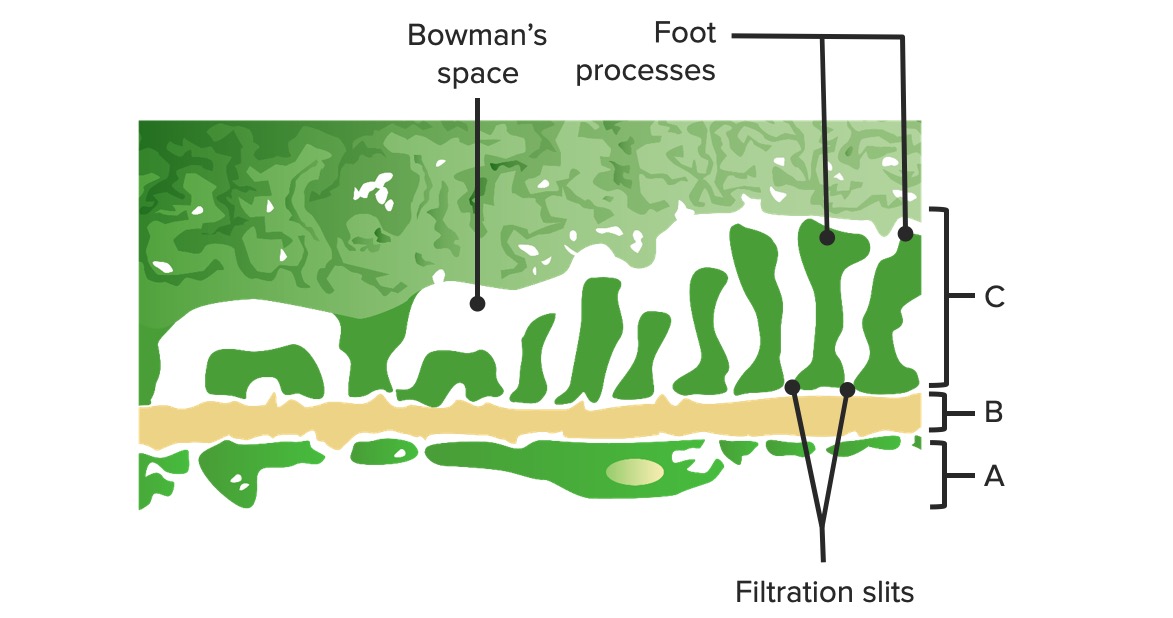
Diagrama de la barrera glomerular:
A: Endotelio fenestrado de los capilares glomerulares
B: Membrana basal
C: Capa epitelial que muestra los procesos podocitarios de los podocitos y las proteínas estructurales que crean el diafragma de hendidura

Imagen por Lecturio.

Fisiopatología

  • El mal funcionamiento de los LOS Neisseria podocitos se debe a:
    • Lesión mediada por complejos inmunes (e.g., nefropatía membranosa y glomeruloesclerosis focal y segmentaria)
    • Mutación genética de las proteínas del diafragma de hendidura (e.g., síndrome nefrótico congénito)
    • Respuesta a la hiperfiltración/hipertensión capilar glomerular
  • Da como resultado la pérdida de varias proteínas en EN Erythema nodosum is an immune-mediated panniculitis (inflammation of the subcutaneous fat) caused by a type IV (delayed-type) hypersensitivity reaction. It commonly manifests in young women as tender, erythematous nodules on the shins. Erythema Nodosum la orina:
    • Albúmina → hipoalbuminemia
    • Factores de coagulación → predisposición al AL Amyloidosis tromboembolismo
    • La pérdida de otras proteínas (transferrina, proteína de unión a vitamina D) generalmente no causa efectos clínicos significativos.
  • Edema Edema Edema is a condition in which excess serous fluid accumulates in the body cavity or interstitial space of connective tissues. Edema is a symptom observed in several medical conditions. It can be categorized into 2 types, namely, peripheral (in the extremities) and internal (in an organ or body cavity). Edema:
    • Albúmina sérica baja → presión oncótica plasmática baja → el líquido se desplaza del volumen plasmático al AL Amyloidosis espacio intersticial → volumen circulante efectivo bajo → estimula el sistema renina-angiotensina-aldosterona → retención de Na+ → retención de agua
    • Retención de Na+ y agua + estimulación simpática + liberación reducida de péptido natriurético → edema Edema Edema is a condition in which excess serous fluid accumulates in the body cavity or interstitial space of connective tissues. Edema is a symptom observed in several medical conditions. It can be categorized into 2 types, namely, peripheral (in the extremities) and internal (in an organ or body cavity). Edema con fóvea
    • Disminución de la presión oncótica → síntesis de lipoproteínas hepáticas → hiperlipidemia

Presentaciones Clínicas

Es más probable que las etiologías primarias se presenten con los LOS Neisseria hallazgos clásicos del síndrome nefrótico ( proteinuria Proteinuria The presence of proteins in the urine, an indicator of kidney diseases. Nephrotic Syndrome in Children, edema Edema Edema is a condition in which excess serous fluid accumulates in the body cavity or interstitial space of connective tissues. Edema is a symptom observed in several medical conditions. It can be categorized into 2 types, namely, peripheral (in the extremities) and internal (in an organ or body cavity). Edema, hipoalbuminemia), mientras que las causas secundarias tienen más probabilidades de presentarse solo con proteinuria Proteinuria The presence of proteins in the urine, an indicator of kidney diseases. Nephrotic Syndrome in Children en EN Erythema nodosum is an immune-mediated panniculitis (inflammation of the subcutaneous fat) caused by a type IV (delayed-type) hypersensitivity reaction. It commonly manifests in young women as tender, erythematous nodules on the shins. Erythema Nodosum rango nefrótico. El diagnóstico se establece mediante la historia clínica y la presentación, el grado de proteinuria Proteinuria The presence of proteins in the urine, an indicator of kidney diseases. Nephrotic Syndrome in Children y los LOS Neisseria hallazgos de la biopsia.
Común en EN Erythema nodosum is an immune-mediated panniculitis (inflammation of the subcutaneous fat) caused by a type IV (delayed-type) hypersensitivity reaction. It commonly manifests in young women as tender, erythematous nodules on the shins. Erythema Nodosum todas las etiologías

  • Presentación clínica clásica del síndrome nefrótico:
    • > 3,5 g/día de proteinuria Proteinuria The presence of proteins in the urine, an indicator of kidney diseases. Nephrotic Syndrome in Children
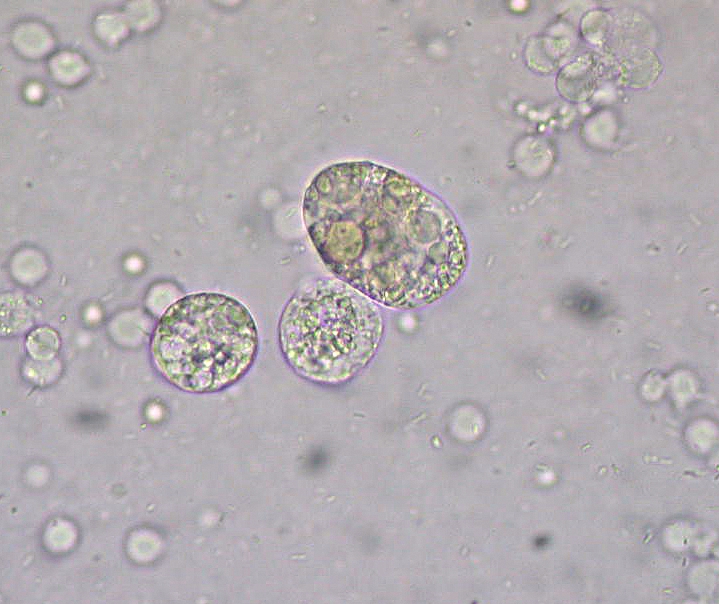
    • La microscopía de orina puede mostrar signos de lipiduria:
      • “Cuerpos grasos ovalados” o cilindros grasos en EN Erythema nodosum is an immune-mediated panniculitis (inflammation of the subcutaneous fat) caused by a type IV (delayed-type) hypersensitivity reaction. It commonly manifests in young women as tender, erythematous nodules on the shins. Erythema Nodosum el microscopio óptico
      • “Cruz de Malta” en EN Erythema nodosum is an immune-mediated panniculitis (inflammation of the subcutaneous fat) caused by a type IV (delayed-type) hypersensitivity reaction. It commonly manifests in young women as tender, erythematous nodules on the shins. Erythema Nodosum microscopía de luz polarizada
    • Edema Edema Edema is a condition in which excess serous fluid accumulates in the body cavity or interstitial space of connective tissues. Edema is a symptom observed in several medical conditions. It can be categorized into 2 types, namely, peripheral (in the extremities) and internal (in an organ or body cavity). Edema periférico/periorbitario
    • Hipoalbuminemia
    • Hiperlipidemia
    • La creatinina sérica suele estar normal.
  • Diagnóstico:
    • Es menos probable que las etiologías secundarias se presenten con edema Edema Edema is a condition in which excess serous fluid accumulates in the body cavity or interstitial space of connective tissues. Edema is a symptom observed in several medical conditions. It can be categorized into 2 types, namely, peripheral (in the extremities) and internal (in an organ or body cavity). Edema periférico/periorbitario, hipoalbuminemia e hiperlipidemia.
    • La proteinuria Proteinuria The presence of proteins in the urine, an indicator of kidney diseases. Nephrotic Syndrome in Children en EN Erythema nodosum is an immune-mediated panniculitis (inflammation of the subcutaneous fat) caused by a type IV (delayed-type) hypersensitivity reaction. It commonly manifests in young women as tender, erythematous nodules on the shins. Erythema Nodosum rango nefrótico (> 3,5 g/día) puede verse sin un diagnóstico de síndrome nefrótico verdadero; esta distinción es clínicamente importante.
    • La proteinuria Proteinuria The presence of proteins in the urine, an indicator of kidney diseases. Nephrotic Syndrome in Children sola no se trata con inmunosupresión.
Cuerpos grasos ovalados en microscopía de orina

Síndrome nefrótico: cuerpos grasos ovalados en la microscopía de orina

Imagen: “Unidentified structures in urine” por Ed Uthman. Licencia: CC BY 2.0
Enfermedad de cambios mínimos

  • Presentación:
    • Inicio abrupto con más frecuencia que otras enfermedades nefróticas
    • También puede tener algunas características nefríticas ( hematuria Hematuria Presence of blood in the urine. Renal Cell Carcinoma microscópica)
    • Puede presentar insuficiencia renal aguda
    • Rara vez causa enfermedad renal en EN Erythema nodosum is an immune-mediated panniculitis (inflammation of the subcutaneous fat) caused by a type IV (delayed-type) hypersensitivity reaction. It commonly manifests in young women as tender, erythematous nodules on the shins. Erythema Nodosum etapa terminal
  • Etiologías:
    • Primaria: idiopática
    • Secundaria:
      • Medicamentos: AINE (causa secundaria más común), ciertos antibióticos
      • Malignidad: leucemia, linfoma, timoma
  • Diagnóstico:
    • Laboratorios y hallazgos clínicos habituales
    • No siempre se necesita una biopsia, ya que el 90% de los LOS Neisseria casos responden a los LOS Neisseria esteroides en EN Erythema nodosum is an immune-mediated panniculitis (inflammation of the subcutaneous fat) caused by a type IV (delayed-type) hypersensitivity reaction. It commonly manifests in young women as tender, erythematous nodules on the shins. Erythema Nodosum 4 semanas.
    • Hallazgos en EN Erythema nodosum is an immune-mediated panniculitis (inflammation of the subcutaneous fat) caused by a type IV (delayed-type) hypersensitivity reaction. It commonly manifests in young women as tender, erythematous nodules on the shins. Erythema Nodosum la biopsia:
      • Microscopía óptica: básicamente normal (cambio mínimo)
      • Inmunofluorescencia: negativa
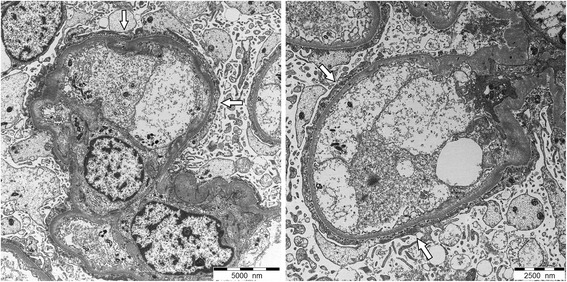
      • Microscopía electrónica: borramiento difuso de los LOS Neisseria procesos podocitarios
  • Tratamiento:
    • Esteroides en EN Erythema nodosum is an immune-mediated panniculitis (inflammation of the subcutaneous fat) caused by a type IV (delayed-type) hypersensitivity reaction. It commonly manifests in young women as tender, erythematous nodules on the shins. Erythema Nodosum dosis altas con una disminución prolongada durante varios meses.
    • Muchos no necesitan IECA o estatinas (a diferencia de otras enfermedades nefróticas).
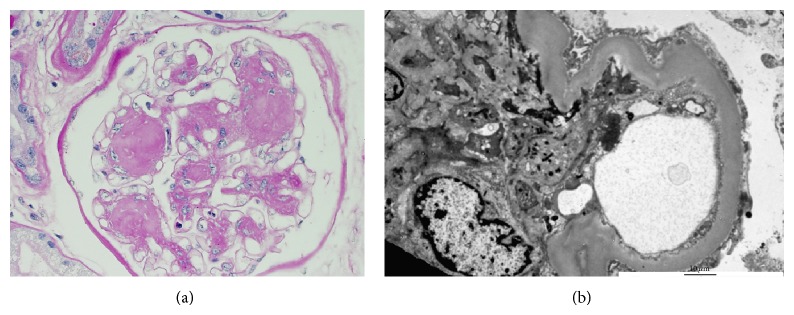
Microscopía electrónica de un glomérulo visto en un paciente con enfermedad de cambios mínimos

Microscopía electrónica que muestra asas capilares glomerulares con hallazgos de enfermedad de cambios mínimos:
Podocitos con borramiento extenso y difuso de los procesos podocitarios (flechas blancas) y transformación de microvellosidades
Sin depósitos electro-densos
Espesor normal de la membrana basal glomerular.
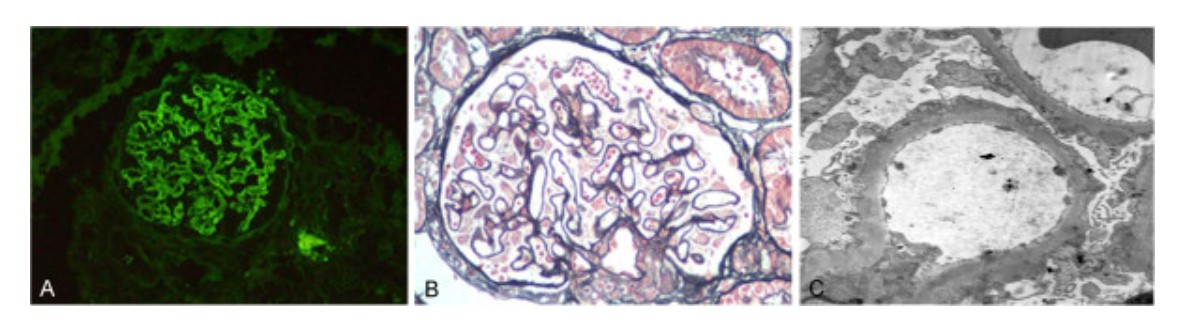
Imagen: “Pembrolizumab-associated minimal change disease in a patient with malignant pleural mesothelioma” por BMC Cancer. Licencia: CC BY 4.0

Nefropatía membranosa

  • Presentación:
    • Primaria: síndrome nefrótico clásico
      • Proteinuria Proteinuria The presence of proteins in the urine, an indicator of kidney diseases. Nephrotic Syndrome in Children
      • Hipoalbuminemia
      • Edema Edema Edema is a condition in which excess serous fluid accumulates in the body cavity or interstitial space of connective tissues. Edema is a symptom observed in several medical conditions. It can be categorized into 2 types, namely, peripheral (in the extremities) and internal (in an organ or body cavity). Edema
    • Secundaria:
      • Inicio lento de proteinuria Proteinuria The presence of proteins in the urine, an indicator of kidney diseases. Nephrotic Syndrome in Children en EN Erythema nodosum is an immune-mediated panniculitis (inflammation of the subcutaneous fat) caused by a type IV (delayed-type) hypersensitivity reaction. It commonly manifests in young women as tender, erythematous nodules on the shins. Erythema Nodosum rango nefrótico
      • Es menos probable que tenga los LOS Neisseria síntomas clásicos del síndrome nefrótico.
  • Etiologías:
    • Proceso autoinmune primario (70% de los LOS Neisseria casos):
      • La IgG IgG The major immunoglobulin isotype class in normal human serum. There are several isotype subclasses of igg, for example, igg1, igg2a, and igg2b. Hypersensitivity Pneumonitis ataca al AL Amyloidosis receptor Receptor Receptors are proteins located either on the surface of or within a cell that can bind to signaling molecules known as ligands (e.g., hormones) and cause some type of response within the cell. Receptors de fosfolipasa A2 de tipo M (PLA2R).
      • Formación de complejos inmunes → activación del complemento → lesión de podocitos
      • El anti-PLA2R sérico se puede medir para el diagnóstico; es posible que no se necesite una biopsia.
    • Secundaria (30% de los LOS Neisseria casos):
      • Infección ( hepatitis B Hepatitis B Hepatitis B virus (HBV) is a partially double-stranded DNA virus, which belongs to the Orthohepadnavirus genus and the Hepadnaviridae family. Most individuals with acute HBV infection are asymptomatic or have mild, self-limiting symptoms. Chronic infection can be asymptomatic or create hepatic inflammation, leading to liver cirrhosis and hepatocellular carcinoma (HCC). Hepatitis B Virus, hepatitis C Hepatitis C Hepatitis C is an infection of the liver caused by the hepatitis C virus (HCV). The infection can be transmitted through infectious blood or body fluids and may be transmitted during childbirth or through IV drug use or sexual intercourse. Hepatitis C virus can cause both acute and chronic hepatitis, ranging from a mild to a serious, lifelong illness including liver cirrhosis and hepatocellular carcinoma (HCC). Hepatitis C Virus, sífilis)
      • Malignidad (pulmón, mama, gastrointestinal) en EN Erythema nodosum is an immune-mediated panniculitis (inflammation of the subcutaneous fat) caused by a type IV (delayed-type) hypersensitivity reaction. It commonly manifests in young women as tender, erythematous nodules on the shins. Erythema Nodosum aproximadamente el 10%
      • Medicamentos (AINE, oro, penicilamina, inhibidores del factor de necrosis Necrosis The death of cells in an organ or tissue due to disease, injury or failure of the blood supply. Ischemic Cell Damage tumoral)
      • Autoinmune (lupus en EN Erythema nodosum is an immune-mediated panniculitis (inflammation of the subcutaneous fat) caused by a type IV (delayed-type) hypersensitivity reaction. It commonly manifests in young women as tender, erythematous nodules on the shins. Erythema Nodosum mujeres jóvenes)
  • Diagnóstico:
    • Características clínicas del síndrome nefrótico ( edema Edema Edema is a condition in which excess serous fluid accumulates in the body cavity or interstitial space of connective tissues. Edema is a symptom observed in several medical conditions. It can be categorized into 2 types, namely, peripheral (in the extremities) and internal (in an organ or body cavity). Edema, hipoalbuminemia)
    • Laboratorios:
      • Proteinuria Proteinuria The presence of proteins in the urine, an indicator of kidney diseases. Nephrotic Syndrome in Children de alto grado: relación proteína/creatinina en EN Erythema nodosum is an immune-mediated panniculitis (inflammation of the subcutaneous fat) caused by a type IV (delayed-type) hypersensitivity reaction. It commonly manifests in young women as tender, erythematous nodules on the shins. Erythema Nodosum orina >2
      • Análisis de orina: sin hematuria Hematuria Presence of blood in the urine. Renal Cell Carcinoma
      • Tasa de filtración glomerular: bien conservada
    • Hallazgos de la biopsia:
      • Microscopía óptica: patrón de púas y cúpula en EN Erythema nodosum is an immune-mediated panniculitis (inflammation of the subcutaneous fat) caused by a type IV (delayed-type) hypersensitivity reaction. It commonly manifests in young women as tender, erythematous nodules on the shins. Erythema Nodosum tinción de plata
      • Inmunofluorescencia: IgG IgG The major immunoglobulin isotype class in normal human serum. There are several isotype subclasses of igg, for example, igg1, igg2a, and igg2b. Hypersensitivity Pneumonitis, variable Variable Variables represent information about something that can change. The design of the measurement scales, or of the methods for obtaining information, will determine the data gathered and the characteristics of that data. As a result, a variable can be qualitative or quantitative, and may be further classified into subgroups. Types of Variables C3
      • Microscopía electrónica: depósitos subepiteliales y borramiento difuso de los LOS Neisseria procesos podocitarios
  • Tratamiento:
    • Todos los LOS Neisseria casos:
      • IECA
      • Diurético de asa ASA Anterior Cord Syndrome
      • Restricción dietética de Na+
      • Estatinas para la hiperlipidemia (si no mejora con el tratamiento de la enfermedad)
    • Personas de alto riesgo:
      • Tratar con inmunosupresión
      • Ciclofosfamida o ciclosporina + prednisona
      • Rituximab Rituximab A murine-derived monoclonal antibody and antineoplastic agent that binds specifically to the cd20 antigen and is used in the treatment of leukemia; lymphoma and rheumatoid arthritis. Immunosuppressants (anticuerpo monoclonal contra CD20)
      • El tratamiento puede ser monitorizado midiendo niveles séricos de anti-PLA2R
  • Pronóstico:
    • Aproximadamente el 66% tendrá al AL Amyloidosis menos una remisión espontánea parcial (< 2 g/día de proteinuria Proteinuria The presence of proteins in the urine, an indicator of kidney diseases. Nephrotic Syndrome in Children) a los LOS Neisseria 5 años.
    • Buen pronóstico en EN Erythema nodosum is an immune-mediated panniculitis (inflammation of the subcutaneous fat) caused by a type IV (delayed-type) hypersensitivity reaction. It commonly manifests in young women as tender, erythematous nodules on the shins. Erythema Nodosum general si responde a la terapia inmunosupresora
    • Pueden ocurrir recaídas.
    • Es posible la progresión a enfermedad renal en EN Erythema nodosum is an immune-mediated panniculitis (inflammation of the subcutaneous fat) caused by a type IV (delayed-type) hypersensitivity reaction. It commonly manifests in young women as tender, erythematous nodules on the shins. Erythema Nodosum etapa terminal; considerar trasplante.
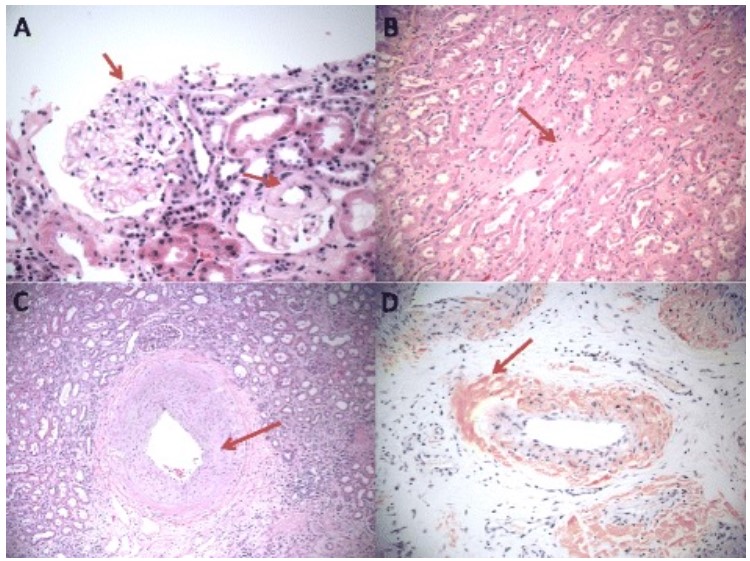
Individuo con nefropatía membranosa y nefropatía diabética

Individuo con nefropatía membranosa y nefropatía diabética:
A: Los depósitos de IgG en la membrana basal aparecen como un patrón granular difuso como se muestra en la inmunofluorescencia (200x).
B: El microscopio óptico muestra glomerulonefritis membranosa con asas capilares engrosadas y prominentes. Se localizaron numerosos depósitos granulares densos en áreas subepiteliales (tinción de ácido peryódico-Schiff (PAS), 200x).
C: Micrografía electrónica de la membrana basal glomerular engrosada con numerosos depósitos granulares densos localizados en áreas subepiteliales (5 000x).

Imagen: “A case with membranous nephropathy (MN) and diabetic nephropathy (DN)” por Zhuo L., et al. Licencia: CC BY 2.0

Glomeruloesclerosis focal y segmentaria

  • La glomeruloesclerosis focal y segmentaria es una lesión histológica que se encuentra comúnmente en EN Erythema nodosum is an immune-mediated panniculitis (inflammation of the subcutaneous fat) caused by a type IV (delayed-type) hypersensitivity reaction. It commonly manifests in young women as tender, erythematous nodules on the shins. Erythema Nodosum individuos con síndrome nefrótico más que una enfermedad específica.
  • Etiologías:
    • Primaria (idiopática): se presenta con síndrome nefrótico clásico
    • Secundaria: a menudo se presenta con proteinuria Proteinuria The presence of proteins in the urine, an indicator of kidney diseases. Nephrotic Syndrome in Children de rango no nefrótico debido a:
      • Disminución de la masa de nefronas en EN Erythema nodosum is an immune-mediated panniculitis (inflammation of the subcutaneous fat) caused by a type IV (delayed-type) hypersensitivity reaction. It commonly manifests in young women as tender, erythematous nodules on the shins. Erythema Nodosum un riñón único
      • Lesión renal recurrente debido a nefropatía por reflujo o enfermedad de células falciformes
      • Enfermedad renal crónica progresiva de cualquier etiología
      • Causa viral más importante: VIH
      • Drogas: pamidronato, interferón, heroína
    • Causas genéticas: puede presentarse a cualquier edad.
  • Los LOS Neisseria hallazgos de la biopsia en EN Erythema nodosum is an immune-mediated panniculitis (inflammation of the subcutaneous fat) caused by a type IV (delayed-type) hypersensitivity reaction. It commonly manifests in young women as tender, erythematous nodules on the shins. Erythema Nodosum glomeruloesclerosis focal y segmentaria deben llevar a una evaluación para determinar la causa subyacente:
    • Microscopía óptica: esclerosis segmentaria
    • Inmunofluorescencia: inespecífica
    • Microscopía electrónica: borramiento de los LOS Neisseria procesos podocitarios localizados en EN Erythema nodosum is an immune-mediated panniculitis (inflammation of the subcutaneous fat) caused by a type IV (delayed-type) hypersensitivity reaction. It commonly manifests in young women as tender, erythematous nodules on the shins. Erythema Nodosum regiones de esclerosis segmentaria
  • Tratamiento:
    • Primaria:
      • Medidas generales (IECA, estatinas, diurético de asa ASA Anterior Cord Syndrome, dieta baja en EN Erythema nodosum is an immune-mediated panniculitis (inflammation of the subcutaneous fat) caused by a type IV (delayed-type) hypersensitivity reaction. It commonly manifests in young women as tender, erythematous nodules on the shins. Erythema Nodosum Na+)
      • Esteroide a dosis altas con una disminución gradual
      • Dependiente de esteroides con recaídas → ciclofosfamida
      • Resistente a esteroides → ciclosporina + prednisona o micofenolato de mofetilo
      • Resistente a todas las terapias, sugiere glomeruloesclerosis focal y segmentaria genética mal diagnosticada → trasplante
    • Secundaria y genética:
      • Medidas generales (IECA, estatinas, diurético de asa ASA Anterior Cord Syndrome, dieta baja en EN Erythema nodosum is an immune-mediated panniculitis (inflammation of the subcutaneous fat) caused by a type IV (delayed-type) hypersensitivity reaction. It commonly manifests in young women as tender, erythematous nodules on the shins. Erythema Nodosum Na+)
      • Tratar la enfermedad subyacente
      • Detener la administración del medicamento causante, si se identifica
      • Pérdida de peso
  • Pronóstico:
    • Primaria: progresará a enfermedad renal en EN Erythema nodosum is an immune-mediated panniculitis (inflammation of the subcutaneous fat) caused by a type IV (delayed-type) hypersensitivity reaction. It commonly manifests in young women as tender, erythematous nodules on the shins. Erythema Nodosum etapa terminal si no se trata
    • Secundaria: función renal estable o remisión espontánea es posible
    • “Glomeruloesclerosis focal y segmentaria en EN Erythema nodosum is an immune-mediated panniculitis (inflammation of the subcutaneous fat) caused by a type IV (delayed-type) hypersensitivity reaction. It commonly manifests in young women as tender, erythematous nodules on the shins. Erythema Nodosum colapso”: la progresión rápida a la enfermedad renal en EN Erythema nodosum is an immune-mediated panniculitis (inflammation of the subcutaneous fat) caused by a type IV (delayed-type) hypersensitivity reaction. It commonly manifests in young women as tender, erythematous nodules on the shins. Erythema Nodosum etapa terminal es común.
      • Variante histológica específica con el peor pronóstico
      • Lesión más grave en EN Erythema nodosum is an immune-mediated panniculitis (inflammation of the subcutaneous fat) caused by a type IV (delayed-type) hypersensitivity reaction. It commonly manifests in young women as tender, erythematous nodules on the shins. Erythema Nodosum la biopsia → el tratamiento suele ser ineficaz
      • Asociado con el VIH

Causas secundarias específicas del síndrome nefrótico

Es menos probable que las siguientes etiologías se presenten con el síndrome nefrótico clásico, pero aún se pueden encontrar en EN Erythema nodosum is an immune-mediated panniculitis (inflammation of the subcutaneous fat) caused by a type IV (delayed-type) hypersensitivity reaction. It commonly manifests in young women as tender, erythematous nodules on the shins. Erythema Nodosum biopsias renales realizadas por proteinuria Proteinuria The presence of proteins in the urine, an indicator of kidney diseases. Nephrotic Syndrome in Children en EN Erythema nodosum is an immune-mediated panniculitis (inflammation of the subcutaneous fat) caused by a type IV (delayed-type) hypersensitivity reaction. It commonly manifests in young women as tender, erythematous nodules on the shins. Erythema Nodosum rango nefrótico.

Nefropatía diabética:

  • Causa más común de proteinuria Proteinuria The presence of proteins in the urine, an indicator of kidney diseases. Nephrotic Syndrome in Children en EN Erythema nodosum is an immune-mediated panniculitis (inflammation of the subcutaneous fat) caused by a type IV (delayed-type) hypersensitivity reaction. It commonly manifests in young women as tender, erythematous nodules on the shins. Erythema Nodosum rango nefrótico
  • Entre el 20%–30% de todas las personas con diabetes Diabetes Diabetes mellitus (DM) is a metabolic disease characterized by hyperglycemia and dysfunction of the regulation of glucose metabolism by insulin. Type 1 DM is diagnosed mostly in children and young adults as the result of autoimmune destruction of β cells in the pancreas and the resulting lack of insulin. Type 2 DM has a significant association with obesity and is characterized by insulin resistance. Diabetes Mellitus desarrollarán alguna etapa de la enfermedad renal crónica.
  • La causa general más común de enfermedad renal en EN Erythema nodosum is an immune-mediated panniculitis (inflammation of the subcutaneous fat) caused by a type IV (delayed-type) hypersensitivity reaction. It commonly manifests in young women as tender, erythematous nodules on the shins. Erythema Nodosum etapa terminal (aproximadamente el 55% de todos los LOS Neisseria individuos nuevos en EN Erythema nodosum is an immune-mediated panniculitis (inflammation of the subcutaneous fat) caused by a type IV (delayed-type) hypersensitivity reaction. It commonly manifests in young women as tender, erythematous nodules on the shins. Erythema Nodosum diálisis)
  • Presentación: progresa de microalbuminuria a proteinuria Proteinuria The presence of proteins in the urine, an indicator of kidney diseases. Nephrotic Syndrome in Children nefrótica a lo largo de muchos años
  • El diagnóstico se basa en EN Erythema nodosum is an immune-mediated panniculitis (inflammation of the subcutaneous fat) caused by a type IV (delayed-type) hypersensitivity reaction. It commonly manifests in young women as tender, erythematous nodules on the shins. Erythema Nodosum la biopsia renal si la presentación no es clásica:
    • Muestra característicamente nódulos de Kimmelstiel-Wilson
    • Puede coexistir con otras enfermedades nefróticas (como enfermedad de cambios mínimos, nefropatía membranosa y glomeruloesclerosis focal y segmentaria)
  • Tratamiento:
    • Estricto control glucémico y IECA
    • Posible trasplante

Glomerulonefritis membranoproliferativa:

  • Enfermedad nefrítica que puede superponerse con proteinuria Proteinuria The presence of proteins in the urine, an indicator of kidney diseases. Nephrotic Syndrome in Children de rango nefrótico
  • Asociado con hepatitis C Hepatitis C Hepatitis C is an infection of the liver caused by the hepatitis C virus (HCV). The infection can be transmitted through infectious blood or body fluids and may be transmitted during childbirth or through IV drug use or sexual intercourse. Hepatitis C virus can cause both acute and chronic hepatitis, ranging from a mild to a serious, lifelong illness including liver cirrhosis and hepatocellular carcinoma (HCC). Hepatitis C Virus crónica, enfermedad autoinmune y disproteinemias
  • Hallazgos de la biopsia:
    • Microscopía óptica: “tram-track” (doble contorno) de la membrana basal
    • Inmunofluorescencia: varía según la etiología
    • Microscopía electrónica: depósitos subendoteliales
  • Tratamiento: esteroides + micofenolato de mofetilo
  • El pronóstico varía según la causa:
    • Idiopático: aproximadamente un 30% progresa a enfermedad renal en EN Erythema nodosum is an immune-mediated panniculitis (inflammation of the subcutaneous fat) caused by a type IV (delayed-type) hypersensitivity reaction. It commonly manifests in young women as tender, erythematous nodules on the shins. Erythema Nodosum etapa terminal dentro de 10 a 15 años
    • Infecciosa/autoinmune: buen pronóstico si se diagnostica/trata a tiempo

Amiloidosis:

  • Causa relativamente rara de síndrome nefrótico
  • Se presenta con proteinuria Proteinuria The presence of proteins in the urine, an indicator of kidney diseases. Nephrotic Syndrome in Children en EN Erythema nodosum is an immune-mediated panniculitis (inflammation of the subcutaneous fat) caused by a type IV (delayed-type) hypersensitivity reaction. It commonly manifests in young women as tender, erythematous nodules on the shins. Erythema Nodosum rango nefrótico (>3,5 g/día)
  • Diagnóstico:
    • Electroforesis de proteínas séricas con inmunofijación
    • Electroforesis de proteínas en EN Erythema nodosum is an immune-mediated panniculitis (inflammation of the subcutaneous fat) caused by a type IV (delayed-type) hypersensitivity reaction. It commonly manifests in young women as tender, erythematous nodules on the shins. Erythema Nodosum orina
  • Hallazgos de la biopsia:
    • Microscopía óptica: birrefringencia verde manzana en EN Erythema nodosum is an immune-mediated panniculitis (inflammation of the subcutaneous fat) caused by a type IV (delayed-type) hypersensitivity reaction. It commonly manifests in young women as tender, erythematous nodules on the shins. Erythema Nodosum microscopía polarizada con tinción de rojo Congo
    • Microscopía electrónica: fibrillas amiloides
  • Tratamiento:
  • Pronóstico: alto riesgo de progresión a enfermedad renal en EN Erythema nodosum is an immune-mediated panniculitis (inflammation of the subcutaneous fat) caused by a type IV (delayed-type) hypersensitivity reaction. It commonly manifests in young women as tender, erythematous nodules on the shins. Erythema Nodosum etapa terminal

Tratamiento

Todas las etiologías del síndrome nefrótico comparten medidas de tratamiento similares; en EN Erythema nodosum is an immune-mediated panniculitis (inflammation of the subcutaneous fat) caused by a type IV (delayed-type) hypersensitivity reaction. It commonly manifests in young women as tender, erythematous nodules on the shins. Erythema Nodosum las etiologías secundarias también se deben abordar las causas subyacentes.

Tratamiento

  • Restricción dietética de Na+: 2 g/día
  • Control estricto de la presión arterial:
    • Objetivo <130/80 mmHg
    • Ayuda a reducir la proteinuria Proteinuria The presence of proteins in the urine, an indicator of kidney diseases. Nephrotic Syndrome in Children
    • Ayuda a reducir la pérdida progresiva de la función glomerular.
  • IECAs o inhibidores de los LOS Neisseria receptores de angiotensina II:
  • Inhibidores SGLT2:
    • Disminuyen la proteinuria Proteinuria The presence of proteins in the urine, an indicator of kidney diseases. Nephrotic Syndrome in Children
    • Pueden beneficiar a individuos con ERC y proteinuria Proteinuria The presence of proteins in the urine, an indicator of kidney diseases. Nephrotic Syndrome in Children (incluso sin diagnóstico de diabetes Diabetes Diabetes mellitus (DM) is a metabolic disease characterized by hyperglycemia and dysfunction of the regulation of glucose metabolism by insulin. Type 1 DM is diagnosed mostly in children and young adults as the result of autoimmune destruction of β cells in the pancreas and the resulting lack of insulin. Type 2 DM has a significant association with obesity and is characterized by insulin resistance. Diabetes Mellitus).
  • Diuréticos de asa ASA Anterior Cord Syndrome:
    • Reducen la hipervolemia y disminuyen el edema Edema Edema is a condition in which excess serous fluid accumulates in the body cavity or interstitial space of connective tissues. Edema is a symptom observed in several medical conditions. It can be categorized into 2 types, namely, peripheral (in the extremities) and internal (in an organ or body cavity). Edema.
    • Puede causar hipovolemia si la albúmina sérica es muy baja.
    • Ejemplos de medicamentos utilizados:
      • Furosemida
      • Bumetanida
      • Torsemida
  • Estatina (inhibidor de la hidroximetiglutaril-coenzima A (HMG-CoA) reductasa) para la hiperlipidemia:
    • Puede que no sea necesario si mejora con el tratamiento de la enfermedad.
    • Ejemplos de medicamentos utilizados:
      • Atorvastatina
      • Simvastatina
  • Medicamentos adicionales de protección renal:
    • Inhibidores del cotransportador sodio-glucosa 2 (SGLT2).
    • Antagonistas selectivos no esteroideos de los LOS Neisseria receptores de mineralocorticoides ( ARM Arm The arm, or “upper arm” in common usage, is the region of the upper limb that extends from the shoulder to the elbow joint and connects inferiorly to the forearm through the cubital fossa. It is divided into 2 fascial compartments (anterior and posterior). Arm: Anatomy)

Complicaciones

  • Tromboembolismo:
    • Hasta un 40% de prevalencia en EN Erythema nodosum is an immune-mediated panniculitis (inflammation of the subcutaneous fat) caused by a type IV (delayed-type) hypersensitivity reaction. It commonly manifests in young women as tender, erythematous nodules on the shins. Erythema Nodosum personas con síndrome nefrótico
    • Puede ser arterial o venoso
    • Causado por un estado de hipercoagulabilidad:
      • Antitrombina III (factor de anticoagulación) perdido en EN Erythema nodosum is an immune-mediated panniculitis (inflammation of the subcutaneous fat) caused by a type IV (delayed-type) hypersensitivity reaction. It commonly manifests in young women as tender, erythematous nodules on the shins. Erythema Nodosum la orina
      • Aumento de la producción hepática de factores procoagulantes.
      • Agravado por la depleción de volumen o el uso de diuréticos
      • Hemoconcentración → agregación plaquetaria → formación de trombos
    • Factores de riesgo:
      • > 10 g/día de proteinuria Proteinuria The presence of proteins in the urine, an indicator of kidney diseases. Nephrotic Syndrome in Children
      • Albúmina sérica muy baja (< 2 g/dL)
      • Nefropatía membranosa secundaria (asociación más común)
    • Las personas de alto riesgo pueden beneficiarse de la anticoagulación profiláctica.
  • Hiperlipidemia:
    • Presión oncótica baja por albuminuria Albuminuria The presence of albumin in the urine, an indicator of kidney diseases. Kidney Function Tests → aumento de la producción de lipoproteínas hepáticas
    • Los LOS Neisseria lípidos séricos excesivos se pierden en EN Erythema nodosum is an immune-mediated panniculitis (inflammation of the subcutaneous fat) caused by a type IV (delayed-type) hypersensitivity reaction. It commonly manifests in young women as tender, erythematous nodules on the shins. Erythema Nodosum la orina (i.e., lipiduria).
    • Puede resolverse con un tratamiento exitoso del síndrome nefrótico o puede requerir tratamiento con inhibidores de la HMG-CoA reductasa (estatinas)
  • Infección:
    • Riesgo particularmente mayor de infecciones por Staphylococcus Staphylococcus Staphylococcus is a medically important genera of Gram-positive, aerobic cocci. These bacteria form clusters resembling grapes on culture plates. Staphylococci are ubiquitous for humans, and many strains compose the normal skin flora. Staphylococcus y Streptococcus Streptococcus Streptococcus is one of the two medically important genera of gram-positive cocci, the other being Staphylococcus. Streptococci are identified as different species on blood agar on the basis of their hemolytic pattern and sensitivity to optochin and bacitracin. There are many pathogenic species of streptococci, including S. pyogenes, S. agalactiae, S. pneumoniae, and the viridans streptococci. Streptococcus pneumoniae
    • El aumento del riesgo se debe a:
      • Pérdida de inmunoglobulinas en EN Erythema nodosum is an immune-mediated panniculitis (inflammation of the subcutaneous fat) caused by a type IV (delayed-type) hypersensitivity reaction. It commonly manifests in young women as tender, erythematous nodules on the shins. Erythema Nodosum la orina
      • Tratamiento con medicamentos inmunosupresores
    • Las vacunas son importantes para la prevención.

Diagnóstico Diferencial

  • Síndrome nefrítico: categoría amplia de enfermedades glomerulares, caracterizadas por hematuria Hematuria Presence of blood in the urine. Renal Cell Carcinoma glomerular, pérdida variable Variable Variables represent information about something that can change. The design of the measurement scales, or of the methods for obtaining information, will determine the data gathered and the characteristics of that data. As a result, a variable can be qualitative or quantitative, and may be further classified into subgroups. Types of Variables de la función renal e hipertensión. Las enfermedades glomerulares primarias, como la nefropatía por IgA IgA Represents 15-20% of the human serum immunoglobulins, mostly as the 4-chain polymer in humans or dimer in other mammals. Secretory iga is the main immunoglobulin in secretions. Immunoglobulins: Types and Functions, pueden superponerse con el síndrome nefrótico. El diagnóstico se sospecha por hematuria Hematuria Presence of blood in the urine. Renal Cell Carcinoma, proteinuria Proteinuria The presence of proteins in the urine, an indicator of kidney diseases. Nephrotic Syndrome in Children leve a moderada y ciertas serologías (e.g., ANCA ANCA Group of systemic vasculitis with a strong association with anca. The disorders are characterized by necrotizing inflammation of small and medium size vessels, with little or no immune-complex deposits in vessel walls. Rapidly Progressive Glomerulonephritis); La biopsia de riñón es necesaria en EN Erythema nodosum is an immune-mediated panniculitis (inflammation of the subcutaneous fat) caused by a type IV (delayed-type) hypersensitivity reaction. It commonly manifests in young women as tender, erythematous nodules on the shins. Erythema Nodosum la mayoría de los LOS Neisseria casos. El tratamiento varía tanto como las presentaciones clínicas, desde vigilancia en EN Erythema nodosum is an immune-mediated panniculitis (inflammation of the subcutaneous fat) caused by a type IV (delayed-type) hypersensitivity reaction. It commonly manifests in young women as tender, erythematous nodules on the shins. Erythema Nodosum casos leves hasta la inmunosupresión y plasmaféresis en EN Erythema nodosum is an immune-mediated panniculitis (inflammation of the subcutaneous fat) caused by a type IV (delayed-type) hypersensitivity reaction. It commonly manifests in young women as tender, erythematous nodules on the shins. Erythema Nodosum la enfermedad agresiva.
  • Nefritis lúpica: la presentación es variable y suele ser nefrítica con hematuria, pero puede superponerse con el síndrome nefrótico. El diagnóstico se realiza mediante un nivel bajo de complemento, pruebas positivas de ANA/ADN bicatenario (dsDNA) y una biopsia renal que muestra “bucles de alambre” característicos que involucran porcentajes variables de los LOS Neisseria glomérulos clasificados por gravedad.
  • Mieloma múltiple: condición maligna de las células plasmáticas (linfocitos B activados) debido al AL Amyloidosis depósito de cadenas ligeras que se observa principalmente en EN Erythema nodosum is an immune-mediated panniculitis (inflammation of the subcutaneous fat) caused by a type IV (delayed-type) hypersensitivity reaction. It commonly manifests in young women as tender, erythematous nodules on the shins. Erythema Nodosum los LOS Neisseria ancianos. La secreción excesiva de anticuerpos produce proteinuria Proteinuria The presence of proteins in the urine, an indicator of kidney diseases. Nephrotic Syndrome in Children y daño renal asociado; la deposición tisular de fibrillas amiloides también causa daño en EN Erythema nodosum is an immune-mediated panniculitis (inflammation of the subcutaneous fat) caused by a type IV (delayed-type) hypersensitivity reaction. It commonly manifests in young women as tender, erythematous nodules on the shins. Erythema Nodosum los LOS Neisseria órganos diana. El diagnóstico se establece mediante electroforesis en EN Erythema nodosum is an immune-mediated panniculitis (inflammation of the subcutaneous fat) caused by a type IV (delayed-type) hypersensitivity reaction. It commonly manifests in young women as tender, erythematous nodules on the shins. Erythema Nodosum plasma Plasma The residual portion of blood that is left after removal of blood cells by centrifugation without prior blood coagulation. Transfusion Products y biopsia de médula ósea. El tratamiento es de soporte y también con quimioterapias específicas.
  • Otras causas de edema Edema Edema is a condition in which excess serous fluid accumulates in the body cavity or interstitial space of connective tissues. Edema is a symptom observed in several medical conditions. It can be categorized into 2 types, namely, peripheral (in the extremities) and internal (in an organ or body cavity). Edema/ anasarca Anasarca Hookworm Infections severa: la insuficiencia cardíaca, el hipotiroidismo o la enfermedad hepática grave (cirrosis) pueden presentarse con un edema Edema Edema is a condition in which excess serous fluid accumulates in the body cavity or interstitial space of connective tissues. Edema is a symptom observed in several medical conditions. It can be categorized into 2 types, namely, peripheral (in the extremities) and internal (in an organ or body cavity). Edema importante, pero se pueden distinguir del síndrome nefrótico por la presencia (o ausencia) de proteinuria Proteinuria The presence of proteins in the urine, an indicator of kidney diseases. Nephrotic Syndrome in Children grave. Los LOS Neisseria individuos con síndrome nefrótico a menudo pueden permanecer acostados cómodamente sin disnea, a diferencia de los LOS Neisseria que padecen insuficiencia cardíaca. El tratamiento es con diuréticos y abordar las causas subyacentes.

Referencias

  1. Beck, L. H., Jr., Salant, D. J. (2020). Membranous nephropathy: clinical manifestations, pathology, and diagnosis. UpToDate. Retrieved October 24, 2021, from https://www.uptodate.com/contents/membranous-nephropathy-clinical-manifestations-pathology-and-diagnosis
  2. Fervenza, F. C., Sethi, S. (2020). Focal segmental glomerulosclerosis: epidemiology, classification, clinical features, and diagnosis. UpToDate. Retrieved October 24, 2021, from https://www.uptodate.com/contents/focal-segmental-glomerulosclerosis-epidemiology-classification-clinical-features-and-diagnosis
  3. Hill, N. R., et al. (2016). Global prevalence of chronic kidney disease—a systematic review and meta-analysis. PLoS One 11(7). https://doi.org/10.1371/journal.pone.0158765
  4. Kelepouris, E., Rovin, B. H. (2019). Overview of heavy proteinuria and the nephrotic syndrome. UpToDate. Retrieved October 24, 2021, from https://www.uptodate.com/contents/overview-of-heavy-proteinuria-and-the-nephrotic-syndrome
  5. Leung, N., Appel, G. B. (2019). Renal amyloidosis. UpToDate. Retrieved October 24, 2021, from https://www.uptodate.com/contents/renal-amyloidosis
  6. Meyrier, A., Radhakrishnan, J. (2020). Acute kidney injury in minimal change disease and other forms of nephrotic syndrome. UpToDate. Retrieved October 24, 2021, from https://www.uptodate.com/contents/acute-kidney-injury-aki-in-minimal-change-disease-and-other-forms-of-nephrotic-syndrome
  7. Radhakrishnan, J. (2021). Hypercoagulability in nephrotic syndrome. UpToDate. Retrieved October 24, 2021, from https://www.uptodate.com/contents/hypercoagulability-in-nephrotic-syndrome
  8. Niaudet, P. (2020). Etiology, clinical manifestations, and diagnosis of nephrotic syndrome in children. UpToDate. Retrieved October 25, 2021, from https://www.uptodate.com/contents/etiology-clinical-manifestations-and-diagnosis-of-nephrotic-syndrome-in-children

¡Crea tu cuenta gratis o inicia una sesión para seguir leyendo!

Regístrate ahora y obtén acceso gratuito a Lecturio con páginas de concepto, videos médicos y cuestionarios para tu educación médica.

User Reviews

Que tengas una sesión de estudio alegre y navideña 🎁 Ahorra 50% en todos los planes >>

Details