Domina Conceptos Médicos

Estudia para la escuela de medicina y tus examenes con Lecturio.

Fiebre Reumática

La fiebre reumática aguda es un proceso inflamatorio autoinmune que generalmente sigue a la faringitis estreptocócica. La fiebre reumática aguda generalmente ocurre de 2–4 semanas después de una infección no tratada y afecta el corazón, piel, articulaciones y sistema nervioso. Esta condición comúnmente se presenta con fiebre, artritis de las grandes articulaciones, pancarditis y, a veces, erupción cutánea y manifestaciones neurológicas. El diagnóstico se hace HACE Altitude Sickness clínicamente con base en EN Erythema nodosum is an immune-mediated panniculitis (inflammation of the subcutaneous fat) caused by a type IV (delayed-type) hypersensitivity reaction. It commonly manifests in young women as tender, erythematous nodules on the shins. Erythema Nodosum los LOS Neisseria criterios de Jones y se confirma con pruebas serológicas. La prevención de la fiebre reumática aguda es la estrategia de tratamiento clave y se basa en EN Erythema nodosum is an immune-mediated panniculitis (inflammation of the subcutaneous fat) caused by a type IV (delayed-type) hypersensitivity reaction. It commonly manifests in young women as tender, erythematous nodules on the shins. Erythema Nodosum el tratamiento antibiótico oportuno de la infección primaria, así como en EN Erythema nodosum is an immune-mediated panniculitis (inflammation of the subcutaneous fat) caused by a type IV (delayed-type) hypersensitivity reaction. It commonly manifests in young women as tender, erythematous nodules on the shins. Erythema Nodosum la profilaxis antibiótica de los LOS Neisseria episodios recurrentes. El tratamiento de los LOS Neisseria episodios agudos es primordialmente de soporte e incluye medicamentos antiinflamatorios. La complicación más grave de la fiebre reumática aguda es el desarrollo de cardiopatía reumática, que se manifiesta con mayor frecuencia como estenosis de la válvula mitral.

Last updated: Dec 15, 2025

Editorial responsibility: Stanley Oiseth, Lindsay Jones, Evelin Maza

Descripción general

Definición

La fiebre reumática aguda es una afección autoinmune que se desarrolla como una complicación de una infección estreptocócica.

Epidemiología

  • Más común en EN Erythema nodosum is an immune-mediated panniculitis (inflammation of the subcutaneous fat) caused by a type IV (delayed-type) hypersensitivity reaction. It commonly manifests in young women as tender, erythematous nodules on the shins. Erythema Nodosum niños y adolescentes (edades 5–15 años)
  • La cardiopatía reumática afecta a unos 40 millones de personas en EN Erythema nodosum is an immune-mediated panniculitis (inflammation of the subcutaneous fat) caused by a type IV (delayed-type) hypersensitivity reaction. It commonly manifests in young women as tender, erythematous nodules on the shins. Erythema Nodosum todo el mundo; la incidencia de fiebre reumática aguda varía según la región
  • Incidencia: 19 casos por cada 100 000 niños en EN Erythema nodosum is an immune-mediated panniculitis (inflammation of the subcutaneous fat) caused by a type IV (delayed-type) hypersensitivity reaction. It commonly manifests in young women as tender, erythematous nodules on the shins. Erythema Nodosum edad escolar a nivel mundial
  • Incidencia: < 2 por cada 100 000 niños en EN Erythema nodosum is an immune-mediated panniculitis (inflammation of the subcutaneous fat) caused by a type IV (delayed-type) hypersensitivity reaction. It commonly manifests in young women as tender, erythematous nodules on the shins. Erythema Nodosum países desarrollados
  • La incidencia es mayor en EN Erythema nodosum is an immune-mediated panniculitis (inflammation of the subcutaneous fat) caused by a type IV (delayed-type) hypersensitivity reaction. It commonly manifests in young women as tender, erythematous nodules on the shins. Erythema Nodosum áreas socioeconómicamente desfavorecidas.

Etiología

  • Infección reciente por estreptococos β-hemolíticos del grupo A/ Streptococcus Streptococcus Streptococcus is one of the two medically important genera of gram-positive cocci, the other being Staphylococcus. Streptococci are identified as different species on blood agar on the basis of their hemolytic pattern and sensitivity to optochin and bacitracin. There are many pathogenic species of streptococci, including S. pyogenes, S. agalactiae, S. pneumoniae, and the viridans streptococci. Streptococcus pyogenes:
    • Casi exclusivamente faringitis o amigdalitis
    • Asociado con cepas que están fuertemente encapsuladas y ricas en EN Erythema nodosum is an immune-mediated panniculitis (inflammation of the subcutaneous fat) caused by a type IV (delayed-type) hypersensitivity reaction. It commonly manifests in young women as tender, erythematous nodules on the shins. Erythema Nodosum proteína M
  • Predisposición genética

Fisiopatología

La patogenia no se comprende completamente.

La predisposición genética es probable, ya que la fiebre reumática tiende a ser familiar:

El principal mecanismo implícito es el mimetismo molecular:

  • Respuesta humoral y celular a antígenos estreptocócicos como resultado de infección
  • Reacción cruzada con proteínas humanas que comparten cierta similitud estructural con antígenos bacterianos

Fase aguda

  • Respuesta inmunitaria causada por el mimetismo molecular entre la proteína M de los LOS Neisseria estreptococos β-hemolíticos del grupo A y los LOS Neisseria antígenos de carbohidratos en EN Erythema nodosum is an immune-mediated panniculitis (inflammation of the subcutaneous fat) caused by a type IV (delayed-type) hypersensitivity reaction. It commonly manifests in young women as tender, erythematous nodules on the shins. Erythema Nodosum la miosina y laminina cardiacas humanas
  • La unión de anticuerpos de reacción cruzada en EN Erythema nodosum is an immune-mediated panniculitis (inflammation of the subcutaneous fat) caused by a type IV (delayed-type) hypersensitivity reaction. It commonly manifests in young women as tender, erythematous nodules on the shins. Erythema Nodosum la superficie de la válvula activa los LOS Neisseria linfocitos T CD4 y los LOS Neisseria linfocitos B:
    • El linfocito T colaborador y las citoquinas median el daño tisular local.
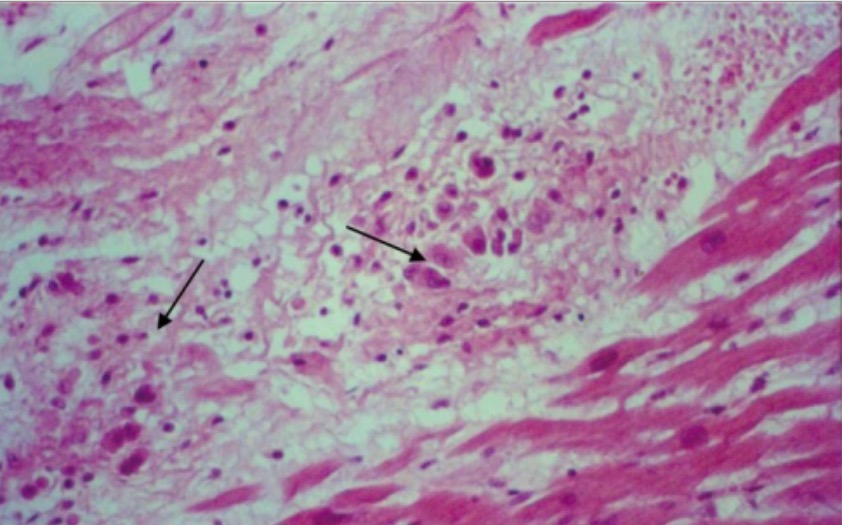
    • Cuerpos de Aschoff: granulomas Granulomas A relatively small nodular inflammatory lesion containing grouped mononuclear phagocytes, caused by infectious and noninfectious agents. Sarcoidosis reumáticos
    • La pancarditis y los LOS Neisseria exudados pericárdicos disminuyen la capacidad de llenado ventricular y pueden causar insuficiencia cardiaca.
  • Los LOS Neisseria anticuerpos contra el antígeno carbohidrato de los LOS Neisseria estreptococos β-hemolíticos del grupo A reaccionan de forma cruzada con las células neuronales en EN Erythema nodosum is an immune-mediated panniculitis (inflammation of the subcutaneous fat) caused by a type IV (delayed-type) hypersensitivity reaction. It commonly manifests in young women as tender, erythematous nodules on the shins. Erythema Nodosum los LOS Neisseria ganglios basales → disfunción de la vía indirecta (D2 estriatal) → pérdida del control motor Motor Neurons which send impulses peripherally to activate muscles or secretory cells. Nervous System: Histology inhibitorio → manifestaciones tipo corea
  • Destrucción del tejido articular → artritis/artralgia
nódulos de Aschoff

Cuerpos de Aschoff (flechas) en el músculo papilar de la válvula mitral

Imagen: “Histopathological findings” por Valvular Heart Disease Department, Heart Institute (InCor), University of São Paulo Medical School, São Paulo, Brazil.  Licencia: CC BY 4.0

Fase crónica

  • Afecta principalmente al AL Amyloidosis corazón.
  • La inflamación conduce a la neovascularización y curación por fibrosis Fibrosis Any pathological condition where fibrous connective tissue invades any organ, usually as a consequence of inflammation or other injury. Bronchiolitis Obliterans.
  • Acumulación de tejido fibrótico en EN Erythema nodosum is an immune-mediated panniculitis (inflammation of the subcutaneous fat) caused by a type IV (delayed-type) hypersensitivity reaction. It commonly manifests in young women as tender, erythematous nodules on the shins. Erythema Nodosum las válvulas cardíacas
  • Estenosis de válvulas cardíacas

Presentación Clínica

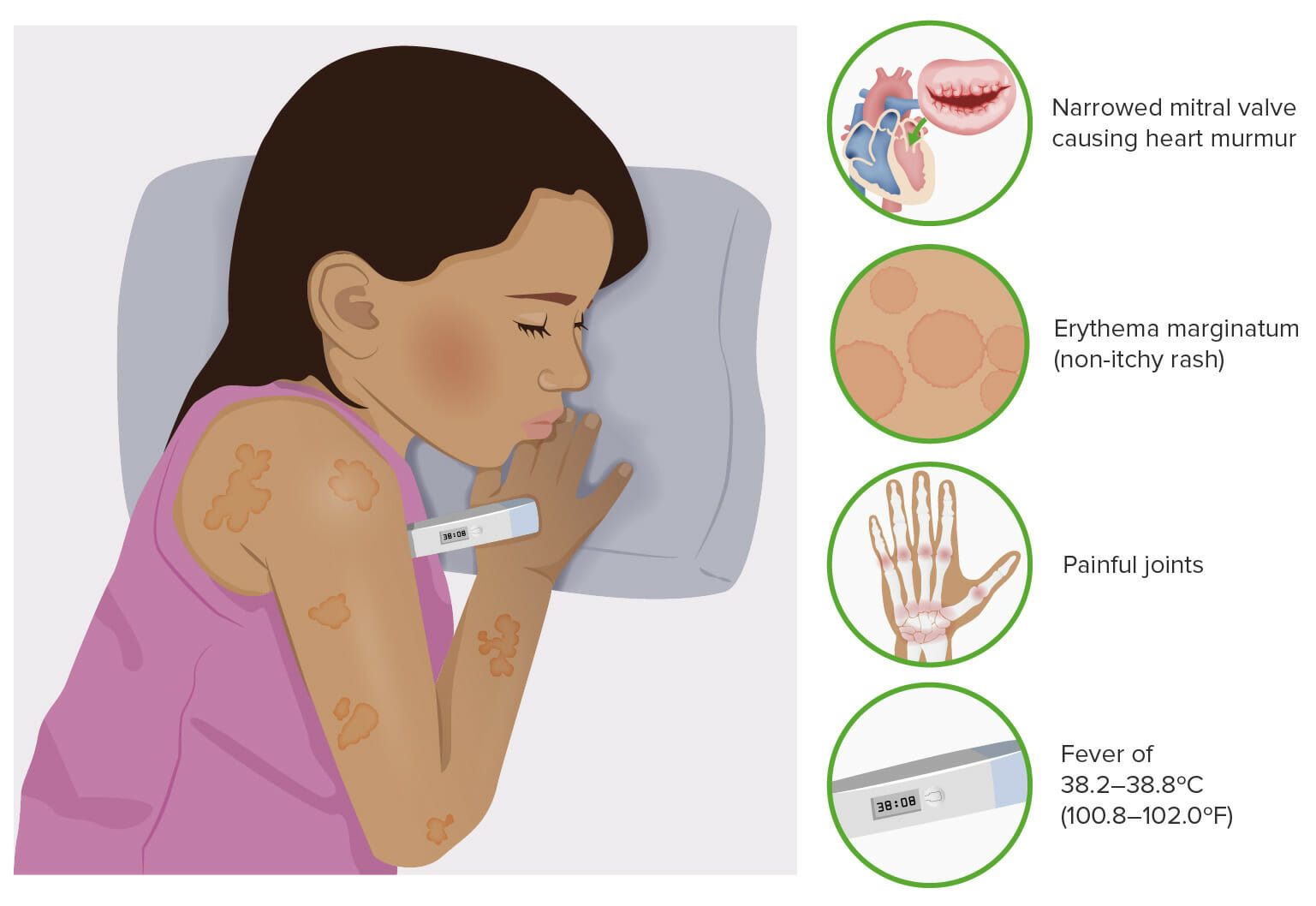
Typical symptoms of rheumatic fever.

Síntomas típicos de la fiebre reumática

Imagen por Lecturio.

Criterios de diagnóstico clínico

  • La fiebre reumática típicamente se presenta de 2–4 semanas después de la faringitis estreptocócica.
  • Las manifestaciones clínicas de la fiebre reumática se conocen como criterios de Jones.
  • Manifestaciones mayores:
  • Manifestaciones menores:
    • Artralgia
    • Fiebre
    • Reactantes de fase aguda elevados:
      • Velocidad de eritrosedimentación
      • Proteína C reactiva ( PCR PCR Polymerase chain reaction (PCR) is a technique that amplifies DNA fragments exponentially for analysis. The process is highly specific, allowing for the targeting of specific genomic sequences, even with minuscule sample amounts. The PCR cycles multiple times through 3 phases: denaturation of the template DNA, annealing of a specific primer to the individual DNA strands, and synthesis/elongation of new DNA molecules. Polymerase Chain Reaction (PCR))
    • Intervalo PR prolongado en EN Erythema nodosum is an immune-mediated panniculitis (inflammation of the subcutaneous fat) caused by a type IV (delayed-type) hypersensitivity reaction. It commonly manifests in young women as tender, erythematous nodules on the shins. Erythema Nodosum electrocardiografía

Síntomas principales

  • Artritis reumática:
    • Poliartritis migratoria
    • Afecta a las articulaciones más grandes.
    • Comúnmente visto en EN Erythema nodosum is an immune-mediated panniculitis (inflammation of the subcutaneous fat) caused by a type IV (delayed-type) hypersensitivity reaction. It commonly manifests in young women as tender, erythematous nodules on the shins. Erythema Nodosum rodillas, tobillos, codos y muñecas.
  • Cardiopatía reumática:
    • Típicamente pancarditis: endocarditis Endocarditis Endocarditis is an inflammatory disease involving the inner lining (endometrium) of the heart, most commonly affecting the cardiac valves. Both infectious and noninfectious etiologies lead to vegetations on the valve leaflets. Patients may present with nonspecific symptoms such as fever and fatigue. Endocarditis, miocarditis y pericarditis Pericarditis Pericarditis is an inflammation of the pericardium, often with fluid accumulation. It can be caused by infection (often viral), myocardial infarction, drugs, malignancies, metabolic disorders, autoimmune disorders, or trauma. Acute, subacute, and chronic forms exist. Pericarditis
    • La endocarditis Endocarditis Endocarditis is an inflammatory disease involving the inner lining (endometrium) of the heart, most commonly affecting the cardiac valves. Both infectious and noninfectious etiologies lead to vegetations on the valve leaflets. Patients may present with nonspecific symptoms such as fever and fatigue. Endocarditis suele ser la manifestación más destacada.
    • Afecta más comúnmente a la válvula mitral (65% de los LOS Neisseria casos):
      • La regurgitación o prolapso mitral es un signo temprano.
      • La estenosis mitral es un signo tardío (crónico).
    • Los LOS Neisseria pacientes pueden tener dificultad respiratoria, disnea de esfuerzo, dolor Dolor Inflammation torácico u ortopnea, según la gravedad.
    • La endocarditis Endocarditis Endocarditis is an inflammatory disease involving the inner lining (endometrium) of the heart, most commonly affecting the cardiac valves. Both infectious and noninfectious etiologies lead to vegetations on the valve leaflets. Patients may present with nonspecific symptoms such as fever and fatigue. Endocarditis y la miocarditis pueden conducir a una miocardiopatía dilatada (10% de los LOS Neisseria casos).
  • Corea de Sydenham:
    • Movimientos sin propósito, involuntarios, no estereotípicos
    • Afecta el tronco y las extremidades
    • A menudo se presenta con debilidad muscular asociada y labilidad emocional
  • Nódulos subcutáneos:
    • Protuberancias firmes e indoloras que se encuentran en EN Erythema nodosum is an immune-mediated panniculitis (inflammation of the subcutaneous fat) caused by a type IV (delayed-type) hypersensitivity reaction. It commonly manifests in young women as tender, erythematous nodules on the shins. Erythema Nodosum las superficies extensoras
    • Afecta las rodillas, los LOS Neisseria codos y las muñecas.
  • Eritema marginado:
    • Erupción única, evanescente, color rosa
    • Centro pálido y márgenes redondeados o serpiginosos
    • Por lo general, en EN Erythema nodosum is an immune-mediated panniculitis (inflammation of the subcutaneous fat) caused by a type IV (delayed-type) hypersensitivity reaction. It commonly manifests in young women as tender, erythematous nodules on the shins. Erythema Nodosum el tronco y las extremidades proximales (sin afectar la cara)

Mnemotecnia

Para recordar las principales manifestaciones clínicas en EN Erythema nodosum is an immune-mediated panniculitis (inflammation of the subcutaneous fat) caused by a type IV (delayed-type) hypersensitivity reaction. It commonly manifests in young women as tender, erythematous nodules on the shins. Erythema Nodosum la fiebre reumática aguda, recuerde los LOS Neisseria criterios de Jones (escritos como J❤NES, en EN Erythema nodosum is an immune-mediated panniculitis (inflammation of the subcutaneous fat) caused by a type IV (delayed-type) hypersensitivity reaction. It commonly manifests in young women as tender, erythematous nodules on the shins. Erythema Nodosum inglés):
Diagnóstico

Criterios diagnósticos

  • Evidencia de infección previa por estreptococos β-hemolíticos del grupo A
  • Episodio inicial:
    • 2 manifestaciones mayores
    • 1 mayor + 2 manifestaciones menores
  • Episodio recurrente:
    • 2 manifestaciones mayores
    • 1 mayor + 2 manifestaciones menores
    • 3 manifestaciones menores
  • Excepciones a los LOS Neisseria criterios anteriores:

Estudios de laboratorio

  • Evidencia de infección estreptocócica:
    • Cultivo de garganta: negativo en EN Erythema nodosum is an immune-mediated panniculitis (inflammation of the subcutaneous fat) caused by a type IV (delayed-type) hypersensitivity reaction. It commonly manifests in young women as tender, erythematous nodules on the shins. Erythema Nodosum el 75% de los LOS Neisseria casos en EN Erythema nodosum is an immune-mediated panniculitis (inflammation of the subcutaneous fat) caused by a type IV (delayed-type) hypersensitivity reaction. It commonly manifests in young women as tender, erythematous nodules on the shins. Erythema Nodosum el momento en EN Erythema nodosum is an immune-mediated panniculitis (inflammation of the subcutaneous fat) caused by a type IV (delayed-type) hypersensitivity reaction. It commonly manifests in young women as tender, erythematous nodules on the shins. Erythema Nodosum que se desarrolla fiebre reumática
    • Prueba de antígeno estreptocócico: comúnmente negativa en EN Erythema nodosum is an immune-mediated panniculitis (inflammation of the subcutaneous fat) caused by a type IV (delayed-type) hypersensitivity reaction. It commonly manifests in young women as tender, erythematous nodules on the shins. Erythema Nodosum el momento de la presentación de fiebre reumática
    • Títulos de anticuerpos (más útiles para el diagnóstico de fiebre reumática):
      • Antiestreptolisina O (ASO)
      • Antidesoxirribonucleasa B (ADB)
      • Antiestreptoquinasa
      • Antihialuronidasa
  • Otros hallazgos:
    • Leucocitosis
    • Anemia Anemia Anemia is a condition in which individuals have low Hb levels, which can arise from various causes. Anemia is accompanied by a reduced number of RBCs and may manifest with fatigue, shortness of breath, pallor, and weakness. Subtypes are classified by the size of RBCs, chronicity, and etiology. Anemia: Overview and Types
    • PCR PCR Polymerase chain reaction (PCR) is a technique that amplifies DNA fragments exponentially for analysis. The process is highly specific, allowing for the targeting of specific genomic sequences, even with minuscule sample amounts. The PCR cycles multiple times through 3 phases: denaturation of the template DNA, annealing of a specific primer to the individual DNA strands, and synthesis/elongation of new DNA molecules. Polymerase Chain Reaction (PCR)
    • ↑ Velocidad de eritrosedimentación
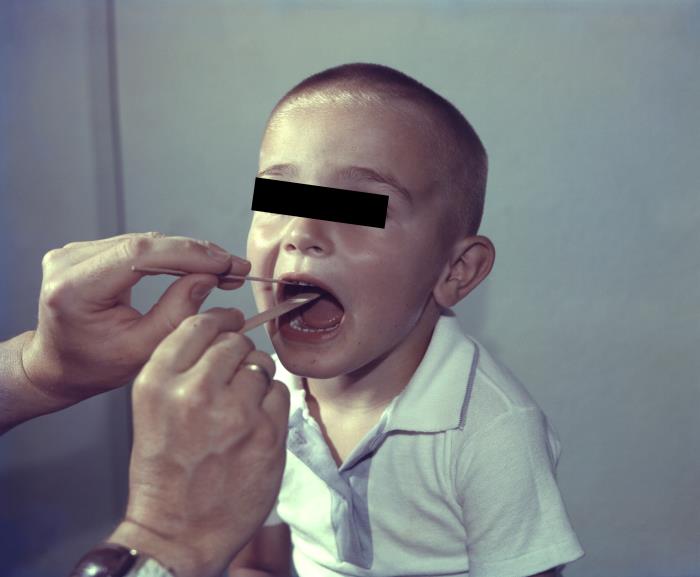
frotis de garganta

Es necesario obtener una muestra de frotis de garganta por sospecha de faringitis estreptocócica.

Imagen: “10190” por CDC/ Dr. M. Moody. Licencia: Dominio Público
Imagenología

  • Ecocardiografía con Doppler Doppler Ultrasonography applying the doppler effect, with frequency-shifted ultrasound reflections produced by moving targets (usually red blood cells) in the bloodstream along the ultrasound axis in direct proportion to the velocity of movement of the targets, to determine both direction and velocity of blood flow. Ultrasound (Sonography):
    • Obligatorio en EN Erythema nodosum is an immune-mediated panniculitis (inflammation of the subcutaneous fat) caused by a type IV (delayed-type) hypersensitivity reaction. It commonly manifests in young women as tender, erythematous nodules on the shins. Erythema Nodosum todos los LOS Neisseria casos de fiebre reumática confirmada y sospechada
    • Carditis Carditis Rheumatic Fever
    • Vegetaciones valvulares
    • Insuficiencia mitral y/o aórtica (fase aguda)
    • Estenosis mitral (fase crónica)
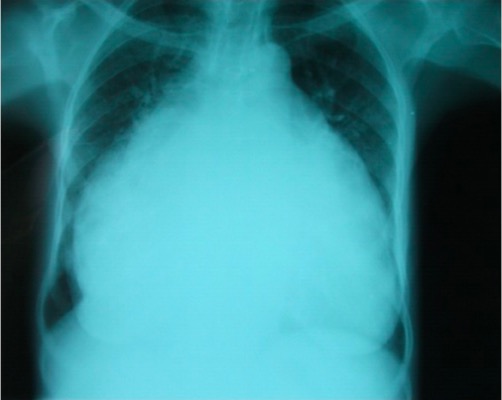
  • Radiografía de tórax:
    • Cardiomegalia
    • Edema Edema Edema is a condition in which excess serous fluid accumulates in the body cavity or interstitial space of connective tissues. Edema is a symptom observed in several medical conditions. It can be categorized into 2 types, namely, peripheral (in the extremities) and internal (in an organ or body cavity). Edema pulmonar en EN Erythema nodosum is an immune-mediated panniculitis (inflammation of the subcutaneous fat) caused by a type IV (delayed-type) hypersensitivity reaction. It commonly manifests in young women as tender, erythematous nodules on the shins. Erythema Nodosum pacientes en EN Erythema nodosum is an immune-mediated panniculitis (inflammation of the subcutaneous fat) caused by a type IV (delayed-type) hypersensitivity reaction. It commonly manifests in young women as tender, erythematous nodules on the shins. Erythema Nodosum quienes se ha HA Hemolytic anemia (HA) is the term given to a large group of anemias that are caused by the premature destruction/hemolysis of circulating red blood cells (RBCs). Hemolysis can occur within (intravascular hemolysis) or outside the blood vessels (extravascular hemolysis). Hemolytic Anemia desarrollado insuficiencia cardíaca

Tratamiento

Tratamiento

Objetivos:

  • Erradicación de estreptococos y antígenos bacterianos de la región faríngea
  • Tratamiento de soporte/sintomático para artritis, carditis Carditis Rheumatic Fever y corea
  • Prevención de complicaciones cardiacas

Erradicación de la infección estreptocócica:

  • La penicilina es el fármaco de elección.
  • La amoxicilina se usa si la penicilina no está disponible.
  • Las cefalosporinas son otra opción.

Artritis:

  • Aspirina
  • Medicamentos antiinflamatorios no esteroideos (AINE): ibuprofeno, naproxeno

Carditis Carditis Rheumatic Fever severa:

  • Corticosteroides
  • Reposo en EN Erythema nodosum is an immune-mediated panniculitis (inflammation of the subcutaneous fat) caused by a type IV (delayed-type) hypersensitivity reaction. It commonly manifests in young women as tender, erythematous nodules on the shins. Erythema Nodosum cama
  • Medicamentos para la insuficiencia cardíaca:
    • Diuréticos
    • Reducción de la poscarga (p. ej., inhibidor de la ECA) según esté indicado
    • Digoxina
  • Monitoreo y tratamiento de arritmias causadas por miocarditis
  • No se realiza cirugía en EN Erythema nodosum is an immune-mediated panniculitis (inflammation of the subcutaneous fat) caused by a type IV (delayed-type) hypersensitivity reaction. It commonly manifests in young women as tender, erythematous nodules on the shins. Erythema Nodosum la fase aguda salvo indicaciones de emergencia:
    • Ruptura de valvas
    • Rotura de cuerdas tendinosas
  • La reparación quirúrgica puede ser necesaria en EN Erythema nodosum is an immune-mediated panniculitis (inflammation of the subcutaneous fat) caused by a type IV (delayed-type) hypersensitivity reaction. It commonly manifests in young women as tender, erythematous nodules on the shins. Erythema Nodosum la fase crónica de la estenosis mitral.

La corea de Sydenham suele ser autolimitada y no requiere tratamiento específico.

Prevención

  • Primaria: tratamiento antibiótico rápido de estreptococos faringitis
  • Secundaria:
    • La penicilina G benzatinica intramuscular se usa ampliamente para prevenir la recurrencia.
    • Administrada cada 28 días
    • En EN Erythema nodosum is an immune-mediated panniculitis (inflammation of the subcutaneous fat) caused by a type IV (delayed-type) hypersensitivity reaction. It commonly manifests in young women as tender, erythematous nodules on the shins. Erythema Nodosum pacientes con alergia a la penicilina, los LOS Neisseria macrólidos orales son una alternativa.
    • Iniciado después de que termina el tratamiento para la infección original
    • La duración de la profilaxis depende de la presentación original y la gravedad.
Tabla: Profilaxis de la fiebre reumática recurrente
Presentación de fiebre reumática Duración de la profilaxis
Fiebre reumática con carditis Carditis Rheumatic Fever y cardiopatía residual (enfermedad valvular persistente) 10 años o hasta los LOS Neisseria 40 años (lo que sea mayor); puede ser necesaria la profilaxis de por vida
Fiebre reumática con carditis Carditis Rheumatic Fever pero sin cardiopatía residual (sin enfermedad valvular) 10 años o hasta los LOS Neisseria 21 años (lo que sea mayor)
Fiebre reumática sin carditis Carditis Rheumatic Fever 5 años o hasta los LOS Neisseria 21 años (lo que sea mayor)

Pronóstico

  • La carditis Carditis Rheumatic Fever se resolverá sin secuelas en EN Erythema nodosum is an immune-mediated panniculitis (inflammation of the subcutaneous fat) caused by a type IV (delayed-type) hypersensitivity reaction. It commonly manifests in young women as tender, erythematous nodules on the shins. Erythema Nodosum 65%–75% de los LOS Neisseria pacientes.
  • El 90% de los LOS Neisseria episodios agudos duran < 3 meses.
  • El riesgo de recurrencia es mayor durante el primer año.

Diagnóstico Diferencial

  • Sepsis Sepsis Systemic inflammatory response syndrome with a proven or suspected infectious etiology. When sepsis is associated with organ dysfunction distant from the site of infection, it is called severe sepsis. When sepsis is accompanied by hypotension despite adequate fluid infusion, it is called septic shock. Sepsis and Septic Shock bacteriana: un síndrome potencialmente mortal que ocurre cuando un patógeno bacteriano y sus productos pasan de la fuente de infección al AL Amyloidosis torrente sanguíneo. La neumonía es el evento precipitante conocido más común. Los LOS Neisseria pacientes suelen presentar fiebre, taquicardia, taquipnea, hipotensión y/o alteraciones mentales. El tratamiento se basa en EN Erythema nodosum is an immune-mediated panniculitis (inflammation of the subcutaneous fat) caused by a type IV (delayed-type) hypersensitivity reaction. It commonly manifests in young women as tender, erythematous nodules on the shins. Erythema Nodosum la causa e incluye tratamiento con antibióticos.
  • Enfermedad de Kawasaki: síndrome vasculítico febril de la primera infancia caracterizado por vasculitis Vasculitis Inflammation of any one of the blood vessels, including the arteries; veins; and rest of the vasculature system in the body. Systemic Lupus Erythematosus de arterias de mediano calibre. La enfermedad de Kawasaki también se conoce como poliarteritis nodosa infantil y síndrome de ganglios linfáticos mucocutáneos. Están involucrados múltiples sistemas, pero el más grave es el compromiso de las arterias coronarias. El tratamiento consiste en EN Erythema nodosum is an immune-mediated panniculitis (inflammation of the subcutaneous fat) caused by a type IV (delayed-type) hypersensitivity reaction. It commonly manifests in young women as tender, erythematous nodules on the shins. Erythema Nodosum inmunoglobulina intravenosa y aspirina en EN Erythema nodosum is an immune-mediated panniculitis (inflammation of the subcutaneous fat) caused by a type IV (delayed-type) hypersensitivity reaction. It commonly manifests in young women as tender, erythematous nodules on the shins. Erythema Nodosum dosis altas.
  • Artritis séptica: se refiere a la invasión del espacio articular por microorganismos como bacterias, virus Virus Viruses are infectious, obligate intracellular parasites composed of a nucleic acid core surrounded by a protein capsid. Viruses can be either naked (non-enveloped) or enveloped. The classification of viruses is complex and based on many factors, including type and structure of the nucleoid and capsid, the presence of an envelope, the replication cycle, and the host range. Virology y hongos. La artritis séptica puede ser causada por una variedad de organismos, siendo el Staphylococcus aureus Staphylococcus aureus Potentially pathogenic bacteria found in nasal membranes, skin, hair follicles, and perineum of warm-blooded animals. They may cause a wide range of infections and intoxications. Brain Abscess el más común. Los LOS Neisseria procedimientos ortopédicos son la causa común de infección por S. aureus S. aureus Potentially pathogenic bacteria found in nasal membranes, skin, hair follicles, and perineum of warm-blooded animals. They may cause a wide range of infections and intoxications. Staphylococcus. Los LOS Neisseria cultivos de la aspiración articular son diagnósticos, con terapia antibiótica adaptada al AL Amyloidosis organismo específico encontrado. El tratamiento antibiótico está dirigido al AL Amyloidosis agente causal.
  • Lupus eritematoso sistémico (LES): un trastorno autoinmune caracterizado por la producción de anticuerpos contra antígenos nucleares y citoplasmáticos, inflamación multisistémica y manifestaciones clínicas proteicas. Los LOS Neisseria síntomas incluyen erupción malar, dolor Dolor Inflammation en EN Erythema nodosum is an immune-mediated panniculitis (inflammation of the subcutaneous fat) caused by a type IV (delayed-type) hypersensitivity reaction. It commonly manifests in young women as tender, erythematous nodules on the shins. Erythema Nodosum las articulaciones, fiebre, proteinuria Proteinuria The presence of proteins in the urine, an indicator of kidney diseases. Nephrotic Syndrome in Children, hipertensión, anemia Anemia Anemia is a condition in which individuals have low Hb levels, which can arise from various causes. Anemia is accompanied by a reduced number of RBCs and may manifest with fatigue, shortness of breath, pallor, and weakness. Subtypes are classified by the size of RBCs, chronicity, and etiology. Anemia: Overview and Types, linfopenia, convulsiones y/o psicosis. El tratamiento incluye esteroides tópicos, esteroides intravenosos o metotrexato.
  • Endocarditis Endocarditis Endocarditis is an inflammatory disease involving the inner lining (endometrium) of the heart, most commonly affecting the cardiac valves. Both infectious and noninfectious etiologies lead to vegetations on the valve leaflets. Patients may present with nonspecific symptoms such as fever and fatigue. Endocarditis infecciosa: una afección caracterizada por la inflamación del revestimiento interno del corazón y sus válvulas, causada por una infección. El diagnóstico se realiza con ecocardiografía y el tratamiento se basa en EN Erythema nodosum is an immune-mediated panniculitis (inflammation of the subcutaneous fat) caused by a type IV (delayed-type) hypersensitivity reaction. It commonly manifests in young women as tender, erythematous nodules on the shins. Erythema Nodosum el tratamiento del agente causal.
  • Enfermedad de Lyme: una infección zoonótica causada por Borrelia burgdorferi Borrelia burgdorferi A specific species of bacteria, part of the borrelia burgdorferi group, whose common name is lyme disease spirochete. Borrelia, que inicialmente se presenta con una erupción localizada y finalmente causa una infección sistémica que afecta articulaciones, piel y sistema nervioso. Las manifestaciones neurológicas, cardíacas, oculares y articulares también son comunes en EN Erythema nodosum is an immune-mediated panniculitis (inflammation of the subcutaneous fat) caused by a type IV (delayed-type) hypersensitivity reaction. It commonly manifests in young women as tender, erythematous nodules on the shins. Erythema Nodosum etapas posteriores. El diagnóstico se basa en EN Erythema nodosum is an immune-mediated panniculitis (inflammation of the subcutaneous fat) caused by a type IV (delayed-type) hypersensitivity reaction. It commonly manifests in young women as tender, erythematous nodules on the shins. Erythema Nodosum los LOS Neisseria hallazgos clínicos y en EN Erythema nodosum is an immune-mediated panniculitis (inflammation of the subcutaneous fat) caused by a type IV (delayed-type) hypersensitivity reaction. It commonly manifests in young women as tender, erythematous nodules on the shins. Erythema Nodosum la exposición a garrapatas y está respaldado por pruebas serológicas. Se utilizan antibióticos para el tratamiento.
  • Artritis reumatoide: un trastorno autoinmune inflamatorio crónico caracterizado por dolor Dolor Inflammation, hinchazón y destrucción de las articulaciones sinoviales. Los LOS Neisseria principales síntomas de presentación son rigidez matinal e inflamación de las pequeñas articulaciones de la mano. El diagnóstico se basa en EN Erythema nodosum is an immune-mediated panniculitis (inflammation of the subcutaneous fat) caused by a type IV (delayed-type) hypersensitivity reaction. It commonly manifests in young women as tender, erythematous nodules on the shins. Erythema Nodosum una fuerte sospecha clínica y se confirma por la presencia de marcadores serológicos y reactantes de fase aguda. El tratamiento incluye AINE y medicamentos inmunosupresores.

Referencias

  1. Gewitz MH. (2015). Revised Jones Criteria for Acute Rheumatic Fever | Ten Points to Remember—American College of Cardiology. Retrieved November 24, 2025, from https://www.acc.org/latest-in-cardiology/ten-points-to-remember/2015/05/08/15/22/revision-of-the-jones-criteria-for-the-diagnosis-of-acute-rheumatic-fever
  2. Karthikeyan, G., & Guilherme, L. (2018). Acute rheumatic fever. The Lancet, 392(10142), 161–174.
  3. Meador R. J. (2024). Acute Rheumatic Fever. Retrieved November 24, 2025, from https://emedicine.medscape.com/article/333103-overview
  4. Steer, A. and Gibofsky, A. (2024). Acute rheumatic fever: Clinical manifestations and diagnosis. UpToDate. Retrieved November 24, 2025, from https://www.uptodate.com/contents/acute-rheumatic-fever-clinical-manifestations-and-diagnosis
  5. Steer, A. and Gibofsky, A. (2024). Acute rheumatic fever: Treatment and prevention. Retrieved November 24, 2025, from https://www.uptodate.com/contents/acute-rheumatic-fever-treatment-and-prevention?search=rheumatic%20fever&source
  6. Wallace, M. (2024). Rheumatic Fever Workup. Emedicine. Retrieved November 24, 2025, from https://emedicine.medscape.com/article/236582-workup#c8

¡Crea tu cuenta gratis o inicia una sesión para seguir leyendo!

Regístrate ahora y obtén acceso gratuito a Lecturio con páginas de concepto, videos médicos y cuestionarios para tu educación médica.

User Reviews

Que tengas una sesión de estudio alegre y navideña 🎁 Ahorra 50% en todos los planes >>

Details