Domina Conceptos Médicos

Estudia para la escuela de medicina y tus examenes con Lecturio.

Enfermedad de Crohn

La enfermedad de Crohn es una condición crónica y recurrente que provoca una inflamación transmural irregular que puede afectar a cualquier parte del tracto gastrointestinal. Es un tipo de enfermedad inflamatoria intestinal junto con la colitis Colitis Inflammation of the colon section of the large intestine, usually with symptoms such as diarrhea (often with blood and mucus), abdominal pain, and fever. Pseudomembranous Colitis ulcerosa. Suelen estar afectados el íleon terminal y el colon Colon The large intestines constitute the last portion of the digestive system. The large intestine consists of the cecum, appendix, colon (with ascending, transverse, descending, and sigmoid segments), rectum, and anal canal. The primary function of the colon is to remove water and compact the stool prior to expulsion from the body via the rectum and anal canal. Colon, Cecum, and Appendix: Anatomy proximal. La enfermedad de Crohn suele presentarse con diarrea intermitente, sin sangre, y dolor Dolor Inflammation abdominal tipo cólico. Las manifestaciones extraintestinales pueden incluir cálculos renales de oxalato de calcio, cálculos biliares, eritema nodoso y artritis. El diagnóstico se establece a través de una endoscopia con biopsia que muestra una inflamación transmural, una mucosa característica en EN Erythema nodosum is an immune-mediated panniculitis (inflammation of the subcutaneous fat) caused by a type IV (delayed-type) hypersensitivity reaction. It commonly manifests in young women as tender, erythematous nodules on the shins. Erythema Nodosum forma de adoquín y granulomas Granulomas A relatively small nodular inflammatory lesion containing grouped mononuclear phagocytes, caused by infectious and noninfectious agents. Sarcoidosis no caseificantes. El tratamiento es con corticosteroides, azatioprina, antibióticos y agentes anti factor de necrosis Necrosis The death of cells in an organ or tissue due to disease, injury or failure of the blood supply. Ischemic Cell Damage tumoral (anti-TNF, por sus siglas en EN Erythema nodosum is an immune-mediated panniculitis (inflammation of the subcutaneous fat) caused by a type IV (delayed-type) hypersensitivity reaction. It commonly manifests in young women as tender, erythematous nodules on the shins. Erythema Nodosum inglés) ( infliximab Infliximab A chimeric monoclonal antibody to tnf-alpha that is used in the treatment of rheumatoid arthritis; ankylosing spondylitis; psoriatic arthritis and Crohn's disease. Disease-Modifying Antirheumatic Drugs (DMARDs) y adalimumab Adalimumab A humanized monoclonal antibody that binds specifically to tnf-alpha and blocks its interaction with endogenous tnf receptors to modulate inflammation. It is used in the treatment of rheumatoid arthritis; psoriatic arthritis; Crohn's disease and ulcerative colitis. Disease-Modifying Antirheumatic Drugs (DMARDs)). Las complicaciones son malabsorción, desnutrición, obstrucción intestinal o fístulas, y un mayor riesgo de cáncer de colon Colon The large intestines constitute the last portion of the digestive system. The large intestine consists of the cecum, appendix, colon (with ascending, transverse, descending, and sigmoid segments), rectum, and anal canal. The primary function of the colon is to remove water and compact the stool prior to expulsion from the body via the rectum and anal canal. Colon, Cecum, and Appendix: Anatomy.

Last updated: Sep 22, 2025

Editorial responsibility: Stanley Oiseth, Lindsay Jones, Evelin Maza

Epidemiología y Fisiopatología

Epidemiología

  • Incidencia: distribución bimodal
    • 1525 años (media ligeramente más joven que en EN Erythema nodosum is an immune-mediated panniculitis (inflammation of the subcutaneous fat) caused by a type IV (delayed-type) hypersensitivity reaction. It commonly manifests in young women as tender, erythematous nodules on the shins. Erythema Nodosum la colitis Colitis Inflammation of the colon section of the large intestine, usually with symptoms such as diarrhea (often with blood and mucus), abdominal pain, and fever. Pseudomembranous Colitis ulcerosa)
    • El pico más pequeño se produce entre los LOS Neisseria 50 y los LOS Neisseria 70 años de edad
  • Los LOS Neisseria hombres y las mujeres están igualmente afectados
  • Más común entre los LOS Neisseria blancos y los LOS Neisseria judíos de Europa del Este (asquenazíes)
  • En EN Erythema nodosum is an immune-mediated panniculitis (inflammation of the subcutaneous fat) caused by a type IV (delayed-type) hypersensitivity reaction. It commonly manifests in young women as tender, erythematous nodules on the shins. Erythema Nodosum 2017, hubo 6,8 millones de casos de enfermedad inflamatoria intestinal en EN Erythema nodosum is an immune-mediated panniculitis (inflammation of the subcutaneous fat) caused by a type IV (delayed-type) hypersensitivity reaction. It commonly manifests in young women as tender, erythematous nodules on the shins. Erythema Nodosum todo el mundo.
  • La prevalencia de la enfermedad de Crohn es de aproximadamente 200 por cada 100 000 adultos
  • La incidencia de la enfermedad de Crohn es de aproximadamente 3–20 por cada 100 000 adultos al AL Amyloidosis año

Factores de riesgo

  • Tabaquismo ( al AL Amyloidosis contrario que la colitis Colitis Inflammation of the colon section of the large intestine, usually with symptoms such as diarrhea (often with blood and mucus), abdominal pain, and fever. Pseudomembranous Colitis ulcerosa)
  • Genética:
    • Genes Genes A category of nucleic acid sequences that function as units of heredity and which code for the basic instructions for the development, reproduction, and maintenance of organisms. DNA Types and Structure IL23R y ATG16L1
    • NOD2 (afecta a la capacidad del organismo para reconocer y atacar a los LOS Neisseria patógenos luminales)
  • Antecedentes familiares de enfermedad inflamatoria intestinal
    • La tasa de concordancia entre gemelos es del 55%.
    • El 15% de los LOS Neisseria pacientes con enfermedad de Crohn tienen un familiar de primer grado afectado
  • Disminución de la actividad física
  • Disminución de la ingesta de fibra
  • Aumento de la ingesta de grasa en EN Erythema nodosum is an immune-mediated panniculitis (inflammation of the subcutaneous fat) caused by a type IV (delayed-type) hypersensitivity reaction. It commonly manifests in young women as tender, erythematous nodules on the shins. Erythema Nodosum la dieta

Fisiopatología

Se desconoce la fisiopatología exacta, pero es probable que esté asociada a una combinación de desregulación del epitelio intestinal y del sistema inmunitario.

  1. Mutaciones del gen NOD2 → defectos en EN Erythema nodosum is an immune-mediated panniculitis (inflammation of the subcutaneous fat) caused by a type IV (delayed-type) hypersensitivity reaction. It commonly manifests in young women as tender, erythematous nodules on the shins. Erythema Nodosum la lámina propia y la barrera epitelial del tracto gastrointestinal → mayor penetración de patógenos en EN Erythema nodosum is an immune-mediated panniculitis (inflammation of the subcutaneous fat) caused by a type IV (delayed-type) hypersensitivity reaction. It commonly manifests in young women as tender, erythematous nodules on the shins. Erythema Nodosum el tracto gastrointestinal → reclutamiento y activación de células citotóxicas
  2. Activación de las células mediadoras de Th1 Th1 A subset of helper-inducer T-lymphocytes which synthesize and secrete interleukin-2; interferon-gamma; and interleukin-12. Due to their ability to kill antigen-presenting cells and their lymphokine-mediated effector activity, th1 cells are associated with vigorous delayed-type hypersensitivity reactions. T cells: Types and Functions en EN Erythema nodosum is an immune-mediated panniculitis (inflammation of the subcutaneous fat) caused by a type IV (delayed-type) hypersensitivity reaction. It commonly manifests in young women as tender, erythematous nodules on the shins. Erythema Nodosum la pared gastrointestinal → liberación de citoquinas proinflamatorias → inflamación intestinal
  3. Falta de regulación negativa sobre la respuesta inmunitaria tras una infección o brote inicial → inflamación crónica → granulomas Granulomas A relatively small nodular inflammatory lesion containing grouped mononuclear phagocytes, caused by infectious and noninfectious agents. Sarcoidosis
  4. Daño al AL Amyloidosis tejido intestinal, incluyendo edema Edema Edema is a condition in which excess serous fluid accumulates in the body cavity or interstitial space of connective tissues. Edema is a symptom observed in several medical conditions. It can be categorized into 2 types, namely, peripheral (in the extremities) and internal (in an organ or body cavity). Edema, ulceraciones, erosiones y necrosis Necrosis The death of cells in an organ or tissue due to disease, injury or failure of the blood supply. Ischemic Cell Damage
  5. Dado que la inflamación es transmural, puede provocar una perforación intestinal y fístulas.
  6. Episodios crónicos y repetitivos → cicatrización, fibrosis Fibrosis Any pathological condition where fibrous connective tissue invades any organ, usually as a consequence of inflammation or other injury. Bronchiolitis Obliterans y obstrucción de la pared intestinal

Localización y patrón de inflamación:

  • Puede incluir cualquier parte del tracto gastrointestinal
  • El sitio más común es el íleon terminal y el colon Colon The large intestines constitute the last portion of the digestive system. The large intestine consists of the cecum, appendix, colon (with ascending, transverse, descending, and sigmoid segments), rectum, and anal canal. The primary function of the colon is to remove water and compact the stool prior to expulsion from the body via the rectum and anal canal. Colon, Cecum, and Appendix: Anatomy proximal.
  • Asociado a lesiones en EN Erythema nodosum is an immune-mediated panniculitis (inflammation of the subcutaneous fat) caused by a type IV (delayed-type) hypersensitivity reaction. It commonly manifests in young women as tender, erythematous nodules on the shins. Erythema Nodosum parches
  • El recto a menudo no está comprometido.

Presentación Clínica

La presentación típica de la enfermedad de Crohn es un trastorno recidivante que incluye:

  • Manifestaciones gastrointestinales:
    • Diarrea crónica e intermitente que no suele ser sanguinolenta
    • Dolor Dolor Inflammation abdominal tipo cólico (puede ser difuso o localizado en EN Erythema nodosum is an immune-mediated panniculitis (inflammation of the subcutaneous fat) caused by a type IV (delayed-type) hypersensitivity reaction. It commonly manifests in young women as tender, erythematous nodules on the shins. Erythema Nodosum el cuadrante inferior derecho)
    • Odinofagia o disfagia (secundaria a la afectación del esófago)
    • Flatulencia e hinchazón
    • Incontinencia fecal
    • Signos de malabsorción, con deficiencias de vitamina B12 y D y anemia Anemia Anemia is a condition in which individuals have low Hb levels, which can arise from various causes. Anemia is accompanied by a reduced number of RBCs and may manifest with fatigue, shortness of breath, pallor, and weakness. Subtypes are classified by the size of RBCs, chronicity, and etiology. Anemia: Overview and Types por deficiencia de hierro
  • Manifestaciones generales:
    • Fiebre de bajo grado
    • Signos de anemia Anemia Anemia is a condition in which individuals have low Hb levels, which can arise from various causes. Anemia is accompanied by a reduced number of RBCs and may manifest with fatigue, shortness of breath, pallor, and weakness. Subtypes are classified by the size of RBCs, chronicity, and etiology. Anemia: Overview and Types: fatiga, palidez, disnea, palpitaciones
    • Pérdida de apetito
    • Pérdida de peso
    • Retraso en EN Erythema nodosum is an immune-mediated panniculitis (inflammation of the subcutaneous fat) caused by a type IV (delayed-type) hypersensitivity reaction. It commonly manifests in young women as tender, erythematous nodules on the shins. Erythema Nodosum el desarrollo o en EN Erythema nodosum is an immune-mediated panniculitis (inflammation of the subcutaneous fat) caused by a type IV (delayed-type) hypersensitivity reaction. It commonly manifests in young women as tender, erythematous nodules on the shins. Erythema Nodosum el crecimiento de los LOS Neisseria niños
  • Manifestaciones extraintestinales:
    • Úlceras aftosas
    • Formación de cálculos biliares (secundaria a la disminución de la reabsorción de ácidos biliares)
    • Cálculos renales (generalmente de oxalato de calcio)
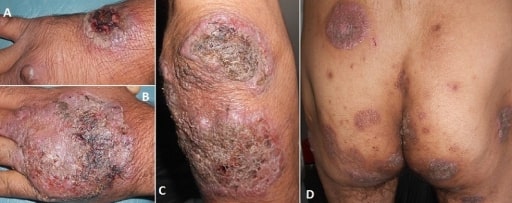
    • Pioderma gangrenoso: pápulas rojas y dolorosas rápidamente progresivas → pústulas → úlceras profundas con necrosis Necrosis The death of cells in an organ or tissue due to disease, injury or failure of the blood supply. Ischemic Cell Damage central
    • Eritema nodoso: nódulos rojos y dolorosos que suelen aparecer en EN Erythema nodosum is an immune-mediated panniculitis (inflammation of the subcutaneous fat) caused by a type IV (delayed-type) hypersensitivity reaction. It commonly manifests in young women as tender, erythematous nodules on the shins. Erythema Nodosum la cara anterior de las piernas
    • Inflamación ocular (uveítis, iritis Iritis Inflammation of the iris characterized by circumcorneal injection, aqueous flare, keratotic precipitates, and constricted and sluggish pupil along with discoloration of the iris. Leprosy, epiescleritis)
    • Artritis periférica, espondilitis anquilosante u osteoporosis Osteoporosis Osteoporosis refers to a decrease in bone mass and density leading to an increased number of fractures. There are 2 forms of osteoporosis: primary, which is commonly postmenopausal or senile; and secondary, which is a manifestation of immobilization, underlying medical disorders, or long-term use of certain medications. Osteoporosis
    • Dedos en EN Erythema nodosum is an immune-mediated panniculitis (inflammation of the subcutaneous fat) caused by a type IV (delayed-type) hypersensitivity reaction. It commonly manifests in young women as tender, erythematous nodules on the shins. Erythema Nodosum palillos de tambor
    • Colangitis esclerosante primaria (mucho más frecuente en EN Erythema nodosum is an immune-mediated panniculitis (inflammation of the subcutaneous fat) caused by a type IV (delayed-type) hypersensitivity reaction. It commonly manifests in young women as tender, erythematous nodules on the shins. Erythema Nodosum la colitis Colitis Inflammation of the colon section of the large intestine, usually with symptoms such as diarrhea (often with blood and mucus), abdominal pain, and fever. Pseudomembranous Colitis ulcerosa que en EN Erythema nodosum is an immune-mediated panniculitis (inflammation of the subcutaneous fat) caused by a type IV (delayed-type) hypersensitivity reaction. It commonly manifests in young women as tender, erythematous nodules on the shins. Erythema Nodosum la enfermedad de Crohn)

La reactivación de la enfermedad de Crohn en EN Erythema nodosum is an immune-mediated panniculitis (inflammation of the subcutaneous fat) caused by a type IV (delayed-type) hypersensitivity reaction. It commonly manifests in young women as tender, erythematous nodules on the shins. Erythema Nodosum un período asintomático puede ser desencadenada por el estrés físico o psicológico, los LOS Neisseria cambios bruscos o drásticos en EN Erythema nodosum is an immune-mediated panniculitis (inflammation of the subcutaneous fat) caused by a type IV (delayed-type) hypersensitivity reaction. It commonly manifests in young women as tender, erythematous nodules on the shins. Erythema Nodosum la dieta y el tabaquismo.
Diagnóstico

El diagnóstico de la enfermedad de Crohn debe sospecharse si un paciente presenta los LOS Neisseria síntomas antes mencionados de dolor Dolor Inflammation abdominal, diarrea crónica intermitente, fatiga y pérdida de peso. El examen inicial incluye lo siguiente:
Estudios de laboratorio

  • El hemograma mostrará anemia Anemia Anemia is a condition in which individuals have low Hb levels, which can arise from various causes. Anemia is accompanied by a reduced number of RBCs and may manifest with fatigue, shortness of breath, pallor, and weakness. Subtypes are classified by the size of RBCs, chronicity, and etiology. Anemia: Overview and Types, leucocitosis y trombocitosis.
  • Panel metabólico completo para comprobar si la diarrea crónica ha HA Hemolytic anemia (HA) is the term given to a large group of anemias that are caused by the premature destruction/hemolysis of circulating red blood cells (RBCs). Hemolysis can occur within (intravascular hemolysis) or outside the blood vessels (extravascular hemolysis). Hemolytic Anemia causado un desequilibrio electrolítico
  • Deficiencia de hierro y de vitamina B
  • ↑ Velocidad de eritrosedimentación (VES) y Proteína C reactiva ( PCR PCR Polymerase chain reaction (PCR) is a technique that amplifies DNA fragments exponentially for analysis. The process is highly specific, allowing for the targeting of specific genomic sequences, even with minuscule sample amounts. The PCR cycles multiple times through 3 phases: denaturation of the template DNA, annealing of a specific primer to the individual DNA strands, and synthesis/elongation of new DNA molecules. Polymerase Chain Reaction (PCR))

Estudios de heces

  • Puede utilizarse para excluir otras causas de diarrea inflamatoria (e.g., infección)
  • Pruebas de Clostridioides difficile durante brotes, independientemente de la exposición previa a antibióticos
  • Puede mostrar rastros de sangre en EN Erythema nodosum is an immune-mediated panniculitis (inflammation of the subcutaneous fat) caused by a type IV (delayed-type) hypersensitivity reaction. It commonly manifests in young women as tender, erythematous nodules on the shins. Erythema Nodosum las heces

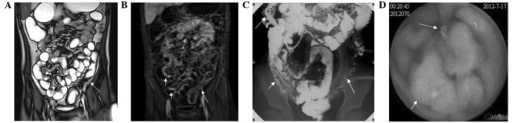
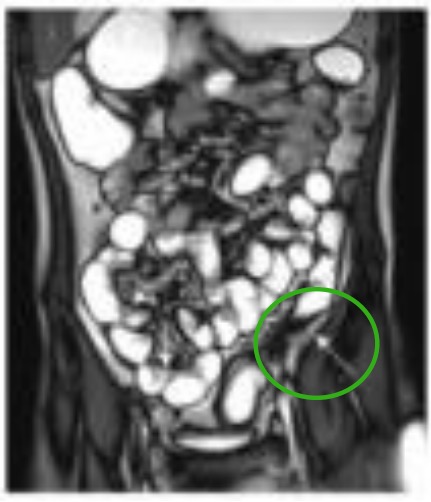
Tomografía computarizada (TC) abdominal, resonancia magnética (RM) o radiografía con ingestión de bario

  • Útil para evaluar la extensión y la gravedad de la enfermedad, así como cualquier complicación, si está presente (e.g., perforación, fístulas, abscesos, estenosis)
  • Signos de inflamación intestinal: engrosamiento de la pared con realce de la mucosa, distorsión e hiperintensidad
  • Úlceras en EN Erythema nodosum is an immune-mediated panniculitis (inflammation of the subcutaneous fat) caused by a type IV (delayed-type) hypersensitivity reaction. It commonly manifests in young women as tender, erythematous nodules on the shins. Erythema Nodosum la mucosa que dan un aspecto “empedrado”
  • El estrechamiento del lumen puede verse como el “signo de la cuerda
  • Las asas del intestino parecen estar muy separadas debido a la proliferación de grasa, conocida como grasa rastrera
  • Pseudodivertículos: zonas de dilatación tras un lugar de contracción localizada debido a una úlcera

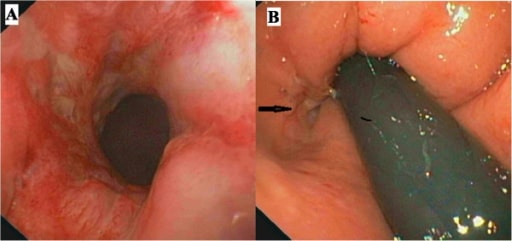
Colonoscopia con biopsia

  • Hallazgos macroscópicos:
    • Lesiones en EN Erythema nodosum is an immune-mediated panniculitis (inflammation of the subcutaneous fat) caused by a type IV (delayed-type) hypersensitivity reaction. It commonly manifests in young women as tender, erythematous nodules on the shins. Erythema Nodosum parches en EN Erythema nodosum is an immune-mediated panniculitis (inflammation of the subcutaneous fat) caused by a type IV (delayed-type) hypersensitivity reaction. It commonly manifests in young women as tender, erythematous nodules on the shins. Erythema Nodosum cualquier parte del tracto gastrointestinal, normalmente evitando el recto
    • Úlceras, fisuras y fístulas (aspecto empedrado)
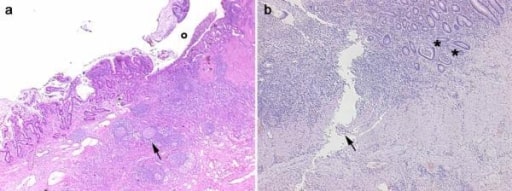
  • Hallazgos microscópicos:
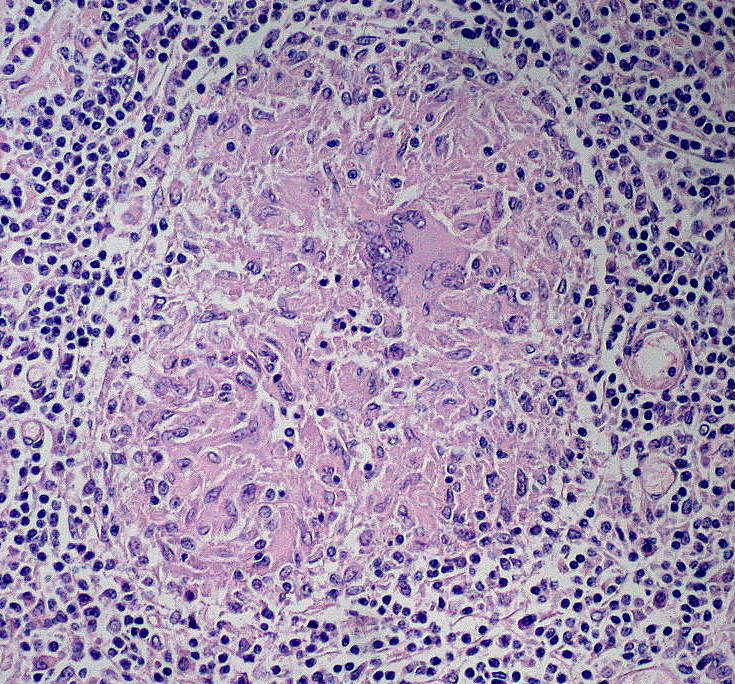
    • Granulomas Granulomas A relatively small nodular inflammatory lesion containing grouped mononuclear phagocytes, caused by infectious and noninfectious agents. Sarcoidosis no caseificantes
    • Agregados linfoides de la lámina propia
    • Inflamación transmural

Tratamiento

Las terapias médicas para la enfermedad de Crohn dependen de la gravedad de la enfermedad. Los LOS Neisseria 2 objetivos terapéuticos principales son poner fin a un ataque agudo y sintomático y prevenir los LOS Neisseria ataques recurrentes.

En EN Erythema nodosum is an immune-mediated panniculitis (inflammation of the subcutaneous fat) caused by a type IV (delayed-type) hypersensitivity reaction. It commonly manifests in young women as tender, erythematous nodules on the shins. Erythema Nodosum general, el tratamiento consiste en EN Erythema nodosum is an immune-mediated panniculitis (inflammation of the subcutaneous fat) caused by a type IV (delayed-type) hypersensitivity reaction. It commonly manifests in young women as tender, erythematous nodules on the shins. Erythema Nodosum lo siguiente:

  • Medidas generales:
    • Dejar de fumar
    • Vitamina B12 y D para la enfermedad grave o antes de la resección ileal
    • Evitar los LOS Neisseria alimentos que contienen lactosa
    • Agentes antidiarreicos (e.g., loperamida, agentes fijadores de ácidos biliares)
  • Terapia médica dirigida:
    • Antibióticos
      • Metronidazol o ciprofloxacina
      • Se utiliza para complicaciones como abscesos y fístulas
    • Corticosteroides
      • Se utiliza para los LOS Neisseria brotes agudos de la enfermedad
      • La duración es limitada debido a las complicaciones del uso a largo plazo
    • Inmunomoduladores
      • Azatioprina o 6-mercaptopurine 6-Mercaptopurine An antimetabolite antineoplastic agent with immunosuppressant properties. It interferes with nucleic acid synthesis by inhibiting purine metabolism and is used, usually in combination with other drugs, in the treatment of or in remission maintenance programs for leukemia. Antimetabolite Chemotherapy ( 6-MP 6-MP An antimetabolite antineoplastic agent with immunosuppressant properties. It interferes with nucleic acid synthesis by inhibiting purine metabolism and is used, usually in combination with other drugs, in the treatment of or in remission maintenance programs for leukemia. Antimetabolite Chemotherapy)
      • Se utiliza después de la terapia de inducción con corticosteroides para permitir la reducción y la retirada de los LOS Neisseria corticosteroides
      • También se utiliza en EN Erythema nodosum is an immune-mediated panniculitis (inflammation of the subcutaneous fat) caused by a type IV (delayed-type) hypersensitivity reaction. It commonly manifests in young women as tender, erythematous nodules on the shins. Erythema Nodosum combinación con agentes anti factor de necrosis Necrosis The death of cells in an organ or tissue due to disease, injury or failure of the blood supply. Ischemic Cell Damage tumoral (anti-TNF, por sus siglas en EN Erythema nodosum is an immune-mediated panniculitis (inflammation of the subcutaneous fat) caused by a type IV (delayed-type) hypersensitivity reaction. It commonly manifests in young women as tender, erythematous nodules on the shins. Erythema Nodosum inglés) para inducir la remisión y reducir la probabilidad de fracaso del tratamiento
    • Terapias anti-TNF
      • Infliximab Infliximab A chimeric monoclonal antibody to tnf-alpha that is used in the treatment of rheumatoid arthritis; ankylosing spondylitis; psoriatic arthritis and Crohn’s disease. Disease-Modifying Antirheumatic Drugs (DMARDs) o adalimumab Adalimumab A humanized monoclonal antibody that binds specifically to tnf-alpha and blocks its interaction with endogenous tnf receptors to modulate inflammation. It is used in the treatment of rheumatoid arthritis; psoriatic arthritis; Crohn’s disease and ulcerative colitis. Disease-Modifying Antirheumatic Drugs (DMARDs)
      • Para la inducción y el mantenimiento de la remisión en EN Erythema nodosum is an immune-mediated panniculitis (inflammation of the subcutaneous fat) caused by a type IV (delayed-type) hypersensitivity reaction. It commonly manifests in young women as tender, erythematous nodules on the shins. Erythema Nodosum casos de enfermedad moderada a grave
      • A menudo se combina con inmunomoduladores para una mayor eficacia.
    • Otras terapias avanzadas:
      • Vedolizumab o ustekinumab Ustekinumab A humanized monoclonal antibody that binds to il-12 and il-23 and is used as a dermatologic agent in the treatment of patients with plaque psoriasis who have not responded to other therapies. Immunosuppressants
      • Risankizumab (anti-IL-23)
      • Upadacitinib (inhibidor de JAK) para enfermedad moderada a grave en EN Erythema nodosum is an immune-mediated panniculitis (inflammation of the subcutaneous fat) caused by a type IV (delayed-type) hypersensitivity reaction. It commonly manifests in young women as tender, erythematous nodules on the shins. Erythema Nodosum pacientes candidatos adecuados.
    • Terapia antiinflamatoria
      • 5-ASA (mesalamina)
      • Beneficio limitado en EN Erythema nodosum is an immune-mediated panniculitis (inflammation of the subcutaneous fat) caused by a type IV (delayed-type) hypersensitivity reaction. It commonly manifests in young women as tender, erythematous nodules on the shins. Erythema Nodosum la enfermedad de Crohn (más eficaz en EN Erythema nodosum is an immune-mediated panniculitis (inflammation of the subcutaneous fat) caused by a type IV (delayed-type) hypersensitivity reaction. It commonly manifests in young women as tender, erythematous nodules on the shins. Erythema Nodosum la colitis Colitis Inflammation of the colon section of the large intestine, usually with symptoms such as diarrhea (often with blood and mucus), abdominal pain, and fever. Pseudomembranous Colitis ulcerosa)
  • Intervención quirúrgica:
    • Resección intestinal, reservada para el fracaso del tratamiento médico
    • También puede ser necesario en EN Erythema nodosum is an immune-mediated panniculitis (inflammation of the subcutaneous fat) caused by a type IV (delayed-type) hypersensitivity reaction. It commonly manifests in young women as tender, erythematous nodules on the shins. Erythema Nodosum caso de complicaciones como fístulas, perforaciones u obstrucciones
  • Preventivo: colonoscopia para tamizaje de cáncer colorrectal (mayor riesgo en EN Erythema nodosum is an immune-mediated panniculitis (inflammation of the subcutaneous fat) caused by a type IV (delayed-type) hypersensitivity reaction. It commonly manifests in young women as tender, erythematous nodules on the shins. Erythema Nodosum pacientes con colitis Colitis Inflammation of the colon section of the large intestine, usually with symptoms such as diarrhea (often with blood and mucus), abdominal pain, and fever. Pseudomembranous Colitis ulcerosa)
    • 810 años después del diagnóstico inicial
    • A partir de entonces, cada 12 años

Complicaciones

  • Obstrucción del intestino delgado o grueso:
    • Se produce por inflamación transmural, estrechamiento de la luz y formación de estenosis
    • Presenta hinchazón postprandial, dolor Dolor Inflammation abdominal tipo cólico y ruidos intestinales agudos
  • Perforación intestinal: generalmente causado por la realización de una colonoscopia durante un brote agudo
  • Fístula:
    • Ocurre de forma secundaria a la inflamación transmural y a la perforación de la pared intestinal
    • Los LOS Neisseria síntomas varían en EN Erythema nodosum is an immune-mediated panniculitis (inflammation of the subcutaneous fat) caused by a type IV (delayed-type) hypersensitivity reaction. It commonly manifests in young women as tender, erythematous nodules on the shins. Erythema Nodosum función de los LOS Neisseria órganos afectados. Pueden formarse fístulas entre:
      • Asas intestinales (enteroentéricas)
      • Intestino y vejiga (enterovesical); asociada a infecciones urinarias recurrentes y neumaturia
      • Intestino y piel (enterocutáneo)
      • Intestino y vagina Vagina The vagina is the female genital canal, extending from the vulva externally to the cervix uteri internally. The structures have sexual, reproductive, and urinary functions and a rich blood supply, mainly arising from the internal iliac artery. Vagina, Vulva, and Pelvic Floor: Anatomy (enterovaginal)
  • Absceso:
    • Puede penetrar a través de la pared intestinal dando lugar a un absceso intraabdominal o retroperitoneal Retroperitoneal Peritoneum: Anatomy
    • Asociado a fiebre, escalofríos, masa abdominal dolorosa y leucocitosis
  • Hemorragia digestiva:
    • Puede ocurrir de forma aguda durante un brote o de forma crónica
    • Puede provocar anemia Anemia Anemia is a condition in which individuals have low Hb levels, which can arise from various causes. Anemia is accompanied by a reduced number of RBCs and may manifest with fatigue, shortness of breath, pallor, and weakness. Subtypes are classified by the size of RBCs, chronicity, and etiology. Anemia: Overview and Types
  • Enfermedad perianal:
    • Marcas en EN Erythema nodosum is an immune-mediated panniculitis (inflammation of the subcutaneous fat) caused by a type IV (delayed-type) hypersensitivity reaction. It commonly manifests in young women as tender, erythematous nodules on the shins. Erythema Nodosum la piel
    • Fisuras y fístulas anales
    • Abscesos perianales
  • Mayor riesgo de cáncer colorrectal

Diagnóstico Diferencial

Las siguientes condiciones son diagnósticos diferenciales de la enfermedad de Crohn:

  • Colitis Colitis Inflammation of the colon section of the large intestine, usually with symptoms such as diarrhea (often with blood and mucus), abdominal pain, and fever. Pseudomembranous Colitis infecciosa: se presenta con fiebre de inicio agudo y diarrea. Los LOS Neisseria patógenos entéricos causantes más comunes son Shigella Shigella Shigella is a genus of gram-negative, non-lactose-fermenting facultative intracellular bacilli. Infection spreads most commonly via person-to-person contact or through contaminated food and water. Humans are the only known reservoir. Shigella, Salmonella Salmonella Salmonellae are gram-negative bacilli of the family Enterobacteriaceae. Salmonellae are flagellated, non-lactose-fermenting, and hydrogen sulfide-producing microbes. Salmonella enterica, the most common disease-causing species in humans, is further classified based on serotype as typhoidal (S. typhi and paratyphi) and nontyphoidal (S. enteritidis and typhimurium). Salmonella, Campylobacter Campylobacter Campylobacter (“curved bacteria”) is a genus of thermophilic, S-shaped, gram-negative bacilli. There are many species of Campylobacter, with C. jejuni and C. coli most commonly implicated in human disease. Campylobacter, Escherichia coli O157 Escherichia coli O157 A verocytotoxin-producing serogroup belonging to the o subfamily of Escherichia coli which has been shown to cause severe food-borne disease. A strain from this serogroup, serotype h7, which produces shiga toxins, has been linked to human disease outbreaks resulting from contamination of foods by E. coli o157 from bovine origin. Diarrheagenic E. coli:H7, Yersinia Yersinia Yersinia is a genus of bacteria characterized as gram-negative bacilli that are facultative anaerobic with bipolar staining. There are 2 enteropathogenic species that cause yersiniosis, Y. enterocolitica and Y. pseudotuberculosis. Infections are manifested as pseudoappendicitis or mesenteric lymphadenitis, and enterocolitis. Yersinia spp./Yersiniosis y C. difficile. Estas infecciones pueden ser autolimitadas o requerir tratamiento antibiótico y pueden confirmarse con cultivos de heces y reacción en EN Erythema nodosum is an immune-mediated panniculitis (inflammation of the subcutaneous fat) caused by a type IV (delayed-type) hypersensitivity reaction. It commonly manifests in young women as tender, erythematous nodules on the shins. Erythema Nodosum cadena de la polimerasa ( PCR PCR Polymerase chain reaction (PCR) is a technique that amplifies DNA fragments exponentially for analysis. The process is highly specific, allowing for the targeting of specific genomic sequences, even with minuscule sample amounts. The PCR cycles multiple times through 3 phases: denaturation of the template DNA, annealing of a specific primer to the individual DNA strands, and synthesis/elongation of new DNA molecules. Polymerase Chain Reaction (PCR)).
  • Enfermedad celíaca: se presenta con dolor Dolor Inflammation abdominal y diarrea tras el consumo de gluten Gluten Prolamins in the endosperm of seeds from the triticeae tribe which includes species of wheat; barley; and rye. Celiac Disease. Asociada a anticuerpos IgA IgA Represents 15-20% of the human serum immunoglobulins, mostly as the 4-chain polymer in humans or dimer in other mammals. Secretory iga is the main immunoglobulin in secretions. Immunoglobulins: Types and Functions antitransglutaminasa tisular. El diagnóstico se confirma con una biopsia intestinal que demuestra atrofia de las vellosidades, hiperplasia de las criptas y linfocitosis intraepitelial.
  • Síndrome del intestino irritable: se presenta con dolor Dolor Inflammation abdominal recurrente; sin embargo, requiere 2 o más de las siguientes características: dolor Dolor Inflammation abdominal que mejora con la defecación, cambio en EN Erythema nodosum is an immune-mediated panniculitis (inflammation of the subcutaneous fat) caused by a type IV (delayed-type) hypersensitivity reaction. It commonly manifests in young women as tender, erythematous nodules on the shins. Erythema Nodosum la frecuencia de las heces o cambio en EN Erythema nodosum is an immune-mediated panniculitis (inflammation of the subcutaneous fat) caused by a type IV (delayed-type) hypersensitivity reaction. It commonly manifests in young women as tender, erythematous nodules on the shins. Erythema Nodosum la consistencia de las mismas (con predominio de diarrea, con predominio de estreñimiento o mixto). El diagnóstico es clínico, y la condición no está asociada con anormalidades estructurales.
  • Intolerancia a la lactosa: se presenta con dolor Dolor Inflammation abdominal y diarrea; sin embargo, los LOS Neisseria síntomas también incluyen flatulencia y se asocian con el consumo de leche o productos lácteos. La intolerancia secundaria a la lactosa suele estar presente en EN Erythema nodosum is an immune-mediated panniculitis (inflammation of the subcutaneous fat) caused by a type IV (delayed-type) hypersensitivity reaction. It commonly manifests in young women as tender, erythematous nodules on the shins. Erythema Nodosum pacientes con enfermedad de Crohn.
  • Colitis Colitis Inflammation of the colon section of the large intestine, usually with symptoms such as diarrhea (often with blood and mucus), abdominal pain, and fever. Pseudomembranous Colitis ulcerosa: se presenta con diarrea sanguinolenta. La endoscopia y la biopsia muestran lesiones colónicas continuas, inflamación de la mucosa y de la submucosa, ulceraciones y absceso de la cripta. La pérdida de haustra Haustra Colon, Cecum, and Appendix: Anatomy también es visible.
    Una de las formas más eficaces de conocer la enfermedad de Crohn es compararla y contrastarla con la colitis Colitis Inflammation of the colon section of the large intestine, usually with symptoms such as diarrhea (often with blood and mucus), abdominal pain, and fever. Pseudomembranous Colitis ulcerosa, la otra forma de enfermedad inflamatoria intestinal. El siguiente cuadro ofrece una comparación.
Tabla: Enfermedad inflamatoria intestinal
Enfermedad de Crohn Colitis Colitis Inflammation of the colon section of the large intestine, usually with symptoms such as diarrhea (often with blood and mucus), abdominal pain, and fever. Pseudomembranous Colitis ulcerosa
Patrón de compromiso Lesiones en EN Erythema nodosum is an immune-mediated panniculitis (inflammation of the subcutaneous fat) caused by a type IV (delayed-type) hypersensitivity reaction. It commonly manifests in young women as tender, erythematous nodules on the shins. Erythema Nodosum parches en EN Erythema nodosum is an immune-mediated panniculitis (inflammation of the subcutaneous fat) caused by a type IV (delayed-type) hypersensitivity reaction. It commonly manifests in young women as tender, erythematous nodules on the shins. Erythema Nodosum cualquier parte del tracto gastrointestinal:
  • Más comúnmente el íleon terminal y el colon Colon The large intestines constitute the last portion of the digestive system. The large intestine consists of the cecum, appendix, colon (with ascending, transverse, descending, and sigmoid segments), rectum, and anal canal. The primary function of the colon is to remove water and compact the stool prior to expulsion from the body via the rectum and anal canal. Colon, Cecum, and Appendix: Anatomy proximal
  • No hay compromiso del recto
Lesiones continuas:
  • Más localizado en EN Erythema nodosum is an immune-mediated panniculitis (inflammation of the subcutaneous fat) caused by a type IV (delayed-type) hypersensitivity reaction. It commonly manifests in young women as tender, erythematous nodules on the shins. Erythema Nodosum el colon Colon The large intestines constitute the last portion of the digestive system. The large intestine consists of the cecum, appendix, colon (with ascending, transverse, descending, and sigmoid segments), rectum, and anal canal. The primary function of the colon is to remove water and compact the stool prior to expulsion from the body via the rectum and anal canal. Colon, Cecum, and Appendix: Anatomy
  • Afectación rectal presente
Síntomas gastrointestinales Generalmente diarrea no sanguinolenta, a veces puede ser sanguinolenta Diarrea con sangre
  • Puede presentar mucosidad en EN Erythema nodosum is an immune-mediated panniculitis (inflammation of the subcutaneous fat) caused by a type IV (delayed-type) hypersensitivity reaction. It commonly manifests in young women as tender, erythematous nodules on the shins. Erythema Nodosum ocasiones
  • Frecuencia de las heces: colitis Colitis Inflammation of the colon section of the large intestine, usually with symptoms such as diarrhea (often with blood and mucus), abdominal pain, and fever. Pseudomembranous Colitis ulcerosa >> enfermedad de Crohn
Manifestaciones extraintestinales Colelitiasis y nefrolitiasis con cálculos de oxalato de calcio Colangitis esclerosante primaria
  • Eritema nodoso
  • Pioderma gangrenoso
  • Uveitis Uveitis Uveitis is the inflammation of the uvea, the pigmented middle layer of the eye, which comprises the iris, ciliary body, and choroid. The condition is categorized based on the site of disease; anterior uveitis is the most common. Diseases of the Uvea
  • Úlceras aftosas
  • Artritis
Complicaciones
  • Fístulas
  • Malabsorción o síndrome del intestino corto
  • Fisuras y fístulas perianales
  • Megacolon Megacolon Megacolon is a severe, abnormal dilatation of the colon, and is classified as acute or chronic. There are many etiologies of megacolon, including neuropathic and dysmotility conditions, severe infections, ischemia, and inflammatory bowel disease. Megacolon tóxico
  • Colitis Colitis Inflammation of the colon section of the large intestine, usually with symptoms such as diarrhea (often with blood and mucus), abdominal pain, and fever. Pseudomembranous Colitis fulminante
  • Hemorragia digestiva
  • Perforación intestinal
  • Obstrucción intestinal
  • Cáncer colorrectal
Hallazgos macroscópicos Inflamación transmural
  • Mucosa empedrada
  • Engrosamiento de la pared intestinal (“signo de la cuerda” en EN Erythema nodosum is an immune-mediated panniculitis (inflammation of the subcutaneous fat) caused by a type IV (delayed-type) hypersensitivity reaction. It commonly manifests in young women as tender, erythematous nodules on the shins. Erythema Nodosum el estudio de deglución de bario)
Inflamación de la mucosa y submucosa
  • Mucosa friable
  • Pérdida de haustra Haustra Colon, Cecum, and Appendix: Anatomy (aspecto de “tubo de plomo” en EN Erythema nodosum is an immune-mediated panniculitis (inflammation of the subcutaneous fat) caused by a type IV (delayed-type) hypersensitivity reaction. It commonly manifests in young women as tender, erythematous nodules on the shins. Erythema Nodosum la radiografía abdominal)
  • Úlceras de base amplia
Hallazgos microscópicos
  • Granulomas Granulomas A relatively small nodular inflammatory lesion containing grouped mononuclear phagocytes, caused by infectious and noninfectious agents. Sarcoidosis no caseificantes
  • Agregados linfoides de la lámina propia
  • No hay granulomas Granulomas A relatively small nodular inflammatory lesion containing grouped mononuclear phagocytes, caused by infectious and noninfectious agents. Sarcoidosis
  • Abscesos y úlceras de la cripta
  • Metaplasia Metaplasia A condition in which there is a change of one adult cell type to another similar adult cell type. Cellular Adaptation epitelial
  • Infiltración de neutrófilos
Tratamiento
  • Corticosteroides
  • Antibióticos (ciprofloxacina, metronidazol)
  • Inmunomoduladores (azatioprina)
  • Agentes anti-TNF ( infliximab Infliximab A chimeric monoclonal antibody to tnf-alpha that is used in the treatment of rheumatoid arthritis; ankylosing spondylitis; psoriatic arthritis and Crohn’s disease. Disease-Modifying Antirheumatic Drugs (DMARDs), adalimumab Adalimumab A humanized monoclonal antibody that binds specifically to tnf-alpha and blocks its interaction with endogenous tnf receptors to modulate inflammation. It is used in the treatment of rheumatoid arthritis; psoriatic arthritis; Crohn’s disease and ulcerative colitis. Disease-Modifying Antirheumatic Drugs (DMARDs))
  • Ácido 5-aminosalicílico (5-ASA) (mesalamina)
  • Inmunomoduladores (6-mercaptopurina)
  • Agentes anti-TNF ( infliximab Infliximab A chimeric monoclonal antibody to tnf-alpha that is used in the treatment of rheumatoid arthritis; ankylosing spondylitis; psoriatic arthritis and Crohn’s disease. Disease-Modifying Antirheumatic Drugs (DMARDs))
  • Colectomía

Referencias

  1. Peppercorn, M. A., & Kane, S. V. (2025). Clinical manifestations, diagnosis, and prognosis of Crohn disease in adults. UpToDate. Retrieved September 22, 2025, from https://www.uptodate.com/contents/clinical-manifestations-diagnosis-and-prognosis-of-crohn-disease-in-adults 
  2. Regueiro, M., & Al Hashash, J. A. (2025). Overview of the medical management of mild (low risk) Crohn disease in adults. UpToDate. Retrieved September 22, 2025, from https://www.uptodate.com/contents/overview-of-the-medical-management-of-mild-low-risk-crohn-disease-in-adults 
  3. Mayo Clinic Staff. (2024). Crohn’s disease – Symptoms & causes. Mayo Clinic. Retrieved September 22, 2025, from https://www.mayoclinic.org/diseases-conditions/crohns-disease/symptoms-causes/syc-20353304
  4. Ranasinghe, I. R., Tian, C., & Hsu, R. (2024). Crohn disease. In StatPearls. StatPearls Publishing. Retrieved September 22, 2025, from https://www.ncbi.nlm.nih.gov/books/NBK436021/ 
  5. Lakatos, P. L., Szamosi, T., Szilvasi, A., et al. (2008). ATG16L1 and IL23 receptor (IL23R) genes are associated with disease susceptibility in Hungarian CD patients. Journal of Crohn’s and Colitis, 2(2), 146–152. https://doi.org/10.1016/j.dld.2008.03.022

¡Crea tu cuenta gratis o inicia una sesión para seguir leyendo!

Regístrate ahora y obtén acceso gratuito a Lecturio con páginas de concepto, videos médicos y cuestionarios para tu educación médica.

User Reviews

Que tengas una sesión de estudio alegre y navideña 🎁 Ahorra 50% en todos los planes >>

Details