
Domina Conceptos Médicos

Estudia para la escuela de medicina y tus examenes con Lecturio.

Anemia Drepanocítica

La anemia Anemia Anemia is a condition in which individuals have low Hb levels, which can arise from various causes. Anemia is accompanied by a reduced number of RBCs and may manifest with fatigue, shortness of breath, pallor, and weakness. Subtypes are classified by the size of RBCs, chronicity, and etiology. Anemia: Overview and Types drepanocítica o de células falciformes es un grupo de trastornos genéticos en EN Erythema nodosum is an immune-mediated panniculitis (inflammation of the subcutaneous fat) caused by a type IV (delayed-type) hypersensitivity reaction. It commonly manifests in young women as tender, erythematous nodules on the shins. Erythema Nodosum los LOS Neisseria que una molécula de hemoglobina ( Hb Hb The oxygen-carrying proteins of erythrocytes. They are found in all vertebrates and some invertebrates. The number of globin subunits in the hemoglobin quaternary structure differs between species. Structures range from monomeric to a variety of multimeric arrangements. Gas Exchange S) anormal transforma los LOS Neisseria eritrocitos en EN Erythema nodosum is an immune-mediated panniculitis (inflammation of the subcutaneous fat) caused by a type IV (delayed-type) hypersensitivity reaction. It commonly manifests in young women as tender, erythematous nodules on the shins. Erythema Nodosum células falciformes, lo que provoca anemia Anemia Anemia is a condition in which individuals have low Hb levels, which can arise from various causes. Anemia is accompanied by a reduced number of RBCs and may manifest with fatigue, shortness of breath, pallor, and weakness. Subtypes are classified by the size of RBCs, chronicity, and etiology. Anemia: Overview and Types crónica, episodios vasooclusivos, dolor Dolor Inflammation y daño de órganos. El rasgo de células falciformes, que es la afección heterocigota, es el único del grupo que generalmente es benigno y rara vez se asocia con complicaciones graves similares a las de la anemia Anemia Anemia is a condition in which individuals have low Hb levels, which can arise from various causes. Anemia is accompanied by a reduced number of RBCs and may manifest with fatigue, shortness of breath, pallor, and weakness. Subtypes are classified by the size of RBCs, chronicity, and etiology. Anemia: Overview and Types de células falciformes. Desencadenantes como el estrés y la hipoxia pueden inducir o empeorar la formación de eritrocitos falciformes. Los LOS Neisseria individuos con anemia Anemia Anemia is a condition in which individuals have low Hb levels, which can arise from various causes. Anemia is accompanied by a reduced number of RBCs and may manifest with fatigue, shortness of breath, pallor, and weakness. Subtypes are classified by the size of RBCs, chronicity, and etiology. Anemia: Overview and Types de células falciformes son susceptibles a infecciones, infartos de varios órganos y aplasia Aplasia Cranial Nerve Palsies de la médula ósea; la afectación pulmonar en EN Erythema nodosum is an immune-mediated panniculitis (inflammation of the subcutaneous fat) caused by a type IV (delayed-type) hypersensitivity reaction. It commonly manifests in young women as tender, erythematous nodules on the shins. Erythema Nodosum el síndrome torácico agudo puede ser rápidamente letal. Las células falciformes generalmente se pueden ver en EN Erythema nodosum is an immune-mediated panniculitis (inflammation of the subcutaneous fat) caused by a type IV (delayed-type) hypersensitivity reaction. It commonly manifests in young women as tender, erythematous nodules on the shins. Erythema Nodosum el frotis de sangre periférica, pero se necesita la electroforesis de hemoglobina para el diagnóstico. El tratamiento de los LOS Neisseria episodios dolorosos consiste en EN Erythema nodosum is an immune-mediated panniculitis (inflammation of the subcutaneous fat) caused by a type IV (delayed-type) hypersensitivity reaction. It commonly manifests in young women as tender, erythematous nodules on the shins. Erythema Nodosum líquidos y analgésicos por vía intravenosa y, en EN Erythema nodosum is an immune-mediated panniculitis (inflammation of the subcutaneous fat) caused by a type IV (delayed-type) hypersensitivity reaction. It commonly manifests in young women as tender, erythematous nodules on the shins. Erythema Nodosum episodios graves, puede ser necesaria la exanguinotransfusión. La supervivencia mejora con la vacunación contra las infecciones bacterianas, los LOS Neisseria antibióticos profilácticos y el tratamiento agresivo de las infecciones.

Last updated: Dec 15, 2025

Editorial responsibility: Stanley Oiseth, Lindsay Jones, Evelin Maza

Descripción General

Definición

La anemia Anemia Anemia is a condition in which individuals have low Hb levels, which can arise from various causes. Anemia is accompanied by a reduced number of RBCs and may manifest with fatigue, shortness of breath, pallor, and weakness. Subtypes are classified by the size of RBCs, chronicity, and etiology. Anemia: Overview and Types drepanocítica o de células falciformes es un grupo de trastornos genéticos que causan una molécula de hemoglobina ( Hb Hb The oxygen-carrying proteins of erythrocytes. They are found in all vertebrates and some invertebrates. The number of globin subunits in the hemoglobin quaternary structure differs between species. Structures range from monomeric to a variety of multimeric arrangements. Gas Exchange S) anormal que transforma los LOS Neisseria eritrocitos en EN Erythema nodosum is an immune-mediated panniculitis (inflammation of the subcutaneous fat) caused by a type IV (delayed-type) hypersensitivity reaction. It commonly manifests in young women as tender, erythematous nodules on the shins. Erythema Nodosum células falciformes, lo que resulta en EN Erythema nodosum is an immune-mediated panniculitis (inflammation of the subcutaneous fat) caused by a type IV (delayed-type) hypersensitivity reaction. It commonly manifests in young women as tender, erythematous nodules on the shins. Erythema Nodosum anemia Anemia Anemia is a condition in which individuals have low Hb levels, which can arise from various causes. Anemia is accompanied by a reduced number of RBCs and may manifest with fatigue, shortness of breath, pallor, and weakness. Subtypes are classified by the size of RBCs, chronicity, and etiology. Anemia: Overview and Types crónica, episodios vasooclusivos, dolor Dolor Inflammation y daño de órganos.
Epidemiología

  • La forma más común de anemia Anemia Anemia is a condition in which individuals have low Hb levels, which can arise from various causes. Anemia is accompanied by a reduced number of RBCs and may manifest with fatigue, shortness of breath, pallor, and weakness. Subtypes are classified by the size of RBCs, chronicity, and etiology. Anemia: Overview and Types hemolítica intrínseca a nivel mundial
  • Ocurre en EN Erythema nodosum is an immune-mediated panniculitis (inflammation of the subcutaneous fat) caused by a type IV (delayed-type) hypersensitivity reaction. It commonly manifests in young women as tender, erythematous nodules on the shins. Erythema Nodosum individuos cuyos antepasados provienen de África subsahariana, India, Arabia Saudita o países mediterráneos
  • Prevalencia del rasgo de células falciformes (portador benigno heterocigoto):
    • 300 millones de personas a nivel mundial
    • 2,5 millones de personas en EN Erythema nodosum is an immune-mediated panniculitis (inflammation of the subcutaneous fat) caused by a type IV (delayed-type) hypersensitivity reaction. It commonly manifests in young women as tender, erythematous nodules on the shins. Erythema Nodosum los LOS Neisseria Estados Unidos
  • Incidencia del rasgo de células falciformes:
    • 30% de las personas en EN Erythema nodosum is an immune-mediated panniculitis (inflammation of the subcutaneous fat) caused by a type IV (delayed-type) hypersensitivity reaction. It commonly manifests in young women as tender, erythematous nodules on the shins. Erythema Nodosum África subsahariana
    • 7,3% de afroamericanos
  • Presente por igual en EN Erythema nodosum is an immune-mediated panniculitis (inflammation of the subcutaneous fat) caused by a type IV (delayed-type) hypersensitivity reaction. It commonly manifests in young women as tender, erythematous nodules on the shins. Erythema Nodosum hombres y mujeres

Etiología

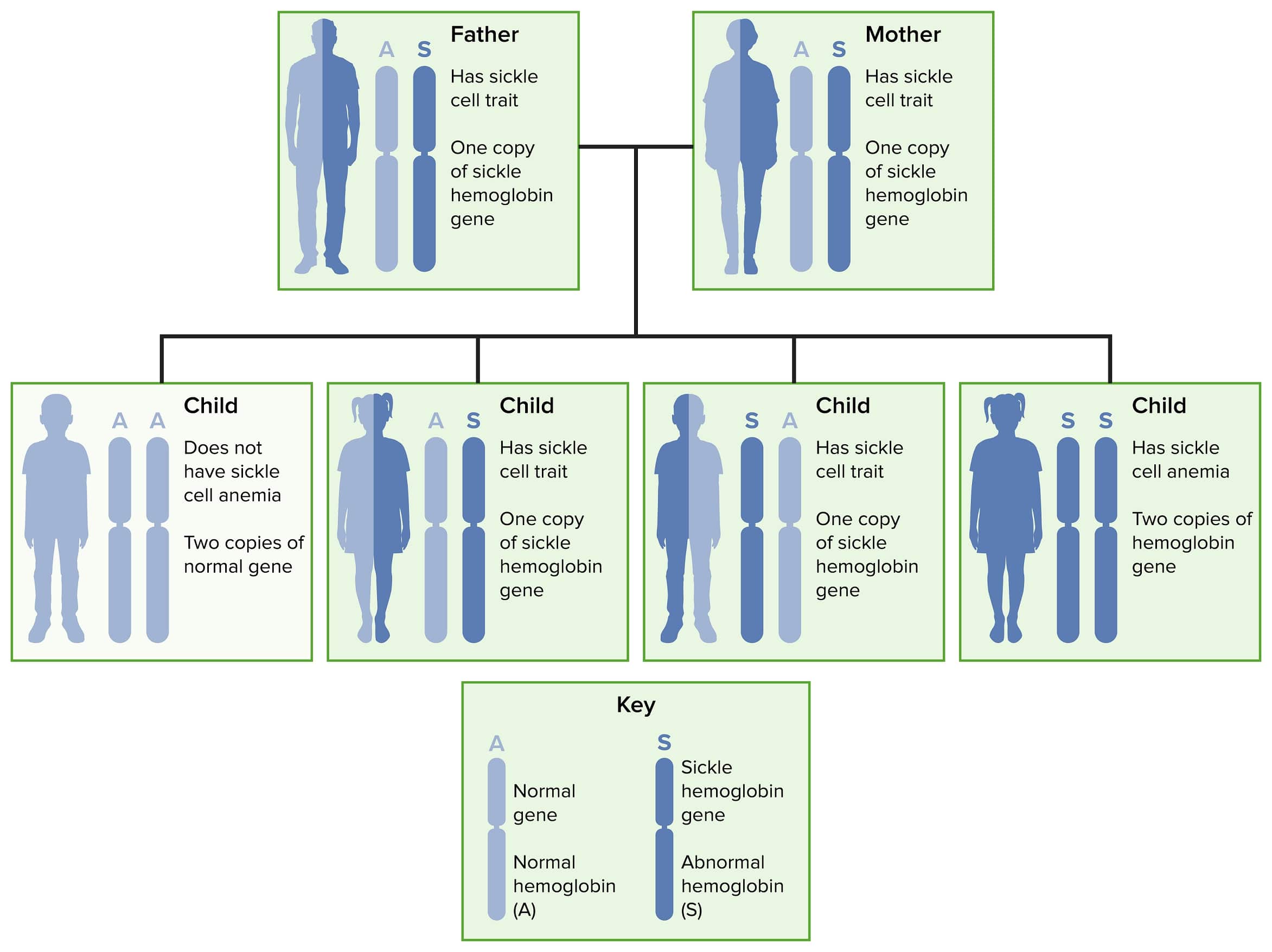
  • La enfermedad de células falciformes es cualquier síndrome con una mutación falciforme que altera la globina beta normal:
    • Determinada por emparejamientos alélicos específicos
    • Herencia autosómica recesiva
  • Genotipo homocigoto = HbSS HbSS Sickle cell disease (SCD) is a group of genetic disorders in which an abnormal Hb molecule (HbS) transforms RBCs into sickle-shaped cells, resulting in chronic anemia, vasoocclusive episodes, pain, and organ damage. Sickle Cell Disease; causa anemia Anemia Anemia is a condition in which individuals have low Hb levels, which can arise from various causes. Anemia is accompanied by a reduced number of RBCs and may manifest with fatigue, shortness of breath, pallor, and weakness. Subtypes are classified by the size of RBCs, chronicity, and etiology. Anemia: Overview and Types de células falciformes
  • Condición heterocigota = HbSA HbSA The condition of being heterozygous for hemoglobin s. Sickle Cell Disease; condición de portador benigna llamada “rasgo de células falciformes”:
    • Solo 1 alelo tiene la mutación Hb Hb The oxygen-carrying proteins of erythrocytes. They are found in all vertebrates and some invertebrates. The number of globin subunits in the hemoglobin quaternary structure differs between species. Structures range from monomeric to a variety of multimeric arrangements. Gas Exchange S
    • Importante para el asesoramiento sobre el riesgo de tener un hijo con anemia Anemia Anemia is a condition in which individuals have low Hb levels, which can arise from various causes. Anemia is accompanied by a reduced number of RBCs and may manifest with fatigue, shortness of breath, pallor, and weakness. Subtypes are classified by the size of RBCs, chronicity, and etiology. Anemia: Overview and Types de células falciformes
  • Hemoglobinopatías con otra mutación del gen de la globina:
    • Ocurren como heterocigotos compuestos con Hb Hb The oxygen-carrying proteins of erythrocytes. They are found in all vertebrates and some invertebrates. The number of globin subunits in the hemoglobin quaternary structure differs between species. Structures range from monomeric to a variety of multimeric arrangements. Gas Exchange S de 1 padre
    • Gravedad clínica variable Variable Variables represent information about something that can change. The design of the measurement scales, or of the methods for obtaining information, will determine the data gathered and the characteristics of that data. As a result, a variable can be qualitative or quantitative, and may be further classified into subgroups. Types of Variables en EN Erythema nodosum is an immune-mediated panniculitis (inflammation of the subcutaneous fat) caused by a type IV (delayed-type) hypersensitivity reaction. It commonly manifests in young women as tender, erythematous nodules on the shins. Erythema Nodosum comparación con la mutación falciforme homocigota ( HbSS HbSS Sickle cell disease (SCD) is a group of genetic disorders in which an abnormal Hb molecule (HbS) transforms RBCs into sickle-shaped cells, resulting in chronic anemia, vasoocclusive episodes, pain, and organ damage. Sickle Cell Disease)
    • Afecta los LOS Neisseria genes Genes A category of nucleic acid sequences that function as units of heredity and which code for the basic instructions for the development, reproduction, and maintenance of organisms. DNA Types and Structure de la globina alfa, beta o gamma:
      • Talasemia falciforme-beta: menos grave si la Hb Hb The oxygen-carrying proteins of erythrocytes. They are found in all vertebrates and some invertebrates. The number of globin subunits in the hemoglobin quaternary structure differs between species. Structures range from monomeric to a variety of multimeric arrangements. Gas Exchange S se combina con talasemia beta (+) (se produce algo de globina beta) que con talasemia beta-cero (no se produce globina beta)
      • Enfermedad HbSC: síntomas similares a la anemia Anemia Anemia is a condition in which individuals have low Hb levels, which can arise from various causes. Anemia is accompanied by a reduced number of RBCs and may manifest with fatigue, shortness of breath, pallor, and weakness. Subtypes are classified by the size of RBCs, chronicity, and etiology. Anemia: Overview and Types de células falciformes pero menos severos
Sickle cell disease

Herencia autosómica recesiva de la enfermedad de células falciformes y su rasgo

Imagen por Lecturio.

Fisiopatología

La molécula normal de hemoglobina adulta (HbA1) consta de 2 pares de cadenas llamadas alfa y beta.
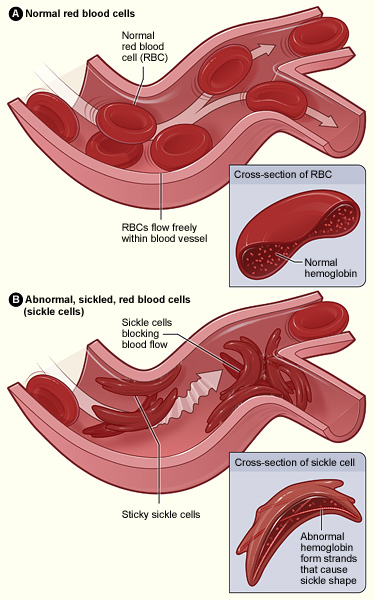
  • La Hb Hb The oxygen-carrying proteins of erythrocytes. They are found in all vertebrates and some invertebrates. The number of globin subunits in the hemoglobin quaternary structure differs between species. Structures range from monomeric to a variety of multimeric arrangements. Gas Exchange S se produce por una mutación puntual en EN Erythema nodosum is an immune-mediated panniculitis (inflammation of the subcutaneous fat) caused by a type IV (delayed-type) hypersensitivity reaction. It commonly manifests in young women as tender, erythematous nodules on the shins. Erythema Nodosum el cromosoma 11, que provoca la sustitución del ácido glutámico normal por valina (aminoácido) en EN Erythema nodosum is an immune-mediated panniculitis (inflammation of the subcutaneous fat) caused by a type IV (delayed-type) hypersensitivity reaction. It commonly manifests in young women as tender, erythematous nodules on the shins. Erythema Nodosum la 6ta posición de la cadena de beta-globina.
  • La Hb Hb The oxygen-carrying proteins of erythrocytes. They are found in all vertebrates and some invertebrates. The number of globin subunits in the hemoglobin quaternary structure differs between species. Structures range from monomeric to a variety of multimeric arrangements. Gas Exchange S es propensa a la polimerización con otras moléculas de hemoglobina en EN Erythema nodosum is an immune-mediated panniculitis (inflammation of the subcutaneous fat) caused by a type IV (delayed-type) hypersensitivity reaction. It commonly manifests in young women as tender, erythematous nodules on the shins. Erythema Nodosum condiciones de baja tensión de oxígeno.
  • La polimerización por sí sola no explica la fisiopatología, pero conduce a:
    • Una estructura celular rígida que distorsiona la membrana de los LOS Neisseria eritrocitos
    • Daño a la membrana → entrada de calcio, salida de potasio y agua → deshidrata los LOS Neisseria eritrocitos → formación de estructura en EN Erythema nodosum is an immune-mediated panniculitis (inflammation of the subcutaneous fat) caused by a type IV (delayed-type) hypersensitivity reaction. It commonly manifests in young women as tender, erythematous nodules on the shins. Erythema Nodosum hoz
    • Vaso-oclusión (oclusión microvascular): múltiples mecanismos fisiopatológicos, sólo parcialmente relacionados con el número de células falciformes irreversibles; otros factores incluyen:
    • La tendencia de los LOS Neisseria eritrocitos falciformes a adherirse y activar el endotelio vascular, lo que expone las proteínas de la matriz subendotelial (e.g., la laminina, la trombospondina de las plaquetas y el factor de von Willebrand) que también se adhieren a las células falciformes
    • Activación del factor tisular de los LOS Neisseria macrófagos: puede activar las células endoteliales y las plaquetas, así como iniciar la coagulación)
    • Inflamación, con adhesión de los LOS Neisseria leucocitos al AL Amyloidosis endotelio y reducción de la velocidad del flujo sanguíneo → aumenta la falciformación de los LOS Neisseria eritrocitos
    • Reducción del ácido nítrico porque se une a la hemoglobina libre de las células lisadas → contracción de las células del músculo liso vascular y agregación plaquetaria
    • La propia hemólisis es un importante motor Motor Neurons which send impulses peripherally to activate muscles or secretory cells. Nervous System: Histology proinflamatorio que puede elevar los LOS Neisseria niveles de trombospondina y factor de von Willebrand, que promueven la adhesión de los LOS Neisseria eritrocitos al AL Amyloidosis endotelio
    • Inicio de un ciclo positivo (“vicioso”) de daño tisular isquémico que promueve más vaso-oclusión debido a la producción de especies reactivas de oxígeno que causan inflamación y más activación plaquetaria, reclutamiento de leucocitos y activación endotelial.
  • Un acortamiento de la vida media de los LOS Neisseria eritrocitos que contienen Hb Hb The oxygen-carrying proteins of erythrocytes. They are found in all vertebrates and some invertebrates. The number of globin subunits in the hemoglobin quaternary structure differs between species. Structures range from monomeric to a variety of multimeric arrangements. Gas Exchange S a 17 días (normalmente 120 días)
  • La falcificación se ve VE Ventilation: Mechanics of Breathing agravada por condiciones de baja tensión de oxígeno, que incluyen:
    • Infección
    • Deshidratación
    • Hipoxia (e.g., altitudes elevadas, trastornos pulmonares, obstrucción de las vías respiratorias)
    • Fiebre
    • Acidosis Acidosis A pathologic condition of acid accumulation or depletion of base in the body. The two main types are respiratory acidosis and metabolic acidosis, due to metabolic acid build up. Respiratory Acidosis
Drepanocito

La hemoglobina anormal da lugar a la formación de hongos en los glóbulos rojos y a la adhesión de las células falciformes al endotelio, que es activado por los glóbulos rojos adheridos. La oclusión de los vasos pequeños se produce por un agregado de glóbulos rojos falciformes, con plaquetas y glóbulos blancos (no se muestra en la figura).

Imagen: “Sickle cell 01” por The National Heart, Lung, and Blood Institute (NHLBI). Licencia: Dominio Público

Presentación Clínica

La mayoría de los LOS Neisseria síntomas resultan de la anemia Anemia Anemia is a condition in which individuals have low Hb levels, which can arise from various causes. Anemia is accompanied by a reduced number of RBCs and may manifest with fatigue, shortness of breath, pallor, and weakness. Subtypes are classified by the size of RBCs, chronicity, and etiology. Anemia: Overview and Types y los LOS Neisseria eventos vasooclusivos que se observan en EN Erythema nodosum is an immune-mediated panniculitis (inflammation of the subcutaneous fat) caused by a type IV (delayed-type) hypersensitivity reaction. It commonly manifests in young women as tender, erythematous nodules on the shins. Erythema Nodosum individuos con anemia Anemia Anemia is a condition in which individuals have low Hb levels, which can arise from various causes. Anemia is accompanied by a reduced number of RBCs and may manifest with fatigue, shortness of breath, pallor, and weakness. Subtypes are classified by the size of RBCs, chronicity, and etiology. Anemia: Overview and Types drepanocítica o complicaciones que incluyen infección.
Enfermedad de células falciformes ( HbSS HbSS Sickle cell disease (SCD) is a group of genetic disorders in which an abnormal Hb molecule (HbS) transforms RBCs into sickle-shaped cells, resulting in chronic anemia, vasoocclusive episodes, pain, and organ damage. Sickle Cell Disease)

  • Los LOS Neisseria lactantes con anemia Anemia Anemia is a condition in which individuals have low Hb levels, which can arise from various causes. Anemia is accompanied by a reduced number of RBCs and may manifest with fatigue, shortness of breath, pallor, and weakness. Subtypes are classified by the size of RBCs, chronicity, and etiology. Anemia: Overview and Types de células falciformes son generalmente sanos al AL Amyloidosis nacer. Los LOS Neisseria síntomas se desarrollan después de los LOS Neisseria 6 meses de edad, cuando los LOS Neisseria niveles de hemoglobina fetal comienzan a disminuir (factor protector en EN Erythema nodosum is an immune-mediated panniculitis (inflammation of the subcutaneous fat) caused by a type IV (delayed-type) hypersensitivity reaction. It commonly manifests in young women as tender, erythematous nodules on the shins. Erythema Nodosum los LOS Neisseria recién nacidos)
  • Principales manifestaciones agudas:
    • Eventos vasooclusivos: se presentan súbitamente con dolor Dolor Inflammation intenso e infarto del tejido afectado
    • Infección:
      • Sepsis Sepsis Systemic inflammatory response syndrome with a proven or suspected infectious etiology. When sepsis is associated with organ dysfunction distant from the site of infection, it is called severe sepsis. When sepsis is accompanied by hypotension despite adequate fluid infusion, it is called septic shock. Sepsis and Septic Shock
      • Neumonía
      • Meningitis Meningitis Meningitis is inflammation of the meninges, the protective membranes of the brain, and spinal cord. The causes of meningitis are varied, with the most common being bacterial or viral infection. The classic presentation of meningitis is a triad of fever, altered mental status, and nuchal rigidity. Meningitis
    • Anemia Anemia Anemia is a condition in which individuals have low Hb levels, which can arise from various causes. Anemia is accompanied by a reduced number of RBCs and may manifest with fatigue, shortness of breath, pallor, and weakness. Subtypes are classified by the size of RBCs, chronicity, and etiology. Anemia: Overview and Types
      • Episodio aplásico transitorio: empeoramiento de los LOS Neisseria síntomas anémicos más púrpura, petequias y sangrado de las mucosas
      • Puede ser desencadenada por infección con parvovirus humano B19 → ralentización transitoria de la eritropoyesis de la médula ósea
    • Sistema nervioso central (SNC): accidente cerebrovascular isquémico o accidente isquémico transitorio
    • Pulmón:
      • Embolia pulmonar o microembolia (que eventualmente conduce a hipertensión pulmonar) y fibrosis Fibrosis Any pathological condition where fibrous connective tissue invades any organ, usually as a consequence of inflammation or other injury. Bronchiolitis Obliterans pulmonar
      • Síndrome torácico agudo: dolor Dolor Inflammation torácico, fiebre, infiltrados pulmonares, hipoxemia
    • Riñón:
    • Huesos y articulaciones:
    • Corazón: infarto de miocardio (IM)
    • Hígado:
      • Dolor Dolor Inflammation abdominal en EN Erythema nodosum is an immune-mediated panniculitis (inflammation of the subcutaneous fat) caused by a type IV (delayed-type) hypersensitivity reaction. It commonly manifests in young women as tender, erythematous nodules on the shins. Erythema Nodosum el cuadrante superior derecho
      • Ictericia debida al AL Amyloidosis agrandamiento agudo del hígado/secuestro hepático
    • Ojos: oclusión de la arteria retiniana, desprendimiento de retina Retina The ten-layered nervous tissue membrane of the eye. It is continuous with the optic nerve and receives images of external objects and transmits visual impulses to the brain. Its outer surface is in contact with the choroid and the inner surface with the vitreous body. The outermost layer is pigmented, whereas the inner nine layers are transparent. Eye: Anatomy
    • Bazo:
      • Niños: aumenta de tamaño, puede haber acumulación de sangre que causa dolor Dolor Inflammation abdominal en EN Erythema nodosum is an immune-mediated panniculitis (inflammation of the subcutaneous fat) caused by a type IV (delayed-type) hypersensitivity reaction. It commonly manifests in young women as tender, erythematous nodules on the shins. Erythema Nodosum el cuadrante superior izquierdo, debilidad, hipotensión y shock Shock Shock is a life-threatening condition associated with impaired circulation that results in tissue hypoxia. The different types of shock are based on the underlying cause: distributive (↑ cardiac output (CO), ↓ systemic vascular resistance (SVR)), cardiogenic (↓ CO, ↑ SVR), hypovolemic (↓ CO, ↑ SVR), obstructive (↓ CO), and mixed. Types of Shock (secuestro esplénico)
      • Adultos: la autoesplenectomía ocurre con la edad, lo que lleva a complicaciones infecciosas
    • Gastrointestinales: dolor Dolor Inflammation abdominal intenso, con o sin vómitos
    • Pene: priapismo (erección sostenida que dura > 4 horas); también se puede observar en EN Erythema nodosum is an immune-mediated panniculitis (inflammation of the subcutaneous fat) caused by a type IV (delayed-type) hypersensitivity reaction. It commonly manifests in young women as tender, erythematous nodules on the shins. Erythema Nodosum niños con anemia Anemia Anemia is a condition in which individuals have low Hb levels, which can arise from various causes. Anemia is accompanied by a reduced number of RBCs and may manifest with fatigue, shortness of breath, pallor, and weakness. Subtypes are classified by the size of RBCs, chronicity, and etiology. Anemia: Overview and Types de células falciformes
  • Principales manifestaciones crónicas:
    • Dolor Dolor Inflammation crónico por:
      • Infarto de tejido
      • Osteonecrosis
    • Infección crónica:
      • Úlceras en EN Erythema nodosum is an immune-mediated panniculitis (inflammation of the subcutaneous fat) caused by a type IV (delayed-type) hypersensitivity reaction. It commonly manifests in young women as tender, erythematous nodules on the shins. Erythema Nodosum las piernas
      • Osteomielitis
    • Hemólisis crónica (intravascular y extravascular) → anemia Anemia Anemia is a condition in which individuals have low Hb levels, which can arise from various causes. Anemia is accompanied by a reduced number of RBCs and may manifest with fatigue, shortness of breath, pallor, and weakness. Subtypes are classified by the size of RBCs, chronicity, and etiology. Anemia: Overview and Types:
      • Fatiga
      • Palidez
      • Taquicardia
      • Retraso cognitivo y retraso en EN Erythema nodosum is an immune-mediated panniculitis (inflammation of the subcutaneous fat) caused by a type IV (delayed-type) hypersensitivity reaction. It commonly manifests in young women as tender, erythematous nodules on the shins. Erythema Nodosum el crecimiento en EN Erythema nodosum is an immune-mediated panniculitis (inflammation of the subcutaneous fat) caused by a type IV (delayed-type) hypersensitivity reaction. It commonly manifests in young women as tender, erythematous nodules on the shins. Erythema Nodosum niños
      • La deficiencia de folato puede empeorar la anemia Anemia Anemia is a condition in which individuals have low Hb levels, which can arise from various causes. Anemia is accompanied by a reduced number of RBCs and may manifest with fatigue, shortness of breath, pallor, and weakness. Subtypes are classified by the size of RBCs, chronicity, and etiology. Anemia: Overview and Types crónica.
    • Osteoporosis Osteoporosis Osteoporosis refers to a decrease in bone mass and density leading to an increased number of fractures. There are 2 forms of osteoporosis: primary, which is commonly postmenopausal or senile; and secondary, which is a manifestation of immobilization, underlying medical disorders, or long-term use of certain medications. Osteoporosis
    • Ceguera por retinopatía crónica
    • La hemólisis de los LOS Neisseria eritrocitos puede causar cálculos biliares de pigmento.
  • Complicaciones:
    • Eventos vasooclusivos recurrentes e infartos tisulares → daño de órganos:
    • El síndrome torácico agudo puede poner en EN Erythema nodosum is an immune-mediated panniculitis (inflammation of the subcutaneous fat) caused by a type IV (delayed-type) hypersensitivity reaction. It commonly manifests in young women as tender, erythematous nodules on the shins. Erythema Nodosum peligro la vida; es la causa más común de muerte en EN Erythema nodosum is an immune-mediated panniculitis (inflammation of the subcutaneous fat) caused by a type IV (delayed-type) hypersensitivity reaction. It commonly manifests in young women as tender, erythematous nodules on the shins. Erythema Nodosum pacientes con anemia Anemia Anemia is a condition in which individuals have low Hb levels, which can arise from various causes. Anemia is accompanied by a reduced number of RBCs and may manifest with fatigue, shortness of breath, pallor, and weakness. Subtypes are classified by the size of RBCs, chronicity, and etiology. Anemia: Overview and Types de células falciformes.
    • Corazón: cor pulmonale Cor Pulmonale Cor pulmonale is right ventricular (RV) dysfunction caused by lung disease that results in pulmonary artery hypertension. The most common cause of cor pulmonale is chronic obstructive pulmonary disease. Dyspnea is the usual presenting symptom. Cor Pulmonale e insuficiencia cardíaca
    • Riñón: enfermedad renal crónica (ERC), hipertensión
    • Musculoesqueléticas: osteonecrosis, osteoporosis Osteoporosis Osteoporosis refers to a decrease in bone mass and density leading to an increased number of fractures. There are 2 forms of osteoporosis: primary, which is commonly postmenopausal or senile; and secondary, which is a manifestation of immobilization, underlying medical disorders, or long-term use of certain medications. Osteoporosis y talla baja en EN Erythema nodosum is an immune-mediated panniculitis (inflammation of the subcutaneous fat) caused by a type IV (delayed-type) hypersensitivity reaction. It commonly manifests in young women as tender, erythematous nodules on the shins. Erythema Nodosum niños
    • Infecciones:
      • Mayor riesgo de infección con bacterias encapsuladas (e.g., Streptococcus Streptococcus Streptococcus is one of the two medically important genera of gram-positive cocci, the other being Staphylococcus. Streptococci are identified as different species on blood agar on the basis of their hemolytic pattern and sensitivity to optochin and bacitracin. There are many pathogenic species of streptococci, including S. pyogenes, S. agalactiae, S. pneumoniae, and the viridans streptococci. Streptococcus pneumoniae, Haemophilus influenzae Haemophilus Influenzae A species of Haemophilus found on the mucous membranes of humans and a variety of animals. The species is further divided into biotypes I through viii. Haemophilus, Neisseria meningitidis Neisseria meningitidis A species of gram-negative, aerobic bacteria. It is a commensal and pathogen only of humans, and can be carried asymptomatically in the nasopharynx. When found in cerebrospinal fluid it is the causative agent of cerebrospinal meningitis. It is also found in venereal discharges and blood. There are at least 13 serogroups based on antigenic differences in the capsular polysaccharides; the ones causing most meningitis infections being a, b, c, y, and w-135. Each serogroup can be further classified by serotype, serosubtype, and immunotype. Neisseria) debido a la pérdida de la función esplénica
      • Hepatitis
      • Osteomielitis
      • Artritis séptica
      • Neumonía
      • Meningitis Meningitis Meningitis is inflammation of the meninges, the protective membranes of the brain, and spinal cord. The causes of meningitis are varied, with the most common being bacterial or viral infection. The classic presentation of meningitis is a triad of fever, altered mental status, and nuchal rigidity. Meningitis
      • Sepsis Sepsis Systemic inflammatory response syndrome with a proven or suspected infectious etiology. When sepsis is associated with organ dysfunction distant from the site of infection, it is called severe sepsis. When sepsis is accompanied by hypotension despite adequate fluid infusion, it is called septic shock. Sepsis and Septic Shock
sickle cell disease

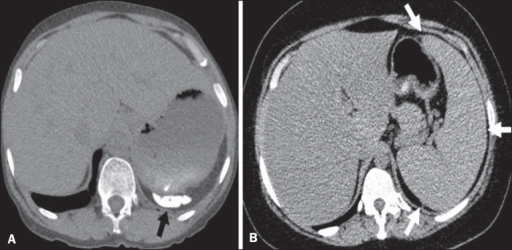
Diferentes patrones de afectación esplénica en la enfermedad de células falciformes:
A: atrofia y calcificación del bazo (flecha)
B: esplenomegalia (flechas)

Imagen: “f6: Different patterns of splenic involvement in sickle cell disease. Sicklecell disease (HbSS) shows atrophy and calcification of the spleen (arrowon A), whereas non-HbSS sickle cell disease can showsplenomegaly (arrows on B).” por Ursula David Alves et al. Licencia: CC BY 4.0

Rasgo de células falciformes ( HbSA HbSA The condition of being heterozygous for hemoglobin s. Sickle Cell Disease)

  • Generalmente asintomático o solo síntomas leves
  • Pueden tener hematuria Hematuria Presence of blood in the urine. Renal Cell Carcinoma indolora debido a la necrosis Necrosis The death of cells in an organ or tissue due to disease, injury or failure of the blood supply. Ischemic Cell Damage papilar renal
  • Disminución (hipostenuria) o pérdida (isostenuria) de la capacidad para concentrar la orina
  • Raramente:
    • Episodios agudos de células falciformes, rabdomiólisis y muerte si se expone a grandes alturas, deshidratación extrema o ejercicio
    • ERC
    • Tromboembolismo pulmonar
    • Carcinoma medular de riñón, raro
  • Beneficio del rasgo de células falciformes: mejora de la supervivencia con infección palúdica
  • Los LOS Neisseria homocigotos de células falciformes ( HbSS HbSS Sickle cell disease (SCD) is a group of genetic disorders in which an abnormal Hb molecule (HbS) transforms RBCs into sickle-shaped cells, resulting in chronic anemia, vasoocclusive episodes, pain, and organ damage. Sickle Cell Disease) no se benefician de la anemia Anemia Anemia is a condition in which individuals have low Hb levels, which can arise from various causes. Anemia is accompanied by a reduced number of RBCs and may manifest with fatigue, shortness of breath, pallor, and weakness. Subtypes are classified by the size of RBCs, chronicity, and etiology. Anemia: Overview and Types de células falciformes; se ven perjudicados por infecciones palúdicas, que empeoran la anemia Anemia Anemia is a condition in which individuals have low Hb levels, which can arise from various causes. Anemia is accompanied by a reduced number of RBCs and may manifest with fatigue, shortness of breath, pallor, and weakness. Subtypes are classified by the size of RBCs, chronicity, and etiology. Anemia: Overview and Types preexistente.

Diagnóstico

La enfermedad de células falciformes generalmente se diagnostica prenatalmente o al AL Amyloidosis nacer mediante un tamizaje neonatal obligatorio. Los LOS Neisseria métodos varían de un estado a otro.
  • Pruebas:
    • Prenatal:
      • Reacción en EN Erythema nodosum is an immune-mediated panniculitis (inflammation of the subcutaneous fat) caused by a type IV (delayed-type) hypersensitivity reaction. It commonly manifests in young women as tender, erythematous nodules on the shins. Erythema Nodosum cadena de polimerasa ( PCR PCR Polymerase chain reaction (PCR) is a technique that amplifies DNA fragments exponentially for analysis. The process is highly specific, allowing for the targeting of specific genomic sequences, even with minuscule sample amounts. The PCR cycles multiple times through 3 phases: denaturation of the template DNA, annealing of a specific primer to the individual DNA strands, and synthesis/elongation of new DNA molecules. Polymerase Chain Reaction (PCR), por sus siglas en EN Erythema nodosum is an immune-mediated panniculitis (inflammation of the subcutaneous fat) caused by a type IV (delayed-type) hypersensitivity reaction. It commonly manifests in young women as tender, erythematous nodules on the shins. Erythema Nodosum inglés) o prueba directa de ácido desoxirribonucleico (ADN)
      • El tamizaje genético se puede realizar en EN Erythema nodosum is an immune-mediated panniculitis (inflammation of the subcutaneous fat) caused by a type IV (delayed-type) hypersensitivity reaction. It commonly manifests in young women as tender, erythematous nodules on the shins. Erythema Nodosum muestras de vellosidades coriónicas entre las 8–12 semanas de gestación
    • Tamizaje universal de recién nacidos en EN Erythema nodosum is an immune-mediated panniculitis (inflammation of the subcutaneous fat) caused by a type IV (delayed-type) hypersensitivity reaction. It commonly manifests in young women as tender, erythematous nodules on the shins. Erythema Nodosum los LOS Neisseria 50 estados de Estados Unidos:
      • El reconocimiento temprano de los LOS Neisseria lactantes afectados ha HA Hemolytic anemia (HA) is the term given to a large group of anemias that are caused by the premature destruction/hemolysis of circulating red blood cells (RBCs). Hemolysis can occur within (intravascular hemolysis) or outside the blood vessels (extravascular hemolysis). Hemolytic Anemia reducido la morbilidad por infecciones
      • La penicilina profiláctica y la atención médica regular Regular Insulin han reducido significativamente la mortalidad en EN Erythema nodosum is an immune-mediated panniculitis (inflammation of the subcutaneous fat) caused by a type IV (delayed-type) hypersensitivity reaction. It commonly manifests in young women as tender, erythematous nodules on the shins. Erythema Nodosum niños pequeños
      • Métodos: electroforesis de hemoglobina, enfoque isoeléctrico o cromatografía líquida de alta resolución seguida de secuenciación de ADN si es anormal
    • Niños y adultos:
      • Individuos con signos o síntomas
      • Individuos con antecedentes familiares de enfermedad de células falciformes
      • La electroforesis de hemoglobina diferencia a los LOS Neisseria homocigotos de los LOS Neisseria heterocigotos (portadores)
  • Patrones de electroforesis de hemoglobina:
    • En EN Erythema nodosum is an immune-mediated panniculitis (inflammation of the subcutaneous fat) caused by a type IV (delayed-type) hypersensitivity reaction. It commonly manifests in young women as tender, erythematous nodules on the shins. Erythema Nodosum pacientes con genotipo HbSS HbSS Sickle cell disease (SCD) is a group of genetic disorders in which an abnormal Hb molecule (HbS) transforms RBCs into sickle-shaped cells, resulting in chronic anemia, vasoocclusive episodes, pain, and organ damage. Sickle Cell Disease:
      • El patrón de HbFS sugiere enfermedad de células falciformes
      • No hay presencia de HbA1 o HbA2
    • El patrón de HbFSA sugiere un estado compuesto que involucra una mutación de células falciformes
      • Talasemia falciforme-beta
      • Enfermedad HbSC
    • El patrón de HbFAS sugiere rasgo de células falciformes
  • Resultados del hemograma:
    • Anemia Anemia Anemia is a condition in which individuals have low Hb levels, which can arise from various causes. Anemia is accompanied by a reduced number of RBCs and may manifest with fatigue, shortness of breath, pallor, and weakness. Subtypes are classified by the size of RBCs, chronicity, and etiology. Anemia: Overview and Types hemolítica crónica compensada con anemia Anemia Anemia is a condition in which individuals have low Hb levels, which can arise from various causes. Anemia is accompanied by a reduced number of RBCs and may manifest with fatigue, shortness of breath, pallor, and weakness. Subtypes are classified by the size of RBCs, chronicity, and etiology. Anemia: Overview and Types de células falciformes ( HbSS HbSS Sickle cell disease (SCD) is a group of genetic disorders in which an abnormal Hb molecule (HbS) transforms RBCs into sickle-shaped cells, resulting in chronic anemia, vasoocclusive episodes, pain, and organ damage. Sickle Cell Disease):
      • Nivel de hemoglobina de aproximadamente 8,0–10,0 g/dL (normal: 12,0–15,5 g/dL para mujeres, 13,5–17,5 g/dL para hombres)
      • Hematocrito aproximadamente 20%–30% (normal: 36%–44% para mujeres, 41%–50% para hombres)
      • Volumen corpuscular medio (VCM) normal
      • ↑ Leucocitos
    • Frotis de sangre periférica:
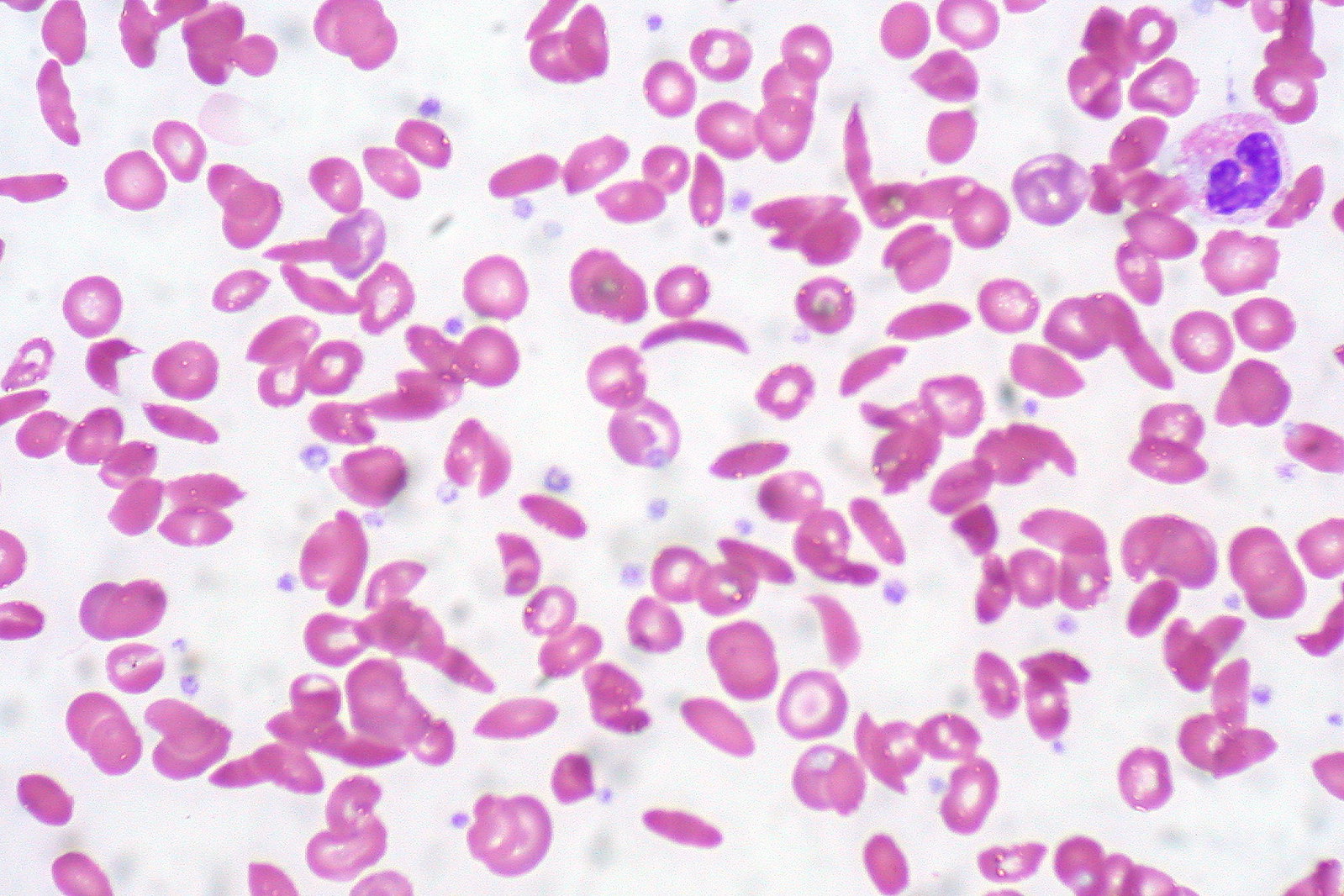
      • Células falciformes
      • Cuerpos de Howell-Jolly en EN Erythema nodosum is an immune-mediated panniculitis (inflammation of the subcutaneous fat) caused by a type IV (delayed-type) hypersensitivity reaction. It commonly manifests in young women as tender, erythematous nodules on the shins. Erythema Nodosum individuos con autoesplenectomía (eritrocitos inmaduros con restos nucleares basófilos)
      • Reticulocitos
      • Células diana con enfermedad HbSC
  • Otras pruebas
    • ↑↑ Recuento de reticulocitos
    • ↓ Velocidad de eritrosedimentación (VES)
    • ↑ Bilirrubina
    • ↑ Nitrógeno de urea Urea A compound formed in the liver from ammonia produced by the deamination of amino acids. It is the principal end product of protein catabolism and constitutes about one half of the total urinary solids. Urea Cycle (BUN, por sus siglas en EN Erythema nodosum is an immune-mediated panniculitis (inflammation of the subcutaneous fat) caused by a type IV (delayed-type) hypersensitivity reaction. It commonly manifests in young women as tender, erythematous nodules on the shins. Erythema Nodosum inglés) ↑ creatinina
    • Pruebas de función hepática: ↑ aspartato aminotransferasa/alanina aminotransferasa ( AST AST Enzymes of the transferase class that catalyze the conversion of l-aspartate and 2-ketoglutarate to oxaloacetate and l-glutamate. Liver Function Tests/ ALT ALT An enzyme that catalyzes the conversion of l-alanine and 2-oxoglutarate to pyruvate and l-glutamate. Liver Function Tests)
Anemia de células falciformes - Frotis de sangre periférica

Frotis de sangre periférica que muestra una mezcla de eritrocitos, algunos con morfología redonda normal y otros con forma de hoz (alargamiento y flexión)

Imagen: “Sickle Cell Anemia” por Ed Uthman. Licencia: CC BY 2.0

Tratamiento

El tratamiento de los LOS Neisseria episodios dolorosos incluye analgésicos y medidas generales de soporte. Las transfusiones pueden ser necesarias en EN Erythema nodosum is an immune-mediated panniculitis (inflammation of the subcutaneous fat) caused by a type IV (delayed-type) hypersensitivity reaction. It commonly manifests in young women as tender, erythematous nodules on the shins. Erythema Nodosum ocasiones si el paciente tiene anemia Anemia Anemia is a condition in which individuals have low Hb levels, which can arise from various causes. Anemia is accompanied by a reduced number of RBCs and may manifest with fatigue, shortness of breath, pallor, and weakness. Subtypes are classified by the size of RBCs, chronicity, and etiology. Anemia: Overview and Types sintomática, incluyendo la complicación del síndrome torácico agudo

Tratamiento

  • Hidroxiurea para la prevención y tratamiento de eventos vasooclusivos:
    • Mecanismo de acción:
    • Reduce el dolor Dolor Inflammation y otras complicaciones vasooclusivas
    • Disminuye las tasas de hospitalización
    • Mejora la supervivencia
  • Prevención de infecciones:
    • Vacunas apropiadas para la edad:
      • S. pneumoniae (vacunas neumocócicas conjugadas y de polisacáridos)
      • Influenza Influenza Influenza viruses are members of the Orthomyxoviridae family and the causative organisms of influenza, a highly contagious febrile respiratory disease. There are 3 primary influenza viruses (A, B, and C) and various subtypes, which are classified based on their virulent surface antigens, hemagglutinin (HA) and neuraminidase (NA). Influenza typically presents with a fever, myalgia, headache, and symptoms of an upper respiratory infection. Influenza Viruses/Influenza estacional
      • N. meningitidis N. meningitidis A species of gram-negative, aerobic bacteria. It is a commensal and pathogen only of humans, and can be carried asymptomatically in the nasopharynx. When found in cerebrospinal fluid it is the causative agent of cerebrospinal meningitis. It is also found in venereal discharges and blood. There are at least 13 serogroups based on antigenic differences in the capsular polysaccharides; the ones causing most meningitis infections being a, b, c, y, and w-135. Each serogroup can be further classified by serotype, serosubtype, and immunotype. Neisseria
      • H. influenzae H. influenzae A species of Haemophilus found on the mucous membranes of humans and a variety of animals. The species is further divided into biotypes I through VIII. Haemophilus tipo b (Hib)
      • Hepatitis B Hepatitis B Hepatitis B virus (HBV) is a partially double-stranded DNA virus, which belongs to the Orthohepadnavirus genus and the Hepadnaviridae family. Most individuals with acute HBV infection are asymptomatic or have mild, self-limiting symptoms. Chronic infection can be asymptomatic or create hepatic inflammation, leading to liver cirrhosis and hepatocellular carcinoma (HCC). Hepatitis B Virus
    • Profilaxis con penicilina:
      • Comenzar dentro de los LOS Neisseria primeros 3 meses de vida.
      • Eritromicina si alergia a la penicilina
      • Continuar hasta los LOS Neisseria 5 años.
  • Suplementación con ácido fólico
  • Indicaciones para transfusión:
    • Anemia Anemia Anemia is a condition in which individuals have low Hb levels, which can arise from various causes. Anemia is accompanied by a reduced number of RBCs and may manifest with fatigue, shortness of breath, pallor, and weakness. Subtypes are classified by the size of RBCs, chronicity, and etiology. Anemia: Overview and Types sintomática
    • Antes de una operación
    • Accidente cerebrovascular agudo
    • Fallo multiorgánico
    • Síndrome torácico agudo
    • Priapismo recurrente
  • El trasplante de células madre hematopoyéticas es la única opción curativa.
  • Terapias no utilizadas para episodios vasooclusivos agudos:
    • O2: a menos que la saturación esté por debajo de los LOS Neisseria límites o haya síntomas pulmonares
    • Hielo: puede precipitar la formación de células falciformes
    • Meperidina: asociada con la acumulación de metabolitos, lo que lleva a convulsiones
    • Ketorolaco: por su toxicidad
    • Transfusión para el dolor Dolor Inflammation vasooclusivo agudo sin anemia Anemia Anemia is a condition in which individuals have low Hb levels, which can arise from various causes. Anemia is accompanied by a reduced number of RBCs and may manifest with fatigue, shortness of breath, pallor, and weakness. Subtypes are classified by the size of RBCs, chronicity, and etiology. Anemia: Overview and Types sintomática
    • Factor estimulante de colonias de granulocitos: debido al AL Amyloidosis riesgo de falla multiorgánica y muerte (con raras excepciones)

Complicaciones y pronóstico

  • Síndrome torácico agudo: una nueva radiodensidad en EN Erythema nodosum is an immune-mediated panniculitis (inflammation of the subcutaneous fat) caused by a type IV (delayed-type) hypersensitivity reaction. It commonly manifests in young women as tender, erythematous nodules on the shins. Erythema Nodosum la radiografía de tórax acompañada de fiebre y/o síntomas respiratorios
    • Fisiopatología: generalmente vaso-oclusión en EN Erythema nodosum is an immune-mediated panniculitis (inflammation of the subcutaneous fat) caused by a type IV (delayed-type) hypersensitivity reaction. It commonly manifests in young women as tender, erythematous nodules on the shins. Erythema Nodosum la microvasculatura pulmonar debido a los LOS Neisseria émbolos de grasa causados por el infarto de la médula ósea
    • Una de las principales causas de muerte de los LOS Neisseria pacientes con anemia Anemia Anemia is a condition in which individuals have low Hb levels, which can arise from various causes. Anemia is accompanied by a reduced number of RBCs and may manifest with fatigue, shortness of breath, pallor, and weakness. Subtypes are classified by the size of RBCs, chronicity, and etiology. Anemia: Overview and Types falciforme; más grave en EN Erythema nodosum is an immune-mediated panniculitis (inflammation of the subcutaneous fat) caused by a type IV (delayed-type) hypersensitivity reaction. It commonly manifests in young women as tender, erythematous nodules on the shins. Erythema Nodosum los LOS Neisseria adultos
    • Necesita un tratamiento rápido para evitar el deterioro clínico y la muerte
  • Pronóstico:
    • La supervivencia de las personas con anemia Anemia Anemia is a condition in which individuals have low Hb levels, which can arise from various causes. Anemia is accompanied by a reduced number of RBCs and may manifest with fatigue, shortness of breath, pallor, and weakness. Subtypes are classified by the size of RBCs, chronicity, and etiology. Anemia: Overview and Types falciforme ha HA Hemolytic anemia (HA) is the term given to a large group of anemias that are caused by the premature destruction/hemolysis of circulating red blood cells (RBCs). Hemolysis can occur within (intravascular hemolysis) or outside the blood vessels (extravascular hemolysis). Hemolytic Anemia mejorado notablemente en EN Erythema nodosum is an immune-mediated panniculitis (inflammation of the subcutaneous fat) caused by a type IV (delayed-type) hypersensitivity reaction. It commonly manifests in young women as tender, erythematous nodules on the shins. Erythema Nodosum los LOS Neisseria últimos 40 años en EN Erythema nodosum is an immune-mediated panniculitis (inflammation of the subcutaneous fat) caused by a type IV (delayed-type) hypersensitivity reaction. It commonly manifests in young women as tender, erythematous nodules on the shins. Erythema Nodosum los LOS Neisseria Estados Unidos.
    • La principal causa de muerte ha HA Hemolytic anemia (HA) is the term given to a large group of anemias that are caused by the premature destruction/hemolysis of circulating red blood cells (RBCs). Hemolysis can occur within (intravascular hemolysis) or outside the blood vessels (extravascular hemolysis). Hemolytic Anemia pasado de las infecciones al AL Amyloidosis daño orgánico progresivo
    • La mediana de la esperanza de vida de los LOS Neisseria adultos con anemia Anemia Anemia is a condition in which individuals have low Hb levels, which can arise from various causes. Anemia is accompanied by a reduced number of RBCs and may manifest with fatigue, shortness of breath, pallor, and weakness. Subtypes are classified by the size of RBCs, chronicity, and etiology. Anemia: Overview and Types falciforme es ≥20 años menor que la de los LOS Neisseria afroamericanos sin anemia Anemia Anemia is a condition in which individuals have low Hb levels, which can arise from various causes. Anemia is accompanied by a reduced number of RBCs and may manifest with fatigue, shortness of breath, pallor, and weakness. Subtypes are classified by the size of RBCs, chronicity, and etiology. Anemia: Overview and Types falciforme que viven en EN Erythema nodosum is an immune-mediated panniculitis (inflammation of the subcutaneous fat) caused by a type IV (delayed-type) hypersensitivity reaction. It commonly manifests in young women as tender, erythematous nodules on the shins. Erythema Nodosum EE.UU.
Resumen del tratamiento de la enfermedad de células falciformes
Presentación clínica Tratamiento
Episodios de dolor Dolor Inflammation agudo/eventos vasooclusivos
  • Hidratación oral
  • Control del dolor Dolor Inflammation con analgésicos opiáceos orales (o intravenosos si es necesario) de acción rápida
  • Líquidos intravenosos si está en EN Erythema nodosum is an immune-mediated panniculitis (inflammation of the subcutaneous fat) caused by a type IV (delayed-type) hypersensitivity reaction. It commonly manifests in young women as tender, erythematous nodules on the shins. Erythema Nodosum estado hipovolémico y para el control del dolor Dolor Inflammation
  • Espirometría de incentivo para reducir el riesgo de síndrome torácico agudo
  • Profilaxis tromboembólica
  • Hidroxiurea
  • Ácido fólico (para la deficiencia de folato)
  • Exanguinotransfusión ( en EN Erythema nodosum is an immune-mediated panniculitis (inflammation of the subcutaneous fat) caused by a type IV (delayed-type) hypersensitivity reaction. It commonly manifests in young women as tender, erythematous nodules on the shins. Erythema Nodosum caso de hemoglobina < 6 g/dL o síndrome torácico agudo)
Secuestro esplénico agudo
  • Exanguinotransfusión
  • Esplenectomía (retraso hasta la edad de 3–5 años)
Infecciones Prevención:
  • Vacunación
  • Penicilina profiláctica para niños < 5 años
Priapismo
  • Hidratación
  • Analgésicos
Tamizaje profiláctico
  • Accidente cerebrovascular: examen Doppler Doppler Ultrasonography applying the doppler effect, with frequency-shifted ultrasound reflections produced by moving targets (usually red blood cells) in the bloodstream along the ultrasound axis in direct proportion to the velocity of movement of the targets, to determine both direction and velocity of blood flow. Ultrasound (Sonography) transcraneal anual (2–16 años de edad)
  • Retinopatía: examen anual de la retina Retina The ten-layered nervous tissue membrane of the eye. It is continuous with the optic nerve and receives images of external objects and transmits visual impulses to the brain. Its outer surface is in contact with the choroid and the inner surface with the vitreous body. The outermost layer is pigmented, whereas the inner nine layers are transparent. Eye: Anatomy (a partir de los LOS Neisseria 10 años)
  • Ecocardiografía: para la hipertensión pulmonar (infancia/edad adulta temprana)
  • Análisis de orina: anualmente para proteinuria Proteinuria The presence of proteins in the urine, an indicator of kidney diseases. Nephrotic Syndrome in Children/cilindros
Refractario
  • Trasplante de células madre hematopoyéticas si:
    • Refractarios a la hidroxiurea
    • Daño terminal de algún órgano
    • Niños (edad < 18)
  • La terapia génica o las técnicas de edición de genes Genes A category of nucleic acid sequences that function as units of heredity and which code for the basic instructions for the development, reproduction, and maintenance of organisms. DNA Types and Structure que reducen la cantidad de Hb Hb The oxygen-carrying proteins of erythrocytes. They are found in all vertebrates and some invertebrates. The number of globin subunits in the hemoglobin quaternary structure differs between species. Structures range from monomeric to a variety of multimeric arrangements. Gas Exchange S se encuentran actualmente en EN Erythema nodosum is an immune-mediated panniculitis (inflammation of the subcutaneous fat) caused by a type IV (delayed-type) hypersensitivity reaction. It commonly manifests in young women as tender, erythematous nodules on the shins. Erythema Nodosum ensayos clínicos.

Diagnóstico Diferencial

  • Anemia Anemia Anemia is a condition in which individuals have low Hb levels, which can arise from various causes. Anemia is accompanied by a reduced number of RBCs and may manifest with fatigue, shortness of breath, pallor, and weakness. Subtypes are classified by the size of RBCs, chronicity, and etiology. Anemia: Overview and Types hemolítica: grupo de afecciones definidas por la descomposición de los LOS Neisseria eritrocitos, reducción de los LOS Neisseria niveles de hemoglobina y reticulocitosis. La enfermedad de células falciformes es una forma de anemia Anemia Anemia is a condition in which individuals have low Hb levels, which can arise from various causes. Anemia is accompanied by a reduced number of RBCs and may manifest with fatigue, shortness of breath, pallor, and weakness. Subtypes are classified by the size of RBCs, chronicity, and etiology. Anemia: Overview and Types hemolítica con episodios vasooclusivos. Otras causas de anemia Anemia Anemia is a condition in which individuals have low Hb levels, which can arise from various causes. Anemia is accompanied by a reduced number of RBCs and may manifest with fatigue, shortness of breath, pallor, and weakness. Subtypes are classified by the size of RBCs, chronicity, and etiology. Anemia: Overview and Types hemolítica deben ser consideradas en EN Erythema nodosum is an immune-mediated panniculitis (inflammation of the subcutaneous fat) caused by a type IV (delayed-type) hypersensitivity reaction. It commonly manifests in young women as tender, erythematous nodules on the shins. Erythema Nodosum el diagnóstico diferencial.
    • Talasemia: deficiencia hereditaria en EN Erythema nodosum is an immune-mediated panniculitis (inflammation of the subcutaneous fat) caused by a type IV (delayed-type) hypersensitivity reaction. It commonly manifests in young women as tender, erythematous nodules on the shins. Erythema Nodosum la cadena de globina alfa o beta que produce anemia Anemia Anemia is a condition in which individuals have low Hb levels, which can arise from various causes. Anemia is accompanied by a reduced number of RBCs and may manifest with fatigue, shortness of breath, pallor, and weakness. Subtypes are classified by the size of RBCs, chronicity, and etiology. Anemia: Overview and Types hipocrómica. La presentación es principalmente con anemia Anemia Anemia is a condition in which individuals have low Hb levels, which can arise from various causes. Anemia is accompanied by a reduced number of RBCs and may manifest with fatigue, shortness of breath, pallor, and weakness. Subtypes are classified by the size of RBCs, chronicity, and etiology. Anemia: Overview and Types severa y los LOS Neisseria individuos más gravemente afectados dependen de transfusiones. El diagnóstico se confirma mediante electroforesis de hemoglobina. El tratamiento incluye suplementos de folato, transfusiones, quelación de hierro y esplenectomía.
    • Anemia Anemia Anemia is a condition in which individuals have low Hb levels, which can arise from various causes. Anemia is accompanied by a reduced number of RBCs and may manifest with fatigue, shortness of breath, pallor, and weakness. Subtypes are classified by the size of RBCs, chronicity, and etiology. Anemia: Overview and Types hemolítica autoinmune: anemia Anemia Anemia is a condition in which individuals have low Hb levels, which can arise from various causes. Anemia is accompanied by a reduced number of RBCs and may manifest with fatigue, shortness of breath, pallor, and weakness. Subtypes are classified by the size of RBCs, chronicity, and etiology. Anemia: Overview and Types rara que resulta de la destrucción de eritrocitos mediada por el sistema inmunológico y el bazo. La presentación clínica es con síntomas de hemólisis y el diagnóstico se realiza mediante una prueba de Coombs positiva. El tratamiento implica atención de soporte, eliminación del agente desencadenante, uso de esteroides y agentes inmunosupresores y esplenectomía en EN Erythema nodosum is an immune-mediated panniculitis (inflammation of the subcutaneous fat) caused by a type IV (delayed-type) hypersensitivity reaction. It commonly manifests in young women as tender, erythematous nodules on the shins. Erythema Nodosum casos refractarios.
    • Esferocitosis hereditaria: tipo más común de anemia Anemia Anemia is a condition in which individuals have low Hb levels, which can arise from various causes. Anemia is accompanied by a reduced number of RBCs and may manifest with fatigue, shortness of breath, pallor, and weakness. Subtypes are classified by the size of RBCs, chronicity, and etiology. Anemia: Overview and Types hemolítica hereditaria. La esferocitosis hereditaria es causada por una anomalía en EN Erythema nodosum is an immune-mediated panniculitis (inflammation of the subcutaneous fat) caused by a type IV (delayed-type) hypersensitivity reaction. It commonly manifests in young women as tender, erythematous nodules on the shins. Erythema Nodosum la proteína de la membrana de los LOS Neisseria eritrocitos, lo que da como resultado eritrocitos con forma esférica que quedan atrapados dentro del tejido esplénico. La presentación clínica es con hemólisis, anemia Anemia Anemia is a condition in which individuals have low Hb levels, which can arise from various causes. Anemia is accompanied by a reduced number of RBCs and may manifest with fatigue, shortness of breath, pallor, and weakness. Subtypes are classified by the size of RBCs, chronicity, and etiology. Anemia: Overview and Types, ictericia y esplenomegalia. El tratamiento es con esplenectomía.
    • Deficiencia de G6PD G6PD Pentose Phosphate Pathway: tipo de anemia Anemia Anemia is a condition in which individuals have low Hb levels, which can arise from various causes. Anemia is accompanied by a reduced number of RBCs and may manifest with fatigue, shortness of breath, pallor, and weakness. Subtypes are classified by the size of RBCs, chronicity, and etiology. Anemia: Overview and Types hemolítica intravascular. Los LOS Neisseria individuos experimentan hemólisis episódica debido a un factor de estrés oxidativo identificado que causa daño a los LOS Neisseria eritrocitos y se presenta con signos clásicos de hemólisis y anemia Anemia Anemia is a condition in which individuals have low Hb levels, which can arise from various causes. Anemia is accompanied by a reduced number of RBCs and may manifest with fatigue, shortness of breath, pallor, and weakness. Subtypes are classified by the size of RBCs, chronicity, and etiology. Anemia: Overview and Types. El diagnóstico se realiza mediante pruebas de laboratorio; el frotis de sangre periférica puede mostrar cuerpos de Heinz y degmacitos. El tratamiento incluye evitar factores de estrés oxidativo y transfusiones, si es necesario.
    • Hemoglobinuria Hemoglobinuria The presence of free hemoglobin in the urine, indicating hemolysis of erythrocytes within the vascular system. After saturating the hemoglobin-binding proteins (haptoglobins), free hemoglobin begins to appear in the urine. Transfusion Reactions paroxística nocturna: mutación adquirida que conduce a anemia Anemia Anemia is a condition in which individuals have low Hb levels, which can arise from various causes. Anemia is accompanied by a reduced number of RBCs and may manifest with fatigue, shortness of breath, pallor, and weakness. Subtypes are classified by the size of RBCs, chronicity, and etiology. Anemia: Overview and Types hemolítica intravascular que es Coombs negativa y episódica. La presentación clínica es con la tríada clásica de anemia Anemia Anemia is a condition in which individuals have low Hb levels, which can arise from various causes. Anemia is accompanied by a reduced number of RBCs and may manifest with fatigue, shortness of breath, pallor, and weakness. Subtypes are classified by the size of RBCs, chronicity, and etiology. Anemia: Overview and Types hemolítica, insuficiencia de la médula ósea y trombofilia. Los LOS Neisseria individuos también pueden tener insuficiencia renal progresiva con un riesgo muy alto de trombosis en EN Erythema nodosum is an immune-mediated panniculitis (inflammation of the subcutaneous fat) caused by a type IV (delayed-type) hypersensitivity reaction. It commonly manifests in young women as tender, erythematous nodules on the shins. Erythema Nodosum localizaciones atípicas. Los LOS Neisseria individuos pueden ser tratados con el anticuerpo monoclonal eculizumab o con trasplante de células madre.
  • Enfermedad de Gaucher: trastorno hereditario que conduce a la acumulación de sustratos de glucolípidos no degradados en EN Erythema nodosum is an immune-mediated panniculitis (inflammation of the subcutaneous fat) caused by a type IV (delayed-type) hypersensitivity reaction. It commonly manifests in young women as tender, erythematous nodules on the shins. Erythema Nodosum las células y ciertos órganos, con infarto de la médula ósea y esplenomegalia. Estos síntomas contrastan con el infarto esplénico observado en EN Erythema nodosum is an immune-mediated panniculitis (inflammation of the subcutaneous fat) caused by a type IV (delayed-type) hypersensitivity reaction. It commonly manifests in young women as tender, erythematous nodules on the shins. Erythema Nodosum pacientes con anemia Anemia Anemia is a condition in which individuals have low Hb levels, which can arise from various causes. Anemia is accompanied by a reduced number of RBCs and may manifest with fatigue, shortness of breath, pallor, and weakness. Subtypes are classified by the size of RBCs, chronicity, and etiology. Anemia: Overview and Types de células falciformes. Los LOS Neisseria síntomas de la enfermedad de Gaucher son hematomas, letargo, anemia Anemia Anemia is a condition in which individuals have low Hb levels, which can arise from various causes. Anemia is accompanied by a reduced number of RBCs and may manifest with fatigue, shortness of breath, pallor, and weakness. Subtypes are classified by the size of RBCs, chronicity, and etiology. Anemia: Overview and Types y hepatoesplenomegalia. El diagnóstico se basa en EN Erythema nodosum is an immune-mediated panniculitis (inflammation of the subcutaneous fat) caused by a type IV (delayed-type) hypersensitivity reaction. It commonly manifests in young women as tender, erythematous nodules on the shins. Erythema Nodosum la sospecha clínica y se confirma mediante la medición de la actividad de la glucocerebrosidasa. El tratamiento es de soporte, con terapia de reemplazo enzimático para los LOS Neisseria síntomas y para mejorar la calidad de vida.

Referencias

  1. Vichinsky, E.P. (2020). Overview of the clinical manifestations of sickle cell disease. UpToDate. Retrieved November 4, 2021, from https://www.uptodate.com/contents/overview-of-the-clinical-manifestations-of-sickle-cell-disease
  2. Vichinsky, E.P. (2020). Diagnosis of sickle cell disorders. UpToDate. Retrieved November 8, 2021, from https://www.uptodate.com/contents/diagnosis-of-sickle-cell-disorders
  3. Lubeck, D., Agodoa, I., Bhakta, N., et al. (2019). Estimated life expectancy and income of patients with sickle cell disease compared with those without sickle cell disease. JAMA Network Open 2(11):e1915374. doi:10.1001/jamanetworkopen.2019.15374
  4. Braunstein, E.M. (2020). Sickle cell disease (Hb S Disease). MSD Manual Professional Edition. Retrieved October 26, 2020, from https://www.msdmanuals.com/professional/hematology-and-oncology/anemias-caused-by-hemolysis/sickle-cell-disease
  5. Vichinsky, E.P., Field, J.J. (2020). Overview of the management and prognosis of sickle cell disease. UpToDate. Retrieved November 8, 2021, from https://www.uptodate.com/contents/overview-of-the-management-and-prognosis-of-sickle-cell-disease
  6. Vichinsky, E.P. (2021) Overview of compound sickle cell syndromes. UpToDate. Retrieved November 8, 2021, from https://www.uptodate.com/contents/overview-of-compound-sickle-cell-syndromes
  7. DeBaun, M.R. et al. (2019) Decreased median survival of adults with sickle cell disease after adjusting for left truncation bias: a pooled analysis. Blood. 133(6): 615–617. https://doi.org/10.1182/blood-2018-10-880575

¡Crea tu cuenta gratis o inicia una sesión para seguir leyendo!

Regístrate ahora y obtén acceso gratuito a Lecturio con páginas de concepto, videos médicos y cuestionarios para tu educación médica.

User Reviews

Que tengas una sesión de estudio alegre y navideña 🎁 Ahorra 50% en todos los planes >>

Details