Domina Conceptos Médicos

Estudia para la escuela de medicina y tus examenes con Lecturio.

Inmunidad Adaptativa Mediada por Células

La inmunidad mediada por células es una parte integral del sistema inmunitario adaptativo, montando una defensa altamente específica contra los LOS Neisseria patógenos. La inmunidad mediada por células se desarrolla durante un período de tiempo más largo que la inmunidad innata. La respuesta adaptativa mediada por células ocurre en EN Erythema nodosum is an immune-mediated panniculitis (inflammation of the subcutaneous fat) caused by a type IV (delayed-type) hypersensitivity reaction. It commonly manifests in young women as tender, erythematous nodules on the shins. Erythema Nodosum células/tejidos (infecciones intracelulares o células aberrantes (e.g., tumores)) e involucra a las células T o linfocitos T. Las células, que surgen de la médula ósea, migran al AL Amyloidosis timo para una mayor maduración. Un receptor Receptor Receptors are proteins located either on the surface of or within a cell that can bind to signaling molecules known as ligands (e.g., hormones) and cause some type of response within the cell. Receptors de células T se ensambla y la activación es facilitada por células presentadoras de antígenos en EN Erythema nodosum is an immune-mediated panniculitis (inflammation of the subcutaneous fat) caused by a type IV (delayed-type) hypersensitivity reaction. It commonly manifests in young women as tender, erythematous nodules on the shins. Erythema Nodosum órganos linfoides secundarios. Bajo la influencia de las citoquinas, los LOS Neisseria linfocitos T activados pueden diferenciarse en EN Erythema nodosum is an immune-mediated panniculitis (inflammation of the subcutaneous fat) caused by a type IV (delayed-type) hypersensitivity reaction. It commonly manifests in young women as tender, erythematous nodules on the shins. Erythema Nodosum subconjuntos (e.g., linfocitos T colaboradores CD4+, linfocitos T citotóxicos CD8+, linfocitos T de memoria). Las células T colaboradoras ayudan en EN Erythema nodosum is an immune-mediated panniculitis (inflammation of the subcutaneous fat) caused by a type IV (delayed-type) hypersensitivity reaction. It commonly manifests in young women as tender, erythematous nodules on the shins. Erythema Nodosum la erradicación de patógenos al AL Amyloidosis ayudar a los LOS Neisseria socios de las células inmunitarias (e.g., macrófagos y granulocitos). Con mecanismos que activan la vía de la caspasa, las células T citotóxicas tienen la capacidad de matar microbios. Las células T de memoria se desarrollan después de la exposición inicial al AL Amyloidosis antígeno y se convierten en EN Erythema nodosum is an immune-mediated panniculitis (inflammation of the subcutaneous fat) caused by a type IV (delayed-type) hypersensitivity reaction. It commonly manifests in young women as tender, erythematous nodules on the shins. Erythema Nodosum células T efectoras en EN Erythema nodosum is an immune-mediated panniculitis (inflammation of the subcutaneous fat) caused by a type IV (delayed-type) hypersensitivity reaction. It commonly manifests in young women as tender, erythematous nodules on the shins. Erythema Nodosum la reinfección. Las células T también activan las células B (un componente principal de la inmunidad humoral), que mejoran la capacidad de eliminar patógenos.

Last updated: Dec 15, 2025

Editorial responsibility: Stanley Oiseth, Lindsay Jones, Evelin Maza

Descripción General

Definición del sistema inmunológico

El sistema inmunológico proporciona defensa (inmunidad) contra patógenos invasores que van desde virus Virus Viruses are infectious, obligate intracellular parasites composed of a nucleic acid core surrounded by a protein capsid. Viruses can be either naked (non-enveloped) or enveloped. The classification of viruses is complex and based on many factors, including type and structure of the nucleoid and capsid, the presence of an envelope, the replication cycle, and the host range. Virology hasta parásitos. Los LOS Neisseria componentes están interconectados por la circulación sanguínea y linfática.

Dos líneas de defensa superpuestas:

  • Inmunidad innata (no específica)
  • Inmunidad adaptativa (basada en EN Erythema nodosum is an immune-mediated panniculitis (inflammation of the subcutaneous fat) caused by a type IV (delayed-type) hypersensitivity reaction. It commonly manifests in young women as tender, erythematous nodules on the shins. Erythema Nodosum el reconocimiento de antígenos específicos):
    • Inmunidad mediada por células: respuesta adaptativa en EN Erythema nodosum is an immune-mediated panniculitis (inflammation of the subcutaneous fat) caused by a type IV (delayed-type) hypersensitivity reaction. It commonly manifests in young women as tender, erythematous nodules on the shins. Erythema Nodosum las células/tejidos que involucra a las células T
    • Inmunidad humoral: respuesta adaptativa en EN Erythema nodosum is an immune-mediated panniculitis (inflammation of the subcutaneous fat) caused by a type IV (delayed-type) hypersensitivity reaction. It commonly manifests in young women as tender, erythematous nodules on the shins. Erythema Nodosum fluidos (“humoral”) que involucra células B e inmunoglobulinas

Inmunidad innata vs adaptativa

Tabla: Inmunidad innata versus adaptativa
Inmunidad innata Inmunidad adaptativa
Genética Línea germinal codificada Reordenamientos genéticos implicados en EN Erythema nodosum is an immune-mediated panniculitis (inflammation of the subcutaneous fat) caused by a type IV (delayed-type) hypersensitivity reaction. It commonly manifests in young women as tender, erythematous nodules on the shins. Erythema Nodosum el desarrollo de linfocitos
Respuesta inmune Inespecífica Altamente específica
Tiempo de respuesta Inmediato (minutos a horas) Se desarrolla durante un período de tiempo más largo
Respuesta de memoria Ninguna Responde rápidamente al AL Amyloidosis reconocimiento del antígeno con respuesta de memoria
Reconocimiento del patógeno Los LOS Neisseria receptores de reconocimiento de patrones, como los LOS Neisseria receptores tipo toll, reconocen patrones moleculares asociados a patógenos
  • Células de memoria (células T y B)
  • Células B activadas
Componentes
  • Barreras anatómicas (e.g., piel)
  • Barreras químicas y biológicas (e.g., ácido gástrico, flora vaginal)
  • Células (e.g., granulocitos)
  • Proteínas secretadas:
    • Enzimas (e.g., lisozima)
    • Otros receptores de reconocimiento de patrones (e.g., péptidos antimicrobianos)
    • Citoquinas*
    • Complemento*
  • Inmunidad mediada por células: células T
  • Inmunidad humoral: células B, inmunoglobulinas
*Los mediadores también tienen funciones en la inmunidad adaptativa.

Componentes del Sistema Inmunológico Adaptativo

Responder a los LOS Neisseria invasores microbianos es responsabilidad del sistema inmunológico. A menudo, el sistema inmunológico innato tiene la capacidad de contener los LOS Neisseria patógenos, pero los LOS Neisseria invasores pueden evolucionar para evadir la inmunidad innata. La siguiente línea de defensa es el sistema inmunológico adaptativo.

Definición de sistema inmunológico adaptativo

  • Inmunidad mediada por células e inmunidad humoral adaptativa
  • Compuesto por linfocitos (células T colaboradoras, células T citotóxicas) y proteínas secretadas (anticuerpos producidos por las células B)
  • La funcionalidad lleva días; sin embargo, una vez comprometidos, los LOS Neisseria encuentros repetidos con el agente ofensor provocan una respuesta más rápida.
  • Los LOS Neisseria componentes de las células B y T:
    • Diversidad: responden a millones de antígenos
    • Especificidad: respuesta inmunitaria adaptada al AL Amyloidosis antígeno específico
    • Memoria: puede responder muchos años después

Inmunidad mediada por células

  • Efectores primarios: células T
    • Células T CD4+ (colaboradoras): diferentes subconjuntos realizan múltiples funciones, incluida la producción de citoquinas y la activación de macrófagos.
    • Células T CD8+ (citotóxicas): defensa contra bacterias y virus Virus Viruses are infectious, obligate intracellular parasites composed of a nucleic acid core surrounded by a protein capsid. Viruses can be either naked (non-enveloped) or enveloped. The classification of viruses is complex and based on many factors, including type and structure of the nucleoid and capsid, the presence of an envelope, the replication cycle, and the host range. Virology intracelulares a través de la destrucción de células infectadas
    • Células T de memoria: responden a la reexposición al AL Amyloidosis antígeno
  • Otros componentes:
    • Las células T dependen de las citoquinas (proteínas solubles liberadas por diferentes células, que desempeñan funciones superpuestas tanto en EN Erythema nodosum is an immune-mediated panniculitis (inflammation of the subcutaneous fat) caused by a type IV (delayed-type) hypersensitivity reaction. It commonly manifests in young women as tender, erythematous nodules on the shins. Erythema Nodosum la inmunidad innata como en EN Erythema nodosum is an immune-mediated panniculitis (inflammation of the subcutaneous fat) caused by a type IV (delayed-type) hypersensitivity reaction. It commonly manifests in young women as tender, erythematous nodules on the shins. Erythema Nodosum la adaptativa).
    • Las células dendríticas y los LOS Neisseria macrófagos del sistema inmunitario innato presentan antígenos a las células T.
Cell-mediated immunity

Inmunidad mediada por células:
La activación de los linfocitos T auxiliares da lugar a la liberación de citoquinas, activando así los linfocitos T citotóxicos y los fagocitos (como los macrófagos).
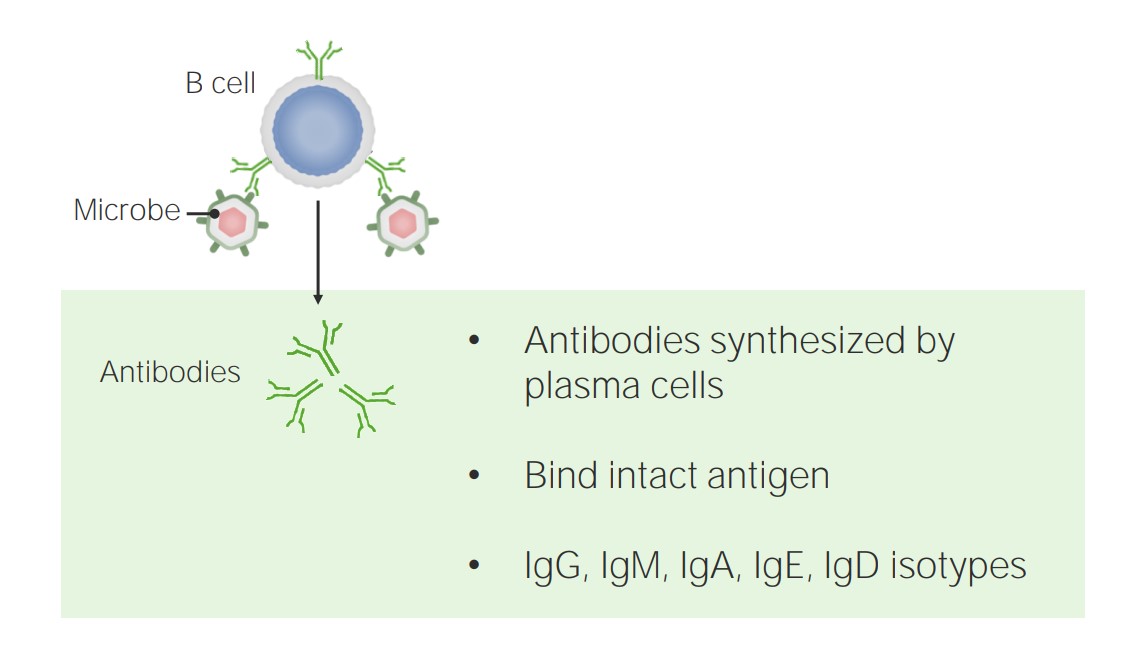
Imagen por Lecturio.

Inmunidad adaptativa humoral

  • Inmunidad mediada por anticuerpos
  • Células B:
    • Se diferencian en EN Erythema nodosum is an immune-mediated panniculitis (inflammation of the subcutaneous fat) caused by a type IV (delayed-type) hypersensitivity reaction. It commonly manifests in young women as tender, erythematous nodules on the shins. Erythema Nodosum células plasmáticas, produciendo anticuerpos con la ayuda de las células T
    • Se diferencian en EN Erythema nodosum is an immune-mediated panniculitis (inflammation of the subcutaneous fat) caused by a type IV (delayed-type) hypersensitivity reaction. It commonly manifests in young women as tender, erythematous nodules on the shins. Erythema Nodosum células de memoria, respondiendo rápidamente a la reinfección
    • Actúan como células presentadoras de antígenos a las células T (expresando complejo mayor de histocompatibilidad de clase II)
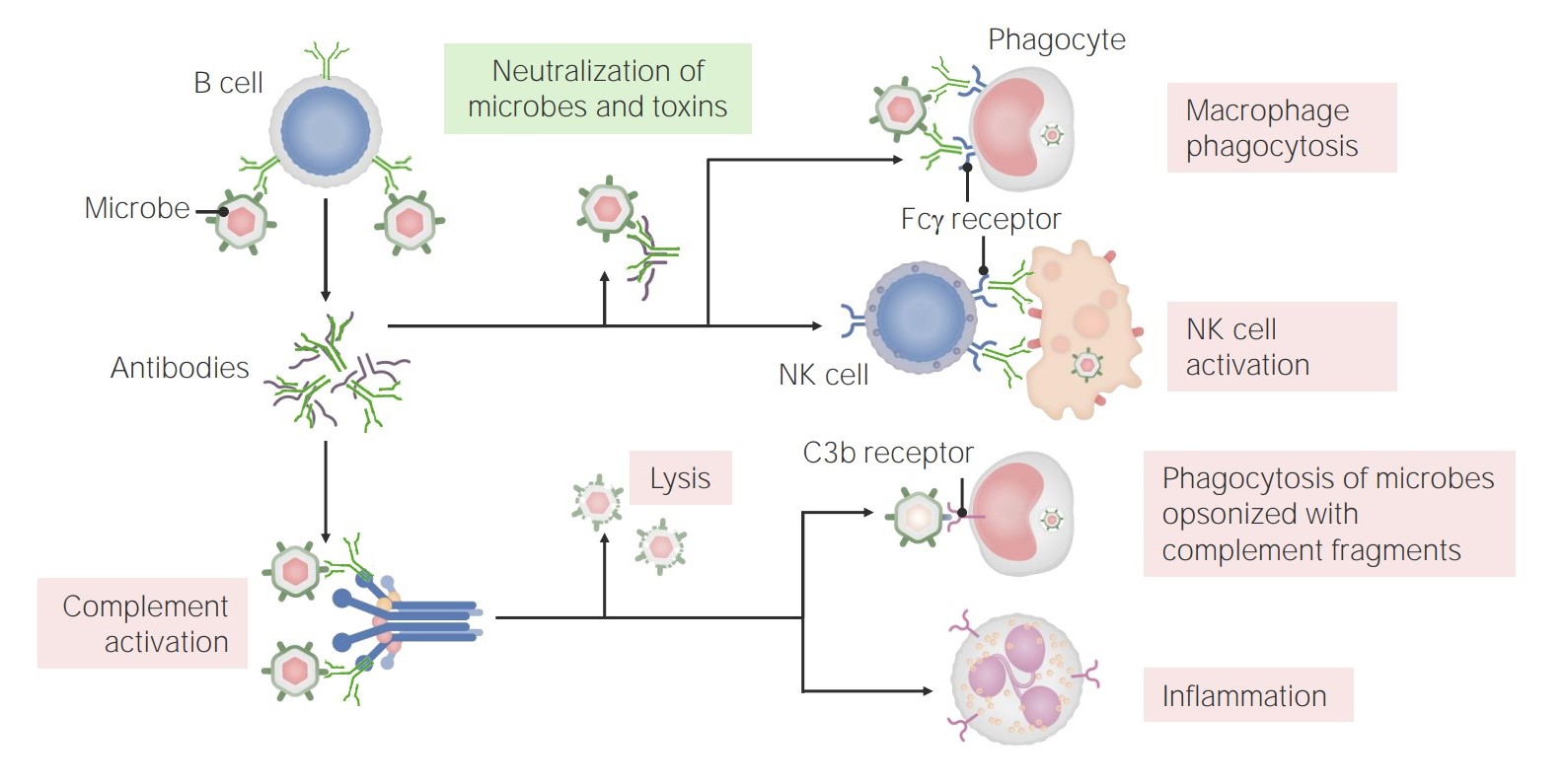
  • Los LOS Neisseria anticuerpos, junto con el complemento, ayudan a las células del sistema innato contra las bacterias encapsuladas extracelulares.
  • Los LOS Neisseria anticuerpos pueden neutralizar toxinas y virus Virus Viruses are infectious, obligate intracellular parasites composed of a nucleic acid core surrounded by a protein capsid. Viruses can be either naked (non-enveloped) or enveloped. The classification of viruses is complex and based on many factors, including type and structure of the nucleoid and capsid, the presence of an envelope, the replication cycle, and the host range. Virology.
Humoral immunity

La inmunidad humoral está mediada por las células B y los anticuerpos.

Imagen por Lecturio.
Desarrollo de Células T

Células T

  • Derivadas de progenitores linfoides comunes
  • A diferencia de las células B, las células T de la médula ósea migran al AL Amyloidosis timo para completar el desarrollo.
  • Antes de ingresar al AL Amyloidosis timo, las células T carecen del receptor Receptor Receptors are proteins located either on the surface of or within a cell that can bind to signaling molecules known as ligands (e.g., hormones) and cause some type of response within the cell. Receptors de células T (el complejo proteico que se une a un antígeno específico)
  • Etapas de desarrollo:
    • Montaje del receptor Receptor Receptors are proteins located either on the surface of or within a cell that can bind to signaling molecules known as ligands (e.g., hormones) and cause some type of response within the cell. Receptors de células T
    • Interacción con autoantígenos
    • Selección positiva y negativa: conduce a la restricción del complejo mayor de histocompatibilidad y la eliminación de células autorreactivas
    • Expresión de CD4 (se convierten en EN Erythema nodosum is an immune-mediated panniculitis (inflammation of the subcutaneous fat) caused by a type IV (delayed-type) hypersensitivity reaction. It commonly manifests in young women as tender, erythematous nodules on the shins. Erythema Nodosum células T colaboradoras) o CD8 (se convierten en EN Erythema nodosum is an immune-mediated panniculitis (inflammation of the subcutaneous fat) caused by a type IV (delayed-type) hypersensitivity reaction. It commonly manifests in young women as tender, erythematous nodules on the shins. Erythema Nodosum células T citotóxicas)
  • Las células T maduras vírgenes liberadas del timo expresan receptor Receptor Receptors are proteins located either on the surface of or within a cell that can bind to signaling molecules known as ligands (e.g., hormones) and cause some type of response within the cell. Receptors de células T de superficie con correceptores CD4 o CD8.
Etapas de diferenciación de células T

Etapas de diferenciación de la célula T:
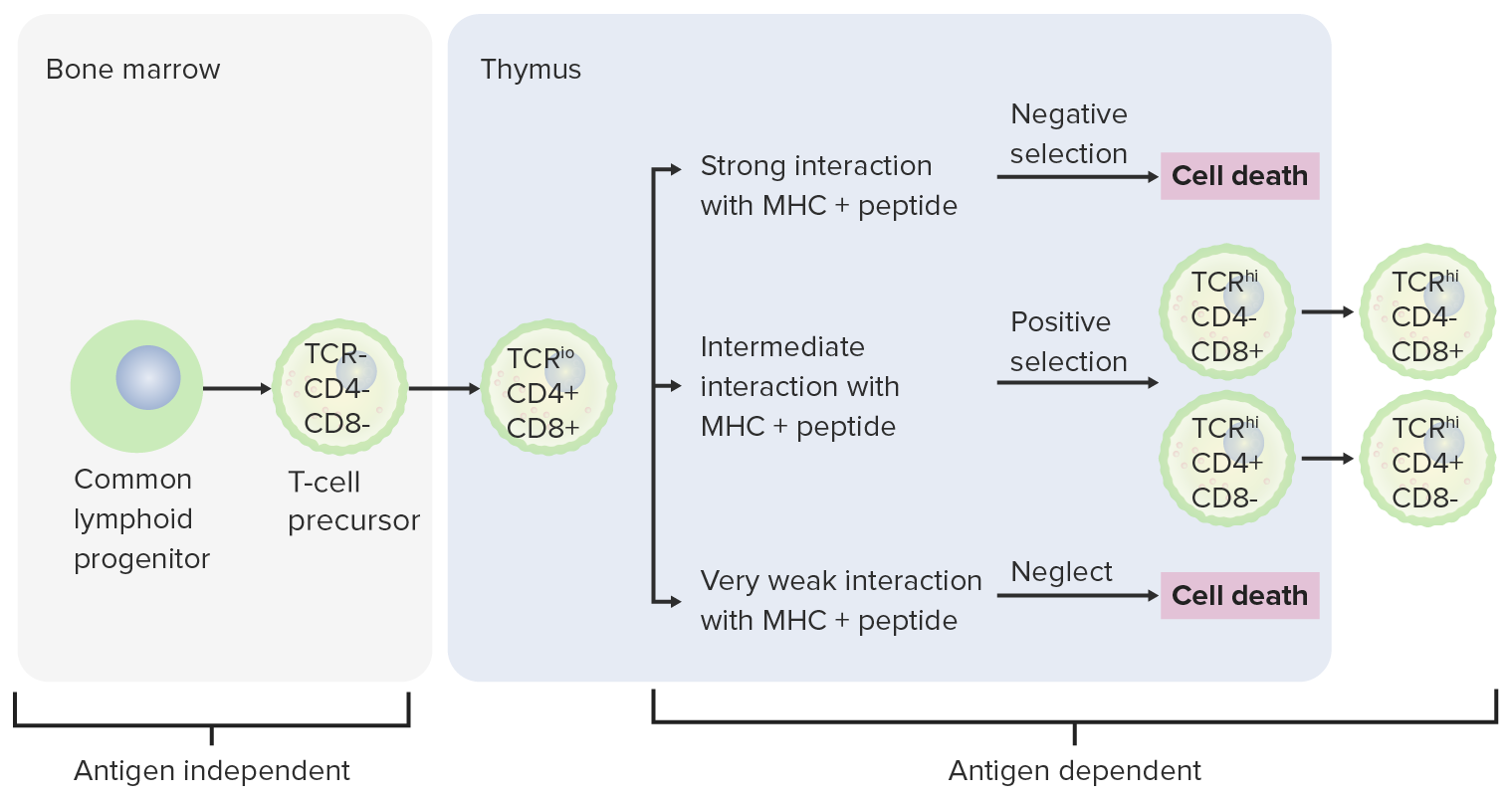
Desde la médula ósea, las células progenitoras van al timo para una mayor maduración. Las células DN (sin expresión de CD4/CD8 o CD4–/CD8–) no han desarrollado el receptor de célula T. Las células DN experimentan un reordenamiento del gen receptor de célula T y se convierten en células pro-T, luego en células pre-T. A través de la serie, se expresan CD4 y CD8, y el receptor de célula T se ensambla a través de reordenamientos de genes (células DP). Luego, el timo presenta moléculas del complejo mayor de histocompatibilidad a las células T en desarrollo. Algunas células experimentan una selección positiva (tiene lugar una interacción intermedia entre el complejo mayor de histocompatibilidad y el receptor de célula T) y producen células funcionales. Algunas células experimentan una selección negativa (fuerte interacción entre el complejo mayor de histocompatibilidad y el receptor de células T), lo que resulta en la muerte celular. Se previene la liberación de células T disfuncionales, que pueden activar la autoinmunidad. Algunas células T no logran interactuar, lo que lleva a la apoptosis. Las células T maduras expresan CD4 (células T colaboradoras) o CD8 (células T citotóxicas), no ambas.
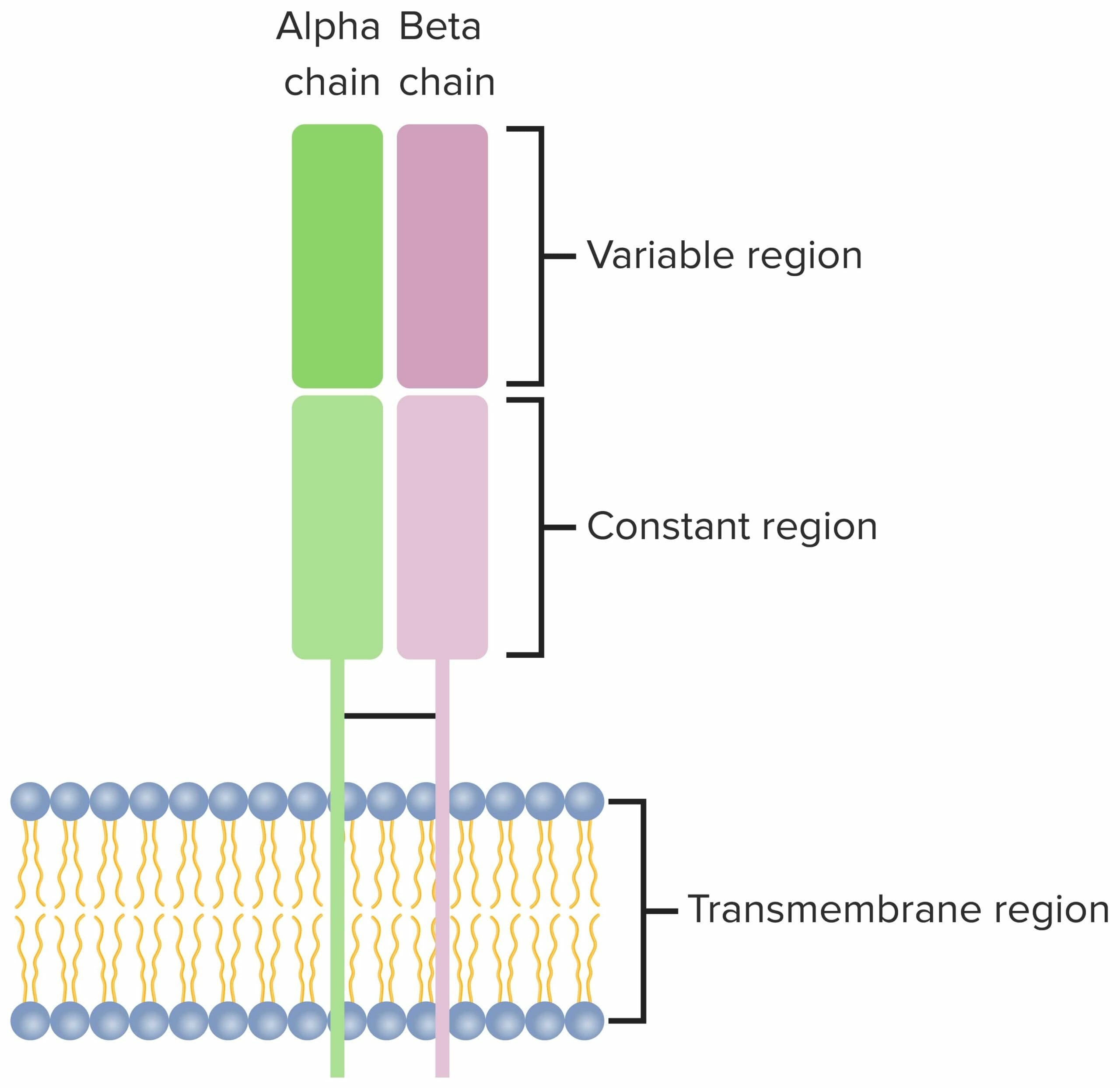
Imagen de Lecturio. Licencia: CC BY-NC-SA 4.0

Receptor Receptor Receptors are proteins located either on the surface of or within a cell that can bind to signaling molecules known as ligands (e.g., hormones) and cause some type of response within the cell. Receptors de célula T

  • Un heterodímero que consta de 2 cadenas polipeptídicas transmembrana: cadenas α y β (la mayoría de las células T) o cadenas γ y δ (la minoría de las células T)
  • El ensamblaje de las 2 cadenas requiere reordenamientos de genes Genes A category of nucleic acid sequences that function as units of heredity and which code for the basic instructions for the development, reproduction, and maintenance of organisms. DNA Types and Structure, que contribuyen a la diversidad del receptor Receptor Receptors are proteins located either on the surface of or within a cell that can bind to signaling molecules known as ligands (e.g., hormones) and cause some type of response within the cell. Receptors de célula T.
  • Estructuralmente, cada cadena α y β del receptor Receptor Receptors are proteins located either on the surface of or within a cell that can bind to signaling molecules known as ligands (e.g., hormones) and cause some type of response within the cell. Receptors de célula T tiene:
    • Regiones variables y una región constante
    • Región transmembrana hidrófoba
    • Región citoplasmática corta
  • Atraviesa la membrana citoplasmática con regiones de unión variables que se proyectan hacia el espacio extracelular para unir antígenos (similar al AL Amyloidosis fragmento de unión a antígeno de un anticuerpo):
    • Los LOS Neisseria antígenos procesados se asocian con moléculas del complejo mayor de histocompatibilidad de clase I o clase II.
    • Las moléculas CD4 se unen a las moléculas del complejo mayor de histocompatibilidad de clase II; Las moléculas CD8 se unen a las moléculas del complejo mayor de histocompatibilidad de clase I.
T cell receptor

Receptor de células T:
Heterodímero que consta de 2 cadenas polipeptídicas transmembrana, con cadenas α y β que se encuentran en la mayoría de las células T. Ambas cadenas tienen una región transmembrana variable, constante y una región citoplasmática corta.
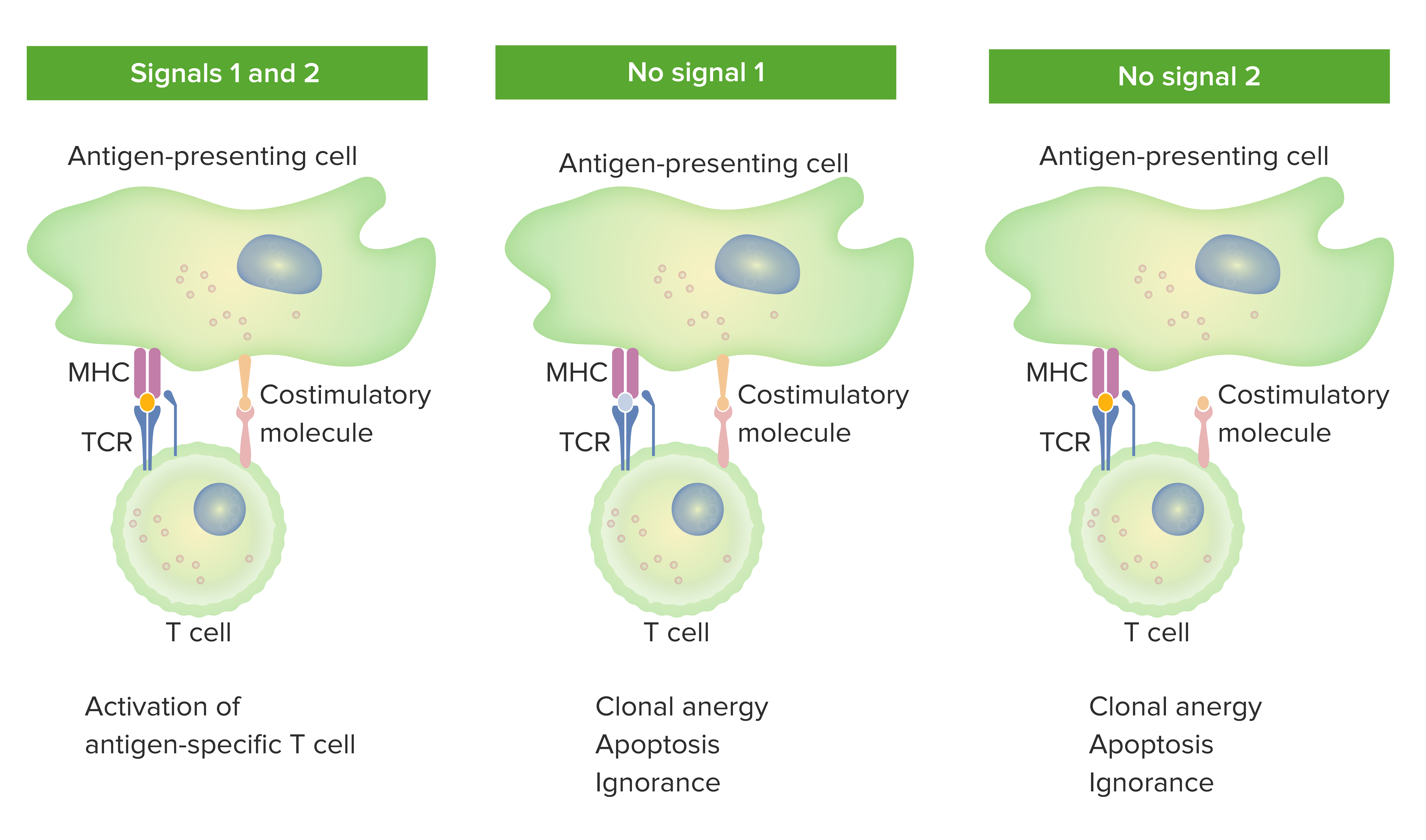
Imagen por Lecturio.

Activación de células T

  • Para que ocurra la proliferación y la activación, las células T maduras vírgenes deben interactuar con un antígeno extraño.
  • Las células T circulan en EN Erythema nodosum is an immune-mediated panniculitis (inflammation of the subcutaneous fat) caused by a type IV (delayed-type) hypersensitivity reaction. It commonly manifests in young women as tender, erythematous nodules on the shins. Erythema Nodosum la sangre y van a los LOS Neisseria tejidos linfoides secundarios.
  • Los LOS Neisseria órganos linfoides secundarios (e.g., ganglios linfáticos) filtran el material antigénico, lo que permite que las células T maduras vírgenes:
    • Interactúen con células presentadoras de antígenos, como macrófagos o células dendríticas.
    • Para muestrear los LOS Neisseria antígenos a activar
  • La activación completa de una célula T lista para montar una respuesta inmune requiere 2 señales (véase imagen):
    • Señal 1: el receptor Receptor Receptors are proteins located either on the surface of or within a cell that can bind to signaling molecules known as ligands (e.g., hormones) and cause some type of response within the cell. Receptors de célula T reconoce el antígeno afín presentado por la célula presentadora de antígeno (e.g., célula dendrítica).
    • Señal 2: coestimulación:
      • Proporcionada por una molécula coestimuladora
      • Se caracteriza mejor por una proteína B7 en EN Erythema nodosum is an immune-mediated panniculitis (inflammation of the subcutaneous fat) caused by a type IV (delayed-type) hypersensitivity reaction. It commonly manifests in young women as tender, erythematous nodules on the shins. Erythema Nodosum la célula presentadora de antígeno que interactúa con CD28 CD28 Costimulatory t-lymphocyte receptors that have specificity for CD80 antigen and CD86 antigen. Activation of this receptor results in increased t-cell proliferation, cytokine production and promotion of t-cell survival. T cells: Types and Functions de la célula T
  • Las células T activadas proliferan y pueden convertirse en EN Erythema nodosum is an immune-mediated panniculitis (inflammation of the subcutaneous fat) caused by a type IV (delayed-type) hypersensitivity reaction. It commonly manifests in young women as tender, erythematous nodules on the shins. Erythema Nodosum:
    • Células T efectoras:
      • Migran desde los LOS Neisseria órganos linfoides hacia la circulación y los LOS Neisseria tejidos para llegar a los LOS Neisseria sitios de infección
      • Capaz de diferenciarse aún más a células de memoria
    • Células T de memoria
Modelo de 2 señales: dependencia de las células T de la coestimulación

Modelo de 2 señales de dependencia de las células T de la coestimulación:
Cuando están presentes tanto la señal 1 (TCR que se une al antígeno afín presentado por la molécula del complejo mayor de histocompatibilidad en la célula presentadora de antígeno) como la señal 2 (interacción de la molécula coestimuladora entre la célula presentadora de antígeno y la célula T), la célula T madura está completamente activada.
El área naranja en el panel izquierdo indica la unión adecuada entre el antígeno y el TCR. Sin embargo, cuando falta la señal 1 (la imagen del medio no muestra unión entre antígeno y TCR) o la señal 2 (la imagen de la derecha no muestra coestimulación), la célula T no se activará por completo.
Los resultados serían anergia (estado de falta de respuesta), apoptosis (muerte celular) o ignorancia (la célula T no se da cuenta o no se ve afectada por el antígeno).
TCR: receptor de células T

Imagen por Lecturio. Licencia: CC BY-NC-SA 4.0

Células T en el Sistema Inmunológico

Células T activadas

  • Las células T activadas se convierten en EN Erythema nodosum is an immune-mediated panniculitis (inflammation of the subcutaneous fat) caused by a type IV (delayed-type) hypersensitivity reaction. It commonly manifests in young women as tender, erythematous nodules on the shins. Erythema Nodosum células T efectoras CD4+ o CD8+ y células T de memoria:
    • Células T CD4+: las categorías funcionales de las células T CD4+ activadas están influenciadas por las citoquinas secretadas.
      • Células T colaboradoras (Th, por sus siglas en EN Erythema nodosum is an immune-mediated panniculitis (inflammation of the subcutaneous fat) caused by a type IV (delayed-type) hypersensitivity reaction. It commonly manifests in young women as tender, erythematous nodules on the shins. Erythema Nodosum inglés): Th1 Th1 A subset of helper-inducer T-lymphocytes which synthesize and secrete interleukin-2; interferon-gamma; and interleukin-12. Due to their ability to kill antigen-presenting cells and their lymphokine-mediated effector activity, th1 cells are associated with vigorous delayed-type hypersensitivity reactions. T cells: Types and Functions y Th2 Th2 A subset of helper-inducer T-lymphocytes which synthesize and secrete the interleukins il-4; il-5; il-6; and il-10. These cytokines influence b-cell development and antibody production as well as augmenting humoral responses. T cells: Types and Functions (las más estudiadas), Th9, Th17 Th17 A subset of helper-effector T-lymphocytes which synthesize and secrete interleukins il-17; il-17f; and il-22. These cytokines are involved in host defenses and tissue inflammation in autoimmune diseases. T cells: Types and Functions, Th22 y colaboradoras foliculares T (Tfh, por sus siglas en EN Erythema nodosum is an immune-mediated panniculitis (inflammation of the subcutaneous fat) caused by a type IV (delayed-type) hypersensitivity reaction. It commonly manifests in young women as tender, erythematous nodules on the shins. Erythema Nodosum inglés)
      • Subconjunto de células T reguladoras (Treg)
    • Células T CD8+: células T citotóxicas (Tc)
    • Células T de memoria
  • Marcadores de superficie celular:
    • Células T: receptor Receptor Receptors are proteins located either on the surface of or within a cell that can bind to signaling molecules known as ligands (e.g., hormones) and cause some type of response within the cell. Receptors de célula T, CD3 CD3 Complex of at least five membrane-bound polypeptides in mature T-lymphocytes that are non-covalently associated with one another and with the T-cell receptor. The CD3 complex includes the gamma, delta, epsilon, zeta, and eta chains (subunits). When antigen binds to the T-cell receptor, the CD3 complex transduces the activating signals to the cytoplasm of the T-cell. The CD3 gamma and delta chains (subunits) are separate from and not related to the gamma/delta chains of the T-cell receptor. T cells: Types and Functions
    • Células Th: CD4, CD40L, CXCR4 CXCR4 Cxcr receptors with specificity for cxcl12 chemokine. The receptors may play a role in hematopoiesis regulation and can also function as coreceptors for the human immunodeficiency virus. HIV Infection and AIDS y CCR5 CCR5 Ccr receptors with specificity for chemokine ccl3; chemokine ccl4; and chemokine ccl5. They are expressed at high levels in T-lymphocytes; B-lymphocytes; macrophages; mast cells; and nk cells. The ccr5 receptor is used by the human immunodeficiency virus to infect cells. HIV Infection and AIDS (correceptores para la entrada del virus Virus Viruses are infectious, obligate intracellular parasites composed of a nucleic acid core surrounded by a protein capsid. Viruses can be either naked (non-enveloped) or enveloped. The classification of viruses is complex and based on many factors, including type and structure of the nucleoid and capsid, the presence of an envelope, the replication cycle, and the host range. Virology de inmunodeficiencia humana 1 (VIH-1) en EN Erythema nodosum is an immune-mediated panniculitis (inflammation of the subcutaneous fat) caused by a type IV (delayed-type) hypersensitivity reaction. It commonly manifests in young women as tender, erythematous nodules on the shins. Erythema Nodosum las células CD4+)
    • Tregs: CD4, CD25
    • Tc: CD8
  • Además de los LOS Neisseria marcadores de superficie, las células T y los LOS Neisseria subconjuntos se identifican mediante perfiles de citoquinas.

Descripción de los LOS Neisseria subconjuntos de células T CD4+

Tabla: subconjuntos de células T CD4+
Células T CD4+ Estimulado por Citoquinas producidas Funciones Papel en EN Erythema nodosum is an immune-mediated panniculitis (inflammation of the subcutaneous fat) caused by a type IV (delayed-type) hypersensitivity reaction. It commonly manifests in young women as tender, erythematous nodules on the shins. Erythema Nodosum la enfermedad
Th1 Th1 A subset of helper-inducer T-lymphocytes which synthesize and secrete interleukin-2; interferon-gamma; and interleukin-12. Due to their ability to kill antigen-presenting cells and their lymphokine-mediated effector activity, th1 cells are associated with vigorous delayed-type hypersensitivity reactions. T cells: Types and Functions IL-12, IFN-γ IFN-γ, TNF TNF Tumor necrosis factor (TNF) is a major cytokine, released primarily by macrophages in response to stimuli. The presence of microbial products and dead cells and injury are among the stimulating factors. This protein belongs to the TNF superfamily, a group of ligands and receptors performing functions in inflammatory response, morphogenesis, and cell proliferation. Tumor Necrosis Factor (TNF), IL-2
  • Activar macrófagos
  • Activar las células T citotóxicas
  • Erradicar organismos intracelulares
  • Proinflamatorio
  • Autoinmunidad
Th2 Th2 A subset of helper-inducer T-lymphocytes which synthesize and secrete the interleukins il-4; il-5; il-6; and il-10. These cytokines influence b-cell development and antibody production as well as augmenting humoral responses. T cells: Types and Functions IL-2, IL-4 IL-4, IL-5, IL-6, IL-9, IL-10, IL-13
  • Activar eosinófilos, ↑ inmunoglobulina E ( IgE IgE An immunoglobulin associated with mast cells. Overexpression has been associated with allergic hypersensitivity. Immunoglobulins: Types and Functions)
  • Activar mastocitos
  • Infecciones parasitarias (e.g., helmintos)
  • Afecciones alérgicas
Th17 Th17 A subset of helper-effector T-lymphocytes which synthesize and secrete interleukins il-17; il-17f; and il-22. These cytokines are involved in host defenses and tissue inflammation in autoimmune diseases. T cells: Types and Functions IL-1, IL-6, IL-23, TGF-β IL-17, IL-21, IL-22 Promover la inflamación neutrofílica
Tfh IL-6 IL-4, IL-21 Facilitar la activación y maduración de las células B Producción de anticuerpos
Treg TGF-β, IL-2 TGF-β, IL-10, IL-35
  • Suprimir la respuesta inmune
  • Promover la autotolerancia
↓ Autoinmunidad, alergia, inflamación
IL: interleuquinas
IFN: interferón
TNF: factor de necrosis tumoral
TGF: factor de crecimiento tumoral

Otros subconjuntos de células T CD4+

  • Th9 y Th22 fueron descubiertos recientemente.
  • Th9:
    • Estimulados por IL-4, TGF-β
    • Importante en EN Erythema nodosum is an immune-mediated panniculitis (inflammation of the subcutaneous fat) caused by a type IV (delayed-type) hypersensitivity reaction. It commonly manifests in young women as tender, erythematous nodules on the shins. Erythema Nodosum inmunidad antitumoral, alergias y enfermedades autoinmunes
  • Th22:
    • Produce IL-22 (como las células Th17 Th17 A subset of helper-effector T-lymphocytes which synthesize and secrete interleukins il-17; il-17f; and il-22. These cytokines are involved in host defenses and tissue inflammation in autoimmune diseases. T cells: Types and Functions)
    • Participa en EN Erythema nodosum is an immune-mediated panniculitis (inflammation of the subcutaneous fat) caused by a type IV (delayed-type) hypersensitivity reaction. It commonly manifests in young women as tender, erythematous nodules on the shins. Erythema Nodosum la inmunidad de las mucosas
Subconjuntos de células T colaboradoras CD4-+

Subconjuntos de células T colaboradoras CD4 positivas:
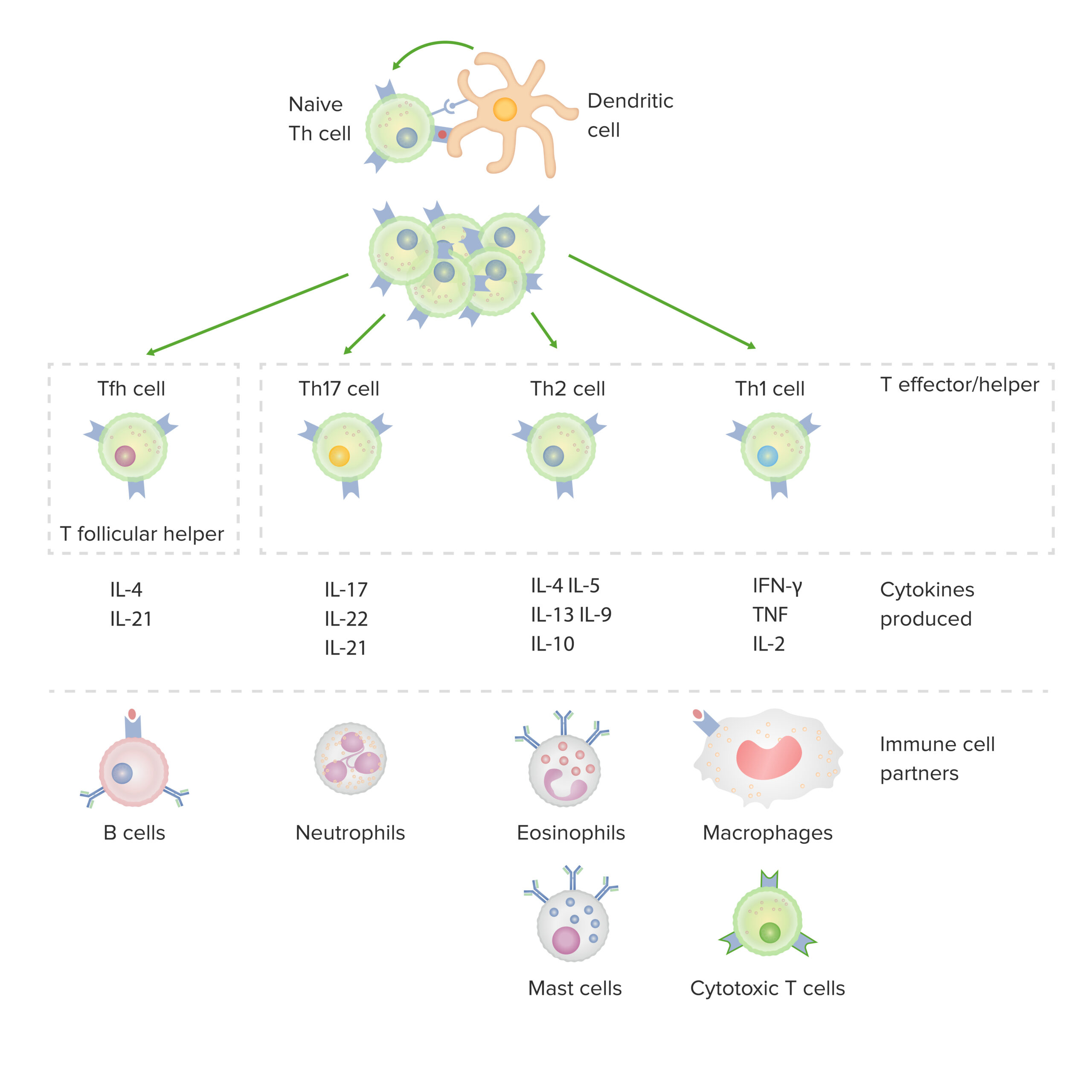
Después de la activación por una célula dendrítica, en presencia de citoquinas particulares, un linfocito T CD4-positivo virgen se divide y se diferencia en subconjuntos efector/colaborador (Th1, Th2 o Th17) o colaborador folicular (Tfh). Cada tipo de célula produce citoquinas que facilitan la activación de otras células inmunitarias asociadas.
IFN: interferón
TNF: factor de necrosis tumoral
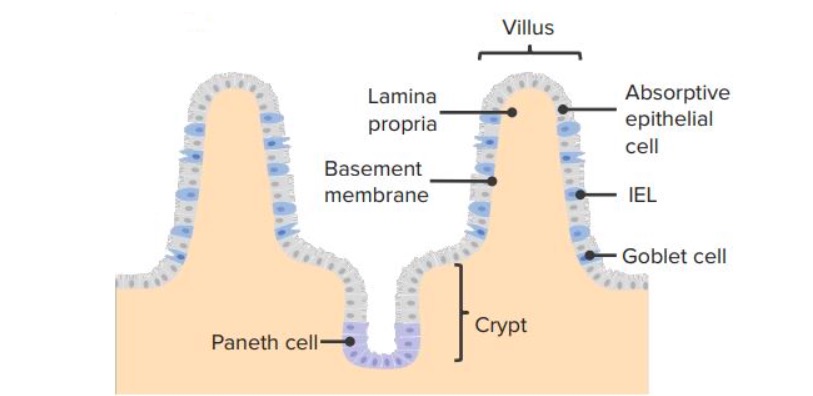
Imagen por Lecturio. Licencia: CC BY-NC-SA 4.0

Células T CD8+

  • Células T citotóxicas o citolíticas
  • Requiere estimulación de citoquinas (IL-2) (de células Th1 Th1 A subset of helper-inducer T-lymphocytes which synthesize and secrete interleukin-2; interferon-gamma; and interleukin-12. Due to their ability to kill antigen-presenting cells and their lymphokine-mediated effector activity, th1 cells are associated with vigorous delayed-type hypersensitivity reactions. T cells: Types and Functions) para activarse, luego abandona el órgano linfoide secundario y circula en EN Erythema nodosum is an immune-mediated panniculitis (inflammation of the subcutaneous fat) caused by a type IV (delayed-type) hypersensitivity reaction. It commonly manifests in young women as tender, erythematous nodules on the shins. Erythema Nodosum busca de dianas
  • Producen citoquinas IFN-γ, TNF-α y TNF-β
  • Factor de transcripción: RUNX3
  • Las funciones incluyen destrucción de:
    • Patógenos
    • Células infectadas
    • Células tumorales
    • Aloinjertos
  • La citotoxicidad se produce a través de:
    • Exocitosis de gránulos: el contenido de los LOS Neisseria gránulos (incluidas las granzimas y perforinas) ingresa a la célula diana y activa la vía de la caspasa, lo que conduce a la apoptosis Apoptosis A regulated cell death mechanism characterized by distinctive morphologic changes in the nucleus and cytoplasm, including the endonucleolytic cleavage of genomic DNA, at regularly spaced, internucleosomal sites, I.e., DNA fragmentation. It is genetically-programmed and serves as a balance to mitosis in regulating the size of animal tissues and in mediating pathologic processes associated with tumor growth. Ischemic Cell Damage.
    • Expresión del ligando Fas (FasL): la interacción Fas ( receptor Receptor Receptors are proteins located either on the surface of or within a cell that can bind to signaling molecules known as ligands (e.g., hormones) and cause some type of response within the cell. Receptors en EN Erythema nodosum is an immune-mediated panniculitis (inflammation of the subcutaneous fat) caused by a type IV (delayed-type) hypersensitivity reaction. It commonly manifests in young women as tender, erythematous nodules on the shins. Erythema Nodosum la célula)-FasL (ligando en EN Erythema nodosum is an immune-mediated panniculitis (inflammation of the subcutaneous fat) caused by a type IV (delayed-type) hypersensitivity reaction. It commonly manifests in young women as tender, erythematous nodules on the shins. Erythema Nodosum la célula T CD8+) activa la vía de la caspasa, lo que conduce a la muerte celular.
  • Relevancia clínica:
    • Papel destacado en EN Erythema nodosum is an immune-mediated panniculitis (inflammation of the subcutaneous fat) caused by a type IV (delayed-type) hypersensitivity reaction. It commonly manifests in young women as tender, erythematous nodules on the shins. Erythema Nodosum los LOS Neisseria patógenos intracelulares (e.g., Listeria Listeria Listeria spp. are motile, flagellated, gram-positive, facultative intracellular bacilli. The major pathogenic species is Listeria monocytogenes. Listeria are part of the normal gastrointestinal flora of domestic mammals and poultry and are transmitted to humans through the ingestion of contaminated food, especially unpasteurized dairy products. Listeria Monocytogenes/Listeriosis monocytogenes), ya que los LOS Neisseria patógenos pasan poco tiempo en EN Erythema nodosum is an immune-mediated panniculitis (inflammation of the subcutaneous fat) caused by a type IV (delayed-type) hypersensitivity reaction. It commonly manifests in young women as tender, erythematous nodules on the shins. Erythema Nodosum circulación (menos susceptibilidad a los LOS Neisseria anticuerpos)
    • Importancia similar en EN Erythema nodosum is an immune-mediated panniculitis (inflammation of the subcutaneous fat) caused by a type IV (delayed-type) hypersensitivity reaction. It commonly manifests in young women as tender, erythematous nodules on the shins. Erythema Nodosum la defensa inmunitaria contra virus Virus Viruses are infectious, obligate intracellular parasites composed of a nucleic acid core surrounded by a protein capsid. Viruses can be either naked (non-enveloped) or enveloped. The classification of viruses is complex and based on many factors, including type and structure of the nucleoid and capsid, the presence of an envelope, the replication cycle, and the host range. Virology (e.g., VIH)

Células T de memoria

  • Pueden ser CD4+ o CD8+
  • Activan la respuesta inmunitaria años después de la exposición inicial
  • Después de la exposición inicial a los LOS Neisseria antígenos, algunas células T se convierten en EN Erythema nodosum is an immune-mediated panniculitis (inflammation of the subcutaneous fat) caused by a type IV (delayed-type) hypersensitivity reaction. It commonly manifests in young women as tender, erythematous nodules on the shins. Erythema Nodosum células de memoria:
    • Las células residen inicialmente en EN Erythema nodosum is an immune-mediated panniculitis (inflammation of the subcutaneous fat) caused by a type IV (delayed-type) hypersensitivity reaction. It commonly manifests in young women as tender, erythematous nodules on the shins. Erythema Nodosum los LOS Neisseria tejidos linfoides (células T de memoria central)
    • Luego, las células T de memoria residen en EN Erythema nodosum is an immune-mediated panniculitis (inflammation of the subcutaneous fat) caused by a type IV (delayed-type) hypersensitivity reaction. It commonly manifests in young women as tender, erythematous nodules on the shins. Erythema Nodosum los LOS Neisseria tejidos periféricos (células de memoria efectoras)
    • Se convierten en EN Erythema nodosum is an immune-mediated panniculitis (inflammation of the subcutaneous fat) caused by a type IV (delayed-type) hypersensitivity reaction. It commonly manifests in young women as tender, erythematous nodules on the shins. Erythema Nodosum células T efectoras después de la reinfección por el mismo antígeno

Células T reguladoras

  • Debido a que la respuesta desenfrenada de las células T puede volverse patológica, las Treg están presentes para prevenir la inflamación excesiva y el daño tisular.
  • Pueden regular Regular Insulin a la baja la actividad de muchas células inmunitarias, entre ellas:
    • Células T CD4+
    • Células T CD8+
    • Células dendríticas (a través de las superficies celulares del antígeno 4 de linfocitos T citotóxicos y el gen de activación de linfocitos)
    • Células B
    • Células asesinas naturales
    • Eosinófilos, basófilos y mastocitos

Linfocitos intraepiteliales

  • Asociados a la protección de la superficie mucosa (tracto intestinal, tracto respiratorio, epitelio del tracto genitourinario y piel)
  • Cuando los LOS Neisseria patógenos invaden la superficie epitelial, los LOS Neisseria linfocitos intraepiteliales son las 1ras células inmunitarias en EN Erythema nodosum is an immune-mediated panniculitis (inflammation of the subcutaneous fat) caused by a type IV (delayed-type) hypersensitivity reaction. It commonly manifests in young women as tender, erythematous nodules on the shins. Erythema Nodosum encontrar los LOS Neisseria patógenos.
  • Células T predominantemente activadas: células CD8+ > CD4+ en EN Erythema nodosum is an immune-mediated panniculitis (inflammation of the subcutaneous fat) caused by a type IV (delayed-type) hypersensitivity reaction. It commonly manifests in young women as tender, erythematous nodules on the shins. Erythema Nodosum la mayoría de los LOS Neisseria sitios (no en EN Erythema nodosum is an immune-mediated panniculitis (inflammation of the subcutaneous fat) caused by a type IV (delayed-type) hypersensitivity reaction. It commonly manifests in young women as tender, erythematous nodules on the shins. Erythema Nodosum todos)
  • Las células TCR-αβ+ y TCR-γδ+ se encuentran dentro de los LOS Neisseria grupos linfocitos intraepiteliales.
Linfocitos intraepiteliales

Linfocitos intraepiteliales (IEL) en el epitelio intestinal

Imagen por Lecturio.

Citoquinas en la Inmunidad Mediada por Células

Citoquinas

  • Proteínas solubles liberadas por diferentes células en EN Erythema nodosum is an immune-mediated panniculitis (inflammation of the subcutaneous fat) caused by a type IV (delayed-type) hypersensitivity reaction. It commonly manifests in young women as tender, erythematous nodules on the shins. Erythema Nodosum respuesta a diversos estímulos inflamatorios:
    • Juegan roles superpuestos en EN Erythema nodosum is an immune-mediated panniculitis (inflammation of the subcutaneous fat) caused by a type IV (delayed-type) hypersensitivity reaction. It commonly manifests in young women as tender, erythematous nodules on the shins. Erythema Nodosum la inmunidad innata y adaptativa
    • Importante en EN Erythema nodosum is an immune-mediated panniculitis (inflammation of the subcutaneous fat) caused by a type IV (delayed-type) hypersensitivity reaction. It commonly manifests in young women as tender, erythematous nodules on the shins. Erythema Nodosum la inmunidad adaptativa mediada por células: la diferenciación de las células T depende de las citoquinas, y las células T producen citoquinas
  • Según función o célula de origen:
    • Linfoquinas: citoquinas producidas por los LOS Neisseria linfocitos
    • Monoquinas: citoquinas producidas por los LOS Neisseria monocitos.
    • Quimioquinas: citoquinas con acciones quimiotácticas
  • Incluyen:
    • IL: citoquinas producidas por un leucocito y que actúan sobre otros leucocitos
    • IFN IFN Interferon (IFN) is a cytokine with antiviral properties (it interferes with viral infections) and various roles in immunoregulation. The different types are type I IFN (IFN-ɑ and IFN-β), type II IFN (IFN-ɣ), and type III IFN (IFN-ƛ). Interferons: originalmente llamado así por la función de “interferir” con infecciones virales:
      • Interferones tipo I (IFN-α e IFN-β): funcionan principalmente para prevenir la replicación viral dentro de las células
      • Interferón tipo II (IFN-γ): activa los LOS Neisseria macrófagos
      • Tipo III (IFN-ƛ): actividad antiviral Antiviral Antivirals for Hepatitis B
    • TNF TNF Tumor necrosis factor (TNF) is a major cytokine, released primarily by macrophages in response to stimuli. The presence of microbial products and dead cells and injury are among the stimulating factors. This protein belongs to the TNF superfamily, a group of ligands and receptors performing functions in inflammatory response, morphogenesis, and cell proliferation. Tumor Necrosis Factor (TNF)
    • Factor de crecimiento transformante
    • Otros factores de crecimiento o estimulantes

Principales citoquinas producidas por las células T

Tabla: Principales citoquinas
Citoquina Función y actividad
IL-2
  • Activación y proliferación de células T
  • Proliferación y activación de células NK
IL-4
  • Diferenciación y proliferación Th2 Th2 A subset of helper-inducer T-lymphocytes which synthesize and secrete the interleukins il-4; il-5; il-6; and il-10. These cytokines influence b-cell development and antibody production as well as augmenting humoral responses. T cells: Types and Functions
  • Maduración de células B y cambio de clase a IgE IgE An immunoglobulin associated with mast cells. Overexpression has been associated with allergic hypersensitivity. Immunoglobulins: Types and Functions e inmunoglobulina G ( IgG IgG The major immunoglobulin isotype class in normal human serum. There are several isotype subclasses of igg, for example, igg1, igg2a, and igg2b. Hypersensitivity Pneumonitis)
IL-5
  • Crecimiento y diferenciación de eosinófilos
  • Crecimiento de células B, cambio de clase a inmunoglobulina A ( IgA IgA Represents 15-20% of the human serum immunoglobulins, mostly as the 4-chain polymer in humans or dimer in other mammals. Secretory iga is the main immunoglobulin in secretions. Immunoglobulins: Types and Functions)
IL-10
  • Antiinflamatorio
  • Atenuación de la respuesta inmune (↓ citoquinas, inhibición de células T y células NK)
IL-13
  • Producción de IgE IgE An immunoglobulin associated with mast cells. Overexpression has been associated with allergic hypersensitivity. Immunoglobulins: Types and Functions
  • ↑ Producción de moco
  • Síntesis de colágeno
IL-17 Liberación de citoquinas inflamatorias (incluyendo IL-6, IL-1, TNF TNF Tumor necrosis factor (TNF) is a major cytokine, released primarily by macrophages in response to stimuli. The presence of microbial products and dead cells and injury are among the stimulating factors. This protein belongs to the TNF superfamily, a group of ligands and receptors performing functions in inflammatory response, morphogenesis, and cell proliferation. Tumor Necrosis Factor (TNF), que median fiebre y sepsis Sepsis Systemic inflammatory response syndrome with a proven or suspected infectious etiology. When sepsis is associated with organ dysfunction distant from the site of infection, it is called severe sepsis. When sepsis is accompanied by hypotension despite adequate fluid infusion, it is called septic shock. Sepsis and Septic Shock)
IL-21 Diferenciación de células B y células T
IL-22
  • Reparación de tejidos
  • ↑ Producción de defensinas y proteínas de adhesión de uniones estrechas en EN Erythema nodosum is an immune-mediated panniculitis (inflammation of the subcutaneous fat) caused by a type IV (delayed-type) hypersensitivity reaction. It commonly manifests in young women as tender, erythematous nodules on the shins. Erythema Nodosum células epiteliales
IFN-ɣ
  • Regula la activación de macrófagos y células NK
  • Activa macrófagos → granuloma
TNF TNF Tumor necrosis factor (TNF) is a major cytokine, released primarily by macrophages in response to stimuli. The presence of microbial products and dead cells and injury are among the stimulating factors. This protein belongs to the TNF superfamily, a group of ligands and receptors performing functions in inflammatory response, morphogenesis, and cell proliferation. Tumor Necrosis Factor (TNF)
  • Proinflamatorio
  • Fuga capilar
  • Reclutamiento de leucocitos y citotoxicidad
  • Caquexia en EN Erythema nodosum is an immune-mediated panniculitis (inflammation of the subcutaneous fat) caused by a type IV (delayed-type) hypersensitivity reaction. It commonly manifests in young women as tender, erythematous nodules on the shins. Erythema Nodosum el cáncer
IL: interleuquinas
IFN: interferón
NK: asesino natural
TNF: factor de necrosis tumoral

Citoquinas y Aplicaciones Clínicas

Inhibidores de citoquinas y aplicaciones

Tabla: Inhibidores de citoquinas y aplicaciones
Inhibición de citoquinas Nombre del medicamento Afecciones tratadas
Anti-TNF
  • Infliximab Infliximab A chimeric monoclonal antibody to tnf-alpha that is used in the treatment of rheumatoid arthritis; ankylosing spondylitis; psoriatic arthritis and Crohn’s disease. Disease-Modifying Antirheumatic Drugs (DMARDs)
  • Etanercept Etanercept A recombinant version of soluble human tnf receptor fused to an IgG Fc fragment that binds specifically to tumor necrosis factor and inhibits its binding with endogenous tnf receptors. It prevents the inflammatory effect of tnf and is used to treat rheumatoid arthritis; psoriatic arthritis and ankylosing spondylitis. Immunosuppressants
  • Adalimumab Adalimumab A humanized monoclonal antibody that binds specifically to tnf-alpha and blocks its interaction with endogenous tnf receptors to modulate inflammation. It is used in the treatment of rheumatoid arthritis; psoriatic arthritis; Crohn’s disease and ulcerative colitis. Disease-Modifying Antirheumatic Drugs (DMARDs)
  • Golimumab Golimumab Disease-Modifying Antirheumatic Drugs (DMARDs)
  • Enfermedad inflamatoria intestinal
  • Artritis reumatoide
  • Psoriasis Psoriasis Psoriasis is a common T-cell-mediated inflammatory skin condition. The etiology is unknown, but is thought to be due to genetic inheritance and environmental triggers. There are 4 major subtypes, with the most common form being chronic plaque psoriasis. Psoriasis
  • Artritis psoriásica
Anti-interleuquina-1 Anakinra Anakinra Immunosuppressants Artritis reumatoide
Anti-interleuquina-1b Canakinumab Canakinumab Immunosuppressants
  • Enfermedad de Still del adulto
  • Síndrome de hiper-IgD
  • Síndrome periódico asociado al AL Amyloidosis receptor Receptor Receptors are proteins located either on the surface of or within a cell that can bind to signaling molecules known as ligands (e.g., hormones) and cause some type of response within the cell. Receptors del factor de necrosis Necrosis The death of cells in an organ or tissue due to disease, injury or failure of the blood supply. Ischemic Cell Damage tumoral
Anti-interleuquina-6 Tocilizumab Tocilizumab Immunosuppressants
  • Artritis reumatoide
  • Arteritis de células gigantes
  • Insuficiencia respiratoria por COVID-19 COVID-19 Coronavirus disease 2019 (COVID-19) is an infectious disease caused by the severe acute respiratory syndrome coronavirus 2 (SARS-CoV-2) that mainly affects the respiratory system but can also cause damage to other body systems (cardiovascular, gastrointestinal, renal, and central nervous systems).

Citoquinas terapéuticas y aplicaciones

Tabla: Citoquinas terapéuticas
Citoquina terapéutica Afecciones tratadas
Interferón-α
  • Hepatitis B Hepatitis B Hepatitis B virus (HBV) is a partially double-stranded DNA virus, which belongs to the Orthohepadnavirus genus and the Hepadnaviridae family. Most individuals with acute HBV infection are asymptomatic or have mild, self-limiting symptoms. Chronic infection can be asymptomatic or create hepatic inflammation, leading to liver cirrhosis and hepatocellular carcinoma (HCC). Hepatitis B Virus y C
  • Virus Virus Viruses are infectious, obligate intracellular parasites composed of a nucleic acid core surrounded by a protein capsid. Viruses can be either naked (non-enveloped) or enveloped. The classification of viruses is complex and based on many factors, including type and structure of the nucleoid and capsid, the presence of an envelope, the replication cycle, and the host range. Virology del papiloma (condiloma acuminado)
  • Leucemia de células pilosas
  • Sarcoma de Kaposi Kaposi A multicentric, malignant neoplastic vascular proliferation characterized by the development of bluish-red cutaneous nodules, usually on the lower extremities, most often on the toes or feet, and slowly increasing in size and number and spreading to more proximal areas. The tumors have endothelium-lined channels and vascular spaces admixed with variably sized aggregates of spindle-shaped cells, and often remain confined to the skin and subcutaneous tissue, but widespread visceral involvement may occur. Hhv-8 is the suspected cause. There is also a high incidence in AIDS patients. AIDS-defining Conditions
  • Recurrencia del melanoma Melanoma Melanoma is a malignant tumor arising from melanocytes, the melanin-producing cells of the epidermis. These tumors are most common in fair-skinned individuals with a history of excessive sun exposure and sunburns. Melanoma
  • Trombocitemia esencial
Interferón-β Esclerosis múltiple
Interferón-γ
  • Enfermedad granulomatosa crónica
  • Osteopetrosis
Interleuquina-2
  • Tumores renales
  • Melanoma Melanoma Melanoma is a malignant tumor arising from melanocytes, the melanin-producing cells of the epidermis. These tumors are most common in fair-skinned individuals with a history of excessive sun exposure and sunburns. Melanoma
  • Infección por VIH

Relevancia Clínica

  • Candidiasis Candidiasis Candida is a genus of dimorphic, opportunistic fungi. Candida albicans is part of the normal human flora and is the most common cause of candidiasis. The clinical presentation varies and can include localized mucocutaneous infections (e.g., oropharyngeal, esophageal, intertriginous, and vulvovaginal candidiasis) and invasive disease (e.g., candidemia, intraabdominal abscess, pericarditis, and meningitis). Candida/Candidiasis mucocutánea crónica: un síndrome autoinmune con características que incluyen infecciones crónicas no invasivas por Candida Candida Candida is a genus of dimorphic, opportunistic fungi. Candida albicans is part of the normal human flora and is the most common cause of candidiasis. The clinical presentation varies and can include localized mucocutaneous infections (e.g., oropharyngeal, esophageal, intertriginous, and vulvovaginal candidiasis) and invasive disease (e.g., candidemia, intraabdominal abscess, pericarditis, and meningitis). Candida/Candidiasis de la piel, uñas y membranas mucosas. La afección se asocia con manifestaciones autoinmunes (más comúnmente endocrinopatías). El hipoparatiroidismo es la anormalidad endocrina más común y ocurre en EN Erythema nodosum is an immune-mediated panniculitis (inflammation of the subcutaneous fat) caused by a type IV (delayed-type) hypersensitivity reaction. It commonly manifests in young women as tender, erythematous nodules on the shins. Erythema Nodosum el 30% de los LOS Neisseria individuos. La insuficiencia suprarrenal ocurre en EN Erythema nodosum is an immune-mediated panniculitis (inflammation of the subcutaneous fat) caused by a type IV (delayed-type) hypersensitivity reaction. It commonly manifests in young women as tender, erythematous nodules on the shins. Erythema Nodosum > 60% de los LOS Neisseria casos a los LOS Neisseria 15 años. La candidiasis Candidiasis Candida is a genus of dimorphic, opportunistic fungi. Candida albicans is part of the normal human flora and is the most common cause of candidiasis. The clinical presentation varies and can include localized mucocutaneous infections (e.g., oropharyngeal, esophageal, intertriginous, and vulvovaginal candidiasis) and invasive disease (e.g., candidemia, intraabdominal abscess, pericarditis, and meningitis). Candida/Candidiasis mucocutánea crónica se debe a defectos genéticos en EN Erythema nodosum is an immune-mediated panniculitis (inflammation of the subcutaneous fat) caused by a type IV (delayed-type) hypersensitivity reaction. It commonly manifests in young women as tender, erythematous nodules on the shins. Erythema Nodosum el sistema inmunológico, incluidos los LOS Neisseria que afectan al AL Amyloidosis regulador autoinmune, que es importante en EN Erythema nodosum is an immune-mediated panniculitis (inflammation of the subcutaneous fat) caused by a type IV (delayed-type) hypersensitivity reaction. It commonly manifests in young women as tender, erythematous nodules on the shins. Erythema Nodosum la selección negativa de las células T, y la vía de la IL-17 (entre otros).
  • Disregulación inmune, poliendocrinopatía, enteropatía, síndrome ligado al AL Amyloidosis cromosoma X: una enfermedad causada por mutaciones en EN Erythema nodosum is an immune-mediated panniculitis (inflammation of the subcutaneous fat) caused by a type IV (delayed-type) hypersensitivity reaction. It commonly manifests in young women as tender, erythematous nodules on the shins. Erythema Nodosum el gen del factor de transcripción FOXP3. La característica definitoria es el deterioro de las células Treg, que se manifiesta como una enfermedad autoinmune con una inflamación alérgica. La enfermedad se presenta típicamente en EN Erythema nodosum is an immune-mediated panniculitis (inflammation of the subcutaneous fat) caused by a type IV (delayed-type) hypersensitivity reaction. It commonly manifests in young women as tender, erythematous nodules on the shins. Erythema Nodosum lactantes varones con una tríada de enteropatía, dermatitis Dermatitis Any inflammation of the skin. Atopic Dermatitis (Eczema) y endocrinopatía autoinmune (generalmente diabetes Diabetes Diabetes mellitus (DM) is a metabolic disease characterized by hyperglycemia and dysfunction of the regulation of glucose metabolism by insulin. Type 1 DM is diagnosed mostly in children and young adults as the result of autoimmune destruction of β cells in the pancreas and the resulting lack of insulin. Type 2 DM has a significant association with obesity and is characterized by insulin resistance. Diabetes Mellitus tipo 1 o tiroiditis). La diarrea puede ser profusa y estar asociada con deshidratación, malabsorción, acidosis Acidosis A pathologic condition of acid accumulation or depletion of base in the body. The two main types are respiratory acidosis and metabolic acidosis, due to metabolic acid build up. Respiratory Acidosis metabólica, insuficiencia renal y retraso en EN Erythema nodosum is an immune-mediated panniculitis (inflammation of the subcutaneous fat) caused by a type IV (delayed-type) hypersensitivity reaction. It commonly manifests in young women as tender, erythematous nodules on the shins. Erythema Nodosum el crecimiento. Otras manifestaciones incluyen alergias alimentarias graves, hepatitis autoinmune crónica, citopenias autoinmunes, nefritis intersticial y retrasos en EN Erythema nodosum is an immune-mediated panniculitis (inflammation of the subcutaneous fat) caused by a type IV (delayed-type) hypersensitivity reaction. It commonly manifests in young women as tender, erythematous nodules on the shins. Erythema Nodosum el desarrollo. El diagnóstico se realiza mediante análisis mutacional del gen FOXP3. La única terapia curativa disponible es el trasplante de células hematopoyéticas.
  • Leucemia/linfoma de células T en EN Erythema nodosum is an immune-mediated panniculitis (inflammation of the subcutaneous fat) caused by a type IV (delayed-type) hypersensitivity reaction. It commonly manifests in young women as tender, erythematous nodules on the shins. Erythema Nodosum adultos: una neoplasia maligna de células T maduras rara, pero a menudo agresiva, causada por una infección crónica de las células CD4+ con el virus Virus Viruses are infectious, obligate intracellular parasites composed of a nucleic acid core surrounded by a protein capsid. Viruses can be either naked (non-enveloped) or enveloped. The classification of viruses is complex and based on many factors, including type and structure of the nucleoid and capsid, the presence of an envelope, the replication cycle, and the host range. Virology linfotrópico T humano ( HTLV-I HTLV-I Acute Lymphoblastic Leukemia, por sus siglas en EN Erythema nodosum is an immune-mediated panniculitis (inflammation of the subcutaneous fat) caused by a type IV (delayed-type) hypersensitivity reaction. It commonly manifests in young women as tender, erythematous nodules on the shins. Erythema Nodosum inglés). La infección es endémica en EN Erythema nodosum is an immune-mediated panniculitis (inflammation of the subcutaneous fat) caused by a type IV (delayed-type) hypersensitivity reaction. It commonly manifests in young women as tender, erythematous nodules on the shins. Erythema Nodosum Japón, el Caribe y África Central. La presentación general es la afectación generalizada de los LOS Neisseria ganglios linfáticos, la sangre periférica y/o la piel. Las variantes clínicas conocidas son aguda, linfomatosa, crónica y latente. Cada variante tiene un curso clínico diferente. El rasgo característico que se observa en EN Erythema nodosum is an immune-mediated panniculitis (inflammation of the subcutaneous fat) caused by a type IV (delayed-type) hypersensitivity reaction. It commonly manifests in young women as tender, erythematous nodules on the shins. Erythema Nodosum la sangre periférica es “hoja de trébol” o “células de flores” (células con núcleos bizarros e hiperlobulados). El diagnóstico se basa en EN Erythema nodosum is an immune-mediated panniculitis (inflammation of the subcutaneous fat) caused by a type IV (delayed-type) hypersensitivity reaction. It commonly manifests in young women as tender, erythematous nodules on the shins. Erythema Nodosum la presentación clínica, los LOS Neisseria cambios morfológicos e inmunofenotípicos de las células malignas y la infección confirmada por HTLV-I HTLV-I Acute Lymphoblastic Leukemia. El tratamiento se adapta al AL Amyloidosis subtipo, pero las opciones incluyen agentes antivirales, terapia con anticuerpos monoclonales, quimioterapia y trasplante alogénico de células madre.

Referencias

  1. Haynes, B.F., & Soderberg K.A., & Fauci A.S. (2018). Introduction to the immune system. Jameson J, Fauci A.S., Kasper D.L., Hauser S.L., Longo D.L., & Loscalzo J(Eds.), Harrison’s Principles of Internal Medicine, 20e. McGraw Hill. https://accessmedicine.mhmedical.com/content.aspx?bookid=2129&sectionid=192284326
  2. Kumar, B.V., Connors, T.J., Farber, D.L. (2018). Human T Cell Development, Localization, and Function throughout Life. Immunity, 48(2), 202–213.
  3. Levinson, W., Chin-Hong, P., Joyce, E. A., Nussbaum, J., & Schwartz, B. (Eds.). (2020). Adaptive immunity: Lymphocyte antigen receptors. In Review of Medical Microbiology & Immunology: A guide to clinical infectious diseases (16.ª ed.). McGraw-Hill.
  4. Levinson, W., Chin-Hong, P., Joyce, E. A., Nussbaum, J., & Schwartz, B. (Eds.). (2020). Overview of immunity. In Review of Medical Microbiology & Immunology: A guide to clinical infectious diseases (16.ª ed.). McGraw-Hill.
  5. Levinson, W., Chin-Hong, P., Joyce, E. A., Nussbaum, J., & Schwartz, B. (Eds.). (2024). Adaptive immunity: T-cell–mediated immunity. In Levinson’s Review of Medical Microbiology & Immunology: A guide to clinical infectious diseases (16.ª ed.). McGraw-Hill. https://accessmedicine.mhmedical.com/content.aspx?bookid=3428&sectionid=284627858
  6. Stephen, R., Holdsworth, S.R., Gan, P. (2015). Cytokines: Names and Numbers You Should Care About. Clin J Am Soc Nephrol, 10(12), 2243–54.

¡Crea tu cuenta gratis o inicia una sesión para seguir leyendo!

Regístrate ahora y obtén acceso gratuito a Lecturio con páginas de concepto, videos médicos y cuestionarios para tu educación médica.

User Reviews

Que tengas una sesión de estudio alegre y navideña 🎁 Ahorra 50% en todos los planes >>

Details