



Tumores Neuroendócrinos Pancreáticos

Os tumores neuroendócrinos pancreáticos ( PanNETs PanNETs Pancreatic neuroendocrine tumors (PanNETs) arise from the endocrine pancreas (islet cells) and represent 2%-5% of primary pancreatic neoplasms; the other 95%-98% of pancreatic neoplasms are from the exocrine pancreas. The majority of PanNETs are nonfunctional (50%-75%), while others that are functional may be benign or malignant. Pancreatic Neuroendocrine Tumors (PanNETs), pela sigla em inglês) surgem do pâncreas endócrino (ilhéus) e representam 2%–5% das neoplasias pancreáticas primárias; os outros 95%–98% das neoplasias pancreáticas são do pâncreas exócrino. A maioria dos PanNETs PanNETs Pancreatic neuroendocrine tumors (PanNETs) arise from the endocrine pancreas (islet cells) and represent 2%-5% of primary pancreatic neoplasms; the other 95%-98% of pancreatic neoplasms are from the exocrine pancreas. The majority of PanNETs are nonfunctional (50%-75%), while others that are functional may be benign or malignant. Pancreatic Neuroendocrine Tumors (PanNETs) são não funcionantes (50%–75%), enquanto que os funcionantes podem ser benignos ou malignos. Os PanNETs PanNETs Pancreatic neuroendocrine tumors (PanNETs) arise from the endocrine pancreas (islet cells) and represent 2%-5% of primary pancreatic neoplasms; the other 95%-98% of pancreatic neoplasms are from the exocrine pancreas. The majority of PanNETs are nonfunctional (50%-75%), while others that are functional may be benign or malignant. Pancreatic Neuroendocrine Tumors (PanNETs) benignos ou malignos incluem os insulinomas Insulinomas An insulinoma is a type of functional neuroendocrine tumor that manifests with hypoglycemia due to autologous secretion of insulin. It more commonly presents as a solitary benign tumor but can sometimes be associated with MEN type 1 (MEN1). Patients present with fasting hypoglycemia, which may manifest as episodes of diaphoresis, palpitations, tremor, and confusion. Insulinomas, gastrinomas, carcinomas neuroendócrinos pancreáticos malignos e tumores muito raros denominados glucagonomas, somatostatinomas e VIPomas, devido às hormonas que secretam. O diagnóstico é feito clinicamente, com exames laboratoriais para averiguação da secreção hormonal, bem como exames de imagem ou endoscopia digestiva alta. O tratamento é cirúrgico ou com terapêuticas molecularmente dirigidas mais MAIS Androgen Insensitivity Syndrome recentes.

Last updated: Dec 15, 2025

Editorial responsibility: Stanley Oiseth, Lindsay Jones, Evelin Maza

Descrição Geral

Epidemiologia

  • Raro; incidência anual: ≤1 caso/100.000
  • 2%–3% de todos os tumores pancreáticos surgem do pâncreas endócrino e são denominados tumores neuroendócrinos pancreáticos ( PanNETs PanNETs Pancreatic neuroendocrine tumors (PanNETs) arise from the endocrine pancreas (islet cells) and represent 2%-5% of primary pancreatic neoplasms; the other 95%-98% of pancreatic neoplasms are from the exocrine pancreas. The majority of PanNETs are nonfunctional (50%-75%), while others that are functional may be benign or malignant. Pancreatic Neuroendocrine Tumors (PanNETs)):
    • Assemelham-se a tumores neuroendócrinos (NETs, pela sigla em inglês) noutras partes do trato GI
    • Podem ser tumores benignos ou malignos
    • Podem produzir hormonas pancreáticas (por exemplo, insulina, glucagon Glucagon A 29-amino acid pancreatic peptide derived from proglucagon which is also the precursor of intestinal glucagon-like peptides. Glucagon is secreted by pancreatic alpha cells and plays an important role in regulation of blood glucose concentration, ketone metabolism, and several other biochemical and physiological processes. Gastrointestinal Secretions, gastrina) ou serem não funcionantes
  • Mais MAIS Androgen Insensitivity Syndrome frequentemente diagnosticado entre os 30 e 50 anos
  • Também denominados tumores de células de ilhéus

Etiologia

  • A maioria dos PanNETs PanNETs Pancreatic neuroendocrine tumors (PanNETs) arise from the endocrine pancreas (islet cells) and represent 2%-5% of primary pancreatic neoplasms; the other 95%-98% of pancreatic neoplasms are from the exocrine pancreas. The majority of PanNETs are nonfunctional (50%-75%), while others that are functional may be benign or malignant. Pancreatic Neuroendocrine Tumors (PanNETs) são esporádicos.
  • 50%–75% são não funcionantes (ou seja, não estão associados a um síndrome hormonal).
  • Nas endocrinopatias hereditárias:
    • Os tumores têm um curso mais MAIS Androgen Insensitivity Syndrome indolente.
    • Síndromes que podem estar envolvidos e percentagem em que desenvolvem PanNET ao longo da vida
      • MEN 1: 80%–100%
      • Síndrome de Von Hippel-Lindau (VHL): 20%
      • Neurofibromatose tipo I ( NF1 NF1 Neurofibromatosis type 1 (NF1), also known as phakomatosis, is a neurocutaneous disorder that is most commonly of autosomal dominant inheritance due to mutations in the NF1 gene. Neurofibromatosis type 1 presents a range of clinical manifestations with the most prominent features being various pigmented skin lesions called café au lait macules (CALMs), neurofibromas, freckling of the inguinal and axillary regions, and iris hamartomas. Neurofibromatosis Type 1): 10%
      • Esclerose tuberosa: 1%
  • Outros potenciais fatores de risco, com evidência científica mais MAIS Androgen Insensitivity Syndrome fraca do que as causas hereditárias:
    • Tabagismo
    • Diabetes Diabetes Diabetes mellitus (DM) is a metabolic disease characterized by hyperglycemia and dysfunction of the regulation of glucose metabolism by insulin. Type 1 DM is diagnosed mostly in children and young adults as the result of autoimmune destruction of β cells in the pancreas and the resulting lack of insulin. Type 2 DM has a significant association with obesity and is characterized by insulin resistance. Diabetes Mellitus
    • Pancreatite crónica
    • Ingestão de álcool

Patologia e Fisiopatologia

Patologia

  • Exceto os insulinomas Insulinomas An insulinoma is a type of functional neuroendocrine tumor that manifests with hypoglycemia due to autologous secretion of insulin. It more commonly presents as a solitary benign tumor but can sometimes be associated with MEN type 1 (MEN1). Patients present with fasting hypoglycemia, which may manifest as episodes of diaphoresis, palpitations, tremor, and confusion. Insulinomas, >50% são malignos.
  • A morfologia assemelha-se a tumores neuroendócrinos encontrados em outras partes do trato GI:
    • Locais:
      • Em qualquer local do pâncreas ou nos tecidos peripancreáticos imediatos
      • Podem ser únicos ou múltiplos
      • Triângulo do gastrinoma Gastrinoma A gastrinoma is a tumor that secretes excessive levels of the hormone gastrin and is responsible for Zollinger-Ellison syndrome (ZES). Gastrinomas are frequently associated with multiple endocrine neoplasia 1 (MEN 1) and can arise from the pancreas, stomach, duodenum, jejunum, and/or even from the lymph nodes. Gastrinoma (maioria dos gastrinomas): duodeno > pâncreas > tecidos extrapancreáticos
    • Características microscópicas de tumores neuroendócrinos bem diferenciados:
      • Arquitetura: ninhos sólidos, trabéculas, glandulares, acinares
      • Citologia: células pequenas a médias, com núcleos redondos de cromatina “sal e pimenta” (pontilhado fino), baixo índice mitótico
    • Características microscópicas de carcinomas neuroendócrinos pouco diferenciados:
      • Arquitetura: folhas ou ninhos de células atípicas
      • Citologia: núcleos pleomórficos, hipercromáticos, figuras mitóticas
      • Maior índice de proliferação ( mais MAIS Androgen Insensitivity Syndrome mitoses ou ≥3% de núcleos expressam Ki-67): tendem a ser agressivos
      • Os únicos critérios válidos para malignidade são a presença de metástases, invasão vascular e infiltração local.

Fisiopatologia

São 3 as mutações somáticas mais MAIS Androgen Insensitivity Syndrome comuns:

  • MEN 1 (a mesma mutação observada no MEN 1 hereditário, relembrada como os “3 Ps PS Invasive Mechanical Ventilation”):
    • Paratiroide — Hiperplasia ou adenoma da paratiroide
    • Pituitária — Adenoma hipofisário da hipófise anterior (geralmente prolactinoma Prolactinoma A pituitary adenoma which secretes prolactin, leading to hyperprolactinemia. Clinical manifestations include amenorrhea; galactorrhea; impotence; headache; visual disturbances; and cerebrospinal fluid rhinorrhea. Hyperprolactinemia)
    • PanNETs PanNETs Pancreatic neuroendocrine tumors (PanNETs) arise from the endocrine pancreas (islet cells) and represent 2%-5% of primary pancreatic neoplasms; the other 95%-98% of pancreatic neoplasms are from the exocrine pancreas. The majority of PanNETs are nonfunctional (50%-75%), while others that are functional may be benign or malignant. Pancreatic Neuroendocrine Tumors (PanNETs) ( gastrinoma Gastrinoma A gastrinoma is a tumor that secretes excessive levels of the hormone gastrin and is responsible for Zollinger-Ellison syndrome (ZES). Gastrinomas are frequently associated with multiple endocrine neoplasia 1 (MEN 1) and can arise from the pancreas, stomach, duodenum, jejunum, and/or even from the lymph nodes. Gastrinoma, insulinoma Insulinoma A benign tumor of the pancreatic beta cells. Insulinoma secretes excess insulin resulting in hypoglycemia. Pancreatic Neuroendocrine Tumors (PanNETs), glucagonoma Glucagonoma A glucagonoma is a glucagon-secreting neuroendocrine tumor that originates from the β-cells in the pancreatic islets. Most glucagonomas are malignant, and many of them are part of the autosomal dominant condition known as multiple endocrine neoplasia syndrome type 1 (MEN 1). Elevated levels of glucagon lead to increased gluconeogenesis and glycogenolysis. Glucagonoma, VIPoma VIPoma A VIPoma is a rare neuroendocrine tumor arising primarily in the pancreas that releases large amounts of vasoactive intestinal polypeptide (VIP). This process leads to chronic watery diarrhea with concomitant hypokalemia and dehydration, as well as wheezing and flushing (known as Verner-Morrison or WDHA syndrome). VIPoma)
  • PTEN , TSC2 : genes Genes A category of nucleic acid sequences that function as units of heredity and which code for the basic instructions for the development, reproduction, and maintenance of organisms. DNA Types and Structure supressores tumorais que causam ativação da via de sinalização mTOR mTOR Peutz-Jeghers Syndrome oncogénica
  • ATRX , DAXX : permitem que os telómeros se mantenham em células neoplásicas

Apresentação Clínica e Diagnóstico

Apresentação clínica

  • Se não funcionante (50% –75%) → diagnóstico realizado por efeito de massa ou presença de metástases
  • Se funcionante (secretor de hormonas) → características da síndrome relacionadas com a hormona elevada
  • Os 4 PanNETs PanNETs Pancreatic neuroendocrine tumors (PanNETs) arise from the endocrine pancreas (islet cells) and represent 2%-5% of primary pancreatic neoplasms; the other 95%-98% of pancreatic neoplasms are from the exocrine pancreas. The majority of PanNETs are nonfunctional (50%-75%), while others that are functional may be benign or malignant. Pancreatic Neuroendocrine Tumors (PanNETs) funcionantes mais MAIS Androgen Insensitivity Syndrome comuns e distintos são:
    • Insulinoma Insulinoma A benign tumor of the pancreatic beta cells. Insulinoma secretes excess insulin resulting in hypoglycemia. Pancreatic Neuroendocrine Tumors (PanNETs) (tumores de células beta): o PanNET funcionante mais MAIS Androgen Insensitivity Syndrome comum
      • Hiperinsulinismo e episódios recorrentes de hipoglicemia
      • A maioria dos insulinomas Insulinomas An insulinoma is a type of functional neuroendocrine tumor that manifests with hypoglycemia due to autologous secretion of insulin. It more commonly presents as a solitary benign tumor but can sometimes be associated with MEN type 1 (MEN1). Patients present with fasting hypoglycemia, which may manifest as episodes of diaphoresis, palpitations, tremor, and confusion. Insulinomas são solitários.
      • 10% associados a MEN 1
      • 90% benignos
    • Gastrinoma Gastrinoma A gastrinoma is a tumor that secretes excessive levels of the hormone gastrin and is responsible for Zollinger-Ellison syndrome (ZES). Gastrinomas are frequently associated with multiple endocrine neoplasia 1 (MEN 1) and can arise from the pancreas, stomach, duodenum, jejunum, and/or even from the lymph nodes. Gastrinoma:
      • Hipergastrinemia em jejum e síndrome de Zollinger-Ellison (SZE)
      • Geralmente múltiplos e localizados na parede duodenal
      • Hipersecreção de ácido gástrico e úlceras pépticas (no estômago, duodeno)
      • 25% associados a MEN 1
      • 60%–90% são malignos.
      • A endoscopia digestiva alta evidencia múltiplas úlceras e pregas gástricas espessadas.
    • Glucagonoma Glucagonoma A glucagonoma is a glucagon-secreting neuroendocrine tumor that originates from the β-cells in the pancreatic islets. Most glucagonomas are malignant, and many of them are part of the autosomal dominant condition known as multiple endocrine neoplasia syndrome type 1 (MEN 1). Elevated levels of glucagon lead to increased gluconeogenesis and glycogenolysis. Glucagonoma ( tumor Tumor Inflammation de células alfa):
      • O excesso de glucagon Glucagon A 29-amino acid pancreatic peptide derived from proglucagon which is also the precursor of intestinal glucagon-like peptides. Glucagon is secreted by pancreatic alpha cells and plays an important role in regulation of blood glucose concentration, ketone metabolism, and several other biochemical and physiological processes. Gastrointestinal Secretions cassocia-se a eritema migratório necrolítico, perda ponderal, intolerância à glucose Glucose A primary source of energy for living organisms. It is naturally occurring and is found in fruits and other parts of plants in its free state. It is used therapeutically in fluid and nutrient replacement. Lactose Intolerance/ diabetes Diabetes Diabetes mellitus (DM) is a metabolic disease characterized by hyperglycemia and dysfunction of the regulation of glucose metabolism by insulin. Type 1 DM is diagnosed mostly in children and young adults as the result of autoimmune destruction of β cells in the pancreas and the resulting lack of insulin. Type 2 DM has a significant association with obesity and is characterized by insulin resistance. Diabetes Mellitus, diarreia, estomatite e uma taxa elevada de tromboembolismo venoso
      • A maioria dos glucagonomas apresentam metástases hepáticas.
    • VIPoma VIPoma A VIPoma is a rare neuroendocrine tumor arising primarily in the pancreas that releases large amounts of vasoactive intestinal polypeptide (VIP). This process leads to chronic watery diarrhea with concomitant hypokalemia and dehydration, as well as wheezing and flushing (known as Verner-Morrison or WDHA syndrome). VIPoma:
      • Produz peptídeo intestinal vasoativo ( VIP VIP A highly basic, 28 amino acid neuropeptide released from intestinal mucosa. It has a wide range of biological actions affecting the cardiovascular, gastrointestinal, and respiratory systems and is neuroprotective. It binds special receptors. Gastrointestinal Neural and Hormonal Signaling, pela sigla em inglês) excessivo, que pode causar diarreia aquosa, hipocaliemia e acroridria (síndrome WDHA, pela sigla em inglês de watery diarrhea Watery diarrhea Rotavirus, hypokalemia Hypokalemia Hypokalemia is defined as plasma potassium (K+) concentration < 3.5 mEq/L. Homeostatic mechanisms maintain plasma concentration between 3.5-5.2 mEq/L despite marked variation in dietary intake. Hypokalemia can be due to renal losses, GI losses, transcellular shifts, or poor dietary intake. Hypokalemia and achlorhydria Achlorhydria A lack of hydrochloric acid in gastric juice despite stimulation of gastric secretion. Gastritis)
      • A maioria são solitários.
      • Aproximadamente 50% têm metástases hepáticas.
    • PanNETs PanNETs Pancreatic neuroendocrine tumors (PanNETs) arise from the endocrine pancreas (islet cells) and represent 2%-5% of primary pancreatic neoplasms; the other 95%-98% of pancreatic neoplasms are from the exocrine pancreas. The majority of PanNETs are nonfunctional (50%-75%), while others that are functional may be benign or malignant. Pancreatic Neuroendocrine Tumors (PanNETs) funcionante raros:
      • Somatostatinomas: causam diabetes Diabetes Diabetes mellitus (DM) is a metabolic disease characterized by hyperglycemia and dysfunction of the regulation of glucose metabolism by insulin. Type 1 DM is diagnosed mostly in children and young adults as the result of autoimmune destruction of β cells in the pancreas and the resulting lack of insulin. Type 2 DM has a significant association with obesity and is characterized by insulin resistance. Diabetes Mellitus mellitus, colelitíase, esteatorreia e hipocloridria
      • Tumores carcinóides: produzem serotonina e causam síndrome carcinóide
      • 2 ou mais MAIS Androgen Insensitivity Syndrome hormonas secretadas: além de insulina, glucagon Glucagon A 29-amino acid pancreatic peptide derived from proglucagon which is also the precursor of intestinal glucagon-like peptides. Glucagon is secreted by pancreatic alpha cells and plays an important role in regulation of blood glucose concentration, ketone metabolism, and several other biochemical and physiological processes. Gastrointestinal Secretions e gastrina, os PanNETs PanNETs Pancreatic neuroendocrine tumors (PanNETs) arise from the endocrine pancreas (islet cells) and represent 2%-5% of primary pancreatic neoplasms; the other 95%-98% of pancreatic neoplasms are from the exocrine pancreas. The majority of PanNETs are nonfunctional (50%-75%), while others that are functional may be benign or malignant. Pancreatic Neuroendocrine Tumors (PanNETs) podem produzir ACTH, hormona antidiurética (ADH, pela sigla em inglês), serotonina e norepinefrina.

Diagnóstico

Os doentes podem apresentar doença metastática hepática, confirmada através da realização de biópsia. A abordagem diagnóstica concentra-se na identificação tanto da extensão da disseminação da doença quanto do provável local primário da doença.
  • Imagiologia:
    • TC ou RM do abdómen
    • Imagens de medicina nuclear utilizando análogos de somatostatina radiomarcados
    • Se disponível, imagem funcional – PET PET An imaging technique that combines a positron-emission tomography (PET) scanner and a ct X ray scanner. This establishes a precise anatomic localization in the same session. Nuclear Imaging com gálio
    • Ecografia endoscópica se não for encontrado em outros exames de imagem
    • Exame com octreotídeo (imita farmacologicamente a somatostatina natural) deteta a expressão do recetor de somatostatina.
  • Avaliação analítica:
    • Secreção hormonal para PanNETs PanNETs Pancreatic neuroendocrine tumors (PanNETs) arise from the endocrine pancreas (islet cells) and represent 2%-5% of primary pancreatic neoplasms; the other 95%-98% of pancreatic neoplasms are from the exocrine pancreas. The majority of PanNETs are nonfunctional (50%-75%), while others that are functional may be benign or malignant. Pancreatic Neuroendocrine Tumors (PanNETs):
      • Insulina
      • Glucagon Glucagon A 29-amino acid pancreatic peptide derived from proglucagon which is also the precursor of intestinal glucagon-like peptides. Glucagon is secreted by pancreatic alpha cells and plays an important role in regulation of blood glucose concentration, ketone metabolism, and several other biochemical and physiological processes. Gastrointestinal Secretions
      • Gastrina
      • VIP VIP A highly basic, 28 amino acid neuropeptide released from intestinal mucosa. It has a wide range of biological actions affecting the cardiovascular, gastrointestinal, and respiratory systems and is neuroprotective. It binds special receptors. Gastrointestinal Neural and Hormonal Signaling
      • ACTH
      • ADH
      • Serotonina
      • Norepinefrina
    • Marcadores peptídicos podem ser utilizados no acompanhamento de doentes com NETs pancreáticos:
      • Cromogranina A ( CgA CgA A type of chromogranin which was first isolated from chromaffin cells of the adrenal medulla but is also found in other tissues and in many species including human, bovine, rat, mouse, and others. It is an acidic protein with 431 to 445 amino acid residues. It contains fragments that inhibit vasoconstriction or release of hormones and neurotransmitter, while other fragments exert antimicrobial actions. Serum Tumor Markers)
      • Polipeptídeo pancreático (PP)
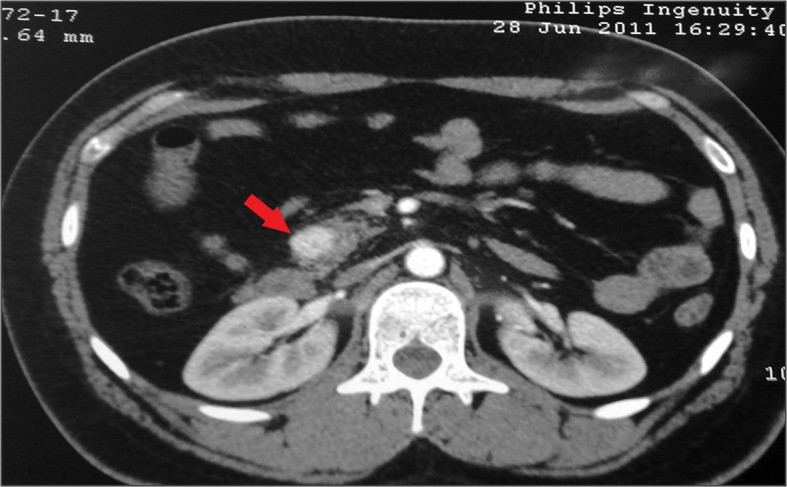
Insulinoma solitário na cabeça do pâncreas CT

TC com contraste (corte transversal) que evidencia um insulinoma solitário na cabeça do pâncreas (seta)

Imagem : “Insulinoma presenting as refractory seizure disorder” por Correia P, Panchani R, Ranjan R, Agrawal C. Licença: CC BY 3.0, editado por Lecturio.

Tratamento

Em geral, o tratamento é cirúrgico se a neoplasia for ressecável.

  • PanNETs PanNETs Pancreatic neuroendocrine tumors (PanNETs) arise from the endocrine pancreas (islet cells) and represent 2%-5% of primary pancreatic neoplasms; the other 95%-98% of pancreatic neoplasms are from the exocrine pancreas. The majority of PanNETs are nonfunctional (50%-75%), while others that are functional may be benign or malignant. Pancreatic Neuroendocrine Tumors (PanNETs) malignos ou irressecáveis: vários tratamentos
    • Análogos de ação prolongada da somatostatina:
      • Octreótido
      • Lanreotida
    • “Debulking”/resseção de tumores locais e metastáticos
    • Radioterapia (RT) e terapêutica radionucleica com recetores de peptídeos radiomarcados
    • Embolização da artéria hepática
    • Ablação por radiofrequência e crioablação
    • Radioembolização
    • Transplante hepático
    • Quimioterapia:
      • Apenas resposta modesta com quimioterapia citotóxica convencional
      • São usadas novas terapêuticas molecularmente direcionadas.
  • Insulinoma Insulinoma A benign tumor of the pancreatic beta cells. Insulinoma secretes excess insulin resulting in hypoglycemia. Pancreatic Neuroendocrine Tumors (PanNETs):
    • Cirurgia se tumor Tumor Inflammation ressecável (90%)
    • Apenas 10% dos insulinomas Insulinomas An insulinoma is a type of functional neuroendocrine tumor that manifests with hypoglycemia due to autologous secretion of insulin. It more commonly presents as a solitary benign tumor but can sometimes be associated with MEN type 1 (MEN1). Patients present with fasting hypoglycemia, which may manifest as episodes of diaphoresis, palpitations, tremor, and confusion. Insulinomas são malignos; a maioria dos outros PanNETs PanNETs Pancreatic neuroendocrine tumors (PanNETs) arise from the endocrine pancreas (islet cells) and represent 2%-5% of primary pancreatic neoplasms; the other 95%-98% of pancreatic neoplasms are from the exocrine pancreas. The majority of PanNETs are nonfunctional (50%-75%), while others that are functional may be benign or malignant. Pancreatic Neuroendocrine Tumors (PanNETs) são malignos.
    • Tumores irressecáveis: diazóxido (inibe a libertação de insulina)
  • Gastrinoma Gastrinoma A gastrinoma is a tumor that secretes excessive levels of the hormone gastrin and is responsible for Zollinger-Ellison syndrome (ZES). Gastrinomas are frequently associated with multiple endocrine neoplasia 1 (MEN 1) and can arise from the pancreas, stomach, duodenum, jejunum, and/or even from the lymph nodes. Gastrinoma:
    • Inibidores da bomba de protões (IBPs): utilizados para controlar os sintomas
    • Cirurgia: procedimento de Whipple se não houver metástases hepáticas
  • VIPoma VIPoma A VIPoma is a rare neuroendocrine tumor arising primarily in the pancreas that releases large amounts of vasoactive intestinal polypeptide (VIP). This process leads to chronic watery diarrhea with concomitant hypokalemia and dehydration, as well as wheezing and flushing (known as Verner-Morrison or WDHA syndrome). VIPoma:
    • Corrigir desiquilíbrios hidroeletrolíticos (desidratação, hipocalémia)
    • A cirurgia é possível em apenas de cerca ½ dos casos.
  • Glucagonoma Glucagonoma A glucagonoma is a glucagon-secreting neuroendocrine tumor that originates from the β-cells in the pancreatic islets. Most glucagonomas are malignant, and many of them are part of the autosomal dominant condition known as multiple endocrine neoplasia syndrome type 1 (MEN 1). Elevated levels of glucagon lead to increased gluconeogenesis and glycogenolysis. Glucagonoma:
    • Suporte nutricional para doentes com perda de peso e défice nutricional
    • Octreótido/lanreotida podem melhorar o rash Rash Rocky Mountain Spotted Fever cutâneo, perda de peso, dor e diarreia.

Diagnóstico Diferencial

Diagnóstico diferencial de massas pancreáticas

  • Adenocarcinoma ductal pancreático invasivo ( PDAC PDAC Exocrine Pancreatic Cancer, pela sigla em inglês): surge das células ductais do pâncreas exócrino. A apresentação clínica inclui sintomas de dor abdominal, icterícia e perda de peso. O diagnóstico é feito por TC, RM e ecografia. O tratamento é feito através de uma resseção cirúrgica, geralmente com quimioterapia neoadjuvante ou adjuvante, a única hipótese de cura em 15%–20% dos doentes com doença ressecável ao momento do diagnóstico. Outros tumores malignos raros com origem no pâncreas exócrino são o carcinoma de células acinares e o pancreatoblastoma.
  • Carcinoma de células acinares: tumor Tumor Inflammation maligno primário raro das glândulas exócrinas que produz enzimas exócrinas, como tripsina e lipase Lipase An enzyme of the hydrolase class that catalyzes the reaction of triacylglycerol and water to yield diacylglycerol and a fatty acid anion. It is produced by glands on the tongue and by the pancreas and initiates the digestion of dietary fats. Malabsorption and Maldigestion. Os carcinomas de células acinares podem causar uma síndrome de necrose gorda metastática devido à libertação de lipase Lipase An enzyme of the hydrolase class that catalyzes the reaction of triacylglycerol and water to yield diacylglycerol and a fatty acid anion. It is produced by glands on the tongue and by the pancreas and initiates the digestion of dietary fats. Malabsorption and Maldigestion na circulação. Estas malignidades podem ocorrer em crianças e têm melhor prognóstico que o PDAC PDAC Exocrine Pancreatic Cancer.
  • Pancreatoblastoma: tumor Tumor Inflammation maligno primário raro das glândulas exócrinas, observado principalmente em crianças. A histologia mostra múltiplas linhas de diferenciação (acinar, ductal, mesenquimatosa, neuroendócrina) e ninhos escamóides misturados com células acinares. O prognóstico é relativamente bom.

Diagnóstico diferencial de insulinoma Insulinoma A benign tumor of the pancreatic beta cells. Insulinoma secretes excess insulin resulting in hypoglycemia. Pancreatic Neuroendocrine Tumors (PanNETs)

  • Hipoglicemia factícia: pode resultar da autoadministração exógena de insulina. A hipoglicemia factícia é frequentemente observada em profissionais de saúde que apresentam sintomas de hipoglicemia. Ao contrário dos insulinomas Insulinomas An insulinoma is a type of functional neuroendocrine tumor that manifests with hypoglycemia due to autologous secretion of insulin. It more commonly presents as a solitary benign tumor but can sometimes be associated with MEN type 1 (MEN1). Patients present with fasting hypoglycemia, which may manifest as episodes of diaphoresis, palpitations, tremor, and confusion. Insulinomas, a avaliação laboratorial revela baixos níveis de peptídeo C e pró-insulina, apesar dos altos níveis de insulina. O tratamento inclui avaliação psiquiátrica e correção da hipoglicemia.
  • Toxicidade das sulfonilureias: pode ocorrer em doentes que não estão a alimentar-se ou que apresentam insuficiência renal. Os doentes apresentaram hipoglicemia. Ao contrário dos insulinomas Insulinomas An insulinoma is a type of functional neuroendocrine tumor that manifests with hypoglycemia due to autologous secretion of insulin. It more commonly presents as a solitary benign tumor but can sometimes be associated with MEN type 1 (MEN1). Patients present with fasting hypoglycemia, which may manifest as episodes of diaphoresis, palpitations, tremor, and confusion. Insulinomas, o doseamento da sulfonilureia sérica será positivo. O tratamento inclui a remoção do agente causador e tratamento da hipoglicemia.

Diagnóstico diferencial de gastrinoma Gastrinoma A gastrinoma is a tumor that secretes excessive levels of the hormone gastrin and is responsible for Zollinger-Ellison syndrome (ZES). Gastrinomas are frequently associated with multiple endocrine neoplasia 1 (MEN 1) and can arise from the pancreas, stomach, duodenum, jejunum, and/or even from the lymph nodes. Gastrinoma e glucagonoma Glucagonoma A glucagonoma is a glucagon-secreting neuroendocrine tumor that originates from the β-cells in the pancreatic islets. Most glucagonomas are malignant, and many of them are part of the autosomal dominant condition known as multiple endocrine neoplasia syndrome type 1 (MEN 1). Elevated levels of glucagon lead to increased gluconeogenesis and glycogenolysis. Glucagonoma

  • Úlcera péptica (DUP): ulceração da mucosa do estômago ou duodeno, mais MAIS Androgen Insensitivity Syndrome frequentemente devido a infeção por Helicobacter pylori Helicobacter pylori A spiral bacterium active as a human gastric pathogen. It is a gram-negative, urease-positive, curved or slightly spiral organism initially isolated in 1982 from patients with lesions of gastritis or peptic ulcers in Western Australia. Helicobacter pylori was originally classified in the genus campylobacter, but RNA sequencing, cellular fatty acid profiles, growth patterns, and other taxonomic characteristics indicate that the micro-organism should be included in the genus Helicobacter. It has been officially transferred to Helicobacter gen. Helicobacter ou uso de AINEs. O sintoma mais MAIS Androgen Insensitivity Syndrome comum, tanto das úlceras duodenais como das gástricas, é a dor epigástrica. O diagnóstico é feito por endoscopia. As úlceras pépticas esporádicas geralmente respondem bem aos esquemas de tratamento com antibióticos e IBPs.
  • VIPoma VIPoma A VIPoma is a rare neuroendocrine tumor arising primarily in the pancreas that releases large amounts of vasoactive intestinal polypeptide (VIP). This process leads to chronic watery diarrhea with concomitant hypokalemia and dehydration, as well as wheezing and flushing (known as Verner-Morrison or WDHA syndrome). VIPoma: tumor Tumor Inflammation neuroendócrino secretor de VIP VIP A highly basic, 28 amino acid neuropeptide released from intestinal mucosa. It has a wide range of biological actions affecting the cardiovascular, gastrointestinal, and respiratory systems and is neuroprotective. It binds special receptors. Gastrointestinal Neural and Hormonal Signaling. O VIPoma VIPoma A VIPoma is a rare neuroendocrine tumor arising primarily in the pancreas that releases large amounts of vasoactive intestinal polypeptide (VIP). This process leads to chronic watery diarrhea with concomitant hypokalemia and dehydration, as well as wheezing and flushing (known as Verner-Morrison or WDHA syndrome). VIPoma está também associado ao MEN 1. O tumor Tumor Inflammation causa diarreia crónica, flushing e sibilos. O diagnóstico é estabelecido através da medição dos níveis de VIP VIP A highly basic, 28 amino acid neuropeptide released from intestinal mucosa. It has a wide range of biological actions affecting the cardiovascular, gastrointestinal, and respiratory systems and is neuroprotective. It binds special receptors. Gastrointestinal Neural and Hormonal Signaling no sangue e na urina. O tratamento consiste na remoção cirúrgica do tumor Tumor Inflammation e no controlo dos sintomas.

Referências

  1. Strosberg, J. R. (2025). Classification, clinical presentation, diagnosis, and staging of pancreatic neuroendocrine neoplasms. In D. M. Nathan (Ed.), UpToDate. Retrieved August 6, 2025, from https://www.uptodate.com/contents/classification-clinical-presentation-diagnosis-and-staging-of-pancreatic-neuroendocrine-neoplasms
  2. Jensen, R. (2018). Neuroendocrine tumors of the gastrointestinal tract and pancreas. In Jameson, J.L., et al. (Ed.), Harrison’s Principles of Internal Medicine. 20th ed. Vol 1. pp. 596–616. McGraw-Hill Education. https://accessmedicine.mhmedical.com/content.aspx?bookid=2129&sectionid=192104918
  3. American Society of Clinical Oncology (ASCO). (2025). Neuroendocrine tumor of the pancreas: Risk factors. Cancer.Net. Retrieved on August 6, 2025, from https://www.cancer.net/cancer-types/neuroendocrine-tumor-pancreas/risk-factors
  4. Abraham, S. C. (2017). Well-differentiated neuroendocrine tumor, ampulla. In L. M. Caccamese & D. S. Klimstra (Eds.), Diagnostic pathology: Hepatobiliary and pancreas (2nd ed., pp. 430–431). Elsevier. https://doi.org/10.1016/B978-0-323-44307-4.50145-7 
  5. Rindi, G., Mete, O., Uccella, S., Basturk, O., La Rosa, S., Brosens, L. A. A., Ezzat, S., de Herder, W. W., Klimstra, D. S., Papotti, M., & Asa, S. L. (2022). Overview of the 2022 WHO classification of neuroendocrine neoplasms. Endocrine Pathology, 33(1), 115–154. https://doi.org/10.1007/s12022-022-09708-2

Crie sua conta gratuita ou faça login para continuar lendo!

Cadastre-se agora e tenha acesso grátis ao Lecturio, com páginas de conceitos, vídeos de medicina e questões para sua educação médica.

Aprende mais com a Lecturio:

Multiple devices displaying human anatomy and health education content.

Complementa o teu estudo da faculdade com o companheiro de estudo tudo-em-um da Lecturio, através de métodos de ensino baseados em evidência.

Estuda onde quiseres

Two iPhones display medical education apps, one showing anatomy, the other Bookmatcher.

A Lecturio Medical complementa o teu estudo através de métodos de ensino baseados em evidência, vídeos de palestras, perguntas e muito mais – tudo combinado num só lugar e fácil de usar.

User Reviews

Have a holly, jolly study session 🎁 Save 50% on all plans now >>

Que tengas una sesión de estudio alegre y navideña 🎁 Ahorra 50% en todos los planes >>

Details