


Infeção pelo VIH e SIDA

O vírus da imunodeficiência humana (VIH), um vírus de RNA RNA A polynucleotide consisting essentially of chains with a repeating backbone of phosphate and ribose units to which nitrogenous bases are attached. RNA is unique among biological macromolecules in that it can encode genetic information, serve as an abundant structural component of cells, and also possesses catalytic activity. RNA Types and Structure de cadeia simples pertencente à família Retroviridae Retroviridae The human immunodeficiency virus (HIV) is a species of Lentivirus, a genus of the family Retroviridae, which causes HIV infections and acquired immunodeficiency syndrome (AIDS). The virus has high genetic variability and is divided into 2 major types, HIV type 1 (HIV-1) and HIV type 2 (HIV-2). The human immunodeficiency virus is a single-stranded, positive-sense, enveloped RNA virus, which targets and destroys WBCs, leading to frequent opportunistic infections and, eventually, death. Human Immunodeficiency Virus (HIV), é o agente etiológico da síndrome da imunodeficiência adquirida (SIDA). O vírus da imunodeficiência humana é uma infeção sexualmente transmissível ou transmitida pelo sangue que ataca células de linfócitos T CD4+, macrófagos e células dendríticas, levando a uma eventual imunodeficiência. A apresentação é marcada por sintomas constitucionais como linfadenopatia e febre. A progressão posterior predispõe a infeções oportunistas e malignidades. O diagnóstico é por imunoensaio enzimático para VIH-1 e VIH-2. Testes Testes Gonadal Hormones adicionais incluem carga viral do VIH, genotipagem e contagem de linfócitos T CD4+ para determinar a terapia e avaliar a resposta ao tratamento e a progressão da doença. É recomendado o tratamento imediato com terapia antirretroviral combinada.

Last updated: Jun 24, 2025
Editorial responsibility: Stanley Oiseth, Lindsay Jones, Evelin Maza

Epidemiologia

Mundial

  • No final de 2018, havia aproximadamente 37 milhões de pessoas infetadas.
  • África Subsariana:
    • A área mais MAIS Androgen Insensitivity Syndrome afetada do mundo
    • São afetados aproximadamente > 10% dos adultos de 15 a 49 anos.
    • Representa > 50% do total de infeções global pelo vírus da imunodeficiência humana (VIH)
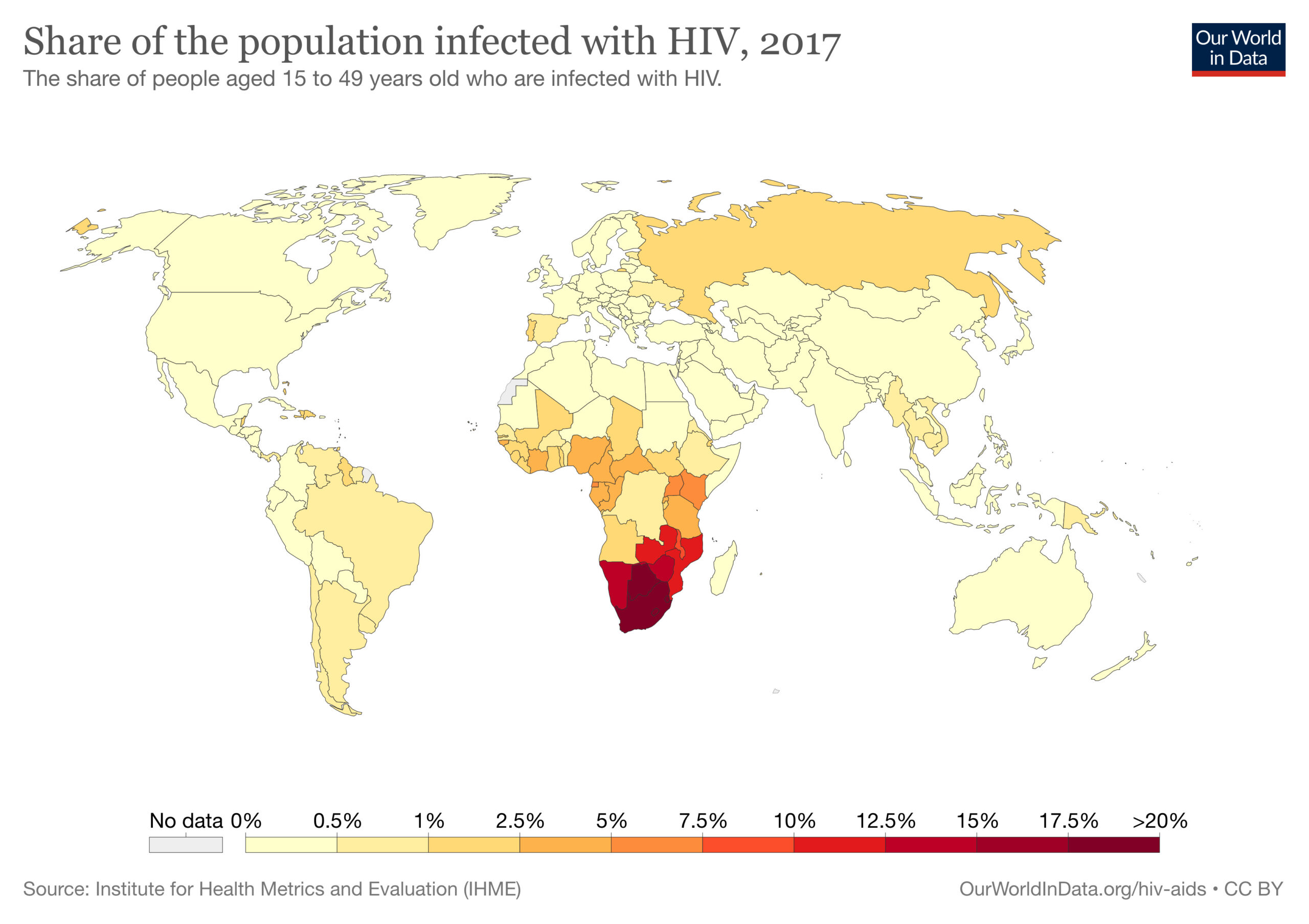
População infectada com HIV em 2017

Distribuição mundial de infeções por HIV de 2017 (em pessoas de 15 a 49 anos):
As cores indicam a percentagem da população com infeção pelo vírus da imunodeficiência humana (VIH) em cada país. As informações sobre o percentual correspondente da população (cor designada) estão abaixo do mapa-mundo.
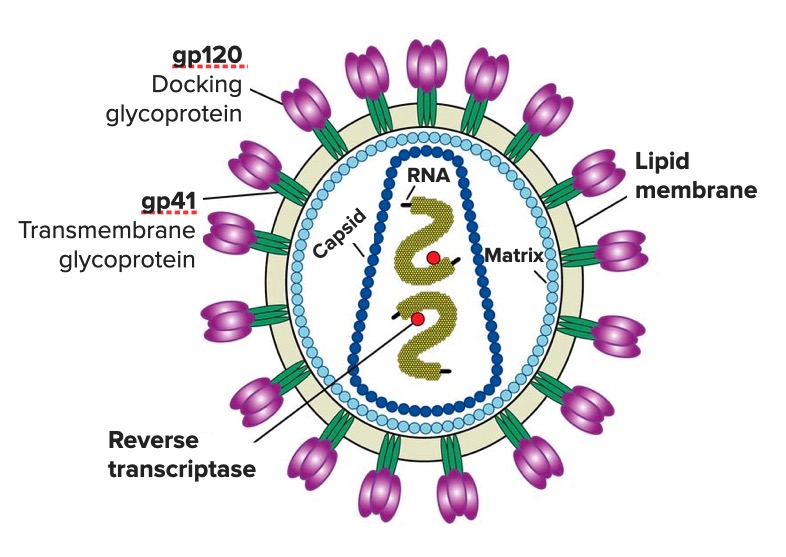
Imagem : “Share of the population infected with HIV, 2017” por Our World in Data. Licença: CC BY 4.0

Estados Unidos

  • Aproximadamente 38.700 novos casos diagnosticados a cada ano
  • Aproximadamente 1.1 milhão de indivíduos atualmente vivem com VIH
  • Infeção por VIH mais MAIS Androgen Insensitivity Syndrome alta entre hispânicos e afro-americanos (provavelmente devido a fatores socioeconómicos)
  • Homens homossexuais e bissexuais representam a maioria dos casos recém-diagnosticados.
  • As crianças geralmente adquirem a infeção da mãe no útero ou através da amamentação subsequente.

Etiologia e Transmissão

VIH

  • Género, Lentivírus ; família, Retroviridae Retroviridae The human immunodeficiency virus (HIV) is a species of Lentivirus, a genus of the family Retroviridae, which causes HIV infections and acquired immunodeficiency syndrome (AIDS). The virus has high genetic variability and is divided into 2 major types, HIV type 1 (HIV-1) and HIV type 2 (HIV-2). The human immunodeficiency virus is a single-stranded, positive-sense, enveloped RNA virus, which targets and destroys WBCs, leading to frequent opportunistic infections and, eventually, death. Human Immunodeficiency Virus (HIV)
  • Estrutura:
    • O envelope Envelope Bilayer lipid membrane acquired by viral particles during viral morphogenesis. Although the lipids of the viral envelope are host derived, various virus-encoded integral membrane proteins, i.e. Viral envelope proteins are incorporated there. Virology do vírion contém 2 glicoproteínas de membrana:
      • Gp41 Gp41 Transmembrane envelope protein of the human immunodeficiency virus which is encoded by the HIV env gene. It has a molecular weight of 41, 000 and is glycosylated. The n-terminal part of gp41 is thought to be involved in cell fusion with the CD4 antigens of T4 lymphocytes, leading to syncytial formation. Gp41 is one of the most common HIV antigens detected by immunoblotting. HIV Infection and AIDS (transmembranar)
      • Gp120 Gp120 External envelope protein of the human immunodeficiency virus which is encoded by the HIV env gene. It has a molecular weight of 120 kda and contains numerous glycosylation sites. Gp120 binds to cells expressing CD4 cell-surface antigens, most notably t4-lymphocytes and monocytes/macrophages. Gp120 has been shown to interfere with the normal function of CD4 and is at least partly responsible for the cytopathic effect of HIV. HIV Infection and AIDS (proteína de superfície/ancoragem)
    • Proteína da matriz p17: envolve o núcleo do vírus
    • Núcleo do vírus:
      • Proteína do capsídeo p24
      • 2 moléculas de ácido ribonucleico ( RNA RNA A polynucleotide consisting essentially of chains with a repeating backbone of phosphate and ribose units to which nitrogenous bases are attached. RNA is unique among biological macromolecules in that it can encode genetic information, serve as an abundant structural component of cells, and also possesses catalytic activity. RNA Types and Structure) de sentido positivo com envelope Envelope Bilayer lipid membrane acquired by viral particles during viral morphogenesis. Although the lipids of the viral envelope are host derived, various virus-encoded integral membrane proteins, i.e. Viral envelope proteins are incorporated there. Virology de cadeia simples revestidas com proteína de nucleocapsídeo
      • Enzimas (transcriptase reversa, integrase Integrase Enzyme of the human immunodeficiency virus that is required to integrate viral DNA into cellular DNA in the nucleus of a host cell. HIV integrase is a DNA nucleotidyltransferase encoded by the pol gene. HIV Infection and AIDS, protease Protease Enzyme of the human immunodeficiency virus that is required for post-translational cleavage of gag and gag-pol precursor polyproteins into functional products needed for viral assembly. HIV protease is an aspartic protease encoded by the amino terminus of the pol gene. HIV Infection and AIDS)
  • Subtipos de VIH:
    • VIH-1:
      • Espécies mais MAIS Androgen Insensitivity Syndrome comuns no mundo
      • Semelhante ao vírus da imunodeficiência símia em chimpanzés
      • 4 subgrupos distintos (M, N, O e P)
      • Subgrupo M: 90% do VIH/SIDA(síndrome da imunodeficiência adquirida) em todo o mundo
    • VIH-2:
      • Infecciosidade mais MAIS Androgen Insensitivity Syndrome baixa, menos virulenta, em grande parte confinada à África Ocidental
      • Semelhante ao vírus da imunodeficiência símia de macacos mangabey fuliginosos
      • 8 subgrupos conhecidos (A a H)
  • Transmissão através de fluidos corporais (ou seja, sangue, sémen, secreções vaginais e leite materno)
virião do HIV

Diagrama do vírus VIH que apresenta a estrutura do seu genoma e as suas principais enzimas e glicoproteínas (gp120 e gp41)

Imagem: “Diagram of the HIV virus” por US National Institute of Health.  Licença: Public Domain

Modos de transmissão do VIH

Sexual:

  • Sexo desprotegido:
    • Responsável por 80% das infeções
    • Relação anal recetiva desprotegida (URAI, pela sigla me inglês) em homens e mulheres > relação sexual recetiva desprotegida
  • Na relação anal, a infeção ocorre:
    • Com inoculação direta no sangue na presença de lágrimas traumáticas
    • Com fácil acesso às células-alvo sob a frágil membrana da mucosa retal
  • Nos Estados Unidos, o risco observou:
  • Na África, as infeções relatadas são predominantemente por transmissão heterossexual (dados limitados sobre taxas de transmissão homossexual).

Parenteral:

  • Uso de drogas intravenosas (IV) e partilha de agulhas
  • Punções acidentais de agulha em profissionais médicos

Vertical:

  • Mãe para filho durante a gravidez, parto ou amamentação
  • A maioria dos casos ocorre durante o parto.
  • Fatores de risco para transmissão vertical:
    • Sem terapia antirretroviral ou profilaxia
    • Carga viral materna elevada
    • Rutura de membranas > 4 horas

Fatores que afetam a transmissão

  • Carga viral:
    • A quantidade de VIH é o fator primário que determina a transmissão.
    • Transmissão improvável se carga viral suprimida (definida como carga viral < 400 cópias de RNA RNA A polynucleotide consisting essentially of chains with a repeating backbone of phosphate and ribose units to which nitrogenous bases are attached. RNA is unique among biological macromolecules in that it can encode genetic information, serve as an abundant structural component of cells, and also possesses catalytic activity. RNA Types and Structure do VIH/mL)
  • Tipo de contacto sexual:
    • O sexo anal recetivo é o de maior risco.
    • A circuncisão reduz o risco de transmissão.
  • Danos nas mucosas: Inflamação, lágrimas, infeções sexualmente transmissíveis e irritação das membranas mucosas genitais aumentam o risco de transmissão.
  • Infeção recente pelo VIH: risco elevado de transmissão devido à alta carga viral

Fisiopatologia

Ciclo de replicação do VIH

  • Células-alvo: células T CD4+, macrófagos e células dendríticas
  • Entrada de células VIH:
    • O vírion entra primeiro através de uma rutura na membrana mucosa.
    • O vírion atravessa a barreira da mucosa e procura células-alvo.
  • Replicação do VIH:
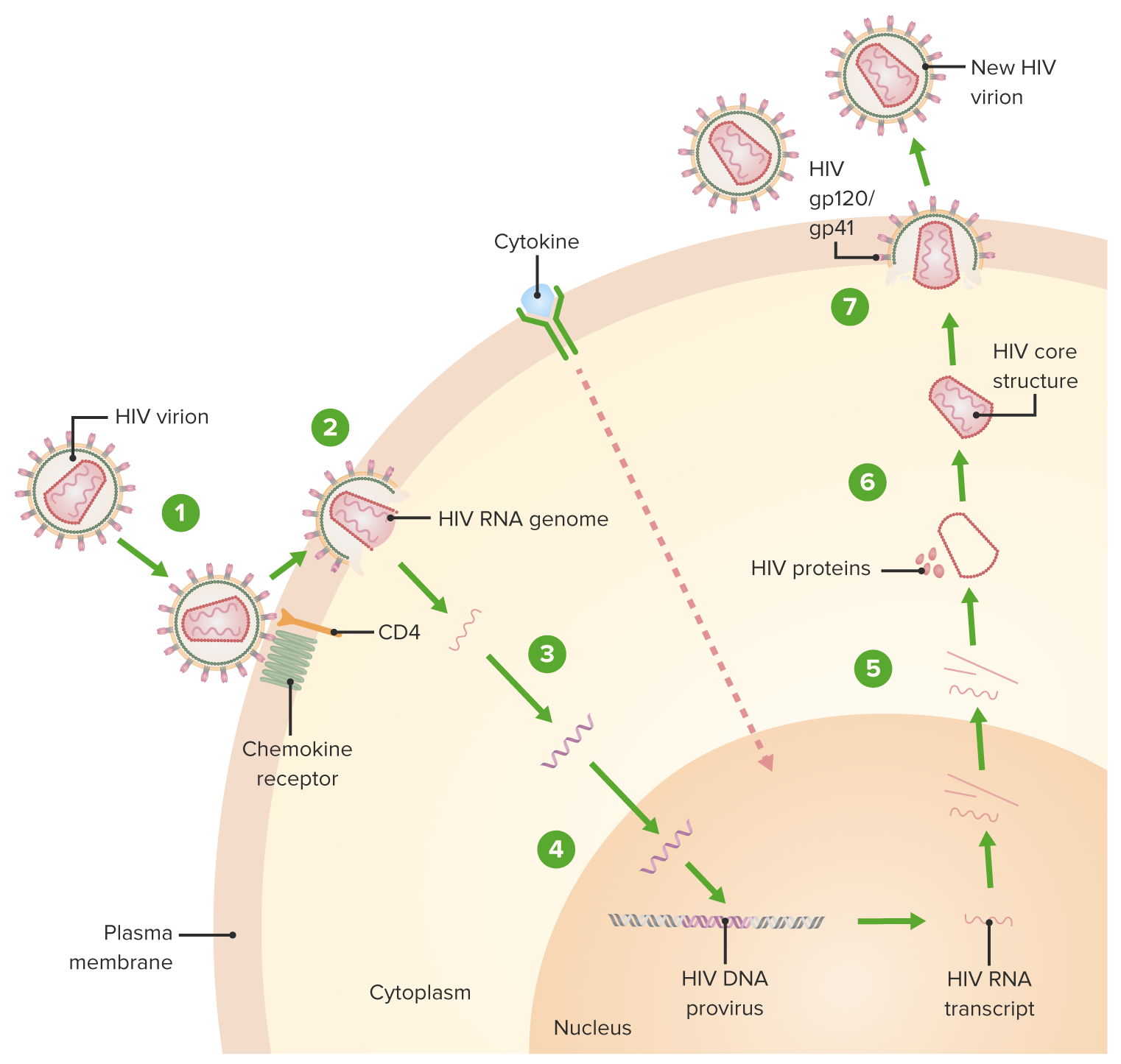
    1. Fusão de membranas e ligação de recetores (entrada): o vírion (transporta RNA RNA A polynucleotide consisting essentially of chains with a repeating backbone of phosphate and ribose units to which nitrogenous bases are attached. RNA is unique among biological macromolecules in that it can encode genetic information, serve as an abundant structural component of cells, and also possesses catalytic activity. RNA Types and Structure viral, transcriptase reversa, integrase Integrase Enzyme of the human immunodeficiency virus that is required to integrate viral DNA into cellular DNA in the nucleus of a host cell. HIV integrase is a DNA nucleotidyltransferase encoded by the pol gene. HIV Infection and AIDS e outras proteínas) inicia a entrada na célula hospedeira.
      • Vírion liga o recetor CD4 e um recetor de quimiocina ( CCR5 CCR5 Ccr receptors with specificity for chemokine ccl3; chemokine ccl4; and chemokine ccl5. They are expressed at high levels in T-lymphocytes; B-lymphocytes; macrophages; mast cells; and nk cells. The ccr5 receptor is used by the human immunodeficiency virus to infect cells. HIV Infection and AIDS em macrófagos, CXCR4 CXCR4 Cxcr receptors with specificity for cxcl12 chemokine. The receptors may play a role in hematopoiesis regulation and can also function as coreceptors for the human immunodeficiency virus. HIV Infection and AIDS em células T).
        • Vírus macrofágicos: estirpes R5
        • Vírus trópicos de células T: estirpes X4
      • A ligação de gp120 Gp120 External envelope protein of the human immunodeficiency virus which is encoded by the HIV env gene. It has a molecular weight of 120 kda and contains numerous glycosylation sites. Gp120 binds to cells expressing CD4 cell-surface antigens, most notably t4-lymphocytes and monocytes/macrophages. Gp120 has been shown to interfere with the normal function of CD4 and is at least partly responsible for the cytopathic effect of HIV. HIV Infection and AIDS com CD4 e os recetores de quimiocinas leva a uma mudança conformacional, expondo o domínio de fusão na gp41 Gp41 Transmembrane envelope protein of the human immunodeficiency virus which is encoded by the HIV env gene. It has a molecular weight of 41, 000 and is glycosylated. The n-terminal part of gp41 is thought to be involved in cell fusion with the CD4 antigens of T4 lymphocytes, leading to syncytial formation. Gp41 is one of the most common HIV antigens detected by immunoblotting. HIV Infection and AIDS.
      • Este processo une as membranas viral e celular, fundindo-as.
    2. O invólucro proteico do capsídeo (que envolve o RNA RNA A polynucleotide consisting essentially of chains with a repeating backbone of phosphate and ribose units to which nitrogenous bases are attached. RNA is unique among biological macromolecules in that it can encode genetic information, serve as an abundant structural component of cells, and also possesses catalytic activity. RNA Types and Structure viral e as proteínas) não é revestido à medida que o vírion atravessa o citoplasma.
    3. Transcrição reversa: ocorre a síntese mediada por transcriptase reversa de ácido desoxirribonucleico ( DNA DNA A deoxyribonucleotide polymer that is the primary genetic material of all cells. Eukaryotic and prokaryotic organisms normally contain DNA in a double-stranded state, yet several important biological processes transiently involve single-stranded regions. DNA, which consists of a polysugar-phosphate backbone possessing projections of purines (adenine and guanine) and pyrimidines (thymine and cytosine), forms a double helix that is held together by hydrogen bonds between these purines and pyrimidines (adenine to thymine and guanine to cytosine). DNA Types and Structure) proviral (a partir do RNA RNA A polynucleotide consisting essentially of chains with a repeating backbone of phosphate and ribose units to which nitrogenous bases are attached. RNA is unique among biological macromolecules in that it can encode genetic information, serve as an abundant structural component of cells, and also possesses catalytic activity. RNA Types and Structure viral).
    4. Integração: O DNA DNA A deoxyribonucleotide polymer that is the primary genetic material of all cells. Eukaryotic and prokaryotic organisms normally contain DNA in a double-stranded state, yet several important biological processes transiently involve single-stranded regions. DNA, which consists of a polysugar-phosphate backbone possessing projections of purines (adenine and guanine) and pyrimidines (thymine and cytosine), forms a double helix that is held together by hydrogen bonds between these purines and pyrimidines (adenine to thymine and guanine to cytosine). DNA Types and Structure viral é transportado através do núcleo e integrado ao DNA DNA A deoxyribonucleotide polymer that is the primary genetic material of all cells. Eukaryotic and prokaryotic organisms normally contain DNA in a double-stranded state, yet several important biological processes transiently involve single-stranded regions. DNA, which consists of a polysugar-phosphate backbone possessing projections of purines (adenine and guanine) and pyrimidines (thymine and cytosine), forms a double helix that is held together by hydrogen bonds between these purines and pyrimidines (adenine to thymine and guanine to cytosine). DNA Types and Structure do hospedeiro, facilitado pela integrase Integrase Enzyme of the human immunodeficiency virus that is required to integrate viral DNA into cellular DNA in the nucleus of a host cell. HIV integrase is a DNA nucleotidyltransferase encoded by the pol gene. HIV Infection and AIDS.
    5. Replicação: O DNA DNA A deoxyribonucleotide polymer that is the primary genetic material of all cells. Eukaryotic and prokaryotic organisms normally contain DNA in a double-stranded state, yet several important biological processes transiently involve single-stranded regions. DNA, which consists of a polysugar-phosphate backbone possessing projections of purines (adenine and guanine) and pyrimidines (thymine and cytosine), forms a double helix that is held together by hydrogen bonds between these purines and pyrimidines (adenine to thymine and guanine to cytosine). DNA Types and Structure viral é transcrito e formam-se várias cópias do novo RNA RNA A polynucleotide consisting essentially of chains with a repeating backbone of phosphate and ribose units to which nitrogenous bases are attached. RNA is unique among biological macromolecules in that it can encode genetic information, serve as an abundant structural component of cells, and also possesses catalytic activity. RNA Types and Structure do VIH que são transportadas para o citoplasma.
      • O novo RNA RNA A polynucleotide consisting essentially of chains with a repeating backbone of phosphate and ribose units to which nitrogenous bases are attached. RNA is unique among biological macromolecules in that it can encode genetic information, serve as an abundant structural component of cells, and also possesses catalytic activity. RNA Types and Structure do VIH torna-se o genoma de um novo vírus.
      • São usadas outras cópias do RNA RNA A polynucleotide consisting essentially of chains with a repeating backbone of phosphate and ribose units to which nitrogenous bases are attached. RNA is unique among biological macromolecules in that it can encode genetic information, serve as an abundant structural component of cells, and also possesses catalytic activity. RNA Types and Structure para produzir novas proteínas do VIH.
    6. Montagem: Novo RNA RNA A polynucleotide consisting essentially of chains with a repeating backbone of phosphate and ribose units to which nitrogenous bases are attached. RNA is unique among biological macromolecules in that it can encode genetic information, serve as an abundant structural component of cells, and also possesses catalytic activity. RNA Types and Structure viral + proteínas + enzimas movem-se para a superfície da célula e formam uma partícula não infecciosa.
    7. Formação e maturação:
      • A partícula ( RNA RNA A polynucleotide consisting essentially of chains with a repeating backbone of phosphate and ribose units to which nitrogenous bases are attached. RNA is unique among biological macromolecules in that it can encode genetic information, serve as an abundant structural component of cells, and also possesses catalytic activity. RNA Types and Structure viral + proteínas) eventualmente saí da célula hospedeira com o VIH imaturo.
      • A protease Protease Enzyme of the human immunodeficiency virus that is required for post-translational cleavage of gag and gag-pol precursor polyproteins into functional products needed for viral assembly. HIV protease is an aspartic protease encoded by the amino terminus of the pol gene. HIV Infection and AIDS da proteína viral cliva as poliproteínas recém-sintetizadas, produzindo um VIH maduro.
Ciclo de replicação do HIV

Ciclo de replicação do VIH:
1. O vírion liga-se ao recetor CD4 e a um recetor de quimiocina, seguido por uma mudança conformacional que facilita a fusão do vírion e da célula hospedeira.
2. Um invólucro de proteína do capsídeo (ao redor do RNA viral e proteínas) é não revestido à medida que o vírion atravessa o citoplasma.
3. Ocorre a síntese de DNA pró-viral mediada por transcriptase reversa.
4. O DNA viral é transportado através do núcleo e integrado ao DNA do hospedeiro, facilitado pela integrase.
5. O DNA viral é transcrito e formam-se múltiplas cópias do novo RNA do VIH que são transportadas para o citoplasma. O novo RNA do VIH torna-se o genoma de um novo vírus. Também ocorre a ativação de citocinas da célula.
6. Novo RNA viral + proteínas + enzimas movem-se para a superfície da célula e formam uma partícula não infecciosa.
7. A partícula (RNA viral + proteínas) eventualmente saí da célula hospedeira com o VIH imaturo. A proteína protease viral (enzima) cliva as poliproteínas recém-sintetizadas produzindo um VIH maduro.
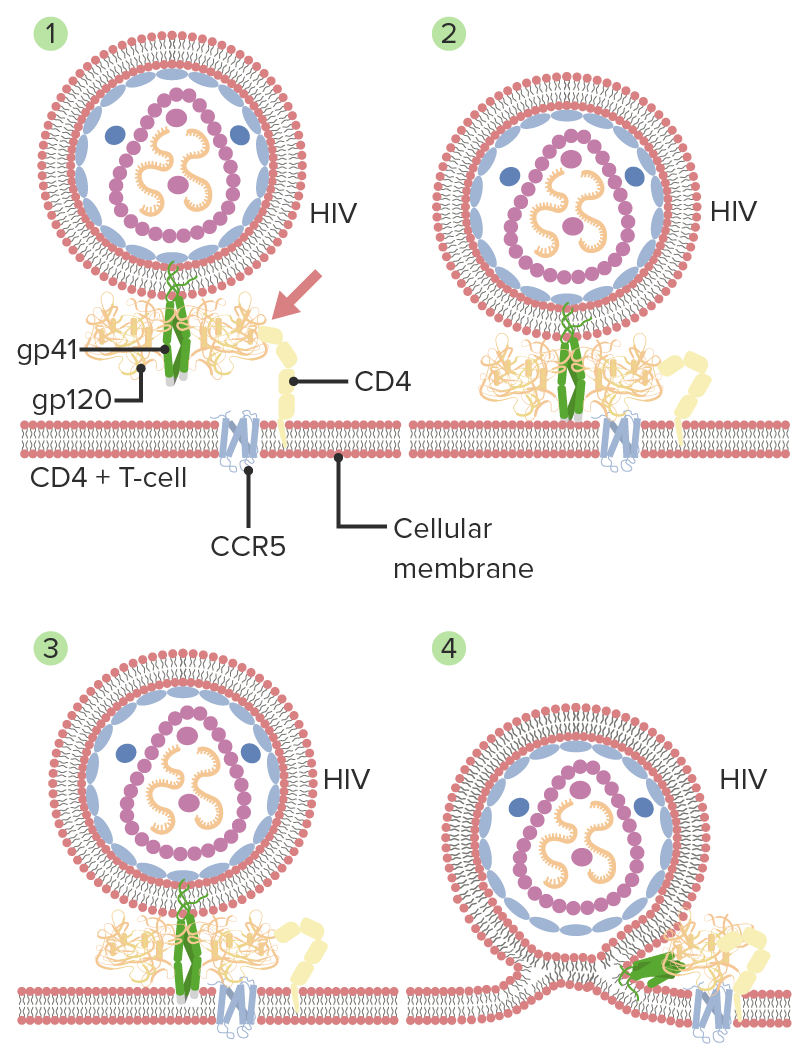
Imagem por Lecturio.
Mecanismo de entrada do HIV e fusão da membrana

Mecanismo de entrada do VIH e fusão da membrana:
1. VIH Gp120 interage com CD4 (célula hospedeira).
2. Segue-se uma interação secundária com outro recetor CCR5, com uma mudança conformacional na gp120.
3. As pontas da gp41 são inseridas na membrana celular.
4. Gp41 dobra-se ao meio e forma “bobinas” enroladas. As membranas viral e celular unem-se, levando à fusão.

Imagem por Lecturio.

História natural

Fase aguda (infeção, disseminação, síndrome retroviral):

  • O VIH infeta e destrói células T CD4+, macrófagos e células dendríticas nos tecidos da mucosa.
  • Ocorre a disseminação e replicação nos gânglios linfáticos, depois prossegue para outros compartimentos linfoides ( mais MAIS Androgen Insensitivity Syndrome células-alvo CD4+) → viremia Viremia The presence of viruses in the blood. Erythema Infectiosum.
  • Segue-se uma disseminação adicional para o plasma Plasma The residual portion of blood that is left after removal of blood cells by centrifugation without prior blood coagulation. Transfusion Products e outros órgãos.
  • A resposta imune antiviral Antiviral Antivirals for Hepatitis B leva à seroconversão (cerca de 3 a 7 semanas).
  • São ativados linfócitos T citolíticos CD8+ (CTLs, pela sigla em inglês) e esta resposta imune produz um controlo parcial da replicação viral.
  • Síndrome retroviral aguda:
    • Apresentação clínica de doença viral aguda autolimitada
    • Associada a milhões de cópias de RNA RNA A polynucleotide consisting essentially of chains with a repeating backbone of phosphate and ribose units to which nitrogenous bases are attached. RNA is unique among biological macromolecules in that it can encode genetic information, serve as an abundant structural component of cells, and also possesses catalytic activity. RNA Types and Structure do VIH/mL de plasma Plasma The residual portion of blood that is left after removal of blood cells by centrifugation without prior blood coagulation. Transfusion Products
    • Alta probabilidade de transmissão durante este período

Fase crónica/latência clínica:

  • Replicação de baixo nível do vírus em tecidos linfoides e depleção lenta e progressiva de células T
  • A replicação sustentada gera mutações, que contribuem para o escape viral do controlo pelas CTLs CD8+.
  • O vírus pode evoluir e sofrer troca de correcetor (em vez de 1 correcetor, o vírus pode contar com CCR5 CCR5 Ccr receptors with specificity for chemokine ccl3; chemokine ccl4; and chemokine ccl5. They are expressed at high levels in T-lymphocytes; B-lymphocytes; macrophages; mast cells; and nk cells. The ccr5 receptor is used by the human immunodeficiency virus to infect cells. HIV Infection and AIDS ou CXCR4 CXCR4 Cxcr receptors with specificity for cxcl12 chemokine. The receptors may play a role in hematopoiesis regulation and can also function as coreceptors for the human immunodeficiency virus. HIV Infection and AIDS).

SIDA:

  • A ativação contínua de células T resulta em morte extensa de células T CD4+.
  • A imunodeficiência profunda leva a infeções oportunistas (causa habitual de morte).
Relação entre contagem de células T CD4+ e carga viral

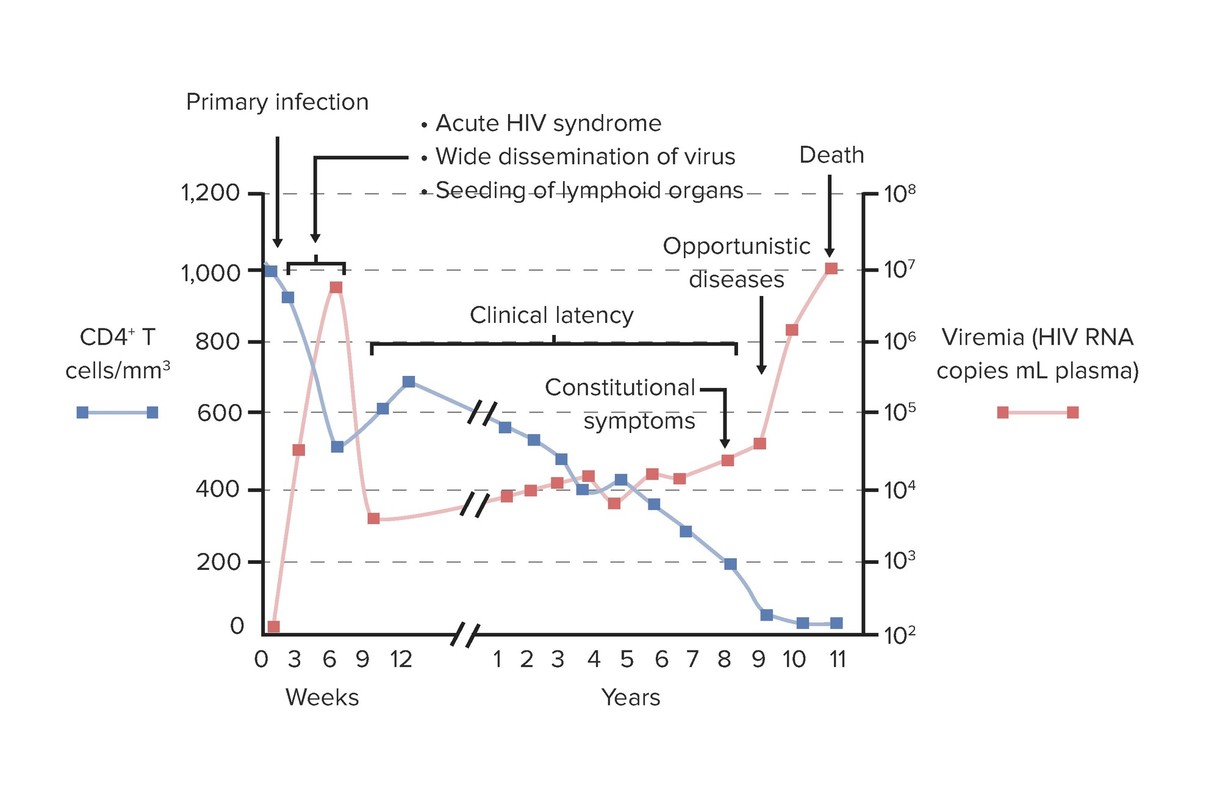
Gráfico da relação entre contagem de células T CD4+ e carga viral durante o curso clínico da infeção pelo VIH e SIDA:
Na infeção primária/aguda (infeção inicial, disseminação e síndrome retroviral aguda), observa-se um aumento da carga viral (viremia) com diminuição das células T CD4+. Este período dura semanas. No período de latência clínica, ocorre replicação viral de baixo nível, mas sustentada, e é observado o declínio gradual das células CD4+. A progressão para SIDA é o resultado da falha das defesas do hospedeiro, com a depleção de células T CD4+ e aumento da carga viral. Este processo predispõe a infeções oportunistas.

Imagem por Lecturio.

Apresentação Clínica

Categorias de infeção pelo VIH

A classificação dos Centros de Controlo e Prevenção de Doenças (CDC, pela sigla em inglês) observa que a contagem de linfócitos T CD4 + é:

  • Um indicador confiável da progressão da doença
  • Um guia para o tratamento clínico e terapêutico da infeção pelo HIV HIV Anti-HIV Drugs
Tabela: Sistema de classificação revisto de 1993 para infeção por VIH
Categorias/estadio de células T CD 4+ 1 2 3
Categorias clínicas CD4+ ≥ 500 células/µL CD4+ 200–499 células/µL CD4+ <200 células/µL*
A: Assintomático, VIH agudo, linfadenopatia persistente A1 A2 A3
B: Sintomático, não A ou C B1 B2 B3
C: SIDA, incluindo infeções oportunistas, doenças neurológicas e tumores C1 C2 C3
* A contagem de CD4 abaixo de 200/μL é considerada definidora de SIDA.

Curso clínico e sintomas

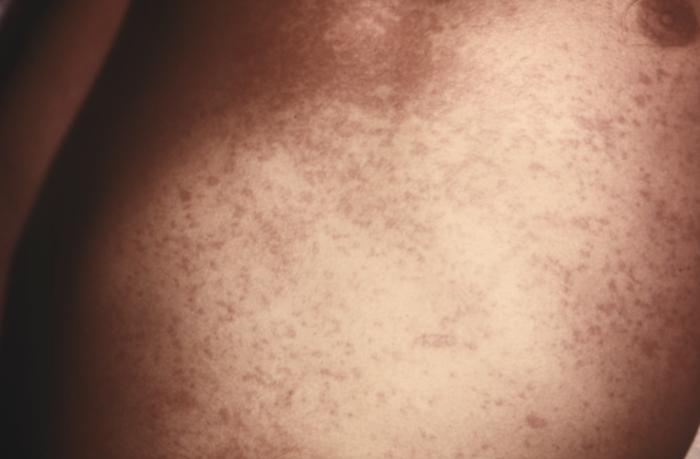
Síndrome retroviral aguda (fase aguda):
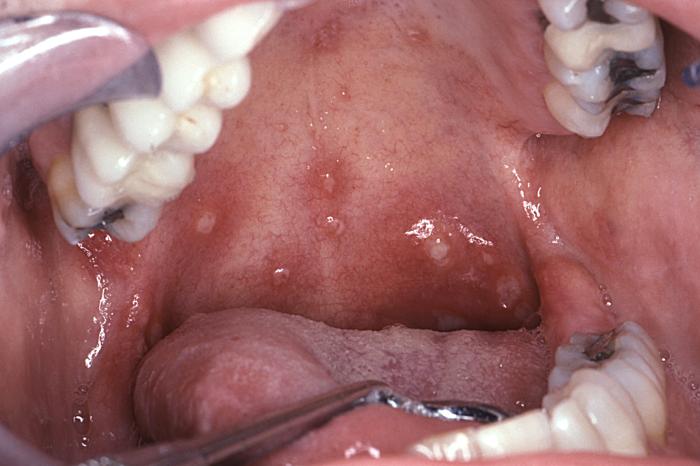
  • 3-6 semanas após a infecção
  • Apresentação semelhante à mononucleose infecciosa:
    • Febre, fadiga , mialgias ( mais MAIS Androgen Insensitivity Syndrome comuns)
    • Cefaleia retro-orbital (pode haver meningite asséptica), dor nas articulações e rash Rash Rocky Mountain Spotted Fever cutâneo
    • Odinofagia e feridas dolorosas na boca (úlceras aftosas)
    • Hepatoesplenomegalia
    • Linfadenopatias (principalmente cervicais, axilares e occipitais)
    • Náuseas, vómitos, diarreia e perda de peso

Infeção crónica (latência clínica):

  • Poucas ou nenhuma manifestação clínica de infeção
  • Infeções oportunistas menores:
    • Candidíase oral
    • Candidíase vaginal
    • Herpes zoster Herpes Zoster Varicella-zoster virus (VZV) is a linear, double-stranded DNA virus in the Herpesviridae family. Shingles (also known as herpes zoster) is more common in adults and occurs due to the reactivation of VZV. Varicella-Zoster Virus/Chickenpox
    • Tuberculose

SIDA:

  • Sem tratamento, a progressão para SIDA ocorre após uma fase crónica de 7 a 10 anos.
  • Doenças definidoras de SIDA e malignidades
  • Infeções oportunistas
  • “Wasting syndrome”
  • Encefalopatia associada ao VIH

SIDA

  • Definida como:
    • Contagem de células T CD4+ de < 200 células/μL ou uma percentagem de células T CD4+ do total de linfócitos < 14%
    • E/ou pelo menos 1 condição definidora de SIDA (infeções oportunistas ou doenças associadas à imunossupressão)
  • Condições definidoras de SIDA:
    • Infeções fúngicas e parasitárias:
      • Candidíase
      • Meningite criptocócica
      • Cryptosporidium Cryptosporidium A genus of coccidian parasites of the family cryptosporidiidae, found in the intestinal epithelium of many vertebrates including humans. Hyper-IgM Syndrome ou Cystoisospora Cystoisospora Cystoisospora is a genus within the Coccidia subclass of protozoans. They are single-celled, obligate intracellular parasites that cause intestinal infections in humans. Humans are the only host for these species, and they are both transmitted through the fecal-oral route. The symptoms of cystoisosporiasis are watery diarrhea, abdominal pain, and fever. Cystoisospora/Cystoisosporiasis and Cyclospora/Cyclosporiasis (enterite/diarréia)
      • Coccidioidomicose
      • Pneumonia Pneumonia Pneumonia or pulmonary inflammation is an acute or chronic inflammation of lung tissue. Causes include infection with bacteria, viruses, or fungi. In more rare cases, pneumonia can also be caused through toxic triggers through inhalation of toxic substances, immunological processes, or in the course of radiotherapy. Pneumonia por Pneumocystis jirovecii
      • Toxoplasmose cerebral
      • Histoplasmose
    • Infeções bacterianas:
      • Mycobacterium Mycobacterium Mycobacterium is a genus of the family Mycobacteriaceae in the phylum Actinobacteria. Mycobacteria comprise more than 150 species of facultative intracellular bacilli that are mostly obligate aerobes. Mycobacteria are responsible for multiple human infections including serious diseases, such as tuberculosis (M. tuberculosis), leprosy (M. leprae), and M. avium complex infections. Mycobacterium avium-intracellulare
      • M. tuberculose
      • Septicemia por salmonela
      • Nocardia Nocardia Nocardia is a branching, filamentous, gram-positive bacilli. It is partially acid fast due to the presence of mycolic acids in the cell wall. Nocardia is a ubiquitous soil organism that most commonly affects immunocompromised patients. Nocardia is transmitted via inhalation of aerosolized bacteria or less commonly, via direct contact with wounds. Nocardia/Nocardiosis
    • Infeções víricas:
      • Herpes zoster Herpes Zoster Varicella-zoster virus (VZV) is a linear, double-stranded DNA virus in the Herpesviridae family. Shingles (also known as herpes zoster) is more common in adults and occurs due to the reactivation of VZV. Varicella-Zoster Virus/Chickenpox
      • Infeções por citomegalovírus (CMV)
      • Encefalite por vírus herpes simples ( HSV HSV Herpes simplex virus (HSV) is a double-stranded DNA virus belonging to the family Herpesviridae. Herpes simplex virus commonly causes recurrent infections involving the skin and mucosal surfaces, including the mouth, lips, eyes, and genitals. Herpes Simplex Virus 1 and 2)
      • Leucoencefalopatia multifocal Multifocal Retinoblastoma progressiva
    • Malignidades:
      • Linfoma (de Burkitt, imunoblástico)
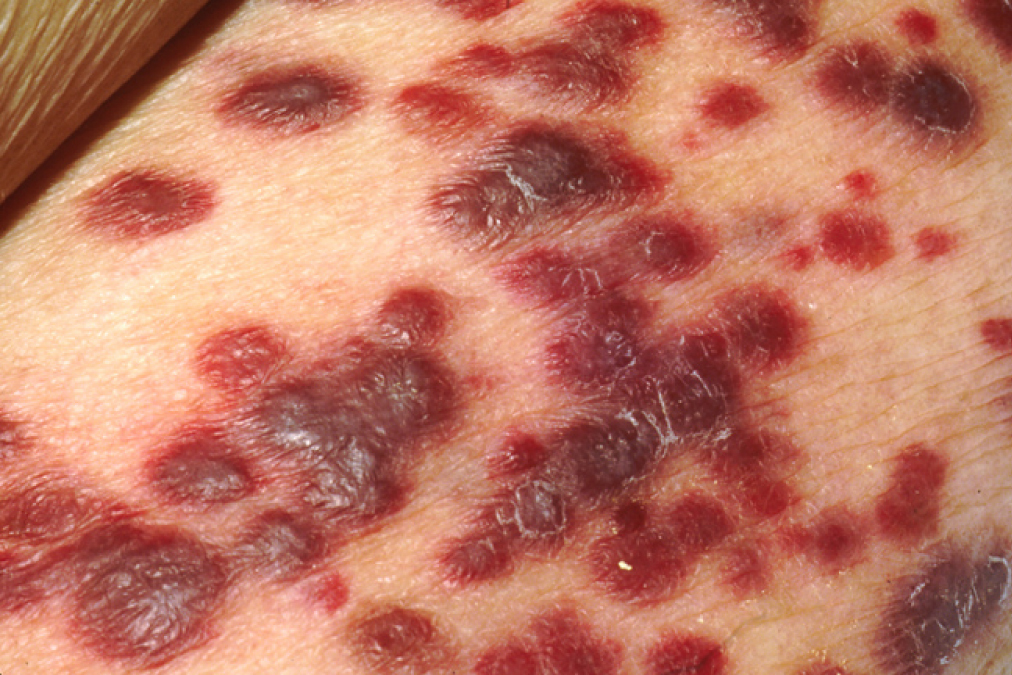
      • Sarcoma de Kaposi Kaposi A multicentric, malignant neoplastic vascular proliferation characterized by the development of bluish-red cutaneous nodules, usually on the lower extremities, most often on the toes or feet, and slowly increasing in size and number and spreading to more proximal areas. The tumors have endothelium-lined channels and vascular spaces admixed with variably sized aggregates of spindle-shaped cells, and often remain confined to the skin and subcutaneous tissue, but widespread visceral involvement may occur. Hhv-8 is the suspected cause. There is also a high incidence in AIDS patients. AIDS-defining Conditions
      • Carcinomas cervicais e anais invasivos
    • Miscelânea:
      • “Wasting syndrome” atribuída ao VIH
      • Encefalopatia associada ao VIH
Sarcoma de Kaposi

Lesões cutâneas do sarcoma de Kaposi

Imagem: “Kaposi’s sarcoma” por OpenStax College. Licença: CC BY 3.0
Infeções e condições selecionadas

  • Pneumonia Pneumonia Pneumonia or pulmonary inflammation is an acute or chronic inflammation of lung tissue. Causes include infection with bacteria, viruses, or fungi. In more rare cases, pneumonia can also be caused through toxic triggers through inhalation of toxic substances, immunological processes, or in the course of radiotherapy. Pneumonia por P. jiroveci :
    • Fatores de risco:
      • Contagem de CD4 < 200/µL
      • Candidíase oral
      • Pneumonia Pneumonia Pneumonia or pulmonary inflammation is an acute or chronic inflammation of lung tissue. Causes include infection with bacteria, viruses, or fungi. In more rare cases, pneumonia can also be caused through toxic triggers through inhalation of toxic substances, immunological processes, or in the course of radiotherapy. Pneumonia por Pneumocystis anterior
      • Perda ponderal
    • Os sintomas incluem dispneia, febre e tosse não produtiva.
    • Resultados do exame objetivo:
      • Taquipneia
      • Taquicardia
      • Crepitações e roncos; auscultação normal em 50% dos casos
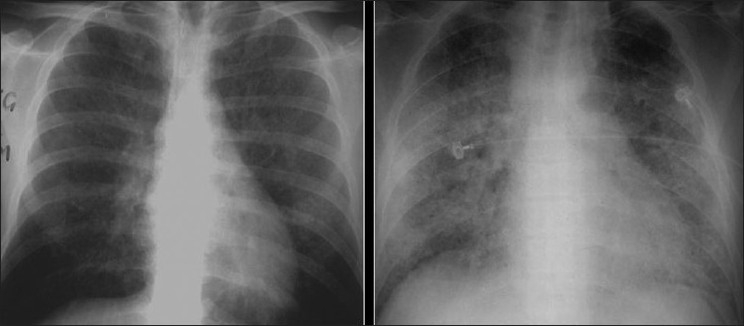
    • A radiografia de tórax mostra infiltrados intersticiais bilaterais.
    • Diagnóstico: coloração especial de prata de secreções respiratórias mostra quistos clássicos
    • Tratamento:
      • Trimetoprim-sulfametoxazol
      • Alternativa: clindamicina + primaquina
      • Hipoxemia moderada ou grave: adição de doses de prednisolona
  • Meningite criptocócica:
    • Maior risco se contagem de CD4 < 100/µL
    • Os sintomas incluem dor de cabeça, febre, alteração do estado de consciência e défices neurológicos.
    • O exame mostra meningismo em < 40% dos doentes.
    • Diagnóstico:
      • Punção lombar incluindo medição da pressão de abertura
      • Líquido cefalorraquidiano (LCR): ↓ contagem de glóbulos brancos, ↑ proteína, ↓ ou glicose normal
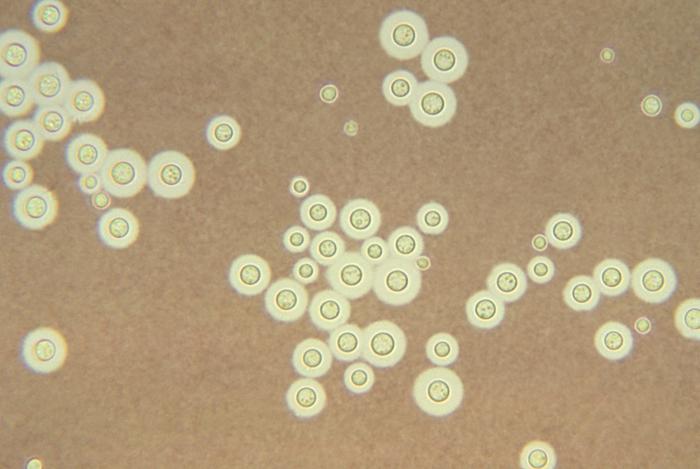
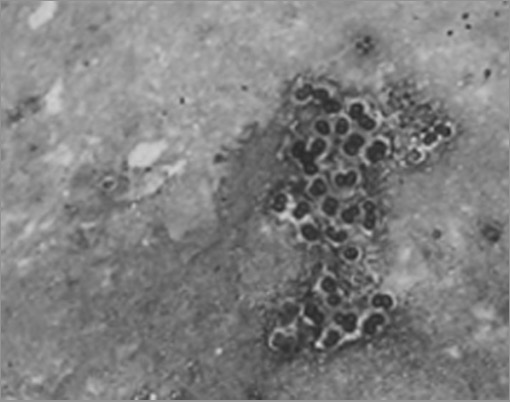
      • Coloração de tinta da Índia LCR (organismos de levedura encapsulados), cultura
      • Teste de antigénio criptocócico no LCR
      • Teste de antigénio criptocócico sérico
    • Tratamento:
      • Anfotericina B e flucitosina por 2 semanas
      • Em seguida, fluconazol oral por 8 semanas ou até que o doente tenha cultura negativa
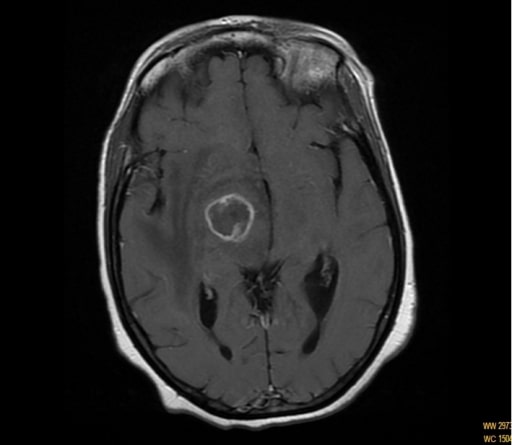
  • Encefalite por toxoplasma Toxoplasma Toxoplasmosis is an infectious disease caused by Toxoplasma gondii, an obligate intracellular protozoan parasite. Felines are the definitive host, but transmission to humans can occur through contact with cat feces or the consumption of contaminated foods. The clinical presentation and complications depend on the host’s immune status. Toxoplasma/Toxoplasmosis:
    • Maior risco se contagem de CD4 < 100/uL
    • Os sintomas incluem dor de cabeça, confusão, febre, convulsões e letargia.
    • O exame mostra ataxia Ataxia Impairment of the ability to perform smoothly coordinated voluntary movements. This condition may affect the limbs, trunk, eyes, pharynx, larynx, and other structures. Ataxia may result from impaired sensory or motor function. Sensory ataxia may result from posterior column injury or peripheral nerve diseases. Motor ataxia may be associated with cerebellar diseases; cerebral cortex diseases; thalamic diseases; basal ganglia diseases; injury to the red nucleus; and other conditions. Ataxia-telangiectasia, défices neurológicos focais e sensoriais.
    • Diagnóstico:
      • Imagens do cérebro: múltiplas lesões de realce do anel
      • + Anticorpo IgG IgG The major immunoglobulin isotype class in normal human serum. There are several isotype subclasses of igg, for example, igg1, igg2a, and igg2b. Hypersensitivity Pneumonitis Toxoplasma Toxoplasma Toxoplasmosis is an infectious disease caused by Toxoplasma gondii, an obligate intracellular protozoan parasite. Felines are the definitive host, but transmission to humans can occur through contact with cat feces or the consumption of contaminated foods. The clinical presentation and complications depend on the host’s immune status. Toxoplasma/Toxoplasmosis gondii
      • Síndrome clínica típica
    • Tratamento: pirimetamina, sulfadiazina e ácido folínico por 6 semanas
  • Infeção disseminada pelo complexo M. avium (MAC):
    • Maior risco se contagem de CD4 < 50/µL
    • Os sintomas incluem febre, perda de peso, suores noturnos, dor abdominal e diarreia.
    • O exame mostra linfadenopatia e hepatoesplenomegalia.
    • Estudos laboratoriais: anemia Anemia Anemia is a condition in which individuals have low Hb levels, which can arise from various causes. Anemia is accompanied by a reduced number of RBCs and may manifest with fatigue, shortness of breath, pallor, and weakness. Subtypes are classified by the size of RBCs, chronicity, and etiology. Anemia: Overview and Types grave (devido ao envolvimento da medula óssea), ↑ fosfatase alcalina, ↑ lactato desidrogenase
    • Diagnóstico: hemoculturas
    • Tratamento:
      • Macrólido (e.g., claritromicina, azitromicina) + etambutol
      • +/- Rifabutina (se com ↑ carga micobacteriana)
  • Manifestações da SIDA no sistema nervoso:
    • 90% dos doentes apresentam envolvimento neurológico na autópsia.
    • Algumas descobertas:
      • Mielopatia vacuolar: microscopicamente assemelha-se à degeneração combinada subaguda (deficiência de vitamina B 12)
      • Neuropatias periféricas associadas à SIDA ( mais MAIS Androgen Insensitivity Syndrome comuns: polineuropatia sensorial distal)
      • Meningoencefalite por VIH: demência, ataxia Ataxia Impairment of the ability to perform smoothly coordinated voluntary movements. This condition may affect the limbs, trunk, eyes, pharynx, larynx, and other structures. Ataxia may result from impaired sensory or motor function. Sensory ataxia may result from posterior column injury or peripheral nerve diseases. Motor ataxia may be associated with cerebellar diseases; cerebral cortex diseases; thalamic diseases; basal ganglia diseases; injury to the red nucleus; and other conditions. Ataxia-telangiectasia, incontinência intestinal e vesical
      • Complexo de demência da SIDA ou encefalopatia do VIH

Diagnóstico

Abordagem diagnóstica

  • Aconselhamento pré-teste:
    • Discutir a indicação para o teste de VIH.
    • Avaliação de risco (comportamentos de risco do doente)
    • Implicações de resultados de testes Testes Gonadal Hormones positivos
    • Discutir confidencialidade e acompanhamento.
  • Indicações para teste:
    • Rastreio: Testar todos os adolescentes e adultos com risco aumentado de infeção pelo VIH e todas as mulheres grávidas.
    • Qualquer doente com características de infeção aguda ou crónica pelo VIH
  • Testes Testes Gonadal Hormones laboratoriais:
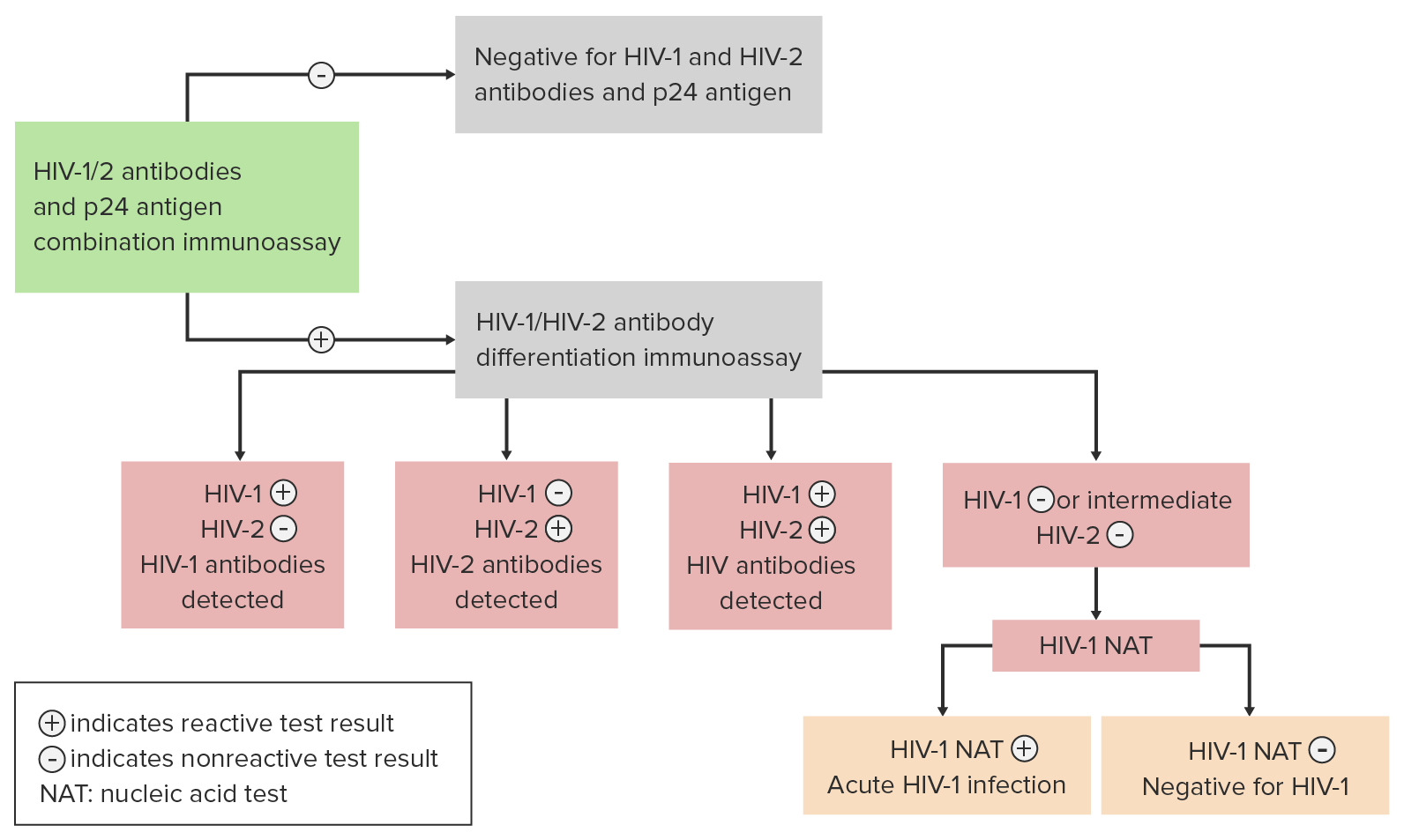
    • Imunoensaio enzimático de 4ª geração ( EIA EIA HIV Infection and AIDS) para VIH-1 e -2
      • Deteta anticorpos (geralmente aparecem de 3 a 12 semanas após a infeção) e antigénio p24 do VIH
      • Resultado negativo: não há necessidade de mais MAIS Androgen Insensitivity Syndrome testes Testes Gonadal Hormones
      • Resultado positivo: Teste imunoensaio de diferenciação de anticorpos VIH-1 e -2.
      • Resultado indeterminado: Teste com teste de ácido nucleico de VIH-1 aprovado pela FDA.
    • Outros testes Testes Gonadal Hormones para VIH:
      • Western blot: separação de proteínas virais por peso molecular em gel de poliacrilamida (2 bandas presentes = positivo)
      • Teste de reação em cadeia da transcriptase reversa da polimerase ( RT-PCR RT-PCR A variation of the pcr technique in which cDNA is made from RNA via reverse transcription. The resultant cDNA is then amplified using standard pcr protocols. Polymerase Chain Reaction (PCR), pela sigla em inglês): quantificação do vírus ou RNA RNA A polynucleotide consisting essentially of chains with a repeating backbone of phosphate and ribose units to which nitrogenous bases are attached. RNA is unique among biological macromolecules in that it can encode genetic information, serve as an abundant structural component of cells, and also possesses catalytic activity. RNA Types and Structure do VIH para monitorização
Fluxograma de vírus de RNA envelopado

Algoritmo para o diagnóstico e diferenciação entre uma infeção por VIH pelo subtipo VIH-1 e subtipo VIH-2

Imagem por Lecturio.

Testes Testes Gonadal Hormones adicionais e monitorização

  • Relacionado com VIH:
    • Contagem de células T CD4+ (avaliar a função imune)
    • Carga de RNA RNA A polynucleotide consisting essentially of chains with a repeating backbone of phosphate and ribose units to which nitrogenous bases are attached. RNA is unique among biological macromolecules in that it can encode genetic information, serve as an abundant structural component of cells, and also possesses catalytic activity. RNA Types and Structure viral (avaliar viremia Viremia The presence of viruses in the blood. Erythema Infectiosum)
    • Teste de resistência ao VIH ou genotipagem (taxa de resistência do VIH à terapia atual: 4%–10%)
    • HLA-B HLA-B Class I human histocompatibility (HLA) surface antigens encoded by more than 30 detectable alleles on locus B of the HLA complex, the most polymorphic of all the HLA specificities. Several of these antigens (e.g., hla-b27, -b7, -b8) are strongly associated with predisposition to rheumatoid and other autoimmune disorders. Like other class I HLA determinants, they are involved in the cellular immune reactivity of cytolytic T lymphocytes. Organ Transplantation*5701:
      • Obter antes de iniciar um esquema terapêutico que contenha abacavir Abacavir Anti-HIV Drugs (ABC)
      • Se positivo, o doente não deve receber ABC devido à reação de hipersensibilidade
  • Serologia para VHB e VHC (o estado de hepatite viral afeta a escolha da terapia)
  • Outras doenças sexualmente transmissíveis
  • Outros exames necessários para monitorização e determinação de comorbilidades:
    • Estudo analítico básico
    • Testes Testes Gonadal Hormones de função hepática (alguns dos antirretrovirais causam alterações na função hepática)
    • Hemograma completo (CBC, pela sigla em inglês) com contagem diferencial
    • Perfil lipídico em jejum (alguns antirretrovirais causam problemas lipídicos)
    • Glicose em jejum ou hemoglobina A1c (os antirretrovirais causam problemas de tolerância à glicose)
    • Análise da urina (devido à prevalência de nefropatia por VIH)
    • Teste de gravidez (tratamento necessário em mulheres grávidas)
  • Monitorização:
    • Carga de RNA RNA A polynucleotide consisting essentially of chains with a repeating backbone of phosphate and ribose units to which nitrogenous bases are attached. RNA is unique among biological macromolecules in that it can encode genetic information, serve as an abundant structural component of cells, and also possesses catalytic activity. RNA Types and Structure viral (indicador de resposta à terapia antirretroviral):
      • ↓ Cargas virais indicam tratamento eficaz
      • Um marcador prognóstico no tratamento a longo prazo
    • Contagem de células T CD4+: aumenta com a terapia antirretroviral (TARV)

Tratamento

Medicamentos antirretrovirais

  • Os inibidores da transcriptase reversa interferem na tradução do RNA RNA A polynucleotide consisting essentially of chains with a repeating backbone of phosphate and ribose units to which nitrogenous bases are attached. RNA is unique among biological macromolecules in that it can encode genetic information, serve as an abundant structural component of cells, and also possesses catalytic activity. RNA Types and Structure viral em DNA DNA A deoxyribonucleotide polymer that is the primary genetic material of all cells. Eukaryotic and prokaryotic organisms normally contain DNA in a double-stranded state, yet several important biological processes transiently involve single-stranded regions. DNA, which consists of a polysugar-phosphate backbone possessing projections of purines (adenine and guanine) and pyrimidines (thymine and cytosine), forms a double helix that is held together by hydrogen bonds between these purines and pyrimidines (adenine to thymine and guanine to cytosine). DNA Types and Structure:
    • Inibidores nucleosídeos da transcriptase reversa (NRTIs, pela sigla em inglês) (por exemplo, zidovudina, emtricitabina, tenofovir Tenofovir An adenine analog reverse transcriptase inhibitor with antiviral activity against HIV-1 and hepatitis b. It is used to treat HIV infections and chronic hepatitis b, in combination with other antiviral agents, due to the emergence of antiviral drug resistance when it is used alone. Anti-HIV Drugs)
    • Inibidores da transcriptase reversa não nucleosídeos (NNRTIs, pela sigla em inglês) (por exemplo, efavirenz Efavirenz Anti-HIV Drugs, doravirina, etravirina)
  • Inibidores de protease Protease Enzyme of the human immunodeficiency virus that is required for post-translational cleavage of gag and gag-pol precursor polyproteins into functional products needed for viral assembly. HIV protease is an aspartic protease encoded by the amino terminus of the pol gene. HIV Infection and AIDS (IPs) :
    • Bloqueiam a clivagem de precursores de proteínas necessários para a produção de partículas virais infecciosas
    • Exemplos: atazanavir Atazanavir Anti-HIV Drugs, darunavir, lopinavir Lopinavir An HIV protease inhibitor used in a fixed-dose combination with ritonavir. It is also an inhibitor of cytochrome p-450 cyp3a. Anti-HIV Drugs
  • Inibidores de transferência da cadeia integrase Integrase Enzyme of the human immunodeficiency virus that is required to integrate viral DNA into cellular DNA in the nucleus of a host cell. HIV integrase is a DNA nucleotidyltransferase encoded by the pol gene. HIV Infection and AIDS
    • Impedem a inserção do genoma viral no DNA DNA A deoxyribonucleotide polymer that is the primary genetic material of all cells. Eukaryotic and prokaryotic organisms normally contain DNA in a double-stranded state, yet several important biological processes transiently involve single-stranded regions. DNA, which consists of a polysugar-phosphate backbone possessing projections of purines (adenine and guanine) and pyrimidines (thymine and cytosine), forms a double helix that is held together by hydrogen bonds between these purines and pyrimidines (adenine to thymine and guanine to cytosine). DNA Types and Structure do hospedeiro
    • Exemplos: dolutegravir Dolutegravir Anti-HIV Drugs, elvitegravir Elvitegravir Anti-HIV Drugs
  • Inibidores de entrada:
    • Antagonista de CCR5 CCR5 Ccr receptors with specificity for chemokine ccl3; chemokine ccl4; and chemokine ccl5. They are expressed at high levels in T-lymphocytes; B-lymphocytes; macrophages; mast cells; and nk cells. The ccr5 receptor is used by the human immunodeficiency virus to infect cells. HIV Infection and AIDS:
      • Inibe a ligação do vírus à célula CD4 bloqueando a ligação da gp120 Gp120 External envelope protein of the human immunodeficiency virus which is encoded by the HIV env gene. It has a molecular weight of 120 kda and contains numerous glycosylation sites. Gp120 binds to cells expressing CD4 cell-surface antigens, most notably t4-lymphocytes and monocytes/macrophages. Gp120 has been shown to interfere with the normal function of CD4 and is at least partly responsible for the cytopathic effect of HIV. HIV Infection and AIDS
      • Maraviroc Maraviroc A cyclohexane and triazole derivative that acts as an antagonist of the ccr5 receptor. It prevents infection by HIV-1 virus strains which use ccr5 as a co-receptor for membrane fusion and cellular entry. Anti-HIV Drugs
    • Inibidor de fusão:
      • Interfere na fusão das membranas celulares do VIH e da célula CD4
      • Enfuvirtida
    • Inibidor de fixação:
      • Liga gp120 Gp120 External envelope protein of the human immunodeficiency virus which is encoded by the HIV env gene. It has a molecular weight of 120 kda and contains numerous glycosylation sites. Gp120 binds to cells expressing CD4 cell-surface antigens, most notably t4-lymphocytes and monocytes/macrophages. Gp120 has been shown to interfere with the normal function of CD4 and is at least partly responsible for the cytopathic effect of HIV. HIV Infection and AIDS, impedindo a fixação viral
      • Fostemsavir Fostemsavir Anti-HIV Drugs
    • Inibidor pós-fixação:

Abordagem terapêutica

  • Iniciar a terapia antirretroviral (TARV) imediatamente!
  • Objetivos:
    • Suprimir o RNA RNA A polynucleotide consisting essentially of chains with a repeating backbone of phosphate and ribose units to which nitrogenous bases are attached. RNA is unique among biological macromolecules in that it can encode genetic information, serve as an abundant structural component of cells, and also possesses catalytic activity. RNA Types and Structure do VIH no plasma Plasma The residual portion of blood that is left after removal of blood cells by centrifugation without prior blood coagulation. Transfusion Products.
    • Melhorar a função imunológica.
    • Reduzir as complicações associadas ao VIH e prolongar a sobrevida.
    • Prevenir a transmissão do VIH.
  • Evitar a resistência: Terapia com três fármacos dada a resistência ao VIH que se desenvolve rapidamente para esquemas de 1 ou 2 fármacos.
  • TARV combinada para doentes naive de tratamento (IAS-USA, 2022):
    • Bictegravir Bictegravir Anti-HIV Drugs + tenofovir Tenofovir An adenine analog reverse transcriptase inhibitor with antiviral activity against HIV-1 and hepatitis b. It is used to treat HIV infections and chronic hepatitis b, in combination with other antiviral agents, due to the emergence of antiviral drug resistance when it is used alone. Anti-HIV Drugs alafenamida + emtricitabina
    • Dolutegravir Dolutegravir Anti-HIV Drugs + tenofovir Tenofovir An adenine analog reverse transcriptase inhibitor with antiviral activity against HIV-1 and hepatitis b. It is used to treat HIV infections and chronic hepatitis b, in combination with other antiviral agents, due to the emergence of antiviral drug resistance when it is used alone. Anti-HIV Drugs alafenamida/disoproxil fumarato + emtricitabina ou lamivudina
    • Dolutegravir Dolutegravir Anti-HIV Drugs + abacavir Abacavir Anti-HIV Drugs + lamivudina: apenas para indivíduos HLA-B HLA-B Class I human histocompatibility (HLA) surface antigens encoded by more than 30 detectable alleles on locus B of the HLA complex, the most polymorphic of all the HLA specificities. Several of these antigens (e.g., hla-b27, -b7, -b8) are strongly associated with predisposition to rheumatoid and other autoimmune disorders. Like other class I HLA determinants, they are involved in the cellular immune reactivity of cytolytic T lymphocytes. Organ Transplantation*5701 negativos e sem VHB crónico
    • Dolutegravir Dolutegravir Anti-HIV Drugs + lamivudina, exceto:
      • Indivíduos com RNA RNA A polynucleotide consisting essentially of chains with a repeating backbone of phosphate and ribose units to which nitrogenous bases are attached. RNA is unique among biological macromolecules in that it can encode genetic information, serve as an abundant structural component of cells, and also possesses catalytic activity. RNA Types and Structure do VIH > 500.000 cópias/mL
      • Indivíduos com coinfeção por VHB
      • Indivíduos que precisam iniciar TARV antes que estejam disponíveis os resultados do teste de resistência genotípica ao VIH para transcriptase reversa ou teste de VHB
  • Uma vez iniciado, o tratamento é indefinido.

Síndrome inflamatória de reconstituição imune (SRIS)

  • Agravamento de infeções oportunistas preexistentes ou não tratadas quando é iniciada a terapia antirretroviral combinada (cTARV):
    • SRIS paradoxal: agravamento de uma condição conhecida ou pré-existente
    • Desmascarar SRIS: sintomas associados a uma condição não diagnosticada anteriormente
  • Frequentemente observado na tuberculose
  • Início: 1 semana a alguns meses do início da cTARV
  • Patogénese: resposta inflamatória semelhante à reação de hipersensibilidade tipo IV
  • Tratamento:
    • Tratar infeção oportunista.
    • Pode atrasar a terapia antirretroviral (por exemplo, meningite criptocócica e tuberculosa)
    • Glicocorticoides conforme necessidade com uma redução subsequente

Prevenção e Profilaxia

Prevenção geral

  • Práticas de sexo seguro (uso de preservativos)
  • Tratamento de doenças sexualmente transmissíveis
  • Circuncisão masculina
  • Uso de instrumentos estéreis
  • Equipamento de proteção individual adequado para profissionais médicos
  • Terapia de substituição de opioides (↓ uso de drogas ilícitas e injeções)
  • Cuidados pré e perinatais adequados (para reduzir a transmissão para bebés)
  • Profilaxia pré e pós-exposição
  • TARV adequado para indivíduos infetados

Profilaxia

  • Profilaxia pós-exposição:
    • Dentro de 72 horas após a exposição após contacto com membranas mucosas ou contacto parenteral com materiais infetados pelo VIH
    • Toma de 28 dias
    • Combinação de 3 fármacos antirretrovirais
    • Opções:
  • Profilaxia pré-exposição (PrEP):
    • Reduzir o risco em indivíduos de alto risco não infetados:
      • Parceiros sexuais de doentes infetados pelo VIH
      • Homens/mulheres trans que fazem sexo com homens
      • Homens (que não usam preservativos) em áreas de alta prevalência
    • Combinação de emtricitabina e tenofovir Tenofovir An adenine analog reverse transcriptase inhibitor with antiviral activity against HIV-1 and hepatitis b. It is used to treat HIV infections and chronic hepatitis b, in combination with other antiviral agents, due to the emergence of antiviral drug resistance when it is used alone. Anti-HIV Drugs
  • Profilaxia perinatal:
    • O maior risco de transmissão do VIH é durante o parto.
    • O objetivo é bloquear a transmissão (da mãe para o bebé):
    • Zidovudina ou regime de 3 fármacos (dependendo da carga viral materna/risco de transmissão) administrado ao bebé como profilaxia

VIH em Populações Especiais

Gravidez

  • Teste:
    • Teste de VIH como parte do rastreio pré-natal
    • Repetir o teste no 3º trimestre em doentes com alto risco de infeção pelo VIH
    • Repetir o teste em doentes com doença sexualmente transmissível
  • Transmissão:
    • Durante a gravidez
    • Parto (maior risco)
    • Amamentação
  • O risco depende da carga viral materna.
  • Tratamento materno:
    • Redução da transmissão:
      • cTARV durante a gravidez
      • A amamentação deve ser evitada nos Estados Unidos (nutrição infantil alternativa facilmente disponível), mas não em países em desenvolvimento.
    • Método de parto para mães que não receberam TARV (alto risco de transmissão): parto por cesariana, se possível (com base em indicações obstétricas)
    • Métodos de parto para mães a fazerTARV:
      • Carga viral materna > 1.000 cópias/mL (alto risco de transmissão): parto por cesariana com 38 semanas (antes do trabalho de parto e rutura de membranas)
      • Carga viral materna ≤ 1.000 cópias/mL, mas > 50 cópias/mL: parto vaginal possível (decidir por indicações obstétricas)
      • Carga viral materna < 50 cópias/mL: parto vaginal possível (decidir por indicações obstétricas)
    • Pós-parto: O tratamento deve ser continuado pela mãe.

Recém-nascidos

  • Teste de diagnóstico de VIH para todos os bebés com exposição perinatal ao VIH:
    • Use PCR PCR Polymerase chain reaction (PCR) is a technique that amplifies DNA fragments exponentially for analysis. The process is highly specific, allowing for the targeting of specific genomic sequences, even with minuscule sample amounts. The PCR cycles multiple times through 3 phases: denaturation of the template DNA, annealing of a specific primer to the individual DNA strands, and synthesis/elongation of new DNA molecules. Polymerase Chain Reaction (PCR) (teste de ácido nucleico de RNA RNA A polynucleotide consisting essentially of chains with a repeating backbone of phosphate and ribose units to which nitrogenous bases are attached. RNA is unique among biological macromolecules in that it can encode genetic information, serve as an abundant structural component of cells, and also possesses catalytic activity. RNA Types and Structure de VIH ou DNA DNA A deoxyribonucleotide polymer that is the primary genetic material of all cells. Eukaryotic and prokaryotic organisms normally contain DNA in a double-stranded state, yet several important biological processes transiently involve single-stranded regions. DNA, which consists of a polysugar-phosphate backbone possessing projections of purines (adenine and guanine) and pyrimidines (thymine and cytosine), forms a double helix that is held together by hydrogen bonds between these purines and pyrimidines (adenine to thymine and guanine to cytosine). DNA Types and Structure de VIH):
      • Não imunoensaio de anticorpos VIH
      • Falsos positivos em testes Testes Gonadal Hormones de anticorpos em crianças < 18 meses de idade (anticorpos maternos circulantes ainda presentes)
    • Tempo:
      • 14-21 dias
      • 1-2 meses
      • 4-6 meses
  • Baixo risco de transmissão perinatal do VIH:
    • Considerado em:
      • Mães com adesão a TARV durante a gravidez
      • Nível de RNA RNA A polynucleotide consisting essentially of chains with a repeating backbone of phosphate and ribose units to which nitrogenous bases are attached. RNA is unique among biological macromolecules in that it can encode genetic information, serve as an abundant structural component of cells, and also possesses catalytic activity. RNA Types and Structure do VIH confirmado < 50 cópias/mL (supressão viral) próximo ao parto
    • Medicação neonatal: zidovudina por 4 semanas
  • Alto risco de transmissão perinatal do VIH:
    • Considerado em:
      • Mães sem TARV pré-parto/intraparto ou apenas TARV intraparto
      • Mães sem supressão viral
      • Mães com VIH agudo durante a gravidez ou amamentação
    • Intraparto: zidovudina IV em RNA RNA A polynucleotide consisting essentially of chains with a repeating backbone of phosphate and ribose units to which nitrogenous bases are attached. RNA is unique among biological macromolecules in that it can encode genetic information, serve as an abundant structural component of cells, and also possesses catalytic activity. RNA Types and Structure do VIH >1000 cópias/mL
    • Do nascimento até 6 semanas (terapia de VIH presumida para recém-nascido):
  • Exposição presumida do recém-nascido:
    • Considerado em:
      • Mães que têm pelo menos 1 teste de VIH positivo no parto ou pós-parto
      • Mães cujos recém-nascidos têm um teste de anticorpos VIH positivo
    • Mesmos fármacos que a terapia presuntiva de VIH para recém-nascidos
  • Recém-nascido com VIH (teste virológico de VIH confirmado): Usar TARV com 3 fármacos (usando doses apropriadas).

Crianças

  • Transmissão:
    • Transmissão vertical (via mais MAIS Androgen Insensitivity Syndrome comum de transmissão)
    • Outros: transfusão de sangue, abuso sexual, uso de drogas injetáveis
    • Aumento do risco de infeção pelo VIH entre aqueles que fazem sexo desprotegido e adolescentes com relações sexuais com parceiros do mesmo sexo
  • Apresentação clínica:
    • Crianças:
      • Progressores rápidos infantis: desenvolvem sinais graves de SIDA no início da vida que contribuem para a morte (aos 2-4 anos de idade)
      • Características únicas: baixa estatura, atraso no desenvolvimento, problemas de aspiração e deglutição, infeções de ouvido recorrentes e puberdade tardia
    • Adolescentes: muitas vezes assintomáticos até que a contagem de CD4 caia
    • Outros achados:
      • Infeções oportunistas
      • Doença do sistema de órgãos (por exemplo, nefropatia, encefalopatia, hepatite)
      • Malignidade (por exemplo, linfoma não-Hodgkin)
  • Diagnóstico:
    • < 18 meses: PCR PCR Polymerase chain reaction (PCR) is a technique that amplifies DNA fragments exponentially for analysis. The process is highly specific, allowing for the targeting of specific genomic sequences, even with minuscule sample amounts. The PCR cycles multiple times through 3 phases: denaturation of the template DNA, annealing of a specific primer to the individual DNA strands, and synthesis/elongation of new DNA molecules. Polymerase Chain Reaction (PCR) (teste de ácido nucleico de RNA RNA A polynucleotide consisting essentially of chains with a repeating backbone of phosphate and ribose units to which nitrogenous bases are attached. RNA is unique among biological macromolecules in that it can encode genetic information, serve as an abundant structural component of cells, and also possesses catalytic activity. RNA Types and Structure de VIH ou DNA DNA A deoxyribonucleotide polymer that is the primary genetic material of all cells. Eukaryotic and prokaryotic organisms normally contain DNA in a double-stranded state, yet several important biological processes transiently involve single-stranded regions. DNA, which consists of a polysugar-phosphate backbone possessing projections of purines (adenine and guanine) and pyrimidines (thymine and cytosine), forms a double helix that is held together by hydrogen bonds between these purines and pyrimidines (adenine to thymine and guanine to cytosine). DNA Types and Structure de VIH), não imunoensaio de anticorpos de VIH
    • > 18 meses: imunoensaio de anticorpos VIH
  • Tratamento:
    • Terapia antirretroviral combinada (regime de 3 fármacos)
    • Tratar infeções oportunistas
  • Prevenção:
    • Testes de “exclusão” de rotina (o teste de VIH está incluído nos testes Testes Gonadal Hormones preventivos de rastreio e o doente tem a oportunidade de recusar)
    • Tratar as mulheres grávidas para reduzir a carga viral (↓ transmissão).
    • Profilaxia infantil
    • Nos Estados Unidos: sem amamentação
    • Rastreio de rotina oferecido pelo menos aos 16 anos em áreas de alta prevalência
  • Categorias imunológicas:
    • Os estadios do VIH em crianças dependem da idade e da contagem de células T CD4.
    • Se for detetada uma infeção oportunista de estadio 3, o doente tem SIDA, independentemente do nível de contagem de células T CD4.
Tabela: Centros de Controlo e Prevenção de Doenças (CDC, pela sigla em inglês) para infeção por VIH e estadio de SIDA com base na contagem de linfócitos T CD4+ específica para a idade
Estadio <1 ano 1-5 anos ≥ 6 anos
0 N / D N / D N / D
1 ≥ 1.500 células/µL ≥ 1.000 células/µL ≥ 500 células/µL
2 750–1.499 células/µL 500–999 células/µL 200–499 células/µL
3 (SIDA) <750 células/µL <500 células/µL <200 células/µL

Idosos

  • Em 2018, > 50% dos americanos infetados pelo VIH tinham > 50 anos de idade.
  • Desafios:
    • O declínio da função hepática/renal relacionada com a idade pode aumentar os efeitos colaterais da TARV ou a toxicidade dos fármacos.
    • Maior risco de interações medicamentosas
    • A idade e o VIH aumentam o risco de doenças cardiovasculares, perda óssea e cancro.

Diagnóstico Diferencial

  • Mononucleose infecciosa ( MI MI MI is ischemia and death of an area of myocardial tissue due to insufficient blood flow and oxygenation, usually from thrombus formation on a ruptured atherosclerotic plaque in the epicardial arteries. Clinical presentation is most commonly with chest pain, but women and patients with diabetes may have atypical symptoms. Myocardial Infarction): infeção viral contagiosa causada pelo vírus Epstein-Barr. A transmissão é através da disseminação de saliva Saliva The clear, viscous fluid secreted by the salivary glands and mucous glands of the mouth. It contains mucins, water, organic salts, and ptyalin. Salivary Glands: Anatomy infetada. As manifestações clínicas incluem febre, faringite tonsilar e linfadenopatia. A infeção pode ser semelhante à síndrome retroviral aguda. O diagnóstico é clínico e confirmado por teste de anticorpos heterófilos.
  • Toxoplasmose: doença causada pelo T. gondii , parasita que vive no intestino do felino (hospedeiro definido). A transmissão dá-se pelo consumo de carne crua ou alimentos contaminados por fezes de gato. A apresentação depende da imunidade do hospedeiro. Doentes imunocompetentes geralmente não apresentam sintomas ou apresentam sintomas virais leves. Doentes imunocomprometidos desenvolvem toxoplasmose cerebral ou ocular.
  • Criptococose: infeção fúngica que afeta mais MAIS Androgen Insensitivity Syndrome frequentemente doentes imunocomprometidos (p.e. SIDA, malignidade, recetores de transplantes, uso crónico de corticoides). Os doentes apresentam dores de cabeça e estado de consciência anormal. O antigénio capsular criptocócico no LCR e cultura estabelecem o diagnóstico.
  • Linfoma de Hodgkin: malignidade de linfócitos B dentro dos gânglios linfáticos. A apresentação da doença é com linfadenopatia palpável não dolorosa, principalmente no pescoço, região supraclavicular e axila. Também são observados “sintomas B” constitucionais (febre, sudorese noturna e perda de peso). O achado histológico patognomónico é a célula de Reed-Sternberg (células B gigantes com inclusões eosinofílicas).

Referências

  1. Cohen MS. HIV infection: Risk factors and prevention strategies. UpToDate. May 6, 2025. Accessed June 24, 2025. https://www.uptodate.com/contents/hiv-infection-risk-factors-and-prevention-strategies.
  2. Costa da Rosa M, Lobato RC, Goncalves CV, et al. Evaluation of factors associated with vertical HIV-1 transmission. Jornal de Pediatria. June 28, 2015. Accessed June 24, 2025. https://www.sciencedirect.com/science/article/pii/S0021755715000959?via%3Dihub.
  3. Fauci A.S., & Folkers G.K., & Lane H (2018). Human immunodeficiency virus disease: aids and related disorders. Jameson J, & Fauci A.S., & Kasper D.L., & Hauser S.L., & Longo D.L., & Loscalzo J(Eds.), Harrison’s Principles of Internal Medicine, 20e. McGraw-Hill.
  4. Gillespie SL, Mirani G. Pediatric HIV infection: Epidemiology, clinical manifestations, and outcome. UpToDate. November 11, 2024. Accessed June 24, 2025. https://www.uptodate.com/contents/pediatric-hiv-infection-epidemiology-clinical-manifestations-and-outcome.
  5. Gilroy SA, Faragon JJ. HIV infection and AIDS. Practice Essentials, Background, Pathophysiology. February 24, 2025. Accessed June 24, 2025. https://emedicine.medscape.com/article/211316-overview.
  6. Cu-Uvin, S. Intrapartum and postpartum management of pregnant women with HIV in resource-abundant settings. UpToDate. April 16, 2025. Accessed June 24, 2025. https://www.uptodate.com/contents/intrapartum-and-postpartum-management-of-pregnant-women-with-hiv-in-resource-abundant-settings.
  7. Katz M.H. (2021). Overview: HIV infection & AIDS. Papadakis M.A., & McPhee S.J., & Rabow M.W.(Eds.), Current Medical Diagnosis & Treatment 2021. McGraw-Hill.
  8. HHS Panel on Antiretroviral Guidelines for Adults and Adolescents—A Working Group of the Office of AIDS Research Advisory Council (OARAC). Guidelines for the Use of Antiretroviral Agents in Adults and Adolescents with HIVS. [Updated 2024 Sep 12]. In: ClinicalInfo.HIV.gov [Internet]. Rockville (MD): US Department of Health and Human Services; 2002-. Available from: https://www.ncbi.nlm.nih.gov/books/NBK586306/
  9. Centers for Disease Control and Prevention; HIV Medicine Association of the Infectious Diseases Society of America; Pediatric Infectious Diseases Society; HHS Panel on Treatment of HIV During Pregnancy and Prevention of Perinatal Transmission— A Working Group of the Office of AIDS Research Advisory Council (OARAC). Recommendations for the Use of Antiretroviral Drugs During Pregnancy and Interventions to Reduce Perinatal HIV Transmission in the United States. [Updated 2024 Dec 19]. In: ClinicalInfo.HIV.gov [Internet]. Rockville (MD): US Department of Health and Human Services; 2002-. Available from: https://www.ncbi.nlm.nih.gov/books/NBK586310/
  10. Rivera D.M., Frye R.E. Pediatric HIV Infection. Practice Essentials, Background, Pathophysiology. February 24, 2025. Accessed June 24, 2025. https://emedicine.medscape.com/article/965086-overview
  11. Ropper A.H., & Samuels M.A., & Klein J.P., & Prasad S (Eds.), (2019). Viral infections of the nervous system and prion diseases. Adams and Victor’s Principles of Neurology, 11e. McGraw-Hill.
  12. Wood B.R., Sax P.E., Mitty J. The natural history and clinical features of HIV infection in adults and adolescents. UpToDate. Feb 15, 2023. Retrieved June 24, 2025, from https://www.uptodate.com/contents/the-natural-history-and-clinical-features-of-hiv-infection-in-adults-and-adolescents
  13. Byonanebye, D. M., Polizzotto, M. N., Maltez, F., Petrovic, M., Čulig, J., Brandt, R. S., Woolley, I., Castagna, A., Gompels, M., Zangerle, R., Hessamfar, M., Braun, D. L., Castelli, F., Stella-Ascariz, N., Mussini, C., Menozzi, M., Beniowski, M., Chkhartishvili, N., Vannappagari, V., & Llibre, J. M. (2024). Associations between change in BMI and the risk of hypertension and dyslipidaemia in people receiving integrase strand-transfer inhibitors, tenofovir alafenamide, or both compared with other contemporary antiretroviral regimens: A multicentre, prospective observational study from the RESPOND consortium cohorts. Lancet HIV, 11(5), e321-e332. https://doi.org/10.1016/S2352-3018(23)00328-4
  14. CDC. “CDC Publishes New HIV Surveillance Reports.” National Center for HIV, Viral Hepatitis, STD, and Tuberculosis Prevention, 21 May 2024, https://www.cdc.gov/nchhstp/director-letters/cdc-publishes-new-hiv-surveillance-reports.html
  15. Centers for Disease Control and Prevention. (2025). Antiretroviral postexposure prophylaxis after sexual, injection drug use, or other nonoccupational exposure to HIV—CDC recommendations, United States, 2025. MMWR Recommendations and Reports, 74(1), 1-28. https://www.cdc.gov/mmwr/volumes/74/rr/rr7401a1.htm
  16. Chen, G. J., Cheng, C. Y., Yang, C. J., Lee, N. Y., Tang, H. J., Huang, S. H., Huang, M. H., Liou, B. H., Lee, Y. C., Lin, C. Y., Hung, T. C., Lin, S. P., Sun, H. Y., Chang, S. Y., Hung, C. C., & Taiwan HIV Study Group. (2024). Trends of pre-treatment drug resistance in antiretroviral-naïve people with HIV-1 in the era of second-generation integrase strand-transfer inhibitors in Taiwan. Journal of Antimicrobial Chemotherapy, 79(5), 1157-1163. https://doi.org/10.1093/jac/dkae086
  17. Gandhi, R. T., Landovitz, R. J., Sax, P. E., Smith, D. M., Springer, S. A., Günthard, H. F., Thompson, M. A., Bedimo, R. J., Benson, C. A., Buchbinder, S. P., Crabtree-Ramirez, B. E., del Rio, C., Eron, J. J., Hoy, J. F., Lehmann, C., Molina, J. M., & Saag, M. S. (2024). Antiretroviral drugs for treatment and prevention of HIV infection in adults: 2024 recommendations of the International Antiviral Society-USA Panel. JAMA, 331(24), 2125-2144. https://doi.org/10.1001/jama.2024.24543
  18. Grinspoon, S. K., Fitch, K. V., Zanni, M. V., Fichtenbaum, C. J., Umbleja, T., Aberg, J. A., Overton, E. T., Malvestutto, C. D., Bloomfield, G. S., Currier, J. S., Geisler, J., Guaraldi, G., Hanna, D. B., Hatano, H., Hsue, P. Y., Hwang, W. T., Lake, J. E., Longenecker, C. T., Luetkemeyer, A. F., & McComsey, G. A. (2023). Pitavastatin to prevent cardiovascular disease in HIV infection. New England Journal of Medicine, 389(8), 687-699. https://doi.org/10.1056/NEJMoa2304146
  19. Horberg, M., Thompson, M., Agwu, A., Colasanti, J. A., Jain, M. K., Short, W. R., Singh, T., & Aberg, J. A. (2024). Primary care guidance for providers of care for persons with human immunodeficiency virus: 2024 update by the HIV Medicine Association of the Infectious Diseases Society of America. Clinical Infectious Diseases, 79(4), 968-1010. https://doi.org/10.1093/cid/ciae479
  20. Joint United Nations Programme on HIV/AIDS. (2024). 2024 Global AIDS update: The urgency of now—AIDS at a crossroads. UNAIDS. https://www.unaids.org/en/resources/documents/2024/global-aids-update-2024
  21. Joint United Nations Programme on HIV/AIDS. (2024). Global HIV & AIDS statistics—Fact sheet 2024. UNAIDS. https://www.unaids.org/en/resources/fact-sheet
  22. Landovitz, R. J., Delany-Moretlwe, S., Fogel, J. M., Cotton, M. F., Farrior, J. N., Bennie, T., Jahan, F., Lewin, S. R., Flexner, C., McCallister, S., Mgodi, N., Hanscom, B., Auma, E., Kimetto, S. M., Mendoza, R., & Brown, E. R. (2024). Features of HIV infection in the context of long-acting cabotegravir preexposure prophylaxis. New England Journal of Medicine, 391(5), 409-418. https://doi.org/10.1056/NEJMc2402088
  23. Lockman, S., Brummel, S. S., Ziemba, L., Stranix-Chibanda, L., McCarthy, K., Coletti, A., Theron, G., Chipato, T., Fairlie, L., Patel, K., Oyugi, J., Cohn, S. E., Yotebieng, M., Santos, B., Bnevins, M., Supparatpinyo, K., Mohapi, L., Puleng, L., Phanwichien, T., & Violari, A. (2024). Efficacy and safety of dolutegravir with emtricitabine and tenofovir alafenamide fumarate or tenofovir disoproxil fumarate, and efavirenz, emtricitabine, and tenofovir disoproxil fumarate HIV antiretroviral therapy regimens started in pregnancy (IMPAACT 2010/VESTED): A multicentre, open-label, randomised, controlled, phase 3 trial. Lancet, 397(10281), 1276-1292. https://doi.org/10.1016/S0140-6736(21)00314-7
  24. Panel on Antiretroviral Guidelines for Adults and Adolescents. (2024). Guidelines for the use of antiretroviral agents in adults and adolescents with HIV (Version 6.11.24). U.S. Department of Health and Human Services. https://clinicalinfo.hiv.gov/en/guidelines/hiv-clinical-guidelines-adult-and-adolescent-arv
  25. Women with HIV Infection and Prevention of Perinatal Transmission. (2024). Recommendations for use of antiretroviral drugs during pregnancy and interventions to reduce perinatal HIV transmission in the United States (Version 12.19.24). U.S. Department of Health and Human Services. https://clinicalinfo.hiv.gov/en/guidelines/perinatal
  26. Patel, K., Huo, Y., Jao, J., Kacanek, D., Smith, R., Khadse, S., Williams, P. L., Van Dyke, R. B., Chadwick, E. G., & Seage, G. R., III. (2023). Dolutegravir in pregnancy as compared with current HIV regimens in the United States. New England Journal of Medicine, 389(9), 799-809. https://doi.org/10.1056/NEJMoa2200600
  27. Trickey, A., McGinnis, K., Gill, M. J., Abgrall, S., Bonnet, F., Sabin, C., Justice, A. C., d’Arminio Monforte, A., Guest, J. L., Jarrin, I., Kirk, O., Reiss, P., Shepherd, L., Sterling, T. R., Vandenhende, M. A., Wasmuth, J. C., Wittkop, L., May, M. T., & Sterne, J. A. (2024). Longitudinal trends in causes of death among adults with HIV on antiretroviral therapy in Europe and North America from 1996 to 2020: A collaboration of cohort studies. Lancet HIV, 11(3), e176-e185. https://doi.org/10.1016/S2352-3018(23)00272-2
  28. World Health Organization. (2023). Consolidated guidelines on HIV prevention, testing, treatment, service delivery and monitoring: Recommendations for a public health approach (2023 update). WHO Press. https://www.who.int/publications/i/item/9789240031593

Crie sua conta gratuita ou faça login para continuar lendo!

Cadastre-se agora e tenha acesso grátis ao Lecturio, com páginas de conceitos, vídeos de medicina e questões para sua educação médica.

Aprende mais com a Lecturio:

Multiple devices displaying human anatomy and health education content.

Complementa o teu estudo da faculdade com o companheiro de estudo tudo-em-um da Lecturio, através de métodos de ensino baseados em evidência.

Estuda onde quiseres

Two iPhones display medical education apps, one showing anatomy, the other Bookmatcher.

A Lecturio Medical complementa o teu estudo através de métodos de ensino baseados em evidência, vídeos de palestras, perguntas e muito mais – tudo combinado num só lugar e fácil de usar.

User Reviews

Have a holly, jolly study session 🎁 Save 50% on all plans now >>

Que tengas una sesión de estudio alegre y navideña 🎁 Ahorra 50% en todos los planes >>

Details