Domina Conceptos Médicos

Estudia para la escuela de medicina y tus examenes con Lecturio.

Poliarteritis Nodosa

La poliarteritis nodosa (PAN) es una vasculitis necrosante, sistémica, principalmente de vasos medianos. La mayoría de los casos de PAN son idiopáticos. Los factores etiológicos de la PAN secundaria son la infección por hepatitis B y C y la leucemia de células pilosas. La PAN se presenta con síntomas y signos sistémicos como fatiga, pérdida de peso, fiebre, debilidad, artralgias, hipertensión y edema de extremidades. Dado que se trata de una enfermedad multisistémica que afecta a la piel, los nervios, los músculos, los riñones y los vasos sanguíneos que irrigan el corazón y el tracto gastrointestinal, la presentación clínica depende de los órganos afectados. El diagnóstico se basa en los antecedentes, el examen físico y los resultados de las pruebas de laboratorio, y se confirma mediante biopsia o angiografía. El tratamiento depende de la severidad y la extensión de la enfermedad. El principal método de tratamiento es con glucocorticoides orales; también pueden ser necesarios agentes inmunosupresores para pacientes con enfermedad de moderada a severa.

Last updated: Dec 15, 2025

Editorial responsibility: Stanley Oiseth, Lindsay Jones, Evelin Maza

Descripción General

Definición

La poliarteritis nodosa (PAN) es una vasculitis Vasculitis Inflammation of any one of the blood vessels, including the arteries; veins; and rest of the vasculature system in the body. Systemic Lupus Erythematosus sistémica, principalmente de vasos medianos, caracterizada por lesiones inflamatorias necrosantes. Esta afección acaba dando lugar a microaneurismas, que provocan hemorragias, trombosis, isquemia de órganos e infartos.

Epidemiología

  • Incidencia anual:
    • Difícil de determinar
    • Cada vez más rara con:
      • Vacunación generalizada contra el virus Virus Viruses are infectious, obligate intracellular parasites composed of a nucleic acid core surrounded by a protein capsid. Viruses can be either naked (non-enveloped) or enveloped. The classification of viruses is complex and based on many factors, including type and structure of the nucleoid and capsid, the presence of an envelope, the replication cycle, and the host range. Virology de la hepatitis B Hepatitis B Hepatitis B virus (HBV) is a partially double-stranded DNA virus, which belongs to the Orthohepadnavirus genus and the Hepadnaviridae family. Most individuals with acute HBV infection are asymptomatic or have mild, self-limiting symptoms. Chronic infection can be asymptomatic or create hepatic inflammation, leading to liver cirrhosis and hepatocellular carcinoma (HCC). Hepatitis B Virus ( HBV HBV Hepatitis B virus (HBV) is a partially double-stranded DNA virus, which belongs to the Orthohepadnavirus genus and the Hepadnaviridae family. Hepatitis B virus is transmitted by exposure to infectious blood or body fluids. Examples of types of exposure include sexual intercourse, IV drug use, and childbirth. Hepatitis B Virus)
      • Opciones de tratamiento recientes para el HBV HBV Hepatitis B virus (HBV) is a partially double-stranded DNA virus, which belongs to the Orthohepadnavirus genus and the Hepadnaviridae family. Hepatitis B virus is transmitted by exposure to infectious blood or body fluids. Examples of types of exposure include sexual intercourse, IV drug use, and childbirth. Hepatitis B Virus y el virus Virus Viruses are infectious, obligate intracellular parasites composed of a nucleic acid core surrounded by a protein capsid. Viruses can be either naked (non-enveloped) or enveloped. The classification of viruses is complex and based on many factors, including type and structure of the nucleoid and capsid, the presence of an envelope, the replication cycle, and the host range. Virology de la hepatitis C Hepatitis C Hepatitis C is an infection of the liver caused by the hepatitis C virus (HCV). The infection can be transmitted through infectious blood or body fluids and may be transmitted during childbirth or through IV drug use or sexual intercourse. Hepatitis C virus can cause both acute and chronic hepatitis, ranging from a mild to a serious, lifelong illness including liver cirrhosis and hepatocellular carcinoma (HCC). Hepatitis C Virus ( HCV HCV Hepatitis C is an infection of the liver caused by the hepatitis C virus (HCV). Hepatitis C virus is an RNA virus and a member of the genus Hepacivirus and the family Flaviviridae. The infection can be transmitted through infectious blood or body fluids and may be transmitted during childbirth or through IV drug use or sexual intercourse. Hepatitis C Virus)
  • Afecta a individuos de cualquier sexo u origen étnico (ligeramente más predominante en EN Erythema nodosum is an immune-mediated panniculitis (inflammation of the subcutaneous fat) caused by a type IV (delayed-type) hypersensitivity reaction. It commonly manifests in young women as tender, erythematous nodules on the shins. Erythema Nodosum hombres)
  • Incidencia máxima: 45-65 años

Etiología

  • Idiopática (mayoría de los LOS Neisseria casos)
  • Algunos casos están asociados a:
    • Infección por HBV HBV Hepatitis B virus (HBV) is a partially double-stranded DNA virus, which belongs to the Orthohepadnavirus genus and the Hepadnaviridae family. Hepatitis B virus is transmitted by exposure to infectious blood or body fluids. Examples of types of exposure include sexual intercourse, IV drug use, and childbirth. Hepatitis B Virus (< 5% de los LOS Neisseria casos)
    • Infección por HCV HCV Hepatitis C is an infection of the liver caused by the hepatitis C virus (HCV). Hepatitis C virus is an RNA virus and a member of the genus Hepacivirus and the family Flaviviridae. The infection can be transmitted through infectious blood or body fluids and may be transmitted during childbirth or through IV drug use or sexual intercourse. Hepatitis C Virus
    • Leucemia de células pilosas
    • Mutaciones recesivas de pérdida de función en EN Erythema nodosum is an immune-mediated panniculitis (inflammation of the subcutaneous fat) caused by a type IV (delayed-type) hypersensitivity reaction. It commonly manifests in young women as tender, erythematous nodules on the shins. Erythema Nodosum el gen CECR1:
      • Codifica la adenosina deaminasa 2 (ADA2)
      • Suele aparecer en EN Erythema nodosum is an immune-mediated panniculitis (inflammation of the subcutaneous fat) caused by a type IV (delayed-type) hypersensitivity reaction. It commonly manifests in young women as tender, erythematous nodules on the shins. Erythema Nodosum la infancia
      • Asociación con PAN cutánea (limitada a la piel, no sistémica)

Related videos

Fisiopatología

  • Una “vasculitis de vasos medianos”
  • Se desconoce la fisiopatología exacta.
  • Mecanismo más ampliamente implicado: formación de inmunocomplejos (especialmente con infección por HBV HBV Hepatitis B virus (HBV) is a partially double-stranded DNA virus, which belongs to the Orthohepadnavirus genus and the Hepadnaviridae family. Hepatitis B virus is transmitted by exposure to infectious blood or body fluids. Examples of types of exposure include sexual intercourse, IV drug use, and childbirth. Hepatitis B Virus) → inflamación arterial segmentaria:
    • La inflamación comienza en EN Erythema nodosum is an immune-mediated panniculitis (inflammation of the subcutaneous fat) caused by a type IV (delayed-type) hypersensitivity reaction. It commonly manifests in young women as tender, erythematous nodules on the shins. Erythema Nodosum la íntima → engrosamiento y proliferación de la pared vascular → estrechamiento arterial → ↓ flujo sanguíneo y predisposición a la trombosis.
    • Debilitamiento de la pared vascular → formación de aneurismas → riesgo de rotura y hemorragia.
    • Predisposición a isquemia e infarto → manifestaciones clínicas en EN Erythema nodosum is an immune-mediated panniculitis (inflammation of the subcutaneous fat) caused by a type IV (delayed-type) hypersensitivity reaction. It commonly manifests in young women as tender, erythematous nodules on the shins. Erythema Nodosum función del sistema orgánico afectado.
  • Generalmente afectación multisistémica, la más frecuente:
    • Riñones
    • Piel
    • Nervios periféricos
    • Músculos y articulaciones
    • Tracto gastrointestinal

Presentación Clínica

Los LOS Neisseria pacientes con PAN suelen presentar afectación multisistémica y signos y síntomas sistémicos. Sin embargo, también existe una forma limitada a la piel denominada PAN cutánea.

Signos y síntomas generales

  • Fatiga
  • Pérdida de peso y de apetito
  • Fiebre
  • Debilidad generalizada
  • Artralgia
Tabla: Manifestaciones específicas de la PAN por sistema
Sistema Presentación clínica
Renal
Cutánea
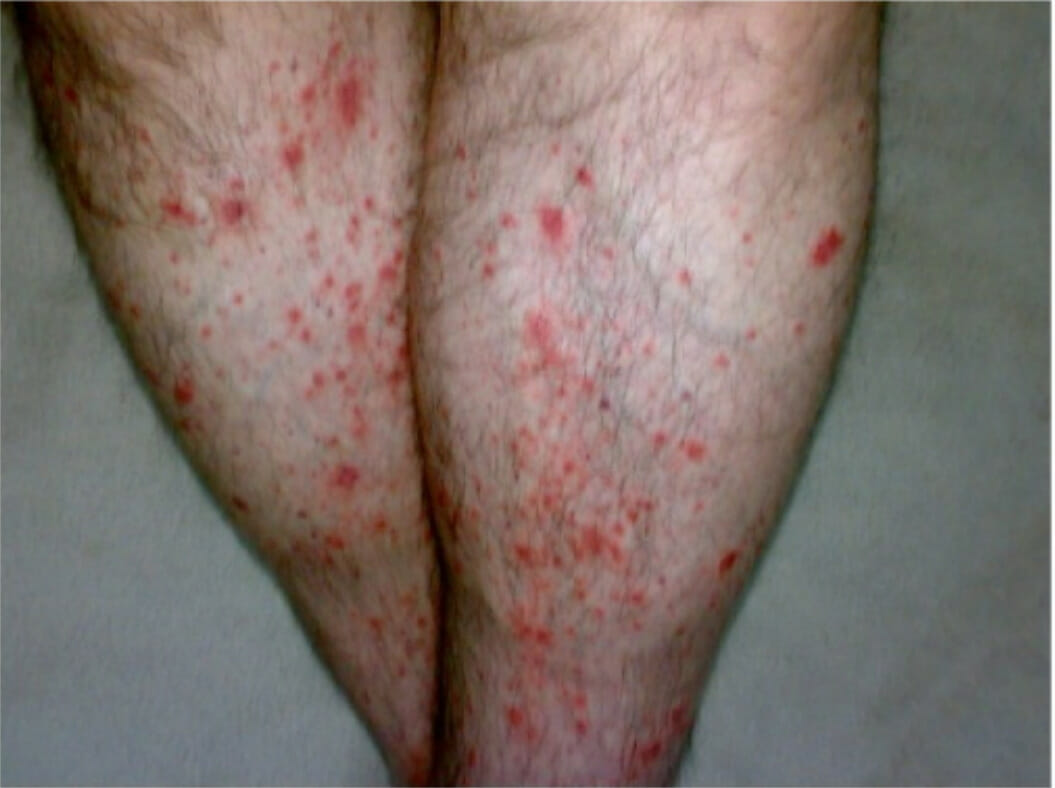
  • Nódulos eritematosos sensibles
  • Púrpura palpable
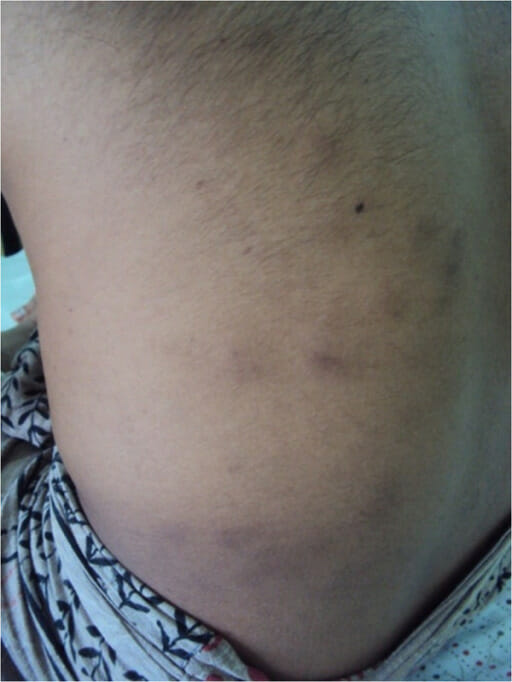
  • Livedo reticularis Livedo reticularis A condition characterized by a reticular or fishnet pattern on the skin of lower extremities and other parts of the body. This red and blue pattern is due to deoxygenated blood in unstable dermal blood vessels. The condition is intensified by cold exposure and relieved by rewarming. Chronic Kidney Disease
  • Úlceras
  • Erupción bullosa/vesicular
  • Fenómeno de Raynaud
  • Gangrena de los LOS Neisseria dedos de manos y pies (forma severa de la enfermedad)
Sistema nervioso
  • Mononeuritis múltiple (polineuropatía asimétrica):
    • A menudo afecta a los LOS Neisseria nervios mediano, cubital y peroneo.
    • Puede evolucionar hasta asemejar a una polineuropatía simétrica distal
  • Neuropatía cutánea
  • Ceguera monocular transitoria
  • Convulsiones
  • Mielopatía
  • ACV (isquémico o hemorrágico)
Muscular
  • Mialgia
  • Debilidad muscular
  • Claudicación
Gastrointestinal
  • Dolor Dolor Inflammation abdominal después de las comidas:
    • “Angina intestinal”
    • Por afectación arterial mesentérica
  • Náuseas y vómitos
  • Malabsorción
  • Melena Melena The black, tarry, foul-smelling feces that contain degraded blood. Gastrointestinal Bleeding
  • Diarrea con o sin hemorragia
  • Complicaciones poco frecuentes:
    • Infarto de páncreas
    • Pancreatitis Pancreatitis Inflammation of the pancreas. Pancreatitis is classified as acute unless there are computed tomographic or endoscopic retrograde cholangiopancreatographic findings of chronic pancreatitis. The two most common forms of acute pancreatitis are alcoholic pancreatitis and gallstone pancreatitis. Acute Pancreatitis necrosante
    • Colecistitis
    • Infarto intestinal y perforación
    • Infarto hepático
    • Infarto esplénico
Cardiovascular
  • Isquemia o infarto de miocardio
  • Insuficiencia cardíaca (por isquemia o hipertensión)
Reproductivo
  • Orquitis
  • Afectación mamaria y uterina
Oftalmológico
  • Visión borrosa
  • Retinopatía isquémica con:
    • Hemorragia
    • Desprendimiento de retina Retina The ten-layered nervous tissue membrane of the eye. It is continuous with the optic nerve and receives images of external objects and transmits visual impulses to the brain. Its outer surface is in contact with the choroid and the inner surface with the vitreous body. The outermost layer is pigmented, whereas the inner nine layers are transparent. Eye: Anatomy
  • Neuropatía óptica isquémica

Diagnóstico

El diagnóstico de PAN se basa en EN Erythema nodosum is an immune-mediated panniculitis (inflammation of the subcutaneous fat) caused by a type IV (delayed-type) hypersensitivity reaction. It commonly manifests in young women as tender, erythematous nodules on the shins. Erythema Nodosum los LOS Neisseria antecedentes, el examen físico y los LOS Neisseria resultados de las pruebas de laboratorio, y debe confirmarse mediante biopsia siempre que sea posible.

Antecedentes y examen físico

  • Antecedentes detallados que revelen afectación multisistémica hacen sospechar PAN.
  • Deben descartarse otras afecciones inflamatorias sistémicas:
    • Lupus eritematoso sistémico (LES)
    • Artritis reumatoide
    • Esclerosis sistémica
  • El examen físico tiene por objeto determinar:
    • Extensión de las lesiones vasculares
    • Órganos afectados
    • Severidad de la enfermedad

Pruebas de laboratorio

Los LOS Neisseria hallazgos de laboratorio suelen ser inespecíficos, y los LOS Neisseria estudios pueden utilizarse para evaluar la afectación de los LOS Neisseria sistemas orgánicos y descartar otros diagnósticos probables.
  • Hemograma completo → los LOS Neisseria hallazgos pueden ser compatibles con un proceso inflamatorio:
    • Leucocitosis
    • Anemia Anemia Anemia is a condition in which individuals have low Hb levels, which can arise from various causes. Anemia is accompanied by a reduced number of RBCs and may manifest with fatigue, shortness of breath, pallor, and weakness. Subtypes are classified by the size of RBCs, chronicity, and etiology. Anemia: Overview and Types normocrómica
    • Trombocitosis
  • Marcadores inflamatorios (inespecíficos):
    • ↑ Velocidad eritrosedimentación (VES)
    • ↑ Proteína C reactiva ( PCR PCR Polymerase chain reaction (PCR) is a technique that amplifies DNA fragments exponentially for analysis. The process is highly specific, allowing for the targeting of specific genomic sequences, even with minuscule sample amounts. The PCR cycles multiple times through 3 phases: denaturation of the template DNA, annealing of a specific primer to the individual DNA strands, and synthesis/elongation of new DNA molecules. Polymerase Chain Reaction (PCR))
  • Evaluar la afectación renal:
  • Evaluaciones adicionales de la afectación de órganos:
    • Perfil hepático
    • Creatina quinasa (CK)
  • Descarte de infecciones:
    • Serología de hepatitis B Hepatitis B Hepatitis B virus (HBV) is a partially double-stranded DNA virus, which belongs to the Orthohepadnavirus genus and the Hepadnaviridae family. Most individuals with acute HBV infection are asymptomatic or have mild, self-limiting symptoms. Chronic infection can be asymptomatic or create hepatic inflammation, leading to liver cirrhosis and hepatocellular carcinoma (HCC). Hepatitis B Virus y C → valorar infección por HBV HBV Hepatitis B virus (HBV) is a partially double-stranded DNA virus, which belongs to the Orthohepadnavirus genus and the Hepadnaviridae family. Hepatitis B virus is transmitted by exposure to infectious blood or body fluids. Examples of types of exposure include sexual intercourse, IV drug use, and childbirth. Hepatitis B Virus o HCV HCV Hepatitis C is an infection of the liver caused by the hepatitis C virus (HCV). Hepatitis C virus is an RNA virus and a member of the genus Hepacivirus and the family Flaviviridae. The infection can be transmitted through infectious blood or body fluids and may be transmitted during childbirth or through IV drug use or sexual intercourse. Hepatitis C Virus.
    • Serología de VIH → posibilidad de coinfección por VIH en EN Erythema nodosum is an immune-mediated panniculitis (inflammation of the subcutaneous fat) caused by a type IV (delayed-type) hypersensitivity reaction. It commonly manifests in young women as tender, erythematous nodules on the shins. Erythema Nodosum individuos con hepatitis.
    • Títulos de Lyme → descartar la enfermedad de Lyme en EN Erythema nodosum is an immune-mediated panniculitis (inflammation of the subcutaneous fat) caused by a type IV (delayed-type) hypersensitivity reaction. It commonly manifests in young women as tender, erythematous nodules on the shins. Erythema Nodosum regiones endémicas.
    • Hemocultivo → descartar infección bacteriana.
  • Exámenes adicionales:
    • Anticuerpos anticitoplasma de neutrófilos ( ANCA ANCA Group of systemic vasculitis with a strong association with anca. The disorders are characterized by necrotizing inflammation of small and medium size vessels, with little or no immune-complex deposits in vessel walls. Rapidly Progressive Glomerulonephritis) → descartar vasculitis Vasculitis Inflammation of any one of the blood vessels, including the arteries; veins; and rest of the vasculature system in the body. Systemic Lupus Erythematosus asociadas a ANCA ANCA Group of systemic vasculitis with a strong association with anca. The disorders are characterized by necrotizing inflammation of small and medium size vessels, with little or no immune-complex deposits in vessel walls. Rapidly Progressive Glomerulonephritis.
    • Anticuerpos antinucleares (ANA) → títulos ↑ sugieren una enfermedad autoinmune (por ejemplo, LES, esclerosis sistémica o un síndrome de solapamiento/superposición).
    • Factor reumatoide (FR) y anticuerpos antipéptido cíclico citrulinado (anti-CCP) → descartar vasculitis Vasculitis Inflammation of any one of the blood vessels, including the arteries; veins; and rest of the vasculature system in the body. Systemic Lupus Erythematosus reumatoide.
    • Componentes del complemento (C3 y C4) → niveles ↓ sugieren crioglobulinemia mixta.
    • Electroforesis de proteínas (suero y orina) → descartar gammapatía monoclonal.

Biopsia

  • Ayuda a confirmar el diagnóstico
  • Evalúa un órgano clínicamente afectado, como:
    • Piel
    • Riñón
    • Testículos
    • Músculo esquelético
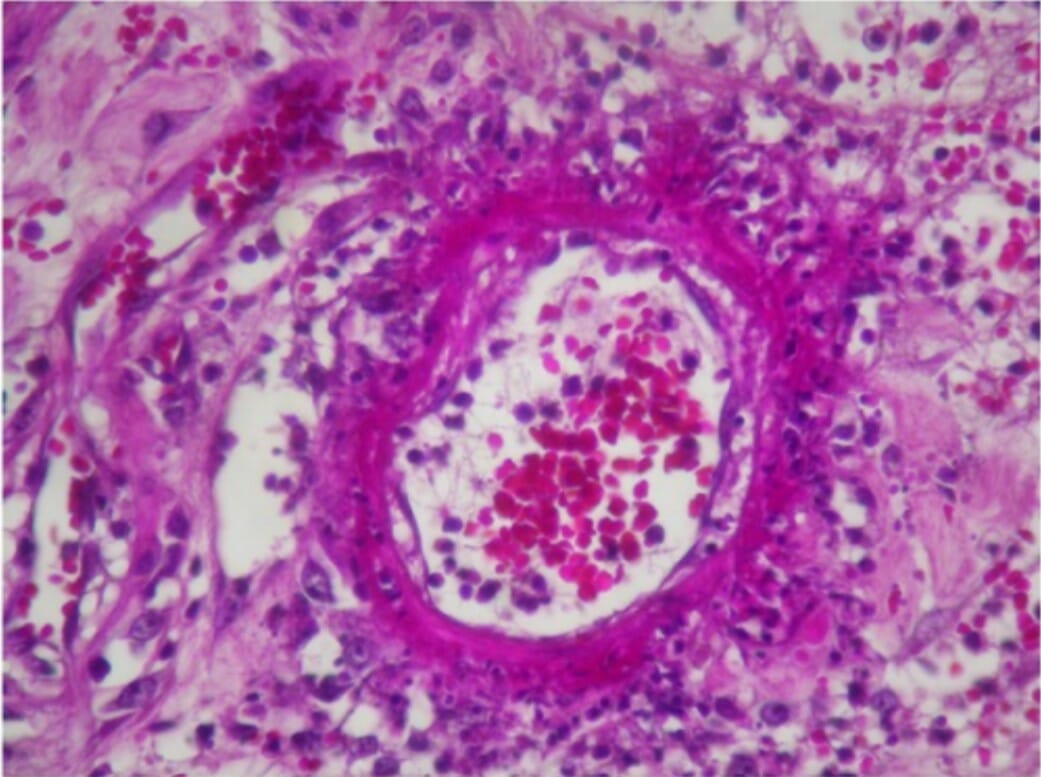
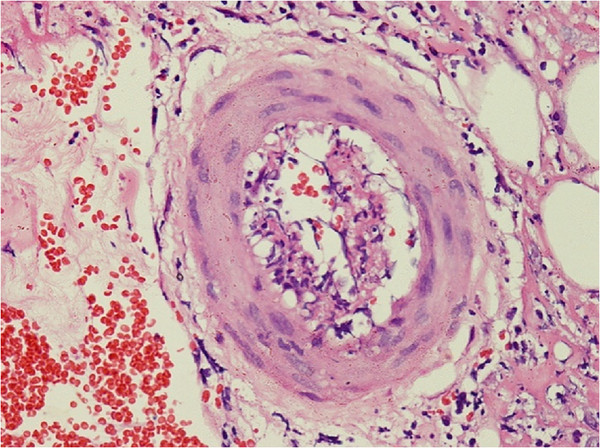
  • Hallazgos histológicos característicos en EN Erythema nodosum is an immune-mediated panniculitis (inflammation of the subcutaneous fat) caused by a type IV (delayed-type) hypersensitivity reaction. It commonly manifests in young women as tender, erythematous nodules on the shins. Erythema Nodosum los LOS Neisseria vasos sanguíneos:
    • Inflamación transmural segmentaria
    • Infiltrado celular con leucocitos polimorfonucleares o células mononucleares
    • Fragmentos de leucocitos (leucocitoclasia)
    • Alteración de la lámina interna y elástica
    • Necrosis Necrosis The death of cells in an organ or tissue due to disease, injury or failure of the blood supply. Ischemic Cell Damage fibrinoide (da lugar a un aspecto homogéneo y eosinofílico de la pared vascular).
    • Las lesiones dentro de una misma muestra suelen tener edades diferentes.

Otras pruebas

  • La angiografía mesentérica o renal puede demostrar:
    • Aneurismas múltiples
    • Estenosis de grandes vasos
    • Oclusión de pequeñas arterias
  • La TC y la RM detectan hallazgos inespecíficos, como:
    • Zonas isquémicas en EN Erythema nodosum is an immune-mediated panniculitis (inflammation of the subcutaneous fat) caused by a type IV (delayed-type) hypersensitivity reaction. It commonly manifests in young women as tender, erythematous nodules on the shins. Erythema Nodosum forma de cuña en EN Erythema nodosum is an immune-mediated panniculitis (inflammation of the subcutaneous fat) caused by a type IV (delayed-type) hypersensitivity reaction. It commonly manifests in young women as tender, erythematous nodules on the shins. Erythema Nodosum el riñón
    • Engrosamiento de la pared intestinal
    • Congestión de la vasculatura mesentérica
    • Engrosamiento difuso de los LOS Neisseria pliegues de la mucosa GI
  • Electromiografía y estudios de conducción nerviosa:
    • Puede ayudar a seleccionar el lugar para la biopsia de nervio o músculo
    • Puede utilizarse para valorar neuropatía periférica
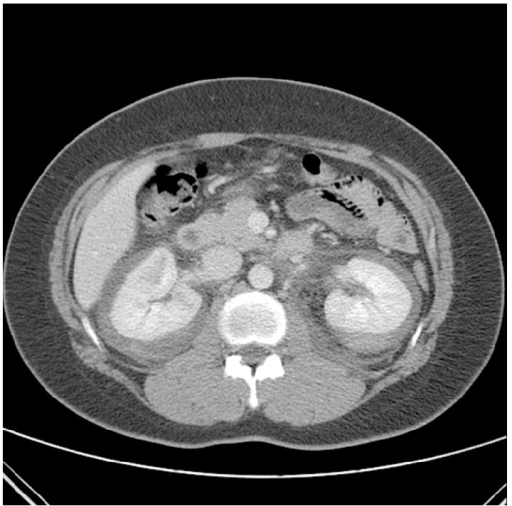
TC con contraste con hemorragia perirrenal bilateral espontánea (complicación poco frecuente) como presentación inicial de PAN en un individuo con dolor en el flanco e hipovolemia.

TC con contraste con hemorragia perirrenal bilateral espontánea (complicación poco frecuente) como presentación inicial de PAN en un individuo con dolor de costado e hipovolemia.

Imagen: “Contrast enhanced CT on the day of admission. CT revealed nonspecific spontaneous bilateral perirenal hemorrhage and delayed enhancing lesion of renal medulla” by Choi HI, Kim YG, Kim SY, Jeong da W, Kim KP, Jeong KH, Lee SH, Moon JY. Licencia: CC BY 3.0

Evaluación de la severidad de la enfermedad

La evaluación de la severidad de la enfermedad es útil para determinar la mejor opción de manejo.

  • Leve:
    • Signos y síntomas:
      • Síntomas constitucionales
      • Artralgias
      • Anemia Anemia Anemia is a condition in which individuals have low Hb levels, which can arise from various causes. Anemia is accompanied by a reduced number of RBCs and may manifest with fatigue, shortness of breath, pallor, and weakness. Subtypes are classified by the size of RBCs, chronicity, and etiology. Anemia: Overview and Types
      • Lesiones cutáneas
    • Función renal normal
    • Ausencia de manifestaciones multiorgánicas significativas o potencialmente mortales.
  • Moderada a severa:
    • Disfuncion renal
    • Hipertensión nueva o agravada
    • Afectación multisistémica (por ejemplo, gastrointestinal, cardíaca, neurológica) o manifestaciones potencialmente mortales

Tratamiento y Pronóstico

El tratamiento depende de la severidad y la extensión de la enfermedad y debe ser guiado por un especialista (reumatólogo). El principal método de tratamiento son los LOS Neisseria glucocorticoides orales. También pueden ser necesarios agentes inmunosupresores para los LOS Neisseria pacientes con enfermedad de moderada a severa.

Objetivos del tratamiento

  • Alcanzar la remisión (ausencia de enfermedad activa)
  • Resolver los LOS Neisseria síntomas reversibles
  • Prevenir la progresión a enfermedad severa

Tratamiento

PAN leve:

  • Monoterapia inicial con glucocorticoides orales
  • Pueden añadirse inmunosupresores adicionales, en EN Erythema nodosum is an immune-mediated panniculitis (inflammation of the subcutaneous fat) caused by a type IV (delayed-type) hypersensitivity reaction. It commonly manifests in young women as tender, erythematous nodules on the shins. Erythema Nodosum función de la respuesta al AL Amyloidosis tratamiento:
    • Azatioprina
    • Metotrexato
    • Micofenolato mofetilo
  • Si se asocia a infección por HBV HBV Hepatitis B virus (HBV) is a partially double-stranded DNA virus, which belongs to the Orthohepadnavirus genus and the Hepadnaviridae family. Hepatitis B virus is transmitted by exposure to infectious blood or body fluids. Examples of types of exposure include sexual intercourse, IV drug use, and childbirth. Hepatitis B Virus o HCV HCV Hepatitis C is an infection of the liver caused by the hepatitis C virus (HCV). Hepatitis C virus is an RNA virus and a member of the genus Hepacivirus and the family Flaviviridae. The infection can be transmitted through infectious blood or body fluids and may be transmitted during childbirth or through IV drug use or sexual intercourse. Hepatitis C Virus, se justifica terapia antiviral Antiviral Antivirals for Hepatitis B

PAN de moderada a severa:

  • Tratamiento inicial: combinación de glucocorticoides y ciclofosfamida
  • Terapia de mantenimiento con:
    • Azatioprina
    • Metotrexato
  • Tratamiento de la hipertensión:
    • Se prefieren los LOS Neisseria inhibidores de la ECA o los LOS Neisseria antagonistas de los LOS Neisseria receptores de angiotensina (ARA).
    • Si la función renal empeora, cambiar a otra clase de antihipertensivo (por ejemplo, antagonistas del calcio).
  • Si se asocia a infección por HBV HBV Hepatitis B virus (HBV) is a partially double-stranded DNA virus, which belongs to the Orthohepadnavirus genus and the Hepadnaviridae family. Hepatitis B virus is transmitted by exposure to infectious blood or body fluids. Examples of types of exposure include sexual intercourse, IV drug use, and childbirth. Hepatitis B Virus o HCV HCV Hepatitis C is an infection of the liver caused by the hepatitis C virus (HCV). Hepatitis C virus is an RNA virus and a member of the genus Hepacivirus and the family Flaviviridae. The infection can be transmitted through infectious blood or body fluids and may be transmitted during childbirth or through IV drug use or sexual intercourse. Hepatitis C Virus, el tratamiento también puede incluir:

Monitoreo de la PAN:

  • Seguimiento regular Regular Insulin a largo plazo de la progresión y los LOS Neisseria efectos adversos de los LOS Neisseria medicamentos.
  • Parámetros controlados:
    • Examen físico rutinario
    • Presión arterial
    • Análisis de laboratorio
    • Control de las toxicidades de los LOS Neisseria medicamentos
    • Creatinina sérica y análisis de orina
    • Evaluación de nuevos síntomas

Pronóstico

El pronóstico depende de la severidad de la enfermedad y de la respuesta al AL Amyloidosis tratamiento.

  • PAN no tratada: mal pronóstico con una supervivencia a 5 años de aproximadamente el 10%.
  • Con el tratamiento adecuado: Supervivencia a 5 años, aproximadamente 80%.
  • Peor pronóstico asociado:
    • Afectación renal
    • Afectación GI (por ejemplo, isquemia, perforación)
    • Afectación del SNC
    • Cardiomiopatía
  • La recaída de la enfermedad tras una remisión satisfactoria es de aproximadamente el 20%.
  • La tasa de supervivencia es mayor en EN Erythema nodosum is an immune-mediated panniculitis (inflammation of the subcutaneous fat) caused by a type IV (delayed-type) hypersensitivity reaction. It commonly manifests in young women as tender, erythematous nodules on the shins. Erythema Nodosum la PAN no asociada a HBV HBV Hepatitis B virus (HBV) is a partially double-stranded DNA virus, which belongs to the Orthohepadnavirus genus and the Hepadnaviridae family. Hepatitis B virus is transmitted by exposure to infectious blood or body fluids. Examples of types of exposure include sexual intercourse, IV drug use, and childbirth. Hepatitis B Virus que en EN Erythema nodosum is an immune-mediated panniculitis (inflammation of the subcutaneous fat) caused by a type IV (delayed-type) hypersensitivity reaction. It commonly manifests in young women as tender, erythematous nodules on the shins. Erythema Nodosum la PAN asociada a HBV HBV Hepatitis B virus (HBV) is a partially double-stranded DNA virus, which belongs to the Orthohepadnavirus genus and the Hepadnaviridae family. Hepatitis B virus is transmitted by exposure to infectious blood or body fluids. Examples of types of exposure include sexual intercourse, IV drug use, and childbirth. Hepatitis B Virus.

Diagnóstico Diferencial

  • Enfermedad anti-membrana basal glomerular (MBG): trastorno autoinmune caracterizado por anticuerpos circulantes dirigidos contra las membranas basales glomerular y alveolar. La presentación clínica puede incluir fatiga, fiebre, epistaxis Epistaxis Bleeding from the nose. Granulomatosis with Polyangiitis, disnea, tos TOS Thoracic outlet syndrome (TOS) is a broad term used for a spectrum of syndromes related to the general region of the thoracic outlet, which involves the compression or irritation of elements of the brachial plexus, subclavian artery, or subclavian vein. Thoracic Outlet Syndrome, hematuria Hematuria Presence of blood in the urine. Renal Cell Carcinoma, oliguria Oliguria Decreased urine output that is below the normal range. Oliguria can be defined as urine output of less than or equal to 0. 5 or 1 ml/kg/hr depending on the age. Renal Potassium Regulation, hipertensión y anemia Anemia Anemia is a condition in which individuals have low Hb levels, which can arise from various causes. Anemia is accompanied by a reduced number of RBCs and may manifest with fatigue, shortness of breath, pallor, and weakness. Subtypes are classified by the size of RBCs, chronicity, and etiology. Anemia: Overview and Types. La detección de anticuerpos anti-MBG y los LOS Neisseria hallazgos de la biopsia renal de glomerulonefritis semilunar con depósito lineal de IgG IgG The major immunoglobulin isotype class in normal human serum. There are several isotype subclasses of igg, for example, igg1, igg2a, and igg2b. Hypersensitivity Pneumonitis a lo largo de la membrana basal proporcionan el diagnóstico. Se trata con plasmaféresis y agentes inmunosupresores.
  • Vasculitis Vasculitis Inflammation of any one of the blood vessels, including the arteries; veins; and rest of the vasculature system in the body. Systemic Lupus Erythematosus inducida por medicamentos: Casi todas las clases de medicamentos, y muchas drogas ilícitas, se han asociado con vasculitis Vasculitis Inflammation of any one of the blood vessels, including the arteries; veins; and rest of the vasculature system in the body. Systemic Lupus Erythematosus debido a una respuesta inmunológica inflamatoria. Las manifestaciones clínicas varían desde erupciones asintomáticas hasta afectación multisistémica. Las erupciones incluyen petequias o púrpura palpable y pueden asociarse a edema Edema Edema is a condition in which excess serous fluid accumulates in the body cavity or interstitial space of connective tissues. Edema is a symptom observed in several medical conditions. It can be categorized into 2 types, namely, peripheral (in the extremities) and internal (in an organ or body cavity). Edema y ulceración. El diagnóstico se realiza mediante examen histopatológico o inmunofluorescencia. El tratamiento incluye la retirada del agente causal. Las lesiones cutáneas pueden tratarse con glucocorticoides tópicos.
  • Síndrome antifosfolípido: trastorno autoinmune adquirido que se presenta clínicamente con trombosis venosa o arterial, o pérdida fetal recurrente. La sospecha clínica debe producirse ante acontecimientos trombóticos inexplicables (especialmente en EN Erythema nodosum is an immune-mediated panniculitis (inflammation of the subcutaneous fat) caused by a type IV (delayed-type) hypersensitivity reaction. It commonly manifests in young women as tender, erythematous nodules on the shins. Erythema Nodosum pacientes jóvenes) o resultados adversos del embarazo. El diagnóstico implica pruebas de laboratorio para detectar anticuerpos antifosfolípidos, como anticuerpos anticardiolipina, anticoagulantes lúpicos y anticuerpos anti beta-2 glicoproteína I. Los LOS Neisseria anticoagulantes son el tratamiento de base para los LOS Neisseria pacientes sintomáticos con trombosis recurrentes.
  • Granulomatosis eosinofílica con poliangeítis: tipo de vasculitis Vasculitis Inflammation of any one of the blood vessels, including the arteries; veins; and rest of the vasculature system in the body. Systemic Lupus Erythematosus necrosante que afecta a vasos de pequeño a mediano tamaño y se asocia con asma ASMA Autoimmune Hepatitis y eosinofilia en EN Erythema nodosum is an immune-mediated panniculitis (inflammation of the subcutaneous fat) caused by a type IV (delayed-type) hypersensitivity reaction. It commonly manifests in young women as tender, erythematous nodules on the shins. Erythema Nodosum sangre y tejidos. La afectación multisistémica da lugar a diversos signos y síntomas. Los LOS Neisseria estudios de laboratorio pueden evidenciar eosinofilia y mieloperoxidasa-ANCA ( p-ANCA p-ANCA Antineutrophil Cytoplasmic Antibody (ANCA)-Associated Vasculitis), y el diagnóstico se confirma por biopsia. El tratamiento depende de la severidad de la enfermedad, pero los LOS Neisseria glucocorticoides y los LOS Neisseria medicamentos inmunosupresores siguen siendo la base del tratamiento.
  • Crioglobulinemia: trastorno poco frecuente causado por una abundancia de crioglobulinas (un tipo de proteína) en EN Erythema nodosum is an immune-mediated panniculitis (inflammation of the subcutaneous fat) caused by a type IV (delayed-type) hypersensitivity reaction. It commonly manifests in young women as tender, erythematous nodules on the shins. Erythema Nodosum el suero, que provoca vasculitis Vasculitis Inflammation of any one of the blood vessels, including the arteries; veins; and rest of the vasculature system in the body. Systemic Lupus Erythematosus. Los LOS Neisseria factores etiológicos incluyen infecciones (por ejemplo, HCV HCV Hepatitis C is an infection of the liver caused by the hepatitis C virus (HCV). Hepatitis C virus is an RNA virus and a member of the genus Hepacivirus and the family Flaviviridae. The infection can be transmitted through infectious blood or body fluids and may be transmitted during childbirth or through IV drug use or sexual intercourse. Hepatitis C Virus), neoplasias malignas y afecciones autoinmunes. Las proteínas anormales pueden aglutinarse y causar lesiones cutáneas, artralgias y neuropatía periférica. La disminución de los LOS Neisseria niveles de complemento y la biopsia pueden ayudar al AL Amyloidosis diagnóstico. El tratamiento incluye inmunosupresores y el tratamiento de la causa subyacente.
  • Púrpura de Henoch-Schönlein: trastorno mediado por IgA IgA Represents 15-20% of the human serum immunoglobulins, mostly as the 4-chain polymer in humans or dimer in other mammals. Secretory iga is the main immunoglobulin in secretions. Immunoglobulins: Types and Functions caracterizado por la inflamación de vasos sanguíneos pequeños. Entre los LOS Neisseria factores desencadenantes se encuentran las infecciones (especialmente las infecciones por estreptococos del grupo A), la vacunación y las exposiciones ambientales. Esta púrpura se presenta con pródromos de cefalea, anorexia Anorexia The lack or loss of appetite accompanied by an aversion to food and the inability to eat. It is the defining characteristic of the disorder anorexia nervosa. Anorexia Nervosa y fiebre. Otros síntomas comunes son erupción cutánea, dolor Dolor Inflammation abdominal, artralgias y edema Edema Edema is a condition in which excess serous fluid accumulates in the body cavity or interstitial space of connective tissues. Edema is a symptom observed in several medical conditions. It can be categorized into 2 types, namely, peripheral (in the extremities) and internal (in an organ or body cavity). Edema. El diagnóstico es clínico, aunque los LOS Neisseria estudios de laboratorio pueden descartar otros diagnósticos. El tratamiento incluye terapia de soporte, AINEs para el dolor Dolor Inflammation articular y glucocorticoides/inmunosupresores para enfermedad severa.

Referencias

  1. Merkel, P. A. (2024). Clinical manifestations and diagnosis of polyarteritis nodosa in adults. UpToDate. Retrieved August 15, 2025, from https://www.uptodate.com/contents/clinical-manifestations-and-diagnosis-of-polyarteritis-nodosa-in-adults
  2. Merkel, P. A. (2023). Treatment and prognosis of polyarteritis nodosa. UpToDate. Retrieved August 15, 2025, from https://www.uptodate.com/contents/treatment-and-prognosis-of-polyarteritis-nodosa
  3. Polyarteritis nodosa. (2008). NORD (National Organization for Rare Disorders). Retrieved August 15, 2025, from https://rarediseases.org/rare-diseases/polyarteritis-nodosa/
  4. Jacobs-Kosmin, D., Jackson, J. M. (2024). Polyarteritis nodosa. Retrieved August 15, 2025, from https://emedicine.medscape.com/article/330717-overview
  5. Stanton, M., Tiwari, V. (2023). Polyarteritis nodosa. Retrieved August 15, 2025, from https://www.ncbi.nlm.nih.gov/books/NBK482157/
  6. Saadoun, D., Vautier, M., & Cacoub, P. (2021). Medium- and large-vessel vasculitis. Circulation, 143(3), 267–282. https://doi.org/10.1161/CIRCULATIONAHA.120.046657
  7. Springer, J. M., Byram, K. (2022). Polyarteritis nodosa: an evolving primary systemic vasculitis. Postgraduate Medicine, 1–8. https://doi.org/10.1080/00325481.2022.2088940
  8. Chung, S. A., Gorelik, M., et al. (2021). 2021 American College of Rheumatology/Vasculitis Foundation guideline for the management of polyarteritis nodosa. Arthritis Care & Research, 73(8), 1061–1070. https://doi.org/10.1002/acr.24633

¡Crea tu cuenta gratis o inicia una sesión para seguir leyendo!

Regístrate ahora y obtén acceso gratuito a Lecturio con páginas de concepto, videos médicos y cuestionarios para tu educación médica.

User Reviews

Details