
Los LOS Neisseria medicamentos antirresortivos son utilizados para tratar la osteoporosis Osteoporosis Osteoporosis refers to a decrease in bone mass and density leading to an increased number of fractures. There are 2 forms of osteoporosis: primary, which is commonly postmenopausal or senile; and secondary, which is a manifestation of immobilization, underlying medical disorders, or long-term use of certain medications. Osteoporosis. Los LOS Neisseria bifosfonatos se utilizan generalmente como terapia de primera línea, pero hay otras opciones disponibles para las personas en EN Erythema nodosum is an immune-mediated panniculitis (inflammation of the subcutaneous fat) caused by a type IV (delayed-type) hypersensitivity reaction. It commonly manifests in young women as tender, erythematous nodules on the shins. Erythema Nodosum quienes fracasan o no pueden tolerar la terapia. Las principales clases de fármacos antirresortivos son los LOS Neisseria bifosfonatos, los LOS Neisseria moduladores selectivos del receptor Receptor Receptors are proteins located either on the surface of or within a cell that can bind to signaling molecules known as ligands (e.g., hormones) and cause some type of response within the cell. Receptors de estrógeno (p. ej., raloxifeno), los LOS Neisseria inhibidores de RANKL RANKL A tumor necrosis factor receptor family member that is specific for rank ligand and plays a role in bone homeostasis by regulating osteoclastogenesis. It is also expressed on dendritic cells where it plays a role in regulating dendritic cell survival. Signaling by the activated receptor occurs through its association with tnf receptor-associated factors. Paget Disease of Bone ( denosumab Denosumab A humanized monoclonal antibody and an inhibitor of the rank ligand, which regulates osteoclast differentiation and bone remodeling. It is used as a bone density conservation agent in the treatment of osteoporosis. Other Antiresorptive Drugs) y ( en EN Erythema nodosum is an immune-mediated panniculitis (inflammation of the subcutaneous fat) caused by a type IV (delayed-type) hypersensitivity reaction. It commonly manifests in young women as tender, erythematous nodules on the shins. Erythema Nodosum pacientes posmenopáusicas seleccionadas) la terapia con estrógenos para la menopausia. Las opciones anabólicas incluyen teriparatida y abaloparatida. La mayoría de estos medicamentos inhiben la actividad de los LOS Neisseria osteoclastos para disminuir la resorción ósea. Una excepción notable es la teriparatida, que estimula la actividad de los LOS Neisseria osteoblastos para promover la formación de hueso. Los LOS Neisseria efectos secundarios varían mucho entre las clases de medicamentos.
Last updated: Dec 15, 2025
La osteoporosis Osteoporosis Osteoporosis refers to a decrease in bone mass and density leading to an increased number of fractures. There are 2 forms of osteoporosis: primary, which is commonly postmenopausal or senile; and secondary, which is a manifestation of immobilization, underlying medical disorders, or long-term use of certain medications. Osteoporosis es un trastorno esquelético causado por el deterioro del tejido óseo, que conduce a la fragilidad de los LOS Neisseria huesos. Los LOS Neisseria medicamentos antirresortivos se utilizan comúnmente en EN Erythema nodosum is an immune-mediated panniculitis (inflammation of the subcutaneous fat) caused by a type IV (delayed-type) hypersensitivity reaction. It commonly manifests in young women as tender, erythematous nodules on the shins. Erythema Nodosum el tratamiento de la osteoporosis Osteoporosis Osteoporosis refers to a decrease in bone mass and density leading to an increased number of fractures. There are 2 forms of osteoporosis: primary, which is commonly postmenopausal or senile; and secondary, which is a manifestation of immobilization, underlying medical disorders, or long-term use of certain medications. Osteoporosis para prevenir la progresión de la enfermedad.
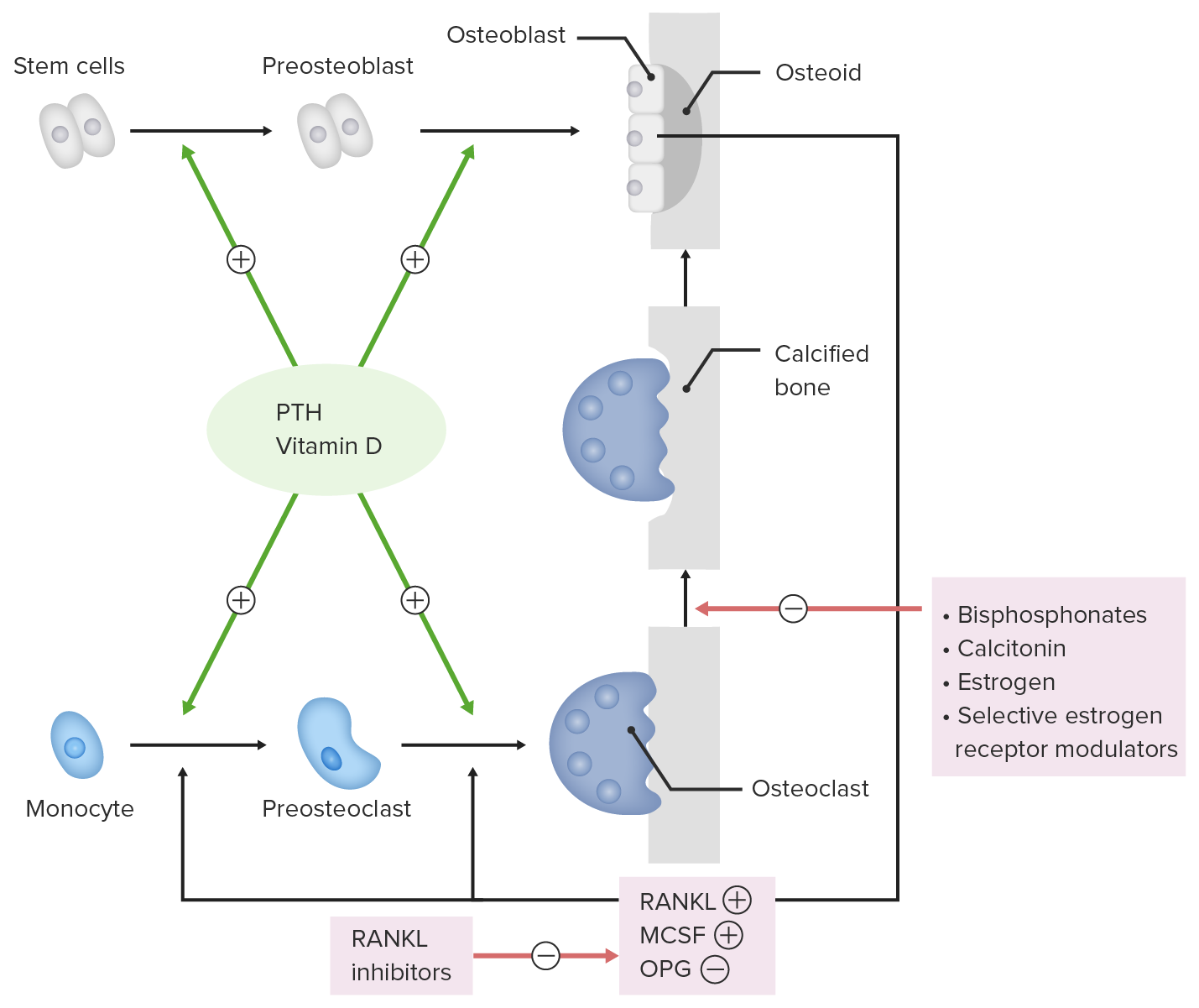
Mecanismos de acción de las diversas terapias para la osteoporosis
OPG: osteoprotegerina
MCSF: factor estimulante de colonias de macrófagos
Teriparatida:
Abaloparatida:
Calcitonina:
Teriparatida:
Abaloparatida:
Calcitonina:
Teriparatida y abaloparatida:
Calcitonina:
Teriparatida:
Abaloparatida:
Calcitonina:
La farmacocinética del raloxifeno es la siguiente:
Los LOS Neisseria siguientes efectos secundarios están asociados con el uso de raloxifeno:
El denosumab Denosumab A humanized monoclonal antibody and an inhibitor of the rank ligand, which regulates osteoclast differentiation and bone remodeling. It is used as a bone density conservation agent in the treatment of osteoporosis. Other Antiresorptive Drugs es el único medicamento de la clase de medicamentos inhibidores del RANKL RANKL A tumor necrosis factor receptor family member that is specific for rank ligand and plays a role in bone homeostasis by regulating osteoclastogenesis. It is also expressed on dendritic cells where it plays a role in regulating dendritic cell survival. Signaling by the activated receptor occurs through its association with tnf receptor-associated factors. Paget Disease of Bone.
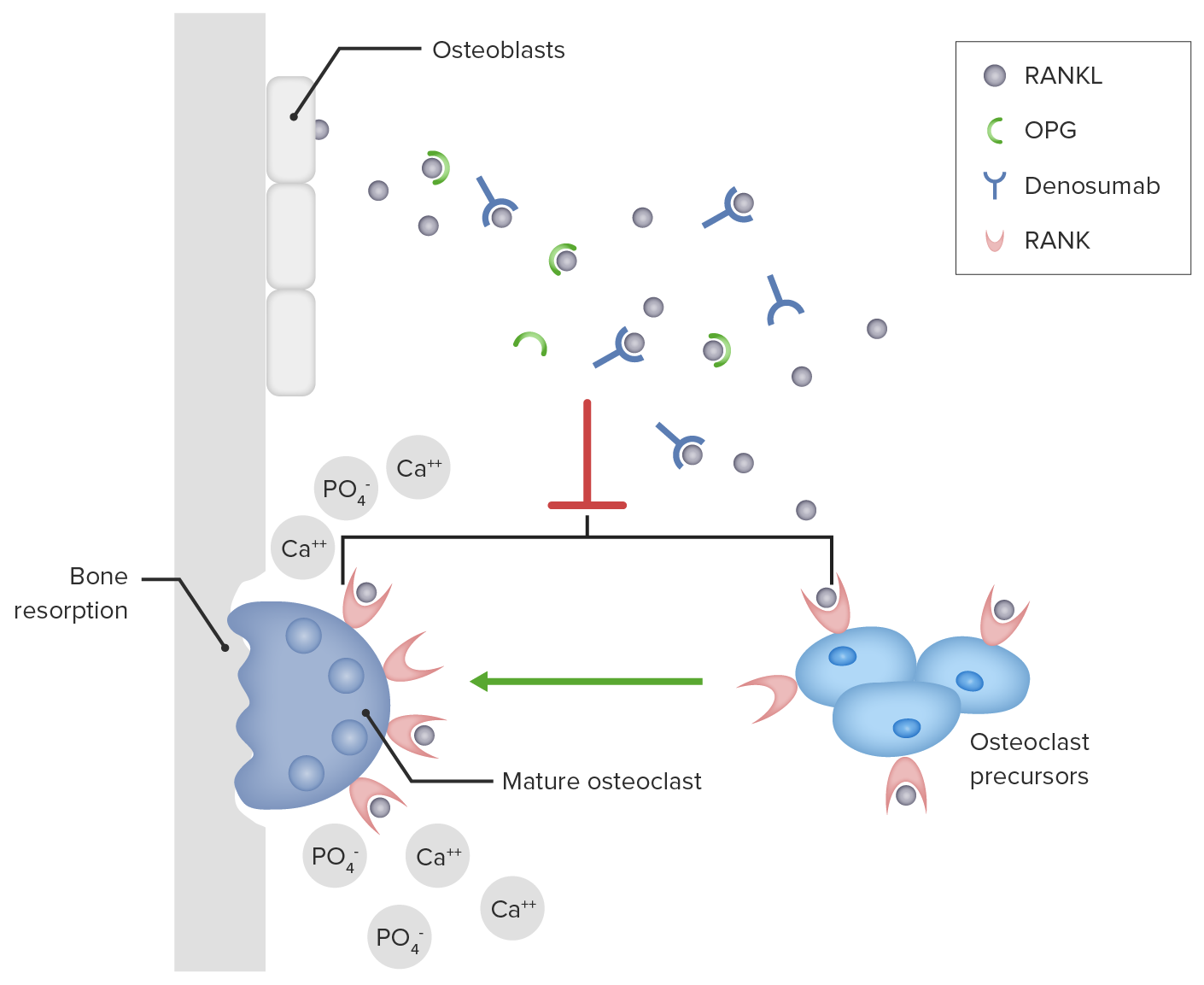
Mecanismo de acción del receptor activador del inhibidor del RANKL, denosumab:
El anticuerpo monoclonal se une al RANKL, evitando su unión al activador del receptor del factor nuclear kappa-B (RANK) en los preosteoclastos. Se inhibe la formación y función de los osteoclastos. Se debe tener en cuenta que la osteoprotegerina (OPG) tiene una función similar en el proceso de la regulación ósea.
La siguiente tabla compara los LOS Neisseria mecanismos de acción y los LOS Neisseria efectos secundarios de las clases de medicamentos utilizados para controlar y/o prevenir la osteoporosis Osteoporosis Osteoporosis refers to a decrease in bone mass and density leading to an increased number of fractures. There are 2 forms of osteoporosis: primary, which is commonly postmenopausal or senile; and secondary, which is a manifestation of immobilization, underlying medical disorders, or long-term use of certain medications. Osteoporosis:
| Clase del medicamento | Mecanismo de acción | Efectos secundarios | |
|---|---|---|---|
| Bifosfonatos |
|
|
|
| Hormonas | Teriparatida |
|
|
| Calcitonina |
|
|
|
| Vitamina D3 (colecalciferol) |
|
|
|
| Estrógeno |
|
|
|
| Moduladores selectivos del receptor Receptor Receptors are proteins located either on the surface of or within a cell that can bind to signaling molecules known as ligands (e.g., hormones) and cause some type of response within the cell. Receptors de estrógenos |
|
|
|
| Inhibidores del RANKL RANKL A tumor necrosis factor receptor family member that is specific for rank ligand and plays a role in bone homeostasis by regulating osteoclastogenesis. It is also expressed on dendritic cells where it plays a role in regulating dendritic cell survival. Signaling by the activated receptor occurs through its association with tnf receptor-associated factors. Paget Disease of Bone |
|
|
|