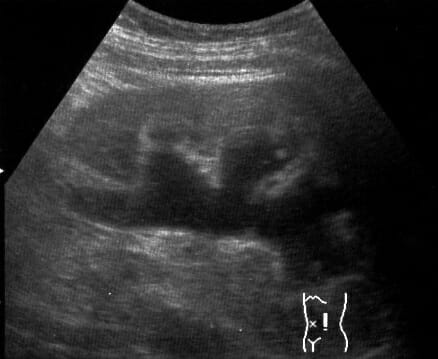
Domina Conceptos Médicos

Estudia para la escuela de medicina y tus examenes con Lecturio.

Insuficiencia Renal Aguda

La insuficiencia renal aguda se refiere a la pérdida repentina y a menudo reversible de la función renal, la cual se desarrolla durante días o semanas. La azotemia Azotemia A biochemical abnormality referring to an elevation of blood urea nitrogen and creatinine. Azotemia can be produced by kidney diseases or other extrarenal disorders. When azotemia becomes associated with a constellation of clinical signs, it is termed uremia. Acute Kidney Injury se refiere a los LOS Neisseria niveles elevados de sustancias nitrogenadas en EN Erythema nodosum is an immune-mediated panniculitis (inflammation of the subcutaneous fat) caused by a type IV (delayed-type) hypersensitivity reaction. It commonly manifests in young women as tender, erythematous nodules on the shins. Erythema Nodosum la sangre que acompañan a la IRA, como el BUN y la creatinina. La uremia Uremia A clinical syndrome associated with the retention of renal waste products or uremic toxins in the blood. It is usually the result of renal insufficiency. Most uremic toxins are end products of protein or nitrogen catabolism, such as urea or creatinine. Severe uremia can lead to multiple organ dysfunctions with a constellation of symptoms. Acute Kidney Injury se refiere específicamente a la constelación de síntomas que se producen con la disfunción renal grave. Las etiologías de la IRA se clasifican como prerrenales, renales intrínsecas o postrenales, y existe una presentación clínica variada según la gravedad de la disfunción renal. La insuficiencia renal aguda se diagnostica inicialmente por un cambio en EN Erythema nodosum is an immune-mediated panniculitis (inflammation of the subcutaneous fat) caused by a type IV (delayed-type) hypersensitivity reaction. It commonly manifests in young women as tender, erythematous nodules on the shins. Erythema Nodosum los LOS Neisseria niveles de creatinina sérica, y luego se determina la etiología mediante la historia clínica, las pruebas de laboratorio, la imagenología y, posiblemente, la biopsia renal. El tratamiento de la IRA depende de la etiología; sin embargo, siempre es importante prestar atención a la volemia del individuo y a los LOS Neisseria electrolitos séricos. Si el tratamiento no tiene éxito y la IRA evoluciona a ERC, es necesario un tratamiento de reemplazo renal con diálisis o trasplante renal.

Last updated: Jul 17, 2023

Editorial responsibility: Stanley Oiseth, Lindsay Jones, Evelin Maza

Descripción General

Definición

La insuficiencia renal aguda se refiere a una disminución brusca de la función renal, manifestada por un aumento del nivel de creatinina sérica, con o sin reducción de la diuresis.

Clasificación

Anteriormente, había más de 30 definiciones de “falla renal aguda” en EN Erythema nodosum is an immune-mediated panniculitis (inflammation of the subcutaneous fat) caused by a type IV (delayed-type) hypersensitivity reaction. It commonly manifests in young women as tender, erythematous nodules on the shins. Erythema Nodosum la literatura, y estas se han actualizado al AL Amyloidosis término de IRA.

  • Los LOS Neisseria criterios RIFLE ( en EN Erythema nodosum is an immune-mediated panniculitis (inflammation of the subcutaneous fat) caused by a type IV (delayed-type) hypersensitivity reaction. It commonly manifests in young women as tender, erythematous nodules on the shins. Erythema Nodosum inglés):
    • RRisk (riesgo)
    • LLesion (lesión)
    • FFailure (fracaso)
    • LLoss of kidney function (pérdida de la función renal)
    • EEnd-stage renal disease (enfermedad renal en EN Erythema nodosum is an immune-mediated panniculitis (inflammation of the subcutaneous fat) caused by a type IV (delayed-type) hypersensitivity reaction. It commonly manifests in young women as tender, erythematous nodules on the shins. Erythema Nodosum estadio terminal)
  • Los LOS Neisseria criterios de la Acute Kidney Injury Acute Kidney Injury Acute kidney injury refers to sudden and often reversible loss of renal function, which develops over days or weeks. Azotemia refers to elevated levels of nitrogen-containing substances in the blood that accompany AKI, which include BUN and creatinine. Acute Kidney Injury Network (AKIN, por sus siglas en EN Erythema nodosum is an immune-mediated panniculitis (inflammation of the subcutaneous fat) caused by a type IV (delayed-type) hypersensitivity reaction. It commonly manifests in young women as tender, erythematous nodules on the shins. Erythema Nodosum inglés)
  • Los LOS Neisseria estadios de Kidney Disease: Improving Global Outcomes (KDIGO) de la IRA.
    • Sustituye a los LOS Neisseria demás sistemas de estadiaje; actualmente es el preferible
    • Clasifica a los LOS Neisseria individuos según los LOS Neisseria criterios que dan lugar al AL Amyloidosis mayor grado de lesión, al AL Amyloidosis igual que los LOS Neisseria otros sistemas
    • Estadio 1:
      • Aumento ≥ 0,3 mg/dL de la creatinina sérica en EN Erythema nodosum is an immune-mediated panniculitis (inflammation of the subcutaneous fat) caused by a type IV (delayed-type) hypersensitivity reaction. It commonly manifests in young women as tender, erythematous nodules on the shins. Erythema Nodosum 48 horas, o
      • Aumento de la creatinina sérica > 1,5–1,9 veces el valor inicial en EN Erythema nodosum is an immune-mediated panniculitis (inflammation of the subcutaneous fat) caused by a type IV (delayed-type) hypersensitivity reaction. It commonly manifests in young women as tender, erythematous nodules on the shins. Erythema Nodosum los LOS Neisseria últimos 7 días, o
      • Volumen urinario/diuresis < 0,5 mL/kg/h durante 6–12 horas
    • Estadio 2:
      • Creatinina sérica 2,0‒2,9 veces el valor inicial, o
      • Volumen urinario/diuresis < 0,5 mL/kg/hora durante ≥ 12 horas
    • Estadio 3:
      • Creatinina sérica 3 veces superior al AL Amyloidosis valor inicial, o
      • Creatinina sérica ≥ 4 mg/dL, o
      • Inicio de la terapia de reemplazo renal, o
      • Disminución de la TFG estimada < 35 mL/min/1,73m2 en EN Erythema nodosum is an immune-mediated panniculitis (inflammation of the subcutaneous fat) caused by a type IV (delayed-type) hypersensitivity reaction. It commonly manifests in young women as tender, erythematous nodules on the shins. Erythema Nodosum individuos < 18 años de edad, o
      • Volumen urinario/diuresis < 0,3 mL/kg/hora durante ≥ 24 horas, o
      • Anuria Anuria Absence of urine formation. It is usually associated with complete bilateral ureteral (ureter) obstruction, complete lower urinary tract obstruction, or unilateral ureteral obstruction when a solitary kidney is present. Acute Kidney Injury durante ≥ 12 horas

Epidemiología

  • El 7% de los LOS Neisseria individuos que son hospitalizados desarrollan IRA.
  • El 20% de los LOS Neisseria enfermos agudos desarrollan IRA.
  • La mortalidad es baja en EN Erythema nodosum is an immune-mediated panniculitis (inflammation of the subcutaneous fat) caused by a type IV (delayed-type) hypersensitivity reaction. It commonly manifests in young women as tender, erythematous nodules on the shins. Erythema Nodosum la IRA no complicada.
  • La mortalidad es de 50%‒70% en EN Erythema nodosum is an immune-mediated panniculitis (inflammation of the subcutaneous fat) caused by a type IV (delayed-type) hypersensitivity reaction. It commonly manifests in young women as tender, erythematous nodules on the shins. Erythema Nodosum la IRA asociada a la sepsis Sepsis Systemic inflammatory response syndrome with a proven or suspected infectious etiology. When sepsis is associated with organ dysfunction distant from the site of infection, it is called severe sepsis. When sepsis is accompanied by hypotension despite adequate fluid infusion, it is called septic shock. Sepsis and Septic Shock y al AL Amyloidosis fallo multiorgánico.
  • No hay predilección en EN Erythema nodosum is an immune-mediated panniculitis (inflammation of the subcutaneous fat) caused by a type IV (delayed-type) hypersensitivity reaction. It commonly manifests in young women as tender, erythematous nodules on the shins. Erythema Nodosum base al AL Amyloidosis sexo
  • Más común en EN Erythema nodosum is an immune-mediated panniculitis (inflammation of the subcutaneous fat) caused by a type IV (delayed-type) hypersensitivity reaction. It commonly manifests in young women as tender, erythematous nodules on the shins. Erythema Nodosum los LOS Neisseria extremos de la edad

Etiología y Patogénesis

Las causas de la IRA se suelen organizar en EN Erythema nodosum is an immune-mediated panniculitis (inflammation of the subcutaneous fat) caused by a type IV (delayed-type) hypersensitivity reaction. It commonly manifests in young women as tender, erythematous nodules on the shins. Erythema Nodosum etiologías prerrenales, renales intrínsecas o postrenales. En EN Erythema nodosum is an immune-mediated panniculitis (inflammation of the subcutaneous fat) caused by a type IV (delayed-type) hypersensitivity reaction. It commonly manifests in young women as tender, erythematous nodules on the shins. Erythema Nodosum las causas prerrenales y postrenales, los LOS Neisseria riñones tienen una anatomía normal y la lesión se debe a los LOS Neisseria efectos del factor incitante.

Fisiología normal

  • Normalmente, la TFG se mantiene mediante mecanismos de compensación:
    • En EN Erythema nodosum is an immune-mediated panniculitis (inflammation of the subcutaneous fat) caused by a type IV (delayed-type) hypersensitivity reaction. It commonly manifests in young women as tender, erythematous nodules on the shins. Erythema Nodosum la arteriola aferente: prostaglandinas → vasodilatación → aumento de la presión hidrostática glomerular
    • En EN Erythema nodosum is an immune-mediated panniculitis (inflammation of the subcutaneous fat) caused by a type IV (delayed-type) hypersensitivity reaction. It commonly manifests in young women as tender, erythematous nodules on the shins. Erythema Nodosum la arteriola eferente: angiotensina II → vasoconstricción → mantiene o aumenta la presión en EN Erythema nodosum is an immune-mediated panniculitis (inflammation of the subcutaneous fat) caused by a type IV (delayed-type) hypersensitivity reaction. It commonly manifests in young women as tender, erythematous nodules on the shins. Erythema Nodosum el glomérulo
  • Con la disminución de la perfusión renal, los LOS Neisseria mecanismos de compensación:
    • Activan la hormona antidiurética (ADH, por sus siglas en EN Erythema nodosum is an immune-mediated panniculitis (inflammation of the subcutaneous fat) caused by a type IV (delayed-type) hypersensitivity reaction. It commonly manifests in young women as tender, erythematous nodules on the shins. Erythema Nodosum inglés) → aumento de la reabsorción de agua en EN Erythema nodosum is an immune-mediated panniculitis (inflammation of the subcutaneous fat) caused by a type IV (delayed-type) hypersensitivity reaction. It commonly manifests in young women as tender, erythematous nodules on the shins. Erythema Nodosum el túbulo distal y el conducto colector → orina concentrada.
    • Aumentan la fracción de filtración → aumento de la presión oncótica en EN Erythema nodosum is an immune-mediated panniculitis (inflammation of the subcutaneous fat) caused by a type IV (delayed-type) hypersensitivity reaction. It commonly manifests in young women as tender, erythematous nodules on the shins. Erythema Nodosum el glomérulo

Etiología y fisiopatología

  • Las causas prerrenales de la IRA dan lugar a una hipoperfusión renal debida a:
    • Depleción de volumen real: pérdida de sodio del líquido extracelular (LEC) debido a:
      • Pérdida aguda de sangre/hemorragia
      • Pérdidas gastrointestinales con vómitos o diarrea
      • Diuréticos
    • Percepción de una disminución del volumen sanguíneo por parte de las arteriolas aferentes renales/glomerulares (aunque el líquido extracelular total puede estar aumentado) debido a:
      • Hipotensión
      • Sepsis Sepsis Systemic inflammatory response syndrome with a proven or suspected infectious etiology. When sepsis is associated with organ dysfunction distant from the site of infection, it is called severe sepsis. When sepsis is accompanied by hypotension despite adequate fluid infusion, it is called septic shock. Sepsis and Septic Shock
      • Insuficiencia cardíaca
      • Cirrosis
      • Quemaduras severas/formación de un 3er espacio
    • Efectos de medicamentos:
      • Los LOS Neisseria AINE bloquean la vasodilatación de la arteriola aferente → disminución de la TFG
      • Los LOS Neisseria inhibidores de la ECA bloquean la constricción de la arteriola eferente → disminución de la TFG
    • A menudo es rápidamente reversible
  • Causas intrarrenales de la IRA: daño directo a los LOS Neisseria glomérulos y/o a las estructuras tubulointersticiales
    • Necrosis Necrosis The death of cells in an organ or tissue due to disease, injury or failure of the blood supply. Ischemic Cell Damage tubular aguda (NTA): la causa más común de IRA intrarrenal:
      • Disminución de la perfusión renal debido a la necrosis Necrosis The death of cells in an organ or tissue due to disease, injury or failure of the blood supply. Ischemic Cell Damage en EN Erythema nodosum is an immune-mediated panniculitis (inflammation of the subcutaneous fat) caused by a type IV (delayed-type) hypersensitivity reaction. It commonly manifests in young women as tender, erythematous nodules on the shins. Erythema Nodosum parches del túbulo proximal y de la rama ascendente gruesa del asa ASA Anterior Cord Syndrome de Henle
      • Lesión de células endoteliales Y epiteliales
      • Obstrucción tubular por cilindros
      • Cambios isquémicos microvasculares en EN Erythema nodosum is an immune-mediated panniculitis (inflammation of the subcutaneous fat) caused by a type IV (delayed-type) hypersensitivity reaction. It commonly manifests in young women as tender, erythematous nodules on the shins. Erythema Nodosum el flujo sanguíneo y lesiones por reperfusión
      • Factores inmunológicos
      • Los LOS Neisseria factores de riesgo son la depleción de volumen, la enfermedad renal subyacente, los LOS Neisseria AINE y la diabetes Diabetes Diabetes mellitus (DM) is a metabolic disease characterized by hyperglycemia and dysfunction of the regulation of glucose metabolism by insulin. Type 1 DM is diagnosed mostly in children and young adults as the result of autoimmune destruction of β cells in the pancreas and the resulting lack of insulin. Type 2 DM has a significant association with obesity and is characterized by insulin resistance. Diabetes Mellitus mellitus.
    • Nefritis intersticial aguda:
      • Infiltración de células inflamatorias en EN Erythema nodosum is an immune-mediated panniculitis (inflammation of the subcutaneous fat) caused by a type IV (delayed-type) hypersensitivity reaction. It commonly manifests in young women as tender, erythematous nodules on the shins. Erythema Nodosum el intersticio renal
      • Causada por medicamentos, infecciones o enfermedades autoinmunes
    • Obstrucción tubular aguda:
      • Mieloma múltiple
      • Síndrome de lisis tumoral
    • Enfermedad vascular:
      • Aterosclerosis
      • Vasculitis Vasculitis Inflammation of any one of the blood vessels, including the arteries; veins; and rest of the vasculature system in the body. Systemic Lupus Erythematosus
    • Enfermedad glomerular:
  • Causas postrenales de IRA: obstrucción
    • Puede ocurrir en EN Erythema nodosum is an immune-mediated panniculitis (inflammation of the subcutaneous fat) caused by a type IV (delayed-type) hypersensitivity reaction. It commonly manifests in young women as tender, erythematous nodules on the shins. Erythema Nodosum cualquier punto de su curso desde la pelvis Pelvis The pelvis consists of the bony pelvic girdle, the muscular and ligamentous pelvic floor, and the pelvic cavity, which contains viscera, vessels, and multiple nerves and muscles. The pelvic girdle, composed of 2 “hip” bones and the sacrum, is a ring-like bony structure of the axial skeleton that links the vertebral column with the lower extremities. Pelvis: Anatomy renal hasta la uretra
    • Requiere una obstrucción bilateral del tracto urinario si el individuo tiene 2 riñones funcionales
    • Si solamente funciona un riñón, la obstrucción provocará un aumento de la creatinina sérica
    • Mecanismo:
      • La obstrucción induce la apoptosis Apoptosis A regulated cell death mechanism characterized by distinctive morphologic changes in the nucleus and cytoplasm, including the endonucleolytic cleavage of genomic DNA, at regularly spaced, internucleosomal sites, I.e., DNA fragmentation. It is genetically-programmed and serves as a balance to mitosis in regulating the size of animal tissues and in mediating pathologic processes associated with tumor growth. Ischemic Cell Damage de las células tubulares renales.
      • La apoptosis Apoptosis A regulated cell death mechanism characterized by distinctive morphologic changes in the nucleus and cytoplasm, including the endonucleolytic cleavage of genomic DNA, at regularly spaced, internucleosomal sites, I.e., DNA fragmentation. It is genetically-programmed and serves as a balance to mitosis in regulating the size of animal tissues and in mediating pathologic processes associated with tumor growth. Ischemic Cell Damage está mediada por las caspasas (una familia de enzimas proteasas que desempeñan un papel esencial en EN Erythema nodosum is an immune-mediated panniculitis (inflammation of the subcutaneous fat) caused by a type IV (delayed-type) hypersensitivity reaction. It commonly manifests in young women as tender, erythematous nodules on the shins. Erythema Nodosum la muerte celular programada), que se generan a partir de la liberación de citoquinas y las respuestas inflamatorias.
      • Los LOS Neisseria procesos obstructivos prolongados inducen la fibrosis Fibrosis Any pathological condition where fibrous connective tissue invades any organ, usually as a consequence of inflammation or other injury. Bronchiolitis Obliterans tubulointersticial y la inflamación.
    • Causas de obstrucción:
      • Obstrucción de la salida de la vejiga
      • Hiperplasia prostática benigna (HPB)
      • Vejiga neurógena
      • Tumores ginecológicos (cáncer de ovario, leiomiomas uterinos, cáncer de cuello uterino)
      • Fibrosis Fibrosis Any pathological condition where fibrous connective tissue invades any organ, usually as a consequence of inflammation or other injury. Bronchiolitis Obliterans retroperitoneal Retroperitoneal Peritoneum: Anatomy (rara)
    • A menudo es rápidamente reversible
  • Efectos fisiopatológicos de la IRA sobre los LOS Neisseria electrolitos y el equilibrio ácido-base:
    • Hiperpotasemia:
      • Debido a la disminución de la excreción renal de potasio
      • Aumenta la probabilidad de arritmias cardíacas
    • Hiperfosfatemia: debido a la disminución de la excreción renal de fosfato
    • Acidosis Acidosis A pathologic condition of acid accumulation or depletion of base in the body. The two main types are respiratory acidosis and metabolic acidosis, due to metabolic acid build up. Respiratory Acidosis metabólica:
      • Incapacidad de los LOS Neisseria riñones para excretar ácidos
      • Exacerba la hiperpotasemia
      • Aumenta la probabilidad de arritmias cardíacas

Presentación Clínica

La insuficiencia renal aguda puede presentarse con una amplia gama de síntomas, desde ser asintomática con solo anormalidades de laboratorio hasta el coma Coma Coma is defined as a deep state of unarousable unresponsiveness, characterized by a score of 3 points on the GCS. A comatose state can be caused by a multitude of conditions, making the precise epidemiology and prognosis of coma difficult to determine. Coma debido a una uremia Uremia A clinical syndrome associated with the retention of renal waste products or uremic toxins in the blood. It is usually the result of renal insufficiency. Most uremic toxins are end products of protein or nitrogen catabolism, such as urea or creatinine. Severe uremia can lead to multiple organ dysfunctions with a constellation of symptoms. Acute Kidney Injury severa.
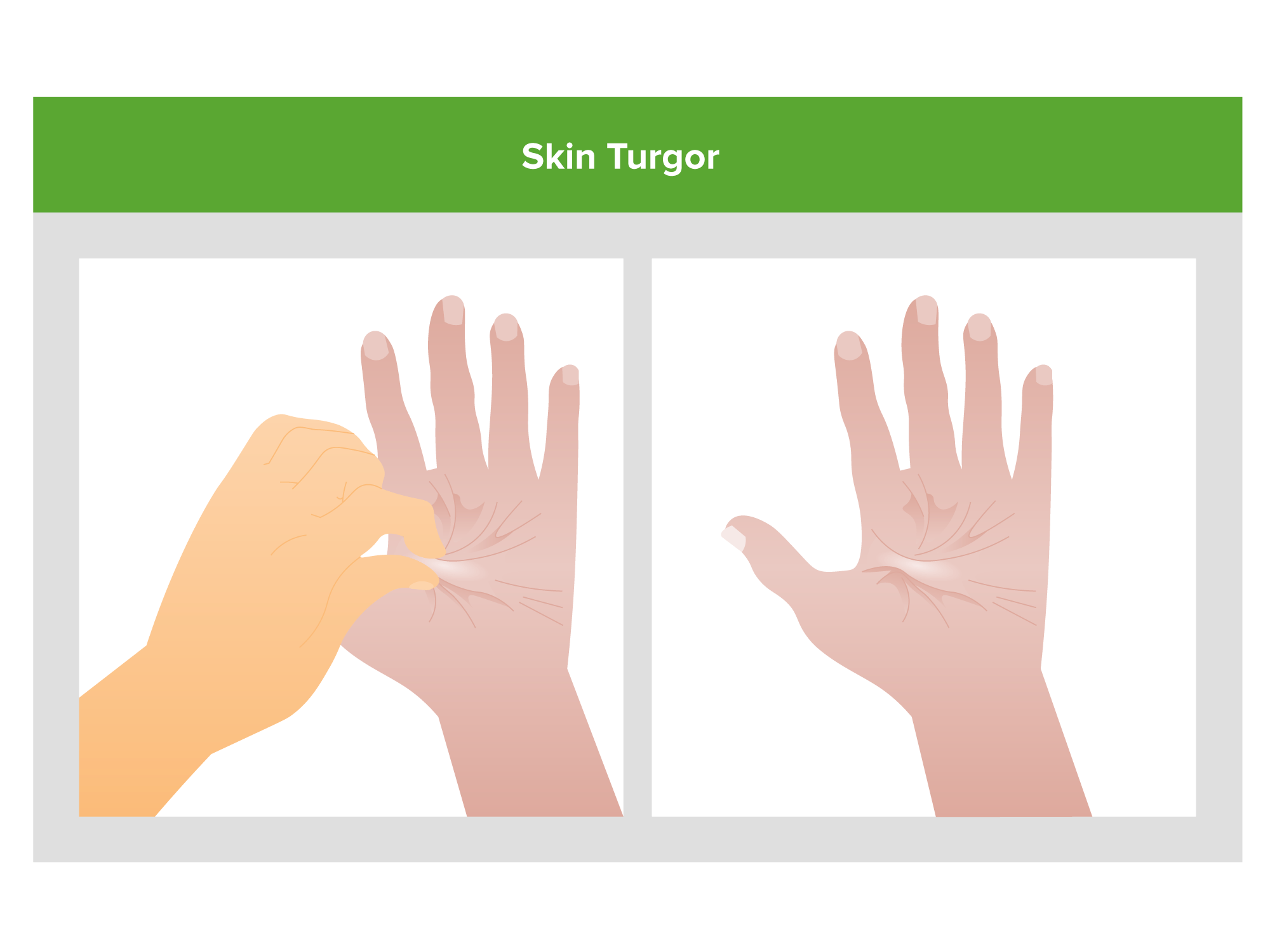
Presentación clínica con hipovolemia

  • Síntomas:
    • Mareo
    • Fatiga
    • Confusión
    • Disminución de la diuresis ( oliguria Oliguria Decreased urine output that is below the normal range. Oliguria can be defined as urine output of less than or equal to 0. 5 or 1 ml/kg/hr depending on the age. Renal Potassium Regulation)
  • Hallazgos del examen físico:
    • Hipotensión
    • Taquicardia
    • Mala turgencia de la piel
    • Membranas mucosas secas
Skin turgor

La pobre turgencia de la piel (la piel permanece tensa después de ser pellizcada) es un indicio potencial de que la depleción de volumen puede ser la causa de la lesión renal aguda de un individuo.

Imagen por Lecturio.
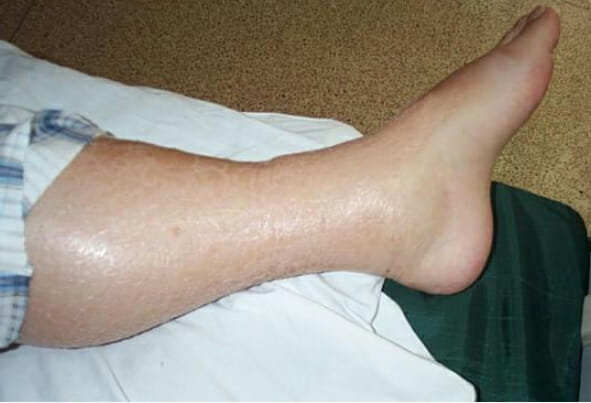
Presentación clínica con hipervolemia/sobrecarga de líquidos

  • Síntomas:
    • Disnea
    • Distensión abdominal
    • Aumento de volumen en EN Erythema nodosum is an immune-mediated panniculitis (inflammation of the subcutaneous fat) caused by a type IV (delayed-type) hypersensitivity reaction. It commonly manifests in young women as tender, erythematous nodules on the shins. Erythema Nodosum las extremidades
  • Hallazgos del examen físico:
    • Edema Edema Edema is a condition in which excess serous fluid accumulates in the body cavity or interstitial space of connective tissues. Edema is a symptom observed in several medical conditions. It can be categorized into 2 types, namely, peripheral (in the extremities) and internal (in an organ or body cavity). Edema
    • Crepitantes
    • Ascitis
    • Derrame pleural
    • Presión venosa yugular elevada
    • S3 S3 Heart Sounds a la auscultación cardíaca
Leg edema

Edema de las extremidades inferiores: puede observarse en individuos que presentan hipervolemia como resultado de una lesión renal aguda

Imagen: “Leg Edema 01” por Wang Kai-feng, Pan Hong-ming, Lou Hai-zhou, Shen Li-rong, Zhu Xi-yan. Licencia: CC BY 2.0
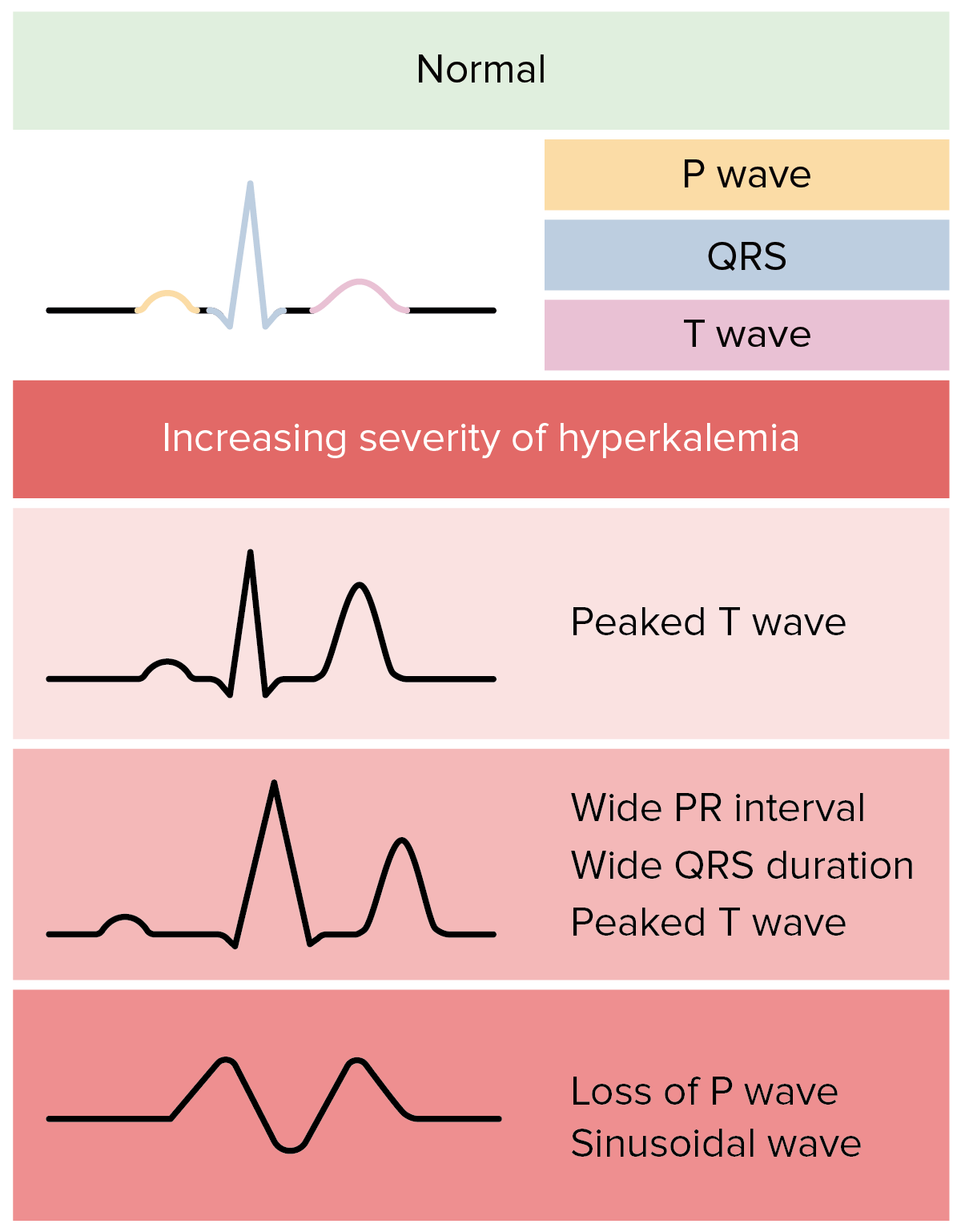
Presentación clínica con hiperpotasemia

  • Síntomas:
    • Debilidad muscular severa
    • Parálisis
  • Anomalías de la conducción cardíaca:
    • Bloqueo de rama derecha
    • Bloqueo de rama izquierda
    • Bloqueo auriculoventricular avanzado
  • Arritmias:
    • Bradicardia sinusal
    • Paro sinusal
    • Taquicardia ventricular
    • Fibrilación ventricular
    • Asistolia
Hyperkalemia EKG

Posibles cambios en el ECG debidos a la hiperpotasemia en individuos con lesión renal aguda:
En realidad, los cambios del ECG en la hiperpotasemia son más variables y menos predecibles.
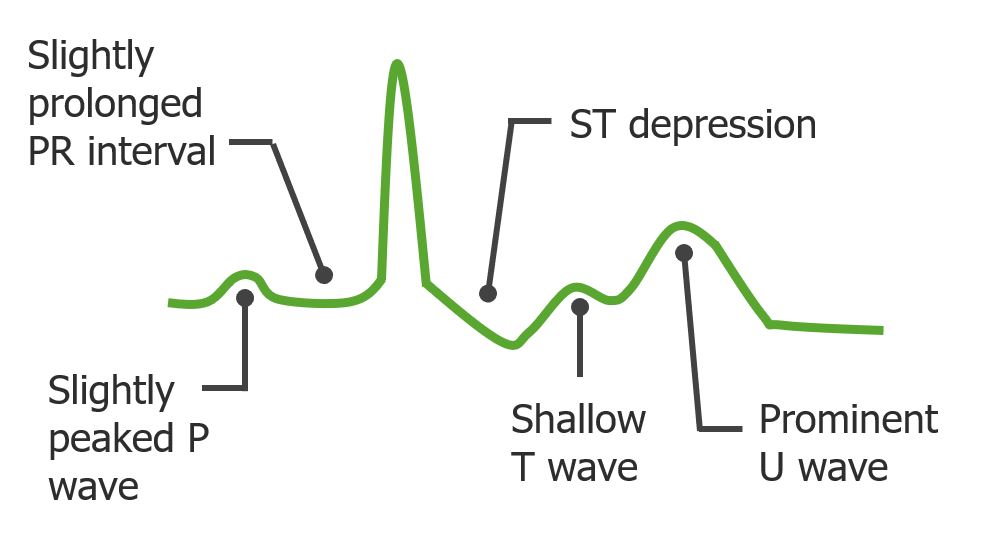
Imagen por Lecturio.

Presentación clínica con hipopotasemia

  • Suele encontrarse en EN Erythema nodosum is an immune-mediated panniculitis (inflammation of the subcutaneous fat) caused by a type IV (delayed-type) hypersensitivity reaction. It commonly manifests in young women as tender, erythematous nodules on the shins. Erythema Nodosum los LOS Neisseria mismos casos que la hipovolemia
  • Síntomas:
    • Calambres musculares
    • Íleo
  • Hallazgos del examen físico:
    • Suele ser normal
    • Puede presentar debilidad muscular y rabdomiólisis, en EN Erythema nodosum is an immune-mediated panniculitis (inflammation of the subcutaneous fat) caused by a type IV (delayed-type) hypersensitivity reaction. It commonly manifests in young women as tender, erythematous nodules on the shins. Erythema Nodosum casos graves
  • Cambios en EN Erythema nodosum is an immune-mediated panniculitis (inflammation of the subcutaneous fat) caused by a type IV (delayed-type) hypersensitivity reaction. It commonly manifests in young women as tender, erythematous nodules on the shins. Erythema Nodosum el ECG ECG An electrocardiogram (ECG) is a graphic representation of the electrical activity of the heart plotted against time. Adhesive electrodes are affixed to the skin surface allowing measurement of cardiac impulses from many angles. The ECG provides 3-dimensional information about the conduction system of the heart, the myocardium, and other cardiac structures. Electrocardiogram (ECG):
    • Depresión del ST
    • Aplanamiento de la onda T
    • Ondas U
    • Prolongación del intervalo QT
    • Puede no mostrar ninguna manifestación evidente en EN Erythema nodosum is an immune-mediated panniculitis (inflammation of the subcutaneous fat) caused by a type IV (delayed-type) hypersensitivity reaction. It commonly manifests in young women as tender, erythematous nodules on the shins. Erythema Nodosum el ECG ECG An electrocardiogram (ECG) is a graphic representation of the electrical activity of the heart plotted against time. Adhesive electrodes are affixed to the skin surface allowing measurement of cardiac impulses from many angles. The ECG provides 3-dimensional information about the conduction system of the heart, the myocardium, and other cardiac structures. Electrocardiogram (ECG)
ECG changes seen in hypokalemia

Posibles cambios en el ECG de personas con lesión renal aguda que presentan hipopotasemia

Imagen por Lecturio. Licencia: CC BY-NC-SA 4.0
Presentación clínica con uremia Uremia A clinical syndrome associated with the retention of renal waste products or uremic toxins in the blood. It is usually the result of renal insufficiency. Most uremic toxins are end products of protein or nitrogen catabolism, such as urea or creatinine. Severe uremia can lead to multiple organ dysfunctions with a constellation of symptoms. Acute Kidney Injury

  • Síntomas:
    • Gastrointestinales:
      • Anorexia Anorexia The lack or loss of appetite accompanied by an aversion to food and the inability to eat. It is the defining characteristic of the disorder anorexia nervosa. Anorexia Nervosa
      • Náuseas/vómitos
    • Disgeusia (sabor anormal)
    • Neurológicos:
      • Confusión
      • Somnolencia
      • Encefalopatía
      • Convulsiones
      • Coma Coma Coma is defined as a deep state of unarousable unresponsiveness, characterized by a score of 3 points on the GCS. A comatose state can be caused by a multitude of conditions, making the precise epidemiology and prognosis of coma difficult to determine. Coma
    • Hemorragia por disfunción plaquetaria cualitativa por las toxinas urémicas
  • Hallazgos del examen físico:
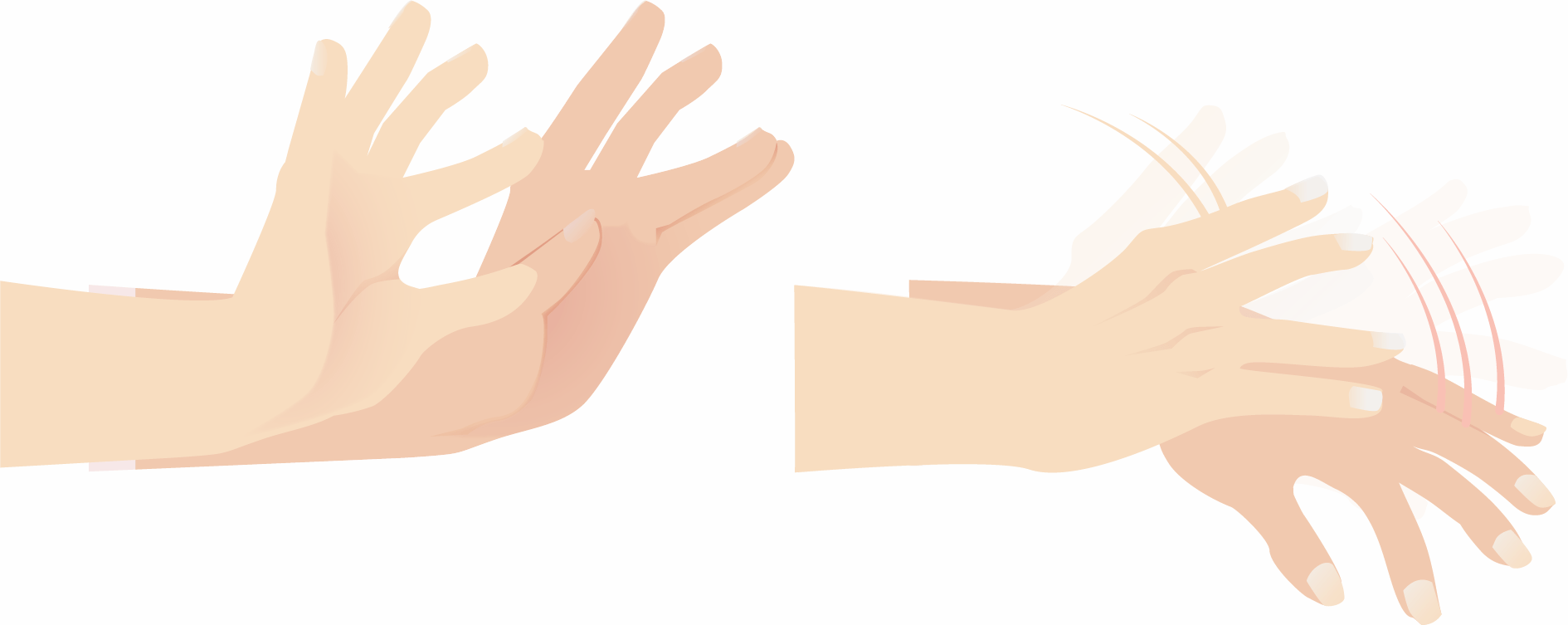
    • Asterixis Asterixis Hepatic Encephalopathy: temblor de la mano cuando se extiende la muñeca
    • Mioclonía: sacudidas musculares rápidas e involuntarias
    • Pericarditis Pericarditis Pericarditis is an inflammation of the pericardium, often with fluid accumulation. It can be caused by infection (often viral), myocardial infarction, drugs, malignancies, metabolic disorders, autoimmune disorders, or trauma. Acute, subacute, and chronic forms exist. Pericarditis/frote pericárdico: crujido audible que se escucha mejor entre el ápice y el esternón
    • Derrame pericárdico
Asterixis

Asterixis: un posible hallazgo de examen en un individuo con uremia por lesión renal aguda

Imagen por Lecturio.
Presentaciones clínicas con etiologías específicas de la IRA

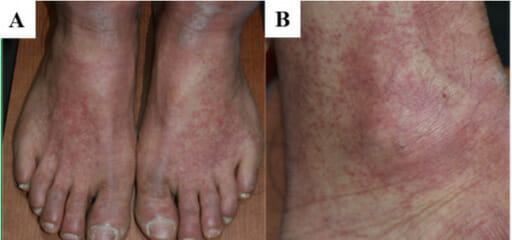
  • Tríada clásica de la nefritis intersticial aguda (las 3 se ven solo en EN Erythema nodosum is an immune-mediated panniculitis (inflammation of the subcutaneous fat) caused by a type IV (delayed-type) hypersensitivity reaction. It commonly manifests in young women as tender, erythematous nodules on the shins. Erythema Nodosum el 10% de los LOS Neisseria individuos afectados):
    • Erupción
    • Fiebre
    • Eosinofilia
  • Otras causas de IRA que se presentan con una erupción:
    • Erupción petequial, púrpura palpable-glomerulonefritis/ vasculitis Vasculitis Inflammation of any one of the blood vessels, including the arteries; veins; and rest of the vasculature system in the body. Systemic Lupus Erythematosus
    • Livedo reticularis-émbolos de colesterol
  • Anuria Anuria Absence of urine formation. It is usually associated with complete bilateral ureteral (ureter) obstruction, complete lower urinary tract obstruction, or unilateral ureteral obstruction when a solitary kidney is present. Acute Kidney Injury: < 50‒100 mL de volumen urinario/diuresis al AL Amyloidosis día:
    • Shock Shock Shock is a life-threatening condition associated with impaired circulation that results in tissue hypoxia. The different types of shock are based on the underlying cause: distributive (↑ cardiac output (CO), ↓ systemic vascular resistance (SVR)), cardiogenic (↓ CO, ↑ SVR), hypovolemic (↓ CO, ↑ SVR), obstructive (↓ CO), and mixed. Types of Shock
    • Obstrucción bilateral de las vías urinarias
    • Glomerulonefritis rápidamente progresiva
    • Síndrome urémico hemolítico
    • Oclusión bilateral de la arteria renal
  • Hematuria Hematuria Presence of blood in the urine. Renal Cell Carcinoma:
    • Microscópica: se observa con la glomerulonefritis
    • Macroscópica: se observa con la nefropatía por IgA IgA Represents 15-20% of the human serum immunoglobulins, mostly as the 4-chain polymer in humans or dimer in other mammals. Secretory iga is the main immunoglobulin in secretions. Immunoglobulins: Types and Functions
  • Orina espumosa: niveles muy altos de proteinuria Proteinuria The presence of proteins in the urine, an indicator of kidney diseases. Nephrotic Syndrome in Children → síndrome nefrótico
  • Frecuencia urinaria/dificultad para iniciar la micción → obstrucción del tracto urinario con HBP
Variable-sized macules and patches of erythematous on an individual with acute interstitial nephritis

Máculas de tamaño variable y parches eritematosos en un individuo con nefritis intersticial aguda

Imagen: “F1: Gross and microscopic exam of the skin.” por Ha Yeon Kim, Sung Sun Kim, Soo Hyeon Bae, Eun Hui Bae, Seong Kwon Ma & Soo Wan Kim. Licencia: CC BY 4.0, cortada por Lecturio.

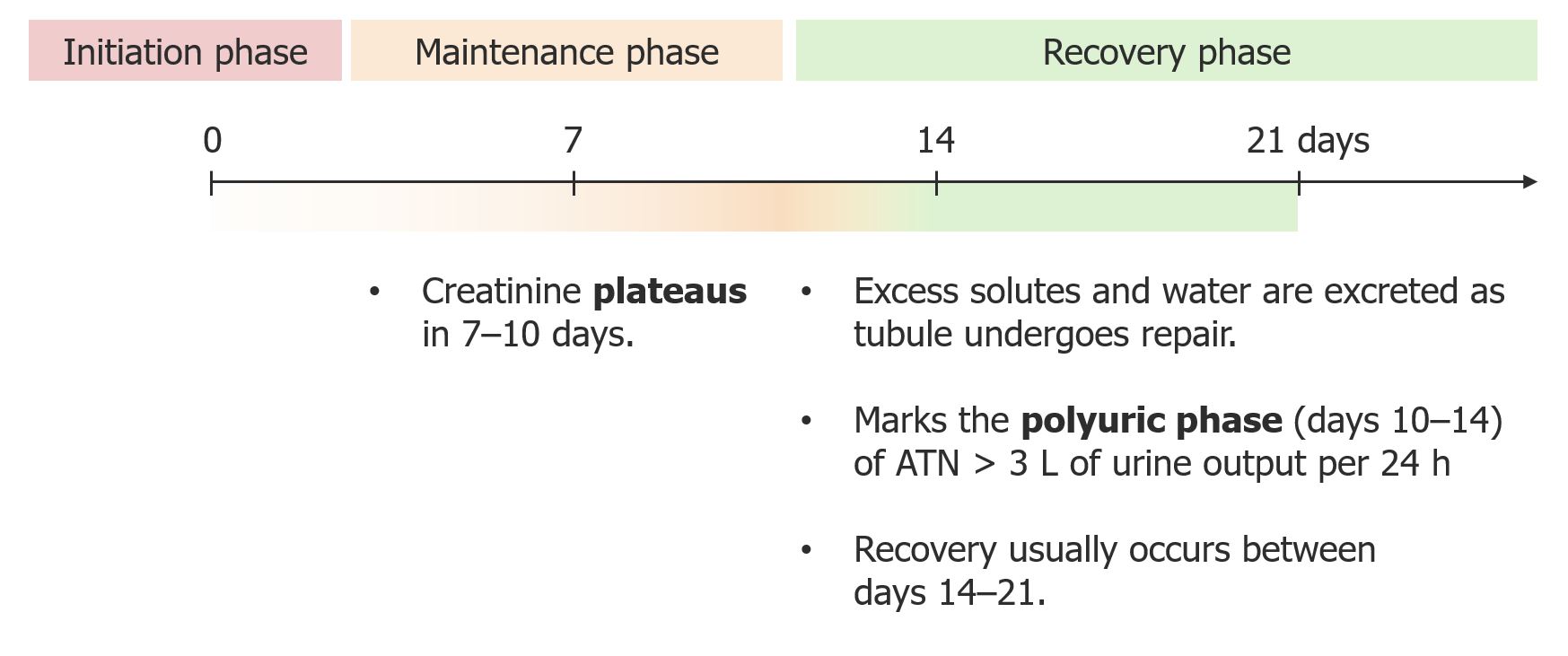
Fases de necrosis Necrosis The death of cells in an organ or tissue due to disease, injury or failure of the blood supply. Ischemic Cell Damage tubular aguda

La necrosis Necrosis The death of cells in an organ or tissue due to disease, injury or failure of the blood supply. Ischemic Cell Damage tubular aguda sigue un curso clínico característico que incluye 3 fases.
Evolución clínica de la NTA

Evolución clínica de la necrosis tubular aguda (NTA)

Imagen por Lecturio. Licencia CC BY-NC-SA 4.0

Diagnóstico

El diagnóstico de la IRA incluye la identificación de los LOS Neisseria factores desencadenantes y determinar si la etiología es prerrenal, intrarrenal o postrenal, con el fin de planificar el tratamiento adecuado.

Antecedentes y examen físico

  • Disminución de volemia/deshidratación:
    • Diarrea
    • Vómitos
    • Sudoración excesiva
  • Medicamentos comunes asociados a la IRA:
    • Diuréticos
    • Inhibidores de la ECA
    • Antagonistas de los LOS Neisseria receptores de la angiotensina
    • AINE
    • Inhibidores de la calcineurina: Ciclosporina, tacrolimus Tacrolimus A macrolide isolated from the culture broth of a strain of streptomyces tsukubaensis that has strong immunosuppressive activity in vivo and prevents the activation of T-lymphocytes in response to antigenic or mitogenic stimulation in vitro. Immunosuppressants
  • Buscar medicamentos nefrotóxicos IV comunes utilizados en EN Erythema nodosum is an immune-mediated panniculitis (inflammation of the subcutaneous fat) caused by a type IV (delayed-type) hypersensitivity reaction. It commonly manifests in young women as tender, erythematous nodules on the shins. Erythema Nodosum el hospital como causa de la IRA:
    • Aminoglucósidos
    • Anfotericina B
    • Quimioterapias que emplean platino
    • Vancomicina
  • Comorbilidades comunes:
    • Sepsis Sepsis Systemic inflammatory response syndrome with a proven or suspected infectious etiology. When sepsis is associated with organ dysfunction distant from the site of infection, it is called severe sepsis. When sepsis is accompanied by hypotension despite adequate fluid infusion, it is called septic shock. Sepsis and Septic Shock
    • Insuficiencia cardíaca
    • Cirrosis

Pruebas de laboratorio comunes

  • BUN y creatinina en EN Erythema nodosum is an immune-mediated panniculitis (inflammation of the subcutaneous fat) caused by a type IV (delayed-type) hypersensitivity reaction. It commonly manifests in young women as tender, erythematous nodules on the shins. Erythema Nodosum suero
  • Relación BUN/creatinina:
    • La proporción normal es de aproximadamente 15.
    • Prerrenal > 20
    • Renal intrínseca < 15
  • Anomalías electrolíticas/hiperpotasemia
  • Panel metabólico completo/bicarbonato para la acidosis Acidosis A pathologic condition of acid accumulation or depletion of base in the body. The two main types are respiratory acidosis and metabolic acidosis, due to metabolic acid build up. Respiratory Acidosis metabólica
  • BNP BNP A peptide that is secreted by the brain and the heart atria, stored mainly in cardiac ventricular myocardium. It can cause natriuresis; diuresis; vasodilation; and inhibits secretion of renin and aldosterone. It improves heart function. It contains 32 amino acids. Renal Sodium and Water Regulation para la insuficiencia cardíaca/sobrecarga de volumen
  • Análisis de orina:
    • Proteinuria Proteinuria The presence of proteins in the urine, an indicator of kidney diseases. Nephrotic Syndrome in Children: se observa en EN Erythema nodosum is an immune-mediated panniculitis (inflammation of the subcutaneous fat) caused by a type IV (delayed-type) hypersensitivity reaction. It commonly manifests in young women as tender, erythematous nodules on the shins. Erythema Nodosum el síndrome nefrótico
    • Hematuria Hematuria Presence of blood in the urine. Renal Cell Carcinoma: se observa en EN Erythema nodosum is an immune-mediated panniculitis (inflammation of the subcutaneous fat) caused by a type IV (delayed-type) hypersensitivity reaction. It commonly manifests in young women as tender, erythematous nodules on the shins. Erythema Nodosum los LOS Neisseria síndromes nefríticos
    • Los LOS Neisseria cilindros eritrocitarios son un hallazgo de la glomerulonefritis.
    • Los LOS Neisseria cilindros leucocitarios son un hallazgo de la nefritis intersticial aguda.
    • Los LOS Neisseria cilindros de células tubulares renales y los LOS Neisseria cilindros de color marrón oscuro son hallazgos de la NTA.
  • Sodio en EN Erythema nodosum is an immune-mediated panniculitis (inflammation of the subcutaneous fat) caused by a type IV (delayed-type) hypersensitivity reaction. It commonly manifests in young women as tender, erythematous nodules on the shins. Erythema Nodosum orina (UNa+):
    • UNa+ < 10 sugiere una causa prerrenal.
    • UNa+ > 20 sugiere una causa renal intrínseca.
  • La fracción de excreción de sodio (FENa) se calcula obteniendo simultáneamente muestras de orina y plasma Plasma The residual portion of blood that is left after removal of blood cells by centrifugation without prior blood coagulation. Transfusion Products de Na+ y creatinina:
    • FENa < 1% sugiere una causa prerrenal de IRA.
    • FENa > 1% sugiere una causa renal intrínseca.
$$FENa \%=\frac{Na\ urinario\times creatinina\ s\acute{e}rica}{Na\ s\acute{e}rico \times creatinina\ urinaria}\times 100$$

Otras pruebas específicas

Considerar otras pruebas específicas para etiologías menos comunes:
  • CK sérica para la rabdomiólisis
  • Cadenas ligeras libres en EN Erythema nodosum is an immune-mediated panniculitis (inflammation of the subcutaneous fat) caused by a type IV (delayed-type) hypersensitivity reaction. It commonly manifests in young women as tender, erythematous nodules on the shins. Erythema Nodosum suero, electroforesis de proteínas en EN Erythema nodosum is an immune-mediated panniculitis (inflammation of the subcutaneous fat) caused by a type IV (delayed-type) hypersensitivity reaction. It commonly manifests in young women as tender, erythematous nodules on the shins. Erythema Nodosum suero/orina para el mieloma múltiple
  • Serologías para la glomerulonefritis:
    • Serologías para VIH, hepatitis B Hepatitis B Hepatitis B virus (HBV) is a partially double-stranded DNA virus, which belongs to the Orthohepadnavirus genus and the Hepadnaviridae family. Most individuals with acute HBV infection are asymptomatic or have mild, self-limiting symptoms. Chronic infection can be asymptomatic or create hepatic inflammation, leading to liver cirrhosis and hepatocellular carcinoma (HCC). Hepatitis B Virus y hepatitis C Hepatitis C Hepatitis C is an infection of the liver caused by the hepatitis C virus (HCV). The infection can be transmitted through infectious blood or body fluids and may be transmitted during childbirth or through IV drug use or sexual intercourse. Hepatitis C virus can cause both acute and chronic hepatitis, ranging from a mild to a serious, lifelong illness including liver cirrhosis and hepatocellular carcinoma (HCC). Hepatitis C Virus
    • Niveles de complemento sérico (C3, C4)
    • Anticuerpo PLA2R para la nefropatía membranosa
    • Anticuerpos anticitoplasma de neutrófilos ( ANCA ANCA Group of systemic vasculitis with a strong association with anca. The disorders are characterized by necrotizing inflammation of small and medium size vessels, with little or no immune-complex deposits in vessel walls. Rapidly Progressive Glomerulonephritis, por sus siglas en EN Erythema nodosum is an immune-mediated panniculitis (inflammation of the subcutaneous fat) caused by a type IV (delayed-type) hypersensitivity reaction. It commonly manifests in young women as tender, erythematous nodules on the shins. Erythema Nodosum inglés) para la vasculitis Vasculitis Inflammation of any one of the blood vessels, including the arteries; veins; and rest of the vasculature system in the body. Systemic Lupus Erythematosus
    • Anticuerpos antimembrana basal glomerular para la enfermedad de Goodpasture
    • ANA y anti-ADNds para el lupus

Imagenología

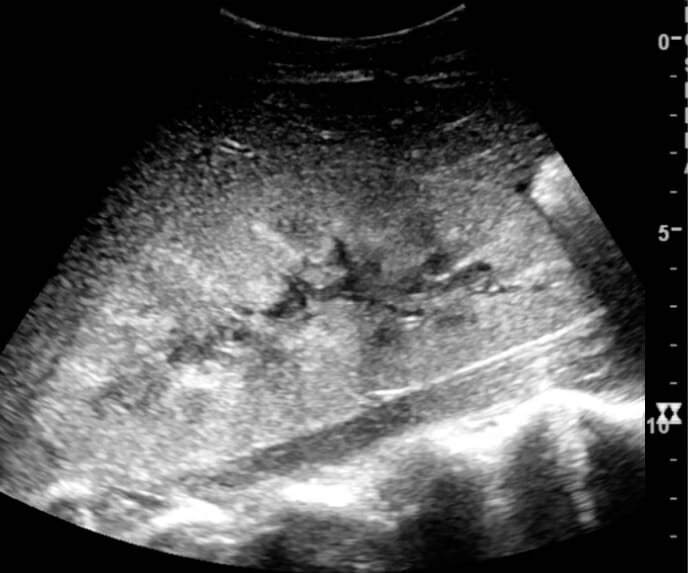
  • Considerar ultrasonido Doppler Doppler Ultrasonography applying the doppler effect, with frequency-shifted ultrasound reflections produced by moving targets (usually red blood cells) in the bloodstream along the ultrasound axis in direct proportion to the velocity of movement of the targets, to determine both direction and velocity of blood flow. Ultrasound (Sonography) de la arteria renal si hay alta sospecha de estenosis de la arteria renal
  • Ultrasonido para detectar cálculos renales u obstrucción:
    • HBP en EN Erythema nodosum is an immune-mediated panniculitis (inflammation of the subcutaneous fat) caused by a type IV (delayed-type) hypersensitivity reaction. It commonly manifests in young women as tender, erythematous nodules on the shins. Erythema Nodosum los LOS Neisseria hombres
    • Tumores ginecológicos en EN Erythema nodosum is an immune-mediated panniculitis (inflammation of the subcutaneous fat) caused by a type IV (delayed-type) hypersensitivity reaction. It commonly manifests in young women as tender, erythematous nodules on the shins. Erythema Nodosum la mujer

Parámetros para diferenciar la IRA prerrenal de la renal

Tabla: Parámetros para diferenciar la IRA prerrenal de la renal
Prerrenal Renal (NTA)
Densidad urinaria ≥ 1,020 ≤ 1,010
Osmolalidad urinaria (mOsm/kg) > 500 < 350
Sodio urinario (mEq/L) < 20 > 20
FENa < 1% > 1%
Proteína en EN Erythema nodosum is an immune-mediated panniculitis (inflammation of the subcutaneous fat) caused by a type IV (delayed-type) hypersensitivity reaction. It commonly manifests in young women as tender, erythematous nodules on the shins. Erythema Nodosum orina Mínima De mínima a grave, según la etiología
NTA: necrosis tubular aguda
FENa: fracción de excreción de sodio

Resultados de la microscopía de orina

Tabla: Resultados de la microscopía de orina
Hallazgo Significado
Células tubulares renales Lesión tubular aguda
Eritrocitos Hemorragia no glomerular/ en EN Erythema nodosum is an immune-mediated panniculitis (inflammation of the subcutaneous fat) caused by a type IV (delayed-type) hypersensitivity reaction. It commonly manifests in young women as tender, erythematous nodules on the shins. Erythema Nodosum cualquier parte del tracto urinario
Eritrocitos dismórficos Enfermedad glomerular
Cilindros eritrocitarios Diagnóstico para la enfermedad glomerular
Leucocitos Infección del tracto urinario
Cilindros leucocitarios Infección renal
Cilindros hialinos Cualquier tipo de enfermedad renal
Cilindros granulares Enfermedad renal más significativa
“Cilindros marrón fangoso” Células tubulares necróticas/lesión tubular aguda

Tratamiento

La etiología de la IRA orienta el tratamiento; la evaluación adicional con una biopsia puede estar indicada después de haber completado el estudio y el tratamiento adecuados para la hipovolemia o la sobrecarga de líquidos.

Tratamiento

  • Según la etiología de la IRA, que puede no ser inmediatamente evidente en EN Erythema nodosum is an immune-mediated panniculitis (inflammation of the subcutaneous fat) caused by a type IV (delayed-type) hypersensitivity reaction. It commonly manifests in young women as tender, erythematous nodules on the shins. Erythema Nodosum la investigación inicial:
    • Si es prerrenal con hipovolemia → tratar con líquidos IV
    • Si hay hipervolemia/sobrecarga de líquidos → tratar con diuréticos
    • Si es postrenal con obstrucción → sonda Foley para aliviar la retención urinaria:
      • Pueden ser necesarios tubos de nefrostomía percutánea.
      • Consultar con especialistas para tratar las enfermedades subyacentes (urología o ginecología)
    • Suspender los LOS Neisseria agentes ofensivos (medicamentos) si se identifican como la causa de la IRA.
  • Tratar urgentemente los LOS Neisseria desequilibrios electrolíticos y ácido-base:
    • Acidosis Acidosis A pathologic condition of acid accumulation or depletion of base in the body. The two main types are respiratory acidosis and metabolic acidosis, due to metabolic acid build up. Respiratory Acidosis metabólica → tratar con bicarbonato sódico oral o IV
    • Hiperpotasemia:
      • Calcio intravenoso para estabilizar las membranas cardíacas (efecto temporal)
      • Insulina y dextrosa IV para desplazar el potasio intracelularmente (efecto temporal)
      • Resinas de intercambio catiónico por vía oral que provocan la pérdida de potasio por vía gastrointestinal (efecto duradero)
      • Los LOS Neisseria diuréticos del asa ASA Anterior Cord Syndrome provocan una pérdida renal de potasio (efecto duradero).
      • La diálisis elimina directamente el potasio de la sangre (efecto duradero).
    • Hiperfosfatemia:
      • Suele ser asintomática y no requiere tratamiento durante la IRA.
      • Causa complicaciones importantes en EN Erythema nodosum is an immune-mediated panniculitis (inflammation of the subcutaneous fat) caused by a type IV (delayed-type) hypersensitivity reaction. It commonly manifests in young women as tender, erythematous nodules on the shins. Erythema Nodosum caso de ERC
  • Para todos los LOS Neisseria casos de IRA:
    • Evitar las nefrotoxinas, incluido el contraste yodado IV para las tomografías.
    • Evitar los LOS Neisseria contrastes a base de gadolinio para los LOS Neisseria estudios de RM.
    • Restringir el sodio, el potasio y el fosfato en EN Erythema nodosum is an immune-mediated panniculitis (inflammation of the subcutaneous fat) caused by a type IV (delayed-type) hypersensitivity reaction. It commonly manifests in young women as tender, erythematous nodules on the shins. Erythema Nodosum la dieta.
    • Repetir los LOS Neisseria niveles de creatinina y potasio en EN Erythema nodosum is an immune-mediated panniculitis (inflammation of the subcutaneous fat) caused by a type IV (delayed-type) hypersensitivity reaction. It commonly manifests in young women as tender, erythematous nodules on the shins. Erythema Nodosum suero.
  • Indicaciones para biopsia renal:
    • Empeoramiento de la creatinina sérica sin diagnóstico claro
    • Sospecha de glomerulonefritis o vasculitis Vasculitis Inflammation of any one of the blood vessels, including the arteries; veins; and rest of the vasculature system in the body. Systemic Lupus Erythematosus: puede requerir tratamientos específicos agresivos como dosis altas de corticoides
      • Glomerulonefritis rápidamente progresiva
      • Nefropatía por IgA IgA Represents 15-20% of the human serum immunoglobulins, mostly as the 4-chain polymer in humans or dimer in other mammals. Secretory iga is the main immunoglobulin in secretions. Immunoglobulins: Types and Functions
      • Enfermedad de Goodpasture (enfermedad de anticuerpos antimembrana basal glomerular)
      • Vasculitis Vasculitis Inflammation of any one of the blood vessels, including the arteries; veins; and rest of the vasculature system in the body. Systemic Lupus Erythematosus ANCA-positiva (granulomatosis con poliangeitis, poliangeitis microscópica)
      • Glomerulonefritis pauciinmune
  • Indicaciones para la diálisis aguda:
    • Hiperpotasemia no controlada
    • Sobrecarga de líquidos que causa compromiso respiratorio
    • Uremia Uremia A clinical syndrome associated with the retention of renal waste products or uremic toxins in the blood. It is usually the result of renal insufficiency. Most uremic toxins are end products of protein or nitrogen catabolism, such as urea or creatinine. Severe uremia can lead to multiple organ dysfunctions with a constellation of symptoms. Acute Kidney Injury:
      • Con derrame pericárdico
      • Con encefalopatía
    • Acidosis Acidosis A pathologic condition of acid accumulation or depletion of base in the body. The two main types are respiratory acidosis and metabolic acidosis, due to metabolic acid build up. Respiratory Acidosis metabólica severa
  • El pronóstico es variable Variable Variables represent information about something that can change. The design of the measurement scales, or of the methods for obtaining information, will determine the data gathered and the characteristics of that data. As a result, a variable can be qualitative or quantitative, and may be further classified into subgroups. Types of Variables, dependiendo de la gravedad y la etiología.
  • Seguimiento a largo plazo con un nefrólogo si la recuperación no es completa

Monitoreo

  • En EN Erythema nodosum is an immune-mediated panniculitis (inflammation of the subcutaneous fat) caused by a type IV (delayed-type) hypersensitivity reaction. It commonly manifests in young women as tender, erythematous nodules on the shins. Erythema Nodosum la fase de recuperación, la creatinina sérica debe volver a su valor basal o a un nuevo nivel estable si se ha HA Hemolytic anemia (HA) is the term given to a large group of anemias that are caused by the premature destruction/hemolysis of circulating red blood cells (RBCs). Hemolysis can occur within (intravascular hemolysis) or outside the blood vessels (extravascular hemolysis). Hemolytic Anemia producido un daño permanente.
  • Vigilar el grado de recuperación renal:
    • Determinar si el individuo tenía una ERC previa:
      • Creatinina previamente elevada
      • Riñones pequeños en EN Erythema nodosum is an immune-mediated panniculitis (inflammation of the subcutaneous fat) caused by a type IV (delayed-type) hypersensitivity reaction. It commonly manifests in young women as tender, erythematous nodules on the shins. Erythema Nodosum el ultrasonido renal
      • Proteinuria Proteinuria The presence of proteins in the urine, an indicator of kidney diseases. Nephrotic Syndrome in Children
    • La creatinina sérica basal de un individuo empeorará al AL Amyloidosis menos ligeramente con cada episodio sucesivo de IRA, lo que refleja el daño a largo plazo de los LOS Neisseria eventos agudos.
  • Es importante que las personas con ERC hagan un seguimiento estrecho con un nefrólogo.
  • Complicaciones: posible desarrollo de ERC

Diagnóstico Diferencial

  • Cálculos renales: depósitos duros de minerales y sales que se forman en EN Erythema nodosum is an immune-mediated panniculitis (inflammation of the subcutaneous fat) caused by a type IV (delayed-type) hypersensitivity reaction. It commonly manifests in young women as tender, erythematous nodules on the shins. Erythema Nodosum el interior de los LOS Neisseria riñones. Los LOS Neisseria individuos suelen ser asintomáticos hasta que los LOS Neisseria cálculos renales migran al AL Amyloidosis uréter, cuando presentan un fuerte dolor Dolor Inflammation agudo de costado, hematuria Hematuria Presence of blood in the urine. Renal Cell Carcinoma y/o infección del tracto urinario. El diagnóstico se realiza por la presentación clínica, el análisis de orina y la imagenología. El tratamiento puede ser autolimitado mediante la expulsión espontánea del cálculo o puede requerir intervención con litotricia o cirugía.
  • Enfermedad renal crónica: daño renal o una TFG estimada (TFGe) < 60 mL/min/1,73 m2durante ≥ 3 meses. Los LOS Neisseria síntomas dependen de la causa: prerrenal, renal o postrenal. El diagnóstico incluye un análisis detallado de sangre y orina con pruebas de tamizaje adicionales. El tratamiento incluye el ajuste de las dosis de los LOS Neisseria medicamentos según el nivel de la TFGe y la preparación para la terapia de reemplazo renal.
  • Infección del tracto urinario: infección de cualquier parte del sistema urinario, más comúnmente observada en EN Erythema nodosum is an immune-mediated panniculitis (inflammation of the subcutaneous fat) caused by a type IV (delayed-type) hypersensitivity reaction. It commonly manifests in young women as tender, erythematous nodules on the shins. Erythema Nodosum las mujeres. Los LOS Neisseria individuos presentan micción frecuente y dolorosa, fiebre, escalofríos, hematuria Hematuria Presence of blood in the urine. Renal Cell Carcinoma y/o dolor Dolor Inflammation abdominal y de espalda. El diagnóstico se realiza clínicamente y mediante un análisis de orina con un cultivo de orina. El tratamiento se realiza por medio de líquidos y antibióticos.

Referencias

  1. Ralston, S.H., et al. (Eds.). (2018). Davidson’s Principles and Practice of Medicine. pp. 411–414. https://www.elsevier.com/books/davidsons-principles-and-practice-of-medicine/ralston/978-0-7020-7028-0
  2. Goyal, A., et al. (2020). Acute kidney injury. StatPearls. Retrieved July 24, 2021, from https://www.ncbi.nlm.nih.gov/books/NBK441896/
  3. Ostermann, M., Joannidis, M. (2016). Acute kidney injury: Diagnosis and diagnostic workup. Critical Care. 20, 299. https://www.ncbi.nlm.nih.gov/pmc/articles/PMC5037640/
  4. Khwaja, A. (2012). KDIGO clinical practice guidelines for acute kidney injury. Nephron Clinical Practice. 120(4), c179–84. https://www.karger.com/Article/FullText/339789
  5. Chawla, L.S., et al. (2017). Acute kidney disease and renal recovery: Consensus report of the Acute Disease Quality Initiative (ADQI) 16 Workgroup. Nature Reviews. Nephrology. 13(4), 241–57. https://core.ac.uk/reader/84041861?utm_source=linkout 
  6. Palevsky, P. (2021). Definition and staging criteria of acute kidney injury in adults. UpToDate. Retrieved February 23, 2021, from https://www.uptodate.com/contents/definition-and-staging-criteria-of-acute-kidney-injury-in-adults
  7. Mount, D.B. (2020). Clinical manifestations of hyperkalemia in adults. UpToDate. Retrieved July 27, 2021, from https://www.uptodate.com/contents/clinical-manifestations-of-hyperkalemia-in-adults

¡Crea tu cuenta gratis o inicia una sesión para seguir leyendo!

Regístrate ahora y obtén acceso gratuito a Lecturio con páginas de concepto, videos médicos y cuestionarios para tu educación médica.

User Reviews

Que tengas una sesión de estudio alegre y navideña 🎁 Ahorra 50% en todos los planes >>

Details