
Domina Conceptos Médicos

Estudia para la escuela de medicina y tus examenes con Lecturio.

Hemoptisis

La hemoptisis se define como la expectoración de sangre originada en EN Erythema nodosum is an immune-mediated panniculitis (inflammation of the subcutaneous fat) caused by a type IV (delayed-type) hypersensitivity reaction. It commonly manifests in young women as tender, erythematous nodules on the shins. Erythema Nodosum el tracto respiratorio inferior. La hemoptisis es una consecuencia de un proceso de otra enfermedad  y se puede clasificar como amenazante o no amenazante. Solo 5%–15% de los LOS Neisseria pacientes con hemoptisis presentan una hemorragia potencialmente mortal. Sin embargo, la hemoptisis puede dar lugar a morbilidad y mortalidad significativas debido a ahogamiento (intercambio reducido de gases, porque los LOS Neisseria pulmones se llenan de sangre) y a shock Shock Shock is a life-threatening condition associated with impaired circulation that results in tissue hypoxia. The different types of shock are based on the underlying cause: distributive (↑ cardiac output (CO), ↓ systemic vascular resistance (SVR)), cardiogenic (↓ CO, ↑ SVR), hypovolemic (↓ CO, ↑ SVR), obstructive (↓ CO), and mixed. Types of Shock hemorrágico. Las causas más comunes de hemoptisis incluyen bronquiectasia, cáncer de pulmón, tuberculosis Tuberculosis Tuberculosis (TB) is an infectious disease caused by Mycobacterium tuberculosis complex bacteria. The bacteria usually attack the lungs but can also damage other parts of the body. Approximately 30% of people around the world are infected with this pathogen, with the majority harboring a latent infection. Tuberculosis spreads through the air when a person with active pulmonary infection coughs or sneezes. Tuberculosis y aspergilosis. El diagnóstico implica imagenología de tórax y broncoscopia. En EN Erythema nodosum is an immune-mediated panniculitis (inflammation of the subcutaneous fat) caused by a type IV (delayed-type) hypersensitivity reaction. It commonly manifests in young women as tender, erythematous nodules on the shins. Erythema Nodosum casos de sangrado potencialmente mortal, el tratamiento se dirige inicialmente a estabilizar al AL Amyloidosis paciente y, si el sangrado está en EN Erythema nodosum is an immune-mediated panniculitis (inflammation of the subcutaneous fat) caused by a type IV (delayed-type) hypersensitivity reaction. It commonly manifests in young women as tender, erythematous nodules on the shins. Erythema Nodosum curso, la hemostasia a menudo se puede lograr con técnicas mínimamente invasivas (e.g., embolización arterial).

Last updated: Dec 15, 2025

Editorial responsibility: Stanley Oiseth, Lindsay Jones, Evelin Maza

Descripción General

Definición y clasificación

La hemoptisis se define como la expectoración de sangre originada en EN Erythema nodosum is an immune-mediated panniculitis (inflammation of the subcutaneous fat) caused by a type IV (delayed-type) hypersensitivity reaction. It commonly manifests in young women as tender, erythematous nodules on the shins. Erythema Nodosum las vías respiratorias inferiores. La hemoptisis es una consecuencia del proceso de otra enfermedad y se puede clasificar como amenazante o no amenazante.

  • Hemoptisis amenazante:
    • También conocida como hemoptisis, mayor, masiva o severa
    • Puede resultar en EN Erythema nodosum is an immune-mediated panniculitis (inflammation of the subcutaneous fat) caused by a type IV (delayed-type) hypersensitivity reaction. It commonly manifests in young women as tender, erythematous nodules on the shins. Erythema Nodosum:
      • Obstrucción de la vía aérea
      • Disminución del intercambio de gas
      • Inestabilidad hemodinámica
    • Las definiciones varían, pero por lo general se definen como > 500 mL de sangre expectorada durante 24 horas o > 100 ml/hora.
  • Hemoptisis no amenazante:
    • También conocida como hemoptisis menor o leve
    • Niveles clínicamente irrelevantes de sangrado (el sangrado en EN Erythema nodosum is an immune-mediated panniculitis (inflammation of the subcutaneous fat) caused by a type IV (delayed-type) hypersensitivity reaction. It commonly manifests in young women as tender, erythematous nodules on the shins. Erythema Nodosum sí no es potencialmente mortal)
    • Puede ser una señal de advertencia de una enfermedad más grave (e.g., cáncer de pulmón)
  • Pseudohemoptisis: sangre expectorada de las vías respiratorias superiores y/o del tracto gastrointestinal superior (i.e., hematemesis Hematemesis Vomiting of blood that is either fresh bright red, or older ‘coffee-ground’ in character. It generally indicates bleeding of the upper gastrointestinal tract. Mallory-Weiss Syndrome (Mallory-Weiss Tear)), que puede imitar a la hemoptisis

Epidemiología

  • Hemoptisis amenazante:
    • Infrecuente
    • Estimada en EN Erythema nodosum is an immune-mediated panniculitis (inflammation of the subcutaneous fat) caused by a type IV (delayed-type) hypersensitivity reaction. It commonly manifests in young women as tender, erythematous nodules on the shins. Erythema Nodosum 5%–15% de los LOS Neisseria pacientes con hemoptisis
  • Hemoptisis no amenazante:
    • 85%–95% de los LOS Neisseria pacientes con hemoptisis
    • Muchas de las etiologías que causan hemoptisis amenazante comúnmente se presentan con hemoptisis no amenazante.
  • En EN Erythema nodosum is an immune-mediated panniculitis (inflammation of the subcutaneous fat) caused by a type IV (delayed-type) hypersensitivity reaction. It commonly manifests in young women as tender, erythematous nodules on the shins. Erythema Nodosum un estudio observacional:
    • > 500 mL/24 horas en EN Erythema nodosum is an immune-mediated panniculitis (inflammation of the subcutaneous fat) caused by a type IV (delayed-type) hypersensitivity reaction. It commonly manifests in young women as tender, erythematous nodules on the shins. Erythema Nodosum el 2% de los LOS Neisseria pacientes
    • 20–500 mL/24 horas en EN Erythema nodosum is an immune-mediated panniculitis (inflammation of the subcutaneous fat) caused by a type IV (delayed-type) hypersensitivity reaction. It commonly manifests in young women as tender, erythematous nodules on the shins. Erythema Nodosum el 30% de los LOS Neisseria pacientes

Etiología

Tabla: Causas de la hemoptisis
Enfermedad de las vías respiratorias
  • Bronquitis*: bronquitis aguda, exacerbación de la bronquitis crónica
  • Bronquiectasia relacionada con la fibrosis Fibrosis Any pathological condition where fibrous connective tissue invades any organ, usually as a consequence of inflammation or other injury. Bronchiolitis Obliterans quística **
  • Aspiración de cuerpo extraño
Neoplasias
  • Neoplasia bronquial maligna:
    • Carcinoma broncogénico**
    • Carcinoma metastásico endobronquial (más comúnmente de melanoma Melanoma Melanoma is a malignant tumor arising from melanocytes, the melanin-producing cells of the epidermis. These tumors are most common in fair-skinned individuals with a history of excessive sun exposure and sunburns. Melanoma o carcinoma de mama/ colon Colon The large intestines constitute the last portion of the digestive system. The large intestine consists of the cecum, appendix, colon (with ascending, transverse, descending, and sigmoid segments), rectum, and anal canal. The primary function of the colon is to remove water and compact the stool prior to expulsion from the body via the rectum and anal canal. Colon, Cecum, and Appendix: Anatomy/células renales)
    • Sarcoma de Kaposi Kaposi A multicentric, malignant neoplastic vascular proliferation characterized by the development of bluish-red cutaneous nodules, usually on the lower extremities, most often on the toes or feet, and slowly increasing in size and number and spreading to more proximal areas. The tumors have endothelium-lined channels and vascular spaces admixed with variably sized aggregates of spindle-shaped cells, and often remain confined to the skin and subcutaneous tissue, but widespread visceral involvement may occur. Hhv-8 is the suspected cause. There is also a high incidence in AIDS patients. AIDS-defining Conditions en EN Erythema nodosum is an immune-mediated panniculitis (inflammation of the subcutaneous fat) caused by a type IV (delayed-type) hypersensitivity reaction. It commonly manifests in young women as tender, erythematous nodules on the shins. Erythema Nodosum el SIDA
  • Neoplasia bronquial benigna:
    • Hemangioma Hemangioma A vascular anomaly due to proliferation of blood vessels that forms a tumor-like mass. The common types involve capillaries and veins. It can occur anywhere in the body but is most frequently noticed in the skin and subcutaneous tissue. Imaging of the Liver and Biliary Tract
    • Adenoma
Infecciones
  • Infección fúngica**:
    • Aspergillus Aspergillus A genus of mitosporic fungi containing about 100 species and eleven different teleomorphs in the family trichocomaceae. Echinocandins sp. (aspergilosis)**
    • Micetoma**
  • Infección bacteriana:
    • Mycobacterium tuberculosis Mycobacterium tuberculosis Tuberculosis (TB) is an infectious disease caused by Mycobacterium tuberculosis complex bacteria. The bacteria usually attack the lungs but can also damage other parts of the body. Approximately 30% of people around the world are infected with this pathogen, with the majority harboring a latent infection. Tuberculosis spreads through the air when a person with active pulmonary infection coughs or sneezes. Tuberculosis ( tuberculosis Tuberculosis Tuberculosis (TB) is an infectious disease caused by Mycobacterium tuberculosis complex bacteria. The bacteria usually attack the lungs but can also damage other parts of the body. Approximately 30% of people around the world are infected with this pathogen, with the majority harboring a latent infection. Tuberculosis spreads through the air when a person with active pulmonary infection coughs or sneezes. Tuberculosis)**
    • Bacillus anthracis Bacillus anthracis A species of bacteria that causes anthrax in humans and animals. Anthrax (ántrax)
    • Leptospira Leptospira Leptospira is a spiral or question mark-shaped, gram-negative spirochete with hook-shaped ends. The disease, leptospirosis, is a zoonosis, infecting animals. Rodents are the most important reservoir. Bacteria shed in the urine of rodents and other animals can be transmitted to humans via contaminated water. Leptospira/Leptospirosis sp. ( leptospirosis Leptospirosis Leptospira is a spiral or question mark-shaped, gram-negative spirochete with hook-shaped ends. The major clinical species is Leptospira interrogans, which causes a mild flu-like illness in a majority of cases. The manifestations are biphasic, with Leptospira found in the blood initially. Leptospira/Leptospirosis)
    • Pestis de Yersinia Yersinia Yersinia is a genus of bacteria characterized as gram-negative bacilli that are facultative anaerobic with bipolar staining. There are 2 enteropathogenic species that cause yersiniosis, Y. enterocolitica and Y. pseudotuberculosis. Infections are manifested as pseudoappendicitis or mesenteric lymphadenitis, and enterocolitis. Yersinia spp./Yersiniosis (plaga)
    • Francisella tularensis Francisella Tularensis Aminoglycosides (tularemia)
  • Infección viral:
    • Herpes Simple
    • Virus Virus Viruses are infectious, obligate intracellular parasites composed of a nucleic acid core surrounded by a protein capsid. Viruses can be either naked (non-enveloped) or enveloped. The classification of viruses is complex and based on many factors, including type and structure of the nucleoid and capsid, the presence of an envelope, the replication cycle, and the host range. Virology del Dengue Dengue An acute febrile disease transmitted by the bite of aedes mosquitoes infected with dengue virus. It is self-limiting and characterized by fever, myalgia, headache, and rash. Severe dengue is a more virulent form of dengue. Dengue Virus
    • Virus Virus Viruses are infectious, obligate intracellular parasites composed of a nucleic acid core surrounded by a protein capsid. Viruses can be either naked (non-enveloped) or enveloped. The classification of viruses is complex and based on many factors, including type and structure of the nucleoid and capsid, the presence of an envelope, the replication cycle, and the host range. Virology del Ébola
  • Infección parasitaria:
    • Paragonimus westermani
    • Strongyloides
  • Neumonía necrotizante
  • Absceso pulmonar
Otra enfermedad del parénquima pulmonar
  • Enfermedad reumática:
    • Enfermedad de Goodpasture (enfermedad anti-membrana basal glomerular)
    • Granulomatosis con poliangeitis
    • Síndrome de anticuerpos antifosfolípidos
    • Lupus eritematoso sistémico (LES)
  • Defectos genéticos del colágeno (e.g., síndrome de Ehlers-Danlos)
  • Endometriosis Endometriosis Endometriosis is a common disease in which patients have endometrial tissue implanted outside of the uterus. Endometrial implants can occur anywhere in the pelvis, including the ovaries, the broad and uterosacral ligaments, the pelvic peritoneum, and the urinary and gastrointestinal tracts. Endometriosis con implantes intratorácicos
Enfermedad vascular pulmonar
  • Condiciones que dan como resultado la elevación de la presión capilar pulmonar:
    • Insuficiencia cardíaca
    • Estenosis mitral
  • Embolia pulmonar ( EP EP Ectopic pregnancy refers to the implantation of a fertilized egg (embryo) outside the uterine cavity. The main cause is disruption of the normal anatomy of the fallopian tube. Ectopic Pregnancy)
  • Malformación arteriovenosa (MAV) pulmonar
  • Fístula broncovascular
  • Aneurisma arterial
Trastornos hemorrágicos
  • Medicamentos anticoagulantes y antiplaquetarios
  • Coagulación intravascular diseminada (CID)
  • Disfunción plaquetaria (e.g., insuficiencia renal)
  • Trombocitopenia (e.g., PTI, PTT, SHU)
  • Enfermedad de Von Willebrand
Trauma
  • Traumas cerrados o penetrantes
  • Trauma iatrogénico
Otros
  • Amiloidosis
  • Cigarrillo electrónico o lesión pulmonar asociada al AL Amyloidosis vapeo (EVALI, por sus siglas en EN Erythema nodosum is an immune-mediated panniculitis (inflammation of the subcutaneous fat) caused by a type IV (delayed-type) hypersensitivity reaction. It commonly manifests in young women as tender, erythematous nodules on the shins. Erythema Nodosum inglés)
  • Consumo de cocaína
  • Hemoptisis criptogénica (hemoptisis sin causa aparente; la mayoría son fumadores)
*La causa más común de hemoptisis no mortal
**Las causas más comunes de hemoptisis amenazante y no amenazante (ninguna etiología causa solo hemoptisis amenazante)
PTI: Púrpura trombocitopénica inmune
PTT: Púrpura trombocitopénica trombótica
SHU: Síndrome hemolítico urémico

Fisiopatología

El suministro de sangre a los LOS Neisseria pulmones implica la circulación pulmonar y sistémica.

Hemoptisis no amenazante

La hemoptisis no amenazante generalmente surge del sangrado en EN Erythema nodosum is an immune-mediated panniculitis (inflammation of the subcutaneous fat) caused by a type IV (delayed-type) hypersensitivity reaction. It commonly manifests in young women as tender, erythematous nodules on the shins. Erythema Nodosum la circulación pulmonar.

Arteria pulmonar:

  • Es parte de la circulación pulmonar
  • Se origina del ventrículo derecho
  • Transporta sangre desoxigenada del corazón a los LOS Neisseria pulmones para el intercambio de gases
  • Un sistema de baja presión → el sangrado de los LOS Neisseria vasos generalmente no amenaza la vida

Hemoptisis amenazante

La hemoptisis amenazante se presenta generalmente por sangrado en EN Erythema nodosum is an immune-mediated panniculitis (inflammation of the subcutaneous fat) caused by a type IV (delayed-type) hypersensitivity reaction. It commonly manifests in young women as tender, erythematous nodules on the shins. Erythema Nodosum la circulación de la arteria bronquial.

Arterias bronquiales:

  • Parte de la circulación sistémica
  • Se originan de la aorta Aorta The main trunk of the systemic arteries. Mediastinum and Great Vessels: Anatomy y las arterias intercostales
  • Llevan sangre oxigenada a las vías respiratorias conductoras (e.g., bronquios), ganglios linfáticos y pleura Pleura The pleura is a serous membrane that lines the walls of the thoracic cavity and the surface of the lungs. This structure of mesodermal origin covers both lungs, the mediastinum, the thoracic surface of the diaphragm, and the inner part of the thoracic cage. The pleura is divided into a visceral pleura and parietal pleura. Pleura: Anatomy visceral
  • Terminan a nivel de los LOS Neisseria bronquiolos donde la sangre se mueve a través de los LOS Neisseria capilares y en EN Erythema nodosum is an immune-mediated panniculitis (inflammation of the subcutaneous fat) caused by a type IV (delayed-type) hypersensitivity reaction. It commonly manifests in young women as tender, erythematous nodules on the shins. Erythema Nodosum la circulación venosa sistémica
  • Un sistema de presión relativamente alta → sangrado de los LOS Neisseria vasos puede dar como resultado un sangrado amenazante para la vida

Fisiopatología de la hemoptisis amenazante:

  • Ahogamiento: la sangre llena los LOS Neisseria alvéolos y las pequeñas vías respiratorias → impide el intercambio de gases
  • El sangrado significativo puede dar como resultado shock Shock Shock is a life-threatening condition associated with impaired circulation that results in tissue hypoxia. The different types of shock are based on the underlying cause: distributive (↑ cardiac output (CO), ↓ systemic vascular resistance (SVR)), cardiogenic (↓ CO, ↑ SVR), hypovolemic (↓ CO, ↑ SVR), obstructive (↓ CO), and mixed. Types of Shock hemorrágico/hipovolémico

Presentación Clínica

La presentación clínica depende de la etiología subyacente.

Hallazgos comunes:

  • Tos TOS Thoracic outlet syndrome (TOS) is a broad term used for a spectrum of syndromes related to the general region of the thoracic outlet, which involves the compression or irritation of elements of the brachial plexus, subclavian artery, or subclavian vein. Thoracic Outlet Syndrome
  • La sangre es espumosa y se mezcla con moco → de los LOS Neisseria pulmones

Hallazgos sugestivos de etiologías infecciosas:

  • Esputo teñido de sangre
  • Fiebre

Hallazgos con sangrado amenazante:

  • Mayores volúmenes de sangrado
  • Hipotensión
  • Dificultad respiratoria: hipoxemia, taquipnea
  • Taquicardia
  • Palidez severa

Hallazgos sugestivos de pseudohemoptisis:

  • Sangre gruesa expulsada sin moco ni esputo
  • Por lo general, la sangre se expulsa sin tos TOS Thoracic outlet syndrome (TOS) is a broad term used for a spectrum of syndromes related to the general region of the thoracic outlet, which involves the compression or irritation of elements of the brachial plexus, subclavian artery, or subclavian vein. Thoracic Outlet Syndrome.
  • Inicio de la hemoptisis después de vomitar
  • Sangre nasal
  • Telangiectasias Telangiectasias Ataxia-telangiectasia nasales u orales visibles

Otros signos y síntomas específicos de la etiología subyacente pueden estar presentes (e.g., el edema Edema Edema is a condition in which excess serous fluid accumulates in the body cavity or interstitial space of connective tissues. Edema is a symptom observed in several medical conditions. It can be categorized into 2 types, namely, peripheral (in the extremities) and internal (in an organ or body cavity). Edema unilateral de las extremidades inferiores puede sugerir trombosis venosa profunda (TVP) indicativa de EP EP Ectopic pregnancy refers to the implantation of a fertilized egg (embryo) outside the uterine cavity. The main cause is disruption of the normal anatomy of the fallopian tube. Ectopic Pregnancy).
Diagnóstico

Estudios de laboratorio

  • Hemograma:
    • Para evaluar la cronicidad y la magnitud de la pérdida de sangre
    • El recuento leucocitario puede sugerir infección
  • Perfil de coagulación: para excluir los LOS Neisseria trastornos hemorrágicos como factores contribuyentes
  • Panel metabólico completo:
    • Para evaluar la función renal y detectar síndromes pulmonares-renales (e.g., síndrome de Goodpasture, granulomatosis con poliangeitis)
    • Para evaluar la función hepática
  • Cultivo de esputo
  • Pruebas de TB TB Tuberculosis (TB) is an infectious disease caused by Mycobacterium tuberculosis complex bacteria. The bacteria usually attack the lungs but can also damage other parts of the body. Approximately 30% of people around the world are infected with this pathogen, with the majority harboring a latent infection. Tuberculosis spreads through the air when a person with active pulmonary infection coughs or sneezes. Tuberculosis:
    • Prueba cutánea con derivado proteico purificado de tuberculina (PPD)
    • Ensayo de liberación de interferón gamma ( IGRA IGRA The assay of interferon-gamma released from lymphocytes after their exposure to a specific test antigen, to check for immunologic memory resulting from a previous exposure to the antigen. The amount of interferon-gamma released is usually assayed by an enzyme-linked immunosorbent assay. Tuberculosis, por sus siglas en EN Erythema nodosum is an immune-mediated panniculitis (inflammation of the subcutaneous fat) caused by a type IV (delayed-type) hypersensitivity reaction. It commonly manifests in young women as tender, erythematous nodules on the shins. Erythema Nodosum inglés) con antígenos contra Mycobacterium Mycobacterium Mycobacterium is a genus of the family Mycobacteriaceae in the phylum Actinobacteria. Mycobacteria comprise more than 150 species of facultative intracellular bacilli that are mostly obligate aerobes. Mycobacteria are responsible for multiple human infections including serious diseases, such as tuberculosis (M. tuberculosis), leprosy (M. leprae), and M. avium complex infections. Mycobacterium tuberculosis Tuberculosis Tuberculosis (TB) is an infectious disease caused by Mycobacterium tuberculosis complex bacteria. The bacteria usually attack the lungs but can also damage other parts of the body. Approximately 30% of people around the world are infected with this pathogen, with the majority harboring a latent infection. Tuberculosis spreads through the air when a person with active pulmonary infection coughs or sneezes. Tuberculosis (M. tuberculosis Tuberculosis Tuberculosis (TB) is an infectious disease caused by Mycobacterium tuberculosis complex bacteria. The bacteria usually attack the lungs but can also damage other parts of the body. Approximately 30% of people around the world are infected with this pathogen, with the majority harboring a latent infection. Tuberculosis spreads through the air when a person with active pulmonary infection coughs or sneezes. Tuberculosis)
    • Frotis y cultivo de bacilos ácido-alcohol resistentes (BAAR, por sus siglas en EN Erythema nodosum is an immune-mediated panniculitis (inflammation of the subcutaneous fat) caused by a type IV (delayed-type) hypersensitivity reaction. It commonly manifests in young women as tender, erythematous nodules on the shins. Erythema Nodosum inglés)
    • Imagenología torácica (véase más abajo)
  • Pruebas serológicas para anticuerpos específicos (si se sospecha de enfermedad reumática)

Imagenología

  • Radiografía de tórax:
    • Mejor prueba inicial
    • Los LOS Neisseria hallazgos pueden incluir:
      • Masas o nódulos pulmonares grandes → sugestivos de cáncer
      • Cavidades apicales, nódulos calcificados o infiltrados redondos → tuberculosis Tuberculosis Tuberculosis (TB) is an infectious disease caused by Mycobacterium tuberculosis complex bacteria. The bacteria usually attack the lungs but can also damage other parts of the body. Approximately 30% of people around the world are infected with this pathogen, with the majority harboring a latent infection. Tuberculosis spreads through the air when a person with active pulmonary infection coughs or sneezes. Tuberculosis
      • Edema Edema Edema is a condition in which excess serous fluid accumulates in the body cavity or interstitial space of connective tissues. Edema is a symptom observed in several medical conditions. It can be categorized into 2 types, namely, peripheral (in the extremities) and internal (in an organ or body cavity). Edema pulmonar → ICC o estenosis mitral
      • Consolidación → neumonía
      • Múltiples fracturas de costillas → traumatismos
      • Cuerpo extraño
      • Hemo/neumotórax
      • Hallazgos normales (no excluye condiciones potencialmente mortales)
  • TC de tórax:
    • Obtener con y sin contraste.
    • Propósito:
      • Para localizar el sitio de sangrado
      • Para determinar la etiología subyacente
    • Indicaciones:
      • Todos los LOS Neisseria pacientes con hemoptisis amenazantes
      • Pacientes con un diagnóstico incierto después de la radiografía de tórax
    • Etiologías diagnosticadas por TC:
      • Bronquiectasias
      • Tuberculosis Tuberculosis Tuberculosis (TB) is an infectious disease caused by Mycobacterium tuberculosis complex bacteria. The bacteria usually attack the lungs but can also damage other parts of the body. Approximately 30% of people around the world are infected with this pathogen, with the majority harboring a latent infection. Tuberculosis spreads through the air when a person with active pulmonary infection coughs or sneezes. Tuberculosis y aspergiloma
      • Cáncer de pulmón
      • Enfermedad vascular: fístula, MAV, aneurisma arterial
  • Broncoscopia:
    • Procedimiento mínimamente invasivo que utiliza un endoscopio para visualizar las vías respiratorias más grandes
    • Procedimiento de elección en EN Erythema nodosum is an immune-mediated panniculitis (inflammation of the subcutaneous fat) caused by a type IV (delayed-type) hypersensitivity reaction. It commonly manifests in young women as tender, erythematous nodules on the shins. Erythema Nodosum la mayoría de las hemoptisis amenazantes
    • Realizar dentro de las primeras 12–24 horas de presentación.
    • Propósito diagnóstico:
      • Para localizar el sitio de sangrado
      • Para determinar la etiología subyacente
    • Finalidad terapéutica:
      • Para aspirar sangre y trombos y despejar las vías respiratorias
      • Detener la hemorragia: electrocauterización, terapia con láser, terapia con epinefrina o taponamiento con balón
  • Angiografía:
    • El contraste se inyecta en EN Erythema nodosum is an immune-mediated panniculitis (inflammation of the subcutaneous fat) caused by a type IV (delayed-type) hypersensitivity reaction. It commonly manifests in young women as tender, erythematous nodules on the shins. Erythema Nodosum la circulación para obtener imágenes en EN Erythema nodosum is an immune-mediated panniculitis (inflammation of the subcutaneous fat) caused by a type IV (delayed-type) hypersensitivity reaction. It commonly manifests in young women as tender, erythematous nodules on the shins. Erythema Nodosum tiempo real.
    • Propósito diagnóstico:
      • Identificación de estructuras vasculares anormales
      • La visualización directa de la hemorragia (extravasación del contraste) es rara.
    • Propósito terapéutico: embolización
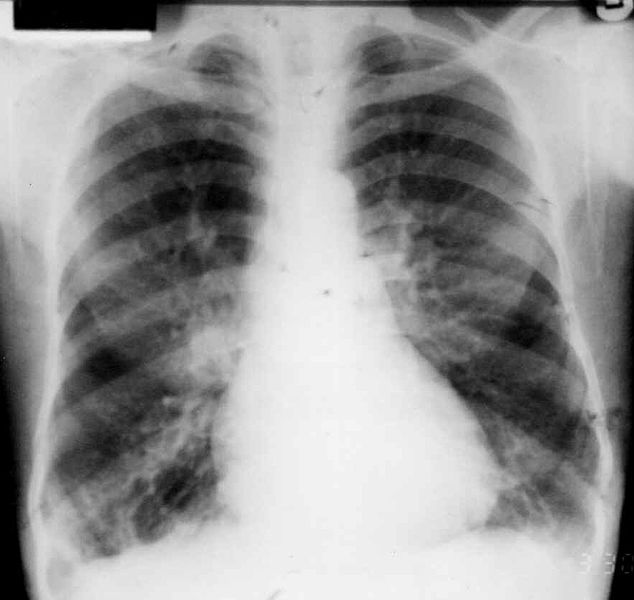
Imágenes de bronquiectasia

Una radiografía de tórax que demuestra bronquiectasia

Imagen: “Bronchiectasis imaging” por Arinna’l. Licencia: Dominio Público

Tratamiento

Hemoptisis amenazante

El 1er paso en EN Erythema nodosum is an immune-mediated panniculitis (inflammation of the subcutaneous fat) caused by a type IV (delayed-type) hypersensitivity reaction. It commonly manifests in young women as tender, erythematous nodules on the shins. Erythema Nodosum la hemoptisis amenazante es estabilizar al AL Amyloidosis paciente.

  • Supervisar la vía aérea, la ventilación y la circulación (ABC, por sus siglas en EN Erythema nodosum is an immune-mediated panniculitis (inflammation of the subcutaneous fat) caused by a type IV (delayed-type) hypersensitivity reaction. It commonly manifests in young women as tender, erythematous nodules on the shins. Erythema Nodosum inglés):
    • Vía aérea:
      • Asegurar una vía aérea segura.
      • Es probable que se requiera intubación → utilizar un tubo de gran calibre para permitir la extracción de sangre y trombos y la realización de la broncoscopia diagnóstica.
    • Ventilación:
      • Proporcionar una ventilación adecuada.
      • Aspiración de sangre para mantener la vía aérea despejada.
      • Dar oxígeno de alto flujo a los LOS Neisseria pacientes que no requieran intubación.
      • Posicionamiento: Colocar al AL Amyloidosis paciente en EN Erythema nodosum is an immune-mediated panniculitis (inflammation of the subcutaneous fat) caused by a type IV (delayed-type) hypersensitivity reaction. It commonly manifests in young women as tender, erythematous nodules on the shins. Erythema Nodosum la posición de decúbito con el pulmón sangrante hacia abajo para prevenir la aspiración en EN Erythema nodosum is an immune-mediated panniculitis (inflammation of the subcutaneous fat) caused by a type IV (delayed-type) hypersensitivity reaction. It commonly manifests in young women as tender, erythematous nodules on the shins. Erythema Nodosum el pulmón no afectado.
    • Circulación:
      • Evaluar la estabilidad hemodinámica.
      • Insertar 2 catéteres endovenosos de gran calibre.
      • Iniciar la reanimación con líquidos.
      • Solicitar el tipo de sangre y realizar pruebas cruzadas → transfundir si está clínicamente indicado
  • Realizar broncoscopia después de la estabilización inicial:
    • Permite una succión más profunda
    • Permite tratar las fuentes identificadas de sangrado
    • Importante en EN Erythema nodosum is an immune-mediated panniculitis (inflammation of the subcutaneous fat) caused by a type IV (delayed-type) hypersensitivity reaction. It commonly manifests in young women as tender, erythematous nodules on the shins. Erythema Nodosum el diagnóstico de la etiología subyacente
  • Corregir trastornos hemorrágicos/coagulantes:
    • Revertir la anticoagulación de ser posible
    • Administrar plaquetas en EN Erythema nodosum is an immune-mediated panniculitis (inflammation of the subcutaneous fat) caused by a type IV (delayed-type) hypersensitivity reaction. It commonly manifests in young women as tender, erythematous nodules on the shins. Erythema Nodosum trombocitopenias severas.
  • Administrar ácido tranexámico (un agente antifibrinolítico) para promover la coagulación.
  • Intervenciones quirúrgicas/procedimentales:
    • Indicado en EN Erythema nodosum is an immune-mediated panniculitis (inflammation of the subcutaneous fat) caused by a type IV (delayed-type) hypersensitivity reaction. It commonly manifests in young women as tender, erythematous nodules on the shins. Erythema Nodosum hemoptisis grave o no controlada
    • Puede incluir:
      • Resección quirúrgica del área hemorrágica
      • Reparación del trauma penetrante
      • Embolización arterial

Hemoptisis no amenazante

El tratamiento se enfoca en EN Erythema nodosum is an immune-mediated panniculitis (inflammation of the subcutaneous fat) caused by a type IV (delayed-type) hypersensitivity reaction. It commonly manifests in young women as tender, erythematous nodules on the shins. Erythema Nodosum tratar la causa subyacente.

  • Antibióticos para etiologías infecciosas
  • Tratamiento quirúrgico cuando sea apropiado:
    • Resección de neoplasias
    • Tratamiento de la MAV, fístula o aneurisma
    • Eliminación del cuerpo extraño aspirado
  • La observación es apropiada para la hemoptisis idiopática o criptogénica (no se encuentra ninguna causa).
  • Dejar de fumar: asesoramiento, medicamentos según corresponda

Diagnóstico diferencial

Cuando un paciente se presenta con hemoptisis, las siguientes etiologías deben ser las primeras en EN Erythema nodosum is an immune-mediated panniculitis (inflammation of the subcutaneous fat) caused by a type IV (delayed-type) hypersensitivity reaction. It commonly manifests in young women as tender, erythematous nodules on the shins. Erythema Nodosum el diagnóstico diferencial:

  • Tuberculosis Tuberculosis Tuberculosis (TB) is an infectious disease caused by Mycobacterium tuberculosis complex bacteria. The bacteria usually attack the lungs but can also damage other parts of the body. Approximately 30% of people around the world are infected with this pathogen, with the majority harboring a latent infection. Tuberculosis spreads through the air when a person with active pulmonary infection coughs or sneezes. Tuberculosis: enfermedad bacteriana infecciosa causada por M. tuberculosis Tuberculosis Tuberculosis (TB) is an infectious disease caused by Mycobacterium tuberculosis complex bacteria. The bacteria usually attack the lungs but can also damage other parts of the body. Approximately 30% of people around the world are infected with this pathogen, with the majority harboring a latent infection. Tuberculosis spreads through the air when a person with active pulmonary infection coughs or sneezes. Tuberculosis. Las bacterias generalmente atacan los LOS Neisseria pulmones, pero también pueden dañar otras partes del cuerpo. Los LOS Neisseria pacientes se presentan típicamente con fiebre, hemoptisis, sudores nocturnos y pérdida de peso. El diagnóstico se establece con una prueba cutánea de tuberculina, un cultivo del esputo e imagenología pulmonar. El apoyo principal en EN Erythema nodosum is an immune-mediated panniculitis (inflammation of the subcutaneous fat) caused by a type IV (delayed-type) hypersensitivity reaction. It commonly manifests in young women as tender, erythematous nodules on the shins. Erythema Nodosum el tratamiento lo constituyen los LOS Neisseria fármacos antituberculosos.
  • Aspergiloma: una infección fúngica oportunista causada por Aspergillus Aspergillus A genus of mitosporic fungi containing about 100 species and eleven different teleomorphs in the family trichocomaceae. Echinocandins fumigatus. El aspergiloma se desarrolla en EN Erythema nodosum is an immune-mediated panniculitis (inflammation of the subcutaneous fat) caused by a type IV (delayed-type) hypersensitivity reaction. It commonly manifests in young women as tender, erythematous nodules on the shins. Erythema Nodosum cavidades pulmonares preexistentes, típicamente de pacientes inmunodeprimidos. La hemoptisis es el síntoma más común, pero los LOS Neisseria pacientes también pueden presentar tos TOS Thoracic outlet syndrome (TOS) is a broad term used for a spectrum of syndromes related to the general region of the thoracic outlet, which involves the compression or irritation of elements of the brachial plexus, subclavian artery, or subclavian vein. Thoracic Outlet Syndrome o fiebre. Aunque son menos frecuentes, otros tipos de aspergilosis (e.g., aspergilosis invasiva o aspergilosis pulmonar necrotizante crónica) también pueden presentarse con hemoptisis. El diagnóstico implica una prueba cutánea, una prueba serológica, un cultivo de esputo e imagenología pulmonar.
  • Bronquiectasia: enfermedad inflamatoria crónica de las vías respiratorias bronquiales, resultante de un ciclo continuo de inflamación, daño bronquial y dilatación, alteración del aclaramiento de secreciones e infecciones recurrentes. La hemoptisis debida a la bronquiectasia es especialmente frecuente en EN Erythema nodosum is an immune-mediated panniculitis (inflammation of the subcutaneous fat) caused by a type IV (delayed-type) hypersensitivity reaction. It commonly manifests in young women as tender, erythematous nodules on the shins. Erythema Nodosum pacientes con fibrosis Fibrosis Any pathological condition where fibrous connective tissue invades any organ, usually as a consequence of inflammation or other injury. Bronchiolitis Obliterans quística. El diagnóstico se realiza con base en EN Erythema nodosum is an immune-mediated panniculitis (inflammation of the subcutaneous fat) caused by a type IV (delayed-type) hypersensitivity reaction. It commonly manifests in young women as tender, erythematous nodules on the shins. Erythema Nodosum resultados radiográficos característicos tales como engrosamiento de la pared bronquial y dilatación luminal. El tratamiento tiene como objetivo mejorar el aclaramiento bronquial y prevenir la infección. La condición rara vez es curable.
  • Cáncer de pulmón: transformación maligna del tejido pulmonar. El cáncer de pulmón es la principal causa de muerte relacionada con el cáncer en EN Erythema nodosum is an immune-mediated panniculitis (inflammation of the subcutaneous fat) caused by a type IV (delayed-type) hypersensitivity reaction. It commonly manifests in young women as tender, erythematous nodules on the shins. Erythema Nodosum los LOS Neisseria Estados Unidos y está estrechamente relacionada con el tabaquismo. Los LOS Neisseria síntomas incluyen; tos TOS Thoracic outlet syndrome (TOS) is a broad term used for a spectrum of syndromes related to the general region of the thoracic outlet, which involves the compression or irritation of elements of the brachial plexus, subclavian artery, or subclavian vein. Thoracic Outlet Syndrome, disnea, pérdida de peso y hemoptisis. El diagnóstico y la estadificación se efectúan mediante biopsia e imagenología. El tratamiento se guía por el estadio del cáncer y el perfil molecular asociado. La enfermedad conlleva un mal pronóstico.
  • Insuficiencia cardíaca del lado izquierdo: incapacidad del corazón para suministrar al AL Amyloidosis cuerpo el gasto cardíaco necesario para satisfacer las necesidades metabólicas del cuerpo. Los LOS Neisseria pacientes se presentan típicamente con disnea en EN Erythema nodosum is an immune-mediated panniculitis (inflammation of the subcutaneous fat) caused by a type IV (delayed-type) hypersensitivity reaction. It commonly manifests in young women as tender, erythematous nodules on the shins. Erythema Nodosum el esfuerzo y/o en EN Erythema nodosum is an immune-mediated panniculitis (inflammation of the subcutaneous fat) caused by a type IV (delayed-type) hypersensitivity reaction. It commonly manifests in young women as tender, erythematous nodules on the shins. Erythema Nodosum descanso, ortopnea y edema Edema Edema is a condition in which excess serous fluid accumulates in the body cavity or interstitial space of connective tissues. Edema is a symptom observed in several medical conditions. It can be categorized into 2 types, namely, peripheral (in the extremities) and internal (in an organ or body cavity). Edema periférico. Se puede desarrollar hemoptisis debido al AL Amyloidosis incremento de la presión capilar pulmonar resultante de la insuficiencia ventricular izquierda. El diagnóstico se confirma con ecocardiografía. El tratamiento incluye la eliminación del exceso de líquido y la disminución de la demanda de O2 del corazón.
  • Embolia pulmonar: una condición potencialmente mortal que resulta comúnmente de la obstrucción intravascular de la arteria pulmonar principal (o de una rama) por un trombo. El aire, el colesterol, la grasa y el líquido amniótico también pueden causar EP EP Ectopic pregnancy refers to the implantation of a fertilized egg (embryo) outside the uterine cavity. The main cause is disruption of the normal anatomy of the fallopian tube. Ectopic Pregnancy. Dado que una EP EP Ectopic pregnancy refers to the implantation of a fertilized egg (embryo) outside the uterine cavity. The main cause is disruption of the normal anatomy of the fallopian tube. Ectopic Pregnancy trombótica surge comúnmente de una TVP en EN Erythema nodosum is an immune-mediated panniculitis (inflammation of the subcutaneous fat) caused by a type IV (delayed-type) hypersensitivity reaction. It commonly manifests in young women as tender, erythematous nodules on the shins. Erythema Nodosum una pierna, los LOS Neisseria pacientes pueden presentarse con el edema Edema Edema is a condition in which excess serous fluid accumulates in the body cavity or interstitial space of connective tissues. Edema is a symptom observed in several medical conditions. It can be categorized into 2 types, namely, peripheral (in the extremities) and internal (in an organ or body cavity). Edema unilateral de extremidades inferiores y/o dolor Dolor Inflammation de pantorrillas. El diagnóstico generalmente se realiza a partir de una TC de tórax. El tratamiento incluye estabilización del paciente y anticoagulación en EN Erythema nodosum is an immune-mediated panniculitis (inflammation of the subcutaneous fat) caused by a type IV (delayed-type) hypersensitivity reaction. It commonly manifests in young women as tender, erythematous nodules on the shins. Erythema Nodosum pacientes con EP EP Ectopic pregnancy refers to the implantation of a fertilized egg (embryo) outside the uterine cavity. The main cause is disruption of the normal anatomy of the fallopian tube. Ectopic Pregnancy de origen trombótico.
  • Bronquitis aguda: infección de la membrana mucosa de los LOS Neisseria bronquios sin evidencia de neumonía. La bronquitis aguda suele ser viral (aproximadamente el 95% de todos los LOS Neisseria casos). De tratarse de una infección bacteriana, las bacterias atípicas son las causantes. El diagnóstico es clínico, aunque una radiografía de tórax puede ser útil para descartar neumonía. Por lo general, los LOS Neisseria pacientes presentan tos TOS Thoracic outlet syndrome (TOS) is a broad term used for a spectrum of syndromes related to the general region of the thoracic outlet, which involves the compression or irritation of elements of the brachial plexus, subclavian artery, or subclavian vein. Thoracic Outlet Syndrome, fiebre y posiblemente pequeñas cantidades de hemoptisis que no ponen en EN Erythema nodosum is an immune-mediated panniculitis (inflammation of the subcutaneous fat) caused by a type IV (delayed-type) hypersensitivity reaction. It commonly manifests in young women as tender, erythematous nodules on the shins. Erythema Nodosum peligro la vida. El tratamiento es usualmente de soporte, puesto que la mayoría de los LOS Neisseria casos son virales y no requieren antibióticos.
  • Bronquitis crónica: enfermedad pulmonar y variante de la enfermedad pulmonar obstructiva crónica (EPOC) caracterizada por la limitación del flujo de aire resultante de la inflamación crónica de las vías respiratorias. La bronquitis crónica está estrechamente asociada con el tabaquismo. La hemoptisis puede ocurrir durante una exacerbación aguda. En EN Erythema nodosum is an immune-mediated panniculitis (inflammation of the subcutaneous fat) caused by a type IV (delayed-type) hypersensitivity reaction. It commonly manifests in young women as tender, erythematous nodules on the shins. Erythema Nodosum otras circunstancias, es poco común. Los LOS Neisseria pacientes se presentan típicamente con disnea progresiva, una tos TOS Thoracic outlet syndrome (TOS) is a broad term used for a spectrum of syndromes related to the general region of the thoracic outlet, which involves the compression or irritation of elements of the brachial plexus, subclavian artery, or subclavian vein. Thoracic Outlet Syndrome productiva crónica, edema Edema Edema is a condition in which excess serous fluid accumulates in the body cavity or interstitial space of connective tissues. Edema is a symptom observed in several medical conditions. It can be categorized into 2 types, namely, peripheral (in the extremities) and internal (in an organ or body cavity). Edema periférico, y cianosis. El diagnóstico implica pruebas de función pulmonar y radiografía de tórax. El tratamiento incluye la cesación tabáquica, broncodilatadores y terapia con O2.

Referencias

  1. Ong, Z. Y., Chai, H. Z., How, C. H., Koh, J., & Low, T. B. (2016). A simplified approach to haemoptysis. Singapore medical journal, 57(8), 415–418. https://doi.org/10.11622/smedj.2016130
  2. Ingar, D & Weinberger, S. (2025). Etiology of hemoptysis. In G. Finlay and H. Hollingsworth (Ed.), UpToDate. Retrieved July 19, 2025, from https://www.uptodate.com/contents/etiology-of-hemoptysis
  3. Ingar, D.H. and Erhan Dincer, H. (2024). Evaluation and management of life-threatening hemoptysis. In Finlay, G., and Hollingsworth, H. (Eds.), UpToDate. Retrieved July 19, 2025, from https://www.uptodate.com/contents/evaluation-and-management-of-life-threatening-hemoptysis
  4. Kassutto, S.M., and Weinberger, S.E. (2023). Evaluation of nonlife-threatening hemoptysis in adults. In Hollingsworth, H., and Finlay, G. (Eds.), UpToDate. Retrieved July 19, 2025, from https://www.uptodate.com/contents/evaluation-of-nonlife-threatening-hemoptysis-in-adults
  5. Herchline, T.E. (2024). Tuberculosis (TB). In Bronze, M.S. (Ed.), Medscape. Retrieved July 19, 2025, from https://emedicine.medscape.com/article/230802-overview
  6. Michaud, G. (2019). Hemoptysis as a cardinal symptom/sign. Pulmonology Advisor. Retrieved July 19, 2025, from https://www.pulmonologyadvisor.com/home/decision-support-in-medicine/pulmonary-medicine/hemoptysis-as-a-cardinal-symptom-sign/

¡Crea tu cuenta gratis o inicia una sesión para seguir leyendo!

Regístrate ahora y obtén acceso gratuito a Lecturio con páginas de concepto, videos médicos y cuestionarios para tu educación médica.

User Reviews

Que tengas una sesión de estudio alegre y navideña 🎁 Ahorra 50% en todos los planes >>

Details