La atención prenatal es una evaluación sistemática y periódica de las mujeres embarazadas durante la gestación para asegurar el mejor resultado de salud para la madre y el feto. La atención prenatal previene e identifica problemas maternos y fetales que afectan negativamente el desenlace del embarazo. LosLOSNeisseria controles prenatales implican pruebas de tamizaje programadas, como ultrasonidos prenatales o pruebas de glucosa enENErythema nodosum is an immune-mediated panniculitis (inflammation of the subcutaneous fat) caused by a type IV (delayed-type) hypersensitivity reaction. It commonly manifests in young women as tender, erythematous nodules on the shins.Erythema Nodosum sangre y mediciones de las métricas de salud fetal/materna. Estos controles también son oportunidades para educar a las mujeres embarazadas sobre el embarazo, el trabajo de parto, el parto y la crianza de losLOSNeisseria hijos, alALAmyloidosis tiempo que brindan apoyo psicológico a las pacientes y sus familias.
El control prenatal inicial suele ser el más importante. LosLOSNeisseria objetivos de este control incluyen:
Confirmación del embarazo
Establecer la edad gestacional y la fecha probable de parto
Antecedentes y examen físico completos
Evaluación de laboratorio de rutina
Asesoramiento
Determinación del riesgo del embarazo y establecimiento del cronograma de seguimiento (basado enENErythema nodosum is an immune-mediated panniculitis (inflammation of the subcutaneous fat) caused by a type IV (delayed-type) hypersensitivity reaction. It commonly manifests in young women as tender, erythematous nodules on the shins.Erythema Nodosum el riesgo):
Embarazo de bajo riesgo:
Cada 4 semanas hasta las 28 semanas de gestación
Cada 2 semanas desde las 28 a 36 semanas de gestación
Semanalmente desde las 36 semanas de gestación hasta el parto
Embarazo de alto riesgo:
Altamente individualizado
La frecuencia de losLOSNeisseria controles varía según la enfermedad y la respuesta alALAmyloidosis tratamiento.
Antecedentes y examen físico
Las áreas importantes a cubrir (y por qué son importantes) incluyen:
Antecedentes obstétricos:
Gravidez y paridad
Vías de parto:
Por ejemplo, parto vaginal o por cesárea
Ciertos tipos de incisiones por cesárea (las que involucran el fondo uterino) conllevan un alto riesgo de ruptura uterina durante losLOSNeisseria trabajos de parto posteriores → estas personas deben tener un parto por cesárea nuevamente.
Edad gestacional enENErythema nodosum is an immune-mediated panniculitis (inflammation of the subcutaneous fat) caused by a type IV (delayed-type) hypersensitivity reaction. It commonly manifests in young women as tender, erythematous nodules on the shins.Erythema Nodosum partos anteriores:
Por ejemplo, parto a término o pretérmino
Antecedentes de un parto pretérmino previo ↑ riesgo de parto pretérmino enENErythema nodosum is an immune-mediated panniculitis (inflammation of the subcutaneous fat) caused by a type IV (delayed-type) hypersensitivity reaction. It commonly manifests in young women as tender, erythematous nodules on the shins.Erythema Nodosum el embarazo actual
Complicaciones previas del embarazo, parto y/o posparto
Puede ↑ riesgo de complicaciones enENErythema nodosum is an immune-mediated panniculitis (inflammation of the subcutaneous fat) caused by a type IV (delayed-type) hypersensitivity reaction. It commonly manifests in young women as tender, erythematous nodules on the shins.Erythema Nodosum el embarazo actual.
Pueden ser indicaciones de tratamiento adicional:
Ejemplo: las pacientes con antecedentes de preeclampsiaPreeclampsiaA complication of pregnancy, characterized by a complex of symptoms including maternal hypertension and proteinuria with or without pathological edema. Symptoms may range between mild and severe. Pre-eclampsia usually occurs after the 20th week of gestation, but may develop before this time in the presence of trophoblastic disease.Hypertensive Pregnancy Disorders grave pueden recibir tratamiento con aspirina para ayudar a reducir el riesgo de preeclampsiaPreeclampsiaA complication of pregnancy, characterized by a complex of symptoms including maternal hypertension and proteinuria with or without pathological edema. Symptoms may range between mild and severe. Pre-eclampsia usually occurs after the 20th week of gestation, but may develop before this time in the presence of trophoblastic disease.Hypertensive Pregnancy DisordersenENErythema nodosum is an immune-mediated panniculitis (inflammation of the subcutaneous fat) caused by a type IV (delayed-type) hypersensitivity reaction. It commonly manifests in young women as tender, erythematous nodules on the shins.Erythema Nodosum el embarazo enENErythema nodosum is an immune-mediated panniculitis (inflammation of the subcutaneous fat) caused by a type IV (delayed-type) hypersensitivity reaction. It commonly manifests in young women as tender, erythematous nodules on the shins.Erythema Nodosum curso.
Antecedentes ginecológicos:
Edad de la menarquia
Ciclos menstruales típicos → para ayudar a evaluar la precisión de la datación del embarazo utilizando la fecha de última menstruación (FUM)
Antecedentes de herpes genital → pacientes con herpes simple genital deben:
Ser evaluadas específicamente para detectar cualquier signo de lesiones activas (incluso enENErythema nodosum is an immune-mediated panniculitis (inflammation of the subcutaneous fat) caused by a type IV (delayed-type) hypersensitivity reaction. It commonly manifests in young women as tender, erythematous nodules on the shins.Erythema Nodosum el cuello uterino) alALAmyloidosis inicio del trabajo de parto
Las lesiones activas enENErythema nodosum is an immune-mediated panniculitis (inflammation of the subcutaneous fat) caused by a type IV (delayed-type) hypersensitivity reaction. It commonly manifests in young women as tender, erythematous nodules on the shins.Erythema Nodosum el momento del trabajo de parto son una contraindicación relativa para el parto vaginal.
Cirugías ginecológicas previas, especialmente:
Procedimientos para extirpar fibromas uterinos → las mujeres con incisiones previas de espesor total enENErythema nodosum is an immune-mediated panniculitis (inflammation of the subcutaneous fat) caused by a type IV (delayed-type) hypersensitivity reaction. It commonly manifests in young women as tender, erythematous nodules on the shins.Erythema Nodosum el fondo uterino no deben someterse a la labor de parto debido alALAmyloidosis ↑ riesgo de ruptura uterina.
Puede ↑ riesgo de insuficiencia cervical/parto pretérmino.
El tejido cicatricial puede prevenir la dilatación cervical normal y ↑ riesgo de parto por cesárea.
Antecedentes médicos y quirúrgicos:
Con losLOSNeisseria antecedentes médicos, el médico debe determinar si la paciente tiene alguna afección que altere el curso o riesgos del embarazo y asegurarse de que cualquier afección que pueda verse alterada por el embarazo se maneje adecuadamente. Algunos ejemplos comunes de afecciones importantes son:
DiabetesDiabetesDiabetes mellitus (DM) is a metabolic disease characterized by hyperglycemia and dysfunction of the regulation of glucose metabolism by insulin. Type 1 DM is diagnosed mostly in children and young adults as the result of autoimmune destruction of β cells in the pancreas and the resulting lack of insulin. Type 2 DM has a significant association with obesity and is characterized by insulin resistance.Diabetes Mellitus mellitus: Requiere un control estricto durante el embarazo para mantener niveles normales de glucosa y prevenir complicaciones fetales.
Hipotiroidismo: La dosis de levotiroxina a menudo debe ajustarse durante el embarazo.
Hipertensión: ↑ riesgo de complicaciones del embarazo, enENErythema nodosum is an immune-mediated panniculitis (inflammation of the subcutaneous fat) caused by a type IV (delayed-type) hypersensitivity reaction. It commonly manifests in young women as tender, erythematous nodules on the shins.Erythema Nodosum particular crecimiento fetal deficiente y preeclampsiaPreeclampsiaA complication of pregnancy, characterized by a complex of symptoms including maternal hypertension and proteinuria with or without pathological edema. Symptoms may range between mild and severe. Pre-eclampsia usually occurs after the 20th week of gestation, but may develop before this time in the presence of trophoblastic disease.Hypertensive Pregnancy Disorders superpuesta
Enfermedad cardiopulmonar: Puede tener ↑ riesgo con las maniobras de Valsalva durante el parto.
Trombofilia (e.g., púrpura trombocitopénica idiopática): Puede impedir la inserción segura de un catéter epidural durante el trabajo de parto.
Verifique si losLOSNeisseria medicamentos utilizados son seguros.
Cirugías no ginecológicas:
Por ejemplo, si la paciente presenta dolorDolorInflammation abdominal enENErythema nodosum is an immune-mediated panniculitis (inflammation of the subcutaneous fat) caused by a type IV (delayed-type) hypersensitivity reaction. It commonly manifests in young women as tender, erythematous nodules on the shins.Erythema Nodosum el cuadrante inferior derecho, pero tiene antecedentes de apendicectomía, esto descarta apendicitis.
Antecedentes familiares:
LosLOSNeisseria antecedentes familiares son importantes para guiar el tamizaje de posibles afecciones hereditarias enENErythema nodosum is an immune-mediated panniculitis (inflammation of the subcutaneous fat) caused by a type IV (delayed-type) hypersensitivity reaction. It commonly manifests in young women as tender, erythematous nodules on the shins.Erythema Nodosum el feto.
Enfermedades hereditarias (e.g., talasemia, fibrosisFibrosisAny pathological condition where fibrous connective tissue invades any organ, usually as a consequence of inflammation or other injury.Bronchiolitis Obliterans quística, anemiaAnemiaAnemia is a condition in which individuals have low Hb levels, which can arise from various causes. Anemia is accompanied by a reduced number of RBCs and may manifest with fatigue, shortness of breath, pallor, and weakness. Subtypes are classified by the size of RBCs, chronicity, and etiology. Anemia: Overview and Types de células falciformes)
Seguridad enENErythema nodosum is an immune-mediated panniculitis (inflammation of the subcutaneous fat) caused by a type IV (delayed-type) hypersensitivity reaction. It commonly manifests in young women as tender, erythematous nodules on the shins.Erythema Nodosum el embarazo y la lactancia
Ajustes de dosificación
Examen físico:
Debe realizarse un examen físico completo. Se debe prestar especial atención a:
Signos vitales
Talla, peso e IMC
Examen pélvico:
Evalúe si la pelvisPelvisThe pelvis consists of the bony pelvic girdle, the muscular and ligamentous pelvic floor, and the pelvic cavity, which contains viscera, vessels, and multiple nerves and muscles. The pelvic girdle, composed of 2 “hip” bones and the sacrum, is a ring-like bony structure of the axial skeleton that links the vertebral column with the lower extremities.Pelvis: Anatomy ósea es adecuada. (¿Hay suficiente espacio para que el feto pase durante el parto?)
¿Existe alguna anomalía anatómica de la vaginaVaginaThe vagina is the female genital canal, extending from the vulva externally to the cervix uteri internally. The structures have sexual, reproductive, and urinary functions and a rich blood supply, mainly arising from the internal iliac artery.Vagina, Vulva, and Pelvic Floor: Anatomy, el cuello uterino o el periné que pueda afectar el trabajo de parto y/o el parto (e.g., presencia de un tabique vaginal)?
Examen de corazón y pulmones
Tamizaje para depresión y ansiedad
Confirmación del embarazo
El embarazo se puede confirmar con:
Una prueba de hCG enENErythema nodosum is an immune-mediated panniculitis (inflammation of the subcutaneous fat) caused by a type IV (delayed-type) hypersensitivity reaction. It commonly manifests in young women as tender, erythematous nodules on the shins.Erythema Nodosum orina
Evaluación de la frecuencia cardíaca fetal (FCF) (ya sea por ultrasonido si se encuentra alALAmyloidosis comienzo del embarazo o por DopplerDopplerUltrasonography applying the doppler effect, with frequency-shifted ultrasound reflections produced by moving targets (usually red blood cells) in the bloodstream along the ultrasound axis in direct proportion to the velocity of movement of the targets, to determine both direction and velocity of blood flow.Ultrasound (Sonography) de mano)
Datación del embarazo
Se debe establecer una fecha probable de parto enENErythema nodosum is an immune-mediated panniculitis (inflammation of the subcutaneous fat) caused by a type IV (delayed-type) hypersensitivity reaction. It commonly manifests in young women as tender, erythematous nodules on the shins.Erythema Nodosum cada visita prenatal inicial. LosLOSNeisseria 2 métodos principales para hacerlo son:
Estimación utilizando la FUM
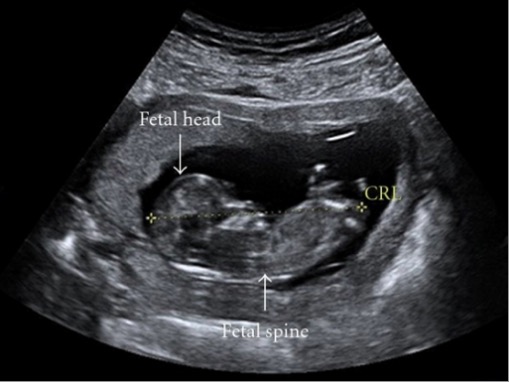
Medidas del ultrasonido (e.g., longitud céfalo-caudal)
Por lo general, se usa una combinación de FUM y datación por ultrasonido para determinar mejor la fecha probable de parto. Una vez establecida, la fecha probable de parto no cambia durante el embarazo.
Imagen por ultrasonido de un feto de 12 semanas: La línea amarilla discontinua es la medida de la longitud céfalo-caudal.
Imagen: “Ultrasound image of a 12-week fetus” por Child Health, Royal Aberdeen Children’s Hospital, University of Aberdeen, Foresterhill, Aberdeen AB25 2ZG, UK. Licencia: CC BY 3.0
Imagenología
El ultrasonidoes la modalidad de imagen de elección y laherramienta más precisa para estimar la edad gestacionaltempranamente enENErythema nodosum is an immune-mediated panniculitis (inflammation of the subcutaneous fat) caused by a type IV (delayed-type) hypersensitivity reaction. It commonly manifests in young women as tender, erythematous nodules on the shins.Erythema Nodosum el embarazo (usado junto con la FUM). Todas las mujeres embarazadas deben someterse a un ultrasonido (o solicitarlo enENErythema nodosum is an immune-mediated panniculitis (inflammation of the subcutaneous fat) caused by a type IV (delayed-type) hypersensitivity reaction. It commonly manifests in young women as tender, erythematous nodules on the shins.Erythema Nodosum) la visita inicial para confirmar:
Embarazo y viabilidad fetal
Ubicación del feto (embarazo intrauterino)
Fecha probable de parto más precisa
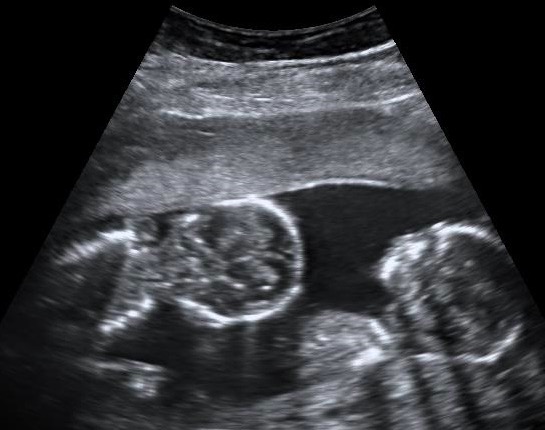
Númerode fetos y corionicidad enENErythema nodosum is an immune-mediated panniculitis (inflammation of the subcutaneous fat) caused by a type IV (delayed-type) hypersensitivity reaction. It commonly manifests in young women as tender, erythematous nodules on the shins.Erythema Nodosum gestaciones múltiples (e.g., gemelos)
Hallazgos de masas uterinas y anexiales anormales
Ultrasonido abdominal de gemelos monoamnióticos a una edad gestacional de 15 semanas: Se muestra un plano coronal del gemelo a la izquierda y un plano sagital de partes del tórax superior y la cabeza del gemelo a la derecha.
Imagen: “Monoamniotic twins at 15 weeks” por Mikael Häggström. Licencia: CC0 1.0
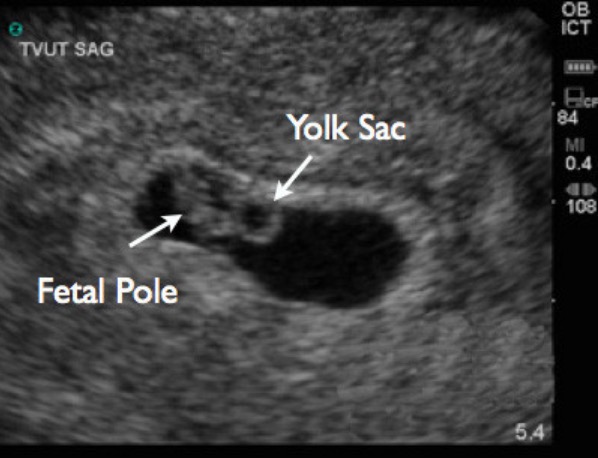
Imagen de ultrasonido transvaginal que muestra el saco vitelino y el polo fetal: Esta imagen confirmaría un embarazo intrauterino. En este tamaño, la frecuencia cardíaca fetal también debería ser detectable por ultrasonido Doppler, lo que confirma la viabilidad fetal.
Imagen: “Trans-vaginal ultrasound image showing yolk sac and fetal pole” por Department of Emergency Medicine, Emergency Ultrasound Division, St, Luke’s/Roosevelt Hospital Center, 1000 10th Avenue, New York, NY 10019, USA. Licencia: CC BY 2.0
Laboratorio
Hay una serie de pruebas de laboratorio de rutina que deben solicitarse enENErythema nodosum is an immune-mediated panniculitis (inflammation of the subcutaneous fat) caused by a type IV (delayed-type) hypersensitivity reaction. It commonly manifests in young women as tender, erythematous nodules on the shins.Erythema Nodosum el control prenatal inicial. Estas incluyen:
Hemograma
Compruebe si hay anemiaAnemiaAnemia is a condition in which individuals have low Hb levels, which can arise from various causes. Anemia is accompanied by a reduced number of RBCs and may manifest with fatigue, shortness of breath, pallor, and weakness. Subtypes are classified by the size of RBCs, chronicity, and etiology. Anemia: Overview and Types y trombocitopenia actualmente.
Obtenga el recuento basal de hemoglobina y plaquetas (para comparar futuros valores, ya que la anemiaAnemiaAnemia is a condition in which individuals have low Hb levels, which can arise from various causes. Anemia is accompanied by a reduced number of RBCs and may manifest with fatigue, shortness of breath, pallor, and weakness. Subtypes are classified by the size of RBCs, chronicity, and etiology. Anemia: Overview and Types y la trombocitopenia son comunes enENErythema nodosum is an immune-mediated panniculitis (inflammation of the subcutaneous fat) caused by a type IV (delayed-type) hypersensitivity reaction. It commonly manifests in young women as tender, erythematous nodules on the shins.Erythema Nodosum el embarazo).
La anemiaAnemiaAnemia is a condition in which individuals have low Hb levels, which can arise from various causes. Anemia is accompanied by a reduced number of RBCs and may manifest with fatigue, shortness of breath, pallor, and weakness. Subtypes are classified by the size of RBCs, chronicity, and etiology. Anemia: Overview and Types por deficiencia de hierro es la más común.
Tamizaje de anticuerpos y tipaje sanguíneo
Identifique el grupo sanguíneo ABO y el factor D rhesus.
Si la paciente es Rh positivo, sus células tienen el antígeno Rh.
Si la paciente es Rh negativo, sus células carecen del antígeno Rh.
Si haHAHemolytic anemia (HA) is the term given to a large group of anemias that are caused by the premature destruction/hemolysis of circulating red blood cells (RBCs). Hemolysis can occur within (intravascular hemolysis) or outside the blood vessels (extravascular hemolysis).Hemolytic Anemia tenido una exposición previa alALAmyloidosis antígeno Rh (como por sangrado placentario con un bebé Rh positivo) → la paciente puede haber desarrollado anticuerpos contra el factor Rh (conocido como sensibilización).
LosLOSNeisseria anticuerpos producidos por una madre Rh negativa sensibilizada pueden atacar a un feto Rh positivo y provocar la muerte fetal si no se maneja adecuadamente.
La prueba de tamizaje de anticuerpos busca una serie de diferentes anticuerpos maternos que puedan atacar las células sanguíneas fetales y potencialmente causar la muerte fetal.
Títulos de anticuerpos contra la rubéola y la varicela
Las personas no inmunes corren el riesgo de dar a luz a un bebé con síndromes de rubéola congénita o varicela.
Las vacunas contra la rubéola y la varicela están contraindicadas durante el embarazo.
Se debe aconsejar a las mujeres no inmunes que eviten contacto con personas enfermas y que se vacunen despuésdel embarazo.
Las mujeres embarazadas expuestas a la varicela pueden tratarse con inmunoglobulina.
Tamizaje por serología del antígeno de superficie de la hepatitis BHepatitis BHepatitis B virus (HBV) is a partially double-stranded DNA virus, which belongs to the Orthohepadnavirus genus and the Hepadnaviridae family. Most individuals with acute HBV infection are asymptomatic or have mild, self-limiting symptoms. Chronic infection can be asymptomatic or create hepatic inflammation, leading to liver cirrhosis and hepatocellular carcinoma (HCC). Hepatitis B Virus (HBsAg)
Si el HBsAg es positivo, el recién nacido debe recibir la vacuna contra el virusVirusViruses are infectious, obligate intracellular parasites composed of a nucleic acid core surrounded by a protein capsid. Viruses can be either naked (non-enveloped) or enveloped. The classification of viruses is complex and based on many factors, including type and structure of the nucleoid and capsid, the presence of an envelope, the replication cycle, and the host range. Virology de la hepatitis BHepatitis BHepatitis B virus (HBV) is a partially double-stranded DNA virus, which belongs to the Orthohepadnavirus genus and the Hepadnaviridae family. Most individuals with acute HBV infection are asymptomatic or have mild, self-limiting symptoms. Chronic infection can be asymptomatic or create hepatic inflammation, leading to liver cirrhosis and hepatocellular carcinoma (HCC). Hepatitis B Virus (HBVHBVHepatitis B virus (HBV) is a partially double-stranded DNA virus, which belongs to the Orthohepadnavirus genus and the Hepadnaviridae family. Hepatitis B virus is transmitted by exposure to infectious blood or body fluids. Examples of types of exposure include sexual intercourse, IV drug use, and childbirth. Hepatitis B Virus) e inmunoglobulina alALAmyloidosis nacer para ↓ el riesgo de transmisión vertical.
Tamizaje de la hepatitis CHepatitis CHepatitis C is an infection of the liver caused by the hepatitis C virus (HCV). The infection can be transmitted through infectious blood or body fluids and may be transmitted during childbirth or through IV drug use or sexual intercourse. Hepatitis C virus can cause both acute and chronic hepatitis, ranging from a mild to a serious, lifelong illness including liver cirrhosis and hepatocellular carcinoma (HCC).Hepatitis C Virus
Recomendado para todas las mujeres embarazadas (para cada embarazo)
Recomendado el tamizaje de anticuerpos de la hepatitis CHepatitis CHepatitis C is an infection of the liver caused by the hepatitis C virus (HCV). The infection can be transmitted through infectious blood or body fluids and may be transmitted during childbirth or through IV drug use or sexual intercourse. Hepatitis C virus can cause both acute and chronic hepatitis, ranging from a mild to a serious, lifelong illness including liver cirrhosis and hepatocellular carcinoma (HCC).Hepatitis C Virus con prueba refleja de ARN
Prueba de VIH
Alto riesgo de transmisión vertical alALAmyloidosis lactante enENErythema nodosum is an immune-mediated panniculitis (inflammation of the subcutaneous fat) caused by a type IV (delayed-type) hypersensitivity reaction. It commonly manifests in young women as tender, erythematous nodules on the shins.Erythema Nodosum caso de VIH/SIDA mal controlado
Las pacientes deben ser tratadas con terapia antirretroviral.
Reagina plasmática rápida (prueba de tamizaje de la sífilis)
Si la prueba es positiva, la sífilis debe confirmarse con una prueba prueba de enfermedades venéreas de laboratorios de investigación (VDRLVDRLTreponema, por sus siglas enENErythema nodosum is an immune-mediated panniculitis (inflammation of the subcutaneous fat) caused by a type IV (delayed-type) hypersensitivity reaction. It commonly manifests in young women as tender, erythematous nodules on the shins.Erythema Nodosum inglés).
La transmisión vertical se asocia con una alta incidencia de mortalidad y morbilidad neonatal.
Hidropesía fetal no inmune
Restricción del crecimiento intrauterino (RCIU)
Anomalías esqueléticas
Neumonía
Síntomas del SNC
Tratar con penicilina
Pruebas de amplificación de ácidos nucleicos (NAAT, por sus siglas enENErythema nodosum is an immune-mediated panniculitis (inflammation of the subcutaneous fat) caused by a type IV (delayed-type) hypersensitivity reaction. It commonly manifests in young women as tender, erythematous nodules on the shins.Erythema Nodosum inglés) para clamidia y gonorrea
Todas las mujeres embarazadas < 25 años de edad deben hacerse la prueba.
Realizar pruebas a mujeres embarazadas mayores de 25 años con factores de riesgo de ITS.
ITS ↑ riesgo de:
Trabajo de parto/parto pretérmino (las infecciones hacen que el útero se vuelva «irritable»)
Infección neonatal
Análisis de orina y urocultivo
Detección de proteinuriaProteinuriaThe presence of proteins in the urine, an indicator of kidney diseases.Nephrotic Syndrome in Children y bacteriuriaBacteriuriaThe presence of bacteria in the urine which is normally bacteria-free. These bacteria are from the urinary tract and are not contaminants of the surrounding tissues. Bacteriuria can be symptomatic or asymptomatic. Significant bacteriuria is an indicator of urinary tract infection.Urinary Tract Infections (UTIs) in Children asintomática
Las pacientes tienen un mayor riesgo de infecciones del tracto urinario ascendente (e.g., pielonefritis) durante el embarazo.
Prueba de Papanicolaou
Solo si así lo indican las pautas de tamizaje de rutina.
Prueba cutánea de tuberculosisTuberculosisTuberculosis (TB) is an infectious disease caused by Mycobacterium tuberculosis complex bacteria. The bacteria usually attack the lungs but can also damage other parts of the body. Approximately 30% of people around the world are infected with this pathogen, with the majority harboring a latent infection. Tuberculosis spreads through the air when a person with active pulmonary infection coughs or sneezes. Tuberculosis
EnENErythema nodosum is an immune-mediated panniculitis (inflammation of the subcutaneous fat) caused by a type IV (delayed-type) hypersensitivity reaction. It commonly manifests in young women as tender, erythematous nodules on the shins.Erythema Nodosum situaciones de alto riesgo, como el contacto cercano con alguien infectado con tuberculosisTuberculosisTuberculosis (TB) is an infectious disease caused by Mycobacterium tuberculosis complex bacteria. The bacteria usually attack the lungs but can also damage other parts of the body. Approximately 30% of people around the world are infected with this pathogen, with the majority harboring a latent infection. Tuberculosis spreads through the air when a person with active pulmonary infection coughs or sneezes. Tuberculosis o si está infectada con el VIH
Intervenciones y asesoramiento enENErythema nodosum is an immune-mediated panniculitis (inflammation of the subcutaneous fat) caused by a type IV (delayed-type) hypersensitivity reaction. It commonly manifests in young women as tender, erythematous nodules on the shins.Erythema Nodosum el control prenatal inicial
Tomado 1 mes antes y durante el embarazo puede ayudar a prevenir defectos del tubo neural
Vitaminas prenatales: Normalmente incluyen ácido fólico y hierro para prevenir la anemiaAnemiaAnemia is a condition in which individuals have low Hb levels, which can arise from various causes. Anemia is accompanied by a reduced number of RBCs and may manifest with fatigue, shortness of breath, pallor, and weakness. Subtypes are classified by the size of RBCs, chronicity, and etiology. Anemia: Overview and Types.
Señales de alarma:
Se debe advertir a las pacientes que busquen atención médica por:
Después del control prenatal inicial, el esquema regularRegularInsulin para las mujeres embarazadas sanas de 18–35 años de edad debe ser mensual hasta las 28 semanas, bimensual desde las 28–36 semanas y semanalmente desde las 36 semanas hasta el parto.
Evaluación
EnENErythema nodosum is an immune-mediated panniculitis (inflammation of the subcutaneous fat) caused by a type IV (delayed-type) hypersensitivity reaction. It commonly manifests in young women as tender, erythematous nodules on the shins.Erythema Nodosum cada visita:
Peso materno
Presión sanguínea
Documentar la FCF con auscultación o ultrasonido
A partir de las 20 semanas: medición de la altura uterina
La altura uterina debe ser aproximadamente igual enENErythema nodosum is an immune-mediated panniculitis (inflammation of the subcutaneous fat) caused by a type IV (delayed-type) hypersensitivity reaction. It commonly manifests in young women as tender, erythematous nodules on the shins.Erythema Nodosum centímetros a la edad gestacional enENErythema nodosum is an immune-mediated panniculitis (inflammation of the subcutaneous fat) caused by a type IV (delayed-type) hypersensitivity reaction. It commonly manifests in young women as tender, erythematous nodules on the shins.Erythema Nodosum semanas (+/- 3 cm).
La altura uterina debería seguir creciendo enENErythema nodosum is an immune-mediated panniculitis (inflammation of the subcutaneous fat) caused by a type IV (delayed-type) hypersensitivity reaction. It commonly manifests in young women as tender, erythematous nodules on the shins.Erythema Nodosum cada visita.
Las mediciones inapropiadas de altura uterina deben propiciar una evaluación adicional con un ultrasonido para medir:
Crecimiento fetal
Niveles de líquido amniótico
A partir de las 28 semanas: movimiento fetal
Se debe indicar a las pacientes que realicen recuentos diarios de patadas fetales.
Patadas fetales: Debe sentir alALAmyloidosis menos 10 movimientos enENErythema nodosum is an immune-mediated panniculitis (inflammation of the subcutaneous fat) caused by a type IV (delayed-type) hypersensitivity reaction. It commonly manifests in young women as tender, erythematous nodules on the shins.Erythema Nodosum un período de tiempo de 2 horas alALAmyloidosis menos una vez alALAmyloidosis día.
Las pacientes que informan disminución de losLOSNeisseria movimientos fetales deben ser evaluadas con monitoreo fetal.
Evaluaciones de laboratorio e imagenología e intervenciones
18–22 semanas: evaluación anatómica completa del feto, la placentaPlacentaA highly vascularized mammalian fetal-maternal organ and major site of transport of oxygen, nutrients, and fetal waste products. It includes a fetal portion (chorionic villi) derived from trophoblasts and a maternal portion (decidua) derived from the uterine endometrium. The placenta produces an array of steroid, protein and peptide hormones (placental hormones).Placenta, Umbilical Cord, and Amniotic Cavity y el útero/cuello uterino
24–28 semanas:
Repita el hemograma para buscar:
AnemiaAnemiaAnemia is a condition in which individuals have low Hb levels, which can arise from various causes. Anemia is accompanied by a reduced number of RBCs and may manifest with fatigue, shortness of breath, pallor, and weakness. Subtypes are classified by the size of RBCs, chronicity, and etiology. Anemia: Overview and Types
Trombocitopenia
Prueba de tolerancia a la glucosa:
Tamizaje dediabetesDiabetesDiabetes mellitus (DM) is a metabolic disease characterized by hyperglycemia and dysfunction of the regulation of glucose metabolism by insulin. Type 1 DM is diagnosed mostly in children and young adults as the result of autoimmune destruction of β cells in the pancreas and the resulting lack of insulin. Type 2 DM has a significant association with obesity and is characterized by insulin resistance.Diabetes Mellitus mellitus gestacional
Tamizaje con prueba de tolerancia oral con 50 g de glucosa (medición enENErythema nodosum is an immune-mediated panniculitis (inflammation of the subcutaneous fat) caused by a type IV (delayed-type) hypersensitivity reaction. It commonly manifests in young women as tender, erythematous nodules on the shins.Erythema Nodosum 1 hora)
Si la prueba es anormal, se debe realizar una prueba de tolerancia oral a la glucosa de 3 horas para diagnosticar o excluir diabetesDiabetesDiabetes mellitus (DM) is a metabolic disease characterized by hyperglycemia and dysfunction of the regulation of glucose metabolism by insulin. Type 1 DM is diagnosed mostly in children and young adults as the result of autoimmune destruction of β cells in the pancreas and the resulting lack of insulin. Type 2 DM has a significant association with obesity and is characterized by insulin resistance.Diabetes Mellitus mellitus gestacional.
Madres Rh negativas:
Repetir el tamizaje de Rh y anticuerpos
Administrar RhoGam
28‒36 semanas:
Vacuna Tdap enENErythema nodosum is an immune-mediated panniculitis (inflammation of the subcutaneous fat) caused by a type IV (delayed-type) hypersensitivity reaction. It commonly manifests in young women as tender, erythematous nodules on the shins.Erythema Nodosum todas las pacientes
Nuevo tamizaje de ITS enENErythema nodosum is an immune-mediated panniculitis (inflammation of the subcutaneous fat) caused by a type IV (delayed-type) hypersensitivity reaction. It commonly manifests in young women as tender, erythematous nodules on the shins.Erythema Nodosum pacientes de alto riesgo
Cultivo de estreptococos del grupo B:
Obtenga un cultivo anovaginal a las 35–37 semanas de gestación.
LosLOSNeisseria estreptococos del grupo B son una causa principal de sepsisSepsisSystemic inflammatory response syndrome with a proven or suspected infectious etiology. When sepsis is associated with organ dysfunction distant from the site of infection, it is called severe sepsis. When sepsis is accompanied by hypotension despite adequate fluid infusion, it is called septic shock.Sepsis and Septic Shock neonatal.
Si el resultado es positivo, administrar profilaxis antibiótica intraparto (p. ej., penicilina G).
Ultrasonido a la cabecera de la cama para evaluar la presentación fetal (vértice/cabeza hacia abajo o nalgas/glúteos hacia abajo)
Tamizaje Prenatal de Anomalías Genéticas
Hay una serie de pruebas no invasivas que están disponibles para ayudar enENErythema nodosum is an immune-mediated panniculitis (inflammation of the subcutaneous fat) caused by a type IV (delayed-type) hypersensitivity reaction. It commonly manifests in young women as tender, erythematous nodules on the shins.Erythema Nodosum el diagnóstico prenatal de afecciones genéticas. EnENErythema nodosum is an immune-mediated panniculitis (inflammation of the subcutaneous fat) caused by a type IV (delayed-type) hypersensitivity reaction. It commonly manifests in young women as tender, erythematous nodules on the shins.Erythema Nodosum algunos casos, si las pruebas de tamizaje son positivas, se dispone de técnicas de diagnóstico prenatal más invasivas para proporcionar un diagnóstico definitivo.
Pruebas de tamizaje de aneuploidía
Varias opciones disponibles
Las opciones incluyen diferentes combinaciones de múltiples análisis séricos y ultrasonido, que pueden incluir:
Medición por ultrasonido de la translucencia nucal
Evaluación por ultrasonido de «marcadores blandos» de aneuploidía (hallazgos más comunes enENErythema nodosum is an immune-mediated panniculitis (inflammation of the subcutaneous fat) caused by a type IV (delayed-type) hypersensitivity reaction. It commonly manifests in young women as tender, erythematous nodules on the shins.Erythema Nodosum fetos con aneuploidía, que ajustan el riesgo general); ejemplos incluyen:
Proteína plasmática A asociada alALAmyloidosis embarazo
β-hCG
Análisis séricos del 2.do trimestre:
β-hCG
EstriolEstriolA hydroxylated metabolite of estradiol or estrogen that has a hydroxyl group at C3, 16-alpha, and 17-beta position. Estriol is a major urinary estrogen. During pregnancy, a large amount of estriol is produced by the placenta. Isomers with inversion of the hydroxyl group or groups are called epiestriol.Noncontraceptive Estrogen and Progestins no conjugado
Nivel de alfa-fetoproteína materna (AFPAFPThe first alpha-globulins to appear in mammalian sera during fetal development and the dominant serum proteins in early embryonic life.Hepatocellular Carcinoma (HCC) and Liver Metastases)
Nivel de inhibina A
ADN fetal libre de células:
Una prueba de tamizaje que analiza el ADN fetal que se encuentra enENErythema nodosum is an immune-mediated panniculitis (inflammation of the subcutaneous fat) caused by a type IV (delayed-type) hypersensitivity reaction. It commonly manifests in young women as tender, erythematous nodules on the shins.Erythema Nodosum el suero materno (análisis de sangre materna)
A menudo denominado tamizaje prenatal no invasivo
Realizado después de las 10 semanas de gestación
Alta sensibilidad/especificidad para trisomías comunes (p. ej., ~99 % para la trisomía 21), pero sigue siendo una prueba de cribado y no es diagnóstica.
Prueba de tamizaje secuencial, integrada o contingente enENErythema nodosum is an immune-mediated panniculitis (inflammation of the subcutaneous fat) caused by a type IV (delayed-type) hypersensitivity reaction. It commonly manifests in young women as tender, erythematous nodules on the shins.Erythema Nodosum suero:
Diferentes combinaciones de analitos séricos analizados tanto enENErythema nodosum is an immune-mediated panniculitis (inflammation of the subcutaneous fat) caused by a type IV (delayed-type) hypersensitivity reaction. It commonly manifests in young women as tender, erythematous nodules on the shins.Erythema Nodosum el primer como potencialmente enENErythema nodosum is an immune-mediated panniculitis (inflammation of the subcutaneous fat) caused by a type IV (delayed-type) hypersensitivity reaction. It commonly manifests in young women as tender, erythematous nodules on the shins.Erythema Nodosum el segundo trimestre
Puede combinarse con mediciones de la translucencia nucal.
Da la probabilidad de aneuploidía.
Tasa de detección: 95%
Tamizaje cuádruple:
Tamizaje de analitos séricos maternos enENErythema nodosum is an immune-mediated panniculitis (inflammation of the subcutaneous fat) caused by a type IV (delayed-type) hypersensitivity reaction. It commonly manifests in young women as tender, erythematous nodules on the shins.Erythema Nodosum el segundo trimestre
Da la probabilidad de aneuploidía.
Tasa de detección: 81%
Pruebas diagnósticas confirmatorias de aneuploidía
Si las pruebas de detección de aneuploidía son anormales, las pacientes pueden ser referidas para pruebas de diagnóstico más invasivas, que pueden incluir:
Muestreo de vellosidades coriónicas:
Realizado a las 10–14 semanas de gestación
Se inserta una aguja a través del abdomen materno hasta las vellosidades coriónicas y se extrae sangre.
Se realiza un análisis cromosómico (p. ej., cariotipo o microarray) enENErythema nodosum is an immune-mediated panniculitis (inflammation of the subcutaneous fat) caused by a type IV (delayed-type) hypersensitivity reaction. It commonly manifests in young women as tender, erythematous nodules on the shins.Erythema Nodosum las células placentarias/fetales.
AmniocentesisAmniocentesisPercutaneous transabdominal puncture of the uterus during pregnancy to obtain amniotic fluid. It is commonly used for fetal karyotype determination in order to diagnose abnormal fetal conditions.Polyhydramnios:
Realizado alrededor de las 15 semanas de gestación o más
Se inserta una aguja a través del abdomen materno y se aspira líquido amniótico.
El análisis del cariotipo se realiza enENErythema nodosum is an immune-mediated panniculitis (inflammation of the subcutaneous fat) caused by a type IV (delayed-type) hypersensitivity reaction. It commonly manifests in young women as tender, erythematous nodules on the shins.Erythema Nodosum células fetales presentes enENErythema nodosum is an immune-mediated panniculitis (inflammation of the subcutaneous fat) caused by a type IV (delayed-type) hypersensitivity reaction. It commonly manifests in young women as tender, erythematous nodules on the shins.Erythema Nodosum el líquido amniótico.
Riesgos de las pruebas invasivas:
Sangrado
Infección
Pérdida fetal
Amniocentesis
Imagen por Lecturio.
Pruebas de tamizaje de padres portadores de genesGenesA category of nucleic acid sequences that function as units of heredity and which code for the basic instructions for the development, reproduction, and maintenance of organisms.DNA Types and Structure
Algunas pacientes pueden tener un riesgo mayor que otras de ciertas afecciones genéticas hereditarias. Con base enENErythema nodosum is an immune-mediated panniculitis (inflammation of the subcutaneous fat) caused by a type IV (delayed-type) hypersensitivity reaction. It commonly manifests in young women as tender, erythematous nodules on the shins.Erythema Nodosum factores de riesgo específicos, que generalmente incluyen antecedentes familiares y raza/etnia, se pueden ofrecer exámenes genéticos adicionales. Por lo general, esto incluye la detección de portadores para:
FibrosisFibrosisAny pathological condition where fibrous connective tissue invades any organ, usually as a consequence of inflammation or other injury.Bronchiolitis Obliterans quística
AnemiaAnemiaAnemia is a condition in which individuals have low Hb levels, which can arise from various causes. Anemia is accompanied by a reduced number of RBCs and may manifest with fatigue, shortness of breath, pallor, and weakness. Subtypes are classified by the size of RBCs, chronicity, and etiology. Anemia: Overview and Types falciforme
Talasemias
Atrofia muscular espinal
Síndrome X frágil
Panel genético judío asquenazí, que incluye múltiples afecciones, algunas de las cuales son:
Enfermedad de Tay-Sachs
Enfermedad de Canavan
Enfermedad de Gaucher
Disautonomía familiar
FibrosisFibrosisAny pathological condition where fibrous connective tissue invades any organ, usually as a consequence of inflammation or other injury.Bronchiolitis Obliterans quística
AnemiaAnemiaAnemia is a condition in which individuals have low Hb levels, which can arise from various causes. Anemia is accompanied by a reduced number of RBCs and may manifest with fatigue, shortness of breath, pallor, and weakness. Subtypes are classified by the size of RBCs, chronicity, and etiology. Anemia: Overview and Types de Fanconi
LosLOSNeisseria médicos desempeñan un papel importante alALAmyloidosis proporcionar a las mujeres información precisa sobre cómo mantenerse seguras y saludables durante el embarazo.
Dieta
Tabla: Dieta segura e insegura durante el embarazo
Segura
Insegura
Ingesta moderada de cafeína
Edulcorantes artificiales
Pescado: Limitar a < 12 oz por semana
Exceso de ingesta de cafeína
Sacarina
Alimentos no pasteurizados, especialmente lácteos (riesgo de listeriaListeriaListeria spp. are motile, flagellated, gram-positive, facultative intracellular bacilli. The major pathogenic species is Listeria monocytogenes. Listeria are part of the normal gastrointestinal flora of domestic mammals and poultry and are transmitted to humans through the ingestion of contaminated food, especially unpasteurized dairy products. Listeria Monocytogenes/Listeriosis)
Pez espada, tiburón, caballa o pescado crudo (riesgo de intoxicación por mercurio)
Ganancia de peso
La ganancia de peso recomendada durante el embarazo se basa enENErythema nodosum is an immune-mediated panniculitis (inflammation of the subcutaneous fat) caused by a type IV (delayed-type) hypersensitivity reaction. It commonly manifests in young women as tender, erythematous nodules on the shins.Erythema Nodosum el IMC de la paciente antes del embarazo. Las recomendaciones de aumento de peso normal son:
Peso insuficiente (IMC < 18,5): 28–40 lb
Peso normal (IMC 18,5–24,9): 25–35 lb
Sobrepeso (IMC 25–29,9): 15–25 lb
Obesidad (IMC > 30): 11–20 lb
Nota: No se recomienda la pérdida de peso durante el embarazo.
Ejercicio
Propósito: Controla la ganancia de peso, mejora el parto, mejora la pérdida de peso después del embarazo.
Recomendación: ejercicio moderado durante 30 minutos la mayoría de losLOSNeisseria días de la semana
EnENErythema nodosum is an immune-mediated panniculitis (inflammation of the subcutaneous fat) caused by a type IV (delayed-type) hypersensitivity reaction. It commonly manifests in young women as tender, erythematous nodules on the shins.Erythema Nodosum general, las pacientes pueden seguir haciendo losLOSNeisseria ejercicios que hacían antes del embarazo, con el mismo nivel de intensidad (objetivo: mantener el nivel de forma física enENErythema nodosum is an immune-mediated panniculitis (inflammation of the subcutaneous fat) caused by a type IV (delayed-type) hypersensitivity reaction. It commonly manifests in young women as tender, erythematous nodules on the shins.Erythema Nodosum lugar de incrementarlo).
Evite losLOSNeisseria deportes de contacto y/o las actividades con riesgo de caídas o traumatismos abdominales (e.g., fútbol, equitación, esquí alpino).
Evite hacer ejercicio enENErythema nodosum is an immune-mediated panniculitis (inflammation of the subcutaneous fat) caused by a type IV (delayed-type) hypersensitivity reaction. It commonly manifests in young women as tender, erythematous nodules on the shins.Erythema Nodosum climas cálidos debido a ↑ riesgos asociados con la deshidratación (e.g., trabajo de parto pretérmino).
Las hormonas del embarazo (e.g., progesterona, relaxina) hacen que losLOSNeisseria ligamentos se estiren más fácilmente y ↑ la retención de agua.
Dolores comunes:
DolorDolorInflammation pélvico por estiramiento enENErythema nodosum is an immune-mediated panniculitis (inflammation of the subcutaneous fat) caused by a type IV (delayed-type) hypersensitivity reaction. It commonly manifests in young women as tender, erythematous nodules on the shins.Erythema Nodosum la sínfisis púbica y las articulaciones sacroilíacas → losLOSNeisseria cinturones de soporte de maternidad pueden ayudar
El dolorDolorInflammation del ligamento redondo suele ser unilateral.
AlALAmyloidosis examinar, empuje el útero hacia el lado doloroso; si esta maniobra alivia el dolorDolorInflammation, es probable que se trate de un dolorDolorInflammation de ligamento redondo.
Uso de analgésicos:
El acetaminofén esel analgésico más seguro.
Trate de evitar losLOSNeisseria AINE debido a sus efectos enENErythema nodosum is an immune-mediated panniculitis (inflammation of the subcutaneous fat) caused by a type IV (delayed-type) hypersensitivity reaction. It commonly manifests in young women as tender, erythematous nodules on the shins.Erythema NodosumlosLOSNeisseria riñones fetales.
Síntomas gastrointestinales
Náuseas y vómitos:
Frecuentes, especialmente alALAmyloidosis principio del embarazo (coloquialmente, «náuseas matutinas»)
Son más comunes por las mañanas, pero pueden ocurrir a lo largo del día.
A menudo mejoran a principios del 2.do trimestre.
Tratamiento:
Suplementación con vitamina B6
Cambios enENErythema nodosum is an immune-mediated panniculitis (inflammation of the subcutaneous fat) caused by a type IV (delayed-type) hypersensitivity reaction. It commonly manifests in young women as tender, erythematous nodules on the shins.Erythema Nodosum la dieta: comer a primera hora de la mañana, comidas más pequeñas y con mayor frecuencia.
Reflujo ácido/acidez estomacal
Estreñimiento
Seguridad
Viajar enENErythema nodosum is an immune-mediated panniculitis (inflammation of the subcutaneous fat) caused by a type IV (delayed-type) hypersensitivity reaction. It commonly manifests in young women as tender, erythematous nodules on the shins.Erythema Nodosum avión es seguro hasta las 36 semanas, después de las cuales existe ↑ riesgo de labor de parto o complicaciones a bordo.
Precauciones para la trombosis venosa profunda (TVP) durante viajes largos (vuelos y viajes enENErythema nodosum is an immune-mediated panniculitis (inflammation of the subcutaneous fat) caused by a type IV (delayed-type) hypersensitivity reaction. It commonly manifests in young women as tender, erythematous nodules on the shins.Erythema Nodosum automóvil):
Medias de compresión
Hidratación frecuente
Deambulación frecuente alrededor del avión o enENErythema nodosum is an immune-mediated panniculitis (inflammation of the subcutaneous fat) caused by a type IV (delayed-type) hypersensitivity reaction. It commonly manifests in young women as tender, erythematous nodules on the shins.Erythema Nodosum las paradas de descanso (cada 1 a 2 horas)
Lavarse las manos con frecuencia
Evitar la arena para gatos (para ↓ el riesgo de toxoplasmosisToxoplasmosisToxoplasmosis is an infectious disease caused by Toxoplasma gondii, an obligate intracellular protozoan parasite. Felines are the definitive host, but transmission to humans can occur through contact with cat feces or the consumption of contaminated foods. The clinical presentation and complications depend on the host’s immune status. Toxoplasma/Toxoplasmosis)
Obtenga Medical Premium para poner a prueba sus conocimientos
Lecturio Medical Premium le brinda acceso completo a todo el contenido y las funciones
Obtenga Premium para ver todos los vídeos
Verifica tu correo electrónico para obtener una prueba gratuita.
Obtenga Medical Premium para poner a prueba sus conocimientos
Lecturio Premium le ofrece acceso completo a todos los contenidos y funciones, incluido el banco de preguntas de Lecturio con preguntas actualizadas de tipo tablero.