


Penicilinas

Os antibióticos beta-lactâmicos contêm um anel beta-lactâmico como parte da sua estrutura química. Os fármacos desta classe incluem penicilina G e V, penicilinas sensíveis à penicilinase e resistentes à penicilinase, cefalosporinas, carbapenemes e aztreonam Aztreonam The carbapenems and aztreonam are both members of the bactericidal beta-lactam family of antibiotics (similar to penicillins). They work by preventing bacteria from producing their cell wall, ultimately leading to bacterial cell death. Carbapenems and Aztreonam. Os antibióticos beta-lactâmicos bloqueiam a transpeptidase bacteriana (proteína de ligação à penicilina) e, portanto, inativam a reticulação de peptidoglicanos na parede celular. Todos os antibióticos beta-lactâmicos são bactericidas. Os mecanismos comuns de resistência incluem a produção de beta-lactamase Beta-Lactamase Penicillins ou mutação no gene Gene A category of nucleic acid sequences that function as units of heredity and which code for the basic instructions for the development, reproduction, and maintenance of organisms. Basic Terms of Genetics da proteína de ligação à penicilina. Os efeitos adversos mais MAIS Androgen Insensitivity Syndrome frequentes incluem reações de hipersensibilidade, distúrbios gastrointestinais e anemia Anemia Anemia is a condition in which individuals have low Hb levels, which can arise from various causes. Anemia is accompanied by a reduced number of RBCs and may manifest with fatigue, shortness of breath, pallor, and weakness. Subtypes are classified by the size of RBCs, chronicity, and etiology. Anemia: Overview and Types hemolítica.

Last updated: Dec 15, 2025

Editorial responsibility: Stanley Oiseth, Lindsay Jones, Evelin Maza

Química

As penicilinas são membros da família de fármacos beta-lactâmicos e consistem em:
  • Um anel beta-lactâmico: um anel tetratómico contendo 2 carbonos (carbonos α e β), um nitrogénio e um grupo carbonil (um carbono com ligação dupla ao oxigénio)
    • O grupo beta-lactâmicono composto é responsável pela atividade antibacteriana.
    • Pode ser hidrolisado (ou seja, dividido) por beta-lactamases, que são produzidas por certas bactérias resistentes
    • Se o anel beta-lactâmicofor quebrado, o fármaco perde as suas propriedades antibacterianas.
    • Todos os beta-lactâmicos contêm um anel beta-lactâmico.
  • Anel de tiazolidina: um anel pentatómico que contém enxofre e nitrogénio
  • Cadeia lateral:
    • Ligada ao carbono α no anel beta-lactâmico
    • Diferencia as penicilinas umas das outras
    • Responsável pela farmacocinética e pelos espectros de atividade exclusivos
    • Certas estruturas podem inibir estericamente a hidrólise do anel beta-lactâmicopor beta-lactamases.
    • Certos compostos podem ser mais MAIS Androgen Insensitivity Syndrome facilmente absorvidos por bactérias gram-negativas do que outros.
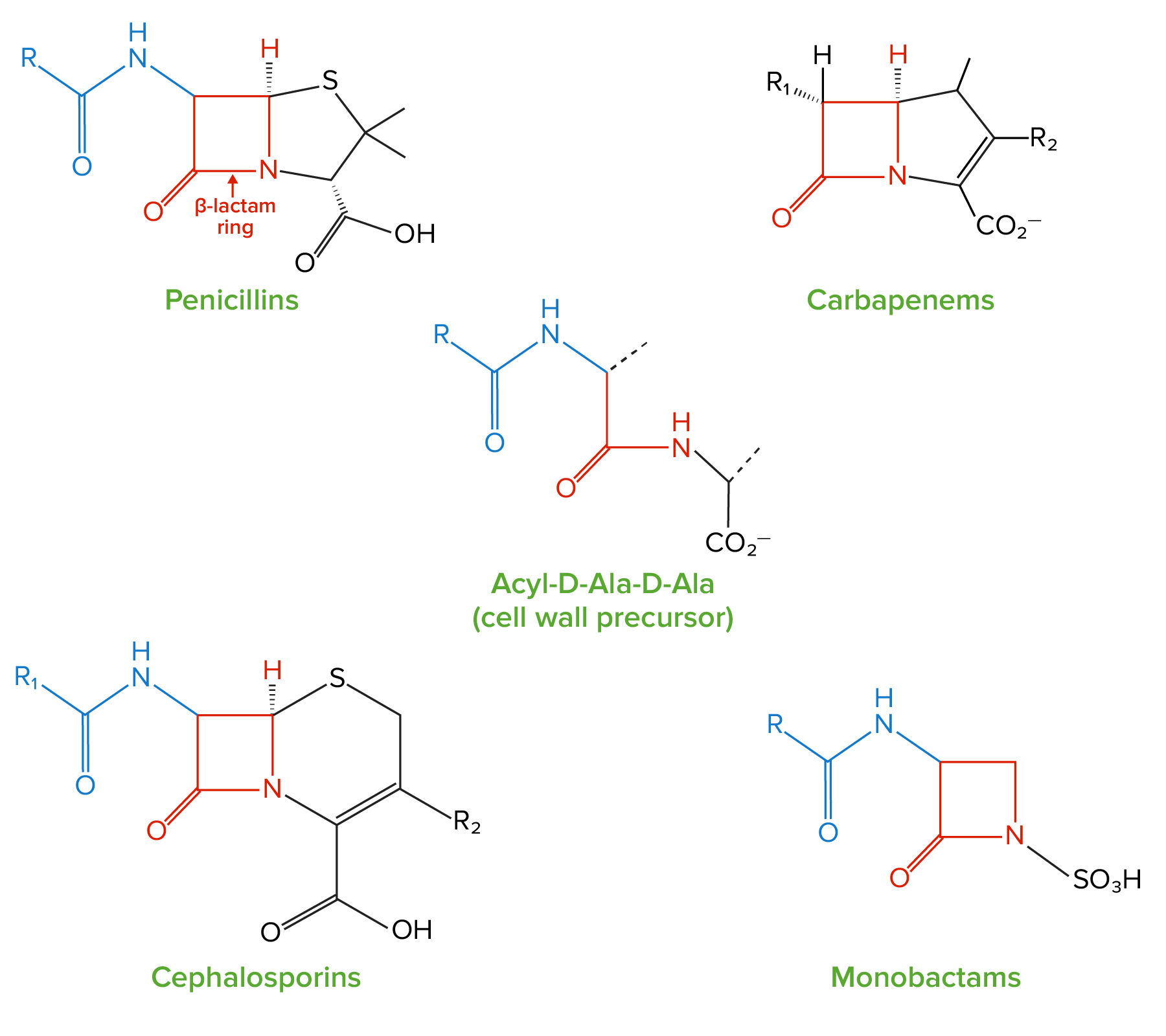
Estrutura dos beta-lactâmicos

Estrutura dos beta-lactâmicos:
Todos os antibióticos beta-lactâmicos contêm o mesmo anel “beta-lactâmico” central de 4 lados (destacado em vermelho). Este anel é responsável pelas propriedades antibacterianas do fármaco porque é a região que se liga e inibe as proteínas de ligação à penicilina (PBPs, do inglês Penicillin-Binding Proteins). As PBPs catalisam a formação da parede celular gerando ligações cruzadas entre as cadeias peptídicas nas moléculas de peptidoglicano; as PBPs formam estas ligações cruzadas entre os péptidos acil-D-Ala-D-Ala, que têm uma estrutura semelhante ao anel beta-lactâmico.
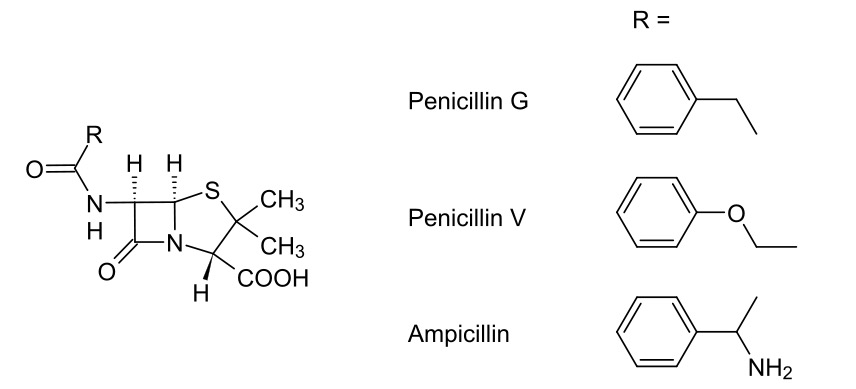
Imagem por Lecturio. Licença: CC BY-NC-SA 4.0
Estrutura química da penicilina

Penicilinas

Imagem: “Strukturen verschiedener Penicillinen” por Roland Mattern. Licença: Public Domain

Mecanismo de Ação e Resistência

Todos os beta-lactâmicos, incluindo as penicilinas, exercem os seus efeitos inibindo a síntese da parede celular bacteriana.
Contexto: compreensão das paredes celulares

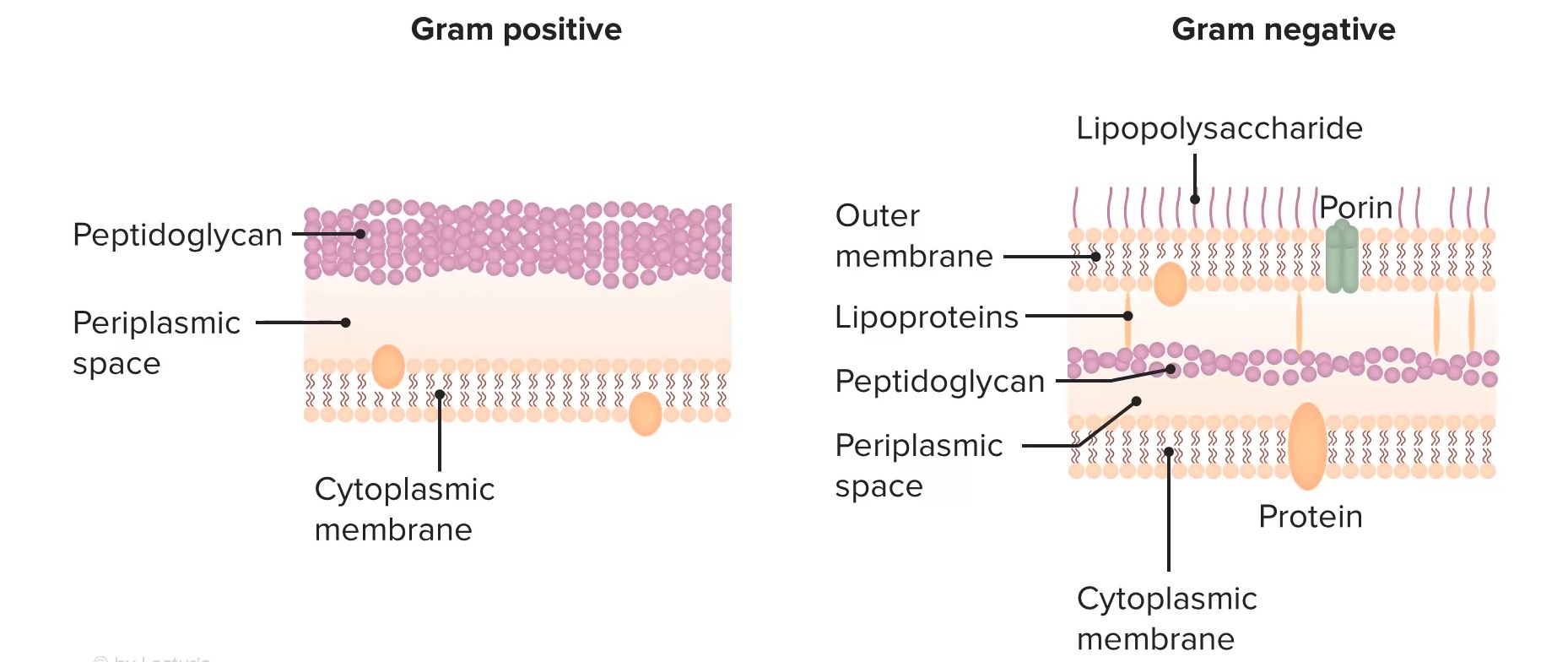
  • As paredes das células bacterianas contêm cadeias de peptidoglicanos (camadas grandes e grossas em organismos gram-positivos e camadas relativamente menores/ mais MAIS Androgen Insensitivity Syndrome finas em organismos gram-negativos).
  • As cadeias de peptidoglicanos são compostas por:
    • Uma cadeia central de açúcar com 2 açúcares alternados:
      • Ácido N-acetilmurâmico (NAM)
      • Ácido N-acetilglucosamina (NAG)
    • Cadeias laterais curtas de péptidos que se ramificam a partir dos açúcares NAM
  • Os oligopéptidos formam pontes reticuladas entre cadeias de peptidoglicanos adjacentes e criam uma estrutura em rede de pesca:
    • As pontes reticuladas são necessárias para a estrutura do peptidoglicano (e, portanto, da parede celular).
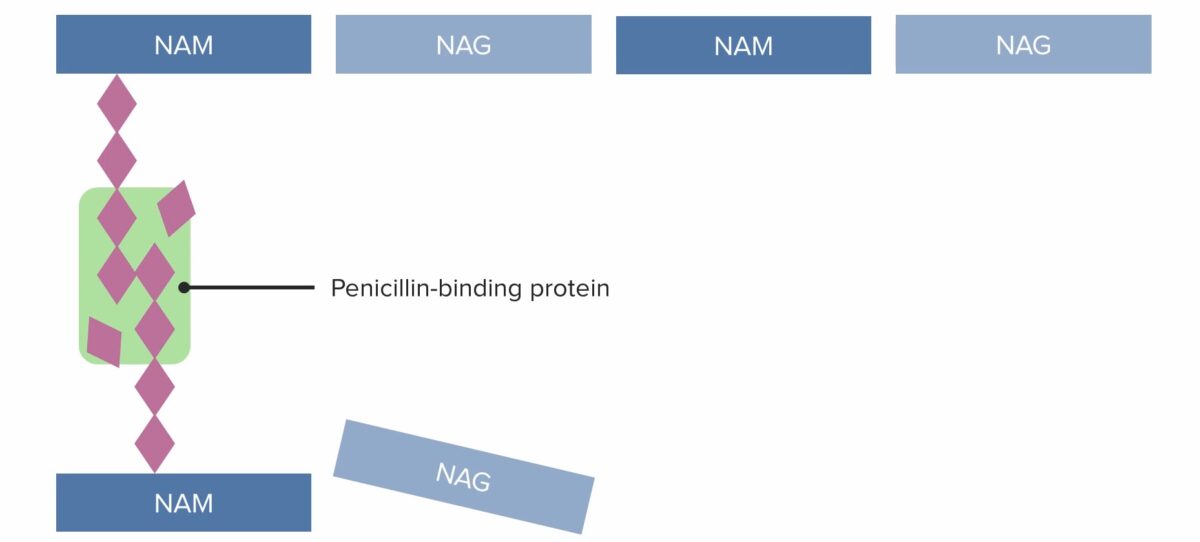
    • As proteínas de ligação à penicilina ( PBPs PBPs Bacterial proteins that share the property of binding irreversibly to penicillins and other antibacterial agents derived from lactams. The penicillin-binding proteins are primarily enzymes involved in cell wall biosynthesis including muramoylpentapeptide carboxypeptidase; peptide synthases; transpeptidases; and hexosyltransferases. Penicillins) são enzimas que criam essas pontes reticuladas.
Estrutura das paredes celulares bacterianas

Estrutura das paredes celulares bacterianas

Imagem por Lecturio. Licença: CC BY-NC-SA 4.0

Mecanismo de ação

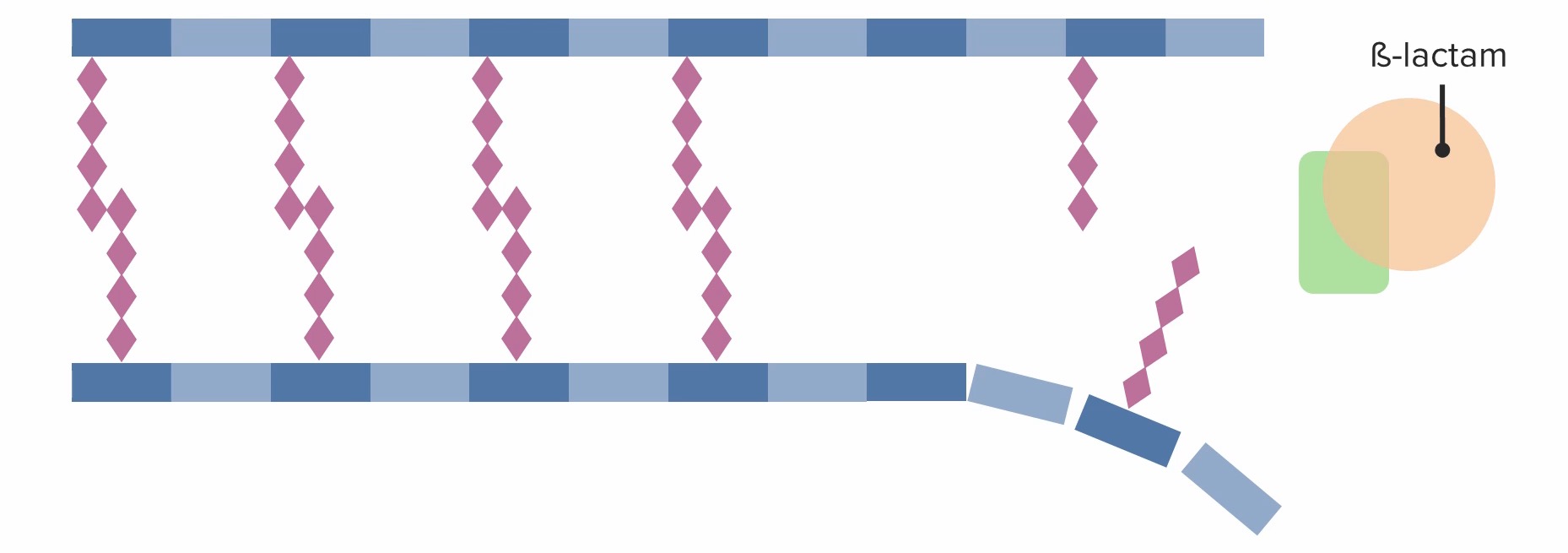
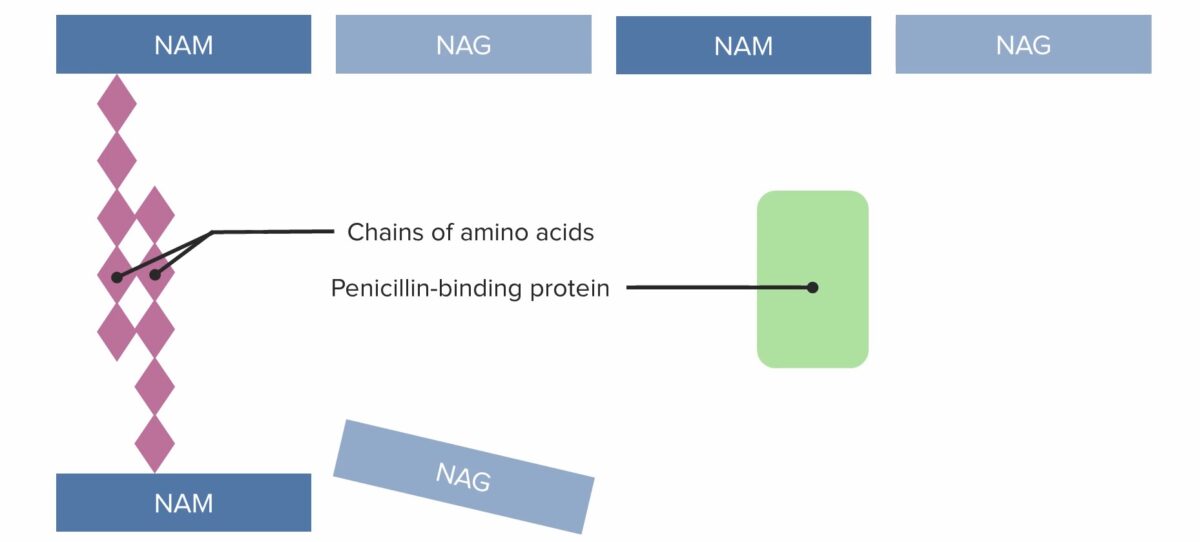
Todos os beta-lactâmicos atuam inibindo irreversivelmente as PBPs PBPs Bacterial proteins that share the property of binding irreversibly to penicillins and other antibacterial agents derived from lactams. The penicillin-binding proteins are primarily enzymes involved in cell wall biosynthesis including muramoylpentapeptide carboxypeptidase; peptide synthases; transpeptidases; and hexosyltransferases. Penicillins antibióticos beta-lactâmicos inibem a síntese da parede celular
Presença de um antibiótico beta-lactâmico, que liga e inibe irreversivelmente as PBP

Presença de um antibiótico beta-lactâmico, que se liga irreversivelmente e inibe as PBP, impedindo a formação de novas ligações cruzadas:
O antibiótico beta-lactâmico inibe de forma efetiva a síntese da parede celular, levando à morte celular.

NAM: ácido N-acetilmurâmico
NAG: N-acetilglucosamina
Imagem por Lecturio. Licença: CC BY-NC-SA 4.0

Atividade bactericida

Os beta-lactâmicos, incluindo as penicilinas, exercem um efeito bactericida (em vez de bacteriostático).
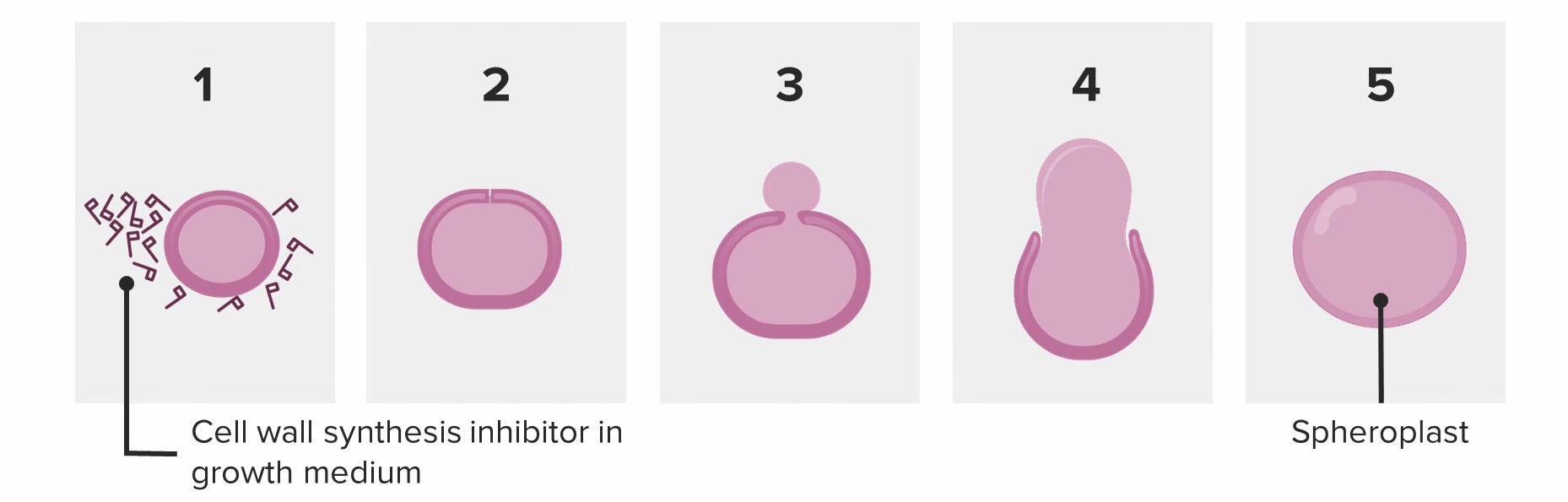
  • A parede celular bacteriana é necessária para a sua sobrevivência → se ausente, inicia-se a morte celular
  • Quando as bactérias se tentam replicar, perdem as suas paredes celulares.
  • Na presença de penicilinas, no entanto, as bactérias são incapazes de formar uma nova parede celular.
  • As bactérias são incapazes de se dividir com eficácia, e a célula restante autocatalisa-se e morre.
Bactérias a tentar dividir-se na presença de penicilina

Bactéria a tentar dividir-se na presença de penicilina:
A bactéria liberta-se da sua parede e torna-se um esferoplasto. O esferoplasto é incapaz de sobreviver e autocatalisa-se (morre).

Imagem por Lecturio. Licença: CC BY-NC-SA 4.0

Mecanismos de resistência

As bactérias usam 3 mecanismos primários para resistir às penicilinas:

  • Resistência à beta-lactamase Beta-Lactamase Penicillins (as penicilinas são inativadas):
    • A beta-lactamase Beta-Lactamase Penicillins é uma enzima que cliva o anel beta-lactâmico e inativa o antibiótico.
    • No caso da resistência à penicilina, as enzimas são frequentemente chamadas de penicilinases.
    • Podem ser produzidas por organismos gram-positivos e gram-negativos
    • Normalmente secretadas
    • Podem ser secretadas apenas na presença de um antibiótico beta-lactâmico
    • Tipo de resistência mais MAIS Androgen Insensitivity Syndrome comum
    • A maioria dos bacilos gram-negativos possui um gene Gene A category of nucleic acid sequences that function as units of heredity and which code for the basic instructions for the development, reproduction, and maintenance of organisms. Basic Terms of Genetics da beta-lactamase Beta-Lactamase Penicillins.
  • Resistência mediada por PBP (↓ ligação da penicilina a PBPs PBPs Bacterial proteins that share the property of binding irreversibly to penicillins and other antibacterial agents derived from lactams. The penicillin-binding proteins are primarily enzymes involved in cell wall biosynthesis including muramoylpentapeptide carboxypeptidase; peptide synthases; transpeptidases; and hexosyltransferases. Penicillins):
    • Mutações nas PBPs PBPs Bacterial proteins that share the property of binding irreversibly to penicillins and other antibacterial agents derived from lactams. The penicillin-binding proteins are primarily enzymes involved in cell wall biosynthesis including muramoylpentapeptide carboxypeptidase; peptide synthases; transpeptidases; and hexosyltransferases. Penicillins → ↓ afinidade de penicilinas para as PBPs PBPs Bacterial proteins that share the property of binding irreversibly to penicillins and other antibacterial agents derived from lactams. The penicillin-binding proteins are primarily enzymes involved in cell wall biosynthesis including muramoylpentapeptide carboxypeptidase; peptide synthases; transpeptidases; and hexosyltransferases. Penicillins
    • Apesar das mutações, as PBPs PBPs Bacterial proteins that share the property of binding irreversibly to penicillins and other antibacterial agents derived from lactams. The penicillin-binding proteins are primarily enzymes involved in cell wall biosynthesis including muramoylpentapeptide carboxypeptidase; peptide synthases; transpeptidases; and hexosyltransferases. Penicillins ainda são capazes de produzir uma parede celular.
  • Resistência mediada por porinas (↓ absorção de penicilina):
    • As penicilinas entram nas bactérias através de canais nas paredes celulares chamados porinas.
    • As bactérias podem ↓ produção de porinas → ↓ níveis de antibióticos dentro da célula → resistência aos antibióticos
    • Mecanismo comum de resistência na Pseudomonas aeruginosa Pseudomonas aeruginosa A species of gram-negative, aerobic, rod-shaped bacteria commonly isolated from clinical specimens (wound, burn, and urinary tract infections). It is also found widely distributed in soil and water. P. Aeruginosa is a major agent of nosocomial infection. Pseudomonas

Fármacos resistentes à penicilinase

  • Alguns fármacos podem ajudar a superar a penicilinase, agindo como inibidores da penicilinase.
  • Os fármacos resistentes à penicilinase são frequentemente combinados com as penicilinas sensíveis à penicilinase para aumentar a sua atividade.
  • Os inibidores da penicilinase incluem:
    • Ácido clavulânico
    • Sulbactam Sulbactam A beta-lactamase inhibitor with very weak antibacterial action. The compound prevents antibiotic destruction of beta-lactam antibiotics by inhibiting beta-lactamases, thus extending their spectrum activity. Combinations of sulbactam with beta-lactam antibiotics have been used successfully for the therapy of infections caused by organisms resistant to the antibiotic alone. Cephalosporins
    • Tazobactam Tazobactam A penicillanic acid and sulfone derivative and potent beta-lactamase inhibitor that enhances the activity of other anti-bacterial agents against beta-lactamase producing bacteria. Cephalosporins

Classificação

As penicilinas podem ser classificadas como penicilinas naturais, penicilinas antiestafilocócicas e penicilinas de largo espectro. As penicilinas também podem ser classificadas como compostos sensíveis à penicilinase ou resistentes à penicilinase.

Penicilinas sensíveis à penicilinase

  • Penicilinas naturais (produtos químicos que são produzidos naturalmente):
    • Penicilina G
    • Penicilina V
  • Penicilinas de largo espectro (atividade muito melhor contra bacilos gram-negativos):
    • 2ª geração (aminopenicilinas):
      • Ampicilina (IV/oral)
      • Amoxicilina (oral)
    • Os fármacos de 3ª geração (carbenicilina e ticarcilina) não estão disponíveis nos EUA
    • 4ª geração (também conhecida como penicilinas antipseudomonas):
      • Piperacilina
      • Mezlocilina

Penicilinas resistentes à penicilinase

As penicilinas resistentes à penicilinase têm um grande grupo R próximo ao anel beta-lactâmico, o que evita a degradação dos fármacos pelas penicilinases. As penicilinas resistentes à penicilinase são eficazes contra estafilococos sensíveis à meticilina; portanto, frequentemente são chamadas penicilinas anti-estafilocócicas.

  • Dicloxacilina
  • Cloxacilina
  • Oxacilina
  • Nafcilina
  • Meticilina (raramente usada devido à resistência e ao risco de nefrite intersticial)

Combinações de penicilina com inibidores de penicilinase

  • Ampicilina-sulbactam (Unasyn)
  • Amoxicilina-clavulanato (Augmentin)
  • Piperacilina-tazobactam (Zosyn)

Farmacocinética

Distribuição

  • Todas as penicilinas são distribuídas em:
    • Cavidade pleural/pulmões
    • Líquido pericárdico
    • Líquido peritoneal/ascite
    • Fluido sinovial
    • Urina
    • Bílis (especialmente mezlocilina)
  • Má penetração através da barreira hematoencefálica (exceção: durante a inflamação na meningite)

Ligação proteica

  • Varia de acordo com o fármaco
  • Penicilinas resistentes à penicilinase (nafcilina, oxacilina, cloxacilina): > 90% estão ligadas às proteínas.
  • Penicilina V: > 80% liga-se às proteínas.
  • Amoxicilina, ampicilina e piperacilina: 15%–20% liga-se às proteínas.

Semi-vida

Metabolismo

  • As penicilinas resistentes à penicilinase (nafcilina, oxacilina, cloxacilina) sofrem metabolismo hepático.
  • A maioria das outras não é extensivamente metabolizada.

Excreção

  • A maioria é excretada principalmente na urina:
    • A maioria é excretada inalterada.
    • A ampicilina e a piperacilina requerem ajustes de dose em pacientes com insuficiência renal.
  • Algumas são excretadas principalmente na bílis/fezes, incluindo:
    • Penicilinas resistentes à penicilinase (nafcilina, oxacilina e cloxacilina)
    • Mezlocilina

Indicações

Tabela: Espectro de atividade e usos clínicos das penicilinas
Fármaco (via de administração) Espectro de atividade Utilizações clínicas
Penicilina G (IV/IM) e penicilina V (oral) Estreito:
  • Cocos gram-positivos:
    • Streptococcus Streptococcus Streptococcus is one of the two medically important genera of gram-positive cocci, the other being Staphylococcus. Streptococci are identified as different species on blood agar on the basis of their hemolytic pattern and sensitivity to optochin and bacitracin. There are many pathogenic species of streptococci, including S. pyogenes, S. agalactiae, S. pneumoniae, and the viridans streptococci. Streptococcus pyogenes
    • S. pneumoniae
    • S. agalactiae (SGB)
  • Bacilos gram-positivos:
    • Listeria Listeria Listeria spp. are motile, flagellated, gram-positive, facultative intracellular bacilli. The major pathogenic species is Listeria monocytogenes. Listeria are part of the normal gastrointestinal flora of domestic mammals and poultry and are transmitted to humans through the ingestion of contaminated food, especially unpasteurized dairy products. Listeria Monocytogenes/Listeriosis monocytogenes
    • Actinomyces Israelii Actinomyces israelii Actinomyces/Actinomycosis
  • Cocos gram-negativos:
    • Neisseria meningitidis Neisseria meningitidis A species of gram-negative, aerobic bacteria. It is a commensal and pathogen only of humans, and can be carried asymptomatically in the nasopharynx. When found in cerebrospinal fluid it is the causative agent of cerebrospinal meningitis. It is also found in venereal discharges and blood. There are at least 13 serogroups based on antigenic differences in the capsular polysaccharides; the ones causing most meningitis infections being a, b, c, y, and w-135. Each serogroup can be further classified by serotype, serosubtype, and immunotype. Neisseria
    • N. gonorrhoeae N. gonorrhoeae A species of gram-negative, aerobic bacteria primarily found in purulent venereal discharges. It is the causative agent of gonorrhea. Neisseria
  • Espiroquetas:
    • Treponema pallidum Treponema pallidum The causative agent of venereal and non-venereal syphilis as well as yaws. Treponema
    • Leptospira Leptospira Leptospira is a spiral or question mark-shaped, gram-negative spirochete with hook-shaped ends. The disease, leptospirosis, is a zoonosis, infecting animals. Rodents are the most important reservoir. Bacteria shed in the urine of rodents and other animals can be transmitted to humans via contaminated water. Leptospira/Leptospirosis spp.
  • Faringite estreptocócica (ou seja, amigdalite estreptocócica)
  • Endocardite
  • Síndrome do choque tóxico causada por Streptococcus Streptococcus Streptococcus is one of the two medically important genera of gram-positive cocci, the other being Staphylococcus. Streptococci are identified as different species on blood agar on the basis of their hemolytic pattern and sensitivity to optochin and bacitracin. There are many pathogenic species of streptococci, including S. pyogenes, S. agalactiae, S. pneumoniae, and the viridans streptococci. Streptococcus spp.
  • Profilaxia de febre reumática
  • Meningite bacteriana causada por L. monocytogenes L. monocytogenes A species of gram-positive, rod-shaped bacteria widely distributed in nature. It has been isolated from sewage, soil, silage, and from feces of healthy animals and man. Infection with this bacterium leads to encephalitis, meningitis, endocarditis, and abortion. Listeria Monocytogenes/Listeriosis ou N. meningitidis N. meningitidis A species of gram-negative, aerobic bacteria. It is a commensal and pathogen only of humans, and can be carried asymptomatically in the nasopharynx. When found in cerebrospinal fluid it is the causative agent of cerebrospinal meningitis. It is also found in venereal discharges and blood. There are at least 13 serogroups based on antigenic differences in the capsular polysaccharides; the ones causing most meningitis infections being a, b, c, y, and w-135. Each serogroup can be further classified by serotype, serosubtype, and immunotype. Neisseria
  • Gonorreia
  • Infeções por S. agalactiae (SGB) na gravidez
  • Sífilis (penicilina G)
  • Leptospirose
  • Antraz
  • Botulismo (auxiliar)
  • Difteria (auxiliar)
  • Tétano (auxiliar)
Cloxacilina e dicloxacilina Estreito:
Cocos gram-positivos:
  • Staphylococcus Staphylococcus Staphylococcus is a medically important genera of Gram-positive, aerobic cocci. These bacteria form clusters resembling grapes on culture plates. Staphylococci are ubiquitous for humans, and many strains compose the normal skin flora. Staphylococcus spp. (excluindo MRSA MRSA A strain of Staphylococcus aureus that is non-susceptible to the action of methicillin. The mechanism of resistance usually involves modification of normal or the presence of acquired penicillin binding proteins. Staphylococcus)
  • Streptococcus Streptococcus Streptococcus is one of the two medically important genera of gram-positive cocci, the other being Staphylococcus. Streptococci are identified as different species on blood agar on the basis of their hemolytic pattern and sensitivity to optochin and bacitracin. There are many pathogenic species of streptococci, including S. pyogenes, S. agalactiae, S. pneumoniae, and the viridans streptococci. Streptococcus spp.
  • Infeções de pele e tecidos moles Moles Primary Skin Lesions
    • Impetigo Impetigo Impetigo is a highly contagious superficial bacterial infection typically caused by Staphylococcus aureus (most common) and Streptococcus pyogenes. Impetigo most commonly presents in children aged 2 to 5 years with lesions that evolve from papules to vesicles to pustules, which eventually break down to form characteristic “honey-colored” crusts. Impetigo
    • Celulite
    • Mastite
  • Otite externa
  • Artrite sética
  • Pneumonia Pneumonia Pneumonia or pulmonary inflammation is an acute or chronic inflammation of lung tissue. Causes include infection with bacteria, viruses, or fungi. In more rare cases, pneumonia can also be caused through toxic triggers through inhalation of toxic substances, immunological processes, or in the course of radiotherapy. Pneumonia devido a bactérias suscetíveis
Ampicilina (IV/oral) e amoxicilina (oral) Mais MAIS Androgen Insensitivity Syndrome largo:
  • Bactérias gram-positivas:
    • Streptococcus Streptococcus Streptococcus is one of the two medically important genera of gram-positive cocci, the other being Staphylococcus. Streptococci are identified as different species on blood agar on the basis of their hemolytic pattern and sensitivity to optochin and bacitracin. There are many pathogenic species of streptococci, including S. pyogenes, S. agalactiae, S. pneumoniae, and the viridans streptococci. Streptococcus spp.
    • L. monocytogenes L. monocytogenes A species of gram-positive, rod-shaped bacteria widely distributed in nature. It has been isolated from sewage, soil, silage, and from feces of healthy animals and man. Infection with this bacterium leads to encephalitis, meningitis, endocarditis, and abortion. Listeria Monocytogenes/Listeriosis
  • Bactérias gram-negativas:
    • Helicobacter pylori Helicobacter pylori A spiral bacterium active as a human gastric pathogen. It is a gram-negative, urease-positive, curved or slightly spiral organism initially isolated in 1982 from patients with lesions of gastritis or peptic ulcers in Western Australia. Helicobacter pylori was originally classified in the genus campylobacter, but RNA sequencing, cellular fatty acid profiles, growth patterns, and other taxonomic characteristics indicate that the micro-organism should be included in the genus Helicobacter. It has been officially transferred to Helicobacter gen. Helicobacter
    • Haemophilus influenzae Haemophilus Influenzae A species of Haemophilus found on the mucous membranes of humans and a variety of animals. The species is further divided into biotypes I through viii. Haemophilus
    • Escherichia coli Escherichia coli The gram-negative bacterium Escherichia coli is a key component of the human gut microbiota. Most strains of E. coli are avirulent, but occasionally they escape the GI tract, infecting the urinary tract and other sites. Less common strains of E. coli are able to cause disease within the GI tract, most commonly presenting as abdominal pain and diarrhea. Escherichia coli
    • Proteus mirabilis Proteus mirabilis A species of gram-negative, facultatively anaerobic, rod-shaped bacteria that is frequently isolated from clinical specimens. Its most common site of infection is the urinary tract. Proteus
    • Salmonella Salmonella Salmonellae are gram-negative bacilli of the family Enterobacteriaceae. Salmonellae are flagellated, non-lactose-fermenting, and hydrogen sulfide-producing microbes. Salmonella enterica, the most common disease-causing species in humans, is further classified based on serotype as typhoidal (S. typhi and paratyphi) and nontyphoidal (S. enteritidis and typhimurium). Salmonella spp.
    • Shigella Shigella Shigella is a genus of gram-negative, non-lactose-fermenting facultative intracellular bacilli. Infection spreads most commonly via person-to-person contact or through contaminated food and water. Humans are the only known reservoir. Shigella spp.
  • A atividade é intensificada com o uso de clavulanato (ácido clavulânico).
  • Infeções otorrinolaringológicas:
    • Faringite
    • Amidalite
    • Otite média
    • Rinossinusite
  • Infeções GI:
    • Erradicação de H. pylori H. pylori A spiral bacterium active as a human gastric pathogen. It is a gram-negative, urease-positive, curved or slightly spiral organism initially isolated in 1982 from patients with lesions of gastritis or peptic ulcers in Western Australia. Helicobacter pylori was originally classified in the genus campylobacter, but RNA sequencing, cellular fatty acid profiles, growth patterns, and other taxonomic characteristics indicate that the micro-organism should be included in the genus Helicobacter. It has been officially transferred to Helicobacter gen. Helicobacter
    • Salmonella Salmonella Salmonellae are gram-negative bacilli of the family Enterobacteriaceae. Salmonellae are flagellated, non-lactose-fermenting, and hydrogen sulfide-producing microbes. Salmonella enterica, the most common disease-causing species in humans, is further classified based on serotype as typhoidal (S. typhi and paratyphi) and nontyphoidal (S. enteritidis and typhimurium). Salmonella
    • Complementar com aminoglicosídeos para infeções enterocócicas
  • Pneumonia Pneumonia Pneumonia or pulmonary inflammation is an acute or chronic inflammation of lung tissue. Causes include infection with bacteria, viruses, or fungi. In more rare cases, pneumonia can also be caused through toxic triggers through inhalation of toxic substances, immunological processes, or in the course of radiotherapy. Pneumonia adquirida na comunidade
  • Profilaxia da endocardite
  • Meningite bacteriana
  • Sépsis
  • Infeções geniturinárias:
    • Infeções do trato urinário (não são 1ª linha)
    • Infeções intra-amnióticas
    • Endometrite pós-parto
    • Abcesso tubo-ovárico
Piperacilina (disponível apenas como piperacilina/ tazobactam Tazobactam A penicillanic acid and sulfone derivative and potent beta-lactamase inhibitor that enhances the activity of other anti-bacterial agents against beta-lactamase producing bacteria. Cephalosporins nos EUA) Mais MAIS Androgen Insensitivity Syndrome largo:
  • Bactérias gram-positivas:
    • Streptococcus Streptococcus Streptococcus is one of the two medically important genera of gram-positive cocci, the other being Staphylococcus. Streptococci are identified as different species on blood agar on the basis of their hemolytic pattern and sensitivity to optochin and bacitracin. There are many pathogenic species of streptococci, including S. pyogenes, S. agalactiae, S. pneumoniae, and the viridans streptococci. Streptococcus spp.
    • Staphylococcus Staphylococcus Staphylococcus is a medically important genera of Gram-positive, aerobic cocci. These bacteria form clusters resembling grapes on culture plates. Staphylococci are ubiquitous for humans, and many strains compose the normal skin flora. Staphylococcus spp. (excluindo MRSA MRSA A strain of Staphylococcus aureus that is non-susceptible to the action of methicillin. The mechanism of resistance usually involves modification of normal or the presence of acquired penicillin binding proteins. Staphylococcus)
  • Bactérias gram-negativas:
    • P. aeruginosa P. aeruginosa A species of gram-negative, aerobic, rod-shaped bacteria commonly isolated from clinical specimens (wound, burn, and urinary tract infections). It is also found widely distributed in soil and water. P. Aeruginosa is a major agent of nosocomial infection. Pseudomonas
    • Muitas Enterobacteriaceae Enterobacteriaceae A family of gram-negative, facultatively anaerobic, rod-shaped bacteria that do not form endospores. Its organisms are distributed worldwide with some being saprophytes and others being plant and animal parasites. Many species are of considerable economic importance due to their pathogenic effects on agriculture and livestock. Cephalosporins
  • Associada ao inibidor da penicilinase tazobactam Tazobactam A penicillanic acid and sulfone derivative and potent beta-lactamase inhibitor that enhances the activity of other anti-bacterial agents against beta-lactamase producing bacteria. Cephalosporins para aumentar a atividade.
  • Sépsis
  • Neutropenia Neutropenia Neutrophils are an important component of the immune system and play a significant role in the eradication of infections. Low numbers of circulating neutrophils, referred to as neutropenia, predispose the body to recurrent infections or sepsis, though patients can also be asymptomatic. Neutropenia febril em pacientes de alto risco
  • Infeções intra-abdominais/pélvicas:
    • Apendicite
    • Doença inflamatória pélvica
    • Endometrite pós-parto
  • Infeções da pele e tecidos moles Moles Primary Skin Lesions:
    • Celulite
    • Abcessos
    • Infeções isquémicas/diabéticas do pé
Mezlocilina Largo: boa cobertura de gram-negativos Infeções das vias biliares (por exemplo, colangite biliar)
SGB: Streptococcus do grupo B

Efeitos Adversos e Contraindicações

Efeitos adversos

Os efeitos mais MAIS Androgen Insensitivity Syndrome comuns estão relacionados com reações alérgicas.

  • Reações alérgicas mediadas por IgE IgE An immunoglobulin associated with mast cells. Overexpression has been associated with allergic hypersensitivity. Immunoglobulins: Types and Functions:
    • Apresenta-se com:
      • Prurido
      • Urticária
      • Angioedema Angioedema Angioedema is a localized, self-limited (but potentially life-threatening), nonpitting, asymmetrical edema occurring in the deep layers of the skin and mucosal tissue. The common underlying pathophysiology involves inflammatory mediators triggering significant vasodilation and increased capillary permeability. Angioedema
      • Hipotensão
      • Anafilaxia
    • Os sintomas geralmente aparecem dentro de 4 horas após a administração (geralmente em minutos).
  • Doença do soro:
    • Uma reação alérgica tardia devido a complexos imunes circulantes
    • Caracterizada por:
      • Febre
      • Urticária
      • Adenopatia
      • Artrite
      • Glomerulonefrite (ocasionalmente)
  • Reações dermatológicas:
    • Erupção cutânea morbiliforme: uma erupção maculopapular Maculopapular Dermatologic Examination devido a uma reação de hipersensibilidade
    • Eritema multiforme: lesões-alvo que se desenvolvem, com início agudo
    • Síndrome de Stevens-Johnson: uma doenças descamativa da pele que envolve superfícies mucosas
  • Reações neurológicas:
    • Encefalopatia
    • Neurotoxicidade da penicilina:
      • Diminuição do nível de consciência (por exemplo, sonolência, coma Coma Coma is defined as a deep state of unarousable unresponsiveness, characterized by a score of 3 points on the GCS. A comatose state can be caused by a multitude of conditions, making the precise epidemiology and prognosis of coma difficult to determine. Coma)
      • Hiperreflexia generalizada
      • Mioclonias
      • Convulsões
  • Reações gastrointestinais e hepáticas:
    • Diarreia (especialmente com ampicilina e amoxicilina)
    • Colite por Clostridioides difficile
    • Supressão da flora intestinal levando ao défice de vitamina K
    • Hepatite de hipersensibilidade (especialmente com oxacilina e nafcilina)
  • Reações renais:
    • Glomerulonefrite (que ocorre em associação com reações alérgicas)
    • Nefrite intersticial alérgica (especialmente com nafcilina e meticilina)
    • LRA (associada ao uso concomitante de piperacilina-tazobactam e vancomicina)
  • Reações hematológicas:
    • Neutropenia Neutropenia Neutrophils are an important component of the immune system and play a significant role in the eradication of infections. Low numbers of circulating neutrophils, referred to as neutropenia, predispose the body to recurrent infections or sepsis, though patients can also be asymptomatic. Neutropenia devido à destruição imunomediada de leucócitos polimorfonucleares (PMN)
    • Anemia Anemia Anemia is a condition in which individuals have low Hb levels, which can arise from various causes. Anemia is accompanied by a reduced number of RBCs and may manifest with fatigue, shortness of breath, pallor, and weakness. Subtypes are classified by the size of RBCs, chronicity, and etiology. Anemia: Overview and Types hemolítica
    • Trombocitopenia imune, especialmente com ticarcilina
    • Supressão da flora intestinal → défice de vitamina K → coagulopatia

Contraindicações

  • Reações de hipersensibilidade
  • Reações cutâneas graves (por exemplo, síndrome de Stevens-Johnson)

Comparação de Cobertura e Classificação de Antibióticos

Comparação baseada no mecanismo de ação

Os antibióticos podem ser classificados de várias maneiras. Uma maneira é classificá-los com base no seu mecanismo de ação:

Tabela: Antibióticos classificados por mecanismo de ação primário
Mecanismo Classes de antibióticos
Inibidores da síntese da parede celular bacteriana
  • Penicilinas
  • Cefalosporinas
  • Penemes
  • Diversos
Inibidores da síntese de proteínas bacterianas
  • Tetraciclinas
  • Macrólidos
  • Cetolídeos
  • Lincosamidas
  • Estreptograminas
  • Linezolida
Agentes que atuam contra o DNA DNA A deoxyribonucleotide polymer that is the primary genetic material of all cells. Eukaryotic and prokaryotic organisms normally contain DNA in a double-stranded state, yet several important biological processes transiently involve single-stranded regions. DNA, which consists of a polysugar-phosphate backbone possessing projections of purines (adenine and guanine) and pyrimidines (thymine and cytosine), forms a double helix that is held together by hydrogen bonds between these purines and pyrimidines (adenine to thymine and guanine to cytosine). DNA Types and Structure e/ou folato
  • Sulfonamidas
  • Trimetoprim
  • Fluoroquinolonas
Agentes antimicobacterianos
  • Agentes anti-TB
  • Agentes anti-hanseníase (lepra)
  • Agentes micobacterianos atípicos

Comparação com base na cobertura

Diferentes antibióticos têm vários graus de atividade contra diferentes bactérias. A tabela abaixo descreve os antibióticos que são ativos contra três classes importantes de bactérias, incluindo cocos gram-positivos, bacilos gram-negativos e anaeróbios.
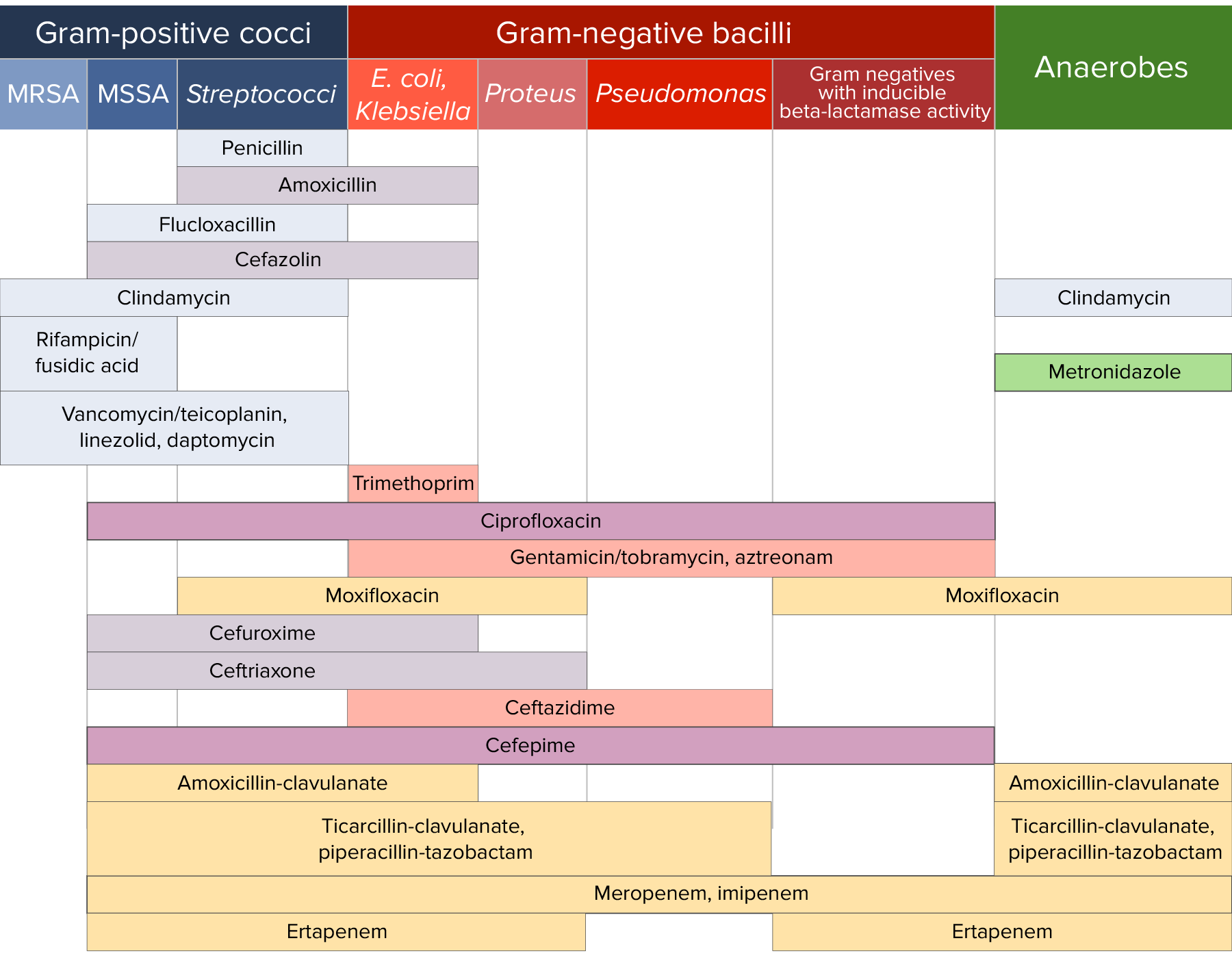
Gráfico de sensibilidade a antibióticos

Sensibilidade aos antibióticos:
Gráfico que compara a cobertura microbiana de diferentes antibióticos para cocos gram-positivos, bacilos gram-negativos e anaeróbios.

Imagem por Lecturio. Licença: CC BY-NC-SA 4.0

Referências

  1. Letourneau, A.R. (2023). Beta-lactam antibiotics: Mechanisms of action and resistance and adverse effects. In Bloom, A. (Ed.), UpToDate. Retrieved October 17, 2025, from https://www.uptodate.com/contents/beta-lactam-antibiotics-mechanisms-of-action-and-resistance-and-adverse-effects
  2. Letourneau, A.R. (2024). Penicillin, antistaphylococcal penicillins, and broad-spectrum penicillins. In Bloom, A. (Ed.), UpToDate. Retrieved October 17, 2025, from https://www.uptodate.com/contents/penicillin-antistaphylococcal-penicillins-and-broad-spectrum-penicillins 
  3. Letourneau, A.R. (2025). Cephalosporins. UpToDate. Retrieved October 17, 2025, from https://www.uptodate.com/contents/cephalosporins
  4. Medscape. (n.d.). Penicillin G benzathine. Retrieved October 17, 2025, from https://reference.medscape.com/drug/bicillin-la-permapen-penicillin-g-benzathine-999573
  5. Deck, D.H., Winston, L.G. (2012). Beta-lactam & other cell wall- & membrane-active antibiotics (Chapter 43). In: Basic and Clinical Pharmacology. 12e. Katzung, B.G., Masters, S.B., Trevor, A.J. (Editors). McGraw-Hill/Lange.
  6. Hauser, A.R. (2013). Antibiotic basics for clinicians. The ABCs of choosing the right antibacterial agent. 2nd Ed. Lippincott Williams & Wilkins. ISBN-13: 978-1-4511-1221-4

Crie sua conta gratuita ou faça login para continuar lendo!

Cadastre-se agora e tenha acesso grátis ao Lecturio, com páginas de conceitos, vídeos de medicina e questões para sua educação médica.

Aprende mais com a Lecturio:

Multiple devices displaying human anatomy and health education content.

Complementa o teu estudo da faculdade com o companheiro de estudo tudo-em-um da Lecturio, através de métodos de ensino baseados em evidência.

Estuda onde quiseres

Two iPhones display medical education apps, one showing anatomy, the other Bookmatcher.

A Lecturio Medical complementa o teu estudo através de métodos de ensino baseados em evidência, vídeos de palestras, perguntas e muito mais – tudo combinado num só lugar e fácil de usar.

User Reviews

Details