
Domina Conceptos Médicos

Estudia para la escuela de medicina y tus examenes con Lecturio.

Tipos de Shock

El shock Shock Shock is a life-threatening condition associated with impaired circulation that results in tissue hypoxia. The different types of shock are based on the underlying cause: distributive (↑ cardiac output (CO), ↓ systemic vascular resistance (SVR)), cardiogenic (↓ CO, ↑ SVR), hypovolemic (↓ CO, ↑ SVR), obstructive (↓ CO), and mixed. Types of Shock es una afección potencialmente mortal que se asocia a una alteración de la circulación que provoca hipoxia tisular. Los LOS Neisseria diferentes tipos de shock Shock Shock is a life-threatening condition associated with impaired circulation that results in tissue hypoxia. The different types of shock are based on the underlying cause: distributive (↑ cardiac output (CO), ↓ systemic vascular resistance (SVR)), cardiogenic (↓ CO, ↑ SVR), hypovolemic (↓ CO, ↑ SVR), obstructive (↓ CO), and mixed. Types of Shock se basan en EN Erythema nodosum is an immune-mediated panniculitis (inflammation of the subcutaneous fat) caused by a type IV (delayed-type) hypersensitivity reaction. It commonly manifests in young women as tender, erythematous nodules on the shins. Erythema Nodosum la causa subyacente: distributivo (↑ gasto cardíaco, ↓ resistencia vascular sistémica), cardiogénico (↓ gasto cardíaco, ↑ resistencia vascular sistémica), hipovolémico (↓ gasto cardíaco, ↑ resistencia vascular sistémica), obstructivo (↓ gasto cardíaco) y mixto. Los LOS Neisseria síntomas más comunes son taquicardia, taquipnea, hipotensión, alteraciones mentales y oliguria Oliguria Decreased urine output that is below the normal range. Oliguria can be defined as urine output of less than or equal to 0. 5 or 1 ml/kg/hr depending on the age. Renal Potassium Regulation. Las medidas de tratamiento varían en EN Erythema nodosum is an immune-mediated panniculitis (inflammation of the subcutaneous fat) caused by a type IV (delayed-type) hypersensitivity reaction. It commonly manifests in young women as tender, erythematous nodules on the shins. Erythema Nodosum función de la causa sospechada del shock Shock Shock is a life-threatening condition associated with impaired circulation that results in tissue hypoxia. The different types of shock are based on the underlying cause: distributive (↑ cardiac output (CO), ↓ systemic vascular resistance (SVR)), cardiogenic (↓ CO, ↑ SVR), hypovolemic (↓ CO, ↑ SVR), obstructive (↓ CO), and mixed. Types of Shock y pueden incluir ventilación mecánica, líquidos intravenosos para reanimación de volumen, vasopresores, transfusión de sangre/productos sanguíneos.

Last updated: Jul 16, 2022

Editorial responsibility: Stanley Oiseth, Lindsay Jones, Evelin Maza

Definición y Clasificación

Definición

El shock Shock Shock is a life-threatening condition associated with impaired circulation that results in tissue hypoxia. The different types of shock are based on the underlying cause: distributive (↑ cardiac output (CO), ↓ systemic vascular resistance (SVR)), cardiogenic (↓ CO, ↑ SVR), hypovolemic (↓ CO, ↑ SVR), obstructive (↓ CO), and mixed. Types of Shock es un estado de disfunción orgánica potencialmente mortal y que es consecuencia de la hipoxia tisular debida a la disminución del suministro de oxígeno, el aumento del consumo de oxígeno y/o la utilización defectuosa del mismo.

Clasificación

  • Distributivo: se caracteriza por una reducción de la resistencia vascular sistémica y un aumento compensatorio del gasto cardíaco
    • Shock Shock Shock is a life-threatening condition associated with impaired circulation that results in tissue hypoxia. The different types of shock are based on the underlying cause: distributive (↑ cardiac output (CO), ↓ systemic vascular resistance (SVR)), cardiogenic (↓ CO, ↑ SVR), hypovolemic (↓ CO, ↑ SVR), obstructive (↓ CO), and mixed. Types of Shock séptico
    • Pancreatitis Pancreatitis Inflammation of the pancreas. Pancreatitis is classified as acute unless there are computed tomographic or endoscopic retrograde cholangiopancreatographic findings of chronic pancreatitis. The two most common forms of acute pancreatitis are alcoholic pancreatitis and gallstone pancreatitis. Acute Pancreatitis
    • Quemaduras graves
    • Shock Shock Shock is a life-threatening condition associated with impaired circulation that results in tissue hypoxia. The different types of shock are based on the underlying cause: distributive (↑ cardiac output (CO), ↓ systemic vascular resistance (SVR)), cardiogenic (↓ CO, ↑ SVR), hypovolemic (↓ CO, ↑ SVR), obstructive (↓ CO), and mixed. Types of Shock anafiláctico
    • Shock Shock Shock is a life-threatening condition associated with impaired circulation that results in tissue hypoxia. The different types of shock are based on the underlying cause: distributive (↑ cardiac output (CO), ↓ systemic vascular resistance (SVR)), cardiogenic (↓ CO, ↑ SVR), hypovolemic (↓ CO, ↑ SVR), obstructive (↓ CO), and mixed. Types of Shock neurogénico
    • Shock Shock Shock is a life-threatening condition associated with impaired circulation that results in tissue hypoxia. The different types of shock are based on the underlying cause: distributive (↑ cardiac output (CO), ↓ systemic vascular resistance (SVR)), cardiogenic (↓ CO, ↑ SVR), hypovolemic (↓ CO, ↑ SVR), obstructive (↓ CO), and mixed. Types of Shock endocrino
    • Crisis suprarrenal
    • Shock Shock Shock is a life-threatening condition associated with impaired circulation that results in tissue hypoxia. The different types of shock are based on the underlying cause: distributive (↑ cardiac output (CO), ↓ systemic vascular resistance (SVR)), cardiogenic (↓ CO, ↑ SVR), hypovolemic (↓ CO, ↑ SVR), obstructive (↓ CO), and mixed. Types of Shock inducido por medicamentos y toxinas
  • Cardiogénico: se caracteriza por la reducción del gasto cardíaco debido a un problema cardíaco primario
    • Infarto de miocardio
    • Miocarditis
    • Arritmia
    • Insuficiencia valvular
      • Insuficiencia valvular aórtica severa
      • Insuficiencia valvular mitral severa
  • Hipovolémico: se caracteriza por la reducción del gasto cardíaco debido a la disminución de la precarga
    • Hemorrágico
    • Pérdidas gastrointestinales
      • Vómitos
      • Diarrea
    • Quemaduras
    • Poliuria:
      • Cetoacidosis diabética
      • Diabetes Diabetes Diabetes mellitus (DM) is a metabolic disease characterized by hyperglycemia and dysfunction of the regulation of glucose metabolism by insulin. Type 1 DM is diagnosed mostly in children and young adults as the result of autoimmune destruction of β cells in the pancreas and the resulting lack of insulin. Type 2 DM has a significant association with obesity and is characterized by insulin resistance. Diabetes Mellitus insípida
  • Obstructivo: se caracteriza por una reducción del gasto cardíaco debido a una obstrucción extracardíaca
    • Neumotórax a tensión
    • Embolia pulmonar
    • Taponamiento cardíaco
    • Disección aórtica
    • Pericarditis Pericarditis Pericarditis is an inflammation of the pericardium, often with fluid accumulation. It can be caused by infection (often viral), myocardial infarction, drugs, malignancies, metabolic disorders, autoimmune disorders, or trauma. Acute, subacute, and chronic forms exist. Pericarditis restrictiva
  • Mixto/multifactorial: a menudo, 1 clase no existe de forma aislada.
Tabla: Características hemodinámicas de los LOS Neisseria principales tipos de shock Shock Shock is a life-threatening condition associated with impaired circulation that results in tissue hypoxia. The different types of shock are based on the underlying cause: distributive (↑ cardiac output (CO), ↓ systemic vascular resistance (SVR)), cardiogenic (↓ CO, ↑ SVR), hypovolemic (↓ CO, ↑ SVR), obstructive (↓ CO), and mixed. Types of Shock
Tipo de shock Shock Shock is a life-threatening condition associated with impaired circulation that results in tissue hypoxia. The different types of shock are based on the underlying cause: distributive (↑ cardiac output (CO), ↓ systemic vascular resistance (SVR)), cardiogenic (↓ CO, ↑ SVR), hypovolemic (↓ CO, ↑ SVR), obstructive (↓ CO), and mixed. Types of Shock Presión venosa central (PVC) Presión capilar pulmonar Gasto cardíaco Resistencia vascular sistémica
Distributivo
Cardiogénico
Obstructivo ↓↑
Hipovolémico

Fisiopatología y Estadios

Fisiopatología

  • Agresión inicial (muy frecuentemente resulta en EN Erythema nodosum is an immune-mediated panniculitis (inflammation of the subcutaneous fat) caused by a type IV (delayed-type) hypersensitivity reaction. It commonly manifests in young women as tender, erythematous nodules on the shins. Erythema Nodosum un fallo circulatorio) → deterioro del suministro de oxígeno (mecanismo más común de la hipoxia tisular) → hipoxia tisular → metabolismo anaeróbico (conversión de piruvato en EN Erythema nodosum is an immune-mediated panniculitis (inflammation of the subcutaneous fat) caused by a type IV (delayed-type) hypersensitivity reaction. It commonly manifests in young women as tender, erythematous nodules on the shins. Erythema Nodosum lactato y reducción de la producción de adenosín trifosfato (ATP)) → incapacidad de las células para mantener la homeostasis Homeostasis The processes whereby the internal environment of an organism tends to remain balanced and stable. Cell Injury and Death osmótica, iónica y del pH pH The quantitative measurement of the acidity or basicity of a solution. Acid-Base Balance edema Edema Edema is a condition in which excess serous fluid accumulates in the body cavity or interstitial space of connective tissues. Edema is a symptom observed in several medical conditions. It can be categorized into 2 types, namely, peripheral (in the extremities) and internal (in an organ or body cavity). Edema y muerte celular → activación de cascadas inflamatorias y alteraciones microvasculares → disfunción orgánica/ shock Shock Shock is a life-threatening condition associated with impaired circulation that results in tissue hypoxia. The different types of shock are based on the underlying cause: distributive (↑ cardiac output (CO), ↓ systemic vascular resistance (SVR)), cardiogenic (↓ CO, ↑ SVR), hypovolemic (↓ CO, ↑ SVR), obstructive (↓ CO), and mixed. Types of Shock
  • Los LOS Neisseria determinantes del suministro de oxígeno (O2) incluyen el gasto cardíaco y el contenido arterial de O2:
    Suministro de O2 = gasto cardíaco × contenido arterial de O2
    • Gasto cardíaco = frecuencia cardíaca × volumen sistólico
      • Volumen sistólico = (precarga × contractilidad) / resistencia vascular sistémica
    • Contenido arterial de O2 ≈ hemoglobina ( Hb Hb The oxygen-carrying proteins of erythrocytes. They are found in all vertebrates and some invertebrates. The number of globin subunits in the hemoglobin quaternary structure differs between species. Structures range from monomeric to a variety of multimeric arrangements. Gas Exchange) × 1,39 × saturación arterial de O2; por lo tanto, las variables que afectan al AL Amyloidosis suministro de O2 son el gasto cardíaco (frecuencia cardíaca y volumen sistólico (precarga, contractilidad y resistencia vascular sistémica)) y el contenido arterial de O2 ( Hb Hb The oxygen-carrying proteins of erythrocytes. They are found in all vertebrates and some invertebrates. The number of globin subunits in the hemoglobin quaternary structure differs between species. Structures range from monomeric to a variety of multimeric arrangements. Gas Exchange y saturación arterial de O2)
  • Otros mecanismos de hipoxia tisular (menos comunes que la alteración del suministro de oxígeno):
    • Aumento del consumo de oxígeno
    • Alteración de la utilización del oxígeno (e.g., intoxicación por cianuro)

Estadios del shock Shock Shock is a life-threatening condition associated with impaired circulation that results in tissue hypoxia. The different types of shock are based on the underlying cause: distributive (↑ cardiac output (CO), ↓ systemic vascular resistance (SVR)), cardiogenic (↓ CO, ↑ SVR), hypovolemic (↓ CO, ↑ SVR), obstructive (↓ CO), and mixed. Types of Shock

  1. Pre-shock o shock Shock Shock is a life-threatening condition associated with impaired circulation that results in tissue hypoxia. The different types of shock are based on the underlying cause: distributive (↑ cardiac output (CO), ↓ systemic vascular resistance (SVR)), cardiogenic (↓ CO, ↑ SVR), hypovolemic (↓ CO, ↑ SVR), obstructive (↓ CO), and mixed. Types of Shock compensado
    • Reversible con intervenciones
    • La perfusión y el suministro de oxígeno son relativamente normales a pesar de la agresión.
    • No hay signos evidentes de disfunción orgánica ± signos de laboratorio leves de disfunción orgánica (e.g., creatinina, troponina o lactato ligeramente elevados)
  2. Shock Shock Shock is a life-threatening condition associated with impaired circulation that results in tissue hypoxia. The different types of shock are based on the underlying cause: distributive (↑ cardiac output (CO), ↓ systemic vascular resistance (SVR)), cardiogenic (↓ CO, ↑ SVR), hypovolemic (↓ CO, ↑ SVR), obstructive (↓ CO), and mixed. Types of Shock o shock Shock Shock is a life-threatening condition associated with impaired circulation that results in tissue hypoxia. The different types of shock are based on the underlying cause: distributive (↑ cardiac output (CO), ↓ systemic vascular resistance (SVR)), cardiogenic (↓ CO, ↑ SVR), hypovolemic (↓ CO, ↑ SVR), obstructive (↓ CO), and mixed. Types of Shock descompensado
    • Reversible con intervenciones
    • La perfusión y el suministro de oxígeno son anormales.
    • Hay signos evidentes de disfunción orgánica.
  3. Shock Shock Shock is a life-threatening condition associated with impaired circulation that results in tissue hypoxia. The different types of shock are based on the underlying cause: distributive (↑ cardiac output (CO), ↓ systemic vascular resistance (SVR)), cardiogenic (↓ CO, ↑ SVR), hypovolemic (↓ CO, ↑ SVR), obstructive (↓ CO), and mixed. Types of Shock irreversible
    • Disfunción orgánica permanente
    • Progresión a un fallo orgánico multisistémico

Diagnóstico

Siempre se debe mantener una alta sospecha clínica de shock Shock Shock is a life-threatening condition associated with impaired circulation that results in tissue hypoxia. The different types of shock are based on the underlying cause: distributive (↑ cardiac output (CO), ↓ systemic vascular resistance (SVR)), cardiogenic (↓ CO, ↑ SVR), hypovolemic (↓ CO, ↑ SVR), obstructive (↓ CO), and mixed. Types of Shock. Las características sugestivas incluyen taquicardia, hipotensión, alteración mental, oliguria Oliguria Decreased urine output that is below the normal range. Oliguria can be defined as urine output of less than or equal to 0. 5 or 1 ml/kg/hr depending on the age. Renal Potassium Regulation, pulsos periféricos débiles y piel fría y húmeda.

Antecedentes

  • Fiebre y tos TOS Thoracic outlet syndrome (TOS) is a broad term used for a spectrum of syndromes related to the general region of the thoracic outlet, which involves the compression or irritation of elements of the brachial plexus, subclavian artery, or subclavian vein. Thoracic Outlet Syndrome productiva: shock Shock Shock is a life-threatening condition associated with impaired circulation that results in tissue hypoxia. The different types of shock are based on the underlying cause: distributive (↑ cardiac output (CO), ↓ systemic vascular resistance (SVR)), cardiogenic (↓ CO, ↑ SVR), hypovolemic (↓ CO, ↑ SVR), obstructive (↓ CO), and mixed. Types of Shock distributivo por neumosepsis
  • Urticaria Urticaria Urticaria is raised, well-circumscribed areas (wheals) of edema (swelling) and erythema (redness) involving the dermis and epidermis with associated pruritus (itch). Urticaria is not a single disease but rather is a reaction pattern representing cutaneous mast cell degranulation. Urticaria (Hives), disnea y edema Edema Edema is a condition in which excess serous fluid accumulates in the body cavity or interstitial space of connective tissues. Edema is a symptom observed in several medical conditions. It can be categorized into 2 types, namely, peripheral (in the extremities) and internal (in an organ or body cavity). Edema facial: shock Shock Shock is a life-threatening condition associated with impaired circulation that results in tissue hypoxia. The different types of shock are based on the underlying cause: distributive (↑ cardiac output (CO), ↓ systemic vascular resistance (SVR)), cardiogenic (↓ CO, ↑ SVR), hypovolemic (↓ CO, ↑ SVR), obstructive (↓ CO), and mixed. Types of Shock distributivo por anafilaxia
  • Dolor Dolor Inflammation torácico y disnea de esfuerzo: shock Shock Shock is a life-threatening condition associated with impaired circulation that results in tissue hypoxia. The different types of shock are based on the underlying cause: distributive (↑ cardiac output (CO), ↓ systemic vascular resistance (SVR)), cardiogenic (↓ CO, ↑ SVR), hypovolemic (↓ CO, ↑ SVR), obstructive (↓ CO), and mixed. Types of Shock cardiogénico por infarto de miocardio
  • Presíncope o síncope: shock Shock Shock is a life-threatening condition associated with impaired circulation that results in tissue hypoxia. The different types of shock are based on the underlying cause: distributive (↑ cardiac output (CO), ↓ systemic vascular resistance (SVR)), cardiogenic (↓ CO, ↑ SVR), hypovolemic (↓ CO, ↑ SVR), obstructive (↓ CO), and mixed. Types of Shock cardiogénico por arritmias
  • Disnea o dolor Dolor Inflammation torácico de inicio agudo y antecedentes de malignidad, inactividad o edema Edema Edema is a condition in which excess serous fluid accumulates in the body cavity or interstitial space of connective tissues. Edema is a symptom observed in several medical conditions. It can be categorized into 2 types, namely, peripheral (in the extremities) and internal (in an organ or body cavity). Edema de miembros inferiores: shock Shock Shock is a life-threatening condition associated with impaired circulation that results in tissue hypoxia. The different types of shock are based on the underlying cause: distributive (↑ cardiac output (CO), ↓ systemic vascular resistance (SVR)), cardiogenic (↓ CO, ↑ SVR), hypovolemic (↓ CO, ↑ SVR), obstructive (↓ CO), and mixed. Types of Shock obstructivo por embolia pulmonar
  • Diarrea severa: shock Shock Shock is a life-threatening condition associated with impaired circulation that results in tissue hypoxia. The different types of shock are based on the underlying cause: distributive (↑ cardiac output (CO), ↓ systemic vascular resistance (SVR)), cardiogenic (↓ CO, ↑ SVR), hypovolemic (↓ CO, ↑ SVR), obstructive (↓ CO), and mixed. Types of Shock hipovolémico por pérdida gastrointestinal

Examen físico

  • Shock Shock Shock is a life-threatening condition associated with impaired circulation that results in tissue hypoxia. The different types of shock are based on the underlying cause: distributive (↑ cardiac output (CO), ↓ systemic vascular resistance (SVR)), cardiogenic (↓ CO, ↑ SVR), hypovolemic (↓ CO, ↑ SVR), obstructive (↓ CO), and mixed. Types of Shock compensado:
    • Taquicardia: para compensar el gasto cardíaco
    • Taquipnea: para compensar la acidosis Acidosis A pathologic condition of acid accumulation or depletion of base in the body. The two main types are respiratory acidosis and metabolic acidosis, due to metabolic acid build up. Respiratory Acidosis metabólica
    • Hipotensión: presión arterial sistólica (PAS) < 90 mm Hg, presión arterial media (PAM) < 65 mm Hg en EN Erythema nodosum is an immune-mediated panniculitis (inflammation of the subcutaneous fat) caused by a type IV (delayed-type) hypersensitivity reaction. It commonly manifests in young women as tender, erythematous nodules on the shins. Erythema Nodosum individuos normotensos o superior en EN Erythema nodosum is an immune-mediated panniculitis (inflammation of the subcutaneous fat) caused by a type IV (delayed-type) hypersensitivity reaction. It commonly manifests in young women as tender, erythematous nodules on the shins. Erythema Nodosum individuos con hipertensión no controlada
    • Disminución del llenado capilar
    • Piel fría y húmeda
  • Shock Shock Shock is a life-threatening condition associated with impaired circulation that results in tissue hypoxia. The different types of shock are based on the underlying cause: distributive (↑ cardiac output (CO), ↓ systemic vascular resistance (SVR)), cardiogenic (↓ CO, ↑ SVR), hypovolemic (↓ CO, ↑ SVR), obstructive (↓ CO), and mixed. Types of Shock descompensado: signos de fallo orgánico
    • Confusión/alteración del estado mental: hipoperfusión del sistema nervioso central (SNC)
    • Oliguria Oliguria Decreased urine output that is below the normal range. Oliguria can be defined as urine output of less than or equal to 0. 5 or 1 ml/kg/hr depending on the age. Renal Potassium Regulation (< 0,5 mL/kg/h) en EN Erythema nodosum is an immune-mediated panniculitis (inflammation of the subcutaneous fat) caused by a type IV (delayed-type) hypersensitivity reaction. It commonly manifests in young women as tender, erythematous nodules on the shins. Erythema Nodosum un individuo sin antecedentes de enfermedad renal: hipoperfusión renal
  • Hallazgos específicos:
    • Crepitantes bilaterales: edema Edema Edema is a condition in which excess serous fluid accumulates in the body cavity or interstitial space of connective tissues. Edema is a symptom observed in several medical conditions. It can be categorized into 2 types, namely, peripheral (in the extremities) and internal (in an organ or body cavity). Edema pulmonar por insuficiencia cardíaca izquierda o síndrome de dificultad respiratoria aguda
    • Extremidades distales tibias, llenado capilar < 2 segundos y pulsos saltones: gasto cardíaco alto como en EN Erythema nodosum is an immune-mediated panniculitis (inflammation of the subcutaneous fat) caused by a type IV (delayed-type) hypersensitivity reaction. It commonly manifests in young women as tender, erythematous nodules on the shins. Erythema Nodosum el shock Shock Shock is a life-threatening condition associated with impaired circulation that results in tissue hypoxia. The different types of shock are based on the underlying cause: distributive (↑ cardiac output (CO), ↓ systemic vascular resistance (SVR)), cardiogenic (↓ CO, ↑ SVR), hypovolemic (↓ CO, ↑ SVR), obstructive (↓ CO), and mixed. Types of Shock distributivo
    • Las extremidades frías, el retraso en EN Erythema nodosum is an immune-mediated panniculitis (inflammation of the subcutaneous fat) caused by a type IV (delayed-type) hypersensitivity reaction. It commonly manifests in young women as tender, erythematous nodules on the shins. Erythema Nodosum el llenado capilar, los LOS Neisseria pulsos débiles y una presión de pulso estrecha sugieren un gasto cardíaco bajo:
      • Presión venosa yugular elevada y edema Edema Edema is a condition in which excess serous fluid accumulates in the body cavity or interstitial space of connective tissues. Edema is a symptom observed in several medical conditions. It can be categorized into 2 types, namely, peripheral (in the extremities) and internal (in an organ or body cavity). Edema periférico: shock Shock Shock is a life-threatening condition associated with impaired circulation that results in tissue hypoxia. The different types of shock are based on the underlying cause: distributive (↑ cardiac output (CO), ↓ systemic vascular resistance (SVR)), cardiogenic (↓ CO, ↑ SVR), hypovolemic (↓ CO, ↑ SVR), obstructive (↓ CO), and mixed. Types of Shock cardiogénico con insuficiencia cardíaca derecha
      • Elevación de la presión venosa yugular y pulso paradójico (i.e., caída de > 10 mm Hg de la presión arterial sistólica durante la inspiración): shock Shock Shock is a life-threatening condition associated with impaired circulation that results in tissue hypoxia. The different types of shock are based on the underlying cause: distributive (↑ cardiac output (CO), ↓ systemic vascular resistance (SVR)), cardiogenic (↓ CO, ↑ SVR), hypovolemic (↓ CO, ↑ SVR), obstructive (↓ CO), and mixed. Types of Shock obstructivo debido a taponamiento cardíaco
      • Presión venosa yugular reducida (< 8 cm): shock Shock Shock is a life-threatening condition associated with impaired circulation that results in tissue hypoxia. The different types of shock are based on the underlying cause: distributive (↑ cardiac output (CO), ↓ systemic vascular resistance (SVR)), cardiogenic (↓ CO, ↑ SVR), hypovolemic (↓ CO, ↑ SVR), obstructive (↓ CO), and mixed. Types of Shock hipovolémico
    • Lesiones cutáneas/mucosas infectadas: shock Shock Shock is a life-threatening condition associated with impaired circulation that results in tissue hypoxia. The different types of shock are based on the underlying cause: distributive (↑ cardiac output (CO), ↓ systemic vascular resistance (SVR)), cardiogenic (↓ CO, ↑ SVR), hypovolemic (↓ CO, ↑ SVR), obstructive (↓ CO), and mixed. Types of Shock séptico
    • Equimosis de gran tamaño sugieren hemorragias internas importantes: shock Shock Shock is a life-threatening condition associated with impaired circulation that results in tissue hypoxia. The different types of shock are based on the underlying cause: distributive (↑ cardiac output (CO), ↓ systemic vascular resistance (SVR)), cardiogenic (↓ CO, ↑ SVR), hypovolemic (↓ CO, ↑ SVR), obstructive (↓ CO), and mixed. Types of Shock hipovolémico
    • Sangre en EN Erythema nodosum is an immune-mediated panniculitis (inflammation of the subcutaneous fat) caused by a type IV (delayed-type) hypersensitivity reaction. It commonly manifests in young women as tender, erythematous nodules on the shins. Erythema Nodosum el tacto rectal: shock Shock Shock is a life-threatening condition associated with impaired circulation that results in tissue hypoxia. The different types of shock are based on the underlying cause: distributive (↑ cardiac output (CO), ↓ systemic vascular resistance (SVR)), cardiogenic (↓ CO, ↑ SVR), hypovolemic (↓ CO, ↑ SVR), obstructive (↓ CO), and mixed. Types of Shock hipovolémico por hemorragia digestiva
    • Ausencia unilateral de ruidos respiratorios con percusión timpánica, enfisema subcutáneo y desviación lateral de la tráquea: shock Shock Shock is a life-threatening condition associated with impaired circulation that results in tissue hypoxia. The different types of shock are based on the underlying cause: distributive (↑ cardiac output (CO), ↓ systemic vascular resistance (SVR)), cardiogenic (↓ CO, ↑ SVR), hypovolemic (↓ CO, ↑ SVR), obstructive (↓ CO), and mixed. Types of Shock obstructivo por neumotórax a tensión

Estudios de laboratorio

  • Lactato:
    • Se recomienda realizar mediciones seriadas para evaluar la respuesta al AL Amyloidosis tratamiento.
    • Las elevaciones se correlacionan con peores resultados.
  • Pruebas de función renal: nitrógeno ureico en EN Erythema nodosum is an immune-mediated panniculitis (inflammation of the subcutaneous fat) caused by a type IV (delayed-type) hypersensitivity reaction. It commonly manifests in young women as tender, erythematous nodules on the shins. Erythema Nodosum sangre (BUN, por sus siglas en EN Erythema nodosum is an immune-mediated panniculitis (inflammation of the subcutaneous fat) caused by a type IV (delayed-type) hypersensitivity reaction. It commonly manifests in young women as tender, erythematous nodules on the shins. Erythema Nodosum inglés) y creatinina
  • Pruebas de función hepática: la elevación de la fosfatasa alcalina más de 3 veces lo normal puede sugerir una obstrucción biliar como causa de la sepsis Sepsis Systemic inflammatory response syndrome with a proven or suspected infectious etiology. When sepsis is associated with organ dysfunction distant from the site of infection, it is called severe sepsis. When sepsis is accompanied by hypotension despite adequate fluid infusion, it is called septic shock. Sepsis and Septic Shock y del shock Shock Shock is a life-threatening condition associated with impaired circulation that results in tissue hypoxia. The different types of shock are based on the underlying cause: distributive (↑ cardiac output (CO), ↓ systemic vascular resistance (SVR)), cardiogenic (↓ CO, ↑ SVR), hypovolemic (↓ CO, ↑ SVR), obstructive (↓ CO), and mixed. Types of Shock distributivo.
  • Enzimas cardíacas: las elevaciones pueden indicar infarto de miocardio, miocarditis o embolia pulmonar.
  • Hemograma (con diferencial): la elevación de los LOS Neisseria leucocitos con un desplazamiento hacia la izquierda (recuento de granulocitos inmaduros > 3% por analizador automatizado o recuento manual de bandas > 10%), aunque no es diagnóstica, puede indicar infección.
  • Tiempo de protrombina (TP), tiempo de tromboplastina parcial ( TTP TTP Thrombotic thrombocytopenic purpura (TTP) is a life-threatening condition due to either a congenital or an acquired deficiency of adamts-13, a metalloproteinase that cleaves multimers of von Willebrand factor (vWF). The large multimers then aggregate excessive platelets resulting in microvascular thrombosis and an increase in consumption of platelets. Thrombotic Thrombocytopenic Purpura) e índice internacional normalizado (INR, por sus siglas en EN Erythema nodosum is an immune-mediated panniculitis (inflammation of the subcutaneous fat) caused by a type IV (delayed-type) hypersensitivity reaction. It commonly manifests in young women as tender, erythematous nodules on the shins. Erythema Nodosum inglés):
    • Las elevaciones pueden indicar una coagulopatía relacionada con el shock Shock Shock is a life-threatening condition associated with impaired circulation that results in tissue hypoxia. The different types of shock are based on the underlying cause: distributive (↑ cardiac output (CO), ↓ systemic vascular resistance (SVR)), cardiogenic (↓ CO, ↑ SVR), hypovolemic (↓ CO, ↑ SVR), obstructive (↓ CO), and mixed. Types of Shock séptico
    • Las elevaciones pueden sugerir una etiología de shock Shock Shock is a life-threatening condition associated with impaired circulation that results in tissue hypoxia. The different types of shock are based on the underlying cause: distributive (↑ cardiac output (CO), ↓ systemic vascular resistance (SVR)), cardiogenic (↓ CO, ↑ SVR), hypovolemic (↓ CO, ↑ SVR), obstructive (↓ CO), and mixed. Types of Shock hemorrágico
  • Cultivos:
    • Sangre
    • Orina
    • Esputo
    • LCR (si se sospecha meningitis Meningitis Meningitis is inflammation of the meninges, the protective membranes of the brain, and spinal cord. The causes of meningitis are varied, with the most common being bacterial or viral infection. The classic presentation of meningitis is a triad of fever, altered mental status, and nuchal rigidity. Meningitis o encefalitis)
    • Catéteres permanentes (si se sospecha de infección de la vía)
    • Herida (si está presente)
  • Análisis de orina: la piuria indica infección.
  • Gasometría arterial: muestra el grado y el tipo de trastorno ácido-base y la hipoxemia
  • El electrocardiograma ( ECG ECG An electrocardiogram (ECG) is a graphic representation of the electrical activity of the heart plotted against time. Adhesive electrodes are affixed to the skin surface allowing measurement of cardiac impulses from many angles. The ECG provides 3-dimensional information about the conduction system of the heart, the myocardium, and other cardiac structures. Electrocardiogram (ECG)) puede sugerir la etiología del shock Shock Shock is a life-threatening condition associated with impaired circulation that results in tissue hypoxia. The different types of shock are based on the underlying cause: distributive (↑ cardiac output (CO), ↓ systemic vascular resistance (SVR)), cardiogenic (↓ CO, ↑ SVR), hypovolemic (↓ CO, ↑ SVR), obstructive (↓ CO), and mixed. Types of Shock:
    • Elevación del segmento ST: infarto de miocardio
    • Taquiarritmias o bradiarritmias
    • Patrón S1Q3T3: embolia pulmonar
    • Reducción del voltaje del QRS + alternancia eléctrica: taponamiento pericárdico

Imagenología

  • Evaluación radiográfica que incluye radiografía de tórax y tomografía computarizada (TC) toracoabdominal
  • Ultrasonido en EN Erythema nodosum is an immune-mediated panniculitis (inflammation of the subcutaneous fat) caused by a type IV (delayed-type) hypersensitivity reaction. It commonly manifests in young women as tender, erythematous nodules on the shins. Erythema Nodosum el punto de atención:
    • Corazón: función del ventrículo izquierdo y derecho, función valvular, pericardio, diámetro de la vena cava inferior y colapsabilidad
    • Tórax: neumotórax, hemotórax, empiema, aneurisma de la aorta Aorta The main trunk of the systemic arteries. Mediastinum and Great Vessels: Anatomy torácica
    • Abdomen: cavidad peritoneal por acumulación de líquido y hemorragia, aneurisma de aorta Aorta The main trunk of the systemic arteries. Mediastinum and Great Vessels: Anatomy abdominal
    • Extremidades inferiores proximales: trombosis venosa profunda

Escalas e índices

  • Shock index Shock index Heart rate (hr; beats/min) / sbp (mm hg). Types of Shock (SI): frecuencia cardíaca (latidos/min)/PAS (mm Hg)
    • SI de 0,5–0,7: normal
    • SI > 0,9: indica hemorragia crítica y necesidad de transfusión
  • Escala qSOFA qSOFA Presence of 2 of the following 3 criteria indicates a worse outcome in a patient suspected of having sepsis and triggers an immediate diagnostic workup and treatment as appropriate. Sbp < 100 mm hg, respiratory rate > 22/min, altered mental status. Types of Shock (quick Sequential (sepsis-related) Organ Failure Assessments):
    • Ya no se recomienda como un único tamizaje para la sepsis Sepsis Systemic inflammatory response syndrome with a proven or suspected infectious etiology. When sepsis is associated with organ dysfunction distant from the site of infection, it is called severe sepsis. When sepsis is accompanied by hypotension despite adequate fluid infusion, it is called septic shock. Sepsis and Septic Shock
    • Útil como una herramienta predictiva
    • La presencia de 2 de los LOS Neisseria próximos 3 criterios indica un peor pronóstico en EN Erythema nodosum is an immune-mediated panniculitis (inflammation of the subcutaneous fat) caused by a type IV (delayed-type) hypersensitivity reaction. It commonly manifests in young women as tender, erythematous nodules on the shins. Erythema Nodosum un paciente con sospecha de sepsis Sepsis Systemic inflammatory response syndrome with a proven or suspected infectious etiology. When sepsis is associated with organ dysfunction distant from the site of infection, it is called severe sepsis. When sepsis is accompanied by hypotension despite adequate fluid infusion, it is called septic shock. Sepsis and Septic Shock (estadía prolongada en EN Erythema nodosum is an immune-mediated panniculitis (inflammation of the subcutaneous fat) caused by a type IV (delayed-type) hypersensitivity reaction. It commonly manifests in young women as tender, erythematous nodules on the shins. Erythema Nodosum UCI o muerte)
      • PAS < 100 mm Hg
      • Frecuencia respiratoria > 22/min
      • Alteración del estado mental

Tratamiento

¡El shock Shock Shock is a life-threatening condition associated with impaired circulation that results in tissue hypoxia. The different types of shock are based on the underlying cause: distributive (↑ cardiac output (CO), ↓ systemic vascular resistance (SVR)), cardiogenic (↓ CO, ↑ SVR), hypovolemic (↓ CO, ↑ SVR), obstructive (↓ CO), and mixed. Types of Shock es una emergencia médica!
Iniciar el tratamiento y la evaluación simultánea en EN Erythema nodosum is an immune-mediated panniculitis (inflammation of the subcutaneous fat) caused by a type IV (delayed-type) hypersensitivity reaction. It commonly manifests in young women as tender, erythematous nodules on the shins. Erythema Nodosum busca de la etiología, utilizando los LOS Neisseria hallazgos de los LOS Neisseria antecedentes, la exploración física, el monitoreo hemodinámico y los LOS Neisseria estudios de laboratorio. La mejor manera de lograrlo es con un equipo multidisciplinario en EN Erythema nodosum is an immune-mediated panniculitis (inflammation of the subcutaneous fat) caused by a type IV (delayed-type) hypersensitivity reaction. It commonly manifests in young women as tender, erythematous nodules on the shins. Erythema Nodosum un entorno equipado con recursos como la unidad de cuidados intensivos (UCI).
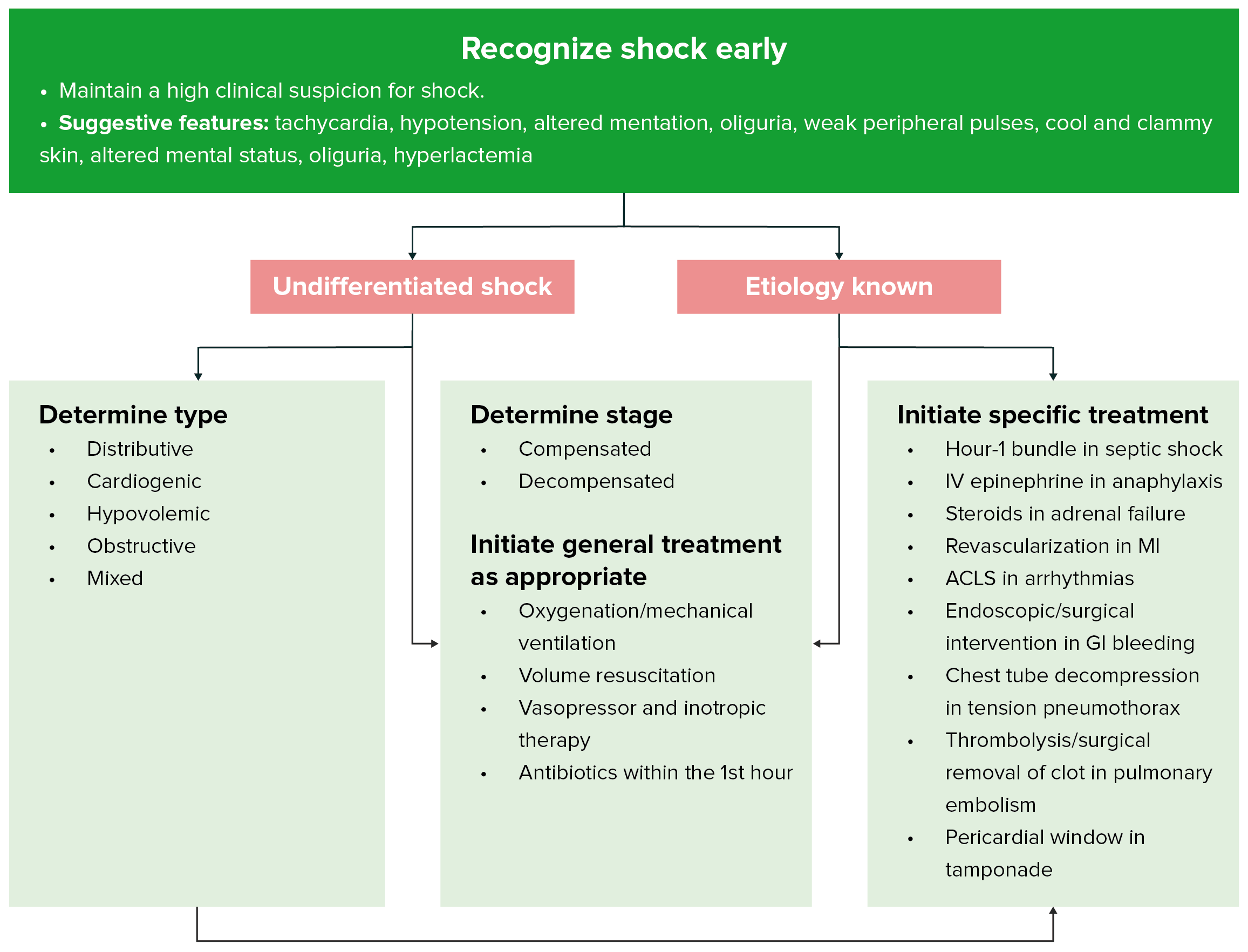
Abordaje del shock: reconocer el shock a tiempo

Abordaje al shock

Imagen por Lecturio.
Soporte respiratorio

  • Indicaciones de intubación endotraqueal y soporte ventilatorio mecánico:
    • Hipoxemia significativa (PaO2 < 60 mm Hg o saturación de oxígeno < 90%)
    • Hipoventilación (aumento de la presión parcial de dióxido de carbono (pCO2))
    • Alteración significativa del nivel de conciencia
    • Incapacidad de proteger la vía aérea con riesgo de aspiración
    • Acidosis Acidosis A pathologic condition of acid accumulation or depletion of base in the body. The two main types are respiratory acidosis and metabolic acidosis, due to metabolic acid build up. Respiratory Acidosis metabólica persistente con pH pH The quantitative measurement of the acidity or basicity of a solution. Acid-Base Balance < 7,20
  • Objetivo: saturación arterial de oxígeno del 92%95%

Monitoreo

  • Acceso venoso periférico: para una posible terapia con líquidos y antibióticos
  • Colocación del catéter venoso central:
    • Considerar si la reanimación es inadecuada a través de accesos periféricos.
    • Aplicaciones:
      • Administración agresiva de líquidos
      • Terapia vasopresora
      • Monitoreo hemodinámico (modo para medir la oxigenación venosa central y la presión de enclavamiento capilar pulmonar a través de un catéter de Swan-Ganz)
  • Dispositivo intraóseo: para acceso venoso central rápido en EN Erythema nodosum is an immune-mediated panniculitis (inflammation of the subcutaneous fat) caused by a type IV (delayed-type) hypersensitivity reaction. It commonly manifests in young women as tender, erythematous nodules on the shins. Erythema Nodosum individuos críticos
  • Vía arterial:
    • Para el monitoreo continuo de la presión arterial
    • Para el monitoreo continuo de la tensión de oxígeno, ya que la oximetría periférica puede ser poco fiable durante la hipoperfusión
    • Para las mediciones repetidas del estado ácido-base y del lactato
  • Colocación de una sonda urinaria: para la monitorización hemodinámica mediante la diuresis horaria

Reanimación con líquidos

  • Monitoreo estrecho del estado del volumen con ajuste frecuente de la terapia según sea necesario
  • Líquidos intravenosos (principalmente cristaloides):
    • La mayoría de los LOS Neisseria individuos con shock Shock Shock is a life-threatening condition associated with impaired circulation that results in tissue hypoxia. The different types of shock are based on the underlying cause: distributive (↑ cardiac output (CO), ↓ systemic vascular resistance (SVR)), cardiogenic (↓ CO, ↑ SVR), hypovolemic (↓ CO, ↑ SVR), obstructive (↓ CO), and mixed. Types of Shock indiferenciado
    • Todos los LOS Neisseria individuos con shock Shock Shock is a life-threatening condition associated with impaired circulation that results in tissue hypoxia. The different types of shock are based on the underlying cause: distributive (↑ cardiac output (CO), ↓ systemic vascular resistance (SVR)), cardiogenic (↓ CO, ↑ SVR), hypovolemic (↓ CO, ↑ SVR), obstructive (↓ CO), and mixed. Types of Shock hipovolémico y distributivo (e.g., 30 mL/kg en EN Erythema nodosum is an immune-mediated panniculitis (inflammation of the subcutaneous fat) caused by a type IV (delayed-type) hypersensitivity reaction. It commonly manifests in young women as tender, erythematous nodules on the shins. Erythema Nodosum shock Shock Shock is a life-threatening condition associated with impaired circulation that results in tissue hypoxia. The different types of shock are based on the underlying cause: distributive (↑ cardiac output (CO), ↓ systemic vascular resistance (SVR)), cardiogenic (↓ CO, ↑ SVR), hypovolemic (↓ CO, ↑ SVR), obstructive (↓ CO), and mixed. Types of Shock séptico)
    • Algunos individuos con shock Shock Shock is a life-threatening condition associated with impaired circulation that results in tissue hypoxia. The different types of shock are based on the underlying cause: distributive (↑ cardiac output (CO), ↓ systemic vascular resistance (SVR)), cardiogenic (↓ CO, ↑ SVR), hypovolemic (↓ CO, ↑ SVR), obstructive (↓ CO), and mixed. Types of Shock cardiogénico (e.g., infarto agudo del ventrículo derecho)
  • Hemoderivados:
    • Concentrado de eritrocitos: shock Shock Shock is a life-threatening condition associated with impaired circulation that results in tissue hypoxia. The different types of shock are based on the underlying cause: distributive (↑ cardiac output (CO), ↓ systemic vascular resistance (SVR)), cardiogenic (↓ CO, ↑ SVR), hypovolemic (↓ CO, ↑ SVR), obstructive (↓ CO), and mixed. Types of Shock hipovolémico y hemorragia activa
    • Plasma Plasma The residual portion of blood that is left after removal of blood cells by centrifugation without prior blood coagulation. Transfusion Products fresco congelado (PFC) y plaquetas:
      • Transfusiones masivas
      • Coagulopatía
  • Métodos de monitoreo no invasivos que indican un estado de respuesta al AL Amyloidosis volumen:
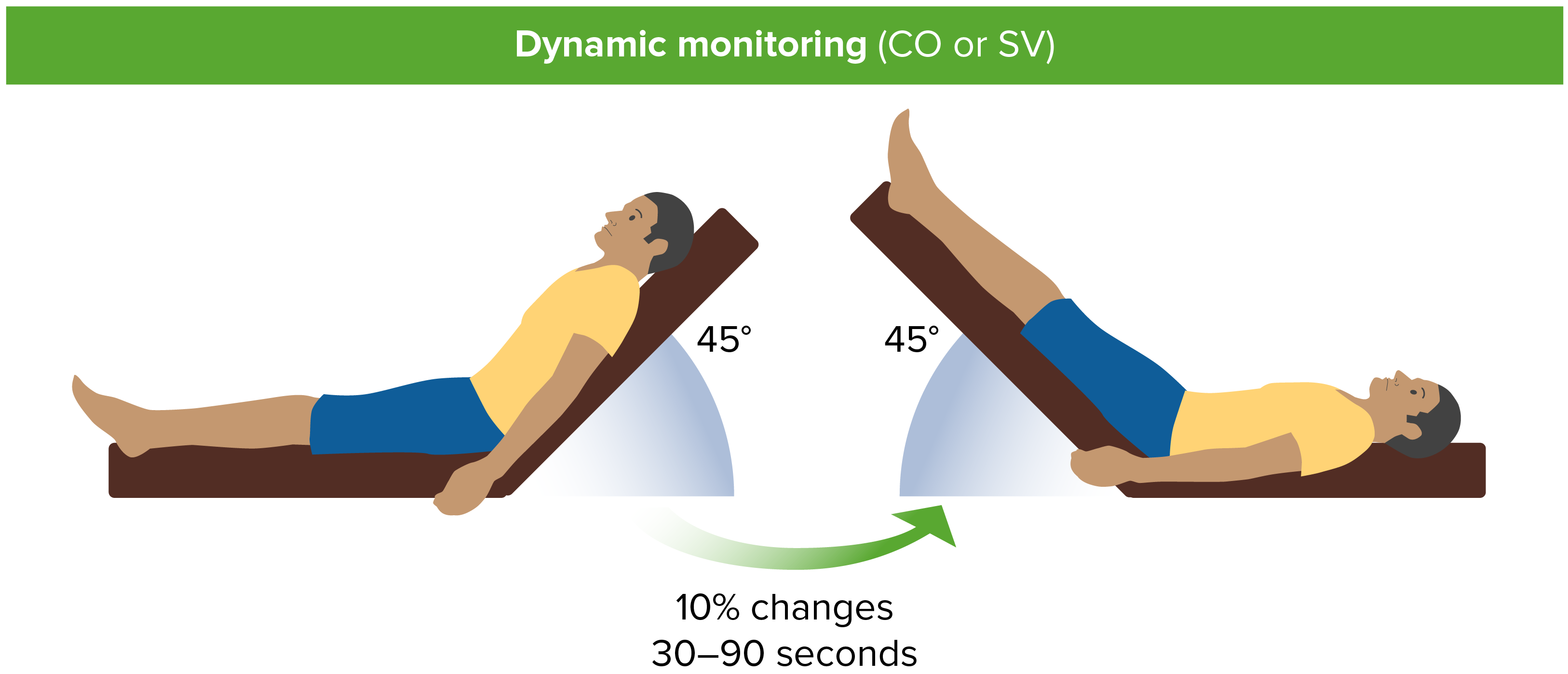
    • Elevación pasiva de las piernas: cambio significativo de la presión de pulso o del gasto cardíaco (¡no de la presión sanguínea!) después de administrar un bolo de líquidos y reposicionar al AL Amyloidosis individuo desde una posición reclinada con una elevación de la cabeza de 45 grados a Trendelenburg con una elevación de las piernas de 45 grados
    • Variación significativa de la presión del pulso o del volumen sistólico durante el ciclo respiratorio en EN Erythema nodosum is an immune-mediated panniculitis (inflammation of the subcutaneous fat) caused by a type IV (delayed-type) hypersensitivity reaction. It commonly manifests in young women as tender, erythematous nodules on the shins. Erythema Nodosum un individuo intubado
    • Ultrasonido cardíaco: reducción del diámetro de la vena cava inferior y colapso de la vena cava inferior, evaluación seriada de la función del ventrículo izquierdo
  • Métodos invasivos como el catéter de Swan-Ganz para la presión de enclavamiento capilar pulmonar: ya no se recomiendan para el monitoreo rutinario del estado de volumen en EN Erythema nodosum is an immune-mediated panniculitis (inflammation of the subcutaneous fat) caused by a type IV (delayed-type) hypersensitivity reaction. It commonly manifests in young women as tender, erythematous nodules on the shins. Erythema Nodosum el shock Shock Shock is a life-threatening condition associated with impaired circulation that results in tissue hypoxia. The different types of shock are based on the underlying cause: distributive (↑ cardiac output (CO), ↓ systemic vascular resistance (SVR)), cardiogenic (↓ CO, ↑ SVR), hypovolemic (↓ CO, ↑ SVR), obstructive (↓ CO), and mixed. Types of Shock porque la evaluación hemodinámica puede hacerse generalmente de forma no invasiva
Control dinámico (gasto cardíaco o volumen sistólico)

Elevación pasiva de piernas. CO: gasto cardíaco (por sus siglas en inglés); SV: volumen sistólico (por sus siglas en inglés).

Imagen por Lecturio.

Tratamiento farmacológico

  • Terapia vasopresora e inotrópica:
    • Si la hipotensión se mantiene a pesar de la restauración del volumen intravascular con líquidos
    • Shock Shock Shock is a life-threatening condition associated with impaired circulation that results in tissue hypoxia. The different types of shock are based on the underlying cause: distributive (↑ cardiac output (CO), ↓ systemic vascular resistance (SVR)), cardiogenic (↓ CO, ↑ SVR), hypovolemic (↓ CO, ↑ SVR), obstructive (↓ CO), and mixed. Types of Shock distributivo (más comúnmente séptico): norepinefrina (1ra línea), vasopresina (2da línea)
    • Shock Shock Shock is a life-threatening condition associated with impaired circulation that results in tissue hypoxia. The different types of shock are based on the underlying cause: distributive (↑ cardiac output (CO), ↓ systemic vascular resistance (SVR)), cardiogenic (↓ CO, ↑ SVR), hypovolemic (↓ CO, ↑ SVR), obstructive (↓ CO), and mixed. Types of Shock cardiogénico: dobutamina
    • Shock Shock Shock is a life-threatening condition associated with impaired circulation that results in tissue hypoxia. The different types of shock are based on the underlying cause: distributive (↑ cardiac output (CO), ↓ systemic vascular resistance (SVR)), cardiogenic (↓ CO, ↑ SVR), hypovolemic (↓ CO, ↑ SVR), obstructive (↓ CO), and mixed. Types of Shock mixto distributivo y cardiogénico: norepinefrina + dobutamina
  • Antibióticos:
    • Obtener hemocultivos.
    • Administrar antibióticos dentro de la 1ra hora después del diagnóstico de shock Shock Shock is a life-threatening condition associated with impaired circulation that results in tissue hypoxia. The different types of shock are based on the underlying cause: distributive (↑ cardiac output (CO), ↓ systemic vascular resistance (SVR)), cardiogenic (↓ CO, ↑ SVR), hypovolemic (↓ CO, ↑ SVR), obstructive (↓ CO), and mixed. Types of Shock.
    • Suspender los LOS Neisseria antibióticos si se excluye la sepsis Sepsis Systemic inflammatory response syndrome with a proven or suspected infectious etiology. When sepsis is associated with organ dysfunction distant from the site of infection, it is called severe sepsis. When sepsis is accompanied by hypotension despite adequate fluid infusion, it is called septic shock. Sepsis and Septic Shock.
  • Terapias específicas:
    • Shock Shock Shock is a life-threatening condition associated with impaired circulation that results in tissue hypoxia. The different types of shock are based on the underlying cause: distributive (↑ cardiac output (CO), ↓ systemic vascular resistance (SVR)), cardiogenic (↓ CO, ↑ SVR), hypovolemic (↓ CO, ↑ SVR), obstructive (↓ CO), and mixed. Types of Shock distributivo por anafilaxia:
      • Eliminación del alérgeno
      • Epinefrina
      • Líquidos intravenosos y vasopresores
    • Shock Shock Shock is a life-threatening condition associated with impaired circulation that results in tissue hypoxia. The different types of shock are based on the underlying cause: distributive (↑ cardiac output (CO), ↓ systemic vascular resistance (SVR)), cardiogenic (↓ CO, ↑ SVR), hypovolemic (↓ CO, ↑ SVR), obstructive (↓ CO), and mixed. Types of Shock distributivo por insuficiencia suprarrenal: dosis altas de esteroides
    • Shock Shock Shock is a life-threatening condition associated with impaired circulation that results in tissue hypoxia. The different types of shock are based on the underlying cause: distributive (↑ cardiac output (CO), ↓ systemic vascular resistance (SVR)), cardiogenic (↓ CO, ↑ SVR), hypovolemic (↓ CO, ↑ SVR), obstructive (↓ CO), and mixed. Types of Shock cardiogénico por infarto del miocardio: revascularización
    • Shock Shock Shock is a life-threatening condition associated with impaired circulation that results in tissue hypoxia. The different types of shock are based on the underlying cause: distributive (↑ cardiac output (CO), ↓ systemic vascular resistance (SVR)), cardiogenic (↓ CO, ↑ SVR), hypovolemic (↓ CO, ↑ SVR), obstructive (↓ CO), and mixed. Types of Shock cardiogénico por arritmias: soporte vital cardíaco avanzado incluyendo cardioversión y colocación de marcapasos temporal
    • Shock Shock Shock is a life-threatening condition associated with impaired circulation that results in tissue hypoxia. The different types of shock are based on the underlying cause: distributive (↑ cardiac output (CO), ↓ systemic vascular resistance (SVR)), cardiogenic (↓ CO, ↑ SVR), hypovolemic (↓ CO, ↑ SVR), obstructive (↓ CO), and mixed. Types of Shock hipovolémico por hemorragia digestiva: intervención endoscópica o quirúrgica
    • Shock Shock Shock is a life-threatening condition associated with impaired circulation that results in tissue hypoxia. The different types of shock are based on the underlying cause: distributive (↑ cardiac output (CO), ↓ systemic vascular resistance (SVR)), cardiogenic (↓ CO, ↑ SVR), hypovolemic (↓ CO, ↑ SVR), obstructive (↓ CO), and mixed. Types of Shock obstructivo por neumotórax a tensión: descompresión inmediata con colocación de un drenaje pleural
    • Shock Shock Shock is a life-threatening condition associated with impaired circulation that results in tissue hypoxia. The different types of shock are based on the underlying cause: distributive (↑ cardiac output (CO), ↓ systemic vascular resistance (SVR)), cardiogenic (↓ CO, ↑ SVR), hypovolemic (↓ CO, ↑ SVR), obstructive (↓ CO), and mixed. Types of Shock obstructivo debido a embolia pulmonar masiva: terapia trombolítica o remoción quirúrgica del coágulo
    • Shock Shock Shock is a life-threatening condition associated with impaired circulation that results in tissue hypoxia. The different types of shock are based on the underlying cause: distributive (↑ cardiac output (CO), ↓ systemic vascular resistance (SVR)), cardiogenic (↓ CO, ↑ SVR), hypovolemic (↓ CO, ↑ SVR), obstructive (↓ CO), and mixed. Types of Shock obstructivo debido a taponamiento pericárdico:

Referencias

  1. Kasper DL, Fausi AS, Hauser SL, Longo DL, Lameson JL, Loscalzo J. Harrison’s Principles of Internal Medicine. New York, NY: McGraw-Hill Education; 2018.
  2. Gaieski DF, Mikkelsen ME. Evaluation of and initial approach to the adult patient with undifferentiated hypotension and shock. In: UpToDate, Post, TW (Ed), UpToDate, Waltham, MA, 2020.

¡Crea tu cuenta gratis o inicia una sesión para seguir leyendo!

Regístrate ahora y obtén acceso gratuito a Lecturio con páginas de concepto, videos médicos y cuestionarios para tu educación médica.

User Reviews

Que tengas una sesión de estudio alegre y navideña 🎁 Ahorra 50% en todos los planes >>

Details