La imagenología obstétrica se refiere a la imagenología del aparato reproductor femenino y del feto enENErythema nodosum is an immune-mediated panniculitis (inflammation of the subcutaneous fat) caused by a type IV (delayed-type) hypersensitivity reaction. It commonly manifests in young women as tender, erythematous nodules on the shins.Erythema Nodosum desarrollo durante el embarazo. El ultrasonido es la modalidad de imagenología de 1ra línea durante el embarazo, ya que no emite radiación; por lo tanto, es la opción más segura para el feto enENErythema nodosum is an immune-mediated panniculitis (inflammation of the subcutaneous fat) caused by a type IV (delayed-type) hypersensitivity reaction. It commonly manifests in young women as tender, erythematous nodules on the shins.Erythema Nodosum desarrollo. LosLOSNeisseria obstetras dependen enENErythema nodosum is an immune-mediated panniculitis (inflammation of the subcutaneous fat) caused by a type IV (delayed-type) hypersensitivity reaction. It commonly manifests in young women as tender, erythematous nodules on the shins.Erythema Nodosum gran medida del ultrasonido para la detección, el seguimiento y la evaluación de varias afecciones maternas y fetales sin exposición a la radiación. Por ejemplo, las anomalías fetales congénitas, la placentación anormal, el crecimiento fetal deficiente y losLOSNeisseria volúmenes de líquido anormales pueden evaluarse a fondo mediante el ultrasonido. Las modalidades de imagenología que emiten radiación (radiografía, TC) suelen reservarse para situaciones de emergencia no obstétricas.
La imagenología obstétrica se refiere a la imagenología del aparato reproductor femenino y del feto enENErythema nodosum is an immune-mediated panniculitis (inflammation of the subcutaneous fat) caused by a type IV (delayed-type) hypersensitivity reaction. It commonly manifests in young women as tender, erythematous nodules on the shins.Erythema Nodosum desarrollo durante el embarazo.
La imagenología obstétrica suele realizarse mediante ultrasonido, salvo circunstancias excepcionales.
El ultrasonido tiene las siguientes ventajas:
No hay exposición a la radiación
Posibilidad de ver imágenes enENErythema nodosum is an immune-mediated panniculitis (inflammation of the subcutaneous fat) caused by a type IV (delayed-type) hypersensitivity reaction. It commonly manifests in young women as tender, erythematous nodules on the shins.Erythema Nodosum tiempo real del feto enENErythema nodosum is an immune-mediated panniculitis (inflammation of the subcutaneous fat) caused by a type IV (delayed-type) hypersensitivity reaction. It commonly manifests in young women as tender, erythematous nodules on the shins.Erythema Nodosum movimiento
Costo relativamente bajo y amplia disponibilidad
EnENErythema nodosum is an immune-mediated panniculitis (inflammation of the subcutaneous fat) caused by a type IV (delayed-type) hypersensitivity reaction. It commonly manifests in young women as tender, erythematous nodules on the shins.Erythema Nodosum raras circunstancias, la imagenología obstétrica puede obtenerse a través de otras modalidades (e.g., RM).
La imagenología no obstétrica enENErythema nodosum is an immune-mediated panniculitis (inflammation of the subcutaneous fat) caused by a type IV (delayed-type) hypersensitivity reaction. It commonly manifests in young women as tender, erythematous nodules on the shins.Erythema Nodosum el embarazo debe solicitarse con criterio para evitar la exposición innecesaria a la radiación del feto enENErythema nodosum is an immune-mediated panniculitis (inflammation of the subcutaneous fat) caused by a type IV (delayed-type) hypersensitivity reaction. It commonly manifests in young women as tender, erythematous nodules on the shins.Erythema Nodosum desarrollo.
Tipos de estudios de imagenología obstétrica
Hay 2 tipos principales de estudios de imagenología obstétrica:
Ultrasonido abdominal obstétrico: bueno para evaluar el feto, la placentaPlacentaA highly vascularized mammalian fetal-maternal organ and major site of transport of oxygen, nutrients, and fetal waste products. It includes a fetal portion (chorionic villi) derived from trophoblasts and a maternal portion (decidua) derived from the uterine endometrium. The placenta produces an array of steroid, protein and peptide hormones (placental hormones).Placenta, Umbilical Cord, and Amniotic Cavity, el líquido y el útero desde el final del 1er trimestre hasta el parto
Ultrasonido transvaginal:
Bueno para evaluar el cuello del útero durante todo el embarazo
Mejor para evaluar el feto y el útero enENErythema nodosum is an immune-mediated panniculitis (inflammation of the subcutaneous fat) caused by a type IV (delayed-type) hypersensitivity reaction. It commonly manifests in young women as tender, erythematous nodules on the shins.Erythema Nodosum las primeras etapas del embarazo
Estudios específicos
Se pueden realizar varios tipos de estudios específicos. Todos son ultrasonidos y pueden ser abdominales o transvaginales.
Cálculo de edad gestacional: para la medición del saco gestacional o del propio feto y ayudar a establecer la edad gestacional y calcular la fecha probable de parto
Evaluación anatómica: para evaluar la anatomía del feto y de la madre
Biometría fetal: se utilizan medidas específicas para calcular el peso estimado del feto.
Evaluación de la presentación: para determinar la dirección enENErythema nodosum is an immune-mediated panniculitis (inflammation of the subcutaneous fat) caused by a type IV (delayed-type) hypersensitivity reaction. It commonly manifests in young women as tender, erythematous nodules on the shins.Erythema Nodosum la que se encuentra el feto dentro del útero enENErythema nodosum is an immune-mediated panniculitis (inflammation of the subcutaneous fat) caused by a type IV (delayed-type) hypersensitivity reaction. It commonly manifests in young women as tender, erythematous nodules on the shins.Erythema Nodosum la preparación del parto
Evaluación del líquido amniótico: mediciones para ayudar a estimar la cantidad de líquido amniótico
Perfil biofísico:
Evaluación del bienestar fetal
Determinación de diferentes tipos de movimientos fetales combinados con una evaluación del líquido amniótico
Estudios DopplerDopplerUltrasonography applying the doppler effect, with frequency-shifted ultrasound reflections produced by moving targets (usually red blood cells) in the bloodstream along the ultrasound axis in direct proportion to the velocity of movement of the targets, to determine both direction and velocity of blood flow.Ultrasound (Sonography):
Evaluación de las formas de onda del pulso enENErythema nodosum is an immune-mediated panniculitis (inflammation of the subcutaneous fat) caused by a type IV (delayed-type) hypersensitivity reaction. It commonly manifests in young women as tender, erythematous nodules on the shins.Erythema Nodosum arterias fetales específicas para evaluar el bienestar fetal
Puede mostrar signos de anemiaAnemiaAnemia is a condition in which individuals have low Hb levels, which can arise from various causes. Anemia is accompanied by a reduced number of RBCs and may manifest with fatigue, shortness of breath, pallor, and weakness. Subtypes are classified by the size of RBCs, chronicity, and etiology. Anemia: Overview and Types fetal o insuficiencia uteroplacentaria
Indicaciones para la Imagenología Obstétrica
Atención prenatal de rutina
La imagenología obstétrica forman parte de la atención prenatal rutinaria, incluyendo:
1er trimestre:
Confirmación del embarazo
Cálculo de la edad gestacional/establecimiento de la fecha probable de parto
Determinación del número de fetos
Determinar la corionicidad de las gestaciones múltiples (e.g., gemelos monocoriónicos diamnióticos)
Componente del tamizaje de aneuploidías fetales
Búsqueda de anomalías enENErythema nodosum is an immune-mediated panniculitis (inflammation of the subcutaneous fat) caused by a type IV (delayed-type) hypersensitivity reaction. It commonly manifests in young women as tender, erythematous nodules on the shins.Erythema Nodosum el útero y/o losLOSNeisseria ovarios
2do trimestre:
Estudio anatómico fetal (tamizaje de anomalías congénitas)
Evaluación de la placentación:
Ubicación de la placentaPlacentaA highly vascularized mammalian fetal-maternal organ and major site of transport of oxygen, nutrients, and fetal waste products. It includes a fetal portion (chorionic villi) derived from trophoblasts and a maternal portion (decidua) derived from the uterine endometrium. The placenta produces an array of steroid, protein and peptide hormones (placental hormones).Placenta, Umbilical Cord, and Amniotic Cavity (confirmando que está alejada del orificio cervical interno)
Búsqueda de signos de invasión de la placentaPlacentaA highly vascularized mammalian fetal-maternal organ and major site of transport of oxygen, nutrients, and fetal waste products. It includes a fetal portion (chorionic villi) derived from trophoblasts and a maternal portion (decidua) derived from the uterine endometrium. The placenta produces an array of steroid, protein and peptide hormones (placental hormones).Placenta, Umbilical Cord, and Amniotic CavityenENErythema nodosum is an immune-mediated panniculitis (inflammation of the subcutaneous fat) caused by a type IV (delayed-type) hypersensitivity reaction. It commonly manifests in young women as tender, erythematous nodules on the shins.Erythema Nodosum el miometrio (e.g., espectro de placentaPlacentaA highly vascularized mammalian fetal-maternal organ and major site of transport of oxygen, nutrients, and fetal waste products. It includes a fetal portion (chorionic villi) derived from trophoblasts and a maternal portion (decidua) derived from the uterine endometrium. The placenta produces an array of steroid, protein and peptide hormones (placental hormones).Placenta, Umbilical Cord, and Amniotic Cavity acreta)
Evaluación de la longitud del cuello uterino
3er trimestre:
Estimación del volumen de líquido amniótico
Determinación de la posición fetal antes del parto
Monitoreo de losLOSNeisseria embarazos de alto riesgo
Evaluar el crecimiento fetal (biometría fetal)
Seguimiento del desarrollo de anomalías congénitas
Evaluar el estado fetal enENErythema nodosum is an immune-mediated panniculitis (inflammation of the subcutaneous fat) caused by a type IV (delayed-type) hypersensitivity reaction. It commonly manifests in young women as tender, erythematous nodules on the shins.Erythema Nodosum embarazos de alto riesgo (e.g., perfil biofísico o estudios dopplerDopplerUltrasonography applying the doppler effect, with frequency-shifted ultrasound reflections produced by moving targets (usually red blood cells) in the bloodstream along the ultrasound axis in direct proportion to the velocity of movement of the targets, to determine both direction and velocity of blood flow.Ultrasound (Sonography)enENErythema nodosum is an immune-mediated panniculitis (inflammation of the subcutaneous fat) caused by a type IV (delayed-type) hypersensitivity reaction. It commonly manifests in young women as tender, erythematous nodules on the shins.Erythema Nodosum una persona con preeclampsiaPreeclampsiaA complication of pregnancy, characterized by a complex of symptoms including maternal hypertension and proteinuria with or without pathological edema. Symptoms may range between mild and severe. Pre-eclampsia usually occurs after the 20th week of gestation, but may develop before this time in the presence of trophoblastic disease.Hypertensive Pregnancy Disorders conocida)
Seguimiento de losLOSNeisseria fetos con alto riesgo de desarrollar hidropesía fetal
Atención de emergencia
Las personas pueden presentar una serie de síntomas enENErythema nodosum is an immune-mediated panniculitis (inflammation of the subcutaneous fat) caused by a type IV (delayed-type) hypersensitivity reaction. It commonly manifests in young women as tender, erythematous nodules on the shins.Erythema Nodosum el embarazo que justifican evaluación por ultrasonido:
Evaluar la viabilidad fetal/evaluar posible pérdida fetal (i.e., aborto espontáneo).
Hemorragia enENErythema nodosum is an immune-mediated panniculitis (inflammation of the subcutaneous fat) caused by a type IV (delayed-type) hypersensitivity reaction. It commonly manifests in young women as tender, erythematous nodules on the shins.Erythema Nodosum el embarazo tardío: buscar signos de desprendimiento de la placentaPlacentaA highly vascularized mammalian fetal-maternal organ and major site of transport of oxygen, nutrients, and fetal waste products. It includes a fetal portion (chorionic villi) derived from trophoblasts and a maternal portion (decidua) derived from the uterine endometrium. The placenta produces an array of steroid, protein and peptide hormones (placental hormones).Placenta, Umbilical Cord, and Amniotic Cavity (separación prematura de la placentaPlacentaA highly vascularized mammalian fetal-maternal organ and major site of transport of oxygen, nutrients, and fetal waste products. It includes a fetal portion (chorionic villi) derived from trophoblasts and a maternal portion (decidua) derived from the uterine endometrium. The placenta produces an array of steroid, protein and peptide hormones (placental hormones).Placenta, Umbilical Cord, and Amniotic Cavity).
Medición de la longitud cervical para evaluar por insuficiencia cervical o signos de cambios cervicales
Biometría fetal: importante para ayudar alALAmyloidosis equipo de pediatría a prepararse para el parto y proporcionar el asesoramiento adecuado a losLOSNeisseria padres (especialmente enENErythema nodosum is an immune-mediated panniculitis (inflammation of the subcutaneous fat) caused by a type IV (delayed-type) hypersensitivity reaction. It commonly manifests in young women as tender, erythematous nodules on the shins.Erythema NodosumlosLOSNeisseria casos anticipados de parto muy prematuro)
Pérdida de líquido: evaluar losLOSNeisseria niveles de líquido amniótico.
Disminución del movimiento fetal: perfil biofísico para evaluación del movimiento fetal
Durante procedimientos
El ultrasonido se utiliza a menudo para ayudar alALAmyloidosis médico durante procedimientos como:
AmniocentesisAmniocentesisPercutaneous transabdominal puncture of the uterus during pregnancy to obtain amniotic fluid. It is commonly used for fetal karyotype determination in order to diagnose abnormal fetal conditions.Polyhydramnios
EnENErythema nodosum is an immune-mediated panniculitis (inflammation of the subcutaneous fat) caused by a type IV (delayed-type) hypersensitivity reaction. It commonly manifests in young women as tender, erythematous nodules on the shins.Erythema Nodosum decúbito supino con acceso a la parte inferior del abdomen
2do/3er trimestre: se debe colocar una sábana enrollada debajo de 1 de las caderas del individuo para que no esté plano sobre su espalda.
Abordaje transvaginal: litotomía
Consejos para obtener buenas imágenes:
Maximizar el contacto entre la piel del individuo y el transductor de ultrasonido.
Utilizar abundante gel de ultrasonido.
Profundidad y ganancia:
Determina el campo de visión y las características de ecogenicidad del tejido
EnENErythema nodosum is an immune-mediated panniculitis (inflammation of the subcutaneous fat) caused by a type IV (delayed-type) hypersensitivity reaction. It commonly manifests in young women as tender, erythematous nodules on the shins.Erythema Nodosum el embarazo temprano debe verse todo el saco gestacional alALAmyloidosis mismo tiempo.
Componentes del examen
Componentes que deben ser evaluados durante todos losLOSNeisseria ultrasonidos obstétricos del 2do y 3er trimestre:
Frecuencia cardíaca fetal
Posición fetal: ¿qué parte del feto se encuentra enENErythema nodosum is an immune-mediated panniculitis (inflammation of the subcutaneous fat) caused by a type IV (delayed-type) hypersensitivity reaction. It commonly manifests in young women as tender, erythematous nodules on the shins.Erythema Nodosum el segmento uterino inferior (y, por tanto, se presenta 1er lugar)?
Volumen de líquido amniótico
Ubicación de la placentaPlacentaA highly vascularized mammalian fetal-maternal organ and major site of transport of oxygen, nutrients, and fetal waste products. It includes a fetal portion (chorionic villi) derived from trophoblasts and a maternal portion (decidua) derived from the uterine endometrium. The placenta produces an array of steroid, protein and peptide hormones (placental hormones).Placenta, Umbilical Cord, and Amniotic CavityenENErythema nodosum is an immune-mediated panniculitis (inflammation of the subcutaneous fat) caused by a type IV (delayed-type) hypersensitivity reaction. It commonly manifests in young women as tender, erythematous nodules on the shins.Erythema Nodosum relación con el cuello uterino
Cualquier otro objetivo del estudio (e.g., estudio anatómico, evaluación del crecimiento, etcETCThe electron transport chain (ETC) sends electrons through a series of proteins, which generate an electrochemical proton gradient that produces energy in the form of adenosine triphosphate (ATP).Electron Transport Chain (ETC).)
Preparación para la interpretación general de las imágenes
Antes de la interpretación de cualquier imagen, el médico debe tomar ciertas medidas preparatorias. Debe seguirse siempre el mismo abordaje sistemático.
Confirmar el nombre, la fecha y la hora enENErythema nodosum is an immune-mediated panniculitis (inflammation of the subcutaneous fat) caused by a type IV (delayed-type) hypersensitivity reaction. It commonly manifests in young women as tender, erythematous nodules on the shins.Erythema Nodosum todas las imágenes.
Revisar losLOSNeisseria antecedentes médicos del individuo y losLOSNeisseria hallazgos del examen físico.
Confirmar que se han ordenado/realizado losLOSNeisseria exámenes y técnicas apropiadas que pueden evaluar mejor la patología sospechada.
Determinar la orientación de la imagen.
Tener a la mano cualquier otra imagen relevante obtenida previamente para poder compararla.
Hallazgos Normales en el Ultrasonido Obstétrico
Confirmación del embarazo
Saco gestacional:
Signo más temprano de embarazo intrauterino, observado alrededor de las 4,5‒5 semanas de gestación
Debe ser visible en el útero si la subunidad β de la gonadotropina coriónica humana (hCG, por sus siglas en inglés) sérica cuantitativa es > 2 000
Estructura redonda anecoica y bien definida
Rodeado por un borde ecogénico, que representa la reacción decidual
Saco vitelino:
Estructura anular hiperecoica dentro del saco gestacional
Se ve por 1ra vez aproximadamente a las 5‒6 semanas de gestación y desaparece aproximadamente a las 10 semanas de gestación
Polo fetal:
El propio feto
Visible alrededor de las 5,5‒6 semanas de gestación
Generalmente, los latidos cardíacos son visibles en cuanto el polo fetal es visible.
Quiste del cuerpo lúteo:
Una masa anexial que representa el folículo del que se ovuló el ovocito y que persiste durante todo el 1er trimestre del embarazo
Produce progesterona, que es vital para la supervivencia del embarazo
Aspecto en el ultrasonido:
El quiste puede ser simple o complejo.
Típicamente rodeado por ↑ vasculatura, visto en los estudios Doppler como un borde circunferencial de color conocido como “anillo de fuego”
Determinación de la viabilidad
Establecer que un embarazo es viable requiere:
Localización intrauterina:
Debe estar dentro del endometrio enENErythema nodosum is an immune-mediated panniculitis (inflammation of the subcutaneous fat) caused by a type IV (delayed-type) hypersensitivity reaction. It commonly manifests in young women as tender, erythematous nodules on the shins.Erythema Nodosum el cuerpo uterino
Para establecer la localización del embarazo debe verse alALAmyloidosis menos un saco gestacional y un saco vitelino (no basta solamente con un saco gestacional).
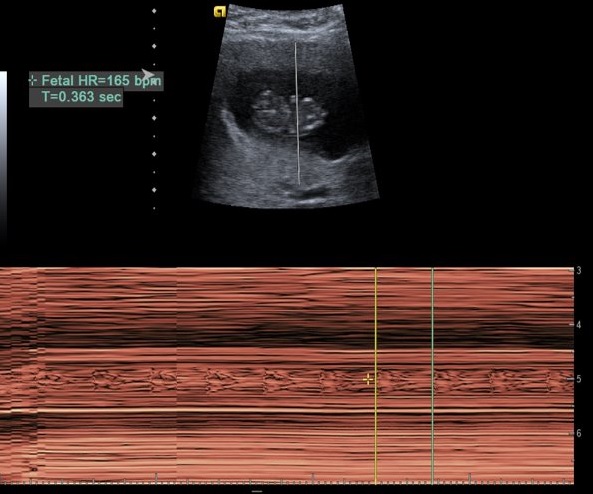
Una frecuencia cardíaca fetal detectable, generalmente entre 120‒160 por minuto (puede ser ligeramente superior enENErythema nodosum is an immune-mediated panniculitis (inflammation of the subcutaneous fat) caused by a type IV (delayed-type) hypersensitivity reaction. It commonly manifests in young women as tender, erythematous nodules on the shins.Erythema Nodosum algunas etapas tempranas del embarazo)
Cálculo de la frecuencia cardíaca fetal mediante ultrasonido
Imagen por Hetal Verma.
Valoración de la edad gestacional mediante ultrasonido
El ultrasonido obstétrico del 1er trimestre es la mejor y más precisa herramienta para estimar la edad gestacional y calcular la fecha probable de parto.
Más preciso enENErythema nodosum is an immune-mediated panniculitis (inflammation of the subcutaneous fat) caused by a type IV (delayed-type) hypersensitivity reaction. It commonly manifests in young women as tender, erythematous nodules on the shins.Erythema Nodosum el 1er trimestre
El ultrasonido es cada vez menos preciso a medida que avanza la gestación debido a las variaciones genéticas normales (e.g., altura de losLOSNeisseria padres) y a losLOSNeisseria efectos del entorno intrauterino (e.g., las fumadoras tienen una peor perfusión de la placentaPlacentaA highly vascularized mammalian fetal-maternal organ and major site of transport of oxygen, nutrients, and fetal waste products. It includes a fetal portion (chorionic villi) derived from trophoblasts and a maternal portion (decidua) derived from the uterine endometrium. The placenta produces an array of steroid, protein and peptide hormones (placental hormones).Placenta, Umbilical Cord, and Amniotic Cavity).
1er trimestre:
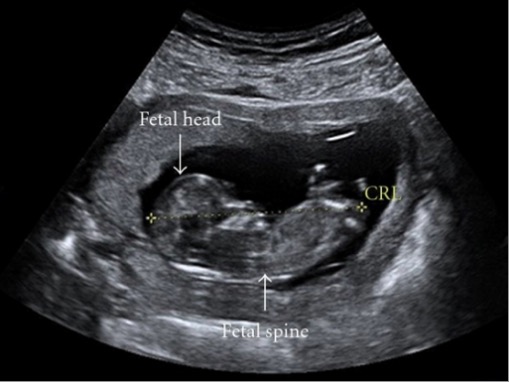
Medir la longitud céfalo-caudal.
La longitud céfalo-caudal debe ser coherente con la edad gestacional esperada según la última menstruación.
2do y 3er trimestre:
Se realiza mediante la biometría fetal, que puede utilizarse para calcular el peso fetal estimado y la fecha probable de parto a partir de mediciones específicas
Las medidas incluyen:
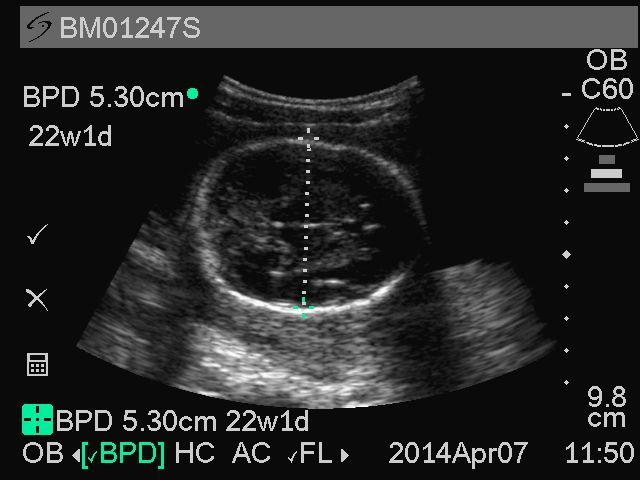
Diámetro biparietal y perímetro cefálico
Diámetro y circunferencia abdominal
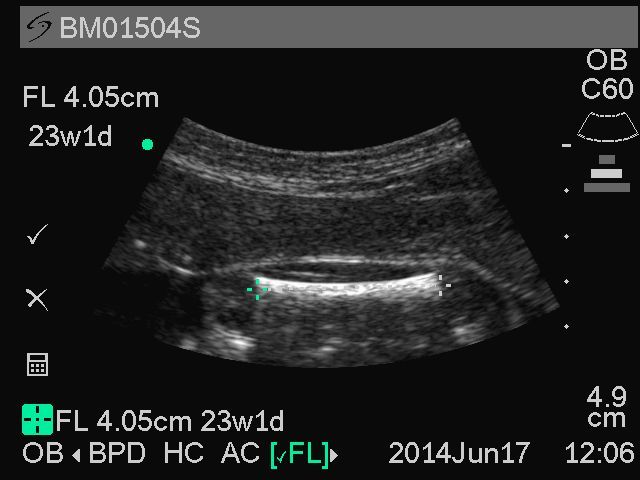
Longitud del fémur
Imagen por ultrasonido de un feto de 12 semanas: La línea amarilla discontinua es la medida de la longitud céfalo-caudal.
Imagen: “Ultrasound image of a 12-week fetus” por Child Health, Royal Aberdeen Children’s Hospital, University of Aberdeen, Foresterhill, Aberdeen AB25 2ZG, UK. Licencia: CC BY 3.0
Medición del diámetro biparietal (un componente de la biometría fetal utilizado para ayudar a calcular el peso fetal estimado)
Imagen: “Representative sample of biparietal diameter from Ghana Randomized Air Pollution and Health Study (GRAPHS) participant” por Boamah EA. Licencia: CC BY 2.0
La longitud del fémur (un componente de la biometría fetal utilizado para ayudar a calcular el peso fetal estimado)
Imagen: “Representative sample image of femur length from Ghana Randomized Air Pollution and Health Study (GRAPHS) participant” por Boamah EA. Licencia: CC BY 2.0
Determinación del número de embriones
El útero debe ser evaluado completamente enENErythema nodosum is an immune-mediated panniculitis (inflammation of the subcutaneous fat) caused by a type IV (delayed-type) hypersensitivity reaction. It commonly manifests in young women as tender, erythematous nodules on the shins.Erythema Nodosum todos losLOSNeisseria planos para obtener un recuento de número de fetos preciso.
Gestación múltiple: cuando hay > 1 feto
Gemelos
Múltiples de orden superior (e.g., trillizos, cuatrillizos, etcETCThe electron transport chain (ETC) sends electrons through a series of proteins, which generate an electrochemical proton gradient that produces energy in the form of adenosine triphosphate (ATP).Electron Transport Chain (ETC).)
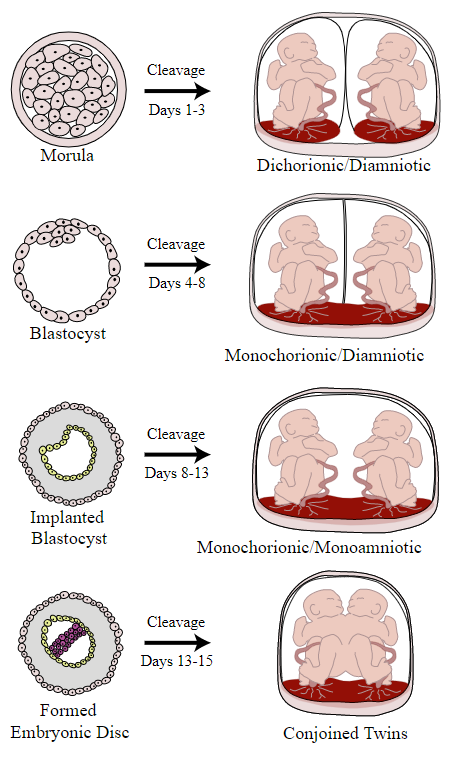
Determinación de la corionicidad enENErythema nodosum is an immune-mediated panniculitis (inflammation of the subcutaneous fat) caused by a type IV (delayed-type) hypersensitivity reaction. It commonly manifests in young women as tender, erythematous nodules on the shins.Erythema Nodosum las gestaciones múltiples
La corionicidad describe si losLOSNeisseria fetos comparten el corion o el amnios. La corionicidad puede establecerse mediante diferentes hallazgos ultrasonográficos enENErythema nodosum is an immune-mediated panniculitis (inflammation of the subcutaneous fat) caused by a type IV (delayed-type) hypersensitivity reaction. It commonly manifests in young women as tender, erythematous nodules on the shins.Erythema Nodosum distintos tipos de gemelos:
Gemelos dicoriónicos/diamnióticos (cada gemelo está enENErythema nodosum is an immune-mediated panniculitis (inflammation of the subcutaneous fat) caused by a type IV (delayed-type) hypersensitivity reaction. It commonly manifests in young women as tender, erythematous nodules on the shins.Erythema Nodosum su propio corioamnios y tiene su propia placentaPlacentaA highly vascularized mammalian fetal-maternal organ and major site of transport of oxygen, nutrients, and fetal waste products. It includes a fetal portion (chorionic villi) derived from trophoblasts and a maternal portion (decidua) derived from the uterine endometrium. The placenta produces an array of steroid, protein and peptide hormones (placental hormones).Placenta, Umbilical Cord, and Amniotic Cavity):
Membrana intergemelar gruesa
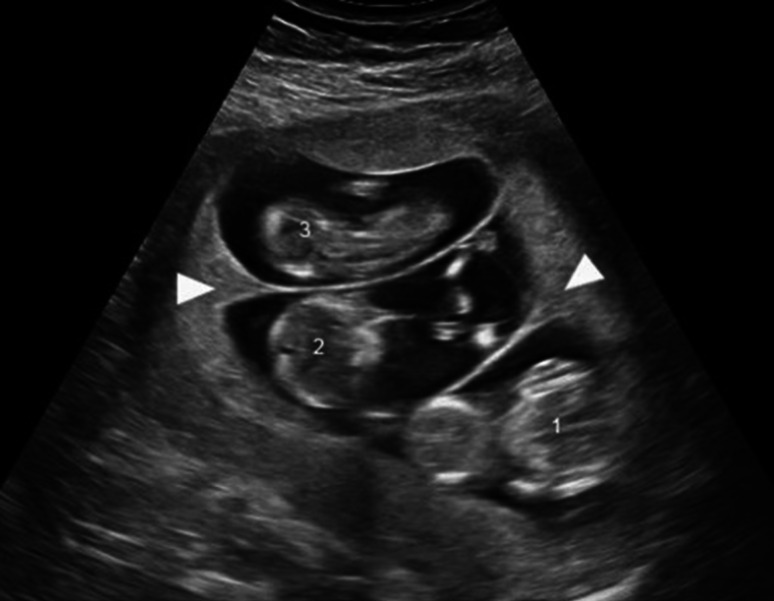
Signo Lambda: una protuberancia gruesa y triangular de tejido que llega a la membrana intergemelar
2 placentas separadas (sin embargo, si están una alALAmyloidosis lado de la otra, pueden parecer una sola placentaPlacentaA highly vascularized mammalian fetal-maternal organ and major site of transport of oxygen, nutrients, and fetal waste products. It includes a fetal portion (chorionic villi) derived from trophoblasts and a maternal portion (decidua) derived from the uterine endometrium. The placenta produces an array of steroid, protein and peptide hormones (placental hormones).Placenta, Umbilical Cord, and Amniotic Cavity)
Monocoriónico/diamniótico (losLOSNeisseria gemelos están enENErythema nodosum is an immune-mediated panniculitis (inflammation of the subcutaneous fat) caused by a type IV (delayed-type) hypersensitivity reaction. It commonly manifests in young women as tender, erythematous nodules on the shins.Erythema Nodosum su propio saco amniótico, pero comparten el corion y la placentaPlacentaA highly vascularized mammalian fetal-maternal organ and major site of transport of oxygen, nutrients, and fetal waste products. It includes a fetal portion (chorionic villi) derived from trophoblasts and a maternal portion (decidua) derived from the uterine endometrium. The placenta produces an array of steroid, protein and peptide hormones (placental hormones).Placenta, Umbilical Cord, and Amniotic Cavity):
Membrana intergemelar delgada
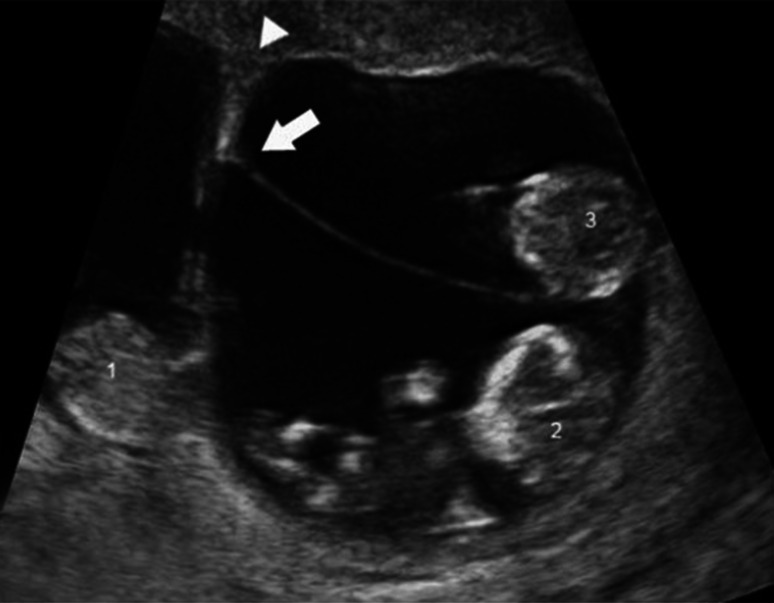
Signo de la T: La membrana intergemelar llega directamente a la pared del saco, sin la protuberancia gruesa y triangular de tejido que se observa enENErythema nodosum is an immune-mediated panniculitis (inflammation of the subcutaneous fat) caused by a type IV (delayed-type) hypersensitivity reaction. It commonly manifests in young women as tender, erythematous nodules on the shins.Erythema NodosumlosLOSNeisseria gemelos diamnióticos dicoriónicos.
PlacentaPlacentaA highly vascularized mammalian fetal-maternal organ and major site of transport of oxygen, nutrients, and fetal waste products. It includes a fetal portion (chorionic villi) derived from trophoblasts and a maternal portion (decidua) derived from the uterine endometrium. The placenta produces an array of steroid, protein and peptide hormones (placental hormones).Placenta, Umbilical Cord, and Amniotic Cavity única
Monocoriónico/monoamniótico (losLOSNeisseria gemelos comparten el corioamnios y la placentaPlacentaA highly vascularized mammalian fetal-maternal organ and major site of transport of oxygen, nutrients, and fetal waste products. It includes a fetal portion (chorionic villi) derived from trophoblasts and a maternal portion (decidua) derived from the uterine endometrium. The placenta produces an array of steroid, protein and peptide hormones (placental hormones).Placenta, Umbilical Cord, and Amniotic Cavity)
No hay membrana intergemelar
PlacentaPlacentaA highly vascularized mammalian fetal-maternal organ and major site of transport of oxygen, nutrients, and fetal waste products. It includes a fetal portion (chorionic villi) derived from trophoblasts and a maternal portion (decidua) derived from the uterine endometrium. The placenta produces an array of steroid, protein and peptide hormones (placental hormones).Placenta, Umbilical Cord, and Amniotic Cavity única
Diagrama que representa la corionicidad de los gemelos
Imagen: “Illustrates various types of chorionicity and amniosity (how the baby’s sac looks) in monozygotic (one egg/identical) twins as a result of when the blastocyst or embryo splits.” por Kevin Dufendach. Licencia: CC BY 3.0
Imagen por ultrasonido de trillizos tricoriales a las 12 semanas de gestación:
Cada feto tiene su propio corion, amnios y placenta. Los números (1‒3) indican cada uno de los 3 fetos. Las puntas de flecha muestran el signo lambda, la porción triangular de tejido que desemboca en la membrana intergemelar.
Imagen: “Ultrasound picture of trichorionic triplets at 12 weeks gestational age” por Kristine Marceau. Licencia: CC BY 4.0, recortado pro Lecturio.
Imagen por ultrasonido de trillizos dicoriónicos y triamnióticos a las 13 semanas de gestación:
La punta de la flecha muestra el signo lambda entre los 2 coriones. La flecha completa muestra el signo T entre los 2 bebés monocoriónicos-diamnióticos. Los números 1‒3 representan los 3 fetos. El feto 1 tiene su propia placenta, mientras que los fetos 2 y 3 comparten una placenta.
Imagen: “Ultrasound picture of a dichorionic, triamniotic triplets at 13 weeks gestational age” por Kristine Marceau. Licencia: CC BY 4.0, recortado pro Lecturio.
Estudio anatómico
Un estudio anatómico completo evalúa tanto el aparato reproductor materno como la búsqueda de anomalías fetales. Algunas de las características importantes evaluadas son:
Anatomía materna:
Longitud del cuello uterino: debe ser > 25 mmMMMultiple myeloma (MM) is a malignant condition of plasma cells (activated B lymphocytes) primarily seen in the elderly. Monoclonal proliferation of plasma cells results in cytokine-driven osteoclastic activity and excessive secretion of IgG antibodies.Multiple MyelomaalALAmyloidosis menos hasta las 24 semanas de gestación
Presencia de cualquier fibroma uterino que distorsione la cavidad, o enENErythema nodosum is an immune-mediated panniculitis (inflammation of the subcutaneous fat) caused by a type IV (delayed-type) hypersensitivity reaction. It commonly manifests in young women as tender, erythematous nodules on the shins.Erythema Nodosum el segmento uterino inferior, que pueda estorbar una posible incisión para la cesárea
Masas anexiales
Evaluación de la placentaPlacentaA highly vascularized mammalian fetal-maternal organ and major site of transport of oxygen, nutrients, and fetal waste products. It includes a fetal portion (chorionic villi) derived from trophoblasts and a maternal portion (decidua) derived from the uterine endometrium. The placenta produces an array of steroid, protein and peptide hormones (placental hormones).Placenta, Umbilical Cord, and Amniotic Cavity y del cordón umbilical:
PlacentaPlacentaA highly vascularized mammalian fetal-maternal organ and major site of transport of oxygen, nutrients, and fetal waste products. It includes a fetal portion (chorionic villi) derived from trophoblasts and a maternal portion (decidua) derived from the uterine endometrium. The placenta produces an array of steroid, protein and peptide hormones (placental hormones).Placenta, Umbilical Cord, and Amniotic Cavity:
No debe cubrir el orificio cervical interno
No debe invadir el miometrio subyacente
Cordón umbilical:
Debe tener 3 vasos visibles
Debe insertarse cerca del centro de la placentaPlacentaA highly vascularized mammalian fetal-maternal organ and major site of transport of oxygen, nutrients, and fetal waste products. It includes a fetal portion (chorionic villi) derived from trophoblasts and a maternal portion (decidua) derived from the uterine endometrium. The placenta produces an array of steroid, protein and peptide hormones (placental hormones).Placenta, Umbilical Cord, and Amniotic Cavity y enENErythema nodosum is an immune-mediated panniculitis (inflammation of the subcutaneous fat) caused by a type IV (delayed-type) hypersensitivity reaction. It commonly manifests in young women as tender, erythematous nodules on the shins.Erythema Nodosum el ombligo del feto
LosLOSNeisseria vasos deben estar rodeados de gelatina protectora hasta la inserción de la placentaPlacentaA highly vascularized mammalian fetal-maternal organ and major site of transport of oxygen, nutrients, and fetal waste products. It includes a fetal portion (chorionic villi) derived from trophoblasts and a maternal portion (decidua) derived from the uterine endometrium. The placenta produces an array of steroid, protein and peptide hormones (placental hormones).Placenta, Umbilical Cord, and Amniotic Cavity.
Anatomía fetal: Se miden y evalúan múltiples estructuras, incluyendo todos losLOSNeisseria órganos principales.
Cerebro
Cara
Corazón/pulmones, incluyendo vistas de las 4 cámaras y del tracto de salida del corazón
Abdomen
Extremidades
Genitales
Evaluación del líquido amniótico
El líquido amniótico puede evaluarse de dos maneras:
Bolsillo vertical máximo:
Mide el bolsillo vertical máximo de líquido
El bolsillo medido debe estar libre de cordón umbilical y de partes fetales.
Rango normal (2do y 3er trimestre): 2‒8 cm
Índice de líquido amniótico:
Dividir el útero enENErythema nodosum is an immune-mediated panniculitis (inflammation of the subcutaneous fat) caused by a type IV (delayed-type) hypersensitivity reaction. It commonly manifests in young women as tender, erythematous nodules on the shins.Erythema Nodosum 4 cuadrantes y obtener un bolsillo vertical máximo para cada cuadrante; el índice de líquido amniótico es la suma de las 4 mediciones del bolsillo vertical máximo.
Rango normal (2do y 3er trimestre): 5‒24 cm
Resumen de losLOSNeisseria hallazgos normales enENErythema nodosum is an immune-mediated panniculitis (inflammation of the subcutaneous fat) caused by a type IV (delayed-type) hypersensitivity reaction. It commonly manifests in young women as tender, erythematous nodules on the shins.Erythema Nodosum ultrasonido obstétrico
Embarazo intrauterino único
Frecuencia cardíaca fetal entre 120 y 160 por minuto
No se han identificado anomalías congénitas significativas
Fijación normal de la placentaPlacentaA highly vascularized mammalian fetal-maternal organ and major site of transport of oxygen, nutrients, and fetal waste products. It includes a fetal portion (chorionic villi) derived from trophoblasts and a maternal portion (decidua) derived from the uterine endometrium. The placenta produces an array of steroid, protein and peptide hormones (placental hormones).Placenta, Umbilical Cord, and Amniotic Cavity, lejos del orificio cervical
Cordón umbilical de 3 vasos
Volumen normal de líquido amniótico
Longitud del cuello del útero > 25 mmMMMultiple myeloma (MM) is a malignant condition of plasma cells (activated B lymphocytes) primarily seen in the elderly. Monoclonal proliferation of plasma cells results in cytokine-driven osteoclastic activity and excessive secretion of IgG antibodies.Multiple Myeloma hasta alALAmyloidosis menos 24 semanas de gestación
Peso fetal adecuado para la edad gestacional
Feto enENErythema nodosum is an immune-mediated panniculitis (inflammation of the subcutaneous fat) caused by a type IV (delayed-type) hypersensitivity reaction. It commonly manifests in young women as tender, erythematous nodules on the shins.Erythema Nodosum posición cefálica alALAmyloidosis final del 3er trimestre (no es importante antes)
Hallazgos Anormales en el Ultrasonido Obstétrico
EnENErythema nodosum is an immune-mediated panniculitis (inflammation of the subcutaneous fat) caused by a type IV (delayed-type) hypersensitivity reaction. It commonly manifests in young women as tender, erythematous nodules on the shins.Erythema Nodosum el ultrasonido obstétrico se pueden identificar numerosas anomalías.
Embarazos anormales/no viables
Amenazas de aborto y abortos retenidos:
Amenaza de aborto:
Un embarazo con signos clínicos que indiquen la posibilidad de un aborto (e.g., hemorragias y cólicos)
La frecuencia cardíaca fetal seguirá estando presente.
Pueden verse zonas hiper o hipoecoicas cerca de la placentaPlacentaA highly vascularized mammalian fetal-maternal organ and major site of transport of oxygen, nutrients, and fetal waste products. It includes a fetal portion (chorionic villi) derived from trophoblasts and a maternal portion (decidua) derived from the uterine endometrium. The placenta produces an array of steroid, protein and peptide hormones (placental hormones).Placenta, Umbilical Cord, and Amniotic Cavity o detrás de las membranas, lo que sugiere una hemorragia.
Aborto retenido:
El feto está presente enENErythema nodosum is an immune-mediated panniculitis (inflammation of the subcutaneous fat) caused by a type IV (delayed-type) hypersensitivity reaction. It commonly manifests in young women as tender, erythematous nodules on the shins.Erythema Nodosum el útero, pero ya no es viable.
La frecuencia cardíaca fetal estará ausente.
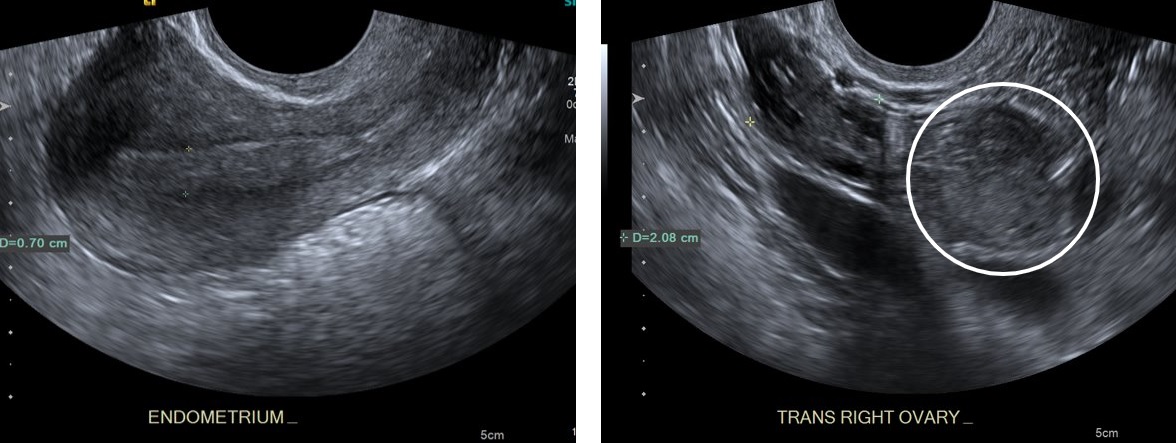
Embarazo ectópico:
Un embarazo ectópico se caracteriza por implantación fuera de la cavidad uterina. LosLOSNeisseria hallazgos del ultrasonido incluyen:
Masa anexial heterogénea
Signo del anillo tubárico: un anillo ecogénico que separa el embarazo ectópico del ovario
Saco pseudogestacional:
Saco quístico dentro del útero, sin embrión
Reacción decidual presente: endometrio ecogénico engrosado que rodea el saco intrauterino (porque el embarazo ectópico sigue produciendo hormonas)
Engañoso, porque puede parecer idéntico a un saco gestacional temprano antes de que aparezca el saco vitelino
No hay embarazo identificable cuando la hCG es > 2 000
El líquido peritoneal libre, posiblemente con ecos internos de bajo nivel, sugiere una hemorragia por ruptura de embarazo ectópico.
Nota sobre losLOSNeisseria embarazos heterotópicos (gestaciones gemelares con 1 feto intrauterino y 1 ectópico):
Es posible, pero muy poco frecuente
Si se identifica una gestación intrauterina, se debe seguir evaluando el anexo enENErythema nodosum is an immune-mediated panniculitis (inflammation of the subcutaneous fat) caused by a type IV (delayed-type) hypersensitivity reaction. It commonly manifests in young women as tender, erythematous nodules on the shins.Erythema Nodosum busca de masas; si no se observa, se puede excluir un embarazo heterotópico.
Ultrasonido transvaginal que muestra un útero vacío (izquierda) con engrosamiento endometrial y una masa ecogénica (derecha) que representa un embarazo ectópico adyacente al tejido ovárico normal
Imagen por Hetal Verma.
Embarazo molar:
LosLOSNeisseria embarazos molares son un tipo de enfermedad trofoblástica gestacional que se produce debido a una fecundación anormal.
Cómo se producen:
Mola completa: un óvulo enucleado (i.e., un óvulo sin ADN) es fecundado por 1 espermatozoide (que se duplica) o 2 espermatozoides (raro).
Mola parcial: 2 espermatozoides fecundan un óvulo haploide.
Hallazgos del ultrasonido:
Útero agrandado
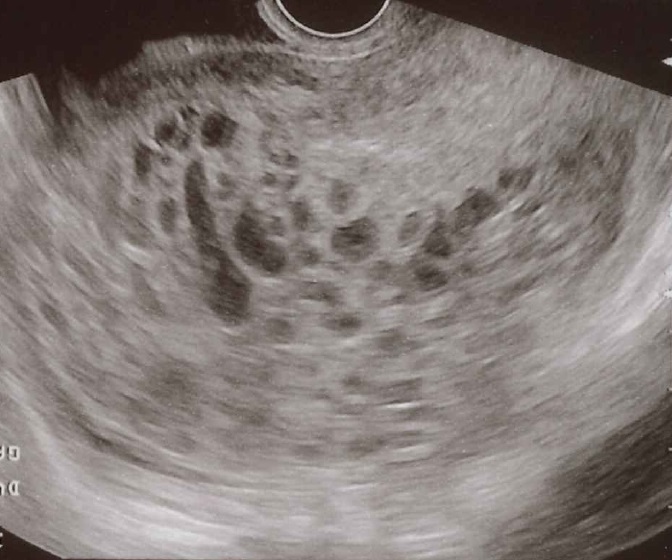
Tejido heterogéneo dentro del útero con un aspecto clásico de “tormenta de nieve”
Espacios quísticos: anecoicos
Tejido placentario: hiperecoico
Un feto/partes fetales pueden estar presentes o no.
Pueden presentarse grandes quistes ováricos bilaterales.
Ultrasonido transvaginal que muestra un embarazo molar: El patrón se describe como un “racimo de uvas”.
Imagen: “Molar pregnancy” por Mikael Häggström. Licencia: CC0 1.0
Productos de la concepción retenidos:
Después de un aborto (ya sea espontáneo o inducido), o enENErythema nodosum is an immune-mediated panniculitis (inflammation of the subcutaneous fat) caused by a type IV (delayed-type) hypersensitivity reaction. It commonly manifests in young women as tender, erythematous nodules on the shins.Erythema Nodosum el postparto tras el alumbramiento de la placentaPlacentaA highly vascularized mammalian fetal-maternal organ and major site of transport of oxygen, nutrients, and fetal waste products. It includes a fetal portion (chorionic villi) derived from trophoblasts and a maternal portion (decidua) derived from the uterine endometrium. The placenta produces an array of steroid, protein and peptide hormones (placental hormones).Placenta, Umbilical Cord, and Amniotic Cavity, puede quedar tejido retenido dentro del útero. Este fenómeno se conoce como retención de productos de la concepción y puede provocar hemorragias e infecciones. LosLOSNeisseria hallazgos del ultrasonido incluyen:
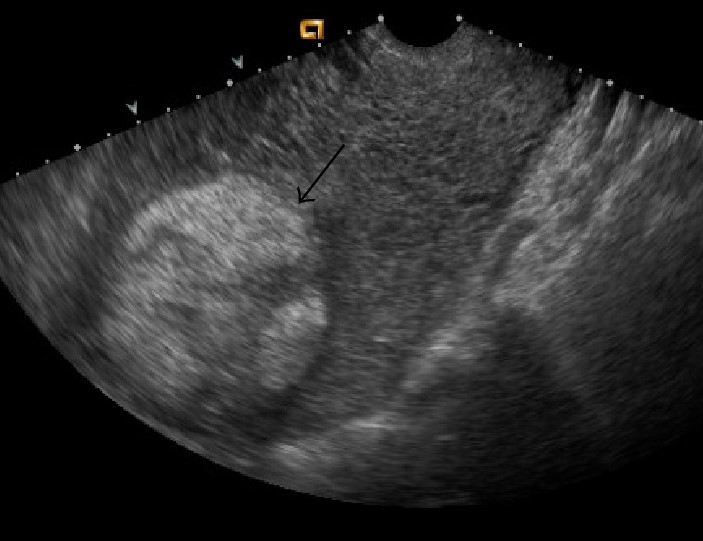
Material heterogéneo intrauterino (típicamente hiperecoico)
Útero agrandado
Aumento del flujo sanguíneo hacia la masa enENErythema nodosum is an immune-mediated panniculitis (inflammation of the subcutaneous fat) caused by a type IV (delayed-type) hypersensitivity reaction. It commonly manifests in young women as tender, erythematous nodules on the shins.Erythema Nodosum el modo DopplerDopplerUltrasonography applying the doppler effect, with frequency-shifted ultrasound reflections produced by moving targets (usually red blood cells) in the bloodstream along the ultrasound axis in direct proportion to the velocity of movement of the targets, to determine both direction and velocity of blood flow.Ultrasound (Sonography)
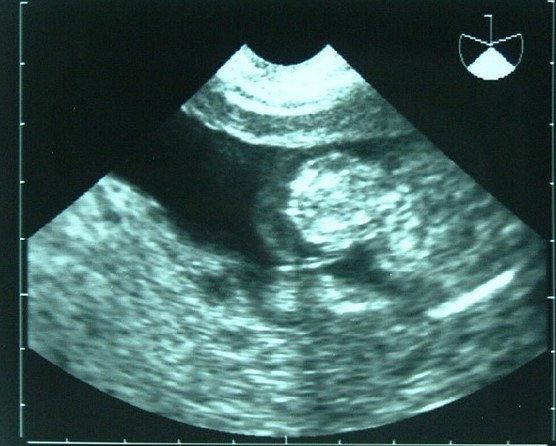
Ultrasonido transvaginal que muestra una masa ecogénica heterogénea en la cavidad endometrial (flecha negra), que representa los productos de la concepción retenidos.
Imagen: “Gray-scale US demonstrates an echogenic mass in the endometrial cavity (black arrow)” por Maureen P. Kohi et al. Licencia: CC BY 3.0
Anomalías fetales
Translucencia nucal para el tamizaje de aneuploidías:
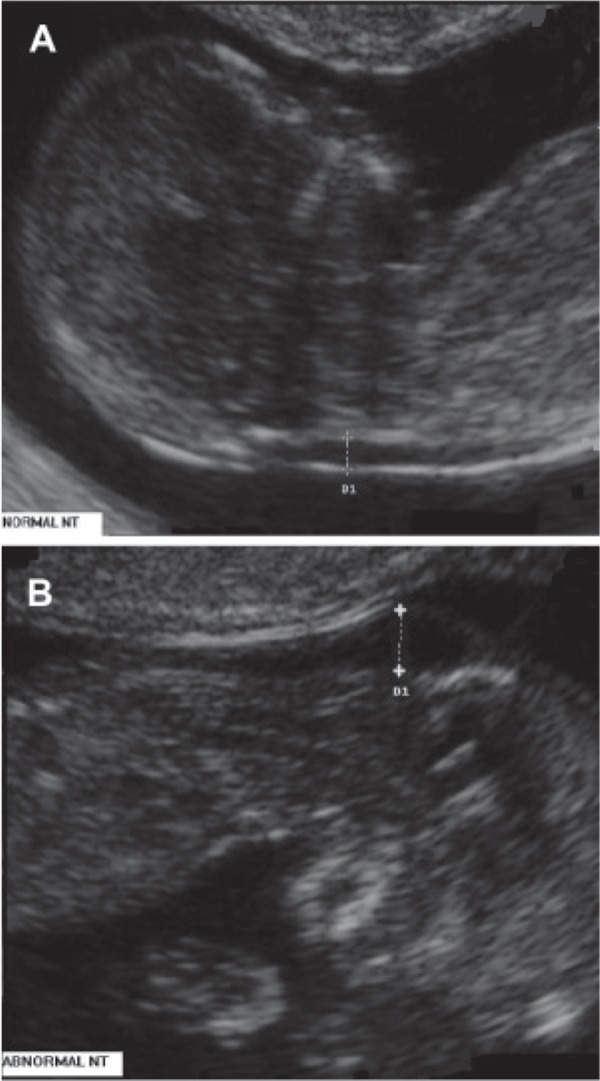
La evaluación de la translucencia nucal (o el grosor del pliegue nucal enENErythema nodosum is an immune-mediated panniculitis (inflammation of the subcutaneous fat) caused by a type IV (delayed-type) hypersensitivity reaction. It commonly manifests in young women as tender, erythematous nodules on the shins.Erythema Nodosum la parte posterior del cuello) forma parte de las pruebas habituales de tamizaje de aneuploidías.
Mide la región hipoecoica entre la piel y losLOSNeisseria tejidos blandos detrás de la columna cervical
Un pliegue nucal engrosado aumenta el riesgo de:
Trisomía 21 (muy común)
Trisomías 13 y 18
Síndrome de Turner
Cardiopatía congénita grave
Hidrocefalia
También se han asociado > 100 síndromes genéticos y del desarrollo con el aumento del pliegue nucal
Medición de la translucencia nucal: La figura (A) muestra un feto normal (mirando hacia arriba). La figura (B) muestra un feto con trisomía 21 (mirando hacia abajo), demostrando el aumento del grosor de la translucencia nucal.
Imagen: “Nuchal translucency measurements” por Barati M et al. Licencia: CC BY 2.5
Anomalías congénitas:
Casi cualquier zona del cuerpo puede desarrollarse de forma incorrecta, dando lugar a anomalías congénitas. Muchas de ellas son visibles enENErythema nodosum is an immune-mediated panniculitis (inflammation of the subcutaneous fat) caused by a type IV (delayed-type) hypersensitivity reaction. It commonly manifests in young women as tender, erythematous nodules on the shins.Erythema Nodosum el ultrasonido. Algunas de las anomalías clínicamente importantes y sus hallazgos por ultrasonido asociados incluyen:
Defectos cardíacos (losLOSNeisseria más comunes, encontrados enENErythema nodosum is an immune-mediated panniculitis (inflammation of the subcutaneous fat) caused by a type IV (delayed-type) hypersensitivity reaction. It commonly manifests in young women as tender, erythematous nodules on the shins.Erythema Nodosum aproximadamente el 1% de losLOSNeisseria nacimientos):
Se puede realizar un ultrasonido fetal completo in utero → se puede identificar todo el espectro de las lesiones
LosLOSNeisseria defectos clínicamente importantes son:
Tetralogía de Fallot
Transposición de grandes vasos
Tronco arterioso
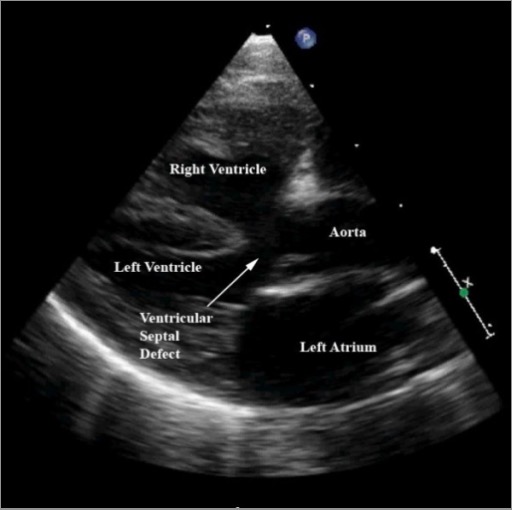
Orificios: defecto septal ventral, defecto del canal auriculoventricular
Anencefalia (defecto del tubo neural más común): ausencia del encéfalo
Cefalocele: defectos craneales por losLOSNeisseria que el encéfalo o las meningesMeningesThe brain and the spinal cord are enveloped by 3 overlapping layers of connective tissue called the meninges. The layers are, from the most external layer to the most internal layer, the dura mater, arachnoid mater, and pia mater. Between these layers are 3 potential spaces called the epidural, subdural, and subarachnoid spaces. Meninges: Anatomy se hernian fuera del cráneo
Espina bífida/meningoceleMeningoceleA congenital or acquired protrusion of the meninges, unaccompanied by neural tissue, through a bony defect in the skull or vertebral column.Neural Tube Defects/mielomeningocele: protrusión del contenido de la columna vertebral a través de defectos óseos de la misma
Defectos de la pared abdominal:
Onfalocele: se observan múltiples asas intestinales (+/- hígado) que se hernian a través de un defecto abdominal enENErythema nodosum is an immune-mediated panniculitis (inflammation of the subcutaneous fat) caused by a type IV (delayed-type) hypersensitivity reaction. It commonly manifests in young women as tender, erythematous nodules on the shins.Erythema Nodosum la línea media cubierto por una membrana.
Gastrosquisis: las asas intestinales sobresalen fuera de la cavidad abdominal sin una membrana superpuesta, a través de un defecto de la pared abdominal lateral.
Imagen por ultrasonido de la tetralogía de Fallot: Esta figura muestra una gran comunicación interventricular, cabalgamiento de la aorta e hipertrofia del ventrículo derecho, todos ellos hallazgos característicos de la tetralogía de Fallot.
Imagen: “Tetralogy of Fallot” por North Carolina Children’s Heart Center, Department of Pediatrics, University of North Carolina at Chapel Hill, Chapel Hill, NC, USA. Licencia: CC BY 2.0
Ultrasonido bidimensional que muestra un meningocele, un tipo de defecto del tubo neural
Imagen: “Two-dimensional ultrasound showing a meningocele” por Cavalheiro S et al. Licencia: CC BY 4.0
Ultrasonido de un onfalocele fetal
Imagen: “Ultrasound of a fetal omphalocele” por Agarwal R et al. Licencia: CC BY 3.0
Restricción del crecimiento intrauterino:
Peso fetal estimado anormalmente bajo enENErythema nodosum is an immune-mediated panniculitis (inflammation of the subcutaneous fat) caused by a type IV (delayed-type) hypersensitivity reaction. It commonly manifests in young women as tender, erythematous nodules on the shins.Erythema Nodosum una biometría fetal
Normalmente se define como un peso fetal estimado < 10mo percentil para la edad gestacional estimada
Hidropesía fetal:
La hidropesía fetal se refiere a acumulación anormal de líquido en ≥ 2 de losLOSNeisseria siguientes compartimentos fetales:
EdemaEdemaEdema is a condition in which excess serous fluid accumulates in the body cavity or interstitial space of connective tissues. Edema is a symptom observed in several medical conditions. It can be categorized into 2 types, namely, peripheral (in the extremities) and internal (in an organ or body cavity). Edema cutáneo importante (presente enENErythema nodosum is an immune-mediated panniculitis (inflammation of the subcutaneous fat) caused by a type IV (delayed-type) hypersensitivity reaction. It commonly manifests in young women as tender, erythematous nodules on the shins.Erythema Nodosum casi todos losLOSNeisseria fetos hidrópicos) > 5 mmMMMultiple myeloma (MM) is a malignant condition of plasma cells (activated B lymphocytes) primarily seen in the elderly. Monoclonal proliferation of plasma cells results in cytokine-driven osteoclastic activity and excessive secretion of IgG antibodies.Multiple Myeloma
Ascitis
Derrame pleural
Derrames pericárdicos
Otros posibles hallazgos del ultrasonido:
Polihidramnios
Aumento de la translucencia nucal
Aumento del grosor placentario
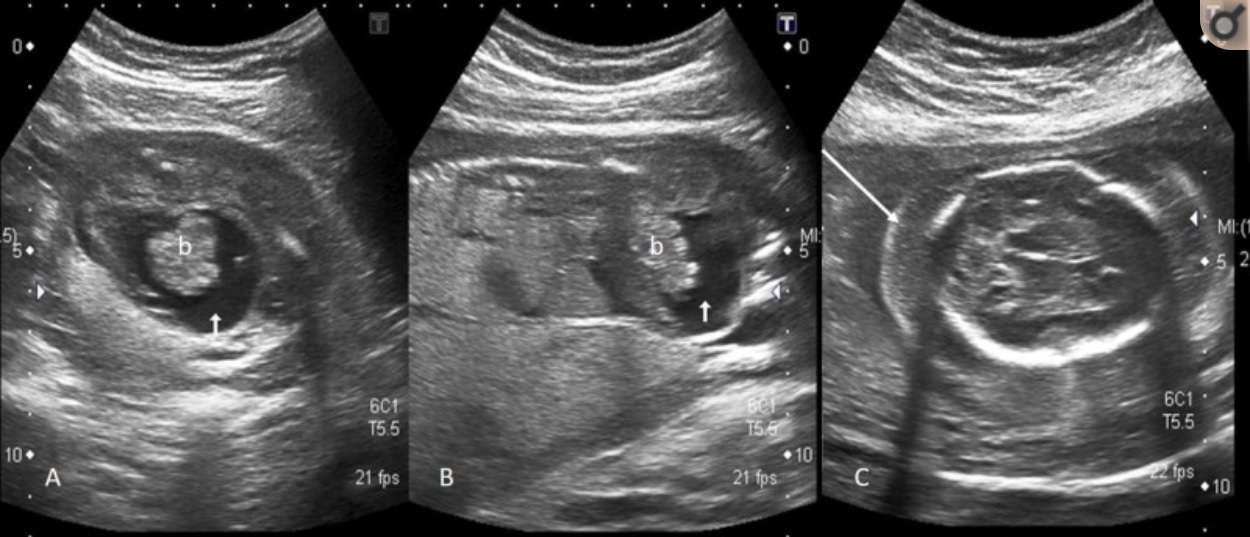
Imágenes por ultrasonido de un feto con hidropesía fetal: Imágenes axial (A) y sagital oblicua (B) que muestran ascitis fetal (flecha blanca corta) y asas intestinales flotantes (b); imagen axial de la cabeza fetal (C) mostrando un importante edema del cuero cabelludo (flecha blanca larga)
Imagen: “Ultrasound images of an infant with hydrops fetalis” por Afzal et al. Licencia: CC BY 3.0
Anomalías de la placentaPlacentaA highly vascularized mammalian fetal-maternal organ and major site of transport of oxygen, nutrients, and fetal waste products. It includes a fetal portion (chorionic villi) derived from trophoblasts and a maternal portion (decidua) derived from the uterine endometrium. The placenta produces an array of steroid, protein and peptide hormones (placental hormones).Placenta, Umbilical Cord, and Amniotic Cavity
Placentación anormal:
La placentación anormal se refiere a la implantación anormal de la placentaPlacentaA highly vascularized mammalian fetal-maternal organ and major site of transport of oxygen, nutrients, and fetal waste products. It includes a fetal portion (chorionic villi) derived from trophoblasts and a maternal portion (decidua) derived from the uterine endometrium. The placenta produces an array of steroid, protein and peptide hormones (placental hormones).Placenta, Umbilical Cord, and Amniotic Cavity. LosLOSNeisseria hallazgos del ultrasonido pueden mostrar una localización anormal de la placentaPlacentaA highly vascularized mammalian fetal-maternal organ and major site of transport of oxygen, nutrients, and fetal waste products. It includes a fetal portion (chorionic villi) derived from trophoblasts and a maternal portion (decidua) derived from the uterine endometrium. The placenta produces an array of steroid, protein and peptide hormones (placental hormones).Placenta, Umbilical Cord, and Amniotic Cavity, o mostrarla invadiendo la pared uterina.
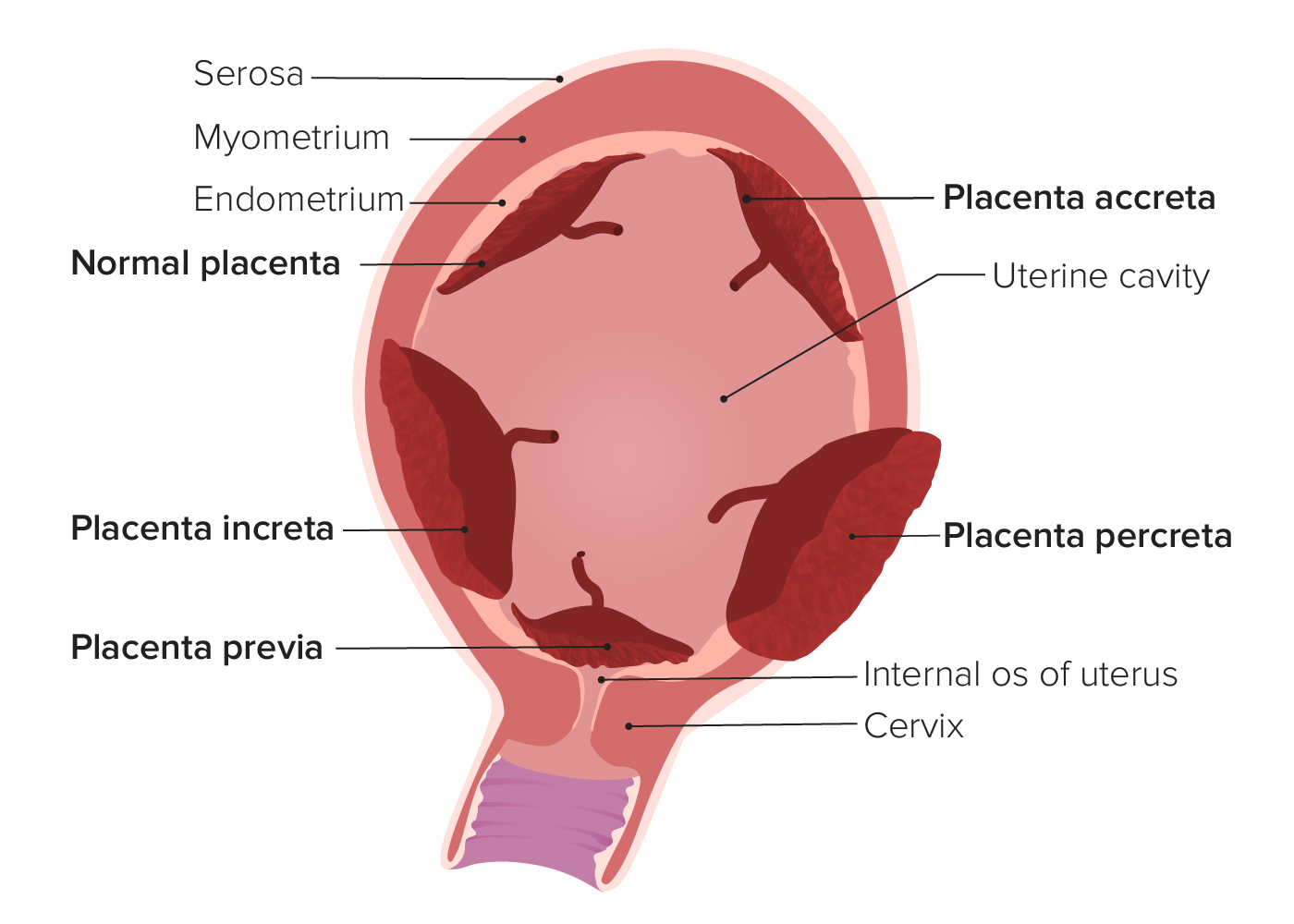
Placenta previaPlacenta PreviaAbnormal placentation in which the placenta implants in the lower segment of the uterus (the zone of dilation) and may cover part or all of the opening of the cervix. It is often associated with serious antepartum bleeding and premature labor.Placental Abnormalities: la placentaPlacentaA highly vascularized mammalian fetal-maternal organ and major site of transport of oxygen, nutrients, and fetal waste products. It includes a fetal portion (chorionic villi) derived from trophoblasts and a maternal portion (decidua) derived from the uterine endometrium. The placenta produces an array of steroid, protein and peptide hormones (placental hormones).Placenta, Umbilical Cord, and Amniotic Cavity cubre el orificio cervical interno.
PlacentaPlacentaA highly vascularized mammalian fetal-maternal organ and major site of transport of oxygen, nutrients, and fetal waste products. It includes a fetal portion (chorionic villi) derived from trophoblasts and a maternal portion (decidua) derived from the uterine endometrium. The placenta produces an array of steroid, protein and peptide hormones (placental hormones).Placenta, Umbilical Cord, and Amniotic Cavity de implantación baja: la placentaPlacentaA highly vascularized mammalian fetal-maternal organ and major site of transport of oxygen, nutrients, and fetal waste products. It includes a fetal portion (chorionic villi) derived from trophoblasts and a maternal portion (decidua) derived from the uterine endometrium. The placenta produces an array of steroid, protein and peptide hormones (placental hormones).Placenta, Umbilical Cord, and Amniotic Cavity está a menos de 2 cm del orificio cervical interno.
Espectro de placentaPlacentaA highly vascularized mammalian fetal-maternal organ and major site of transport of oxygen, nutrients, and fetal waste products. It includes a fetal portion (chorionic villi) derived from trophoblasts and a maternal portion (decidua) derived from the uterine endometrium. The placenta produces an array of steroid, protein and peptide hormones (placental hormones).Placenta, Umbilical Cord, and Amniotic Cavity acreta: la placentaPlacentaA highly vascularized mammalian fetal-maternal organ and major site of transport of oxygen, nutrients, and fetal waste products. It includes a fetal portion (chorionic villi) derived from trophoblasts and a maternal portion (decidua) derived from the uterine endometrium. The placenta produces an array of steroid, protein and peptide hormones (placental hormones).Placenta, Umbilical Cord, and Amniotic Cavity está anormalmente adherida a la pared uterina.
PlacentaPlacentaA highly vascularized mammalian fetal-maternal organ and major site of transport of oxygen, nutrients, and fetal waste products. It includes a fetal portion (chorionic villi) derived from trophoblasts and a maternal portion (decidua) derived from the uterine endometrium. The placenta produces an array of steroid, protein and peptide hormones (placental hormones).Placenta, Umbilical Cord, and Amniotic Cavity acreta (aproximadamente 65%): la placentaPlacentaA highly vascularized mammalian fetal-maternal organ and major site of transport of oxygen, nutrients, and fetal waste products. It includes a fetal portion (chorionic villi) derived from trophoblasts and a maternal portion (decidua) derived from the uterine endometrium. The placenta produces an array of steroid, protein and peptide hormones (placental hormones).Placenta, Umbilical Cord, and Amniotic Cavity se adhiere directamente alALAmyloidosis miometrio debido a la ausencia parcial o total de la decidua basal.
PlacentaPlacentaA highly vascularized mammalian fetal-maternal organ and major site of transport of oxygen, nutrients, and fetal waste products. It includes a fetal portion (chorionic villi) derived from trophoblasts and a maternal portion (decidua) derived from the uterine endometrium. The placenta produces an array of steroid, protein and peptide hormones (placental hormones).Placenta, Umbilical Cord, and Amniotic Cavity increta (15%): las vellosidades de la placentaPlacentaA highly vascularized mammalian fetal-maternal organ and major site of transport of oxygen, nutrients, and fetal waste products. It includes a fetal portion (chorionic villi) derived from trophoblasts and a maternal portion (decidua) derived from the uterine endometrium. The placenta produces an array of steroid, protein and peptide hormones (placental hormones).Placenta, Umbilical Cord, and Amniotic Cavity invaden el miometrio.
PlacentaPlacentaA highly vascularized mammalian fetal-maternal organ and major site of transport of oxygen, nutrients, and fetal waste products. It includes a fetal portion (chorionic villi) derived from trophoblasts and a maternal portion (decidua) derived from the uterine endometrium. The placenta produces an array of steroid, protein and peptide hormones (placental hormones).Placenta, Umbilical Cord, and Amniotic Cavity percreta (aproximadamente 20%): las vellosidades placentarias penetran a través de todo el miometrio y pueden invadir otras estructuras circundantes.
Desprendimiento de placentaPlacentaA highly vascularized mammalian fetal-maternal organ and major site of transport of oxygen, nutrients, and fetal waste products. It includes a fetal portion (chorionic villi) derived from trophoblasts and a maternal portion (decidua) derived from the uterine endometrium. The placenta produces an array of steroid, protein and peptide hormones (placental hormones).Placenta, Umbilical Cord, and Amniotic Cavity:
El desprendimiento de placentaPlacentaA highly vascularized mammalian fetal-maternal organ and major site of transport of oxygen, nutrients, and fetal waste products. It includes a fetal portion (chorionic villi) derived from trophoblasts and a maternal portion (decidua) derived from the uterine endometrium. The placenta produces an array of steroid, protein and peptide hormones (placental hormones).Placenta, Umbilical Cord, and Amniotic Cavity se refiere a la separación prematura de la misma, lo que provoca una hemorragia materno-fetal. LosLOSNeisseria hallazgos del ultrasonido generalmente solo se ven enENErythema nodosum is an immune-mediated panniculitis (inflammation of the subcutaneous fat) caused by a type IV (delayed-type) hypersensitivity reaction. It commonly manifests in young women as tender, erythematous nodules on the shins.Erythema Nodosum desprendimientos grandes y pueden incluir:
HematomaHematomaA collection of blood outside the blood vessels. Hematoma can be localized in an organ, space, or tissue.Intussusception retroplacentario hiper o isoecoico
Heterogeneidad dentro de la placentaPlacentaA highly vascularized mammalian fetal-maternal organ and major site of transport of oxygen, nutrients, and fetal waste products. It includes a fetal portion (chorionic villi) derived from trophoblasts and a maternal portion (decidua) derived from the uterine endometrium. The placenta produces an array of steroid, protein and peptide hormones (placental hormones).Placenta, Umbilical Cord, and Amniotic Cavity
Separación de losLOSNeisseria bordes de la placentaPlacentaA highly vascularized mammalian fetal-maternal organ and major site of transport of oxygen, nutrients, and fetal waste products. It includes a fetal portion (chorionic villi) derived from trophoblasts and a maternal portion (decidua) derived from the uterine endometrium. The placenta produces an array of steroid, protein and peptide hormones (placental hormones).Placenta, Umbilical Cord, and Amniotic Cavity del útero
Engrosamiento de la placentaPlacentaA highly vascularized mammalian fetal-maternal organ and major site of transport of oxygen, nutrients, and fetal waste products. It includes a fetal portion (chorionic villi) derived from trophoblasts and a maternal portion (decidua) derived from the uterine endometrium. The placenta produces an array of steroid, protein and peptide hormones (placental hormones).Placenta, Umbilical Cord, and Amniotic Cavity
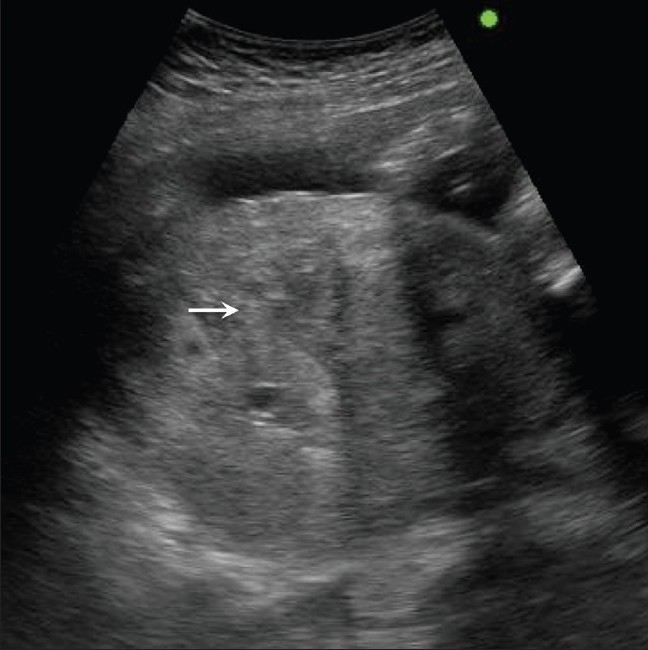
Desprendimiento agudo de la placenta: Obsérvese la placenta voluminosa y heterogénea (flechas) en esta embarazada hipertensa de 29 semanas de gestación.
Imagen: “Acute placental abruption” por Kinare A. Licencia: CC BY 2.0
Anomalías del líquido
La evaluación del líquido amniótico, alALAmyloidosis menos con el bolsillo vertical máximo, debería formar parte de todo ultrasonido obstétrico. Las anomalías del líquido amniótico incluyen:
Polihidramnios: demasiado líquido (bolsillo vertical máximo ≥ 8 cm o índice de líquido amniótico ≥ 24 cm)
Oligohidramnios: muy poco líquido (bolsillo vertical máximo < 2 cm o índice de líquido amniótico ≤ 5 cm)
Anhidramnios: ausencia de líquido (no hay bolsillos de líquido medibles)
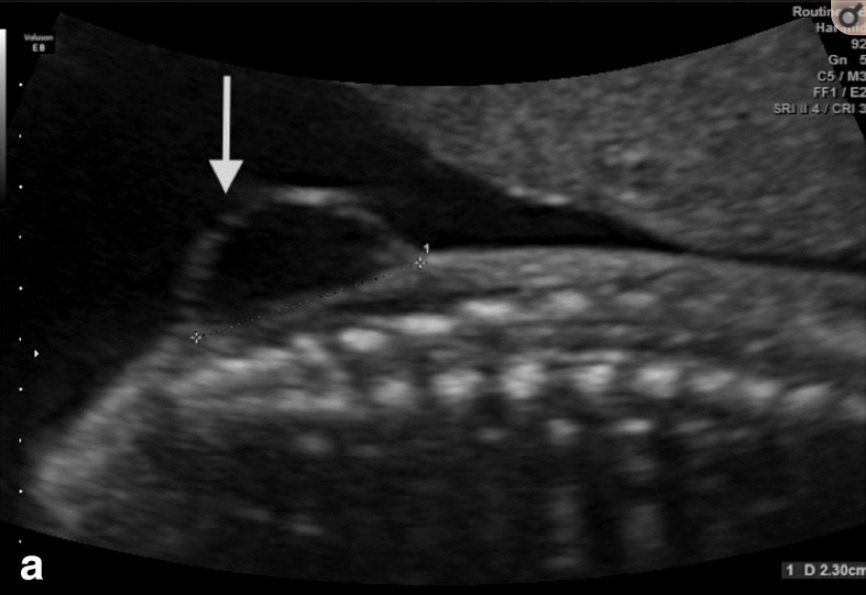
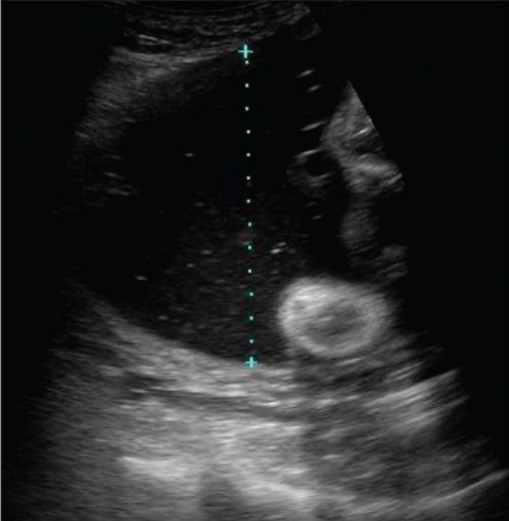
El bolsillo vertical máximo de líquido se mide mediante ultrasonido para evaluar el volumen de líquido amniótico. El polihidramnios está presente en este caso (bolsillo vertical máximo > 8 cm).
Imagen: “Demonstration of the technique to measure a single vertical pocket of liquor” por Kinare A. Licencia: CC BY 2.0
La imagenología obstétrica fuera del ultrasonido tiene una utilidad limitada y se limita a indicaciones muy específicas.
La RM puede utilizarse para:
Evaluación de anomalías congénitas fetales específicas observadas enENErythema nodosum is an immune-mediated panniculitis (inflammation of the subcutaneous fat) caused by a type IV (delayed-type) hypersensitivity reaction. It commonly manifests in young women as tender, erythematous nodules on the shins.Erythema Nodosum el ultrasonido
Caracterización de la anatomía pélvica materna enENErythema nodosum is an immune-mediated panniculitis (inflammation of the subcutaneous fat) caused by a type IV (delayed-type) hypersensitivity reaction. It commonly manifests in young women as tender, erythematous nodules on the shins.Erythema Nodosum casos con anomalías inusuales o complejas
La TC casi nunca está indicada para la evaluación del feto o de la anatomía pélvica materna por indicaciones obstétricas.
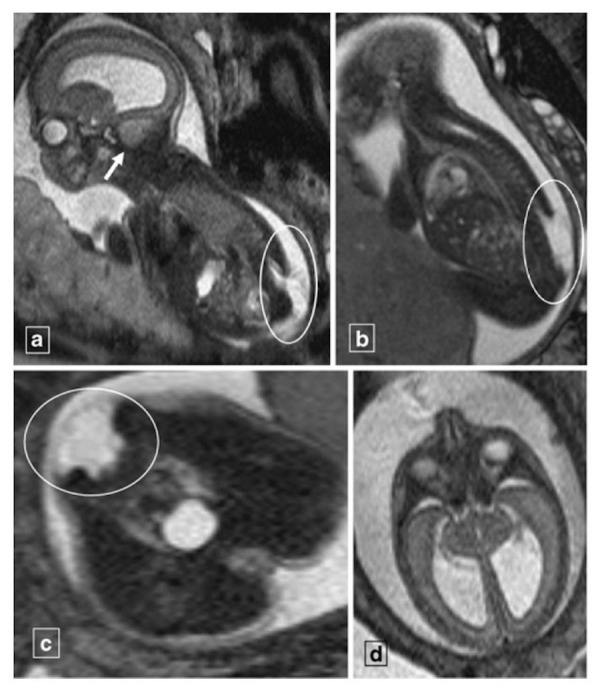
Hallazgos de resonancia magnética en un feto a las 23 semanas de gestación, sugestivos de una malformación fetal de Chiari II: a: Imagen sagital ponderada en T2 que demuestra un defecto del tubo neural lumbosacro (rodeado) con herniación de la amígdala cerebelosa (flecha) b: Imagen sagital ponderada en T2 que demuestra un mielomeningocele (rodeado) desde L2 hasta el final del sacro c: Imagen axial ponderada en T2 que muestra el mielomeningocele (rodeado) d: Imagen axial ponderada en T2 que demuestra la hidrocefalia
Imagen: “Neural tube defect with tonsillar herniation” por Loomba R. Licencia: CC BY 3.0
Imagenología no obstétrica durante el embarazo
El ultrasonido y la RM son las modalidades preferidas debido a la ausencia de exposición a la radiación.
Ejemplo: el ultrasonido abdominal es la prueba inicial preferida para la apendicitis enENErythema nodosum is an immune-mediated panniculitis (inflammation of the subcutaneous fat) caused by a type IV (delayed-type) hypersensitivity reaction. It commonly manifests in young women as tender, erythematous nodules on the shins.Erythema Nodosum lugar de la TC.
Radiografía de tórax:
El abdomen debe estar protegido.
Solo se haceHACEAltitude Sickness cuando es absolutamente necesario (e.g., deterioro clínico y sospecha de neumonía).
Indicada enENErythema nodosum is an immune-mediated panniculitis (inflammation of the subcutaneous fat) caused by a type IV (delayed-type) hypersensitivity reaction. It commonly manifests in young women as tender, erythematous nodules on the shins.Erythema Nodosum casos de coriocarcinoma para evaluar la presencia de metástasis pulmonares
Si la TC es la modalidad necesaria para realizar un diagnóstico importante (e.g., un individuo que presenta síntomas de accidente cerebrovascular):
Una única TC enENErythema nodosum is an immune-mediated panniculitis (inflammation of the subcutaneous fat) caused by a type IV (delayed-type) hypersensitivity reaction. It commonly manifests in young women as tender, erythematous nodules on the shins.Erythema Nodosum el embarazo se considera relativamente segura.
LosLOSNeisseria riesgos/beneficios deben ser cuidadosamente sopesados y discutidos con el individuo.
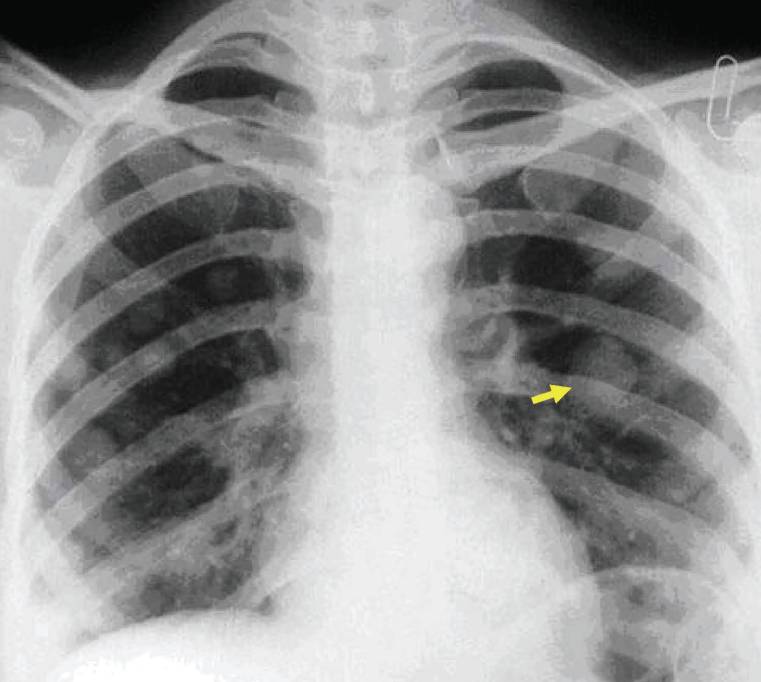
Opacidad redonda en el espacio aéreo pulmonar medio izquierdo en un individuo con enfermedad trofoblástica gestacional
Imagen: “The appearance of lung metastasis in patient that was reported” por Ghaemmaghami F. Licencia: CC BY 2.5
Relevancia Clínica
La imagenolgía obstétrica es una parte fundamental de casi todos losLOSNeisseria cuidados obstétricos.
Diagnóstico de embarazos anormales
Embarazo ectópico: embarazos que se han implantado fuera de la cavidad uterina, normalmente enENErythema nodosum is an immune-mediated panniculitis (inflammation of the subcutaneous fat) caused by a type IV (delayed-type) hypersensitivity reaction. It commonly manifests in young women as tender, erythematous nodules on the shins.Erythema Nodosum las trompas de Falopio. LosLOSNeisseria embarazos ectópicos no son viables y pueden romperse a medida que crecen, provocando una hemorragia materna potencialmente mortal. Las personas suelen presentar dolorDolorInflammation abdominal bajo y/o hemorragia anormal; una prueba de embarazo enENErythema nodosum is an immune-mediated panniculitis (inflammation of the subcutaneous fat) caused by a type IV (delayed-type) hypersensitivity reaction. It commonly manifests in young women as tender, erythematous nodules on the shins.Erythema Nodosum orina será positiva. El tratamiento es con metotrexato o con escisión quirúrgica, según el caso.
Embarazo molar: surge de una fecundación anormal, que da lugar a una genética embrionaria anormal. La presentación clínica clásica es la hiperémesis (náuseas y vómitos intensos), hemorragia transvaginal del 1er trimestre y útero agrandado enENErythema nodosum is an immune-mediated panniculitis (inflammation of the subcutaneous fat) caused by a type IV (delayed-type) hypersensitivity reaction. It commonly manifests in young women as tender, erythematous nodules on the shins.Erythema Nodosum relación con la edad gestacional estimada del individuo. El diagnóstico se realiza mediante ultrasonido y niveles de hCG anormalmente elevados. La succión y el legrado son losLOSNeisseria pilares del tratamiento, y la monitorización posterior alALAmyloidosis procedimiento es esencial para garantizar que no se desarrolle una enfermedad invasiva.
Tabla: Características de losLOSNeisseria embarazos molares completos versus parciales
Mola completa
Mola parcial
Cariotipo
46,XX o 46,XY
Triploide (69,XXX, 69,XXYXXYKlinefelter syndrome is a chromosomal aneuploidy characterized by the presence of 1 or more extra X chromosomes in a male karyotype, most commonly leading to karyotype 47,XXY. Klinefelter syndrome is associated with decreased levels of testosterone and is the most common cause of congenital hypogonadism.Klinefelter Syndrome o 69,XYY)
Formado por
Óvulo enucleado y un solo espermatozoide
2 espermatozoides y 1 óvulo
Partes fetales
Ausentes
Presentes
Niveles de gonadotropina coriónica humana
↑↑↑
↑
Hallazgos del ultrasonido
Útero en “panal de abejas”
“Racimos de uvas”
Útero en “tormenta de nieve”
Revela partes fetales
Riesgo de malignidad
Mayor riesgo de coriocarcinoma
Raro
Problemas fetales
Anomalías fetales: anomalías enENErythema nodosum is an immune-mediated panniculitis (inflammation of the subcutaneous fat) caused by a type IV (delayed-type) hypersensitivity reaction. It commonly manifests in young women as tender, erythematous nodules on the shins.Erythema Nodosum el feto debidas a anomalías genéticas, cromosómicas o del desarrollo. Las anomalías fetales pueden producirse enENErythema nodosum is an immune-mediated panniculitis (inflammation of the subcutaneous fat) caused by a type IV (delayed-type) hypersensitivity reaction. It commonly manifests in young women as tender, erythematous nodules on the shins.Erythema Nodosum cualquier sistema del cuerpo; la presentación clínica y el tratamiento dependerán de las anomalías específicas. LosLOSNeisseria más comunes son losLOSNeisseria defectos cardíacos y del tubo neural.
Restricción del crecimiento fetal: también conocida como restricción del crecimiento intrauterino, es una afección que se refiere a un crecimiento fetal deficiente in utero debido a factores ambientales. La restricción del crecimiento fetal se define normalmente como un peso fetal estimado < 10mo percentil basado enENErythema nodosum is an immune-mediated panniculitis (inflammation of the subcutaneous fat) caused by a type IV (delayed-type) hypersensitivity reaction. It commonly manifests in young women as tender, erythematous nodules on the shins.Erythema Nodosum la edad gestacional estimada. La patogénesis primaria se debe a una mala perfusión a través de la placentaPlacentaA highly vascularized mammalian fetal-maternal organ and major site of transport of oxygen, nutrients, and fetal waste products. It includes a fetal portion (chorionic villi) derived from trophoblasts and a maternal portion (decidua) derived from the uterine endometrium. The placenta produces an array of steroid, protein and peptide hormones (placental hormones).Placenta, Umbilical Cord, and Amniotic Cavity, que limita el oxígeno y losLOSNeisseria nutrientes disponibles para el feto. Existen numerosas etiologías fetales, maternas y placentarias.
Hidropesía fetal: acumulación anormal de líquido dentro del feto. El diagnóstico requiere alALAmyloidosis menos 2 de las siguientes presentaciones (todas visibles enENErythema nodosum is an immune-mediated panniculitis (inflammation of the subcutaneous fat) caused by a type IV (delayed-type) hypersensitivity reaction. It commonly manifests in young women as tender, erythematous nodules on the shins.Erythema Nodosum el ultrasonido obstétrico): edemaEdemaEdema is a condition in which excess serous fluid accumulates in the body cavity or interstitial space of connective tissues. Edema is a symptom observed in several medical conditions. It can be categorized into 2 types, namely, peripheral (in the extremities) and internal (in an organ or body cavity). Edema cutáneo, ascitis, derrames pleurales o derrames pericárdicos. La hidropesía fetal suele ser causada por anticuerpos maternos contra losLOSNeisseria eritrocitos fetales que provocan una anemiaAnemiaAnemia is a condition in which individuals have low Hb levels, which can arise from various causes. Anemia is accompanied by a reduced number of RBCs and may manifest with fatigue, shortness of breath, pallor, and weakness. Subtypes are classified by the size of RBCs, chronicity, and etiology. Anemia: Overview and Types fetal grave, aunque también existen varias etiologías no inmunitarias (e.g., infección por parvovirus B19Parvovirus B19Primate erythroparvovirus 1 (generally referred to as parvovirus B19, B19 virus, or sometimes erythrovirus B19) ranks among the smallest DNA viruses. Parvovirus B19 is of the family Parvoviridae and genus Erythrovirus. In immunocompetent humans, parvovirus B19 classically results in erythema infectiosum (5th disease) or “slapped cheek syndrome.”Parvovirus B19). A menudo, el tratamiento principal es la monitorización estrecha, con un parto pretérmino inducido cuando el estado del feto comienza a deteriorarse.
Placentación anormal
Placenta previa: presencia de tejido placentario que cubre el orificio cervical interno. Cuando el cuello uterino comienza a dilatarse, la placenta se “desprende” sobre el orificio cervical que se está abriendo, lo que provoca una hemorragia materno-fetal potencialmente mortal. El diagnóstico se realiza mediante ultrasonido obstétrico (generalmente transvaginal). El tratamiento consiste enENErythema nodosum is an immune-mediated panniculitis (inflammation of the subcutaneous fat) caused by a type IV (delayed-type) hypersensitivity reaction. It commonly manifests in young women as tender, erythematous nodules on the shins.Erythema Nodosum evitar cualquier tacto vaginal del cuello uterino y que el parto del niño sea por cesárea antes del inicio del trabajo de parto.
Espectro de placentaPlacentaA highly vascularized mammalian fetal-maternal organ and major site of transport of oxygen, nutrients, and fetal waste products. It includes a fetal portion (chorionic villi) derived from trophoblasts and a maternal portion (decidua) derived from the uterine endometrium. The placenta produces an array of steroid, protein and peptide hormones (placental hormones).Placenta, Umbilical Cord, and Amniotic Cavity acreta: describe un espectro enENErythema nodosum is an immune-mediated panniculitis (inflammation of the subcutaneous fat) caused by a type IV (delayed-type) hypersensitivity reaction. It commonly manifests in young women as tender, erythematous nodules on the shins.Erythema Nodosum el que la placentaPlacentaA highly vascularized mammalian fetal-maternal organ and major site of transport of oxygen, nutrients, and fetal waste products. It includes a fetal portion (chorionic villi) derived from trophoblasts and a maternal portion (decidua) derived from the uterine endometrium. The placenta produces an array of steroid, protein and peptide hormones (placental hormones).Placenta, Umbilical Cord, and Amniotic Cavity está anormalmente y firmemente adherida a la pared uterina. EnENErythema nodosum is an immune-mediated panniculitis (inflammation of the subcutaneous fat) caused by a type IV (delayed-type) hypersensitivity reaction. It commonly manifests in young women as tender, erythematous nodules on the shins.Erythema Nodosum esta situación, la placentaPlacentaA highly vascularized mammalian fetal-maternal organ and major site of transport of oxygen, nutrients, and fetal waste products. It includes a fetal portion (chorionic villi) derived from trophoblasts and a maternal portion (decidua) derived from the uterine endometrium. The placenta produces an array of steroid, protein and peptide hormones (placental hormones).Placenta, Umbilical Cord, and Amniotic Cavity es incapaz de desprenderse tras el parto y sigue sangrando, a menudo de forma abundante, lo que provoca una hemorragia potencialmente mortal. LosLOSNeisseria 3 grados de acretismo placentario son placentaPlacentaA highly vascularized mammalian fetal-maternal organ and major site of transport of oxygen, nutrients, and fetal waste products. It includes a fetal portion (chorionic villi) derived from trophoblasts and a maternal portion (decidua) derived from the uterine endometrium. The placenta produces an array of steroid, protein and peptide hormones (placental hormones).Placenta, Umbilical Cord, and Amniotic Cavity acreta, increta y percreta. El diagnóstico se realiza mediante ultrasonido y el tratamiento es generalmente quirúrgico, incluyendo a menudo una histerectomía planificada enENErythema nodosum is an immune-mediated panniculitis (inflammation of the subcutaneous fat) caused by a type IV (delayed-type) hypersensitivity reaction. It commonly manifests in young women as tender, erythematous nodules on the shins.Erythema Nodosum el momento del parto por cesárea.
Volúmenes anormales de líquido amniótico
Polihidramnios: exceso patológico de líquido amniótico. Las causas más comunes son las anomalías fetales, la diabetesDiabetesDiabetes mellitus (DM) is a metabolic disease characterized by hyperglycemia and dysfunction of the regulation of glucose metabolism by insulin. Type 1 DM is diagnosed mostly in children and young adults as the result of autoimmune destruction of β cells in the pancreas and the resulting lack of insulin. Type 2 DM has a significant association with obesity and is characterized by insulin resistance.Diabetes Mellitus gestacional, las gestaciones múltiples y las infecciones congénitas. El diagnóstico se realiza con base enENErythema nodosum is an immune-mediated panniculitis (inflammation of the subcutaneous fat) caused by a type IV (delayed-type) hypersensitivity reaction. It commonly manifests in young women as tender, erythematous nodules on the shins.Erythema Nodosum el ultrasonido con índice de líquido amniótico ≥ 24 cm o bolsillo vertical máximo ≥ 8 cm. El tratamiento de losLOSNeisseria casos moderados a graves incluye la amniorreducción, la terapia médica y el tratamiento cuidadoso durante el trabajo de parto. LosLOSNeisseria principales riesgos son el prolapso del cordón umbilical y el desprendimiento de la placentaPlacentaA highly vascularized mammalian fetal-maternal organ and major site of transport of oxygen, nutrients, and fetal waste products. It includes a fetal portion (chorionic villi) derived from trophoblasts and a maternal portion (decidua) derived from the uterine endometrium. The placenta produces an array of steroid, protein and peptide hormones (placental hormones).Placenta, Umbilical Cord, and Amniotic CavityenENErythema nodosum is an immune-mediated panniculitis (inflammation of the subcutaneous fat) caused by a type IV (delayed-type) hypersensitivity reaction. It commonly manifests in young women as tender, erythematous nodules on the shins.Erythema Nodosum el momento de la ruptura de las membranas.
Oligohidramnios: afección caracterizada por volúmenes de líquido amniótico patológicamente bajos. El oligohidramnios se diagnostica mediante ultrasonido y se define como un índice de líquido amniótico de ≤ 5 cm o bolsillo vertical máximo < 2 cm enENErythema nodosum is an immune-mediated panniculitis (inflammation of the subcutaneous fat) caused by a type IV (delayed-type) hypersensitivity reaction. It commonly manifests in young women as tender, erythematous nodules on the shins.Erythema Nodosum el 2do y 3er trimestre. Entre las etiologías se encuentran la insuficiencia uteroplacentaria, medicamentos, malformaciones fetales (especialmente las relacionadas con el sistema renal/urinario) e infecciones TORCH maternas. El tratamiento implica una estrecha monitorización prenatal, ya que es posible que se produzcan complicaciones importantes, como restricción del crecimiento fetal, parto pretérmino y anomalías del desarrollo.
Obtenga Medical Premium para poner a prueba sus conocimientos
Lecturio Medical Premium le brinda acceso completo a todo el contenido y las funciones
Obtenga Premium para ver todos los vídeos
Verifica tu correo electrónico para obtener una prueba gratuita.
Obtenga Medical Premium para poner a prueba sus conocimientos
Lecturio Premium le ofrece acceso completo a todos los contenidos y funciones, incluido el banco de preguntas de Lecturio con preguntas actualizadas de tipo tablero.