Domina Conceptos Médicos

Estudia para la escuela de medicina y tus examenes con Lecturio.

Afecciones Hipocoagulables

Las afecciones hipocoagulables, también conocidas como trastornos hemorrágicos o diátesis hemorrágicas, son un grupo diverso de enfermedades que dan lugar a una hemostasia anormal. La hemostasia es el proceso innato y escalonado que da lugar al AL Amyloidosis cese de la hemorragia de un vaso sanguíneo dañado. La hemostasia fisiológica depende de la integridad de las células endoteliales y la matriz subendotelial, las plaquetas y los LOS Neisseria factores de coagulación. Los LOS Neisseria estados hipocoagulables son el resultado de anomalías en EN Erythema nodosum is an immune-mediated panniculitis (inflammation of the subcutaneous fat) caused by a type IV (delayed-type) hypersensitivity reaction. It commonly manifests in young women as tender, erythematous nodules on the shins. Erythema Nodosum uno o varios de estos factores contribuyentes, lo que da lugar a trombosis inefectivas y hemorragias.

Last updated: Dec 15, 2025

Editorial responsibility: Stanley Oiseth, Lindsay Jones, Evelin Maza

Descripción General

Definición

Las afecciones hipocoagulables, también conocidas como trastornos hemorrágicos o diátesis hemorrágicas, son un grupo diverso de enfermedades que provocan una hemostasia anormal y un mayor riesgo de hemorragia.

La hemostasia fisiológica depende una normal estructura y funcionamiento de:

  • Paredes vasculares, compuestas por:
    • Células endoteliales
    • Matriz subendotelial
    • Tejido conectivo extravascular
  • Plaquetas
  • Factores de coagulación

Revisión de la hemostasia

A continuación se presenta un resumen del proceso:
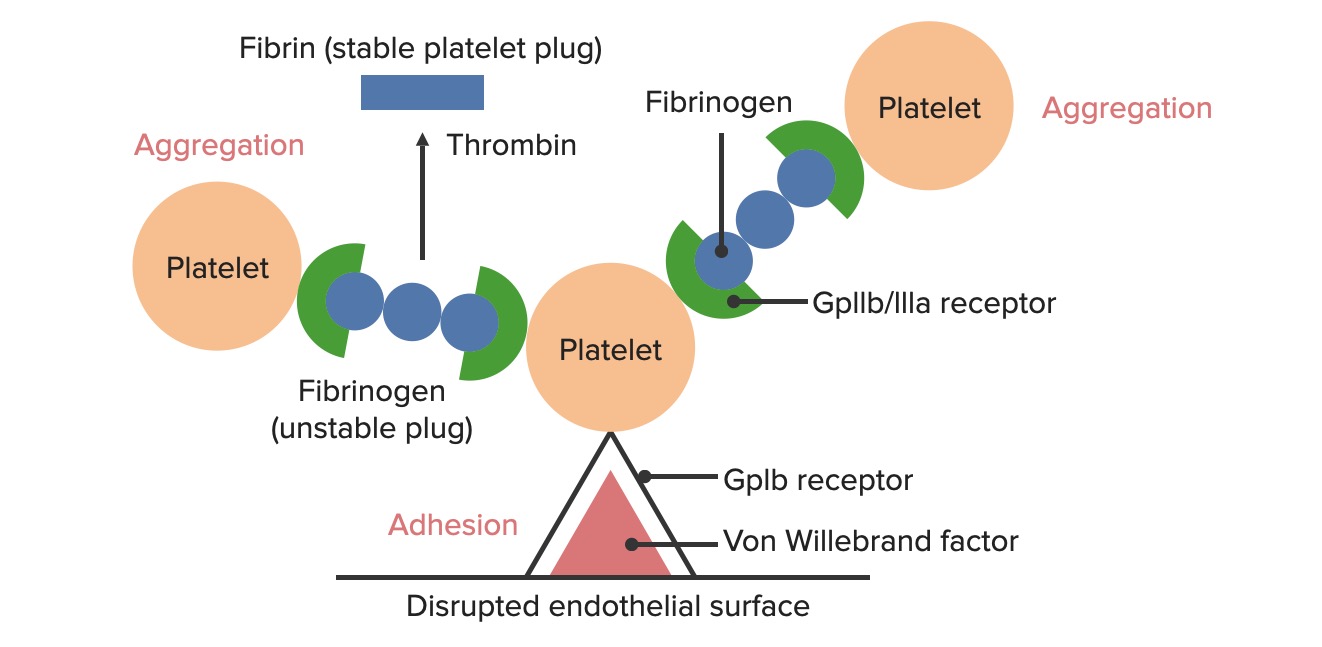
  • La constricción del vaso sanguíneo limita el flujo de sangre a la zona.
  • Formación del tapón plaquetario: el tapón inicial y temporal se forma a través de los LOS Neisseria siguientes pasos:
    • Adhesión: El factor Von Willebrand (FVW) expuesto se une a los LOS Neisseria receptores de glicoproteína (Gp) Ib de las plaquetas.
    • Agregación: Los LOS Neisseria receptores GpIIb/IIIa de las plaquetas se unen al AL Amyloidosis fibrinógeno.
    • Secreción: Se liberan sustancias que estimulan la activación y agregación de las plaquetas y el inicio de la cascada de coagulación.
  • Activación de la cascada de coagulación: forma un coágulo de fibrina más estable
    • Vía extrínseca:
      • Es el principal responsable de la iniciación de la cascada
      • Implica (por orden): factor tisular, factor VII Factor VII Heat- and storage-stable plasma protein that is activated by tissue thromboplastin to form factor viia in the extrinsic pathway of blood coagulation. The activated form then catalyzes the activation of factor X to factor Xa. Hemostasis y factor X Factor X Storage-stable glycoprotein blood coagulation factor that can be activated to factor Xa by both the intrinsic and extrinsic pathways. A deficiency of factor X, sometimes called stuart-prower factor deficiency, may lead to a systemic coagulation disorder. Hemostasis
    • Vía intrínseca:
      • Participa principalmente en EN Erythema nodosum is an immune-mediated panniculitis (inflammation of the subcutaneous fat) caused by a type IV (delayed-type) hypersensitivity reaction. It commonly manifests in young women as tender, erythematous nodules on the shins. Erythema Nodosum la amplificación de la cascada
      • También puede activarse directamente por una lesión de los LOS Neisseria vasos sanguíneos
      • Implica (por orden): los LOS Neisseria factores XII, XI, IX, VIII y X
    • Vía común:
      • Las vías extrínseca e intrínseca se unen cuando se activa el factor X Factor X Storage-stable glycoprotein blood coagulation factor that can be activated to factor Xa by both the intrinsic and extrinsic pathways. A deficiency of factor X, sometimes called stuart-prower factor deficiency, may lead to a systemic coagulation disorder. Hemostasis para formar la vía común final.
      • Intervienen (por orden): los LOS Neisseria factores X, V, II (trombina), I (fibrina) y XIII
  • Inhibición de la coagulación y de la fase fibrinolítica:
    • Detiene la coagulación y descompone el coágulo cuando ya no es necesario
    • Implica:
      • Plasmina
      • Antitrombina
      • Proteínas C y S
Formación del tapón hemostático temporal

Formación del tapón hemostático temporal:
La superficie endotelial alterada expone el FVW al paso de la sangre. Las plaquetas se unen al FVW a través de sus receptores GpIb y se activan. La activación de las plaquetas las lleva a secretar adenosín difosfato (ADP), lo que estimula la expresión de los receptores GpIIb/IIIa en las plaquetas. Los receptores GpIIb/IIIa se unen al fibrinógeno, que es capaz de unir una plaqueta en cada extremo, provocando la agregación de las plaquetas. A medida que se unen más plaquetas entre sí, se genera el tapón plaquetario. Al activarse la cascada de la coagulación, la trombina convierte el fibrinógeno débil en fibrina más fuerte, creando un coágulo mucho más estable.
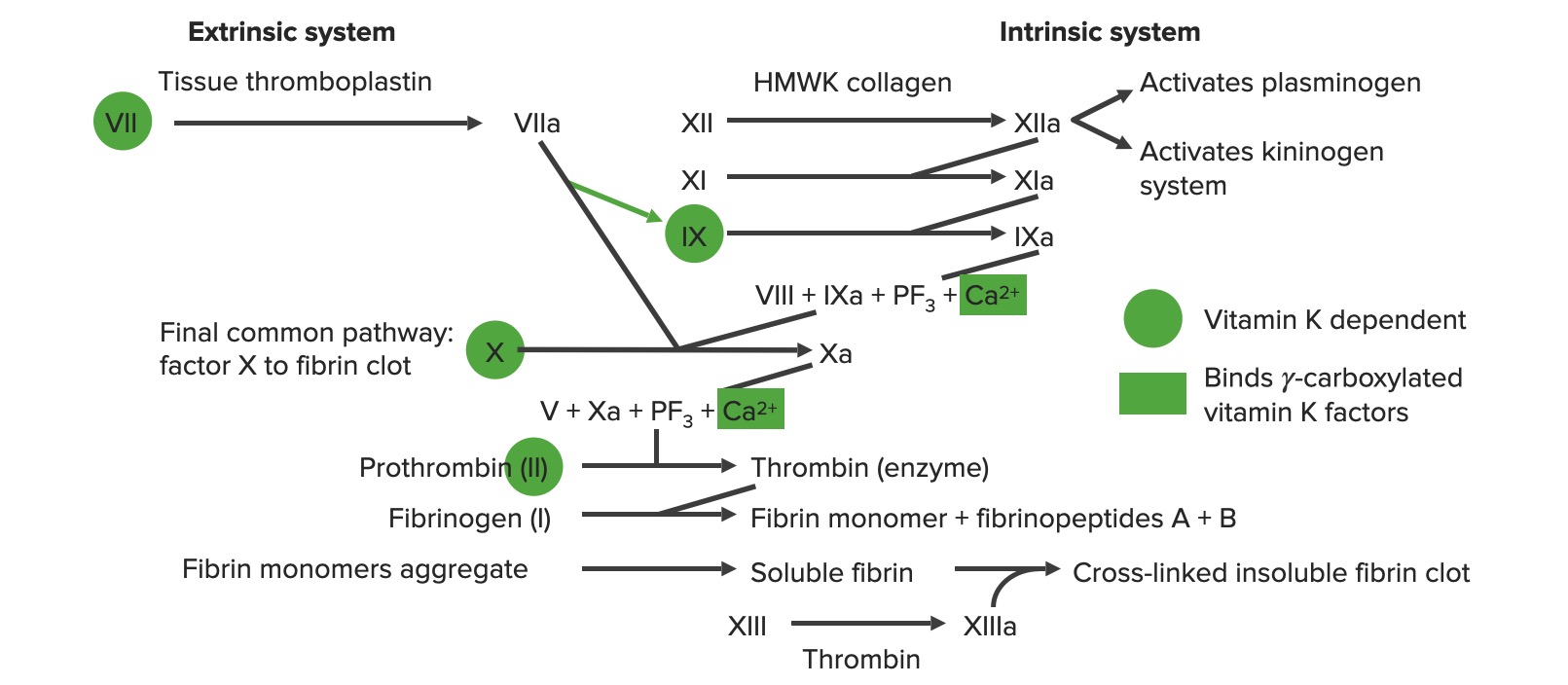
Imagen por Lecturio.

Etiología

Las siguientes afecciones pueden conducir a un estado hipocoagulable.

Tabla: Etiologías de las afecciones hipocoagulables
Afecciones heredadas Afecciones adquiridas
Trastornos de la pared del vaso
  • Telangiectasia Telangiectasia Permanent dilation of preexisting blood vessels creating small focal red lesions, most commonly in the skin or mucous membranes. It is characterized by the prominence of skin blood vessels, such as vascular spiders. Chronic Venous Insufficiency hemorrágica hereditaria (enfermedad de Osler–Weber–Rendu)
  • Síndrome de Ehlers–Danlos
  • Adelgazamiento de la piel debido a la edad
  • Uso crónico de glucocorticoides
  • Deficiencia de vitamina C
  • Púrpura de Henoch–Schönlein
Trastornos plaquetarios
  • Síndrome de Wiskott–Aldrich
  • Anemia Anemia Anemia is a condition in which individuals have low Hb levels, which can arise from various causes. Anemia is accompanied by a reduced number of RBCs and may manifest with fatigue, shortness of breath, pallor, and weakness. Subtypes are classified by the size of RBCs, chronicity, and etiology. Anemia: Overview and Types de Fanconi
  • Síndrome de Bernard–Soulier
  • Trombastenia de Glanzmann
  • Púrpura trombocitopénica idiopática
  • Púrpura trombocitopénica trombótica
  • Síndrome hemolítico urémico
  • Secuestro esplénico
  • Anemia Anemia Anemia is a condition in which individuals have low Hb levels, which can arise from various causes. Anemia is accompanied by a reduced number of RBCs and may manifest with fatigue, shortness of breath, pallor, and weakness. Subtypes are classified by the size of RBCs, chronicity, and etiology. Anemia: Overview and Types aplásica
  • Infiltración de la médula ósea
  • Mielosupresión: inducida por medicamentos, inducida por radiación
  • Cirrosis hepática
  • Enfermedad renal crónica
  • Infecciones virales
  • Deficiencias de vitamina B12 y folato
  • Afecciones asociadas al AL Amyloidosis embarazo: trombocitopenia gestacional, síndrome HELLP (por sus siglas en EN Erythema nodosum is an immune-mediated panniculitis (inflammation of the subcutaneous fat) caused by a type IV (delayed-type) hypersensitivity reaction. It commonly manifests in young women as tender, erythematous nodules on the shins. Erythema Nodosum inglés)
Trastornos de la coagulación Hemofilias A, B y C
  • Desarrollo de autoanticuerpos contra el factor de coagulación
  • Deficiencia de vitamina K
Trastornos mixtos Enfermedad de Von Willebrand Coagulación intravascular diseminada
Medicamentos
  • Fármacos antiplaquetarios: aspirina, antiinflamatorios no esteroideos (AINE), clopidogrel Clopidogrel A ticlopidine analog and platelet purinergic p2y receptor antagonist that inhibits adenosine diphosphate-mediated platelet aggregation. It is used to prevent thromboembolism in patients with arterial occlusive diseases; myocardial infarction; stroke; or atrial fibrillation. Antiplatelet Drugs, ticlopidina
  • Anticoagulantes: warfarina, heparina
  • Inhibidores de factor:
    • Argatroban Argatroban Anticoagulants (inhibe la trombina)
    • Rivaroxaban Rivaroxaban A morpholine and thiophene derivative that functions as a factor Xa inhibitor and is used in the treatment and prevention of deep-vein thrombosis and pulmonary embolism. It is also used for the prevention of stroke and systemic embolization in patients with non-valvular atrial fibrillation, and for the prevention of atherothrombotic events in patients after an acute coronary syndrome. Anticoagulants (inhibe el factor Xa)
  • Agentes quimioterapéuticos mielosupresores

Presentación Clínica

Un estado hipocoagulable puede presentarse de las siguientes maneras:

  • Hemorragia cutánea:
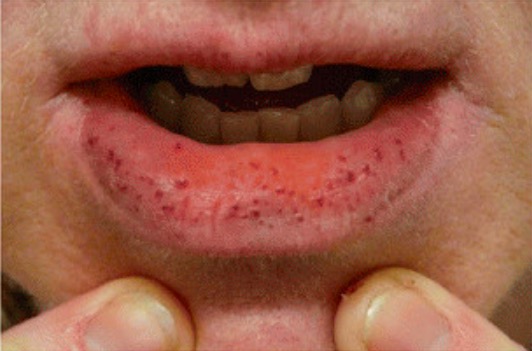
    • Petequias
    • Púrpura
    • Equimosis y fácil aparición de hematomas
  • Hemorragia de mucosas:
    • Sangrado gingival: con el cepillado, el uso de hilo dental y/o los LOS Neisseria procedimientos dentales
    • Hemorragia de la mucosa gastrointestinal: sangre evidente en EN Erythema nodosum is an immune-mediated panniculitis (inflammation of the subcutaneous fat) caused by a type IV (delayed-type) hypersensitivity reaction. It commonly manifests in young women as tender, erythematous nodules on the shins. Erythema Nodosum las heces o en EN Erythema nodosum is an immune-mediated panniculitis (inflammation of the subcutaneous fat) caused by a type IV (delayed-type) hypersensitivity reaction. It commonly manifests in young women as tender, erythematous nodules on the shins. Erythema Nodosum la prueba de sangre oculta en EN Erythema nodosum is an immune-mediated panniculitis (inflammation of the subcutaneous fat) caused by a type IV (delayed-type) hypersensitivity reaction. It commonly manifests in young women as tender, erythematous nodules on the shins. Erythema Nodosum heces
    • Hemorragia nasofaríngea: epistaxis Epistaxis Bleeding from the nose. Granulomatosis with Polyangiitis prolongada o recurrente
    • Sangrado menstrual: períodos prolongados o abundantes
    • Hemorragia de vías urinarias: hematuria Hematuria Presence of blood in the urine. Renal Cell Carcinoma macro o microscópica
  • Hemorragia interna:
  • Anemia Anemia Anemia is a condition in which individuals have low Hb levels, which can arise from various causes. Anemia is accompanied by a reduced number of RBCs and may manifest with fatigue, shortness of breath, pallor, and weakness. Subtypes are classified by the size of RBCs, chronicity, and etiology. Anemia: Overview and Types ferropénica (si se produce una pérdida de sangre importante):
    • Fatiga
    • Palidez conjuntival
    • Pica Pica Pica is an eating disorder characterized by a desire or recurrent compulsion to eat substances that are nonnutritive and not food. These compulsions and ingested substances are inappropriate for age or culture. Pica
  • Trastornos hemorrágicos genéticos/heredados:
    • Hemorragia sintomática en EN Erythema nodosum is an immune-mediated panniculitis (inflammation of the subcutaneous fat) caused by a type IV (delayed-type) hypersensitivity reaction. It commonly manifests in young women as tender, erythematous nodules on the shins. Erythema Nodosum la primera infancia/niñez
    • Otros hallazgos consistentes con un trastorno hereditario
Tabla: Presentación clínica habitual según la causa
Hemorragia cutánea Hemorragia de la mucosa Hemorragia interna Inicio de hemorragia después de un traumatismo
Trastornos plaquetarios Temprano (inmediatamente)
Trastornos vasculares
Trastornos de la cascada de la coagulación Tarde (de minutos a horas)

Trastornos de la Pared Vascular

Descripción general

Los LOS Neisseria trastornos hemorrágicos pueden tener su origen en EN Erythema nodosum is an immune-mediated panniculitis (inflammation of the subcutaneous fat) caused by a type IV (delayed-type) hypersensitivity reaction. It commonly manifests in young women as tender, erythematous nodules on the shins. Erythema Nodosum anomalías de la pared de los LOS Neisseria vasos.

  • Las anomalías pueden darse en EN Erythema nodosum is an immune-mediated panniculitis (inflammation of the subcutaneous fat) caused by a type IV (delayed-type) hypersensitivity reaction. It commonly manifests in young women as tender, erythematous nodules on the shins. Erythema Nodosum cualquier componente de las paredes de los LOS Neisseria vasos, las cuales están formadas por:
    • Células endoteliales
    • Matriz subendotelial
    • Tejidos conectivos extravasculares
  • Los LOS Neisseria trastornos pueden ser hereditarios o adquiridos.
  • Suelen presentarse con la aparición espontánea de petequias y equimosis en EN Erythema nodosum is an immune-mediated panniculitis (inflammation of the subcutaneous fat) caused by a type IV (delayed-type) hypersensitivity reaction. It commonly manifests in young women as tender, erythematous nodules on the shins. Erythema Nodosum la piel y las mucosas o tras un traumatismo menor
  • Los LOS Neisseria estudios de coagulación y hemorragia suelen ser normales.

Trastornos hereditarios de la pared vascular

Los LOS Neisseria trastornos hereditarios de la matriz del tejido conectivo pueden causar fragilidad vascular, lo que provoca frecuentes lesiones en EN Erythema nodosum is an immune-mediated panniculitis (inflammation of the subcutaneous fat) caused by a type IV (delayed-type) hypersensitivity reaction. It commonly manifests in young women as tender, erythematous nodules on the shins. Erythema Nodosum los LOS Neisseria vasos.
  • Telangiectasia Telangiectasia Permanent dilation of preexisting blood vessels creating small focal red lesions, most commonly in the skin or mucous membranes. It is characterized by the prominence of skin blood vessels, such as vascular spiders. Chronic Venous Insufficiency hemorrágica hereditaria (síndrome de Osler–Weber–Rendu):
    • Mutación autosómica dominante en EN Erythema nodosum is an immune-mediated panniculitis (inflammation of the subcutaneous fat) caused by a type IV (delayed-type) hypersensitivity reaction. It commonly manifests in young women as tender, erythematous nodules on the shins. Erythema Nodosum la endoglina (una proteína integral del colágeno)
    • Se presenta con:
      • Telangiectasias Telangiectasias Ataxia-telangiectasia en EN Erythema nodosum is an immune-mediated panniculitis (inflammation of the subcutaneous fat) caused by a type IV (delayed-type) hypersensitivity reaction. It commonly manifests in young women as tender, erythematous nodules on the shins. Erythema Nodosum piel, membranas mucosas y órganos internos
      • Epistaxis Epistaxis Bleeding from the nose. Granulomatosis with Polyangiitis
      • Hemorragia gastrointestinal
      • Anemia Anemia Anemia is a condition in which individuals have low Hb levels, which can arise from various causes. Anemia is accompanied by a reduced number of RBCs and may manifest with fatigue, shortness of breath, pallor, and weakness. Subtypes are classified by the size of RBCs, chronicity, and etiology. Anemia: Overview and Types ferropénica
      • Malformaciones arteriovenosas en EN Erythema nodosum is an immune-mediated panniculitis (inflammation of the subcutaneous fat) caused by a type IV (delayed-type) hypersensitivity reaction. It commonly manifests in young women as tender, erythematous nodules on the shins. Erythema Nodosum los LOS Neisseria pulmones, el hígado y el cerebro
  • Síndrome de Ehlers–Danlos:
    • Un trastorno genético que afecta a la síntesis y/o al AL Amyloidosis procesamiento del colágeno
    • Múltiples fenotipos, pero generalmente caracterizados por:
      • Hiperextensibilidad de la piel
      • Hipermovilidad articular
      • Fragilidad de los LOS Neisseria tejidos
    • El tipo vascular, en EN Erythema nodosum is an immune-mediated panniculitis (inflammation of the subcutaneous fat) caused by a type IV (delayed-type) hypersensitivity reaction. It commonly manifests in young women as tender, erythematous nodules on the shins. Erythema Nodosum particular, tiene ↑ riesgo de ruptura espontánea vascular o visceral con una hemorragia potencialmente mortal.
Telangiectasias mucocutáneas

Telangiectasia hemorrágica hereditaria

Imagen: “Clinical manifestations of HHT” por Latino et al. Licencia: CC BY 4.0, recortada por Lecturio.

Trastornos adquiridos de la pared vascular

Las siguientes condiciones adquiridas pueden conducir a la fragilidad vascular y aumentar la lesión de los LOS Neisseria vasos:

  • Adelgazamiento de la piel debido a la edad
  • El uso de glucocorticoides tópicos a largo plazo puede causar atrofia del tejido conectivo de soporte.
  • Deficiencia de vitamina C (escorbuto):
    • La vitamina C es esencial para la síntesis e integridad del colágeno.
    • Presentación:
      • Signos cutáneos: petequias, hemorragia perifolicular y equimosis
      • Gingivitis Gingivitis Inflammation of gum tissue (gingiva) without loss of connective tissue. Chédiak-Higashi Syndrome
      • Artralgias
      • Deterioro en EN Erythema nodosum is an immune-mediated panniculitis (inflammation of the subcutaneous fat) caused by a type IV (delayed-type) hypersensitivity reaction. It commonly manifests in young women as tender, erythematous nodules on the shins. Erythema Nodosum la cicatrización de las heridas
  • Púrpura de Henoch–Schönlein:
    • Vasculitis Vasculitis Inflammation of any one of the blood vessels, including the arteries; veins; and rest of the vasculature system in the body. Systemic Lupus Erythematosus postinfecciosa de pequeños vasos mediada por inmunoglobulina A ( IgA IgA Represents 15-20% of the human serum immunoglobulins, mostly as the 4-chain polymer in humans or dimer in other mammals. Secretory iga is the main immunoglobulin in secretions. Immunoglobulins: Types and Functions) en EN Erythema nodosum is an immune-mediated panniculitis (inflammation of the subcutaneous fat) caused by a type IV (delayed-type) hypersensitivity reaction. It commonly manifests in young women as tender, erythematous nodules on the shins. Erythema Nodosum niños y adultos jóvenes
    • Presentación clásica:
      • Púrpura en EN Erythema nodosum is an immune-mediated panniculitis (inflammation of the subcutaneous fat) caused by a type IV (delayed-type) hypersensitivity reaction. It commonly manifests in young women as tender, erythematous nodules on the shins. Erythema Nodosum las superficies extensoras
      • Artralgias
      • Dolor Dolor Inflammation abdominal
      • Enfermedad renal/ hematuria Hematuria Presence of blood in the urine. Renal Cell Carcinoma

Trastornos Plaquetarios

Descripción general

  • Los LOS Neisseria trastornos plaquetarios hipocoagulables pueden deberse a:
    • Disminución del número (trombocitopenia)
      • Aumento de la destrucción/aclaramiento
      • Disminución de la producción
    • Función anormal
  • Hallazgos de laboratorio:
    • Tiempo de sangrado: prolongado
    • Tiempo de protrombina, índice internacional normalizado y tiempo parcial de tromboplastina: no afectados por trastornos plaquetarios puros

Trombocitopenias

  • Púrpura trombocitopénica inmune (PTI):
    • Anticuerpos de inmunoglobulina G ( IgG IgG The major immunoglobulin isotype class in normal human serum. There are several isotype subclasses of igg, for example, igg1, igg2a, and igg2b. Hypersensitivity Pneumonitis) contra las plaquetas, lo que provoca su destrucción
    • Puede ser primario o secundario
    • La PTI secundaria puede ser causada por:
      • Infecciones víricas (véase más abajo)
      • Leucemia linfocítica crónica (LLC)
      • Lupus eritematoso sistémico (LES)
      • Síndrome antifosfolípido
      • Inmunodeficiencia común variable Variable Variables represent information about something that can change. The design of the measurement scales, or of the methods for obtaining information, will determine the data gathered and the characteristics of that data. As a result, a variable can be qualitative or quantitative, and may be further classified into subgroups. Types of Variables (IDCV)
  • Púrpura trombocitopénica trombótica (PTT):
    • Deficiencia de la metaloproteínasa ADAMTS13 (congénita o autoinmune)
      • Esta proteína es responsable de escindir los LOS Neisseria grandes multímeros del FVW.
      • Las deficiencias dan lugar a grandes multímeros de FVW que se adhieren fuertemente a las plaquetas y aumentan la agregación plaquetaria.
      • Estos tapones de plaquetas dañan los LOS Neisseria eritrocitos que fluyen → anemia Anemia Anemia is a condition in which individuals have low Hb levels, which can arise from various causes. Anemia is accompanied by a reduced number of RBCs and may manifest with fatigue, shortness of breath, pallor, and weakness. Subtypes are classified by the size of RBCs, chronicity, and etiology. Anemia: Overview and Types hemolítica
      • Limita el flujo sanguíneo al AL Amyloidosis cerebro y a los LOS Neisseria riñones
    • Presentación clásica (pentada):
      • Trombocitopenia
      • Anemia Anemia Anemia is a condition in which individuals have low Hb levels, which can arise from various causes. Anemia is accompanied by a reduced number of RBCs and may manifest with fatigue, shortness of breath, pallor, and weakness. Subtypes are classified by the size of RBCs, chronicity, and etiology. Anemia: Overview and Types hemolítica
      • Insuficiencia renal aguda
      • Síntomas neurológicos
      • Fiebre
    • Presentación moderna (ahora se diagnostica a menudo antes de la presentación clásica de la enfermedad más grave; la fiebre, especialmente, es poco común):
      • Fatiga, debilidad
      • Sangrado, petequias o púrpura
      • Síntomas gastrointestinales
      • Hallazgos neurológicos: accidente cerebrovascular, convulsiones, cefalea, confusión
  • Síndrome urémico hemolítico:
    • Principalmente, es una condición adquirida, típicamente en EN Erythema nodosum is an immune-mediated panniculitis (inflammation of the subcutaneous fat) caused by a type IV (delayed-type) hypersensitivity reaction. It commonly manifests in young women as tender, erythematous nodules on the shins. Erythema Nodosum niños
      • El 90% se produce tras una infección por Escherichia coli Escherichia coli The gram-negative bacterium Escherichia coli is a key component of the human gut microbiota. Most strains of E. coli are avirulent, but occasionally they escape the GI tract, infecting the urinary tract and other sites. Less common strains of E. coli are able to cause disease within the GI tract, most commonly presenting as abdominal pain and diarrhea. Escherichia coli productora de toxina Shiga.
      • Son posibles las formas hereditarias que implican mutaciones en EN Erythema nodosum is an immune-mediated panniculitis (inflammation of the subcutaneous fat) caused by a type IV (delayed-type) hypersensitivity reaction. It commonly manifests in young women as tender, erythematous nodules on the shins. Erythema Nodosum las proteínas de la vía del complemento y de la coagulación.
    • Presentación clásica (tríada):
      • Trombocitopenia
      • Anemia Anemia Anemia is a condition in which individuals have low Hb levels, which can arise from various causes. Anemia is accompanied by a reduced number of RBCs and may manifest with fatigue, shortness of breath, pallor, and weakness. Subtypes are classified by the size of RBCs, chronicity, and etiology. Anemia: Overview and Types hemolítica
      • Insuficiencia renal aguda
    • Generalmente, precede a la diarrea con sangre
  • Hiperesplenismo (secuestro esplénico de plaquetas):
    • La trombocitopenia suele ser leve.
    • Las anomalías hemorrágicas son raras.
  • Cirrosis hepática:
    • Disminución de la producción hepática de trombopoyetina → ↓ producción de plaquetas
    • Hipertensión portal → esplenomegalia → secuestro esplénico
  • Infecciones víricas:
    • Mecanismos:
      • Secuestro esplénico
      • Infección viral → hepatitis → ↓ producción de plaquetas.
      • PTI secundaria
      • Destrucción directa de las plaquetas
    • Virus Virus Viruses are infectious, obligate intracellular parasites composed of a nucleic acid core surrounded by a protein capsid. Viruses can be either naked (non-enveloped) or enveloped. The classification of viruses is complex and based on many factors, including type and structure of the nucleoid and capsid, the presence of an envelope, the replication cycle, and the host range. Virology con mayor probabilidad de causar trombocitopenia:
      • VIH
      • Virus Virus Viruses are infectious, obligate intracellular parasites composed of a nucleic acid core surrounded by a protein capsid. Viruses can be either naked (non-enveloped) or enveloped. The classification of viruses is complex and based on many factors, including type and structure of the nucleoid and capsid, the presence of an envelope, the replication cycle, and the host range. Virology de Epstein–Barr
      • Citomegalovirus
      • Rubeola Rubeola Measles (also known as rubeola) is caused by a single-stranded, linear, negative-sense RNA virus of the family Paramyxoviridae. It is highly contagious and spreads by respiratory droplets or direct-contact transmission from an infected person. Typically a disease of childhood, measles classically starts with cough, coryza, and conjunctivitis, followed by a maculopapular rash. Measles Virus
      • Varicela
      • Paperas
      • Parvovirus
      • Hepatitis C Hepatitis C Hepatitis C is an infection of the liver caused by the hepatitis C virus (HCV). The infection can be transmitted through infectious blood or body fluids and may be transmitted during childbirth or through IV drug use or sexual intercourse. Hepatitis C virus can cause both acute and chronic hepatitis, ranging from a mild to a serious, lifelong illness including liver cirrhosis and hepatocellular carcinoma (HCC). Hepatitis C Virus
  • Supresión de la médula ósea:
    • Anemia Anemia Anemia is a condition in which individuals have low Hb levels, which can arise from various causes. Anemia is accompanied by a reduced number of RBCs and may manifest with fatigue, shortness of breath, pallor, and weakness. Subtypes are classified by the size of RBCs, chronicity, and etiology. Anemia: Overview and Types aplásica:
      • Un fallo de la médula ósea que amenaza la vida y causa pancitopenia
      • Debido a la lesión de las células madre hematopoyéticas multipotentes
    • Anemia Anemia Anemia is a condition in which individuals have low Hb levels, which can arise from various causes. Anemia is accompanied by a reduced number of RBCs and may manifest with fatigue, shortness of breath, pallor, and weakness. Subtypes are classified by the size of RBCs, chronicity, and etiology. Anemia: Overview and Types de Fanconi:
      • Un tipo hereditario de anemia Anemia Anemia is a condition in which individuals have low Hb levels, which can arise from various causes. Anemia is accompanied by a reduced number of RBCs and may manifest with fatigue, shortness of breath, pallor, and weakness. Subtypes are classified by the size of RBCs, chronicity, and etiology. Anemia: Overview and Types aplásica
      • Se asocia con un mayor riesgo de malignidad, retraso en EN Erythema nodosum is an immune-mediated panniculitis (inflammation of the subcutaneous fat) caused by a type IV (delayed-type) hypersensitivity reaction. It commonly manifests in young women as tender, erythematous nodules on the shins. Erythema Nodosum el desarrollo, manchas color café con leche y anomalías de la asociación VACTERL [Vertebral defects (defectos vertebrales), Anal atresia Atresia Hypoplastic Left Heart Syndrome (HLHS) ( atresia Atresia Hypoplastic Left Heart Syndrome (HLHS) anal), Cardiac defects (defectos cardíacos), Tracheo-Esophageal  fistula Fistula Abnormal communication most commonly seen between two internal organs, or between an internal organ and the surface of the body. Anal Fistula (fístula traqueo-esofágica), Renal anomalies (anomalías renales), Limb abnormalities (anomalías de las extremidades)]
    • Mielodisplasia
    • Mielosupresión inducida por medicamentos (e.g., quimioterapia)
    • Mielosupresión inducida por radiación
    • Productos químicos tóxicos (e.g., arsénico, benceno)
  • Deficiencias vitamínicas:
    • B12
    • Ácido fólico
  • Afecciones asociadas al AL Amyloidosis embarazo:
    • Trombocitopenia gestacional
    • Síndrome HELLP

Trastornos de la función plaquetaria

Trastornos hereditarios:

  • Síndrome de BernardSoulier:
    • Condición autosómica recesiva
    • Adhesión anormal de las plaquetas debido a una GpIb baja
    • Plaquetas grandes en EN Erythema nodosum is an immune-mediated panniculitis (inflammation of the subcutaneous fat) caused by a type IV (delayed-type) hypersensitivity reaction. It commonly manifests in young women as tender, erythematous nodules on the shins. Erythema Nodosum el frotis
  • Trombastenia de Glanzmann:
    • Condición autosómica recesiva
    • Agregación plaquetaria anormal debido a una baja GpIIb/IIIa
    • Presenta una hemorragia mucocutánea sin trombocitopenia
  • Síndrome de WiskottAldrich (WAS, por sus siglas en EN Erythema nodosum is an immune-mediated panniculitis (inflammation of the subcutaneous fat) caused by a type IV (delayed-type) hypersensitivity reaction. It commonly manifests in young women as tender, erythematous nodules on the shins. Erythema Nodosum inglés):
    • Trastorno recesivo ligado al AL Amyloidosis cromosoma X causado por mutaciones en EN Erythema nodosum is an immune-mediated panniculitis (inflammation of the subcutaneous fat) caused by a type IV (delayed-type) hypersensitivity reaction. It commonly manifests in young women as tender, erythematous nodules on the shins. Erythema Nodosum la proteína WAS
    • Presentación (tríada clásica):
      • Inmunodeficiencia
      • Trombocitopenia
      • Eccema
    • La deficiencia mixta de células B y T provoca una inmunodeficiencia.
    • Causas del desarrollo anormal de las plaquetas:
      • Plaquetas severamente disfuncionales
      • Trombocitopenia
      • Sangrado anormal

Condiciones adquiridas:

  • Disfunción plaquetaria urémica:
    • La insuficiencia renal crónica provoca anomalías en EN Erythema nodosum is an immune-mediated panniculitis (inflammation of the subcutaneous fat) caused by a type IV (delayed-type) hypersensitivity reaction. It commonly manifests in young women as tender, erythematous nodules on the shins. Erythema Nodosum las plaquetas ( los LOS Neisseria mecanismos no se conocen del todo).
    • Presentación: hematomas, epistaxis Epistaxis Bleeding from the nose. Granulomatosis with Polyangiitis, hemorragias gastrointestinales y genitourinarias
  • Trastornos mieloproliferativos:
    • Las complicaciones hemorrágicas varían (incidencia: 3%–59%).
    • Presentación: hematomas, epistaxis Epistaxis Bleeding from the nose. Granulomatosis with Polyangiitis, hemorragia gingival y hemorragia gastrointestinal
  • Uso de agentes antiplaquetarios:
    • AINE
    • Aspirina
    • Clopidogrel Clopidogrel A ticlopidine analog and platelet purinergic p2y receptor antagonist that inhibits adenosine diphosphate-mediated platelet aggregation. It is used to prevent thromboembolism in patients with arterial occlusive diseases; myocardial infarction; stroke; or atrial fibrillation. Antiplatelet Drugs

Trastornos de la Cascada de Coagulación

Descripción general

  • Los LOS Neisseria trastornos hipocoagulables pueden deberse a:
    • Disminución del número de factores de coagulación (denominada “deficiencia de factores”)
    • Función anormal de los LOS Neisseria factores de coagulación
  • Resultados de laboratorio:
    • El tiempo de protrombina y/o el tiempo parcial de tromboplastina se prolongarán en EN Erythema nodosum is an immune-mediated panniculitis (inflammation of the subcutaneous fat) caused by a type IV (delayed-type) hypersensitivity reaction. It commonly manifests in young women as tender, erythematous nodules on the shins. Erythema Nodosum caso de trastornos puros de los LOS Neisseria factores de coagulación.
    • El recuento de plaquetas y el tiempo de sangrado no se verán afectados.

Condiciones heredadas

  • Hemofilia A:
    • Trastorno recesivo ligado al AL Amyloidosis X
    • Deficiencia de factor VIII Factor VIII Factor VIII of blood coagulation. Antihemophilic factor that is part of the factor viii/von Willebrand factor complex. Factor VIII is produced in the liver and acts in the intrinsic pathway of blood coagulation. It serves as a cofactor in factor X activation and this action is markedly enhanced by small amounts of thrombin. Hemostasis
    • Se presenta con:
      • Hemorragia y hematomas de fácil aparición en EN Erythema nodosum is an immune-mediated panniculitis (inflammation of the subcutaneous fat) caused by a type IV (delayed-type) hypersensitivity reaction. It commonly manifests in young women as tender, erythematous nodules on the shins. Erythema Nodosum la infancia
      • Hemorragia en EN Erythema nodosum is an immune-mediated panniculitis (inflammation of the subcutaneous fat) caused by a type IV (delayed-type) hypersensitivity reaction. It commonly manifests in young women as tender, erythematous nodules on the shins. Erythema Nodosum las articulaciones, los LOS Neisseria músculos y el tracto gastrointestinal cuando se es mayor
    • Tratados con infusiones profilácticas de factor VIII Factor VIII Factor VIII of blood coagulation. Antihemophilic factor that is part of the factor viii/von Willebrand factor complex. Factor VIII is produced in the liver and acts in the intrinsic pathway of blood coagulation. It serves as a cofactor in factor X activation and this action is markedly enhanced by small amounts of thrombin. Hemostasis
  • Hemofilia B:
    • Trastorno recesivo ligado al AL Amyloidosis X
    • Deficiencia de factor IX Factor IX Storage-stable blood coagulation factor acting in the intrinsic pathway of blood coagulation. Its activated form, ixa, forms a complex with factor VIII and calcium on platelet factor 3 to activate factor X to Xa. Hemostasis
    • Menos común
  • Hemofilia C:
    • Trastorno autosómico recesivo
    • Deficiencia del factor XI
    • Menos común

Condiciones adquiridas

  • Desarrollo de inhibidores de factor (autoanticuerpos contra factores de coagulación específicos):
    • Se manifiesta clínicamente como hemofilia
    • A menudo es difícil de tratar
  • Deficiencia de vitamina K:
    • Malabsorción
    • Desnutrición (e.g., abuso de alcohol)
  • Terapia de anticoagulación:
    • Heparinas:
      • Se unen a la antitrombina y aumentan su actividad
      • Conduce a inactivación más rápida de los LOS Neisseria factores de coagulación (trombina, factor Xa)
    • Warfarina:
      • Inhibe la epóxido reductasa de la vitamina K en EN Erythema nodosum is an immune-mediated panniculitis (inflammation of the subcutaneous fat) caused by a type IV (delayed-type) hypersensitivity reaction. It commonly manifests in young women as tender, erythematous nodules on the shins. Erythema Nodosum el hígado, lo que impide la gamma-carboxilación de los LOS Neisseria factores de coagulación dependientes de vitamina K
      • Procoagulantes dependientes de la vitamina K: factores II (trombina), VII, IX y X
      • Anticoagulantes dependientes de la vitamina K: proteínas C y S

Trastornos Mixtos de las Plaquetas y la Coagulación

  • Coagulación intravascular diseminada (CID):
    • Causa: formación de trombos sistémicos en EN Erythema nodosum is an immune-mediated panniculitis (inflammation of the subcutaneous fat) caused by a type IV (delayed-type) hypersensitivity reaction. It commonly manifests in young women as tender, erythematous nodules on the shins. Erythema Nodosum toda la microcirculación causada por la activación sistémica de la coagulación debido a:
      • Sepsis Sepsis Systemic inflammatory response syndrome with a proven or suspected infectious etiology. When sepsis is associated with organ dysfunction distant from the site of infection, it is called severe sepsis. When sepsis is accompanied by hypotension despite adequate fluid infusion, it is called septic shock. Sepsis and Septic Shock
      • Malignidad
      • Trauma
      • Complicaciones obstétricas: preeclampsia Preeclampsia A complication of pregnancy, characterized by a complex of symptoms including maternal hypertension and proteinuria with or without pathological edema. Symptoms may range between mild and severe. Pre-eclampsia usually occurs after the 20th week of gestation, but may develop before this time in the presence of trophoblastic disease. Hypertensive Pregnancy Disorders, hemorragia posparto, feto muerto retenido
      • Reacción transfusional hemolítica aguda
    • Resultados: Las plaquetas y los LOS Neisseria factores de coagulación se consumen, provocando una diátesis hemorrágica.
    • Presentación: hemorragia espontánea de las membrana mucosas
  • Enfermedad de Von Willebrand:
    • Es el trastorno hemorrágico hereditario más común
    • Herencia autosómica dominante
    • Resulta de la deficiencia cuantitativa o cualitativa del FVW
    • Funciones del FVW:
      • El FVW se une al AL Amyloidosis factor VIII Factor VIII Factor VIII of blood coagulation. Antihemophilic factor that is part of the factor viii/von Willebrand factor complex. Factor VIII is produced in the liver and acts in the intrinsic pathway of blood coagulation. It serves as a cofactor in factor X activation and this action is markedly enhanced by small amounts of thrombin. Hemostasis y lo estabiliza (afecta a la vía intrínseca).
      • El FVW está presente en EN Erythema nodosum is an immune-mediated panniculitis (inflammation of the subcutaneous fat) caused by a type IV (delayed-type) hypersensitivity reaction. It commonly manifests in young women as tender, erythematous nodules on the shins. Erythema Nodosum las paredes de los LOS Neisseria vasos lesionados y se une al AL Amyloidosis receptor Receptor Receptors are proteins located either on the surface of or within a cell that can bind to signaling molecules known as ligands (e.g., hormones) and cause some type of response within the cell. Receptors GpIb de las plaquetas (adhesión inicial de las plaquetas).
    • Presentaciones clínicas:

Referencias

  1. Rajendran, P., Rengarajan, T., Thangavel, J., Nishigaki, Y., Sakthisekaran, D., Sethi, G., Nishigaki, I. (2013). The vascular endothelium and human diseases. International Journal of Biological Sciences 9(10):1057–1069. https://doi.org/10.7150/ijbs.7502
  2. Zehnder, J. (2020). Clinical use of coagulation tests. Retrieved March 3, 2021, from https://www.uptodate.com/contents/clinical-use-of-coagulation-tests
  3. Ma, A. (2021). Approach to the adult with a suspected bleeding disorder. En Tirnauer, J.S. (Ed.), UpToDate. Retrieved March 18, 2021, from https://www.uptodate.com/contents/approach-to-the-adult-with-a-suspected-bleeding-disorder
  4. Longo, D., Fauci, A., Kasper, D., Hauser, S., Jameson, J., Loscalzo, J. (2012). Harrison’s Manual of Medicine, 18th ed. McGraw-Hill Professional, páginas 2159-2178.
  5. Arnold, D.M., Cuker, A. (2021). Diagnostic approach to the adult with unexplained thrombocytopenia. En Tirnauer, J.S. (Ed.), UpToDate. Retrieved March 30, 2021, from https://www.uptodate.com/contents/diagnostic-approach-to-the-adult-with-unexplained-thrombocytopenia

¡Crea tu cuenta gratis o inicia una sesión para seguir leyendo!

Regístrate ahora y obtén acceso gratuito a Lecturio con páginas de concepto, videos médicos y cuestionarios para tu educación médica.

User Reviews

Que tengas una sesión de estudio alegre y navideña 🎁 Ahorra 50% en todos los planes >>

Details