Domina Conceptos Médicos

Estudia para la escuela de medicina y tus examenes con Lecturio.

Absceso Parafaríngeo

El absceso parafaríngeo es una infección profunda del cuello que afecta al AL Amyloidosis espacio parafaríngeo. La infección suele surgir de los LOS Neisseria senos paranasales, la boca o la garganta. Los LOS Neisseria pacientes suelen presentar picos febriles, disfagia, odinofagia, trismo y dolor Dolor Inflammation de cuello. Puede haber compromiso de las vías respiratorias. El diagnóstico se realiza mediante TC o RM. El tratamiento incluye la estabilización de la vía aérea, el inicio de la terapia antibiótica, y posiblemente, drenaje quirúrgico.

Last updated: Dec 15, 2025

Editorial responsibility: Stanley Oiseth, Lindsay Jones, Evelin Maza

Descripción General

Definición

El absceso parafaríngeo es una infección profunda del cuello que afecta al AL Amyloidosis espacio parafaríngeo.

Epidemiología

  • Incidencia: 2,6 por cada 100 000 en EN Erythema nodosum is an immune-mediated panniculitis (inflammation of the subcutaneous fat) caused by a type IV (delayed-type) hypersensitivity reaction. It commonly manifests in young women as tender, erythematous nodules on the shins. Erythema Nodosum Taiwán (desconocida en EN Erythema nodosum is an immune-mediated panniculitis (inflammation of the subcutaneous fat) caused by a type IV (delayed-type) hypersensitivity reaction. It commonly manifests in young women as tender, erythematous nodules on the shins. Erythema Nodosum Estados Unidos)
  • Hombres > mujeres
  • Más común en EN Erythema nodosum is an immune-mediated panniculitis (inflammation of the subcutaneous fat) caused by a type IV (delayed-type) hypersensitivity reaction. It commonly manifests in young women as tender, erythematous nodules on the shins. Erythema Nodosum los LOS Neisseria niños
  • Localización de la infección: compartimento anterior > compartimento posterior

Factores de riesgo

  • Infecciones dentales
  • Infecciones amigdalinas
  • Mastoiditis Mastoiditis Inflammation of the honeycomb-like mastoid bone in the skull just behind the ear. It is usually a complication of otitis media. Mumps Virus/Mumps
  • Parotiditis
  • Lesión traumática de la cavidad oral y la faringe
  • Inmunosupresión
  • Instrumentación (e.g., esofagoscopia, procedimientos dentales)
  • Aspiración de cuerpo extraño
  • Necrosis Necrosis The death of cells in an organ or tissue due to disease, injury or failure of the blood supply. Ischemic Cell Damage de ganglios linfáticos cervicales malignos
  • Diabetes Diabetes Diabetes mellitus (DM) is a metabolic disease characterized by hyperglycemia and dysfunction of the regulation of glucose metabolism by insulin. Type 1 DM is diagnosed mostly in children and young adults as the result of autoimmune destruction of β cells in the pancreas and the resulting lack of insulin. Type 2 DM has a significant association with obesity and is characterized by insulin resistance. Diabetes Mellitus mellitus
  • Hipertensión

Etiología

  • Lo más común es que surja de un foco séptico de:
    • Dientes inferiores
    • Amígdalas
    • Glándula parótida
    • Ganglios linfáticos cervicales profundos
    • Oído medio
    • Senos paranasales
  • La infección parafaríngea es polimicrobiana:
    • Los LOS Neisseria organismos aerobios más comunes son:
      • Streptococcus Streptococcus Streptococcus is one of the two medically important genera of gram-positive cocci, the other being Staphylococcus. Streptococci are identified as different species on blood agar on the basis of their hemolytic pattern and sensitivity to optochin and bacitracin. There are many pathogenic species of streptococci, including S. pyogenes, S. agalactiae, S. pneumoniae, and the viridans streptococci. Streptococcus pyogenes
      • Staphylococcus aureus Staphylococcus aureus Potentially pathogenic bacteria found in nasal membranes, skin, hair follicles, and perineum of warm-blooded animals. They may cause a wide range of infections and intoxications. Brain Abscess
      • Haemophilus influenzae Haemophilus Influenzae A species of Haemophilus found on the mucous membranes of humans and a variety of animals. The species is further divided into biotypes I through viii. Haemophilus
      • Streptococcus Streptococcus Streptococcus is one of the two medically important genera of gram-positive cocci, the other being Staphylococcus. Streptococci are identified as different species on blood agar on the basis of their hemolytic pattern and sensitivity to optochin and bacitracin. There are many pathogenic species of streptococci, including S. pyogenes, S. agalactiae, S. pneumoniae, and the viridans streptococci. Streptococcus viridans
    • Los LOS Neisseria organismos anaerobios más comunes son:
      • Fusobacterium Fusobacterium A genus of gram-negative, anaerobic, rod-shaped bacteria found in cavities of humans and other animals. No endospores are formed. Some species are pathogenic and occur in various purulent or gangrenous infections. Dog and Cat Bites
      • Prevotella Prevotella A genus of gram-negative, anaerobic, nonsporeforming, nonmotile rods. Organisms of this genus had originally been classified as members of the bacteroides genus but overwhelming biochemical and chemical findings in 1990 indicated the need to separate them from other bacteroides species, and hence, this new genus was established. Dog and Cat Bites
      • Peptostreptococcus Peptostreptococcus A genus of gram-positive, anaerobic, coccoid bacteria that is part of the normal flora of humans. Its organisms are opportunistic pathogens causing bacteremias and soft tissue infections. Perianal and Perirectal Abscess
      • Bacteroides Bacteroides Bacteroides is a genus of opportunistic, anaerobic, gram-negative bacilli. Bacteroides fragilis is the most common species involved in human disease and is part of the normal flora of the large intestine. Bacteroides spp.

Fisiopatología

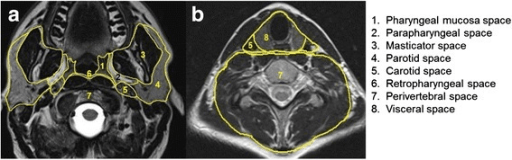
Las capas de la fascia Fascia Layers of connective tissue of variable thickness. The superficial fascia is found immediately below the skin; the deep fascia invests muscles, nerves, and other organs. Cellulitis cervical profunda representan las posibles vías de propagación de estas infecciones.
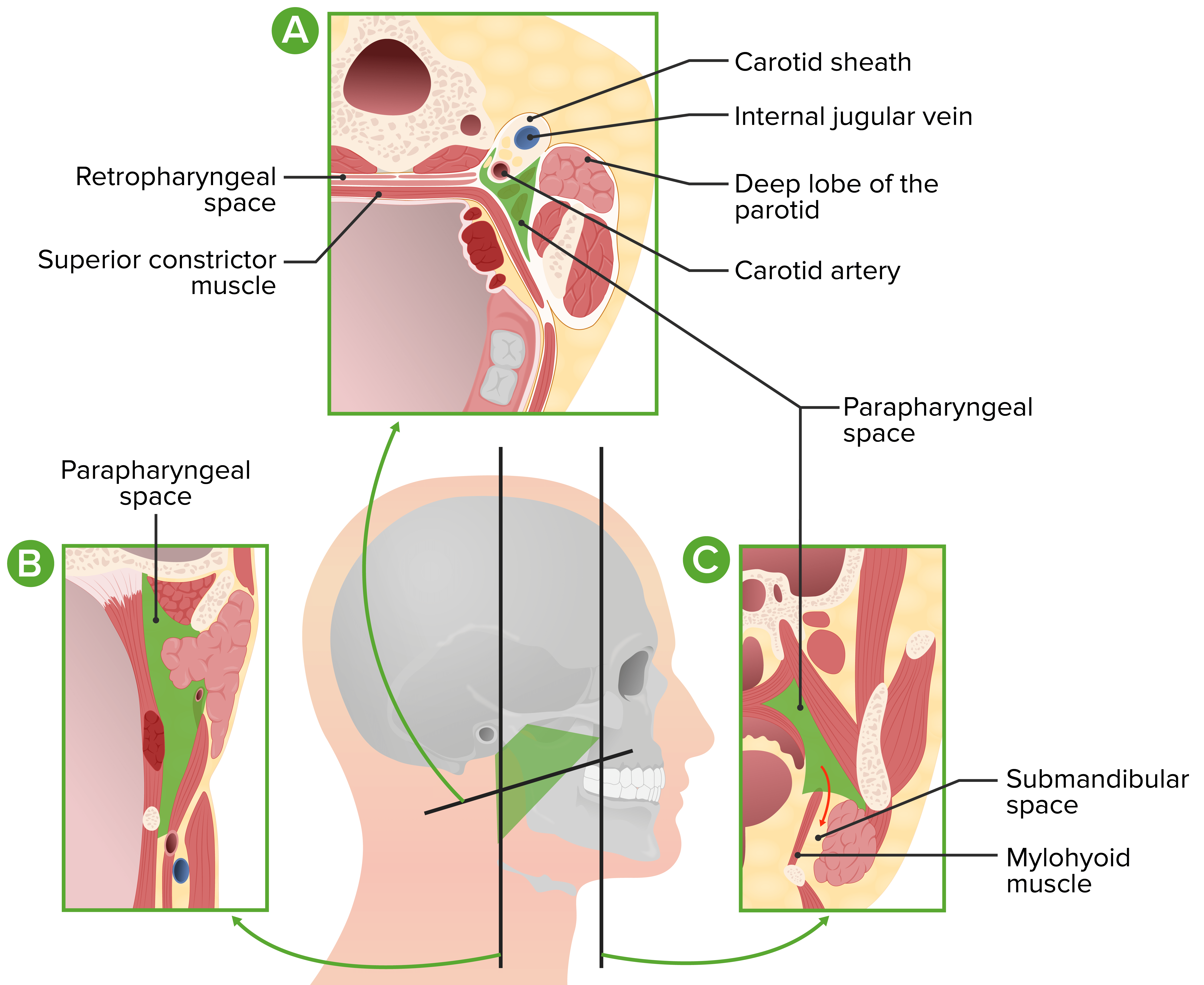
  • Espacio parafaríngeo:
    • Espacio faríngeo lateral o faringomaxilar
    • Su límite superior es la base del cráneo y se extiende inferiormente hasta el hueso hioides
    • Se encuentra contiguo a otros múltiples espacios que pueden ser fuente de infección
    • Compartimentos:
      • Anterior (prestiloide o muscular): grasa, ganglios linfáticos, músculo, tejido conectivo
      • Posterior: nervios craneales IX-XII, tronco simpático cervical, vaina carotídea (parte de la fascia Fascia Layers of connective tissue of variable thickness. The superficial fascia is found immediately below the skin; the deep fascia invests muscles, nerves, and other organs. Cellulitis cervical profunda)
    • La infección en EN Erythema nodosum is an immune-mediated panniculitis (inflammation of the subcutaneous fat) caused by a type IV (delayed-type) hypersensitivity reaction. It commonly manifests in young women as tender, erythematous nodules on the shins. Erythema Nodosum el compartimento posterior dará lugar a síntomas neurológicos.
  • Las infecciones del espacio profundo pueden propagarse por múltiples vías:
    • Extensión directa a lo largo de los LOS Neisseria planos fasciales
    • Extensión linfática desde la orofaringe
    • Traumatismo penetrante
    • Extensión vascular
    • Linfadenitis supurativa con posible formación de abscesos

Presentación Clínica y Diagnóstico

Antecedentes

  • Los LOS Neisseria pacientes suelen presentar:
    • Disfagia
    • Odinofagia
    • Dolor Dolor Inflammation de cuello
    • Trismo: inflamación de los LOS Neisseria músculos pterigoideos
    • Tortícolis: inflamación de los LOS Neisseria músculos paraespinales
    • Edema Edema Edema is a condition in which excess serous fluid accumulates in the body cavity or interstitial space of connective tissues. Edema is a symptom observed in several medical conditions. It can be categorized into 2 types, namely, peripheral (in the extremities) and internal (in an organ or body cavity). Edema del cuello
    • Masa fluctuante (no siempre palpable)
    • Linfadenopatía cervical
    • Disfonía o parálisis de las cuerdas vocales: afectación del nervio vago
    • Fiebre
  • Los LOS Neisseria signos de una posible obstrucción de la vía aérea son:
    • Estridor
    • Sialorrea
  • Debemos enfocarnos en EN Erythema nodosum is an immune-mediated panniculitis (inflammation of the subcutaneous fat) caused by a type IV (delayed-type) hypersensitivity reaction. It commonly manifests in young women as tender, erythematous nodules on the shins. Erythema Nodosum los LOS Neisseria detalles de los LOS Neisseria antecedentes clínicos que aumentan el riesgo:
    • Enfermedades dentales
    • Enfermedades amigdalinas
    • Inmunosupresión
    • Procedimientos en EN Erythema nodosum is an immune-mediated panniculitis (inflammation of the subcutaneous fat) caused by a type IV (delayed-type) hypersensitivity reaction. It commonly manifests in young women as tender, erythematous nodules on the shins. Erythema Nodosum el área afectada
    • Diabetes Diabetes Diabetes mellitus (DM) is a metabolic disease characterized by hyperglycemia and dysfunction of the regulation of glucose metabolism by insulin. Type 1 DM is diagnosed mostly in children and young adults as the result of autoimmune destruction of β cells in the pancreas and the resulting lack of insulin. Type 2 DM has a significant association with obesity and is characterized by insulin resistance. Diabetes Mellitus mellitus
  • Síntomas neurológicos

Examen físico

  • Palpación del cuello para evaluar:
    • Asimetría
    • Fluctuación
    • Plenitud
  • Otoscopia: hallazgos consistentes con una infección de oído medio
  • Examinación de la cavidad oral: desplazamiento medial de la amígdala y de la pared faríngea lateral
  • Palpación de los LOS Neisseria ganglios linfáticos faciales y del cuello
  • Puede tener el síndrome de Horner, causado por el daño a los LOS Neisseria nervios simpáticos en EN Erythema nodosum is an immune-mediated panniculitis (inflammation of the subcutaneous fat) caused by a type IV (delayed-type) hypersensitivity reaction. It commonly manifests in young women as tender, erythematous nodules on the shins. Erythema Nodosum el lado ipsilateral del cuello, que se presenta con:

Pruebas diagnósticas

  • Estudios de laboratorio:
    • El hemograma con diferencial suele mostrar leucocitosis.
    • Química sanguínea
    • Hemocultivos
  • Cultivo y tinción de Gram del líquido aspirado del absceso
  • Imagenología:
    • TC:
      • Estudio de elección
      • Es visible una colección de líquido con o sin realce del borde periférico.
    • La RM se utiliza para identificar complicaciones vasculares.

Tratamiento y Complicaciones

El tratamiento inicial se centra en EN Erythema nodosum is an immune-mediated panniculitis (inflammation of the subcutaneous fat) caused by a type IV (delayed-type) hypersensitivity reaction. It commonly manifests in young women as tender, erythematous nodules on the shins. Erythema Nodosum la estabilización de la vía aérea. Las infecciones son polimicrobianas y comprenden la flora habitual de la mucosa de origen adyacente. Debe iniciarse inmediatamente una terapia antibiótica intravenosa empírica.
Tratamiento

  • Si la infección proviene de una fuente dental → se indica la eliminación temprana de la fuente
  • Terapia médica: regímenes para pacientes inmunocompetentes
    • Medicamentos iniciales para el presunto origen oral o dental:
      • Ampicilina– sulbactam Sulbactam A beta-lactamase inhibitor with very weak antibacterial action. The compound prevents antibiotic destruction of beta-lactam antibiotics by inhibiting beta-lactamases, thus extending their spectrum activity. Combinations of sulbactam with beta-lactam antibiotics have been used successfully for the therapy of infections caused by organisms resistant to the antibiotic alone. Cephalosporins, Ó
      • Clindamicina más levofloxacina, Ó
      • Ceftriaxona más metronidazol
    • Por presunto origen otogénico (oído o mastoides):
      • Cefepime Cefepime A fourth-generation cephalosporin antibacterial agent that is used in the treatment of infections, including those of the abdomen, urinary tract, respiratory tract, and skin. It is effective against pseudomonas aeruginosa and may also be used in the empiric treatment of febrile neutropenia. Cephalosporins más metronidazol, Ó
      • Piperacilina– tazobactam Tazobactam A penicillanic acid and sulfone derivative and potent beta-lactamase inhibitor that enhances the activity of other anti-bacterial agents against beta-lactamase producing bacteria. Cephalosporins, Ó
      • Imipenem Imipenem Semisynthetic thienamycin that has a wide spectrum of antibacterial activity against gram-negative and gram-positive aerobic and anaerobic bacteria, including many multiresistant strains. It is stable to beta-lactamases. Clinical studies have demonstrated high efficacy in the treatment of infections of various body systems. Its effectiveness is enhanced when it is administered in combination with cilastatin, a renal dipeptidase inhibitor. Carbapenems and Aztreonam o meropenem Meropenem A thienamycin derivative antibacterial agent that is more stable to renal dehydropeptidase I than imipenem, but does not need to be given with an enzyme inhibitor such as cilastatin. It is used in the treatment of bacterial infections, including infections in immunocompromised patients. Carbapenems and Aztreonam
    • Por presunto origen sinusal:
      • Vancomicina más ampicilina– sulbactam Sulbactam A beta-lactamase inhibitor with very weak antibacterial action. The compound prevents antibiotic destruction of beta-lactam antibiotics by inhibiting beta-lactamases, thus extending their spectrum activity. Combinations of sulbactam with beta-lactam antibiotics have been used successfully for the therapy of infections caused by organisms resistant to the antibiotic alone. Cephalosporins, Ó
      • Vancomicina más ceftriaxona más metronidazol, Ó
      • Clindamicina más levofloxacina
    • La cobertura contra el ( MRSA MRSA A strain of Staphylococcus aureus that is non-susceptible to the action of methicillin. The mechanism of resistance usually involves modification of normal or the presence of acquired penicillin binding proteins. Staphylococcus, por sus siglas en EN Erythema nodosum is an immune-mediated panniculitis (inflammation of the subcutaneous fat) caused by a type IV (delayed-type) hypersensitivity reaction. It commonly manifests in young women as tender, erythematous nodules on the shins. Erythema Nodosum inglés) debe iniciarse en EN Erythema nodosum is an immune-mediated panniculitis (inflammation of the subcutaneous fat) caused by a type IV (delayed-type) hypersensitivity reaction. It commonly manifests in young women as tender, erythematous nodules on the shins. Erythema Nodosum pacientes inmunocomprometidos o con una infección asociada a una instalación de salud:
      • Vancomicina o linezolid Linezolid An oxazolidinone and acetamide derived anti-bacterial agent and protein synthesis inhibitor that is used in the treatment of gram-positive bacterial infections of the skin and respiratory tract. Oxazolidinones
      • Más cefepime Cefepime A fourth-generation cephalosporin antibacterial agent that is used in the treatment of infections, including those of the abdomen, urinary tract, respiratory tract, and skin. It is effective against pseudomonas aeruginosa and may also be used in the empiric treatment of febrile neutropenia. Cephalosporins y metronidazol, piperacilina– tazobactam Tazobactam A penicillanic acid and sulfone derivative and potent beta-lactamase inhibitor that enhances the activity of other anti-bacterial agents against beta-lactamase producing bacteria. Cephalosporins o imipenem Imipenem Semisynthetic thienamycin that has a wide spectrum of antibacterial activity against gram-negative and gram-positive aerobic and anaerobic bacteria, including many multiresistant strains. It is stable to beta-lactamases. Clinical studies have demonstrated high efficacy in the treatment of infections of various body systems. Its effectiveness is enhanced when it is administered in combination with cilastatin, a renal dipeptidase inhibitor. Carbapenems and Aztreonam
    • El régimen de antibióticos puede reducirse cuando se disponga de los LOS Neisseria resultados del cultivo.
  • Indicaciones de drenaje quirúrgico:
    • No hay mejoría de los LOS Neisseria síntomas con 48 horas de terapia antibiótica
    • Loculación de abscesos

Complicaciones

  • Síndrome de Lemierre: tromboflebitis séptica de la vena yugular interna
  • Mediastinitis Mediastinitis Mediastinitis refers to an infection or inflammation involving the mediastinum (a region in the thoracic cavity containing the heart, thymus gland, portions of the esophagus, and trachea). Acute mediastinitis can be caused by bacterial infection due to direct contamination, hematogenous or lymphatic spread, or extension of infection from nearby structures. Mediastinitis aguda
  • Neumonía por aspiración
  • Obstrucción de la vía aérea
  • Daño del contenido de la vaina carotídea
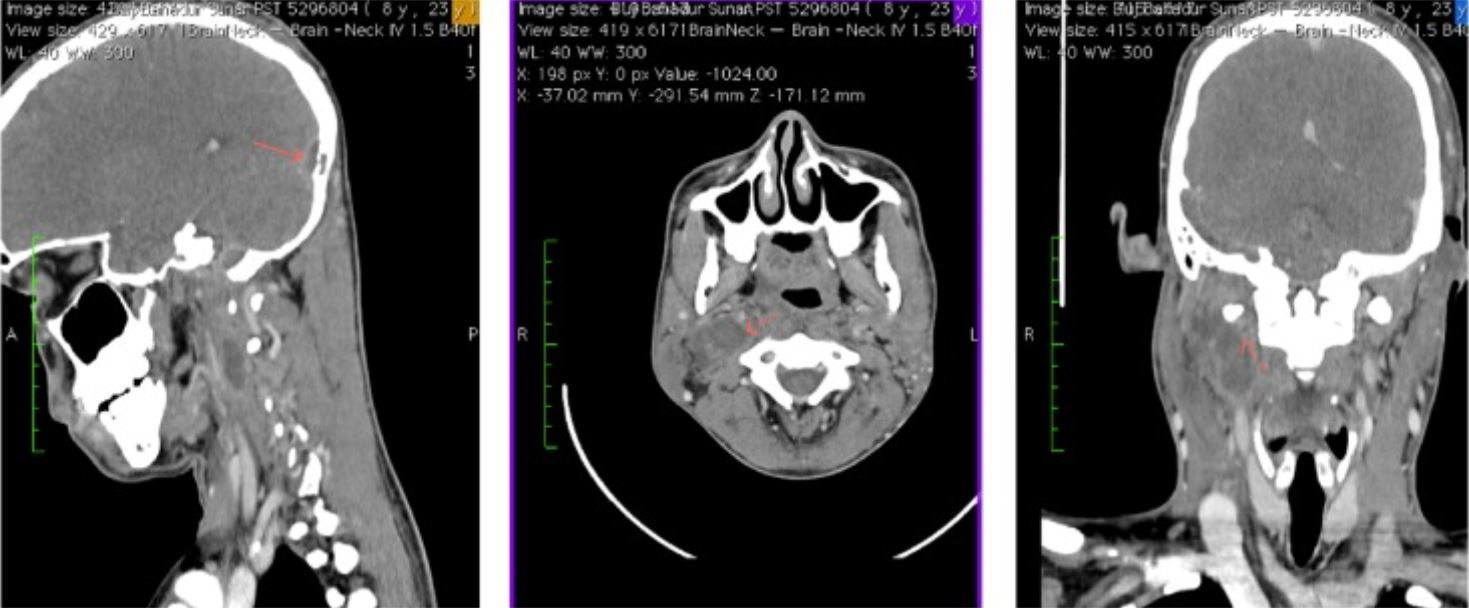
TC absceso parafaríngeo derecho

La TC demuestra un absceso parafaríngeo derecho y una trombosis de la vena yugular interna derecha (flecha en los 3 paneles).

Imagen: “CECT showing right IJV thrombosis with right parapharyngeal abscess and delta sign at the transverse sinus” por Case Reports in Otolaryngology. Licencia: CC BY 4.0

Diagnóstico Diferencial

  • Meningitis Meningitis Meningitis is inflammation of the meninges, the protective membranes of the brain, and spinal cord. The causes of meningitis are varied, with the most common being bacterial or viral infection. The classic presentation of meningitis is a triad of fever, altered mental status, and nuchal rigidity. Meningitis: inflamación de las membranas protectoras del cerebro y las meninges Meninges The brain and the spinal cord are enveloped by 3 overlapping layers of connective tissue called the meninges. The layers are, from the most external layer to the most internal layer, the dura mater, arachnoid mater, and pia mater. Between these layers are 3 potential spaces called the epidural, subdural, and subarachnoid spaces. Meninges: Anatomy. Los LOS Neisseria pacientes presentan la tríada clásica de fiebre, rigidez nucal y alteración del estado mental. El diagnóstico de la meningitis Meningitis Meningitis is inflammation of the meninges, the protective membranes of the brain, and spinal cord. The causes of meningitis are varied, with the most common being bacterial or viral infection. The classic presentation of meningitis is a triad of fever, altered mental status, and nuchal rigidity. Meningitis se realiza con un examen neurológico y un análisis del LCR. El tratamiento incluye la administración oportuna de antibióticos de amplio espectro. El retraso en EN Erythema nodosum is an immune-mediated panniculitis (inflammation of the subcutaneous fat) caused by a type IV (delayed-type) hypersensitivity reaction. It commonly manifests in young women as tender, erythematous nodules on the shins. Erythema Nodosum el tratamiento puede provocar un aumento de la mortalidad.
  • Faringitis: inflamación de la faringe causada a menudo por una infección viral de las vías respiratorias superiores. Los LOS Neisseria síntomas incluyen odinofagia, fiebre, tos TOS Thoracic outlet syndrome (TOS) is a broad term used for a spectrum of syndromes related to the general region of the thoracic outlet, which involves the compression or irritation of elements of the brachial plexus, subclavian artery, or subclavian vein. Thoracic Outlet Syndrome, rinorrea y disfagia. La tos TOS Thoracic outlet syndrome (TOS) is a broad term used for a spectrum of syndromes related to the general region of the thoracic outlet, which involves the compression or irritation of elements of the brachial plexus, subclavian artery, or subclavian vein. Thoracic Outlet Syndrome y la coriza están ausentes en EN Erythema nodosum is an immune-mediated panniculitis (inflammation of the subcutaneous fat) caused by a type IV (delayed-type) hypersensitivity reaction. It commonly manifests in young women as tender, erythematous nodules on the shins. Erythema Nodosum la faringitis estreptocócica beta-hemolítica del grupo A. El diagnóstico se realiza sobre la base de los LOS Neisseria hallazgos clínicos y los LOS Neisseria resultados de un hisopado faríngeo. El tratamiento de la faringitis viral es de soporte. La faringitis bacteriana requiere un tratamiento antibiótico.
  • Traqueítis bacteriana: inflamación de la tráquea subglótica. La traqueítis bacteriana es una infección potencialmente mortal y suele ir precedida de una infección vírica de la vía aérea alta. Los LOS Neisseria pacientes se presentan con fiebre, estridor, tos TOS Thoracic outlet syndrome (TOS) is a broad term used for a spectrum of syndromes related to the general region of the thoracic outlet, which involves the compression or irritation of elements of the brachial plexus, subclavian artery, or subclavian vein. Thoracic Outlet Syndrome productiva y sialorrea. El diagnóstico es clínico. El tratamiento incluye la evaluación de la vía aérea y antibióticos de amplio espectro.

Referencias

  1. Sudhanthar, S., et al. (2019). Parapharyngeal abscess: a difficult diagnosis in younger children. Clinical Case reports 7:1218–1221. https://doi.org/10.1002/ccr3.2209
  2. Murray, A.D., et al. (2024). Deep neck infections. Medscape. Retrieved July 21, 2025, from https://emedicine.medscape.com/article/837048-overview#a8
  3. Al Duwaiki, S.M., et al. (2018). Lemierre’s syndrome. Oman Medical Journal 33:523–526. https://doi.org/10.5001/omj.2018.95
  4. Chow, A.W. (2024). Deep neck space infections in adults. UpToDate. Retrieved July 21, 2025, from https://www.uptodate.com/contents/deep-neck-space-infections-in-adults
  5. Yang, T.-H., et al. (2021). A nationwide population-based study on the incidence of parapharyngeal and retropharyngeal abscess—A 10-year study. International Journal of Environmental Research and Public Health 18:1049. https://www.mdpi.com/1660-4601/18/3/1049

¡Crea tu cuenta gratis o inicia una sesión para seguir leyendo!

Regístrate ahora y obtén acceso gratuito a Lecturio con páginas de concepto, videos médicos y cuestionarios para tu educación médica.

User Reviews

Que tengas una sesión de estudio alegre y navideña 🎁 Ahorra 50% en todos los planes >>

Details