Domina Conceptos Médicos

Estudia para la escuela de medicina y tus examenes con Lecturio.

Yersinia Pestis/Peste

La peste es una infección bacteriana causada por Yersinia pestis Yersinia pestis The plague is a bacterial infection caused by Yersinia pestis (Y. pestis), which primarily infects rodents. The disease is transmitted to humans via a flea bite. Inhalation of infectious droplets and handling infected animals or laboratory specimens are other means of transmission. The plague has 3 forms: bubonic (most common form), septicemic, and pneumonic. Yersinia pestis/Plague (Y. pestis), que infecta principalmente a los LOS Neisseria roedores. La enfermedad se transmite a los LOS Neisseria humanos a través de una picadura de pulga. La inhalación de gotas infecciosas y la manipulación de animales infectados o de muestras de laboratorio son otros medios de transmisión. La peste tiene 3 formas: bubónica (la más común), septicémica y neumónica. La peste bubónica da lugar a unos ganglios linfáticos inflamados y sensibles llamados bubones en EN Erythema nodosum is an immune-mediated panniculitis (inflammation of the subcutaneous fat) caused by a type IV (delayed-type) hypersensitivity reaction. It commonly manifests in young women as tender, erythematous nodules on the shins. Erythema Nodosum la zona inguinal. La peste neumónica y septicémica puede surgir como presentación primaria, pero también puede ser el resultado de la propagación hematógena de la enfermedad bubónica. El diagnóstico incluye los LOS Neisseria antecedentes y hallazgos clínicos, el cultivo, la reacción en EN Erythema nodosum is an immune-mediated panniculitis (inflammation of the subcutaneous fat) caused by a type IV (delayed-type) hypersensitivity reaction. It commonly manifests in young women as tender, erythematous nodules on the shins. Erythema Nodosum cadena de la polimerasa ( PCR PCR Polymerase chain reaction (PCR) is a technique that amplifies DNA fragments exponentially for analysis. The process is highly specific, allowing for the targeting of specific genomic sequences, even with minuscule sample amounts. The PCR cycles multiple times through 3 phases: denaturation of the template DNA, annealing of a specific primer to the individual DNA strands, and synthesis/elongation of new DNA molecules. Polymerase Chain Reaction (PCR)) y la serología. La tasa de mortalidad es elevada, por lo que es necesario un diagnóstico y un tratamiento rápido con antibióticos.

Last updated: Dec 15, 2025

Editorial responsibility: Stanley Oiseth, Lindsay Jones, Evelin Maza

Características Generales

Características básicas de Yersinia pestis Yersinia pestis The plague is a bacterial infection caused by Yersinia pestis (Y. pestis), which primarily infects rodents. The disease is transmitted to humans via a flea bite. Inhalation of infectious droplets and handling infected animals or laboratory specimens are other means of transmission. The plague has 3 forms: bubonic (most common form), septicemic, and pneumonic. Yersinia pestis/Plague

  • Estructura: cocobacilo
  • Tinción de Gram: gram-negativa
  • Otra(s) tinción(es):
    • Tinciones como la de Wright, Giemsa y Wayson
    • Tinción bipolar Bipolar Nervous System: Histology (retención de la tinción en EN Erythema nodosum is an immune-mediated panniculitis (inflammation of the subcutaneous fat) caused by a type IV (delayed-type) hypersensitivity reaction. It commonly manifests in young women as tender, erythematous nodules on the shins. Erythema Nodosum los LOS Neisseria extremos de las células) o aspecto de “imperdible”
  • Formación de esporas: no forman esporas
  • Invasión y replicación en EN Erythema nodosum is an immune-mediated panniculitis (inflammation of the subcutaneous fat) caused by a type IV (delayed-type) hypersensitivity reaction. It commonly manifests in young women as tender, erythematous nodules on the shins. Erythema Nodosum relación con la(s) célula(s) huésped(s): intracelular facultativa
  • Necesidad de oxígeno: anaerobios facultativos
  • Pruebas enzimáticas/bioquímicas:
    • Oxidasa negativa
    • Lactosa negativa

Especies clínicamente relevantes y enfermedades:

  • Especies asociadas: Especies de Yersinia Yersinia Yersinia is a genus of bacteria characterized as gram-negative bacilli that are facultative anaerobic with bipolar staining. There are 2 enteropathogenic species that cause yersiniosis, Y. enterocolitica and Y. pseudotuberculosis. Infections are manifested as pseudoappendicitis or mesenteric lymphadenitis, and enterocolitis. Yersinia spp./Yersiniosis entérica ( Y. enterocolitica Y. enterocolitica A species of the genus yersinia, isolated from both man and animal. It is a frequent cause of bacterial gastroenteritis in children. Yersinia spp./Yersiniosis, Y. pseudotuberculosis) causan yersiniosis Yersiniosis Yersinia is a genus of bacteria characterized as gram-negative bacilli that are facultative anaerobic with bipolar staining. There are 2 enteropathogenic species that cause yersiniosis, Y. enterocolitica and Y. pseudotuberculosis. Infections are manifested as pseudoappendicitis or mesenteric lymphadenitis, and enterocolitis. Yersinia spp./Yersiniosis (se cubre en EN Erythema nodosum is an immune-mediated panniculitis (inflammation of the subcutaneous fat) caused by a type IV (delayed-type) hypersensitivity reaction. It commonly manifests in young women as tender, erythematous nodules on the shins. Erythema Nodosum otra página)
  • Enfermedad asociada: peste (“peste negra”)
    • Yersinia Yersinia Yersinia is a genus of bacteria characterized as gram-negative bacilli that are facultative anaerobic with bipolar staining. There are 2 enteropathogenic species that cause yersiniosis, Y. enterocolitica and Y. pseudotuberculosis. Infections are manifested as pseudoappendicitis or mesenteric lymphadenitis, and enterocolitis. Yersinia spp./Yersiniosis pestis (Y. pestis) causa predominantemente la enfermedad en EN Erythema nodosum is an immune-mediated panniculitis (inflammation of the subcutaneous fat) caused by a type IV (delayed-type) hypersensitivity reaction. It commonly manifests in young women as tender, erythematous nodules on the shins. Erythema Nodosum roedores; los LOS Neisseria seres humanos suelen ser huéspedes incidentales.
    • Formas:
      • Peste bubónica (la más común)
      • Peste neumónica
      • Peste septicémica

Epidemiología

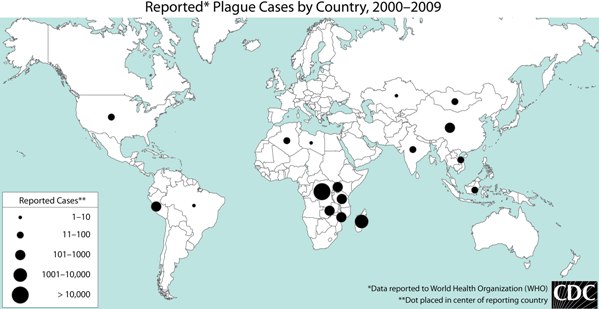
Casos de peste a nivel mundial:

  • La mayoría de los LOS Neisseria casos son de África.
  • Países con mayor prevalencia de casos:
    • República Democrática del Congo
    • Madagascar
    • Perú
Mapa mundial de la peste 2009

Mapa mundial de los casos de peste notificados a la World Health Organization (WHO), 2000–2009

Imagen: “World Plague Map – 2000 to 2009 – CDC” por CDC. Licencia: Dominio público.

La peste en EN Erythema nodosum is an immune-mediated panniculitis (inflammation of the subcutaneous fat) caused by a type IV (delayed-type) hypersensitivity reaction. It commonly manifests in young women as tender, erythematous nodules on the shins. Erythema Nodosum Estados Unidos:
  • Localizaciones:
    • 4 esquinas (el punto de unión de Nuevo México, Arizona, Colorado y Utah)
    • Oeste: California, sur de Oregón y oeste de Nevada
  • Período con más casos: De mayo a octubre (La gente está al AL Amyloidosis aire libre y los LOS Neisseria roedores son abundantes).

Related videos

Patogénesis

Reservorio y transmisión

  • Peste: infección zoonótica
  • Reservorio: roedores, perros de la pradera
  • Transmisión:
    • En EN Erythema nodosum is an immune-mediated panniculitis (inflammation of the subcutaneous fat) caused by a type IV (delayed-type) hypersensitivity reaction. It commonly manifests in young women as tender, erythematous nodules on the shins. Erythema Nodosum zonas con malas condiciones sanitarias e infestaciones de ratas, la infección se adquiere por una picadura de pulga (la vía más común).
    • Manipulación de mamíferos vivos o muertos
    • Examen post-mortem de un cuerpo infectado o manipulación de una muestra en EN Erythema nodosum is an immune-mediated panniculitis (inflammation of the subcutaneous fat) caused by a type IV (delayed-type) hypersensitivity reaction. It commonly manifests in young women as tender, erythematous nodules on the shins. Erythema Nodosum el laboratorio
    • La inhalación de gotas infecciosas (como en EN Erythema nodosum is an immune-mediated panniculitis (inflammation of the subcutaneous fat) caused by a type IV (delayed-type) hypersensitivity reaction. It commonly manifests in young women as tender, erythematous nodules on the shins. Erythema Nodosum el bioterrorismo) puede causar la peste neumónica.
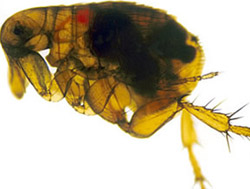
  • Vector: Xenopsylla cheopis Xenopsylla Cheopis Yersinia pestis/Plague (la pulga de la rata oriental, el vector de pulgas más eficaz):
    • Y. pestis se multiplica en EN Erythema nodosum is an immune-mediated panniculitis (inflammation of the subcutaneous fat) caused by a type IV (delayed-type) hypersensitivity reaction. It commonly manifests in young women as tender, erythematous nodules on the shins. Erythema Nodosum el intestino medio de la pulga tras la ingestión de una comida de sangre.
    • Los LOS Neisseria agregados de Yersinia Yersinia Yersinia is a genus of bacteria characterized as gram-negative bacilli that are facultative anaerobic with bipolar staining. There are 2 enteropathogenic species that cause yersiniosis, Y. enterocolitica and Y. pseudotuberculosis. Infections are manifested as pseudoappendicitis or mesenteric lymphadenitis, and enterocolitis. Yersinia spp./Yersiniosis pueden bloquear el intestino de la pulga.
    • La pulga regurgita entonces la bacteria Bacteria Bacteria are prokaryotic single-celled microorganisms that are metabolically active and divide by binary fission. Some of these organisms play a significant role in the pathogenesis of diseases. Bacteriology en EN Erythema nodosum is an immune-mediated panniculitis (inflammation of the subcutaneous fat) caused by a type IV (delayed-type) hypersensitivity reaction. It commonly manifests in young women as tender, erythematous nodules on the shins. Erythema Nodosum la herida de la picadura con cada alimentación.
    • En EN Erythema nodosum is an immune-mediated panniculitis (inflammation of the subcutaneous fat) caused by a type IV (delayed-type) hypersensitivity reaction. It commonly manifests in young women as tender, erythematous nodules on the shins. Erythema Nodosum algunos casos, las bacterias se transmiten justo después de alimentarse de un huésped infectado.

Factores de virulencia

  • Endotoxina lipopolisacárida: provoca toxicidad sistémica en EN Erythema nodosum is an immune-mediated panniculitis (inflammation of the subcutaneous fat) caused by a type IV (delayed-type) hypersensitivity reaction. It commonly manifests in young women as tender, erythematous nodules on the shins. Erythema Nodosum la bacteriemia
  • Sistema de secreción de tipo III:
    • Inyecta proteínas de la membrana externa de Yersinia Yersinia Yersinia is a genus of bacteria characterized as gram-negative bacilli that are facultative anaerobic with bipolar staining. There are 2 enteropathogenic species that cause yersiniosis, Y. enterocolitica and Y. pseudotuberculosis. Infections are manifested as pseudoappendicitis or mesenteric lymphadenitis, and enterocolitis. Yersinia spp./Yersiniosis (Yops) en EN Erythema nodosum is an immune-mediated panniculitis (inflammation of the subcutaneous fat) caused by a type IV (delayed-type) hypersensitivity reaction. It commonly manifests in young women as tender, erythematous nodules on the shins. Erythema Nodosum la célula huésped
    • Yops desencadenan eventos citotóxicos e inhiben la fagocitosis, así como las vías bioquímicas.
  • Isla de alta patogenicidad:
    • Codifica para un sideróforo que elimina el hierro, la yersiniabactina
    • Yersiniabactina proporciona a la bacteria Bacteria Bacteria are prokaryotic single-celled microorganisms that are metabolically active and divide by binary fission. Some of these organisms play a significant role in the pathogenesis of diseases. Bacteriology la capacidad de tomar las moléculas de hierro necesarias para su crecimiento y diseminación.
  • Regulación de la virulencia por la temperatura y el calcio:
    • La expresión de los LOS Neisseria factores de virulencia de Yersinia Yersinia Yersinia is a genus of bacteria characterized as gram-negative bacilli that are facultative anaerobic with bipolar staining. There are 2 enteropathogenic species that cause yersiniosis, Y. enterocolitica and Y. pseudotuberculosis. Infections are manifested as pseudoappendicitis or mesenteric lymphadenitis, and enterocolitis. Yersinia spp./Yersiniosis se ve VE Ventilation: Mechanics of Breathing afectada por la temperatura y el calcio libre.
    • Fisiológicamente, la temperatura del huésped mamífero es diferente a la de un insecto.
    • Asimismo, la concentración de calcio es diferente en EN Erythema nodosum is an immune-mediated panniculitis (inflammation of the subcutaneous fat) caused by a type IV (delayed-type) hypersensitivity reaction. It commonly manifests in young women as tender, erythematous nodules on the shins. Erythema Nodosum el líquido intracelular que en EN Erythema nodosum is an immune-mediated panniculitis (inflammation of the subcutaneous fat) caused by a type IV (delayed-type) hypersensitivity reaction. It commonly manifests in young women as tender, erythematous nodules on the shins. Erythema Nodosum los LOS Neisseria líquidos extracelulares.
    • Yersinia Yersinia Yersinia is a genus of bacteria characterized as gram-negative bacilli that are facultative anaerobic with bipolar staining. There are 2 enteropathogenic species that cause yersiniosis, Y. enterocolitica and Y. pseudotuberculosis. Infections are manifested as pseudoappendicitis or mesenteric lymphadenitis, and enterocolitis. Yersinia spp./Yersiniosis: capaz de ajustar los LOS Neisseria factores de virulencia en EN Erythema nodosum is an immune-mediated panniculitis (inflammation of the subcutaneous fat) caused by a type IV (delayed-type) hypersensitivity reaction. It commonly manifests in young women as tender, erythematous nodules on the shins. Erythema Nodosum función de las acciones anteriores, continuando el ciclo de vida en EN Erythema nodosum is an immune-mediated panniculitis (inflammation of the subcutaneous fat) caused by a type IV (delayed-type) hypersensitivity reaction. It commonly manifests in young women as tender, erythematous nodules on the shins. Erythema Nodosum el entorno o en EN Erythema nodosum is an immune-mediated panniculitis (inflammation of the subcutaneous fat) caused by a type IV (delayed-type) hypersensitivity reaction. It commonly manifests in young women as tender, erythematous nodules on the shins. Erythema Nodosum el huésped
  • Y. pestis:
    • pPCP1 (o pPst): plásmido con genes Genes A category of nucleic acid sequences that function as units of heredity and which code for the basic instructions for the development, reproduction, and maintenance of organisms. DNA Types and Structure para enzimas con actividad proteasa, coagulasa y fibrinolítica
    • pFra/pMT: codifica la proteína capsular de la fracción 1 (tiene función antifagocítica) y la fosfolipasa D (facilita la supervivencia en EN Erythema nodosum is an immune-mediated panniculitis (inflammation of the subcutaneous fat) caused by a type IV (delayed-type) hypersensitivity reaction. It commonly manifests in young women as tender, erythematous nodules on the shins. Erythema Nodosum el intestino medio de la pulga)

Proceso de la enfermedad

La peste bubónica:

  • Cuando una pulga pica Pica Pica is an eating disorder characterized by a desire or recurrent compulsion to eat substances that are nonnutritive and not food. These compulsions and ingested substances are inappropriate for age or culture. Pica a un humano y contamina la herida con la sangre regurgitada, las bacterias pasan al AL Amyloidosis tejido.
  • Las bacterias entran en EN Erythema nodosum is an immune-mediated panniculitis (inflammation of the subcutaneous fat) caused by a type IV (delayed-type) hypersensitivity reaction. It commonly manifests in young women as tender, erythematous nodules on the shins. Erythema Nodosum el sistema linfático dérmico.
  • Efectos posteriores de la infección:
    • Replicación de Yersinia Yersinia Yersinia is a genus of bacteria characterized as gram-negative bacilli that are facultative anaerobic with bipolar staining. There are 2 enteropathogenic species that cause yersiniosis, Y. enterocolitica and Y. pseudotuberculosis. Infections are manifested as pseudoappendicitis or mesenteric lymphadenitis, and enterocolitis. Yersinia spp./Yersiniosis → inflamación de los LOS Neisseria ganglios linfáticos → hemorragia o necrosis Necrosis The death of cells in an organ or tissue due to disease, injury or failure of the blood supply. Ischemic Cell Damage → linfadenitis supurativa (bubón)
    • Ganglios linfáticos axilares e inguinales a menudo afectados
  • Los LOS Neisseria ganglios linfáticos se saturan y la infección pasa al AL Amyloidosis torrente sanguíneo.

Peste neumónica:

  • Surge de la inhalación de gotas infectadas altamente contagiosas
  • Puede ser resultado de la propagación hematógena de la peste bubónica
  • Neumonía rápidamente progresiva con bacterias prominentes en EN Erythema nodosum is an immune-mediated panniculitis (inflammation of the subcutaneous fat) caused by a type IV (delayed-type) hypersensitivity reaction. It commonly manifests in young women as tender, erythematous nodules on the shins. Erythema Nodosum los LOS Neisseria espacios aéreos (segmentaria → lobar → afectación pulmonar bilateral)

Peste septicémica:

  • Las bacterias se replican en EN Erythema nodosum is an immune-mediated panniculitis (inflammation of the subcutaneous fat) caused by a type IV (delayed-type) hypersensitivity reaction. It commonly manifests in young women as tender, erythematous nodules on the shins. Erythema Nodosum el torrente sanguíneo y se extienden a otros órganos.
  • El desplazamiento a los LOS Neisseria pulmones produce una peste neumónica secundaria (Inicialmente, las bacterias son más prominentes en EN Erythema nodosum is an immune-mediated panniculitis (inflammation of the subcutaneous fat) caused by a type IV (delayed-type) hypersensitivity reaction. It commonly manifests in young women as tender, erythematous nodules on the shins. Erythema Nodosum el intersticio que en EN Erythema nodosum is an immune-mediated panniculitis (inflammation of the subcutaneous fat) caused by a type IV (delayed-type) hypersensitivity reaction. It commonly manifests in young women as tender, erythematous nodules on the shins. Erythema Nodosum los LOS Neisseria espacios aéreos).
  • Puede producirse una infección de las meninges Meninges The brain and the spinal cord are enveloped by 3 overlapping layers of connective tissue called the meninges. The layers are, from the most external layer to the most internal layer, the dura mater, arachnoid mater, and pia mater. Between these layers are 3 potential spaces called the epidural, subdural, and subarachnoid spaces. Meninges: Anatomy ( meningitis Meningitis Meningitis is inflammation of the meninges, the protective membranes of the brain, and spinal cord. The causes of meningitis are varied, with the most common being bacterial or viral infection. The classic presentation of meningitis is a triad of fever, altered mental status, and nuchal rigidity. Meningitis) y del tracto gastrointestinal.
  • Progresa a:
    • Shock Shock Shock is a life-threatening condition associated with impaired circulation that results in tissue hypoxia. The different types of shock are based on the underlying cause: distributive (↑ cardiac output (CO), ↓ systemic vascular resistance (SVR)), cardiogenic (↓ CO, ↑ SVR), hypovolemic (↓ CO, ↑ SVR), obstructive (↓ CO), and mixed. Types of Shock endotóxico bacteriano
    • Coagulación intravascular diseminada (CID): cascada de coagulación, trombosis con eventual hemorragia por agotamiento de los LOS Neisseria factores de coagulación y las plaquetas
    • Necrosis Necrosis The death of cells in an organ or tissue due to disease, injury or failure of the blood supply. Ischemic Cell Damage isquémica por mala perfusión
    • Muerte
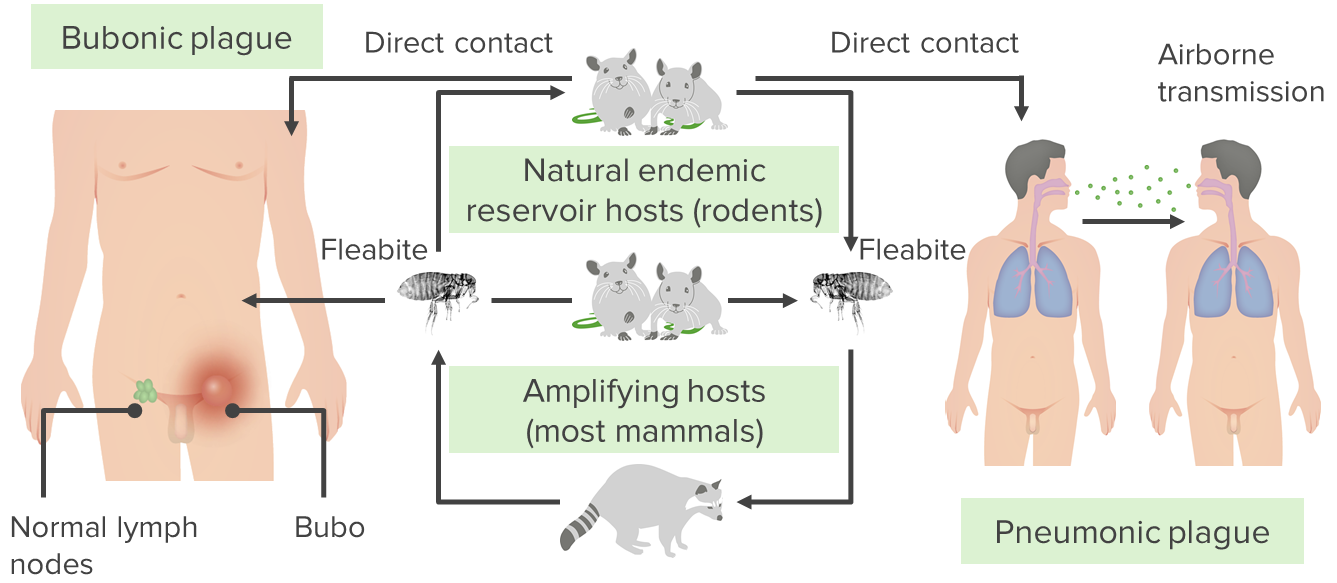
Transmisión de Y. pestis

La transmisión de Yersinia pestis
El contacto directo con roedores o las picaduras de pulgas dan lugar a la peste bubónica, mientras que la transmisión por vía aérea (de persona a persona), ya sea por tos o estornudos, da lugar a la peste neumónica.
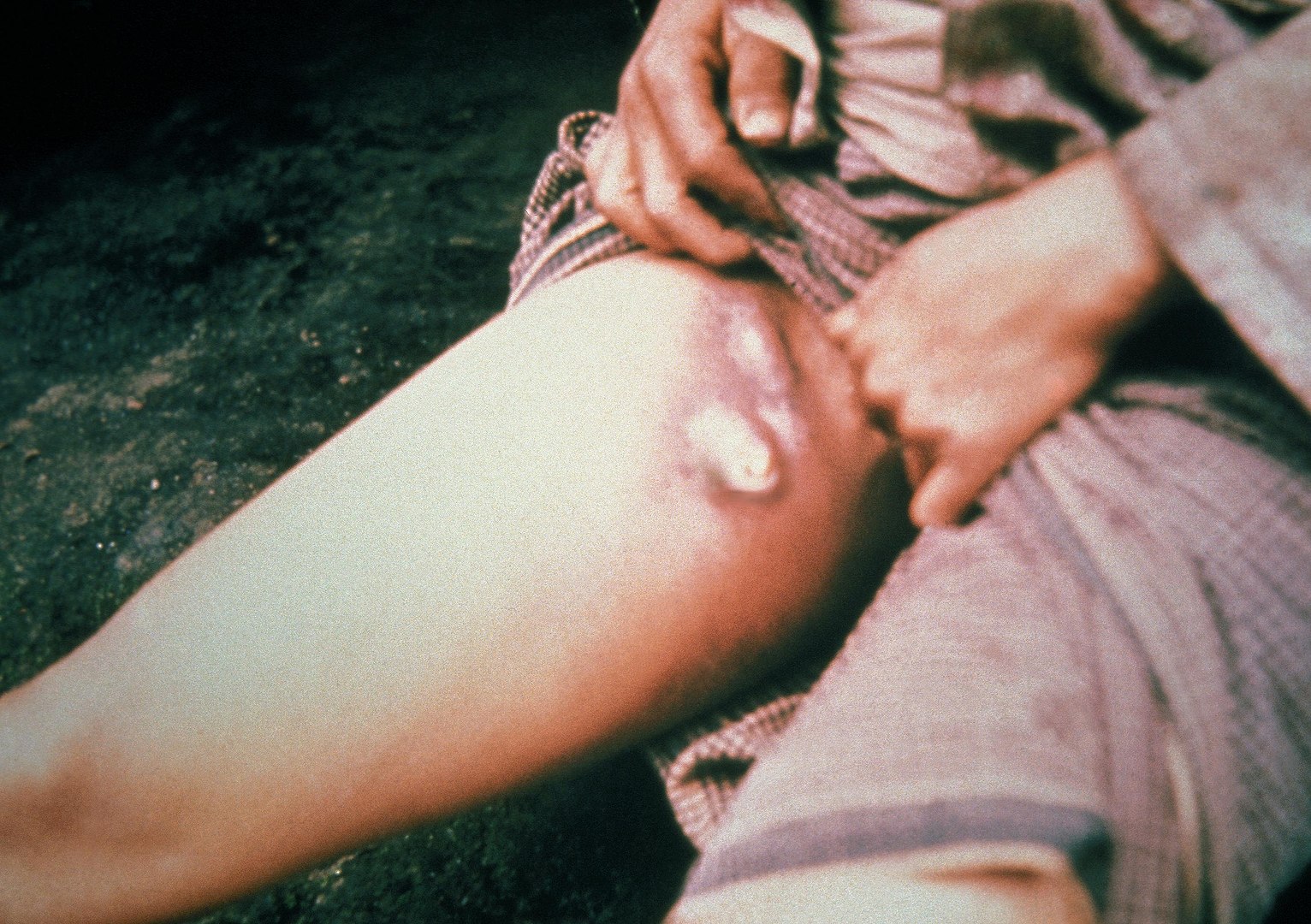
Imagen por Lecturio.

Related videos

Presentación Clínica

Peste bubónica

  • Los LOS Neisseria síntomas comienzan a la semana de la inoculación:
    • Cefalea, malestar, mialgia
    • Fiebre, escalofríos
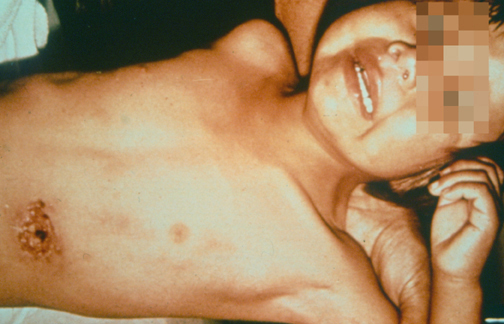
    • Ganglios linfáticos dolorosos, inflamados y algunos supurativos (bubones)
    • Los LOS Neisseria ganglios linfáticos inguinales (más frecuente) y axilares suelen estar afectados
  • Sin tratamiento, la propagación hematógena provoca una enfermedad grave.
Bubones de peste

Peste bubónica: ganglios linfáticos inguinales inflamados en una persona infectada por la peste bubónica

Imagen: Plague buboes” por CDC. Licencia: Dominio Público.
Peste neumónica

  • En EN Erythema nodosum is an immune-mediated panniculitis (inflammation of the subcutaneous fat) caused by a type IV (delayed-type) hypersensitivity reaction. It commonly manifests in young women as tender, erythematous nodules on the shins. Erythema Nodosum la peste neumónica primaria, los LOS Neisseria síntomas comienzan a los LOS Neisseria 2–3 días de la exposición.
  • Los LOS Neisseria signos iniciales son indistinguibles de otras enfermedades respiratorias:
    • Fiebre
    • Cefalea
    • Debilidad
  • Después de 24 horas, sigue la tos TOS Thoracic outlet syndrome (TOS) is a broad term used for a spectrum of syndromes related to the general region of the thoracic outlet, which involves the compression or irritation of elements of the brachial plexus, subclavian artery, or subclavian vein. Thoracic Outlet Syndrome, la hemoptisis y la dificultad para respirar.

Peste septicémica

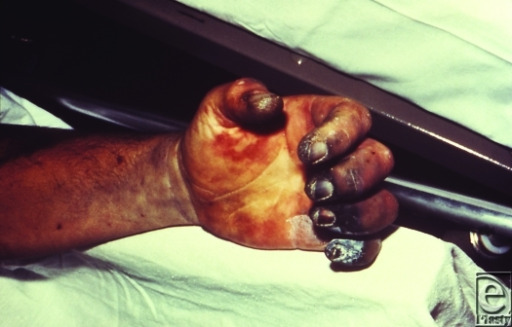
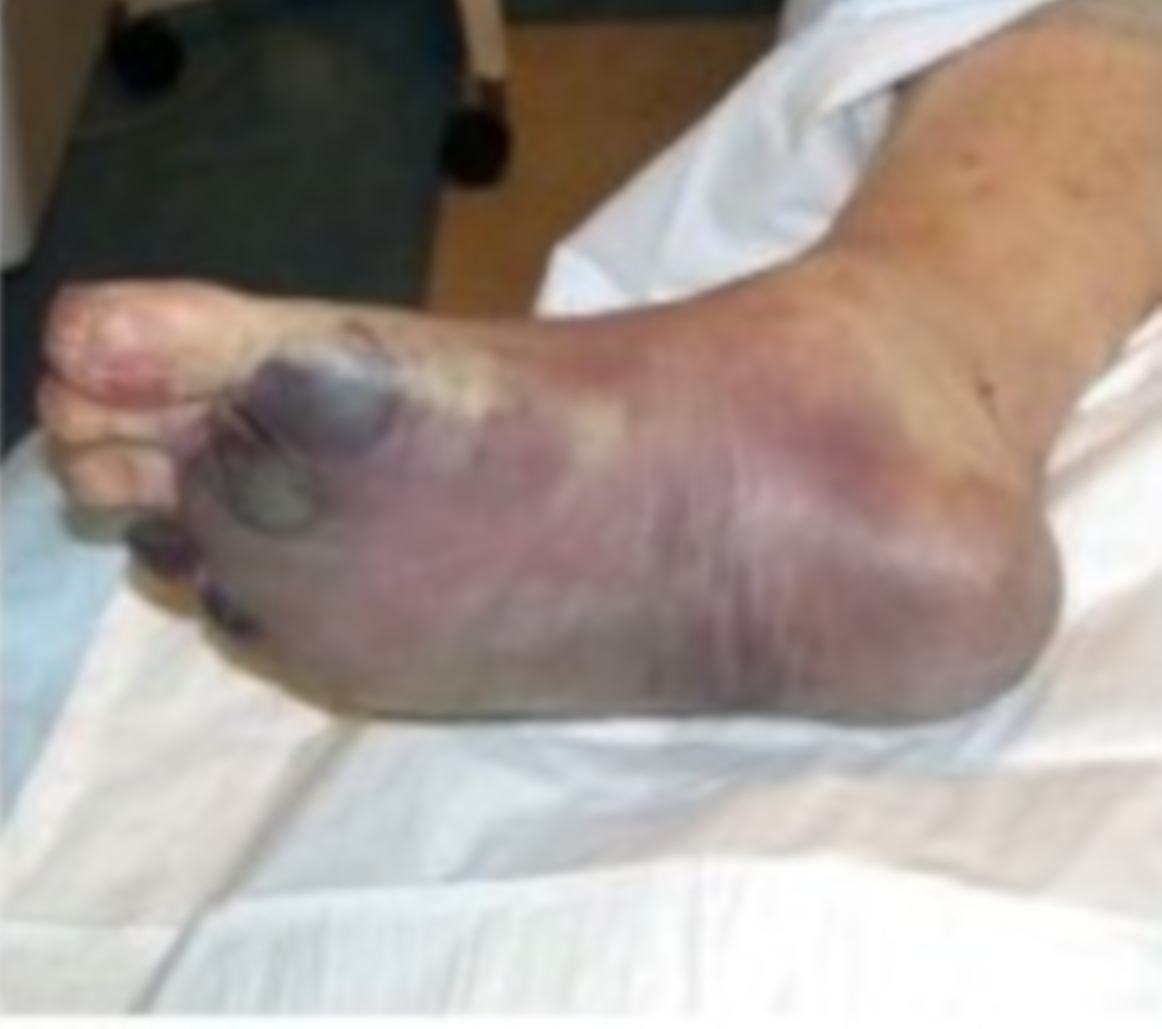
  • La presentación inicial en EN Erythema nodosum is an immune-mediated panniculitis (inflammation of the subcutaneous fat) caused by a type IV (delayed-type) hypersensitivity reaction. It commonly manifests in young women as tender, erythematous nodules on the shins. Erythema Nodosum una minoría de casos: shock Shock Shock is a life-threatening condition associated with impaired circulation that results in tissue hypoxia. The different types of shock are based on the underlying cause: distributive (↑ cardiac output (CO), ↓ systemic vascular resistance (SVR)), cardiogenic (↓ CO, ↑ SVR), hypovolemic (↓ CO, ↑ SVR), obstructive (↓ CO), and mixed. Types of Shock séptico sin linfadenopatía/ bubo Bubo Yersinia pestis/Plague
  • Factores de riesgo de septicemia (para todas las especies de Yersinia Yersinia Yersinia is a genus of bacteria characterized as gram-negative bacilli that are facultative anaerobic with bipolar staining. There are 2 enteropathogenic species that cause yersiniosis, Y. enterocolitica and Y. pseudotuberculosis. Infections are manifested as pseudoappendicitis or mesenteric lymphadenitis, and enterocolitis. Yersinia spp./Yersiniosis):
    • Diabetes Diabetes Diabetes mellitus (DM) is a metabolic disease characterized by hyperglycemia and dysfunction of the regulation of glucose metabolism by insulin. Type 1 DM is diagnosed mostly in children and young adults as the result of autoimmune destruction of β cells in the pancreas and the resulting lack of insulin. Type 2 DM has a significant association with obesity and is characterized by insulin resistance. Diabetes Mellitus mellitus
    • Sobrecarga de hierro o hemocromatosis
  • La hemorragia se produce en EN Erythema nodosum is an immune-mediated panniculitis (inflammation of the subcutaneous fat) caused by a type IV (delayed-type) hypersensitivity reaction. It commonly manifests in young women as tender, erythematous nodules on the shins. Erythema Nodosum otros órganos, con la vasculatura tisular ocluida por los LOS Neisseria trombos:
    • Lesiones purpúricas
    • Hemoptisis/ hematemesis Hematemesis Vomiting of blood that is either fresh bright red, or older ‘coffee-ground’ in character. It generally indicates bleeding of the upper gastrointestinal tract. Mallory-Weiss Syndrome (Mallory-Weiss Tear)
    • Gangrena en EN Erythema nodosum is an immune-mediated panniculitis (inflammation of the subcutaneous fat) caused by a type IV (delayed-type) hypersensitivity reaction. It commonly manifests in young women as tender, erythematous nodules on the shins. Erythema Nodosum las orejas, los LOS Neisseria dedos de las manos y los LOS Neisseria pies
  • Difícil de diagnosticar, especialmente en EN Erythema nodosum is an immune-mediated panniculitis (inflammation of the subcutaneous fat) caused by a type IV (delayed-type) hypersensitivity reaction. It commonly manifests in young women as tender, erythematous nodules on the shins. Erythema Nodosum una presentación esporádica sin bubón

Diagnóstico

Herramientas de diagnóstico

  • Antecedentes clínicos y hallazgos:
    • Viajes a zonas endémicas
    • Contacto con los LOS Neisseria animales
    • Exposición profesional
    • Síntomas sugestivos y exámen
  • Frotis y cultivo:
    • Especímenes:
      • Bubones: aspiración con aguja de los LOS Neisseria ganglios linfáticos afectados
      • Pulmones: esputo, aspirado bronquial/traqueal
      • Sangre
      • Líquido cefalorraquídeo
    • Tinción bipolar Bipolar Nervous System: Histology (forma de “imperdible”) en EN Erythema nodosum is an immune-mediated panniculitis (inflammation of the subcutaneous fat) caused by a type IV (delayed-type) hypersensitivity reaction. It commonly manifests in young women as tender, erythematous nodules on the shins. Erythema Nodosum las tinciones de Wright, Giemsa o Wayson
    • Tinciones con anticuerpos fluorescentes dirigidos al AL Amyloidosis antígeno capsular F1
    • Cultivo de muestras en EN Erythema nodosum is an immune-mediated panniculitis (inflammation of the subcutaneous fat) caused by a type IV (delayed-type) hypersensitivity reaction. It commonly manifests in young women as tender, erythematous nodules on the shins. Erythema Nodosum agar sangre, placas de agar MacConkey y caldo de infusión cerebro-corazón
    • Medio de cultivo específico para Yersinia Yersinia Yersinia is a genus of bacteria characterized as gram-negative bacilli that are facultative anaerobic with bipolar staining. There are 2 enteropathogenic species that cause yersiniosis, Y. enterocolitica and Y. pseudotuberculosis. Infections are manifested as pseudoappendicitis or mesenteric lymphadenitis, and enterocolitis. Yersinia spp./Yersiniosis: agar cefsulodina, irgasan Irgasan Yersinia spp./Yersiniosis y novobiocina
  • Serología: Un título de > 1:16 es sugestivo de peste.
  • Reacción en EN Erythema nodosum is an immune-mediated panniculitis (inflammation of the subcutaneous fat) caused by a type IV (delayed-type) hypersensitivity reaction. It commonly manifests in young women as tender, erythematous nodules on the shins. Erythema Nodosum cadena de la polimerasa ( PCR PCR Polymerase chain reaction (PCR) is a technique that amplifies DNA fragments exponentially for analysis. The process is highly specific, allowing for the targeting of specific genomic sequences, even with minuscule sample amounts. The PCR cycles multiple times through 3 phases: denaturation of the template DNA, annealing of a specific primer to the individual DNA strands, and synthesis/elongation of new DNA molecules. Polymerase Chain Reaction (PCR)) específica
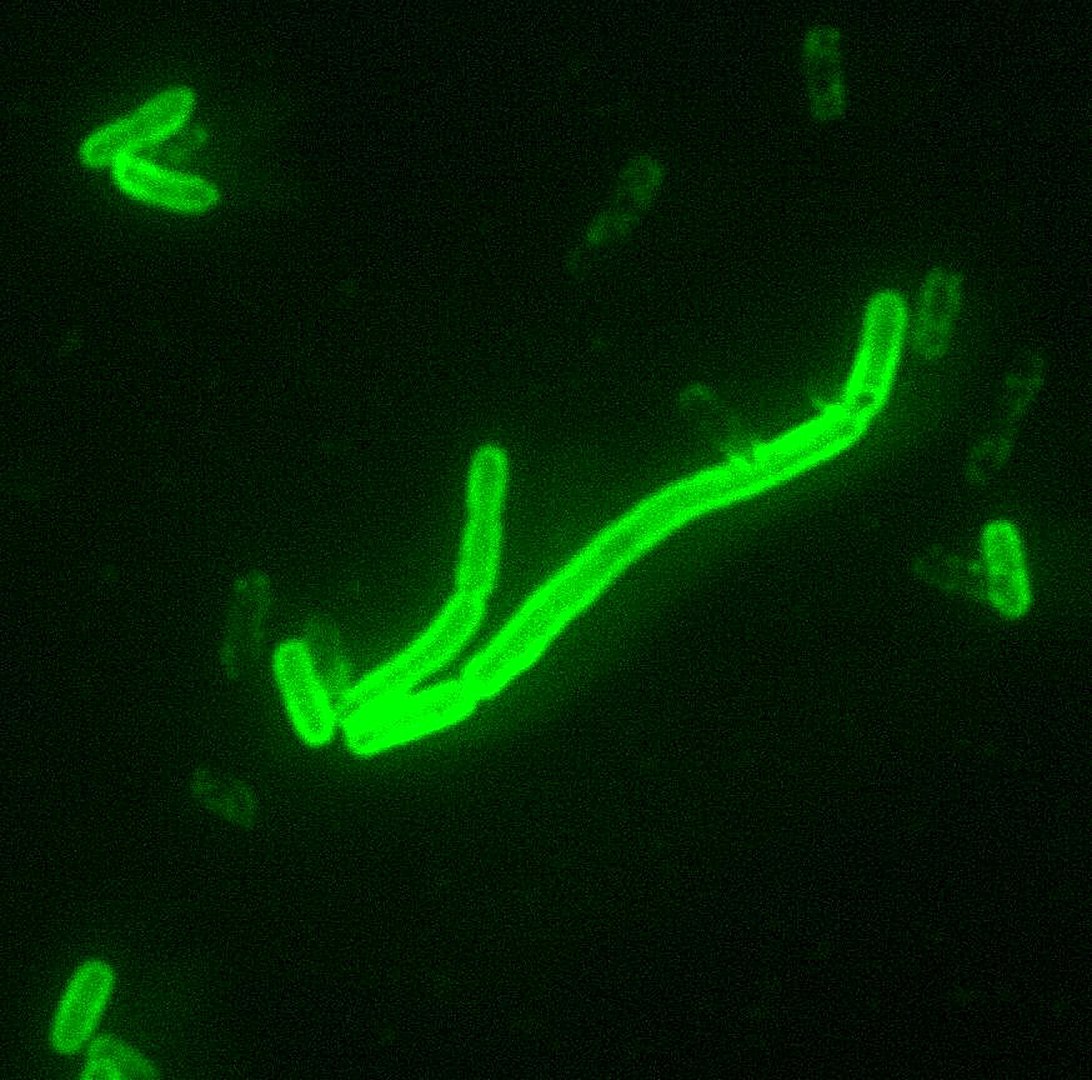
Yersinia pestis fluorescente

Yersinia pestis: bajo microscopio, teñido con tinción fluorescente

Imagen: “Yersinia pestis fluorescent” por CDC/Courtesy of Larry Stauffer, Oregon State Public Health Laboratory. Licencia: Dominio Público.
Estudios adicionales

  • Pruebas de laboratorio:
    • Recuento sanguíneo completo: puede mostrar leucocitosis con desviación a la izquierda; en EN Erythema nodosum is an immune-mediated panniculitis (inflammation of the subcutaneous fat) caused by a type IV (delayed-type) hypersensitivity reaction. It commonly manifests in young women as tender, erythematous nodules on the shins. Erythema Nodosum algunos, puede haber leucopenia; trombocitopenia en EN Erythema nodosum is an immune-mediated panniculitis (inflammation of the subcutaneous fat) caused by a type IV (delayed-type) hypersensitivity reaction. It commonly manifests in young women as tender, erythematous nodules on the shins. Erythema Nodosum la CID
    • Panel metabólico: La afectación multiorgánica puede mostrar anomalías de la función renal y hepática.
    • Productos de degradación de la fibrina elevados y tiempos de protrombina prolongados en EN Erythema nodosum is an immune-mediated panniculitis (inflammation of the subcutaneous fat) caused by a type IV (delayed-type) hypersensitivity reaction. It commonly manifests in young women as tender, erythematous nodules on the shins. Erythema Nodosum la septicemia
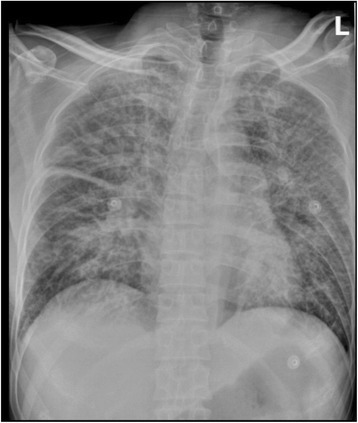
  • Imagenología: radiografía de tórax en EN Erythema nodosum is an immune-mediated panniculitis (inflammation of the subcutaneous fat) caused by a type IV (delayed-type) hypersensitivity reaction. It commonly manifests in young women as tender, erythematous nodules on the shins. Erythema Nodosum la peste neumónica
Radiografía de tórax de la peste neumónica

Un paciente con peste neumónica
Una radiografía de tórax muestra un aumento de las marcas pulmonares, con una pleura interlobar gruesa en un paciente que presentó fiebre, tos y disnea tras la exposición a un perro pastor.

Imagen: “PMC4759734_12879_2016_1403_Fig2_HTML” por Li YF, Li DB, Shao HS, Li HJ, Han YD. Licencia: CC BY 4.0.

Tratamiento

Tratamiento

  • Alta tasa de mortalidad con retraso o sin tratamiento
  • Antibióticos: aminoglucósidos (gentamicina)
  • Alternativas:
    • Doxiciclina/tetraciclina
    • Fluoroquinolonas (p. ej., ciprofloxacino, levofloxacino, moxifloxacino)
    • Cloranfenicol (reservado para meningitis Meningitis Meningitis is inflammation of the meninges, the protective membranes of the brain, and spinal cord. The causes of meningitis are varied, with the most common being bacterial or viral infection. The classic presentation of meningitis is a triad of fever, altered mental status, and nuchal rigidity. Meningitis)
  • Aislamiento de las gotas del paciente infectado (hasta que se descarte la neumonía o > 48 horas de tratamiento)
  • Profilaxis posterior a la exposición:
    • Exposición a la peste: contacto estrecho con un paciente que tiene peste neumónica o contacto directo con tejidos o fluidos infectados
    • Dar doxiciclina o levofloxacina.
    • Para mujeres embarazadas o niños: Administrar trimetoprim-sulfametoxazol.

Prevención

  • Vacuna:
    • No disponible en EN Erythema nodosum is an immune-mediated panniculitis (inflammation of the subcutaneous fat) caused by a type IV (delayed-type) hypersensitivity reaction. It commonly manifests in young women as tender, erythematous nodules on the shins. Erythema Nodosum Estados Unidos
    • Se utiliza en EN Erythema nodosum is an immune-mediated panniculitis (inflammation of the subcutaneous fat) caused by a type IV (delayed-type) hypersensitivity reaction. It commonly manifests in young women as tender, erythematous nodules on the shins. Erythema Nodosum el personal militar desplegado en EN Erythema nodosum is an immune-mediated panniculitis (inflammation of the subcutaneous fat) caused by a type IV (delayed-type) hypersensitivity reaction. It commonly manifests in young women as tender, erythematous nodules on the shins. Erythema Nodosum zonas endémicas
  • Utilización de equipos de protección individual adecuados en EN Erythema nodosum is an immune-mediated panniculitis (inflammation of the subcutaneous fat) caused by a type IV (delayed-type) hypersensitivity reaction. It commonly manifests in young women as tender, erythematous nodules on the shins. Erythema Nodosum ocupaciones de alto riesgo
  • Medidas de saneamiento y control de roedores
  • En EN Erythema nodosum is an immune-mediated panniculitis (inflammation of the subcutaneous fat) caused by a type IV (delayed-type) hypersensitivity reaction. It commonly manifests in young women as tender, erythematous nodules on the shins. Erythema Nodosum las actividades al AL Amyloidosis aire libre: uso de repelente de insectos, insecticida y ropa protectora

Diagnóstico Diferencial

  • Ántrax: infección causada por Bacillus anthracis Bacillus anthracis A species of bacteria that causes anthrax in humans and animals. Anthrax. El carbunco cutáneo se presenta con pequeñas ampollas que se convierten en EN Erythema nodosum is an immune-mediated panniculitis (inflammation of the subcutaneous fat) caused by a type IV (delayed-type) hypersensitivity reaction. It commonly manifests in young women as tender, erythematous nodules on the shins. Erythema Nodosum úlceras con una escara negra. En EN Erythema nodosum is an immune-mediated panniculitis (inflammation of the subcutaneous fat) caused by a type IV (delayed-type) hypersensitivity reaction. It commonly manifests in young women as tender, erythematous nodules on the shins. Erythema Nodosum el carbunco por inhalación, se produce dolor Dolor Inflammation torácico y disnea. En EN Erythema nodosum is an immune-mediated panniculitis (inflammation of the subcutaneous fat) caused by a type IV (delayed-type) hypersensitivity reaction. It commonly manifests in young women as tender, erythematous nodules on the shins. Erythema Nodosum el carbunco gastrointestinal se observa diarrea con sangre, dolor Dolor Inflammation abdominal y vómitos. Los LOS Neisseria antecedentes, la PCR PCR Polymerase chain reaction (PCR) is a technique that amplifies DNA fragments exponentially for analysis. The process is highly specific, allowing for the targeting of specific genomic sequences, even with minuscule sample amounts. The PCR cycles multiple times through 3 phases: denaturation of the template DNA, annealing of a specific primer to the individual DNA strands, and synthesis/elongation of new DNA molecules. Polymerase Chain Reaction (PCR) y el cultivo ayudan al AL Amyloidosis diagnóstico. Para el carbunco sistémico se administra tratamiento antimicrobiano y antitoxina.
  • Enfermedad por arañazo de gato: infección causada por Bartonella henselae Bartonella henselae A species of gram-negative bacteria that is the etiologic agent of bacillary angiomatosis. This organism can also be a cause of cat-scratch disease in immunocompetent patients. Bartonella, un bacilo gramnegativo. Pacientes suelen presentarse con fiebre, pérdida de peso y linfadenopatía sensible tras ser mordidos o arañados por un gato. Se recomienda el tratamiento sintomático, con azitromicina en EN Erythema nodosum is an immune-mediated panniculitis (inflammation of the subcutaneous fat) caused by a type IV (delayed-type) hypersensitivity reaction. It commonly manifests in young women as tender, erythematous nodules on the shins. Erythema Nodosum caso de enfermedad grave.
  • Tularemia: infección rara causada por Francisella tularensis Francisella Tularensis Aminoglycosides que se adquiere por contacto con tejidos animales, por garrapatas o por picaduras de moscas. La infección se manifiesta como una pápula, seguida de fiebre, cefalea y linfadenopatía supurativa. La tularemia puede tener una afectación multiorgánica. El diagnóstico se realiza mediante el cultivo de sangre y tejido infectados. El tratamiento es con antibióticos.
  • Neumonía: infección del parénquima pulmonar causada generalmente por bacterias (la más común: Streptococcus Streptococcus Streptococcus is one of the two medically important genera of gram-positive cocci, the other being Staphylococcus. Streptococci are identified as different species on blood agar on the basis of their hemolytic pattern and sensitivity to optochin and bacitracin. There are many pathogenic species of streptococci, including S. pyogenes, S. agalactiae, S. pneumoniae, and the viridans streptococci. Streptococcus pneumoniae) o virus Virus Viruses are infectious, obligate intracellular parasites composed of a nucleic acid core surrounded by a protein capsid. Viruses can be either naked (non-enveloped) or enveloped. The classification of viruses is complex and based on many factors, including type and structure of the nucleoid and capsid, the presence of an envelope, the replication cycle, and the host range. Virology. La neumonía se adquiere en EN Erythema nodosum is an immune-mediated panniculitis (inflammation of the subcutaneous fat) caused by a type IV (delayed-type) hypersensitivity reaction. It commonly manifests in young women as tender, erythematous nodules on the shins. Erythema Nodosum la comunidad en EN Erythema nodosum is an immune-mediated panniculitis (inflammation of the subcutaneous fat) caused by a type IV (delayed-type) hypersensitivity reaction. It commonly manifests in young women as tender, erythematous nodules on the shins. Erythema Nodosum el 80% de los LOS Neisseria casos. El diagnóstico se basa en EN Erythema nodosum is an immune-mediated panniculitis (inflammation of the subcutaneous fat) caused by a type IV (delayed-type) hypersensitivity reaction. It commonly manifests in young women as tender, erythematous nodules on the shins. Erythema Nodosum una presentación clínica de fiebre, tos TOS Thoracic outlet syndrome (TOS) is a broad term used for a spectrum of syndromes related to the general region of the thoracic outlet, which involves the compression or irritation of elements of the brachial plexus, subclavian artery, or subclavian vein. Thoracic Outlet Syndrome, disnea, estertores y consolidación en EN Erythema nodosum is an immune-mediated panniculitis (inflammation of the subcutaneous fat) caused by a type IV (delayed-type) hypersensitivity reaction. It commonly manifests in young women as tender, erythematous nodules on the shins. Erythema Nodosum la radiografía de tórax. La neumonía atípica puede presentarse con síntomas más leves y una imagen menos notable.

Referencias

  1. Prentice, M.B. (2018). Plague and other Yersinia infections. In Jameson J, et al. (Ed.) Harrison’s Principles of Internal Medicine, 20th ed. McGraw-Hill.
  2. Stout, J., Sexton, D., & Bloom, A. (2025). Clinical manifestations, diagnosis, and treatment of plague (Yersinia pestis infection). UpToDate. Retrieved October 27, 2025, from https://www.uptodate.com/contents/clinical-manifestations-diagnosis-and-treatment-of-plague-yersinia-pestis-infection
  3. Stout, J., Sexton, D., & Bloom, A. (2025). Epidemiology, microbiology and pathogenesis of plague (Yersinia pestis infection). UpToDate. Retrieved October 27, 2025, from https://www.uptodate.com/contents/epidemiology-microbiology-and-pathogenesis-of-plague-yersinia-pestis-infection

¡Crea tu cuenta gratis o inicia una sesión para seguir leyendo!

Regístrate ahora y obtén acceso gratuito a Lecturio con páginas de concepto, videos médicos y cuestionarios para tu educación médica.

User Reviews

Que tengas una sesión de estudio alegre y navideña 🎁 Ahorra 50% en todos los planes >>

Details