Domina Conceptos Médicos

Estudia para la escuela de medicina y tus examenes con Lecturio.

Virus del Dengue

El virus Virus Viruses are infectious, obligate intracellular parasites composed of a nucleic acid core surrounded by a protein capsid. Viruses can be either naked (non-enveloped) or enveloped. The classification of viruses is complex and based on many factors, including type and structure of the nucleoid and capsid, the presence of an envelope, the replication cycle, and the host range. Virology del dengue Dengue An acute febrile disease transmitted by the bite of aedes mosquitoes infected with dengue virus. It is self-limiting and characterized by fever, myalgia, headache, and rash. Severe dengue is a more virulent form of dengue. Dengue Virus ( DENV DENV An acute febrile disease transmitted by the bite of aedes mosquitoes infected with dengue virus. It is self-limiting and characterized by fever, myalgia, headache, and rash. Severe dengue is a more virulent form of dengue. Dengue Virus, por sus siglas en EN Erythema nodosum is an immune-mediated panniculitis (inflammation of the subcutaneous fat) caused by a type IV (delayed-type) hypersensitivity reaction. It commonly manifests in young women as tender, erythematous nodules on the shins. Erythema Nodosum inglés) es un virus Virus Viruses are infectious, obligate intracellular parasites composed of a nucleic acid core surrounded by a protein capsid. Viruses can be either naked (non-enveloped) or enveloped. The classification of viruses is complex and based on many factors, including type and structure of the nucleoid and capsid, the presence of an envelope, the replication cycle, and the host range. Virology pequeño de ácido ribonucleico (ARN) monocatenario, de sentido positivo, del género Flavivirus Flavivirus A genus of flaviviridae containing several subgroups and many species. Most are arboviruses transmitted by mosquitoes or ticks. The type species is yellow fever virus. Tick-borne Encephalitis Virus. La infección se puede transmitir a los LOS Neisseria humanos por la picadura de mosquitos Aedes hembras. La mayoría de las infecciones son asintomáticas. Los LOS Neisseria individuos sintomáticos pueden progresar a través de 3 etapas de la enfermedad, con manifestaciones graves que ocurren en EN Erythema nodosum is an immune-mediated panniculitis (inflammation of the subcutaneous fat) caused by a type IV (delayed-type) hypersensitivity reaction. It commonly manifests in young women as tender, erythematous nodules on the shins. Erythema Nodosum aquellos con infecciones previas. La fase febril incluye fiebre alta, cefalea y dolor Dolor Inflammation retroorbitario, mialgias y artralgias severas ( dolor Dolor Inflammation de “fractura de hueso”) y erupción macular o maculopapular Maculopapular Dermatologic Examination. La fase crítica incluye manifestaciones más graves de fuga capilar, hemorragia y shock Shock Shock is a life-threatening condition associated with impaired circulation that results in tissue hypoxia. The different types of shock are based on the underlying cause: distributive (↑ cardiac output (CO), ↓ systemic vascular resistance (SVR)), cardiogenic (↓ CO, ↑ SVR), hypovolemic (↓ CO, ↑ SVR), obstructive (↓ CO), and mixed. Types of Shock. Se produce una resolución de los LOS Neisseria signos y síntomas en EN Erythema nodosum is an immune-mediated panniculitis (inflammation of the subcutaneous fat) caused by a type IV (delayed-type) hypersensitivity reaction. It commonly manifests in young women as tender, erythematous nodules on the shins. Erythema Nodosum la fase de convalecencia. El diagnóstico se realiza con base en EN Erythema nodosum is an immune-mediated panniculitis (inflammation of the subcutaneous fat) caused by a type IV (delayed-type) hypersensitivity reaction. It commonly manifests in young women as tender, erythematous nodules on the shins. Erythema Nodosum los LOS Neisseria antecedentes clínicos, examen, serología, prueba de antígeno o reacción en EN Erythema nodosum is an immune-mediated panniculitis (inflammation of the subcutaneous fat) caused by a type IV (delayed-type) hypersensitivity reaction. It commonly manifests in young women as tender, erythematous nodules on the shins. Erythema Nodosum cadena de polimerasa ( PCR PCR Polymerase chain reaction (PCR) is a technique that amplifies DNA fragments exponentially for analysis. The process is highly specific, allowing for the targeting of specific genomic sequences, even with minuscule sample amounts. The PCR cycles multiple times through 3 phases: denaturation of the template DNA, annealing of a specific primer to the individual DNA strands, and synthesis/elongation of new DNA molecules. Polymerase Chain Reaction (PCR), por sus siglas en EN Erythema nodosum is an immune-mediated panniculitis (inflammation of the subcutaneous fat) caused by a type IV (delayed-type) hypersensitivity reaction. It commonly manifests in young women as tender, erythematous nodules on the shins. Erythema Nodosum inglés). El tratamiento es de soporte.

Last updated: Dec 15, 2025
Editorial responsibility: Stanley Oiseth, Lindsay Jones, Evelin Maza

Clasificación

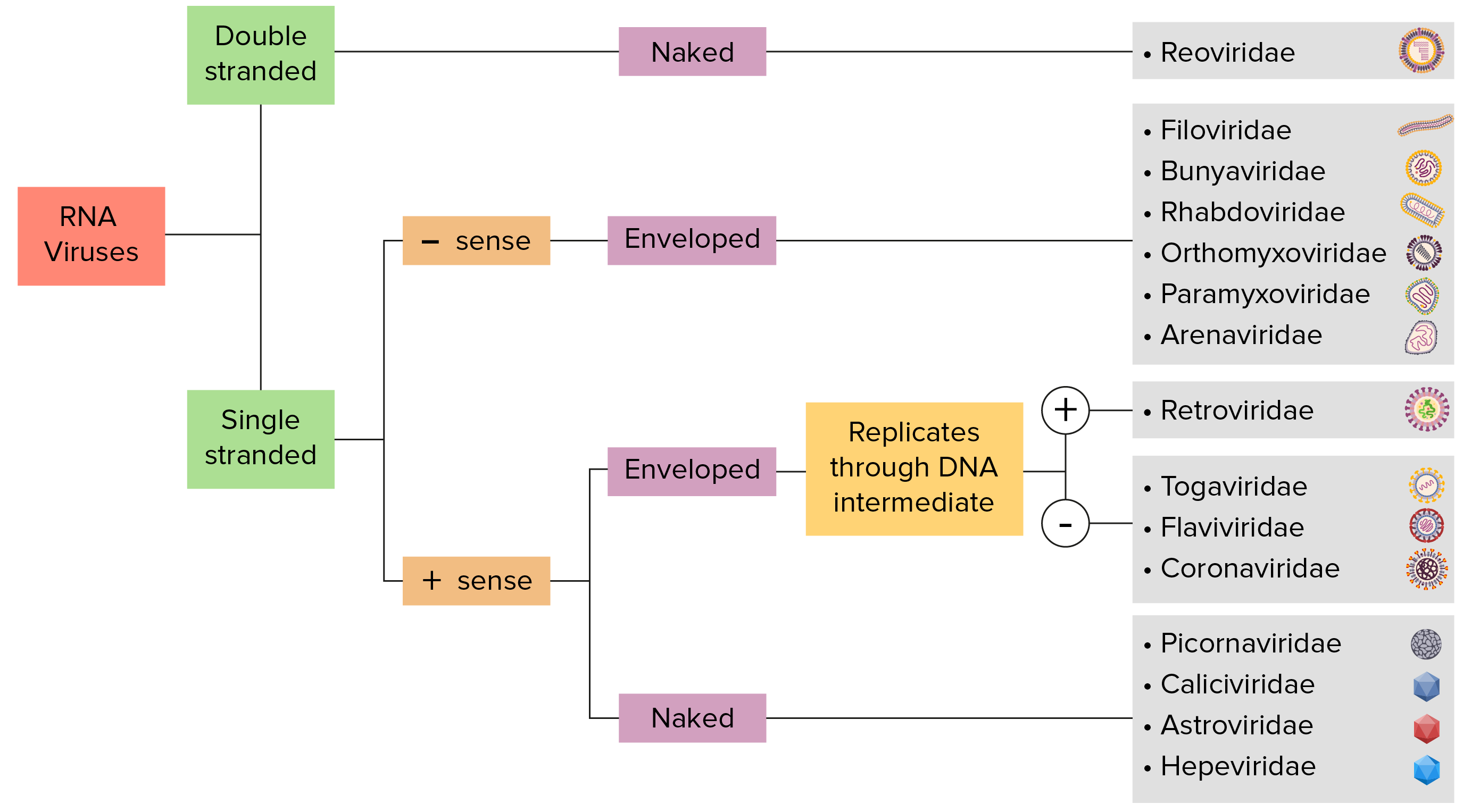
Diagrama de flujo de la clasificación de virus de ARN

Identificación del virus de ARN:
Los virus se pueden clasificar de muchas formas. La mayoría de los virus, sin embargo, tendrán un genoma formado por ácido desoxirribonucleico (ADN) o ARN. Los virus del genoma de ARN pueden caracterizarse además por ARN monocatenario o bicatenario. Los virus “envueltos” están cubiertos por una fina capa de membrana celular (generalmente extraída de la célula huésped). Si la envoltura está ausente, los virus se denominan virus “desnudos”. Los virus con genomas monocatenarios son virus de “sentido positivo” si el genoma se emplea directamente como ARN mensajero (ARNm), que se traduce en proteínas. Los virus monocatenarios de “sentido negativo” emplean la ARN polimerasa dependiente de ARN, una enzima viral, para transcribir su genoma en ARN mensajero.
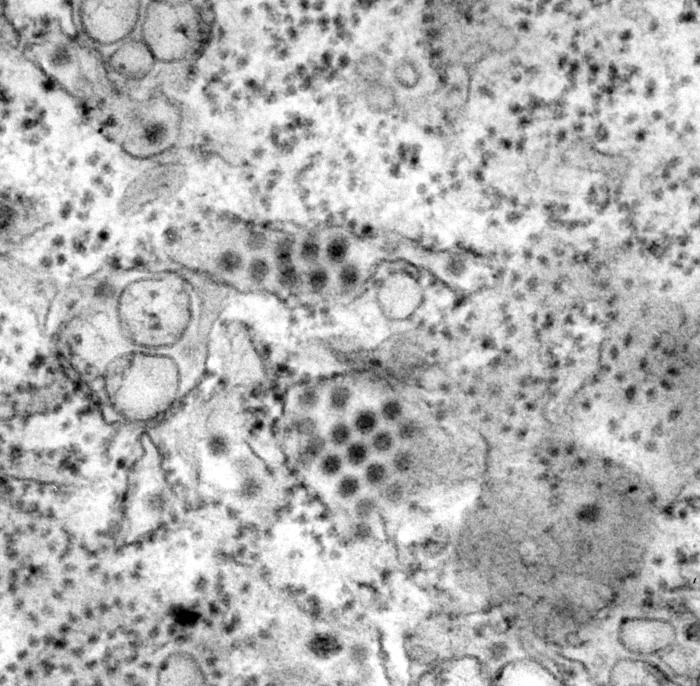
Imagen por Lecturio. Licencia: CC BY-NC-SA 4.0

Características Generales y Epidemiología

Características básicas del virus Virus Viruses are infectious, obligate intracellular parasites composed of a nucleic acid core surrounded by a protein capsid. Viruses can be either naked (non-enveloped) or enveloped. The classification of viruses is complex and based on many factors, including type and structure of the nucleoid and capsid, the presence of an envelope, the replication cycle, and the host range. Virology del dengue Dengue An acute febrile disease transmitted by the bite of aedes mosquitoes infected with dengue virus. It is self-limiting and characterized by fever, myalgia, headache, and rash. Severe dengue is a more virulent form of dengue. Dengue Virus

  • Taxonomía:
    • Familia: Flaviviridae Flaviviridae A family of RNA viruses, many of which cause disease in humans and domestic animals. There are three genera flavivirus; pestivirus; and hepacivirus, as well as several unassigned species. Hepatitis C Virus
    • Género: Flavivirus Flavivirus A genus of flaviviridae containing several subgroups and many species. Most are arboviruses transmitted by mosquitoes or ticks. The type species is yellow fever virus. Tick-borne Encephalitis Virus
  • Virus Virus Viruses are infectious, obligate intracellular parasites composed of a nucleic acid core surrounded by a protein capsid. Viruses can be either naked (non-enveloped) or enveloped. The classification of viruses is complex and based on many factors, including type and structure of the nucleoid and capsid, the presence of an envelope, the replication cycle, and the host range. Virology de ARN
    • Monocatenario
    • Sentido positivo
    • Lineal
  • Esférico
  • Simetría icosaédrica
  • Envuelto
  • Tamaño: 40–60 nm
partículas del virus de la fiebre del dengue Flaviviridae

Imagen de microscopía electrónica de transmisión de una muestra de tejido observando una serie de partículas redondas del DENV

Imagen: “Transmission electron microscopic image of a tissue specimen depicts a number of round, dengue virus particles.” por CDC. Licencia: Dominio Público

Especies clínicamente relevantes

Cuatro serotipos distintos ( DENV DENV An acute febrile disease transmitted by the bite of aedes mosquitoes infected with dengue virus. It is self-limiting and characterized by fever, myalgia, headache, and rash. Severe dengue is a more virulent form of dengue. Dengue Virus 1–4) causan la infección por dengue Dengue An acute febrile disease transmitted by the bite of aedes mosquitoes infected with dengue virus. It is self-limiting and characterized by fever, myalgia, headache, and rash. Severe dengue is a more virulent form of dengue. Dengue Virus.

Epidemiología

  • La principal causa de enfermedades virales transmitidas por artrópodos en EN Erythema nodosum is an immune-mediated panniculitis (inflammation of the subcutaneous fat) caused by a type IV (delayed-type) hypersensitivity reaction. It commonly manifests in young women as tender, erythematous nodules on the shins. Erythema Nodosum el mundo
  • > 100 millones de seres humanos afectados anualmente
  • La incidencia va VA Ventilation: Mechanics of Breathing en EN Erythema nodosum is an immune-mediated panniculitis (inflammation of the subcutaneous fat) caused by a type IV (delayed-type) hypersensitivity reaction. It commonly manifests in young women as tender, erythematous nodules on the shins. Erythema Nodosum aumento.
  • Encontrado en EN Erythema nodosum is an immune-mediated panniculitis (inflammation of the subcutaneous fat) caused by a type IV (delayed-type) hypersensitivity reaction. It commonly manifests in young women as tender, erythematous nodules on the shins. Erythema Nodosum > 100 países
  • Mortalidad:
    • Provoca entre 20 000–25 000 muertes al AL Amyloidosis año (principalmente en EN Erythema nodosum is an immune-mediated panniculitis (inflammation of the subcutaneous fat) caused by a type IV (delayed-type) hypersensitivity reaction. It commonly manifests in young women as tender, erythematous nodules on the shins. Erythema Nodosum niños)
    • Fiebre del dengue Dengue An acute febrile disease transmitted by the bite of aedes mosquitoes infected with dengue virus. It is self-limiting and characterized by fever, myalgia, headache, and rash. Severe dengue is a more virulent form of dengue. Dengue Virus grave no tratada: 10% a 20%
    • Fiebre del dengue Dengue An acute febrile disease transmitted by the bite of aedes mosquitoes infected with dengue virus. It is self-limiting and characterized by fever, myalgia, headache, and rash. Severe dengue is a more virulent form of dengue. Dengue Virus grave tratada: 1%
  • Distribución geográfica:
    • El sudeste de Asia ASIA Spinal Cord Injuries
    • Australia y Oceanía
    • América Central y del Sur
    • Caribe
    • África
    • Oriente Medio

Patogénesis

Reservorio

  • Humanos (reservorio primario)
  • Primates

Transmisión

  • Vector: mosquitos Aedes hembra (modo primario de transmisión)
  • Rara:
    • Vertical
    • Transfusiones de sangre
    • Leche materna
    • Trasplante de órgano

Factores de riesgo del huésped

  • Para la infección por dengue Dengue An acute febrile disease transmitted by the bite of aedes mosquitoes infected with dengue virus. It is self-limiting and characterized by fever, myalgia, headache, and rash. Severe dengue is a more virulent form of dengue. Dengue Virus:
    • Vivir en EN Erythema nodosum is an immune-mediated panniculitis (inflammation of the subcutaneous fat) caused by a type IV (delayed-type) hypersensitivity reaction. It commonly manifests in young women as tender, erythematous nodules on the shins. Erythema Nodosum una zona endémica
    • Viaja a una región endémica
  • Para enfermedad grave:
    • Infección previa por dengue Dengue An acute febrile disease transmitted by the bite of aedes mosquitoes infected with dengue virus. It is self-limiting and characterized by fever, myalgia, headache, and rash. Severe dengue is a more virulent form of dengue. Dengue Virus con un serotipo diferente
    • Niños pequeños

Ciclo de replicación viral

  • El virus Virus Viruses are infectious, obligate intracellular parasites composed of a nucleic acid core surrounded by a protein capsid. Viruses can be either naked (non-enveloped) or enveloped. The classification of viruses is complex and based on many factors, including type and structure of the nucleoid and capsid, the presence of an envelope, the replication cycle, and the host range. Virology se adhiere a los LOS Neisseria receptores de la superficie celular (facilitado por la glicoproteína de la envoltura viral (E)→ endocitosis
  • Acidificación del endosoma → fusión de membranas celulares y virales → ARN viral liberado en EN Erythema nodosum is an immune-mediated panniculitis (inflammation of the subcutaneous fat) caused by a type IV (delayed-type) hypersensitivity reaction. It commonly manifests in young women as tender, erythematous nodules on the shins. Erythema Nodosum el citoplasma
  • Traducción de ARN en EN Erythema nodosum is an immune-mediated panniculitis (inflammation of the subcutaneous fat) caused by a type IV (delayed-type) hypersensitivity reaction. It commonly manifests in young women as tender, erythematous nodules on the shins. Erythema Nodosum proteínas virales
  • Ensamblaje y gemación de nuevos viriones (el mecanismo no se comprende bien)

Fisiopatología

  • Picadura de mosquito → inyección subcutánea de DENV DENV An acute febrile disease transmitted by the bite of aedes mosquitoes infected with dengue virus. It is self-limiting and characterized by fever, myalgia, headache, and rash. Severe dengue is a more virulent form of dengue. Dengue Virus en EN Erythema nodosum is an immune-mediated panniculitis (inflammation of the subcutaneous fat) caused by a type IV (delayed-type) hypersensitivity reaction. It commonly manifests in young women as tender, erythematous nodules on the shins. Erythema Nodosum un humano
  • La replicación ocurre en EN Erythema nodosum is an immune-mediated panniculitis (inflammation of the subcutaneous fat) caused by a type IV (delayed-type) hypersensitivity reaction. It commonly manifests in young women as tender, erythematous nodules on the shins. Erythema Nodosum células locales (células diana aún no identificadas, pero potencialmente macrófagos y células dendríticas)
  • Diseminación al AL Amyloidosis sistema linfático → viremia Viremia The presence of viruses in the blood. Erythema Infectiosum → diseminación a órganos
  • Respuesta inmune innata y adaptativa
  • Infección por un serotipo (infección primaria) → inmunidad de por vida al AL Amyloidosis mismo serotipo
  • Las personas con antecedentes de infección previa por un serotipo pueden seguir infectándose por otro serotipo de dengue Dengue An acute febrile disease transmitted by the bite of aedes mosquitoes infected with dengue virus. It is self-limiting and characterized by fever, myalgia, headache, and rash. Severe dengue is a more virulent form of dengue. Dengue Virus (infección secundaria):
    • La infección secundaria tiene un mayor riesgo de enfermedad más grave (e.g., fiebre hemorrágica del dengue Dengue An acute febrile disease transmitted by the bite of aedes mosquitoes infected with dengue virus. It is self-limiting and characterized by fever, myalgia, headache, and rash. Severe dengue is a more virulent form of dengue. Dengue Virus, síndrome de shock Shock Shock is a life-threatening condition associated with impaired circulation that results in tissue hypoxia. The different types of shock are based on the underlying cause: distributive (↑ cardiac output (CO), ↓ systemic vascular resistance (SVR)), cardiogenic (↓ CO, ↑ SVR), hypovolemic (↓ CO, ↑ SVR), obstructive (↓ CO), and mixed. Types of Shock del dengue Dengue An acute febrile disease transmitted by the bite of aedes mosquitoes infected with dengue virus. It is self-limiting and characterized by fever, myalgia, headache, and rash. Severe dengue is a more virulent form of dengue. Dengue Virus).
    • Factores que contribuyen:
      • Potenciación dependiente de anticuerpos ( los LOS Neisseria anticuerpos potenciadores no neutralizan el virus Virus Viruses are infectious, obligate intracellular parasites composed of a nucleic acid core surrounded by a protein capsid. Viruses can be either naked (non-enveloped) or enveloped. The classification of viruses is complex and based on many factors, including type and structure of the nucleoid and capsid, the presence of an envelope, the replication cycle, and the host range. Virology).
      • ↑ Complejos inmunitarios
      • ↑ Respuesta de los LOS Neisseria linfocitos T

Presentación Clínica

La mayoría de los LOS Neisseria pacientes serán asintomáticos. Aquellos con enfermedad sintomática pueden experimentar 3 fases: febril, crítica y convaleciente.

Fase febril

Esta fase ocurre después de un período de incubación de 3–14 días y dura de 2–7 días.
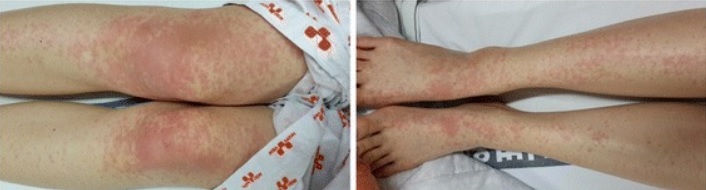
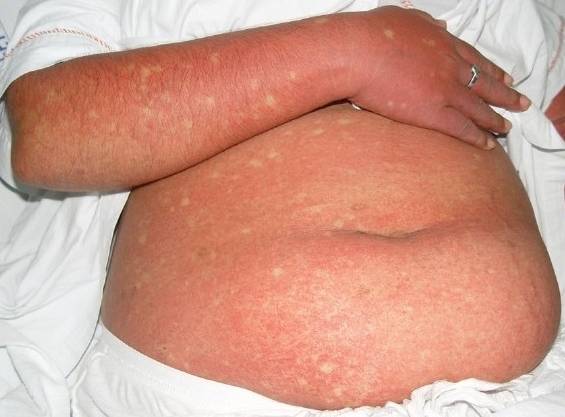
  • General:
    • Fiebre alta repentina
    • Linfadenopatía
  • Dolor Dolor Inflammation:
  • Erupción:
  • Respiratorio:
    • Faringitis
    • Tos TOS Thoracic outlet syndrome (TOS) is a broad term used for a spectrum of syndromes related to the general region of the thoracic outlet, which involves the compression or irritation of elements of the brachial plexus, subclavian artery, or subclavian vein. Thoracic Outlet Syndrome
    • Congestión nasal
  • Abdominal:

Fase crítica

Esta fase no se observa en EN Erythema nodosum is an immune-mediated panniculitis (inflammation of the subcutaneous fat) caused by a type IV (delayed-type) hypersensitivity reaction. It commonly manifests in young women as tender, erythematous nodules on the shins. Erythema Nodosum todos los LOS Neisseria casos y suele presentarse en EN Erythema nodosum is an immune-mediated panniculitis (inflammation of the subcutaneous fat) caused by a type IV (delayed-type) hypersensitivity reaction. It commonly manifests in young women as tender, erythematous nodules on the shins. Erythema Nodosum pacientes que han tenido una infección previa por dengue Dengue An acute febrile disease transmitted by the bite of aedes mosquitoes infected with dengue virus. It is self-limiting and characterized by fever, myalgia, headache, and rash. Severe dengue is a more virulent form of dengue. Dengue Virus.

Características generales:

  • ↓ Fiebre
  • Fuga capilar sistémica (secundaria a ↑ de la permeabilidad vascular) ocurre entre los LOS Neisseria días 3-7:
    • Edema Edema Edema is a condition in which excess serous fluid accumulates in the body cavity or interstitial space of connective tissues. Edema is a symptom observed in several medical conditions. It can be categorized into 2 types, namely, peripheral (in the extremities) and internal (in an organ or body cavity). Edema
    • Ascitis
    • Derrame pleural
    • Hemoconcentración (↑hematócrito del 20% o más por encima de los LOS Neisseria valores basales)

Fiebre hemorrágica del dengue Dengue An acute febrile disease transmitted by the bite of aedes mosquitoes infected with dengue virus. It is self-limiting and characterized by fever, myalgia, headache, and rash. Severe dengue is a more virulent form of dengue. Dengue Virus:
  • Manifestaciones hemorrágicas:
    • Petequias, púrpura o equimosis
    • Hemorragia de las mucosas
    • Hematemesis Hematemesis Vomiting of blood that is either fresh bright red, or older ‘coffee-ground’ in character. It generally indicates bleeding of the upper gastrointestinal tract. Mallory-Weiss Syndrome (Mallory-Weiss Tear) o melena Melena The black, tarry, foul-smelling feces that contain degraded blood. Gastrointestinal Bleeding
    • Hemorragia menstrual abundante
    • Prueba del torniquete positiva:
      • Inflar el manguito de presión arterial en EN Erythema nodosum is an immune-mediated panniculitis (inflammation of the subcutaneous fat) caused by a type IV (delayed-type) hypersensitivity reaction. It commonly manifests in young women as tender, erythematous nodules on the shins. Erythema Nodosum el brazo a medio camino entre las presiones sistólica y diastólica durante 5 minutos.
      • ≥ 10 petequias por 2,5 cm² (por debajo del manguito).
  • Coagulación intravascular diseminada (CID)
  • Dolor Dolor Inflammation abdominal
  • Estado mental alterado

Síndrome de shock Shock Shock is a life-threatening condition associated with impaired circulation that results in tissue hypoxia. The different types of shock are based on the underlying cause: distributive (↑ cardiac output (CO), ↓ systemic vascular resistance (SVR)), cardiogenic (↓ CO, ↑ SVR), hypovolemic (↓ CO, ↑ SVR), obstructive (↓ CO), and mixed. Types of Shock por dengue Dengue An acute febrile disease transmitted by the bite of aedes mosquitoes infected with dengue virus. It is self-limiting and characterized by fever, myalgia, headache, and rash. Severe dengue is a more virulent form of dengue. Dengue Virus:

  • Shock Shock Shock is a life-threatening condition associated with impaired circulation that results in tissue hypoxia. The different types of shock are based on the underlying cause: distributive (↑ cardiac output (CO), ↓ systemic vascular resistance (SVR)), cardiogenic (↓ CO, ↑ SVR), hypovolemic (↓ CO, ↑ SVR), obstructive (↓ CO), and mixed. Types of Shock
    • El dolor Dolor Inflammation abdominal extremo, los LOS Neisseria vómitos, el letargo/la intranquilidad que se producen con la defervescencia indican un síndrome de shock Shock Shock is a life-threatening condition associated with impaired circulation that results in tissue hypoxia. The different types of shock are based on the underlying cause: distributive (↑ cardiac output (CO), ↓ systemic vascular resistance (SVR)), cardiogenic (↓ CO, ↑ SVR), hypovolemic (↓ CO, ↑ SVR), obstructive (↓ CO), and mixed. Types of Shock inminente.
    • Pulso débil
    • Hipotensión
  • Disfunción de órganos
  • Puede ser letal
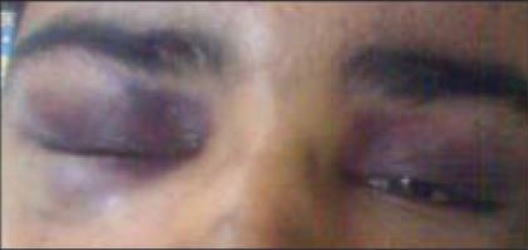
Equimosis periorbitaria bilateral del virus del dengue Flaviviridae

Equimosis periorbitaria bilateral en paciente con dengue hemorrágico

Imagen: “Bilateral periorbital ecchymosis in a case with dengue fever” por Kumar V et al. Licencia: CC BY 2.0

Fase de convalecencia

  • Reabsorción gradual de líquido extravascular
  • Estabilización de signos vitales
  • Resolución de hemorragia
  • Puede producirse una erupción eritematosa confluente y pruriginosa
  • Fatiga profunda (puede durar de días a semanas)

Diagnóstico y Tratamiento

Diagnóstico

El diagnóstico debe sospecharse en EN Erythema nodosum is an immune-mediated panniculitis (inflammation of the subcutaneous fat) caused by a type IV (delayed-type) hypersensitivity reaction. It commonly manifests in young women as tender, erythematous nodules on the shins. Erythema Nodosum personas que viven o viajan desde áreas endémicas.

  • Las pruebas de laboratorio confirmatorias incluyen:
    • Serología por ensayo inmunoabsorbente ligado a enzimas ( ELISA ELISA An immunoassay utilizing an antibody labeled with an enzyme marker such as horseradish peroxidase. While either the enzyme or the antibody is bound to an immunosorbent substrate, they both retain their biologic activity; the change in enzyme activity as a result of the enzyme-antibody-antigen reaction is proportional to the concentration of the antigen and can be measured spectrophotometrically or with the naked eye. Many variations of the method have been developed. St. Louis Encephalitis Virus, por sus siglas en EN Erythema nodosum is an immune-mediated panniculitis (inflammation of the subcutaneous fat) caused by a type IV (delayed-type) hypersensitivity reaction. It commonly manifests in young women as tender, erythematous nodules on the shins. Erythema Nodosum inglés)
    • Detección de antígenos virales
    • PCR PCR Polymerase chain reaction (PCR) is a technique that amplifies DNA fragments exponentially for analysis. The process is highly specific, allowing for the targeting of specific genomic sequences, even with minuscule sample amounts. The PCR cycles multiple times through 3 phases: denaturation of the template DNA, annealing of a specific primer to the individual DNA strands, and synthesis/elongation of new DNA molecules. Polymerase Chain Reaction (PCR) para ARN viral
    • Cultivo viral (rara vez útil)
  • Evaluación de soporte:
    • Leucopenia
    • Trombocitopenia
    • ↑ Enzimas hepáticas
    • ↑ Tiempo de protrombina (TP) y tiempo de tromboplastina parcial ( TTP TTP Thrombotic thrombocytopenic purpura (TTP) is a life-threatening condition due to either a congenital or an acquired deficiency of adamts-13, a metalloproteinase that cleaves multimers of von Willebrand factor (vWF). The large multimers then aggregate excessive platelets resulting in microvascular thrombosis and an increase in consumption of platelets. Thrombotic Thrombocytopenic Purpura)
    • ↓ Fibrinógeno
    • ↓ Proteínas (hipoproteinemia)
    • Ultrasonido → ascitis
    • Rayos X → derrame pleural

Tratamiento

No existe una terapia antiviral Antiviral Antivirals for Hepatitis B eficaz, por lo que el tratamiento es de soporte. Esto puede incluir:

Prevención

  • Evita picaduras de mosquitos
    • Insecticida/repelentes
    • Ropa protectora
    • Dormir bajo una mosquitera
    • Eliminar el agua estancada en EN Erythema nodosum is an immune-mediated panniculitis (inflammation of the subcutaneous fat) caused by a type IV (delayed-type) hypersensitivity reaction. It commonly manifests in young women as tender, erythematous nodules on the shins. Erythema Nodosum el hogar
  • Vacuna
    • Disminuye el riesgo de enfermedad grave en EN Erythema nodosum is an immune-mediated panniculitis (inflammation of the subcutaneous fat) caused by a type IV (delayed-type) hypersensitivity reaction. It commonly manifests in young women as tender, erythematous nodules on the shins. Erythema Nodosum pacientes previamente infectados.
    • Puede aumentar el riesgo de enfermedad grave en EN Erythema nodosum is an immune-mediated panniculitis (inflammation of the subcutaneous fat) caused by a type IV (delayed-type) hypersensitivity reaction. It commonly manifests in young women as tender, erythematous nodules on the shins. Erythema Nodosum niños seronegativos.
    • No aprobada para viajeros a regiones endémicas

Comparación de Especies Similares de Flavivirus

Tabla: Comparación de especies de Flavivirus Flavivirus A genus of flaviviridae containing several subgroups and many species. Most are arboviruses transmitted by mosquitoes or ticks. The type species is yellow fever virus. Tick-borne Encephalitis Virus
Organismo Virus Virus Viruses are infectious, obligate intracellular parasites composed of a nucleic acid core surrounded by a protein capsid. Viruses can be either naked (non-enveloped) or enveloped. The classification of viruses is complex and based on many factors, including type and structure of the nucleoid and capsid, the presence of an envelope, the replication cycle, and the host range. Virology de la fiebre amarilla Virus Virus Viruses are infectious, obligate intracellular parasites composed of a nucleic acid core surrounded by a protein capsid. Viruses can be either naked (non-enveloped) or enveloped. The classification of viruses is complex and based on many factors, including type and structure of the nucleoid and capsid, the presence of an envelope, the replication cycle, and the host range. Virology de la hepatitis C Hepatitis C Hepatitis C is an infection of the liver caused by the hepatitis C virus (HCV). The infection can be transmitted through infectious blood or body fluids and may be transmitted during childbirth or through IV drug use or sexual intercourse. Hepatitis C virus can cause both acute and chronic hepatitis, ranging from a mild to a serious, lifelong illness including liver cirrhosis and hepatocellular carcinoma (HCC). Hepatitis C Virus ( HCV HCV Hepatitis C is an infection of the liver caused by the hepatitis C virus (HCV). Hepatitis C virus is an RNA virus and a member of the genus Hepacivirus and the family Flaviviridae. The infection can be transmitted through infectious blood or body fluids and may be transmitted during childbirth or through IV drug use or sexual intercourse. Hepatitis C Virus, por sus siglas en EN Erythema nodosum is an immune-mediated panniculitis (inflammation of the subcutaneous fat) caused by a type IV (delayed-type) hypersensitivity reaction. It commonly manifests in young women as tender, erythematous nodules on the shins. Erythema Nodosum inglés) Virus Virus Viruses are infectious, obligate intracellular parasites composed of a nucleic acid core surrounded by a protein capsid. Viruses can be either naked (non-enveloped) or enveloped. The classification of viruses is complex and based on many factors, including type and structure of the nucleoid and capsid, the presence of an envelope, the replication cycle, and the host range. Virology del dengue Dengue An acute febrile disease transmitted by the bite of aedes mosquitoes infected with dengue virus. It is self-limiting and characterized by fever, myalgia, headache, and rash. Severe dengue is a more virulent form of dengue. Dengue Virus ( DENV DENV An acute febrile disease transmitted by the bite of aedes mosquitoes infected with dengue virus. It is self-limiting and characterized by fever, myalgia, headache, and rash. Severe dengue is a more virulent form of dengue. Dengue Virus)
Caracteristicas
  • 1 serotipo
  • 40–60 nm
  • 2 serotipos
  • 55–65 nm
  • 4 serotipos
  • 40–60 nm
Transmisión Mosquito Sanguínea Mosquito
Presentación clínica
  • Fiebre
  • Síntomas similares a la gripe
  • Ictericia
  • Disfunción multiorgánica
  • Hemorragia
  • Shock Shock Shock is a life-threatening condition associated with impaired circulation that results in tissue hypoxia. The different types of shock are based on the underlying cause: distributive (↑ cardiac output (CO), ↓ systemic vascular resistance (SVR)), cardiogenic (↓ CO, ↑ SVR), hypovolemic (↓ CO, ↑ SVR), obstructive (↓ CO), and mixed. Types of Shock
  • Asintomático
  • Hepatitis
  • Cirrosis
  • Carcinoma hepatocelular
  • Fiebre
  • Síntomas similares a la gripe
  • Enrojecimiento de la piel/erupción
  • Dolor Dolor Inflammation severo
  • Disfunción multiorgánica
  • Hemorragia
  • Shock Shock Shock is a life-threatening condition associated with impaired circulation that results in tissue hypoxia. The different types of shock are based on the underlying cause: distributive (↑ cardiac output (CO), ↓ systemic vascular resistance (SVR)), cardiogenic (↓ CO, ↑ SVR), hypovolemic (↓ CO, ↑ SVR), obstructive (↓ CO), and mixed. Types of Shock
Diagnóstico
  • Serología
  • PCR PCR Polymerase chain reaction (PCR) is a technique that amplifies DNA fragments exponentially for analysis. The process is highly specific, allowing for the targeting of specific genomic sequences, even with minuscule sample amounts. The PCR cycles multiple times through 3 phases: denaturation of the template DNA, annealing of a specific primer to the individual DNA strands, and synthesis/elongation of new DNA molecules. Polymerase Chain Reaction (PCR)
  • Cultivo viral
  • Serología
  • PCR PCR Polymerase chain reaction (PCR) is a technique that amplifies DNA fragments exponentially for analysis. The process is highly specific, allowing for the targeting of specific genomic sequences, even with minuscule sample amounts. The PCR cycles multiple times through 3 phases: denaturation of the template DNA, annealing of a specific primer to the individual DNA strands, and synthesis/elongation of new DNA molecules. Polymerase Chain Reaction (PCR)
  • Serología
  • PCR PCR Polymerase chain reaction (PCR) is a technique that amplifies DNA fragments exponentially for analysis. The process is highly specific, allowing for the targeting of specific genomic sequences, even with minuscule sample amounts. The PCR cycles multiple times through 3 phases: denaturation of the template DNA, annealing of a specific primer to the individual DNA strands, and synthesis/elongation of new DNA molecules. Polymerase Chain Reaction (PCR)
  • Prueba de antígeno
Tratamiento De soporte Antivirales de acción directa De soporte
Prevención
  • Evitar compartir agujas.
  • Eliminación adecuada de objetos punzantes y desechos
  • Análisis de sangre donada

Diagnóstico Diferencial

  • Virus Virus Viruses are infectious, obligate intracellular parasites composed of a nucleic acid core surrounded by a protein capsid. Viruses can be either naked (non-enveloped) or enveloped. The classification of viruses is complex and based on many factors, including type and structure of the nucleoid and capsid, the presence of an envelope, the replication cycle, and the host range. Virology del Zika Zika Zika virus belongs to the genus Flavivirus and is primarily transmitted by Aedes aegypti mosquitoes, but can also be transmitted sexually and transplacentally. Although most infected patients are asymptomatic, some may present with low-grade fever, pruritic rash, and conjunctivitis. Zika Virus Infection: un Flavivirus Flavivirus A genus of flaviviridae containing several subgroups and many species. Most are arboviruses transmitted by mosquitoes or ticks. The type species is yellow fever virus. Tick-borne Encephalitis Virus que causa fiebre, conjuntivitis y cefalea. Una infección durante el embarazo puede provocar microcefalia y alteraciones del desarrollo en EN Erythema nodosum is an immune-mediated panniculitis (inflammation of the subcutaneous fat) caused by a type IV (delayed-type) hypersensitivity reaction. It commonly manifests in young women as tender, erythematous nodules on the shins. Erythema Nodosum los LOS Neisseria recién nacidos. El diagnóstico se establece con serología o PCR PCR Polymerase chain reaction (PCR) is a technique that amplifies DNA fragments exponentially for analysis. The process is highly specific, allowing for the targeting of specific genomic sequences, even with minuscule sample amounts. The PCR cycles multiple times through 3 phases: denaturation of the template DNA, annealing of a specific primer to the individual DNA strands, and synthesis/elongation of new DNA molecules. Polymerase Chain Reaction (PCR). El tratamiento es de soporte.
  • Virus Virus Viruses are infectious, obligate intracellular parasites composed of a nucleic acid core surrounded by a protein capsid. Viruses can be either naked (non-enveloped) or enveloped. The classification of viruses is complex and based on many factors, including type and structure of the nucleoid and capsid, the presence of an envelope, the replication cycle, and the host range. Virology Chikungunya Chikungunya Chikungunya virus belongs to the Alphavirus genus and causes a viral infection characterized by fever and joint pain. Symptoms usually appear within 1 week of infection. Additional manifestations of chikungunya virus may include muscle pain, headache, maculopapular rash, and lymphadenopathy. Chikungunya Virus: virus Virus Viruses are infectious, obligate intracellular parasites composed of a nucleic acid core surrounded by a protein capsid. Viruses can be either naked (non-enveloped) or enveloped. The classification of viruses is complex and based on many factors, including type and structure of the nucleoid and capsid, the presence of an envelope, the replication cycle, and the host range. Virology perteneciente a la familia Togaviridae Togaviridae A family of RNA viruses, mainly arboviruses, consisting of two genera: alphavirus (group A arboviruses), and rubivirus. Virions are spherical, 60-70 nm in diameter, with a lipoprotein envelope tightly applied to the icosahedral nucleocapsid. Rubella Virus y transmitido por mosquitos Aedes. Los LOS Neisseria pacientes afectados presentan inicio abrupto de fiebre y mialgias. Puede ocurrir una poliartralgia bilateral simétrica en EN Erythema nodosum is an immune-mediated panniculitis (inflammation of the subcutaneous fat) caused by a type IV (delayed-type) hypersensitivity reaction. It commonly manifests in young women as tender, erythematous nodules on the shins. Erythema Nodosum las articulaciones distales, así como una erupción maculopapular Maculopapular Dermatologic Examination generalizada. El diagnóstico incluye serología y PCR PCR Polymerase chain reaction (PCR) is a technique that amplifies DNA fragments exponentially for analysis. The process is highly specific, allowing for the targeting of specific genomic sequences, even with minuscule sample amounts. The PCR cycles multiple times through 3 phases: denaturation of the template DNA, annealing of a specific primer to the individual DNA strands, and synthesis/elongation of new DNA molecules. Polymerase Chain Reaction (PCR). El tratamiento es de soporte.
  • Malaria Malaria Malaria is an infectious parasitic disease affecting humans and other animals. Most commonly transmitted via the bite of a female Anopheles mosquito infected with microorganisms of the Plasmodium genus. Patients present with fever, chills, myalgia, headache, and diaphoresis. Plasmodium/Malaria: enfermedad infecciosa transmitida por mosquitos causada por especies de Plasmodium Plasmodium A genus of protozoa that comprise the malaria parasites of mammals. Four species infect humans (although occasional infections with primate malarias may occur). These are plasmodium falciparum; plasmodium malariae; plasmodium ovale, and plasmodium vivax. Species causing infection in vertebrates other than man include: plasmodium berghei; plasmodium chabaudi; p. Vinckei, and plasmodium yoelii in rodents; p. Brasilianum, plasmodium cynomolgi; and plasmodium knowlesi in monkeys; and plasmodium gallinaceum in chickens. Antimalarial Drugs. La malaria Malaria Malaria is an infectious parasitic disease affecting humans and other animals. Most commonly transmitted via the bite of a female Anopheles mosquito infected with microorganisms of the Plasmodium genus. Patients present with fever, chills, myalgia, headache, and diaphoresis. Plasmodium/Malaria a menudo se presenta con fiebre, escalofríos, diaforesis, ictericia, dolor Dolor Inflammation abdominal, anemia Anemia Anemia is a condition in which individuals have low Hb levels, which can arise from various causes. Anemia is accompanied by a reduced number of RBCs and may manifest with fatigue, shortness of breath, pallor, and weakness. Subtypes are classified by the size of RBCs, chronicity, and etiology. Anemia: Overview and Types hemolítica, hepatoesplenomegalia y deterioro renal. Un frotis de sangre muestra un solo anillo pleomórfico. También se pueden realizar pruebas rápidas de antígenos de Plasmodium Plasmodium A genus of protozoa that comprise the malaria parasites of mammals. Four species infect humans (although occasional infections with primate malarias may occur). These are plasmodium falciparum; plasmodium malariae; plasmodium ovale, and plasmodium vivax. Species causing infection in vertebrates other than man include: plasmodium berghei; plasmodium chabaudi; p. Vinckei, and plasmodium yoelii in rodents; p. Brasilianum, plasmodium cynomolgi; and plasmodium knowlesi in monkeys; and plasmodium gallinaceum in chickens. Antimalarial Drugs. El tratamiento requiere un ciclo prolongado de múltiples medicamentos antipalúdicos.
  • Leptospirosis Leptospirosis Leptospira is a spiral or question mark-shaped, gram-negative spirochete with hook-shaped ends. The major clinical species is Leptospira interrogans, which causes a mild flu-like illness in a majority of cases. The manifestations are biphasic, with Leptospira found in the blood initially. Leptospira/Leptospirosis: una enfermedad causada por la espiroqueta Gram-negativa Leptospira Leptospira Leptospira is a spiral or question mark-shaped, gram-negative spirochete with hook-shaped ends. The disease, leptospirosis, is a zoonosis, infecting animals. Rodents are the most important reservoir. Bacteria shed in the urine of rodents and other animals can be transmitted to humans via contaminated water. Leptospira/Leptospirosis. Las bacterias que se desprenden de la orina de roedores y otros animales pueden transmitirse a los LOS Neisseria humanos a través del agua contaminada. En EN Erythema nodosum is an immune-mediated panniculitis (inflammation of the subcutaneous fat) caused by a type IV (delayed-type) hypersensitivity reaction. It commonly manifests in young women as tender, erythematous nodules on the shins. Erythema Nodosum la mayoría de los LOS Neisseria casos se presenta una enfermedad leve parecida a la gripe. En EN Erythema nodosum is an immune-mediated panniculitis (inflammation of the subcutaneous fat) caused by a type IV (delayed-type) hypersensitivity reaction. It commonly manifests in young women as tender, erythematous nodules on the shins. Erythema Nodosum una minoría de pacientes se desarrolla leptospirosis Leptospirosis Leptospira is a spiral or question mark-shaped, gram-negative spirochete with hook-shaped ends. The major clinical species is Leptospira interrogans, which causes a mild flu-like illness in a majority of cases. The manifestations are biphasic, with Leptospira found in the blood initially. Leptospira/Leptospirosis icterohemorrágica, que se manifiesta como hemorragia, insuficiencia renal e ictericia. Un cultivo bacteriano lleva semanas, por lo que se utilizan otras pruebas de diagnóstico, como serología y microscopía de campo oscuro. El tratamiento es principalmente con antibióticos (e.g., doxiciclina, azitromicina, penicilina).

Referencias:

  1. World Health Organization. (2024). Dengue and severe dengue fact sheet. WHO. Retrieved June 27, 2025, from http://www.who.int/mediacentre/factsheets/fs117/en/
  2. Bhatt, S., Gething, P. W., Brady, O. J., Messina, J. P., Farlow, A. W., et al. (2013). The global distribution and burden of dengue. Nature, 496(7446), 504–507. https://doi.org/10.1038/nature12060
  3. Baak-Baak, C. M., Cigarroa-Toledo, N., Pech-May, A., Cruz-Escalona, G. A., Cetina-Trejo, R. C., et al. (2019). Entomological and virological surveillance for dengue virus in churches in Merida, Mexico. Revista do Instituto de Medicina Tropical de São Paulo, 61, e9. https://doi.org/10.1590/S1678-9946201961009
  4. Sharma, M., Glasner, D. R., Watkins, H., Puerta-Guardo, H., Kassa, Y., Egan, M. A., Dean, H., & Harris, E. (2019). Magnitude and functionality of the NS1-specific antibody response elicited by a live-attenuated tetravalent dengue vaccine candidate. The Journal of Infectious Diseases, 221(6), 867–877. https://doi.org/10.1093/infdis/jiz081
  5. Wilder-Smith, A., & Gubler, D. J. (2008). Geographic expansion of dengue: The impact of international travel. Medical Clinics of North America, 92(6), 1377–1390. https://doi.org/10.1016/j.mcna.2008.07.002
  6. Maia, L. M. S., Bezerra, M. C. F., Costa, M. C. S., Souza, E. M., Oliveira, M. E. B., Ribeiro, A. L. M., Miyazaki, R. D., & Sihesseranko, R. D. (2019). Natural vertical infection by dengue virus serotype 4, Zika virus and Mayaro virus in Aedes (Stegomyia) aegypti and Aedes (Stegomyia) albopictus. Medical and Veterinary Entomology, 33(3), 437–442. https://doi.org/10.1111/mve.12369
  7. Wharton-Smith, A., Green, J., Loh, E. C., Gorrie, A., Syed Omar, S. F., Bacchus, L., & Lum, L. C. S. (2019). Using clinical practice guidelines to manage dengue: A qualitative study in a Malaysian hospital. BMC Infectious Diseases, 19(1), 45. https://doi.org/10.1186/s12879-019-3680-5
  8. Thomas, SJ, and Rothman, AL. (2025). Dengue virus infection: Epidemiology. UpToDate. Retrieved June 27, 2025, from https://www.uptodate.com/contents/dengue-virus-infection-epidemiology
  9. Thomas, SJ, and Rothman, AL. (2025). Dengue virus infection: Pathogenesis. UpToDate. Retrieved June 27, 2025, from https://www.uptodate.com/contents/dengue-virus-infection-pathogenesis
  10. Thomas, SJ, Rothman, AL, Srikiatkhachorn, A, and Kalayanarooj, S. (2025). Dengue virus infection: Clinical manifestations and diagnosis. UpToDate. Retrieved June 27, 2025, from https://www.uptodate.com/contents/dengue-virus-infection-clinical-manifestations-and-diagnosis
  11. Thomas, SJ, Rothman, AL, Srikiatkhachorn, A, and Kalayanarooj, S. (2025). Dengue virus infection: Prevention and treatment. UpToDate. Retrieved June 27, 2025, from https://www.uptodate.com/contents/dengue-virus-infection-prevention-and-treatment
  12. Smith, DS, Mariano, DJ, and Trautwein, ML. (2025). Dengue. In Bronze, M.S. (Ed.), Medscape. Retrieved June 27, 2025, from https://emedicine.medscape.com/article/215840-overview
  13. Yuill, TM. (2023). Dengue. [online] MSD Manual Professional Version. Retrieved June 27, 2025, from https://www.msdmanuals.com/professional/infectious-diseases/arboviruses-arenaviridae-and-filoviridae/dengue
  14. Schaefer, TJ, Panda, PK, and Wolford, RW. (2024). Dengue fever. [online] StatPearls. Retrieved June 27, 2025, from https://www.ncbi.nlm.nih.gov/books/NBK430732/
  15. Mustafa, M. S., Rasotgi, V., Jain, S., & Gupta, V. (2014). Discovery of fifth serotype of dengue virus (DENV-5): A new public health dilemma in dengue control. Medical Journal Armed Forces India, 71(1), 67–70. https://doi.org/10.1016/j.mjafi.2014.09.011

¡Crea tu cuenta gratis o inicia una sesión para seguir leyendo!

Regístrate ahora y obtén acceso gratuito a Lecturio con páginas de concepto, videos médicos y cuestionarios para tu educación médica.

User Reviews

Que tengas una sesión de estudio alegre y navideña 🎁 Ahorra 50% en todos los planes >>

Details