Domina Conceptos Médicos

Estudia para la escuela de medicina y tus examenes con Lecturio.

Síndrome de Stevens-Johnson

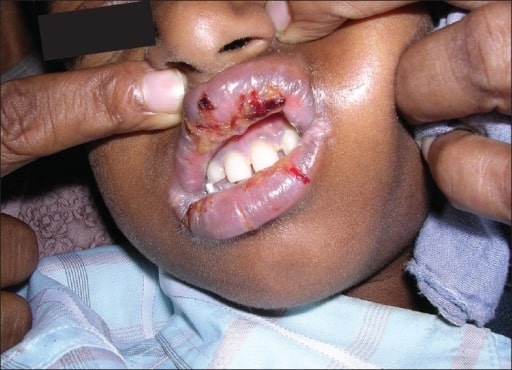
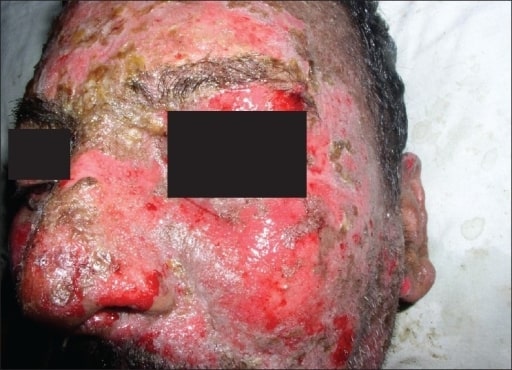
El síndrome de Stevens-Johnson (SSJ) es una reacción de hipersensibilidad cutánea, inmunomediada, que suele ser desencadenada por medicamentos, como los LOS Neisseria antiepilépticos y los LOS Neisseria antibióticos. La afección se sitúa en EN Erythema nodosum is an immune-mediated panniculitis (inflammation of the subcutaneous fat) caused by a type IV (delayed-type) hypersensitivity reaction. It commonly manifests in young women as tender, erythematous nodules on the shins. Erythema Nodosum un espectro con la necrólisis epidérmica tóxica (NET) basado en EN Erythema nodosum is an immune-mediated panniculitis (inflammation of the subcutaneous fat) caused by a type IV (delayed-type) hypersensitivity reaction. It commonly manifests in young women as tender, erythematous nodules on the shins. Erythema Nodosum la cantidad de superficie corporal afectada. El síndrome de Stevens-Johnson se caracteriza por la necrosis Necrosis The death of cells in an organ or tissue due to disease, injury or failure of the blood supply. Ischemic Cell Damage de los LOS Neisseria queratinocitos y la separación de la epidermis Epidermis The external, nonvascular layer of the skin. It is made up, from within outward, of five layers of epithelium: (1) basal layer (stratum basale epidermidis); (2) spinous layer (stratum spinosum epidermidis); (3) granular layer (stratum granulosum epidermidis); (4) clear layer (stratum lucidum epidermidis); and (5) horny layer (stratum corneum epidermidis). Skin: Structure and Functions de la dermis Dermis A layer of vascularized connective tissue underneath the epidermis. The surface of the dermis contains innervated papillae. Embedded in or beneath the dermis are sweat glands; hair follicles; and sebaceous glands. Skin: Structure and Functions. Los LOS Neisseria pacientes presentan un pródromo gripal, seguido de ampollas cutáneas y descamación en EN Erythema nodosum is an immune-mediated panniculitis (inflammation of the subcutaneous fat) caused by a type IV (delayed-type) hypersensitivity reaction. It commonly manifests in young women as tender, erythematous nodules on the shins. Erythema Nodosum la cara, tórax y mucosas. El síndrome de Stevens-Johnson se considera una emergencia médica, y el tratamiento es principalmente de soporte. Se requiere la retirada del agente causal. La vigilancia y el tratamiento de la sobreinfección son esenciales debido al AL Amyloidosis alto riesgo de muerte asociado a estos casos.

Last updated: Apr 13, 2022

Editorial responsibility: Stanley Oiseth, Lindsay Jones, Evelin Maza

Descripción General

Clasificación

  • El síndrome de Stevens-Johnson (SSJ) y la necrólisis epidérmica tóxica (NET) son reacciones mucocutáneas graves.
  • Se considera un continuo de la misma enfermedad
  • Se clasifica en EN Erythema nodosum is an immune-mediated panniculitis (inflammation of the subcutaneous fat) caused by a type IV (delayed-type) hypersensitivity reaction. It commonly manifests in young women as tender, erythematous nodules on the shins. Erythema Nodosum función del porcentaje de superficie corporal afectada por ampollas, erosiones y desprendimientos de piel:
Subtipo Área de superficie corporal implicada

Síndrome de Stevens-Johnson

<10% de superficie corporal afectada

Superposición de SSJ/TEN

10%–30% de superficie corporal

Necrólisis epidérmica tóxica

>30% de área de superficie corporal

BSA: superficie corporal
SSJ: Síndrome de Stevens-Johnson
NET: necrólisis epidérmica tóxica

Epidemiología

  • Incidencia:
    • 1–7 casos por millón de personas al AL Amyloidosis año
    • Mayor en EN Erythema nodosum is an immune-mediated panniculitis (inflammation of the subcutaneous fat) caused by a type IV (delayed-type) hypersensitivity reaction. It commonly manifests in young women as tender, erythematous nodules on the shins. Erythema Nodosum pacientes con VIH y cáncer activo
    • El SSJ es más común.
  • Tasa de mortalidad:
    • SJS SJS Stevens-Johnson syndrome (SJS) is a cutaneous, immune-mediated hypersensitivity reaction that is commonly triggered by medications, including antiepileptics and antibiotics. The condition runs on a spectrum with toxic epidermal necrolysis (TEN) based on the amount of body surface area (BSA) involved. Stevens-Johnson Syndrome: ~10%
    • NET: ~30 %
  • Más común en EN Erythema nodosum is an immune-mediated panniculitis (inflammation of the subcutaneous fat) caused by a type IV (delayed-type) hypersensitivity reaction. It commonly manifests in young women as tender, erythematous nodules on the shins. Erythema Nodosum mujeres que en EN Erythema nodosum is an immune-mediated panniculitis (inflammation of the subcutaneous fat) caused by a type IV (delayed-type) hypersensitivity reaction. It commonly manifests in young women as tender, erythematous nodules on the shins. Erythema Nodosum hombres, con una proporción de 2:1
  • Puede ocurrir a cualquier edad

Etiología

  • Medicamentos
    • Aproximadamente el 70% de los LOS Neisseria casos
    • Ocurre dentro de las 8 semanas después de iniciar un nuevo medicamento
  • Infecciones
    • 2do desencadenante más común
    • Causa frecuente en EN Erythema nodosum is an immune-mediated panniculitis (inflammation of the subcutaneous fat) caused by a type IV (delayed-type) hypersensitivity reaction. It commonly manifests in young women as tender, erythematous nodules on the shins. Erythema Nodosum los LOS Neisseria niños
  • Idiopática
  • Genética
    • Algunos tipos de HLA están asociados a un mayor riesgo.
  • Otros factores de riesgo
    • Malignidad
    • Lupus
    • Estímulo de luz ultravioleta
    • Radioterapia

En EN Erythema nodosum is an immune-mediated panniculitis (inflammation of the subcutaneous fat) caused by a type IV (delayed-type) hypersensitivity reaction. It commonly manifests in young women as tender, erythematous nodules on the shins. Erythema Nodosum la siguiente tabla se enumeran las principales causas infecciosas y por medicamentos más comunes del SSJ/NET:

Tipos Ejemplos

Medicamentos

Antiepilépticos

Lamotrigina, fenobarbital, carbamazepina, fenitoína

Sulfa

Cotrimoxazol, sulfasalazina

Otros antibióticos

Aminopenicilinas, fluoroquinolonas, cefalosporinas

AINE

Meloxicam Meloxicam A benzothiazine and thiazole derivative that acts as a nsaid and cyclooxygenase-2 (cox-2) inhibitor. It is used in the treatment of rheumatoid arthritis; osteoarthritis; and ankylosing spondylitis. Nonsteroidal Antiinflammatory Drugs (NSAIDs), piroxicam Piroxicam A cyclooxygenase inhibiting, non-steroidal anti-inflammatory agent (nsaid) that is well established in treating rheumatoid arthritis and osteoarthritis and used for musculoskeletal disorders, dysmenorrhea, and postoperative pain. Its long half-life enables it to be administered once daily. Nonsteroidal Antiinflammatory Drugs (NSAIDs)

Antirretrovirales

Nevirapina

Misceláneos

Alopurinol, clormezanona

Infecciosa

Viral

Virus Virus Viruses are infectious, obligate intracellular parasites composed of a nucleic acid core surrounded by a protein capsid. Viruses can be either naked (non-enveloped) or enveloped. The classification of viruses is complex and based on many factors, including type and structure of the nucleoid and capsid, the presence of an envelope, the replication cycle, and the host range. Virology del herpes simple, VIH, coxsackievirus Coxsackievirus Coxsackievirus is a member of a family of viruses called Picornaviridae and the genus Enterovirus. Coxsackieviruses are single-stranded, positive-sense RNA viruses, and are divided into coxsackie group A and B viruses. Both groups of viruses cause upper respiratory infections, rashes, aseptic meningitis, or encephalitis. Coxsackievirus, hepatitis, gripe, paperas, virus Virus Viruses are infectious, obligate intracellular parasites composed of a nucleic acid core surrounded by a protein capsid. Viruses can be either naked (non-enveloped) or enveloped. The classification of viruses is complex and based on many factors, including type and structure of the nucleoid and capsid, the presence of an envelope, the replication cycle, and the host range. Virology de Epstein-Barr, enterovirus Enterovirus A genus of the family picornaviridae whose members preferentially inhabit the intestinal tract of a variety of hosts. The genus contains many species. Newly described members of human enteroviruses are assigned continuous numbers with the species designated ‘human enterovirus’. Coxsackievirus

Bacteriana

Estreptococos beta-hemolíticos del grupo A, brucelosis, micobacterias, Mycoplasma pneumoniae Mycoplasma pneumoniae Short filamentous organism of the genus mycoplasma, which binds firmly to the cells of the respiratory epithelium. It is one of the etiologic agents of non-viral primary atypical pneumonia in man. Mycoplasma, rickettsias, tularemia
AINE: Antiinflamatorios no esteroideos

Patogénesis

Se desconoce el mecanismo exacto, pero hay varias teorías:

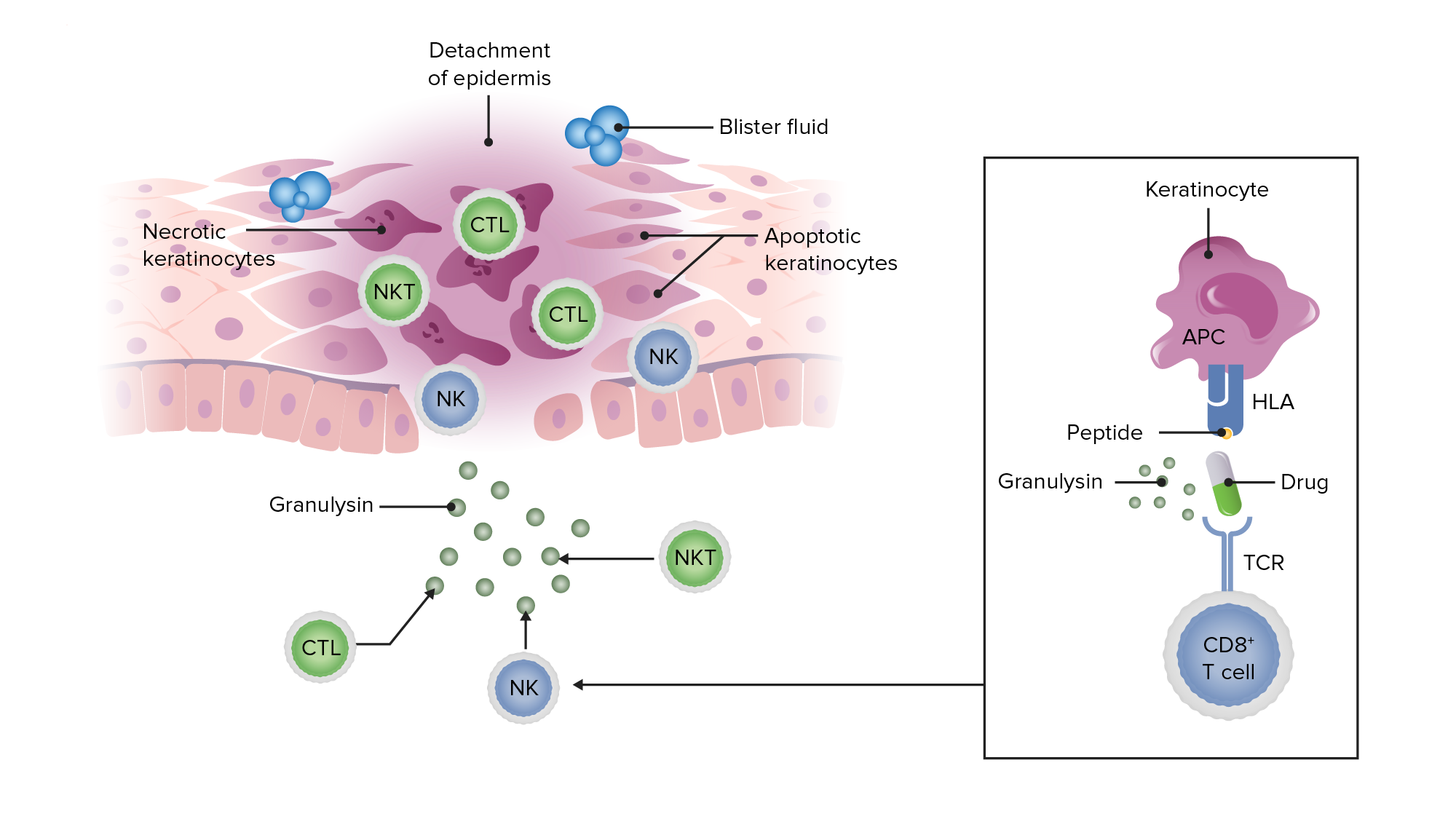
  1. Medicamento, o antígeno infeccioso, en EN Erythema nodosum is an immune-mediated panniculitis (inflammation of the subcutaneous fat) caused by a type IV (delayed-type) hypersensitivity reaction. It commonly manifests in young women as tender, erythematous nodules on the shins. Erythema Nodosum el tejido cutáneo → estimula las células T citotóxicas, las células T asesinas naturales y las células asesinas naturales → liberación de granulisina → muerte de queratinocitos.
  2. Apoptosis Apoptosis A regulated cell death mechanism characterized by distinctive morphologic changes in the nucleus and cytoplasm, including the endonucleolytic cleavage of genomic DNA, at regularly spaced, internucleosomal sites, I.e., DNA fragmentation. It is genetically-programmed and serves as a balance to mitosis in regulating the size of animal tissues and in mediating pathologic processes associated with tumor growth. Ischemic Cell Damage de los LOS Neisseria queratinocitos → separación epidérmica de la dermis Dermis A layer of vascularized connective tissue underneath the epidermis. The surface of the dermis contains innervated papillae. Embedded in or beneath the dermis are sweat glands; hair follicles; and sebaceous glands. Skin: Structure and Functions → desprendimiento de piel característico del SSJ/NET.
  3. Células moribundas y necrosis Necrosis The death of cells in an organ or tissue due to disease, injury or failure of the blood supply. Ischemic Cell Damage → ↑ carga de antígeno → desencadena que las células T continúen la respuesta inflamatoria → desarrollo de ampollas llenas de líquido

Esta alteración de la integridad de la piel puede provocar:
  • Pérdida de agua
  • Infecciones bacterianas secundarias y sepsis Sepsis Systemic inflammatory response syndrome with a proven or suspected infectious etiology. When sepsis is associated with organ dysfunction distant from the site of infection, it is called severe sepsis. When sepsis is accompanied by hypotension despite adequate fluid infusion, it is called septic shock. Sepsis and Septic Shock
Fisiopatología del síndrome de Stevens-Johnson y de la necrólisis epidérmica tóxica

Esquema que muestra cómo un antígeno peptídico (en este caso, de un medicamento) presentado en los queratinocitos puede provocar una respuesta inflamatoria citotóxica que da lugar a la liberación de granulisina, a la apoptosis y necrosis de los queratinocitos, al desprendimiento de la epidermis y a la formación de ampollas en el SSJ y el NET.

Imagen por Lecturio.

Presentación Clínica

Manifestaciones clínicas

Pródromo:

  • Fiebre (a menudo > 39°C)
  • Mialgia y artralgia
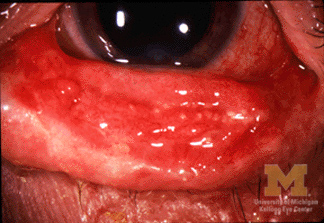
  • Queratoconjuntivitis (inflamación de la córnea y la conjuntiva)
  • Dolor Dolor Inflammation de garganta
  • Cefalea
  • Malestar

Fase aguda:

  • 1–3 días después del pródromo
  • Dura de 8–12 días
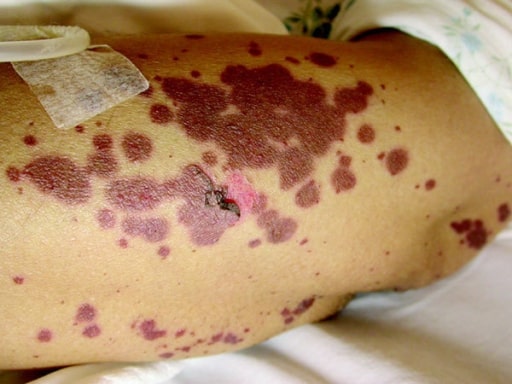
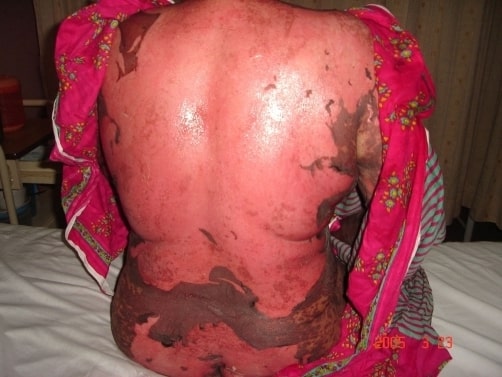
  • Lesiones cutáneas
    • Comienzan como máculas mal definidas y coalescentes con centros purpúricos o eritema difuso
      • Empieza por la cara y el tórax, extendiéndose luego simétricamente
      • Por lo general, el cuero cabelludo, las palmas de las manos y las plantas de los LOS Neisseria pies no se ven afectados
      • Tierno al AL Amyloidosis tacto
    • Se forman vesículas y bullas a medida que avanza la enfermedad
    • La piel comienza a desprenderse en EN Erythema nodosum is an immune-mediated panniculitis (inflammation of the subcutaneous fat) caused by a type IV (delayed-type) hypersensitivity reaction. It commonly manifests in young women as tender, erythematous nodules on the shins. Erythema Nodosum pocos días
    • Signo de Nikolsky: extensión de la descamación de la piel al AL Amyloidosis aplicar presión
  • Lesiones de la mucosa
    • Ocurre en EN Erythema nodosum is an immune-mediated panniculitis (inflammation of the subcutaneous fat) caused by a type IV (delayed-type) hypersensitivity reaction. It commonly manifests in young women as tender, erythematous nodules on the shins. Erythema Nodosum aproximadamente el 90% de los LOS Neisseria casos
    • Incluye erosiones orales, faríngeas, oculares y urogenitales

Complicaciones

  • Pérdida significativa de líquidos
    • Deshidratación severa
    • Shock Shock Shock is a life-threatening condition associated with impaired circulation that results in tissue hypoxia. The different types of shock are based on the underlying cause: distributive (↑ cardiac output (CO), ↓ systemic vascular resistance (SVR)), cardiogenic (↓ CO, ↑ SVR), hypovolemic (↓ CO, ↑ SVR), obstructive (↓ CO), and mixed. Types of Shock hipovolémico
    • Insuficiencia renal
  • Infección bacteriana
    • La sepsis Sepsis Systemic inflammatory response syndrome with a proven or suspected infectious etiology. When sepsis is associated with organ dysfunction distant from the site of infection, it is called severe sepsis. When sepsis is accompanied by hypotension despite adequate fluid infusion, it is called septic shock. Sepsis and Septic Shock y el shock Shock Shock is a life-threatening condition associated with impaired circulation that results in tissue hypoxia. The different types of shock are based on the underlying cause: distributive (↑ cardiac output (CO), ↓ systemic vascular resistance (SVR)), cardiogenic (↓ CO, ↑ SVR), hypovolemic (↓ CO, ↑ SVR), obstructive (↓ CO), and mixed. Types of Shock séptico son la principal causa de muerte en EN Erythema nodosum is an immune-mediated panniculitis (inflammation of the subcutaneous fat) caused by a type IV (delayed-type) hypersensitivity reaction. It commonly manifests in young women as tender, erythematous nodules on the shins. Erythema Nodosum los LOS Neisseria pacientes con SSJ/NET.
    • La mayoría de las veces está causada por Staphylococcus aureus Staphylococcus aureus Potentially pathogenic bacteria found in nasal membranes, skin, hair follicles, and perineum of warm-blooded animals. They may cause a wide range of infections and intoxications. Brain Abscess y Pseudomonas aeruginosa Pseudomonas aeruginosa A species of gram-negative, aerobic, rod-shaped bacteria commonly isolated from clinical specimens (wound, burn, and urinary tract infections). It is also found widely distributed in soil and water. P. Aeruginosa is a major agent of nosocomial infection. Pseudomonas
  • Afectación del epitelio traqueobronquial
    • Neumonía
    • Neumonitis intersticial
    • Síndrome de dificultad respiratoria agudo
  • Pérdida de proteínas: edema Edema Edema is a condition in which excess serous fluid accumulates in the body cavity or interstitial space of connective tissues. Edema is a symptom observed in several medical conditions. It can be categorized into 2 types, namely, peripheral (in the extremities) and internal (in an organ or body cavity). Edema
  • Desequilibrios electrolíticos
  • Necrosis Necrosis The death of cells in an organ or tissue due to disease, injury or failure of the blood supply. Ischemic Cell Damage epitelial del tracto gastrointestinal
    • Diarrea
    • Melena Melena The black, tarry, foul-smelling feces that contain degraded blood. Gastrointestinal Bleeding
    • Perforación colónica
    • Intususcepción del intestino delgado

Diagnóstico

El diagnóstico es clínico, basado en EN Erythema nodosum is an immune-mediated panniculitis (inflammation of the subcutaneous fat) caused by a type IV (delayed-type) hypersensitivity reaction. It commonly manifests in young women as tender, erythematous nodules on the shins. Erythema Nodosum los LOS Neisseria antecedentes y el examen físico.

  • Biopsia de piel
    • No es necesario para el diagnóstico, pero puede confirmar y descartar otras enfermedades
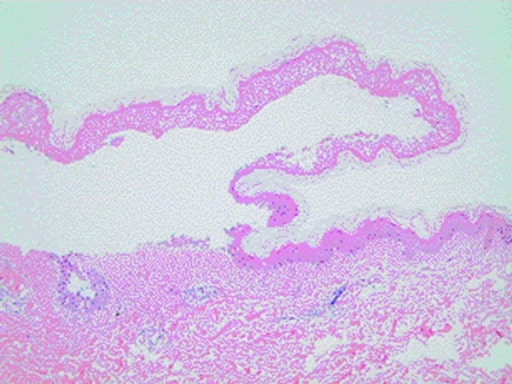
    • La necrosis Necrosis The death of cells in an organ or tissue due to disease, injury or failure of the blood supply. Ischemic Cell Damage de los LOS Neisseria queratinocitos es el hallazgo distintivo.
      • Puede ser de grosor parcial o total
      • En EN Erythema nodosum is an immune-mediated panniculitis (inflammation of the subcutaneous fat) caused by a type IV (delayed-type) hypersensitivity reaction. It commonly manifests in young women as tender, erythematous nodules on the shins. Erythema Nodosum las lesiones tempranas, los LOS Neisseria queratinocitos apoptóticos están dispersos en EN Erythema nodosum is an immune-mediated panniculitis (inflammation of the subcutaneous fat) caused by a type IV (delayed-type) hypersensitivity reaction. It commonly manifests in young women as tender, erythematous nodules on the shins. Erythema Nodosum la capa basal de la epidermis Epidermis The external, nonvascular layer of the skin. It is made up, from within outward, of five layers of epithelium: (1) basal layer (stratum basale epidermidis); (2) spinous layer (stratum spinosum epidermidis); (3) granular layer (stratum granulosum epidermidis); (4) clear layer (stratum lucidum epidermidis); and (5) horny layer (stratum corneum epidermidis). Skin: Structure and Functions.
      • Necrosis Necrosis The death of cells in an organ or tissue due to disease, injury or failure of the blood supply. Ischemic Cell Damage epidérmica en EN Erythema nodosum is an immune-mediated panniculitis (inflammation of the subcutaneous fat) caused by a type IV (delayed-type) hypersensitivity reaction. It commonly manifests in young women as tender, erythematous nodules on the shins. Erythema Nodosum todo el espesor y bullas subepidérmicas más tarde en EN Erythema nodosum is an immune-mediated panniculitis (inflammation of the subcutaneous fat) caused by a type IV (delayed-type) hypersensitivity reaction. It commonly manifests in young women as tender, erythematous nodules on the shins. Erythema Nodosum la evolución de la enfermedad
    • Infiltración inflamatoria linfocítica
    • La inmunofluorescencia directa es negativa.
  • Estudios adicionales
    • Ayudan a monitorear el tratamiento y las complicaciones
    • Panel metabólico básico → evaluar el desequilibrio electrolítico y la insuficiencia renal
    • Recuento sanguíneo completo → una leucocitosis significativa puede ser señal de una infección
    • Cultivos bacterianos y fúngicos → sobreinfección bacteriana y sepsis Sepsis Systemic inflammatory response syndrome with a proven or suspected infectious etiology. When sepsis is associated with organ dysfunction distant from the site of infection, it is called severe sepsis. When sepsis is accompanied by hypotension despite adequate fluid infusion, it is called septic shock. Sepsis and Septic Shock
    • Radiografía de tórax → neumonía o neumonitis intersticial
La curcumina en el síndrome de stevens-johnsons, culpable o espectador

Histopatología de una biopsia de piel tomada a un paciente con SSJ/NET que muestra el desprendimiento epidérmico característico y la infiltración de linfocitos en la dermis

Imagen: “Curcumin in stevens-johnsons syndrome: culprit or bystander?” por Irani C, Haddad F, Maalouly G, Nemnoum R. Licencia: CC BY 2.0
Tratamiento

  • Ingreso hospitalario inmediato
    • Los LOS Neisseria pacientes suelen necesitar cuidados intensivos o una unidad de quemados.
    • La puntuación SCORTEN (puntuación de la necrólisis epidérmica tóxica) se calcula para determinar la gravedad, el pronóstico y el entorno adecuado para el tratamiento (véase la tabla siguiente).
  • Se requiere la retirada del agente causal.
  • Tratamiento de soporte:
    • Cuidado de las heridas
      • Desbridamiento
      • Hidratantes
      • Pomadas antibacterianas
    • Tratamiento con fluidos y electrolitos
    • Soporte nutricional
      • Nutrición parenteral para personas con disfagia y odinofagia
      • Transición a alimentación oral cuando se tolere
    • Cuidados oculares
      • Consulta de oftalmología
      • Colirios con corticoides y antibióticos
      • Lágrimas artificiales para la lubricación
    • Tratamiento de la temperatura
    • Tratamiento del dolor Dolor Inflammation
    • Seguimiento y tratamiento de las sobreinfecciones
      • Cultivos bacterianos y fúngicos de sangre, heridas y lesiones de las mucosas
      • Antibióticos y antifúngicos apropiados, según sea necesario
    • Educación para evitar futuros medicamentos, incluyendo agentes estrechamente relacionados
  • Tratamientos controvertidos:
    • Ciclosporina
    • Corticoides sistémicos
    • Plasmaferesis
    • Inmunoglobulina intravenosa
Tabla: Puntuación SCORTEN
Factores pronósticosPuntuación

Edad ≥ 40 años

1

Malignidad presente

1

Superficie corporal desprendida ≥ 10%.

1

Taquicardia ≥ 120/min.

1

Urea Urea A compound formed in the liver from ammonia produced by the deamination of amino acids. It is the principal end product of protein catabolism and constitutes about one half of the total urinary solids. Urea Cycle sérica > 10 mmol/L

1

Glucosa sérica > 14 mmol/L

1

Bicarbonato sérico <20 mmol/L

1

La puntuación SCORTEN se utiliza para ayudar a determinar la gravedad, el pronóstico y el entorno adecuado para el tratamiento de los LOS Neisseria pacientes con SSJ/NET.

  • Puntuación 0–1: 94% de supervivencia, puede ser tratado en EN Erythema nodosum is an immune-mediated panniculitis (inflammation of the subcutaneous fat) caused by a type IV (delayed-type) hypersensitivity reaction. It commonly manifests in young women as tender, erythematous nodules on the shins. Erythema Nodosum salas no especializadas
  • Puntuación 2: 87% de supervivencia, debe ser trasladado a una unidad de cuidados intensivos, unidad de quemados o unidad de dermatología especializada
  • Puntuación 3: 53% de supervivencia, debe ser trasladado a una unidad de cuidados intensivos, unidad de quemados o unidad de dermatología especializada
  • Puntuación 4: 25% de supervivencia, debe ser trasladado a una unidad de cuidados intensivos, unidad de quemados o unidad de dermatología especializada
  • Puntuación 5–7: 17% de supervivencia, debe ser trasladado a una unidad de cuidados intensivos, unidad de quemados o unidad de dermatología especializada

Diagnóstico Diferencial

  • Eritema multiforme: erupción cutánea aguda, inmunomediada, con lesiones típicas de tipo targetoide; puede ir acompañada de síntomas sistémicos y afectación de las mucosas. La etiología suele deberse a una infección por el virus Virus Viruses are infectious, obligate intracellular parasites composed of a nucleic acid core surrounded by a protein capsid. Viruses can be either naked (non-enveloped) or enveloped. The classification of viruses is complex and based on many factors, including type and structure of the nucleoid and capsid, the presence of an envelope, the replication cycle, and the host range. Virology del herpes simple, a diferencia del SSJ/NET, que suele estar causado por un medicamento. El diagnóstico es clínico y diferenciará esta afección del SSJ. El tratamiento incluye cuidados de soporte.
  • Síndrome de piel escaldada estafilocócica: se presenta con una erupción cutánea dolorosa y descamativa, especialmente alrededor de la nariz, la boca y el ano. Esta afección es el resultado de una toxina estafilocócica y suele darse en EN Erythema nodosum is an immune-mediated panniculitis (inflammation of the subcutaneous fat) caused by a type IV (delayed-type) hypersensitivity reaction. It commonly manifests in young women as tender, erythematous nodules on the shins. Erythema Nodosum niños. A diferencia del SSJ/NET, no hay afectación de las mucosas. El diagnóstico es clínico y se confirma con cultivos bacterianos. Una biopsia mostrará una división superficial no inflamatoria de la epidermis Epidermis The external, nonvascular layer of the skin. It is made up, from within outward, of five layers of epithelium: (1) basal layer (stratum basale epidermidis); (2) spinous layer (stratum spinosum epidermidis); (3) granular layer (stratum granulosum epidermidis); (4) clear layer (stratum lucidum epidermidis); and (5) horny layer (stratum corneum epidermidis). Skin: Structure and Functions. El tratamiento incluye antibióticos, cuidado de las heridas y cuidados de soporte.
  • Dermatitis Dermatitis Any inflammation of the skin. Atopic Dermatitis (Eczema) exfoliativa: una erupción eritematosa generalizada y simétrica causada por una enfermedad cutánea subyacente ( psoriasis Psoriasis Psoriasis is a common T-cell-mediated inflammatory skin condition. The etiology is unknown, but is thought to be due to genetic inheritance and environmental triggers. There are 4 major subtypes, with the most common form being chronic plaque psoriasis. Psoriasis, dermatitis Dermatitis Any inflammation of the skin. Atopic Dermatitis (Eczema) atópica), medicamentos y una neoplasia (linfoma). La afección puede imitar las primeras etapas del SSJ; sin embargo, no hay afectación de las mucosas (lo que diferenciará la afección del SJS SJS Stevens-Johnson syndrome (SJS) is a cutaneous, immune-mediated hypersensitivity reaction that is commonly triggered by medications, including antiepileptics and antibiotics. The condition runs on a spectrum with toxic epidermal necrolysis (TEN) based on the amount of body surface area (BSA) involved. Stevens-Johnson Syndrome). El diagnóstico se realiza clínicamente y el tratamiento se centra en EN Erythema nodosum is an immune-mediated panniculitis (inflammation of the subcutaneous fat) caused by a type IV (delayed-type) hypersensitivity reaction. It commonly manifests in young women as tender, erythematous nodules on the shins. Erythema Nodosum el tratamiento de la causa subyacente, la retirada de los LOS Neisseria medicamentos implicados y los LOS Neisseria cuidados de soporte.
  • Síndrome de shock Shock Shock is a life-threatening condition associated with impaired circulation that results in tissue hypoxia. The different types of shock are based on the underlying cause: distributive (↑ cardiac output (CO), ↓ systemic vascular resistance (SVR)), cardiogenic (↓ CO, ↑ SVR), hypovolemic (↓ CO, ↑ SVR), obstructive (↓ CO), and mixed. Types of Shock tóxico: síndrome sistémico causado por endotoxinas de estafilococos o estreptococos. Los LOS Neisseria pacientes presentan fiebre, shock Shock Shock is a life-threatening condition associated with impaired circulation that results in tissue hypoxia. The different types of shock are based on the underlying cause: distributive (↑ cardiac output (CO), ↓ systemic vascular resistance (SVR)), cardiogenic (↓ CO, ↑ SVR), hypovolemic (↓ CO, ↑ SVR), obstructive (↓ CO), and mixed. Types of Shock y disfunción orgánica multisistémica. Las manifestaciones cutáneas incluyen una erupción eritematosa difusa y descamación. El diagnóstico se basa en EN Erythema nodosum is an immune-mediated panniculitis (inflammation of the subcutaneous fat) caused by a type IV (delayed-type) hypersensitivity reaction. It commonly manifests in young women as tender, erythematous nodules on the shins. Erythema Nodosum los LOS Neisseria resultados de los LOS Neisseria hemocultivos, los LOS Neisseria antecedentes y el examen físico, que diferenciarán esta afección del SSJ. El tratamiento incluye soporte hemodinámico, reanimación con líquidos y antibióticos.
  • Pénfigo vulgar: trastorno autoinmune que provoca ampollas y erosiones intraepidérmicas en EN Erythema nodosum is an immune-mediated panniculitis (inflammation of the subcutaneous fat) caused by a type IV (delayed-type) hypersensitivity reaction. It commonly manifests in young women as tender, erythematous nodules on the shins. Erythema Nodosum la piel y las mucosas. Los LOS Neisseria pacientes presentarán bullas cutáneas que aparecen en EN Erythema nodosum is an immune-mediated panniculitis (inflammation of the subcutaneous fat) caused by a type IV (delayed-type) hypersensitivity reaction. It commonly manifests in young women as tender, erythematous nodules on the shins. Erythema Nodosum una piel de apariencia normal y erosiones mucocutáneas dolorosas. El diagnóstico implica una biopsia con pruebas de inmunofluorescencia que muestren anticuerpos de inmunoglobulina G ( IgG IgG The major immunoglobulin isotype class in normal human serum. There are several isotype subclasses of igg, for example, igg1, igg2a, and igg2b. Hypersensitivity Pneumonitis) contra los LOS Neisseria queratinocitos, lo que permite diferenciar esta afección del SSJ. El tratamiento incluye corticosteroides, inmunosupresores e inmunoglobulina intravenosa.
  • Penfigoide ampolloso: trastorno cutáneo autoinmune que provoca prurito, placas eritematosas y lesiones tensas y ampollosas. La afectación de las mucosas es rara. Los LOS Neisseria factores desencadenantes son medicamentos, traumatismos, afecciones cutáneas y enfermedades sistémicas. La biopsia con inmunofluorescencia muestra depósitos de IgG IgG The major immunoglobulin isotype class in normal human serum. There are several isotype subclasses of igg, for example, igg1, igg2a, and igg2b. Hypersensitivity Pneumonitis y complemento a lo largo de la membrana basal, lo que diferencia la afección del SSJ. El tratamiento incluye esteroides, inmunosupresores y antiinflamatorios.

Referencias

  1. High, W.A. (2025). Stevens-Johsnon syndrome and toxic epidermal necrolysis: Pathogenesis, clinical manifestations, and diagnosis. In Corona, R. (Ed.), Uptodate. Retrieved July 14, 2025, from https://www.uptodate.com/contents/stevens-johnson-syndrome-and-toxic-epidermal-necrolysis-pathogenesis-clinical-manifestations-and-diagnosis
  2. High, W.A. (2025). Stevens-Johnson syndrome and toxic epidermal necrolysis: Management, prognosis, and long-term sequelae. In Corona, R. (Ed.), Uptodate. Retrieved July 14, 2025, from https://www.uptodate.com/contents/stevens-johnson-syndrome-and-toxic-epidermal-necrolysis-management-prognosis-and-long-term-sequelae
  3. Benedetti, J. (2024). Stevens-Johnson syndrome (SJS) and toxic epidermal necrolysis (TEN). MSD Manual Professional Edition. Retrieved July 14, 2025, from https://www.msdmanuals.com/professional/dermatologic-disorders/hypersensitivity-and-inflammatory-skin-disorders/stevens-johnson-syndrome-sjs-and-toxic-epidermal-necrolysis-ten
  4. Foster, C.S, Ba-Abbad, R., Letko, E., and Parillo, S.J. (2024). Stevens-Johnson syndrome. In Dahl, A.A. (Ed.), Medscape. Retrieved July 14, 2025, from https://emedicine.medscape.com/article/1197450-overview

¡Crea tu cuenta gratis o inicia una sesión para seguir leyendo!

Regístrate ahora y obtén acceso gratuito a Lecturio con páginas de concepto, videos médicos y cuestionarios para tu educación médica.

User Reviews

Que tengas una sesión de estudio alegre y navideña 🎁 Ahorra 50% en todos los planes >>

Details