Domina Conceptos Médicos

Estudia para la escuela de medicina y tus examenes con Lecturio.

Granulomatosis con Poliangeitis

La granulomatosis con poliangeitis, anteriormente conocida como granulomatosis de Wegener, es una enfermedad autoinmune rara de etiología desconocida. Produce una inflamación granulomatosa necrosante de los LOS Neisseria vasos sanguíneos pequeños y medianos de la nariz, los LOS Neisseria senos paranasales, la garganta, los LOS Neisseria pulmones y los LOS Neisseria riñones. Los LOS Neisseria estadios iniciales de la granulomatosis con poliangeitis suelen presentar manifestaciones localizadas, como infecciones del tracto respiratorio superior, lesiones cutáneas y/o síntomas constitucionales. Los LOS Neisseria estadios posteriores pueden presentar insuficiencia renal y enfermedad respiratoria grave. El diagnóstico y el tratamiento tempranos de la granulomatosis con poliangeitis (que implica la administración de corticosteroides y agentes inmunosupresores como el metotrexato) pueden conducir a una remisión completa, pero sin tratamiento, la afección tiene una alta tasa de mortalidad.

Last updated: Dec 15, 2025
Editorial responsibility: Stanley Oiseth, Lindsay Jones, Evelin Maza

Epidemiología y Etiología

Epidemiología

  • Prevalencia: 2,3 a 146 casos por millón de personas
  • Incidencia: 0,4 a 11,9 casos por millón de personas-año
    • Máxima incidencia: 65-74 años
  • Distribución geográfica: Más común en EN Erythema nodosum is an immune-mediated panniculitis (inflammation of the subcutaneous fat) caused by a type IV (delayed-type) hypersensitivity reaction. It commonly manifests in young women as tender, erythematous nodules on the shins. Erythema Nodosum latitudes septentrionales, regiones con ascendencia predominantemente europea y menos común en EN Erythema nodosum is an immune-mediated panniculitis (inflammation of the subcutaneous fat) caused by a type IV (delayed-type) hypersensitivity reaction. It commonly manifests in young women as tender, erythematous nodules on the shins. Erythema Nodosum Asia ASIA Spinal Cord Injuries Oriental
  • Proporción hombre-mujer: aproximadamente igual

Etiología

  • Idiopática
    • Suele ocurrir con más frecuencia después de infecciones, especialmente de las vías respiratorias
  • Predisposición genética (antecedentes familiares positivos)
  • Reacción autoinmune

Fisiopatología

  • Inflamación de los LOS Neisseria vasos sanguíneos pequeños a medianos, que afecta principalmente a las vías respiratorias superiores e inferiores y los LOS Neisseria riñones
  • Desencadenante autoinmune puede estar relacionado a la colonización bacteriana con Staphylococcus aureus Staphylococcus aureus Potentially pathogenic bacteria found in nasal membranes, skin, hair follicles, and perineum of warm-blooded animals. They may cause a wide range of infections and intoxications. Brain Abscess
  • Los LOS Neisseria anticuerpos anticitoplasma de neutrófilos ( ANCA ANCA Group of systemic vasculitis with a strong association with anca. The disorders are characterized by necrotizing inflammation of small and medium size vessels, with little or no immune-complex deposits in vessel walls. Rapidly Progressive Glomerulonephritis, por sus siglas en EN Erythema nodosum is an immune-mediated panniculitis (inflammation of the subcutaneous fat) caused by a type IV (delayed-type) hypersensitivity reaction. It commonly manifests in young women as tender, erythematous nodules on the shins. Erythema Nodosum inglés) son los LOS Neisseria responsables de la inflamación en EN Erythema nodosum is an immune-mediated panniculitis (inflammation of the subcutaneous fat) caused by a type IV (delayed-type) hypersensitivity reaction. It commonly manifests in young women as tender, erythematous nodules on the shins. Erythema Nodosum la granulomatosis con poliangeitis.
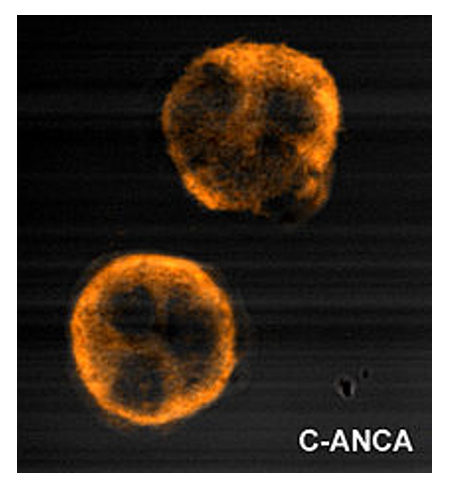
    • Los LOS Neisseria ANCA ANCA Group of systemic vasculitis with a strong association with anca. The disorders are characterized by necrotizing inflammation of small and medium size vessels, with little or no immune-complex deposits in vessel walls. Rapidly Progressive Glomerulonephritis en EN Erythema nodosum is an immune-mediated panniculitis (inflammation of the subcutaneous fat) caused by a type IV (delayed-type) hypersensitivity reaction. It commonly manifests in young women as tender, erythematous nodules on the shins. Erythema Nodosum la granulomatosis con poliangeitis son los LOS Neisseria que reaccionan con la proteinasa 3, una enzima de los LOS Neisseria granulocitos de los LOS Neisseria neutrófilos. Denominado c-ANCA c-ANCA Antineutrophil Cytoplasmic Antibody (ANCA)-Associated Vasculitis ( ANCA ANCA Group of systemic vasculitis with a strong association with anca. The disorders are characterized by necrotizing inflammation of small and medium size vessels, with little or no immune-complex deposits in vessel walls. Rapidly Progressive Glomerulonephritis citoplasmático; patrón de tinción característico mostrado en EN Erythema nodosum is an immune-mediated panniculitis (inflammation of the subcutaneous fat) caused by a type IV (delayed-type) hypersensitivity reaction. It commonly manifests in young women as tender, erythematous nodules on the shins. Erythema Nodosum la imagen inferior)
    • Los LOS Neisseria ANCA ANCA Group of systemic vasculitis with a strong association with anca. The disorders are characterized by necrotizing inflammation of small and medium size vessels, with little or no immune-complex deposits in vessel walls. Rapidly Progressive Glomerulonephritis se forman debido a una expresión epigenética aberrante de la proteinasa 3 en EN Erythema nodosum is an immune-mediated panniculitis (inflammation of the subcutaneous fat) caused by a type IV (delayed-type) hypersensitivity reaction. It commonly manifests in young women as tender, erythematous nodules on the shins. Erythema Nodosum todas las membranas de los LOS Neisseria neutrófilos.
  • Los LOS Neisseria ANCA ANCA Group of systemic vasculitis with a strong association with anca. The disorders are characterized by necrotizing inflammation of small and medium size vessels, with little or no immune-complex deposits in vessel walls. Rapidly Progressive Glomerulonephritis pueden activar a los LOS Neisseria neutrófilos, aumentar su adherencia al AL Amyloidosis endotelio e inducir su desgranulación, lo que provoca daños en EN Erythema nodosum is an immune-mediated panniculitis (inflammation of the subcutaneous fat) caused by a type IV (delayed-type) hypersensitivity reaction. It commonly manifests in young women as tender, erythematous nodules on the shins. Erythema Nodosum la pared del vaso.
Granulomatosis C-ANCA

Tinción citoplasmática granular uniforme de c-ANCA

Imagen de Malittle, PD.
Presentación Clínica

  • Los LOS Neisseria síntomas del estadio inicial incluyen síntomas constitucionales, infecciones crónicas de las vías respiratorias superiores, epistaxis Epistaxis Bleeding from the nose. Granulomatosis with Polyangiitis, otalgia Otalgia Acute Otitis Media, hemoptisis y hematuria Hematuria Presence of blood in the urine. Renal Cell Carcinoma.
  • Los LOS Neisseria síntomas del estadio tardío incluyen estenosis bronquial, insuficiencia renal, deformidad de la nariz en EN Erythema nodosum is an immune-mediated panniculitis (inflammation of the subcutaneous fat) caused by a type IV (delayed-type) hypersensitivity reaction. It commonly manifests in young women as tender, erythematous nodules on the shins. Erythema Nodosum silla de montar y neuropatías sensoriales.
  • Síntomas generales:
    • Pérdida de apetito
    • Pérdida de peso
    • Fiebre
    • Fatiga
  • Afecta principalmente al AL Amyloidosis riñón y a los LOS Neisseria pulmones: hematuria Hematuria Presence of blood in the urine. Renal Cell Carcinoma y hemoptisis
    • Raramente, afecta el corazón, tracto gastrointestinal, cerebro y otros órganos
  • Síntomas renales:
    • Glomerulonefritis rápidamente progresiva
    • Enfermedad renal crónica (puede evolucionar a insuficiencia renal)
    • Hematuria Hematuria Presence of blood in the urine. Renal Cell Carcinoma (síntoma renal más frecuente)
    • Hipertensión
  • Síntomas de oídos, nariz y garganta:
    • Nariz: epistaxis Epistaxis Bleeding from the nose. Granulomatosis with Polyangiitis, goteo nasal y deformación de la nariz en EN Erythema nodosum is an immune-mediated panniculitis (inflammation of the subcutaneous fat) caused by a type IV (delayed-type) hypersensitivity reaction. It commonly manifests in young women as tender, erythematous nodules on the shins. Erythema Nodosum silla de montar debido a la destrucción del cartílago nasal
    • Oídos: otitis media, hipoacusia conductiva por disfunción de la trompa de Eustaquio, hipoacusia neurosensorial (mecanismo poco claro)
    • Cavidad oral: gingivitis Gingivitis Inflammation of gum tissue (gingiva) without loss of connective tissue. Chédiak-Higashi Syndrome de fresa, destrucción ósea con aflojamiento de los LOS Neisseria dientes, ulceración inespecífica
  • Síntomas traqueales:
    • Sibilancias
    • Estenosis subglótica
  • Síntomas pulmonares:
    • Tos TOS Thoracic outlet syndrome (TOS) is a broad term used for a spectrum of syndromes related to the general region of the thoracic outlet, which involves the compression or irritation of elements of the brachial plexus, subclavian artery, or subclavian vein. Thoracic Outlet Syndrome
    • Hemoptisis (síntoma pulmonar más frecuente)
    • Nódulos pulmonares (a veces denominados “lesiones en moneda”)
    • Infiltrados (a menudo interpretados como neumonía; representan una hemorragia intraparenquimatosa)
    • Lesiones cavitarias
    • Estenosis bronquial
  • Otros síntomas:
    • Artritis
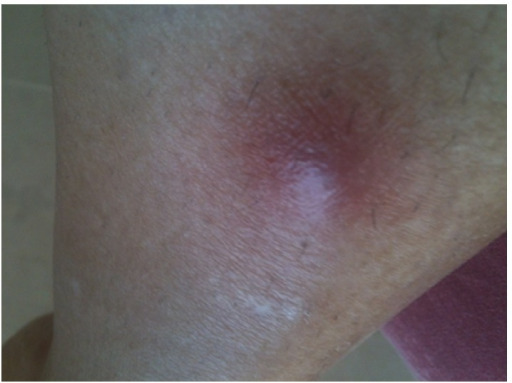
    • Nódulos subcutáneos ( granulomas Granulomas A relatively small nodular inflammatory lesion containing grouped mononuclear phagocytes, caused by infectious and noninfectious agents. Sarcoidosis) en EN Erythema nodosum is an immune-mediated panniculitis (inflammation of the subcutaneous fat) caused by a type IV (delayed-type) hypersensitivity reaction. It commonly manifests in young women as tender, erythematous nodules on the shins. Erythema Nodosum el codo, púrpura
    • Neuropatía sensorial y, en EN Erythema nodosum is an immune-mediated panniculitis (inflammation of the subcutaneous fat) caused by a type IV (delayed-type) hypersensitivity reaction. It commonly manifests in young women as tender, erythematous nodules on the shins. Erythema Nodosum raras ocasiones, mononeuritis múltiple

Diagnóstico

  • Estudios de laboratorio:
    • Hemograma completo suele mostrar leucocitosis, trombocitosis (>400.000/μL) y anemia Anemia Anemia is a condition in which individuals have low Hb levels, which can arise from various causes. Anemia is accompanied by a reduced number of RBCs and may manifest with fatigue, shortness of breath, pallor, and weakness. Subtypes are classified by the size of RBCs, chronicity, and etiology. Anemia: Overview and Types normocítica normocrómica.
    • Velocidad de eritrosedimentación (VES) elevada
    • Proteína C reactiva ( PCR PCR Polymerase chain reaction (PCR) is a technique that amplifies DNA fragments exponentially for analysis. The process is highly specific, allowing for the targeting of specific genomic sequences, even with minuscule sample amounts. The PCR cycles multiple times through 3 phases: denaturation of the template DNA, annealing of a specific primer to the individual DNA strands, and synthesis/elongation of new DNA molecules. Polymerase Chain Reaction (PCR)) elevada
    • El perfil metabólico completo mostrará un nivel bajo de albúmina sérica, creatinina elevada y nitrógeno ureico en EN Erythema nodosum is an immune-mediated panniculitis (inflammation of the subcutaneous fat) caused by a type IV (delayed-type) hypersensitivity reaction. It commonly manifests in young women as tender, erythematous nodules on the shins. Erythema Nodosum sangre muy elevado
    • Pruebas de ANCA ANCA Group of systemic vasculitis with a strong association with anca. The disorders are characterized by necrotizing inflammation of small and medium size vessels, with little or no immune-complex deposits in vessel walls. Rapidly Progressive Glomerulonephritis:
      • Entre el 82 % y el 94 % de los LOS Neisseria pacientes con GPA GPA A multisystemic disease of a complex genetic background. It is characterized by inflammation of the blood vessels (vasculitis) leading to damage in any number of organs. The common features include granulomatous inflammation of the respiratory tract and kidneys. Most patients have measurable autoantibodies (antineutrophil cytoplasmic antibodies) against myeloblastin. Granulomatosis with Polyangiitis o PAM tienen un ANCA ANCA Group of systemic vasculitis with a strong association with anca. The disorders are characterized by necrotizing inflammation of small and medium size vessels, with little or no immune-complex deposits in vessel walls. Rapidly Progressive Glomerulonephritis positivo.
      • La GPA GPA A multisystemic disease of a complex genetic background. It is characterized by inflammation of the blood vessels (vasculitis) leading to damage in any number of organs. The common features include granulomatous inflammation of the respiratory tract and kidneys. Most patients have measurable autoantibodies (antineutrophil cytoplasmic antibodies) against myeloblastin. Granulomatosis with Polyangiitis se asocia predominantemente con PR3-ANCA PR3-ANCA Antineutrophil Cytoplasmic Antibody (ANCA)-Associated Vasculitis (65 %-75 % de los LOS Neisseria casos).
      • La PAM se asocia predominantemente con MPO-ANCA MPO-ANCA Antineutrophil Cytoplasmic Antibody (ANCA)-Associated Vasculitis (55 %-65 % de los LOS Neisseria casos).
      • Entre el 20 % y el 30 % de los LOS Neisseria pacientes con GPA GPA A multisystemic disease of a complex genetic background. It is characterized by inflammation of the blood vessels (vasculitis) leading to damage in any number of organs. The common features include granulomatous inflammation of the respiratory tract and kidneys. Most patients have measurable autoantibodies (antineutrophil cytoplasmic antibodies) against myeloblastin. Granulomatosis with Polyangiitis o PAM clínica tienen el ANCA ANCA Group of systemic vasculitis with a strong association with anca. The disorders are characterized by necrotizing inflammation of small and medium size vessels, with little or no immune-complex deposits in vessel walls. Rapidly Progressive Glomerulonephritis alternativo.
      • Al AL Amyloidosis menos el 10 % de los LOS Neisseria pacientes son ANCA ANCA Group of systemic vasculitis with a strong association with anca. The disorders are characterized by necrotizing inflammation of small and medium size vessels, with little or no immune-complex deposits in vessel walls. Rapidly Progressive Glomerulonephritis negativos.
    • Pruebas adicionales para descartar diagnósticos alternativos:
      • Anticuerpos antinucleares (ANA)
      • Anticuerpos anti-membrana basal glomerular (anti-MBG)
      • Niveles séricos del complemento C3 y C4
      • Crioglobulinas
      • Pruebas para los LOS Neisseria virus Virus Viruses are infectious, obligate intracellular parasites composed of a nucleic acid core surrounded by a protein capsid. Viruses can be either naked (non-enveloped) or enveloped. The classification of viruses is complex and based on many factors, including type and structure of the nucleoid and capsid, the presence of an envelope, the replication cycle, and the host range. Virology de la hepatitis B Hepatitis B Hepatitis B virus (HBV) is a partially double-stranded DNA virus, which belongs to the Orthohepadnavirus genus and the Hepadnaviridae family. Most individuals with acute HBV infection are asymptomatic or have mild, self-limiting symptoms. Chronic infection can be asymptomatic or create hepatic inflammation, leading to liver cirrhosis and hepatocellular carcinoma (HCC). Hepatitis B Virus y C, y VIH
      • Pruebas de función hepática
      • Detección de tuberculosis Tuberculosis Tuberculosis (TB) is an infectious disease caused by Mycobacterium tuberculosis complex bacteria. The bacteria usually attack the lungs but can also damage other parts of the body. Approximately 30% of people around the world are infected with this pathogen, with the majority harboring a latent infection. Tuberculosis spreads through the air when a person with active pulmonary infection coughs or sneezes. Tuberculosis
      • Hemocultivos
  • Análisis de orina:
  • Imagenología
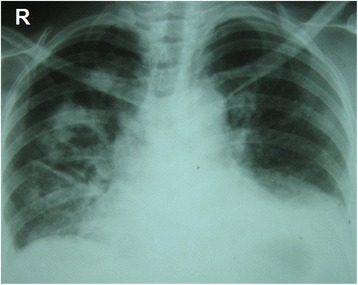
    • Radiografía de tórax: nódulos cavitarios, opacidades difusas, atelectasia y consolidación
    • Tomografía computarizada del tórax: consolidación, opacidades en EN Erythema nodosum is an immune-mediated panniculitis (inflammation of the subcutaneous fat) caused by a type IV (delayed-type) hypersensitivity reaction. It commonly manifests in young women as tender, erythematous nodules on the shins. Erythema Nodosum vidrio esmerilado, estenosis de la laringe o del árbol traqueobronquial, engrosamiento de los LOS Neisseria bronquios, bronquiectasias, engrosamiento o derrame pleural y linfadenopatía
  • Biopsia(confirmación del diagnóstico)
    • En EN Erythema nodosum is an immune-mediated panniculitis (inflammation of the subcutaneous fat) caused by a type IV (delayed-type) hypersensitivity reaction. It commonly manifests in young women as tender, erythematous nodules on the shins. Erythema Nodosum última instancia, se debe realizar una biopsia del tejido afectado en EN Erythema nodosum is an immune-mediated panniculitis (inflammation of the subcutaneous fat) caused by a type IV (delayed-type) hypersensitivity reaction. It commonly manifests in young women as tender, erythematous nodules on the shins. Erythema Nodosum cualquier paciente en EN Erythema nodosum is an immune-mediated panniculitis (inflammation of the subcutaneous fat) caused by a type IV (delayed-type) hypersensitivity reaction. It commonly manifests in young women as tender, erythematous nodules on the shins. Erythema Nodosum el que se sospeche granulomatosis con poliangeitis.
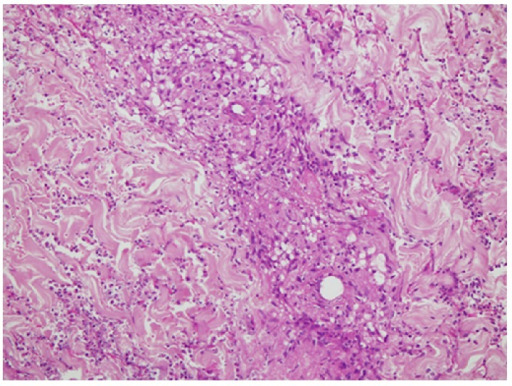
    • La biopsia confirma el diagnóstico de granulomatosis con poliangeitis.
    • Se observan granulomas Granulomas A relatively small nodular inflammatory lesion containing grouped mononuclear phagocytes, caused by infectious and noninfectious agents. Sarcoidosis mal formados, necrosis Necrosis The death of cells in an organ or tissue due to disease, injury or failure of the blood supply. Ischemic Cell Damage y muchas células gigantes.
Criterios de clasificación
1. Inflamación nasal o bucal Úlceras orales dolorosas o indoloras o secreción nasal purulenta o sanguinolenta
2. Radiografía de tórax anormal Nódulos pulmonares, infiltrados pulmonares fijos o cavidades pulmonares
3. Sedimento urinario anormal Hematuria Hematuria Presence of blood in the urine. Renal Cell Carcinoma microscópica con o sin cilindros eritrocitarios (glomerulonefritis)
4. Inflamación granulomatosa La biopsia de una arteria o zona perivascular muestra una inflamación granulomatosa.
La presencia de 2 o más de estos 4 criterios arroja una sensibilidad del 88% y una especificidad del 92%.

Tratamiento

Tratamiento

  • La inmunosupresión en EN Erythema nodosum is an immune-mediated panniculitis (inflammation of the subcutaneous fat) caused by a type IV (delayed-type) hypersensitivity reaction. It commonly manifests in young women as tender, erythematous nodules on the shins. Erythema Nodosum diferentes combinaciones es el principal método de tratamiento.
  • En EN Erythema nodosum is an immune-mediated panniculitis (inflammation of the subcutaneous fat) caused by a type IV (delayed-type) hypersensitivity reaction. It commonly manifests in young women as tender, erythematous nodules on the shins. Erythema Nodosum caso de enfermedad leve (i.e., sin glomerulonefritis o problemas que puedan poner en EN Erythema nodosum is an immune-mediated panniculitis (inflammation of the subcutaneous fat) caused by a type IV (delayed-type) hypersensitivity reaction. It commonly manifests in young women as tender, erythematous nodules on the shins. Erythema Nodosum peligro la vida) → corticosteroides MÁS metotrexato
  • En EN Erythema nodosum is an immune-mediated panniculitis (inflammation of the subcutaneous fat) caused by a type IV (delayed-type) hypersensitivity reaction. It commonly manifests in young women as tender, erythematous nodules on the shins. Erythema Nodosum caso de enfermedad moderada o grave (i.e., con glomerulonefritis, hemorragia pulmonar, hemoptisis, etc ETC The electron transport chain (ETC) sends electrons through a series of proteins, which generate an electrochemical proton gradient that produces energy in the form of adenosine triphosphate (ATP). Electron Transport Chain (ETC).) → corticoides MÁS uno de los LOS Neisseria siguientes inmunosupresores:
    • Ciclofosfamida: debido a su toxicidad, la ciclofosfamida se utiliza solo hasta la remisión de la enfermedad (aproximadamente 3–6 meses).
      • Tras la remisión, se sustituye por otro agente inmunosupresor para mantener la remisión.
    • Rituximab Rituximab A murine-derived monoclonal antibody and antineoplastic agent that binds specifically to the cd20 antigen and is used in the treatment of leukemia; lymphoma and rheumatoid arthritis. Immunosuppressants
    • Azatioprina
    • Metotrexato
    • Micofenolato-mofetilo (uso distinto al AL Amyloidosis de la ficha)
  • Plasmaféresis indicada para:
    • Enfermedad renal activa grave
    • Presencia de autoanticuerpos anti-membrana basal glomerular
    • Hemorragia pulmonar

Complicaciones

  • Pérdida de la audición
  • Insuficiencia renal
  • Riesgo de trombosis venosa profunda

Pronóstico

  • Si no se trata, la tasa de mortalidad a los LOS Neisseria 2 años es del 90%.
  • Con un tratamiento óptimo:
    • La mortalidad en EN Erythema nodosum is an immune-mediated panniculitis (inflammation of the subcutaneous fat) caused by a type IV (delayed-type) hypersensitivity reaction. It commonly manifests in young women as tender, erythematous nodules on the shins. Erythema Nodosum el primer año es de aproximadamente el 10% (debido a las infecciones que siguen a la inmunosupresión).
    • La supervivencia a los LOS Neisseria 5 años de los LOS Neisseria pacientes tratados es del 80%.

Diagnóstico Diferencial

  • Síndrome de Goodpasture: subtipo de glomerulonefritis rápidamente progresiva en EN Erythema nodosum is an immune-mediated panniculitis (inflammation of the subcutaneous fat) caused by a type IV (delayed-type) hypersensitivity reaction. It commonly manifests in young women as tender, erythematous nodules on the shins. Erythema Nodosum el que se forman autoanticuerpos contra los LOS Neisseria glomérulos renales y los LOS Neisseria capilares pulmonares. Los LOS Neisseria síntomas pueden incluir hemoptisis y signos de síndrome nefrítico ( hematuria Hematuria Presence of blood in the urine. Renal Cell Carcinoma, oliguria Oliguria Decreased urine output that is below the normal range. Oliguria can be defined as urine output of less than or equal to 0. 5 or 1 ml/kg/hr depending on the age. Renal Potassium Regulation, edema Edema Edema is a condition in which excess serous fluid accumulates in the body cavity or interstitial space of connective tissues. Edema is a symptom observed in several medical conditions. It can be categorized into 2 types, namely, peripheral (in the extremities) and internal (in an organ or body cavity). Edema, dolor Dolor Inflammation de costado). Los LOS Neisseria análisis muestran anticuerpos anti-membrana basal glomerular. El tratamiento inmunosupresor con corticoides y ciclofosfamida es necesario para detener la progresión.
  • Poliarteritis nodosa: una vasculitis Vasculitis Inflammation of any one of the blood vessels, including the arteries; veins; and rest of the vasculature system in the body. Systemic Lupus Erythematosus sistémica de los LOS Neisseria vasos pequeños y medianos. La afección involucra con mayor frecuencia a la piel, los LOS Neisseria nervios periféricos, los LOS Neisseria músculos, las articulaciones, el tracto gastrointestinal y los LOS Neisseria riñones. A menudo se asocia a infección por hepatitis B Hepatitis B Hepatitis B virus (HBV) is a partially double-stranded DNA virus, which belongs to the Orthohepadnavirus genus and the Hepadnaviridae family. Most individuals with acute HBV infection are asymptomatic or have mild, self-limiting symptoms. Chronic infection can be asymptomatic or create hepatic inflammation, leading to liver cirrhosis and hepatocellular carcinoma (HCC). Hepatitis B Virus ( HBV HBV Hepatitis B virus (HBV) is a partially double-stranded DNA virus, which belongs to the Orthohepadnavirus genus and the Hepadnaviridae family. Hepatitis B virus is transmitted by exposure to infectious blood or body fluids. Examples of types of exposure include sexual intercourse, IV drug use, and childbirth. Hepatitis B Virus, por sus siglas en EN Erythema nodosum is an immune-mediated panniculitis (inflammation of the subcutaneous fat) caused by a type IV (delayed-type) hypersensitivity reaction. It commonly manifests in young women as tender, erythematous nodules on the shins. Erythema Nodosum inglés) o C ( HCV HCV Hepatitis C is an infection of the liver caused by the hepatitis C virus (HCV). Hepatitis C virus is an RNA virus and a member of the genus Hepacivirus and the family Flaviviridae. The infection can be transmitted through infectious blood or body fluids and may be transmitted during childbirth or through IV drug use or sexual intercourse. Hepatitis C Virus, por sus siglas en EN Erythema nodosum is an immune-mediated panniculitis (inflammation of the subcutaneous fat) caused by a type IV (delayed-type) hypersensitivity reaction. It commonly manifests in young women as tender, erythematous nodules on the shins. Erythema Nodosum inglés). Los LOS Neisseria pacientes suelen presentar síntomas inespecíficos (fiebre, artralgias), hipertensión, mayor riesgo de infarto de miocardio y polineuropatía. Generalmente, la poliarteritis nodosa no afecta a los LOS Neisseria pulmones y las serologías serán ANCA ANCA Group of systemic vasculitis with a strong association with anca. The disorders are characterized by necrotizing inflammation of small and medium size vessels, with little or no immune-complex deposits in vessel walls. Rapidly Progressive Glomerulonephritis negativa. La angiografía muestra el aspecto clásico de cuentas de aneurismas y estenosis alternados en EN Erythema nodosum is an immune-mediated panniculitis (inflammation of the subcutaneous fat) caused by a type IV (delayed-type) hypersensitivity reaction. It commonly manifests in young women as tender, erythematous nodules on the shins. Erythema Nodosum vasos pequeños y medianos. El tratamiento incluye regímenes inmunosupresores y una posible terapia antiviral Antiviral Antivirals for Hepatitis B contra el HBV HBV Hepatitis B virus (HBV) is a partially double-stranded DNA virus, which belongs to the Orthohepadnavirus genus and the Hepadnaviridae family. Hepatitis B virus is transmitted by exposure to infectious blood or body fluids. Examples of types of exposure include sexual intercourse, IV drug use, and childbirth. Hepatitis B Virus y el HCV HCV Hepatitis C is an infection of the liver caused by the hepatitis C virus (HCV). Hepatitis C virus is an RNA virus and a member of the genus Hepacivirus and the family Flaviviridae. The infection can be transmitted through infectious blood or body fluids and may be transmitted during childbirth or through IV drug use or sexual intercourse. Hepatitis C Virus.
  • Poliangeitis microscópica: una vasculitis Vasculitis Inflammation of any one of the blood vessels, including the arteries; veins; and rest of the vasculature system in the body. Systemic Lupus Erythematosus necrosante de los LOS Neisseria vasos pequeños (normalmente de los LOS Neisseria riñones, la piel y los LOS Neisseria pulmones). Los LOS Neisseria pacientes generalmente presentan púrpura palpable, vasculitis Vasculitis Inflammation of any one of the blood vessels, including the arteries; veins; and rest of the vasculature system in the body. Systemic Lupus Erythematosus pulmonar con hemoptisis y glomerulonefritis pauciinmune con hipertensión. Esta patología mostrará anticuerpos p-ANCA p-ANCA Antineutrophil Cytoplasmic Antibody (ANCA)-Associated Vasculitis positivos (a diferencia de la granulomatosis con poliangeitis). El tratamiento implica un régimen inmunosupresor.
  • Síndrome de Churg-Strauss: también conocido como granulomatosis eosinofílica con poliangeitis. Churg-Strauss es una enfermedad multisistémica caracterizada por una vasculitis Vasculitis Inflammation of any one of the blood vessels, including the arteries; veins; and rest of the vasculature system in the body. Systemic Lupus Erythematosus granulomatosa necrosante con eosinofilia que afecta más comúnmente al AL Amyloidosis pulmón y a la piel. Los LOS Neisseria pacientes presentan ataques severos de asma ASMA Autoimmune Hepatitis alérgica, rinitis alérgica, sinusitis Sinusitis Sinusitis refers to inflammation of the mucosal lining of the paranasal sinuses. The condition usually occurs concurrently with inflammation of the nasal mucosa (rhinitis), a condition known as rhinosinusitis. Acute sinusitis is due to an upper respiratory infection caused by a viral, bacterial, or fungal agent. Sinusitis, polineuropatía (caída de pies o muñecas) y nódulos en EN Erythema nodosum is an immune-mediated panniculitis (inflammation of the subcutaneous fat) caused by a type IV (delayed-type) hypersensitivity reaction. It commonly manifests in young women as tender, erythematous nodules on the shins. Erythema Nodosum la piel. Tendrán eosinofilia en EN Erythema nodosum is an immune-mediated panniculitis (inflammation of the subcutaneous fat) caused by a type IV (delayed-type) hypersensitivity reaction. It commonly manifests in young women as tender, erythematous nodules on the shins. Erythema Nodosum sangre periférica y anticuerpos p-ANCA p-ANCA Antineutrophil Cytoplasmic Antibody (ANCA)-Associated Vasculitis positivos (a diferencia de la granulomatosis con poliangeitis). El tratamiento incluye un régimen inmunosupresor.
  • Arteritis de células gigantes: también conocida como arteritis temporal. La arteritis de células gigantes es una vasculitis Vasculitis Inflammation of any one of the blood vessels, including the arteries; veins; and rest of the vasculature system in the body. Systemic Lupus Erythematosus que provoca la inflamación de las arterias de mediano y gran tamaño, especialmente las carótidas y la aorta Aorta The main trunk of the systemic arteries. Mediastinum and Great Vessels: Anatomy. Los LOS Neisseria pacientes generalmente presentan síntomas constitucionales, cefalea de nueva aparición, sensibilidad y endurecimiento de la arteria temporal, claudicación mandibular y amaurosis fugaz. Los LOS Neisseria estudios de laboratorio muestran una elevación de la VES y la PCR PCR Polymerase chain reaction (PCR) is a technique that amplifies DNA fragments exponentially for analysis. The process is highly specific, allowing for the targeting of specific genomic sequences, even with minuscule sample amounts. The PCR cycles multiple times through 3 phases: denaturation of the template DNA, annealing of a specific primer to the individual DNA strands, and synthesis/elongation of new DNA molecules. Polymerase Chain Reaction (PCR). Para el diagnóstico es necesaria la biopsia, que muestra la infiltración mononuclear de las paredes de los LOS Neisseria vasos y la formación de células gigantes. El tratamiento consiste en EN Erythema nodosum is an immune-mediated panniculitis (inflammation of the subcutaneous fat) caused by a type IV (delayed-type) hypersensitivity reaction. It commonly manifests in young women as tender, erythematous nodules on the shins. Erythema Nodosum la administración rápida de glucocorticoides.
  • Púrpura de Henoch-Schonlein: una vasculitis Vasculitis Inflammation of any one of the blood vessels, including the arteries; veins; and rest of the vasculature system in the body. Systemic Lupus Erythematosus autoinmune de pequeños vasos. La afección se presenta típicamente como una tríada de dolor Dolor Inflammation abdominal, hematuria Hematuria Presence of blood in the urine. Renal Cell Carcinoma y erupción purpúrica. La fisiopatología implica el depósito de complejos inmunes de inmunoglobulina A en EN Erythema nodosum is an immune-mediated panniculitis (inflammation of the subcutaneous fat) caused by a type IV (delayed-type) hypersensitivity reaction. It commonly manifests in young women as tender, erythematous nodules on the shins. Erythema Nodosum múltiples vasos tras un desencadenante (infección/ambiente), con síntomas que dependen de los LOS Neisseria tejidos abastecidos por estos vasos. La enfermedad de Henoch-Schonlein tiene un diagnóstico clínico y se trata sintomáticamente.
  • Artritis reumatoide: una poliartritis inflamatoria que se presenta con dolor en las articulaciones que están cálidas y “cenagosas” al AL Amyloidosis tacto. Este dolor Dolor Inflammation suele ser peor por las mañanas y mejora durante el día. La afectación de las articulaciones es simétrica, con inclusión de las articulaciones interfalángicas proximales y metacarpofalángicas, pero sin afectación de las articulaciones interfalángicas distales. Los LOS Neisseria antiinflamatorios no esteroideos son el pilar del tratamiento del dolor Dolor Inflammation; las opciones terapéuticas modificadoras de la enfermedad incluyen metotrexato, sulfasalazina, hidroxicloroquina y los LOS Neisseria inhibidores del factor de necrosis Necrosis The death of cells in an organ or tissue due to disease, injury or failure of the blood supply. Ischemic Cell Damage tumoral-ɑ (TNF-ɑ, por sus siglas en EN Erythema nodosum is an immune-mediated panniculitis (inflammation of the subcutaneous fat) caused by a type IV (delayed-type) hypersensitivity reaction. It commonly manifests in young women as tender, erythematous nodules on the shins. Erythema Nodosum inglés).
  • Lupus eritematoso sistémico: afección inflamatoria crónica caracterizada por la afectación clínica de la piel, las articulaciones, los LOS Neisseria riñones, las células sanguíneas y el sistema nervioso central. Se cree que la afección es un trastorno autoinmune y se ha HA Hemolytic anemia (HA) is the term given to a large group of anemias that are caused by the premature destruction/hemolysis of circulating red blood cells (RBCs). Hemolysis can occur within (intravascular hemolysis) or outside the blood vessels (extravascular hemolysis). Hemolytic Anemia asociado a la formación de autoanticuerpos como el anticuerpos antinucleares, anti-Smith y anti-ADN de doble cadena. Las principales características clínicas del lupus son la erupción malar, dolor Dolor Inflammation articular, fiebre, proteinuria Proteinuria The presence of proteins in the urine, an indicator of kidney diseases. Nephrotic Syndrome in Children, hipertensión, anemia Anemia Anemia is a condition in which individuals have low Hb levels, which can arise from various causes. Anemia is accompanied by a reduced number of RBCs and may manifest with fatigue, shortness of breath, pallor, and weakness. Subtypes are classified by the size of RBCs, chronicity, and etiology. Anemia: Overview and Types, linfopenia, convulsiones y/o psicosis.

Referencias

  1. Banerjee, S., Quinn, K. A., Gribbons, K. B., Rosenblum, J. S., Civelek, A. C., Novakovich, E., Merkel, P. A., Ahlman, M. A., & Grayson, P. C. (2020). Effect of Treatment on Imaging, Clinical, and Serologic Assessments of Disease Activity in Large-vessel Vasculitis. The Journal of rheumatology47(1), 99–107. https://doi.org/10.3899/jrheum.181222
  2. Chung, S. A., Langford, C. A., Maz, M., Abril, A., Gorelik, M., Guyatt, G., Archer, A. M., Conn, D. L., Full, K. A., Grayson, P. C., Ibarra, M. F., Imundo, L. F., Kim, S., Merkel, P. A., Rhee, R. L., Seo, P., Stone, J. H., Sule, S., Sundel, R. P., Vitobaldi, O. I., … Mustafa, R. A. (2021). 2021 American College of Rheumatology/Vasculitis Foundation Guideline for the Management of Antineutrophil Cytoplasmic Antibody-Associated Vasculitis. Arthritis & rheumatology (Hoboken, N.J.)73(8), 1366–1383. https://doi.org/10.1002/art.41773
  3. Falk RJ, Merkel PA, King TE. (2025). Granulomatosis with polyangiitis and microscopic polyangiitis: Clinical manifestations and diagnosis. UpToDate. Retrieved May 14, 2025, from https://www.uptodate.com/contents/granulomatosis-with-polyangiitis-and-microscopic-polyangiitis-clinical-manifestations-and-diagnosis.
  4. Firestein, G. S., Budd, R. C., Gabriel, S. E., McInnes, I. B., & O’Dell, J. R. (Eds.). (2023). Firestein & Kelley’s textbook of rheumatology (11th ed.). Elsevier.
  5. Hochberg, M. C., Gravallese, E. M., Silman, A. J., Smolen, J. S., Weinblatt, M. E., & Weisman, M. H. (Eds.). (2023). Rheumatology (8th ed.). Elsevier.
  6. King, C., Harper, L., & Little, M. (2018). The complications of vasculitis and its treatment. Best practice & research. Clinical rheumatology32(1), 125–136. https://doi.org/10.1016/j.berh.2018.07.009
  7. Kitching, A. R., Anders, H. J., Basu, N., Brouwer, E., Gordon, J., Jayne, D. R., Kullman, J., Lyons, P. A., Merkel, P. A., Savage, C. O. S., Specks, U., & Kain, R. (2020). ANCA-associated vasculitis. Nature reviews. Disease primers6(1), 71. https://doi.org/10.1038/s41572-020-0204-y
  8. Loscalzo, J., Fauci, A. S., Kasper, D. L., Hauser, S. L., Longo, D. L., & Jameson, J. L. (Eds.). (2023). Harrison’s principles of internal medicine (21st ed.). McGraw-Hill Education.

¡Crea tu cuenta gratis o inicia una sesión para seguir leyendo!

Regístrate ahora y obtén acceso gratuito a Lecturio con páginas de concepto, videos médicos y cuestionarios para tu educación médica.

User Reviews

Que tengas una sesión de estudio alegre y navideña 🎁 Ahorra 50% en todos los planes >>

Details