
Domina Conceptos Médicos

Estudia para la escuela de medicina y tus examenes con Lecturio.

Enfermedad Granulomatosa Crónica

La enfermedad granulomatosa crónica, como su nombre lo indica, es un trastorno crónico que se caracteriza por la formación de granulomas Granulomas A relatively small nodular inflammatory lesion containing grouped mononuclear phagocytes, caused by infectious and noninfectious agents. Sarcoidosis. Este trastorno es consecuencia de células fagocíticas defectuosas que no pueden producir superóxido bactericida debido a un defecto en EN Erythema nodosum is an immune-mediated panniculitis (inflammation of the subcutaneous fat) caused by a type IV (delayed-type) hypersensitivity reaction. It commonly manifests in young women as tender, erythematous nodules on the shins. Erythema Nodosum la nicotinamida adenina dinucleótido fosfato ( NADPH NADPH Nicotinamide adenine dinucleotide phosphate. A coenzyme composed of ribosylnicotinamide 5'-phosphate (nmn) coupled by pyrophosphate linkage to the 5'-phosphate adenosine 2. Pentose Phosphate Pathway), la oxidasa responsable del estallido respiratorio en EN Erythema nodosum is an immune-mediated panniculitis (inflammation of the subcutaneous fat) caused by a type IV (delayed-type) hypersensitivity reaction. It commonly manifests in young women as tender, erythematous nodules on the shins. Erythema Nodosum los LOS Neisseria leucocitos fagocíticos. El diagnóstico se realiza analizando la función de los LOS Neisseria neutrófilos para la producción de superóxido. Los LOS Neisseria pacientes con enfermedad granulomatosa crónica tienen un mayor riesgo de infecciones potencialmente mortales por hongos y bacterias catalasa positivas. También son posibles las complicaciones inflamatorias como la colitis Colitis Inflammation of the colon section of the large intestine, usually with symptoms such as diarrhea (often with blood and mucus), abdominal pain, and fever. Pseudomembranous Colitis por enfermedad granulomatosa crónica. La introducción de la profilaxis antimicrobiana y el uso de antifúngicos azólicos ha HA Hemolytic anemia (HA) is the term given to a large group of anemias that are caused by the premature destruction/hemolysis of circulating red blood cells (RBCs). Hemolysis can occur within (intravascular hemolysis) or outside the blood vessels (extravascular hemolysis). Hemolytic Anemia aumentado la expectativa de vida general de estos pacientes.

Last updated: Dec 15, 2025

Editorial responsibility: Stanley Oiseth, Lindsay Jones, Evelin Maza

Epidemiología y Etiología

Epidemiología

  • Identificados por igual en EN Erythema nodosum is an immune-mediated panniculitis (inflammation of the subcutaneous fat) caused by a type IV (delayed-type) hypersensitivity reaction. It commonly manifests in young women as tender, erythematous nodules on the shins. Erythema Nodosum todas las etnias y razas
  • Incidencia estimada: aproximadamente 1 caso por 200 000 nacimientos vivos al AL Amyloidosis año
  • Predominante en EN Erythema nodosum is an immune-mediated panniculitis (inflammation of the subcutaneous fat) caused by a type IV (delayed-type) hypersensitivity reaction. It commonly manifests in young women as tender, erythematous nodules on the shins. Erythema Nodosum hombres (65%–70% de los LOS Neisseria casos se deben a una mutación ligada al AL Amyloidosis cromosoma X)
  • Mortalidad:
    • La mayoría de los LOS Neisseria pacientes ahora sobreviven hasta los LOS Neisseria 30–40 años de edad.
    • Mortalidad elevada después de la edad > 10 años
    • La forma de la enfermedad ligada al AL Amyloidosis cromosoma X se asocia con la mayor mortalidad y morbilidad.

Etiología

La enfermedad granulomatosa crónica es causada por mutaciones en EN Erythema nodosum is an immune-mediated panniculitis (inflammation of the subcutaneous fat) caused by a type IV (delayed-type) hypersensitivity reaction. It commonly manifests in young women as tender, erythematous nodules on the shins. Erythema Nodosum los LOS Neisseria genes Genes A category of nucleic acid sequences that function as units of heredity and which code for the basic instructions for the development, reproduction, and maintenance of organisms. DNA Types and Structure que codifican las proteínas que forman la nicotinamida adenina dinucleótido fosfato ( NADPH NADPH Nicotinamide adenine dinucleotide phosphate. A coenzyme composed of ribosylnicotinamide 5′-phosphate (nmn) coupled by pyrophosphate linkage to the 5′-phosphate adenosine 2. Pentose Phosphate Pathway) oxidasa:

  • Gp91phox (trastorno ligado al AL Amyloidosis cromosoma X)
  • P47phox (gen NCF1 que se encuentra en EN Erythema nodosum is an immune-mediated panniculitis (inflammation of the subcutaneous fat) caused by a type IV (delayed-type) hypersensitivity reaction. It commonly manifests in young women as tender, erythematous nodules on the shins. Erythema Nodosum el cromosoma 7, herencia autosómica)
  • P22phox (autosómico recesivo)
  • P67phox (autosómico recesivo)
  • P40phox (autosómico recesivo)

Fisiopatología

Vía de fagocitosis normal

  • Los LOS Neisseria neutrófilos fagocitan bacterias y otros patógenos
  • ↑ Consumo de oxígeno
  • Se producen diferentes especies reactivas del oxígeno, que son bactericidas

Fisiopatología de la enfermedad granulomatosa crónica

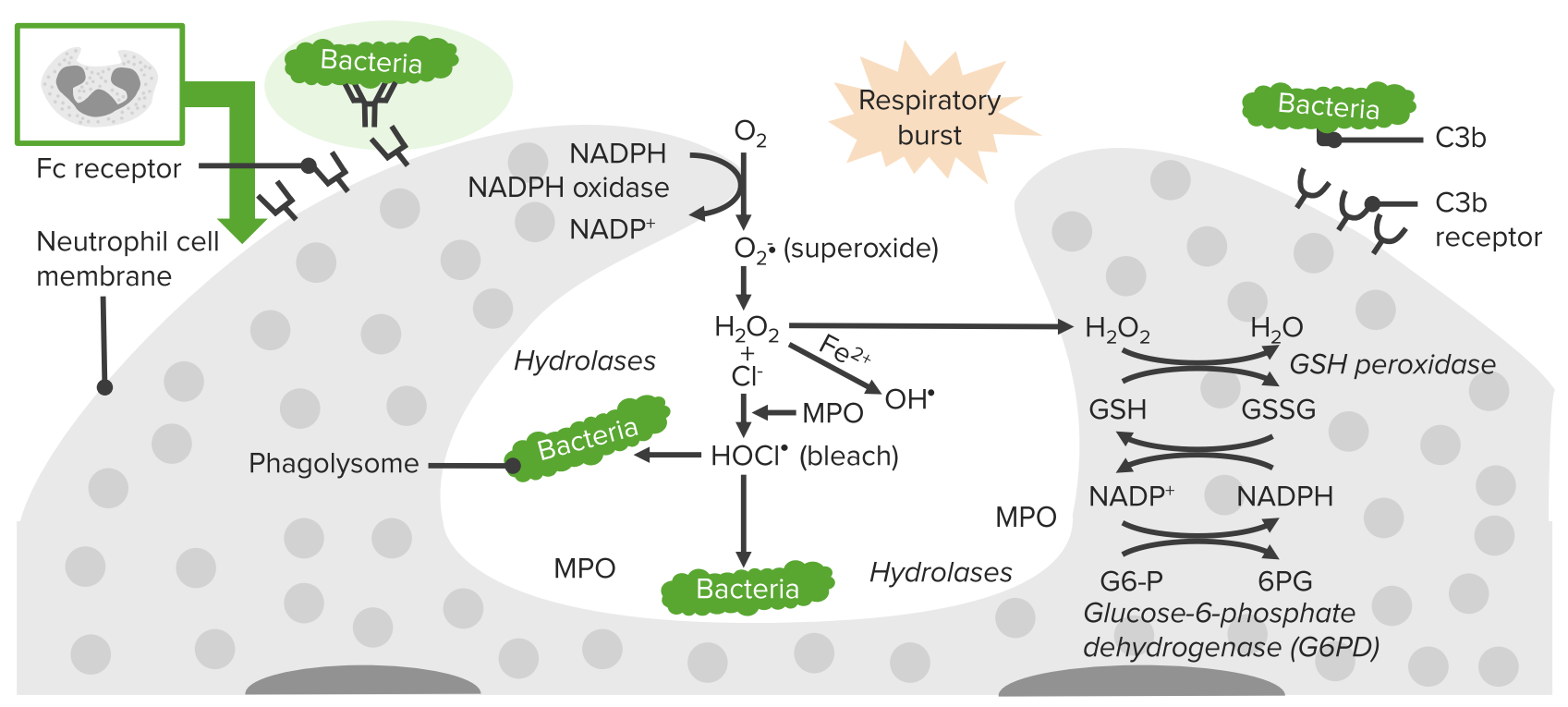
La enzima NADPH-oxidasa está alterada en EN Erythema nodosum is an immune-mediated panniculitis (inflammation of the subcutaneous fat) caused by a type IV (delayed-type) hypersensitivity reaction. It commonly manifests in young women as tender, erythematous nodules on the shins. Erythema Nodosum la célula fagocítica → ↓ producción de anión superóxido O2, lo que afecta a otros oxidantes. Esta enzima es responsable de la incapacidad para combatir infecciones.
  • Los LOS Neisseria microorganismos catalasa positivos están implicados en EN Erythema nodosum is an immune-mediated panniculitis (inflammation of the subcutaneous fat) caused by a type IV (delayed-type) hypersensitivity reaction. It commonly manifests in young women as tender, erythematous nodules on the shins. Erythema Nodosum infecciones potencialmente mortales:
    • Burkholderia Burkholderia Burkholderia species are gram-negative bacilli with 2 clinically relevant pathogens: B. pseudomallei (causing melioidosis) and B. cepacia complex (causing opportunistic infections). Melioidosis is commonly seen in Asia and Australia. Infection is transmitted by contact with contaminated soil or water (via skin wounds). Burkholderia cepacia
    • Aspergillus Aspergillus A genus of mitosporic fungi containing about 100 species and eleven different teleomorphs in the family trichocomaceae. Echinocandins
    • Candida albicans Candida albicans A unicellular budding fungus which is the principal pathogenic species causing candidiasis (moniliasis). Candida/Candidiasis
    • Staphylococcus aureus Staphylococcus aureus Potentially pathogenic bacteria found in nasal membranes, skin, hair follicles, and perineum of warm-blooded animals. They may cause a wide range of infections and intoxications. Brain Abscess
    • Nocardia Nocardia Nocardia is a branching, filamentous, gram-positive bacilli. It is partially acid fast due to the presence of mycolic acids in the cell wall. Nocardia is a ubiquitous soil organism that most commonly affects immunocompromised patients. Nocardia is transmitted via inhalation of aerosolized bacteria or less commonly, via direct contact with wounds. Nocardia/Nocardiosis spp.
    • Serratia marcescens Serratia Marcescens A species of gram-negative, facultatively anaerobic, rod-shaped bacteria found in soil, water, food, and clinical specimens. It is a prominent opportunistic pathogen for hospitalized patients. Aminoglycosides
  • Aunque Pseudomonas aeruginosa Pseudomonas aeruginosa A species of gram-negative, aerobic, rod-shaped bacteria commonly isolated from clinical specimens (wound, burn, and urinary tract infections). It is also found widely distributed in soil and water. P. Aeruginosa is a major agent of nosocomial infection. Pseudomonas es catalasa positiva, es eliminada por los LOS Neisseria neutrófilos de pacientes con enfermedad granulomatosa crónica.
  • Los LOS Neisseria microorganismos catalasa negativos aún pueden ser eliminados por los LOS Neisseria fagocitos.
Proceso de fagocitosis en neutrófilos.

Proceso de fagocitosis en neutrófilos:
Una deficiencia de NADPH oxidasa da como resultado una incapacidad para producir superóxido, lo que disminuye la capacidad de la célula para destruir microorganismos catalasa positivos.

Imagen por Lecturio. Licencia: CC BY-NC-SA 4.0

Presentación Clínica

Presentación general

La mayoría de los LOS Neisseria pacientes con enfermedad granulomatosa crónica tienen < 5 años de edad y la gravedad es variable Variable Variables represent information about something that can change. The design of the measurement scales, or of the methods for obtaining information, will determine the data gathered and the characteristics of that data. As a result, a variable can be qualitative or quantitative, and may be further classified into subgroups. Types of Variables (según el defecto genético). La presentación clínica puede incluir:

  • Falta de crecimiento
  • Cicatrización anormal de heridas
  • Infecciones

Infecciones

Los LOS Neisseria pacientes pueden experimentar infecciones repetidas causadas por patógenos bacterianos y fúngicos.
  • Los LOS Neisseria pacientes pueden presentar pocos síntomas y signos clínicos a pesar de la gravedad de la infección
  • La respuesta a la infección viral es normal
  • Siempre se debe buscar una etiología infecciosa en EN Erythema nodosum is an immune-mediated panniculitis (inflammation of the subcutaneous fat) caused by a type IV (delayed-type) hypersensitivity reaction. It commonly manifests in young women as tender, erythematous nodules on the shins. Erythema Nodosum cualquier niño que presente fiebre.
  • Los LOS Neisseria tipos de infecciones incluyen:
    • Neumonía
    • Abscesos (perianal, perirrectal, hepático)
    • Adenitis supurativa
    • Osteomielitis
    • Bacteriemia/ fungemia Fungemia The presence of fungi circulating in the blood. Opportunistic fungal sepsis is seen most often in immunosuppressed patients with severe neutropenia or in postoperative patients with intravenous catheters and usually follows prolonged antibiotic therapy. Chronic Granulomatous Disease
    • Infecciones cutáneas superficiales (celulitis/impétigo)

Manifestaciones inflamatorias y otras

  • Granulomas Granulomas A relatively small nodular inflammatory lesion containing grouped mononuclear phagocytes, caused by infectious and noninfectious agents. Sarcoidosis: principalmente en EN Erythema nodosum is an immune-mediated panniculitis (inflammation of the subcutaneous fat) caused by a type IV (delayed-type) hypersensitivity reaction. It commonly manifests in young women as tender, erythematous nodules on the shins. Erythema Nodosum tracto gastrointestinal y genitourinario
  • Manifestaciones gastrointestinales:
    • Enfermedad inflamatoria intestinal (EII)
    • Diarrea
    • Colitis Colitis Inflammation of the colon section of the large intestine, usually with symptoms such as diarrhea (often with blood and mucus), abdominal pain, and fever. Pseudomembranous Colitis
    • Proctitis Proctitis Inflammation of the mucous membrane of the rectum, the distal end of the large intestine. Chronic Granulomatous Disease
    • Fístulas
    • Vómitos
    • Estreñimiento
  • Hepático:
    • Elevación de enzimas hepáticas
    • Hepatitis
    • Abscesos hepáticos
    • Hipertensión portal
  • Oftálmicos:
    • Lesiones coriorretinianas (principalmente en EN Erythema nodosum is an immune-mediated panniculitis (inflammation of the subcutaneous fat) caused by a type IV (delayed-type) hypersensitivity reaction. It commonly manifests in young women as tender, erythematous nodules on the shins. Erythema Nodosum la enfermedad granulomatosa crónica ligada al AL Amyloidosis cromosoma X)
  • Pulmonar:
    • Bronquiectasias
    • Fibrosis Fibrosis Any pathological condition where fibrous connective tissue invades any organ, usually as a consequence of inflammation or other injury. Bronchiolitis Obliterans crónica
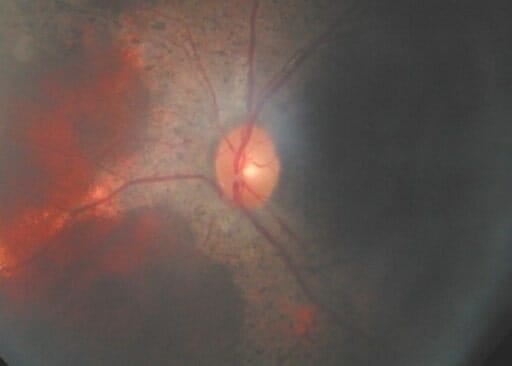
The fundus of an individual with CGD showing a retinal mass

El examen de fondo del ojo de un individuo con enfermedad granulomatosa crónica que muestra una masa retiniana

Imagen: “F3: Brother’s fundus” por Mansour A. M. et al. Licencia: CC BY 2.0

Diagnóstico

Evaluación general

  • Hipergammaglobulinemia → inflamación crónica
  • ↓ Linfocitos B circulantes
  • Linfocitopenia de linfocitos T CD4
  • Anemia Anemia Anemia is a condition in which individuals have low Hb levels, which can arise from various causes. Anemia is accompanied by a reduced number of RBCs and may manifest with fatigue, shortness of breath, pallor, and weakness. Subtypes are classified by the size of RBCs, chronicity, and etiology. Anemia: Overview and Types de enfermedad crónica
  • ↑ Marcadores de inflamación (velocidad de eritrosedimentación (VES) y PCR PCR Polymerase chain reaction (PCR) is a technique that amplifies DNA fragments exponentially for analysis. The process is highly specific, allowing for the targeting of specific genomic sequences, even with minuscule sample amounts. The PCR cycles multiple times through 3 phases: denaturation of the template DNA, annealing of a specific primer to the individual DNA strands, and synthesis/elongation of new DNA molecules. Polymerase Chain Reaction (PCR))
  • Hipoalbuminemia
  • La imagenología se indica de acuerdo al AL Amyloidosis proceso infeccioso que se presente.

Evaluación específica de laboratorio

Las pruebas de función de neutrófilos deben realizarse:

  • Prueba de nitroazul de tetrazolio: los LOS Neisseria fagocitos normales reducen el nitroazul de tetrazolio a formazán azul
  • Prueba de dihidrorodamina:
    • Más precisa que la prueba de nitroazul de tetrazolio para el diagnóstico de la enfermedad granulomatosa crónica
    • Resultados de dihidrorodamina: los LOS Neisseria fagocitos no pueden ↓ dihidrorodamina en EN Erythema nodosum is an immune-mediated panniculitis (inflammation of the subcutaneous fat) caused by a type IV (delayed-type) hypersensitivity reaction. It commonly manifests in young women as tender, erythematous nodules on the shins. Erythema Nodosum el compuesto activo fluorescente, rodamina
    • El grado de conversión varía según la mutación genética.

Pruebas de genética molecular y genotipado:
  • Indicado en EN Erythema nodosum is an immune-mediated panniculitis (inflammation of the subcutaneous fat) caused by a type IV (delayed-type) hypersensitivity reaction. It commonly manifests in young women as tender, erythematous nodules on the shins. Erythema Nodosum casos familiares de enfermedad granulomatosa crónica
  • Se puede utilizar en EN Erythema nodosum is an immune-mediated panniculitis (inflammation of the subcutaneous fat) caused by a type IV (delayed-type) hypersensitivity reaction. It commonly manifests in young women as tender, erythematous nodules on the shins. Erythema Nodosum muestras de vellosidades coriónicas para mutaciones previamente identificadas

Biopsia

  • Se realiza cuando se forman granulomas Granulomas A relatively small nodular inflammatory lesion containing grouped mononuclear phagocytes, caused by infectious and noninfectious agents. Sarcoidosis.
  • Examen histológico:
    • Centros necróticos
    • Capas de histiocitos y macrófagos
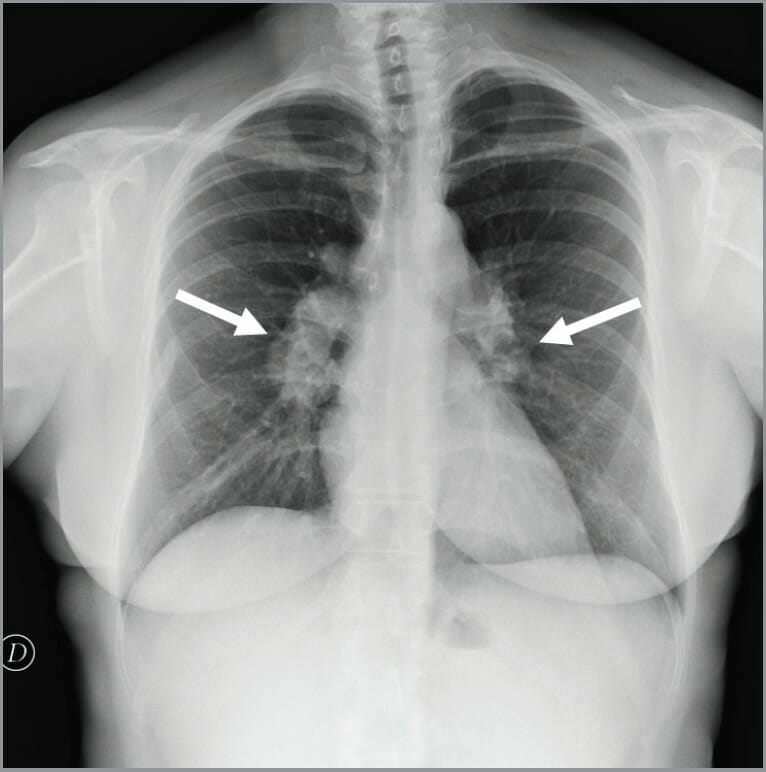
Chest X-ray showing bilateral hilar lymphadenopathy in a patient with CGD

Radiografía de tórax que muestra linfadenopatía hiliar bilateral en un individuo con enfermedad granulomatosa crónica

Imagen: “Chest x-ray showed bilateral hilar lymphadenopathies (arrows) suggestive for chronic granulomatous disease” por Conte G. et al. Licencia: CC BY 3.0

Tratamiento

  • Trasplante de células madre hematopoyéticas de un donante compatible en EN Erythema nodosum is an immune-mediated panniculitis (inflammation of the subcutaneous fat) caused by a type IV (delayed-type) hypersensitivity reaction. It commonly manifests in young women as tender, erythematous nodules on the shins. Erythema Nodosum el sistema del antígeno leucocitario humano (HLA, por sus siglas en EN Erythema nodosum is an immune-mediated panniculitis (inflammation of the subcutaneous fat) caused by a type IV (delayed-type) hypersensitivity reaction. It commonly manifests in young women as tender, erythematous nodules on the shins. Erythema Nodosum inglés)
  • Profilaxis antimicrobiana (trimetoprim-sulfametoxazol se considera tratamiento de 1era línea)
  • Tratamiento agresivo de las infecciones actuales.
    • Infecciones de la piel: ciprofloxacina intravenosa
    • Neumonía fúngica: voriconazol o posaconazol hasta por 6 meses
  • Administración de interferón-gamma
  • Drenaje quirúrgico de abscesos
  • La terapia génica está experimentando una extensa investigación y desarrollo.

Diagnóstico Diferencial

  • Fibrosis Fibrosis Any pathological condition where fibrous connective tissue invades any organ, usually as a consequence of inflammation or other injury. Bronchiolitis Obliterans quística: trastorno autosómico recesivo. La mayoría de los LOS Neisseria portadores del gen de la fibrosis Fibrosis Any pathological condition where fibrous connective tissue invades any organ, usually as a consequence of inflammation or other injury. Bronchiolitis Obliterans quística son asintomáticos y la enfermedad se manifiesta como una disfunción de las glándulas exocrinas que afecta múltiples sistemas, pero generalmente produce infecciones respiratorias crónicas, insuficiencia de enzimas pancreáticas y complicaciones asociadas en EN Erythema nodosum is an immune-mediated panniculitis (inflammation of the subcutaneous fat) caused by a type IV (delayed-type) hypersensitivity reaction. It commonly manifests in young women as tender, erythematous nodules on the shins. Erythema Nodosum pacientes no tratados. La afectación pulmonar ocurre en EN Erythema nodosum is an immune-mediated panniculitis (inflammation of the subcutaneous fat) caused by a type IV (delayed-type) hypersensitivity reaction. It commonly manifests in young women as tender, erythematous nodules on the shins. Erythema Nodosum el 90% de los LOS Neisseria pacientes que sobreviven al AL Amyloidosis período neonatal. La enfermedad pulmonar terminal es la principal causa de muerte
  • Síndrome de hiperinmunoglobulina E: descrito por primera vez como síndrome de Job en EN Erythema nodosum is an immune-mediated panniculitis (inflammation of the subcutaneous fat) caused by a type IV (delayed-type) hypersensitivity reaction. It commonly manifests in young women as tender, erythematous nodules on the shins. Erythema Nodosum 1966. El síndrome de hiperinmunoglobulina E se caracteriza por abscesos cutáneos recurrentes, neumonía recurrente con neumatocele, dermatitis Dermatitis Any inflammation of the skin. Atopic Dermatitis (Eczema) eczematosa y niveles séricos elevados de IgE IgE An immunoglobulin associated with mast cells. Overexpression has been associated with allergic hypersensitivity. Immunoglobulins: Types and Functions. Inicialmente se informó que el síndrome de hiperinmunoglobulina E tenía un patrón de herencia autosómico dominante, pero se han reportado casos con herencia autosómica recesiva y casos esporádicos.
  • Enfermedad de Crohn ( en EN Erythema nodosum is an immune-mediated panniculitis (inflammation of the subcutaneous fat) caused by a type IV (delayed-type) hypersensitivity reaction. It commonly manifests in young women as tender, erythematous nodules on the shins. Erythema Nodosum pacientes con inflamación limitada al AL Amyloidosis recto): enteritis Enteritis Inflammation of any segment of the small intestine. Lactose Intolerance regional crónica idiopática que afecta más comúnmente al AL Amyloidosis íleon terminal pero tiene el potencial de afectar cualquier parte del tracto gastrointestinal desde la boca hasta el ano. La enfermedad de Crohn se define por una inflamación transmural que carece de continuidad a lo largo del intestino (áreas saltadas). En EN Erythema nodosum is an immune-mediated panniculitis (inflammation of the subcutaneous fat) caused by a type IV (delayed-type) hypersensitivity reaction. It commonly manifests in young women as tender, erythematous nodules on the shins. Erythema Nodosum algunos casos, la enfermedad de Corhn tiene granulomas Granulomas A relatively small nodular inflammatory lesion containing grouped mononuclear phagocytes, caused by infectious and noninfectious agents. Sarcoidosis no necrosantes que contienen histiocitos epitelioides. Los LOS Neisseria pacientes se presentan con signos típicos de enfermedad de Crohn, que incluyen dolor Dolor Inflammation abdominal, diarrea sanguinolenta y, en EN Erythema nodosum is an immune-mediated panniculitis (inflammation of the subcutaneous fat) caused by a type IV (delayed-type) hypersensitivity reaction. It commonly manifests in young women as tender, erythematous nodules on the shins. Erythema Nodosum casos graves, fístulas intestinales, abscesos intramurales y obstrucción intestinal.

Referencias

  1. Zerbe CS, Marciano BE, Holland SM. (2023). Chronic granulomatous disease: pathogenesis, clinical manifestations, and diagnosis. UpToDate. Retrieved November 6, 2024, from https://www.uptodate.com/contents/chronic-granulomatous-disease-pathogenesis-clinical-manifestations-and-diagnosis
  2. Marciano BE, Zerbe CS, Holland SM. (2023). Chronic granulomatous disease: Treatment and prognosis. UpToDate. Retrieved November 6, 2024, from https://www.uptodate.com/contents/chronic-granulomatous-disease-treatment-and-prognosis
  3. Nowicki RJ. (2019). Chronic Granulomatous Disease. eMedicine. Retrieved November 6, 2024, from https://emedicine.medscape.com/article/1116022
  4. Fischer, A. (2018). Primary Immune Deficiency Diseases. In Jameson JL, et al. (Ed.), Harrison’s Principles of Internal Medicine (20th ed., ch. 344).

¡Crea tu cuenta gratis o inicia una sesión para seguir leyendo!

Regístrate ahora y obtén acceso gratuito a Lecturio con páginas de concepto, videos médicos y cuestionarios para tu educación médica.

User Reviews

Que tengas una sesión de estudio alegre y navideña 🎁 Ahorra 50% en todos los planes >>

Details