Domina Conceptos Médicos

Estudia para la escuela de medicina y tus examenes con Lecturio.

Cloranfenicol

El cloranfenicol es el único medicamento clínicamente relevante de la clase de los anfenicoles, es un potente inhibidor de la síntesis proteica bacteriana al unirse a la subunidad ribosomal 50S e impide la formación de enlaces peptídicos. El cloranfenicol es un antibiótico de amplio espectro con una amplia distribución; sin embargo, debido a su toxicidad, su uso se limita a las infecciones graves en EN Erythema nodosum is an immune-mediated panniculitis (inflammation of the subcutaneous fat) caused by a type IV (delayed-type) hypersensitivity reaction. It commonly manifests in young women as tender, erythematous nodules on the shins. Erythema Nodosum las que no se dispone de otras alternativas antibióticas (normalmente por problemas de resistencia). Los LOS Neisseria efectos secundarios incluyen la neuritis óptica, anemia Anemia Anemia is a condition in which individuals have low Hb levels, which can arise from various causes. Anemia is accompanied by a reduced number of RBCs and may manifest with fatigue, shortness of breath, pallor, and weakness. Subtypes are classified by the size of RBCs, chronicity, and etiology. Anemia: Overview and Types aplásica y el síndrome del bebé gris.

Last updated: Feb 13, 2025
Editorial responsibility: Stanley Oiseth, Lindsay Jones, Evelin Maza

Farmacodinamia y Farmacocinética

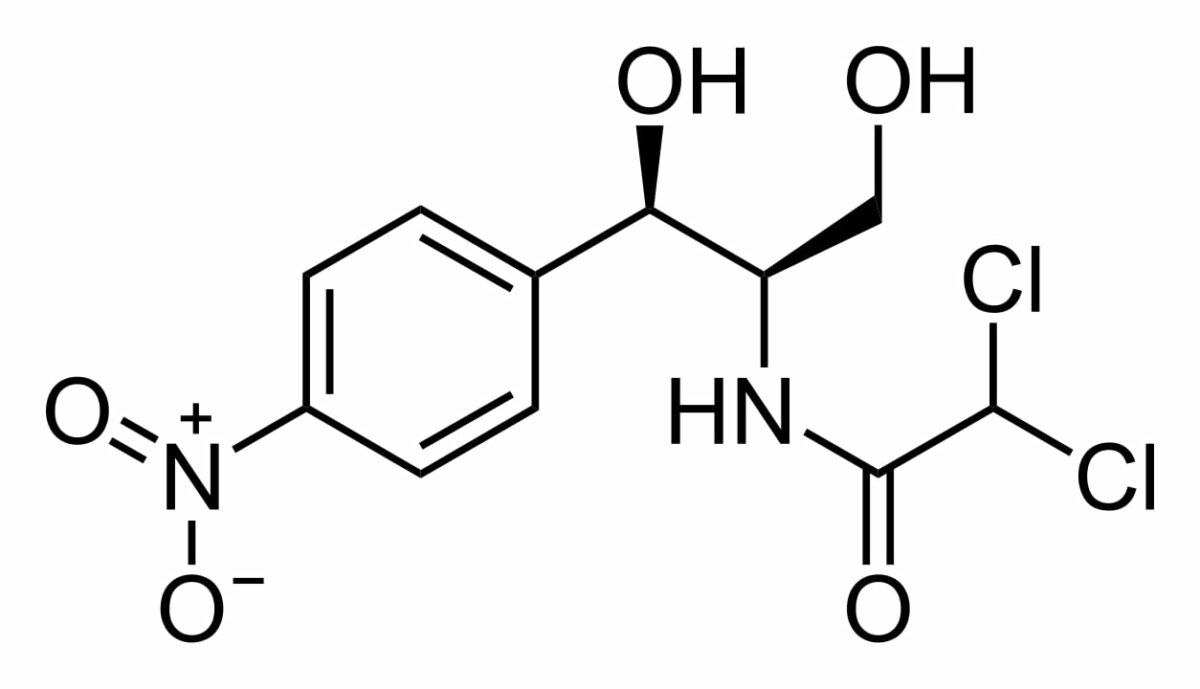
Estructura química

  • El cloranfenicol es el único medicamento de su clase.
  • Compuesto cristalino
  • Soluble en EN Erythema nodosum is an immune-mediated panniculitis (inflammation of the subcutaneous fat) caused by a type IV (delayed-type) hypersensitivity reaction. It commonly manifests in young women as tender, erythematous nodules on the shins. Erythema Nodosum alcohol

Mecanismo de acción

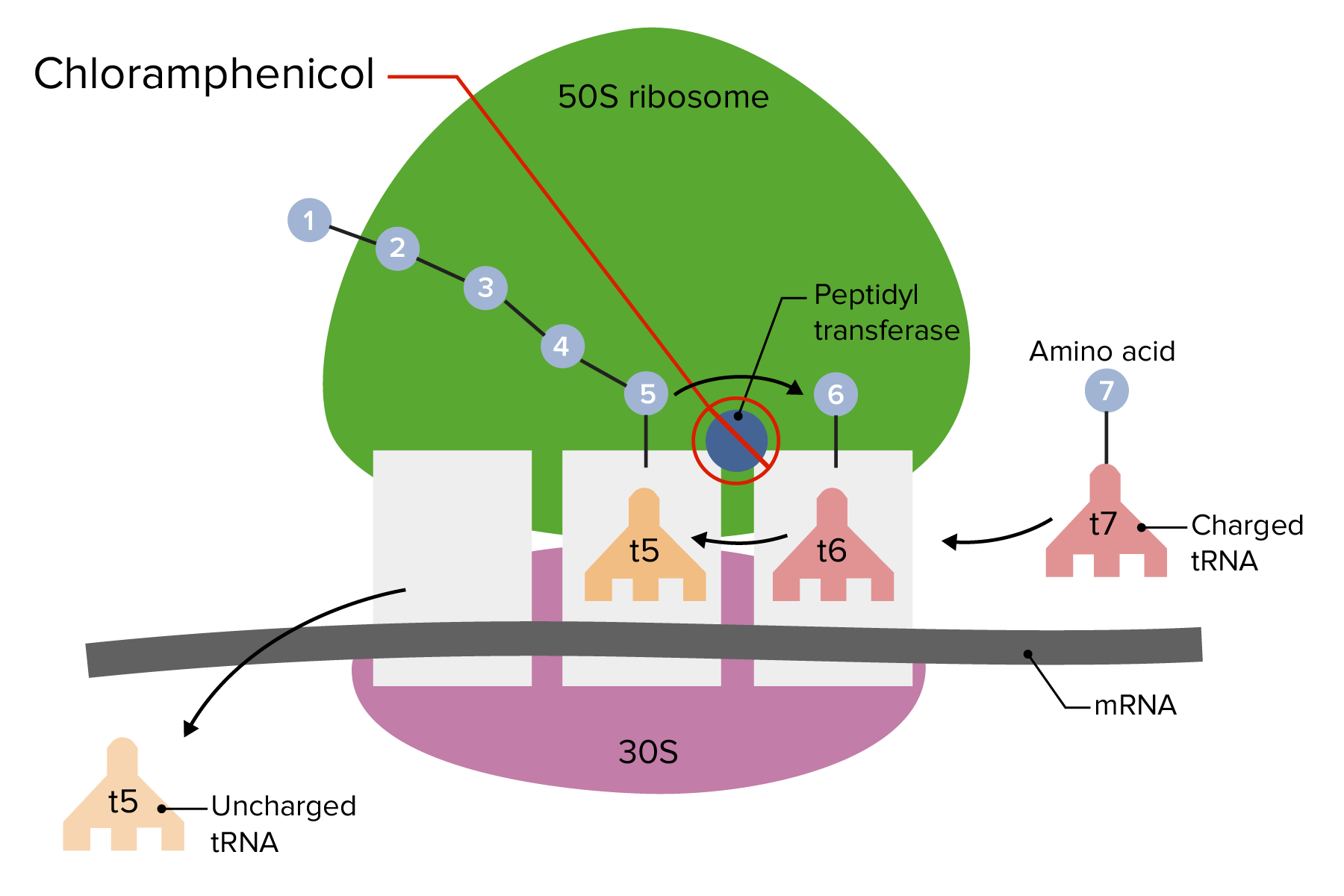
  • Inhibe la síntesis proteica bacteriana
    • Se une de forma reversible a la subunidad ribosomal 50S bacteriana del ribosoma 70S
    • Inhibe la peptidil transferasa → impide la formación de enlaces peptídicos (impide la transpeptidación)
  • Limita el crecimiento bacteriano → bacteriostático; puede ser bactericida a concentraciones altas
Sitio de acción del cloranfenicol en la subunidad ribosomal 50S

Sitio de acción del cloranfenicol en la subunidad ribosomal 50S:
Este impide la unión de los aminoácidos a la cadena peptídica, lo que provoca la inhibición de la síntesis proteica.
ARNt: ARN de transferencia

Imagen por Lecturio. Licencia: CC BY-NC-SA 4.0

Farmacocinética

  • Absorción: se absorbe fácilmente en EN Erythema nodosum is an immune-mediated panniculitis (inflammation of the subcutaneous fat) caused by a type IV (delayed-type) hypersensitivity reaction. It commonly manifests in young women as tender, erythematous nodules on the shins. Erythema Nodosum el tracto gastrointestinal
  • Distribución:
    • 60% unido a proteínas
    • Liposoluble
    • Distribución amplia
    • Atraviesa la barrera hematoencefálica
  • Metabolismo: inactivado por la glucuroniltransferasa hepática
  • Excreción: orina

Indicaciones

Cobertura antimicrobiana

  • Cocos y bacilos Gram-positivos:
    • Streptococcus Streptococcus Streptococcus is one of the two medically important genera of gram-positive cocci, the other being Staphylococcus. Streptococci are identified as different species on blood agar on the basis of their hemolytic pattern and sensitivity to optochin and bacitracin. There are many pathogenic species of streptococci, including S. pyogenes, S. agalactiae, S. pneumoniae, and the viridans streptococci. Streptococcus (especialmente S. pneumoniae)
    • Staphylococcus Staphylococcus Staphylococcus is a medically important genera of Gram-positive, aerobic cocci. These bacteria form clusters resembling grapes on culture plates. Staphylococci are ubiquitous for humans, and many strains compose the normal skin flora. Staphylococcus
    • Enterococcus Enterococcus Enterococcus is a genus of oval-shaped gram-positive cocci that are arranged in pairs or short chains. Distinguishing factors include optochin resistance and the presence of pyrrolidonyl arylamidase (PYR) and Lancefield D antigen. Enterococcus is part of the normal flora of the human GI tract. Enterococcus
    • Bacillus Bacillus Bacillus are aerobic, spore-forming, gram-positive bacilli. Two pathogenic species are Bacillus anthracis (B. anthracis) and B. cereus. Bacillus
    • Listeria Listeria Listeria spp. are motile, flagellated, gram-positive, facultative intracellular bacilli. The major pathogenic species is Listeria monocytogenes. Listeria are part of the normal gastrointestinal flora of domestic mammals and poultry and are transmitted to humans through the ingestion of contaminated food, especially unpasteurized dairy products. Listeria Monocytogenes/Listeriosis
  • Cocos y bacilos Gram-negativos:
    • Haemophilus influenzae Haemophilus Influenzae A species of Haemophilus found on the mucous membranes of humans and a variety of animals. The species is further divided into biotypes I through viii. Haemophilus
    • Neisseria meningitidis Neisseria meningitidis A species of gram-negative, aerobic bacteria. It is a commensal and pathogen only of humans, and can be carried asymptomatically in the nasopharynx. When found in cerebrospinal fluid it is the causative agent of cerebrospinal meningitis. It is also found in venereal discharges and blood. There are at least 13 serogroups based on antigenic differences in the capsular polysaccharides; the ones causing most meningitis infections being a, b, c, y, and w-135. Each serogroup can be further classified by serotype, serosubtype, and immunotype. Neisseria
    • Moraxella catarrhalis Moraxella catarrhalis Gram-negative aerobic cocci of low virulence that colonize the nasopharynx and occasionally cause meningitis; bacteremia; empyema; pericarditis; and pneumonia. Moraxella
    • Escherichia coli Escherichia coli The gram-negative bacterium Escherichia coli is a key component of the human gut microbiota. Most strains of E. coli are avirulent, but occasionally they escape the GI tract, infecting the urinary tract and other sites. Less common strains of E. coli are able to cause disease within the GI tract, most commonly presenting as abdominal pain and diarrhea. Escherichia coli
    • Yersinia pestis Yersinia pestis The plague is a bacterial infection caused by Yersinia pestis (Y. pestis), which primarily infects rodents. The disease is transmitted to humans via a flea bite. Inhalation of infectious droplets and handling infected animals or laboratory specimens are other means of transmission. The plague has 3 forms: bubonic (most common form), septicemic, and pneumonic. Yersinia pestis/Plague
    • Salmonella Salmonella Salmonellae are gram-negative bacilli of the family Enterobacteriaceae. Salmonellae are flagellated, non-lactose-fermenting, and hydrogen sulfide-producing microbes. Salmonella enterica, the most common disease-causing species in humans, is further classified based on serotype as typhoidal (S. typhi and paratyphi) and nontyphoidal (S. enteritidis and typhimurium). Salmonella
    • Shigella Shigella Shigella is a genus of gram-negative, non-lactose-fermenting facultative intracellular bacilli. Infection spreads most commonly via person-to-person contact or through contaminated food and water. Humans are the only known reservoir. Shigella
  • Bacterias atípicas:
    • Rickettsia Rickettsia Rickettsiae are a diverse collection of obligate intracellular, gram-negative bacteria that have a tropism for vascular endothelial cells. The vectors for transmission vary by species but include ticks, fleas, mites, and lice. Rickettsia
    • Mycoplasma Mycoplasma Mycoplasma is a species of pleomorphic bacteria that lack a cell wall, which makes them difficult to target with conventional antibiotics and causes them to not gram stain well. Mycoplasma bacteria commonly target the respiratory and urogenital epithelium. Mycoplasma pneumoniae (M. pneumoniae), the causative agent of atypical or “walking” pneumonia. Mycoplasma

Tipos de infecciones

Debido a los LOS Neisseria efectos secundarios del cloranfenicol, su uso se limita generalmente a las infecciones graves en EN Erythema nodosum is an immune-mediated panniculitis (inflammation of the subcutaneous fat) caused by a type IV (delayed-type) hypersensitivity reaction. It commonly manifests in young women as tender, erythematous nodules on the shins. Erythema Nodosum las que se ha HA Hemolytic anemia (HA) is the term given to a large group of anemias that are caused by the premature destruction/hemolysis of circulating red blood cells (RBCs). Hemolysis can occur within (intravascular hemolysis) or outside the blood vessels (extravascular hemolysis). Hemolytic Anemia desarrollado una resistencia contra agentes alternativos:

  • Meningitis Meningitis Meningitis is inflammation of the meninges, the protective membranes of the brain, and spinal cord. The causes of meningitis are varied, with the most common being bacterial or viral infection. The classic presentation of meningitis is a triad of fever, altered mental status, and nuchal rigidity. Meningitis bacteriana
  • Conjuntivitis bacteriana y endoftalmitis
  • Otitis externa Otitis externa Otitis externa (also known as external otitis or swimmer’s ear) is an infection of the external auditory canal that is most often caused by acute bacterial infection and is frequently associated with hot, humid weather and water exposure. Patients commonly present with ear pain, pruritus, discharge, and hearing loss. Otitis Externa
  • Fiebre maculosa de las montañas rocosas
  • Fiebre tifoidea
  • Ántrax
  • Plaga

Efectos Secundarios y Contraindicaciones

Efectos secundarios

  • Malestar gastrointestinal
  • Neuritis óptica
  • Ototoxicidad (con gotas para los LOS Neisseria oídos)
  • Supresión de la medula ósea
    • Anemia Anemia Anemia is a condition in which individuals have low Hb levels, which can arise from various causes. Anemia is accompanied by a reduced number of RBCs and may manifest with fatigue, shortness of breath, pallor, and weakness. Subtypes are classified by the size of RBCs, chronicity, and etiology. Anemia: Overview and Types leve, trombocitopenia y neutropenia Neutropenia Neutrophils are an important component of the immune system and play a significant role in the eradication of infections. Low numbers of circulating neutrophils, referred to as neutropenia, predispose the body to recurrent infections or sepsis, though patients can also be asymptomatic. Neutropenia
    • Anemia Anemia Anemia is a condition in which individuals have low Hb levels, which can arise from various causes. Anemia is accompanied by a reduced number of RBCs and may manifest with fatigue, shortness of breath, pallor, and weakness. Subtypes are classified by the size of RBCs, chronicity, and etiology. Anemia: Overview and Types aplásica
  • Síndrome del bebé gris
    • Debido a la glucuronidación inmadura de la enzima ↓ la glucuronosiltransferasa en EN Erythema nodosum is an immune-mediated panniculitis (inflammation of the subcutaneous fat) caused by a type IV (delayed-type) hypersensitivity reaction. It commonly manifests in young women as tender, erythematous nodules on the shins. Erythema Nodosum neonatos → acumulación de cloranfenicol
    • Signos y síntomas:
      • Aparición de cianosis (color gris)
      • Hipotermia
      • Distensión abdominal
      • Flacidez
      • Colapso cardiovascular

Contraindicaciones

  • No debe utilizarse si se dispone de una terapia antibiótica alternativa
  • Evitar uso en EN Erythema nodosum is an immune-mediated panniculitis (inflammation of the subcutaneous fat) caused by a type IV (delayed-type) hypersensitivity reaction. It commonly manifests in young women as tender, erythematous nodules on the shins. Erythema Nodosum pacientes embarazadas o en EN Erythema nodosum is an immune-mediated panniculitis (inflammation of the subcutaneous fat) caused by a type IV (delayed-type) hypersensitivity reaction. It commonly manifests in young women as tender, erythematous nodules on the shins. Erythema Nodosum periodo de lactancia.

Interacciones con otros medicamentos

  • Clozapina: ↑ riesgo de mielosupresión
  • Puede ↑ concentraciones séricas de:
    • Barbitúricos
    • Ciclosporinas
    • Fosfenitoína y fenitoína
    • Sulfonilureas
    • Tacrolimus Tacrolimus A macrolide isolated from the culture broth of a strain of streptomyces tsukubaensis that has strong immunosuppressive activity in vivo and prevents the activation of T-lymphocytes in response to antigenic or mitogenic stimulation in vitro. Immunosuppressants

Mecanismos de Resistencia

Los LOS Neisseria mecanismos de resistencia al AL Amyloidosis cloranfenicol en EN Erythema nodosum is an immune-mediated panniculitis (inflammation of the subcutaneous fat) caused by a type IV (delayed-type) hypersensitivity reaction. It commonly manifests in young women as tender, erythematous nodules on the shins. Erythema Nodosum las bacterias incluyen:

  • Inactivación enzimática por vía de la acetilación
    • Cloranfenicol acetiltransferasa (el más común)
    • Fosfotransferasas de cloranfenicol
  • Bombas de eflujo
  • Barreras de permeabilidad
  • Mutación en EN Erythema nodosum is an immune-mediated panniculitis (inflammation of the subcutaneous fat) caused by a type IV (delayed-type) hypersensitivity reaction. It commonly manifests in young women as tender, erythematous nodules on the shins. Erythema Nodosum el sitio de acción de la subunidad 50S

Comparación de Antibióticos

Tabla: Comparación de varias clases de antibióticos inhibidores de la síntesis proteica bacteriana
Clase de medicamento Mecanismo de acción Cobertura Efectos secundarios
Anfenicoles
  • Se unen a la subunidad 50S
  • Evitan la transpeptidación
  • Gram positivos
  • Gram negativos
  • Atípicos
  • Malestar gastrointestinal
  • Neuritis óptica
  • Anemia Anemia Anemia is a condition in which individuals have low Hb levels, which can arise from various causes. Anemia is accompanied by a reduced number of RBCs and may manifest with fatigue, shortness of breath, pallor, and weakness. Subtypes are classified by the size of RBCs, chronicity, and etiology. Anemia: Overview and Types aplásica
  • Síndrome del bebé gris
Lincosamidas
  • Se unen a la subunidad 50S
  • Evitan la transpeptidación
  • Cocos Gram-positivos:
    • Staphylococcus aureus Staphylococcus aureus Potentially pathogenic bacteria found in nasal membranes, skin, hair follicles, and perineum of warm-blooded animals. They may cause a wide range of infections and intoxications. Brain Abscess sensible a meticilina (MSSA, por sus siglas en EN Erythema nodosum is an immune-mediated panniculitis (inflammation of the subcutaneous fat) caused by a type IV (delayed-type) hypersensitivity reaction. It commonly manifests in young women as tender, erythematous nodules on the shins. Erythema Nodosum inglés)
    • Staphylococcus aureus Staphylococcus aureus Potentially pathogenic bacteria found in nasal membranes, skin, hair follicles, and perineum of warm-blooded animals. They may cause a wide range of infections and intoxications. Brain Abscess resistente a meticilina ( MRSA MRSA A strain of Staphylococcus aureus that is non-susceptible to the action of methicillin. The mechanism of resistance usually involves modification of normal or the presence of acquired penicillin binding proteins. Staphylococcus, por sus siglas en EN Erythema nodosum is an immune-mediated panniculitis (inflammation of the subcutaneous fat) caused by a type IV (delayed-type) hypersensitivity reaction. It commonly manifests in young women as tender, erythematous nodules on the shins. Erythema Nodosum inglés)
    • Streptococcus Streptococcus Streptococcus is one of the two medically important genera of gram-positive cocci, the other being Staphylococcus. Streptococci are identified as different species on blood agar on the basis of their hemolytic pattern and sensitivity to optochin and bacitracin. There are many pathogenic species of streptococci, including S. pyogenes, S. agalactiae, S. pneumoniae, and the viridans streptococci. Streptococcus
  • Anaerobios
  • Malestar gastrointestinal
  • Reacciones alérgicas
  • Colitis Colitis Inflammation of the colon section of the large intestine, usually with symptoms such as diarrhea (often with blood and mucus), abdominal pain, and fever. Pseudomembranous Colitis pseudomembranosa
Macrólidos
  • Se unen a la subunidad 50S
  • Evitan la transpeptidación
  • Gram positivos
  • Gram negativos
  • Atípicos
  • Complejo Mycobacterium avium Mycobacterium avium A bacterium causing tuberculosis in domestic fowl and other birds. In pigs, it may cause localized and sometimes disseminated disease. The organism occurs occasionally in sheep and cattle. It should be distinguished from the m. avium complex, which infects primarily humans. Mycobacterium
  • Malestar gastrointestinal
  • Prolongación del QT
  • Hepatotoxicidad
  • Exacerbación de la miastenia gravis
Oxazolidinonas
  • Se unen al AL Amyloidosis 23S del ARNr de la subunidad 50S
  • Evitan la formación de complejos de iniciación
Cocos Gram-positivos:
  • MSSA
  • MRSA MRSA A strain of Staphylococcus aureus that is non-susceptible to the action of methicillin. The mechanism of resistance usually involves modification of normal or the presence of acquired penicillin binding proteins. Staphylococcus
  • ERV
  • Streptococcus Streptococcus Streptococcus is one of the two medically important genera of gram-positive cocci, the other being Staphylococcus. Streptococci are identified as different species on blood agar on the basis of their hemolytic pattern and sensitivity to optochin and bacitracin. There are many pathogenic species of streptococci, including S. pyogenes, S. agalactiae, S. pneumoniae, and the viridans streptococci. Streptococcus
  • Mielosupresión
  • Neuropatía
  • Acidosis Acidosis A pathologic condition of acid accumulation or depletion of base in the body. The two main types are respiratory acidosis and metabolic acidosis, due to metabolic acid build up. Respiratory Acidosis láctica
  • Síndrome serotoninérgico
ARNr: ARN ribosómico
ERV: Enterococo resistente a la vancomicina
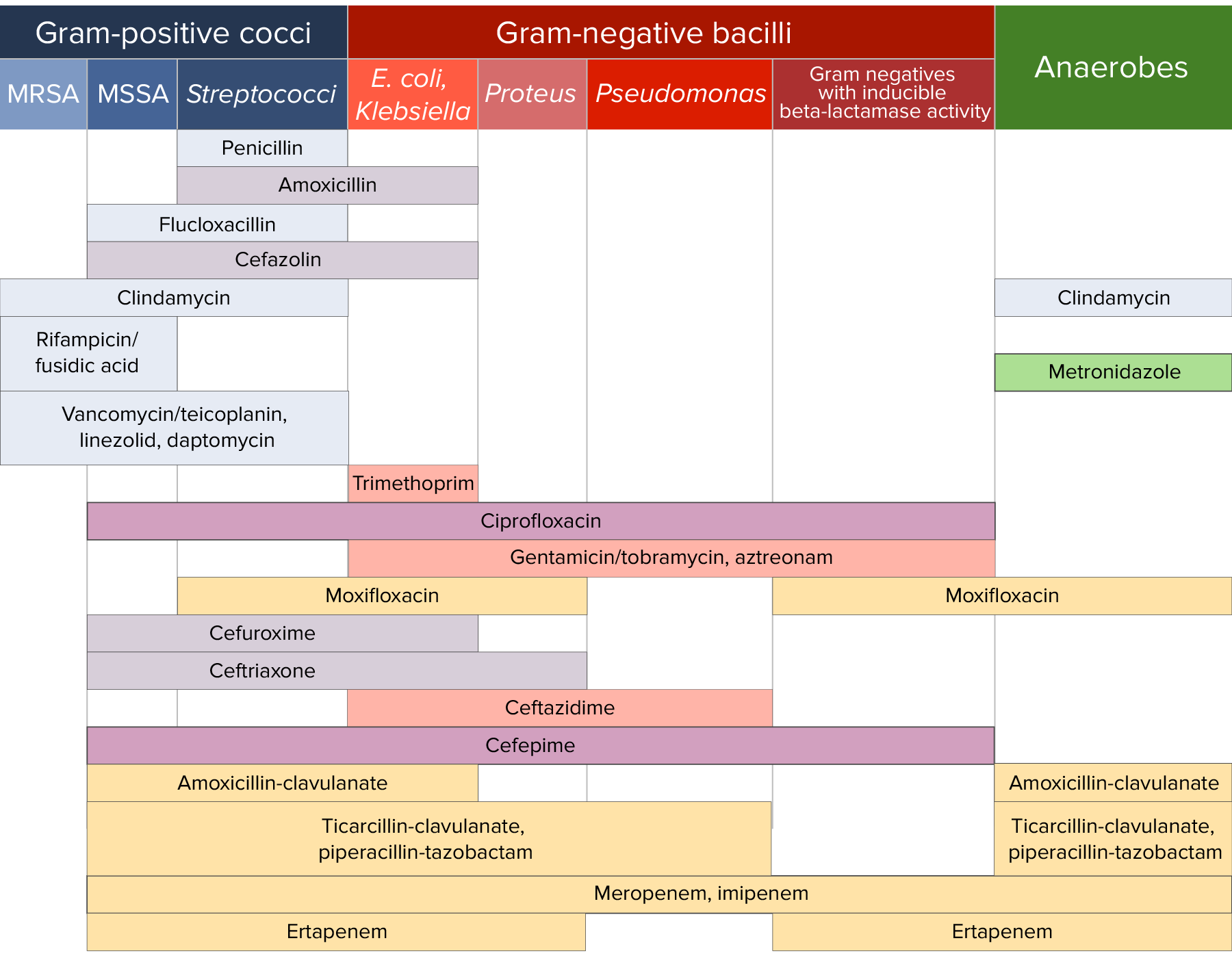
Tabla de sensibilidad a los antibióticos

Sensibilidad a los antibióticos:
Gráfico que compara la cobertura microbiana de diferentes antibióticos para cocos Gram-positivos, bacilos Gram-negativos y anaerobios.

Imagen por Lecturio. Licencia: CC BY-NC-SA 4.0

Referencias

  1. The American Society of Health-System Pharmacists. (2015). Chloramphenicol. Archived from the original on June 24, 2015, from https://web.archive.org/web/20150624080341/http://www.drugs.com/monograph/chloramphenicol.html
  2. Deck, D.H., and Winston, L.G. (2012). Tetracyclines, macrolides, clindamycin, chloramphenicol, streptogramins, & oxazolidinones. In Katzung, B.G., et al (Eds.), Basic & Clinical Pharmacology (12th edition, pp. 809–819). https://pharmacomedicale.org/images/cnpm/CNPM_2016/katzung-pharmacology.pdf
  3. OOong, G. C., & Tadi, P. (2023). Chloramphenicol. In StatPearls [Internet]. StatPearls Publishing. Retrieved February 12, 2025, from https://www.ncbi.nlm.nih.gov/books/NBK555966/
  4. Werth, B.J. (2024). Chloramphenicol. [online] MSD Manual Professional Version. Retrieved February 12, 2025, from https://www.msdmanuals.com/professional/infectious-diseases/bacteria-and-antibacterial-drugs/chloramphenicol

¡Crea tu cuenta gratis o inicia una sesión para seguir leyendo!

Regístrate ahora y obtén acceso gratuito a Lecturio con páginas de concepto, videos médicos y cuestionarios para tu educación médica.

User Reviews

Que tengas una sesión de estudio alegre y navideña 🎁 Ahorra 50% en todos los planes >>

Details