Domina Conceptos Médicos

Estudia para la escuela de medicina y tus examenes con Lecturio.

Cefalosporinas

Las cefalosporinas son un grupo de antibióticos betalactámicos bactericidas (similares a las penicilinas) que ejercen su efecto impidiendo que las bacterias produzcan su pared celular, lo que en EN Erythema nodosum is an immune-mediated panniculitis (inflammation of the subcutaneous fat) caused by a type IV (delayed-type) hypersensitivity reaction. It commonly manifests in young women as tender, erythematous nodules on the shins. Erythema Nodosum última instancia conduce a la muerte celular. Las cefalosporinas se clasifican por generaciones y todos los LOS Neisseria nombres de los LOS Neisseria medicamentos comienzan con “cef-” o “ceph-”. Las cefalosporinas tienen una amplia actividad antimicrobiana en EN Erythema nodosum is an immune-mediated panniculitis (inflammation of the subcutaneous fat) caused by a type IV (delayed-type) hypersensitivity reaction. It commonly manifests in young women as tender, erythematous nodules on the shins. Erythema Nodosum comparación con la mayoría de las penicilinas y son más eficaces contra las Enterobacteriaceae Enterobacteriaceae A family of gram-negative, facultatively anaerobic, rod-shaped bacteria that do not form endospores. Its organisms are distributed worldwide with some being saprophytes and others being plant and animal parasites. Many species are of considerable economic importance due to their pathogenic effects on agriculture and livestock. Cephalosporins; algunos medicamentos son activos también contra las Pseudomonas Pseudomonas Pseudomonas is a non-lactose-fermenting, gram-negative bacillus that produces pyocyanin, which gives it a characteristic blue-green color. Pseudomonas is found ubiquitously in the environment, as well as in moist reservoirs, such as hospital sinks and respiratory equipment. Pseudomonas y/o especies anaerobias. Las cefalosporinas se utilizan a menudo para tratar las infecciones de la piel, tejidos blandos, huesos, pulmones, vías urinarias, intraabdominales y pélvicas causadas por organismos susceptibles.

Last updated: Dec 15, 2025

Editorial responsibility: Stanley Oiseth, Lindsay Jones, Evelin Maza

Estructura Química

Estructura de las cefalosporinas

Las cefalosporinas son miembros de la familia de los LOS Neisseria medicamentos betalactámicos y consisten en EN Erythema nodosum is an immune-mediated panniculitis (inflammation of the subcutaneous fat) caused by a type IV (delayed-type) hypersensitivity reaction. It commonly manifests in young women as tender, erythematous nodules on the shins. Erythema Nodosum:
  • Un anillo betalactámico: un anillo de 4 miembros que contiene 2 carbonos (α y β), un nitrógeno y un grupo carbonilo (un carbono doblemente unido al AL Amyloidosis oxígeno)
    • El grupo en EN Erythema nodosum is an immune-mediated panniculitis (inflammation of the subcutaneous fat) caused by a type IV (delayed-type) hypersensitivity reaction. It commonly manifests in young women as tender, erythematous nodules on the shins. Erythema Nodosum el compuesto es responsable de la actividad antibacteriana
    • Puede ser hidrolizado (es decir, descompuesto) por las betalactamasas, que son producidas por ciertas bacterias resistentes
    • Si el anillo betalactámico se rompe, el medicamento pierde sus propiedades antibacterianas.
    • Todos los LOS Neisseria betalactámicos contienen un anillo betalactámico.
  • Cadena lateral (grupo R):
    • Unido al AL Amyloidosis carbono-α del anillo betalactámico
    • Diferencia a las cefalosporinas entre sí
    • Responsable de su farmacocinética única y espectros de actividad
    • Algunas estructuras pueden inhibir estéricamente la hidrólisis del anillo betalactámico por parte de las betalactamasas.
  • Un anillo de 6 miembros que contiene azufre y nitrógeno con un segundo grupo R
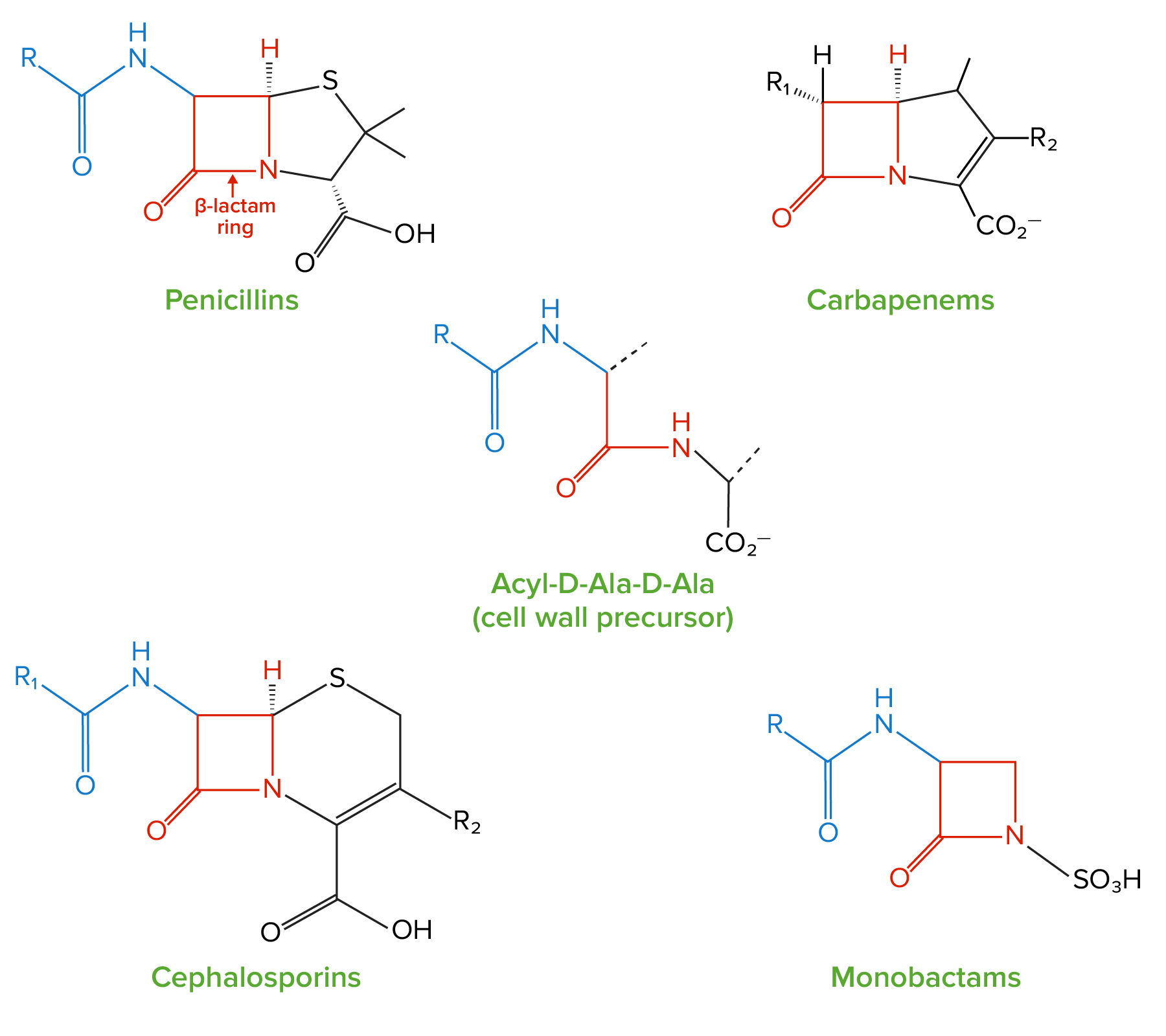
Estructura de los betalactámicos

Estructura de los betalactámicos:
Todos los antibióticos betalactámicos contienen el mismo anillo central “betalactámico” de 4 miembros (resaltado en rojo). Este anillo es el responsable de las propiedades antibacterianas del medicamento porque es la región que se une a las proteínas de unión a la penicilina (PBP, por sus siglas en inglés) y las inhibe. Las PBP catalizan la formación de la pared celular generando enlaces entrecruzados entre las cadenas peptídicas de las moléculas del peptidoglicano; las PBP forman estos enlaces entrecruzados entre los péptidos acil-D-Ala-D-Ala, que tienen una estructura similar al anillo betalactámico.

Imagen por Lecturio. Licencia: CC BY-NC-SA 4.0

Mecanismos de Acción y Resistencia

Todos los LOS Neisseria betalactámicos, incluidas las cefalosporinas, ejercen sus efectos inhibiendo la síntesis de la pared celular bacteriana.
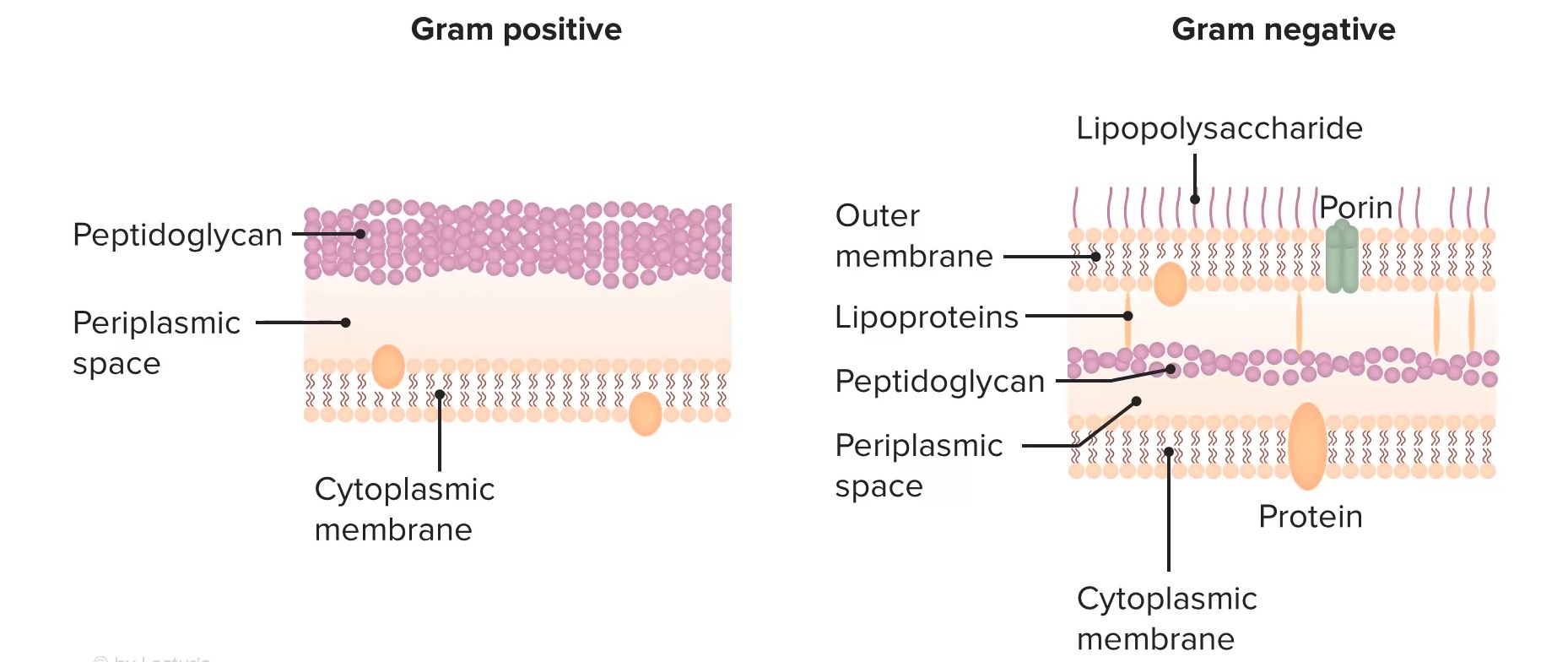
Resumen: entendiendo las paredes celulares

  • Las paredes celulares de las bacterias contienen cadenas de peptidoglicano (capas grandes y gruesas en EN Erythema nodosum is an immune-mediated panniculitis (inflammation of the subcutaneous fat) caused by a type IV (delayed-type) hypersensitivity reaction. It commonly manifests in young women as tender, erythematous nodules on the shins. Erythema Nodosum los LOS Neisseria organismos Gram-positivos y capas relativamente más pequeñas y finas en EN Erythema nodosum is an immune-mediated panniculitis (inflammation of the subcutaneous fat) caused by a type IV (delayed-type) hypersensitivity reaction. It commonly manifests in young women as tender, erythematous nodules on the shins. Erythema Nodosum los LOS Neisseria organismos Gram-negativos).
  • Las cadenas de peptidoglicanos están compuestas por:
    • Una columna vertebral de azúcar con 2 azúcares alternados:
      • Ácido N-acetilmurámico (NAM)
      • N-acetilglucosamina (NAG)
    • Cadenas peptídicas laterales cortas que se ramifican de los LOS Neisseria azúcares NAM
  • Los LOS Neisseria péptidos cortos forman puentes entrecruzados entre las cadenas de peptidoglicano adyacentes y crean una estructura de red.
    • Los LOS Neisseria puentes entrecruzados son necesarios para la estructura del peptidoglicano (y, por tanto, de la pared celular).
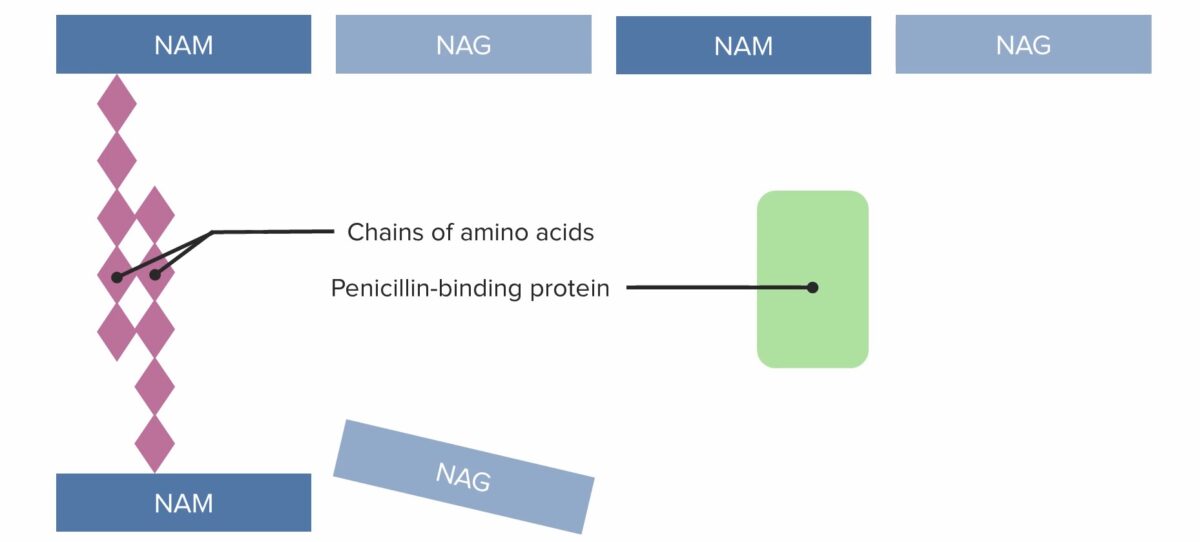
    • Las PBP son enzimas que crean estos puentes entrecruzados.
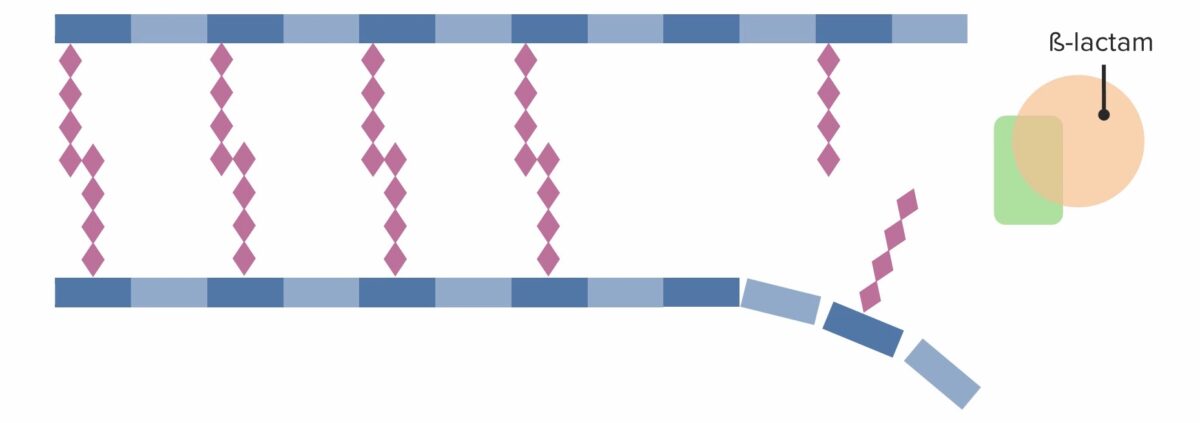
Estructura de las paredes celulares bacterianas Cefalosporinas

Estructura de las paredes celulares bacterianas

Imagen por Lecturio. Licencia: CC BY-NC-SA 4.0

Mecanismo de acción

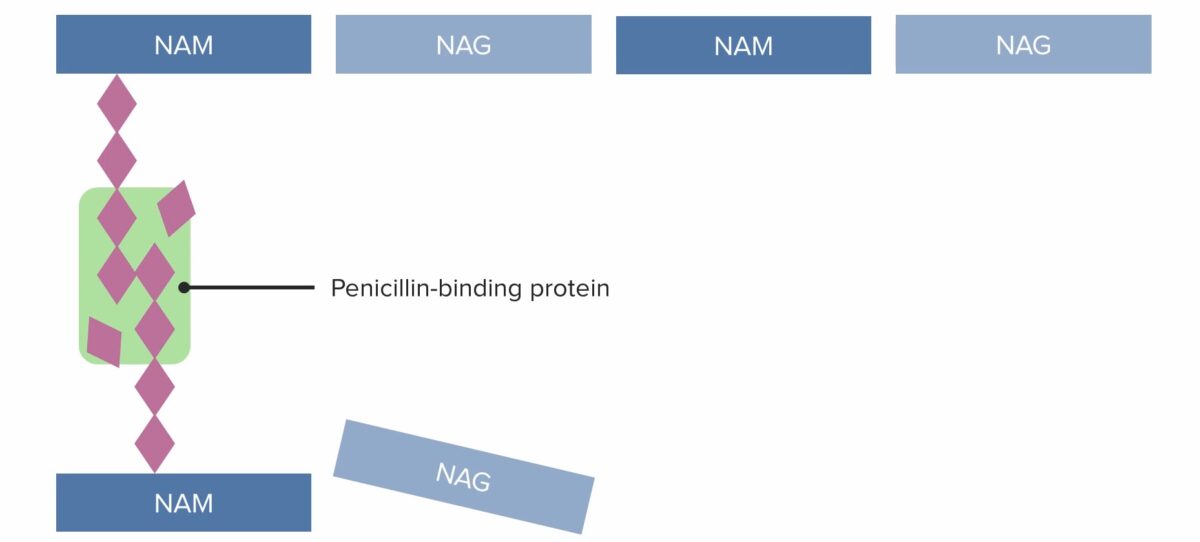
Todos los LOS Neisseria betalactámicos actúan inhibiendo irreversiblemente las PBP los LOS Neisseria antibióticos betalactámicos inhiben la síntesis de la pared celular.
Actividad bactericida

Los LOS Neisseria betalactámicos, incluidas las cefalosporinas, tienen un efecto bactericida (más que bacteriostático).

  • La pared celular bacteriana es necesaria para la supervivencia → si se pierde, se inicia la muerte celular
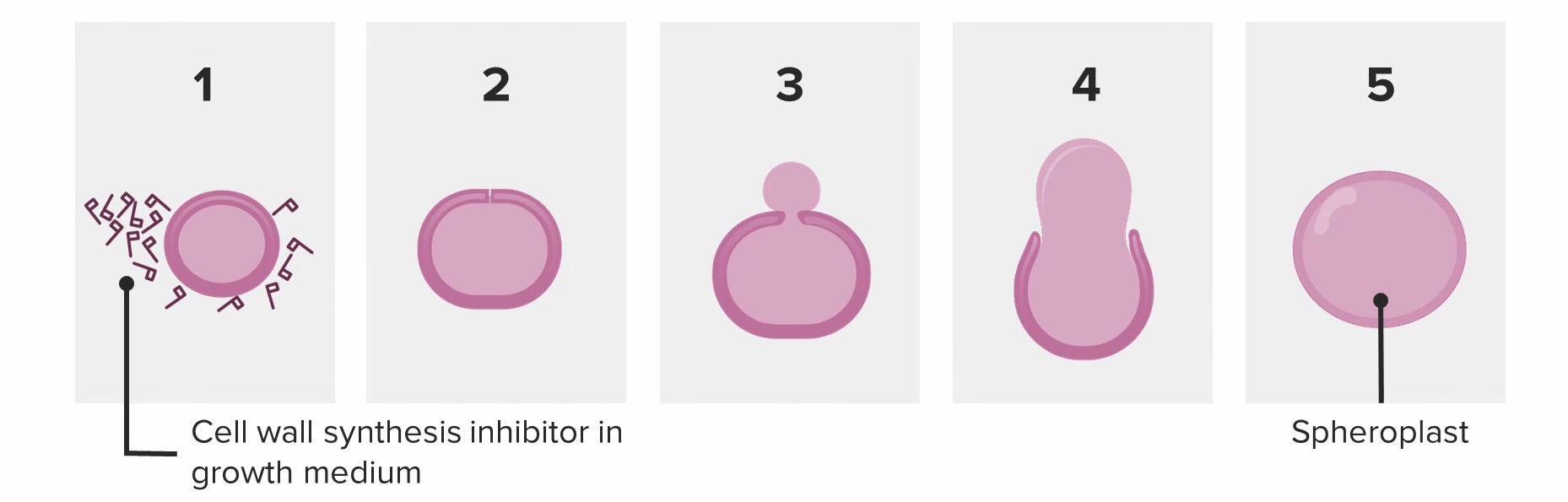
  • Cuando las bacterias intentan replicarse, se desprenden de su pared celular.
  • Sin embargo, en EN Erythema nodosum is an immune-mediated panniculitis (inflammation of the subcutaneous fat) caused by a type IV (delayed-type) hypersensitivity reaction. It commonly manifests in young women as tender, erythematous nodules on the shins. Erythema Nodosum presencia de betalactámicos, las bacterias son incapaces de formar una nueva pared celular.
  • Las bacterias son incapaces de dividirse eficazmente y la célula restante se autocataliza y muere.
Bacterias que intentan dividirse en presencia de penicilina

Bacteria que intenta dividirse en presencia de penicilina:
La bacteria se desprende de su pared y se convierte en un esferoplasto. El esferoplasto no puede sobrevivir y se autocataliza (muere).

Imagen por Lecturio. Licencia: CC BY-NC-SA 4.0
Mecanismos de resistencia

Las bacterias utilizan 3 mecanismos principales para resistir a las cefalosporinas:

  • Resistencia a las betalactamasas (las cefalosporinas son ineficaces):
    • La betalactamasa es una enzima que escinde el anillo betalactámico e inactiva el antibiótico.
    • Cefalosporinasas están implicadas en EN Erythema nodosum is an immune-mediated panniculitis (inflammation of the subcutaneous fat) caused by a type IV (delayed-type) hypersensitivity reaction. It commonly manifests in young women as tender, erythematous nodules on the shins. Erythema Nodosum el caso de la resistencia a las cefalosporinas.
    • Pueden ser producidas tanto por microorganismos Gram-positivos como Gram-negativos
    • Normalmente se segregan
    • Solo se pueden secretar en EN Erythema nodosum is an immune-mediated panniculitis (inflammation of the subcutaneous fat) caused by a type IV (delayed-type) hypersensitivity reaction. It commonly manifests in young women as tender, erythematous nodules on the shins. Erythema Nodosum presencia de un antibiótico betalactámico
    • Tipo de resistencia más común
    • La mayoría de los LOS Neisseria bacilos Gram-negativos poseen un gen de betalactamasa.
  • Resistencia mediada por PBP (unión de cefalosporinas a las PBP):
    • Mutaciones en EN Erythema nodosum is an immune-mediated panniculitis (inflammation of the subcutaneous fat) caused by a type IV (delayed-type) hypersensitivity reaction. It commonly manifests in young women as tender, erythematous nodules on the shins. Erythema Nodosum las PBP → ↓ afinidad de las cefalosporinas a las PBP
    • A pesar de las mutaciones, estas PBP pueden producir una pared celular.
  • Resistencia mediada por porinas (captación de cefalosporinas ↓):
    • Las cefalosporinas entran en EN Erythema nodosum is an immune-mediated panniculitis (inflammation of the subcutaneous fat) caused by a type IV (delayed-type) hypersensitivity reaction. It commonly manifests in young women as tender, erythematous nodules on the shins. Erythema Nodosum las bacterias a través de unos canales llamados porinas en EN Erythema nodosum is an immune-mediated panniculitis (inflammation of the subcutaneous fat) caused by a type IV (delayed-type) hypersensitivity reaction. It commonly manifests in young women as tender, erythematous nodules on the shins. Erythema Nodosum las paredes celulares.
    • Las bacterias pueden ↓ su producción de porinas → ↓ antibiótico dentro de la célula → resistencia a los LOS Neisseria antibióticos
    • Mecanismo más común de resistencia en EN Erythema nodosum is an immune-mediated panniculitis (inflammation of the subcutaneous fat) caused by a type IV (delayed-type) hypersensitivity reaction. It commonly manifests in young women as tender, erythematous nodules on the shins. Erythema Nodosum la Pseudomona aeruginosa

Medicamentos resistentes a la betalactamasa

  • Algunos medicamentos pueden superar las betalactamasas actuando como inhibidores de las mismas.
  • Los LOS Neisseria inhibidores de la betalactamasa pueden combinarse con cefalosporinas sensibles a la betalactamasa para potenciar su actividad.
  • Los LOS Neisseria inhibidores de la beta-lactamasa incluyen:
    • Tazobactam Tazobactam A penicillanic acid and sulfone derivative and potent beta-lactamase inhibitor that enhances the activity of other anti-bacterial agents against beta-lactamase producing bacteria. Cephalosporins
    • Avibactam Avibactam Cephalosporins
    • Ácido clavulánico (no disponible en EN Erythema nodosum is an immune-mediated panniculitis (inflammation of the subcutaneous fat) caused by a type IV (delayed-type) hypersensitivity reaction. It commonly manifests in young women as tender, erythematous nodules on the shins. Erythema Nodosum combinación con cefalosporinas)
    • Sulbactam Sulbactam A beta-lactamase inhibitor with very weak antibacterial action. The compound prevents antibiotic destruction of beta-lactam antibiotics by inhibiting beta-lactamases, thus extending their spectrum activity. Combinations of sulbactam with beta-lactam antibiotics have been used successfully for the therapy of infections caused by organisms resistant to the antibiotic alone. Cephalosporins

Farmacocinética

Absorción y vida media

  • Las cefalosporinas orales son absorbidas rápidamente.
  • La vida media tiende a ser corta.
    • Gran parte de las cefalosporinas tienen una vida media < 1 hora y deben ser dosificadas cada 4 horas en EN Erythema nodosum is an immune-mediated panniculitis (inflammation of the subcutaneous fat) caused by a type IV (delayed-type) hypersensitivity reaction. It commonly manifests in young women as tender, erythematous nodules on the shins. Erythema Nodosum pacientes con función renal normal.
    • Cefalosporinas con vida media más larga:
      • Ceftriaxona (dosis cada 24 horas)
      • Cefazolina (dosis cada 8 horas)

Distribución

  • Todas las cefalosporinas alcanzan los LOS Neisseria niveles terapéuticos en EN Erythema nodosum is an immune-mediated panniculitis (inflammation of the subcutaneous fat) caused by a type IV (delayed-type) hypersensitivity reaction. It commonly manifests in young women as tender, erythematous nodules on the shins. Erythema Nodosum:
    • Líquido pleural
    • Líquido pericárdico
    • Líquido peritoneal
    • Líquido sinovial
    • Orina
  • Penetración a través de la barrera hematoencefálica en EN Erythema nodosum is an immune-mediated panniculitis (inflammation of the subcutaneous fat) caused by a type IV (delayed-type) hypersensitivity reaction. It commonly manifests in young women as tender, erythematous nodules on the shins. Erythema Nodosum el líquido cefalorraquídeo (LCR):
    • 1ra y 2da generación: pobre
    • 3ra y 4ta generación (especialmente ceftriaxona, cefotaxima, cefepime Cefepime A fourth-generation cephalosporin antibacterial agent that is used in the treatment of infections, including those of the abdomen, urinary tract, respiratory tract, and skin. It is effective against pseudomonas aeruginosa and may also be used in the empiric treatment of febrile neutropenia. Cephalosporins y ceftazidima): buena con irritación meníngea
  • La unión a las proteínas varía significativamente entre los LOS Neisseria medicamentos:
    • < 20%: cefalexina, ceftazidima, cefepima, ceftolozano-tazobactam, ceftarolina
    • 20%‒80%: cefuroxima, cefoxitina
    • > 80%: cefazolina, cefotetan, ceftriaxona

Excreción

  • Principalmente excreción renal
  • Todas las cefalosporinas, excepto la ceftriaxona, requieren un ajuste de la dosis en EN Erythema nodosum is an immune-mediated panniculitis (inflammation of the subcutaneous fat) caused by a type IV (delayed-type) hypersensitivity reaction. It commonly manifests in young women as tender, erythematous nodules on the shins. Erythema Nodosum la insuficiencia renal.

Precipitación de ceftriaxona

  • La ceftriaxona puede precipitarse en EN Erythema nodosum is an immune-mediated panniculitis (inflammation of the subcutaneous fat) caused by a type IV (delayed-type) hypersensitivity reaction. It commonly manifests in young women as tender, erythematous nodules on the shins. Erythema Nodosum presencia de calcio, especialmente en EN Erythema nodosum is an immune-mediated panniculitis (inflammation of the subcutaneous fat) caused by a type IV (delayed-type) hypersensitivity reaction. It commonly manifests in young women as tender, erythematous nodules on the shins. Erythema Nodosum los LOS Neisseria pulmones y los LOS Neisseria riñones.

Por lo tanto, la ceftriaxona no debe ser reconstituida/mezclada directamente con productos que contengan calcio, como el Ringer lactato o la nutrición parenteral total (NPT).

Clasificación

Las cefalosporinas se clasifican generalmente por generaciones, siendo los LOS Neisseria medicamentos de primera generación los LOS Neisseria más antiguos de esta clase. En EN Erythema nodosum is an immune-mediated panniculitis (inflammation of the subcutaneous fat) caused by a type IV (delayed-type) hypersensitivity reaction. It commonly manifests in young women as tender, erythematous nodules on the shins. Erythema Nodosum la siguiente tabla se muestran algunos de los LOS Neisseria medicamentos más utilizados.

Tabla: Clasificación de las cefalosporinas
Generación Agentes parenterales Agentes orales
1ra generación Cefazolina (Ancef) Cefalexina (Keflex)
2da generación
  • Cefuroxima
  • Cefamicinas (subgrupo):
    • Cefotetan
    • Cefoxitina
Cefaclor (Ceclor)
3ra generación
  • Ceftriaxona (Rocephin)
  • Cefotaxima
  • Ceftazidima
  • Cefdinir (Omnicef)
  • Cefixima (Suprax)
  • Cefpodoxima
4ta generación Cefepima Ninguno
5ta generación y combinaciones avanzadas
  • Ceftarolina
  • Ceftolozano
  • Ceftolozano-tazobactam
  • Ceftazidima-avibactam
Ninguno

Indicaciones

Espectro de actividad

Tabla: Espectro de actividad de las cefalosporinas
Medicamentos Cocos Gram-positivos Bacilos Gram-negativos Cocos Gram-negativos Anaerobios
Streptococcus Streptococcus Streptococcus is one of the two medically important genera of gram-positive cocci, the other being Staphylococcus. Streptococci are identified as different species on blood agar on the basis of their hemolytic pattern and sensitivity to optochin and bacitracin. There are many pathogenic species of streptococci, including S. pyogenes, S. agalactiae, S. pneumoniae, and the viridans streptococci. Streptococcus, Staphylococcus aureus Staphylococcus aureus Potentially pathogenic bacteria found in nasal membranes, skin, hair follicles, and perineum of warm-blooded animals. They may cause a wide range of infections and intoxications. Brain Abscess sensible a la meticilina (MSSA, por sus siglas en EN Erythema nodosum is an immune-mediated panniculitis (inflammation of the subcutaneous fat) caused by a type IV (delayed-type) hypersensitivity reaction. It commonly manifests in young women as tender, erythematous nodules on the shins. Erythema Nodosum inglés)
  • Escherichia coli Escherichia coli The gram-negative bacterium Escherichia coli is a key component of the human gut microbiota. Most strains of E. coli are avirulent, but occasionally they escape the GI tract, infecting the urinary tract and other sites. Less common strains of E. coli are able to cause disease within the GI tract, most commonly presenting as abdominal pain and diarrhea. Escherichia coli
  • Klebsiella pneumoniae Klebsiella Pneumoniae Gram-negative, non-motile, capsulated, gas-producing rods found widely in nature and associated with urinary and respiratory infections in humans. Aminoglycosides
  • Haemophilus influenzae Haemophilus Influenzae A species of Haemophilus found on the mucous membranes of humans and a variety of animals. The species is further divided into biotypes I through viii. Haemophilus
Organismos SPACE Pseudomonas Pseudomonas Pseudomonas is a non-lactose-fermenting, gram-negative bacillus that produces pyocyanin, which gives it a characteristic blue-green color. Pseudomonas is found ubiquitously in the environment, as well as in moist reservoirs, such as hospital sinks and respiratory equipment. Pseudomonas Neisseria Neisseria Neisseria is a genus of bacteria commonly present on mucosal surfaces. Several species exist, but only 2 are pathogenic to humans: N. gonorrhoeae and N. meningitidis. Neisseria species are non-motile, gram-negative diplococci most commonly isolated on modified Thayer-Martin (MTM) agar. Neisseria spp Peptostreptococcus Peptostreptococcus A genus of gram-positive, anaerobic, coccoid bacteria that is part of the normal flora of humans. Its organisms are opportunistic pathogens causing bacteremias and soft tissue infections. Perianal and Perirectal Abscess
1ra generación
  • Cefalexina
  • Cefazolina
X X* X
2da generación
  • Cefuroxima
  • Cefaclor
  • Cefoxitina
  • Cefotetan
X X X** X+
3ra generación
  • Ceftriaxona
  • Cefotaxima
  • Ceftazidima
  • Cefdinir
  • Cefixima
X X X++ X X
4ta generación
  • Cefepima
X X X X X+
5ta generación y combinaciones:
  • Ceftarolina +++
  • Ceftolozano-tazobactam
  • Ceftazidima-avibactam
X X X X X+

Organismos SPACE: Serratia marcescens, Proteus mirabilis, Acinetobacter spp., Citrobacter spp. y Enterobacter spp.
*Solo especies no productoras de betalactamasas
**Solo cefamicinas: cefoxitina y cefotetan
+La cefoxitina y el ceftolozano-tazobactam también son activos contra los anaerobios “por debajo del diafragma”
Bacteroides
++ Solo ceftazidima
+++ Ceftarolina es activo contra el S. aureus meticilino resistente (MRSA)

Usos clínicos

Las cefalosporinas se utilizan para tratar las infecciones causadas por microorganismos susceptibles, incluyendo:

  • Profilaxis preoperatoria contra las infecciones del sitio quirúrgico (cefazolina)
  • Infecciones de piel y tejidos blandos
  • Infecciones óseas y articulares
  • Infecciones respiratorias causadas por S. pneumoniae y S. pyogenes
    • Infecciones de vías respiratorias superiores, incluida la faringitis
    • Neumonía
    • Exacerbaciones de la fibrosis Fibrosis Any pathological condition where fibrous connective tissue invades any organ, usually as a consequence of inflammation or other injury. Bronchiolitis Obliterans quística
  • Otitis media debida a microorganismos susceptibles
  • Infecciones del tracto urinario (ITU) por microorganismos Gram-negativos susceptibles, especialmente Escherichia coli Escherichia coli The gram-negative bacterium Escherichia coli is a key component of the human gut microbiota. Most strains of E. coli are avirulent, but occasionally they escape the GI tract, infecting the urinary tract and other sites. Less common strains of E. coli are able to cause disease within the GI tract, most commonly presenting as abdominal pain and diarrhea. Escherichia coli, Klebsiella Klebsiella Klebsiella are encapsulated gram-negative, lactose-fermenting bacilli. They form pink colonies on MacConkey agar due to lactose fermentation. The main virulence factor is a polysaccharide capsule. Klebsiella pneumoniae is the most important pathogenic species. Klebsiella o Proteus Proteus Proteus spp. are gram-negative, facultatively anaerobic bacilli. Different types of infection result from Proteus, but the urinary tract is the most common site. The majority of cases are caused by Proteus mirabilis (P. mirabilis). The bacteria are part of the normal intestinal flora and are also found in the environment. Proteus spp.
  • Sepsis Sepsis Systemic inflammatory response syndrome with a proven or suspected infectious etiology. When sepsis is associated with organ dysfunction distant from the site of infection, it is called severe sepsis. When sepsis is accompanied by hypotension despite adequate fluid infusion, it is called septic shock. Sepsis and Septic Shock por microorganismos susceptibles
  • Meningitis Meningitis Meningitis is inflammation of the meninges, the protective membranes of the brain, and spinal cord. The causes of meningitis are varied, with the most common being bacterial or viral infection. The classic presentation of meningitis is a triad of fever, altered mental status, and nuchal rigidity. Meningitis bacteriana por Enterobacteriaceae Enterobacteriaceae A family of gram-negative, facultatively anaerobic, rod-shaped bacteria that do not form endospores. Its organisms are distributed worldwide with some being saprophytes and others being plant and animal parasites. Many species are of considerable economic importance due to their pathogenic effects on agriculture and livestock. Cephalosporins: cefalosporinas de 3ra y 4ta generación (tratamiento de elección)
  • Infecciones “por debajo del diafragma”: cefamicinas y cefalosporinas de 3era generación
    • Enfermedad inflamatoria pélvica
    • Endometritis Endometritis Endometritis is an inflammation of the endometrium, the inner layer of the uterus. The most common subtype is postpartum endometritis, resulting from the ascension of normal vaginal flora to the previously aseptic uterus. Postpartum Endometritis
    • Neisseria gonorrhoeae Neisseria gonorrhoeae A species of gram-negative, aerobic bacteria primarily found in purulent venereal discharges. It is the causative agent of gonorrhea. Neisseria (nota: la cefoxitina es ineficaz contra Chlamydia trachomatis Chlamydia trachomatis Type species of Chlamydia causing a variety of ocular and urogenital diseases. Chlamydia)

Efectos Secundarios y Contraindicaciones

Efectos secundarios

Las reacciones alérgicas son los LOS Neisseria efectos secundarios más comunes.

  • Reacciones alérgicas mediadas por inmunoglobulina E ( IgE IgE An immunoglobulin associated with mast cells. Overexpression has been associated with allergic hypersensitivity. Immunoglobulins: Types and Functions):
    • Presentan prurito, urticaria Urticaria Urticaria is raised, well-circumscribed areas (wheals) of edema (swelling) and erythema (redness) involving the dermis and epidermis with associated pruritus (itch). Urticaria is not a single disease but rather is a reaction pattern representing cutaneous mast cell degranulation. Urticaria (Hives), angioedema Angioedema Angioedema is a localized, self-limited (but potentially life-threatening), nonpitting, asymmetrical edema occurring in the deep layers of the skin and mucosal tissue. The common underlying pathophysiology involves inflammatory mediators triggering significant vasodilation and increased capillary permeability. Angioedema, hipotensión y/o anafilaxia
    • Los LOS Neisseria pacientes alérgicos a la penicilina tienen más probabilidades de ser alérgicos a las cefalosporinas debido a la reactividad cruzada
      • Más común con las cefalosporinas de 1ra y 2da generación debido a las similitudes en EN Erythema nodosum is an immune-mediated panniculitis (inflammation of the subcutaneous fat) caused by a type IV (delayed-type) hypersensitivity reaction. It commonly manifests in young women as tender, erythematous nodules on the shins. Erythema Nodosum sus grupos R
      • Las cefalosporinas de 3ra a 5ta generación muestran una mínima reactividad cruzada.
  • Reacciones dermatológicas:
    • Erupción morbiliforme: erupción maculopapular Maculopapular Dermatologic Examination debida a una reacción de hipersensibilidad
    • Eritema multiforme: lesiones en EN Erythema nodosum is an immune-mediated panniculitis (inflammation of the subcutaneous fat) caused by a type IV (delayed-type) hypersensitivity reaction. It commonly manifests in young women as tender, erythematous nodules on the shins. Erythema Nodosum diana de aparición aguda
    • Síndrome de Stevens-Johnson: enfermedad cutánea descamativa que incluye a las superficies mucosas
  • Reacciones neurológicas:
    • Convulsiones (cefepima, especialmente en EN Erythema nodosum is an immune-mediated panniculitis (inflammation of the subcutaneous fat) caused by a type IV (delayed-type) hypersensitivity reaction. It commonly manifests in young women as tender, erythematous nodules on the shins. Erythema Nodosum el marco de deterioro renal)
  • Reacciones gastrointestinales y hepáticas:
    • Colitis Colitis Inflammation of the colon section of the large intestine, usually with symptoms such as diarrhea (often with blood and mucus), abdominal pain, and fever. Pseudomembranous Colitis por Clostridioides difficile
    • Supresión de la microbiota que conduce a deficiencia de vitamina K
    • Formación de lodo biliar y pseudocolelitiasis (ceftriaxona, especialmente en EN Erythema nodosum is an immune-mediated panniculitis (inflammation of the subcutaneous fat) caused by a type IV (delayed-type) hypersensitivity reaction. It commonly manifests in young women as tender, erythematous nodules on the shins. Erythema Nodosum niños)
  • Reacciones renales:
    • Las cefalosporinas pueden potenciar la toxicidad renal de los LOS Neisseria aminoglucósidos.
    • La glomerulonefritis se observa en EN Erythema nodosum is an immune-mediated panniculitis (inflammation of the subcutaneous fat) caused by a type IV (delayed-type) hypersensitivity reaction. It commonly manifests in young women as tender, erythematous nodules on the shins. Erythema Nodosum asociación con reacciones alérgicas.
  • Reacciones hematológicas:
    • Anemia Anemia Anemia is a condition in which individuals have low Hb levels, which can arise from various causes. Anemia is accompanied by a reduced number of RBCs and may manifest with fatigue, shortness of breath, pallor, and weakness. Subtypes are classified by the size of RBCs, chronicity, and etiology. Anemia: Overview and Types hemolítica
    • Neutropenia Neutropenia Neutrophils are an important component of the immune system and play a significant role in the eradication of infections. Low numbers of circulating neutrophils, referred to as neutropenia, predispose the body to recurrent infections or sepsis, though patients can also be asymptomatic. Neutropenia
    • Trombocitopenia inmunitaria

Contraindicaciones

  • Todas las cefalosporinas:
    • Reacciones de hipersensibilidad
    • Reacciones anafilácticas a las penicilinas
  • Contraindicaciones específicas de la ceftriaxona:
    • Hiperbilirrubinemia en EN Erythema nodosum is an immune-mediated panniculitis (inflammation of the subcutaneous fat) caused by a type IV (delayed-type) hypersensitivity reaction. It commonly manifests in young women as tender, erythematous nodules on the shins. Erythema Nodosum neonatos (especialmente si son prematuros)
    • Lactantes < 28 días de edad que reciben cualquier producto que contenga calcio por vía intravenosa
  • Utilizar con precaución:
    • Pacientes con índice internacional normalizado (INR, por sus siglas en EN Erythema nodosum is an immune-mediated panniculitis (inflammation of the subcutaneous fat) caused by a type IV (delayed-type) hypersensitivity reaction. It commonly manifests in young women as tender, erythematous nodules on the shins. Erythema Nodosum inglés) elevado
    • Otras alergias a la penicilina
    • Trastornos convulsivos
    • Deterioro renal

Comparación de la Cobertura de Antibióticos

Comparación basada en EN Erythema nodosum is an immune-mediated panniculitis (inflammation of the subcutaneous fat) caused by a type IV (delayed-type) hypersensitivity reaction. It commonly manifests in young women as tender, erythematous nodules on the shins. Erythema Nodosum los LOS Neisseria mecanismos de acción

Los LOS Neisseria antibióticos pueden clasificarse de varias maneras. Una forma de clasificarlos es en EN Erythema nodosum is an immune-mediated panniculitis (inflammation of the subcutaneous fat) caused by a type IV (delayed-type) hypersensitivity reaction. It commonly manifests in young women as tender, erythematous nodules on the shins. Erythema Nodosum función de su mecanismo de acción:

Tabla: Antibióticos clasificados por su mecanismo de acción primario
Mecanismo Clases de antibióticos
Inhibidores de la síntesis de la pared celular bacteriana
  • Penicilinas
  • Cefalosporinas
  • Penems
  • Misceláneos
Inhibidores de la síntesis proteica bacteriana
  • Tetraciclinas
  • Macrólidos
  • Cetólidos
  • Lincosamidas
  • Estreptograminas
  • Linezolid Linezolid An oxazolidinone and acetamide derived anti-bacterial agent and protein synthesis inhibitor that is used in the treatment of gram-positive bacterial infections of the skin and respiratory tract. Oxazolidinones
Agentes que actúan contra el ADN y/o el folato
  • Sulfonamidas
  • Trimetoprim
  • Fluoroquinolonas
Agentes antimicobacterianos
  • Agentes antituberculosos
  • Agentes antileprosos
  • Agentes micobacterianos atípicos

Comparación basada en EN Erythema nodosum is an immune-mediated panniculitis (inflammation of the subcutaneous fat) caused by a type IV (delayed-type) hypersensitivity reaction. It commonly manifests in young women as tender, erythematous nodules on the shins. Erythema Nodosum la cobertura

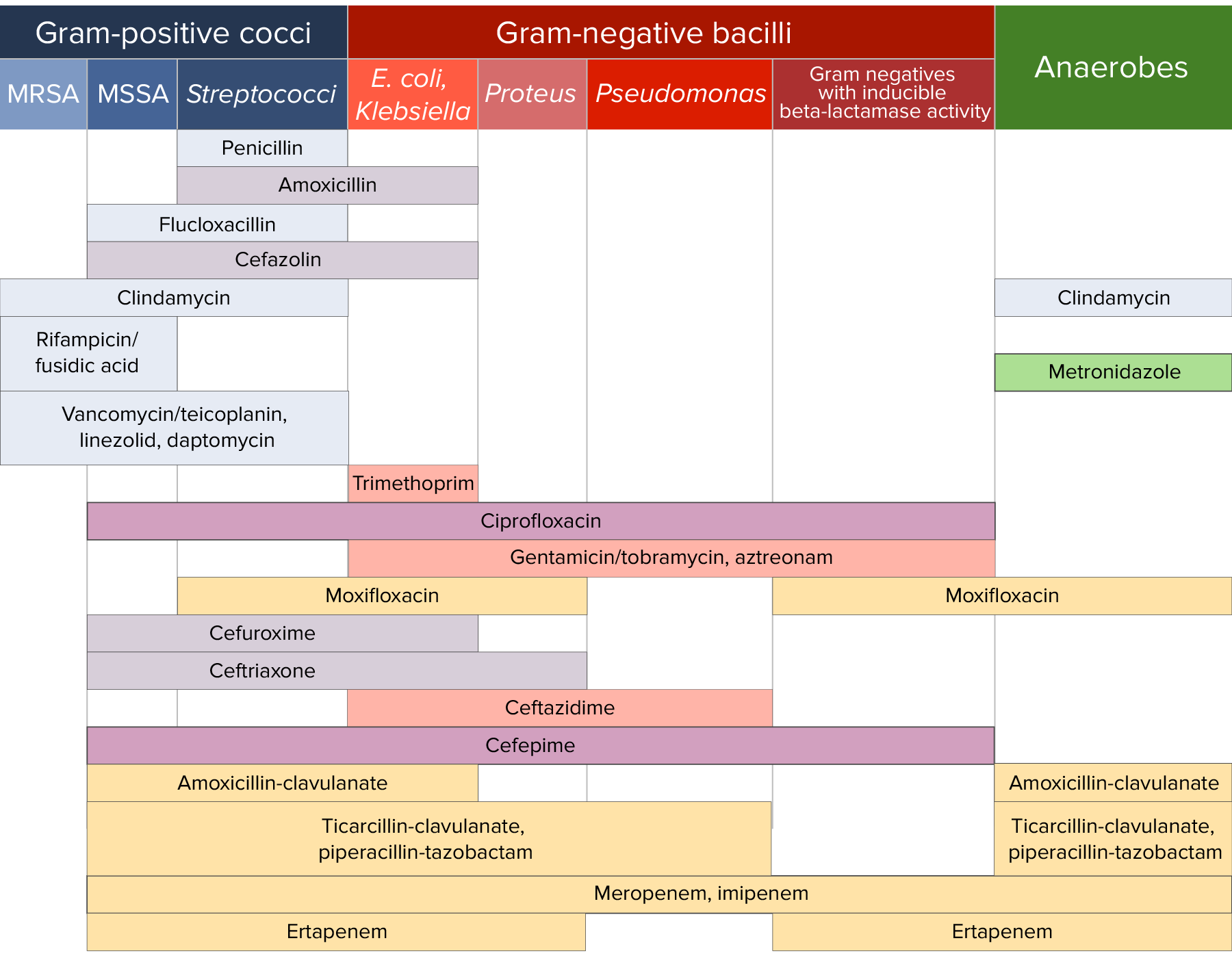
Los LOS Neisseria diferentes antibióticos tienen distintos grados de actividad contra diferentes bacterias. En EN Erythema nodosum is an immune-mediated panniculitis (inflammation of the subcutaneous fat) caused by a type IV (delayed-type) hypersensitivity reaction. It commonly manifests in young women as tender, erythematous nodules on the shins. Erythema Nodosum la siguiente tabla se describen los LOS Neisseria antibióticos que son activos contra 3 clases importantes de bacterias, incluidos los LOS Neisseria cocos Gram-positivos, bacilos Gram-negativos y anaerobios.

Tabla de sensibilidad a los antibióticos

Sensibilidad a los antibióticos:
Gráfico que compara la cobertura microbiana de diferentes antibióticos para cocos Gram-positivos, bacilos Gram-negativos y anaerobios.

Imagen por Lecturio. Licencia: CC BY-NC-SA 4.0

Referencias

  1. McCormack, J., Lalji, F. (2019). The “best” antibiotic sensitivity chart. Retrieved October 16, 2025, from https://therapeuticseducation.org/sites/therapeuticseducation.org/files/Antibiotic_Sensitivity_FINAL_Nov_2019.pdf
  2. Letourneau, A.R. (2023). Beta-lactam antibiotics: Mechanisms of action and resistance and adverse effects. In Bloom, A. (Ed.), UpToDate. Retrieved October 16, 2025, from https://www.uptodate.com/contents/beta-lactam-antibiotics-mechanisms-of-action-and-resistance-and-adverse-effects
  3. Letourneau, A.R. (2025). Cephalosporins. In Bloom, A. (Ed.), UpToDate. Retrieved October 16, 2025, from https://www.uptodate.com/contents/cephalosporins  
  4. Bui, T., and Preuss, C.V. (2024). Cephalosporins. StatPearls. Retrieved October 16, 2025, from https://www.ncbi.nlm.nih.gov/books/NBK551517/ 
  5. Lexicomp, Inc. (2025). Drug Information Sheets, UpToDate, Retrieved October 16, 2025, from:
    ∘ Cephalexin, https://www.uptodate.com/contents/cephalexin-drug-information 
    ∘ Cefazolin, https://www.uptodate.com/contents/cefazolin-drug-information 
    ∘ Cefaclor, https://www.uptodate.com/contents/cefaclor-drug-information 
    ∘ Cefotetan, https://www.uptodate.com/contents/cefotetan-drug-information 
    ∘ Cefoxitin, https://www.uptodate.com/contents/cefoxitin-drug-information 
    ∘ Cefuroxime, https://www.uptodate.com/contents/cefuroxime-drug-information 
    ∘ Ceftriaxone, https://www.uptodate.com/contents/ceftriaxone-drug-information 
    ∘ Ceftazidime, https://www.uptodate.com/contents/ceftazidime-drug-information 
    ∘ Cefepime, https://www.uptodate.com/contents/cefepime-drug-information 
    ∘ Ceftolozane and tazobactam, https://www.uptodate.com/contents/ceftolozane-and-tazobactam-drug-information
    ∘ Ceftaroline, https://www.uptodate.com/contents/ceftaroline-drug-information

¡Crea tu cuenta gratis o inicia una sesión para seguir leyendo!

Regístrate ahora y obtén acceso gratuito a Lecturio con páginas de concepto, videos médicos y cuestionarios para tu educación médica.

User Reviews

Que tengas una sesión de estudio alegre y navideña 🎁 Ahorra 50% en todos los planes >>

Details