Domina Conceptos Médicos

Estudia para la escuela de medicina y tus examenes con Lecturio.

Cáncer Colorrectal

El cáncer colorrectal es la segunda causa de muerte relacionada con el cáncer en Estados Unidos. El cáncer colorrectal es una enfermedad heterogénea que surge de anomalías genéticas y epigenéticas, con influencia de factores ambientales. Casi todos los casos de cáncer colorrectal son adenocarcinomas, y la mayoría de las lesiones provienen de la transformación maligna de un pólipo adenomatoso. Dado que la mayoría de los casos de cáncer colorrectal son asintomáticos, generalmente se recomienda la colonoscopia de tamizaje o análisis de heces en pacientes ≥ 45 años de edad. Junto con el tamizaje, el diagnóstico se realiza mediante colonoscopia, que permite la visualización y la toma de muestras de tejido. El tratamiento es principalmente quirúrgico, y la quimioterapia se reserva para la enfermedad avanzada.

Last updated: Jan 2, 2024

Editorial responsibility: Stanley Oiseth, Lindsay Jones, Evelin Maza

Descripción General

Epidemiología

  • 3er cáncer más frecuente (tanto en EN Erythema nodosum is an immune-mediated panniculitis (inflammation of the subcutaneous fat) caused by a type IV (delayed-type) hypersensitivity reaction. It commonly manifests in young women as tender, erythematous nodules on the shins. Erythema Nodosum hombres como en EN Erythema nodosum is an immune-mediated panniculitis (inflammation of the subcutaneous fat) caused by a type IV (delayed-type) hypersensitivity reaction. It commonly manifests in young women as tender, erythematous nodules on the shins. Erythema Nodosum mujeres)
  • 2da causa de muerte por cáncer en EN Erythema nodosum is an immune-mediated panniculitis (inflammation of the subcutaneous fat) caused by a type IV (delayed-type) hypersensitivity reaction. It commonly manifests in young women as tender, erythematous nodules on the shins. Erythema Nodosum Estados Unidos
  • En EN Erythema nodosum is an immune-mediated panniculitis (inflammation of the subcutaneous fat) caused by a type IV (delayed-type) hypersensitivity reaction. It commonly manifests in young women as tender, erythematous nodules on the shins. Erythema Nodosum Estados Unidos, las tasas de incidencia y mortalidad han ido disminuyendo.
  • La mayoría son adenocarcinomas.
  • La mayoría de los LOS Neisseria cánceres colorrectales surgen de pólipos (adenomatosos o serrados).

Factores de riesgo

  • Edad ≥ 45 años (94% de los LOS Neisseria nuevos casos de cáncer colorrectal)
  • Síndromes hereditarios:
    • Poliposis adenomatosa familiar
    • Cáncer colorrectal hereditario no polipósico o síndrome de Lynch
    • Síndrome de Peutz-Jeghers
    • Poliposis asociada a MUTYH: mutación en EN Erythema nodosum is an immune-mediated panniculitis (inflammation of the subcutaneous fat) caused by a type IV (delayed-type) hypersensitivity reaction. It commonly manifests in young women as tender, erythematous nodules on the shins. Erythema Nodosum el gen de reparación de escisión de bases Bases Usually a hydroxide of lithium, sodium, potassium, rubidium or cesium, but also the carbonates of these metals, ammonia, and the amines. Acid-Base Balance mutY homólogo
    • Antecedentes familiares de cáncer colorrectal
  • Patologías del colon Colon The large intestines constitute the last portion of the digestive system. The large intestine consists of the cecum, appendix, colon (with ascending, transverse, descending, and sigmoid segments), rectum, and anal canal. The primary function of the colon is to remove water and compact the stool prior to expulsion from the body via the rectum and anal canal. Colon, Cecum, and Appendix: Anatomy:
    • Enfermedad inflamatoria intestinal
    • Pólipos adenomatosos grandes o cáncer colorrectal previo
  • Otras afecciones médicas:
    • Fibrosis Fibrosis Any pathological condition where fibrous connective tissue invades any organ, usually as a consequence of inflammation or other injury. Bronchiolitis Obliterans quística
    • Radiación abdominopélvica
    • Condiciones con aumento de la insulina o del factor de crecimiento similar a la insulina (e.g., diabetes Diabetes Diabetes mellitus (DM) is a metabolic disease characterized by hyperglycemia and dysfunction of the regulation of glucose metabolism by insulin. Type 1 DM is diagnosed mostly in children and young adults as the result of autoimmune destruction of β cells in the pancreas and the resulting lack of insulin. Type 2 DM has a significant association with obesity and is characterized by insulin resistance. Diabetes Mellitus, acromegalia, obesidad)
    • Bacteriemia por Streptococcus Streptococcus Streptococcus is one of the two medically important genera of gram-positive cocci, the other being Staphylococcus. Streptococci are identified as different species on blood agar on the basis of their hemolytic pattern and sensitivity to optochin and bacitracin. There are many pathogenic species of streptococci, including S. pyogenes, S. agalactiae, S. pneumoniae, and the viridans streptococci. Streptococcus bovis
    • Trasplante renal
  • Estilo de vida y factores sociales:
    • Tabaquismo y consumo de alcohol (> 4 bebidas/día)
    • Dieta (aumento de grasas, carnes rojas y procesadas, poca fibra)
    • Bajo nivel socioeconómico

Etiología

Pólipos colorrectales

  • Excrecencias anormales de tejido que surgen de la mucosa colónica y se extienden hacia el lumen
  • Lesiones más comunes de las que surge el cáncer colorrectal
  • Morfología:
    • Sésil: pólipo sin tallo, con crecimiento adyacente a la masa
    • Pedunculado: pólipo con un tallo
  • El 30% de la población tiene pólipos a los LOS Neisseria 50 años.

Tipos de pólipos:

  • Pólipos inflamatorios (no neoplásicos)
  • Pólipos hamartomatosos (↑ riesgo de cáncer colorrectal si se asocia a síndrome de Peutz-Jeghers)
  • Lesiones serradas sésiles:
    • Adenomas/pólipos serrados sésiles
    • Adenomas serrados tradicionales
    • Pólipos hiperplásicos (histológicamente similares a los LOS Neisseria adenomas serrados sésiles; no neoplásicos)
  • Pólipos adenomatosos:
    • Tubular (> 80%)
    • Adenomas vellosos (la mayoría son sésiles)
    • Tubulovellosos

Pólipos de alto riesgo:

  • Pólipos > 1 cm de tamaño
  • Adenomas con características vellosas (riesgo de cáncer colorrectal > 3 veces superior al AL Amyloidosis de los LOS Neisseria adenomas tubulares) o displasia de alto grado
  • Pólipos/adenomas serrados
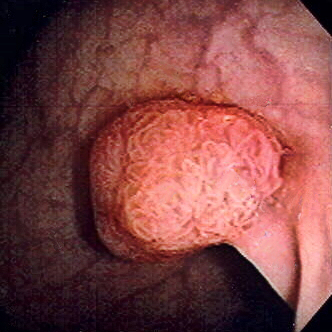
Pólipo de colon

Pólipo de colon sigmoide revelado por colonoscopia: El pólipo es pedunculado (con un tallo corto).

Imagen: “Colon polyp” por Dr. F.C. Turner. Licencia: CC BY 2.5

Desarrollo del cáncer

La mayoría de los LOS Neisseria pólipos son benignos. La transformación maligna se ve VE Ventilation: Mechanics of Breathing afectada por una serie de mutaciones y factores ambientales.

Mutaciones:

  • Mutación en EN Erythema nodosum is an immune-mediated panniculitis (inflammation of the subcutaneous fat) caused by a type IV (delayed-type) hypersensitivity reaction. It commonly manifests in young women as tender, erythematous nodules on the shins. Erythema Nodosum la línea germinal:
    • Se produce antes de la fecundación
    • Puede transmitirse (de padres a hijos)
    • Se encuentra en EN Erythema nodosum is an immune-mediated panniculitis (inflammation of the subcutaneous fat) caused by a type IV (delayed-type) hypersensitivity reaction. It commonly manifests in young women as tender, erythematous nodules on the shins. Erythema Nodosum los LOS Neisseria síndromes hereditarios comunes (e.g., poliposis adenomatosa familiar, síndrome de Lynch), que representan <10% de los LOS Neisseria cánceres colorrectales
  • Mutación somática:
    • Mutación espontánea en EN Erythema nodosum is an immune-mediated panniculitis (inflammation of the subcutaneous fat) caused by a type IV (delayed-type) hypersensitivity reaction. It commonly manifests in young women as tender, erythematous nodules on the shins. Erythema Nodosum el esperma/óvulo o en EN Erythema nodosum is an immune-mediated panniculitis (inflammation of the subcutaneous fat) caused by a type IV (delayed-type) hypersensitivity reaction. It commonly manifests in young women as tender, erythematous nodules on the shins. Erythema Nodosum el cigoto
    • El padre no tiene la mutación, pero la futura descendencia puede heredarla.
    • Se encuentra en EN Erythema nodosum is an immune-mediated panniculitis (inflammation of the subcutaneous fat) caused by a type IV (delayed-type) hypersensitivity reaction. It commonly manifests in young women as tender, erythematous nodules on the shins. Erythema Nodosum los LOS Neisseria cánceres colorrectales esporádicos (> 70%)

Gen poliposis adenomatosa coli:

  • La mayoría de los LOS Neisseria cánceres colorrectales comienzan con la inactivación del gen poliposis adenomatosa coli ( APC APC A polyposis syndrome due to an autosomal dominant mutation of the apc genes on chromosome 5. The syndrome is characterized by the development of hundreds of adenomatous polyps in the colon and rectum of affected individuals by early adulthood. Familial Adenomatous Polyposis) (ya sea por una mutación de la línea germinal o somática).
  • Los LOS Neisseria cánceres colorrectales tardan entre 10–15 años en EN Erythema nodosum is an immune-mediated panniculitis (inflammation of the subcutaneous fat) caused by a type IV (delayed-type) hypersensitivity reaction. It commonly manifests in young women as tender, erythematous nodules on the shins. Erythema Nodosum desarrollarse, pero pueden avanzar en EN Erythema nodosum is an immune-mediated panniculitis (inflammation of the subcutaneous fat) caused by a type IV (delayed-type) hypersensitivity reaction. It commonly manifests in young women as tender, erythematous nodules on the shins. Erythema Nodosum menos tiempo en EN Erythema nodosum is an immune-mediated panniculitis (inflammation of the subcutaneous fat) caused by a type IV (delayed-type) hypersensitivity reaction. It commonly manifests in young women as tender, erythematous nodules on the shins. Erythema Nodosum determinadas condiciones.
  • La proteína poliposis adenomatosa coli, codificada por el gen poliposis adenomatosa coli, promueve la degradación de la β-catenina.
  • Sin la proteína poliposis adenomatosa coli:
    • La β-catenina activa la transcripción dependiente del factor de células T de genes Genes A category of nucleic acid sequences that function as units of heredity and which code for the basic instructions for the development, reproduction, and maintenance of organisms. DNA Types and Structure diana específicos.
    • Estos genes Genes A category of nucleic acid sequences that function as units of heredity and which code for the basic instructions for the development, reproduction, and maintenance of organisms. DNA Types and Structure incluyen MYC y ciclina D1 ( oncogenes Oncogenes Genes whose gain-of-function alterations lead to neoplastic cell transformation. They include, for example, genes for activators or stimulators of cell proliferation such as growth factors, growth factor receptors, protein kinases, signal transducers, nuclear phosphoproteins, and transcription factors. A prefix of ‘v-‘ before oncogene symbols indicates oncogenes captured and transmitted by retroviruses; the prefix ‘c-‘ before the gene symbol of an oncogene indicates it is the cellular homolog (proto-oncogenes) of a v-oncogene. Carcinogenesis), que promueven la proliferación.
  • Mutaciones del gen poliposis adenomatosa coli: el evento que inicia la formación del adenoma, pero se requieren múltiples impactos genéticos para la progresión del cáncer colorrectal

Fisiopatología

Poliposis adenomatosa coli

La mutación del gen poliposis adenomatosa coli es inicial

  • La mayoría de los LOS Neisseria adenomas y los LOS Neisseria cánceres colorrectales comienzan con la inactivación del gen poliposis adenomatosa coli (ya sea por mutación germinal o somática).
  • Tras el acontecimiento inicial, los LOS Neisseria cánceres colorrectales tardan entre 10–15 años en EN Erythema nodosum is an immune-mediated panniculitis (inflammation of the subcutaneous fat) caused by a type IV (delayed-type) hypersensitivity reaction. It commonly manifests in young women as tender, erythematous nodules on the shins. Erythema Nodosum desarrollarse (menos tiempo en EN Erythema nodosum is an immune-mediated panniculitis (inflammation of the subcutaneous fat) caused by a type IV (delayed-type) hypersensitivity reaction. It commonly manifests in young women as tender, erythematous nodules on the shins. Erythema Nodosum determinadas condiciones).
  • La proteína poliposis adenomatosa coli, codificada por el gen poliposis adenomatosa coli, promueve la degradación de la β-catenina.
  • Sin la proteína poliposis adenomatosa coli:
    • La β-catenina (de la vía WnT) activa la transcripción dependiente de factor de células T de genes Genes A category of nucleic acid sequences that function as units of heredity and which code for the basic instructions for the development, reproduction, and maintenance of organisms. DNA Types and Structure diana específicos.
    • Estos genes Genes A category of nucleic acid sequences that function as units of heredity and which code for the basic instructions for the development, reproduction, and maintenance of organisms. DNA Types and Structure incluyen MYC y ciclina D1 ( oncogenes Oncogenes Genes whose gain-of-function alterations lead to neoplastic cell transformation. They include, for example, genes for activators or stimulators of cell proliferation such as growth factors, growth factor receptors, protein kinases, signal transducers, nuclear phosphoproteins, and transcription factors. A prefix of ‘v-‘ before oncogene symbols indicates oncogenes captured and transmitted by retroviruses; the prefix ‘c-‘ before the gene symbol of an oncogene indicates it is the cellular homolog (proto-oncogenes) of a v-oncogene. Carcinogenesis), que promueven la proliferación.

Mecanismos moleculares de la carcinogénesis

La progresión del cáncer colorrectal requiere múltiples golpes genéticos.

Acumulación de mutaciones y eventos moleculares:

La acumulación de mutaciones y eventos moleculares (e.g., alteración genética, metilación del ADN, sobreexpresión) contribuye a la carcinogénesis.

  • Inestabilidad cromosómica:
    • Aberraciones cromosómicas estructurales (deleciones o pérdida de heterocigosidad)
    • Da lugar a la promoción de oncogenes Oncogenes Genes whose gain-of-function alterations lead to neoplastic cell transformation. They include, for example, genes for activators or stimulators of cell proliferation such as growth factors, growth factor receptors, protein kinases, signal transducers, nuclear phosphoproteins, and transcription factors. A prefix of ‘v-‘ before oncogene symbols indicates oncogenes captured and transmitted by retroviruses; the prefix ‘c-‘ before the gene symbol of an oncogene indicates it is the cellular homolog (proto-oncogenes) of a v-oncogene. Carcinogenesis o a la reducción de genes Genes A category of nucleic acid sequences that function as units of heredity and which code for the basic instructions for the development, reproduction, and maintenance of organisms. DNA Types and Structure supresores de tumores
    • Se observa en EN Erythema nodosum is an immune-mediated panniculitis (inflammation of the subcutaneous fat) caused by a type IV (delayed-type) hypersensitivity reaction. It commonly manifests in young women as tender, erythematous nodules on the shins. Erythema Nodosum las alteraciones genéticas del gen poliposis adenomatosa coli
    • Otros genes Genes A category of nucleic acid sequences that function as units of heredity and which code for the basic instructions for the development, reproduction, and maintenance of organisms. DNA Types and Structure: DCC, TP53/p53 y SMAD4 ( genes Genes A category of nucleic acid sequences that function as units of heredity and which code for the basic instructions for the development, reproduction, and maintenance of organisms. DNA Types and Structure supresores de tumores) o KRAS (un protooncogen)
    • El 85% de los LOS Neisseria cánceres colorrectales se desarrollan a través de este mecanismo.
  • Inestabilidad microsatelital:
    • También se denomina fenotipo mutante/vía de reparación de desajustes
    • Microsatélites: secuencias cortas, repetidas y anormales, de bases Bases Usually a hydroxide of lithium, sodium, potassium, rubidium or cesium, but also the carbonates of these metals, ammonia, and the amines. Acid-Base Balance de nucleótidos, causadas por una deficiencia en EN Erythema nodosum is an immune-mediated panniculitis (inflammation of the subcutaneous fat) caused by a type IV (delayed-type) hypersensitivity reaction. It commonly manifests in young women as tender, erythematous nodules on the shins. Erythema Nodosum la reparación de los LOS Neisseria desajustes.
    • Causa: mutación en EN Erythema nodosum is an immune-mediated panniculitis (inflammation of the subcutaneous fat) caused by a type IV (delayed-type) hypersensitivity reaction. It commonly manifests in young women as tender, erythematous nodules on the shins. Erythema Nodosum la línea germinal de los LOS Neisseria genes Genes A category of nucleic acid sequences that function as units of heredity and which code for the basic instructions for the development, reproduction, and maintenance of organisms. DNA Types and Structure MLH1, MSH2 o PMS2 que conduce a la disfunción de las enzimas de reparación de desajustes del ADN
    • Acumulación de microsatélites: se encuentra en EN Erythema nodosum is an immune-mediated panniculitis (inflammation of the subcutaneous fat) caused by a type IV (delayed-type) hypersensitivity reaction. It commonly manifests in young women as tender, erythematous nodules on the shins. Erythema Nodosum los LOS Neisseria tumores con inestabilidad microsatelital elevada
    • Sello biológico del síndrome de Lynch
    • Se observa hasta en EN Erythema nodosum is an immune-mediated panniculitis (inflammation of the subcutaneous fat) caused by a type IV (delayed-type) hypersensitivity reaction. It commonly manifests in young women as tender, erythematous nodules on the shins. Erythema Nodosum el 15% de los LOS Neisseria cánceres colorrectales esporádicos
  • Vía del fenotipo metilador de islas CpG (CIMP+):
    • La hipo o hipermetilación del ADN puede modificar la expresión de los LOS Neisseria genes Genes A category of nucleic acid sequences that function as units of heredity and which code for the basic instructions for the development, reproduction, and maintenance of organisms. DNA Types and Structure.
    • En EN Erythema nodosum is an immune-mediated panniculitis (inflammation of the subcutaneous fat) caused by a type IV (delayed-type) hypersensitivity reaction. It commonly manifests in young women as tender, erythematous nodules on the shins. Erythema Nodosum los LOS Neisseria genes Genes A category of nucleic acid sequences that function as units of heredity and which code for the basic instructions for the development, reproduction, and maintenance of organisms. DNA Types and Structure supresores de tumores se produce una alta metilación de las islas CpG (citosina seguida de una base de guanina, unida por un enlace fosfodiéster).
    • La metilación inactiva el gen supresor tumoral, lo que conduce a la progresión del tumor Tumor Inflammation.
    • Se encuentra en EN Erythema nodosum is an immune-mediated panniculitis (inflammation of the subcutaneous fat) caused by a type IV (delayed-type) hypersensitivity reaction. It commonly manifests in young women as tender, erythematous nodules on the shins. Erythema Nodosum los LOS Neisseria tumores CIMP+

Sobreexpresión de la ciclooxigenasa (COX)-2:

  • COX-2: se sobreexpresa en EN Erythema nodosum is an immune-mediated panniculitis (inflammation of the subcutaneous fat) caused by a type IV (delayed-type) hypersensitivity reaction. It commonly manifests in young women as tender, erythematous nodules on the shins. Erythema Nodosum el 43% de los LOS Neisseria adenomas y en EN Erythema nodosum is an immune-mediated panniculitis (inflammation of the subcutaneous fat) caused by a type IV (delayed-type) hypersensitivity reaction. It commonly manifests in young women as tender, erythematous nodules on the shins. Erythema Nodosum el 86% de los LOS Neisseria carcinomas
  • La inhibición de la COX-2 reduce el número de pólipos intestinales.

Mecanismos morfológicos de la carcinogénesis

Secuencia adenoma-carcinoma:

  • Secuencia seguida por la mayoría de los LOS Neisseria cánceres colorrectales
  • Progresión: adenoma temprano (tubular o tubulovelloso) → adenoma avanzado (velloso) → adenocarcinoma
  • Pólipos adenomatosos:
    • Se desarrolla con la renovación epitelial interrumpida
    • La sustitución del revestimiento celular superficial se vuelve displásica a medida que los LOS Neisseria adenomas aumentan de tamaño.
  • Mutación del gen poliposis adenomatosa coli es común
  • Vía(s) molecular(es) asociada(s): inestabilidad cromosómica
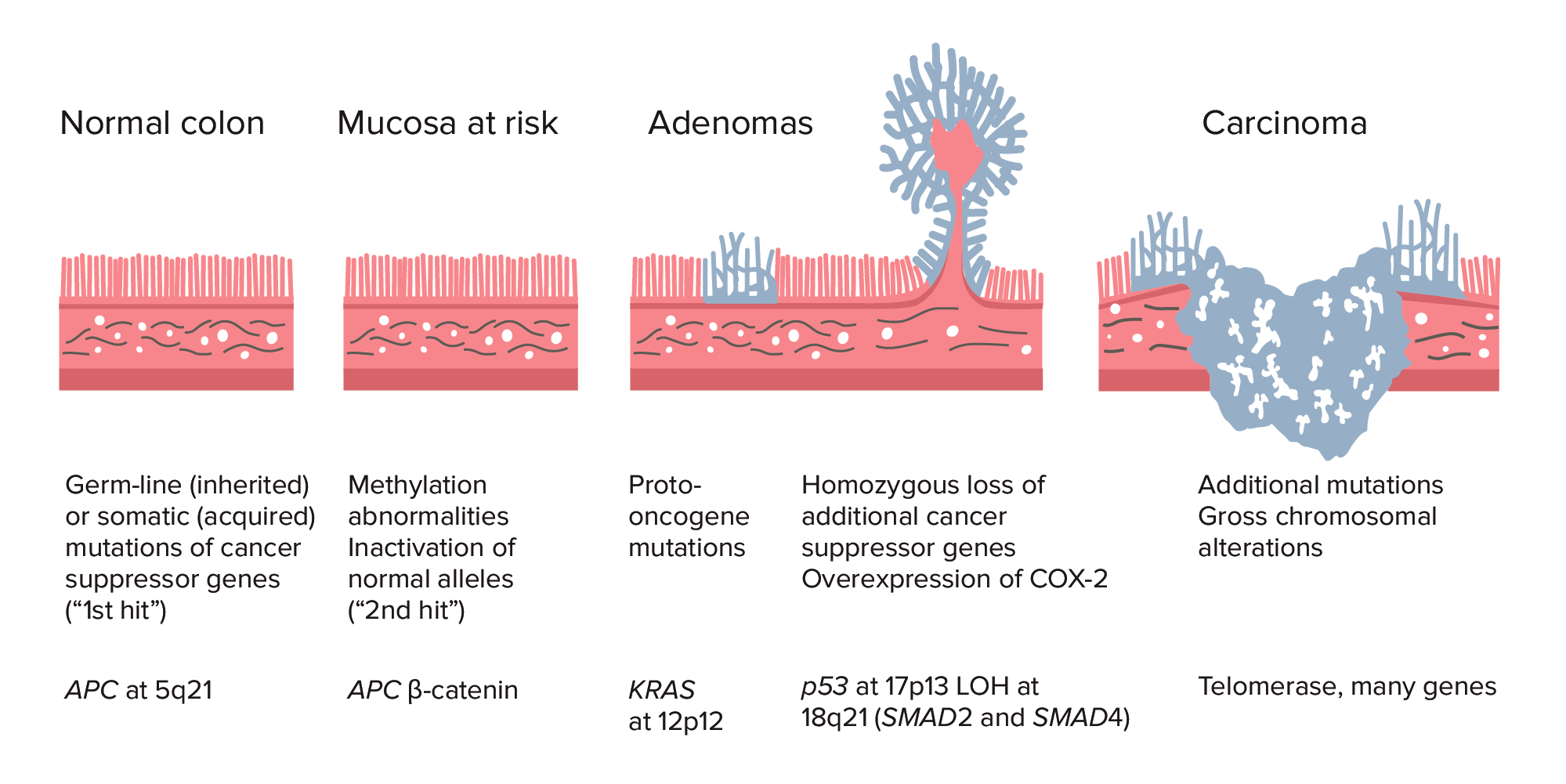
Adenoma-carcinoma sequence

Adenoma–carcinoma sequence from normal colon to carcinoma:
Colorectal cancer (CRC) formation begins with APC gene mutation (inherited or acquired) and methylation abnormalities. Other changes can include KRAS gene mutation. Late in the process, p53 deletion, loss of heterozygosity (LOH) at 18q21 (involving SMAD2 and SMAD4), with overexpression of COX-2 can contribute to further growth and progression to cancer. The accumulation of mutations, rather than the timing of occurrence, is most crucial in carcinogenesis.

Image by Lecturio. License: CC BY-NC-SA 4.0

Vía de los LOS Neisseria pólipos serrados:
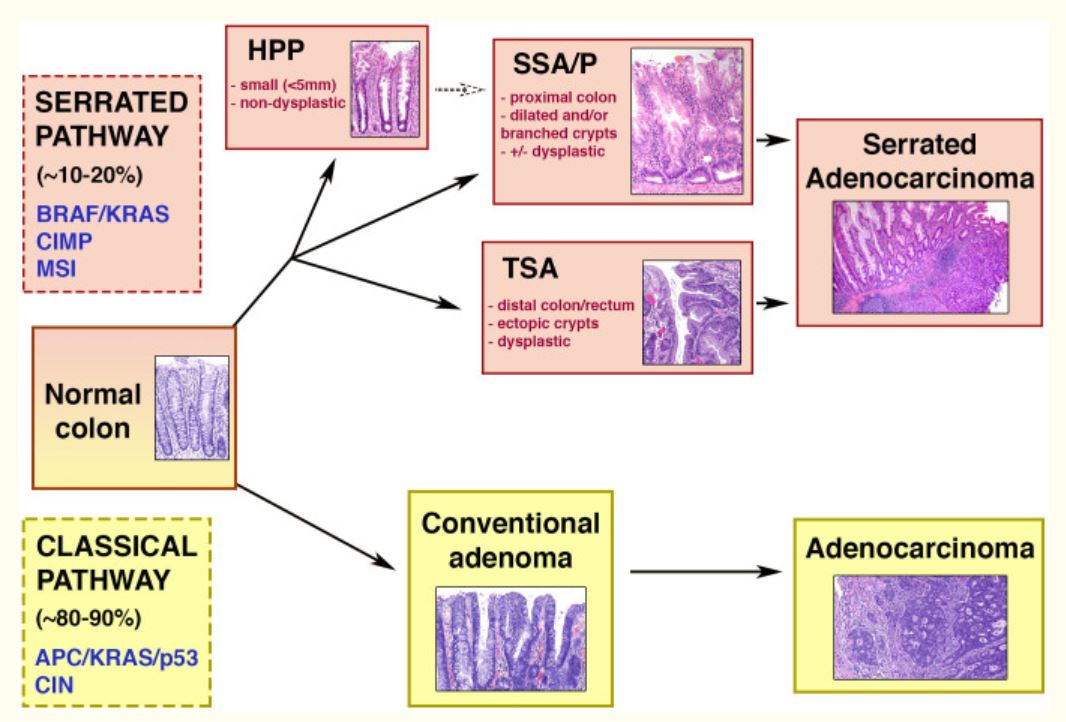
  • Pólipos serrados: también tienen potencial maligno
  • Se ve VE Ventilation: Mechanics of Breathing en EN Erythema nodosum is an immune-mediated panniculitis (inflammation of the subcutaneous fat) caused by a type IV (delayed-type) hypersensitivity reaction. It commonly manifests in young women as tender, erythematous nodules on the shins. Erythema Nodosum 10%–20% de los LOS Neisseria casos
  • Progresión: pólipo serrado sésil/adenoma → adenocarcinoma
  • Activación del oncogén BRAF con mutaciones KRAS observadas
  • Vía/s molecular/es asociada/s:
    • CIMP (principal mecanismo que impulsa la vía serrada hacia el cancer colorrectal)
    • Inestabilidad microsatelital
Adenoma-carcinoma clásico y vías serradas

Diagrama esquemático de las vías clásicas (adenoma-carcinoma) y serrada.
Mitad superior: vía serrada de la carcinogénesis colorrectal, que se da en 10%–20% de los cánceres colorrectales. La vía está asociada a las siguientes características genéticas: mutaciones BRAF/KRAS, MSI (inestabilidad microsatelital) y CIMP (fenotipo metilador de islas CpG). Las lesiones serradas pueden ser pólipos hiperplásicos (HPP), adenomas/pólipos serrados sésiles (SSA/Ps) y adenomas serrados tradicionales (TSA). Estos dos últimos están asociados a la displasia y a la progresión hacia el carcinoma.
Mitad inferior: adenoma-carcinoma o vía clásica, que se da en la mayoría de los cánceres colorrectales. Entre las características genéticas se encuentran las mutaciones en los genes APC/KRAS/p53 y la inestabilidad cromosómica (CIN). A través de esta secuencia, el adenoma se convierte en adenocarcinoma.
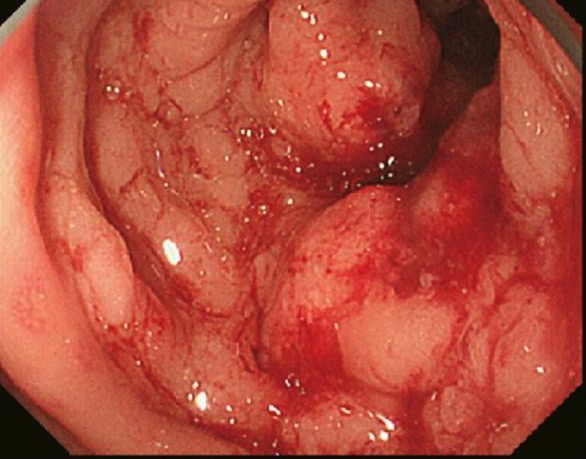
Imagen: “Schematic diagram of the classical (adenoma-carcinoma) and serrated pathways” por Centre for Tumor Biology, Barts Cancer Institute, Barts and the London School of Medicine and Dentistry, Queen Mary University of London, London, UK. Licencia: CC BY 4.0

Presentación Clínica

Hallazgos clínicos generales

  • A menudo asintomáticos, con cáncer colorrectal detectado en EN Erythema nodosum is an immune-mediated panniculitis (inflammation of the subcutaneous fat) caused by a type IV (delayed-type) hypersensitivity reaction. It commonly manifests in young women as tender, erythematous nodules on the shins. Erythema Nodosum la colonoscopia de tamizaje
  • Sintomático:
    • Características sistémicas: debilidad, anemia Anemia Anemia is a condition in which individuals have low Hb levels, which can arise from various causes. Anemia is accompanied by a reduced number of RBCs and may manifest with fatigue, shortness of breath, pallor, and weakness. Subtypes are classified by the size of RBCs, chronicity, and etiology. Anemia: Overview and Types, pérdida de peso
    • La anemia Anemia Anemia is a condition in which individuals have low Hb levels, which can arise from various causes. Anemia is accompanied by a reduced number of RBCs and may manifest with fatigue, shortness of breath, pallor, and weakness. Subtypes are classified by the size of RBCs, chronicity, and etiology. Anemia: Overview and Types ferropénica en EN Erythema nodosum is an immune-mediated panniculitis (inflammation of the subcutaneous fat) caused by a type IV (delayed-type) hypersensitivity reaction. It commonly manifests in young women as tender, erythematous nodules on the shins. Erythema Nodosum un paciente de edad avanzada indica cáncer de colon Colon The large intestines constitute the last portion of the digestive system. The large intestine consists of the cecum, appendix, colon (with ascending, transverse, descending, and sigmoid segments), rectum, and anal canal. The primary function of the colon is to remove water and compact the stool prior to expulsion from the body via the rectum and anal canal. Colon, Cecum, and Appendix: Anatomy hasta que se demuestre lo contrario.
    • Depende de la localización

Carcinomas del lado derecho

  • Los LOS Neisseria síntomas obstructivos no son frecuentes:
    • Las heces en EN Erythema nodosum is an immune-mediated panniculitis (inflammation of the subcutaneous fat) caused by a type IV (delayed-type) hypersensitivity reaction. It commonly manifests in young women as tender, erythematous nodules on the shins. Erythema Nodosum la zona (de la válvula ileocecal al AL Amyloidosis colon Colon The large intestines constitute the last portion of the digestive system. The large intestine consists of the cecum, appendix, colon (with ascending, transverse, descending, and sigmoid segments), rectum, and anal canal. The primary function of the colon is to remove water and compact the stool prior to expulsion from the body via the rectum and anal canal. Colon, Cecum, and Appendix: Anatomy ascendente) siguen siendo líquidas.
    • El lumen es más grande (que el lado izquierdo).
  • Las lesiones pueden crecer, ulcerarse y provocar pérdidas de sangre oculta:
    • Anemia Anemia Anemia is a condition in which individuals have low Hb levels, which can arise from various causes. Anemia is accompanied by a reduced number of RBCs and may manifest with fatigue, shortness of breath, pallor, and weakness. Subtypes are classified by the size of RBCs, chronicity, and etiology. Anemia: Overview and Types ferropénica: fatiga, angina, palpitaciones
    • Melena Melena The black, tarry, foul-smelling feces that contain degraded blood. Gastrointestinal Bleeding

Carcinomas del lado izquierdo

  • Las heces se forman desde el colon Colon The large intestines constitute the last portion of the digestive system. The large intestine consists of the cecum, appendix, colon (with ascending, transverse, descending, and sigmoid segments), rectum, and anal canal. The primary function of the colon is to remove water and compact the stool prior to expulsion from the body via the rectum and anal canal. Colon, Cecum, and Appendix: Anatomy transverso hasta el descendente.
  • Así, las lesiones cancerosas pueden impedir el paso de las heces, provocando:
    • Calambres abdominales o dolores tipo cólico
    • Cambios en EN Erythema nodosum is an immune-mediated panniculitis (inflammation of the subcutaneous fat) caused by a type IV (delayed-type) hypersensitivity reaction. It commonly manifests in young women as tender, erythematous nodules on the shins. Erythema Nodosum los LOS Neisseria hábitos intestinales (estreñimiento alternado con heces blandas)
    • Heces con sangre o hematoquecia
    • Disminución del calibre de las heces debido a la obstrucción

Cánceres rectales

  • Masa ulcerosa palpable en EN Erythema nodosum is an immune-mediated panniculitis (inflammation of the subcutaneous fat) caused by a type IV (delayed-type) hypersensitivity reaction. It commonly manifests in young women as tender, erythematous nodules on the shins. Erythema Nodosum el tacto rectal
  • Tenesmo
  • Hemorragia rectal
  • Obstrucción

Metástasis

  • Los LOS Neisseria cánceres colorrectales hacen metástasis por extensión directa o por vía hematógena y linfática.
  • Sitios de metástasis:
    • Hígado (1er lugar de los LOS Neisseria tumores intestinales): distensión abdominal, ictericia, ascitis, hepatomegalia
    • Pulmones (1er lugar para los LOS Neisseria tumores rectales distales): tos TOS Thoracic outlet syndrome (TOS) is a broad term used for a spectrum of syndromes related to the general region of the thoracic outlet, which involves the compression or irritation of elements of the brachial plexus, subclavian artery, or subclavian vein. Thoracic Outlet Syndrome, disnea (puede ser por derrame pleural), hemoptisis

Diagnóstico

Colonoscopia

  • Prueba diagnóstica de elección
  • Se puede realizar la visualización de la(s) lesión(es) y la toma de muestras de tejido (biopsia o extirpación de la lesión).
  • Colonoscopia de tamizaje:
    • Pacientes asintomáticos
    • Para la población con riesgo promedio: se realiza a partir de los LOS Neisseria 45 años
    • El tamizaje a una edad más temprana depende de las condiciones y los LOS Neisseria riesgos.
  • Colonoscopia diagnóstica:
    • Realizado en EN Erythema nodosum is an immune-mediated panniculitis (inflammation of the subcutaneous fat) caused by a type IV (delayed-type) hypersensitivity reaction. It commonly manifests in young women as tender, erythematous nodules on the shins. Erythema Nodosum pacientes sintomáticos
    • Indicado para aquellos con estudios de imagenología anormal
  • Hallazgos:
    • Pólipos
    • Carcinoma:
      • Masas exofíticas voluminosas
      • Lesiones anulares constrictoras
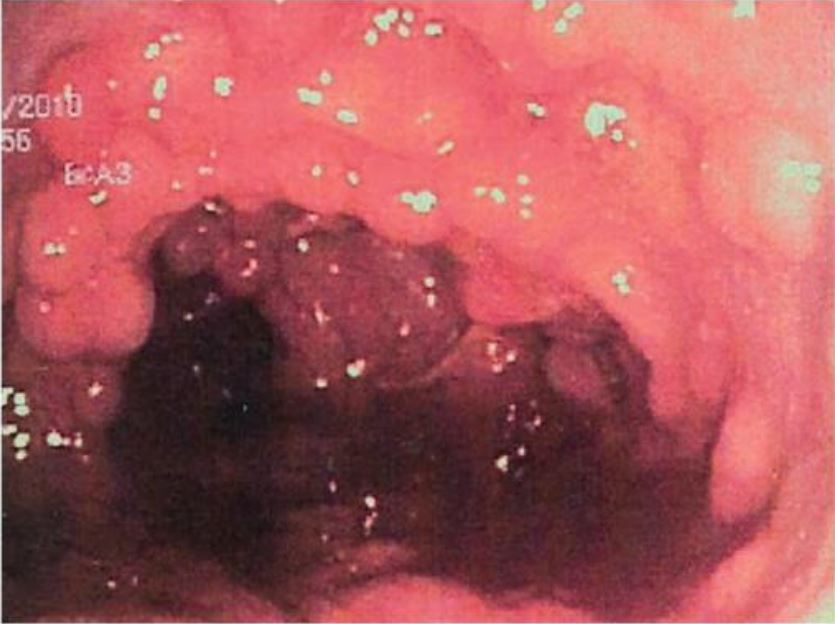
Cáncer de colon

Cáncer de colon detectado en la colonoscopia y confirmado mediante biopsia

Imagen: “Primary tumor” por Second Department of Surgery, Wakayama Medical University, School of Medicine, 811-1 Kimiidera, Wakayama 641-8510, Japan. Licencia: CC BY 2.0
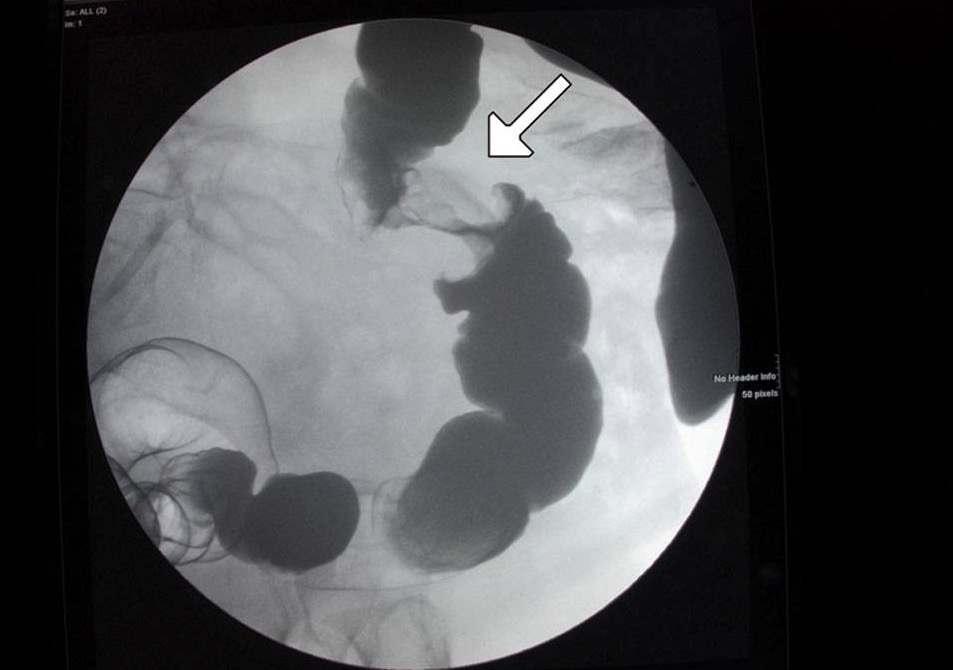
Colonografía por tomografía computarizada (TC)

  • Colonoscopia virtual
  • Requiere preparación mecánica
  • Puede utilizarse en EN Erythema nodosum is an immune-mediated panniculitis (inflammation of the subcutaneous fat) caused by a type IV (delayed-type) hypersensitivity reaction. It commonly manifests in young women as tender, erythematous nodules on the shins. Erythema Nodosum colonoscopias incompletas (e.g., obstrucción, colon Colon The large intestines constitute the last portion of the digestive system. The large intestine consists of the cecum, appendix, colon (with ascending, transverse, descending, and sigmoid segments), rectum, and anal canal. The primary function of the colon is to remove water and compact the stool prior to expulsion from the body via the rectum and anal canal. Colon, Cecum, and Appendix: Anatomy tortuoso) o como prueba diagnóstica inicial
  • La colonoscopia sigue siendo el estándar de oro.
  • Limitaciones:
    • Los LOS Neisseria pacientes deben ser capaces de canalizar flatos
    • No se puede realizar una biopsia o una extirpación de la lesión

PILLCam 2

  • Endoscopia con cápsula de colon Colon The large intestines constitute the last portion of the digestive system. The large intestine consists of the cecum, appendix, colon (with ascending, transverse, descending, and sigmoid segments), rectum, and anal canal. The primary function of the colon is to remove water and compact the stool prior to expulsion from the body via the rectum and anal canal. Colon, Cecum, and Appendix: Anatomy: El paciente ingiere un endoscopio del tamaño de una cápsula.
  • Considerar en EN Erythema nodosum is an immune-mediated panniculitis (inflammation of the subcutaneous fat) caused by a type IV (delayed-type) hypersensitivity reaction. It commonly manifests in young women as tender, erythematous nodules on the shins. Erythema Nodosum pacientes con colonoscopia incompleta
  • Los LOS Neisseria pacientes no deben tener ninguna obstrucción.

Imagenología adicional

  • El enema de bario con contraste de aire puede mostrar la lesión en EN Erythema nodosum is an immune-mediated panniculitis (inflammation of the subcutaneous fat) caused by a type IV (delayed-type) hypersensitivity reaction. It commonly manifests in young women as tender, erythematous nodules on the shins. Erythema Nodosum coronta de manzana.
  • TC:
    • Para la estadificación preoperatoria
    • Detecta las complicaciones asociadas (e.g., obstrucción, perforación, fístula)
    • Detecta las metástasis
  • Resonancia magnética (RM) pélvica o ultrasonido endoscópico transrectal:
    • Para los LOS Neisseria cánceres de recto
    • Para evaluar la profundidad del cáncer a través de la pared rectal y los LOS Neisseria ganglios linfáticos perirectales

Pruebas de laboratorio

  • Antígeno carcinoembrionario:
    • Marcador tumoral para el cáncer colorrectal; se obtiene en EN Erythema nodosum is an immune-mediated panniculitis (inflammation of the subcutaneous fat) caused by a type IV (delayed-type) hypersensitivity reaction. It commonly manifests in young women as tender, erythematous nodules on the shins. Erythema Nodosum cáncer colorrectal comprobado
    • No se utiliza como prueba de tamizaje o de diagnóstico
    • Valor pronóstico: el antígeno carcinoembrionario preoperatorio > 5 ng/mL tiene peor pronóstico.
    • Ausencia de normalización de los LOS Neisseria valores después de la cirugía: indicativo de enfermedad persistente
  • Hemograma: puede mostrar anemia Anemia Anemia is a condition in which individuals have low Hb levels, which can arise from various causes. Anemia is accompanied by a reduced number of RBCs and may manifest with fatigue, shortness of breath, pallor, and weakness. Subtypes are classified by the size of RBCs, chronicity, and etiology. Anemia: Overview and Types
  • Panel metabólico:
    • Puede mostrar anormalidades metabólicas adicionales
    • Fosfatasa alcalina elevada: la anomalía hepática más común asociada a las metástasis hepáticas

Estadificación

Después de establecer el diagnóstico de cáncer colorrectal, es necesario estadificar la enfermedad para un tratamiento adecuado.

Sistema de estadificación TNM ( tumor Tumor Inflammation, nódulos (ganglios), metástasis):

  • Determina la extensión de la enfermedad
  • Hallazgos basados en EN Erythema nodosum is an immune-mediated panniculitis (inflammation of the subcutaneous fat) caused by a type IV (delayed-type) hypersensitivity reaction. It commonly manifests in young women as tender, erythematous nodules on the shins. Erythema Nodosum:
    • Examen preoperatorio (e.g., ascitis, ganglios linfáticos)
    • Resultados de la imagenología:
      • TC (tórax/abdomen/ pelvis Pelvis The pelvis consists of the bony pelvic girdle, the muscular and ligamentous pelvic floor, and the pelvic cavity, which contains viscera, vessels, and multiple nerves and muscles. The pelvic girdle, composed of 2 “hip” bones and the sacrum, is a ring-like bony structure of the axial skeleton that links the vertebral column with the lower extremities. Pelvis: Anatomy)
      • RM (identifica más lesiones hepáticas metastásicas)
      • Ultrasonido endoscópico transrectal (para el cáncer de recto)
    • Endoscopia (con biopsia) y biopsia de ganglios linfáticos
Estadio Tumor Tumor Inflammation (T) Nódulos (ganglios) linfáticos regionales (N) Metástasis a distancia (M)
Estadio 0
  • Tis: carcinoma in situ Carcinoma in situ A lesion with cytological characteristics associated with invasive carcinoma but the tumor cells are confined to the epithelium of origin, without invasion of the basement membrane. Leukoplakia (carcinoma intramucoso)
  • N0: no hay ganglios linfáticos regionales afectados
  • M0: sin metástasis a distancia
Estadio I
  • T1: invasión en EN Erythema nodosum is an immune-mediated panniculitis (inflammation of the subcutaneous fat) caused by a type IV (delayed-type) hypersensitivity reaction. It commonly manifests in young women as tender, erythematous nodules on the shins. Erythema Nodosum la submucosa a través de la muscularis mucosa
  • T2: invasión en EN Erythema nodosum is an immune-mediated panniculitis (inflammation of the subcutaneous fat) caused by a type IV (delayed-type) hypersensitivity reaction. It commonly manifests in young women as tender, erythematous nodules on the shins. Erythema Nodosum la muscularis propria
  • N0: no hay ganglios linfáticos regionales afectados
  • M0: sin metástasis a distancia
Estadio II
  • T3 T3 A T3 thyroid hormone normally synthesized and secreted by the thyroid gland in much smaller quantities than thyroxine (T4). Most T3 is derived from peripheral monodeiodination of T4 at the 5′ position of the outer ring of the iodothyronine nucleus. The hormone finally delivered and used by the tissues is mainly t3. Thyroid Hormones: invasión a través de la muscularis propria y en EN Erythema nodosum is an immune-mediated panniculitis (inflammation of the subcutaneous fat) caused by a type IV (delayed-type) hypersensitivity reaction. It commonly manifests in young women as tender, erythematous nodules on the shins. Erythema Nodosum los LOS Neisseria tejidos pericolorrectales
  • T4a: invasión a través del peritoneo visceral
  • T4b: invade o se adhiere a órganos o estructuras adyacentes
  • N0: no hay ganglios linfáticos regionales afectados
  • M0: sin metástasis a distancia
Estadio III
  • Cualquier T
  • N1: metástasis en EN Erythema nodosum is an immune-mediated panniculitis (inflammation of the subcutaneous fat) caused by a type IV (delayed-type) hypersensitivity reaction. It commonly manifests in young women as tender, erythematous nodules on the shins. Erythema Nodosum 1–3 ganglios linfáticos regionales o cualquier número de depósitos tumorales presentes y todos los LOS Neisseria ganglios linfáticos identificables son negativos
    N2: metástasis en EN Erythema nodosum is an immune-mediated panniculitis (inflammation of the subcutaneous fat) caused by a type IV (delayed-type) hypersensitivity reaction. It commonly manifests in young women as tender, erythematous nodules on the shins. Erythema Nodosum 4 o más ganglios linfáticos regionales
  • M0: sin metástasis a distancia
Estadio IV
  • Cualquier T
  • Cualquier N
  • M1a: metástasis en EN Erythema nodosum is an immune-mediated panniculitis (inflammation of the subcutaneous fat) caused by a type IV (delayed-type) hypersensitivity reaction. It commonly manifests in young women as tender, erythematous nodules on the shins. Erythema Nodosum 1 sitio u órgano; sin metástasis peritoneal
  • M1b: metástasis en EN Erythema nodosum is an immune-mediated panniculitis (inflammation of the subcutaneous fat) caused by a type IV (delayed-type) hypersensitivity reaction. It commonly manifests in young women as tender, erythematous nodules on the shins. Erythema Nodosum 2 o más sitios; sin metástasis peritoneal
  • M1c: metástasis en EN Erythema nodosum is an immune-mediated panniculitis (inflammation of the subcutaneous fat) caused by a type IV (delayed-type) hypersensitivity reaction. It commonly manifests in young women as tender, erythematous nodules on the shins. Erythema Nodosum la superficie peritoneal (sola o con metástasis en EN Erythema nodosum is an immune-mediated panniculitis (inflammation of the subcutaneous fat) caused by a type IV (delayed-type) hypersensitivity reaction. It commonly manifests in young women as tender, erythematous nodules on the shins. Erythema Nodosum otro sitio)

Related videos

Prevención

  • Adultos (50–59 años):
    • United States Preventive Services Taskforce: aspirina en EN Erythema nodosum is an immune-mediated panniculitis (inflammation of the subcutaneous fat) caused by a type IV (delayed-type) hypersensitivity reaction. It commonly manifests in young women as tender, erythematous nodules on the shins. Erythema Nodosum dosis bajas para prevención del cáncer colorrectal
    • Los LOS Neisseria individuos deben tener:
      • Sin riesgo de hemorragia
      • Al AL Amyloidosis menos 10 años de esperanza de vida
      • ≥ 10% del riesgo de ECV ECV A procedure in which the physician attempts to manually rotate the fetus from a breech to a cephalic presentation by pushing on the maternal abdomen Fetal Malpresentation and Malposition a 10 años
  • Individuos con riesgo promedio:
    • Iniciado a los LOS Neisseria 45 años de edad
    • Opciones de tamizaje:
      • Prueba anual de sangre oculta en EN Erythema nodosum is an immune-mediated panniculitis (inflammation of the subcutaneous fat) caused by a type IV (delayed-type) hypersensitivity reaction. It commonly manifests in young women as tender, erythematous nodules on the shins. Erythema Nodosum heces de alta sensibilidad basada en EN Erythema nodosum is an immune-mediated panniculitis (inflammation of the subcutaneous fat) caused by a type IV (delayed-type) hypersensitivity reaction. It commonly manifests in young women as tender, erythematous nodules on the shins. Erythema Nodosum guayacol
      • Prueba inmunoquímica fecal anual
      • Prueba inmunoquímica fecal con análisis de ADN cada 3 años
      • Sigmoidoscopia flexible cada 5 años (limitada a la parte distal del colon Colon The large intestines constitute the last portion of the digestive system. The large intestine consists of the cecum, appendix, colon (with ascending, transverse, descending, and sigmoid segments), rectum, and anal canal. The primary function of the colon is to remove water and compact the stool prior to expulsion from the body via the rectum and anal canal. Colon, Cecum, and Appendix: Anatomy)
      • Colonoscopia cada 10 años
      • Colonografía por TC cada 5 años
    • Una prueba de tamizaje basada en EN Erythema nodosum is an immune-mediated panniculitis (inflammation of the subcutaneous fat) caused by a type IV (delayed-type) hypersensitivity reaction. It commonly manifests in young women as tender, erythematous nodules on the shins. Erythema Nodosum las heces, una colonografía por TC o una sigmoidoscopia positivas justifican una colonoscopia.
    • En EN Erythema nodosum is an immune-mediated panniculitis (inflammation of the subcutaneous fat) caused by a type IV (delayed-type) hypersensitivity reaction. It commonly manifests in young women as tender, erythematous nodules on the shins. Erythema Nodosum general, no se recomienda el tamizaje después de los LOS Neisseria 75 años
  • Individuos con antecedentes familiares de cancer colorrectal/adenoma avanzado/lesión serrada avanzada:
    • Colonoscopia a los LOS Neisseria 40 años o 10 años antes de la edad de diagnóstico del familiar de 1er grado (lo que ocurra primero)
    • Repetir cada 5 años

Related videos

Tratamiento

Principios generales

  • Resección del cáncer primario:
    • Tratamiento de elección para casi todos los LOS Neisseria pacientes con lesiones resecables
    • Puede ser una cirugía laparoscópica o abierta
  • La disección de los LOS Neisseria ganglios linfáticos regionales ( al AL Amyloidosis menos 12 ganglios linfáticos) se realiza con la resección (ayuda a determinar la terapia adyuvante adicional).
  • Quimioterapia:
    • Quimioterapia adyuvante: se administra en EN Erythema nodosum is an immune-mediated panniculitis (inflammation of the subcutaneous fat) caused by a type IV (delayed-type) hypersensitivity reaction. It commonly manifests in young women as tender, erythematous nodules on the shins. Erythema Nodosum función del estadio del carcinoma de colon Colon The large intestines constitute the last portion of the digestive system. The large intestine consists of the cecum, appendix, colon (with ascending, transverse, descending, and sigmoid segments), rectum, and anal canal. The primary function of the colon is to remove water and compact the stool prior to expulsion from the body via the rectum and anal canal. Colon, Cecum, and Appendix: Anatomy
    • Quimioterapia y/o radioterapia neoadyuvante: se administra a pacientes con carcinoma rectal ( T3 T3 A T3 thyroid hormone normally synthesized and secreted by the thyroid gland in much smaller quantities than thyroxine (T4). Most T3 is derived from peripheral monodeiodination of T4 at the 5′ position of the outer ring of the iodothyronine nucleus. The hormone finally delivered and used by the tissues is mainly t3. Thyroid Hormones o superior, cánceres con ganglios positivos)
    • Regímenes de quimioterapia:
      • Régimen FOLFOX(5-fluorouracilo/ 5-FU 5-FU A pyrimidine analog that is an antineoplastic antimetabolite. It interferes with DNA synthesis by blocking the thymidylate synthetase conversion of deoxyuridylic acid to thymidylic acid. Antimetabolite Chemotherapy + ácido folínico/leucovorina + oxaliplatino)
      • FOLFIRI (5-fluorouracilo + ácido folínico + irinotecán)
      • CAPOX/XELOX: capecitabina oral (Xeloda) utilizada con oxaliplatino

El estadio del cancer colorrectal y la biología molecular ( en EN Erythema nodosum is an immune-mediated panniculitis (inflammation of the subcutaneous fat) caused by a type IV (delayed-type) hypersensitivity reaction. It commonly manifests in young women as tender, erythematous nodules on the shins. Erythema Nodosum el caso de la terapia dirigida) dictan el papel de los LOS Neisseria tratamientos quirúrgicos y farmacológicos.

Carcinoma en EN Erythema nodosum is an immune-mediated panniculitis (inflammation of the subcutaneous fat) caused by a type IV (delayed-type) hypersensitivity reaction. It commonly manifests in young women as tender, erythematous nodules on the shins. Erythema Nodosum un pólipo

  • Extirpación endoscópica o polipectomía
  • Cuando se sospecha de un cáncer invasivo, se realiza el tatuaje (para la localización si se encuentra una lesión invasiva o si se necesita terapia/cirugía adicional).
  • Factores que indican un alto riesgo de cáncer residual o metástasis ganglionares (considerar la cirugía radical):
    • Histología poco diferenciada
    • Cáncer en EN Erythema nodosum is an immune-mediated panniculitis (inflammation of the subcutaneous fat) caused by a type IV (delayed-type) hypersensitivity reaction. It commonly manifests in young women as tender, erythematous nodules on the shins. Erythema Nodosum el margen del tallo
    • Invasión linfovascular
    • Lesión T2
    • Carcinoma invasivo en EN Erythema nodosum is an immune-mediated panniculitis (inflammation of the subcutaneous fat) caused by a type IV (delayed-type) hypersensitivity reaction. It commonly manifests in young women as tender, erythematous nodules on the shins. Erythema Nodosum un pólipo sésil

Cáncer de colon Colon The large intestines constitute the last portion of the digestive system. The large intestine consists of the cecum, appendix, colon (with ascending, transverse, descending, and sigmoid segments), rectum, and anal canal. The primary function of the colon is to remove water and compact the stool prior to expulsion from the body via the rectum and anal canal. Colon, Cecum, and Appendix: Anatomy estadio I-III

  • Se realiza una resección amplia de la lesión con linfadenectomía regional.
  • Opciones quirúrgicas:
    • Hemicolectomía derecha: lesión(es) en EN Erythema nodosum is an immune-mediated panniculitis (inflammation of the subcutaneous fat) caused by a type IV (delayed-type) hypersensitivity reaction. It commonly manifests in young women as tender, erythematous nodules on the shins. Erythema Nodosum el ciego y el colon Colon The large intestines constitute the last portion of the digestive system. The large intestine consists of the cecum, appendix, colon (with ascending, transverse, descending, and sigmoid segments), rectum, and anal canal. The primary function of the colon is to remove water and compact the stool prior to expulsion from the body via the rectum and anal canal. Colon, Cecum, and Appendix: Anatomy derecho (puede ampliarse para incluir el colon Colon The large intestines constitute the last portion of the digestive system. The large intestine consists of the cecum, appendix, colon (with ascending, transverse, descending, and sigmoid segments), rectum, and anal canal. The primary function of the colon is to remove water and compact the stool prior to expulsion from the body via the rectum and anal canal. Colon, Cecum, and Appendix: Anatomy transverso)
    • Hemicolectomía izquierda: lesión(es) en EN Erythema nodosum is an immune-mediated panniculitis (inflammation of the subcutaneous fat) caused by a type IV (delayed-type) hypersensitivity reaction. It commonly manifests in young women as tender, erythematous nodules on the shins. Erythema Nodosum la flexura esplénica y en EN Erythema nodosum is an immune-mediated panniculitis (inflammation of the subcutaneous fat) caused by a type IV (delayed-type) hypersensitivity reaction. It commonly manifests in young women as tender, erythematous nodules on the shins. Erythema Nodosum el colon Colon The large intestines constitute the last portion of the digestive system. The large intestine consists of the cecum, appendix, colon (with ascending, transverse, descending, and sigmoid segments), rectum, and anal canal. The primary function of the colon is to remove water and compact the stool prior to expulsion from the body via the rectum and anal canal. Colon, Cecum, and Appendix: Anatomy izquierdo (puede ampliarse para incluir el colon Colon The large intestines constitute the last portion of the digestive system. The large intestine consists of the cecum, appendix, colon (with ascending, transverse, descending, and sigmoid segments), rectum, and anal canal. The primary function of the colon is to remove water and compact the stool prior to expulsion from the body via the rectum and anal canal. Colon, Cecum, and Appendix: Anatomy transverso)
    • Colectomía sigmoidea: colon Colon The large intestines constitute the last portion of the digestive system. The large intestine consists of the cecum, appendix, colon (with ascending, transverse, descending, and sigmoid segments), rectum, and anal canal. The primary function of the colon is to remove water and compact the stool prior to expulsion from the body via the rectum and anal canal. Colon, Cecum, and Appendix: Anatomy sigmoide
    • Colectomía abdominal total:
      • Cánceres de colon Colon The large intestines constitute the last portion of the digestive system. The large intestine consists of the cecum, appendix, colon (with ascending, transverse, descending, and sigmoid segments), rectum, and anal canal. The primary function of the colon is to remove water and compact the stool prior to expulsion from the body via the rectum and anal canal. Colon, Cecum, and Appendix: Anatomy sincrónicos
      • Poliposis adenomatosa familiar
      • Cancer colorrectal hereditario no polipósico
  • Se recomienda la resección multivisceral con márgenes negativos de la estructura implicada en EN Erythema nodosum is an immune-mediated panniculitis (inflammation of the subcutaneous fat) caused by a type IV (delayed-type) hypersensitivity reaction. It commonly manifests in young women as tender, erythematous nodules on the shins. Erythema Nodosum los LOS Neisseria pacientes que presentan una invasión de los LOS Neisseria órganos contiguos o adherencias con las estructuras adyacentes.
  • Opciones de quimioterapia:
    • Estadio I: sin terapia adyuvante
    • Estadio II: controvertido; aquellos con alto riesgo de recurrencia pueden beneficiarse de la terapia adyuvante
    • Estadio III (enfermedad con ganglios positivos):
      • Beneficio significativo de la terapia adyuvante
      • Tumores con inestabilidad microsatelital elevada: no se benefician de la quimioterapia basada en EN Erythema nodosum is an immune-mediated panniculitis (inflammation of the subcutaneous fat) caused by a type IV (delayed-type) hypersensitivity reaction. It commonly manifests in young women as tender, erythematous nodules on the shins. Erythema Nodosum 5-FU 5-FU A pyrimidine analog that is an antineoplastic antimetabolite. It interferes with DNA synthesis by blocking the thymidylate synthetase conversion of deoxyuridylic acid to thymidylic acid. Antimetabolite Chemotherapy

Enfermedad metastásica o estadio IV

  • La mayoría no tiene una enfermedad resecable (curable).
  • Quimioterapia: tratamiento estándar y puede frenar la progresión del tumor Tumor Inflammation
  • Lesiones hepáticas/pulmonares aisladas: Las lesiones metastásicas limitadas al AL Amyloidosis hígado o al AL Amyloidosis pulmón pueden ser resecadas.
  • La adición de agentes biológicos/terapia dirigida mejora la supervivencia en EN Erythema nodosum is an immune-mediated panniculitis (inflammation of the subcutaneous fat) caused by a type IV (delayed-type) hypersensitivity reaction. It commonly manifests in young women as tender, erythematous nodules on the shins. Erythema Nodosum los LOS Neisseria pacientes adecuados.
  • Enfermedad metastásica no resecable:
    • Tratar la(s) complicación(es) asociada(s) (obstrucción, perforación).
    • Técnicas de ablación local (criocirugía, coagulación por radiofrecuencia, embolización, quimioterapia intraarterial hepática) o radiación

Cáncer rectal

  • Quimioterapia y/o radioterapia preoperatoria (neoadyuvante):
    • En EN Erythema nodosum is an immune-mediated panniculitis (inflammation of the subcutaneous fat) caused by a type IV (delayed-type) hypersensitivity reaction. It commonly manifests in young women as tender, erythematous nodules on the shins. Erythema Nodosum tumores T3 T3 A T3 thyroid hormone normally synthesized and secreted by the thyroid gland in much smaller quantities than thyroxine (T4). Most T3 is derived from peripheral monodeiodination of T4 at the 5′ position of the outer ring of the iodothyronine nucleus. The hormone finally delivered and used by the tissues is mainly t3. Thyroid Hormones o superiores
    • Recomendado en EN Erythema nodosum is an immune-mediated panniculitis (inflammation of the subcutaneous fat) caused by a type IV (delayed-type) hypersensitivity reaction. It commonly manifests in young women as tender, erythematous nodules on the shins. Erythema Nodosum todos los LOS Neisseria tumores con ganglios positivos
  • El enfoque quirúrgico después de la quimioterapia depende de:
    • Nivel del tumor Tumor Inflammation por encima del borde anal
    • Tamaño y profundidad de penetración
    • Estado clínico general del paciente
  • Para tumores rectales T1 mínimamente invasivos, pequeños (menos de 3 cm) y bien diferenciados: escisión transanal
  • La mayoría de las etapas II–III:
    • Resección anterior baja:
      • Cirugía de preservación de esfínteres
      • Tumores moderados o bien diferenciados a menos de 2 cm del esfínter anal
      • Tumores poco diferenciados a menos de 5 cm del esfínter anal
    • Resección abdominoperineal:
      • Escisión rectal total con colostomía permanente
      • Tumores moderados o bien diferenciados < 2 cm del esfínter anal
      • Tumores poco diferenciados < 5 cm del esfínter anal
  • Cáncer rectal no resecable: tratamiento paliativo con colostomía desviadora

El papel de la terapia dirigida

  • Perfil genético del tejido tumoral: se realiza para encontrar anomalías moleculares específicas y determinar las opciones de tratamiento
  • Se utiliza con la quimioterapia o por sí solo cuando el cáncer ha HA Hemolytic anemia (HA) is the term given to a large group of anemias that are caused by the premature destruction/hemolysis of circulating red blood cells (RBCs). Hemolysis can occur within (intravascular hemolysis) or outside the blood vessels (extravascular hemolysis). Hemolytic Anemia progresado con la quimioterapia
    • Anti-VEGF (factor de crecimiento epidérmico vascular):
      • Bevacizumab Bevacizumab An anti-vegf humanized murine monoclonal antibody. It inhibits vegf receptors and helps to prevent pathologic angiogenesis. Targeted and Other Nontraditional Antineoplastic Therapy (añadido a la quimioterapia de 1ra línea)
      • Ramucirumab (tratamiento de 2da línea)
      • Trampa de VEGF o aflibercept (tratamiento de 2da línea)
    • Anti-EGFR ( receptor Receptor Receptors are proteins located either on the surface of or within a cell that can bind to signaling molecules known as ligands (e.g., hormones) and cause some type of response within the cell. Receptors del factor de crecimiento epidérmico) (añadido a la quimioterapia en EN Erythema nodosum is an immune-mediated panniculitis (inflammation of the subcutaneous fat) caused by a type IV (delayed-type) hypersensitivity reaction. It commonly manifests in young women as tender, erythematous nodules on the shins. Erythema Nodosum tumores en EN Erythema nodosum is an immune-mediated panniculitis (inflammation of the subcutaneous fat) caused by a type IV (delayed-type) hypersensitivity reaction. It commonly manifests in young women as tender, erythematous nodules on the shins. Erythema Nodosum estadio IV con mutaciones específicas): cetuximab Cetuximab A chimeric monoclonal antibody that functions as an antineoplastic agent through its binding to the epidermal growth factor receptor, where it prevents the binding and signaling action of cell growth and survival factors. Targeted and Other Nontraditional Antineoplastic Therapy, panitumumab Panitumumab Recombinant human monoclonal antibody that binds to and inhibits the function of the epidermal growth factor receptor. It is used in the treatment of egfr-expressing metastatic colorectal cancer that expresses wild-type RAS gene. Targeted and Other Nontraditional Antineoplastic Therapy
    • Inhibidor de BRAF (para el cáncer colorrectal metastásico que ha HA Hemolytic anemia (HA) is the term given to a large group of anemias that are caused by the premature destruction/hemolysis of circulating red blood cells (RBCs). Hemolysis can occur within (intravascular hemolysis) or outside the blood vessels (extravascular hemolysis). Hemolytic Anemia progresado con quimioterapia previa): encorafenib
    • Inhibidores del punto de control inmunitario (para el cáncer colorrectal con inestabilidad microsatelital elevada o deficiente en EN Erythema nodosum is an immune-mediated panniculitis (inflammation of the subcutaneous fat) caused by a type IV (delayed-type) hypersensitivity reaction. It commonly manifests in young women as tender, erythematous nodules on the shins. Erythema Nodosum la reparación de desajustes): pembrolizumab Pembrolizumab Squamous Cell Carcinoma (SCC), nivolumab Nivolumab A genetically engineered, fully humanized immunoglobulin g4 monoclonal antibody that binds to the pd-1 receptor, activating an immune response to tumor cells. It is used as monotherapy or in combination with ipilimumab for the treatment of advanced malignant melanoma. It is also used in the treatment of advanced or recurring non-small cell lung cancer; renal cell carcinoma; and Hodgkin’s lymphoma. Melanoma
    • Inhibidor multiobjetivo de la quinasa (para el cáncer colorrectal metastásico y refractario tras la progresión con regímenes estándar): regorafenib
    • Trifluridina/tipiracilo (cáncer colorrectal refractario tras progresión con regímenes estándar)

Seguimiento

Antígeno carcinoembrionario:

  • Seguimiento durante 5 años tras la finalización del tratamiento (cada 6 meses).
  • Valores seriados después de la cirugía/tratamiento:
    • La elevación del antígeno carcinoembrionario debe ser reexaminada.
    • Cuando se confirma, las pruebas pueden incluir una tomografía computarizada, una tomografía por emisión de positrones ( PET PET An imaging technique that combines a positron-emission tomography (PET) scanner and a ct X ray scanner. This establishes a precise anatomic localization in the same session. Nuclear Imaging, por sus siglas en EN Erythema nodosum is an immune-mediated panniculitis (inflammation of the subcutaneous fat) caused by a type IV (delayed-type) hypersensitivity reaction. It commonly manifests in young women as tender, erythematous nodules on the shins. Erythema Nodosum inglés) y/o una colonoscopia en EN Erythema nodosum is an immune-mediated panniculitis (inflammation of the subcutaneous fat) caused by a type IV (delayed-type) hypersensitivity reaction. It commonly manifests in young women as tender, erythematous nodules on the shins. Erythema Nodosum busca de recurrencia de la enfermedad.

Colonoscopia:

  • A los LOS Neisseria pocos meses de la resección quirúrgica, y un año después de la cirugía
  • A partir de entonces, cada 3–5 años

Imagenología:

  • TC anual (tórax y abdomen) durante al AL Amyloidosis menos 3 años
  • TC anual ( pelvis Pelvis The pelvis consists of the bony pelvic girdle, the muscular and ligamentous pelvic floor, and the pelvic cavity, which contains viscera, vessels, and multiple nerves and muscles. The pelvic girdle, composed of 2 “hip” bones and the sacrum, is a ring-like bony structure of the axial skeleton that links the vertebral column with the lower extremities. Pelvis: Anatomy) para cáncer rectal si no se ha HA Hemolytic anemia (HA) is the term given to a large group of anemias that are caused by the premature destruction/hemolysis of circulating red blood cells (RBCs). Hemolysis can occur within (intravascular hemolysis) or outside the blood vessels (extravascular hemolysis). Hemolytic Anemia administrado radiación pélvica

Síndromes Familiares de Cáncer de Colon

Poliposis adenomatosa familiar

  • Autosómico dominante
  • Se produce debido a una mutación en EN Erythema nodosum is an immune-mediated panniculitis (inflammation of the subcutaneous fat) caused by a type IV (delayed-type) hypersensitivity reaction. It commonly manifests in young women as tender, erythematous nodules on the shins. Erythema Nodosum el gen poliposis adenomatosa coli
  • Cientos de adenomas colorrectales se desarrollan (se ven en EN Erythema nodosum is an immune-mediated panniculitis (inflammation of the subcutaneous fat) caused by a type IV (delayed-type) hypersensitivity reaction. It commonly manifests in young women as tender, erythematous nodules on the shins. Erythema Nodosum la colonoscopia) antes de los LOS Neisseria 15 años.
  • Riesgo de cáncer colorrectal: 100%, suele detectarse a los LOS Neisseria 40 años
  • Tamizaje de cáncer: colonoscopia a partir de los LOS Neisseria 10–15 años
  • Tratamiento: colectomía profiláctica (proctocolectomía o colectomía total), generalmente a los LOS Neisseria 20 años
  • Indicaciones de colectomía en EN Erythema nodosum is an immune-mediated panniculitis (inflammation of the subcutaneous fat) caused by a type IV (delayed-type) hypersensitivity reaction. It commonly manifests in young women as tender, erythematous nodules on the shins. Erythema Nodosum la poliposis adenomatosa familiar:
    • Electiva
    • Sospecha de cáncer colorrectal
    • Presencia de displasia o neoplasia colónica
    • Aumento significativo del número de pólipos durante el tamizaje

Cáncer colorrectal hereditario no polipósico/ Síndrome de Lynch

  • Autosómico dominante
  • Se produce debido a la mutación de uno de los LOS Neisseria genes Genes A category of nucleic acid sequences that function as units of heredity and which code for the basic instructions for the development, reproduction, and maintenance of organisms. DNA Types and Structure reparadores de desajustes del ADN (MSH2, MSH6, MLH1) que da lugar a inhibición microsatelital, o al AL Amyloidosis gen EPCAM EPCAM A cell adhesion molecule that is expressed on the membranes of nearly all epithelial cells, especially at the junctions between intestinal epithelial cells and intraepithelial lymphocytes. It also is expressed on the surface of adenocarcinoma and epithelial tumor cells. It may function in the mucosa through homophilic interactions to provide a barrier against infection. It also regulates the proliferation and differentiation of embryonic stem cells. Lynch syndrome.
  • Riesgo de cáncer colorrectal: 75%.
  • Personas de riesgo que cumplen los LOS Neisseria criterios de Amsterdam II (regla 3-2-1):
    • 3 o más familiares con cáncer colorrectal, uno de los LOS Neisseria cuales debe ser familiar de 1er grado de los LOS Neisseria otros 2
    • Participación de 2 o más generaciones
    • Al AL Amyloidosis menos 1 cáncer debe haber sido diagnosticado < 50 años de edad.
    • Se ha HA Hemolytic anemia (HA) is the term given to a large group of anemias that are caused by the premature destruction/hemolysis of circulating red blood cells (RBCs). Hemolysis can occur within (intravascular hemolysis) or outside the blood vessels (extravascular hemolysis). Hemolytic Anemia excluido la polipomatosis adenomatosa familiar.
    • Tumores verificados por el examen patológico
  • Prueba de confirmación: secuencia de ADN
  • Tamizaje de cáncer colorrectal: colonoscopia de tamizaje anual a los LOS Neisseria 20–25 años de edad
  • Tratamiento:
    • Generalmente se prefiere la vigilancia
    • Aspirina (puede reducir el riesgo de cáncer colorrectal)
    • Cirugía si la vigilancia no es factible/mutaciones confirmadas/cuando se encuentra un adenoma/cáncer colorrectal avanzado

Síndrome de Peutz-Jeghers

  • Autosómico dominante
  • Mutación en EN Erythema nodosum is an immune-mediated panniculitis (inflammation of the subcutaneous fat) caused by a type IV (delayed-type) hypersensitivity reaction. It commonly manifests in young women as tender, erythematous nodules on the shins. Erythema Nodosum STK11
  • Desarrollo de hamartomas del intestino delgado y grueso
  • Se asocia a la hiperpigmentación de la boca, las manos y los LOS Neisseria pies
  • Riesgo de desarrollar un cáncer colorrectal: 40%.
  • Malignidades:
    • Las neoplasias gastrointestinales (estómago, intestino delgado y colon Colon The large intestines constitute the last portion of the digestive system. The large intestine consists of the cecum, appendix, colon (with ascending, transverse, descending, and sigmoid segments), rectum, and anal canal. The primary function of the colon is to remove water and compact the stool prior to expulsion from the body via the rectum and anal canal. Colon, Cecum, and Appendix: Anatomy) se desarrollan en EN Erythema nodosum is an immune-mediated panniculitis (inflammation of the subcutaneous fat) caused by a type IV (delayed-type) hypersensitivity reaction. It commonly manifests in young women as tender, erythematous nodules on the shins. Erythema Nodosum 40%–60% de los LOS Neisseria casos.
    • Cáncer de mama en EN Erythema nodosum is an immune-mediated panniculitis (inflammation of the subcutaneous fat) caused by a type IV (delayed-type) hypersensitivity reaction. It commonly manifests in young women as tender, erythematous nodules on the shins. Erythema Nodosum 30%–50% de los LOS Neisseria casos
    • Órganos no intestinales (gónadas, páncreas)

Diagnóstico Diferencial

  • Enfermedad inflamatoria intestinal: también se presenta con cambios en EN Erythema nodosum is an immune-mediated panniculitis (inflammation of the subcutaneous fat) caused by a type IV (delayed-type) hypersensitivity reaction. It commonly manifests in young women as tender, erythematous nodules on the shins. Erythema Nodosum los LOS Neisseria hábitos intestinales, dolor Dolor Inflammation abdominal y pérdida de peso, pero los LOS Neisseria hallazgos de la colonoscopia y las manifestaciones extraintestinales de la enfermedad inflamatoria intestinal ayudan a diferenciar esta enfermedad del cáncer colorrectal. La calprotectina fecal es una prueba muy sensible para la inflamación intestinal que puede utilizarse para distinguir la enfermedad inflamatoria intestinal.
  • Hemorroides: también se presenta con sangre por el recto y cambios en EN Erythema nodosum is an immune-mediated panniculitis (inflammation of the subcutaneous fat) caused by a type IV (delayed-type) hypersensitivity reaction. It commonly manifests in young women as tender, erythematous nodules on the shins. Erythema Nodosum los LOS Neisseria hábitos intestinales. Las hemorroides pueden causar dolor Dolor Inflammation rectal y pueden identificarse en EN Erythema nodosum is an immune-mediated panniculitis (inflammation of the subcutaneous fat) caused by a type IV (delayed-type) hypersensitivity reaction. It commonly manifests in young women as tender, erythematous nodules on the shins. Erythema Nodosum un examen físico o anoscópico. El sangrado rectal en EN Erythema nodosum is an immune-mediated panniculitis (inflammation of the subcutaneous fat) caused by a type IV (delayed-type) hypersensitivity reaction. It commonly manifests in young women as tender, erythematous nodules on the shins. Erythema Nodosum un paciente > de 50 años de edad con hemorroides aún debe ser investigado por cáncer colorrectal.
  • Enfermedad diverticular: la diverticulosis Diverticulosis A pathological condition characterized by the presence of a number of colonic diverticula in the colon. Its pathogenesis is multifactorial, including colon aging, motor dysfunction, increases in intraluminal pressure, and lack of dietary fibers. Diverticular Disease es la presencia de protuberancias en EN Erythema nodosum is an immune-mediated panniculitis (inflammation of the subcutaneous fat) caused by a type IV (delayed-type) hypersensitivity reaction. It commonly manifests in young women as tender, erythematous nodules on the shins. Erythema Nodosum forma de saco en EN Erythema nodosum is an immune-mediated panniculitis (inflammation of the subcutaneous fat) caused by a type IV (delayed-type) hypersensitivity reaction. It commonly manifests in young women as tender, erythematous nodules on the shins. Erythema Nodosum el colon Colon The large intestines constitute the last portion of the digestive system. The large intestine consists of the cecum, appendix, colon (with ascending, transverse, descending, and sigmoid segments), rectum, and anal canal. The primary function of the colon is to remove water and compact the stool prior to expulsion from the body via the rectum and anal canal. Colon, Cecum, and Appendix: Anatomy. Las complicaciones son la hemorragia diverticular y la diverticulitis Diverticulitis Inflammation of a diverticulum or diverticula. Diverticular Disease, que también se presentan con sangrado rectal y cambios en EN Erythema nodosum is an immune-mediated panniculitis (inflammation of the subcutaneous fat) caused by a type IV (delayed-type) hypersensitivity reaction. It commonly manifests in young women as tender, erythematous nodules on the shins. Erythema Nodosum los LOS Neisseria hábitos intestinales. Los LOS Neisseria hallazgos colonoscópicos diferencian la enfermedad diverticular del cáncer colorrectal.
  • Neoplasias del intestino delgado: también se presentan con sangre en EN Erythema nodosum is an immune-mediated panniculitis (inflammation of the subcutaneous fat) caused by a type IV (delayed-type) hypersensitivity reaction. It commonly manifests in young women as tender, erythematous nodules on the shins. Erythema Nodosum las heces y síntomas obstructivos. Para diferenciar estas neoplasias del cáncer colorrectal, puede ser necesaria una endoscopia superior e inferior.
  • Tumores neuroendocrinos: afectan al AL Amyloidosis colon Colon The large intestines constitute the last portion of the digestive system. The large intestine consists of the cecum, appendix, colon (with ascending, transverse, descending, and sigmoid segments), rectum, and anal canal. The primary function of the colon is to remove water and compact the stool prior to expulsion from the body via the rectum and anal canal. Colon, Cecum, and Appendix: Anatomy derecho en EN Erythema nodosum is an immune-mediated panniculitis (inflammation of the subcutaneous fat) caused by a type IV (delayed-type) hypersensitivity reaction. It commonly manifests in young women as tender, erythematous nodules on the shins. Erythema Nodosum la mayoría de los LOS Neisseria casos. Estas lesiones presentan síntomas característicos del síndrome carcinoide (diarrea, rubor Rubor Inflammation y sibilancias).

Referencias

  1. American Joint Committee on Cancer (AJCC) and Union for International Cancer Control (UICC). (2018). Colorectal cancer TNM staging. 8th edition.
  2. De Palma, F., D’Argenio, V., Pol, J., Kroemer, G., Chiara Maiuri, M., & Salvatore, F. (2019). The Molecular Hallmarks of the Serrated Pathway in Colorectal Cancer. Cancers (Basel) 11(7): 1017. https://www.ncbi.nlm.nih.gov/pmc/articles/PMC6678087/
  3. Eshghifar, N. Farrokhi, N., Naji, T. & Zali, M. (2017). Tumor suppressor genes in familial adenomatous polyposis. Gastroenterol Hepatol Bed Bench. 10(1): 3–13. https://www.ncbi.nlm.nih.gov/pmc/articles/PMC5346818/
  4. Frucht, H., Lucas, A. Goldberg, R. & Raby, B. & Savarese, D. (2020). Molecular genetics of colon cancer. UpToDate. Retrieved Nov 30, 2020, from https://www.uptodate.com/contents/molecular-genetics-of-colorectal-cancer?search=molecular%20genetics%20colon&source=search_result&selectedTitle=1~150&usage_type=default&display_rank=1.
  5. Grady, W., Markowitz, S. (2015). The molecular pathogenesis of colorectal cancer and its potential application to colorectal cancer screening. Dig Dis Sci. 60(3): 762–772. https://www.ncbi.nlm.nih.gov/pmc/articles/PMC4779895/
  6. Heidt, D., Huang, E., Minter, R. & Doherty, G. (2010). Operative Management of Rectal Tumors. Current Procedures: Surgery. McGraw-Hill.
  7. Khattab, A., Monga, D. (2020). Turcot Syndrome. StatPearls. https://www.ncbi.nlm.nih.gov/books/NBK534782/
  8. Kumar V, Abbas A, Aster J, Robbins, S. Robbins & Cotran (Eds.). (2020). The gastrointestinal tract. Pathologic Basis of Disease (10ª ed., 807-818). Elsevier, Inc.
  9. Kuipers, E., Grady, W., Lieberman, D. et al. (2015). Colorectal Cancer. Nat Rev Dis Primers. 2015(1): 15065. https://www.ncbi.nlm.nih.gov/pmc/articles/PMC4874655/
  10. Kwaan M.R., Stewart Sr D.B., & Dunn K (2019). Colon, rectum, and anus. In Brunicardi F, et al. (Eds), Schwartz’s Principles of Surgery, 11th ed. McGraw-Hill.
  11. Macrae, F., Goldberg, R., Seres, D., & Savarese, D. (Eds.). (2020). Colorectal cancer: Epidemiology, risk factors and protective factors. UpToDate. Retrieved December 3, 2020, from https://www.uptodate.com/contents/colorectal-cancer-epidemiology-risk-factors-and-protective-factors?search=colorectal%20cancer%20epidemiology&source=search_result&selectedTitle=1~150&usage_type=default&display_rank=1
  12. Macrae, F., Lamont, T. & Grover, MD, S. (2020). Overview of colon polyps. UpToDate. Retrieved December 3, 2020, from https://www.uptodate.com/contents/overview-of-colon-polyps?search=overview%20of%20managememnt%20of%20colorectal%20cancer&source=search_result&selectedTitle=15~150&usage_type=default&display_rank=15
  13. Ursem C, & McQuaid K.R. (2021). Colorectal cancer. Papadakis M.A., & McPhee S.J., & Rabow M.W. (Eds.), Current Medical Diagnosis & Treatment 2021. McGraw-Hill.

¡Crea tu cuenta gratis o inicia una sesión para seguir leyendo!

Regístrate ahora y obtén acceso gratuito a Lecturio con páginas de concepto, videos médicos y cuestionarios para tu educación médica.

User Reviews

Que tengas una sesión de estudio alegre y navideña 🎁 Ahorra 50% en todos los planes >>

Details