


Vírus Lassa

O vírus Lassa, parte da família Arenaviridae Arenaviridae A family of RNA viruses naturally infecting rodents and consisting of one genus (arenavirus) with two groups: old world arenaviruses and new world arenaviruses. Infection in rodents is persistent and silent. Vertical transmission is through milk-, saliva-, or urine-borne routes. Horizontal transmission to humans, monkeys, and other animals is important. Lassa Virus, é um vírus ssRNA que causa a febre de Lassa, um tipo de doença hemorrágica viral. O vírus é endémico em partes da África Ocidental (Serra Leoa, Libéria, Guiné e Nigéria) e países vizinhos. O reservatório é o rato multimamato ( Mastomys natalensis Mastomys natalensis Lassa Virus), e a transmissão é por inalação ou contato com excreções de roedores ou consumo de roedores. A transmissão de pessoa para pessoa também ocorre. A maioria dos pacientes infetados não tem sintomas. No entanto, os pacientes sintomáticos apresentam febre, mal-estar, dores de cabeça, vómitos e dor torácica, que podem progredir para hemorragia, hipovolémia e choque. O tratamento é feito principalmente com ribavirina e cuidados de suporte. Não existe uma vacina eficaz, mas medidas preventivas tais como evitar a exposição a roedores e o uso de EPI, podem reduzir a transmissão. A ribavirina também é administrada como profilaxia pós-exposição.

Last updated: Dec 15, 2025
Editorial responsibility: Stanley Oiseth, Lindsay Jones, Evelin Maza

Classificação

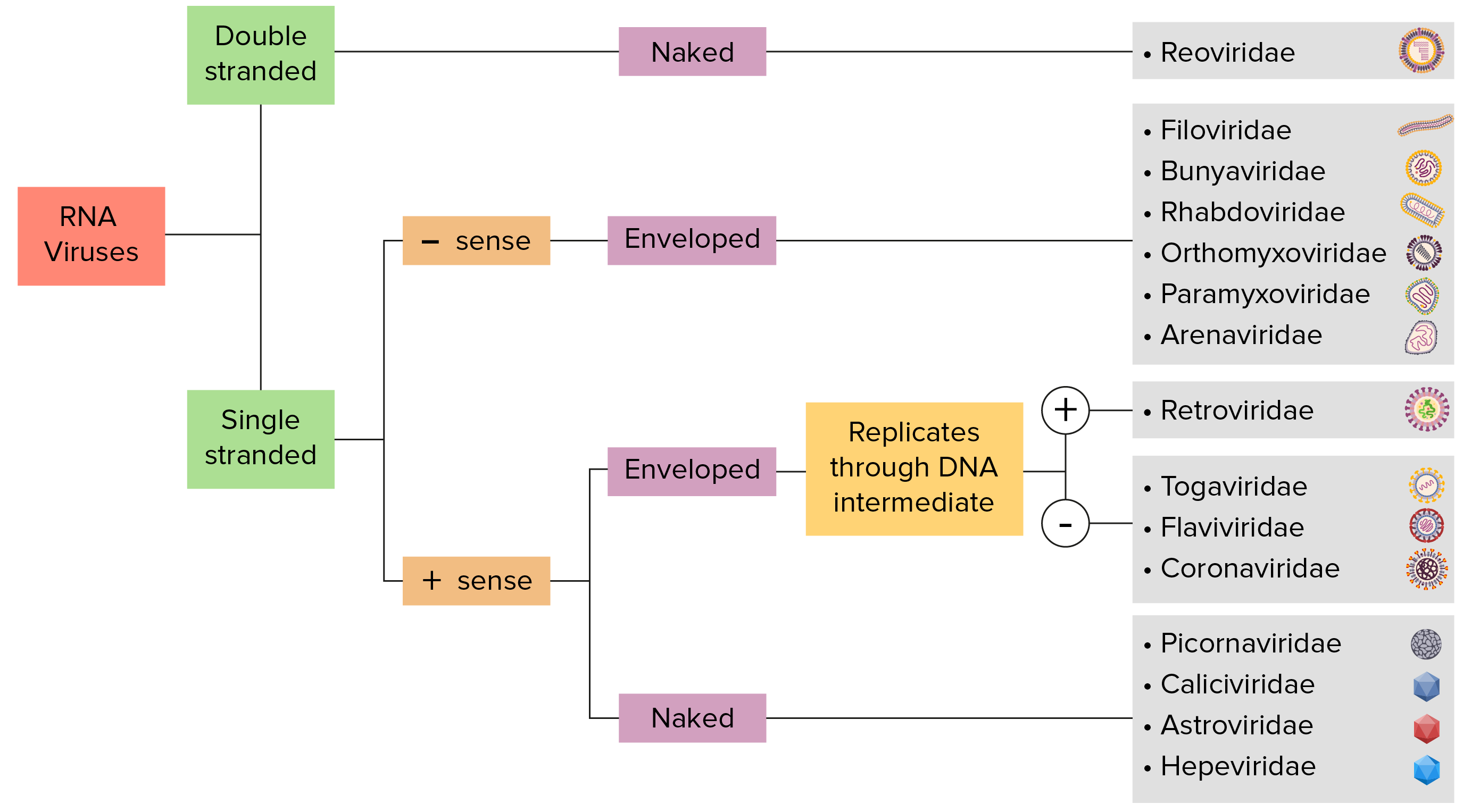
Fluxograma de classificação de vírus de RNA

Identificação de vírus de RNA:
Os vírus podem ser classificados de várias maneiras. Contudo, a maioria dos vírus terá um genoma formado por DNA ou RNA. Os vírus do genoma de RNA podem ainda ser caracterizados por um RNA de cadeia simples ou dupla. Os vírus “envelopados” são cobertos por uma fina camada de membrana celular (geralmente retirada da célula hospedeira). Se esta camada estiver ausente, os vírus são chamados de vírus “nus”. Os vírus com genomas de fita simples são vírus de “sentido positivo” se o genoma for empregado diretamente como RNA mensageiro (mRNA), que é traduzido em proteínas. Os vírus de cadeia simples de “sentido negativo” empregam RNA polimerase dependente de RNA, uma enzima viral, para transcrever o seu genoma em RNA mensageiro.
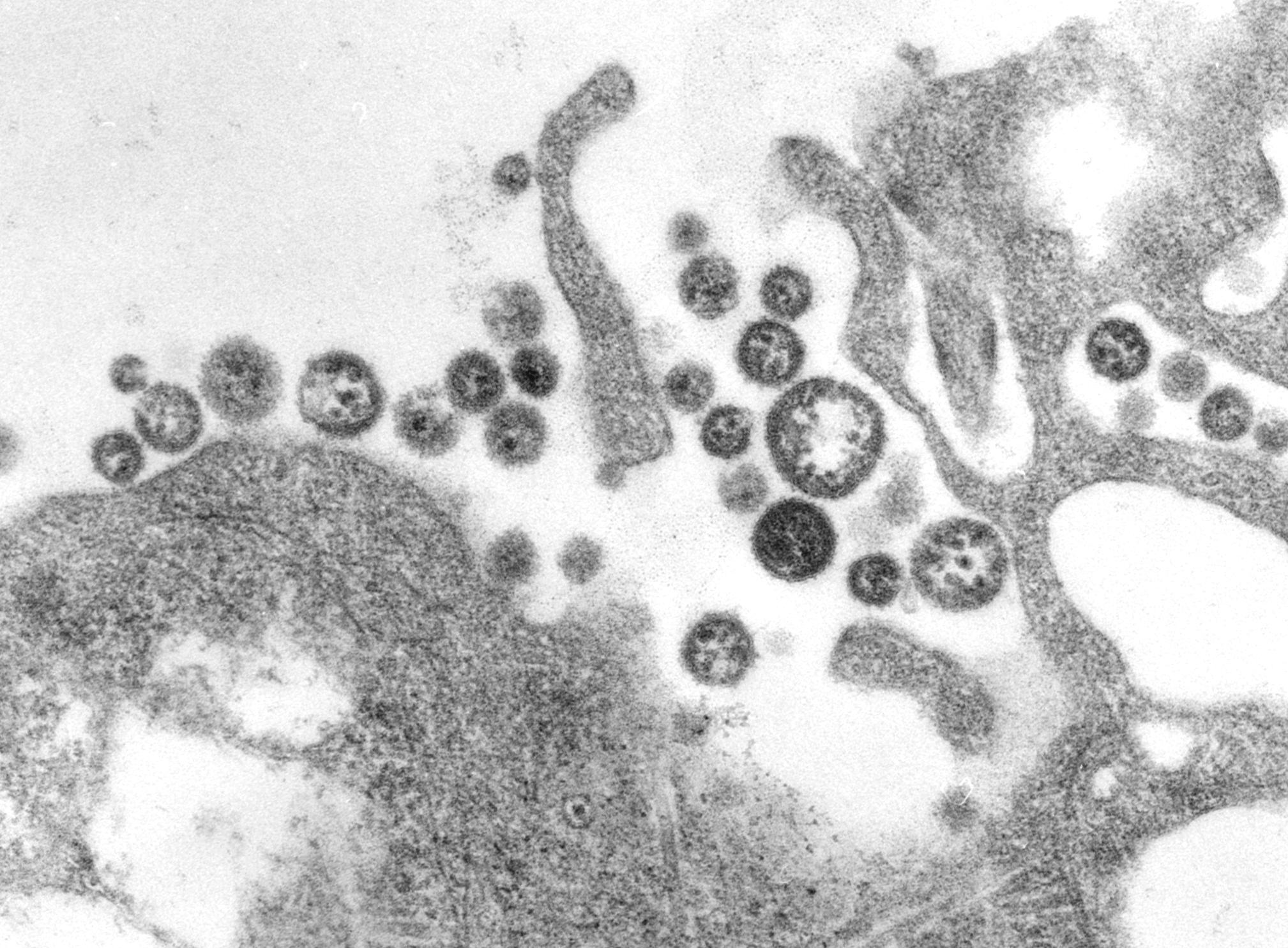
Imagem de Lecturio. Licença: CC BY-NC-SA 4.0

Características Gerais

Características básicas

  • Envelopado
  • Esférico
  • Agente de tamanho médio, medindo 70-150 nm de diâmetro
  • 2 glicoproteínas de superfície viral no envelope Envelope Bilayer lipid membrane acquired by viral particles during viral morphogenesis. Although the lipids of the viral envelope are host derived, various virus-encoded integral membrane proteins, i.e. Viral envelope proteins are incorporated there. Virology: G1 e G2
  • Genoma do vírus:
    • Encapsulado por um nucleocapsídeo helicoidal
    • RNA RNA A polynucleotide consisting essentially of chains with a repeating backbone of phosphate and ribose units to which nitrogenous bases are attached. RNA is unique among biological macromolecules in that it can encode genetic information, serve as an abundant structural component of cells, and also possesses catalytic activity. RNA Types and Structure de cadeia simples segmentado de sentido negativo, composto de:
      • Fragmento grande (L): codifica a RNA RNA A polynucleotide consisting essentially of chains with a repeating backbone of phosphate and ribose units to which nitrogenous bases are attached. RNA is unique among biological macromolecules in that it can encode genetic information, serve as an abundant structural component of cells, and also possesses catalytic activity. RNA Types and Structure polimerase dependente de RNA RNA A polynucleotide consisting essentially of chains with a repeating backbone of phosphate and ribose units to which nitrogenous bases are attached. RNA is unique among biological macromolecules in that it can encode genetic information, serve as an abundant structural component of cells, and also possesses catalytic activity. RNA Types and Structure (RdRP)
      • Fragmento pequeno (S): codifica as proteínas estruturais virais
  • Taxonomia:
    • Família Arenaviridae Arenaviridae A family of RNA viruses naturally infecting rodents and consisting of one genus (arenavirus) with two groups: old world arenaviruses and new world arenaviruses. Infection in rodents is persistent and silent. Vertical transmission is through milk-, saliva-, or urine-borne routes. Horizontal transmission to humans, monkeys, and other animals is important. Lassa Virus
    • Género Mammarenavirus Mammarenavirus Lassa Virus
    • Os vírus contêm ribossomas hospedeiros, dando ao vírus uma aparência granular ( Arenosus em latim significa “arenoso”).
    • Outros arenavírus incluem:
      • Vírus da coriomeningite linfocítica ( LCMV LCMV Lymphocytic choriomeningitis virus (LCMV) is a single-stranded RNA virus transmitted to humans via rodents, the primary reservoir. Viral infections can occur through direct contact (such as through a break in the skin) with rodent urine, saliva, or droppings or via inhalation of aerosolized virus. The disease typically results in a self-limited, febrile, biphasic disease. Lymphocytic Choriomeningitis Virus)
      • Vírus Junin (febre hemorrágica argentina)
      • Vírus de Machupo (febre hemorrágica boliviana)
      • Vírus Guanarito (febre hemorrágica venezuelana)
      • Sabiá (febre hemorrágica brasileira)
      • Chapare (febre hemorrágica do Chapare)
      • Lujo (febre hemorrágica de Lujo)

Epidemiologia

  • Endémica na África Ocidental:
    • Guiné
    • Libéria
    • Serra Leoa
    • Nigéria
    • Benin
    • Gana
    • Mali
  • Maior incidência em março, quando as estações passam de seca para chuvosa
  • Morbilidade e mortalidade:
    • Estimativa de 300.000 casos por ano
    • 5000 mortes anualmente
    • Taxa geral de letalidade: 1%

Patogénese

Reservatório e transmissão

  • Reservatório:
    • Rato multimamato ( Mastomys natalensis Mastomys natalensis Lassa Virus )
    • A infestação de roedores Mastomys é frequentemente vista em residências construídas com materiais como lama, que permite tocas para roedores.
  • Transmissão:
    • Contato com roedor(es):
      • Contato direto com urina ou fezes de ratos infetados
      • Inalação de excreções aerossolizadas de roedores
      • Consumo de roedores infetados
    • Transmissão de pessoa para pessoa:
      • Contato direto com sangue, urina, fezes ou outras secreções corporais de uma pessoa infetada
      • A eliminação viral na urina pode durar até 9 semanas
      • Transmissão sexual: a eliminação viral no sémen ocorre por até 3 meses

Fatores de risco do hospedeiro

  • Habitantes e visitantes de regiões endémicas
  • Profissional de saúde (requer medidas de proteção e métodos de esterilização adequados)

Entrada viral e patogénese

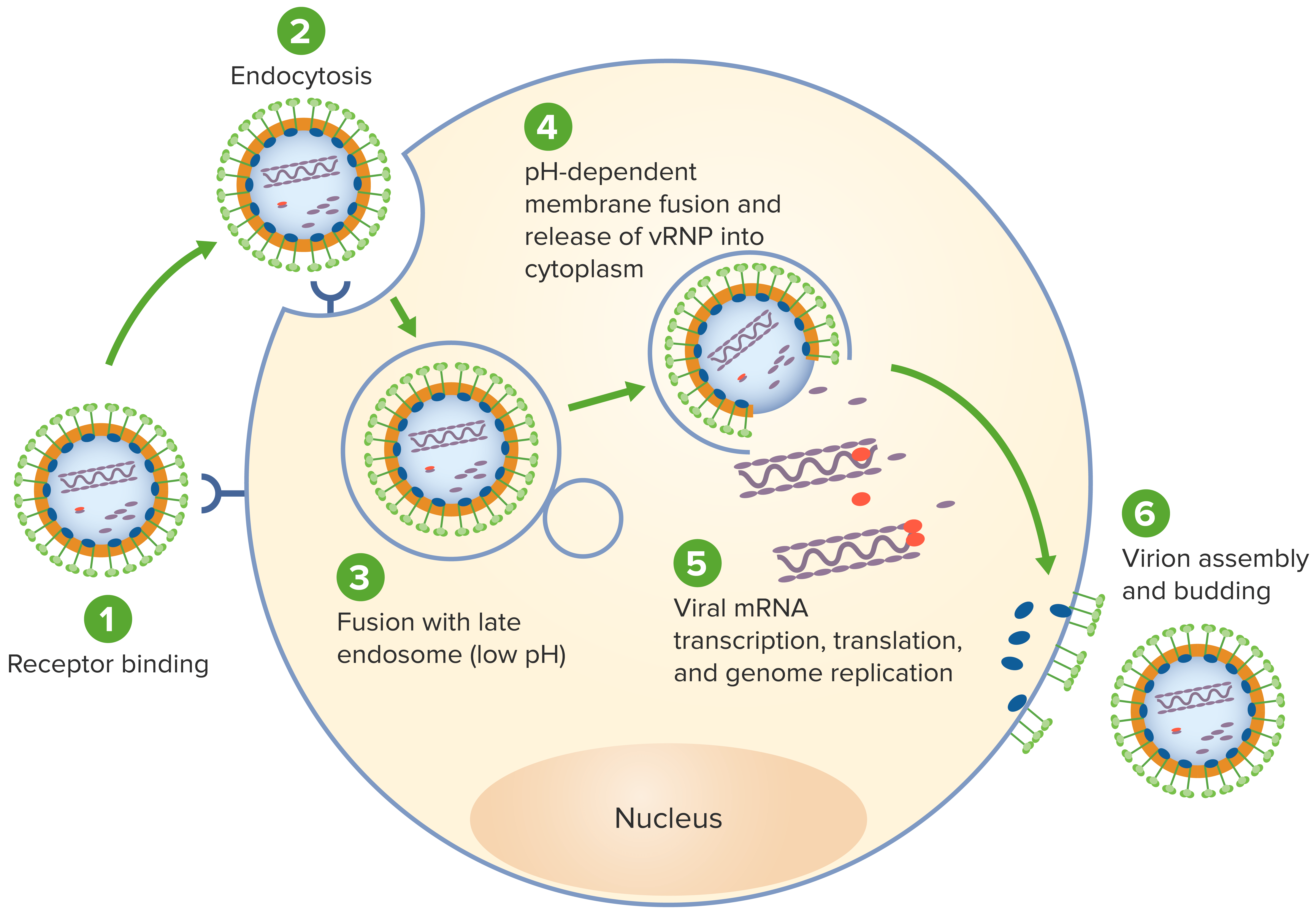
  • A entrada pela mucosa nasofaríngea e o vírus Lassa tem como alvo as células apresentadoras de antigéneo:
    • Células dendríticas
    • Macrófagos
    • Monócitos
  • Os vírus Lassa ligam-se às células principalmente através do recetor G1 de ligação à célula α-distroglicano (α-DG).
  • A partícula viral entra na célula (endocitose) e é engolfada por um endossoma.
  • Há um rearranjo do complexo de glicoproteína do envelope Envelope Bilayer lipid membrane acquired by viral particles during viral morphogenesis. Although the lipids of the viral envelope are host derived, various virus-encoded integral membrane proteins, i.e. Viral envelope proteins are incorporated there. Virology viral (GPC) (em pH pH The quantitative measurement of the acidity or basicity of a solution. Acid-Base Balance baixo), levando à fusão mediada por G2 da partícula com a membrana da vesícula.
  • Isso posteriormente liberta o genoma viral no citoplasma para replicação e transcrição.
  • A maturação das novas partículas virais ocorre por brotamento na membrana da célula hospedeira.
  • O vírus espalha-se para os gânglios linfáticos e segue-se a disseminação para outros tecidos.
  • Macrófagos e células dendríticas libertam mediadores que causam disfunção endotelial, perturbações da hemostase e diminuição da agregação plaquetária, levando a:
    • Necrose hepática e / ou esplénica
    • Edema Edema Edema is a condition in which excess serous fluid accumulates in the body cavity or interstitial space of connective tissues. Edema is a symptom observed in several medical conditions. It can be categorized into 2 types, namely, peripheral (in the extremities) and internal (in an organ or body cavity). Edema alveolar
    • Miocardite
    • Hemorragia gastrointestinal

Apresentação Clínica

Febre de Lassa

  • Período de incubação: 6–21 dias
  • Aproximadamente 80% das pessoas que são infetadas apresentam sintomas ligeiros:
    • Febre baixa
    • Mal-estar
    • Dor de cabeça
    • Melhoria em 8–10 dias
  • Aproximadamente 20% das infeções progridem e desenvolvem:
    • Tosse, dor de garganta, conjuntivite
    • Dor abdominal, náuseas, vómitos
    • Dor no peito
    • Situações clínicas graves e/ou potencialmente fatais:
      • Edema Edema Edema is a condition in which excess serous fluid accumulates in the body cavity or interstitial space of connective tissues. Edema is a symptom observed in several medical conditions. It can be categorized into 2 types, namely, peripheral (in the extremities) and internal (in an organ or body cavity). Edema facial
      • Derrame pleural, edema Edema Edema is a condition in which excess serous fluid accumulates in the body cavity or interstitial space of connective tissues. Edema is a symptom observed in several medical conditions. It can be categorized into 2 types, namely, peripheral (in the extremities) and internal (in an organ or body cavity). Edema pulmonar
      • Miocardite
      • Hemorragia da boca, nariz, vagina Vagina The vagina is the female genital canal, extending from the vulva externally to the cervix uteri internally. The structures have sexual, reproductive, and urinary functions and a rich blood supply, mainly arising from the internal iliac artery. Vagina, Vulva, and Pelvic Floor: Anatomy ou trato gastrointestinal
      • Hipotensão
      • Insuficiência renal
      • Choque
      • Convulsões, tremor Tremor Cyclical movement of a body part that can represent either a physiologic process or a manifestation of disease. Intention or action tremor, a common manifestation of cerebellar diseases, is aggravated by movement. In contrast, resting tremor is maximal when there is no attempt at voluntary movement, and occurs as a relatively frequent manifestation of parkinson disease. Myotonic Dystrophies, desorientação e coma Coma Coma is defined as a deep state of unarousable unresponsiveness, characterized by a score of 3 points on the GCS. A comatose state can be caused by a multitude of conditions, making the precise epidemiology and prognosis of coma difficult to determine. Coma

Complicações e mortalidade

  • Surdez (complicação mais MAIS Androgen Insensitivity Syndrome comum) em até 30% dos pacientes, com cerca de 20% sofrendo perda auditiva permanente
  • Na doença fatal, a morte geralmente ocorre dentro de 2 semanas após o início dos sintomas.
  • Na gravidez:
    • Doença geralmente grave
    • Perda fetal (> 60%) e morte materna na maioria das infeções que ocorrem no terceiro trimestre
    • “Síndrome do bebé inchado”:
  • Mesmo após a recuperação, a eliminação viral pode persistir por até 3 meses.

Diagnóstico e Abordagem

Exames

  • Diagnóstico:
    • ELISA ELISA An immunoassay utilizing an antibody labeled with an enzyme marker such as horseradish peroxidase. While either the enzyme or the antibody is bound to an immunosorbent substrate, they both retain their biologic activity; the change in enzyme activity as a result of the enzyme-antibody-antigen reaction is proportional to the concentration of the antigen and can be measured spectrophotometrically or with the naked eye. Many variations of the method have been developed. St. Louis Encephalitis Virus: deteta antigéneo, anticorpos IgM IgM A class of immunoglobulin bearing mu chains (immunoglobulin mu-chains). Igm can fix complement. The name comes from its high molecular weight and originally being called a macroglobulin. Immunoglobulins: Types and Functions e IgG IgG The major immunoglobulin isotype class in normal human serum. There are several isotype subclasses of igg, for example, igg1, igg2a, and igg2b. Hypersensitivity Pneumonitis
    • RT-PCR RT-PCR A variation of the pcr technique in which cDNA is made from RNA via reverse transcription. The resultant cDNA is then amplified using standard pcr protocols. Polymerase Chain Reaction (PCR)
    • Cultura: realizada apenas em laboratórios de alta contenção
  • Outros achados laboratoriais:
    • CBC:
      • Leucopenia
      • Trombocitopenia
    • Transaminases Transaminases A subclass of enzymes of the transferase class that catalyze the transfer of an amino group from a donor (generally an amino acid) to an acceptor (generally a 2-keto acid). Most of these enzymes are pyridoxyl phosphate proteins. Autoimmune Hepatitis e amilase elevadas
    • Estudos de coagulação geralmente normais
    • Alterações da função renal (associada ao aumento da mortalidade)

Abordagem

  • Ribavirina:
    • IV é preferível à preparação oral, mas a forma oral pode ser administrada se a IV não estiver disponível
    • Demonstrou melhorar os resultados do tratamento quando administrado no início do curso da doença
  • Cuidados de suporte:
    • Fluidos IV (é necessária precaução para evitar sobrecarga)
    • Suporte respiratório (oxigenação)
    • Transfusões de sangue conforme indicado

Prevenção

  • Atualmente não há vacinas eficazes
  • Evite roedores
  • Isolamento de pacientes
  • Uso de EPI em ambientes hospitalares ou de atendimento ao paciente
  • O corpo do paciente falecido deve ser manuseado de maneira adequada (saco para o corpo lacrado e enterrado por pessoal treinado).
  • Para reduzir o risco de transmissão sexual, espere 3 meses (após a resolução) antes de fazer sexo desprotegido.
  • Profilaxia pós-exposição:
    • Ribavirina
    • Monitoramento de perto

Comparação de Arenavírus

Os arenavírus podem causar febres hemorrágicas (vírus de Lassa) e / ou doença neurológica (vírus da coriomeningite linfocítica ( LCMV LCMV Lymphocytic choriomeningitis virus (LCMV) is a single-stranded RNA virus transmitted to humans via rodents, the primary reservoir. Viral infections can occur through direct contact (such as through a break in the skin) with rodent urine, saliva, or droppings or via inhalation of aerosolized virus. The disease typically results in a self-limited, febrile, biphasic disease. Lymphocytic Choriomeningitis Virus)).

Tabela: Comparação de Arenavírus
Organismo LCMV LCMV Lymphocytic choriomeningitis virus (LCMV) is a single-stranded RNA virus transmitted to humans via rodents, the primary reservoir. Viral infections can occur through direct contact (such as through a break in the skin) with rodent urine, saliva, or droppings or via inhalation of aerosolized virus. The disease typically results in a self-limited, febrile, biphasic disease. Lymphocytic Choriomeningitis Virus Vírus Lassa
Família Arenaviridae Arenaviridae A family of RNA viruses naturally infecting rodents and consisting of one genus (arenavirus) with two groups: old world arenaviruses and new world arenaviruses. Infection in rodents is persistent and silent. Vertical transmission is through milk-, saliva-, or urine-borne routes. Horizontal transmission to humans, monkeys, and other animals is important. Lassa Virus Arenaviridae Arenaviridae A family of RNA viruses naturally infecting rodents and consisting of one genus (arenavirus) with two groups: old world arenaviruses and new world arenaviruses. Infection in rodents is persistent and silent. Vertical transmission is through milk-, saliva-, or urine-borne routes. Horizontal transmission to humans, monkeys, and other animals is important. Lassa Virus
Género Mammarenavirus Mammarenavirus Lassa Virus Mammarenavirus Mammarenavirus Lassa Virus
Características
  • Envelopado
  • Médio
  • Esférico
  • Genoma segmentado
  • ssRNA
  • Envelopado
  • Médio
  • Esférico
  • Genoma segmentado
  • ssRNA
Reservatório Roedores Roedores
Transmissão
  • Aerossóis
  • Contacto direto
  • Transmissão vertical
  • Transplante de órgão
  • Aerossóis
  • Contacto direto
  • Ingestão
  • Pessoa a pessoa (através da exposição ao sangue, secreções, tecido de indivíduo infetado)
Curso clínico Bifásico:
  • Doença semelhante à gripe
  • Meningite, encefalite
  • Maioria assintomática ou com sintomas ligeiros
  • Manifestações hemorrágicas
  • Surdez é comum
Diagnóstico
  • Serologia
  • RT-PCR RT-PCR A variation of the pcr technique in which cDNA is made from RNA via reverse transcription. The resultant cDNA is then amplified using standard pcr protocols. Polymerase Chain Reaction (PCR)
  • Serologia
  • RT-PCR RT-PCR A variation of the pcr technique in which cDNA is made from RNA via reverse transcription. The resultant cDNA is then amplified using standard pcr protocols. Polymerase Chain Reaction (PCR)
Abordagem
  • De suporte
  • De suporte
  • Ribavirina
Prevenção
  • Evitar o contato com roedores e seus fluidos corporais
  • Evitar o contato com roedores e seus fluidos corporais
  • EPI
LCMV: vírus da coriomeningite linfocítica

Diagnóstico Diferencial

Outras febres hemorrágicas virais:

  • Ebola: febre hemorrágica altamente contagiosa e potencialmente letal causada pelo vírus Ebola ( Filoviridae Filoviridae A family of RNA viruses, of the order mononegavirales, containing filamentous virions. Although they resemble rhabdoviridae in possessing helical nucleocapsids, filoviridae differ in the length and degree of branching in their virions. There are two genera: ebolavirus and marburgvirus. Ebolavirus and Marburgvirus) O ébola tem regiões endémicas e apresentação semelhantes às do vírus de Lassa. Os pacientes apresentam sintomas de febre, mal-estar, náuseas, vómitos e dor abdominal. Esses sintomas podem progredir para hemorragia, falência multiorgânica e choque. O diagnóstico é confirmado por PCR PCR Polymerase chain reaction (PCR) is a technique that amplifies DNA fragments exponentially for analysis. The process is highly specific, allowing for the targeting of specific genomic sequences, even with minuscule sample amounts. The PCR cycles multiple times through 3 phases: denaturation of the template DNA, annealing of a specific primer to the individual DNA strands, and synthesis/elongation of new DNA molecules. Polymerase Chain Reaction (PCR), serologia e microscopia eletrónica de tecido ou sangue. O tratamento é de suporte.
  • Febre hemorrágica da dengue Dengue An acute febrile disease transmitted by the bite of aedes mosquitoes infected with dengue virus. It is self-limiting and characterized by fever, myalgia, headache, and rash. Severe dengue is a more virulent form of dengue. Dengue Virus : doença febril aguda causada pelo vírus da dengue Dengue An acute febrile disease transmitted by the bite of aedes mosquitoes infected with dengue virus. It is self-limiting and characterized by fever, myalgia, headache, and rash. Severe dengue is a more virulent form of dengue. Dengue Virus ( Flaviviridae Flaviviridae A family of RNA viruses, many of which cause disease in humans and domestic animals. There are three genera flavivirus; pestivirus; and hepacivirus, as well as several unassigned species. Hepatitis C Virus) O vírus é transmitido por mosquitosAedes aegypti. A maioria das infeções é assintomática. Indivíduos sintomáticos podem passar por diferentes fases, com manifestações graves ocorrendo naqueles com infeções prévias. A doença manifesta-se por febre alta, cefaleia e dor retro-orbitária, mialgias e artralgias (dor “ossos quebrados”) e erupção cutânea macular ou maculopapular Maculopapular Dermatologic Examination. Podem surgir hemorragias e choque. O diagnóstico é feito por serologia, teste de antigéneo ou PCR PCR Polymerase chain reaction (PCR) is a technique that amplifies DNA fragments exponentially for analysis. The process is highly specific, allowing for the targeting of specific genomic sequences, even with minuscule sample amounts. The PCR cycles multiple times through 3 phases: denaturation of the template DNA, annealing of a specific primer to the individual DNA strands, and synthesis/elongation of new DNA molecules. Polymerase Chain Reaction (PCR). O tratamento é de suporte.
  • Febre amarela: causada pelo vírus da febre amarela ( Flaviviridae Flaviviridae A family of RNA viruses, many of which cause disease in humans and domestic animals. There are three genera flavivirus; pestivirus; and hepacivirus, as well as several unassigned species. Hepatitis C Virus) Humanos e primatas servem como reservatórios, e a transmissão ocorre a partir da picada de uma fêmea de mosquito infetada. Os pacientes apresentam febre e sintomas semelhantes aos da gripe na maioria dos casos. A doença grave pode causar disfunção multiorgânica, resultando em icterícia, disfunção renal, hemorragia, choque e eventualmente morte. O diagnóstico é por serologia e PCR PCR Polymerase chain reaction (PCR) is a technique that amplifies DNA fragments exponentially for analysis. The process is highly specific, allowing for the targeting of specific genomic sequences, even with minuscule sample amounts. The PCR cycles multiple times through 3 phases: denaturation of the template DNA, annealing of a specific primer to the individual DNA strands, and synthesis/elongation of new DNA molecules. Polymerase Chain Reaction (PCR). Não há tratamento antiviral Antiviral Antivirals for Hepatitis B, portanto, o tratamento é de suporte. A prevenção inclui a vacinação e evitar o mosquito.
  • Febre hemorrágica da Crimeia-Congo (CCHF): doença zoonótica causada por um vírus ( Bunyaviridae Bunyaviridae A family of viruses, mainly arboviruses, consisting of a single strand of RNA. Virions are enveloped particles 90-120 nm diameter. The complete family contains over 300 members arranged in five genera: orthobunyavirus; hantavirus; nairovirus; phlebovirus; and tospovirus. Bunyavirales) transmitido por carrapatos. Os sintomas e sinais incluem febre, mialgias, dor abdominal, náuseas e vómitos. A maioria dos pacientes recupera da doença após 1 semana, mas pode progredir para hemorragia, choque e falência multiorgânica. O vírus é endémico em partes da África, Médio Oriente, Ásia e sudeste da Europa. O diagnóstico é feito por RT-PCR RT-PCR A variation of the pcr technique in which cDNA is made from RNA via reverse transcription. The resultant cDNA is then amplified using standard pcr protocols. Polymerase Chain Reaction (PCR) ou serologia.
  • Hantavírus: causa febre hemorrágica com síndrome renal. Hantavírus ( Bunyaviridae Bunyaviridae A family of viruses, mainly arboviruses, consisting of a single strand of RNA. Virions are enveloped particles 90-120 nm diameter. The complete family contains over 300 members arranged in five genera: orthobunyavirus; hantavirus; nairovirus; phlebovirus; and tospovirus. Bunyavirales) é transmitido por roedores (inalação, contato direto ou ingestão de excreções de roedores). Os casos ocorrem em todo o mundo (Américas, Europa, Ásia, África). As infeções podem causar sintomas pulmonares, hemorragia e danos renais por lesão endotelial vascular. O diagnóstico é por RT-PCR RT-PCR A variation of the pcr technique in which cDNA is made from RNA via reverse transcription. The resultant cDNA is then amplified using standard pcr protocols. Polymerase Chain Reaction (PCR) e serologia. O tratamento é de suporte.

Patologias causadas por outros patógenos não virais:

  • Malária: doença infecciosa transmitida por mosquitos causada pelas espécies de Plasmodium Plasmodium A genus of protozoa that comprise the malaria parasites of mammals. Four species infect humans (although occasional infections with primate malarias may occur). These are plasmodium falciparum; plasmodium malariae; plasmodium ovale, and plasmodium vivax. Species causing infection in vertebrates other than man include: plasmodium berghei; plasmodium chabaudi; p. Vinckei, and plasmodium yoelii in rodents; p. Brasilianum, plasmodium cynomolgi; and plasmodium knowlesi in monkeys; and plasmodium gallinaceum in chickens. Antimalarial Drugs. A malária frequentemente apresenta-se com febre, calafrios, sudorese, icterícia, dor abdominal, anemia Anemia Anemia is a condition in which individuals have low Hb levels, which can arise from various causes. Anemia is accompanied by a reduced number of RBCs and may manifest with fatigue, shortness of breath, pallor, and weakness. Subtypes are classified by the size of RBCs, chronicity, and etiology. Anemia: Overview and Types hemolítica, hepatoesplenomegalia e insuficiência renal. Deve-se suspeitar de Malária em pessoas com apresentação típica e com residência ou viagem para áreas endémicas (geralmente, áreas tropicais). O diagnóstico é por esfregaço de sangue. Também podem ser realizados testes Testes Gonadal Hormones rápidos para antigéneos de Plasmodium Plasmodium A genus of protozoa that comprise the malaria parasites of mammals. Four species infect humans (although occasional infections with primate malarias may occur). These are plasmodium falciparum; plasmodium malariae; plasmodium ovale, and plasmodium vivax. Species causing infection in vertebrates other than man include: plasmodium berghei; plasmodium chabaudi; p. Vinckei, and plasmodium yoelii in rodents; p. Brasilianum, plasmodium cynomolgi; and plasmodium knowlesi in monkeys; and plasmodium gallinaceum in chickens. Antimalarial Drugs. O tratamento requer um curso prolongado de vários medicamentos antimaláricos.
  • Leptospirose: doença causada por Leptospira interrogans Leptospira interrogans A genus of question mark-shaped bacteria spirochetes which is found in freshwater that is contaminated by animal urine. It causes leptospirosis. Leptospira/Leptospirosis. As bactérias eliminadas na urina de roedores e outros animais podem ser transmitidas aos humanos através de água contaminada. Os pacientes apresentam uma doença ligeira semelhante à gripe na maioria dos casos, e as manifestações são bifásicas. Em cerca de 10% das infeções, desenvolve-se leptospirose icterohemorrágica, manifestando-se como hemorragia, insuficiência renal e icterícia. A cultura bacteriana leva semanas e portanto, outros testes Testes Gonadal Hormones diagnósticos, como serologia e microscopia de campo escuro, são usados. O tratamento é principalmente com penicilina.

Referências

  1. Centers for Disease Control and Prevention. (2025). Lassa fever. Centers for Disease Control and Prevention. https://www.cdc.gov/vhf/lassa/index.html
  2. Ryan K.J. (2017). Arthropod-borne and other zoonotic viruses. Chapter 16 of Sherris Medical Microbiology, 7th ed. McGraw-Hill. https://accessmedicine.mhmedical.com/content.aspx?bookid=2268&sectionid=176083946
  3. Schieffelin, J. (2025). Lassa fever. UpToDate. Retrieved March 12, 2025, from https://www.uptodate.com/contents/lassa-fever
  4. Shao, J., Liang, Y., Ly, H. (2015). Human hemorrhagic fever causing arenaviruses: molecular mechanisms contributing to virus virulence and disease pathogenesis. Pathogens 4:283–306. https://doi.org/10.3390/pathogens4020283
  5. Yun, N.E., Walker, D.H. (2012). Pathogenesis of Lassa fever. Viruses 4:2031–2048. https://pubmed.ncbi.nlm.nih.gov/23202452/

Crie sua conta gratuita ou faça login para continuar lendo!

Cadastre-se agora e tenha acesso grátis ao Lecturio, com páginas de conceitos, vídeos de medicina e questões para sua educação médica.

Aprende mais com a Lecturio:

Multiple devices displaying human anatomy and health education content.

Complementa o teu estudo da faculdade com o companheiro de estudo tudo-em-um da Lecturio, através de métodos de ensino baseados em evidência.

Estuda onde quiseres

Two iPhones display medical education apps, one showing anatomy, the other Bookmatcher.

A Lecturio Medical complementa o teu estudo através de métodos de ensino baseados em evidência, vídeos de palestras, perguntas e muito mais – tudo combinado num só lugar e fácil de usar.

User Reviews

Have a holly, jolly study session 🎁 Save 50% on all plans now >>

Que tengas una sesión de estudio alegre y navideña 🎁 Ahorra 50% en todos los planes >>

Details