


Vírus Dengue

O vírus Dengue Dengue An acute febrile disease transmitted by the bite of aedes mosquitoes infected with dengue virus. It is self-limiting and characterized by fever, myalgia, headache, and rash. Severe dengue is a more virulent form of dengue. Dengue Virus ( DENV DENV An acute febrile disease transmitted by the bite of aedes mosquitoes infected with dengue virus. It is self-limiting and characterized by fever, myalgia, headache, and rash. Severe dengue is a more virulent form of dengue. Dengue Virus, pela sigla em inglês) é um vírus pequeno de RNA RNA A polynucleotide consisting essentially of chains with a repeating backbone of phosphate and ribose units to which nitrogenous bases are attached. RNA is unique among biological macromolecules in that it can encode genetic information, serve as an abundant structural component of cells, and also possesses catalytic activity. RNA Types and Structure de cadeia simples e sentido positivo, do género Flavivirus Flavivirus A genus of flaviviridae containing several subgroups and many species. Most are arboviruses transmitted by mosquitoes or ticks. The type species is yellow fever virus. Tick-borne Encephalitis Virus. Esta infeção pode ser transmitida ao ser humano através da picada de um mosquito Aedes fêmea. A maioria dos doentes são assintomáticos. A apresentação clínica de indivíduos sintomáticos pode progredir entre 3 estadios da doença, ocorrendo manifestações graves naqueles com infeções anteriores. A fase febril inclui febre alta, cefaleia, dor retro-orbital, mialgias e artralgias graves (dor em “quebra-ossos”) e um rash Rash Rocky Mountain Spotted Fever macular ou maculopapular Maculopapular Dermatologic Examination. A fase crítica inclui manifestações mais MAIS Androgen Insensitivity Syndrome graves de extravasamento capilar, hemorragia e choque. Na fase de convalescência ocorre a resolução dos sinais e sintomas. O diagnóstico é feito com base na história clínica, exame objetivo, serologia, teste de antigénio ou PCR PCR Polymerase chain reaction (PCR) is a technique that amplifies DNA fragments exponentially for analysis. The process is highly specific, allowing for the targeting of specific genomic sequences, even with minuscule sample amounts. The PCR cycles multiple times through 3 phases: denaturation of the template DNA, annealing of a specific primer to the individual DNA strands, and synthesis/elongation of new DNA molecules. Polymerase Chain Reaction (PCR). O tratamento é de suporte.

Last updated: Dec 15, 2025
Editorial responsibility: Stanley Oiseth, Lindsay Jones, Evelin Maza

Classificação

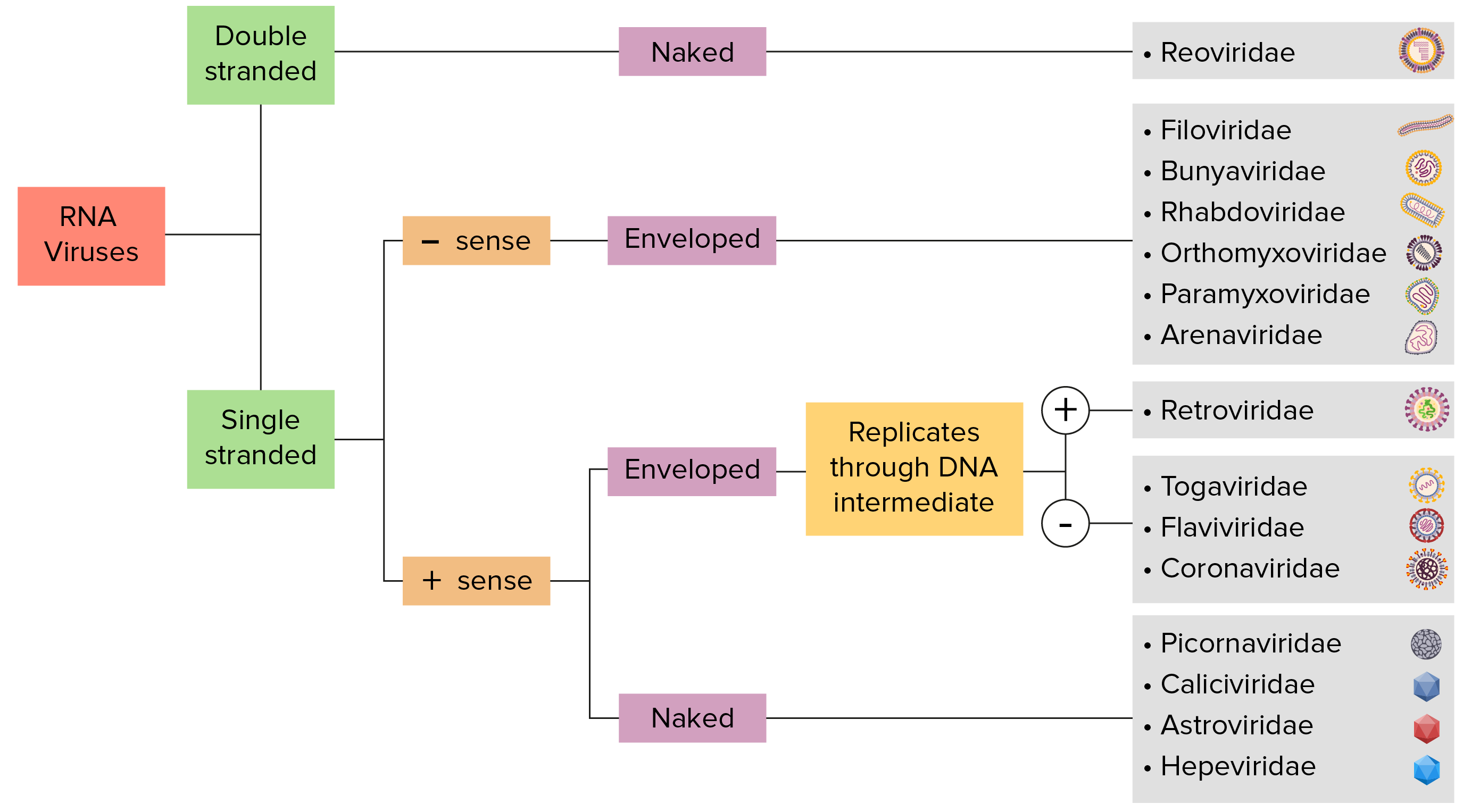
Classificação do fluxograma de vírus de RNA

Identificação do RNA vírico:
Os vírus podem ser classificados de várias formas. No entanto, a maioria destes tem um genoma constituído por ADN ou RNA. Os vírus cujo genoma é de RNA podem ser ainda caracterizados em RNA de cadeia simples ou dupla. Os vírus com invólucro são cobertos por uma fina camada de membrana celular (geralmente da célula hospedeira). Na ausência desta camada, são apelidados de vírus “nus”. Os vírus com genomas de cadeia simples são chamados de vírus de “sentido positivo” se o genoma puder ser diretamente utilizado como RNA mensageiro (mRNA, pela sigla em inglês), que é traduzido em proteínas. Os de “sentido negativo” necessitam da RNA polimerase dependente de RNA, uma enzima vírica, para transcrever o seu genoma em RNA mensageiro.
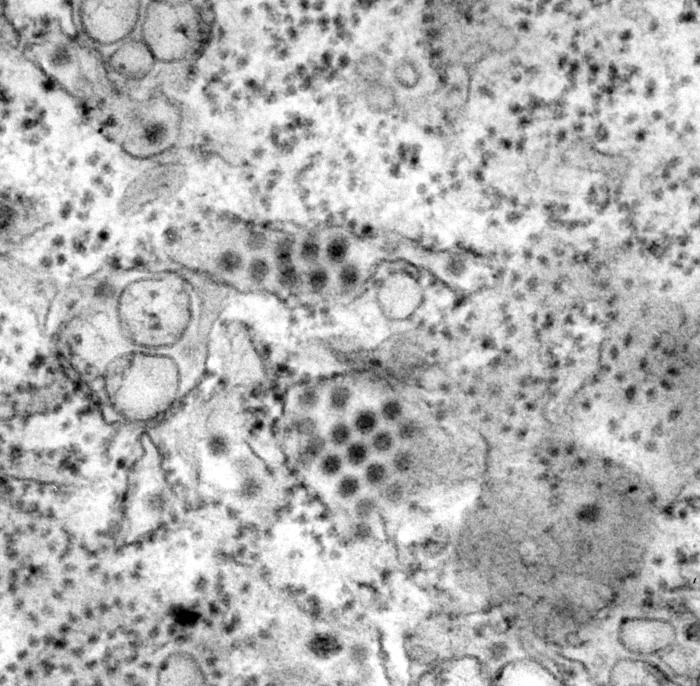
Imagem por Lecturio. Licença: CC BY-NC-SA 4.0

Características Gerais e Epidemiologia

Características gerais do vírus Dengue Dengue An acute febrile disease transmitted by the bite of aedes mosquitoes infected with dengue virus. It is self-limiting and characterized by fever, myalgia, headache, and rash. Severe dengue is a more virulent form of dengue. Dengue Virus ( DENV DENV An acute febrile disease transmitted by the bite of aedes mosquitoes infected with dengue virus. It is self-limiting and characterized by fever, myalgia, headache, and rash. Severe dengue is a more virulent form of dengue. Dengue Virus, pela sigla em inglês)

  • Taxonomia:
    • Família: Flaviviridae Flaviviridae A family of RNA viruses, many of which cause disease in humans and domestic animals. There are three genera flavivirus; pestivirus; and hepacivirus, as well as several unassigned species. Hepatitis C Virus
    • Género: Flavivirus Flavivirus A genus of flaviviridae containing several subgroups and many species. Most are arboviruses transmitted by mosquitoes or ticks. The type species is yellow fever virus. Tick-borne Encephalitis Virus
  • Vírus de RNA RNA A polynucleotide consisting essentially of chains with a repeating backbone of phosphate and ribose units to which nitrogenous bases are attached. RNA is unique among biological macromolecules in that it can encode genetic information, serve as an abundant structural component of cells, and also possesses catalytic activity. RNA Types and Structure
    • Cadeia simples
    • Sentido positivo
    • Linear
  • Esférico
  • Simetria icosaédrica
  • Com invólucro
  • Tamanho: 40–60 nm
partículas do vírus da dengue Flaviviridae

Imagem de microscopia eletrónica de transmissão de uma amostra de tecido com várias partículas redondas do vírus Dengue (DENV, pela sigla em inglês).

Imagem: “Transmission electron microscopic image of a tissue specimen depicts a number of round, dengue virus particles.” por CDC. Licença: Public Domain

Espécies clinicamente relevantes

Quatro serotipos distintos ( DENV DENV An acute febrile disease transmitted by the bite of aedes mosquitoes infected with dengue virus. It is self-limiting and characterized by fever, myalgia, headache, and rash. Severe dengue is a more virulent form of dengue. Dengue Virus 1-4) causam infeção.

Epidemiologia

  • A principal causa de doença vírica transmitida por artrópodes no mundo
  • > 100 milhões de humanos são infetados anualmente
  • A incidência está a aumentar.
  • Diagnosticada em > 100 países
  • Mortalidade:
    • Causa 20.000–25.000 mortes anualmente (principalmente em crianças)
    • Dengue Dengue An acute febrile disease transmitted by the bite of aedes mosquitoes infected with dengue virus. It is self-limiting and characterized by fever, myalgia, headache, and rash. Severe dengue is a more virulent form of dengue. Dengue Virus grave não tratada: 10% a 20%
    • Dengue Dengue An acute febrile disease transmitted by the bite of aedes mosquitoes infected with dengue virus. It is self-limiting and characterized by fever, myalgia, headache, and rash. Severe dengue is a more virulent form of dengue. Dengue Virus grave tratada: 1%
  • Distribuição geográfica:
    • Sudeste Asiático
    • Austrália e Oceânia
    • América Central e do Sul
    • Caraíbas
    • África
    • Médio Oriente

Patogénese

Reservatório

  • Humanos (reservatório principal)
  • Primatas

Transmissão

  • Vetor: mosquitos Aedes fêmeas (modo primário de transmissão)
  • Raro:
    • Vertical
    • Transfusões sanguíneas
    • Amamentação
    • Transplante de órgão

Fatores de risco do hospedeiro

  • Para infeção por dengue Dengue An acute febrile disease transmitted by the bite of aedes mosquitoes infected with dengue virus. It is self-limiting and characterized by fever, myalgia, headache, and rash. Severe dengue is a more virulent form of dengue. Dengue Virus:
    • Viver numa área endémica
    • Viajar para uma região endémica
  • Para doença grave:
    • Infeção prévia por um serotipo diferente de dengue Dengue An acute febrile disease transmitted by the bite of aedes mosquitoes infected with dengue virus. It is self-limiting and characterized by fever, myalgia, headache, and rash. Severe dengue is a more virulent form of dengue. Dengue Virus
    • Crianças pequenas

Ciclo de replicação viral

  • O vírus liga-se a recetores na superfície da célula (facilitada pela glicoproteína do envelope Envelope Bilayer lipid membrane acquired by viral particles during viral morphogenesis. Although the lipids of the viral envelope are host derived, various virus-encoded integral membrane proteins, i.e. Viral envelope proteins are incorporated there. Virology (E) viral) → endocitose
  • Acidificação do endossoma → fusão das membranas celular e vírica → libertação do RNA RNA A polynucleotide consisting essentially of chains with a repeating backbone of phosphate and ribose units to which nitrogenous bases are attached. RNA is unique among biological macromolecules in that it can encode genetic information, serve as an abundant structural component of cells, and also possesses catalytic activity. RNA Types and Structure do vírus no citoplasma
  • Tradução do RNA RNA A polynucleotide consisting essentially of chains with a repeating backbone of phosphate and ribose units to which nitrogenous bases are attached. RNA is unique among biological macromolecules in that it can encode genetic information, serve as an abundant structural component of cells, and also possesses catalytic activity. RNA Types and Structure em proteínas víricas
  • Montagem e gemulação de novos virions (o mecanismo é pouco compreendido)

Fisiopatologia

  • Picada de mosquito → injeção subcutânea de DENV DENV An acute febrile disease transmitted by the bite of aedes mosquitoes infected with dengue virus. It is self-limiting and characterized by fever, myalgia, headache, and rash. Severe dengue is a more virulent form of dengue. Dengue Virus no humano
  • A replicação ocorre nas células locais (as células-alvo ainda não foram identificadas, mas potencialmente incluem os macrófagos e as células dendríticas)
  • Disseminação para o sistema linfático → viremia Viremia The presence of viruses in the blood. Erythema Infectiosum → disseminação para os órgãos
  • Resposta imune inata e adquirida
  • Infeção com um serótipo (infeção primária) → imunidade vitalícia para o mesmo serótipo
  • Os indivíduos com antecedentes de infeção prévia por um serótipo ainda podem ser infetados por outro serótipo de dengue Dengue An acute febrile disease transmitted by the bite of aedes mosquitoes infected with dengue virus. It is self-limiting and characterized by fever, myalgia, headache, and rash. Severe dengue is a more virulent form of dengue. Dengue Virus (infeção secundária):
    • A infeção secundária aumentou o risco de doença mais MAIS Androgen Insensitivity Syndrome grave (por exemplo, febre hemorrágica do dengue Dengue An acute febrile disease transmitted by the bite of aedes mosquitoes infected with dengue virus. It is self-limiting and characterized by fever, myalgia, headache, and rash. Severe dengue is a more virulent form of dengue. Dengue Virus, síndrome de choque do dengue Dengue An acute febrile disease transmitted by the bite of aedes mosquitoes infected with dengue virus. It is self-limiting and characterized by fever, myalgia, headache, and rash. Severe dengue is a more virulent form of dengue. Dengue Virus).
    • Factores que contribuem para isto:
      • Desenvolvimento dependente de anticorpos (o aumento dos anticorpos não neutraliza o vírus)
      • ↑ Complexos imunes
      • ↑ Resposta de linfócitos T

Apresentação Clínica

A maioria dos doentes são assintomáticos. Aqueles que apresentam sintomas podem experienciar 3 fases: febril, crítica e convalescência.

Fase febril

Esta fase ocorre após um período de incubação de 3 a 14 dias e dura entre 2 a 7 dias.
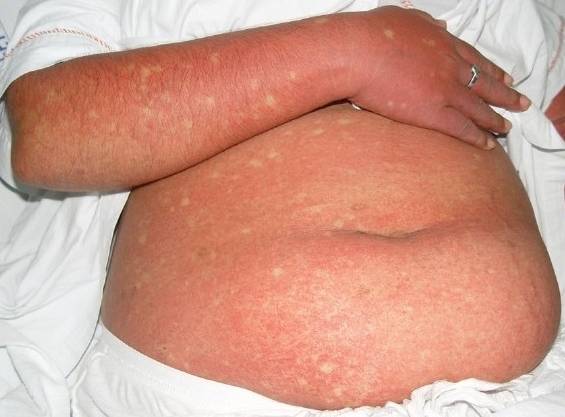
  • Gerais:
    • Febre alta repentina
    • Adenopatia
  • Dor:
    • Cefaleia
    • Dor retro-orbitária
    • Dor lombar
    • Mialgias e artralgias severas (dor em “quebra-ossos”)
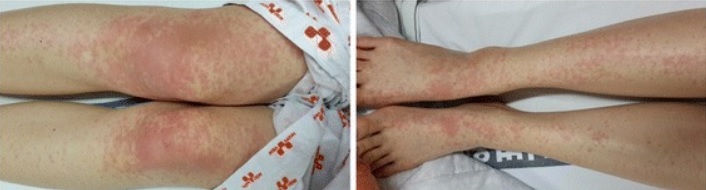
  • Rash Rash Rocky Mountain Spotted Fever:
  • Respiratórios:
    • Faringite
    • Tosse
    • Congestão nasal
  • Abdominais:
    • Náuseas e vómitos
    • Dor abdominal
    • Hepatomegalia

Fase crítica

Nem todos os casos apresentam esta fase e é geralmente observada em doentes com infeção prévia por dengue Dengue An acute febrile disease transmitted by the bite of aedes mosquitoes infected with dengue virus. It is self-limiting and characterized by fever, myalgia, headache, and rash. Severe dengue is a more virulent form of dengue. Dengue Virus.

Características gerais:

  • ↓ Febre
  • O extravasamento capilar sistémico (secundário ao ↑ da permeabilidade vascular) ocorre entre os dias 3-7:
    • Edema Edema Edema is a condition in which excess serous fluid accumulates in the body cavity or interstitial space of connective tissues. Edema is a symptom observed in several medical conditions. It can be categorized into 2 types, namely, peripheral (in the extremities) and internal (in an organ or body cavity). Edema
    • Ascite
    • Derrame pleural
    • Hemoconcentração (o hematócrito ↑ 20% ou mais MAIS Androgen Insensitivity Syndrome acima da linha de base)

Febre hemorrágica do dengue Dengue An acute febrile disease transmitted by the bite of aedes mosquitoes infected with dengue virus. It is self-limiting and characterized by fever, myalgia, headache, and rash. Severe dengue is a more virulent form of dengue. Dengue Virus:
  • Manifestações hemorrágicas:
    • Petéquias, púrpura ou equimoses
    • Hemorragia das mucosas
    • Hematemese ou melenas
    • Hemorragia menstrual intensa
    • Teste do torniquete positivo:
      • Insuflar a braçadeira do esfigmomanómetro no braço entre entre as pressões sistólica e diastólica durante 5 minutos
      • ≥ 10 petéquias por 2,5 cm² (abaixo da braçadeira)
  • Coagulação intravascular disseminada (CID)
  • Dor abdominal
  • Alteração do estado mental

Síndrome do choque do dengue Dengue An acute febrile disease transmitted by the bite of aedes mosquitoes infected with dengue virus. It is self-limiting and characterized by fever, myalgia, headache, and rash. Severe dengue is a more virulent form of dengue. Dengue Virus:

  • Choque
    • Dor abdominal estrema, vómitos, letargia/agitação com a defeverescência indica síndrome de choque iminente
    • Pulso fraco
    • Hipotensão
  • Disfunção orgânica
  • Pode ser letal
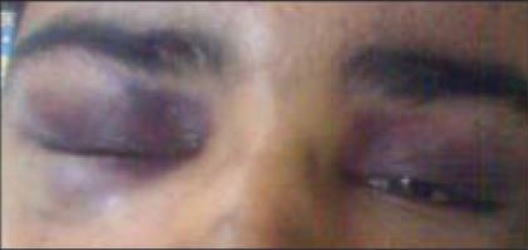
Vírus da dengue da equimose periorbital bilateral Flaviviridae

Equimose periorbitária bilateral num doente com febre hemorrágica do dengue

Imagem: “Bilateral periorbital ecchymosis in a case with dengue fever” por Kumar V et al. Licença: CC BY 2.0

Fase de convalescença

  • Reabsorção gradual do fluido extravascular
  • Estabilização dos sinais vitais
  • Resolução da hemorragia
  • Pode aparecer um rash Rash Rocky Mountain Spotted Fever eritematoso, pruriginoso e confluente
  • Fadiga marcada (pode durar de dias a semanas)

Diagnóstico e Tratamento

Diagnóstico

Deve suspeitar-se do diagnóstico em pessoas que vivem em ou viajam para áreas endémicas.

  • Testes Testes Gonadal Hormones laboratoriais confirmatórios incluem:
    • Serologia ( ELISA ELISA An immunoassay utilizing an antibody labeled with an enzyme marker such as horseradish peroxidase. While either the enzyme or the antibody is bound to an immunosorbent substrate, they both retain their biologic activity; the change in enzyme activity as a result of the enzyme-antibody-antigen reaction is proportional to the concentration of the antigen and can be measured spectrophotometrically or with the naked eye. Many variations of the method have been developed. St. Louis Encephalitis Virus)
    • Deteção de antigénios víricos
    • PCR PCR Polymerase chain reaction (PCR) is a technique that amplifies DNA fragments exponentially for analysis. The process is highly specific, allowing for the targeting of specific genomic sequences, even with minuscule sample amounts. The PCR cycles multiple times through 3 phases: denaturation of the template DNA, annealing of a specific primer to the individual DNA strands, and synthesis/elongation of new DNA molecules. Polymerase Chain Reaction (PCR) para deteção do RNA RNA A polynucleotide consisting essentially of chains with a repeating backbone of phosphate and ribose units to which nitrogenous bases are attached. RNA is unique among biological macromolecules in that it can encode genetic information, serve as an abundant structural component of cells, and also possesses catalytic activity. RNA Types and Structure vírico
    • Cultura do vírus (raramente útil)
  • Avaliação de apoio ao diagnóstico:
    • Leucopenia
    • Trombocitopenia
    • ↑ Enzimas hepáticas
    • ↑ PT e PTT
    • ↓ Fibrinogénio
    • ↓ Proteínas (hipoproteinemia)
    • Ecografia → ascite
    • Raio-X → derrame pleural

Tratamento

Não existe um tratamento antivírico eficaz, portanto, este é de suporte. Pode incluir:

Prevenção

  • Prevenir as picadas de mosquito
    • Inseticida/repelentes
    • Roupa protetora
    • Dormir com um mosquiteiro
    • Evitar ter águas estagnadas em redor da casa
  • Vacina
    • Diminui o risco de doença grave em doentes previamente infetados
    • Pode aumentar o risco de doença grave em crianças seronegativas
    • Não aprovada para os viajantes para regiões endémicas

Comparação de Espécies Semelhantes de Flavivírus

Tabela: Comparação de espécies de Flavivirus Flavivirus A genus of flaviviridae containing several subgroups and many species. Most are arboviruses transmitted by mosquitoes or ticks. The type species is yellow fever virus. Tick-borne Encephalitis Virus
Organismo Vírus da febre amarela Vírus da hepatite C (VHC) Vírus do dengue Dengue An acute febrile disease transmitted by the bite of aedes mosquitoes infected with dengue virus. It is self-limiting and characterized by fever, myalgia, headache, and rash. Severe dengue is a more virulent form of dengue. Dengue Virus ( DENV DENV An acute febrile disease transmitted by the bite of aedes mosquitoes infected with dengue virus. It is self-limiting and characterized by fever, myalgia, headache, and rash. Severe dengue is a more virulent form of dengue. Dengue Virus, pela sigla em inglês)
Características
  • 1 serotipo
  • 40-60 nm
  • 2 serotipos
  • 55-65 nm
  • 4 serotipos
  • 40-60 nm
Transmissão Mosquito Transmissão pelo sangue Mosquito
Apresentação clínica
  • Febre
  • Sintomas semelhantes à gripe
  • Icterícia
  • Disfunção multiorgânica
  • Hemorragia
  • Choque
  • Assintomática
  • Hepatite
  • Cirrose
  • Carcinoma hepatocelular
  • Febre
  • Sintomas semelhantes à gripe
  • Rubor Rubor Inflammation / erupção cutânea
  • Dor forte
  • Disfunção multiorgânica
  • Hemorragia
  • Choque
Diagnóstico
  • Serologia
  • PCR PCR Polymerase chain reaction (PCR) is a technique that amplifies DNA fragments exponentially for analysis. The process is highly specific, allowing for the targeting of specific genomic sequences, even with minuscule sample amounts. The PCR cycles multiple times through 3 phases: denaturation of the template DNA, annealing of a specific primer to the individual DNA strands, and synthesis/elongation of new DNA molecules. Polymerase Chain Reaction (PCR) – reação em cadeia da polimerase
  • Cultura vírica
  • Serologia
  • PCR PCR Polymerase chain reaction (PCR) is a technique that amplifies DNA fragments exponentially for analysis. The process is highly specific, allowing for the targeting of specific genomic sequences, even with minuscule sample amounts. The PCR cycles multiple times through 3 phases: denaturation of the template DNA, annealing of a specific primer to the individual DNA strands, and synthesis/elongation of new DNA molecules. Polymerase Chain Reaction (PCR) – reação em cadeia da polimerase
  • Serologia
  • PCR PCR Polymerase chain reaction (PCR) is a technique that amplifies DNA fragments exponentially for analysis. The process is highly specific, allowing for the targeting of specific genomic sequences, even with minuscule sample amounts. The PCR cycles multiple times through 3 phases: denaturation of the template DNA, annealing of a specific primer to the individual DNA strands, and synthesis/elongation of new DNA molecules. Polymerase Chain Reaction (PCR) – reação em cadeia da polimerase
  • Teste de antigénio
Tratamento Suporte Antivíricos de ação direta Suporte
Prevenção
  • Medidas para evitar picadas de mosquitos
  • Vacinação
  • Evitar a partilha de agulhas
  • Descarte seguro dos cortoperfurantes e resíduos
  • Rastreio do sangue de dadores
  • Medidas para evitar picadas de mosquitos
  • Vacinação

Diagnóstico Diferencial

  • Vírus Zika Zika Zika virus belongs to the genus Flavivirus and is primarily transmitted by Aedes aegypti mosquitoes, but can also be transmitted sexually and transplacentally. Although most infected patients are asymptomatic, some may present with low-grade fever, pruritic rash, and conjunctivitis. Zika Virus Infection: um Flavivirus Flavivirus A genus of flaviviridae containing several subgroups and many species. Most are arboviruses transmitted by mosquitoes or ticks. The type species is yellow fever virus. Tick-borne Encephalitis Virus que causa febre, conjuntivite e cefaleia. A infeção durante a gravidez pode resultar em microcefalia e comprometimento do desenvolvimento dos recém-nascidos. O diagnóstico é estabelecido com serologia ou PCR PCR Polymerase chain reaction (PCR) is a technique that amplifies DNA fragments exponentially for analysis. The process is highly specific, allowing for the targeting of specific genomic sequences, even with minuscule sample amounts. The PCR cycles multiple times through 3 phases: denaturation of the template DNA, annealing of a specific primer to the individual DNA strands, and synthesis/elongation of new DNA molecules. Polymerase Chain Reaction (PCR). O tratamento é de suporte.
  • Vírus Chikungunya Chikungunya Chikungunya virus belongs to the Alphavirus genus and causes a viral infection characterized by fever and joint pain. Symptoms usually appear within 1 week of infection. Additional manifestations of chikungunya virus may include muscle pain, headache, maculopapular rash, and lymphadenopathy. Chikungunya Virus: vírus da família Togaviridae Togaviridae A family of RNA viruses, mainly arboviruses, consisting of two genera: alphavirus (group A arboviruses), and rubivirus. Virions are spherical, 60-70 nm in diameter, with a lipoprotein envelope tightly applied to the icosahedral nucleocapsid. Rubella Virus transmitido por mosquitos Aedes. Os indivíduos afetados apresentam um início abrupto de febre e mialgias. Pode também manifestar-se com poliartralgias simétricas bilaterais das articulações distais, bem como com rash Rash Rocky Mountain Spotted Fever maculopapular Maculopapular Dermatologic Examination generalizado. Para o diagnóstico realiza-se serologia e PCR PCR Polymerase chain reaction (PCR) is a technique that amplifies DNA fragments exponentially for analysis. The process is highly specific, allowing for the targeting of specific genomic sequences, even with minuscule sample amounts. The PCR cycles multiple times through 3 phases: denaturation of the template DNA, annealing of a specific primer to the individual DNA strands, and synthesis/elongation of new DNA molecules. Polymerase Chain Reaction (PCR). O tratamento é de suporte.
  • Malária: doença infeciosa causada por espécies de Plasmodium Plasmodium A genus of protozoa that comprise the malaria parasites of mammals. Four species infect humans (although occasional infections with primate malarias may occur). These are plasmodium falciparum; plasmodium malariae; plasmodium ovale, and plasmodium vivax. Species causing infection in vertebrates other than man include: plasmodium berghei; plasmodium chabaudi; p. Vinckei, and plasmodium yoelii in rodents; p. Brasilianum, plasmodium cynomolgi; and plasmodium knowlesi in monkeys; and plasmodium gallinaceum in chickens. Antimalarial Drugs, transmitida por mosquitos. A malária apresenta-se geralmente com febre, arrepios, diaforese, icterícia, dor abdominal, anemia Anemia Anemia is a condition in which individuals have low Hb levels, which can arise from various causes. Anemia is accompanied by a reduced number of RBCs and may manifest with fatigue, shortness of breath, pallor, and weakness. Subtypes are classified by the size of RBCs, chronicity, and etiology. Anemia: Overview and Types hemolítica, hepatoesplenomegalia e insuficiência renal. O esfregaço sanguíneo mostra um único anel pleomórfico. Também se podem realizar testes Testes Gonadal Hormones rápidos de antigénio do Plasmodium Plasmodium A genus of protozoa that comprise the malaria parasites of mammals. Four species infect humans (although occasional infections with primate malarias may occur). These are plasmodium falciparum; plasmodium malariae; plasmodium ovale, and plasmodium vivax. Species causing infection in vertebrates other than man include: plasmodium berghei; plasmodium chabaudi; p. Vinckei, and plasmodium yoelii in rodents; p. Brasilianum, plasmodium cynomolgi; and plasmodium knowlesi in monkeys; and plasmodium gallinaceum in chickens. Antimalarial Drugs. O tratamento requer um curso prolongado de vários medicamentos antimaláricos.
  • Leptospirose: doença causada pela espiroqueta gram-negativa Leptospira Leptospira Leptospira is a spiral or question mark-shaped, gram-negative spirochete with hook-shaped ends. The disease, leptospirosis, is a zoonosis, infecting animals. Rodents are the most important reservoir. Bacteria shed in the urine of rodents and other animals can be transmitted to humans via contaminated water. Leptospira/Leptospirosis. As bactérias podem ser transmitidas ao ser humano através de água contaminada com urina de roedores e outros animais. Geralmente apresenta-se como uma doença ligeira semelhante à gripe. Numa minoria de doentes, desenvolve-se leptospirose icterohemorrágica, que se manifesta com hemorragia, insuficiência renal e icterícia. Uma vez que uma cultura bacteriana demora semanas, são utilizados outros testes Testes Gonadal Hormones para o diagnóstico, como a serologia e a microscopia de campo escuro. O tratamento é principalmente com antibióticos (por exemplo, doxiciclina, azitromicina, penicilina).

Referências

  1. World Health Organization. (2024). Dengue and severe dengue fact sheet. WHO. Retrieved June 27, 2025, from http://www.who.int/mediacentre/factsheets/fs117/en/
  2. Bhatt, S., Gething, P. W., Brady, O. J., Messina, J. P., Farlow, A. W., et al. (2013). The global distribution and burden of dengue. Nature, 496(7446), 504–507. https://doi.org/10.1038/nature12060
  3. Baak-Baak, C. M., Cigarroa-Toledo, N., Pech-May, A., Cruz-Escalona, G. A., Cetina-Trejo, R. C., et al. (2019). Entomological and virological surveillance for dengue virus in churches in Merida, Mexico. Revista do Instituto de Medicina Tropical de São Paulo, 61, e9. https://doi.org/10.1590/S1678-9946201961009
  4. Sharma, M., Glasner, D. R., Watkins, H., Puerta-Guardo, H., Kassa, Y., Egan, M. A., Dean, H., & Harris, E. (2019). Magnitude and functionality of the NS1-specific antibody response elicited by a live-attenuated tetravalent dengue vaccine candidate. The Journal of Infectious Diseases, 221(6), 867–877. https://doi.org/10.1093/infdis/jiz081
  5. Wilder-Smith, A., & Gubler, D. J. (2008). Geographic expansion of dengue: The impact of international travel. Medical Clinics of North America, 92(6), 1377–1390. https://doi.org/10.1016/j.mcna.2008.07.002
  6. Maia, L. M. S., Bezerra, M. C. F., Costa, M. C. S., Souza, E. M., Oliveira, M. E. B., Ribeiro, A. L. M., Miyazaki, R. D., & Sihesseranko, R. D. (2019). Natural vertical infection by dengue virus serotype 4, Zika virus and Mayaro virus in Aedes (Stegomyia) aegypti and Aedes (Stegomyia) albopictus. Medical and Veterinary Entomology, 33(3), 437–442. https://doi.org/10.1111/mve.12369
  7. Wharton-Smith, A., Green, J., Loh, E. C., Gorrie, A., Syed Omar, S. F., Bacchus, L., & Lum, L. C. S. (2019). Using clinical practice guidelines to manage dengue: A qualitative study in a Malaysian hospital. BMC Infectious Diseases, 19(1), 45. https://doi.org/10.1186/s12879-019-3680-5
  8. Thomas, SJ, and Rothman, AL. (2025). Dengue virus infection: Epidemiology. UpToDate. Retrieved June 27, 2025, from https://www.uptodate.com/contents/dengue-virus-infection-epidemiology
  9. Thomas, SJ, and Rothman, AL. (2025). Dengue virus infection: Pathogenesis. UpToDate. Retrieved June 27, 2025, from https://www.uptodate.com/contents/dengue-virus-infection-pathogenesis
  10. Thomas, SJ, Rothman, AL, Srikiatkhachorn, A, and Kalayanarooj, S. (2025). Dengue virus infection: Clinical manifestations and diagnosis. UpToDate. Retrieved June 27, 2025, from https://www.uptodate.com/contents/dengue-virus-infection-clinical-manifestations-and-diagnosis
  11. Thomas, SJ, Rothman, AL, Srikiatkhachorn, A, and Kalayanarooj, S. (2025). Dengue virus infection: Prevention and treatment. UpToDate. Retrieved June 27, 2025, from https://www.uptodate.com/contents/dengue-virus-infection-prevention-and-treatment
  12. Smith, DS, Mariano, DJ, and Trautwein, ML. (2025). Dengue. In Bronze, M.S. (Ed.), Medscape. Retrieved June 27, 2025, from https://emedicine.medscape.com/article/215840-overview
  13. Yuill, TM. (2023). Dengue. [online] MSD Manual Professional Version. Retrieved June 27, 2025, from https://www.msdmanuals.com/professional/infectious-diseases/arboviruses-arenaviridae-and-filoviridae/dengue
  14. Schaefer, TJ, Panda, PK, and Wolford, RW. (2024). Dengue fever. [online] StatPearls. Retrieved June 27, 2025, from https://www.ncbi.nlm.nih.gov/books/NBK430732/
  15. Mustafa, M. S., Rasotgi, V., Jain, S., & Gupta, V. (2014). Discovery of fifth serotype of dengue virus (DENV-5): A new public health dilemma in dengue control. Medical Journal Armed Forces India, 71(1), 67–70. https://doi.org/10.1016/j.mjafi.2014.09.011

Crie sua conta gratuita ou faça login para continuar lendo!

Cadastre-se agora e tenha acesso grátis ao Lecturio, com páginas de conceitos, vídeos de medicina e questões para sua educação médica.

Aprende mais com a Lecturio:

Multiple devices displaying human anatomy and health education content.

Complementa o teu estudo da faculdade com o companheiro de estudo tudo-em-um da Lecturio, através de métodos de ensino baseados em evidência.

Estuda onde quiseres

Two iPhones display medical education apps, one showing anatomy, the other Bookmatcher.

A Lecturio Medical complementa o teu estudo através de métodos de ensino baseados em evidência, vídeos de palestras, perguntas e muito mais – tudo combinado num só lugar e fácil de usar.

User Reviews

Have a holly, jolly study session 🎁 Save 50% on all plans now >>

Que tengas una sesión de estudio alegre y navideña 🎁 Ahorra 50% en todos los planes >>

Details