


Sulfonamidas e Trimetoprim

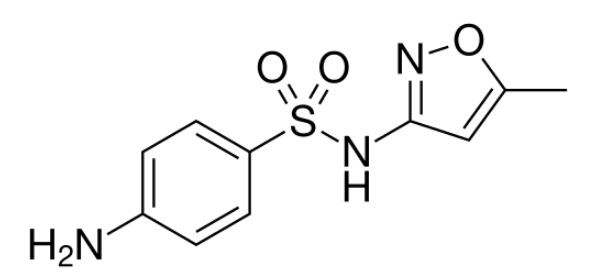
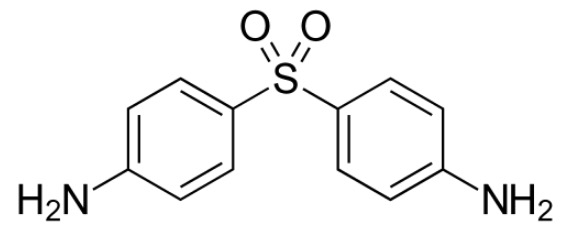
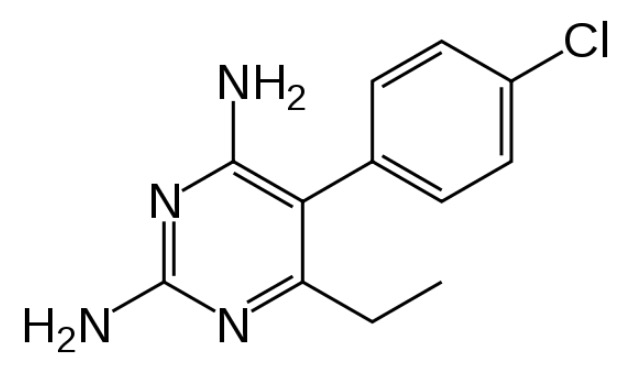
As sulfonamidas são uma classe de antibióticos que inibe a síntese do ácido fólico em agentes patogénicos. O fármaco padrão desta classe é o sulfametoxazol. Embora não sejam tecnicamente sulfonamidas, o trimetoprim, a dapsona e a pirimetamina também são importantes agentes antimicrobianos que inibem a síntese de ácido fólico. Os agentes são frequentemente combinados com sulfonamidas, o que resulta num efeito sinérgico. A principal indicação para a sua utilização é o tratamento da infeção do trato urinário (embora tenha surgido uma resistência significativa). Além disso, os fármacos são usados para tratar e prevenir infeções oportunistas, como encefalite por toxoplasmose e pneumonia Pneumonia Pneumonia or pulmonary inflammation is an acute or chronic inflammation of lung tissue. Causes include infection with bacteria, viruses, or fungi. In more rare cases, pneumonia can also be caused through toxic triggers through inhalation of toxic substances, immunological processes, or in the course of radiotherapy. Pneumonia pneumocística em indivíduos imunocomprometidos. Os efeitos adversos mais MAIS Androgen Insensitivity Syndrome comuns são reações de hipersensibilidade, febre, erupção cutânea, distúrbios gastrointestinais e reações hematológicas. Geralmente, os fármacos estão contraindicados na gravidez, em bebés/crianças doentes e em indivíduos com anemia Anemia Anemia is a condition in which individuals have low Hb levels, which can arise from various causes. Anemia is accompanied by a reduced number of RBCs and may manifest with fatigue, shortness of breath, pallor, and weakness. Subtypes are classified by the size of RBCs, chronicity, and etiology. Anemia: Overview and Types megaloblástica ou insuficiência renal grave.

Last updated: Dec 15, 2025

Editorial responsibility: Stanley Oiseth, Lindsay Jones, Evelin Maza

Classificação

Os antibióticos sulfonamidas são fármacos antimicrobianos que contêm um grupo funcional sulfonamida.

  • O sulfametoxazol é o fármaco padrão desta classe.
  • Outros antibióticos sulfonamidas incluem:
    • Sulfadiazina
    • Sulfisoxazol
  • Muitos outros fármacos de sulfonamida não são antibióticos:
    • Sulfassalazina (trata a doença de Crohn)
    • Sulfonilureias (agentes antidiabéticos, como glipizida)
    • Alguns diuréticos (por exemplo, acetazolamida, clortalidona, furosemida e hidroclorotiazida)
    • Alguns fármacos antivirais e antirretrovirais
    • Alguns inibidores COX-2

Fármacos com mecanismo de ação semelhante aos antibióticos sulfonamidas (mas não tecnicamente sulfonamidas):

  • Trimetoprim
  • Dapsona
  • Pirimetamina

Associação de fármacos (funcionam sinergicamente):

  • Trimetroprim-sulfametoxazol (TMP-SMX) (vendido comercialmente como Septra e Bactrim)
  • Eritromicina-sulfisoxazol

Estrutura Química e Farmacodinâmica

Estrutura química

Os antibióticos sulfonamidas contêm um grupo funcional sulfonamida, que é um enxofre ligado a:
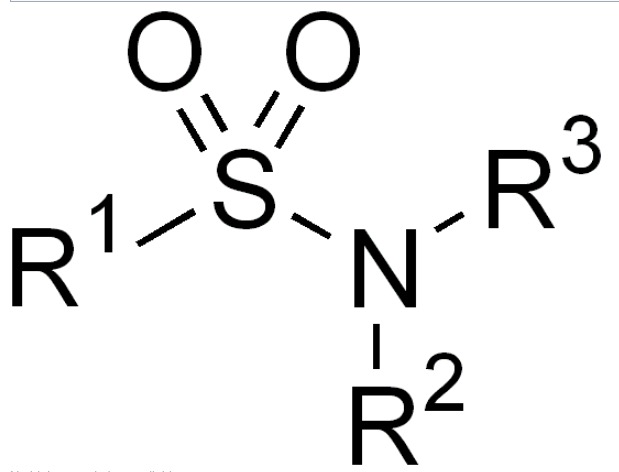
  • 2 moléculas de oxigénio separadas, cada uma através de uma ligação dupla
  • 1 nitrogénio
  • 1 cadeia lateral do grupo R

Mecanismo de ação

As sulfonamidas, o trimetoprim, a dapsona e a pirimetamina perturbam a síntese de ácido fólico em micróbios.
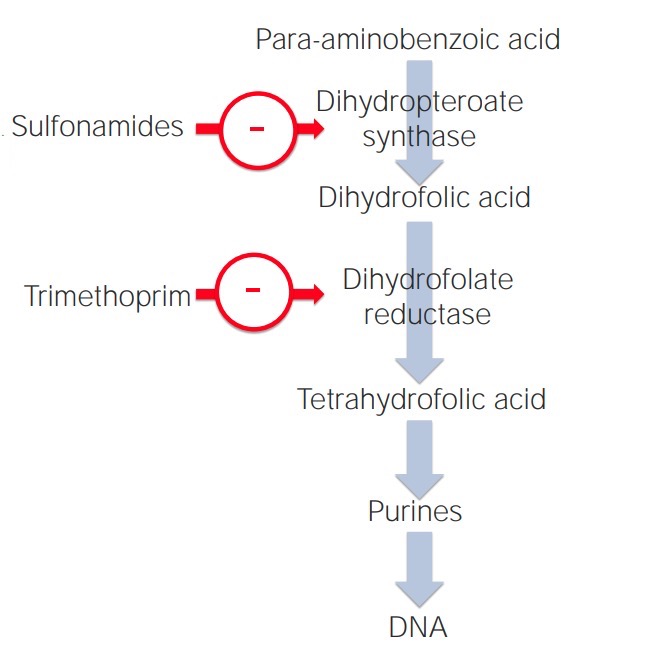
  • Síntese de ácido fólico:
    • A dihidropteroato sintase converte o ácido para-aminobenzoico (PABA) em dihidrofolato.
    • A dihidrofolato redutase converte o dihidrofolato em tetra-hidrofolato.
    • O tetraidrofolato é usado para sintetizar purinas, que são necessárias para a síntese de DNA DNA A deoxyribonucleotide polymer that is the primary genetic material of all cells. Eukaryotic and prokaryotic organisms normally contain DNA in a double-stranded state, yet several important biological processes transiently involve single-stranded regions. DNA, which consists of a polysugar-phosphate backbone possessing projections of purines (adenine and guanine) and pyrimidines (thymine and cytosine), forms a double helix that is held together by hydrogen bonds between these purines and pyrimidines (adenine to thymine and guanine to cytosine). DNA Types and Structure.
    • Os humanos obtêm o tetraidrofolato a partir da dieta, porém os organismos unicelulares têm de sintetizar o tetraidrofolato.
  • Sulfonamidas e dapsona:
    • Análogos estruturais do PABA
    • Competem com o PABA na ligação à dihidropteroato sintase bacteriana (inibição competitiva) → bloqueia a conversão de PABA em dihidrofolato
    • ↓ Dihidrofolato → ↓ tetrahidrofolato → bactéria não consegue sintetizar purinas → interrompe a síntese de DNA DNA A deoxyribonucleotide polymer that is the primary genetic material of all cells. Eukaryotic and prokaryotic organisms normally contain DNA in a double-stranded state, yet several important biological processes transiently involve single-stranded regions. DNA, which consists of a polysugar-phosphate backbone possessing projections of purines (adenine and guanine) and pyrimidines (thymine and cytosine), forms a double helix that is held together by hydrogen bonds between these purines and pyrimidines (adenine to thymine and guanine to cytosine). DNA Types and Structure bacteriano
  • Trimetoprim e pirimetamina:
    • Inibem a dihidrofolato redutase:
      • Trimetoprim: liga-se seletivamente à dihidrofolato redutase bacteriana
      • Pirimetamina: liga-se seletivamente à dihidrofolato redutase parasitária
    • Bloqueia a formação de tetrahidrofolato a partir de dihidrofolato
    • ↓ Dihidrofolato → ↓ tetrahidrofolato → bactéria não consegue sintetizar purinas → interrompe a síntese de DNA DNA A deoxyribonucleotide polymer that is the primary genetic material of all cells. Eukaryotic and prokaryotic organisms normally contain DNA in a double-stranded state, yet several important biological processes transiently involve single-stranded regions. DNA, which consists of a polysugar-phosphate backbone possessing projections of purines (adenine and guanine) and pyrimidines (thymine and cytosine), forms a double helix that is held together by hydrogen bonds between these purines and pyrimidines (adenine to thymine and guanine to cytosine). DNA Types and Structure bacteriano
  • Estes fármacos são bacteriostáticos quando administrados de forma independente, mas bactericidas quando administrados em combinação:
    • TMP-SMX
    • Sulfadiazina + pirimetamina
Mecanismo de ação das sulfonamidas e do trimetoprim na via do ácido fólico

Mecanismo de ação das sulfonamidas e do trimetoprim na via do ácido fólico

Imagem por Lecturio. Licença: CC BY-NC-SA 4.0

Mecanismos de resistência

  • Algumas bactérias usam folato exógeno → não dependente da síntese de folato pelo PABA → sem suscetibilidade às sulfonamidas
  • Mutações que levam à superprodução de substratos ou enzimas:
    • ↑ PABA → resistência às sulfonamidas
    • ↑ Dihidrofolato redutase → resistência ao trimetoprim
  • As mutações e/ou plasmídeos codificam genes Genes A category of nucleic acid sequences that function as units of heredity and which code for the basic instructions for the development, reproduction, and maintenance of organisms. DNA Types and Structure com um local de ligação ao fármaco alterado → ↓ afinidade:
    • Dihidropteroato sintetase com baixa afinidade para as sulfonamidas
    • Dihidrofolato redutase com baixa afinidade para o trimetoprim
  • Limita a permeabilidade aos fármacos

Farmacocinética

Distribuição

  • TMP-SMX:
    • Localizações:
      • Ouvido médio
      • Expetoração e secreções brônquicas
      • Fluido prostático e vaginal
      • Líquido cefalorraquidiano
      • Atravessa a placenta Placenta A highly vascularized mammalian fetal-maternal organ and major site of transport of oxygen, nutrients, and fetal waste products. It includes a fetal portion (chorionic villi) derived from trophoblasts and a maternal portion (decidua) derived from the uterine endometrium. The placenta produces an array of steroid, protein and peptide hormones (placental hormones). Placenta, Umbilical Cord, and Amniotic Cavity (teratogénico)
    • O TMP é mais MAIS Androgen Insensitivity Syndrome lipossolúvel do que o SMX → formulado num rácio 1:5, que resulta numa concentração ótima para efeito sinérgico 
  • Pirimetamina:
    • Rins
    • Pulmão
    • Fígado
    • Baço

Absorção, metabolismo e eliminação

  • Absorção: geralmente bem absorvido por via oral
  • Ligação às proteínas: Todos estão ligados às proteínas (variando de 40%–90%):
    • SMX: 70%
    • TMP: 45%
    • Dapsona: 70%–90%
    • Pirimetamina: 87%
  • Metabolismo:
    • Algum metabolismo hepático
    • O SMX sofre hidroxilação via CYP2C9 CYP2C9 A cytochrome p-450 subtype that has specificity for acidic xenobiotics. It oxidizes a broad range of important clinical drugs that fall under the categories of nonsteroidal anti-inflammatory agents; hypoglycemic agents; anticoagulants; and diuretics. Anticoagulants.
  • Eliminação:
    • Renal: fármaco e metabolitos inalterados
    • Semi-vida (intermédia a longa, prolongada na insuficiência renal):
      • TMP-SMX: 9–12 horas
      • Dapsona: 28 horas
      • Pirimetamina: 80-95 horas

Indicações

Espectro de atividade: TMP-SMX

Devido à resistência significativa, especialmente contra o TMP-SMX, os agentes são mais MAIS Androgen Insensitivity Syndrome bem empregues após o teste de sensibilidade aos antibióticos. A atividade pode ser contra:

  • Bactérias gram-positivas:
    • Staphylococcus Staphylococcus Staphylococcus is a medically important genera of Gram-positive, aerobic cocci. These bacteria form clusters resembling grapes on culture plates. Staphylococci are ubiquitous for humans, and many strains compose the normal skin flora. Staphylococcus (incluindo MRSA MRSA A strain of Staphylococcus aureus that is non-susceptible to the action of methicillin. The mechanism of resistance usually involves modification of normal or the presence of acquired penicillin binding proteins. Staphylococcus)
    • Streptococcus Streptococcus Streptococcus is one of the two medically important genera of gram-positive cocci, the other being Staphylococcus. Streptococci are identified as different species on blood agar on the basis of their hemolytic pattern and sensitivity to optochin and bacitracin. There are many pathogenic species of streptococci, including S. pyogenes, S. agalactiae, S. pneumoniae, and the viridans streptococci. Streptococcus (cobertura não confiável, resistência significativa vista com S. pneumoniae)
  • Bactérias gram-negativas:
    • Enterobacteriaceae Enterobacteriaceae A family of gram-negative, facultatively anaerobic, rod-shaped bacteria that do not form endospores. Its organisms are distributed worldwide with some being saprophytes and others being plant and animal parasites. Many species are of considerable economic importance due to their pathogenic effects on agriculture and livestock. Cephalosporins:
      • Escherichia coli Escherichia coli The gram-negative bacterium Escherichia coli is a key component of the human gut microbiota. Most strains of E. coli are avirulent, but occasionally they escape the GI tract, infecting the urinary tract and other sites. Less common strains of E. coli are able to cause disease within the GI tract, most commonly presenting as abdominal pain and diarrhea. Escherichia coli (resistência significativa)
      • Klebsiella Klebsiella Klebsiella are encapsulated gram-negative, lactose-fermenting bacilli. They form pink colonies on MacConkey agar due to lactose fermentation. The main virulence factor is a polysaccharide capsule. Klebsiella pneumoniae is the most important pathogenic species. Klebsiella
      • Enterobacter Enterobacter Multidrug-resistant Organisms and Nosocomial Infections
      • Salmonella Salmonella Salmonellae are gram-negative bacilli of the family Enterobacteriaceae. Salmonellae are flagellated, non-lactose-fermenting, and hydrogen sulfide-producing microbes. Salmonella enterica, the most common disease-causing species in humans, is further classified based on serotype as typhoidal (S. typhi and paratyphi) and nontyphoidal (S. enteritidis and typhimurium). Salmonella
      • Shigella Shigella Shigella is a genus of gram-negative, non-lactose-fermenting facultative intracellular bacilli. Infection spreads most commonly via person-to-person contact or through contaminated food and water. Humans are the only known reservoir. Shigella
    • Haemophilus influenzae Haemophilus Influenzae A species of Haemophilus found on the mucous membranes of humans and a variety of animals. The species is further divided into biotypes I through viii. Haemophilus
    • Morganella Morganella Multidrug-resistant Organisms and Nosocomial Infections
    • Clamídia
    • Neisseria Neisseria Neisseria is a genus of bacteria commonly present on mucosal surfaces. Several species exist, but only 2 are pathogenic to humans: N. gonorrhoeae and N. meningitidis. Neisseria species are non-motile, gram-negative diplococci most commonly isolated on modified Thayer-Martin (MTM) agar. Neisseria
  • Agentes patogénicos oportunistas:
    • Pneumocystis jiroveci Pneumocystis jiroveci Pneumocystis jiroveci is a yeast-like fungus causing pneumocystis pneumonia (PCP) in immunocompromised patients. Pneumocystis pneumonia is spread through airborne transmission and classically affects patients with AIDS, functioning as an AIDS-defining illness. Patients may present with insidious onset of fever, chills, dry cough, chest pain, and shortness of breath. Pneumocystis jirovecii/Pneumocystis Pneumonia (PCP)
    • Toxoplasma Toxoplasma Toxoplasmosis is an infectious disease caused by Toxoplasma gondii, an obligate intracellular protozoan parasite. Felines are the definitive host, but transmission to humans can occur through contact with cat feces or the consumption of contaminated foods. The clinical presentation and complications depend on the host’s immune status. Toxoplasma/Toxoplasmosis gondii
    • Nocardia Nocardia Nocardia is a branching, filamentous, gram-positive bacilli. It is partially acid fast due to the presence of mycolic acids in the cell wall. Nocardia is a ubiquitous soil organism that most commonly affects immunocompromised patients. Nocardia is transmitted via inhalation of aerosolized bacteria or less commonly, via direct contact with wounds. Nocardia/Nocardiosis
  • Organismos NÃO cobertos pelo TMP-SMX:
    • Pseudomonas aeruginosa Pseudomonas aeruginosa A species of gram-negative, aerobic, rod-shaped bacteria commonly isolated from clinical specimens (wound, burn, and urinary tract infections). It is also found widely distributed in soil and water. P. Aeruginosa is a major agent of nosocomial infection. Pseudomonas
    • Rickettsia Rickettsia Rickettsiae are a diverse collection of obligate intracellular, gram-negative bacteria that have a tropism for vascular endothelial cells. The vectors for transmission vary by species but include ticks, fleas, mites, and lice. Rickettsia

Indicações para terapêutica com TMP-SMX

  • Infeções do trato urinário:
    • Indicação primária para TMP-SMX
    • Aumento da resistência a E. coli
  • Prostatite
  • Exacerbações da doença pulmonar obstrutiva crónica (DPOC)
  • Otite média aguda
  • Diarreia do viajante causada por E. coli
  • Salmonella Salmonella Salmonellae are gram-negative bacilli of the family Enterobacteriaceae. Salmonellae are flagellated, non-lactose-fermenting, and hydrogen sulfide-producing microbes. Salmonella enterica, the most common disease-causing species in humans, is further classified based on serotype as typhoidal (S. typhi and paratyphi) and nontyphoidal (S. enteritidis and typhimurium). Salmonella sistémica
  • Shigelose
  • Pneumonia Pneumonia Pneumonia or pulmonary inflammation is an acute or chronic inflammation of lung tissue. Causes include infection with bacteria, viruses, or fungi. In more rare cases, pneumonia can also be caused through toxic triggers through inhalation of toxic substances, immunological processes, or in the course of radiotherapy. Pneumonia por Pneumocystis (tratamento e profilaxia)
  • Uso off-label:
    • Feridas por dentadas
    • Celulite com alto risco de MRSA MRSA A strain of Staphylococcus aureus that is non-susceptible to the action of methicillin. The mechanism of resistance usually involves modification of normal or the presence of acquired penicillin binding proteins. Staphylococcus
    • Meningite e abcessos intracranianos
    • Osteomielite e infeções articulares protésicas

Indicações para dapsona

  • Lepra
  • Profilaxia e tratamento em indivíduos com HIV HIV Anti-HIV Drugs contra:
    • Encefalite toxoplasmática
    • Pneumonia Pneumonia Pneumonia or pulmonary inflammation is an acute or chronic inflammation of lung tissue. Causes include infection with bacteria, viruses, or fungi. In more rare cases, pneumonia can also be caused through toxic triggers through inhalation of toxic substances, immunological processes, or in the course of radiotherapy. Pneumonia por Pneumocystis
  • Doenças dermatológicas:
    • Dermatite herpetiforme
    • Dermatoses bolhosas autoimunes (por exemplo, pênfigo vulgar, penfigoide bolhoso)
    • Policondrite recidivante
    • Manifestações dermatológicas do lúpus eritematoso sistémico (LES)

Indicações para pirimetamina

  • Profilaxia e tratamento em indivíduos com HIV HIV Anti-HIV Drugs contra:
    • Encefalite toxoplasmática (em combinação com uma sulfonamida (por exemplo, sulfadiazina))
    • Pneumonia Pneumonia Pneumonia or pulmonary inflammation is an acute or chronic inflammation of lung tissue. Causes include infection with bacteria, viruses, or fungi. In more rare cases, pneumonia can also be caused through toxic triggers through inhalation of toxic substances, immunological processes, or in the course of radiotherapy. Pneumonia por Pneumocystis
  • Cistoisosporíase

Efeitos Adversos e Contraindicações

Efeitos adversos

  • Reações de hipersensibilidade
  • Febre
  • Reações dermatológicas:
    • Erupções cutâneas
    • Dermatite esfoliativa
    • Fotossensibilidade
    • Síndrome de Stevens-Johnson
  • Náuseas, vómitos e/ou diarreia
  • Cristalúria (com pH pH The quantitative measurement of the acidity or basicity of a solution. Acid-Base Balance urinário neutro ou ácido)
  • Reações hematológicas:
    • Anemia Anemia Anemia is a condition in which individuals have low Hb levels, which can arise from various causes. Anemia is accompanied by a reduced number of RBCs and may manifest with fatigue, shortness of breath, pallor, and weakness. Subtypes are classified by the size of RBCs, chronicity, and etiology. Anemia: Overview and Types hemolítica (especialmente em indivíduos com deficiência de glicose-6-fosfato-desidrogenase ( G6PD G6PD Pentose Phosphate Pathway))
    • Anemia Anemia Anemia is a condition in which individuals have low Hb levels, which can arise from various causes. Anemia is accompanied by a reduced number of RBCs and may manifest with fatigue, shortness of breath, pallor, and weakness. Subtypes are classified by the size of RBCs, chronicity, and etiology. Anemia: Overview and Types megaloblástica
    • Anemia Anemia Anemia is a condition in which individuals have low Hb levels, which can arise from various causes. Anemia is accompanied by a reduced number of RBCs and may manifest with fatigue, shortness of breath, pallor, and weakness. Subtypes are classified by the size of RBCs, chronicity, and etiology. Anemia: Overview and Types aplástica
    • Granulocitopenia
    • Trombocitopenia

Contraindicações

  • Hipersensibilidade a fármacos à base de sulfa
  • Anemia Anemia Anemia is a condition in which individuals have low Hb levels, which can arise from various causes. Anemia is accompanied by a reduced number of RBCs and may manifest with fatigue, shortness of breath, pallor, and weakness. Subtypes are classified by the size of RBCs, chronicity, and etiology. Anemia: Overview and Types megaloblástica devido a deficiência de folato
  • Deficiência de G6PD G6PD Pentose Phosphate Pathway
  • Bebés < 2 meses de idade
  • Doença renal grave
  • Gravidez (especialmente no primeiro trimestre devido ao ↑ risco de defeitos do tubo neural)
  • Amamentação se bebé com:

Comparação de Antibióticos

Comparação baseada no mecanismo de ação

Os antibióticos podem ser classificados de várias formas. Uma forma é classificar os antibióticos por mecanismo de ação.

Tabela: Antibióticos classificados por mecanismo de ação primário
Mecanismo Classe de antibióticos
Inibidores da síntese da parede celular bacteriana
  • Penicilinas
  • Cefalosporinas
  • Penemes
  • Diversos
Inibidores da síntese de proteínas bacterianas
  • Tetraciclinas
  • Macrólidos
  • Cetolídeos
  • Lincosamidas
  • Estreptograminas
  • Linezolida
Agentes que atuam contra DNA DNA A deoxyribonucleotide polymer that is the primary genetic material of all cells. Eukaryotic and prokaryotic organisms normally contain DNA in a double-stranded state, yet several important biological processes transiently involve single-stranded regions. DNA, which consists of a polysugar-phosphate backbone possessing projections of purines (adenine and guanine) and pyrimidines (thymine and cytosine), forms a double helix that is held together by hydrogen bonds between these purines and pyrimidines (adenine to thymine and guanine to cytosine). DNA Types and Structure e/ou folato
  • Sulfonamidas
  • Trimetoprim
  • Fluoroquinolonas
Agentes antimicobacterianos
  • Agentes anti-TB
  • Agentes anti-hanseníase (lepra)
  • Agentes micobacterianos atípicos

Comparação com base na cobertura

Diferentes antibióticos têm vários graus de atividade contra diferentes bactérias. A tabela abaixo descreve os antibióticos com atividade contra 3 classes importantes de bactérias: cocos gram-positivos, bacilos gram-negativos e anaeróbios.
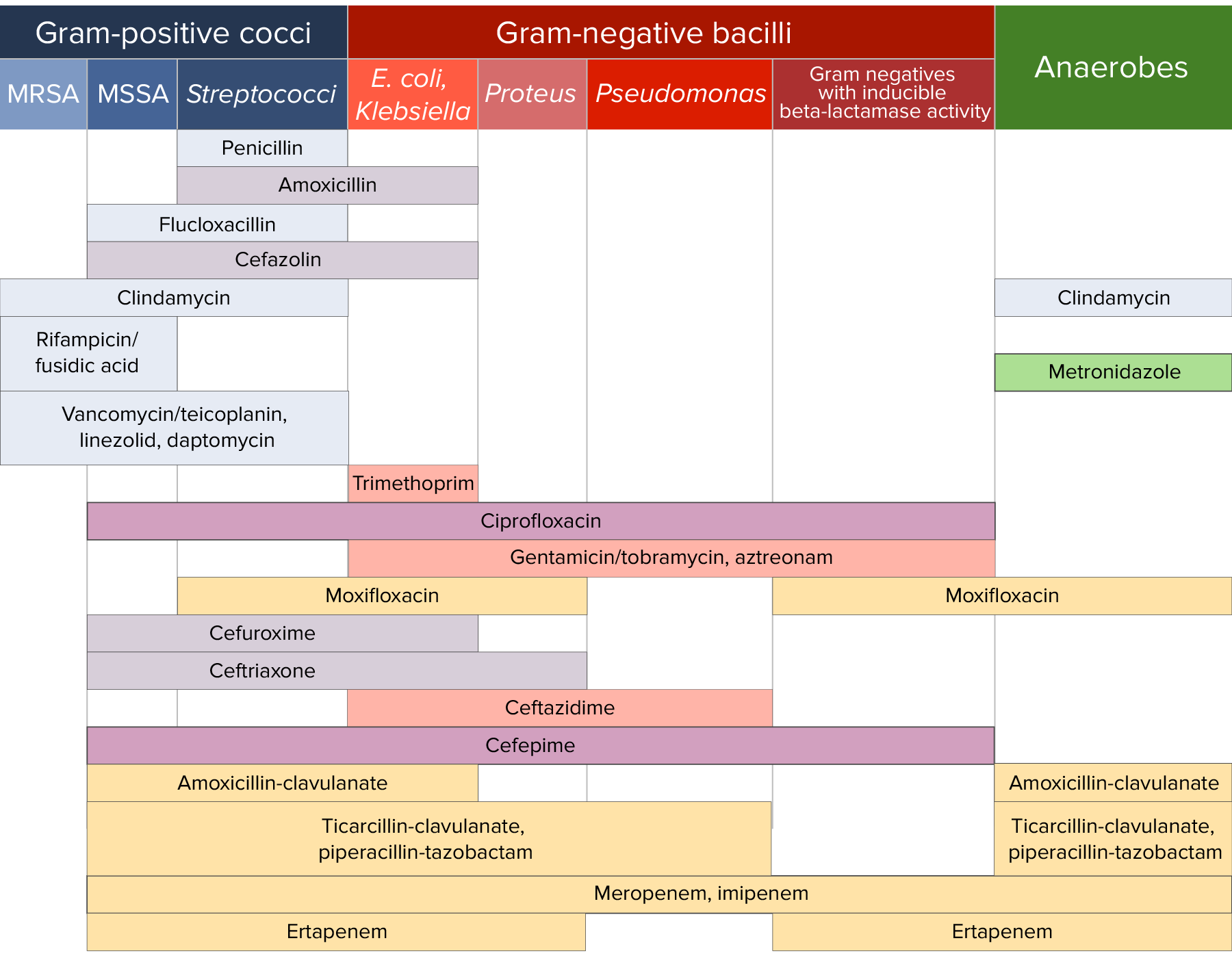
Gráfico de sensibilidade a antibióticos

Sensibilidade aos antibióticos:
Gráfico que compara a cobertura microbiana de diferentes antibióticos para cocos gram-positivos, bacilos gram-negativos e anaeróbios.

Imagem por Lecturio. Licença: CC BY-NC-SA 4.0

Referências

  1. May, D. B. (2025). Trimethoprim-sulfamethoxazole: An overview. In Mitty, J. (Ed.), UpToDate, Retrieved October 16, 2025, from https://www.uptodate.com/contents/trimethoprim-sulfamethoxazole-an-overview 
  2. Lexicomp Drug Information Sheets (2025). In UpToDate. Retrieved October 16, 2025, from:
    1. Trimethoprim-sulfamethoxazole (co-trimoxazole): https://www.uptodate.com/contents/trimethoprim-sulfamethoxazole-co-trimoxazole-drug-information 
    2. Dapsone: https://www.uptodate.com/contents/dapsone-systemic-drug-information 
    3. Pyrimethamine: https://www.uptodate.com/contents/pyrimethamine-drug-information 
    4. Sulfadiazine: https://www.uptodate.com/contents/sulfadiazine-drug-information 
  3. Kemnic, T. (2022). Trimethoprim sulfamethoxazole. In StatPearls. Retrieved October 16, 2025, from https://www.statpearls.com/articlelibrary/viewarticle/30613/ 
  4. Kurien, G. (2024). Dapsone. In StatPearls. Retrieved October 16, 2025, from https://www.statpearls.com/articlelibrary/viewarticle/20256/

Crie sua conta gratuita ou faça login para continuar lendo!

Cadastre-se agora e tenha acesso grátis ao Lecturio, com páginas de conceitos, vídeos de medicina e questões para sua educação médica.

Aprende mais com a Lecturio:

Multiple devices displaying human anatomy and health education content.

Complementa o teu estudo da faculdade com o companheiro de estudo tudo-em-um da Lecturio, através de métodos de ensino baseados em evidência.

Estuda onde quiseres

Two iPhones display medical education apps, one showing anatomy, the other Bookmatcher.

A Lecturio Medical complementa o teu estudo através de métodos de ensino baseados em evidência, vídeos de palestras, perguntas e muito mais – tudo combinado num só lugar e fácil de usar.

User Reviews

Details