Domina Conceptos Médicos

Estudia para la escuela de medicina y tus examenes con Lecturio.

Síndrome Nefrótico en Niños

El síndrome nefrótico es un trastorno renal causado por afecciones que aumentan la permeabilidad de las barreras de filtración glomerular. El síndrome nefrótico afecta a todos los LOS Neisseria grupos etarios, pero tiene una mayor prevalencia pediátrica. Este trastorno puede deberse tanto a causas primarias (renales) como secundarias (sistémicas). La enfermedad de cambios mínimos es la presentación más común en EN Erythema nodosum is an immune-mediated panniculitis (inflammation of the subcutaneous fat) caused by a type IV (delayed-type) hypersensitivity reaction. It commonly manifests in young women as tender, erythematous nodules on the shins. Erythema Nodosum los LOS Neisseria niños. Las características distintivas incluyen proteinuria Proteinuria The presence of proteins in the urine, an indicator of kidney diseases. Nephrotic Syndrome in Children de > 40 mg/m²/hora, hipoalbuminemia, hipercolesterolemia y edema Edema Edema is a condition in which excess serous fluid accumulates in the body cavity or interstitial space of connective tissues. Edema is a symptom observed in several medical conditions. It can be categorized into 2 types, namely, peripheral (in the extremities) and internal (in an organ or body cavity). Edema. El diagnóstico se basa en EN Erythema nodosum is an immune-mediated panniculitis (inflammation of the subcutaneous fat) caused by a type IV (delayed-type) hypersensitivity reaction. It commonly manifests in young women as tender, erythematous nodules on the shins. Erythema Nodosum los LOS Neisseria antecedentes, el examen físico, las pruebas de laboratorio que confirman la proteinuria Proteinuria The presence of proteins in the urine, an indicator of kidney diseases. Nephrotic Syndrome in Children de rango nefrótico y el estudio de la enfermedad sistémica. En EN Erythema nodosum is an immune-mediated panniculitis (inflammation of the subcutaneous fat) caused by a type IV (delayed-type) hypersensitivity reaction. It commonly manifests in young women as tender, erythematous nodules on the shins. Erythema Nodosum algunos casos se recomiendan las pruebas genéticas. Los LOS Neisseria esteroides son el tratamiento inicial en EN Erythema nodosum is an immune-mediated panniculitis (inflammation of the subcutaneous fat) caused by a type IV (delayed-type) hypersensitivity reaction. It commonly manifests in young women as tender, erythematous nodules on the shins. Erythema Nodosum una presentación clásica de la enfermedad de cambios mínimos que suele responder a los LOS Neisseria esteroides. En EN Erythema nodosum is an immune-mediated panniculitis (inflammation of the subcutaneous fat) caused by a type IV (delayed-type) hypersensitivity reaction. It commonly manifests in young women as tender, erythematous nodules on the shins. Erythema Nodosum otros casos, está indicada la biopsia renal. El tratamiento y el pronóstico varían según la causa subyacente y la respuesta a los LOS Neisseria esteroides.

Last updated: Dec 15, 2025

Editorial responsibility: Stanley Oiseth, Lindsay Jones, Evelin Maza

Descripción General

Definición

El síndrome nefrótico es un trastorno renal caracterizado por aumento de la permeabilidad de las barreras de filtración glomerular que conduce significativamente a una proteinuria Proteinuria The presence of proteins in the urine, an indicator of kidney diseases. Nephrotic Syndrome in Children grave.

Las características clásicas incluyen:

  • Proteinuria Proteinuria The presence of proteins in the urine, an indicator of kidney diseases. Nephrotic Syndrome in Children de rango nefrótico de > 40 mg/m²/hora
  • Hipoalbuminemia, a menudo < 2,5 g/dL
  • Colesterol y triglicéridos elevados
  • Edema Edema Edema is a condition in which excess serous fluid accumulates in the body cavity or interstitial space of connective tissues. Edema is a symptom observed in several medical conditions. It can be categorized into 2 types, namely, peripheral (in the extremities) and internal (in an organ or body cavity). Edema

Epidemiología

  • Ocurre a cualquier edad, pero es más frecuente en EN Erythema nodosum is an immune-mediated panniculitis (inflammation of the subcutaneous fat) caused by a type IV (delayed-type) hypersensitivity reaction. It commonly manifests in young women as tender, erythematous nodules on the shins. Erythema Nodosum niños y adolescentes en EN Erythema nodosum is an immune-mediated panniculitis (inflammation of the subcutaneous fat) caused by a type IV (delayed-type) hypersensitivity reaction. It commonly manifests in young women as tender, erythematous nodules on the shins. Erythema Nodosum edad escolar
  • Incidencia mundial de ~1 a 17 casos por cada 100 000 niños al AL Amyloidosis año
  • Hombres > mujeres (2:1) en EN Erythema nodosum is an immune-mediated panniculitis (inflammation of the subcutaneous fat) caused by a type IV (delayed-type) hypersensitivity reaction. It commonly manifests in young women as tender, erythematous nodules on the shins. Erythema Nodosum los LOS Neisseria niños más pequeños, pero se iguala en EN Erythema nodosum is an immune-mediated panniculitis (inflammation of the subcutaneous fat) caused by a type IV (delayed-type) hypersensitivity reaction. It commonly manifests in young women as tender, erythematous nodules on the shins. Erythema Nodosum la adolescencia
  • El 90% de los LOS Neisseria casos en EN Erythema nodosum is an immune-mediated panniculitis (inflammation of the subcutaneous fat) caused by a type IV (delayed-type) hypersensitivity reaction. It commonly manifests in young women as tender, erythematous nodules on the shins. Erythema Nodosum niños se deben a causas primarias (e.g., enfermedad de cambios mínimos).
  • Mayor incidencia de enfermedad glomerular crónica en EN Erythema nodosum is an immune-mediated panniculitis (inflammation of the subcutaneous fat) caused by a type IV (delayed-type) hypersensitivity reaction. It commonly manifests in young women as tender, erythematous nodules on the shins. Erythema Nodosum niños ≥ 12 años de edad

Clasificación

Los LOS Neisseria diferentes sistemas de clasificación general pueden superponerse:

  • Basada en EN Erythema nodosum is an immune-mediated panniculitis (inflammation of the subcutaneous fat) caused by a type IV (delayed-type) hypersensitivity reaction. It commonly manifests in young women as tender, erythematous nodules on the shins. Erythema Nodosum el inicio en EN Erythema nodosum is an immune-mediated panniculitis (inflammation of the subcutaneous fat) caused by a type IV (delayed-type) hypersensitivity reaction. It commonly manifests in young women as tender, erythematous nodules on the shins. Erythema Nodosum pacientes ≤ 1 año de edad:
    • Congénita (< 3 meses de edad)
    • Infantil (3 meses a 1 año de edad)
  • Basada en EN Erythema nodosum is an immune-mediated panniculitis (inflammation of the subcutaneous fat) caused by a type IV (delayed-type) hypersensitivity reaction. It commonly manifests in young women as tender, erythematous nodules on the shins. Erythema Nodosum la presencia de una enfermedad sistémica o un proceso subyacente:
    • Síndrome nefrótico primario (incluye el idiopático)
    • Síndrome nefrótico secundario

El síndrome nefrótico idiopático se clasifica además en EN Erythema nodosum is an immune-mediated panniculitis (inflammation of the subcutaneous fat) caused by a type IV (delayed-type) hypersensitivity reaction. It commonly manifests in young women as tender, erythematous nodules on the shins. Erythema Nodosum función de la respuesta a los LOS Neisseria esteroides:

Etiología

Congénita/infantil:

  • Síndrome de Denys-Drash (asociado a un alto riesgo de tumor Tumor Inflammation de Wilms)
  • Síndrome nefrótico congénito tipo finlandés (autosómico recesivo)
  • Glomeruloesclerosis focal y segmentaria familiar autosómica
  • Glomeruloesclerosis focal y segmentaria autosómica dominante
  • Síndrome de Frasier
  • Esclerosis mesangial difusa
  • Síndrome uña-rótula
  • Síndrome de Pierson
  • Displasia inmuno-ósea de Schimke
  • Causas no genéticas (también clasificadas como secundarias):
    • Sífilis congénita
    • Toxoplasmosis Toxoplasmosis Toxoplasmosis is an infectious disease caused by Toxoplasma gondii, an obligate intracellular protozoan parasite. Felines are the definitive host, but transmission to humans can occur through contact with cat feces or the consumption of contaminated foods. The clinical presentation and complications depend on the host’s immune status. Toxoplasma/Toxoplasmosis congénita
    • Otros: citomegalovirus, VIH

Primaria (90% idiopática):

  • Enfermedad de cambios mínimos: presentación más común y hallazgo histológico del síndrome nefrótico en EN Erythema nodosum is an immune-mediated panniculitis (inflammation of the subcutaneous fat) caused by a type IV (delayed-type) hypersensitivity reaction. It commonly manifests in young women as tender, erythematous nodules on the shins. Erythema Nodosum niños en EN Erythema nodosum is an immune-mediated panniculitis (inflammation of the subcutaneous fat) caused by a type IV (delayed-type) hypersensitivity reaction. It commonly manifests in young women as tender, erythematous nodules on the shins. Erythema Nodosum edad escolar
  • Glomeruloesclerosis focal y segmentaria
  • Proliferación mesangial
  • Glomerulonefritis membranoproliferativa
  • Nefropatía membranosa (rara en EN Erythema nodosum is an immune-mediated panniculitis (inflammation of the subcutaneous fat) caused by a type IV (delayed-type) hypersensitivity reaction. It commonly manifests in young women as tender, erythematous nodules on the shins. Erythema Nodosum niños)

Secundaria:

  • Enfermedades o afecciones:
    • Lupus eritematoso sistémico (puede ser nefrítica o nefrótica)
    • Vasculitis Vasculitis Inflammation of any one of the blood vessels, including the arteries; veins; and rest of the vasculature system in the body. Systemic Lupus Erythematosus por IgA IgA Represents 15-20% of the human serum immunoglobulins, mostly as the 4-chain polymer in humans or dimer in other mammals. Secretory iga is the main immunoglobulin in secretions. Immunoglobulins: Types and Functions (anteriormente púrpura de Henoch-Schönlein; puede ser nefrítica o nefrótica)
    • Amiloidosis
    • Nefropatía IgA IgA Represents 15-20% of the human serum immunoglobulins, mostly as the 4-chain polymer in humans or dimer in other mammals. Secretory iga is the main immunoglobulin in secretions. Immunoglobulins: Types and Functions (más a menudo nefrítica)
    • Linfoma
    • Diabetes Diabetes Diabetes mellitus (DM) is a metabolic disease characterized by hyperglycemia and dysfunction of the regulation of glucose metabolism by insulin. Type 1 DM is diagnosed mostly in children and young adults as the result of autoimmune destruction of β cells in the pancreas and the resulting lack of insulin. Type 2 DM has a significant association with obesity and is characterized by insulin resistance. Diabetes Mellitus mellitus
  • Medicamentos, como los LOS Neisseria AINE
  • Infecciones:
    • Glomerulonefritis postestreptocócica (puede ser nefrítica o nefrótica)
    • Hepatitis B Hepatitis B Hepatitis B virus (HBV) is a partially double-stranded DNA virus, which belongs to the Orthohepadnavirus genus and the Hepadnaviridae family. Most individuals with acute HBV infection are asymptomatic or have mild, self-limiting symptoms. Chronic infection can be asymptomatic or create hepatic inflammation, leading to liver cirrhosis and hepatocellular carcinoma (HCC). Hepatitis B Virus
    • Hepatitis C Hepatitis C Hepatitis C is an infection of the liver caused by the hepatitis C virus (HCV). The infection can be transmitted through infectious blood or body fluids and may be transmitted during childbirth or through IV drug use or sexual intercourse. Hepatitis C virus can cause both acute and chronic hepatitis, ranging from a mild to a serious, lifelong illness including liver cirrhosis and hepatocellular carcinoma (HCC). Hepatitis C Virus
    • VIH
    • Malaria Malaria Malaria is an infectious parasitic disease affecting humans and other animals. Most commonly transmitted via the bite of a female Anopheles mosquito infected with microorganisms of the Plasmodium genus. Patients present with fever, chills, myalgia, headache, and diaphoresis. Plasmodium/Malaria
  • Cicatrización renal

Fisiopatología

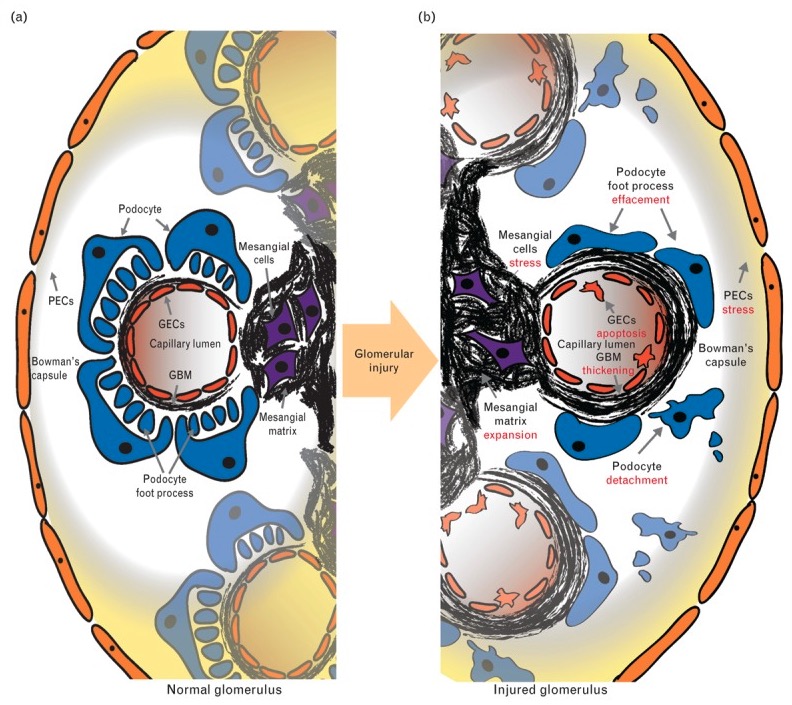
La estructura del glomérulo crea un sistema de filtración, la barrera de filtración glomerular, compuesta por:

  • Endotelio fenestrado
  • Membrana basal glomerular
  • Capa epitelial:
    • Podocitos y procesos pediculados
    • Ranuras de filtración
    • Diafragma de hendidura

En EN Erythema nodosum is an immune-mediated panniculitis (inflammation of the subcutaneous fat) caused by a type IV (delayed-type) hypersensitivity reaction. It commonly manifests in young women as tender, erythematous nodules on the shins. Erythema Nodosum circunstancias normales, el paso de las proteínas a través de la barrera de filtración glomerular está controlado por su tamaño o carga.

  • Tamaño de las moléculas:
    • La barrera es permeable solo al AL Amyloidosis agua, pequeñas proteínas y iones.
    • Las proteínas de alto peso molecular no pueden atravesar la membrana basal glomerular.
  • Carga de las moléculas:
    • La membrana basal glomerular está cargada negativamente debido a la presencia de polianiones, como los LOS Neisseria proteoglicanos de heparán sulfato.
    • Aniones como la albúmina son repelidos.

Los LOS Neisseria factores genéticos o inmunitarios provocan:

  • Daño estructural o funcional de los LOS Neisseria componentes de la barrera de filtración glomerular, como los LOS Neisseria podocitos
  • Pérdida de carga negativa que permite la filtración de aniones como la albúmina
  • Aumento de la permeabilidad de la membrana
  • Pérdida posterior de proteínas del plasma Plasma The residual portion of blood that is left after removal of blood cells by centrifugation without prior blood coagulation. Transfusion Products al AL Amyloidosis espacio urinario

Efectos:

  • Proteinuria Proteinuria The presence of proteins in the urine, an indicator of kidney diseases. Nephrotic Syndrome in Children abundante → pérdida de albúmina (hipoalbuminemia) → ↓ presión osmótica intravascular → edema Edema Edema is a condition in which excess serous fluid accumulates in the body cavity or interstitial space of connective tissues. Edema is a symptom observed in several medical conditions. It can be categorized into 2 types, namely, peripheral (in the extremities) and internal (in an organ or body cavity). Edema
  • ↑ Lipogénesis hepática (respuesta inespecífica a la hipoalbuminemia) + enzimas reguladoras anormales → hiperlipidemia
  • Pérdida de anticoagulantes endógenos (antitrombina III) → complicaciones trombóticas y tromboembólicas
  • Pérdida de inmunoglobulinas → mayor riesgo de infecciones, especialmente por bacterias encapsuladas

Presentación Clínica

  • Edema Edema Edema is a condition in which excess serous fluid accumulates in the body cavity or interstitial space of connective tissues. Edema is a symptom observed in several medical conditions. It can be categorized into 2 types, namely, peripheral (in the extremities) and internal (in an organ or body cavity). Edema:
    • Con fóvea
    • Depende de la gravedad:
      • Comienza con un edema Edema Edema is a condition in which excess serous fluid accumulates in the body cavity or interstitial space of connective tissues. Edema is a symptom observed in several medical conditions. It can be categorized into 2 types, namely, peripheral (in the extremities) and internal (in an organ or body cavity). Edema periorbital Periorbital Orbital and Preseptal Cellulitis (que disminuye durante el día)
      • El edema Edema Edema is a condition in which excess serous fluid accumulates in the body cavity or interstitial space of connective tissues. Edema is a symptom observed in several medical conditions. It can be categorized into 2 types, namely, peripheral (in the extremities) and internal (in an organ or body cavity). Edema de las extremidades inferiores se observa entonces durante el día
      • Al AL Amyloidosis reclinarse, se observa edema Edema Edema is a condition in which excess serous fluid accumulates in the body cavity or interstitial space of connective tissues. Edema is a symptom observed in several medical conditions. It can be categorized into 2 types, namely, peripheral (in the extremities) and internal (in an organ or body cavity). Edema de la espalda y región sacra.
    • A menudo, aparición repentina tras una enfermedad reciente, como una infección de las vías respiratorias superiores
  • Disnea debida a:
    • Derrame pleural
    • Ascitis
    • Neumonía
    • Embolia pulmonar
  • Inespecíficos: cefalea, fatiga, irritabilidad, dolor Dolor Inflammation abdominal
  • Puede presentarse con hematuria Hematuria Presence of blood in the urine. Renal Cell Carcinoma (síndrome nefrítico y nefrótico mixto)
  • Puede asociarse con hipertensión
  • Puede presentar complicaciones:
    • Infecciones (debidas a una respuesta inmunitaria deteriorada)
    • Evento tromboembólico (debido a un estado hipercoagulable)
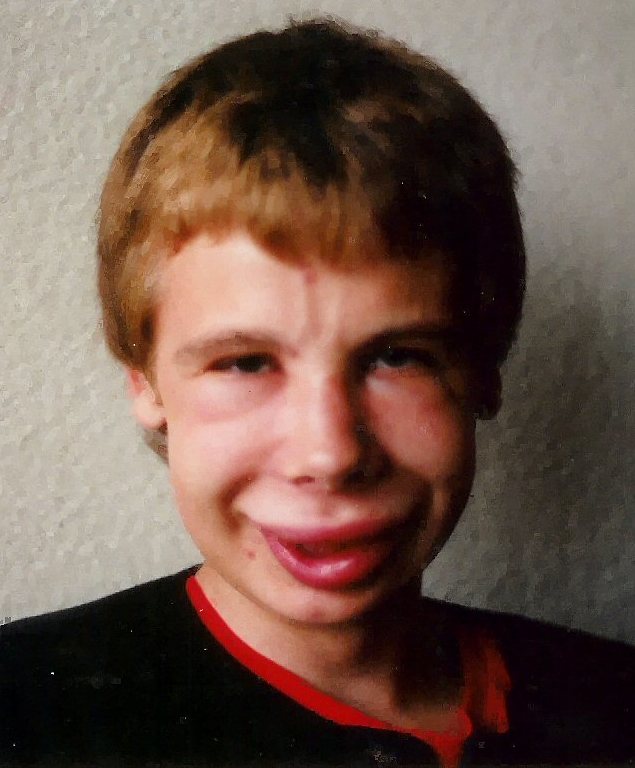
Edema por síndrome nefrótico

Síndrome nefrótico:
La afección se acompaña de retención de agua y sodio. La imagen muestra aumento de volumen/edema facial. El grado de edema puede variar entre un ligero edema en los párpados que disminuye durante el día, hasta un aumento de volumen que afecta a las extremidades inferiores, pasando por una aumento de volumen generalizado o anasarca.

Imagen: “Nephrotic syndrome” por Charles Picavet. Licencia: Dominio Público

Diagnóstico

Estudios de orina

  • Recolección de orina de 24 horas (estándar de oro):
    • Cuantificación de proteínas
    • El síndrome nefrótico es la excreción de proteínas > 40 mg/m²/hora (> 50 mg/kg/día).
  • Relación proteína/creatinina en EN Erythema nodosum is an immune-mediated panniculitis (inflammation of the subcutaneous fat) caused by a type IV (delayed-type) hypersensitivity reaction. It commonly manifests in young women as tender, erythematous nodules on the shins. Erythema Nodosum orina en EN Erythema nodosum is an immune-mediated panniculitis (inflammation of the subcutaneous fat) caused by a type IV (delayed-type) hypersensitivity reaction. It commonly manifests in young women as tender, erythematous nodules on the shins. Erythema Nodosum la primera orina de la mañana:
    • Útil en EN Erythema nodosum is an immune-mediated panniculitis (inflammation of the subcutaneous fat) caused by a type IV (delayed-type) hypersensitivity reaction. It commonly manifests in young women as tender, erythematous nodules on the shins. Erythema Nodosum niños en EN Erythema nodosum is an immune-mediated panniculitis (inflammation of the subcutaneous fat) caused by a type IV (delayed-type) hypersensitivity reaction. It commonly manifests in young women as tender, erythematous nodules on the shins. Erythema Nodosum los LOS Neisseria que no siempre es posible una recolección cronometrada de 24 horas
    • Proteinuria Proteinuria The presence of proteins in the urine, an indicator of kidney diseases. Nephrotic Syndrome in Children persistente:
      • Se define como una relación proteína/creatinina en EN Erythema nodosum is an immune-mediated panniculitis (inflammation of the subcutaneous fat) caused by a type IV (delayed-type) hypersensitivity reaction. It commonly manifests in young women as tender, erythematous nodules on the shins. Erythema Nodosum orina > 0,2 mg/mg (> 0,5 para niños de 6 a 24 meses de edad) observada en EN Erythema nodosum is an immune-mediated panniculitis (inflammation of the subcutaneous fat) caused by a type IV (delayed-type) hypersensitivity reaction. It commonly manifests in young women as tender, erythematous nodules on the shins. Erythema Nodosum varias ocasiones
      • Requiere una evaluación adicional para determinar cualquier patología renal subyacente
    • El síndrome nefrótico es una relación proteína/creatinina en EN Erythema nodosum is an immune-mediated panniculitis (inflammation of the subcutaneous fat) caused by a type IV (delayed-type) hypersensitivity reaction. It commonly manifests in young women as tender, erythematous nodules on the shins. Erythema Nodosum orina de > 2 mg/mg.
  • Análisis de orina:
    • Proteínas en EN Erythema nodosum is an immune-mediated panniculitis (inflammation of the subcutaneous fat) caused by a type IV (delayed-type) hypersensitivity reaction. It commonly manifests in young women as tender, erythematous nodules on the shins. Erythema Nodosum la orina con tira reactiva:
      • 3+ (consistente con > 300 mg/dL)
      • 4+ (consistente con > 2 000 mg/dL)
    • Cilindros grasos (“cruz de Malta” bajo luz polarizada)
    • Hematuria Hematuria Presence of blood in the urine. Renal Cell Carcinoma (eritrocitos) o cilindros eritrocitarios en EN Erythema nodosum is an immune-mediated panniculitis (inflammation of the subcutaneous fat) caused by a type IV (delayed-type) hypersensitivity reaction. It commonly manifests in young women as tender, erythematous nodules on the shins. Erythema Nodosum el síndrome nefrítico-nefrótico mixto

Estudios adicionales

  • Panel metabólico completo:
    • Electrolitos:
      • Frecuentemente normales
      • La hiponatremia puede producirse debido a una afección subyacente, a la liberación inadecuada de la hormona antidiurética o a un tratamiento diurético agresivo.
      • El calcio puede ser bajo debido a la hipoalbuminemia, pero generalmente el calcio ionizado es normal.
    • Nitrógeno ureico en EN Erythema nodosum is an immune-mediated panniculitis (inflammation of the subcutaneous fat) caused by a type IV (delayed-type) hypersensitivity reaction. It commonly manifests in young women as tender, erythematous nodules on the shins. Erythema Nodosum sangre (BUN, por sus siglas en EN Erythema nodosum is an immune-mediated panniculitis (inflammation of the subcutaneous fat) caused by a type IV (delayed-type) hypersensitivity reaction. It commonly manifests in young women as tender, erythematous nodules on the shins. Erythema Nodosum inglés)/creatinina:
      • Puede ser normal
      • Puede ser elevado en EN Erythema nodosum is an immune-mediated panniculitis (inflammation of the subcutaneous fat) caused by a type IV (delayed-type) hypersensitivity reaction. It commonly manifests in young women as tender, erythematous nodules on the shins. Erythema Nodosum la insuficiencia renal
    • Albúmina sérica < 2,5 g/dL
  • Hipogammaglobulinemia
  • Colesterol y triglicéridos elevados
  • Niveles del complemento (C3, C4)
  • Otros efectos de las proteínas de baja unión:
    • Disminución de la vitamina D (debido a la reducción de la proteína de unión a la vitamina D)
    • Reducción de la tiroxina (debido a la disminución de la proteína de unión tiroidea)
  • Pruebas específicas de las enfermedades:
    • Glomerulonefritis postestreptocócica:
      • Títulos elevados de antiestreptolisina O
      • Anticuerpos anti-DNasa B elevados
      • Disminución del complemento sérico C3 debido al AL Amyloidosis consumo
    • Lupus eritematoso sistémico:
      • Anticuerpos antinucleares (ANA, por sus siglas en EN Erythema nodosum is an immune-mediated panniculitis (inflammation of the subcutaneous fat) caused by a type IV (delayed-type) hypersensitivity reaction. It commonly manifests in young women as tender, erythematous nodules on the shins. Erythema Nodosum inglés)
      • Anti-ADN de doble cadena
    • Diabetes Diabetes Diabetes mellitus (DM) is a metabolic disease characterized by hyperglycemia and dysfunction of the regulation of glucose metabolism by insulin. Type 1 DM is diagnosed mostly in children and young adults as the result of autoimmune destruction of β cells in the pancreas and the resulting lack of insulin. Type 2 DM has a significant association with obesity and is characterized by insulin resistance. Diabetes Mellitus mellitus: glucosa en EN Erythema nodosum is an immune-mediated panniculitis (inflammation of the subcutaneous fat) caused by a type IV (delayed-type) hypersensitivity reaction. It commonly manifests in young women as tender, erythematous nodules on the shins. Erythema Nodosum ayunas, hemoglobina glicosilada (A1c)
    • Adicional: VIH (glomerulonefritis membranoproliferativa, glomeruloesclerosis focal y segmentaria); hepatitis B Hepatitis B Hepatitis B virus (HBV) is a partially double-stranded DNA virus, which belongs to the Orthohepadnavirus genus and the Hepadnaviridae family. Most individuals with acute HBV infection are asymptomatic or have mild, self-limiting symptoms. Chronic infection can be asymptomatic or create hepatic inflammation, leading to liver cirrhosis and hepatocellular carcinoma (HCC). Hepatitis B Virus y C (glomerulonefritis membranoproliferativa); prueba serológica para sífilis
  • Pruebas genéticas si son resistentes a los LOS Neisseria esteroides o < 1 año de edad
  • Imagenología: ultrasonido renal para determinar el tamaño y excluir causas obstructivas

Diferenciación de la enfermedad glomerular

  • Los LOS Neisseria síndromes nefríticos y nefróticos son presentaciones comunes de enfermedades glomerulares que pueden constituir un reto diagnóstico.
  • El síndrome nefrítico se caracteriza por la inflamación glomerular, mientras que el tipo nefrótico presenta una alteración de las paredes capilares glomerulares que provoca un aumento de la permeabilidad.
  • Hay hallazgos que se superponen, como la proteinuria Proteinuria The presence of proteins in the urine, an indicator of kidney diseases. Nephrotic Syndrome in Children y el edema Edema Edema is a condition in which excess serous fluid accumulates in the body cavity or interstitial space of connective tissues. Edema is a symptom observed in several medical conditions. It can be categorized into 2 types, namely, peripheral (in the extremities) and internal (in an organ or body cavity). Edema, pero el grado difiere.
  • Además, algunas enfermedades presentan un cuadro mixto: síndrome nefrítico-nefrótico.
  • El conocimiento de las diferencias ayuda a llegar a los LOS Neisseria posibles diagnósticos.
Diferencias entre los LOS Neisseria síndromes nefrótico y nefrítico
Síndrome nefrótico Síndrome nefrítico
Edema Edema Edema is a condition in which excess serous fluid accumulates in the body cavity or interstitial space of connective tissues. Edema is a symptom observed in several medical conditions. It can be categorized into 2 types, namely, peripheral (in the extremities) and internal (in an organ or body cavity). Edema ++++ ++
Presión arterial Normal/elevada Elevada
Proteinuria Proteinuria The presence of proteins in the urine, an indicator of kidney diseases. Nephrotic Syndrome in Children ++++ ++
Hematuria Hematuria Presence of blood in the urine. Renal Cell Carcinoma – o microscópica +++
Otras características
  • Hipoalbuminemia
  • Hiperlipidemia
  • Hipercoagulabilidad
  • Cilindros eritrocitarios
  • Piuria estéril

Biopsia

  • A menudo no es necesaria para establecer el diagnóstico
  • Indicaciones:
    • < 1 año de edad o > 10–12 años de edad al AL Amyloidosis inicio
    • Sin respuesta a los LOS Neisseria esteroides (resistente a los LOS Neisseria esteroides)
    • Recaída con la reducción de los LOS Neisseria esteroides (dependiente de esteroides)
    • Los LOS Neisseria antecedentes y otros hallazgos sugieren un síndrome nefrótico secundario o un síndrome nefrótico primario distinto de la enfermedad de cambios mínimos.
    • Antecedentes familiares de enfermedad renal
Resultados de laboratorio y biopsia de los LOS Neisseria síndromes nefróticos primarios en EN Erythema nodosum is an immune-mediated panniculitis (inflammation of the subcutaneous fat) caused by a type IV (delayed-type) hypersensitivity reaction. It commonly manifests in young women as tender, erythematous nodules on the shins. Erythema Nodosum niños
Síndrome nefrótico Pruebas de laboratorio y adicionales Resultados de la biopsia renal
Enfermedad de cambios mínimos La función renal se mantiene generalmente buena; no hay hematuria Hematuria Presence of blood in the urine. Renal Cell Carcinoma
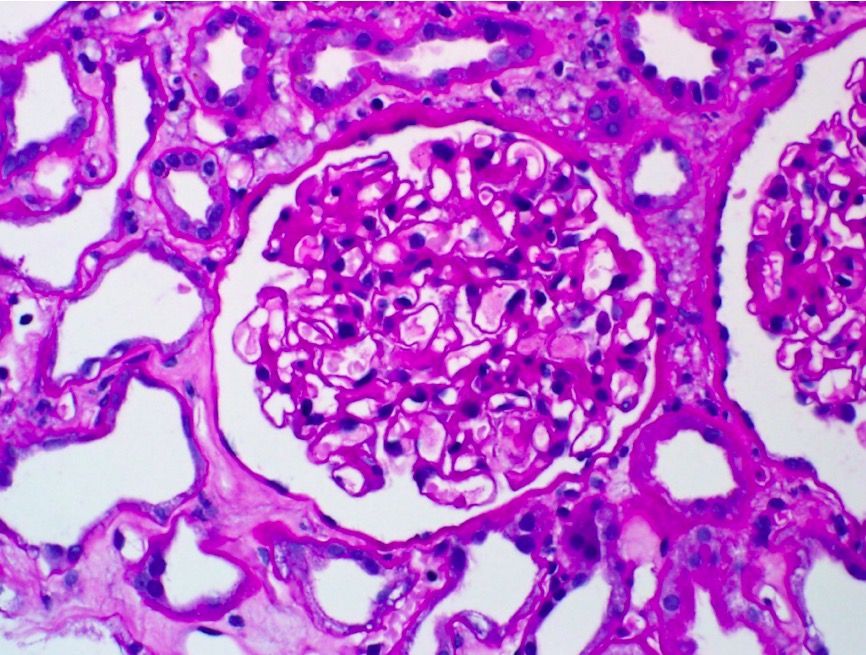
  • MO: proliferación mesangial mínima o normal (de ahí el nombre de “cambio mínimo”)
  • IF: no hay depósito de inmunocomplejos
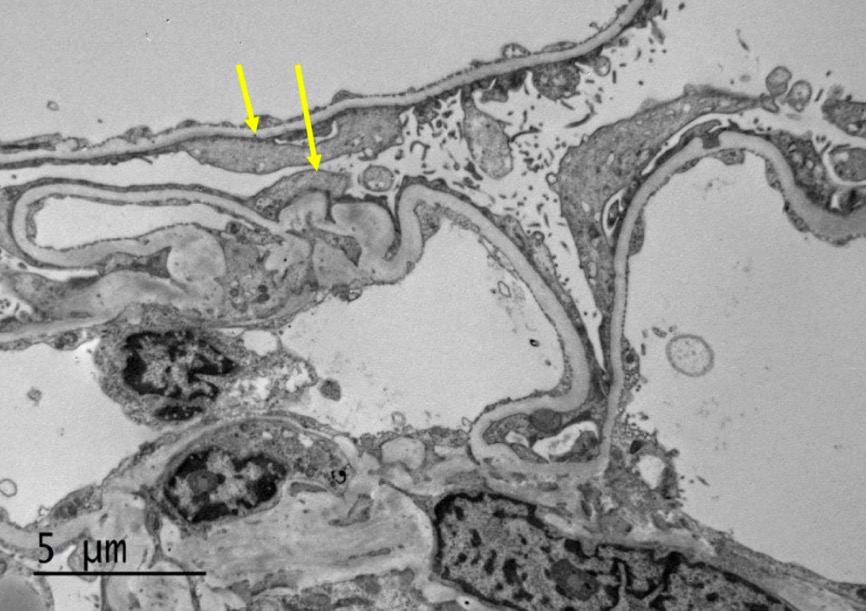
  • ME: borramiento uniforme de podocitos (aplanamiento, retracción)
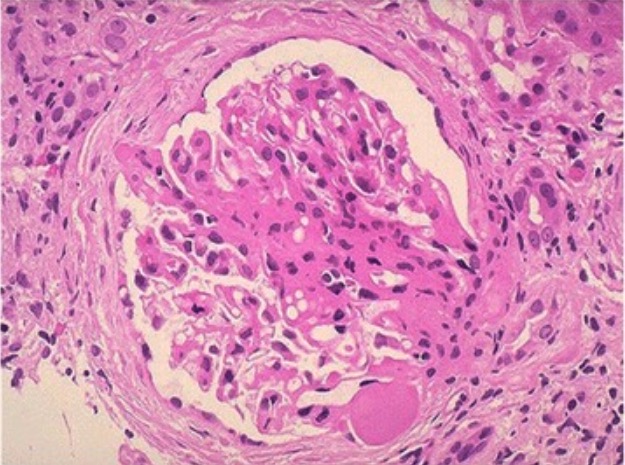
Glomeruloesclerosis focal y segmentaria Puede haber hematuria Hematuria Presence of blood in the urine. Renal Cell Carcinoma en EN Erythema nodosum is an immune-mediated panniculitis (inflammation of the subcutaneous fat) caused by a type IV (delayed-type) hypersensitivity reaction. It commonly manifests in young women as tender, erythematous nodules on the shins. Erythema Nodosum la orina
  • MO: esclerosis focal y segmentaria en EN Erythema nodosum is an immune-mediated panniculitis (inflammation of the subcutaneous fat) caused by a type IV (delayed-type) hypersensitivity reaction. It commonly manifests in young women as tender, erythematous nodules on the shins. Erythema Nodosum algunos glomérulos
  • IF: puede haber IgM IgM A class of immunoglobulin bearing mu chains (immunoglobulin mu-chains). Igm can fix complement. The name comes from its high molecular weight and originally being called a macroglobulin. Immunoglobulins: Types and Functions, C3 en EN Erythema nodosum is an immune-mediated panniculitis (inflammation of the subcutaneous fat) caused by a type IV (delayed-type) hypersensitivity reaction. It commonly manifests in young women as tender, erythematous nodules on the shins. Erythema Nodosum áreas escleróticas
  • ME: desprendimiento/denudación focal de células epiteliales con borramiento difuso de podocitos (característica distintiva de la glomeruloesclerosis focal y segmentaria)
Proliferación mesangial Puede haber hematuria Hematuria Presence of blood in the urine. Renal Cell Carcinoma en EN Erythema nodosum is an immune-mediated panniculitis (inflammation of the subcutaneous fat) caused by a type IV (delayed-type) hypersensitivity reaction. It commonly manifests in young women as tender, erythematous nodules on the shins. Erythema Nodosum la orina
  • MO: aumento de la matriz mesangial y aumento de la hipercelularidad mesangial
  • IF: negativa
  • ME: borramiento de podocitos
Glomerulonefritis membranoproliferativa (un patrón de lesión glomerular con los LOS Neisseria tipos I–III) ↓ C3
  • MO: hipercelularidad mesangial, proliferación endocapilar, aspecto de doble contorno/”pista de tranvía” de la membrana basal glomerular
  • IF:
    • I: IgG IgG The major immunoglobulin isotype class in normal human serum. There are several isotype subclasses of igg, for example, igg1, igg2a, and igg2b. Hypersensitivity Pneumonitis, C3, C1q, C4
    • II: C3
    • III: C3
  • ME:
    • I: depósitos subendoteliales
    • II: depósitos densos
    • III: depósitos subepiteliales y subendoteliales
MO: microscopía óptica
IF: inmunofluorescencia
ME: microscopía electrónica
GN: glomerulonefritis

Tratamiento

Abordaje terapéutico

  • Como la mayoría de los LOS Neisseria casos nefróticos pediátricos se deben a la enfermedad de cambios mínimos (que suele responder a los LOS Neisseria esteroides), el tratamiento con esteroides se inicia incluso sin biopsia en EN Erythema nodosum is an immune-mediated panniculitis (inflammation of the subcutaneous fat) caused by a type IV (delayed-type) hypersensitivity reaction. It commonly manifests in young women as tender, erythematous nodules on the shins. Erythema Nodosum los LOS Neisseria siguientes casos:
    • Pacientes de 1–12 años de edad
    • Antecedentes y hallazgos no sugestivos de enfermedad sistémica
    • Función renal normal
    • No hay hematuria Hematuria Presence of blood in the urine. Renal Cell Carcinoma macroscópica
    • Niveles normales de complemento
    • Pruebas virales negativas: se descarta una infección activa o latente
    • No hay antecedentes familiares de enfermedad renal
  • Además, la glomerulosclerosis focal y segmentaria responde a los LOS Neisseria esteroides en EN Erythema nodosum is an immune-mediated panniculitis (inflammation of the subcutaneous fat) caused by a type IV (delayed-type) hypersensitivity reaction. It commonly manifests in young women as tender, erythematous nodules on the shins. Erythema Nodosum 10%–20% de los LOS Neisseria casos.

Tratamiento inmunosupresor

  • Esteroides: necesidad de descartar una infección activa o latente antes de iniciarla
  • Respuestas a los LOS Neisseria esteroides:
    • Sensible a los LOS Neisseria esteroides:
      • Remisión (desaparición de la proteinuria Proteinuria The presence of proteins in the urine, an indicator of kidney diseases. Nephrotic Syndrome in Children) con 4–8 semanas de tratamiento
      • Se observa en EN Erythema nodosum is an immune-mediated panniculitis (inflammation of the subcutaneous fat) caused by a type IV (delayed-type) hypersensitivity reaction. It commonly manifests in young women as tender, erythematous nodules on the shins. Erythema Nodosum la mayoría de los LOS Neisseria pacientes pediátricos
    • Resistente a los LOS Neisseria esteroides:
      • No hay remisión después de completar el tratamiento con esteroides
      • Evaluación adicional: biopsia y pruebas genéticas
    • Dependiente de los LOS Neisseria esteroides:
      • Se experimenta una recaída durante la reducción de la dosis
      • Se requiere reiniciar los LOS Neisseria esteroides (curso más largo)
  • Agentes de 2da línea:
    • Se administra si hay efectos secundarios importantes de los LOS Neisseria esteroides (e.g., rasgos cushingoides, exceso de peso, alteraciones psiquiátricas, cataratas)
    • Opciones:
      • Micofenolato mofetilo
      • Ciclosporina
      • Tacrolimus Tacrolimus A macrolide isolated from the culture broth of a strain of streptomyces tsukubaensis that has strong immunosuppressive activity in vivo and prevents the activation of T-lymphocytes in response to antigenic or mitogenic stimulation in vitro. Immunosuppressants
      • Levamisol (no disponible en EN Erythema nodosum is an immune-mediated panniculitis (inflammation of the subcutaneous fat) caused by a type IV (delayed-type) hypersensitivity reaction. It commonly manifests in young women as tender, erythematous nodules on the shins. Erythema Nodosum Estados Unidos)
      • Ciclofosfamida (tiene efectos secundarios graves)

Tratamiento adicional

  • Edema Edema Edema is a condition in which excess serous fluid accumulates in the body cavity or interstitial space of connective tissues. Edema is a symptom observed in several medical conditions. It can be categorized into 2 types, namely, peripheral (in the extremities) and internal (in an organ or body cavity). Edema:
    • Restricción de sal
    • Tratamiento diurético: a menudo furosemida
    • En EN Erythema nodosum is an immune-mediated panniculitis (inflammation of the subcutaneous fat) caused by a type IV (delayed-type) hypersensitivity reaction. It commonly manifests in young women as tender, erythematous nodules on the shins. Erythema Nodosum anasarca Anasarca Hookworm Infections/ edema Edema Edema is a condition in which excess serous fluid accumulates in the body cavity or interstitial space of connective tissues. Edema is a symptom observed in several medical conditions. It can be categorized into 2 types, namely, peripheral (in the extremities) and internal (in an organ or body cavity). Edema grave/derrame pleural: furosemida + albúmina
  • Estado hipercoagulable:
    • Fomentar la deambulación regular Regular Insulin.
    • Evitar la depleción de volumen (para reducir el riesgo de hemoconcentración).
    • La anticoagulación profiláctica no está probada.
    • El tromboembolismo venoso se trata con heparina de bajo peso molecular y luego con warfarina.
  • Riesgo de infección:
    • Riesgo de bacterias encapsuladas (como Streptococcus Streptococcus Streptococcus is one of the two medically important genera of gram-positive cocci, the other being Staphylococcus. Streptococci are identified as different species on blood agar on the basis of their hemolytic pattern and sensitivity to optochin and bacitracin. There are many pathogenic species of streptococci, including S. pyogenes, S. agalactiae, S. pneumoniae, and the viridans streptococci. Streptococcus pneumoniae): vacunar con la serie de vacunas antineumocócicas conjugadas (PCV15/20) y la vacuna antineumocócica polisacárida (PPSV23) a los LOS Neisseria ≥ 2 años para niños de alto riesgo
    • Vacunación anual con la vacuna inactivada contra la influenza Influenza Influenza viruses are members of the Orthomyxoviridae family and the causative organisms of influenza, a highly contagious febrile respiratory disease. There are 3 primary influenza viruses (A, B, and C) and various subtypes, which are classified based on their virulent surface antigens, hemagglutinin (HA) and neuraminidase (NA). Influenza typically presents with a fever, myalgia, headache, and symptoms of an upper respiratory infection. Influenza Viruses/Influenza
    • Evite la vacuna viva mientras esté en EN Erythema nodosum is an immune-mediated panniculitis (inflammation of the subcutaneous fat) caused by a type IV (delayed-type) hypersensitivity reaction. It commonly manifests in young women as tender, erythematous nodules on the shins. Erythema Nodosum tratamiento inmunosupresor (o en EN Erythema nodosum is an immune-mediated panniculitis (inflammation of the subcutaneous fat) caused by a type IV (delayed-type) hypersensitivity reaction. It commonly manifests in young women as tender, erythematous nodules on the shins. Erythema Nodosum recaída).
    • Alto índice de sospecha si hay signos de infección
  • Hipertensión:
    • Los LOS Neisseria diuréticos pueden controlar la presión arterial.
    • IECA o antagonistas de los LOS Neisseria receptores de la angiotensina II (ARA):
      • Disminuyen la proteinuria Proteinuria The presence of proteins in the urine, an indicator of kidney diseases. Nephrotic Syndrome in Children
      • Precaución en EN Erythema nodosum is an immune-mediated panniculitis (inflammation of the subcutaneous fat) caused by a type IV (delayed-type) hypersensitivity reaction. It commonly manifests in young women as tender, erythematous nodules on the shins. Erythema Nodosum caso de depleción de volumen (puede empeorar la función renal)
    • También pueden utilizarse bloqueadores de los LOS Neisseria canales de calcio.
  • El trasplante puede ser curativo en EN Erythema nodosum is an immune-mediated panniculitis (inflammation of the subcutaneous fat) caused by a type IV (delayed-type) hypersensitivity reaction. It commonly manifests in young women as tender, erythematous nodules on the shins. Erythema Nodosum algunos casos (e.g., síndrome nefrótico congénito tipo finlandés).

Relevancia Clínica

  • Lupus eritematoso sistémico: afección crónica, autoinmune e inflamatoria que provoca el depósito de inmunocomplejos en EN Erythema nodosum is an immune-mediated panniculitis (inflammation of the subcutaneous fat) caused by a type IV (delayed-type) hypersensitivity reaction. It commonly manifests in young women as tender, erythematous nodules on the shins. Erythema Nodosum los LOS Neisseria órganos, lo que da lugar a manifestaciones sistémicas: el depósito de inmunocomplejos en EN Erythema nodosum is an immune-mediated panniculitis (inflammation of the subcutaneous fat) caused by a type IV (delayed-type) hypersensitivity reaction. It commonly manifests in young women as tender, erythematous nodules on the shins. Erythema Nodosum el glomérulo conduce a la nefritis lúpica. Esta afección es más común en EN Erythema nodosum is an immune-mediated panniculitis (inflammation of the subcutaneous fat) caused by a type IV (delayed-type) hypersensitivity reaction. It commonly manifests in young women as tender, erythematous nodules on the shins. Erythema Nodosum las mujeres asiáticas y afroamericanas. Las manifestaciones renales incluyen el síndrome nefrítico o nefrótico, la hematuria Hematuria Presence of blood in the urine. Renal Cell Carcinoma macroscópica o microscópica, y/o la insuficiencia renal crónica. El diagnóstico se realiza con una biopsia renal.
  • Glomerulonefritis postestreptocócica: trastorno renal en EN Erythema nodosum is an immune-mediated panniculitis (inflammation of the subcutaneous fat) caused by a type IV (delayed-type) hypersensitivity reaction. It commonly manifests in young women as tender, erythematous nodules on the shins. Erythema Nodosum niños precedido por una infección por Streptococcus Streptococcus Streptococcus is one of the two medically important genera of gram-positive cocci, the other being Staphylococcus. Streptococci are identified as different species on blood agar on the basis of their hemolytic pattern and sensitivity to optochin and bacitracin. There are many pathogenic species of streptococci, including S. pyogenes, S. agalactiae, S. pneumoniae, and the viridans streptococci. Streptococcus beta-hemolíticos del grupo A de la garganta o la piel: La glomerulonefritis postestreptocócica se presenta comúnmente como un síndrome nefrítico, pero el síndrome nefrótico ocurre en EN Erythema nodosum is an immune-mediated panniculitis (inflammation of the subcutaneous fat) caused by a type IV (delayed-type) hypersensitivity reaction. It commonly manifests in young women as tender, erythematous nodules on the shins. Erythema Nodosum el 5% de los LOS Neisseria casos. La biopsia renal no suele ser necesaria para establecer el diagnóstico. La afección es generalmente autolimitada.
  • Púrpura de Henoch-Schönlein: también conocida como vasculitis Vasculitis Inflammation of any one of the blood vessels, including the arteries; veins; and rest of the vasculature system in the body. Systemic Lupus Erythematosus por IgA IgA Represents 15-20% of the human serum immunoglobulins, mostly as the 4-chain polymer in humans or dimer in other mammals. Secretory iga is the main immunoglobulin in secretions. Immunoglobulins: Types and Functions: los LOS Neisseria rasgos clínicos incluyen una erupción característica, artralgias, dolor Dolor Inflammation abdominal y nefritis. Esta glomerulonefritis mediada por IgA IgA Represents 15-20% of the human serum immunoglobulins, mostly as the 4-chain polymer in humans or dimer in other mammals. Secretory iga is the main immunoglobulin in secretions. Immunoglobulins: Types and Functions puede ser desencadenada por una infección respiratoria o gastrointestinal. Generalmente, la púrpura de Henoch-Schönlein se presenta en EN Erythema nodosum is an immune-mediated panniculitis (inflammation of the subcutaneous fat) caused by a type IV (delayed-type) hypersensitivity reaction. It commonly manifests in young women as tender, erythematous nodules on the shins. Erythema Nodosum niños < 10 años. Esta afección también puede presentarse como síndrome nefrítico.
  • Amiloidosis: depósito patológico en EN Erythema nodosum is an immune-mediated panniculitis (inflammation of the subcutaneous fat) caused by a type IV (delayed-type) hypersensitivity reaction. It commonly manifests in young women as tender, erythematous nodules on the shins. Erythema Nodosum el tejido extracelular de fibrillas compuestas por diversas subunidades proteicas de bajo peso molecular mal plegadas: las proteínas mal plegadas se depositan en EN Erythema nodosum is an immune-mediated panniculitis (inflammation of the subcutaneous fat) caused by a type IV (delayed-type) hypersensitivity reaction. It commonly manifests in young women as tender, erythematous nodules on the shins. Erythema Nodosum varios tejidos, interfieren con las funciones normales de los LOS Neisseria órganos y causan enfermedades específicas de los LOS Neisseria tejidos (e.g., amiloidosis renal). Las manifestaciones de la enfermedad renal van desde la proteinuria Proteinuria The presence of proteins in the urine, an indicator of kidney diseases. Nephrotic Syndrome in Children leve hasta la nefrosis franca. El diagnóstico se establece con una biopsia renal. La diálisis o el trasplante mejoran el pronóstico.
  • Síndrome nefrótico congénito e infantil: afecta a los LOS Neisseria niños < 1 año de edad: las mutaciones que conducen al AL Amyloidosis síndrome nefrótico incluyen NPHS1, NPHS2, NPHS3, LAMB2 y WT1. NPHS1 (codifica la nefrina y su mutación causa el síndrome nefrótico congénito tipo finlandés) y NPHS2 (codifica la podocina y su mutación conduce a la glomeruloesclerosis focal y segmentaria familiar) son los LOS Neisseria genes Genes A category of nucleic acid sequences that function as units of heredity and which code for the basic instructions for the development, reproduction, and maintenance of organisms. DNA Types and Structure más frecuentemente afectados (95% de los LOS Neisseria casos). Estos trastornos no responden a los LOS Neisseria esteroides ni a otros tratamientos inmunosupresores, y la evaluación debe incluir pruebas genéticas.

Referencias

  1. Andolino TP, Reid-Adam J. (2015). Nephrotic syndrome. Pediatrics in Review. https://pedsinreview.aappublications.org/content/pedsinreview/36/3/117.full.pdf
  2. Floege J, Feehally J. (2019). Introduction to glomerular disease: Clinical presentations. In Feehally J, Floege J, Tonelli M, Johnson RJ (Eds.), Comprehensive Clinical Nephrology (pp. 18-198.e1). https://www.clinicalkey.es/#!/content/3-s2.0-B9780323479097000159
  3. Gattineni, J. (2012). Highlights for the management of a child with proteinuria and hematuria. International Journal of Pediatrics, 2012, Article 768142. https://doi.org/10.1155/2012/768142
  4. Lane J. (2023). Pediatric nephrotic syndrome work-up. Medscape. Retrieved October 24, 2025, from https://emedicine.medscape.com/article/982920-overview
  5. Lewis JB, Neilson EG. (2018). Glomerular diseases. In Jameson JL, Fauci AS, Kasper DL, Hauser SL, Longo DL, Loscalzo J (Eds.), Harrison’s Principles of Internal Medicine, 20th ed. New York: McGraw-Hill Education.
  6. Niaudet, P. (2024). Clinical manifestations, diagnosis, and evaluation of nephrotic syndrome in children. UpToDate. Retrieved October 24, 2025, from https://www.uptodate.com/contents/clinical-manifestations-diagnosis-and-evaluation-of-nephrotic-syndrome-in-children
  7. Niaudet P. (2023). Symptomatic management of nephrotic syndrome in children. UpToDate. Retrieved October 24, 2025, from https://www.uptodate.com/contents/symptomatic-management-of-nephrotic-syndrome-in-children
  8. Niaudet P. (2024). Treatment of idiopathic nephrotic syndrome in children. UpToDate. Retrieved October 24, 2025, from https://www.uptodate.com/contents/treatment-of-idiopathic-nephrotic-syndrome-in-children

¡Crea tu cuenta gratis o inicia una sesión para seguir leyendo!

Regístrate ahora y obtén acceso gratuito a Lecturio con páginas de concepto, videos médicos y cuestionarios para tu educación médica.

User Reviews

Details