La fiebre se define como una temperatura corporal superior a la normal. EnENErythema nodosum is an immune-mediated panniculitis (inflammation of the subcutaneous fat) caused by a type IV (delayed-type) hypersensitivity reaction. It commonly manifests in young women as tender, erythematous nodules on the shins.Erythema Nodosum la medicina moderna, la fiebre se define como una temperatura> 38°C (100,4°F). Es un síntoma común enENErythema nodosum is an immune-mediated panniculitis (inflammation of the subcutaneous fat) caused by a type IV (delayed-type) hypersensitivity reaction. It commonly manifests in young women as tender, erythematous nodules on the shins.Erythema Nodosum la población pediátrica como síntoma aislado o acompañado de otros hallazgos que pueden ayudar a acotar el diagnóstico diferencial. La fiebre suele ser la respuesta del organismo a losLOSNeisseria procesos infecciosos; sin embargo, también se puede observar enENErythema nodosum is an immune-mediated panniculitis (inflammation of the subcutaneous fat) caused by a type IV (delayed-type) hypersensitivity reaction. It commonly manifests in young women as tender, erythematous nodules on the shins.Erythema Nodosum otros procesos patológicos. EnENErythema nodosum is an immune-mediated panniculitis (inflammation of the subcutaneous fat) caused by a type IV (delayed-type) hypersensitivity reaction. It commonly manifests in young women as tender, erythematous nodules on the shins.Erythema Nodosum neonatos y lactantes muy pequeños, la presentación clínica carece de especificidad, por lo que se despliegan más ayudas diagnósticas para descartar una infección bacteriana grave (IBG) e iniciar el tratamiento según la edad y la evolución clínica.
≤ 56 días de edad, cualquier temperatura ≥ 38°C (100,4°F)
> 56 días de edad, cualquier temperatura ≥ 38,5°C (101,3°F)
Bebés con un estado inmunodeprimido subyacente:
≥ 38,5°C una vez
≥ 38,0°C 3 veces enENErythema nodosum is an immune-mediated panniculitis (inflammation of the subcutaneous fat) caused by a type IV (delayed-type) hypersensitivity reaction. It commonly manifests in young women as tender, erythematous nodules on the shins.Erythema Nodosum un periodo de 24 horas, con 1 hora de diferencia
Etiología
Infecciosa:
Viral
Bacteriana
No infecciosa:
Malignidad
Enfermedad reumática
Reacción a medicamentos
Enfoque sistemático para determinar la causa de la fiebre
Antecedentes clínicos y examen físico completo, buscando focos infecciosos
Examen de laboratorio: pruebas de laboratorio y diagnóstico por imagen, según losLOSNeisseria signos y síntomas que se presenten.
Cuándo admitir la atención hospitalaria
Signos de inestabilidad clínica:
Disminución del nivel de consciencia
Signos de shockShockShock is a life-threatening condition associated with impaired circulation that results in tissue hypoxia. The different types of shock are based on the underlying cause: distributive (↑ cardiac output (CO), ↓ systemic vascular resistance (SVR)), cardiogenic (↓ CO, ↑ SVR), hypovolemic (↓ CO, ↑ SVR), obstructive (↓ CO), and mixed. Types of Shock hipovolémico
Signos de dificultad respiratoria
Bebés de alto riesgo:
Inmunosuprimido
Bebés con una enfermedad crónica
Bebé que requiere atención hospitalaria:
Múltiples exámenes físicos repetidos debido a la inestabilidad de la condición
La elección del tratamiento empírico requiere medicación intravenosa o hidratación.
Prevalencia de infecciones bacterianas graves (IBG): 6%–10% (con mayor frecuencia infecciones del tracto urinario (ITU))
Diagnóstico y manejo
Laboratorios:
Análisis de orina
Cultivo de orina
Biometría hemática
Cultivo de sangre
+/– proteína C reactiva (PCRPCRPolymerase chain reaction (PCR) is a technique that amplifies DNA fragments exponentially for analysis. The process is highly specific, allowing for the targeting of specific genomic sequences, even with minuscule sample amounts. The PCR cycles multiple times through 3 phases: denaturation of the template DNA, annealing of a specific primer to the individual DNA strands, and synthesis/elongation of new DNA molecules.Polymerase Chain Reaction (PCR))
+/– Procalcitonina
PL (punción lumbar) debe realizarse si:
Es nacido prematuro (< 37 semanas de gestación)
Estadía prolongada enENErythema nodosum is an immune-mediated panniculitis (inflammation of the subcutaneous fat) caused by a type IV (delayed-type) hypersensitivity reaction. It commonly manifests in young women as tender, erythematous nodules on the shins.Erythema Nodosum la UCIN
Antecedentes de problemas médicos crónicos
HaHAHemolytic anemia (HA) is the term given to a large group of anemias that are caused by the premature destruction/hemolysis of circulating red blood cells (RBCs). Hemolysis can occur within (intravascular hemolysis) or outside the blood vessels (extravascular hemolysis).Hemolytic Anemia recibido antibióticos enENErythema nodosum is an immune-mediated panniculitis (inflammation of the subcutaneous fat) caused by a type IV (delayed-type) hypersensitivity reaction. It commonly manifests in young women as tender, erythematous nodules on the shins.Erythema Nodosum las últimas 72 horas.
Parece enfermo, deprimido o inconsolable.
Infecciones visibles enENErythema nodosum is an immune-mediated panniculitis (inflammation of the subcutaneous fat) caused by a type IV (delayed-type) hypersensitivity reaction. It commonly manifests in young women as tender, erythematous nodules on the shins.Erythema Nodosum la inspección
Leucocitos < 5.000 o > 15.000
Relación banda-neutrófilos (bandas/bandas + neutrófilos) > 0,2
La radiografía de tórax (si se obtiene) muestra infiltrado.
La prueba de PCRPCRPolymerase chain reaction (PCR) is a technique that amplifies DNA fragments exponentially for analysis. The process is highly specific, allowing for the targeting of specific genomic sequences, even with minuscule sample amounts. The PCR cycles multiple times through 3 phases: denaturation of the template DNA, annealing of a specific primer to the individual DNA strands, and synthesis/elongation of new DNA molecules.Polymerase Chain Reaction (PCR) del VHS está indicada para todos con:
Pleocitosis o glóbulos rojos enENErythema nodosum is an immune-mediated panniculitis (inflammation of the subcutaneous fat) caused by a type IV (delayed-type) hypersensitivity reaction. It commonly manifests in young women as tender, erythematous nodules on the shins.Erythema Nodosum el LCR
Mala apariencia
Estado neurológico anormal, incluidas convulsiones
Vesículas, ampollas, erupción
Evidencia de hepatitis por laboratorio
Antecedentes de infección materna primaria por VHS durante el parto
Si el bebé parece estar bien y todos losLOSNeisseria análisis de laboratorio son normales, dé de alta y realice un seguimiento enENErythema nodosum is an immune-mediated panniculitis (inflammation of the subcutaneous fat) caused by a type IV (delayed-type) hypersensitivity reaction. It commonly manifests in young women as tender, erythematous nodules on the shins.Erythema Nodosum 12–24 horas.
Nota: Este enfoque es apropiado para niños que no sean inmunodeprimidos. Existen pautas específicas de fiebre pediátrica para niños con:
Procesos oncológicos
AnemiaAnemiaAnemia is a condition in which individuals have low Hb levels, which can arise from various causes. Anemia is accompanied by a reduced number of RBCs and may manifest with fatigue, shortness of breath, pallor, and weakness. Subtypes are classified by the size of RBCs, chronicity, and etiology. Anemia: Overview and Types drepanocítica
Las infecciones virales son la causa más común de fiebre enENErythema nodosum is an immune-mediated panniculitis (inflammation of the subcutaneous fat) caused by a type IV (delayed-type) hypersensitivity reaction. It commonly manifests in young women as tender, erythematous nodules on the shins.Erythema Nodosum este grupo de edad.
El grado y el enfoque de las pruebas empíricas enENErythema nodosum is an immune-mediated panniculitis (inflammation of the subcutaneous fat) caused by a type IV (delayed-type) hypersensitivity reaction. It commonly manifests in young women as tender, erythematous nodules on the shins.Erythema Nodosum este grupo de edad depende de:
Antecedentes de la enfermedad actual
Examen físico
Apariencia clínica del niño
LosLOSNeisseria niños con buena apariencia y exámenes sin complicaciones pueden ser dados de alta sin pruebas de laboratorio y sin antibióticos. Las pruebas de rutina no son necesarias enENErythema nodosum is an immune-mediated panniculitis (inflammation of the subcutaneous fat) caused by a type IV (delayed-type) hypersensitivity reaction. It commonly manifests in young women as tender, erythematous nodules on the shins.Erythema Nodosum un niño vacunado previamente sano.
No se recomienda el uso rutinario de biometría hemática ni de hemocultivo.
Para la bronquiolitis y la fiebre, no está indicado el uso rutinario de cultivos de orina y de sangre.
Las pruebas de secreciones nasales enENErythema nodosum is an immune-mediated panniculitis (inflammation of the subcutaneous fat) caused by a type IV (delayed-type) hypersensitivity reaction. It commonly manifests in young women as tender, erythematous nodules on the shins.Erythema Nodosum busca de una etiología viral, como el virusVirusViruses are infectious, obligate intracellular parasites composed of a nucleic acid core surrounded by a protein capsid. Viruses can be either naked (non-enveloped) or enveloped. The classification of viruses is complex and based on many factors, including type and structure of the nucleoid and capsid, the presence of an envelope, the replication cycle, and the host range. Virology respiratorio sincitial (VRS) o la influenza AInfluenza AAntivirals for Influenza o B, pueden ser útiles enENErythema nodosum is an immune-mediated panniculitis (inflammation of the subcutaneous fat) caused by a type IV (delayed-type) hypersensitivity reaction. It commonly manifests in young women as tender, erythematous nodules on the shins.Erythema Nodosum un niño con síntomas respiratorios.
EnENErythema nodosum is an immune-mediated panniculitis (inflammation of the subcutaneous fat) caused by a type IV (delayed-type) hypersensitivity reaction. It commonly manifests in young women as tender, erythematous nodules on the shins.Erythema Nodosum el caso de losLOSNeisseria niños con mal aspecto, se debe realizar un estudio completo de la sepsisSepsisSystemic inflammatory response syndrome with a proven or suspected infectious etiology. When sepsis is associated with organ dysfunction distant from the site of infection, it is called severe sepsis. When sepsis is accompanied by hypotension despite adequate fluid infusion, it is called septic shock.Sepsis and Septic Shock con hospitalización.
Patógenos Infecciosos del Recién Nacido
StreptococcusStreptococcusStreptococcus is one of the two medically important genera of gram-positive cocci, the other being Staphylococcus. Streptococci are identified as different species on blood agar on the basis of their hemolytic pattern and sensitivity to optochin and bacitracin. There are many pathogenic species of streptococci, including S. pyogenes, S. agalactiae, S. pneumoniae, and the viridans streptococci.Streptococcusdel grupo B
Diplococos gram-positivos
Coloniza habitualmente losLOSNeisseria tractos gastrointestinal y genitourinario: Proporciona una ruta de transmisión de la madre colonizada alALAmyloidosis neonato.
La infección neonatal se puede clasificar según la edad de aparición:
Inicio temprano: normalmente desde el nacimiento hasta las 24 horas de vida, pero puede llegar hasta losLOSNeisseria 6 días de vida
Inicio tardío: 7–89 días de vida
Inicio muy tardío: > 3 meses
Presentación clínica:
Inicio temprano:
SepsisSepsisSystemic inflammatory response syndrome with a proven or suspected infectious etiology. When sepsis is associated with organ dysfunction distant from the site of infection, it is called severe sepsis. When sepsis is accompanied by hypotension despite adequate fluid infusion, it is called septic shock.Sepsis and Septic Shock (80% de losLOSNeisseria casos): fiebre o hipotermia, hipotonía, aumento de la irritabilidad
Neumonía (10% de losLOSNeisseria casos): fiebre o hipotermia, dificultad para respirar, aumento del trabajo respiratorio, ruidos pulmonares desiguales, desaturaciones persistentes
MeningitisMeningitisMeningitis is inflammation of the meninges, the protective membranes of the brain, and spinal cord. The causes of meningitis are varied, with the most common being bacterial or viral infection. The classic presentation of meningitis is a triad of fever, altered mental status, and nuchal rigidity. Meningitis (10% de losLOSNeisseria casos): fiebre o hipotermia, aumento o disminución del tono, aumento de la irritabilidad, mala alimentación
Inicio tardío:
BacteremiaBacteremiaThe presence of viable bacteria circulating in the blood. Fever, chills, tachycardia, and tachypnea are common acute manifestations of bacteremia. The majority of cases are seen in already hospitalized patients, most of whom have underlying diseases or procedures which render their bloodstreams susceptible to invasion.Glycopeptides (60% de losLOSNeisseria casos): fiebre, irritabilidad, letargo, taquipnea y apnea
MeningitisMeningitisMeningitis is inflammation of the meninges, the protective membranes of the brain, and spinal cord. The causes of meningitis are varied, with the most common being bacterial or viral infection. The classic presentation of meningitis is a triad of fever, altered mental status, and nuchal rigidity. Meningitis (30% de losLOSNeisseria casos): inestabilidad de térmica, irritabilidad, letargo, mala alimentación o vómitos, fontanela abultada, rigidez de nuca, hallazgos neurológicos focales y convulsiones
Infección de huesos y articulaciones (5% de losLOSNeisseria casos): Puede no haber fiebre; puede ser incapaz de soportar peso o puede estar completamente activo o tener un rango completo de movimiento pasivo de la articulación afectada.
Infección de tejidos blandos (5% de losLOSNeisseria casos): fiebre, dolorDolorInflammation a la palpación, eritema, secreción purulenta
Inicio muy tardío:
BacteremiaBacteremiaThe presence of viable bacteria circulating in the blood. Fever, chills, tachycardia, and tachypnea are common acute manifestations of bacteremia. The majority of cases are seen in already hospitalized patients, most of whom have underlying diseases or procedures which render their bloodstreams susceptible to invasion.Glycopeptides sin foco: fiebre, malestar, tono bajo
Otras infecciones focales observadas, pero raras
Diagnóstico:
Basado enENErythema nodosum is an immune-mediated panniculitis (inflammation of the subcutaneous fat) caused by a type IV (delayed-type) hypersensitivity reaction. It commonly manifests in young women as tender, erythematous nodules on the shins.Erythema Nodosum apariencia clínica y presencia de factores de riesgo
Pruebas de laboratorio:
Hemograna
Hemocultivo
PL si hay signos de sepsisSepsisSystemic inflammatory response syndrome with a proven or suspected infectious etiology. When sepsis is associated with organ dysfunction distant from the site of infection, it is called severe sepsis. When sepsis is accompanied by hypotension despite adequate fluid infusion, it is called septic shock.Sepsis and Septic Shock o meningitisMeningitisMeningitis is inflammation of the meninges, the protective membranes of the brain, and spinal cord. The causes of meningitis are varied, with the most common being bacterial or viral infection. The classic presentation of meningitis is a triad of fever, altered mental status, and nuchal rigidity. Meningitis o si el bebé tiene < 28 días
Radiografía de tórax si hay síntomas respiratorios
Urocultivo
Tratamiento: terapia antimicrobiana
Terapia empírica enENErythema nodosum is an immune-mediated panniculitis (inflammation of the subcutaneous fat) caused by a type IV (delayed-type) hypersensitivity reaction. It commonly manifests in young women as tender, erythematous nodules on the shins.Erythema Nodosum todos losLOSNeisseria bebés enENErythema nodosum is an immune-mediated panniculitis (inflammation of the subcutaneous fat) caused by a type IV (delayed-type) hypersensitivity reaction. It commonly manifests in young women as tender, erythematous nodules on the shins.Erythema NodosumlosLOSNeisseria que se sospecha sepsisSepsisSystemic inflammatory response syndrome with a proven or suspected infectious etiology. When sepsis is associated with organ dysfunction distant from the site of infection, it is called severe sepsis. When sepsis is accompanied by hypotension despite adequate fluid infusion, it is called septic shock.Sepsis and Septic Shock, generalmente con ampicilina y gentamicina inicialmente (+ cefotaxima si se sospecha meningitisMeningitisMeningitis is inflammation of the meninges, the protective membranes of the brain, and spinal cord. The causes of meningitis are varied, with the most common being bacterial or viral infection. The classic presentation of meningitis is a triad of fever, altered mental status, and nuchal rigidity. Meningitis), luego se reduce según la sensibilidad de las bacterias
Cuidados de soporte
Soporte respiratorio, si fuera necesario
Infecciones por TORCH
TORCH es un acrónimo de losLOSNeisseria patógenos causantes de un grupo de infecciones congénitas particularmente devastadoras:
Toxoplasmosis
Otros
VirusVirusViruses are infectious, obligate intracellular parasites composed of a nucleic acid core surrounded by a protein capsid. Viruses can be either naked (non-enveloped) or enveloped. The classification of viruses is complex and based on many factors, including type and structure of the nucleoid and capsid, the presence of an envelope, the replication cycle, and the host range. Virology de la Rubéola
Citomegalovirus
VirusVirusViruses are infectious, obligate intracellular parasites composed of a nucleic acid core surrounded by a protein capsid. Viruses can be either naked (non-enveloped) or enveloped. The classification of viruses is complex and based on many factors, including type and structure of the nucleoid and capsid, the presence of an envelope, the replication cycle, and the host range. Virology del Herpes simple
ToxoplasmosisToxoplasmosisToxoplasmosis is an infectious disease caused by Toxoplasma gondii, an obligate intracellular protozoan parasite. Felines are the definitive host, but transmission to humans can occur through contact with cat feces or the consumption of contaminated foods. The clinical presentation and complications depend on the host’s immune status. Toxoplasma/Toxoplasmosis
Causado por el protozoario ToxoplasmaToxoplasmaToxoplasmosis is an infectious disease caused by Toxoplasma gondii, an obligate intracellular protozoan parasite. Felines are the definitive host, but transmission to humans can occur through contact with cat feces or the consumption of contaminated foods. The clinical presentation and complications depend on the host’s immune status. Toxoplasma/Toxoplasmosis gondii:
Parásito ubicuo que infecta a animales y humanos
Se encuentra enENErythema nodosum is an immune-mediated panniculitis (inflammation of the subcutaneous fat) caused by a type IV (delayed-type) hypersensitivity reaction. It commonly manifests in young women as tender, erythematous nodules on the shins.Erythema Nodosum gatos y se transmite a través del contacto con las heces o alALAmyloidosis ser arañado por un gato.
EnENErythema nodosum is an immune-mediated panniculitis (inflammation of the subcutaneous fat) caused by a type IV (delayed-type) hypersensitivity reaction. It commonly manifests in young women as tender, erythematous nodules on the shins.Erythema Nodosum individuos inmunocompetentes, la infección es asintomática.
Transmitida por vía transplacentaria de la madre infectada alALAmyloidosis feto enENErythema nodosum is an immune-mediated panniculitis (inflammation of the subcutaneous fat) caused by a type IV (delayed-type) hypersensitivity reaction. It commonly manifests in young women as tender, erythematous nodules on the shins.Erythema Nodosum desarrollo
Presentación clínica:
Coriorretinitis
Hidrocefalia
Calcificaciones intracraneales
Hallazgos anormales de LCR
Ictericia
Trombocitopenia
AnemiaAnemiaAnemia is a condition in which individuals have low Hb levels, which can arise from various causes. Anemia is accompanied by a reduced number of RBCs and may manifest with fatigue, shortness of breath, pallor, and weakness. Subtypes are classified by the size of RBCs, chronicity, and etiology. Anemia: Overview and Types
Fiebre
Microcefalia
Diagnóstico:
A quién evaluar:
Hijos de madres con evidencia de infección primaria por T. gondii durante el embarazo
Hijos de madres inmunodeprimidas que también tienen evidencia serológica de infección por T.gondii
Lactantes con presentación clínica compatible con la infección por T. gondii
Lactantes con prueba de detección positiva para ToxoplasmaToxoplasmaToxoplasmosis is an infectious disease caused by Toxoplasma gondii, an obligate intracellular protozoan parasite. Felines are the definitive host, but transmission to humans can occur through contact with cat feces or the consumption of contaminated foods. The clinical presentation and complications depend on the host’s immune status. Toxoplasma/ToxoplasmosisIgMIgMA class of immunoglobulin bearing mu chains (immunoglobulin mu-chains). Igm can fix complement. The name comes from its high molecular weight and originally being called a macroglobulin.Immunoglobulins: Types and Functions
Pruebas:
PL: El LCR a menudo tiene proteínas elevadas y puede enviarse para una prueba de PCRPCRPolymerase chain reaction (PCR) is a technique that amplifies DNA fragments exponentially for analysis. The process is highly specific, allowing for the targeting of specific genomic sequences, even with minuscule sample amounts. The PCR cycles multiple times through 3 phases: denaturation of the template DNA, annealing of a specific primer to the individual DNA strands, and synthesis/elongation of new DNA molecules.Polymerase Chain Reaction (PCR).
Las neuroimágenes (prenatales y posnatales) pueden revelar calcificaciones intracraneales, ventriculomegalia o hidrocefalia.
Serología para IgGIgGThe major immunoglobulin isotype class in normal human serum. There are several isotype subclasses of igg, for example, igg1, igg2a, and igg2b.Hypersensitivity Pneumonitis de ToxoplasmaToxoplasmaToxoplasmosis is an infectious disease caused by Toxoplasma gondii, an obligate intracellular protozoan parasite. Felines are the definitive host, but transmission to humans can occur through contact with cat feces or the consumption of contaminated foods. The clinical presentation and complications depend on the host’s immune status. Toxoplasma/Toxoplasmosis, IgMIgMA class of immunoglobulin bearing mu chains (immunoglobulin mu-chains). Igm can fix complement. The name comes from its high molecular weight and originally being called a macroglobulin.Immunoglobulins: Types and Functions e IgAIgARepresents 15-20% of the human serum immunoglobulins, mostly as the 4-chain polymer in humans or dimer in other mammals. Secretory iga is the main immunoglobulin in secretions.Immunoglobulins: Types and Functions específicas de ToxoplasmaToxoplasmaToxoplasmosis is an infectious disease caused by Toxoplasma gondii, an obligate intracellular protozoan parasite. Felines are the definitive host, but transmission to humans can occur through contact with cat feces or the consumption of contaminated foods. The clinical presentation and complications depend on the host’s immune status. Toxoplasma/Toxoplasmosis
Tratamiento:
A quién tratar:
Lactantes diagnosticados prenatalmente
Lactantes sintomáticos
Farmacoterapia con antiparasitarios:
Pirimetamina
Sulfadiazina
Ácido folínico
Otros (sífilis, varicela-zóster, parvovirus B19Parvovirus B19Primate erythroparvovirus 1 (generally referred to as parvovirus B19, B19 virus, or sometimes erythrovirus B19) ranks among the smallest DNA viruses. Parvovirus B19 is of the family Parvoviridae and genus Erythrovirus. In immunocompetent humans, parvovirus B19 classically results in erythema infectiosum (5th disease) or “slapped cheek syndrome.”Parvovirus B19)
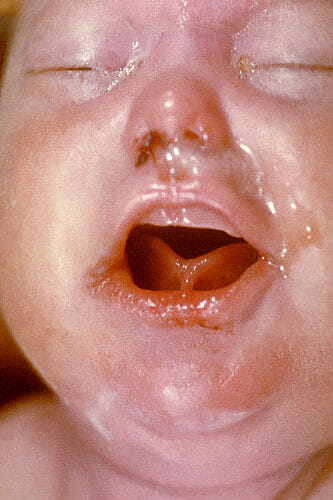
La sífilis es causada por Treponema pallidumTreponema pallidumThe causative agent of venereal and non-venereal syphilis as well as yaws.Treponema.
Transmitida por contacto con la madre infectada durante el embarazo o el parto
AnemiaAnemiaAnemia is a condition in which individuals have low Hb levels, which can arise from various causes. Anemia is accompanied by a reduced number of RBCs and may manifest with fatigue, shortness of breath, pallor, and weakness. Subtypes are classified by the size of RBCs, chronicity, and etiology. Anemia: Overview and Types hemolítica/trombocitopenia
Erupción enENErythema nodosum is an immune-mediated panniculitis (inflammation of the subcutaneous fat) caused by a type IV (delayed-type) hypersensitivity reaction. It commonly manifests in young women as tender, erythematous nodules on the shins.Erythema Nodosum palmas y plantas
Ceguera por coriorretinitis
Diagnóstico:
Prueba primaria: reagina plasmática rápida y prueba de enfermedades venéreas de laboratorios de investigación (VDRLVDRLTreponema, por sus siglas enENErythema nodosum is an immune-mediated panniculitis (inflammation of the subcutaneous fat) caused by a type IV (delayed-type) hypersensitivity reaction. It commonly manifests in young women as tender, erythematous nodules on the shins.Erythema Nodosum inglés)
Prueba de confirmación: inmovilización de T. pallidum, absorción de anticuerpos treponémicos fluorescentes (FTA-ABS) y aglutinación de partículas de T. pallidum
Tratamiento: penicilina G
La varicela es causada por el virusVirusViruses are infectious, obligate intracellular parasites composed of a nucleic acid core surrounded by a protein capsid. Viruses can be either naked (non-enveloped) or enveloped. The classification of viruses is complex and based on many factors, including type and structure of the nucleoid and capsid, the presence of an envelope, the replication cycle, and the host range. Virology varicela-zóster, también conocido como varicela.
Presentación clínica:
Cicatrices cutáneas
Atrofia de extremidades
Vejiga neurogénica/hidronefrosis
Manifestaciones del SNC: microcefalia/atrofia cortical/convulsiones/retraso mental
El diagnóstico clínico se basa enENErythema nodosum is an immune-mediated panniculitis (inflammation of the subcutaneous fat) caused by a type IV (delayed-type) hypersensitivity reaction. It commonly manifests in young women as tender, erythematous nodules on the shins.Erythema Nodosum la aparición de lesiones cutáneas.
Prueba de anticuerpos fluorescentes de dirección o PCRPCRPolymerase chain reaction (PCR) is a technique that amplifies DNA fragments exponentially for analysis. The process is highly specific, allowing for the targeting of specific genomic sequences, even with minuscule sample amounts. The PCR cycles multiple times through 3 phases: denaturation of the template DNA, annealing of a specific primer to the individual DNA strands, and synthesis/elongation of new DNA molecules.Polymerase Chain Reaction (PCR) de líquido extraído de ampollas o LCR
Serología para inmunoglobulinas
Tratamiento: aciclovir
La infección por parvovirus B19Parvovirus B19Primate erythroparvovirus 1 (generally referred to as parvovirus B19, B19 virus, or sometimes erythrovirus B19) ranks among the smallest DNA viruses. Parvovirus B19 is of the family Parvoviridae and genus Erythrovirus. In immunocompetent humans, parvovirus B19 classically results in erythema infectiosum (5th disease) or “slapped cheek syndrome.”Parvovirus B19 durante el segundo trimestre puede asociarse con hidropesía fetal o pérdida fetal.
Presentación clínica:
Hidropesía fetal
AnemiaAnemiaAnemia is a condition in which individuals have low Hb levels, which can arise from various causes. Anemia is accompanied by a reduced number of RBCs and may manifest with fatigue, shortness of breath, pallor, and weakness. Subtypes are classified by the size of RBCs, chronicity, and etiology. Anemia: Overview and Types
La mayoría de las infecciones intrauterinas no provocan defectos del desarrollo fetal.
Diagnóstico: ensayos serológicos de IgGIgGThe major immunoglobulin isotype class in normal human serum. There are several isotype subclasses of igg, for example, igg1, igg2a, and igg2b.Hypersensitivity Pneumonitis e IgMIgMA class of immunoglobulin bearing mu chains (immunoglobulin mu-chains). Igm can fix complement. The name comes from its high molecular weight and originally being called a macroglobulin.Immunoglobulins: Types and Functions frente alALAmyloidosisparvovirus B19Parvovirus B19Primate erythroparvovirus 1 (generally referred to as parvovirus B19, B19 virus, or sometimes erythrovirus B19) ranks among the smallest DNA viruses. Parvovirus B19 is of the family Parvoviridae and genus Erythrovirus. In immunocompetent humans, parvovirus B19 classically results in erythema infectiosum (5th disease) or “slapped cheek syndrome.”Parvovirus B19
Tratamiento:cuidados de apoyo
Un recién nacido que muestra ronquidos, indicativos de sífilis congénita
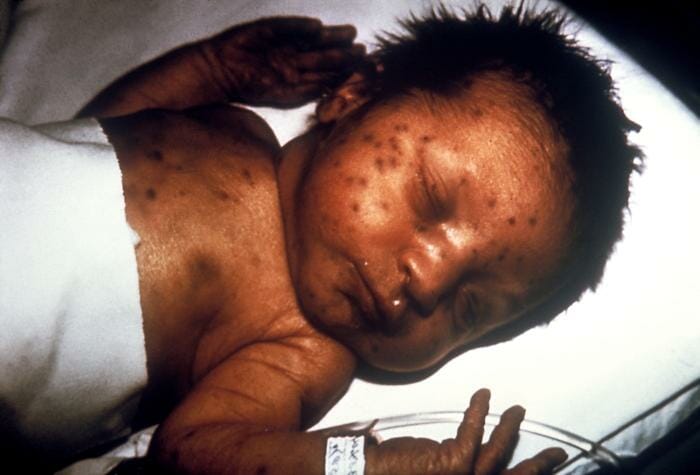
Causada por el virusVirusViruses are infectious, obligate intracellular parasites composed of a nucleic acid core surrounded by a protein capsid. Viruses can be either naked (non-enveloped) or enveloped. The classification of viruses is complex and based on many factors, including type and structure of the nucleoid and capsid, the presence of an envelope, the replication cycle, and the host range. Virology de la rubéola
La hematopoyesis extramedular da como resultado una apariencia de “muffin de arándanos” enENErythema nodosum is an immune-mediated panniculitis (inflammation of the subcutaneous fat) caused by a type IV (delayed-type) hypersensitivity reaction. It commonly manifests in young women as tender, erythematous nodules on the shins.Erythema Nodosum muchos bebés infectados.
Diagnóstico:
PCRPCRPolymerase chain reaction (PCR) is a technique that amplifies DNA fragments exponentially for analysis. The process is highly specific, allowing for the targeting of specific genomic sequences, even with minuscule sample amounts. The PCR cycles multiple times through 3 phases: denaturation of the template DNA, annealing of a specific primer to the individual DNA strands, and synthesis/elongation of new DNA molecules.Polymerase Chain Reaction (PCR) para ARN de rubéola (hisopado de garganta, LCR)
Serología (anticuerpos IgMIgMA class of immunoglobulin bearing mu chains (immunoglobulin mu-chains). Igm can fix complement. The name comes from its high molecular weight and originally being called a macroglobulin.Immunoglobulins: Types and Functions/IgGIgGThe major immunoglobulin isotype class in normal human serum. There are several isotype subclasses of igg, for example, igg1, igg2a, and igg2b.Hypersensitivity Pneumonitis)
Ocurre temprano durante el periodo neonatal o más tarde durante la infancia.
La presentación temprana generalmente incluye:
Restricción del crecimiento intrauterino
Microcefalia
Letargo
Neuropatía óptica
Calcificaciones intracraneales
Retraso motorMotorNeurons which send impulses peripherally to activate muscles or secretory cells.Nervous System: Histology
Hepatoesplenomegalia
La tasa de mortalidad es alta y puede alcanzar el 12% durante losLOSNeisseria primeros 6 meses de vida.
El retraso mental y la pérdida auditiva pueden ocurrir durante la niñez y generalmente son progresivos.
Tratamiento con ganciclovirGanciclovirAn acyclovir analog that is a potent inhibitor of the herpesvirus family including cytomegalovirus. Ganciclovir is used to treat complications from aids-associated cytomegalovirus infections.Antivirals for Herpes Virus
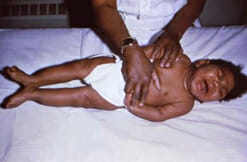
Un bebé con infección congénita por citomegalovirus presenta microcefalia y espasticidad de los miembros inferiores
VirusVirusViruses are infectious, obligate intracellular parasites composed of a nucleic acid core surrounded by a protein capsid. Viruses can be either naked (non-enveloped) or enveloped. The classification of viruses is complex and based on many factors, including type and structure of the nucleoid and capsid, the presence of an envelope, the replication cycle, and the host range. Virology del herpes simple (VHS)
PCRPCRPolymerase chain reaction (PCR) is a technique that amplifies DNA fragments exponentially for analysis. The process is highly specific, allowing for the targeting of specific genomic sequences, even with minuscule sample amounts. The PCR cycles multiple times through 3 phases: denaturation of the template DNA, annealing of a specific primer to the individual DNA strands, and synthesis/elongation of new DNA molecules.Polymerase Chain Reaction (PCR) de HSVHSVHerpes simplex virus (HSV) is a double-stranded DNA virus belonging to the family Herpesviridae. Herpes simplex virus commonly causes recurrent infections involving the skin and mucosal surfaces, including the mouth, lips, eyes, and genitals.Herpes Simplex Virus 1 and 2 de análisis de sangre
Cultivo de HSVHSVHerpes simplex virus (HSV) is a double-stranded DNA virus belonging to the family Herpesviridae. Herpes simplex virus commonly causes recurrent infections involving the skin and mucosal surfaces, including the mouth, lips, eyes, and genitals.Herpes Simplex Virus 1 and 2: ojos, nariz, boca, recto
PCRPCRPolymerase chain reaction (PCR) is a technique that amplifies DNA fragments exponentially for analysis. The process is highly specific, allowing for the targeting of specific genomic sequences, even with minuscule sample amounts. The PCR cycles multiple times through 3 phases: denaturation of the template DNA, annealing of a specific primer to the individual DNA strands, and synthesis/elongation of new DNA molecules.Polymerase Chain Reaction (PCR) de HSVHSVHerpes simplex virus (HSV) is a double-stranded DNA virus belonging to the family Herpesviridae. Herpes simplex virus commonly causes recurrent infections involving the skin and mucosal surfaces, including the mouth, lips, eyes, and genitals.Herpes Simplex Virus 1 and 2 de LCR
Pruebas de función hepática
Tratamiento:
Obtener hemocultivos
Enfermedad de la piel, losLOSNeisseria ojos y la boca: aciclovir
MeningitisMeningitisMeningitis is inflammation of the meninges, the protective membranes of the brain, and spinal cord. The causes of meningitis are varied, with the most common being bacterial or viral infection. The classic presentation of meningitis is a triad of fever, altered mental status, and nuchal rigidity. Meningitis o VHS diseminado: aciclovir
Nield, L. S., & Kamat, D. (2020). Fever. In R. M. Kliegman, J. W. St. Geme, N. J. Blum, S. S. Shah, R. C. Tasker, & K. M. Wilson (Eds.), Nelson textbook of pediatrics (21st ed., pp. 1384–1388.e1). Elsevier.
Brower, L., & Shah, S. S. (2020). Fever without a focus in the neonate and young infant. In R. M. Kliegman, J. W. St. Geme, N. J. Blum, S. S. Shah, R. C. Tasker, & K. M. Wilson (Eds.), Nelson textbook of pediatrics (21st ed., pp. 1389–1392.e1). Elsevier.
Arora, R., Mahajan, P. (2013). Evaluation of a child with fever without source. Pediatric Clinics of North America. 60, 1049–1062. https://pubmed.ncbi.nlm.nih.gov/24093895/
Burstein, B., Lirette, M.-P., Beck, C., Chauvin-Kimoff, L., & Chan, K. (2024). Management of well-appearing febrile young infants aged ≤90 days. Paediatrics & Child Health, 29(1), 50–57. https://doi.org/10.1093/pch/pxad085
Obtenga Medical Premium para poner a prueba sus conocimientos
Lecturio Medical Premium le brinda acceso completo a todo el contenido y las funciones
Obtenga Premium para ver todos los vídeos
Verifica tu correo electrónico para obtener una prueba gratuita.
Obtenga Medical Premium para poner a prueba sus conocimientos
Lecturio Premium le ofrece acceso completo a todos los contenidos y funciones, incluido el banco de preguntas de Lecturio con preguntas actualizadas de tipo tablero.