
Domina Conceptos Médicos

Estudia para la escuela de medicina y tus examenes con Lecturio.

Lactancia Materna

La lactancia materna suele ser la principal fuente de nutrición del recién nacido. Durante el embarazo, la estimulación hormonal hace HACE Altitude Sickness que el número y el tamaño de las glándulas mamarias aumenten considerablemente. Después del parto, la prolactina estimula la producción de leche, mientras que la oxitocina estimula la expulsión de la leche a través de los LOS Neisseria conductos galactóforos, donde el lactante la succiona a través del pezón. La lactancia materna tiene muchos beneficios para la madre y el bebé, como la disminución del riesgo de infecciones, trastornos gastrointestinales y enfermedades atópicas para el niño, y la disminución del riesgo de anemia Anemia Anemia is a condition in which individuals have low Hb levels, which can arise from various causes. Anemia is accompanied by a reduced number of RBCs and may manifest with fatigue, shortness of breath, pallor, and weakness. Subtypes are classified by the size of RBCs, chronicity, and etiology. Anemia: Overview and Types, enfermedades cardiovasculares y cáncer de mama y ovarios para la madre. Existen contraindicaciones absolutas para la lactancia materna, pero son bastante raras. Entre las afecciones clínicas importantes asociadas a la lactancia materna se encuentran la congestión mamaria, la mastitis Mastitis Mastitis is inflammation of the breast tissue with or without infection. The most common form of mastitis is associated with lactation in the first few weeks after birth. Non-lactational mastitis includes periductal mastitis and idiopathic granulomatous mastitis (IGM). Mastitis, el galactocele Galactocele Benign Breast Conditions, el absceso mamario y la ictericia infantil.

Last updated: Dec 15, 2025
Editorial responsibility: Stanley Oiseth, Lindsay Jones, Evelin Maza

Estructura y Desarrollo de la Mama Femenina Durante el Embarazo

Estructura de la mama femenina

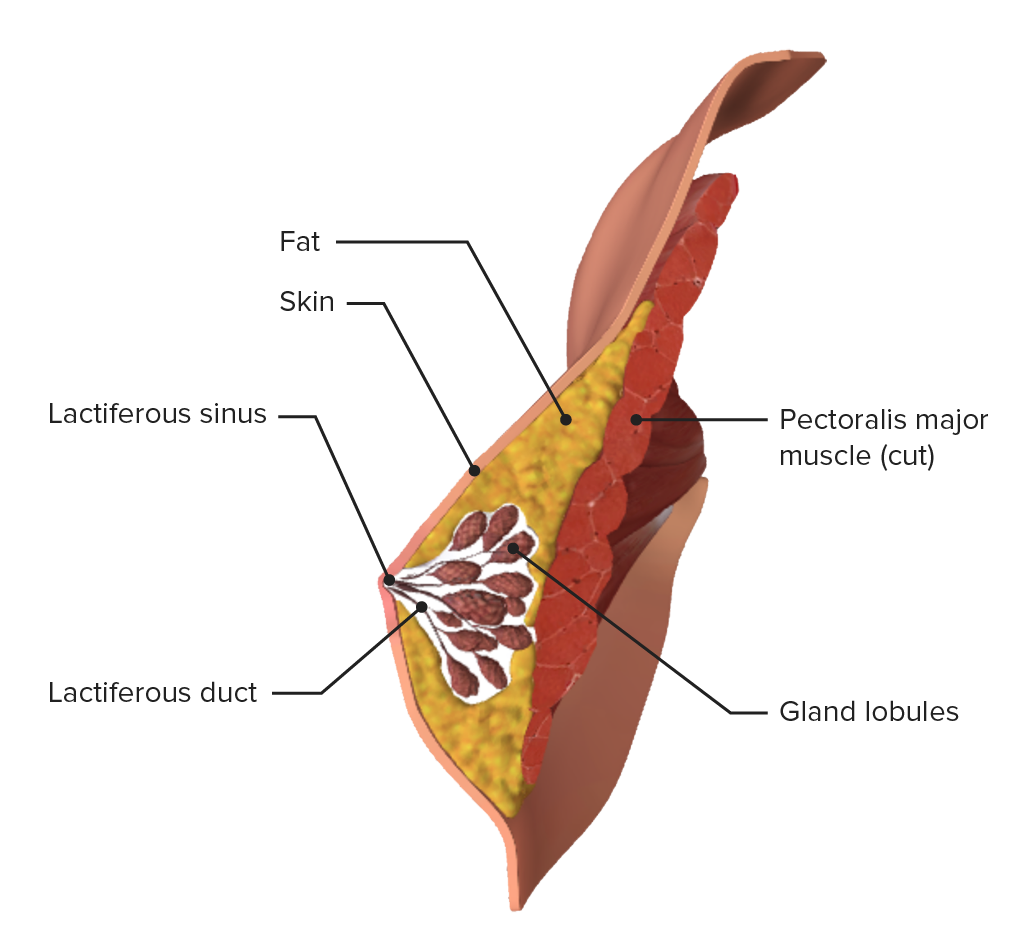
  • La mama femenina es una glándula exocrina que se superpone a los LOS Neisseria músculos pectorales.
  • Lóbulos: Cada mama está compuesta por 15–20 compartimentos llamados lóbulos.
    • Los LOS Neisseria lóbulos están dispuestos radialmente alrededor del pezón.
    • Separados entre sí por tejido fibroso
    • Cada lóbulo tiene su propio conducto galactóforo que drena la leche producida en EN Erythema nodosum is an immune-mediated panniculitis (inflammation of the subcutaneous fat) caused by a type IV (delayed-type) hypersensitivity reaction. It commonly manifests in young women as tender, erythematous nodules on the shins. Erythema Nodosum el lóbulo hacia el pezón.
    • Los LOS Neisseria lóbulos se dividen a su vez en EN Erythema nodosum is an immune-mediated panniculitis (inflammation of the subcutaneous fat) caused by a type IV (delayed-type) hypersensitivity reaction. It commonly manifests in young women as tender, erythematous nodules on the shins. Erythema Nodosum lobulillos.
  • Lóbulos:
    • Glándulas individuales productoras de leche llamadas glándulas mamarias
    • Compuestos por grupos de acinos:
      • Los LOS Neisseria lóbulos menos maduros contienen aproximadamente 10 brotes alveolares.
      • Los LOS Neisseria lóbulos más maduros contienen > 80 brotes alveolares.
  • Alvéolos mamarios:
    • Revestidos por un epitelio cuboidal
    • Rodeados de células mioepiteliales que tienen capacidad contráctil
    • Se vacían en EN Erythema nodosum is an immune-mediated panniculitis (inflammation of the subcutaneous fat) caused by a type IV (delayed-type) hypersensitivity reaction. It commonly manifests in young women as tender, erythematous nodules on the shins. Erythema Nodosum los LOS Neisseria conductos galactóforos
  • Sistema ductal:
    • Forma el paso para el transporte de la leche desde los LOS Neisseria alvéolos hasta el pezón
    • Alvéolos mamarios (i.e., acinos) → conductos galactóforos→ seno galactóforo→ poros del pezón ( en EN Erythema nodosum is an immune-mediated panniculitis (inflammation of the subcutaneous fat) caused by a type IV (delayed-type) hypersensitivity reaction. It commonly manifests in young women as tender, erythematous nodules on the shins. Erythema Nodosum la parte central de la areola Areola Examination of the Breast)
  • Estroma mamario (zona entre las glándulas) está compuesto principalmente por tejido graso y ligamentos.
    • El tamaño de las mamas está determinado por la cantidad de tejido adiposo y no está relacionado con la cantidad de leche que pueden producir los LOS Neisseria componentes glandulares.
    • El tejido adiposo constituye el 80% del tejido en EN Erythema nodosum is an immune-mediated panniculitis (inflammation of the subcutaneous fat) caused by a type IV (delayed-type) hypersensitivity reaction. It commonly manifests in young women as tender, erythematous nodules on the shins. Erythema Nodosum las mujeres no lactantes.
    • Ligamentos entre los LOS Neisseria lóbulos:
      • Conocidos como ligamentos suspensorios de la mama (ligamentos de Cooper)
      • Proporcionan apoyo estructural
Diagrama de un corte transversal sagital de la mama

Diagrama de un corte sagital de la mama

Imagen de Lecturio.

Crecimiento y desarrollo de las mamas en EN Erythema nodosum is an immune-mediated panniculitis (inflammation of the subcutaneous fat) caused by a type IV (delayed-type) hypersensitivity reaction. It commonly manifests in young women as tender, erythematous nodules on the shins. Erythema Nodosum el embarazo

Durante el embarazo se produce un importante crecimiento y maduración de las mamas como consecuencia de la secreción hormonal de la placenta Placenta A highly vascularized mammalian fetal-maternal organ and major site of transport of oxygen, nutrients, and fetal waste products. It includes a fetal portion (chorionic villi) derived from trophoblasts and a maternal portion (decidua) derived from the uterine endometrium. The placenta produces an array of steroid, protein and peptide hormones (placental hormones). Placenta, Umbilical Cord, and Amniotic Cavity.

  • Las hormonas importantes son:
    • Estrógeno
    • Progesterona
    • Gonadotropina coriónica
    • Lactógeno placentario humano
    • Prolactina
    • Hormona de crecimiento
    • Insulina
    • Glucocorticoides
  • La hormonas causan:
    • Crecimiento y ramificación del sistema ductal
    • Brote y desarrollo de los LOS Neisseria alvéolos (tras el crecimiento ductal):
      • Las células alveolares experimentan una división celular activa.
      • Las células individuales aumentan de tamaño.
    • Para el momento del parto: la mama está formada casi en EN Erythema nodosum is an immune-mediated panniculitis (inflammation of the subcutaneous fat) caused by a type IV (delayed-type) hypersensitivity reaction. It commonly manifests in young women as tender, erythematous nodules on the shins. Erythema Nodosum su totalidad por glándulas con muy poco estroma.
  • Embarazo temprano:
    • La mayor parte del desarrollo ductal y glandular se produce en EN Erythema nodosum is an immune-mediated panniculitis (inflammation of the subcutaneous fat) caused by a type IV (delayed-type) hypersensitivity reaction. It commonly manifests in young women as tender, erythematous nodules on the shins. Erythema Nodosum la 1ra ½ del embarazo.
    • Puede producirse sensibilidad en EN Erythema nodosum is an immune-mediated panniculitis (inflammation of the subcutaneous fat) caused by a type IV (delayed-type) hypersensitivity reaction. It commonly manifests in young women as tender, erythematous nodules on the shins. Erythema Nodosum las mamas (síntoma común del embarazo temprano).
  • Embarazo tardío:
    • El crecimiento continúa, pero es lento.
    • Las secreciones (calostro) comienzan a acumularse en EN Erythema nodosum is an immune-mediated panniculitis (inflammation of the subcutaneous fat) caused by a type IV (delayed-type) hypersensitivity reaction. It commonly manifests in young women as tender, erythematous nodules on the shins. Erythema Nodosum los LOS Neisseria conductos.
  • Justo antes del parto: otra ola de crecimiento
  • Durante la lactancia: el crecimiento y la diferenciación pueden continuar hasta que se detenga la lactancia.

Fisiología de la Lactancia

Síntesis de la leche

  • La leche materna es sintetizada por las células epiteliales columnares de los LOS Neisseria acinos de las glándulas mamarias.
  • Es liberada hacia los LOS Neisseria acinos (pero aún no en EN Erythema nodosum is an immune-mediated panniculitis (inflammation of the subcutaneous fat) caused by a type IV (delayed-type) hypersensitivity reaction. It commonly manifests in young women as tender, erythematous nodules on the shins. Erythema Nodosum los LOS Neisseria conductos)
  • La síntesis de la leche es estimulada por la prolactina:
    • La prolactina es secretada por la hipófisis anterior.
    • La secreción comienza alrededor de la 5ta semana de embarazo.
    • Aumenta 10‒20 veces su nivel normal para el parto
  • La síntesis de la leche es inhibida por el estrógeno y la progesterona:
    • Aumento de la secreción por la placenta Placenta A highly vascularized mammalian fetal-maternal organ and major site of transport of oxygen, nutrients, and fetal waste products. It includes a fetal portion (chorionic villi) derived from trophoblasts and a maternal portion (decidua) derived from the uterine endometrium. The placenta produces an array of steroid, protein and peptide hormones (placental hormones). Placenta, Umbilical Cord, and Amniotic Cavity durante el embarazo
    • Los LOS Neisseria niveles hormonales descienden significativamente tras la extracción de la placenta Placenta A highly vascularized mammalian fetal-maternal organ and major site of transport of oxygen, nutrients, and fetal waste products. It includes a fetal portion (chorionic villi) derived from trophoblasts and a maternal portion (decidua) derived from the uterine endometrium. The placenta produces an array of steroid, protein and peptide hormones (placental hormones). Placenta, Umbilical Cord, and Amniotic Cavity en EN Erythema nodosum is an immune-mediated panniculitis (inflammation of the subcutaneous fat) caused by a type IV (delayed-type) hypersensitivity reaction. It commonly manifests in young women as tender, erythematous nodules on the shins. Erythema Nodosum el parto.
  • Durante el embarazo, las hormonas placentarias (estrógeno y progesterona) son dominantes → efecto global de inhibición de la síntesis de leche
  • Al AL Amyloidosis momento del parto, las hormonas placentarias ↓, pero la prolactina (procedente de la hipófisis) persiste y se vuelve dominante:
    • El efecto global es la estimulación de la síntesis de la leche.
    • La síntesis de la leche aumenta significativamente durante la 1ra semana del postparto.
  • Aumento de la prolactina:
    • Sin inhibidores de estrógenos y progesterona, los LOS Neisseria niveles de prolactina basales vuelven a los LOS Neisseria niveles no gestacionales.
    • Con la estimulación del pezón (i.e., succión), los LOS Neisseria niveles de prolactina aumentan hasta 10‒20 veces más que los LOS Neisseria niveles no gestacionales durante aproximadamente 1 hora para sintetizar la leche para la siguiente alimentación.
  • Síntesis de la leche:
    • Se detiene aproximadamente después de 1 semana si no hay aumentos de prolactina
    • Se detiene cuando:
      • La madre deja de dar lactancia.
      • Los LOS Neisseria aumentos de prolactina están ausentes debido a daño hipofisario.
  • Si la madre sigue dando lactancia:
    • La producción de leche continúa durante algunos años después del parto.
    • La cantidad puede disminuir gradualmente después de 8–9 meses.
  • La prolactina también inhibe la ovulación:
    • La prolactina inhibe la liberación de gonadotropinas:
      • Hormona foliculoestimulante ( FSH FSH A major gonadotropin secreted by the adenohypophysis. Follicle-stimulating hormone stimulates gametogenesis and the supporting cells such as the ovarian granulosa cells, the testicular sertoli cells, and leydig cells. Fsh consists of two noncovalently linked subunits, alpha and beta. Within a species, the alpha subunit is common in the three pituitary glycoprotein hormones (TSH, LH, and FSH), but the beta subunit is unique and confers its biological specificity. Menstrual Cycle, por sus siglas en EN Erythema nodosum is an immune-mediated panniculitis (inflammation of the subcutaneous fat) caused by a type IV (delayed-type) hypersensitivity reaction. It commonly manifests in young women as tender, erythematous nodules on the shins. Erythema Nodosum inglés)
      • Hormona luteinizante ( LH LH A major gonadotropin secreted by the adenohypophysis. Luteinizing hormone regulates steroid production by the interstitial cells of the testis and the ovary. The preovulatory luteinizing hormone surge in females induces ovulation, and subsequent luteinization of the follicle. Luteinizing hormone consists of two noncovalently linked subunits, alpha and beta. Within a species, the alpha subunit is common in the three pituitary glycoprotein hormones (TSH, LH, and FSH), but the beta subunit is unique and confers its biological specificity. Menstrual Cycle, por sus siglas en EN Erythema nodosum is an immune-mediated panniculitis (inflammation of the subcutaneous fat) caused by a type IV (delayed-type) hypersensitivity reaction. It commonly manifests in young women as tender, erythematous nodules on the shins. Erythema Nodosum inglés)
    • Las madres lactantes suelen ser amenorreicas durante los LOS Neisseria 1ros meses.
    • Aproximadamente 5‒10% de las mujeres quedan embarazadas mientras amamantan un bebé a tiempo completo.
    • Finalmente, al AL Amyloidosis bajar los LOS Neisseria niveles de prolactina, se producen FSH FSH A major gonadotropin secreted by the adenohypophysis. Follicle-stimulating hormone stimulates gametogenesis and the supporting cells such as the ovarian granulosa cells, the testicular sertoli cells, and leydig cells. Fsh consists of two noncovalently linked subunits, alpha and beta. Within a species, the alpha subunit is common in the three pituitary glycoprotein hormones (TSH, LH, and FSH), but the beta subunit is unique and confers its biological specificity. Menstrual Cycle y LH LH A major gonadotropin secreted by the adenohypophysis. Luteinizing hormone regulates steroid production by the interstitial cells of the testis and the ovary. The preovulatory luteinizing hormone surge in females induces ovulation, and subsequent luteinization of the follicle. Luteinizing hormone consists of two noncovalently linked subunits, alpha and beta. Within a species, the alpha subunit is common in the three pituitary glycoprotein hormones (TSH, LH, and FSH), but the beta subunit is unique and confers its biological specificity. Menstrual Cycle → ovulación

Expulsión de la leche

La eyección de leche requiere la hormona hipofisaria oxitocina.
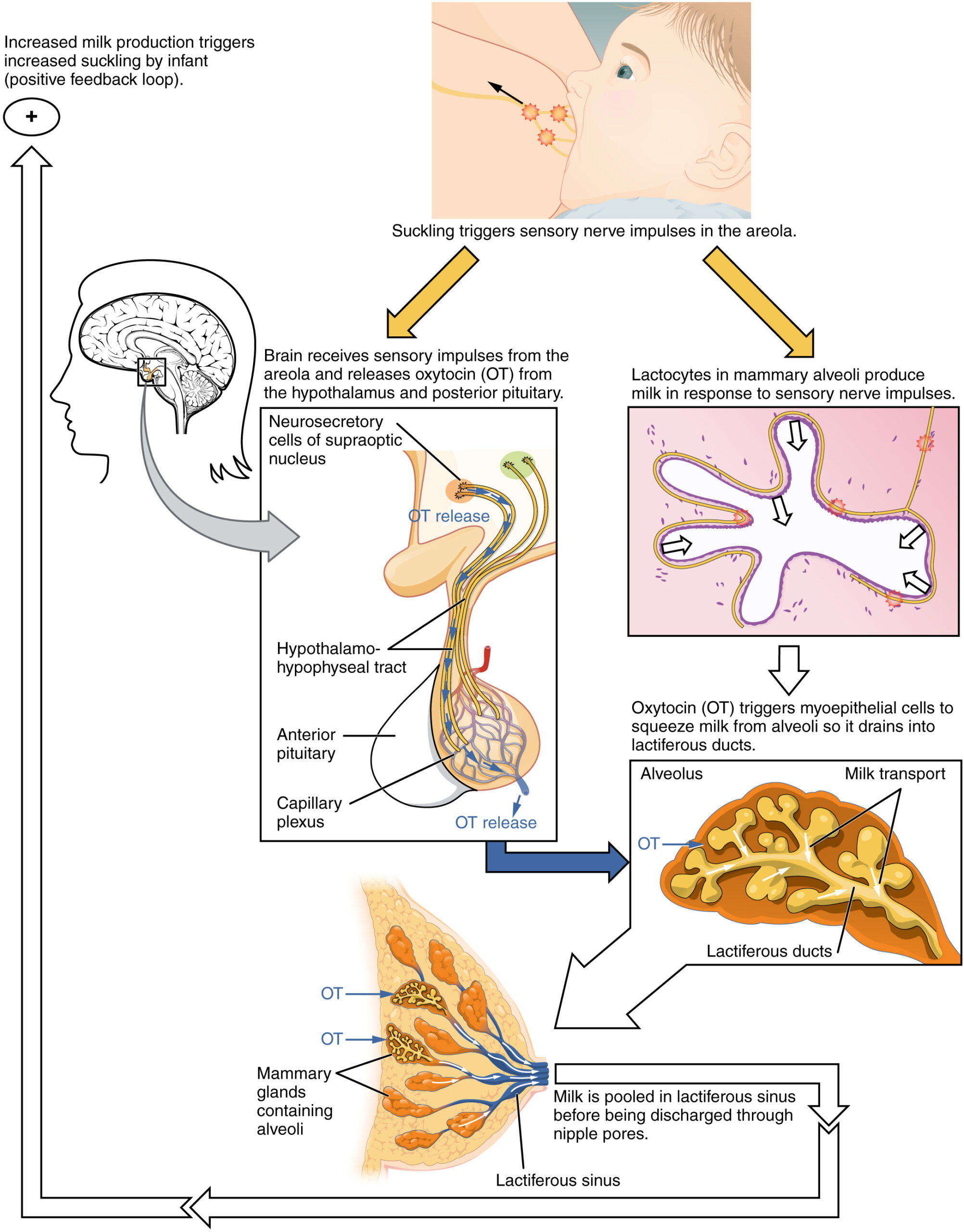
  • Estimulación del pezón (mediante la succión o el uso de un extractor mecánico) → las señales sensoriales viajan hasta el hipotálamo y la hipófisis → la hipófisis posterior libera oxitocina
  • Oxitocina:
    • Viaja a través de la sangre para llegar a las células mioepiteliales que rodean la pared exterior de los LOS Neisseria alvéolos
    • Desencadena la contracción de las células mioepiteliales → ↑ presión en EN Erythema nodosum is an immune-mediated panniculitis (inflammation of the subcutaneous fat) caused by a type IV (delayed-type) hypersensitivity reaction. It commonly manifests in young women as tender, erythematous nodules on the shins. Erythema Nodosum los LOS Neisseria acinos → expulsa la leche hacia el sistema ductal
  • La leche fluye hacia los LOS Neisseria conductos galactóforos → seno galactóforo → es succionada del pezón a través de los LOS Neisseria poros del pezón por el bebé o por la acción del extractor
  • Aproximadamente 30 segundos desde el inicio de la succión hasta la salida de la leche (conocida como “bajada“)
  • La oxitocina también puede ser liberada por:
    • El llanto de un bebé
    • Factores visuales y psicógenos
The let-down reflex

El reflejo de bajada

Imagen: “A positive feedback loop ensures continued milk production as long as the infant continues to breastfeed” por OpenStax College. Licencia: CC BY 4.0

Estadios de la lactogénesis

Hay 2 estadios de la lactogénesis:

  • Lactogénesis I:
    • Comienza a mediados del embarazo
    • Representa el momento en EN Erythema nodosum is an immune-mediated panniculitis (inflammation of the subcutaneous fat) caused by a type IV (delayed-type) hypersensitivity reaction. It commonly manifests in young women as tender, erythematous nodules on the shins. Erythema Nodosum que la glándula está suficientemente diferenciada para secretar pequeñas cantidades de componentes lácteos
    • La secreción de leche generalmente no se produce debido a los LOS Neisseria efectos inhibidores de los LOS Neisseria estrógenos y la progesterona.
  • Lactogénesis II:
    • Comienza poco después del parto
    • Representa el momento de la secreción abundante de leche que se produce con la caída de estrógenos y progesterona

Reflejo de succión del bebé

  • Los LOS Neisseria bebés succionarán cualquier cosa que entre en EN Erythema nodosum is an immune-mediated panniculitis (inflammation of the subcutaneous fat) caused by a type IV (delayed-type) hypersensitivity reaction. It commonly manifests in young women as tender, erythematous nodules on the shins. Erythema Nodosum contacto con el paladar.
  • Es un instinto primitivo presente en EN Erythema nodosum is an immune-mediated panniculitis (inflammation of the subcutaneous fat) caused by a type IV (delayed-type) hypersensitivity reaction. It commonly manifests in young women as tender, erythematous nodules on the shins. Erythema Nodosum todos los LOS Neisseria mamíferos recién nacidos
  • Desarrollo del reflejo de succión:
    • Comienza alrededor de las 32 semanas de gestación
    • Se desarrolla por completo aproximadamente a las 36 semanas de gestación
    • Los LOS Neisseria bebés prematuros pueden tener dificultades para succionar.
  • Persiste como reflejo hasta aproximadamente los LOS Neisseria 4 meses de vida → entonces, cambia a una acción voluntaria y consciente

Leche Materna Versus Fórmula

Leche materna

  • Contiene todos los LOS Neisseria nutrientes que necesita un bebé (excepto la vitamina D)
  • Contiene anticuerpos maternos que protegen al AL Amyloidosis bebé de las infecciones
  • Cambios en EN Erythema nodosum is an immune-mediated panniculitis (inflammation of the subcutaneous fat) caused by a type IV (delayed-type) hypersensitivity reaction. It commonly manifests in young women as tender, erythematous nodules on the shins. Erythema Nodosum la composición:
    • Depende del momento del día
    • Durante el transcurso de una sola alimentación (e.g., al AL Amyloidosis final, hay menos lactosa y proteínas, pero mucha más grasa)
    • A medida que el bebé crece
  • La leche materna humana está formada por los LOS Neisseria siguientes componentes:
    • Grasas
    • Proteínas
    • Carbohidratos (principalmente lactosa)
    • Vitaminas y minerales
    • Anticuerpos maternos
  • Calostro:
    • Líquido que se acumula en EN Erythema nodosum is an immune-mediated panniculitis (inflammation of the subcutaneous fat) caused by a type IV (delayed-type) hypersensitivity reaction. It commonly manifests in young women as tender, erythematous nodules on the shins. Erythema Nodosum los LOS Neisseria conductos y senos galactóforos antes del parto
    • Extremadamente denso en EN Erythema nodosum is an immune-mediated panniculitis (inflammation of the subcutaneous fat) caused by a type IV (delayed-type) hypersensitivity reaction. It commonly manifests in young women as tender, erythematous nodules on the shins. Erythema Nodosum nutrientes aunque de bajo volumen
    • Mantiene a los LOS Neisseria bebés durante los LOS Neisseria 1ros días de vida hasta que se produce leche madura alrededor del día 3

Beneficios de la lactancia materna

  • Estimula las contracciones uterinas:
    • Menos hemorragias postparto
    • ↓ Riesgo de hemorragia postparto tardía
    • ↓ Riesgo de anemia Anemia Anemia is a condition in which individuals have low Hb levels, which can arise from various causes. Anemia is accompanied by a reduced number of RBCs and may manifest with fatigue, shortness of breath, pallor, and weakness. Subtypes are classified by the size of RBCs, chronicity, and etiology. Anemia: Overview and Types
  • ↓ Riesgo de depresión postparto
  • Menos infecciones del tracto urinario
  • Pérdida de peso más rápida/recuperación del peso pregestacional
  • ↓ Embarazo no deseado (debido a la inhibición de la ovulación por la prolactina)
  • ↓ Riesgo de afecciones médicas más adelante en EN Erythema nodosum is an immune-mediated panniculitis (inflammation of the subcutaneous fat) caused by a type IV (delayed-type) hypersensitivity reaction. It commonly manifests in young women as tender, erythematous nodules on the shins. Erythema Nodosum la vida:
    • Cánceres de mama y ovario
    • Enfermedades autoinmunes
    • Endometriosis Endometriosis Endometriosis is a common disease in which patients have endometrial tissue implanted outside of the uterus. Endometrial implants can occur anywhere in the pelvis, including the ovaries, the broad and uterosacral ligaments, the pelvic peritoneum, and the urinary and gastrointestinal tracts. Endometriosis
    • Diabetes Diabetes Diabetes mellitus (DM) is a metabolic disease characterized by hyperglycemia and dysfunction of the regulation of glucose metabolism by insulin. Type 1 DM is diagnosed mostly in children and young adults as the result of autoimmune destruction of β cells in the pancreas and the resulting lack of insulin. Type 2 DM has a significant association with obesity and is characterized by insulin resistance. Diabetes Mellitus
    • Hipertensión
    • Enfermedades cardiovasculares
  • Bajo costo

Beneficios de la lactancia materna para el bebé

  • Un sistema inmunitario más fuerte:
    • ↓ Riesgo de infección debido a los LOS Neisseria anticuerpos IgA IgA Represents 15-20% of the human serum immunoglobulins, mostly as the 4-chain polymer in humans or dimer in other mammals. Secretory iga is the main immunoglobulin in secretions. Immunoglobulins: Types and Functions maternos:
      • Infecciones respiratorias: neumonía, infección causada por el virus Virus Viruses are infectious, obligate intracellular parasites composed of a nucleic acid core surrounded by a protein capsid. Viruses can be either naked (non-enveloped) or enveloped. The classification of viruses is complex and based on many factors, including type and structure of the nucleoid and capsid, the presence of an envelope, the replication cycle, and the host range. Virology sincitial respiratorio ( RSV RSV Respiratory syncytial virus (RSV) is an enveloped, single-stranded, linear, negative-sense RNA virus of the family Paramyxoviridae and the genus Orthopneumovirus. Two subtypes (A and B) are present in outbreaks, but type A causes more severe disease. Respiratory syncytial virus causes infections of the lungs and respiratory tract. Respiratory Syncytial Virus, por sus siglas en EN Erythema nodosum is an immune-mediated panniculitis (inflammation of the subcutaneous fat) caused by a type IV (delayed-type) hypersensitivity reaction. It commonly manifests in young women as tender, erythematous nodules on the shins. Erythema Nodosum inglés), tos TOS Thoracic outlet syndrome (TOS) is a broad term used for a spectrum of syndromes related to the general region of the thoracic outlet, which involves the compression or irritation of elements of the brachial plexus, subclavian artery, or subclavian vein. Thoracic Outlet Syndrome ferina
      • Infecciones de oído
      • Meningitis Meningitis Meningitis is inflammation of the meninges, the protective membranes of the brain, and spinal cord. The causes of meningitis are varied, with the most common being bacterial or viral infection. The classic presentation of meningitis is a triad of fever, altered mental status, and nuchal rigidity. Meningitis bacteriana
    • Mejora de la respuesta a las vacunas
  • Promueve la colonización del intestino con bacterias beneficiosas
  • Más fácil de digerir que la leche de vaca
  • Menos síntomas gastrointestinales, incluyendo:
    • Diarrea o estreñimiento
    • Gastroenteritis Gastroenteritis Gastroenteritis is inflammation of the stomach and intestines, commonly caused by infections from bacteria, viruses, or parasites. Transmission may be foodborne, fecal-oral, or through animal contact. Common clinical features include abdominal pain, diarrhea, vomiting, fever, and dehydration. Gastroenteritis
    • ERGE
    • Enterocolitis Enterocolitis Inflammation of the mucosa of both the small intestine and the large intestine. Etiology includes ischemia, infections, allergic, and immune responses. Yersinia spp./Yersiniosis necrosante en EN Erythema nodosum is an immune-mediated panniculitis (inflammation of the subcutaneous fat) caused by a type IV (delayed-type) hypersensitivity reaction. It commonly manifests in young women as tender, erythematous nodules on the shins. Erythema Nodosum bebés prematuros
  • Menos afecciones atópicas, incluyendo:
  • Menos riesgo de:
    • Cánceres infantiles, especialmente leucemia y linfoma
    • Diabetes Diabetes Diabetes mellitus (DM) is a metabolic disease characterized by hyperglycemia and dysfunction of the regulation of glucose metabolism by insulin. Type 1 DM is diagnosed mostly in children and young adults as the result of autoimmune destruction of β cells in the pancreas and the resulting lack of insulin. Type 2 DM has a significant association with obesity and is characterized by insulin resistance. Diabetes Mellitus
    • Obesidad
  • Menores tasas de mortalidad infantil y síndrome de muerte súbita infantil

Fórmula

  • Muchos tipos diferentes para elegir, incluyendo:
    • Fórmulas a base de leche: opción común de 1ra línea
    • Fórmulas a base de soya: se utilizan cuando las fórmulas a base de leche son mal toleradas
    • Fórmulas especializadas: se utilizan cuando existen verdaderas alergias o requerimientos nutricionales especializados
  • Contiene todos los LOS Neisseria nutrientes necesarios para un bebé
  • No contiene anticuerpos
  • Nota: las empresas de fórmulas se promocionan a los LOS Neisseria padres de una manera que puede ser engañosa. Para promover la lactancia materna, es mejor evitar los LOS Neisseria materiales de mercadotecnia en EN Erythema nodosum is an immune-mediated panniculitis (inflammation of the subcutaneous fat) caused by a type IV (delayed-type) hypersensitivity reaction. It commonly manifests in young women as tender, erythematous nodules on the shins. Erythema Nodosum el hospital.

Indicaciones para la alimentación con fórmula

Aunque generalmente “lo mejor es la lactancia”, hay casos en los que no se recomienda la lactancia materna, en cuyo caso, “lo mejor es la fórmula”. Estos casos incluyen:

  • Fracaso de la lactancia materna:
    • Puede ser debido a:
      • Falta de salida de leche (más frecuente en EN Erythema nodosum is an immune-mediated panniculitis (inflammation of the subcutaneous fat) caused by a type IV (delayed-type) hypersensitivity reaction. It commonly manifests in young women as tender, erythematous nodules on the shins. Erythema Nodosum mujeres con antecedentes de cirugía mamaria)
      • Mal agarre
    • Puede provocar deshidratación en EN Erythema nodosum is an immune-mediated panniculitis (inflammation of the subcutaneous fat) caused by a type IV (delayed-type) hypersensitivity reaction. It commonly manifests in young women as tender, erythematous nodules on the shins. Erythema Nodosum el bebé → hipernatremia → convulsiones
    • Lo ideal es que las mujeres tengan acceso a apoyo para la lactancia para evitar esta situación.
  • Ictericia severa/ kernicterus Kernicterus A term used pathologically to describe bilirubin staining of the basal ganglia; brain stem; and cerebellum and clinically to describe a syndrome associated with hyperbilirubinemia. Clinical features include athetosis, muscle spasticity or hypotonia, impaired vertical gaze, and deafness. Nonconjugated bilirubin enters the brain and acts as a neurotoxin, often in association with conditions that impair the blood-brain barrier (e.g., sepsis). This condition occurs primarily in neonates, but may rarely occur in adults. Hyperbilirubinemia of the Newborn:
    • La lactancia materna aumenta el riesgo de ictericia:
      • La ingesta inadecuada de leche retrasa el paso del meconio (contiene grandes cantidades de bilirrubina) → ↑ reabsorción intestinal de la bilirrubina
      • Suele ocurrir en EN Erythema nodosum is an immune-mediated panniculitis (inflammation of the subcutaneous fat) caused by a type IV (delayed-type) hypersensitivity reaction. It commonly manifests in young women as tender, erythematous nodules on the shins. Erythema Nodosum la 2da semana de vida
    • Los LOS Neisseria bebés pueden necesitar un suplemento de fórmula (o una breve interrupción de la lactancia materna) hasta que los LOS Neisseria niveles de bilirrubina mejoren.
  • Existen contraindicaciones para la lactancia materna.

Contraindicaciones para la lactancia materna

Las contraindicaciones absolutas para la lactancia son raras, pero incluyen:

  • VIH materno en EN Erythema nodosum is an immune-mediated panniculitis (inflammation of the subcutaneous fat) caused by a type IV (delayed-type) hypersensitivity reaction. It commonly manifests in young women as tender, erythematous nodules on the shins. Erythema Nodosum los LOS Neisseria países desarrollados:
    • El VIH puede transmitirse al AL Amyloidosis bebé a través de la leche materna.
    • En EN Erythema nodosum is an immune-mediated panniculitis (inflammation of the subcutaneous fat) caused by a type IV (delayed-type) hypersensitivity reaction. It commonly manifests in young women as tender, erythematous nodules on the shins. Erythema Nodosum los LOS Neisseria países desarrollados, con agua potable fiable y acceso a la fórmula, los LOS Neisseria riesgos superan los LOS Neisseria posibles beneficios de la lactancia materna.
    • En EN Erythema nodosum is an immune-mediated panniculitis (inflammation of the subcutaneous fat) caused by a type IV (delayed-type) hypersensitivity reaction. It commonly manifests in young women as tender, erythematous nodules on the shins. Erythema Nodosum los LOS Neisseria países en EN Erythema nodosum is an immune-mediated panniculitis (inflammation of the subcutaneous fat) caused by a type IV (delayed-type) hypersensitivity reaction. It commonly manifests in young women as tender, erythematous nodules on the shins. Erythema Nodosum desarrollo, los LOS Neisseria beneficios de la lactancia materna pueden ser mayores que los LOS Neisseria riesgos.
  • Consumo actual de drogas por parte de la madre → el bebé estará expuesto a la droga a través de la leche materna
  • Algunos medicamentos maternos:
    • En EN Erythema nodosum is an immune-mediated panniculitis (inflammation of the subcutaneous fat) caused by a type IV (delayed-type) hypersensitivity reaction. It commonly manifests in young women as tender, erythematous nodules on the shins. Erythema Nodosum muchos casos, se pueden utilizar medicamentos alternativos que son seguros en EN Erythema nodosum is an immune-mediated panniculitis (inflammation of the subcutaneous fat) caused by a type IV (delayed-type) hypersensitivity reaction. It commonly manifests in young women as tender, erythematous nodules on the shins. Erythema Nodosum la lactancia.
    • Casos comunes en EN Erythema nodosum is an immune-mediated panniculitis (inflammation of the subcutaneous fat) caused by a type IV (delayed-type) hypersensitivity reaction. It commonly manifests in young women as tender, erythematous nodules on the shins. Erythema Nodosum los LOS Neisseria que no son posibles las sustituciones: quimioterapia

Abordaje Clínico de la Lactancia Materna

Recomendaciones para la lactancia materna

La lactancia materna es recomendada por la World Health Organization (WHO, por sus siglas en EN Erythema nodosum is an immune-mediated panniculitis (inflammation of the subcutaneous fat) caused by a type IV (delayed-type) hypersensitivity reaction. It commonly manifests in young women as tender, erythematous nodules on the shins. Erythema Nodosum inglés), la Centers for Disease Control and Prevention (CDC, por sus siglas en EN Erythema nodosum is an immune-mediated panniculitis (inflammation of the subcutaneous fat) caused by a type IV (delayed-type) hypersensitivity reaction. It commonly manifests in young women as tender, erythematous nodules on the shins. Erythema Nodosum inglés) de EE. UU. y el Fondo Internacional de Emergencia de las Naciones Unidas para la Infancia (UNICEF, por sus siglas en EN Erythema nodosum is an immune-mediated panniculitis (inflammation of the subcutaneous fat) caused by a type IV (delayed-type) hypersensitivity reaction. It commonly manifests in young women as tender, erythematous nodules on the shins. Erythema Nodosum inglés). En EN Erythema nodosum is an immune-mediated panniculitis (inflammation of the subcutaneous fat) caused by a type IV (delayed-type) hypersensitivity reaction. It commonly manifests in young women as tender, erythematous nodules on the shins. Erythema Nodosum concreto, estas organizaciones recomiendan lo siguiente:

  • Inicio de la lactancia materna en EN Erythema nodosum is an immune-mediated panniculitis (inflammation of the subcutaneous fat) caused by a type IV (delayed-type) hypersensitivity reaction. It commonly manifests in young women as tender, erythematous nodules on the shins. Erythema Nodosum la hora 1 del nacimiento
  • Lactancia materna exclusiva durante 6 meses de vida
  • Continuación de la lactancia materna (con alimentos complementarios) hasta al AL Amyloidosis menos los LOS Neisseria 12 meses de edad
  • Los LOS Neisseria beneficios continúan con la lactancia materna hasta los LOS Neisseria 2 años y más.

Formas de promover la lactancia materna

  • Tener una política de lactancia materna en EN Erythema nodosum is an immune-mediated panniculitis (inflammation of the subcutaneous fat) caused by a type IV (delayed-type) hypersensitivity reaction. It commonly manifests in young women as tender, erythematous nodules on the shins. Erythema Nodosum su hospital.
  • Educar al AL Amyloidosis personal sobre las formas de promover la lactancia materna.
  • Establecer la lactancia materna lo antes posible (idealmente entre 30‒60 minutos después del nacimiento).
  • Permitir que los LOS Neisseria bebés permanezcan en EN Erythema nodosum is an immune-mediated panniculitis (inflammation of the subcutaneous fat) caused by a type IV (delayed-type) hypersensitivity reaction. It commonly manifests in young women as tender, erythematous nodules on the shins. Erythema Nodosum la misma habitación con la madre en EN Erythema nodosum is an immune-mediated panniculitis (inflammation of the subcutaneous fat) caused by a type IV (delayed-type) hypersensitivity reaction. It commonly manifests in young women as tender, erythematous nodules on the shins. Erythema Nodosum el hospital.
  • Tiempo “piel con piel” entre la madre y el bebé (ayuda a que los LOS Neisseria bebés se mantengan calientes y también facilita el vínculo afectivo)
  • Los LOS Neisseria asesores de lactancia enseñan a los LOS Neisseria padres a dar lactancia de forma adecuada, incluyendo la aplicación de diferentes posiciones de lactancia:
    • Posición de cuna cruzada
    • Posición supina
    • Posición de balón de rugby
  • Poner también a disposición de las familias el apoyo para la lactancia después del alta.
  • Impedir que las empresas de leche artificial den muestras gratuitas a los LOS Neisseria padres.
  • Evitar dar fórmula a menos que sea médicamente necesario.
  • Educar a los LOS Neisseria padres sobre los LOS Neisseria beneficios de la lactancia materna con antelación.
  • Establecer las expectativas de la familia.
Posiciones de lactancia

Posiciones de lactancia:
a. Posición de cuna cruzada
b. Posición supina
c. Posición de balón de rugby

Imagen de Lecturio.

Expectativas para los LOS Neisseria 1ros días de vida

  • La madre solo producirá calostro durante los LOS Neisseria 1ros días:
    • Bajo volumen
    • Proporciona una nutrición e hidratación adecuadas a los LOS Neisseria bebés a pesar del bajo volumen
    • Se espera una pérdida de peso debido al AL Amyloidosis bajo volumen de calostro:
      • Los LOS Neisseria bebés nacen con líquido extra para compensar la baja hidratación durante los LOS Neisseria 1ros días de vida.
      • Los LOS Neisseria bebés no deben perder más del 7% de su peso al AL Amyloidosis nacer.
      • Los LOS Neisseria bebés deben recuperar su peso al AL Amyloidosis nacer en EN Erythema nodosum is an immune-mediated panniculitis (inflammation of the subcutaneous fat) caused by a type IV (delayed-type) hypersensitivity reaction. It commonly manifests in young women as tender, erythematous nodules on the shins. Erythema Nodosum los LOS Neisseria primeros 14 días de vida.
  • La estimulación continua de la alimentación/del pezón libera las hormonas necesarias para producir leche madura.
  • Los LOS Neisseria bebés deben alimentarse entre 8–12 veces al AL Amyloidosis día, cada 2–3 horas.
  • Los LOS Neisseria 2 1ros días:
  • Señales de advertencia de problemas con la lactancia:
    • El bebé parece seguir teniendo hambre después de la mayoría de las alimentaciones.
    • No ha HA Hemolytic anemia (HA) is the term given to a large group of anemias that are caused by the premature destruction/hemolysis of circulating red blood cells (RBCs). Hemolysis can occur within (intravascular hemolysis) or outside the blood vessels (extravascular hemolysis). Hemolytic Anemia recuperado el peso al AL Amyloidosis nacer a las 2 semanas
    • No se extrae leche incluso después de 5 días de estimulación regular Regular Insulin (cada 2–3 horas, incluso durante la noche).
    • Congestión mamaria severa (puede ser un signo de que el bebé no se agarra o succiona correctamente)
    • Dolor Dolor Inflammation severo durante la lactancia

Relevancia Clínica: Problemas Médicos Asociados a la Lactancia Materna

Agalactorrea/fallo de la lactancia

  • Una afeccción médica caracterizada por la producción insuficiente de leche o la ausencia del reflejo de bajada de la leche en EN Erythema nodosum is an immune-mediated panniculitis (inflammation of the subcutaneous fat) caused by a type IV (delayed-type) hypersensitivity reaction. It commonly manifests in young women as tender, erythematous nodules on the shins. Erythema Nodosum respuesta a la succión
  • Por lo tanto, la madre no puede amamantar a su bebé recién nacido.
  • Etiologías:
    • Lo más común es que se deba a una estimulación inadecuada del pezón/alimentación infrecuente poco después del parto
    • Síndrome de Sheehan
    • Hipofisitis linfocítica
    • Tejido cicatricial de una cirugía mamaria anterior
    • Idiopática
  • Evaluación: niveles séricos de prolactina
  • Tratamiento:
    • Galactagogos como la domperidona
    • Algunos antipsicóticos
    • Evitar la anticoncepción hormonal combinada (e.g., píldoras, parche, anillo).
    • Evitar la placentofagia (consumir la placenta Placenta A highly vascularized mammalian fetal-maternal organ and major site of transport of oxygen, nutrients, and fetal waste products. It includes a fetal portion (chorionic villi) derived from trophoblasts and a maternal portion (decidua) derived from the uterine endometrium. The placenta produces an array of steroid, protein and peptide hormones (placental hormones). Placenta, Umbilical Cord, and Amniotic Cavity):
      • Una práctica de salud alternativa que la gente realiza para tratar de disminuir el riesgo de depresión postparto
      • Contiene estrógenos (puede suprimir la producción de leche)

Pezones adoloridos y/o agrietados

  • Un problema común que suele estar relacionado con un agarre inadecuado
  • Buen agarre: El pezón debe estar dentro de la boca del bebé.
  • Otras causas:
    • Anquiloglosia (lengua trabada)
    • Pezones planos o invertidos
  • Tratamiento:
    • Aplicar leche materna como emoliente en EN Erythema nodosum is an immune-mediated panniculitis (inflammation of the subcutaneous fat) caused by a type IV (delayed-type) hypersensitivity reaction. It commonly manifests in young women as tender, erythematous nodules on the shins. Erythema Nodosum los LOS Neisseria pezones.
    • Utilizar un emoliente que sea seguro incluso si se ingiere (e.g., lanolina).
    • Probar diferentes posiciones para amamantar.
    • Utilizar un protector de pezones.

Congestión mamaria

  • Se produce cuando la mama está demasiado llena
  • Debido a:
    • Frecuencia inadecuada de la lactancia materna (causa más común) → animar a la madre a amamantar más a menudo
    • Alimentación ineficaz → trabajar con un asesor de lactancia para mejorar la técnica de alimentación
    • Alimentar siempre del mismo lado 1ro → alternar la mama inicial
  • Presentación clínica:
    • Dolor Dolor Inflammation bilateral
    • Mama dura y firme
    • Puede tener fiebre baja
    • No hay enrojecimiento
  • Tratamiento:
    • Vaciar la mama.
    • Aumento de la frecuencia de la lactancia materna.
    • Compresas calientes
    • Masaje
    • Variar las posiciones: las diferentes posiciones permiten que el bebé succione la mama desde diferentes ángulos, permitiendo que los LOS Neisseria conductos se vacíen.

Mastitis Mastitis Mastitis is inflammation of the breast tissue with or without infection. The most common form of mastitis is associated with lactation in the first few weeks after birth. Non-lactational mastitis includes periductal mastitis and idiopathic granulomatous mastitis (IGM). Mastitis

  • Una infección causada comúnmente por Staphylococcus aureus Staphylococcus aureus Potentially pathogenic bacteria found in nasal membranes, skin, hair follicles, and perineum of warm-blooded animals. They may cause a wide range of infections and intoxications. Brain Abscess
  • Presentación:
    • Dolor Dolor Inflammation unilateral
    • Aumento de temperatura
    • Estrías eritematosas
    • Fiebre
  • Tratamiento:
    • Antibióticos (e.g., dicloxacilina)
    • Continuar la lactancia:
      • La mastitis Mastitis Mastitis is inflammation of the breast tissue with or without infection. The most common form of mastitis is associated with lactation in the first few weeks after birth. Non-lactational mastitis includes periductal mastitis and idiopathic granulomatous mastitis (IGM). Mastitis se produce por la transmisión de una infección de la boca del bebé a la mama.
      • Estasis de la leche → ↑ tiempo para que las bacterias se repliquen
      • Vaciar la mama con frecuencia ayuda a resolver/prevenir las infecciones.

Galactocele Galactocele Benign Breast Conditions

  • Quistes que se forman en EN Erythema nodosum is an immune-mediated panniculitis (inflammation of the subcutaneous fat) caused by a type IV (delayed-type) hypersensitivity reaction. It commonly manifests in young women as tender, erythematous nodules on the shins. Erythema Nodosum la mama debido a la obstrucción de los LOS Neisseria conductos galactóforos
  • Presentación:
    • Masa palpable, tensa y firme
    • No hay fiebre
    • Unilateral
  • Tratamiento:
    • El objetivo es vaciar el conducto de la leche.
    • Aumentar la lactancia materna
    • Compresas: calientes antes de la lactancia, frías después de la lactancia
    • Masaje
    • Probar diferentes posiciones para amamantar.

Absceso mamario

  • Proceso infeccioso
  • Presentación:
    • Masa unilateral, fluctuante y dolorosa
    • Fiebre y malestar general
  • Tratamiento:
    • Incisión y drenaje
    • Antibióticos

Ictericia infantil debida a la lactancia materna

Hay dos tipos de ictericia infantil asociados a la lactancia materna:

  • Ictericia por falta de lactancia:
    • Ocurre pronto, en EN Erythema nodosum is an immune-mediated panniculitis (inflammation of the subcutaneous fat) caused by a type IV (delayed-type) hypersensitivity reaction. It commonly manifests in young women as tender, erythematous nodules on the shins. Erythema Nodosum la 1ra semana
    • Se produce cuando el bebé no se alimenta lo suficiente y se deshidrata
    • Debido a la ↓ excreción y ↑ circulación enterohepática de la bilirrubina
  • Ictericia por leche materna:
    • Suele ocurrir alrededor de los LOS Neisseria 10–14 días de vida
    • Transitoria y generalmente benigna
    • Etiología: no se conoce bien, pero se cree que un componente de la leche materna afecta al AL Amyloidosis metabolismo de la bilirrubina en EN Erythema nodosum is an immune-mediated panniculitis (inflammation of the subcutaneous fat) caused by a type IV (delayed-type) hypersensitivity reaction. It commonly manifests in young women as tender, erythematous nodules on the shins. Erythema Nodosum el hígado y ↑ la circulación enterohepática
    • Puede tardar varias semanas en EN Erythema nodosum is an immune-mediated panniculitis (inflammation of the subcutaneous fat) caused by a type IV (delayed-type) hypersensitivity reaction. It commonly manifests in young women as tender, erythematous nodules on the shins. Erythema Nodosum resolverse
  • Tratamiento:
    • Comprobar/vigilar los LOS Neisseria niveles de bilirrubina.
    • Generalmente, se debe aconsejar a las madres que continúen con la lactancia materna.
    • Puede ser necesaria la fototerapia.

Referencias

  1. Kalarikkal, S.M., Pfleghaar, J.L. (2021). Breastfeeding. In StatPearls. Treasure Island (FL): StatPearls Publishing. Retrieved October 22, 2021, from https://www.ncbi.nlm.nih.gov/books/NBK534767/
  2. Dieterich, C.M., Felice, J.P., O’Sullivan, E., Rasmussen, K.M. (2013). Breastfeeding and health outcomes for the mother-infant dyad. Pediatr Clin North Am. 2013, 60, pp. 31–48. https://doi.org/10.1016/j.pcl.2012.09.010
  3. Hoddinott, P., Tappin, D., Wright, C. (2008). Breast feeding. BMJ, 336, pp. 881–887. https://doi.org/10.1136/bmj.39521.566296.BE
  4. Shamir, R. (2016). The benefits of breast feeding. Nestle Nutr Inst Workshop Ser. 2015, vol. 86, pp. 67–76. https://doi.org/10.1159/000442724
  5. Spencer, J. (2021). Common problems of breastfeeding and weaning. In UpToDate. Retrieved October 22, 2021, from https://www.uptodate.com/contents/common-problems-of-breastfeeding-and-weaning 
  6. Pillay, J., Davis, T.J. (2021). Physiology, Lactation. In StatPearls. Treasure Island (FL): StatPearls Publishing. Retrieved October 22, 2021, from https://www.ncbi.nlm.nih.gov/books/NBK499981/ 
  7. Cleveland Clinic Health Library (2018). The benefits of breastfeeding for baby & for mom. Retrieved October 22, 2021, from https://my.clevelandclinic.org/health/articles/15274-the-benefits-of-breastfeeding-for-baby–for-mom 
  8. Center for Disease Control and Prevention (2021). Breastfeeding. Retrieved October 22, 2021, from https://www.cdc.gov/breastfeeding/index.htm 

¡Crea tu cuenta gratis o inicia una sesión para seguir leyendo!

Regístrate ahora y obtén acceso gratuito a Lecturio con páginas de concepto, videos médicos y cuestionarios para tu educación médica.

User Reviews

Que tengas una sesión de estudio alegre y navideña 🎁 Ahorra 50% en todos los planes >>

Details