Domina Conceptos Médicos

Estudia para la escuela de medicina y tus examenes con Lecturio.

Hipertensión Portal

La hipertensión portal es el aumento de la presión en EN Erythema nodosum is an immune-mediated panniculitis (inflammation of the subcutaneous fat) caused by a type IV (delayed-type) hypersensitivity reaction. It commonly manifests in young women as tender, erythematous nodules on the shins. Erythema Nodosum el sistema venoso portal. Este aumento de la presión puede provocar vasodilatación esplácnica, flujo sanguíneo colateral a través de anastomosis portosistémicas y aumento de la presión hidrostática. Hay una serie de etiologías, que incluyen cirrosis, insuficiencia cardíaca derecha, esquistosomiasis, trombosis de la vena porta, hepatitis y síndrome de Budd-Chiari. La mayoría de los LOS Neisseria individuos son asintomáticos hasta que surgen complicaciones, como várices esofágicas, gastropatía hipertensiva portal, ascitis e hiperesplenismo. El diagnóstico es clínico, pero puede apoyarse en EN Erythema nodosum is an immune-mediated panniculitis (inflammation of the subcutaneous fat) caused by a type IV (delayed-type) hypersensitivity reaction. It commonly manifests in young women as tender, erythematous nodules on the shins. Erythema Nodosum los LOS Neisseria hallazgos del ultrasonido (y la medición del gradiente de presión venoso hepático en EN Erythema nodosum is an immune-mediated panniculitis (inflammation of the subcutaneous fat) caused by a type IV (delayed-type) hypersensitivity reaction. It commonly manifests in young women as tender, erythematous nodules on the shins. Erythema Nodosum casos poco claros). El tratamiento requiere tratar la etiología subyacente y tratar las complicaciones. Esto puede incluir beta-bloqueadores no selectivos para prevenir el sangrado por várices, diuréticos y restricción de sodio para la ascitis, y derivación portosistémica intrahepática transyugular para complicaciones refractarias.

Last updated: Dec 15, 2025

Editorial responsibility: Stanley Oiseth, Lindsay Jones, Evelin Maza

Etiología y Fisiopatología

Etiología

Las etiologías de la hipertensión portal se pueden clasificar según la ubicación del aumento de la resistencia al AL Amyloidosis flujo sanguíneo a través del hígado.

Etiologías prehepáticas:

  • Trombosis de la vena porta
  • Trombosis de la vena esplénica
  • Esplenomegalia masiva
  • Fístula arteriovenosa esplácnica

Etiologías hepáticas:

  • Presinusoidal:
    • Esquistosomiasis
    • Colangitis biliar primaria temprana
    • Enfermedad granulomatosa (e.g., sarcoidosis Sarcoidosis Sarcoidosis is a multisystem inflammatory disease that causes noncaseating granulomas. The exact etiology is unknown. Sarcoidosis usually affects the lungs and thoracic lymph nodes, but it can also affect almost every system in the body, including the skin, heart, and eyes, most commonly. Sarcoidosis)
    • Fibrosis Fibrosis Any pathological condition where fibrous connective tissue invades any organ, usually as a consequence of inflammation or other injury. Bronchiolitis Obliterans hepática congénita
    • Enfermedad poliquística del hígado
    • Hipertensión portal idiopática no cirrótica
  • Sinusoidal:
    • Cirrosis (causa más común en EN Erythema nodosum is an immune-mediated panniculitis (inflammation of the subcutaneous fat) caused by a type IV (delayed-type) hypersensitivity reaction. It commonly manifests in young women as tender, erythematous nodules on the shins. Erythema Nodosum los LOS Neisseria países occidentales)
    • Hepatitis alcohólica aguda
    • Hepatitis viral
    • Intoxicación por vitamina A
  • Postsinusoidal: enfermedad venooclusiva hepática

Etiologías posthepáticas:

  • Cardíacas:
    • Insuficiencia cardíaca derecha
    • Regurgitación tricuspídea severa
    • Pericarditis Pericarditis Pericarditis is an inflammation of the pericardium, often with fluid accumulation. It can be caused by infection (often viral), myocardial infarction, drugs, malignancies, metabolic disorders, autoimmune disorders, or trauma. Acute, subacute, and chronic forms exist. Pericarditis constrictiva
    • Miocardiopatía restrictiva
  • No cardíaca: síndrome de Budd-Chiari

Fisiopatología

Anatomía:

  • Irrigación: el hígado tiene una irrigación dual especial que proporciona una mezcla de sangre oxigenada y desoxigenada (pero rica en EN Erythema nodosum is an immune-mediated panniculitis (inflammation of the subcutaneous fat) caused by a type IV (delayed-type) hypersensitivity reaction. It commonly manifests in young women as tender, erythematous nodules on the shins. Erythema Nodosum nutrientes).
    • Arteria hepática propia:
      • 25% del suministro de sangre del hígado.
      • Transporta sangre oxigenada
    • Vena porta:
      • Suministra el 75% del suministro de sangre
      • Formada más comúnmente por la unión de las venas mesentérica superior y esplénica.
      • Transporta sangre pobre en EN Erythema nodosum is an immune-mediated panniculitis (inflammation of the subcutaneous fat) caused by a type IV (delayed-type) hypersensitivity reaction. It commonly manifests in young women as tender, erythematous nodules on the shins. Erythema Nodosum oxígeno y rica en EN Erythema nodosum is an immune-mediated panniculitis (inflammation of the subcutaneous fat) caused by a type IV (delayed-type) hypersensitivity reaction. It commonly manifests in young women as tender, erythematous nodules on the shins. Erythema Nodosum nutrientes drenada de los LOS Neisseria órganos abdominales
  • Drenaje venoso: sinusoides → vena central de cada lóbulo → venas hepáticas → vena cava inferior
  • Anastomosis portosistémicas:
    • Las rutas alternativas de circulación aseguran el drenaje venoso de los LOS Neisseria órganos abdominales incluso si se produce un bloqueo en EN Erythema nodosum is an immune-mediated panniculitis (inflammation of the subcutaneous fat) caused by a type IV (delayed-type) hypersensitivity reaction. It commonly manifests in young women as tender, erythematous nodules on the shins. Erythema Nodosum el sistema portal.
    • Las anastomosis incluyen:
      • Venas gástricas izquierdas y venas esofágicas inferiores
      • Venas rectales superiores y venas rectales inferior y media
      • Venas paraumbilicales y pequeñas venas epigástricas
      • Ramas hepáticas intraparenquimatosas de la división derecha de la vena porta y las venas retroperitoneales
      • Venas omentales y colónicas con venas retroperitoneales
      • Conducto venoso y la vena cava inferior

Hipertensión portal:

  • Presión patológicamente elevada del sistema venoso portal (> 5 mm Hg por encima de la vena cava inferior)
  • ↑ Resistencia venosa (e.g., enfermedad hepática, obstrucción vascular) → ↑ presión venosa portal → complicaciones:
    • Várices: ↑ flujo sanguíneo colateral a través de las anastomosis portosistémicas
    • Ascitis:
      • ↑ Presión hidrostática en EN Erythema nodosum is an immune-mediated panniculitis (inflammation of the subcutaneous fat) caused by a type IV (delayed-type) hypersensitivity reaction. It commonly manifests in young women as tender, erythematous nodules on the shins. Erythema Nodosum los LOS Neisseria vasos hepáticos corriente abajo → cambio de líquido del espacio intravascular a la cavidad peritoneal
      • ↑ Vasodilatación esplácnica y acumulación de sangre → ↓ volumen arterial → ↓ flujo sanguíneo renal → activación de sistema renina-angiotensina-aldosterona → retención de sodio y agua
    • Hiperesplenismo: ↑ presión de la vena esplénica
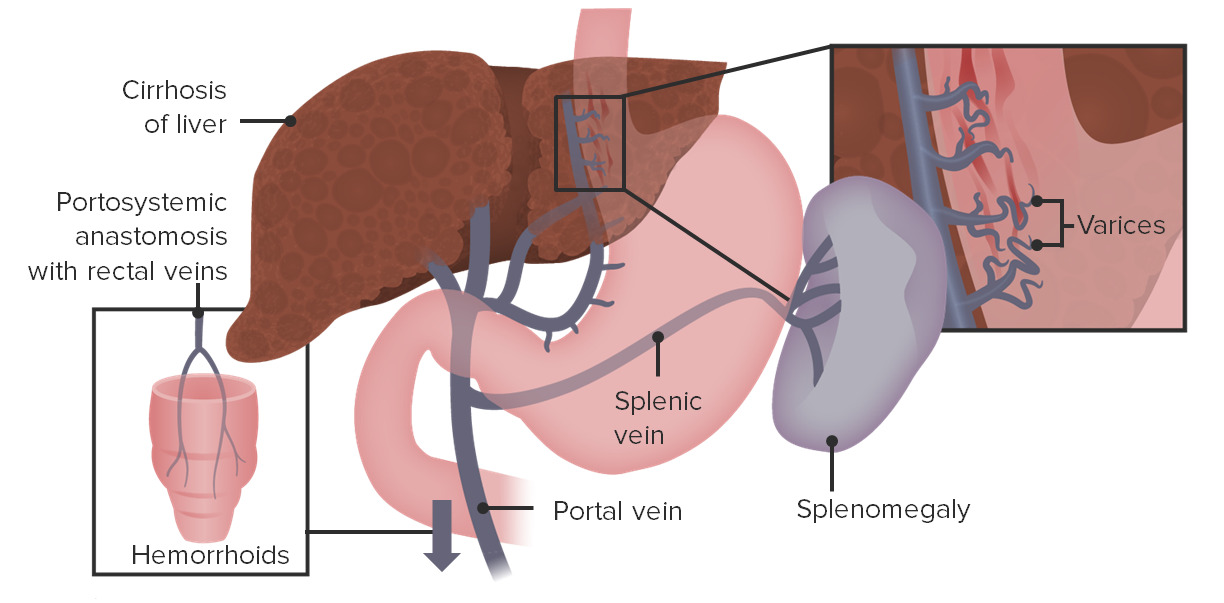
Várices esofágicas, esplenomegalia y várices rectales en la hipertensión portal

Várices esofágicas, esplenomegalia y várices rectales resultantes del reflujo de sangre debido a presiones elevadas dentro de la vena porta

Imagen por Lecturio.

Presentación Clínica

La hipertensión portal en EN Erythema nodosum is an immune-mediated panniculitis (inflammation of the subcutaneous fat) caused by a type IV (delayed-type) hypersensitivity reaction. It commonly manifests in young women as tender, erythematous nodules on the shins. Erythema Nodosum sí no suele presentar síntomas. Las manifestaciones clínicas surgen como resultado de la etiología subyacente y/o de las complicaciones.
Evidencia de complicaciones comunes

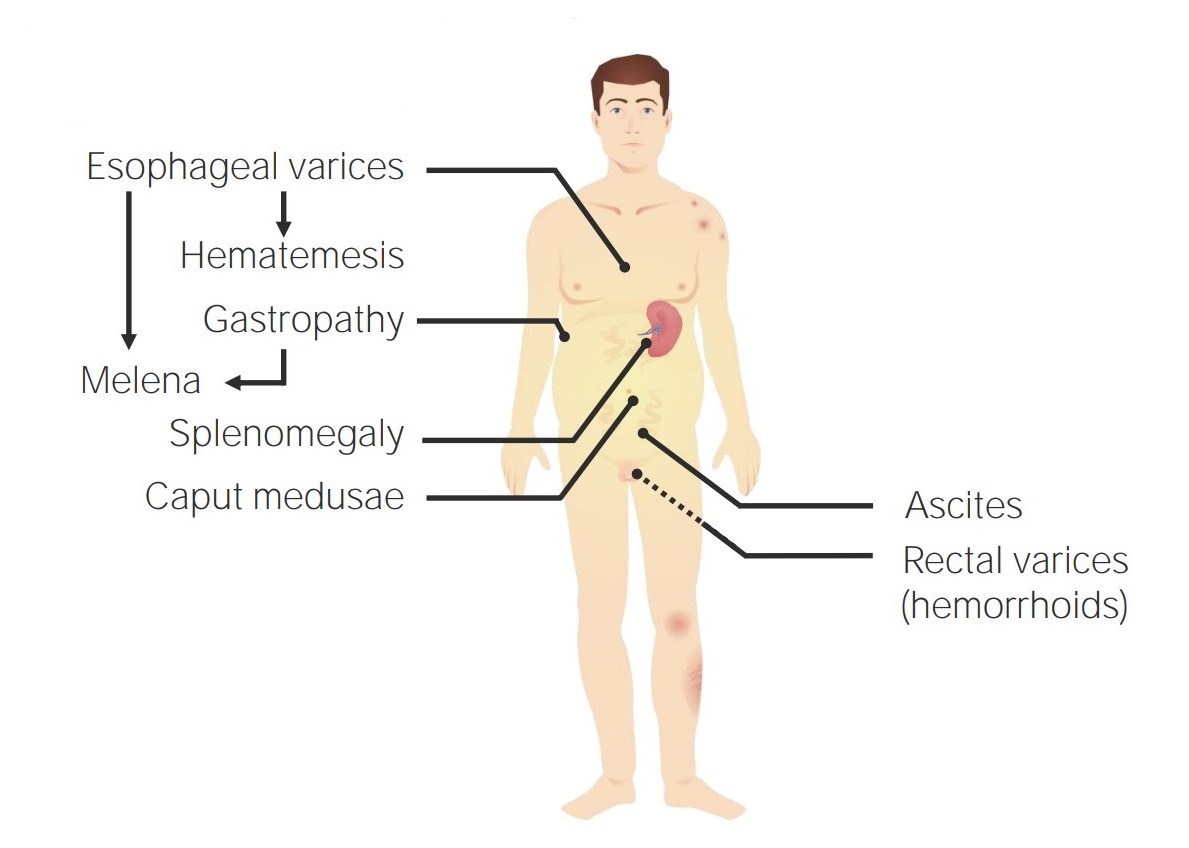
  • Flujo sanguíneo portosistémico colateral y várices:
    • Cabeza de medusa (venas paraumbilicales congestionadas)
    • Hematemesis Hematemesis Vomiting of blood that is either fresh bright red, or older ‘coffee-ground’ in character. It generally indicates bleeding of the upper gastrointestinal tract. Mallory-Weiss Syndrome (Mallory-Weiss Tear) y/o melena Melena The black, tarry, foul-smelling feces that contain degraded blood. Gastrointestinal Bleeding por:
      • Várices esofágicas (potencialmente mortales)
      • Gastropatía portal hipertensiva (congestión vascular de la mucosa gástrica)
    • Sangrado por várices rectales
  • Hiperesplenismo:
    • Esplenomegalia
    • Pancitopenia
  • Ascitis:
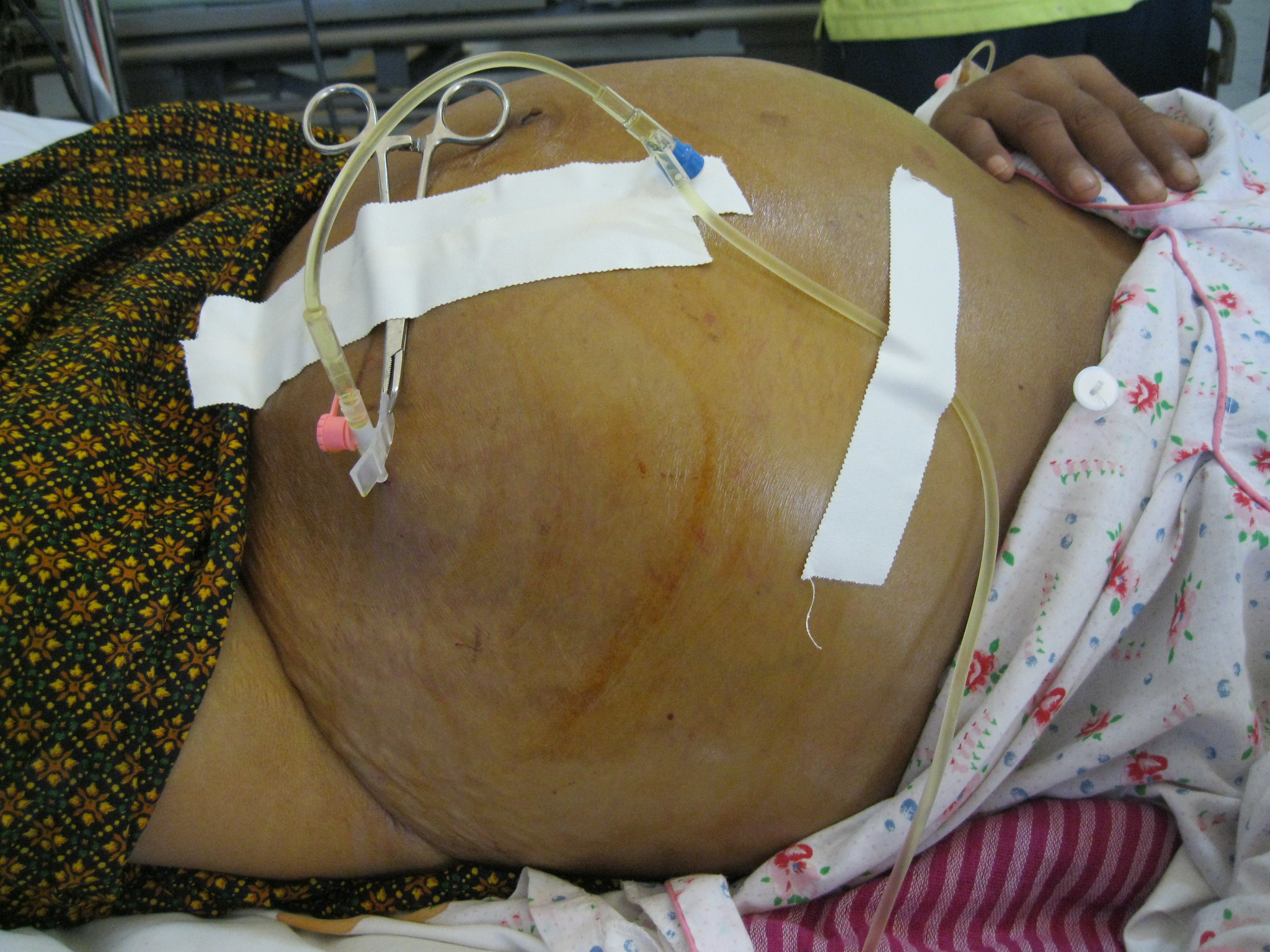
    • Distensión abdominal
    • Onda fluida
    • Cambio de matidez

Evidencia de etiologías comunes

  • Cirrosis:
  • Insuficiencia cardíaca derecha
    • Edema Edema Edema is a condition in which excess serous fluid accumulates in the body cavity or interstitial space of connective tissues. Edema is a symptom observed in several medical conditions. It can be categorized into 2 types, namely, peripheral (in the extremities) and internal (in an organ or body cavity). Edema periférico
    • Presión venosa yugular elevada
    • Dificultad para respirar
    • Disnea paroxística nocturna

Diagnóstico

Evaluación diagnóstica

El diagnóstico de hipertensión portal generalmente se basa en EN Erythema nodosum is an immune-mediated panniculitis (inflammation of the subcutaneous fat) caused by a type IV (delayed-type) hypersensitivity reaction. It commonly manifests in young women as tender, erythematous nodules on the shins. Erythema Nodosum la evaluación clínica, pero puede estar respaldado por:
  • Ultrasonido:
    • Debe realizarse con flujo Doppler Doppler Ultrasonography applying the doppler effect, with frequency-shifted ultrasound reflections produced by moving targets (usually red blood cells) in the bloodstream along the ultrasound axis in direct proportion to the velocity of movement of the targets, to determine both direction and velocity of blood flow. Ultrasound (Sonography)
    • Puede apoyar el diagnóstico, pero no es sensible.
    • Hallazgos potenciales que sugieren hipertensión portal:
      • Flujo sanguíneo invertido en EN Erythema nodosum is an immune-mediated panniculitis (inflammation of the subcutaneous fat) caused by a type IV (delayed-type) hypersensitivity reaction. It commonly manifests in young women as tender, erythematous nodules on the shins. Erythema Nodosum la vena porta
      • Colaterales portosistémicas
      • Diámetro de la vena porta agrandado
      • Ascitis
      • Esplenomegalia
    • Evalúa posibles etiologías:
      • Hígado nodular/cirrótico
      • Trombosis venosa
  • Medición del gradiente de presión venosa hepática
    • Por lo general, se realiza solo si el diagnóstico no está claro.
    • Aproxima el gradiente de presión entre la vena porta y la vena cava inferior mediante el uso de un catéter transyugular
    • Gradiente de presión venosa hepática ≥ 6 mm Hg es diagnóstico.
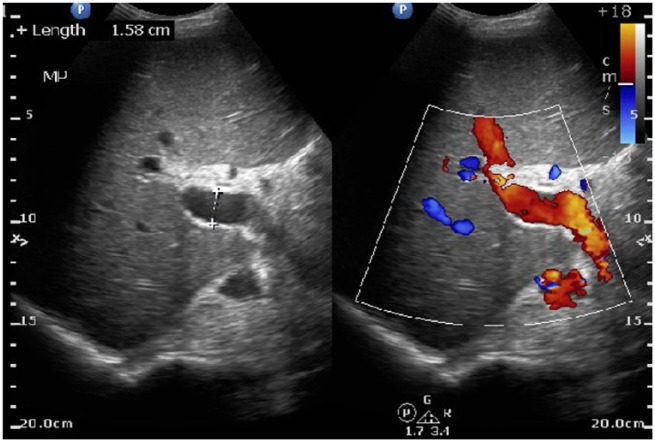
La ecografía del hígado identifica una vena porta grande compatible con hipertensión portal

Ultrasonido del hígado que identifica una vena porta grande, compatible con hipertensión portal.

Imagen: “Ultrasound abdomen: ultrasound of liver dentifies a patent portal vein, 158 mm in diameter, indicative of portal hypertension in this noncirrhotic patient.” por Ratnayake S. et al.  Licencia: CC BY 3.0

Evaluación adicional

Se pueden realizar estudios adicionales en EN Erythema nodosum is an immune-mediated panniculitis (inflammation of the subcutaneous fat) caused by a type IV (delayed-type) hypersensitivity reaction. It commonly manifests in young women as tender, erythematous nodules on the shins. Erythema Nodosum función de la presentación clínica y la presencia de complicaciones.
  • Cirrosis:
    • Enzimas hepáticas
      • ↑ Bilirrubina
      • AST AST Enzymes of the transferase class that catalyze the conversion of l-aspartate and 2-ketoglutarate to oxaloacetate and l-glutamate. Liver Function Tests y ALT ALT An enzyme that catalyzes the conversion of l-alanine and 2-oxoglutarate to pyruvate and l-glutamate. Liver Function Tests (pueden ser normales en EN Erythema nodosum is an immune-mediated panniculitis (inflammation of the subcutaneous fat) caused by a type IV (delayed-type) hypersensitivity reaction. It commonly manifests in young women as tender, erythematous nodules on the shins. Erythema Nodosum cirrosis avanzada)
    • Estudios de coagulación
      • ↑TP/ INR
      • ↑TTPa
    • ↓ Albúmina
    • ↑ Amoníaco
  • Hiperesplenismo:
    • Anemia Anemia Anemia is a condition in which individuals have low Hb levels, which can arise from various causes. Anemia is accompanied by a reduced number of RBCs and may manifest with fatigue, shortness of breath, pallor, and weakness. Subtypes are classified by the size of RBCs, chronicity, and etiology. Anemia: Overview and Types
    • Trombocitopenia
  • Ascitis:
    • Se puede considerar la paracentesis Paracentesis A procedure in which fluid is withdrawn from a body cavity or organ via a trocar and cannula, needle, or other hollow instrument. Portal Hypertension.
    • Gradiente de albúmina sérica-ascítica: > 1,1 g/dl indica hipertensión portal
    • Proteína total en EN Erythema nodosum is an immune-mediated panniculitis (inflammation of the subcutaneous fat) caused by a type IV (delayed-type) hypersensitivity reaction. It commonly manifests in young women as tender, erythematous nodules on the shins. Erythema Nodosum líquido ascítico:
      • > 2,5 g/dl, considerar causas cardíacas y síndrome de Budd-Chiari
      • < 2,5 g/dL, considerar cirrosis
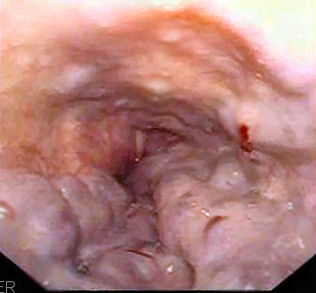
  • Várices: esofagoduodenoscopía:
    • Se puede realizar para detectar várices esofágicas
    • Diagnóstica y terapéutica del sangrado agudo por várices esofágicas
Cirrosis por várices esofágicas

Vista endoscópica de las várices esofágicas:
Los parches rojos indican una hemorragia reciente.

Imagen: “Gastroscopy image of esophageal varices with prominent red wale spots” por Samir. Licencia: Dominio Público

Tratamiento

El enfoque de la terapia es prevenir y tratar las complicaciones de la trombosis de la vena porta. También es importante tratar la etiología subyacente (cuando sea posible).

Tratamiento de várices y gastropatía portal hipertensiva

  • Bloqueadores β no selectivos ( propranolol Propranolol A widely used non-cardioselective beta-adrenergic antagonist. Propranolol has been used for myocardial infarction; arrhythmia; angina pectoris; hypertension; hyperthyroidism; migraine; pheochromocytoma; and anxiety but adverse effects instigate replacement by newer drugs. Antiadrenergic Drugs, nadolol Nadolol A non-selective beta-adrenergic antagonist with a long half-life, used in cardiovascular disease to treat arrhythmias, angina pectoris, and hypertension. Nadolol is also used for migraine disorders and for tremor. Class 2 Antiarrhythmic Drugs (Beta Blockers)):
    • Causan vasoconstricción esplácnica y ↓ entrada portal
    • ↓ Riesgo de sangrado por várices o gastropatía
  • Tratamiento del sangrado agudo:
    • Reanimación con líquidos intravenosos
    • Transfusión de sangre, según sea necesario
      • Glóbulos rojos empacados
      • Plasma Plasma The residual portion of blood that is left after removal of blood cells by centrifugation without prior blood coagulation. Transfusion Products fresco congelado
      • Plaquetas
    • Octreotide Octreotide A potent, long-acting synthetic somatostatin octapeptide analog that inhibits secretion of growth hormone and is used to treat hormone-secreting tumors; diabetes mellitus; hypotension, orthostatic; hyperinsulinism; hypergastrinemia; and small bowel fistula. Antidiarrheal Drugs: causa vasoconstricción esplácnica → ↓ presión portal
    • Profilaxis antibiótica (ceftriaxona): ↓ riesgo de peritonitis Peritonitis Inflammation of the peritoneum lining the abdominal cavity as the result of infectious, autoimmune, or chemical processes. Primary peritonitis is due to infection of the peritoneal cavity via hematogenous or lymphatic spread and without intra-abdominal source. Secondary peritonitis arises from the abdominal cavity itself through rupture or abscess of intra-abdominal organs. Penetrating Abdominal Injury bacteriana espontánea
    • Intervenciones endoscópicas: ligadura endoscópica con banda o escleroterapia para várices
  • Derivación portosistémica intrahepática transyugular:
    • Puede usarse para sangrado recurrente o refractario
    • Crea y mantiene una conexión (vía stents) entre la vena porta y la hepática → ↓ presión en EN Erythema nodosum is an immune-mediated panniculitis (inflammation of the subcutaneous fat) caused by a type IV (delayed-type) hypersensitivity reaction. It commonly manifests in young women as tender, erythematous nodules on the shins. Erythema Nodosum la vena porta

Tratamiento de la ascitis

  • Tratamiento conservador:
    • Restricción de sodio (< 2 g/día)
    • Terapia diurética:
      • Furosemida
      • Espironolactona
  • Tratamiento invasivo
    • Paracentesis Paracentesis A procedure in which fluid is withdrawn from a body cavity or organ via a trocar and cannula, needle, or other hollow instrument. Portal Hypertension terapéutica:
      • Alivio rápido de los LOS Neisseria síntomas
      • Se utiliza si la ascitis es refractaria a las medidas conservadoras
    • Derivación portosistémica intrahepática transyugular para ascitis refractaria

Relevancia Clínica

  • Cirrosis: etapa tardía de necrosis Necrosis The death of cells in an organ or tissue due to disease, injury or failure of the blood supply. Ischemic Cell Damage hepática y cicatrización. En EN Erythema nodosum is an immune-mediated panniculitis (inflammation of the subcutaneous fat) caused by a type IV (delayed-type) hypersensitivity reaction. It commonly manifests in young women as tender, erythematous nodules on the shins. Erythema Nodosum la cirrosis, el daño celular crónico causa una distorsión extensa de la arquitectura hepática normal, lo que puede conducir a un deterioro del flujo sanguíneo normal a través del hígado e hipertensión portal. Los LOS Neisseria signos y síntomas suelen ser inespecíficos (e.g., fatiga, anorexia Anorexia The lack or loss of appetite accompanied by an aversion to food and the inability to eat. It is the defining characteristic of the disorder anorexia nervosa. Anorexia Nervosa, pérdida de peso). La descompensación se manifiesta como ictericia, ascitis e insuficiencia hepática. El diagnóstico a menudo requiere una biopsia de hígado. El tratamiento es principalmente de soporte, siendo el trasplante de hígado el único tratamiento curativo.
  • Síndrome de Budd-Chiari: obstrucción del flujo venoso hepático (por trombosis, compresión o invasión vascular), que puede afectar las venas hepáticas y/o la vena cava inferior. La presentación típica es con hepatomegalia, ascitis y malestar abdominal. El diagnóstico se confirma mediante ultrasonido Doppler Doppler Ultrasonography applying the doppler effect, with frequency-shifted ultrasound reflections produced by moving targets (usually red blood cells) in the bloodstream along the ultrasound axis in direct proportion to the velocity of movement of the targets, to determine both direction and velocity of blood flow. Ultrasound (Sonography). El tratamiento consiste en EN Erythema nodosum is an immune-mediated panniculitis (inflammation of the subcutaneous fat) caused by a type IV (delayed-type) hypersensitivity reaction. It commonly manifests in young women as tender, erythematous nodules on the shins. Erythema Nodosum abordar la afección subyacente que causó la oclusión venosa.
  • Trombosis de la vena porta: puede ocurrir por varias causas (estado de hipercoagulabilidad, cirugía, inflamación, trauma, malignidad) y da como resultado hipertensión portal. El ultrasonido Doppler Doppler Ultrasonography applying the doppler effect, with frequency-shifted ultrasound reflections produced by moving targets (usually red blood cells) in the bloodstream along the ultrasound axis in direct proportion to the velocity of movement of the targets, to determine both direction and velocity of blood flow. Ultrasound (Sonography), que muestra ausencia o disminución del flujo sanguíneo a través de la vena porta, suele ser diagnóstico. El tratamiento incluye anticoagulación, trombólisis en EN Erythema nodosum is an immune-mediated panniculitis (inflammation of the subcutaneous fat) caused by a type IV (delayed-type) hypersensitivity reaction. It commonly manifests in young women as tender, erythematous nodules on the shins. Erythema Nodosum casos específicos y tratamiento de las complicaciones de la hipertensión portal.
  • Esquistosomiasis: infección por el tremátode Schistosoma Schistosoma Schistosomiasis is an infection caused by Schistosoma, a trematode. Schistosomiasis occurs in developing countries with poor sanitation. Freshwater snails are the intermediate host and are transmitted to humans through skin contact with contaminated fresh water. The clinical presentation occurs as a result of the host’s immune response to antigens from the eggs. Schistosoma/Schistosomiasis. La esquistosomiasis ocurre en EN Erythema nodosum is an immune-mediated panniculitis (inflammation of the subcutaneous fat) caused by a type IV (delayed-type) hypersensitivity reaction. It commonly manifests in young women as tender, erythematous nodules on the shins. Erythema Nodosum países en EN Erythema nodosum is an immune-mediated panniculitis (inflammation of the subcutaneous fat) caused by a type IV (delayed-type) hypersensitivity reaction. It commonly manifests in young women as tender, erythematous nodules on the shins. Erythema Nodosum desarrollo con saneamiento deficiente. La presentación clínica es el resultado de la respuesta inmune del huésped a los LOS Neisseria antígenos de los LOS Neisseria huevos. La mayoría de las personas son asintomáticas, pero otras pueden desarrollar dermatitis Dermatitis Any inflammation of the skin. Atopic Dermatitis (Eczema) esquistosómica aguda, síndrome de esquistosomiasis aguda o esquistosomiasis crónica. El diagnóstico se puede hacer con evaluación microscópica de la orina o las heces, serología o reacción en EN Erythema nodosum is an immune-mediated panniculitis (inflammation of the subcutaneous fat) caused by a type IV (delayed-type) hypersensitivity reaction. It commonly manifests in young women as tender, erythematous nodules on the shins. Erythema Nodosum cadena de la polimerasa ( PCR PCR Polymerase chain reaction (PCR) is a technique that amplifies DNA fragments exponentially for analysis. The process is highly specific, allowing for the targeting of specific genomic sequences, even with minuscule sample amounts. The PCR cycles multiple times through 3 phases: denaturation of the template DNA, annealing of a specific primer to the individual DNA strands, and synthesis/elongation of new DNA molecules. Polymerase Chain Reaction (PCR)). El tratamiento de la esquistosomiasis es praziquantel Praziquantel An anthelmintic used in most schistosome and many cestode infestations. Anthelmintic Drugs.
  • Hepatopatía congestiva: la insuficiencia cardíaca congestiva del lado derecho puede provocar una congestión venosa grave, incluso dentro del hígado. Esto puede progresar a cirrosis. Los LOS Neisseria individuos pueden tener evidencia tanto de insuficiencia cardíaca como de cirrosis, y el diagnóstico generalmente es clínico. El tratamiento implica el tratamiento de la insuficiencia cardíaca subyacente.

Referencias

  1. Hou, W., Sanyal, A. J. (2009). Ascites: diagnosis and management. Med Clin North Am 93:801–817, vii. reference.medscape.com/medline/abstract/19577115
  2. Lubel, J. S., Angus, P. W. /2005). Modern management of portal hypertension. Intern Med J 35:45–49. reference.medscape.com/medline/abstract/15667468
  3. Bleibel, W., Chopra, S., Curry, M. P. (2021). Portal hypertension in adults. UpToDate. Retrieved October 3, 2021, from https://www.uptodate.com/contents/portal-hypertension-in-adults
  4. Garcia-Pagan, J. C., Pik Eu, J. C. (2021). Noncirrhotic portal hypertension. UpToDate. Retrieved October 3, 2021, from https://www.uptodate.com/contents/noncirrhotic-portal-hypertension
  5. Oliver, T. I., Sharma, B., John, S. (2021). Portal hypertension. StatPearls. Retrieved October 3, 2021, from https://www.ncbi.nlm.nih.gov/books/NBK507718/
  6. Carale, J., Azer, S. A., Mekaroonkamol, P. (2017). Portal hypertension. Medscape. Retrieved October 3, 2021, from https://emedicine.medscape.com/article/182098-overview
  7. Tholey, D. (2021). Portal hypertension. MSD Manual Professional Version. Retrieved October 3, 2021, from https://www.msdmanuals.com/professional/hepatic-and-biliary-disorders/approach-to-the-patient-with-liver-disease/portal-hypertension

¡Crea tu cuenta gratis o inicia una sesión para seguir leyendo!

Regístrate ahora y obtén acceso gratuito a Lecturio con páginas de concepto, videos médicos y cuestionarios para tu educación médica.

User Reviews

Que tengas una sesión de estudio alegre y navideña 🎁 Ahorra 50% en todos los planes >>

Details