
Domina Conceptos Médicos

Estudia para la escuela de medicina y tus examenes con Lecturio.

Endometritis Postparto

La endometritis Endometritis Endometritis is an inflammation of the endometrium, the inner layer of the uterus. The most common subtype is postpartum endometritis, resulting from the ascension of normal vaginal flora to the previously aseptic uterus. Postpartum Endometritis posparto es una inflamación infecciosa del endometrio (la capa interna del útero) que se produce en EN Erythema nodosum is an immune-mediated panniculitis (inflammation of the subcutaneous fat) caused by a type IV (delayed-type) hypersensitivity reaction. It commonly manifests in young women as tender, erythematous nodules on the shins. Erythema Nodosum el entorno posparto, y que suele aparecer en EN Erythema nodosum is an immune-mediated panniculitis (inflammation of the subcutaneous fat) caused by a type IV (delayed-type) hypersensitivity reaction. It commonly manifests in young women as tender, erythematous nodules on the shins. Erythema Nodosum los LOS Neisseria primeros días después del parto. Estas infecciones son el resultado del ascenso de la flora vaginal normal al AL Amyloidosis útero previamente aséptico a través del cuello uterino dilatado. Las mujeres que han tenido un parto por cesárea tienen entre 10 y 30 veces más probabilidades de desarrollar una endometritis Endometritis Endometritis is an inflammation of the endometrium, the inner layer of the uterus. The most common subtype is postpartum endometritis, resulting from the ascension of normal vaginal flora to the previously aseptic uterus. Postpartum Endometritis postparto que las que han tenido un parto vaginal espontáneo. Las pacientes presentan fiebre y una sensibilidad uterina exquisita a la palpación; también puede haber un drenaje anormal/purulento. El diagnóstico es casi siempre clínico, y el diagnóstico por imagen solo es necesario para excluir otras causas en EN Erythema nodosum is an immune-mediated panniculitis (inflammation of the subcutaneous fat) caused by a type IV (delayed-type) hypersensitivity reaction. It commonly manifests in young women as tender, erythematous nodules on the shins. Erythema Nodosum los LOS Neisseria casos que no responden al AL Amyloidosis tratamiento empírico inicial. El manejo es con terapia antibiótica intravenosa.

Last updated: Dec 15, 2025

Editorial responsibility: Stanley Oiseth, Lindsay Jones, Evelin Maza

Descripción General

Definición

La endometritis Endometritis Endometritis is an inflammation of the endometrium, the inner layer of the uterus. The most common subtype is postpartum endometritis, resulting from the ascension of normal vaginal flora to the previously aseptic uterus. Postpartum Endometritis es una inflamación del revestimiento interno del útero, el endometrio.

Epidemiología

Endometritis Endometritis Endometritis is an inflammation of the endometrium, the inner layer of the uterus. The most common subtype is postpartum endometritis, resulting from the ascension of normal vaginal flora to the previously aseptic uterus. Postpartum Endometritis postparto:

  • Infección posparto más común
  • Incidencia después de un parto vaginal espontáneo: 1% a 2%.
  • Incidencia tras el parto por cesárea en EN Erythema nodosum is an immune-mediated panniculitis (inflammation of the subcutaneous fat) caused by a type IV (delayed-type) hypersensitivity reaction. It commonly manifests in young women as tender, erythematous nodules on the shins. Erythema Nodosum mujeres que recibieron antibióticos profilácticos (que es estándar de atención incluso en EN Erythema nodosum is an immune-mediated panniculitis (inflammation of the subcutaneous fat) caused by a type IV (delayed-type) hypersensitivity reaction. It commonly manifests in young women as tender, erythematous nodules on the shins. Erythema Nodosum los LOS Neisseria casos emergentes):
    • 7% para la cesárea realizada después del inicio del parto
    • 1,5% para la cesárea realizada antes del inicio del parto (e.g., casos programados para la presentación pelviana)
  • Incidencia tras la cesárea en EN Erythema nodosum is an immune-mediated panniculitis (inflammation of the subcutaneous fat) caused by a type IV (delayed-type) hypersensitivity reaction. It commonly manifests in young women as tender, erythematous nodules on the shins. Erythema Nodosum mujeres que no recibieron antibióticos profilácticos:
    • 18% para la cesárea después del inicio del parto
    • 4% para la cesárea antes del inicio del parto

Factores de riesgo

  • Parto por cesárea (principal factor de riesgo)
  • Infección/ colonización durante el trabajo de parto:
    • Vaginosis bacteriana
    • Corioamnionitis (infecciones intraamnióticas); especialmente si no se trata adecuadamente intraparto
    • Colonización con Streptococcus Streptococcus Streptococcus is one of the two medically important genera of gram-positive cocci, the other being Staphylococcus. Streptococci are identified as different species on blood agar on the basis of their hemolytic pattern and sensitivity to optochin and bacitracin. There are many pathogenic species of streptococci, including S. pyogenes, S. agalactiae, S. pneumoniae, and the viridans streptococci. Streptococcus del grupo B
  • Rotura prolongada de membrana
  • Trabajo de parto prolongado
  • Líquido amniótico meconial
  • Parto vaginal instrumental
  • Inserción de cuerpo extraño en EN Erythema nodosum is an immune-mediated panniculitis (inflammation of the subcutaneous fat) caused by a type IV (delayed-type) hypersensitivity reaction. It commonly manifests in young women as tender, erythematous nodules on the shins. Erythema Nodosum el cérvix/ útero:
    • Múltiples tactos vaginales
    • Monitoreo fetal y/o uterina invasiva
    • Remoción manual de la placenta Placenta A highly vascularized mammalian fetal-maternal organ and major site of transport of oxygen, nutrients, and fetal waste products. It includes a fetal portion (chorionic villi) derived from trophoblasts and a maternal portion (decidua) derived from the uterine endometrium. The placenta produces an array of steroid, protein and peptide hormones (placental hormones). Placenta, Umbilical Cord, and Amniotic Cavity
  • Otros factores maternos:
    • Obesidad
    • Estado socioeconómico bajo
    • Diabetes Diabetes Diabetes mellitus (DM) is a metabolic disease characterized by hyperglycemia and dysfunction of the regulation of glucose metabolism by insulin. Type 1 DM is diagnosed mostly in children and young adults as the result of autoimmune destruction of β cells in the pancreas and the resulting lack of insulin. Type 2 DM has a significant association with obesity and is characterized by insulin resistance. Diabetes Mellitus mellitus
    • Infección por VIH

Fisiopatología

Mecanismo fisiopatológico

La endometritis Endometritis Endometritis is an inflammation of the endometrium, the inner layer of the uterus. The most common subtype is postpartum endometritis, resulting from the ascension of normal vaginal flora to the previously aseptic uterus. Postpartum Endometritis postparto está causada por el movimiento de la flora vaginal normal hacia el útero → colonización del revestimiento uterino dañado → infección e inflamación.

  • Se produce espontáneamente con el tiempo tras la rotura de las membranas amnióticas
  • Las bacterias pueden introducirse durante las intervenciones médicas en EN Erythema nodosum is an immune-mediated panniculitis (inflammation of the subcutaneous fat) caused by a type IV (delayed-type) hypersensitivity reaction. It commonly manifests in young women as tender, erythematous nodules on the shins. Erythema Nodosum el parto (e.g., tactos vaginales, monitorización fetal intrauterina)
  • Alta incidencia de contaminación intrauterina durante el parto por cesárea (especialmente cuando la parte de presentación del feto ya está en EN Erythema nodosum is an immune-mediated panniculitis (inflammation of the subcutaneous fat) caused by a type IV (delayed-type) hypersensitivity reaction. It commonly manifests in young women as tender, erythematous nodules on the shins. Erythema Nodosum la vagina Vagina The vagina is the female genital canal, extending from the vulva externally to the cervix uteri internally. The structures have sexual, reproductive, and urinary functions and a rich blood supply, mainly arising from the internal iliac artery. Vagina, Vulva, and Pelvic Floor: Anatomy)
  • También puede ser causada por loquios y/o productos de la concepción retenidos
  • Otros factores implicados:
    • Estado de las defensas del huésped (e.g., las pacientes inmunodeprimidas son más susceptibles a las infecciones)
    • Tamaño del inóculo bacteriano
    • Virulencia de las bacterias colonizadoras

Microbiología

La endometritis Endometritis Endometritis is an inflammation of the endometrium, the inner layer of the uterus. The most common subtype is postpartum endometritis, resulting from the ascension of normal vaginal flora to the previously aseptic uterus. Postpartum Endometritis postparto es una infección polimicrobiana en EN Erythema nodosum is an immune-mediated panniculitis (inflammation of the subcutaneous fat) caused by a type IV (delayed-type) hypersensitivity reaction. It commonly manifests in young women as tender, erythematous nodules on the shins. Erythema Nodosum la que intervienen tanto organismos aerobios como anaerobios. La mayoría de las pacientes tienen un promedio de 2-3 organismos.

Organismos aeróbicos:

  • Estreptococos del grupo A y B
  • Staphylococcus aureus Staphylococcus aureus Potentially pathogenic bacteria found in nasal membranes, skin, hair follicles, and perineum of warm-blooded animals. They may cause a wide range of infections and intoxications. Brain Abscess
  • Especies de Enterobacteriaceae Enterobacteriaceae A family of gram-negative, facultatively anaerobic, rod-shaped bacteria that do not form endospores. Its organisms are distributed worldwide with some being saprophytes and others being plant and animal parasites. Many species are of considerable economic importance due to their pathogenic effects on agriculture and livestock. Cephalosporins:
    • Klebsiella Klebsiella Klebsiella are encapsulated gram-negative, lactose-fermenting bacilli. They form pink colonies on MacConkey agar due to lactose fermentation. The main virulence factor is a polysaccharide capsule. Klebsiella pneumoniae is the most important pathogenic species. Klebsiella
    • Proteus Proteus Proteus spp. are gram-negative, facultatively anaerobic bacilli. Different types of infection result from Proteus, but the urinary tract is the most common site. The majority of cases are caused by Proteus mirabilis (P. mirabilis). The bacteria are part of the normal intestinal flora and are also found in the environment. Proteus
    • Especies de Enterococcus Enterococcus Enterococcus is a genus of oval-shaped gram-positive cocci that are arranged in pairs or short chains. Distinguishing factors include optochin resistance and the presence of pyrrolidonyl arylamidase (PYR) and Lancefield D antigen. Enterococcus is part of the normal flora of the human GI tract. Enterococcus
    • Escherichia coli Escherichia coli The gram-negative bacterium Escherichia coli is a key component of the human gut microbiota. Most strains of E. coli are avirulent, but occasionally they escape the GI tract, infecting the urinary tract and other sites. Less common strains of E. coli are able to cause disease within the GI tract, most commonly presenting as abdominal pain and diarrhea. Escherichia coli
  • Chlamydia Chlamydia Chlamydiae are obligate intracellular gram-negative bacteria. They lack a peptidoglycan layer and are best visualized using Giemsa stain. The family of Chlamydiaceae comprises 3 pathogens that can infect humans: Chlamydia trachomatis, Chlamydia psittaci, and Chlamydia pneumoniae. Chlamydia (asociada a enfermedad de aparición tardía)

Organismos anaerobios:

  • Peptostreptococcus Peptostreptococcus A genus of gram-positive, anaerobic, coccoid bacteria that is part of the normal flora of humans. Its organisms are opportunistic pathogens causing bacteremias and soft tissue infections. Perianal and Perirectal Abscess
  • Peptococcus
  • Bacteroides Bacteroides Bacteroides is a genus of opportunistic, anaerobic, gram-negative bacilli. Bacteroides fragilis is the most common species involved in human disease and is part of the normal flora of the large intestine. Bacteroides
  • Clostridium (nota: C. sordellii y C. perfringens C. perfringens The most common etiologic agent of gas gangrene. It is differentiable into several distinct types based on the distribution of twelve different toxins. Gas Gangrene son infecciones raras, pero potencialmente letales)
  • Gardnerella vaginalis Gardnerella vaginalis Polymicrobial, nonspecific vaginitis associated with positive cultures of gardnerella vaginalis and other anaerobic organisms and a decrease in lactobacilli. It remains unclear whether the initial pathogenic event is caused by the growth of anaerobes or a primary decrease in lactobacilli. Vulvovaginitis
  • Ureaplasma urealyticum

Presentación Clínica

Las pacientes se presentarán dentro de los LOS Neisseria primeros 10 días postparto (y generalmente dentro de los LOS Neisseria primeros 2-3 días), con los LOS Neisseria siguientes signos/síntomas:
  • Fiebre
  • Dolor Dolor Inflammation uterino intenso / sensibilidad a la palpación (hallazgo clave)
  • Loquios malolientes y/o purulentos
  • Hemorragia vaginal abundante (a menudo causada por subinvolución uterina)
  • Taquicardia
  • Diarrea ( en EN Erythema nodosum is an immune-mediated panniculitis (inflammation of the subcutaneous fat) caused by a type IV (delayed-type) hypersensitivity reaction. It commonly manifests in young women as tender, erythematous nodules on the shins. Erythema Nodosum el caso de infecciones por estreptococos del grupo A)
  • Puede evolucionar a un síndrome de shock Shock Shock is a life-threatening condition associated with impaired circulation that results in tissue hypoxia. The different types of shock are based on the underlying cause: distributive (↑ cardiac output (CO), ↓ systemic vascular resistance (SVR)), cardiogenic (↓ CO, ↑ SVR), hypovolemic (↓ CO, ↑ SVR), obstructive (↓ CO), and mixed. Types of Shock tóxico
    • Más común en EN Erythema nodosum is an immune-mediated panniculitis (inflammation of the subcutaneous fat) caused by a type IV (delayed-type) hypersensitivity reaction. It commonly manifests in young women as tender, erythematous nodules on the shins. Erythema Nodosum el caso de infecciones por estafilococos, estreptococos del grupo A o Clostridium sordellii)
    • Fiebre alta (> 101,3°F); nota, esto puede estar ausente en EN Erythema nodosum is an immune-mediated panniculitis (inflammation of the subcutaneous fat) caused by a type IV (delayed-type) hypersensitivity reaction. It commonly manifests in young women as tender, erythematous nodules on the shins. Erythema Nodosum las infecciones por C. sordellii que es altamente letal
    • Taquicardia e hipotensión
    • Descamación
    • Evidencia de afectación de otros dos sistemas orgánicos (e.g., insuficiencia renal, hepática o pulmonar, coagulopatía)

Diagnóstico

  • Las pacientes son diagnosticadas con endometritis Endometritis Endometritis is an inflammation of the endometrium, the inner layer of the uterus. The most common subtype is postpartum endometritis, resulting from the ascension of normal vaginal flora to the previously aseptic uterus. Postpartum Endometritis postparto clínicamente cuando tienen:
    • Fiebre
    • Sensibilidad uterina severa a la palpación abdominal
    • +/- drenaje purulento del útero
  • Generalmente no se requiere un examen pélvico, cultivos vaginales y/o estudios de imagen
  • Análisis de sangre que pueden ayudar al AL Amyloidosis diagnóstico:
    • Hemograma con diferencial que muestra leucocitosis
    • Hemocultivos (sólo cuando hay una alta sospecha de sepsis Sepsis Systemic inflammatory response syndrome with a proven or suspected infectious etiology. When sepsis is associated with organ dysfunction distant from the site of infection, it is called severe sepsis. When sepsis is accompanied by hypotension despite adequate fluid infusion, it is called septic shock. Sepsis and Septic Shock)
  • Imagenología:
    • Generalmente sólo es necesario para descartar otras causas en EN Erythema nodosum is an immune-mediated panniculitis (inflammation of the subcutaneous fat) caused by a type IV (delayed-type) hypersensitivity reaction. It commonly manifests in young women as tender, erythematous nodules on the shins. Erythema Nodosum los LOS Neisseria casos que no responden al AL Amyloidosis tratamiento empírico inicial
    • Ultrasonido pélvico es la 1ra modalidad de imagen de elección, buscando principalmente:
      • Productos de la concepción retenidos (e.g., fragmentos de placenta Placenta A highly vascularized mammalian fetal-maternal organ and major site of transport of oxygen, nutrients, and fetal waste products. It includes a fetal portion (chorionic villi) derived from trophoblasts and a maternal portion (decidua) derived from the uterine endometrium. The placenta produces an array of steroid, protein and peptide hormones (placental hormones). Placenta, Umbilical Cord, and Amniotic Cavity retenidos)
      • Abscesos intraabdominales
    • TC pélvica: para excluir una tromboflebitis pélvica séptica
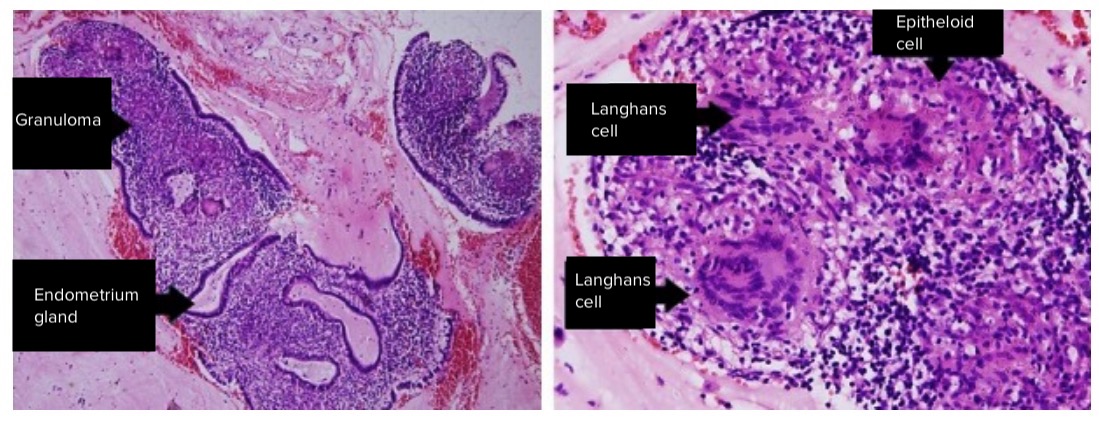
Endometrio antes de la administración de medicamentos antituberculosos - endometritis

Endometritis tuberculosa:
Izquierda: Tejido endometrial con granuloma y linfocitos
Derecha: Histiocitos y células epitelioides y gigantes multinucleadas de Langhans

Imagen: “The endometrium prior to administration of anti-tuberculosis drug” por Raditya Perdhana et al. Licencia: CC BY 2.0, editada por Lecturio.

Tratamiento

Tratamiento

El tratamiento es con antibióticos intravenosos.

  • El tratamiento se administra hasta que el paciente esté afebril durante 24-48 horas.
  • Se realizan estudios de imagen si los LOS Neisseria síntomas persisten durante más de 72 horas después de la terapia antibiótica.
  • Regímenes:
    • Sin colonización por estreptococos del grupo B: clindamicina + gentamicina
    • Con colonización por estreptococos del grupo B: clindamicina + gentamicina + ampicilina
    • Régimen alternativo (con o sin estreptococos del grupo B): ampicilina/ sulbactam Sulbactam A beta-lactamase inhibitor with very weak antibacterial action. The compound prevents antibiotic destruction of beta-lactam antibiotics by inhibiting beta-lactamases, thus extending their spectrum activity. Combinations of sulbactam with beta-lactam antibiotics have been used successfully for the therapy of infections caused by organisms resistant to the antibiotic alone. Cephalosporins
  • Los LOS Neisseria individuos no suelen requerir ningún antibiótico adicional (i.e., oral).

Profilaxis

  • Disminución significativa de la morbilidad
  • Estándar de cuidado en EN Erythema nodosum is an immune-mediated panniculitis (inflammation of the subcutaneous fat) caused by a type IV (delayed-type) hypersensitivity reaction. It commonly manifests in young women as tender, erythematous nodules on the shins. Erythema Nodosum pacientes que se someten a un parto por cesárea
  • Medicamentos:
    • Cefalosporinas de primera o segunda generación (e.g., cefazolina)
    • Cefalosporina más azitromicina/metronidazol

Complicaciones

  • Sepsis Sepsis Systemic inflammatory response syndrome with a proven or suspected infectious etiology. When sepsis is associated with organ dysfunction distant from the site of infection, it is called severe sepsis. When sepsis is accompanied by hypotension despite adequate fluid infusion, it is called septic shock. Sepsis and Septic Shock
  • Síndrome de shock Shock Shock is a life-threatening condition associated with impaired circulation that results in tissue hypoxia. The different types of shock are based on the underlying cause: distributive (↑ cardiac output (CO), ↓ systemic vascular resistance (SVR)), cardiogenic (↓ CO, ↑ SVR), hypovolemic (↓ CO, ↑ SVR), obstructive (↓ CO), and mixed. Types of Shock tóxico
  • Absceso
  • Infertilidad (debido al AL Amyloidosis tejido cicatricial)
  • Complicaciones de la herida quirúrgica
  • Fascitis necrosante (infección potencialmente mortal que afecta al AL Amyloidosis tejido subcutáneo y a la fascia Fascia Layers of connective tissue of variable thickness. The superficial fascia is found immediately below the skin; the deep fascia invests muscles, nerves, and other organs. Cellulitis)

Diagnóstico Diferencial

  • Infección del sitio quirúrgico: una infección que se produce en EN Erythema nodosum is an immune-mediated panniculitis (inflammation of the subcutaneous fat) caused by a type IV (delayed-type) hypersensitivity reaction. It commonly manifests in young women as tender, erythematous nodules on the shins. Erythema Nodosum una incisión quirúrgica o cerca de ella; estas infecciones pueden ser superficiales (que afectan a la piel y al AL Amyloidosis tejido subcutáneo), profundas (que afectan a las capas fasciales y/o musculares) o que afectan al AL Amyloidosis órgano o espacio interno. En EN Erythema nodosum is an immune-mediated panniculitis (inflammation of the subcutaneous fat) caused by a type IV (delayed-type) hypersensitivity reaction. It commonly manifests in young women as tender, erythematous nodules on the shins. Erythema Nodosum el período posparto, esto puede ocurrir en EN Erythema nodosum is an immune-mediated panniculitis (inflammation of the subcutaneous fat) caused by a type IV (delayed-type) hypersensitivity reaction. It commonly manifests in young women as tender, erythematous nodules on the shins. Erythema Nodosum el abdomen después de una cesárea, o en EN Erythema nodosum is an immune-mediated panniculitis (inflammation of the subcutaneous fat) caused by a type IV (delayed-type) hypersensitivity reaction. It commonly manifests in young women as tender, erythematous nodules on the shins. Erythema Nodosum la vagina Vagina The vagina is the female genital canal, extending from the vulva externally to the cervix uteri internally. The structures have sexual, reproductive, and urinary functions and a rich blood supply, mainly arising from the internal iliac artery. Vagina, Vulva, and Pelvic Floor: Anatomy después de un parto vaginal epsontáneo. El tratamiento suele consistir en EN Erythema nodosum is an immune-mediated panniculitis (inflammation of the subcutaneous fat) caused by a type IV (delayed-type) hypersensitivity reaction. It commonly manifests in young women as tender, erythematous nodules on the shins. Erythema Nodosum la administración de antibióticos y la posible apertura de la herida y/o el desbridamiento quirúrgico.
  • Pielonefritis: infección bacteriana del tracto urinario superior que provoca una inflamación renal. Los LOS Neisseria pacientes presentan fiebre, dolor Dolor Inflammation de costado, náuseas/vómitos y sensibilidad en EN Erythema nodosum is an immune-mediated panniculitis (inflammation of the subcutaneous fat) caused by a type IV (delayed-type) hypersensitivity reaction. It commonly manifests in young women as tender, erythematous nodules on the shins. Erythema Nodosum el ángulo costovertebral. El diagnóstico se basa en EN Erythema nodosum is an immune-mediated panniculitis (inflammation of the subcutaneous fat) caused by a type IV (delayed-type) hypersensitivity reaction. It commonly manifests in young women as tender, erythematous nodules on the shins. Erythema Nodosum los LOS Neisseria hallazgos clínicos, el análisis de orina y los LOS Neisseria cultivos de orina. La pielonefritis puede tratarse en EN Erythema nodosum is an immune-mediated panniculitis (inflammation of the subcutaneous fat) caused by a type IV (delayed-type) hypersensitivity reaction. It commonly manifests in young women as tender, erythematous nodules on the shins. Erythema Nodosum régimen ambulatorio o de hospitalización, dependiendo de la presencia de factores de riesgo y de la gravedad de la enfermedad. El tratamiento incluye la administración de antibióticos, analgésicos y antipiréticos.
  • Tromboflebitis pélvica séptica: una enfermedad poco frecuente en EN Erythema nodosum is an immune-mediated panniculitis (inflammation of the subcutaneous fat) caused by a type IV (delayed-type) hypersensitivity reaction. It commonly manifests in young women as tender, erythematous nodules on the shins. Erythema Nodosum la que un trombo infectado en EN Erythema nodosum is an immune-mediated panniculitis (inflammation of the subcutaneous fat) caused by a type IV (delayed-type) hypersensitivity reaction. It commonly manifests in young women as tender, erythematous nodules on the shins. Erythema Nodosum una de las venas pélvicas profundas (e.g., la vena ovárica) provoca una inflamación venosa. Las pacientes presentan fiebre resistente a la terapia antibiótica y dolor Dolor Inflammation pélvico, abdominal bajo, de espalda o de flanco, que no es de tipo cólico y es constante. El diagnóstico suele ser clínico, pero puede confirmarse por medio de estudios de imagen (generalmente TC) si se observa un trombo y una inflamación. El tratamiento incluye anticoagulación y terapia antibiótica.
  • Corioamnionitis: inflamación de las membranas amnióticas y coriónicas. La diferencia clave entre la corioamnionitis y la endometritis Endometritis Endometritis is an inflammation of the endometrium, the inner layer of the uterus. The most common subtype is postpartum endometritis, resulting from the ascension of normal vaginal flora to the previously aseptic uterus. Postpartum Endometritis posparto es el momento en EN Erythema nodosum is an immune-mediated panniculitis (inflammation of the subcutaneous fat) caused by a type IV (delayed-type) hypersensitivity reaction. It commonly manifests in young women as tender, erythematous nodules on the shins. Erythema Nodosum que se producen: la corioamnionitis es una infección intraparto de las membranas, que suele resolverse rápidamente tras el alumbramiento de las membranas fetales, mientras que la endometritis Endometritis Endometritis is an inflammation of the endometrium, the inner layer of the uterus. The most common subtype is postpartum endometritis, resulting from the ascension of normal vaginal flora to the previously aseptic uterus. Postpartum Endometritis es una infección posparto del propio revestimiento uterino. Ambas enfermedades cursan con fiebre, sensibilidad uterina y flujo vaginal maloliente. El tratamiento de la corioamnionitis incluye la administración de antibióticos, antipiréticos y el parto.

Referencias

  1. Endometritis. (2019). Medscape. Retrieved May 26, 2021, from https://emedicine.medscape.com/article/254169-overview
  2. Singhal, A., Alomari, M., Gupta, S., Almomani, S., Khazaaleh, S. (2019). Another fatality due to postpartum group A streptococcal endometritis in the modern era. Cureus 11(5):e4618. https://doi.org/10.7759/cureus.4618
  3. Agrawal, P., Garg, R. (2012). Fulminant leukemoid reaction due to postpartum Clostridium sordellii infection. Journal of global infectious diseases, 4(4):209–211. https://doi.org/10.4103/0974-777X.103899
  4. Mackeen, A. D., Packard, R. E., Ota, E., Speer, L. (2015). Antibiotic regimens for postpartum endometritis. Cochrane Database of Systematic Reviews 2015(2):CD001067.
  5. Park, H. J., Kim, Y. S., Yoon, T. K., Lee, W. S. (2016). Chronic endometritis and infertility. Clinical and Experimental Reproductive Medicine 43:185–192. https://doi.org/10.5653/cerm.2016.43.4.185
  6. Chen, K. T. (2020). Postpartum endometritis. UpToDate. Retrieved on June 24, 2021, from https://www.uptodate.com/contents/postpartum-endometritis

¡Crea tu cuenta gratis o inicia una sesión para seguir leyendo!

Regístrate ahora y obtén acceso gratuito a Lecturio con páginas de concepto, videos médicos y cuestionarios para tu educación médica.

User Reviews

Que tengas una sesión de estudio alegre y navideña 🎁 Ahorra 50% en todos los planes >>

Details