Domina Conceptos Médicos

Estudia para la escuela de medicina y tus examenes con Lecturio.

Dermatitis Atópica (Eccema)

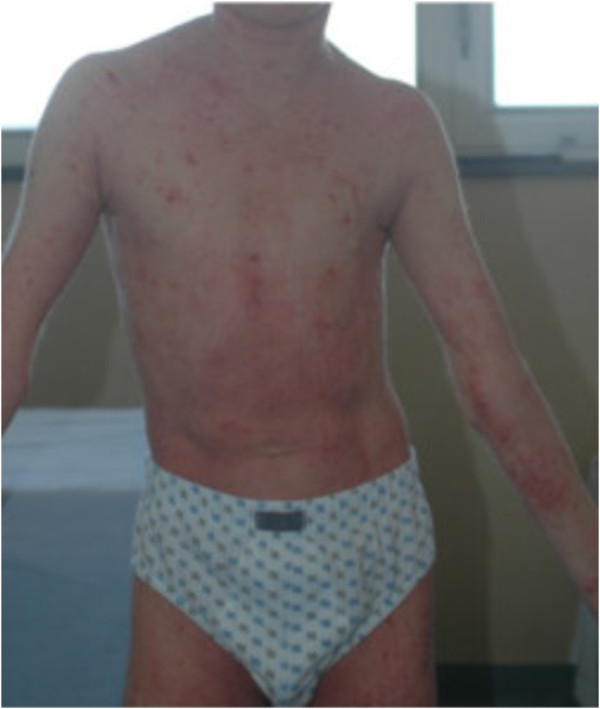
La dermatitis Dermatitis Any inflammation of the skin. Atopic Dermatitis (Eczema) atópica, también conocida como eccema, es una enfermedad cutánea crónica, recurrente, pruriginosa e inflamatoria que se presenta con mayor frecuencia en EN Erythema nodosum is an immune-mediated panniculitis (inflammation of the subcutaneous fat) caused by a type IV (delayed-type) hypersensitivity reaction. It commonly manifests in young women as tender, erythematous nodules on the shins. Erythema Nodosum niños, aunque también puede afectar a adultos. La condición a menudo se asocia con niveles séricos elevados de IgE IgE An immunoglobulin associated with mast cells. Overexpression has been associated with allergic hypersensitivity. Immunoglobulins: Types and Functions y antecedentes personales o familiares de atopia. Están presentes la sequedad de la piel, eritema, supuración, formación de costras y liquenificación. El prurito es un síntoma cardinal. El diagnóstico se establece clínicamente. Los LOS Neisseria pilares del tratamiento son evitar los LOS Neisseria desencadenantes, los LOS Neisseria emolientes y los LOS Neisseria corticosteroides tópicos.

Last updated: Dec 15, 2025

Editorial responsibility: Stanley Oiseth, Lindsay Jones, Evelin Maza

Descripción General

Definición

La dermatitis Dermatitis Any inflammation of the skin. Atopic Dermatitis (Eczema) atópica (también conocida como eczema Eczema Atopic dermatitis, also known as eczema, is a chronic, relapsing, pruritic, inflammatory skin disease that occurs more frequently in children, although adults can also be affected. The condition is often associated with elevated serum levels of IgE and a personal or family history of atopy. Skin dryness, erythema, oozing, crusting, and lichenification are present. Atopic Dermatitis (Eczema)) es un trastorno de integridad alterada de la barrera cutánea y desregulación inmunitaria que se presenta como una enfermedad inflamatoria crónica recurrente de la piel.
Epidemiología

  • Prevalencia:
    • Niños en EN Erythema nodosum is an immune-mediated panniculitis (inflammation of the subcutaneous fat) caused by a type IV (delayed-type) hypersensitivity reaction. It commonly manifests in young women as tender, erythematous nodules on the shins. Erythema Nodosum edad escolar: aproximadamente 17%
    • Adultos: 2%–10%
  • Tríada atópica (presente en EN Erythema nodosum is an immune-mediated panniculitis (inflammation of the subcutaneous fat) caused by a type IV (delayed-type) hypersensitivity reaction. It commonly manifests in young women as tender, erythematous nodules on the shins. Erythema Nodosum 30%–50% de los LOS Neisseria pacientes):
  • El 30% de los LOS Neisseria pacientes desarrollan asma ASMA Autoimmune Hepatitis.
  • La gran mayoría de los LOS Neisseria casos en EN Erythema nodosum is an immune-mediated panniculitis (inflammation of the subcutaneous fat) caused by a type IV (delayed-type) hypersensitivity reaction. It commonly manifests in young women as tender, erythematous nodules on the shins. Erythema Nodosum niños; vinculado con antecedentes familiares de atopia
  • La mayoría de los LOS Neisseria casos ocurren antes de los LOS Neisseria 5 años.
  • Ligera preponderancia femenina
  • El antecedente previo de atopia es un factor de riesgo importante.
  • Incidencia mayor en EN Erythema nodosum is an immune-mediated panniculitis (inflammation of the subcutaneous fat) caused by a type IV (delayed-type) hypersensitivity reaction. It commonly manifests in young women as tender, erythematous nodules on the shins. Erythema Nodosum:
    • Áreas urbanas
    • Países desarrollados

Etiología

  • Multifactorial y no completamente entendida
  • Genética:
    • Antecedentes familiares de atopia
    • Mutaciones del gen de la filagrina (mutación de pérdida de función):
      • El factor de riesgo genético conocido más fuerte
      • Disfunción de la barrera de queratinocitos
      • Mayor susceptibilidad a antígenos potenciales
  • Defectos inmunológicos: enfermedad Th2 Th2 A subset of helper-inducer T-lymphocytes which synthesize and secrete the interleukins il-4; il-5; il-6; and il-10. These cytokines influence b-cell development and antibody production as well as augmenting humoral responses. T cells: Types and Functions (células T colaboradoras)
  • Factores prenatales: sangre de cordón umbilical con IgE IgE An immunoglobulin associated with mast cells. Overexpression has been associated with allergic hypersensitivity. Immunoglobulins: Types and Functions elevada
  • Infección:
    • Colonización por Staphylococcus aureus Staphylococcus aureus Potentially pathogenic bacteria found in nasal membranes, skin, hair follicles, and perineum of warm-blooded animals. They may cause a wide range of infections and intoxications. Brain Abscess:
      • A menudo causa brotes
      • Actúa como un superantígeno
    • Virus Virus Viruses are infectious, obligate intracellular parasites composed of a nucleic acid core surrounded by a protein capsid. Viruses can be either naked (non-enveloped) or enveloped. The classification of viruses is complex and based on many factors, including type and structure of the nucleoid and capsid, the presence of an envelope, the replication cycle, and the host range. Virology Herpes simple
  • Hipótesis de la higiene: la exposición en EN Erythema nodosum is an immune-mediated panniculitis (inflammation of the subcutaneous fat) caused by a type IV (delayed-type) hypersensitivity reaction. It commonly manifests in young women as tender, erythematous nodules on the shins. Erythema Nodosum la primera infancia a microbios y alérgenos previene la atopia.

Fisiopatología y Presentación Clínica

Fisiopatología

  • La patogenia está mal definida.
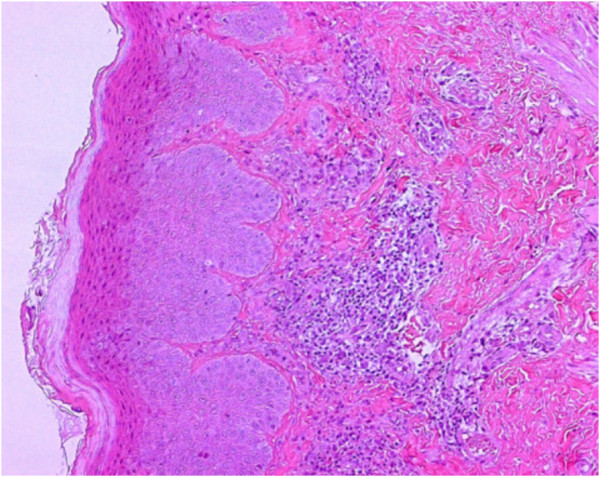
  • Caracterizada por espongiosis ( edema Edema Edema is a condition in which excess serous fluid accumulates in the body cavity or interstitial space of connective tissues. Edema is a symptom observed in several medical conditions. It can be categorized into 2 types, namely, peripheral (in the extremities) and internal (in an organ or body cavity). Edema epidérmico)
  • El edema Edema Edema is a condition in which excess serous fluid accumulates in the body cavity or interstitial space of connective tissues. Edema is a symptom observed in several medical conditions. It can be categorized into 2 types, namely, peripheral (in the extremities) and internal (in an organ or body cavity). Edema conduce a la ruptura de las uniones intercelulares → formación de vesículas
  • Hay infiltrados dérmicos linfocíticos.
  • Puede haber acantosis e hiperqueratosis.
  • Se han implicado 2 vías interrelacionadas:
    • Alteración de la barrera epitelial primaria (hipótesis de afuera hacia adentro):
      • Interrupción de las uniones estrechas y aumento de la permeabilidad del estrato córneo
      • Aumento de la pérdida de agua transepidérmica
      • Puede estar asociado con defectos en EN Erythema nodosum is an immune-mediated panniculitis (inflammation of the subcutaneous fat) caused by a type IV (delayed-type) hypersensitivity reaction. It commonly manifests in young women as tender, erythematous nodules on the shins. Erythema Nodosum las proteínas estructurales (la filagrina es la principal implicada)
      • La ruptura de la barrera también puede ser causada por la colonización microbiana y la liberación de citocinas inflamatorias.
    • Defecto de respuesta inmune (hipótesis de adentro hacia afuera):
      • Desregulación inmunológica secundaria
      • El defecto en EN Erythema nodosum is an immune-mediated panniculitis (inflammation of the subcutaneous fat) caused by a type IV (delayed-type) hypersensitivity reaction. It commonly manifests in young women as tender, erythematous nodules on the shins. Erythema Nodosum los LOS Neisseria receptores tipo toll se ha HA Hemolytic anemia (HA) is the term given to a large group of anemias that are caused by the premature destruction/hemolysis of circulating red blood cells (RBCs). Hemolysis can occur within (intravascular hemolysis) or outside the blood vessels (extravascular hemolysis). Hemolytic Anemia implicado en EN Erythema nodosum is an immune-mediated panniculitis (inflammation of the subcutaneous fat) caused by a type IV (delayed-type) hypersensitivity reaction. It commonly manifests in young women as tender, erythematous nodules on the shins. Erythema Nodosum la pérdida de la inmunidad innata epidérmica (la colonización con S. aureus S. aureus Potentially pathogenic bacteria found in nasal membranes, skin, hair follicles, and perineum of warm-blooded animals. They may cause a wide range of infections and intoxications. Staphylococcus conduce a una inflamación grave).
      • Sensibilización alérgica mediada por IgE IgE An immunoglobulin associated with mast cells. Overexpression has been associated with allergic hypersensitivity. Immunoglobulins: Types and Functions → mayor susceptibilidad a irritantes/alérgenos secundaria a defectos epidérmicos estructurales
Hallazgos histológicos dermatitis atópica

Dermatitis atópica:
Imagen histológica de la capa epidérmica con leve infiltrado linfohistiocitario y granulocitario, de predominio eosinofílico
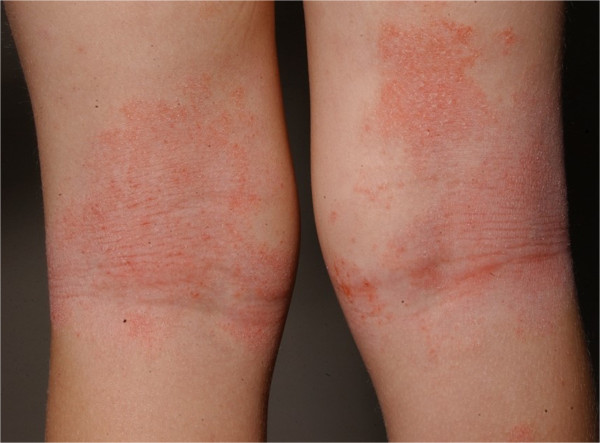
Imagen: “Atopic dermatitis, short stature, skeletal malformations, hyperimmunoglobulin E syndrome, hypereosinophilia and recurrent infections” por Leonardi S, Filippelli M, Costanzo V, Rotolo N, La Rosa M. Licencia: CC BY 2.0

Presentación clínica

  • Curso crónico con periodos de remisión y exacerbación
  • Prurito intenso: síntoma cardinal
  • Hiperreactividad cutánea a estímulos ambientales
  • Edad:
    • Bebés y niños pequeños:
      • Lesiones papulovesiculares
      • Prurito intenso
      • Eritema
      • Edema Edema Edema is a condition in which excess serous fluid accumulates in the body cavity or interstitial space of connective tissues. Edema is a symptom observed in several medical conditions. It can be categorized into 2 types, namely, peripheral (in the extremities) and internal (in an organ or body cavity). Edema
      • Excoriaciones: resultado del prurito
      • Localización: cara, cuero cabelludo, superficies extensoras, respetando la zona del pañal
    • Niños mayores y adultos jóvenes:
      • Lesiones crónicas con liquenificación
      • Superficies flexoras de codos, rodillas y lados del cuello, muñecas y tobillos
      • Mejora con la edad con remisión vista a los LOS Neisseria 13 años de edad en EN Erythema nodosum is an immune-mediated panniculitis (inflammation of the subcutaneous fat) caused by a type IV (delayed-type) hypersensitivity reaction. It commonly manifests in young women as tender, erythematous nodules on the shins. Erythema Nodosum aproximadamente el 50% de los LOS Neisseria casos
  • Gravedad:
    • Leve:
      • Áreas de piel seca
      • Prurito: infrecuente
      • Impacto mínimo en EN Erythema nodosum is an immune-mediated panniculitis (inflammation of the subcutaneous fat) caused by a type IV (delayed-type) hypersensitivity reaction. It commonly manifests in young women as tender, erythematous nodules on the shins. Erythema Nodosum las actividades, el sueño y el bienestar psicosocial
    • Moderada:
      • Áreas de piel seca
      • Prurito: frecuente
      • Enrojecimiento
      • Engrosamiento cutáneo localizado con o sin excoriación
      • Impacto moderado en EN Erythema nodosum is an immune-mediated panniculitis (inflammation of the subcutaneous fat) caused by a type IV (delayed-type) hypersensitivity reaction. It commonly manifests in young women as tender, erythematous nodules on the shins. Erythema Nodosum las actividades y el bienestar psicosocial
      • Sueño frecuentemente perturbado
    • Grave:
      • Piel seca generalizada
      • Prurito: incesante
      • Enrojecimiento
      • Engrosamiento extenso de la piel, sangrado, supuración, agrietamiento y alteración de la pigmentación
      • Impacto severo en EN Erythema nodosum is an immune-mediated panniculitis (inflammation of the subcutaneous fat) caused by a type IV (delayed-type) hypersensitivity reaction. It commonly manifests in young women as tender, erythematous nodules on the shins. Erythema Nodosum las actividades, el funcionamiento psicosocial y el sueño.

Diagnóstico

Antecedentes

  • Prurito
  • 3 o más de los LOS Neisseria siguientes (además del prurito):
    • Pliegues de la piel involucrados:
      • Fosas antecubitales
      • Fosas poplíteas
      • Cuello
      • Áreas periorbitarias
      • Tobillos anteriormente
    • Antecedentes de asma ASMA Autoimmune Hepatitis o fiebre del heno (o familiar de 1er grado si el niño tiene < 4 años)
    • Piel seca en EN Erythema nodosum is an immune-mediated panniculitis (inflammation of the subcutaneous fat) caused by a type IV (delayed-type) hypersensitivity reaction. It commonly manifests in young women as tender, erythematous nodules on the shins. Erythema Nodosum el último año
    • Síntomas que comienzan antes de los LOS Neisseria 2 años (no se usa si el niño tiene < 4 años)
    • Dermatitis Dermatitis Any inflammation of the skin. Atopic Dermatitis (Eczema) de las superficies de flexión (si es un niño < 4 años, mejillas, frente o cara externa de las extremidades)
  • Antecedentes de cronicidad o recidivante
  • Estímulos ambientales (ciertos alimentos, alérgenos, medicamentos)

Examen físico (piel)

  • Niños pequeños/bebés:
    • Cara
    • Cuero cabelludo
    • Cuello
    • Superficies extensoras
    • Lesiones papulovesiculares
    • Eritema
    • Edema Edema Edema is a condition in which excess serous fluid accumulates in the body cavity or interstitial space of connective tissues. Edema is a symptom observed in several medical conditions. It can be categorized into 2 types, namely, peripheral (in the extremities) and internal (in an organ or body cavity). Edema
    • Excoriaciones
  • Niños mayores y adultos:
    • Liquenificación
    • Superficies flexoras:
      • Codos
      • Rodillas
      • Lados del cuello, muñecas, tobillos
  • Piel seca

Estudios de laboratorio

  • Solo para descartar otras afecciones de la piel
  • IgE IgE An immunoglobulin associated with mast cells. Overexpression has been associated with allergic hypersensitivity. Immunoglobulins: Types and Functions sérica: elevada en EN Erythema nodosum is an immune-mediated panniculitis (inflammation of the subcutaneous fat) caused by a type IV (delayed-type) hypersensitivity reaction. It commonly manifests in young women as tender, erythematous nodules on the shins. Erythema Nodosum el 80% de los LOS Neisseria pacientes
  • Biopsia de piel
  • Preparación de hidróxido de potasio de raspados de piel para descartar Tinea corporis Tinea corporis Dermatophytes/Tinea Infections
  • Prueba del parche para descartar dermatitis Dermatitis Any inflammation of the skin. Atopic Dermatitis (Eczema) de contacto
  • Pruebas genéticas

Tratamiento

Medidas de apoyo/profilácticas

Educación del paciente:

  • Niños
  • Padres

Eliminación de factores exacerbantes:

  • Evite los LOS Neisseria desencadenantes:
    • Calor Calor Inflammation
    • Baja humedad
    • Baño excesivo (sin hidratación)
    • Estrés y ansiedad
    • Exposición a disolventes y detergentes.
    • Xerosis Xerosis Sjögren Syndrome (piel seca)
    • Sobrecalentamiento de la piel
    • Detergentes fuertes
  • Tratar las infecciones cutáneas asociadas:
    • S. aureus S. aureus Potentially pathogenic bacteria found in nasal membranes, skin, hair follicles, and perineum of warm-blooded animals. They may cause a wide range of infections and intoxications. Staphylococcus
    • Herpes Simple

Hidratación de la piel (pilar del tratamiento para reducir el picor y los LOS Neisseria episodios de inflamación):

  • Emolientes:
  • Hidratantes que contienen:
    • Ácido glicirretínico
    • Urea Urea A compound formed in the liver from ammonia produced by the deamination of amino acids. It is the principal end product of protein catabolism and constitutes about one half of the total urinary solids. Urea Cycle
    • Glicerol

Medicamentos/intervenciones

Tratamientos tópicos:

  • Corticosteroides: El uso prolongado puede causar atrofia de la piel u otros efectos secundarios.
  • Inhibidores de la calcineurina: tratamiento de 2da línea
  • Inhibidores de la fosfodiesterasa 4 (PDE4) (crisaborol)
  • Inhibidores tópicos de la Janus quinasa (JAK) (p. ej., ruxolitinib Ruxolitinib Targeted and Other Nontraditional Antineoplastic Therapy)

Antihistamínicos orales:

Inmunosupresores orales:

  • Ciclosporina
  • También se utilizan metotrexato, azatioprina y micofenolato de mofetilo
  • Recurrencia común al AL Amyloidosis suspender el tratamiento
  • Inhibidores orales de la Janus quinasa (JAK) (p. ej., abrocitinib, upadacitinib)

Anticuerpos monoclonales humanos:

  • Dupilumab Dupilumab Asthma Drugs (inhibe IL-4 y IL-13)
  • Tralokinumab (inhibe IL-13)
  • Lebrikizumab (inhibe IL-13)
  • Nemolizumab (inhibe el receptor Receptor Receptors are proteins located either on the surface of or within a cell that can bind to signaling molecules known as ligands (e.g., hormones) and cause some type of response within the cell. Receptors alfa de IL-31)

Fototerapia:

  • Utilizado en EN Erythema nodosum is an immune-mediated panniculitis (inflammation of the subcutaneous fat) caused by a type IV (delayed-type) hypersensitivity reaction. It commonly manifests in young women as tender, erythematous nodules on the shins. Erythema Nodosum pacientes con prurito difuso no controlado con terapia tópica sola
  • Reducción de la producción de histamina a partir de mastocitos y basófilos.
  • Ultravioleta B de banda estrecha (NBUVB)
  • Ultravioleta A1 (UVA1)

Diagnóstico Diferencial

  • Dermatitis Dermatitis Any inflammation of the skin. Atopic Dermatitis (Eczema) de contacto: una dermatitis Dermatitis Any inflammation of the skin. Atopic Dermatitis (Eczema) papular eritematosa, a menudo con áreas de formación de vesículas. Ocurre debido a la exposición directa de la piel a un irritante ofensivo con un efecto citotóxico directo. El diagnóstico se realiza por los LOS Neisseria antecedentes y los LOS Neisseria hallazgos al AL Amyloidosis examen físico. El tratamiento consiste en EN Erythema nodosum is an immune-mediated panniculitis (inflammation of the subcutaneous fat) caused by a type IV (delayed-type) hypersensitivity reaction. It commonly manifests in young women as tender, erythematous nodules on the shins. Erythema Nodosum evitar los LOS Neisseria irritantes ofensivos y adoptar medidas protectoras, así como emolientes y humectantes. Los LOS Neisseria esteroides tópicos son la intervención de 1ra línea.
  • Dermatitis Dermatitis Any inflammation of the skin. Atopic Dermatitis (Eczema) seborreica: una forma de dermatitis Dermatitis Any inflammation of the skin. Atopic Dermatitis (Eczema) crónica, recurrente y generalmente leve con una incidencia bifásica en EN Erythema nodosum is an immune-mediated panniculitis (inflammation of the subcutaneous fat) caused by a type IV (delayed-type) hypersensitivity reaction. It commonly manifests in young women as tender, erythematous nodules on the shins. Erythema Nodosum bebés y adultos. La afección se caracteriza por placas eritematosas bien delimitadas con escamas amarillentas de apariencia grasosa en EN Erythema nodosum is an immune-mediated panniculitis (inflammation of the subcutaneous fat) caused by a type IV (delayed-type) hypersensitivity reaction. It commonly manifests in young women as tender, erythematous nodules on the shins. Erythema Nodosum áreas ricas en EN Erythema nodosum is an immune-mediated panniculitis (inflammation of the subcutaneous fat) caused by a type IV (delayed-type) hypersensitivity reaction. It commonly manifests in young women as tender, erythematous nodules on the shins. Erythema Nodosum glándulas sebáceas. Se desconoce la causa, pero las glándulas sebáceas parecen ser necesarias para el desarrollo del trastorno. El diagnóstico se realiza clínicamente. El tratamiento es con agentes tópicos antifúngicos, antiinflamatorios y de venta libre.
  • Dermatitis Dermatitis Any inflammation of the skin. Atopic Dermatitis (Eczema) del pañal: una forma de dermatitis Dermatitis Any inflammation of the skin. Atopic Dermatitis (Eczema) irritante más común en EN Erythema nodosum is an immune-mediated panniculitis (inflammation of the subcutaneous fat) caused by a type IV (delayed-type) hypersensitivity reaction. It commonly manifests in young women as tender, erythematous nodules on the shins. Erythema Nodosum bebés y niños. La humedad excesiva, la fricción, el aumento del pH pH The quantitative measurement of the acidity or basicity of a solution. Acid-Base Balance y la alta actividad enzimática contribuyen a la alteración local de la barrera de la piel. La afección se limita al AL Amyloidosis área de la ingle y, a menudo, no afecta a los LOS Neisseria pliegues donde la orina o las heces no entran en EN Erythema nodosum is an immune-mediated panniculitis (inflammation of the subcutaneous fat) caused by a type IV (delayed-type) hypersensitivity reaction. It commonly manifests in young women as tender, erythematous nodules on the shins. Erythema Nodosum contacto con la piel. El diagnóstico se realiza clínicamente. El tratamiento consiste en EN Erythema nodosum is an immune-mediated panniculitis (inflammation of the subcutaneous fat) caused by a type IV (delayed-type) hypersensitivity reaction. It commonly manifests in young women as tender, erythematous nodules on the shins. Erythema Nodosum medidas generales de cuidado de la piel (cambios frecuentes de pañales, exposición al AL Amyloidosis aire y limpieza), esteroides tópicos y antifúngicos ( en EN Erythema nodosum is an immune-mediated panniculitis (inflammation of the subcutaneous fat) caused by a type IV (delayed-type) hypersensitivity reaction. It commonly manifests in young women as tender, erythematous nodules on the shins. Erythema Nodosum casos graves de sobreinfección por Candida Candida Candida is a genus of dimorphic, opportunistic fungi. Candida albicans is part of the normal human flora and is the most common cause of candidiasis. The clinical presentation varies and can include localized mucocutaneous infections (e.g., oropharyngeal, esophageal, intertriginous, and vulvovaginal candidiasis) and invasive disease (e.g., candidemia, intraabdominal abscess, pericarditis, and meningitis). Candida/Candidiasis).
  • Micosis fungoide: un tipo de linfoma cutáneo de células T. La enfermedad se presenta en EN Erythema nodosum is an immune-mediated panniculitis (inflammation of the subcutaneous fat) caused by a type IV (delayed-type) hypersensitivity reaction. It commonly manifests in young women as tender, erythematous nodules on the shins. Erythema Nodosum la piel, pero también puede afectar a los LOS Neisseria ganglios linfáticos, la sangre y las vísceras. La micosis fungoide a menudo involucra sitios debajo de la ropa interior y es poco común en EN Erythema nodosum is an immune-mediated panniculitis (inflammation of the subcutaneous fat) caused by a type IV (delayed-type) hypersensitivity reaction. It commonly manifests in young women as tender, erythematous nodules on the shins. Erythema Nodosum los LOS Neisseria niños. La enfermedad se presenta con lesiones cutáneas persistentes y progresivas de diferentes formas y tamaños y pueden ser placas o tumores localizados o diseminados, o eritrodermia generalizada. El prurito es frecuente. El diagnóstico es clínico junto con biopsia de piel con histología de rutina. El tratamiento involucra agentes tópicos, incluidos esteroides, quimioterapia, retinoides, imiquimod Imiquimod A topically-applied aminoquinoline immune modulator that induces interferon production. It is used in the treatment of external genital and perianal warts, superficial carcinoma, basal cell; and actinic keratosis. Hypertrophic and Keloid Scars, radiación local y fototerapia.
  • Psoriasis Psoriasis Psoriasis is a common T-cell-mediated inflammatory skin condition. The etiology is unknown, but is thought to be due to genetic inheritance and environmental triggers. There are 4 major subtypes, with the most common form being chronic plaque psoriasis. Psoriasis: un trastorno inflamatorio crónico común de la piel caracterizado por pápulas y placas eritematosas con escamas plateadas. La psoriasis Psoriasis Psoriasis is a common T-cell-mediated inflammatory skin condition. The etiology is unknown, but is thought to be due to genetic inheritance and environmental triggers. There are 4 major subtypes, with the most common form being chronic plaque psoriasis. Psoriasis es una enfermedad inmunomediada compleja en EN Erythema nodosum is an immune-mediated panniculitis (inflammation of the subcutaneous fat) caused by a type IV (delayed-type) hypersensitivity reaction. It commonly manifests in young women as tender, erythematous nodules on the shins. Erythema Nodosum la que los LOS Neisseria linfocitos T, las citocinas, las células dendríticas y el factor de necrosis Necrosis The death of cells in an organ or tissue due to disease, injury or failure of the blood supply. Ischemic Cell Damage tumoral desempeñan un papel predominante. Anteriormente, se consideraba una enfermedad de hiperproliferación. El diagnóstico se realiza mediante un examen físico. El tratamiento es con corticosteroides tópicos, fototerapia, retinoides, metotrexato, ciclosporina o agentes modificadores inmunológicos biológicos.
  • Escabiosis: una infestación cutánea causada por el ácaro Sarcoptes scabiei Sarcoptes scabiei A species of mite that causes scabies in humans and sarcoptic mange in other animals. Specific variants of s. Scabiei exist for humans and animals, but many have the ability to cross species and cause disease. Scabies. La sarna es una erupción intensamente pruriginosa con pequeñas pápulas eritematosas en EN Erythema nodosum is an immune-mediated panniculitis (inflammation of the subcutaneous fat) caused by a type IV (delayed-type) hypersensitivity reaction. It commonly manifests in young women as tender, erythematous nodules on the shins. Erythema Nodosum los LOS Neisseria dedos, las muñecas, las axilas, las areolas, la cintura, los LOS Neisseria genitales y las nalgas. El diagnóstico se basa en EN Erythema nodosum is an immune-mediated panniculitis (inflammation of the subcutaneous fat) caused by a type IV (delayed-type) hypersensitivity reaction. It commonly manifests in young women as tender, erythematous nodules on the shins. Erythema Nodosum la anamnesis y el examen físico junto con la detección de ácaros, huevos o heces fecales bajo evaluación microscópica. El tratamiento está dirigido tanto al AL Amyloidosis paciente como a sus contactos cercanos. La permetrina tópica y la ivermectina oral son los LOS Neisseria pilares del tratamiento.

Referencias

  1. Weston, W., Howe, W. (2024). Atopic dermatitis (eczema): Pathogenesis, clinical manifestations, and diagnosis. In Corona, R. (Ed.). UpToDate. Retrieved July 16, 2025, from https://www.uptodate.com/contents/atopic-dermatitis-eczema-pathogenesis-clinical-manifestations-and-diagnosis
  2. Weston, W., Howe, W. (2025). Treatment of atopic dermatitis (eczema). In Corona, R. (Ed.). UpToDate. Retrieved July 16, 2025, from https://www.uptodate.com/contents/treatment-of-atopic-dermatitis-eczema
  3. Gonzalez, M. E., & Dellavalle, R. P. et al. (2025, June 2). Management of severe, refractory atopic dermatitis (eczema) in children. UpToDate. Retrieved July 16, 2025, from https://www.uptodate.com/contents/management-of-severe-refractory-atopic-dermatitis-eczema-in-children
  4. Kim, B. (2024). Atopic Dermatitis. In James, W. (Ed). Medscape. Retrieved July 16, 2025, from https://reference.medscape.com/article/1049085-overview
  5. Eichenfield, L.F., et al. (2014). Guidelines of care for the management of atopic dermatitis: section 2. Management and treatment of atopic dermatitis with topical therapies. J Am Acad Dermatol. 71(1), 116–132. https://pubmed.ncbi.nlm.nih.gov/24813302/
  6. Weidinger, S., Novak, N. (2016). Atopic dermatitis. Lancet. 387(10023), 1109–1122. https://pubmed.ncbi.nlm.nih.gov/26377142/
  7. National Eczema Society. (n.d.). Azathioprine. Retrieved July 16, 2025, from https://eczema.org/information-and-advice/treatments-for-eczema/azathioprine/

¡Crea tu cuenta gratis o inicia una sesión para seguir leyendo!

Regístrate ahora y obtén acceso gratuito a Lecturio con páginas de concepto, videos médicos y cuestionarios para tu educación médica.

User Reviews

Que tengas una sesión de estudio alegre y navideña 🎁 Ahorra 50% en todos los planes >>

Details